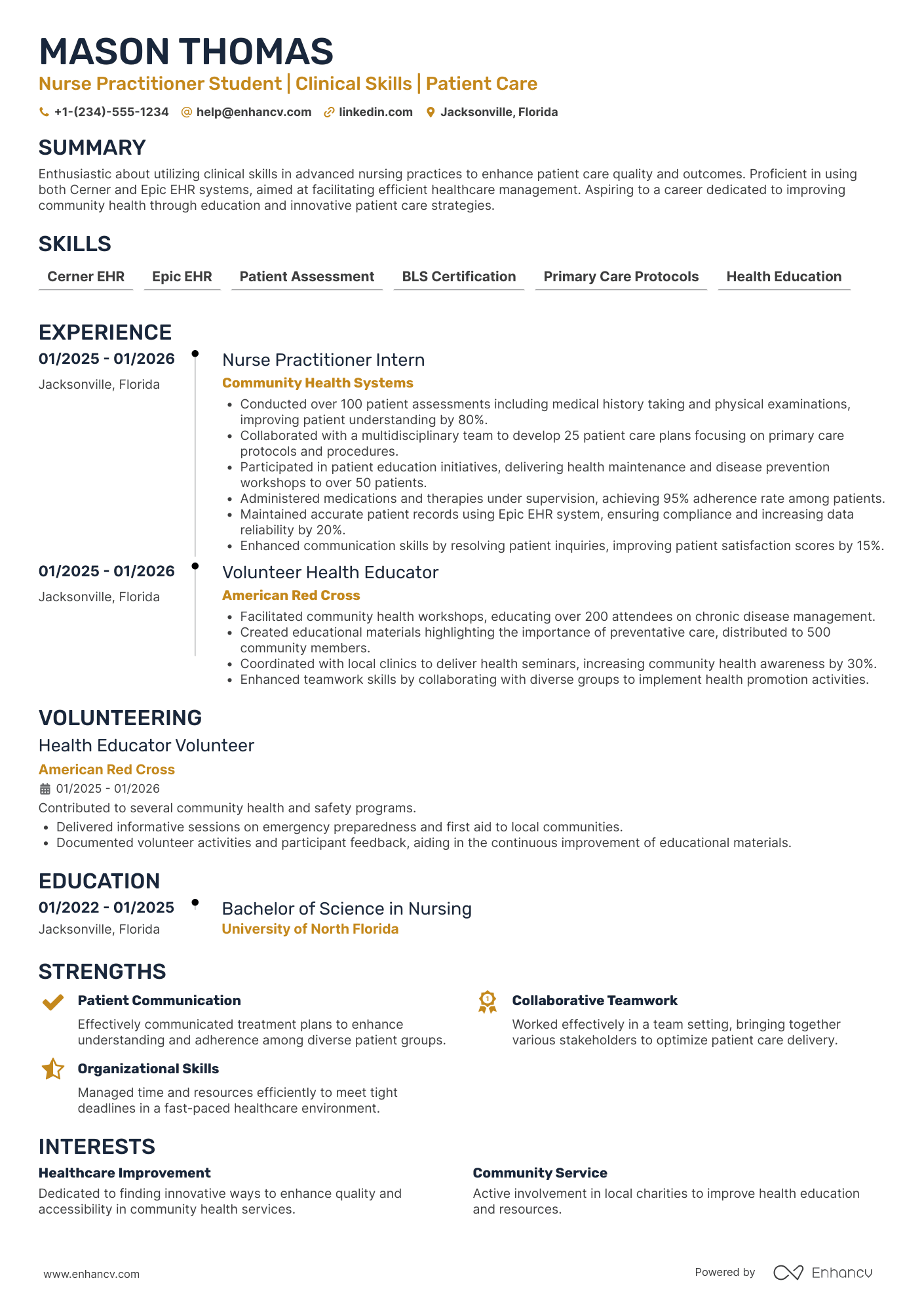
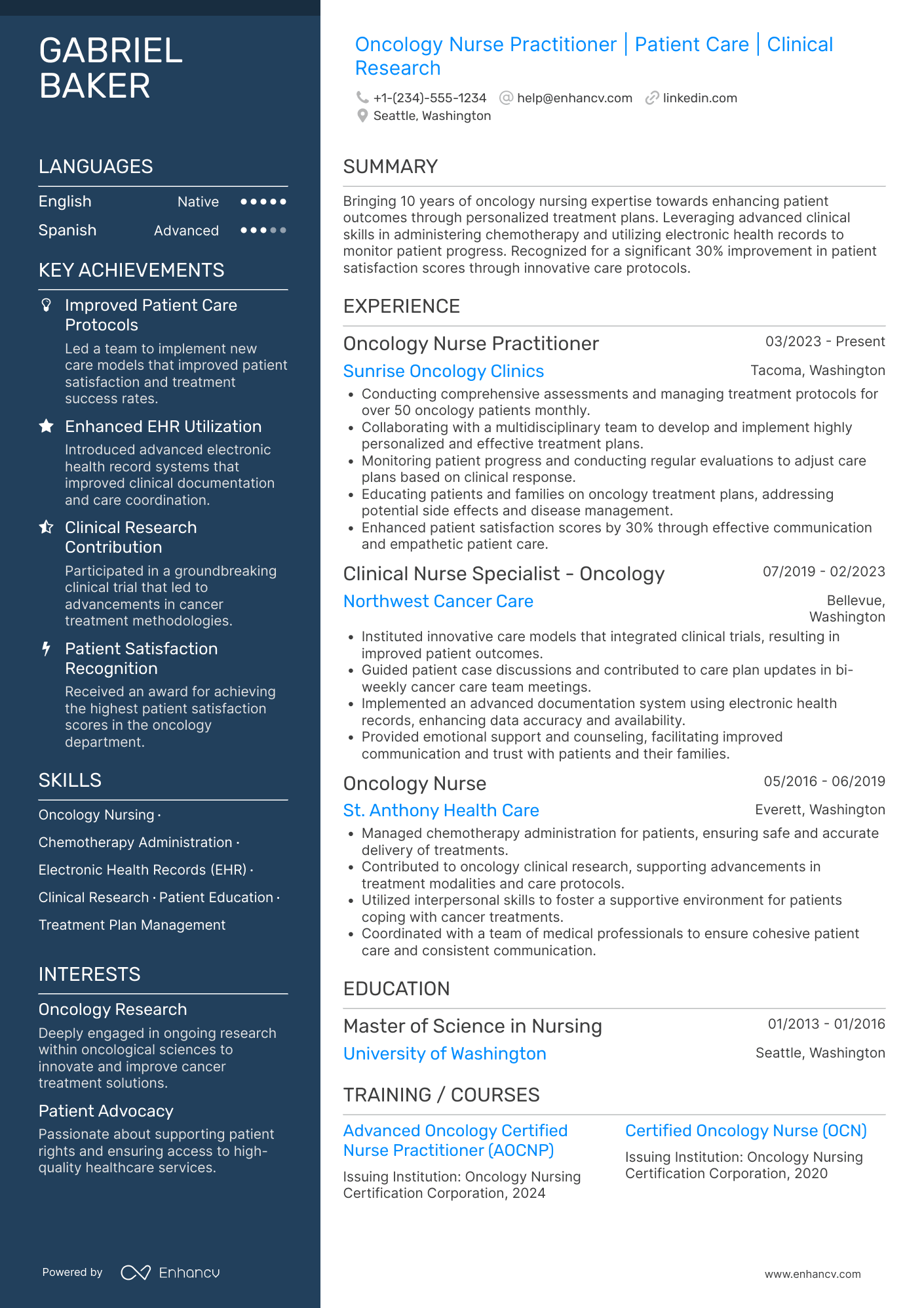
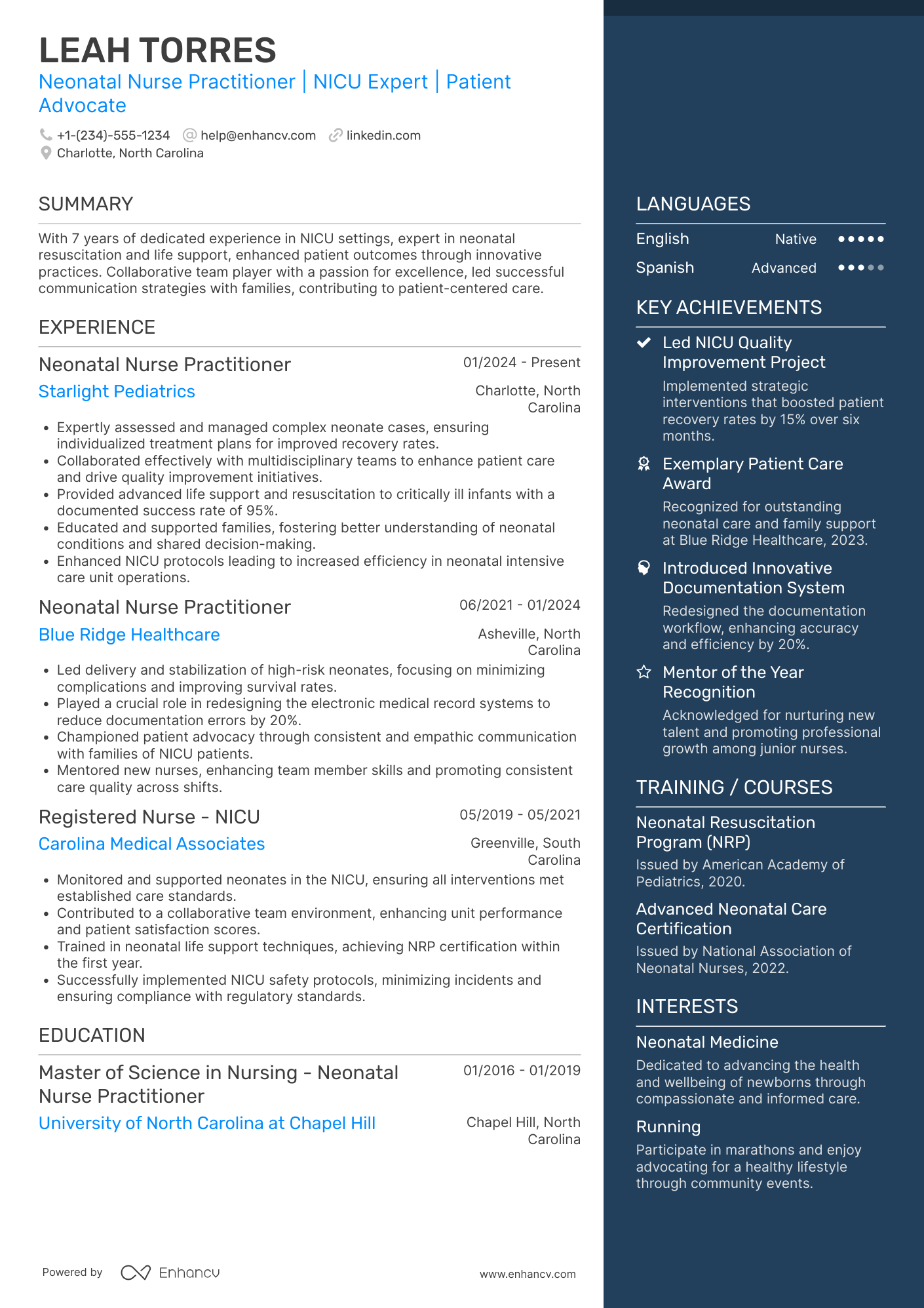
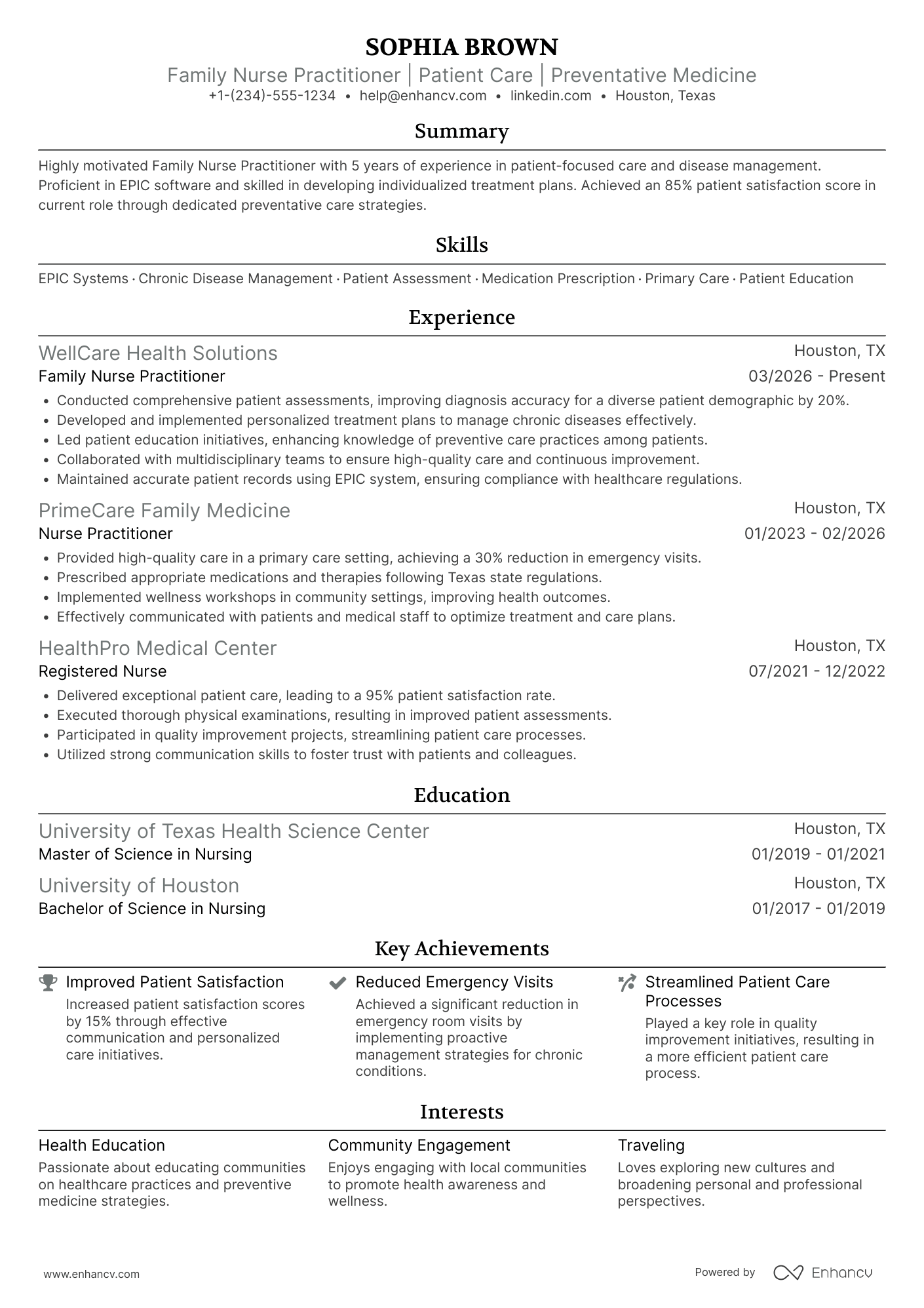
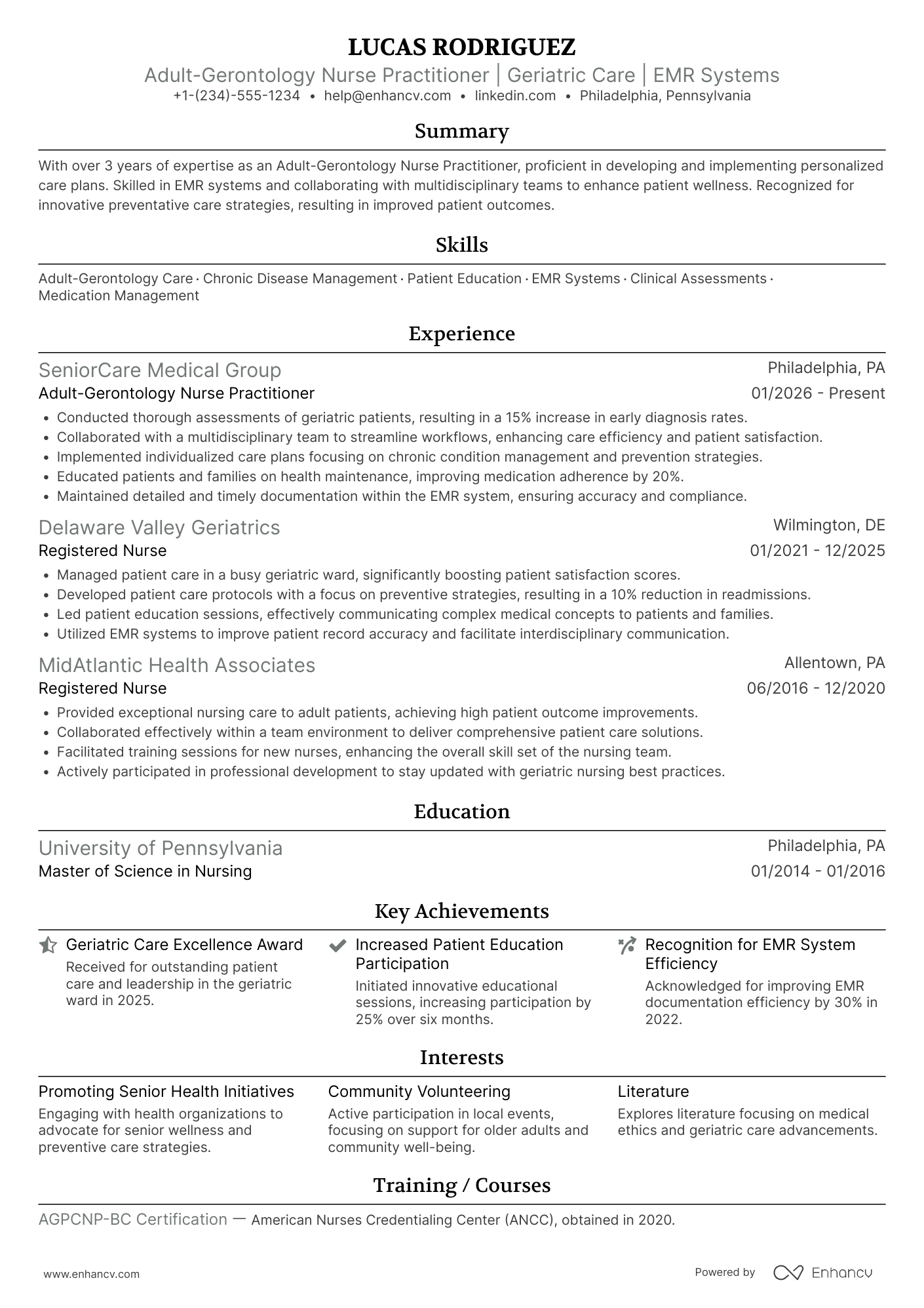
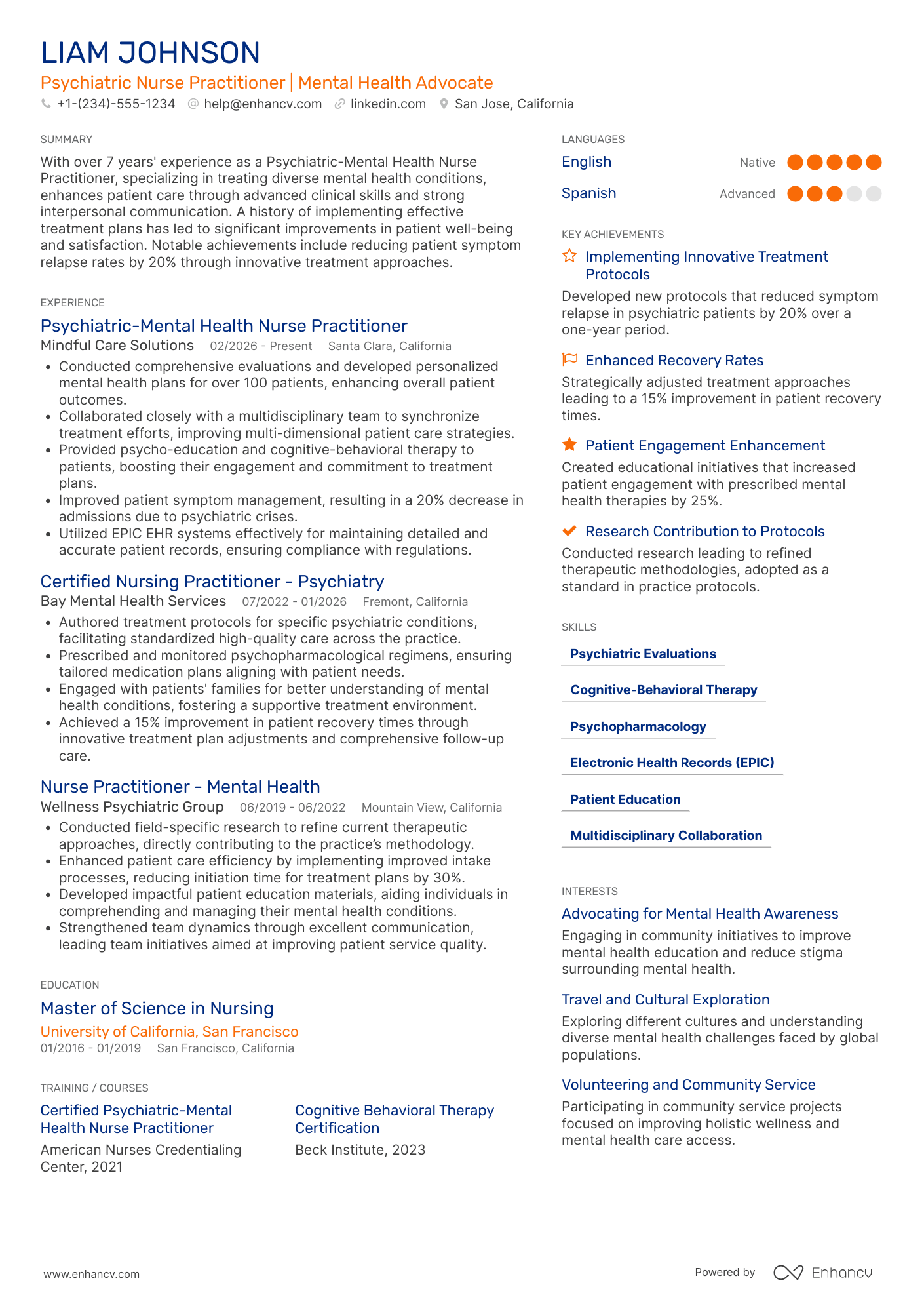
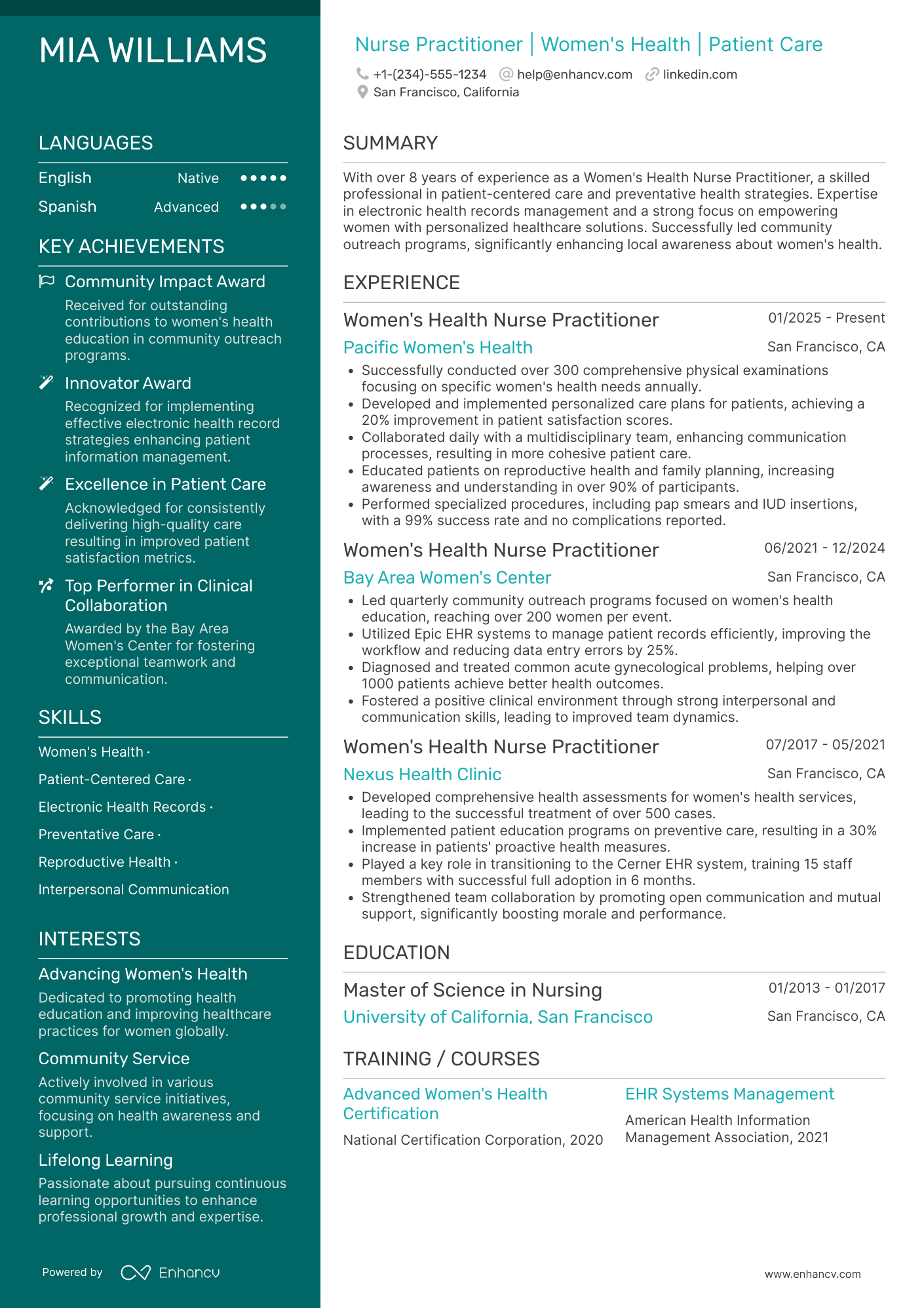
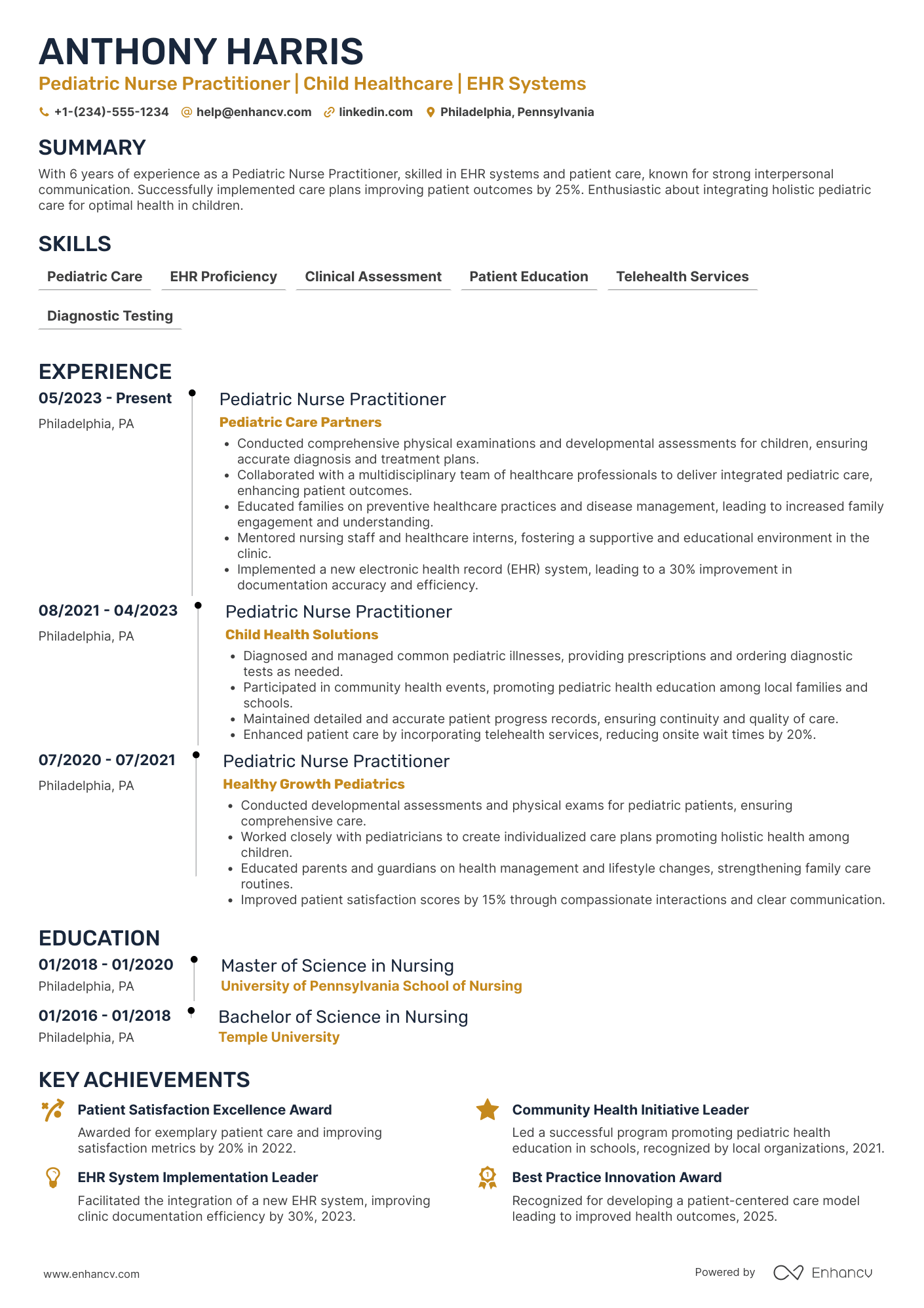
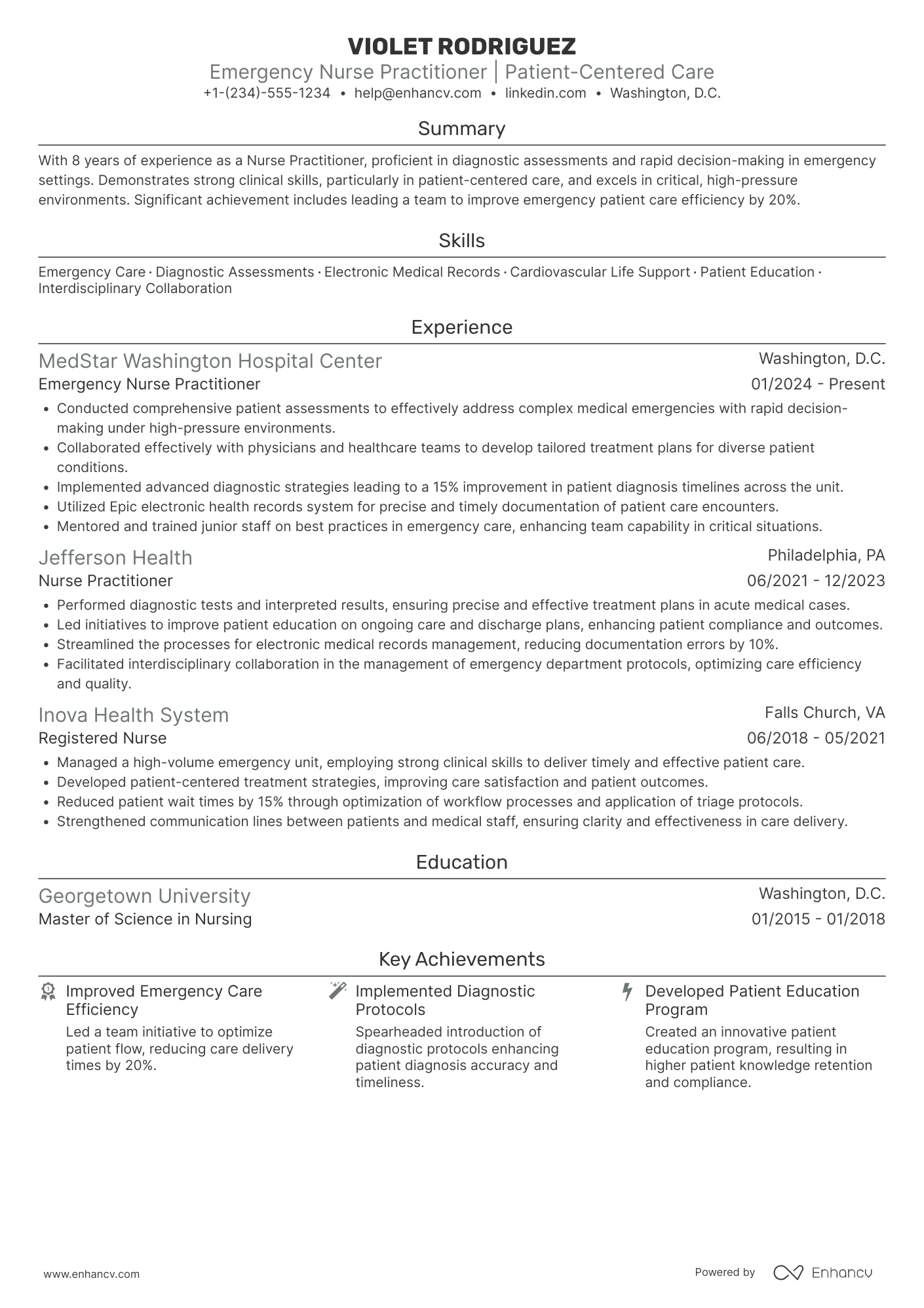
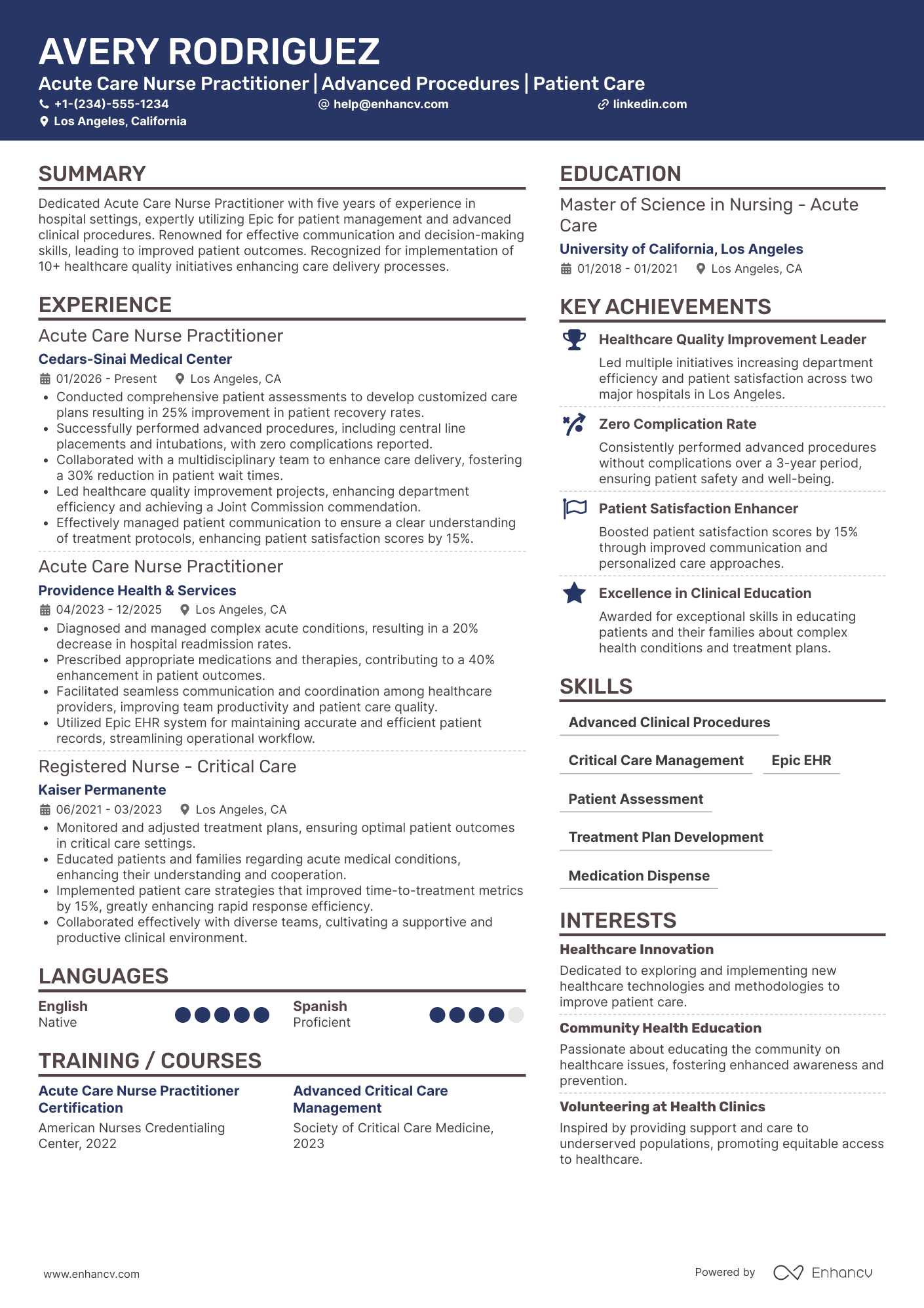
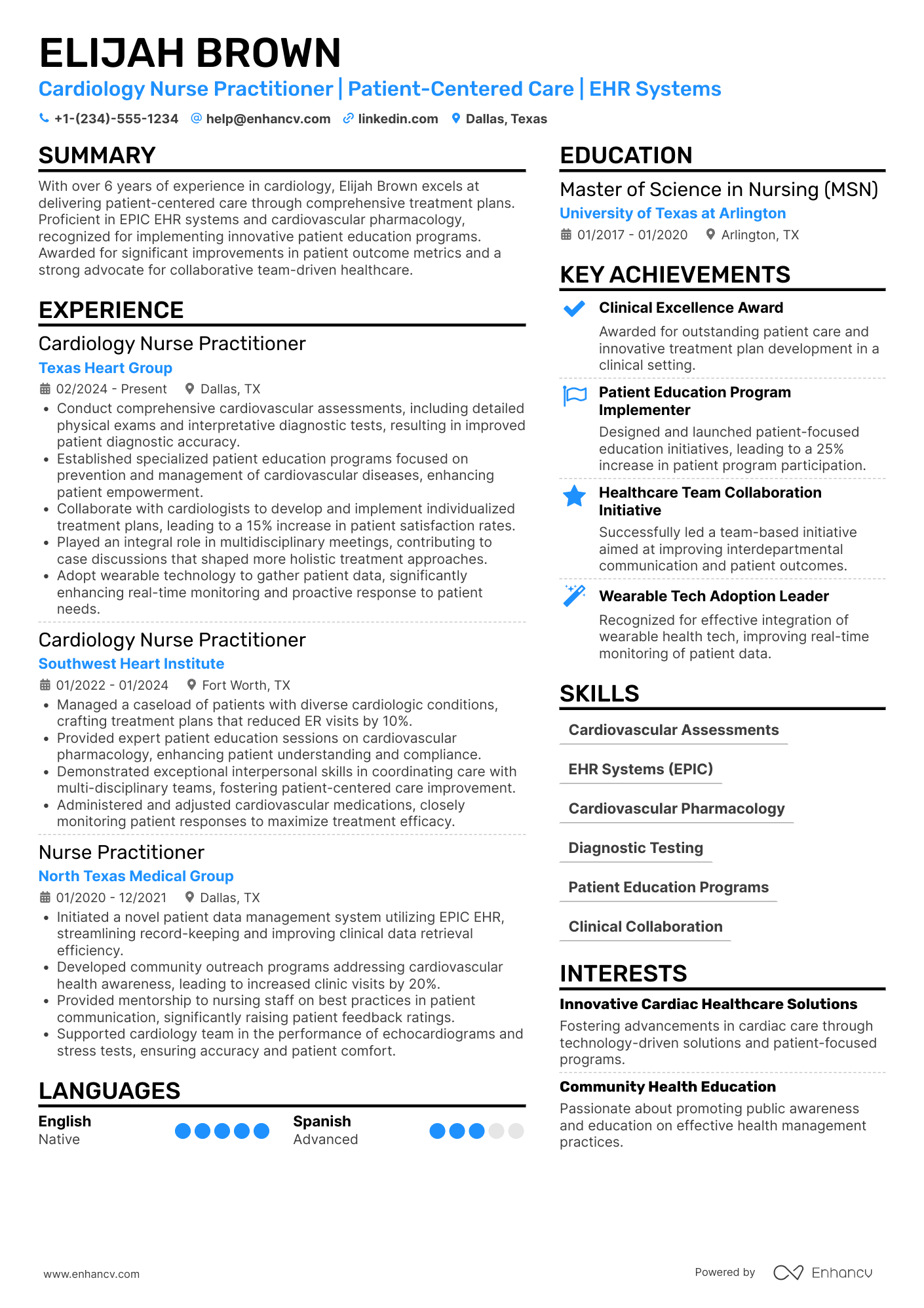
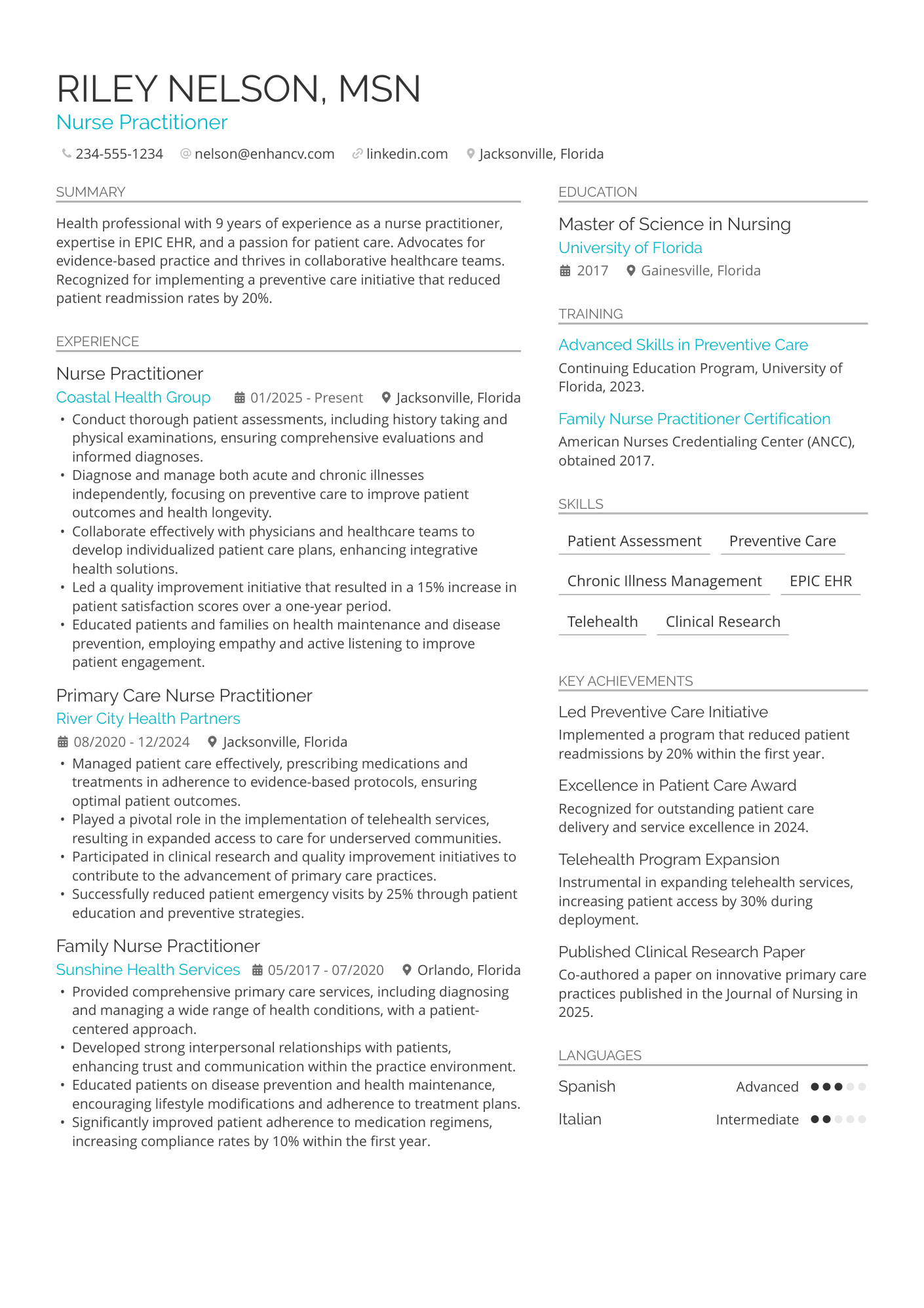
Nurse practitioners (NPs) are in the middle of the fastest hiring wave the role has ever seen—the Bureau of Labor Statistics projects NP jobs to grow 35% by 2034, among the highest growth rates of any occupation in the country. That demand is good news, but it also means more competition for the roles that pay best and offer the most autonomy.
Your resume is what separates "qualified" from "the one they call back."
At Enhancv, we've helped thousands of health professionals turn clinical responsibility, certifications, and patient outcomes into a resume that gets read. In this guide, you'll find 11 nurse practitioner resume examples, samples and templates, along with a clear breakdown of what to include, what to cut, and how to stand out in a market that's hiring fast.

Key takeaways
- Your resume format should match your experience level—reverse-chronological for practicing NPs, hybrid for newly certified ones with RN experience behind them.
- Certifications aren't just a section. List your key credentials directly after your name in the header so they're visible before a recruiter reads a single bullet.
- Every experience bullet should prove clinical impact, not just describe a duty—patient panel size, readmission rates, satisfaction scores, and visit volume are all fair game.
- Tailor your resume to each role by mirroring the population, setting, and EMR systems in the job posting. A generic NP resume won't survive a competitive shortlist.
- Enhancv's resume tools—from the One-Click Tailoring Tool to the Bullet Point Generator and Summary Generator—can help you build and refine every section without starting from scratch.
Once you've got that big-picture pitch right, the next decision is how to structure it on the page.
How to choose the best nurse practitioner resume format
Recruiters reviewing NP resumes are mostly checking two things: are you board-certified for this population, and have you actually practiced at this level of autonomy? The format you choose either makes those answers obvious in five seconds or buries them under a layout that looks more like an entry-level nurse's resume than an advanced practitioner's.

Which resume format should a nurse practitioner use?
Most practicing NPs should use a reverse-chronological format. It puts your most recent clinical role, certifications, and patient population front and center, which is exactly what hiring managers scan for first.
Newly certified nurse practitioners can benefit from the hybrid format. It lets you lead with certifications and clinical skills while still giving your RN background room to read as real, relevant experience.
Whatever the case, your resume will need the following sections:
- Header (name, credentials, contact info)
- Resume summary or objective
- Certifications and licensure
- Professional experience
- Education
- Skills
For nurse practitioners specifically, certifications often need to sit higher up than on a typical resume. They’re sometimes the first thing a recruiter scans for, even before reading your experience.
Once you've got your sections in place, run your document through Enhancv's Resume Checker. It scans 27 points across your content so you know exactly where you stand before you apply.
Is your resume good enough?
Drop your resume here or choose a file. PDF & DOCX only. Max 2MB file size.
How to write your nurse practitioner resume experience
This is where your resume shows you can practice independently. However, hiring managers aren't only confirming you held the title—they want to see the patient population, procedures, and outcomes that prove you were actually doing the work.
Every NP experience section should include:
- Job title and setting
- Dates of employment, formatted consistently
- Location (city and state is enough)
- Three to six bullet points covering your most recent contributions and measurable outcomes
Here’s an example of how this can look on a real resume:
Good example of a nurse practitioner experience section
Family Nurse Practitioner
Lakeside Family Medicine, Austin, TX
March 2022 - April 2026
- Managed a panel of 900+ patients across pediatric, adult, and geriatric primary care, handling acute visits, chronic disease management, and annual wellness exams.
- Diagnosed and treated common acute and chronic conditions independently, including hypertension, type 2 diabetes, and upper respiratory infections, consulting with collaborating physicians on complex cases.
- Ordered and interpreted diagnostic tests, prescribed medications, and adjusted treatment plans based on patient response.
- Reduced 30-day readmissions for diabetic patients by 18% through a structured follow-up call protocol introduced for high-risk cases.
Solid bullets are step one—but the same resume sent to every job posting will only get you so far. Tailoring is what makes a hiring manager feel like you wrote this one specifically for them.
How to tailor your nurse practitioner resume experience
Resume tailoring means adjusting your content to mirror the specific role, not rewriting it from scratch.
For a nurse practitioner, that usually means:
- Matching the patient population with the posting names (pediatric vs. geriatric vs. psych).
- Echoing the certifications or licensure they list (FNP-BC, PMHNP-BC, state APRN license).
- Reflecting the EMR system they use if it's mentioned.
- Adjusting your clinical examples to the setting—primary care, urgent care, or specialty practice—all expect different proof points.
Resume tailoring examples for nurse practitioners
| Job description excerpt | Untailored bullet | Tailored bullet |
|---|---|---|
| Function as a consultant, clinician and mentor in the delivery and evaluation of hospice, palliative care, and symptom management services. | Worked with physicians on patient care plans. | Served as clinical consultant to 2 Medical Directors, co-managing symptom protocols for a 40-patient hospice and palliative care caseload. |
| Perform bedside patient assessments and assist with diagnosis, treatment, and management of acute and chronic health conditions. | Assessed patients and helped manage treatment. | Conducted bedside assessments for 15+ patients daily, diagnosing and managing acute and chronic conditions including COPD exacerbations and pain crises. |
| Prepare and maintain accurate patient records, charts, and documents to support sound medical practice and reimbursement for services provided. | Kept patient records updated. | Maintained documentation accuracy across 900+ patient charts, supporting compliant reimbursement and zero audit flags over 12 months. |
You don't have to rebuild bullets like this from scratch every time you apply. Enhancv's One-Click Tailoring Tool reads the job ad and adjusts your bullet points, skills, and summary to match it in seconds.
Notice how every tailored bullet above leans on a number? That's not a coincidence. Numbers are what turn a clinical responsibility into proof of impact.
As an NP, you've got more to quantify than most roles:
- Patient panel size
- Visit volume
- Readmission or complication rates
- Patient satisfaction scores
- Diagnostic accuracy
- Time-to-treatment
- Any process you introduced that improved efficiency.
If you're not sure how to turn your day-to-day into numbers like that, Enhancv's Bullet Point Generator can help you build quantified bullets from scratch.
Example of quantified NP achievements on your resume
| How to quantify | Example bullet point |
|---|---|
| Show the size of the patient population you manage or have managed. | "Managed a panel of 1,100+ patients across chronic disease management and preventive care." |
How to list skills on a nurse practitioner resume
Your experience section proves what you've done, but your skills section is what gets you past the keyword scan in the first place. Both applicant tracking systems (ATS) and hiring managers check it to see if you have the clinical competencies and tools the role requires before they read a single bullet point.
Hard skills are the technical, teachable abilities specific to NP practice—things like diagnostic procedures, EMR systems, or prescribing protocols. Soft skills are how you apply them—communication, judgment under pressure, collaboration with a care team.
Your hard skills belong in a dedicated section near the top of your resume. Make sure you include the practical, role-specific terms ATS systems are typically scanning for.
Best hard skills for your nurse practitioner resume
- Patient assessment and physical exams
- Diagnosis and treatment planning
- Prescribing and medication management
- Chronic disease management
- EMR/EHR systems (Epic, Cerner, athenahealth)
- Diagnostic test ordering and interpretation
- Telehealth/telemedicine platforms
- Wound care and minor procedures
- Patient education and care coordination
- ICD-10 and CPT coding
Your strongest soft skills should show up woven into your summary or experience bullets, since a list alone doesn't prove you have them.
Here's how critical thinking could be showcased in the summary, without even explicitly mentioning it.
Demonstrating soft skills in the summary
Board-certified Family Nurse Practitioner with 6 years in primary care, managing a panel of 900+ patients across adult and geriatric populations. Known for catching early-stage diagnoses, including two cases of early-onset Parkinson's flagged during routine wellness visits, and adjusting treatment plans proactively before conditions escalate. Collaborated with a team of 4 physicians across two clinic locations, maintaining a 94% patient satisfaction score over the past year.
Here are the soft skills that tend to matter most in an NP hiring process.
Best soft skills for an NP resume
- Clinical judgment
- Communication
- Empathy
- Critical thinking
- Adaptability
- Time management
- Collaboration
- Attention to detail
- Conflict resolution
- Cultural competence
Keep your skills section in the top third of your resume—that's where ATS software looks first. Use it for the essential tools, certifications, and clinical procedures the role requires. Everything else, particularly your soft skills, should come through in your experience bullets and summary, backed by numbers that show what those skills actually produced.
How to list certifications and education on your nurse practitioner resume
Education and licensure aren't optional extras on an NP resume. Your degree confirms you're qualified to practice at the advanced level and your certifications confirm you're board-certified for the specific population the role serves.
A clean education entry includes your degree, the institution, and your graduation year. No need for the month.
Education entry sample
Master of Science in Nursing (MSN), Family Nurse Practitioner Track
University of Texas at Austin
2018
For certifications, list each one with its full name, issuing body, and expiration year. State licensure and your NPI number are worth including too, especially if you're applying across state lines or to roles where compact licensure is relevant.
Top credentials for nurse practitioners
- Family Nurse Practitioner Board Certified (FNP-BC)
- Psychiatric Mental Health Nurse Practitioner Board Certified (PMHNP-BC)
- Adult-Gerontology Primary Care NP Certified (AGPCNP-BC)
- Pediatric Nursing Certification (CPNP-PC or CPNP-AC)
- Acute Care Nurse Practitioner Certified (ACNPC-AG)
- DEA Registration (if applicable)
- State APRN License
- Basic Life Support (BLS)
- Advanced Cardiac Life Support (ACLS)
Your most important credentials—FNP-BC, PMHNP-BC, and your state APRN license—deserve to appear twice on your resume. Put the abbreviations directly after your name in the header (e.g., Jane Smith, FNP-BC) or next to your job title, so they're visible in the first second of a scan. Then list the full details, issuing body, and expiration year in the certifications section below.
How to write your nurse practitioner resume summary
Your summary is the first thing a recruiter reads after your name and credentials, so it needs to do real work, fast. For an NP, that means establishing your specialty, your patient population, and at least one concrete result before they've scrolled an inch.
A strong NP summary should include:
- Your certification and years of experience as an NP
- The setting and patient population you've worked with
- A key clinical strength or area of focus
- One or two quantified achievements
- A closing line that connects your experience to what the employer is looking for
Example summary
Board-certified Family Nurse Practitioner with 7 years in primary care, specializing in chronic disease management across adult and geriatric populations. Reduced 30-day readmissions by 18% through a structured diabetic patient follow-up protocol and maintained a 94% patient satisfaction score across a 900+ patient panel. Looking to bring that same proactive, outcomes-focused approach to a team-based primary care environment.
This summary works because it leads with credentials, grounds the experience in a specific population, and closes with what the candidate brings to the target role.
A resume objective is worth mentioning here because many NPs often think they need one, but in most cases, a summary is the stronger choice. The exception is a new grad nurse practitioner writing their first resume in the role, where an objective can help frame the transition from RN to NP practice clearly. If that's you, keep it short, specific, and forward-facing.
Example objective
Registered Nurse with 5 years of acute care experience, recently board-certified as a Family Nurse Practitioner. Seeking a primary care role where I can apply my clinical background in chronic disease management and patient education to deliver independent, patient-centered care.
Everyone else—stick with the summary.
Not sure where to start with yours? Enhancv's Resume Summary Generator builds a tailored summary from your experience in seconds.
Get a summary that shows your clinical scope and impact
Drop your resume here or choose a file.
PDF & DOCX only. Max 2MB file size.
How to write an NP resume with no experience
"No experience" means something different for NPs than it does for most roles. You're never starting from zero—the question is which kind of experience you're working with.
There are three realistic scenarios where an NP might be writing a resume without direct NP practice history:
- New grad NP: Freshly board-certified, with RN experience behind you but no hours logged as an NP yet. Lead with your certification and clinical rotations, and treat your RN experience as the professional backbone it is. Quantify it the same way a practicing NP would—patient volume, settings, conditions managed.
- RN transitioning to NP: Similar to the above, but you may still be mid-certification or working toward full licensure. Be transparent about your status, list your expected certification date, and lean heavily on the advanced clinical skills you've already been building.
- NP changing specialties: Board-certified in one population but applying to a different one (e.g., FNP moving into psychiatric care). Here the gap isn't experience—it's specialty-specific experience. Lead with transferable clinical skills, highlight any relevant rotations or continuing education in the new specialty, and consider a hybrid format that surfaces skills before chronology.
In all three cases, swap the hybrid format for reverse-chronological once you have 12 months of NP practice under your belt.
Frequently asked questions about nurse practitioner resumes and job applications
Got more questions about your nurse practitioner resume? Here are the ones that come up most often.
How long should a nurse practitioner resume be?
One to two pages. New grad NPs or those with fewer than three years of NP-level practice should aim for one strong page—your RN experience included. More experienced NPs with leadership roles, multiple specialties, or committee work can go to two. The only exception is an academic or research role, where a full CV is more appropriate than a resume.
What's the best resume template for a nurse practitioner?
A two-column template works particularly well for nurse practitioners. It lets you keep credentials, certifications, and skills visible in a sidebar while your experience takes up the main column. That structure mirrors how hiring managers actually read an NP resume: credentials first, clinical history second.
Enhancv's double-column templates are designed with these considerations in mind and are ATS-compatible.
Should I include my RN experience on my NP resume?
Yes, always. Your RN background is part of your clinical foundation, and most hiring managers expect to see it. The rule of thumb is to give it proportional space: if you've been practicing as a nurse practitioner for several years, condense your registered nurse roles to two or three bullets each and let your NP experience lead.
If you're a new grad NP, your RN experience is doing real heavy lifting and deserves more room.
Should I list my DEA number on my resume?
This one divides opinion. Including it signals that you're licensed to prescribe controlled substances, which is a relevant credential for many NP roles. Leaving it off is also reasonable if privacy is a concern—employers will verify it independently. A middle ground is to note "DEA Registration — active" without the number itself.
Do I need a cover letter as a nurse practitioner?
A cover letter isn’t always required, but it's worth writing one when you're applying to a specific practice model or patient population you're particularly suited for. It's the right place to explain context your resume can't, like why you're moving from acute care to primary care, or why you're relocating. Keep it to three short paragraphs and make it specific to the role.
Drop your resume here or choose a file.
PDF & DOCX only. Max 2MB file size.
How much do nurse practitioners earn, and does it affect how I position my resume?
The median annual wage for nurse practitioners was $129,210 as of May 2024, according to BLS data. Specialty and setting matter: NPs in psychiatric and substance use disorder hospitals earn a higher median of $140,400.
If you're targeting more lucrative specialties or hospital settings, your resume should reflect that positioning—leading with the certifications, autonomous practice experience, and outcomes those employers prioritize.
Final thoughts
Your nurse practitioner resume needs to do something most clinical training never prepares you for—translate years of high-stakes, patient-facing work into a document a recruiter can scan in seconds. Get the format right, lead with your credentials, quantify your outcomes, and tailor every application to the role in front of you.
You've got the clinical experience. Now make sure your resume shows it.