

Most job seekers write their resume summary believing a bot will judge it first. The truth is the opposite. In a 25-recruiter study Enhancv ran across recruiters that work with Workday, Greenhouse, iCIMS, Bullhorn and other major ATS platforms, 92% of recruiters said their systems do not auto-reject resumes. A human reads every one. Forget the six-second filter. Your summary has to earn the next 60 seconds of attention from a human screening hundreds of applications.
This guide shows you exactly how to write a resume summary that lands well with both the ATS and the human on the other side, with real examples for every career stage.
What is a resume summary?
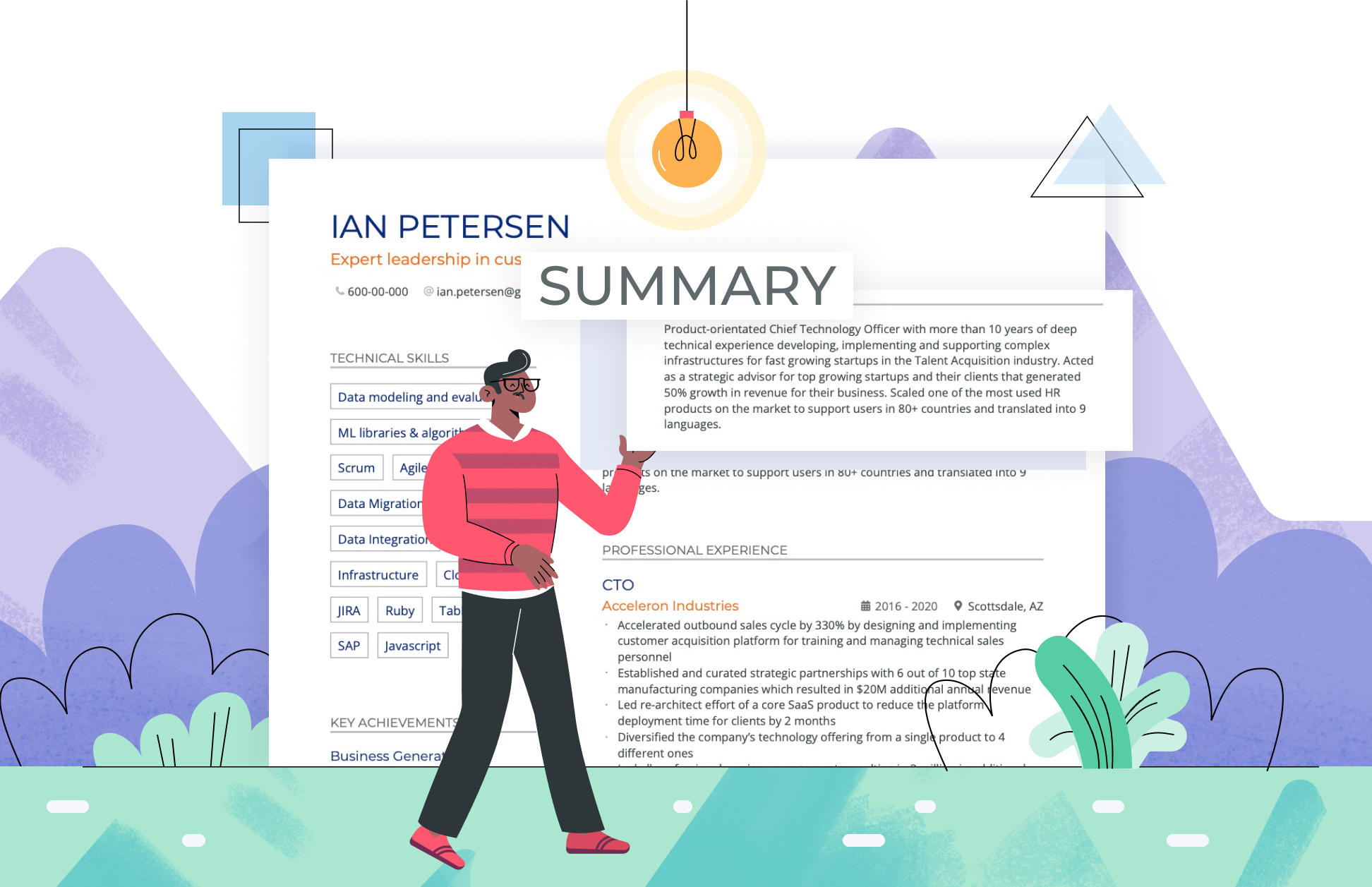
A resume summary is a two-to-four sentence snapshot at the top of your resume that tells a recruiter who you are, what you bring, and why you're the right fit, before they read a single bullet point.
Think of it as the elevator-pitch version of your whole resume: the one thing you'd lead with if you had a recruiter's attention for ten seconds and nothing else.
It sits directly below your contact information, above your work experience section. You'll also see it called a professional summary, resume profile, or summary statement. Different names, same section.
How is it different from a resume objective?
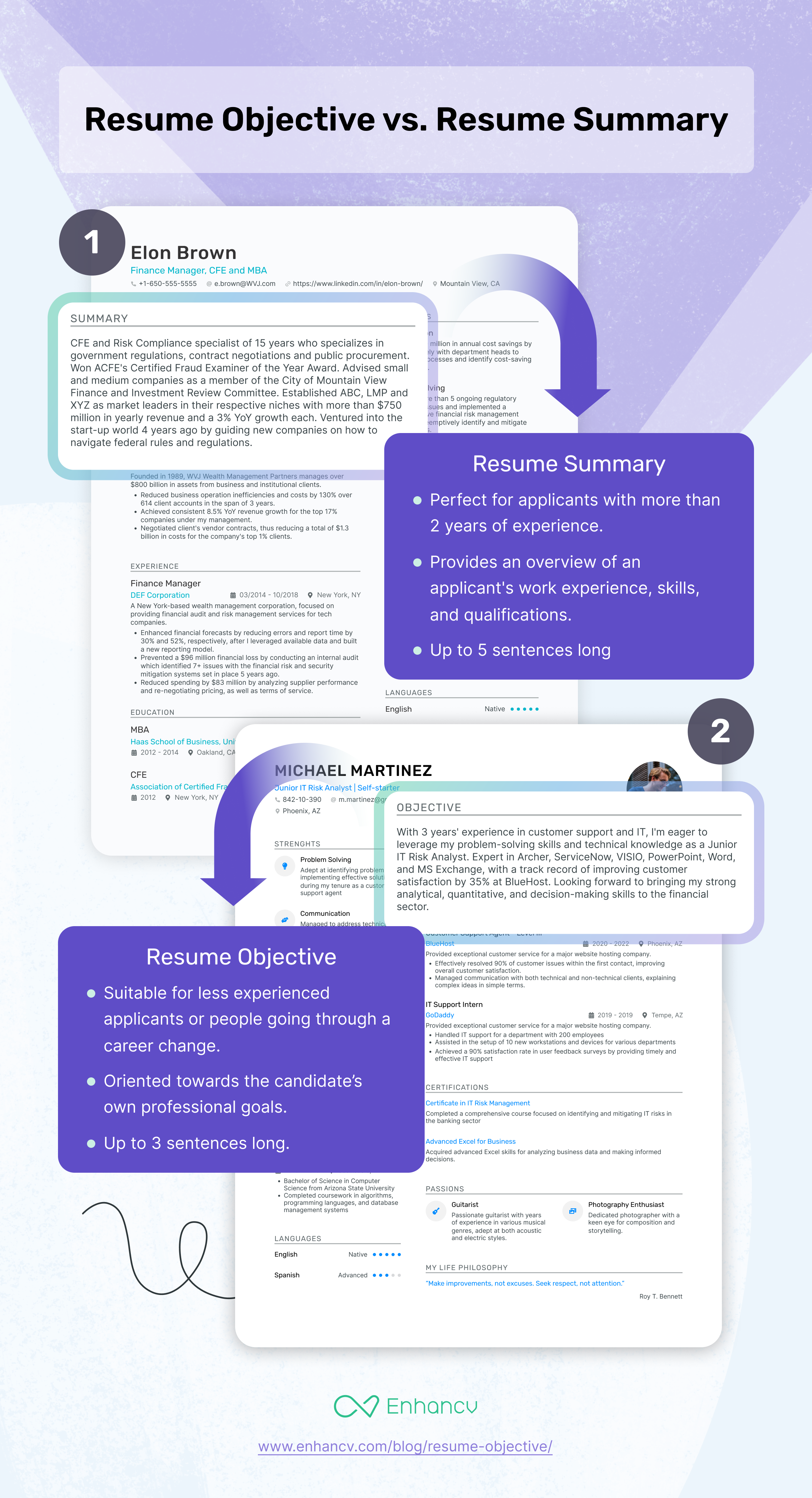
A summary leads with what you offer the employer. An objective, on the other hand, leads with what you want from the role.
For most people with relevant experience, a summary is the right call. There's one exception. If you're a new graduate or switching careers, an objective can still work, because it explains your direction before your limited or unrelated experience raises questions.
Here's the difference between the two, side by side:
Optimize your resume summary and objective for ATS
Drop your resume here or choose a file.
PDF & DOCX only. Max 2MB file size.
Why the resume summary is the first thing a recruiter actually reads
The popular line is that an ATS pre-filters your resume before any human sees it. Enhancv's recruiter study tested that claim directly and found it didn't hold up: 23 of 25 recruiters said rejections are either manual or triggered by eligibility knockout questions (work authorization, required certifications, minimum degree), never by formatting or keyword density. Your summary's first real reader is a person, not a bot.
That person is usually overwhelmed, and cutting through that is your summary's whole purpose. It has to earn a closer read, and fast. That's the whole job now.
Does applying early matter?
Yes, more than most candidates realize. In Enhancv's recruiter study, 52% said applying early improves a candidate's chances simply because they review applications in the order they arrive. A strong summary at the top of an early application is the best combination you've got going for you.
What about the seven-second scan?
You'll see the "recruiters spend seven seconds on a resume" line repeated everywhere. It traces back to a 2012 TheLadders eye-tracking study, and recruiters in our 2025 study described something more nuanced: a fast first scan to decide whether to invest the next 30 to 60 seconds, not a final verdict. The summary is what earns that second look. If it's vague, the recruiter moves on. If it's specific, quantified, and aligned to the job, they keep reading.
For experienced professionals with 10 or more years of career history, this matters even more. A strong summary is the only place to compress a complex career arc into an immediate, readable signal of seniority and domain authority. Nowhere else on your resume can you do that in three sentences.
Don't recruiters skip summaries?
They skip generic ones. A specific, quantified, job-aligned summary earns the read. Enhancv's Resume Headline Generator can help you craft an opening line calibrated to your experience level and target role, so the first thing a recruiter reads earns you a further look.
What to include in a resume summary: the core components
Every strong resume summary contains four things: your professional identity, your years of relevant experience, your top two or three hard skills, and one quantified result that proves your value. Keep it between 40 and 80 words. Two to four sentences, depending on where you are in your career.
That's it. If you can't say it in that space, you haven't edited it yet.

The four components of a strong resume summary
- Professional identity: a role label that mirrors the job posting's exact language.
- Years of experience and industry context: "12 years in enterprise SaaS sales" beats "over a decade in sales."
- Two or three hard skills pulled straight from the job description, in its words.
- One concrete, quantified result: your single strongest number.
Component 1: Your professional identity
Open with a role label that mirrors the job posting's exact language. If the job description says "Senior Product Manager," your summary should open with "Senior Product Manager," not "product leader" or "tech strategist." When recruiters search the ATS database for candidates, they search for the title that's on the requisition. Hiring managers scan for familiar titles for the same reason.
Component 2: Years of experience and industry context
Specificity matters here. "12 years in enterprise SaaS sales" lands harder than "over a decade in sales." The domain context tells recruiters you haven't just done the job, you've done it in a world they recognize.
Component 3: Two or three hard skills pulled from the job description
Read the posting. Find the skills or tools that appear more than once. Use those words, in that order. This is where the keyword overlap that recruiters search for shows up, and it's also what a recruiter's eye gravitates to when scanning your resume.
Here's a word of caution: this is not keyword stuffing. 76% of recruiters in our study said they value "natural use of keywords, not keyword stuffing" as a sign of a well-written resume. Pack the words in densely without context and you fail the human reader, even if the algorithm doesn't trip you up.
Component 4: One concrete, quantified result
Pick your single strongest number. Revenue grown, costs cut, teams led, products shipped. "Grew ARR from $4M to $11M in 18 months" tells a story that "results-driven professional" never could.
Optional: a forward-looking phrase
For senior professionals and executives, one closing phrase that signals where you're headed can help frame the rest of the resume. Something like "now focused on scaling operations across EMEA" gives a recruiter context before they read your experience section.
How long should a resume summary be?
For mid-level professionals with five to nine years of experience, two to three sentences is the right range. For senior professionals or executives with 10 or more years, three to four sentences gives you room to convey scope, specialization, and scale without padding.
If your summary runs past four sentences, that's not a summary, so trim it liberally.
What to leave out
Soft skills listed in isolation, like "excellent communicator" or "team player," add nothing to your resume without some evidence. Every candidate says this, so essentially, you are not standing out. If collaboration is genuinely a differentiator, back it with a result: "led a cross-functional team of 14 across three time zones to deliver a $6M product launch on schedule."
Write your resume summary in five steps
Start with the job description, not a blank page. The fastest way to write a strong summary is finding the overlap between what the employer needs and what you've actually done, then writing directly to support that connection.
The five steps
- Highlight what the employer emphasizes most. Mark the three to five skills, qualifications, or outcomes that appear more than once in the job description. Those are the terms your summary needs to reflect.
- Lead with the right job title. Use the title from the posting. If your actual title was unusual or internal, translate it so recruiter search and the human screen both find a role-match in the first line.
- Add experience and domain context. "10 years in B2B SaaS sales" lands better than "10 years of sales experience" when the job is at a SaaS company.
- Mirror the job description's language. Use the exact phrasing where it fits naturally. If the job says "financial modeling," don't write "financial analysis" and hope for the best.
- Close with a quantified result. End with one achievement that proves you can deliver what they're hiring for. One number beats three vague claims every time.
One practical note: write the summary last. Once your bullet points are tailored, you'll know which achievements are worth surfacing at the top.
If you want a shortcut on the keyword gap, Enhancv's AI Resume Tailoring analyzes the job description and flags which terms are missing from your summary, giving you a match score and specific suggestions so you can close the gap before you apply.
Resume summary examples by career stage
The right summary structure shifts depending on where you are in your career. The core ingredients stay the same: identity, experience, skills, proof. What changes is the weight you give each one.
Here's what a strong summary looks like at each stage.
Entry-level and new graduates
When you have little work history, lead with your degree, any relevant coursework or internships, and the specific value you bring to the role. You can switch to a resume objective format here, because hiring managers expect it. What they don't expect is one that actually sounds confident and specific.
Before: weak
"Recent marketing graduate seeking an entry-level position where I can apply my skills and grow professionally."
This says nothing a recruiter can act on. Every new grad sounds like this.
After: strong
"Marketing graduate with hands-on experience running paid social campaigns for a 12,000-follower brand account. Proficient in Google Analytics, Meta Ads Manager, and HubSpot. Looking to bring data-driven campaign thinking to a growth-focused team."
The "after" version names real tools, cites a real context, and signals a specific kind of role. A recruiter can picture you on their team.
Mid-level professionals (5 to 9 years)
Lead with your role label, your domain, and one strong metric. At this stage you have proof that your experience is relevant, so prove it.
Before: weak
"Experienced project manager with a background in technology and strong communication skills."
After: strong
"PMP-certified project manager with seven years delivering enterprise software implementations on time and under budget. Led cross-functional teams of up to 20 across three time zones, cutting average delivery cycles by 18%."
The credential, the number of years, the team size, the metric: each detail does a job. Nothing is decorative.
Senior professionals (10+ years)
At this level, scope and strategic contribution matter more than individual tasks. Show the scale of what you've managed and the business impact behind it.
Before: weak
"Senior sales leader with extensive experience in B2B environments and a proven track record of success."
After: strong
"Enterprise sales leader with 12 years scaling B2B SaaS revenue from $4M to $38M ARR across North America and EMEA. Built and managed a 35-person team, consistently hitting 115%+ of quota. Specialized in complex, multi-stakeholder deals in the financial services vertical."
Notice there's no filler phrase like "proven track record." The numbers are the track record.
Executives
Open with the strategic mandate, not the title. Board-level readers want to see P&L scope, transformation experience, or enterprise scale in the first line, not a job label they already know from your work history.
Before: weak
"Seasoned executive with 20 years of leadership experience across multiple industries and a history of driving results."
After: strong
"Chief Revenue Officer with 18 years building go-to-market functions for Series B through post-IPO SaaS companies. Grew combined ARR by $220M across four organizations. Known for building high-retention sales cultures and shortening enterprise sales cycles by restructuring comp and territory design."
Career changers
Acknowledge the transition briefly, then pivot hard to transferable skills and outcomes. Don't bury the reason for the career shift, but don't apologize for it either.
Before: weak
"Former teacher looking to transition into corporate training and development. Eager to apply classroom skills in a new environment."
After: strong
"Instructional designer and former high school educator with nine years designing curriculum for diverse learners. Developed and delivered training programs for cohorts of up to 60, achieving an average post-training assessment score of 87%. Now applying that same curriculum design and facilitation expertise to L&D roles in tech and financial services."
The skills are named, the outcomes are quantified, and the pivot reads like a natural evolution to the role.
How to write a resume summary that earns the ATS handoff
Most ATS platforms don't auto-reject. They rank, surface, and flag, and a human still does the screening. But how your summary reads inside the system still matters, because recruiters search the database using the job's exact language, and your summary is the first place that language has to show up.
How does the ATS actually handle your summary?
When you upload a resume, the ATS parses it into sections and stores those sections in a searchable database. Recruiters then search that database using the title, skills, certifications, and keywords from the requisition. Your summary is the section most likely to surface in those searches because it concentrates role-relevant language in the smallest space.
One thing worth knowing: exact-match and near-match keywords both count in most modern systems. "Grew revenue" and "revenue growth" will typically both register. But "P&L management" and "budget oversight" are different phrases, and recruiters who search the database for one term won't surface candidates who only used the other. When the job description uses a specific term, use that term.
Does keyword stuffing work?
No, and it actively hurts you with the human reader who eventually opens your file. 76% of recruiters in Enhancv's study said they specifically look for "natural use of keywords, not keyword stuffing" as a marker of a well-written resume. Pack disconnected terms into your summary and you fail the second test even if you pass the first. The goal is natural integration of role-relevant language, not repetition.
Does formatting matter?
Yes, but probably less than the internet suggests. Enhancv's ATS parsing study uploaded identical resumes built in Google Docs, MS Office, Canva, and Enhancv to a major ATS and measured per-section parse rates. For the summary section specifically, single-column layouts parsed at 97% and double-column layouts at 89%, both good, but the difference is real. Canva resumes ranged from 52% to 92% across all sections; Enhancv's double-column templates parsed at 98% overall, the highest of any builder tested. The fix is simple: use a builder whose summary section parses reliably, so your carefully chosen keywords land in the searchable database. Stripping out formatting altogether was never the answer.
What does a weak vs. strong searchable summary look like?
Here's the gap in practice.
Weak: zero searchable terms
"Experienced sales leader with a proven track record of driving results."
That sentence contains zero searchable terms. "Proven track record" and "driving results" are filler phrases that match nothing in a job description.
Strong: every term is searchable
"Enterprise sales leader with nine years in B2B SaaS, consistently exceeding quota across EMEA markets and expanding ARR within financial services accounts."
That version contains "enterprise sales," "B2B SaaS," "quota," "EMEA," "ARR," and "financial services." Every term maps to something a recruiter actually searches for.
Before you submit, you can use Enhancv's Resume Checker to run a series of in-depth checks, including ATS keyword scoring, so you can see exactly how your summary performs against a specific job description and fix any gaps before your resume leaves your hands.
Is your resume good enough?
Drop your resume here or choose a file. PDF & DOCX only. Max 2MB file size.
Seven resume summary mistakes Enhancv's writers fix every week
The most damaging resume summary mistakes are also the most common. Each one below comes up repeatedly in the resumes our in-house Certified Professional Resume Writers rebuild for clients. Run your summary against this list before you send it.
The seven mistakes to check for
- Opening with "I am a…" or "I have…" First-person openers read as informal and waste prime space. Start with your identity as a noun phrase: "Senior Financial Analyst with 11 years of experience…"
- Listing soft skills with no evidence. "Results-driven, detail-oriented, passionate team player" gets skipped. Tie any soft skill to a result: "cut onboarding time by 40% by redesigning cross-team documentation."
- Describing what you want, not what you deliver. "Seeking a challenging role where I can grow" tells the recruiter nothing. Answer one question: what value do you bring on day one?
- Using the same summary for every application. An unmodified summary misses the keywords a specific posting calls for. Even two or three swapped words lift how often you surface in searches.
- Making it too long. Five-plus sentences signal poor editing judgment. Keep it to two to four. If you can't distill your value to 80 words, that's a drafting problem, not a length problem.
- Burying the lead. Your strongest credential or result belongs in the first sentence. If your best proof point sits in sentence four, most readers skim past it.
- Inflating scope without evidence. "Global leader" and "industry expert" read as empty. Qualify the claim: "Led go-to-market strategy across 14 countries" earns credibility.
How to use AI to draft, tailor, and score your resume summary
AI tools can cut your drafting time significantly, but only if you treat them as a starting point, not a finished product. Pair AI generation with your real numbers and an ATS check, and you'll produce a stronger summary faster than writing from scratch.
That pattern works at scale. In the 90 days from late February through late May 2026, more than 8,500 Enhancv users ran the AI Tailored Summary generator, reviewed the output, and clicked approve, keeping over 19,000 AI-drafted summary suggestions in total. The tool earns the click. The edit pass below is what makes the result worth keeping.
What's the right workflow?
The four-step AI workflow
- Draft. Feed the job description and your top three to five achievements into an AI tool and ask it to draft a summary in the job's exact language. The output won't be perfect, but you get a structured first draft in seconds.
- Edit ruthlessly. Strip generic phrases ("results-driven," "passionate," "proven track record"), add your real metrics, and read it aloud. If it could belong to any of 500 candidates, rewrite it until it sounds like you.
- Run it through an ATS checker. See which job-description keywords appear, which are missing, and which are underweighted. Missing terms drop you out of database searches before anyone opens your file.
- Iterate once, then do a final human read for tone and specificity. Two revision passes is usually enough. A third just introduces second-guessing.
Enhancv handles steps one and three inside the same tool: AI Resume Tailoring analyzes the job ad and suggests keyword-aligned language for your summary, while the built-in Resume Checker scores the result against the posting so you know what to fix before you apply.
And here's a word of caution: leaving your AI-generated summary unedited tends to produce exactly the vague, cliché-heavy language that the mistakes section of this guide warns against. The tools you have at your disposal nowadays accelerate drafting. Your judgment is still what makes the summary (and the entire resume) worth reading.
Make your resume summary work for every application
A resume summary earns its spot at the top of the page only when it's specific, quantified, and written for the job in front of you. Generic summaries get skimmed past. Tailored ones get you called, and they get you called faster, because 52% of recruiters review applications in the order they arrive.
One habit that pays off fast: keep a master summary file. Every strong version you write goes in it. Each time you apply, pull the closest match, sharpen it for that role, and save the result. Over time, you'll build a library of proven language that makes each application faster and sharper than the last.
Enhancv's resume builder lets you draft, score, and iterate your summary with AI feedback and ATS checking built in, so the version you submit is always your strongest.
Make one that's truly you.