You finished your program, passed your exams, and now every job posting wants "classroom experience" you technically don't have yet. Here's the good news: a new teacher cover letter isn't about hiding the gap. It's about reframing your student-teaching, practicum, and tutoring hours as the real teaching they were.
Principals hire first-year teachers all the time. What they need to see is proof you can manage a room, plan a lesson, and move student outcomes. This page gives you two angles, one for the candidate with zero paid experience and one for the candidate with a year or a placement under their belt, plus a full example, formatting rules, and ready-to-use lines. Pair it with a strong resume using our matching new teacher resume example.

Key takeaways
- Treat student-teaching, practicum, and substitute work as real classroom experience, then quantify the results.
- Name your state teaching license, plus Praxis or edTPA scores, in the first or second paragraph.
- Lead with one specific, non-round number: "reading proficiency rose from 64% to 81%," not "improved test scores."
- Keep it to one page, three to four short paragraphs, and address the principal by name.
- Tie your approach to the school's stated priorities, not a generic love of teaching.
- Send the cover letter with a matching new teacher resume so both tell one story.
Drop your resume here or choose a file.
PDF & DOCX only. Max 2MB file size.
New teacher cover letter example
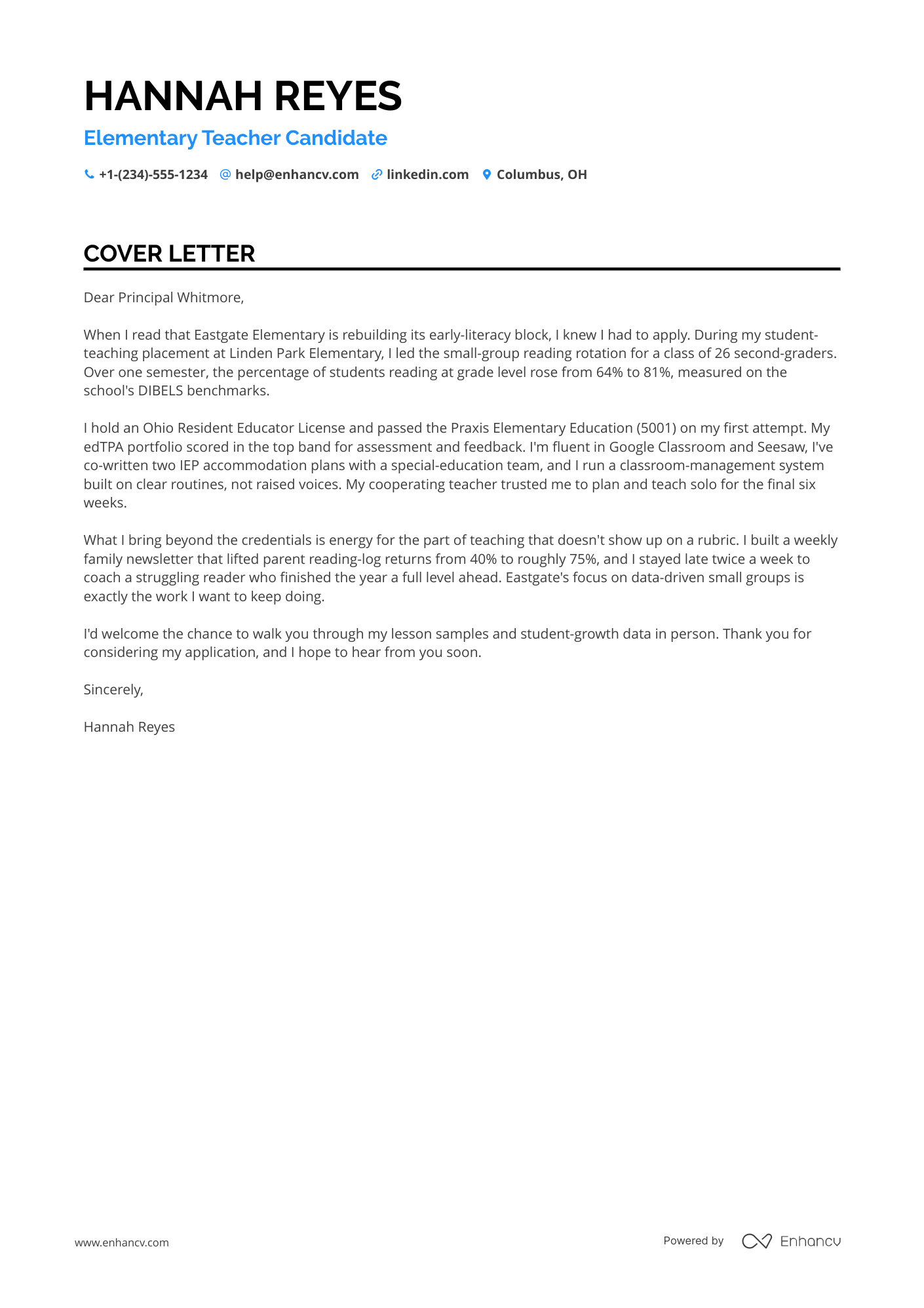
Here's a full sample from a first-year elementary candidate with only a student-teaching placement. Notice how she turns one semester of practicum into concrete, measurable proof.
Hannah Reyes
Columbus, OH
+1-(234)-555-1234
help@enhancv.com


How to format a new teacher cover letter
Match the look of your resume so the application feels like one package. Use a clean header with your name, phone, email, and city, then the date and the school's details. A simple cover letter header keeps the focus on your words.
Stick to a single page with one-inch margins and a readable 11 or 12 point font. Our notes on the cover letter format and the best font for cover letter cover the small choices that make it look intentional. If you're new to the whole thing, start with how to write a cover letter.

The top sections on a new teacher cover letter
- Header: Your name, contact info, and the school's address, matched to your resume.
- Greeting: The principal's or hiring committee's name, not a generic salutation.
- Opening hook: The grade you teach plus one quantified result from your placement.
- Body: Your license and exam scores, classroom tools, and a story that shows impact.
- Fit paragraph: A line connecting your approach to this school's goals.
- Closing: A confident ask for an interview and a thank-you.
Your opening decides whether a busy principal keeps reading. Skip "I am writing to apply for the position of teacher." Open with a grade, a result, and a reason you chose this school. For more openers, see how to start a cover letter.
Cover letter intro
When I read that Eastgate Elementary is rebuilding its early-literacy block, I knew I had to apply. During my student-teaching placement, I led the small-group reading rotation for 26 second-graders and lifted grade-level reading from 64% to 81% in one semester.
Cover letter intro
I am a recent graduate writing to apply for the teaching position at your school. Although I do not have much experience, I am very passionate about teaching and a fast learner who would love the opportunity to grow.
What leads your letter: no experience vs. some experience
| First-year, no paid experience | One year or a strong placement |
|---|---|
| Lead with your student-teaching results and the grade you're certified for | Lead with retention, growth data, or a program you ran |
| Frame practicum, tutoring, and subbing as classroom hours | Name your school, caseload size, and measurable outcomes |
| Emphasize edTPA and Praxis scores as proof of readiness | Emphasize observed evaluations and mentor feedback |
| Show coachability and clear classroom routines | Show initiative, like leading a club or co-writing curriculum |
If you have zero paid experience, your placement is the star. If you've already logged a year or a long-term sub role, lead with the harder proof. Here's the same candidate angle written both ways. For the deeper version of this move, read our guide to a cover letter with no experience and the companion piece on how to sell yourself in a cover letter.
Cover letter body example #1
I hold an Ohio Resident Educator License and passed the Praxis Elementary Education (5001) on my first attempt. My edTPA portfolio scored in the top band for assessment and feedback. I'm fluent in Google Classroom and Seesaw, I co-wrote two IEP accommodation plans, and my cooperating teacher trusted me to plan and teach solo for the final six weeks.
Cover letter body example #2
In my long-term substitute role covering a fifth-grade class for a full semester, I kept all 29 students on pace through a teacher's medical leave and raised the class math benchmark average by 12 points. I built the weekly small-group plan from district data and led two parent-teacher conference nights on my own.
Close with a clear ask, not an apology for your experience level. State that you'd welcome an interview and that you can share lesson samples or student-growth data. See more endings in our cover letter ending guide.
Cover letter closing
I'd welcome the chance to walk you through my lesson samples and student-growth data in person. Thank you for considering my application, and I hope to hear from you soon.

Professional greetings for a new teacher cover letter
- Dear Principal Whitmore,
- Dear Dr. Alvarez,
- Dear Eastgate Elementary Hiring Committee,
- Dear Mr. Okafor and the Hiring Team,
Professional sign-offs for a new teacher cover letter
- Sincerely,
- Respectfully,
- With appreciation,
- Thank you for your time,
Key qualities principals search for in a new teacher's cover letter
- Classroom management: Routines and structure that keep a full roster on task.
- Data literacy: Comfort with benchmarks like DIBELS, MAP, or state assessments.
- Differentiation: Small-group instruction and IEP-aware planning.
- Family communication: Newsletters, conferences, and parent follow-up.
- Coachability: Openness to mentor feedback and observation cycles.
- Subject readiness: Strong teaching skills backed by your license and exams.
Pro tip: Quantify one placement result before you write a word. "Raised reading from 64% to 81%" beats "helped students improve" every time. Our guide to quantify achievements shows how to find numbers you didn't know you had.
Common mistakes new teachers make
The biggest one is apologizing for a lack of experience. Don't. Use the STAR method to turn each placement into a result. The second mistake is sending the same letter to every school, so name the school's program and tie your approach to it.
A few more quick fixes: address a real person, not "To Whom It May Concern" (see cover letter salutation), keep it to one page, and proofread twice. For a final pass, run through our cover letter tips.
When the letter is ready, build the document that goes with it. Our first job resume guide and the example for a resume with no work experience help you turn placements into a resume, and you can finish the set with the new teacher resume example.
Next step: with your letter ready, build the resume to match. See the matching New Teacher resume example.