An academic cover letter is the primary narrative document submitted with a faculty or postdoc application, addressed to a search committee of three to five subfield peers plus the department chair. Standard length runs 1.5 to two pages for tenure-track searches—longer than industry norms because the letter must signpost a multi-document dossier without duplicating any of it.

Key takeaways
- Your reader is a search committee of subfield peers, not a manager—write scholar-to-scholar.
- Standard length runs 1.5 to two pages for tenure-track positions, while STEM postdoc letters often hit just one.
- R1, SLAC, R2, and teaching-college searches each weigh the teaching paragraph differently. Using the wrong template is a common rejection trigger.
- The letter signposts your dossier—research statement, teaching philosophy, CV, references—without rewriting any of those documents.
- Naming a specific faculty member's recent paper or a course you'd want to teach is expected when the connection is real, not sycophantic.
Who reads your academic cover letter?
Search committees in academic hiring evaluate you the way they evaluate a paper submitted to their journal. Тhey ask whether the argument coheres, whether the contribution is real, whether the work fits the conversation the department is having, and whether the methods generalize past the dissertation.
The dossier mentioned above is what makes the letter’s framing decisions concrete — our academic resume guide shows how to compress the same publication, teaching, and service record into the streamlined hybrid that ships alongside the letter.
The shape of that committee drives everything below the answer capsule. The register stays formal-scholarly. The opening doesn't sell, it situates. Citing a colleague's recent work isn't sycophancy because the readers wrote that work.

PRO TIP
The HR screener who filters 90% of industry applications mostly doesn't exist in this process—academic searches rarely use ATS for the long list, and even when they do, the cover letter goes straight to the committee.
How is an academic cover letter different from an industry one?
An academic cover letter is one of four to six documents in a dossier, whereas the industry cover letter usually goes alongside the resume and nothing else. That structural difference drives almost every other one.
The academic letter is longer than an industry one. It’s just doing more structural work to highlight the research statement, the teaching philosophy, sometimes a diversity or inclusion statement, and the CV without restating any of them.
Here’s how the two types compare:
Differences between an academic cover letter and an industry one
| Dimension | Academic cover letter | Industry cover letter |
|---|---|---|
| Length | 700–1,100 words / 1.5–2 pages | 250–400 words / 1 page |
| Reader | Subfield peer scholar judging contribution to a field | Hiring manager scanning for outcomes |
| Register | Formal-scholarly | Promotional |
| Salutation | "Dear Members of the Search Committee" | "Dear Hiring Manager" |
What does a strong academic cover letter look like?
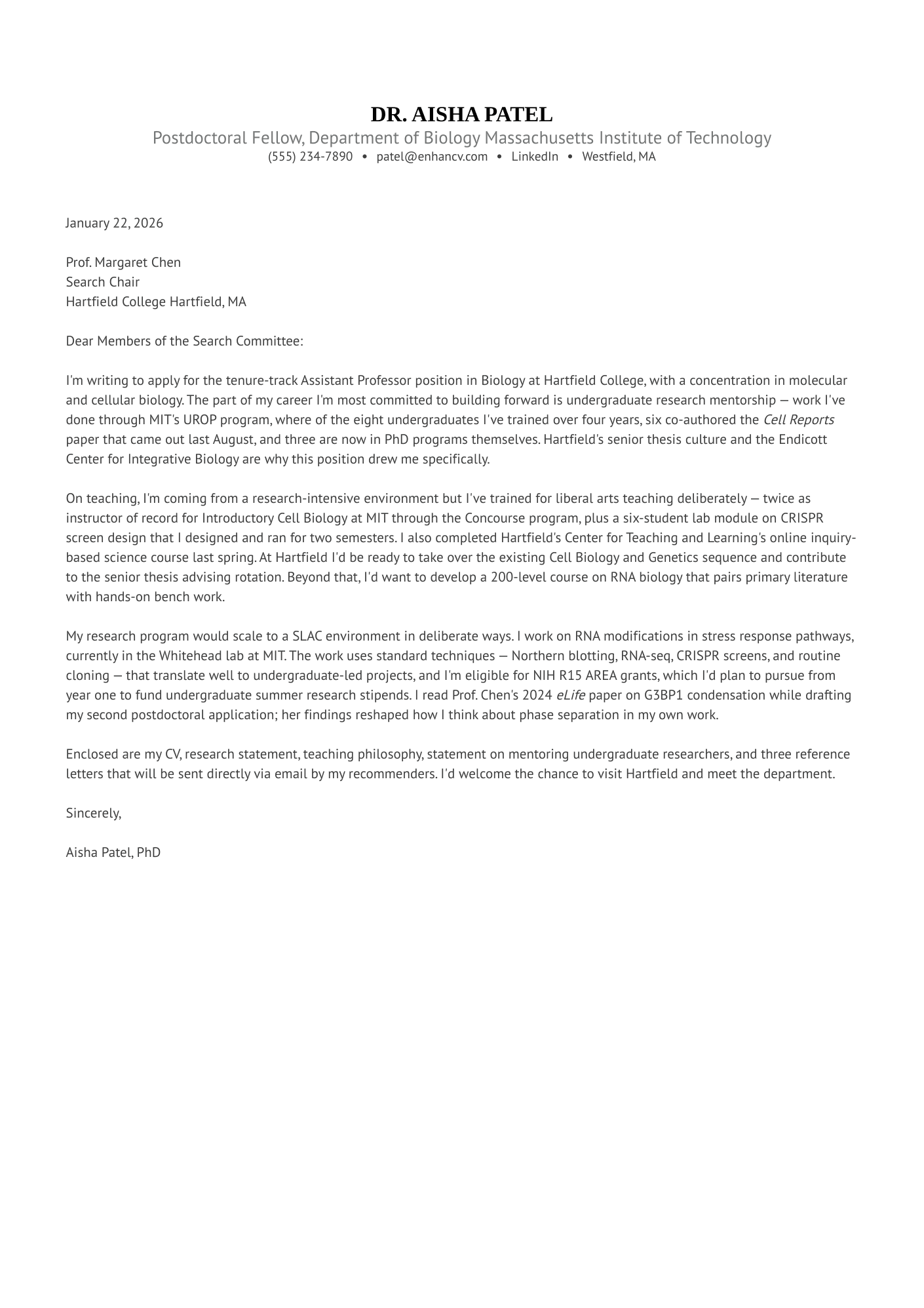
The sample below is a tenure-track application from a postdoc in sociology to a state R1 search. Her field is labor and immigration sociology. Read it once for shape, then come back to dissect each paragraph after we walk through the parts.
Dr. Elena Martínez
Columbus, OH
(555) 123-4567
e.martinez@example.edu


Academic cover letter opening
The opening paragraph in an academic letter handles four small jobs at once: it names the position, places your research program in a single sentence, signals you've read the search ad, and flags any specific tie to the department.
Industry letters lean on a punchy hook designed to grab a hiring manager who'll spend 30 seconds on the page. Academic openings work differently because the committee will spend five to 15 minutes on a serious application—the opening orients the reader, it doesn't grab them.
Naming the search code matters when the ad lists one. Some departments run two simultaneous searches and the code tells the committee which file your application belongs in.
The first sentence is also where you address the search committee in the salutation correctly—"Dear Members of the Search Committee" or "Dear Professor [Chair Name] and Members of the Search Committee" both work.
Below are two openings from different field-and-institution combinations. Each handles the four jobs in roughly four sentences.
Example 1: Humanities tenure-track at an R1 (English literature)
Dear Members of the Search Committee:
I'm applying for the tenure-track Assistant Professor position in 19th-century British Literature, search 2026-ENG-04. My dissertation, Coal Smoke and the Lyric Self, traces how Manchester poets between 1830 and 1865 developed an environmental vocabulary that anticipates contemporary ecocriticism — a project I've extended in a 2025 Victorian Studies article on Eliza Cook and a chapter forthcoming with Cambridge. Your department's strength in nineteenth-century studies, and Prof. Adams's recent book on industrial poetics, would put the next stage of this work in direct conversation with colleagues whose research I've taught and cited for the past four years.
Example 2: STEM postdoc applying to a tenure-track position (synthetic chemistry)
Dear Members of the Search Committee:
I'm writing in response to your search for an Assistant Professor in synthetic organic chemistry, REQ 2026-CHEM-12. My postdoctoral research in Prof. Tanaka's group at Caltech has focused on palladium-catalyzed C–H activation methods for late-stage drug functionalization, producing four first-author publications in JACS and Angewandte Chemie over the past two years and a Welch Foundation seed grant of $75,000 carried in my own name. I would build the next phase of that program at UT Austin in dialogue with the Doyle and Yang labs, with a starter project already mapped to the department's NMR and X-ray crystallography facilities.
Academic cover letter body
The body of an academic letter is its longest section, holding two heavy-lift paragraphs—research and teaching—and carrying 60 to 70% of the letter's word count. They weight differently depending on institution type and the search ad's emphasis.
Research paragraph
The research paragraph compresses what your three-page research statement spells out into one paragraph, sometimes a paragraph and a half.
Lead with the single question that ties your dissertation, your published work, your postdoc projects, and whatever comes next. Quantify scholarly impact in field-appropriate terms:
- Humanists name university presses (Chicago, Cambridge, Princeton UP, Duke), invited talks at peer institutions, articles in the discipline's flagship venue, and contracted book projects.
- Social scientists cite field-relevant journals, granting agencies (NSF, ACLS, Russell Sage, Mellon), citation counts where they help the case, and book contracts when applicable.
- STEM postdocs lead with first-author publications in field-defining journals plus a clear grant trajectory.
Contribution gets measured in the field's own currency.
Teaching paragraph
The teaching paragraph's weight depends on the institution. Match the search ad's emphasis or the letter feels off.
- R1 search committees want a tight half-page paragraph: graduate mentoring track record, one signature undergraduate course, what you'd most want to develop, and any unusual pedagogical experience. The committee assumes you can teach.
- SLAC and small private liberal arts searches want named course preps, evidence of small-class pedagogy, a sense of how teaching connects to your research without overrunning the curriculum, and recognition of a 3/3 load. Length pushes toward a full page.
- Teaching colleges, regional comprehensives, community colleges, and R2 institutions want student outcomes, curriculum design examples, evidence you'd handle a 4/4 or 5/5 load without burning out, and accessibility-minded teaching. Research gets framed in service of teaching here.

Closing guidelines for academic cover letters
The closing wraps the letter in two to four sentences—stick to these moves:
- Inventory what's enclosed: CV, research statement, teaching philosophy, writing samples, and any other dossier materials.
- Note how reference letters will arrive—typically through Interfolio or AcademicJobsOnline (sometimes direct from referees).
- Express measured interest in visiting the department. No industry-style CTA.
- Avoid "I look forward to hearing from you soon" (reads as pushy) and "I'm confident I'd be an excellent fit" (reads as self-aggrandizing).
- Sign off as "Sincerely, [Your Name], [Your Academic Title]."
How do you adapt the letter for postdoc, visiting, or senior roles?
Postdoc letters compress the teaching paragraph and lengthen the research one. The reader is the PI or lab head plus one or two collaborators, not a full search committee. Naming the PI's recent paper or the lab's current project matters more than naming the institution.
Visiting and lecturer searches reverse the weighting—teaching becomes the lead paragraph, research compresses to a sentence or two. Course preps matter most, including willingness to teach service courses outside your direct subfield. The structure sits closer to a teacher cover letter than a research-faculty letter.
Frequently asked questions on academic cover letters
Five questions come up in almost every academic job market cycle. Here's the short version of each, drawn from search-chair feedback and recent hires across humanities and social sciences.
Should I name specific faculty members in the cover letter?
Yes, when the connection is real. Naming a search committee member's recent paper or a department center you'd contribute to is expected at the assistant professor level and above. Vague flattery ("your distinguished department") signals the opposite. If you can't find a specific tie after reading three or four department faculty pages, the position may not be the right fit anyway.
Do I tailor every academic letter or template the bulk?
Tailor more than you'd expect. The opening paragraph and the institutional-fit paragraph need real customization for every application. The research and teaching paragraphs can run 70-80% shared text across applications, with a few sentences swapped to match the search. Search committees can read tailoring within ten or fifteen seconds. Generic letters get filtered fast.
Where does the diversity statement go—inside the letter or attached separately?
Almost always attached as a separate document when the search ad asks for one. A few searches ask candidates to integrate diversity work into the cover letter itself, which the ad will state explicitly. When in doubt, ask the search chair or a recent hire. Both questions are normal during a search.
How do I handle a two-body problem in the cover letter?
Most academic search guides advise against raising it in the cover letter. The letter's job is to make the case for the position. Partner-hire conversations come after the offer, not before. A few candidates flag a partner with a relevant academic position only when explicitly invited by the search ad, which is rare.
What if the search ad is vague about what the department wants?
Vague ads usually mean the department is split internally on what they're looking for. The safer move is to write a research-led letter that signals breadth in the second paragraph and to keep the teaching paragraph adaptable. Reach out to the search chair with one specific question—most chairs will answer briefly, and the answer often reveals the real priority.
Final thoughts
Academic cover letters succeed when several things land together: the letter reads scholar-to-scholar, it signposts the dossier instead of restating it, it names specific work coming out of the department, and it matches the institution type, or teaching college — in tone and emphasis.
Length runs 1.5 to two pages for tenure-track searches, drops to one page for STEM postdocs, and climbs to two to three pages for senior associate or full appointments.
For broader formatting groundwork, see the standard cover letter format guide. Keep in mind that the teaching-paragraph weighting is one of the most common reasons strong candidates land on the long list but not the short list.
Build your academic cover letter and matching CV with Enhancv's templates and examples library.
Drop your resume here or choose a file.
PDF & DOCX only. Max 2MB file size.