Most elementary school teacher cover letters sound the same.
“I’m passionate about education. I love working with children. I create engaging lessons.”
Every applicant says this and it doesn’t help a principal decide who to interview. The difference comes down to one thing: evidence.
Strong candidates don’t just describe their teaching—they show what changed because of it. Student progress, classroom outcomes, and measurable improvements carry more weight than enthusiasm.
Your cover letter is where you move beyond your resume and explain how you teach, how you manage a classroom, and how you support student growth.
This guide shows you how to structure your cover letter so principals can quickly see your value.

Key takeaways
- Open with a measurable classroom outcome or student growth example.
- Name the school, grade level, and subject focus clearly.
- Show one teaching example with real results (engagement, scores, behavior).
- Demonstrate classroom management and lesson planning together.
- Reference the school’s values or teaching approach.
- Keep it to one page—principals review applications quickly.
What is an elementary school teacher cover letter?
An elementary school teacher cover letter is a one-page document that explains how you teach, manage a classroom, and support student development.
It complements your resume by showing:
- How you structure lessons.
- How you handle classroom dynamics.
- How you measure and improve student outcomes.
Why most elementary teacher cover letters fail:
- They rely on passion instead of proof.
- They don’t include measurable student outcomes.
- They describe responsibilities instead of results.
- They don’t connect teaching style to the school’s approach.
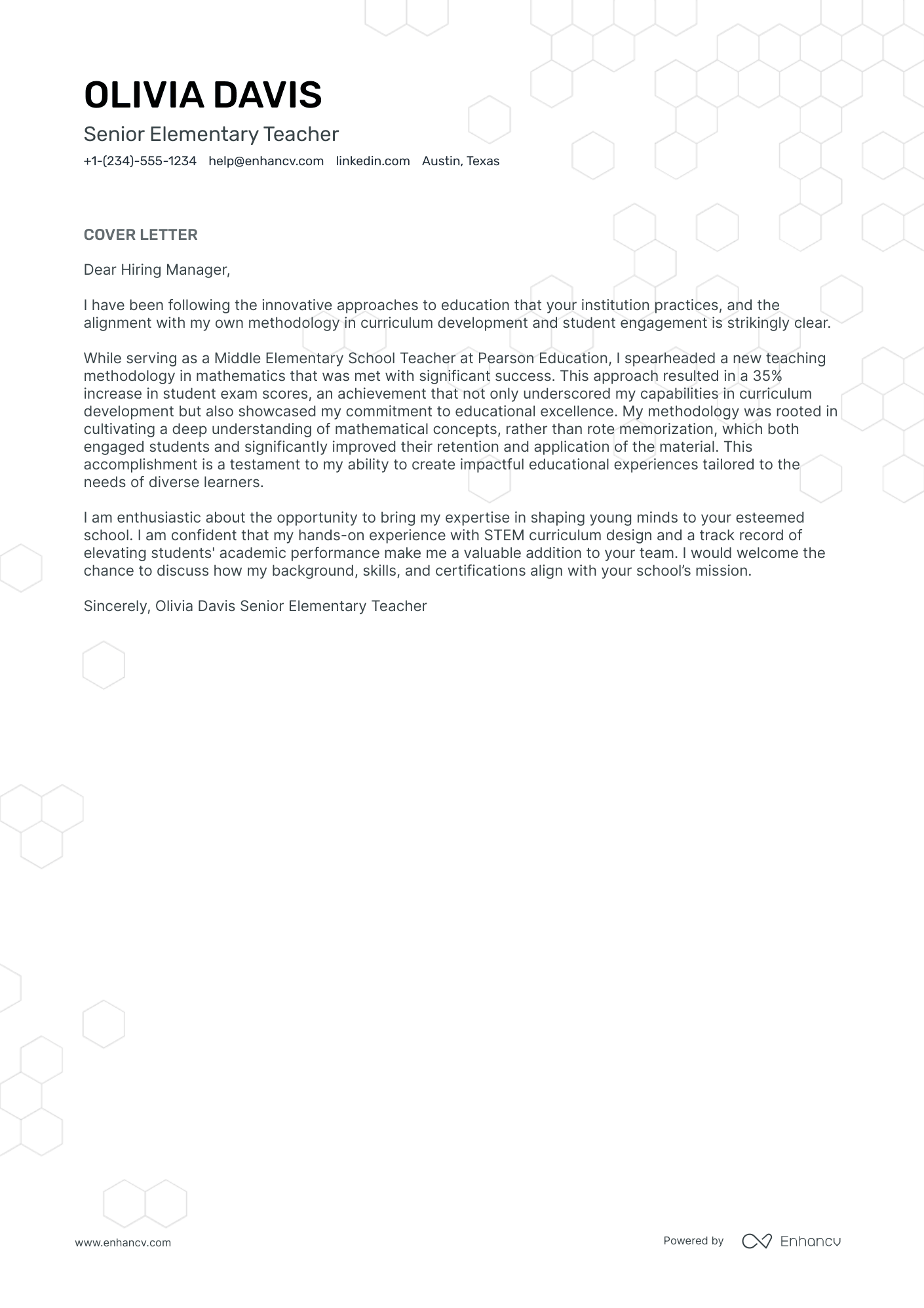
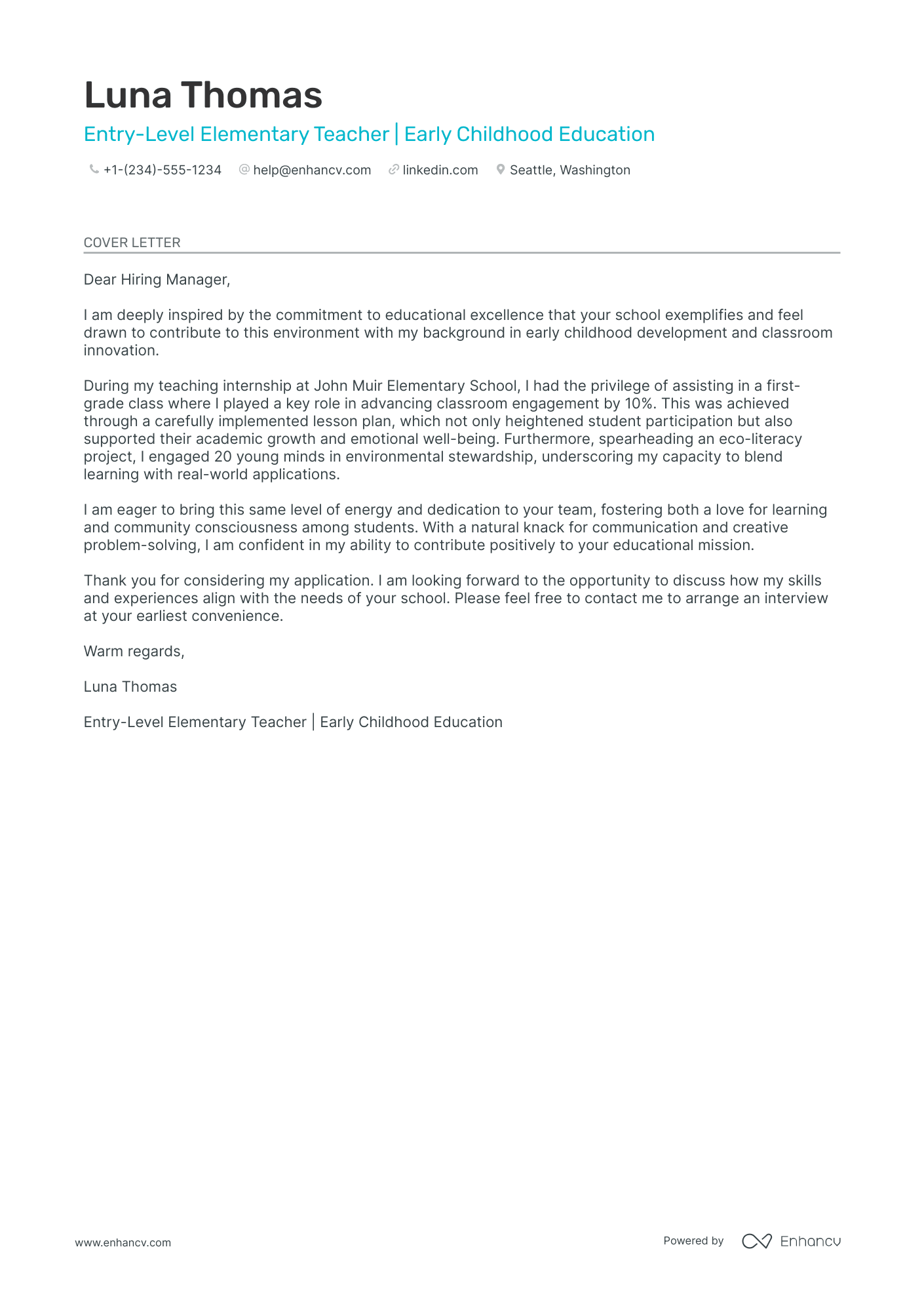
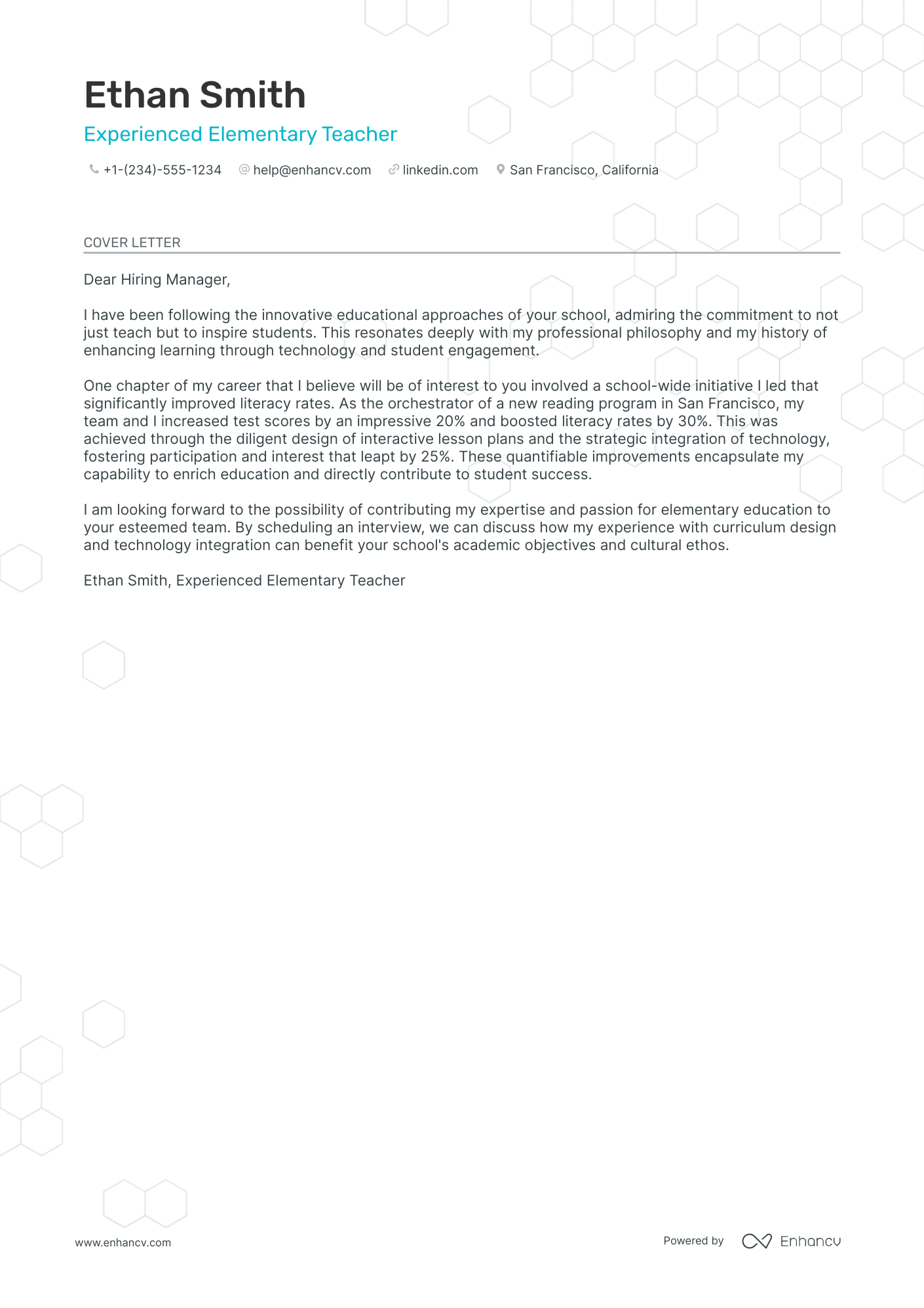
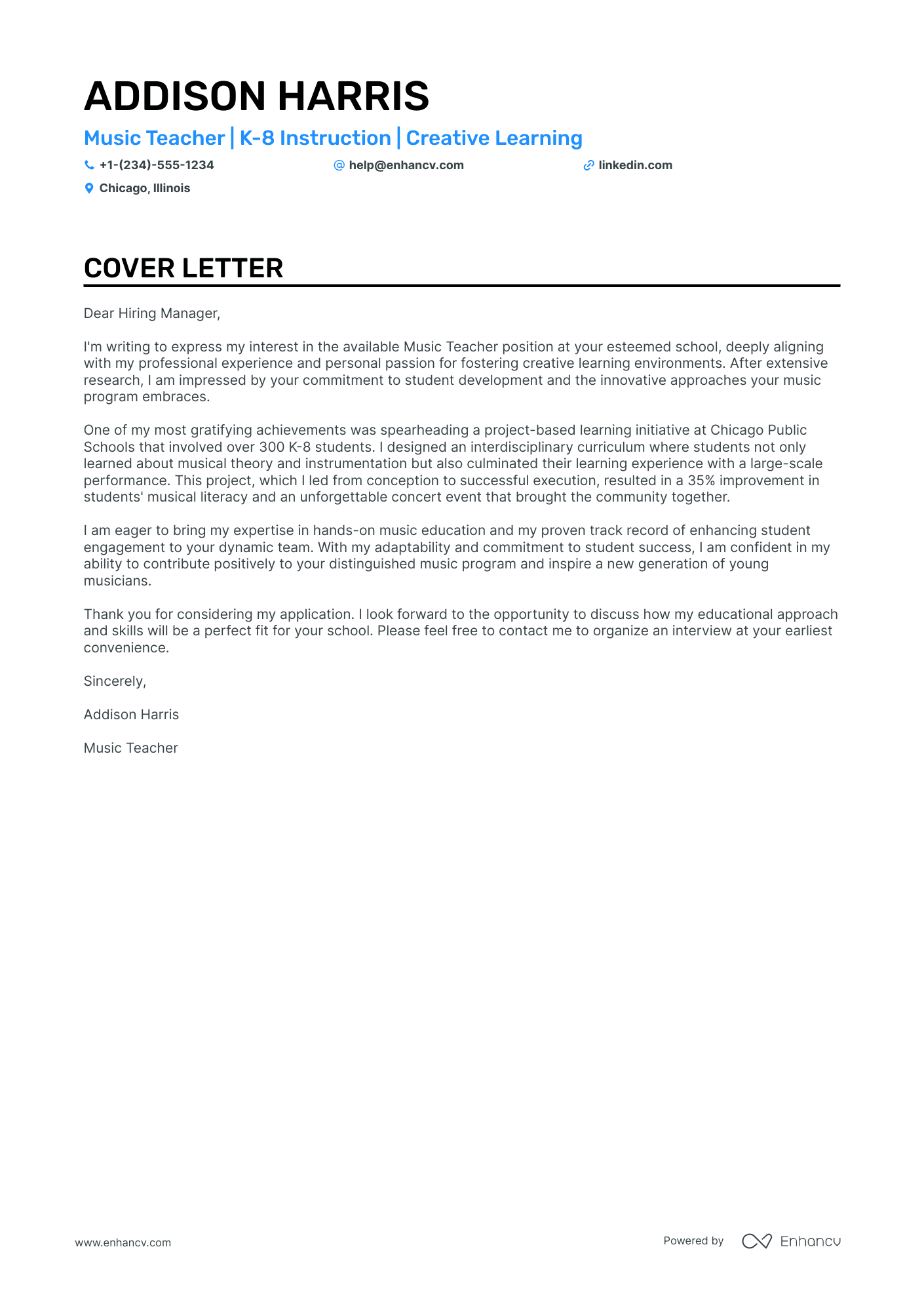
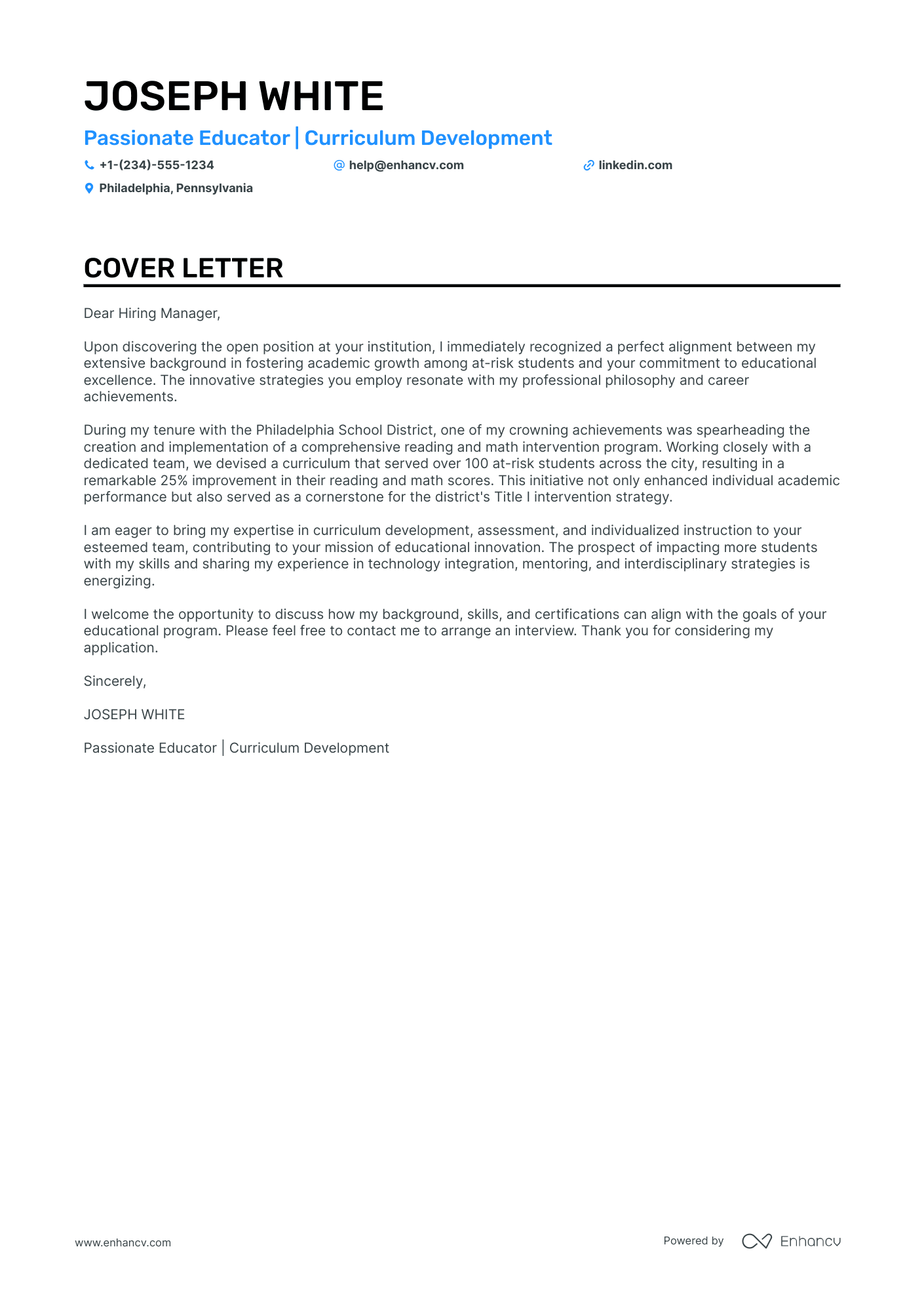
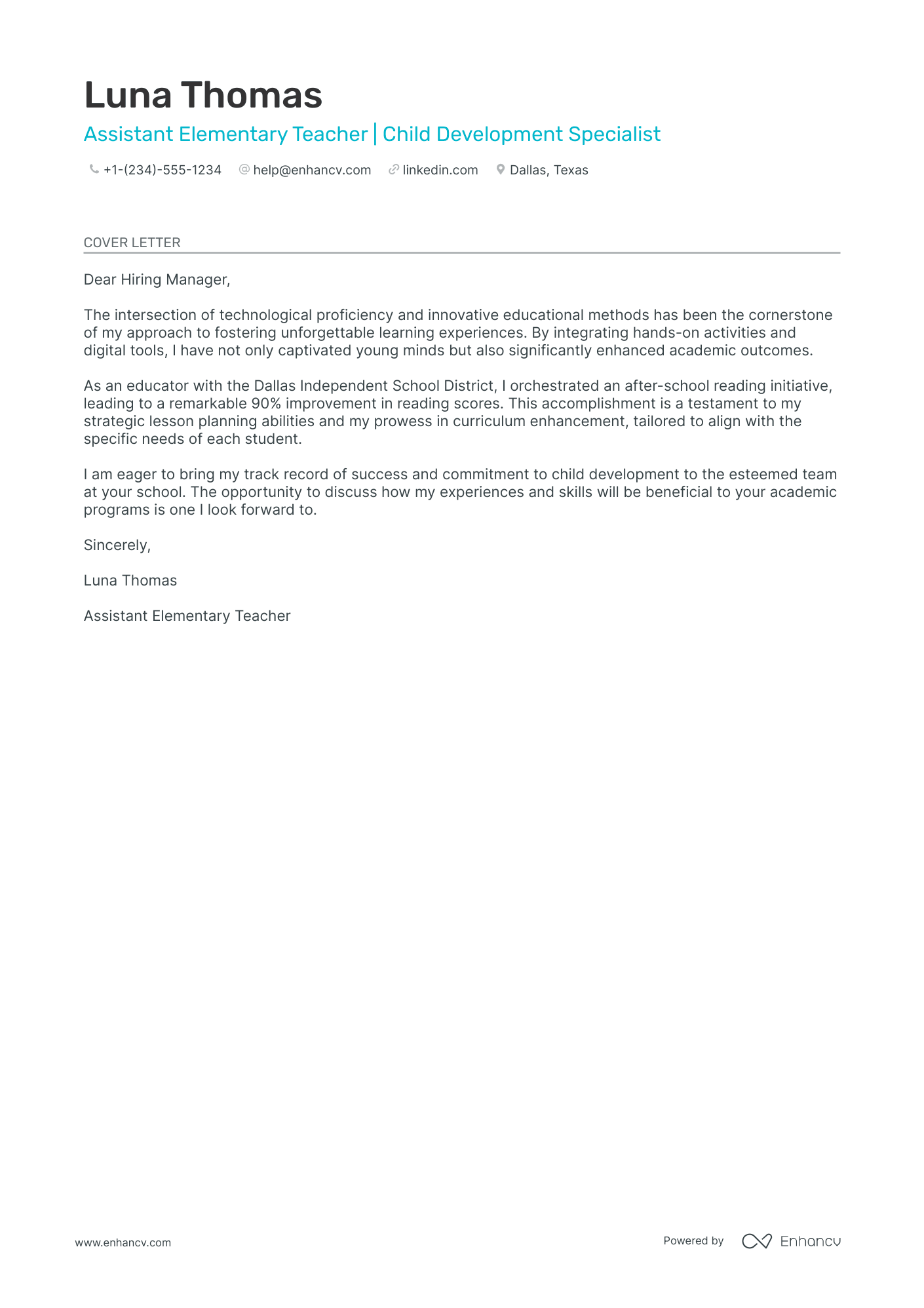
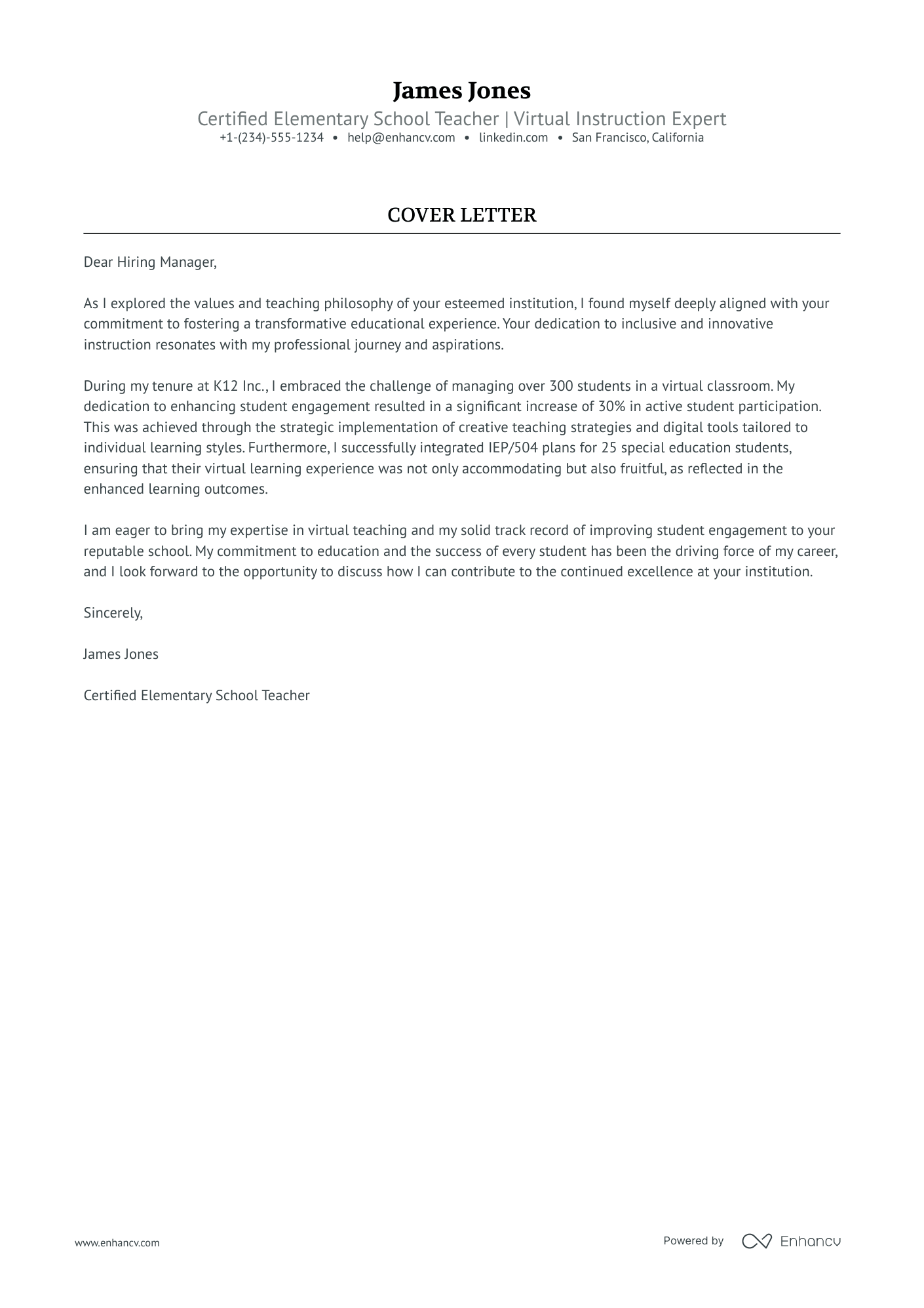
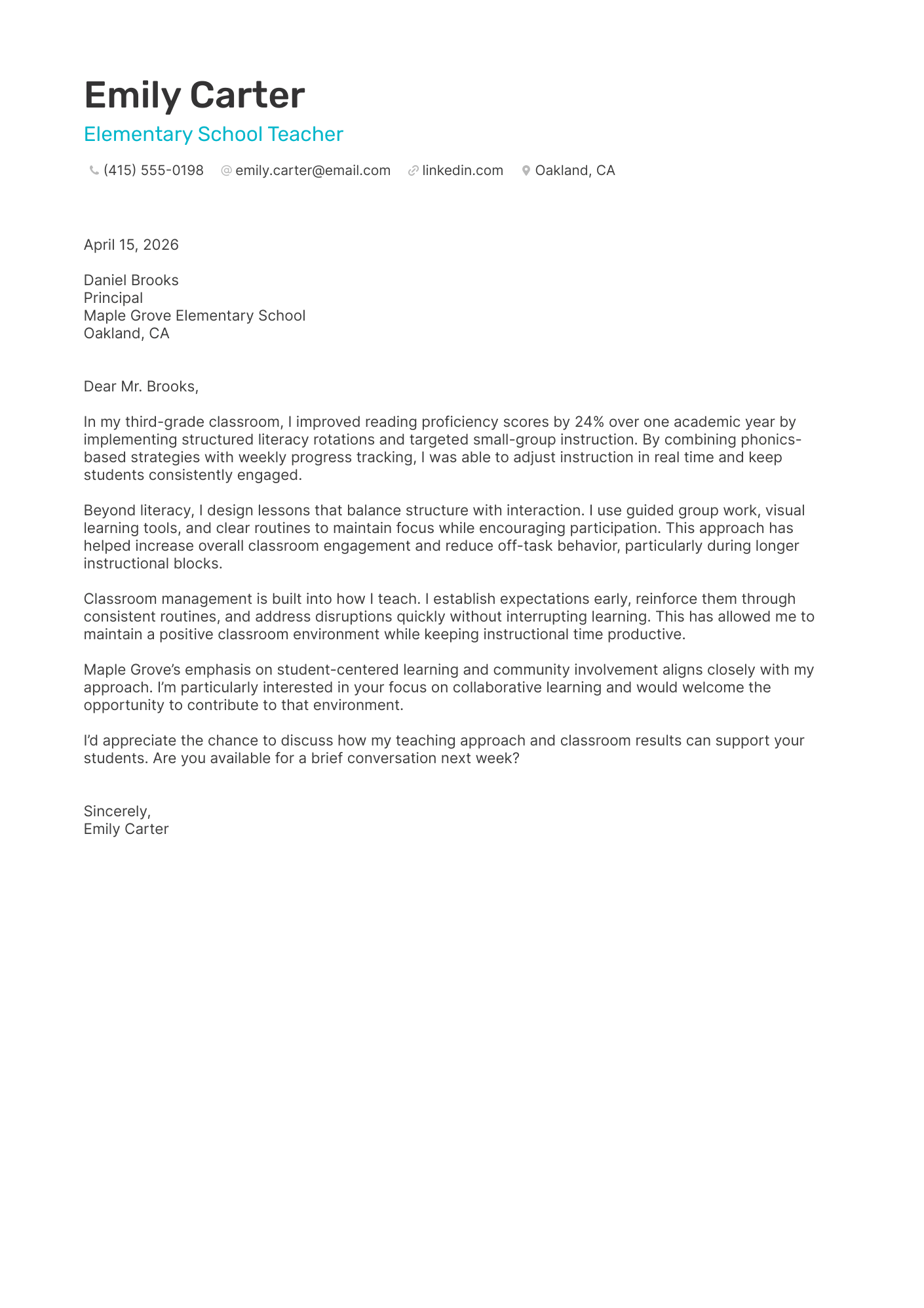
Elementary school teacher cover letter example
Before breaking down structure, it helps to see what a strong elementary teacher cover letter looks like in practice. Let’s take a peek at a cover letter example.
Emily Carter
Oakland, CA
(415) 555-0198
emily.carter@email.com
Daniel Brooks
Principal
Maple Grove Elementary School
Oakland, CA
Emily Carter


Why this works
- Opens with a clear classroom outcome and measurable result.
- Shows teaching approach and student engagement strategy.
- Demonstrates classroom management in context.
- Connects experience to the school’s environment.
- Keeps language clear and focused.
- Ends with a direct next step.
What your elementary school teacher cover letter needs to show
Principals review applications with a simple set of questions in mind. Most candidates answer only one and miss the opportunity to really sell themselves.
1. Can you drive student progress?
- Show measurable outcomes such as reading level improvements, test scores, or engagement gains.
- Explain how your teaching directly impacted student learning, not just what you taught.
- Demonstrate consistency, not just a one-time success.
2. What’s your strongest teaching example?
- Focus on one classroom situation and walk through the full story from challenge to result.
- Explain how you adapted your teaching to meet student needs.
- Include a clear outcome, such as improved participation, behavior, or performance.
3. Why this school?
- Show that you understand the school’s values, curriculum, or student population.
- Reference specific programs, teaching philosophies, or community focus.
- Connect your experience to how the school operates.
4. Can you manage a classroom effectively?
- Demonstrate a structured classroom management approach.
- Show how you create a positive and productive learning environment.
- Prove you can handle challenges without disrupting learning.
Once you understand what principals are looking for, the next step is structuring your cover letter so those signals are easy to spot.
Drop your resume here or choose a file.
PDF & DOCX only. Max 2MB file size.
Sections to include and how to format your cover letter
An elementary school teacher cover letter follows a standard structure—but each section needs to show something specific.
Required sections
- Full header: name, degree, certifications, contact information
- Date and school address
- Named salutation (principal or hiring manager)
- Opening paragraph: role, grade level, key outcome
- Body: teaching example + school alignment
- Closing: availability and next step
- Professional sign-off with credentials
Formatting rules
- Length: one page (300–400 words)
- Font: clean and readable
- Layout: simple and left-aligned
- Structure: easy to scan quickly
A clear structure reflects clear thinking—something principals value immediately.
What recruiters look for in elementary school teacher candidates
Schools look for a combination of instructional skill and classroom control.
What hiring managers scan for first:
- Teaching certification and degree
- Grade-level experience
- Evidence of student progress
- Classroom management approach
- Lesson planning and differentiation
- Alignment with school values
Understanding what schools look for is essential—but it only matters if your letter reaches the right person.
How to address an elementary school teacher cover letter
Most applications are reviewed by principals or school administrators. It’s essential that you address them correctly.

Salutations
Find:
- principal
- assistant principal
- hiring manager
Use:
- “Dear [Principal’s Name]”
- or “Dear [School Name] Hiring Team”
Avoid generic greetings—they signal a lack of effort.
Once your letter reaches the right person, the next step is making sure they keep reading.
Before you draft the opening, make sure the document it ships with is just as sharp—our elementary teacher resume guide shows how to mirror the same classroom outcomes in resume bullet form.
How to open an elementary school teacher cover letter
Your opening should show immediate teaching impact.
Strong opening
In my second-grade classroom, I improved reading proficiency scores by 22% over one academic year by introducing structured literacy rotations and targeted small-group instruction.
Weak opening
I am writing to apply for the Elementary School Teacher position.
How to write the body of your elementary school teacher cover letter
The body is where you show how you teach—not just what you teach.
Paragraph 1: Teaching impact
Structure:
- challenge
- approach
- measurable result
Example of teaching impact
A group of third-grade students entered the year below grade level in reading comprehension. By implementing differentiated instruction and weekly progress tracking, I helped 80% of the class reach or exceed grade-level expectations by year-end.
Paragraph 2: School alignment
Show:
- why this school
- how your experience fits
School alignment example
Your school’s focus on project-based learning aligns with my approach to creating interactive, student-centered lessons that build both academic and social skills.
How to tailor your elementary school teacher cover letter to the job description
Even strong applications get overlooked if they don’t match what the school is asking for.
Most job postings tell you exactly what to highlight—you just need to translate their language into your experience.
Match school posting language to your elementary teacher cover letter
| Job posting says | Your cover letter should include |
|---|---|
| Experience with early literacy instruction. | Specific reading strategies and measurable outcomes. |
| Strong classroom management skills. | Your approach and a real example with results. |
| Ability to differentiate instruction. | How you adapt lessons for different learning levels. |
| Collaboration with parents and staff. | Examples of communication and teamwork. |
| Focus on student engagement. | Techniques you use to keep students involved. |
Why this matters
Most candidates send the same letter everywhere.
Stronger candidates adjust:
- one sentence in the opening
- one example in the body
- one line about the school
That’s enough to show relevance.

PRO TIP
Enhancv’s Tailoring Tool scans a school’s job posting and highlights which parts of your teaching experience to emphasize—saving time when you’re applying to multiple schools or districts.
How to close an elementary school teacher cover letter
Your closing should reinforce your value and suggest a next step.
Strong closing
I’d welcome the opportunity to discuss how my approach to literacy instruction and classroom management can support your students’ growth. I’m available for an interview at your convenience.
Weak closing
Thank you for considering my application. I look forward to hearing from you.
PRO TIP
Use a professional sign-off and include your teaching credential after your name—this immediately signals your qualification to teach at the grade level.
Elementary school teacher cover letter with no experience
Even without full-time teaching experience, you likely have relevant skills.
What counts:
- student teaching
- tutoring
- classroom volunteering
- childcare or group leadership
Good example of someone without experience
During my student teaching placement, I led guided reading sessions for small groups and helped improve reading fluency levels across the class over a 10-week period.
Describe one situation where you:
- Identified a challenge.
- Adapted your approach.
- Achieved a result.
That shows readiness more effectively than stating you’re “eager to teach.”
Frequently asked questions
Even strong teaching candidates hesitate on the details. These are the questions principals and hiring committees indirectly answer when they read your cover letter—and where small improvements make a real difference.
What makes an elementary teacher cover letter stand out?
Specific teaching outcomes.
Strong cover letters:
- Include measurable student progress (reading levels, test scores, engagement).
- Explain how instruction was adapted.
- Show classroom management in action.
Most applicants write about being “engaging” or “dedicated.” Few explain what actually changed in their classroom.
Should I include test scores or student data?
Yes—when used clearly and responsibly.
Instead of:
🔴 “My students improved significantly”
Write:
🟢 “Reading proficiency scores improved by 22% over one academic year”
You don’t need perfect data—but you do need evidence that your teaching works.
How do I show classroom management in a cover letter?
Focus on systems, not personality.
Include:
- How you set expectations.
- How you handle disruption.
- How you maintain consistency.
Classroom management example
I implemented structured routines and clear expectations at the start of each lesson, reducing classroom disruptions and increasing instructional time.
That’s more credible than saying you’re “good with students.”
What’s the biggest mistake candidates make?
Writing a personality-driven letter instead of a results-driven one.
Weak cover letters:
- Focus on passion.
- List responsibilities.
- Use generic language.
Strong cover letters:
- Show one clear teaching example.
- Include measurable outcomes.
- Connect directly to the school.
Principals aren’t looking for enthusiasm—they’re looking for effectiveness.
Do elementary school teachers actually need a cover letter?
Yes—especially in competitive schools.
Many candidates meet the minimum qualifications.

The cover letter displays:
- How you think about teaching.
- How you manage a classroom.
- How you support student growth.
It’s often the difference between being shortlisted—or not.
What should I check before sending my cover letter?
- One clear teaching example is included.
- Student progress or outcomes are measurable.
- The school is named and referenced.
- Classroom management is demonstrated.
- The structure is clean and easy to scan.
If all five are true, you’re ahead of most applicants.
If you're ready to put together the full application, Enhancv's cover letter templates keep everything on one page without any manual formatting. Pair the letter with a strong elementary school teacher resume to give HR everything they need in one package.
Final thoughts
A strong elementary school teacher cover letter isn’t about passion—it’s about proof.
If you clearly show how your teaching improves student outcomes, you make it easy for schools to see your value.
PRO TIP
Structure your cover letter around one clear teaching example with a measurable result. Enhancv’s AI Cover Letter Generator helps you organize your ideas so principals can quickly understand how you make an impact.