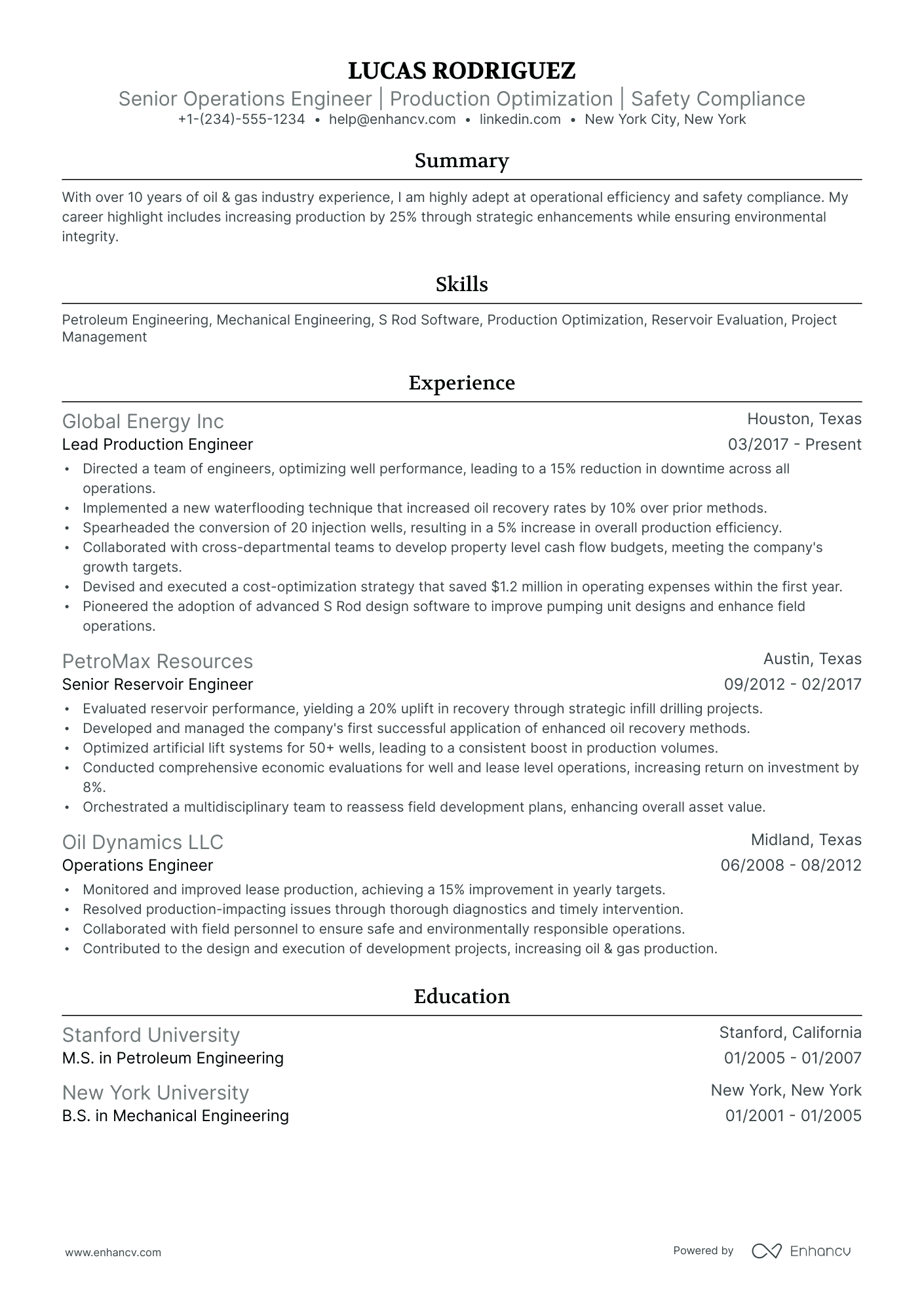
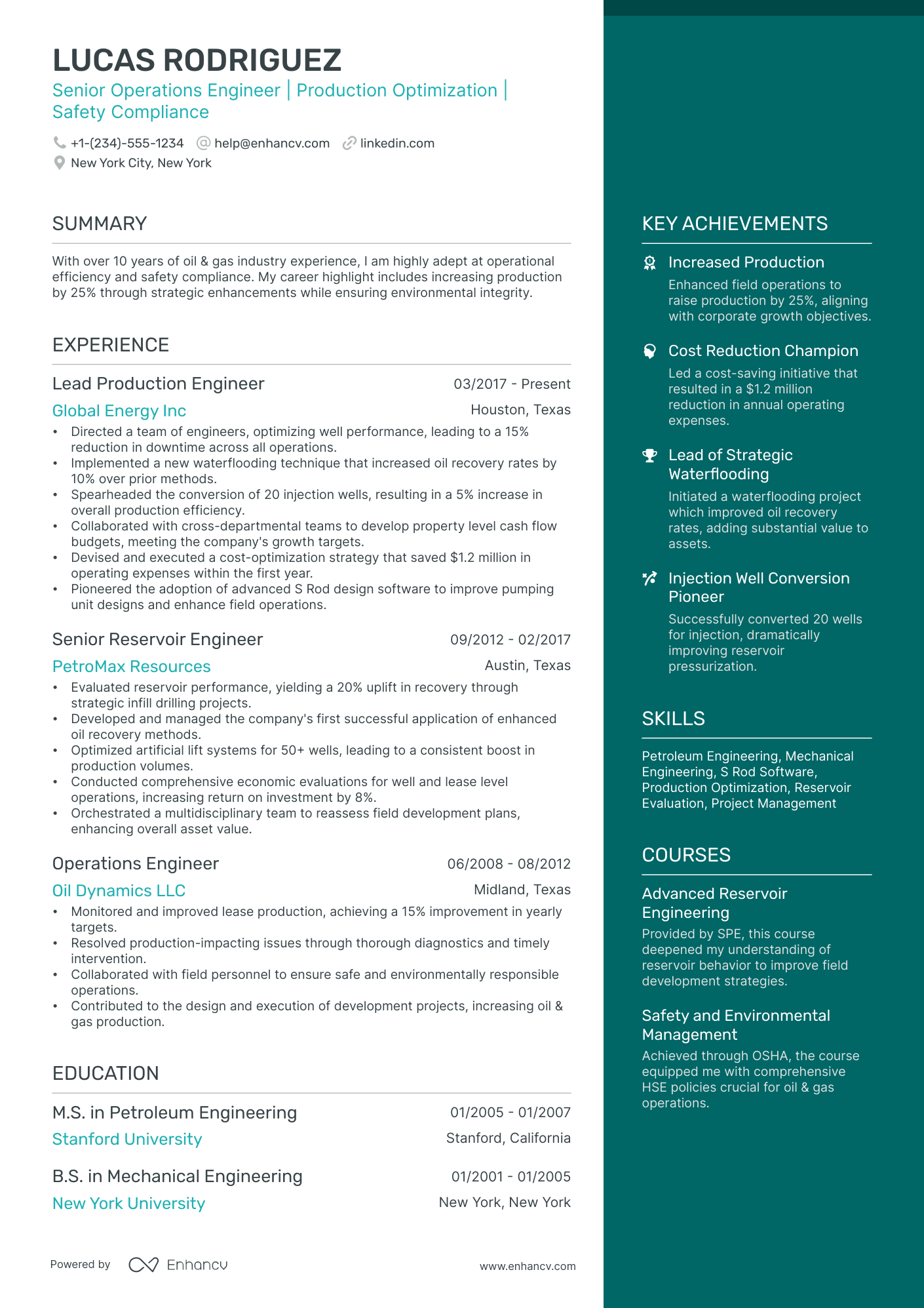
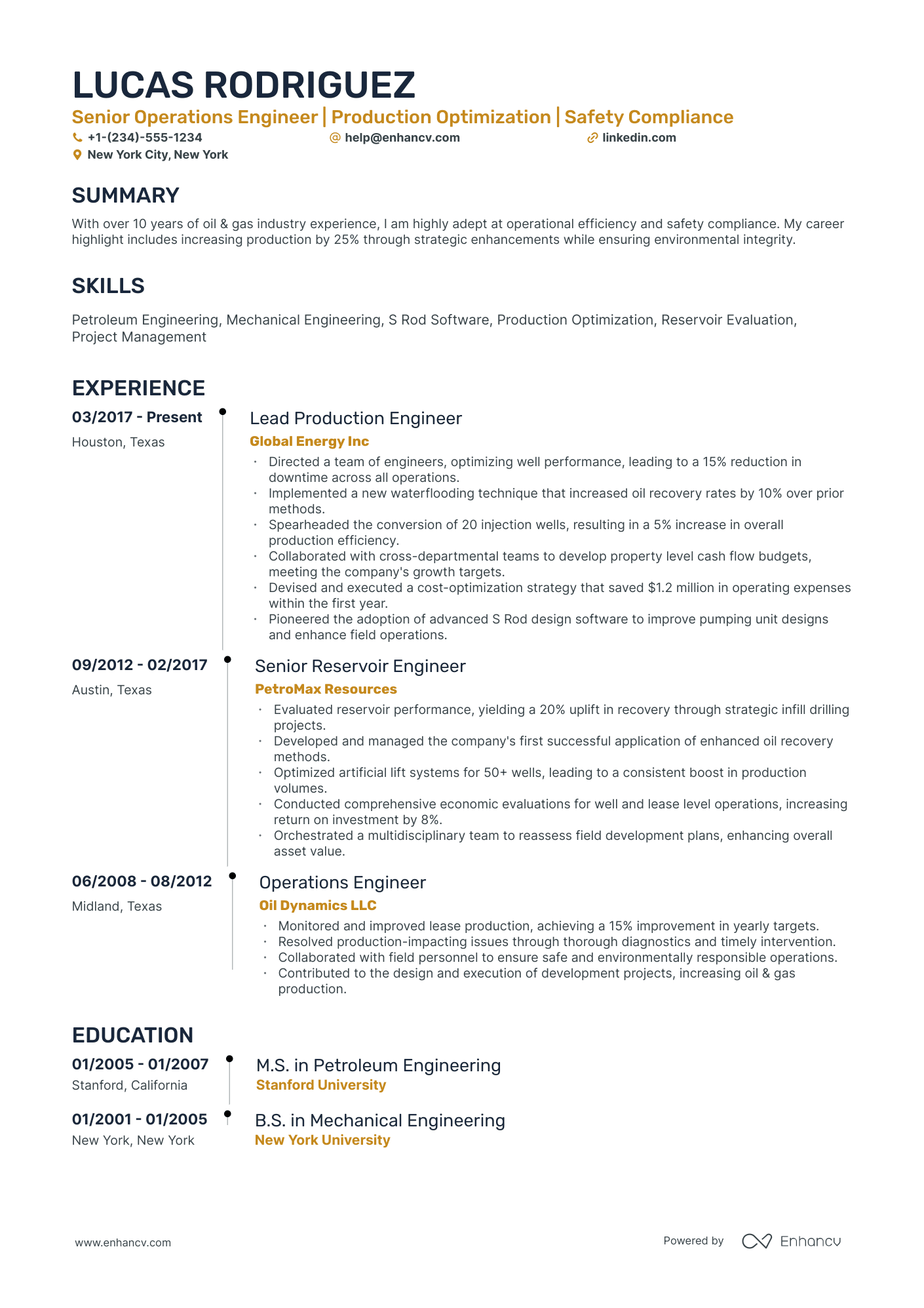
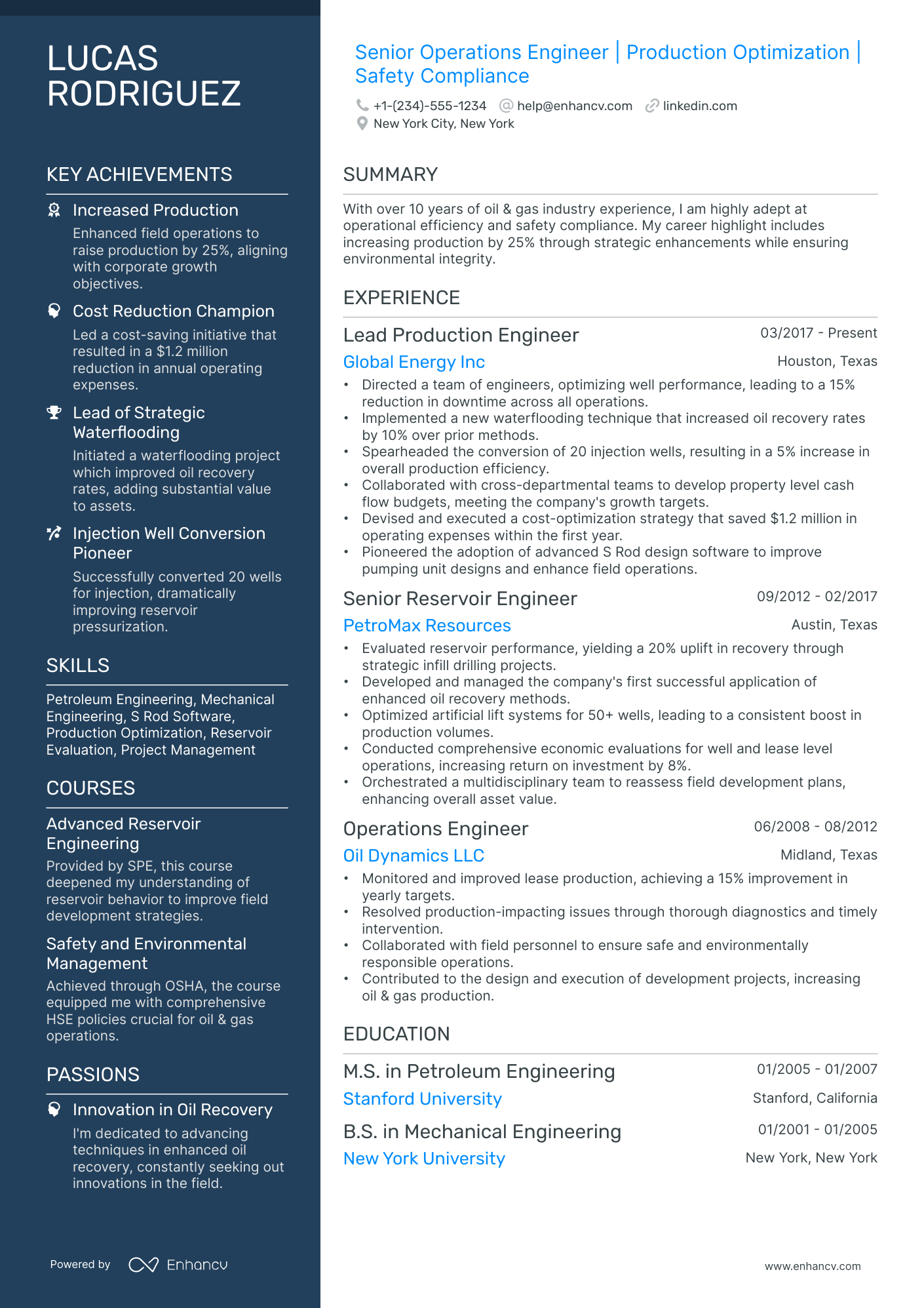
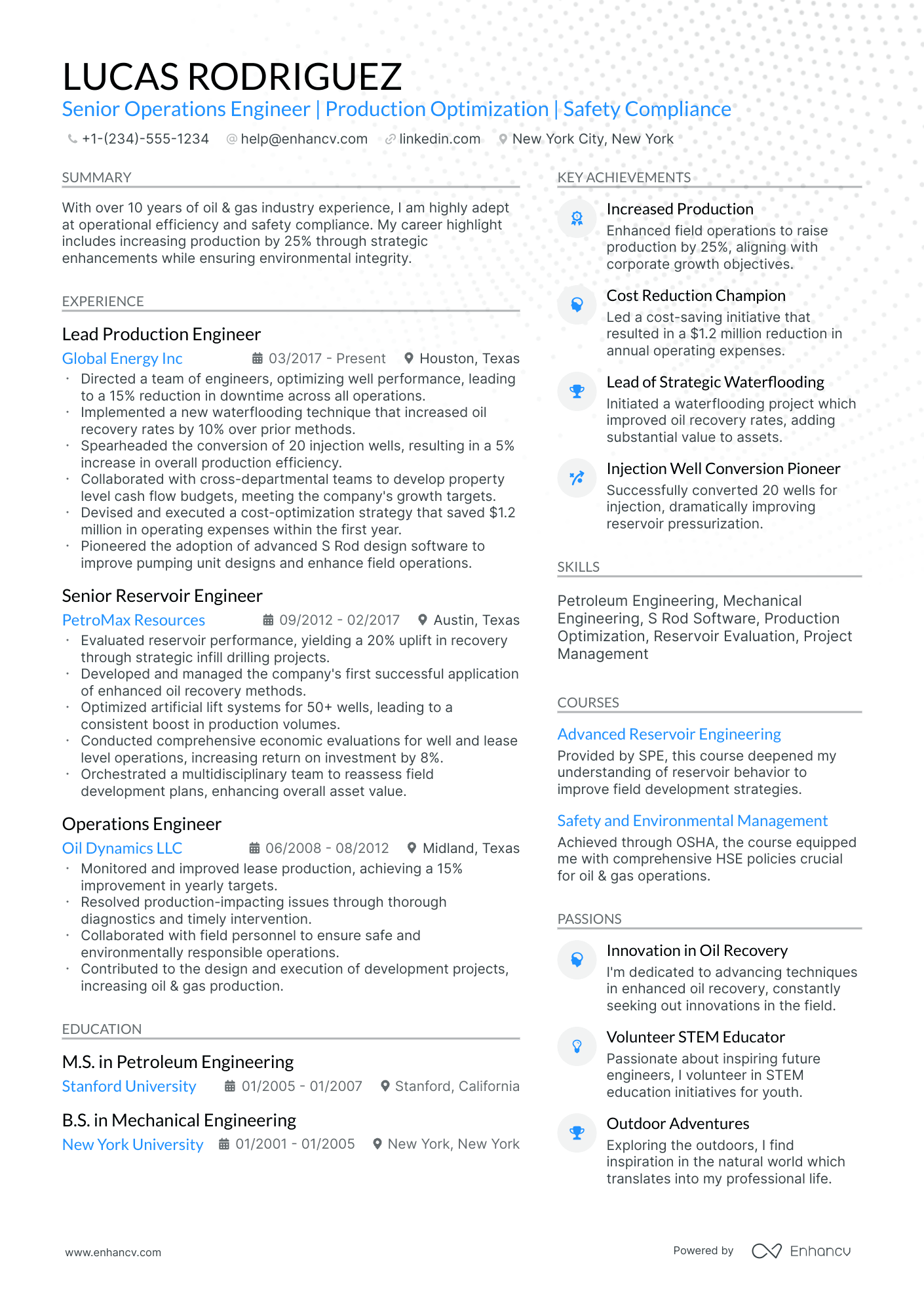
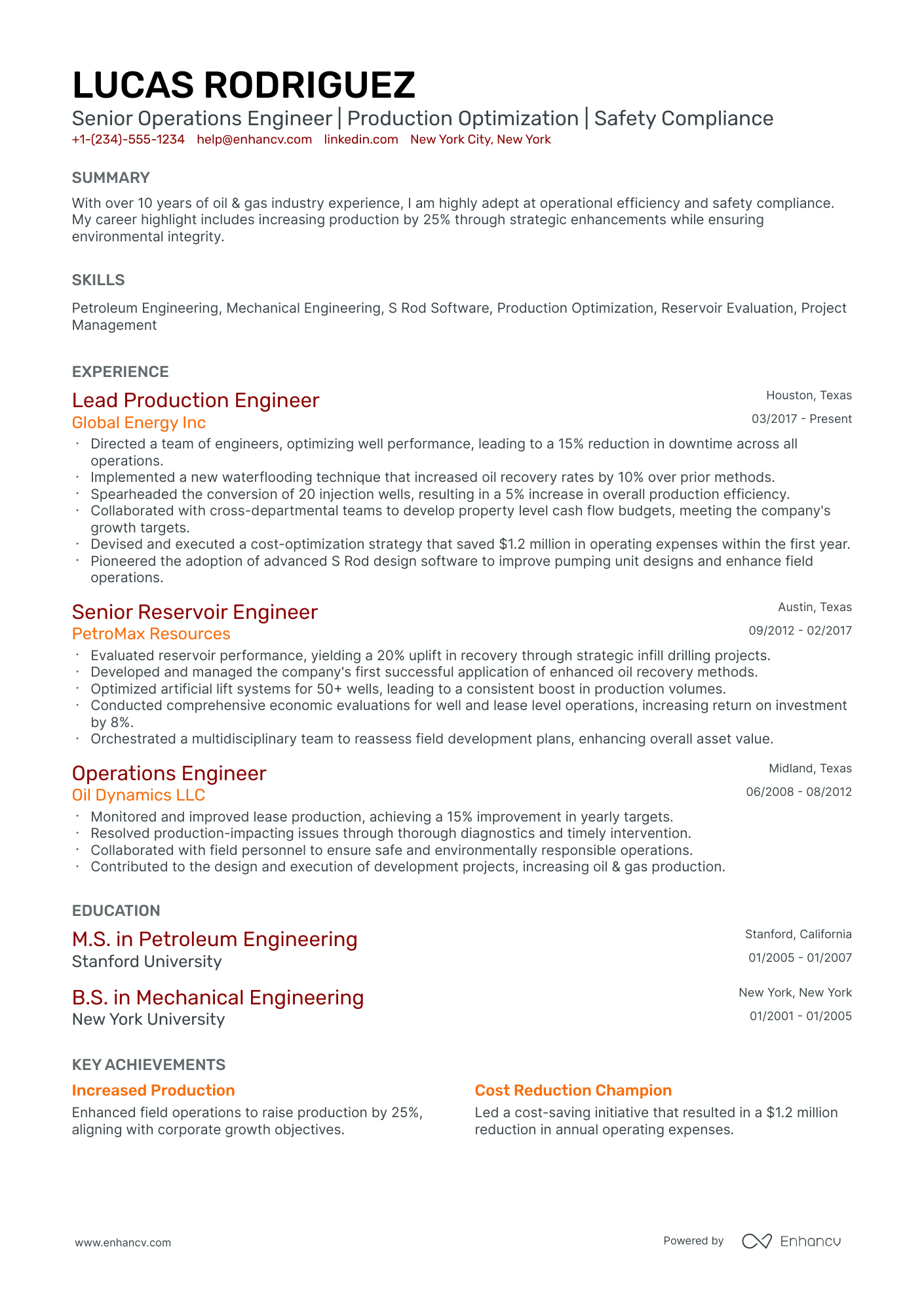
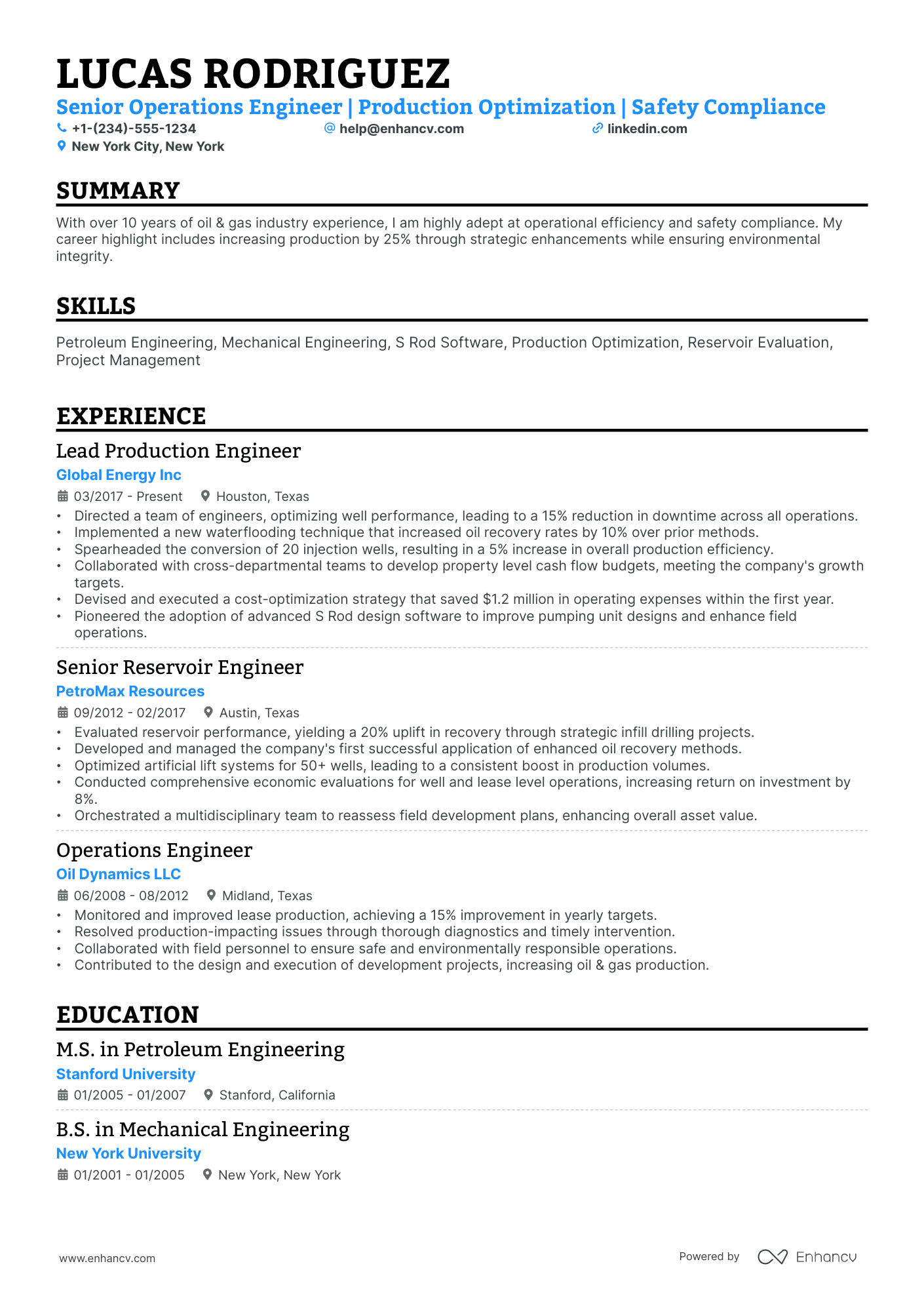
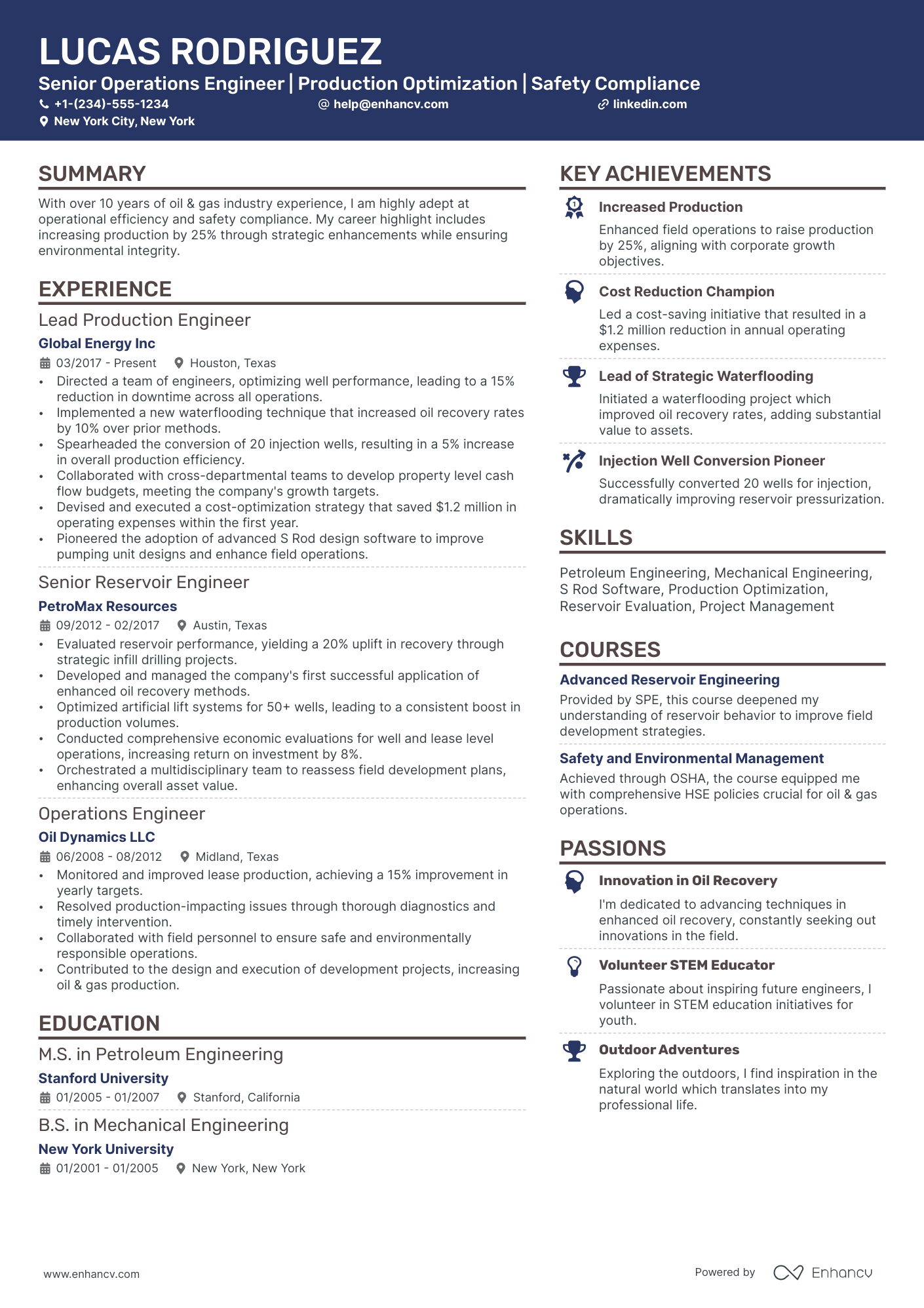
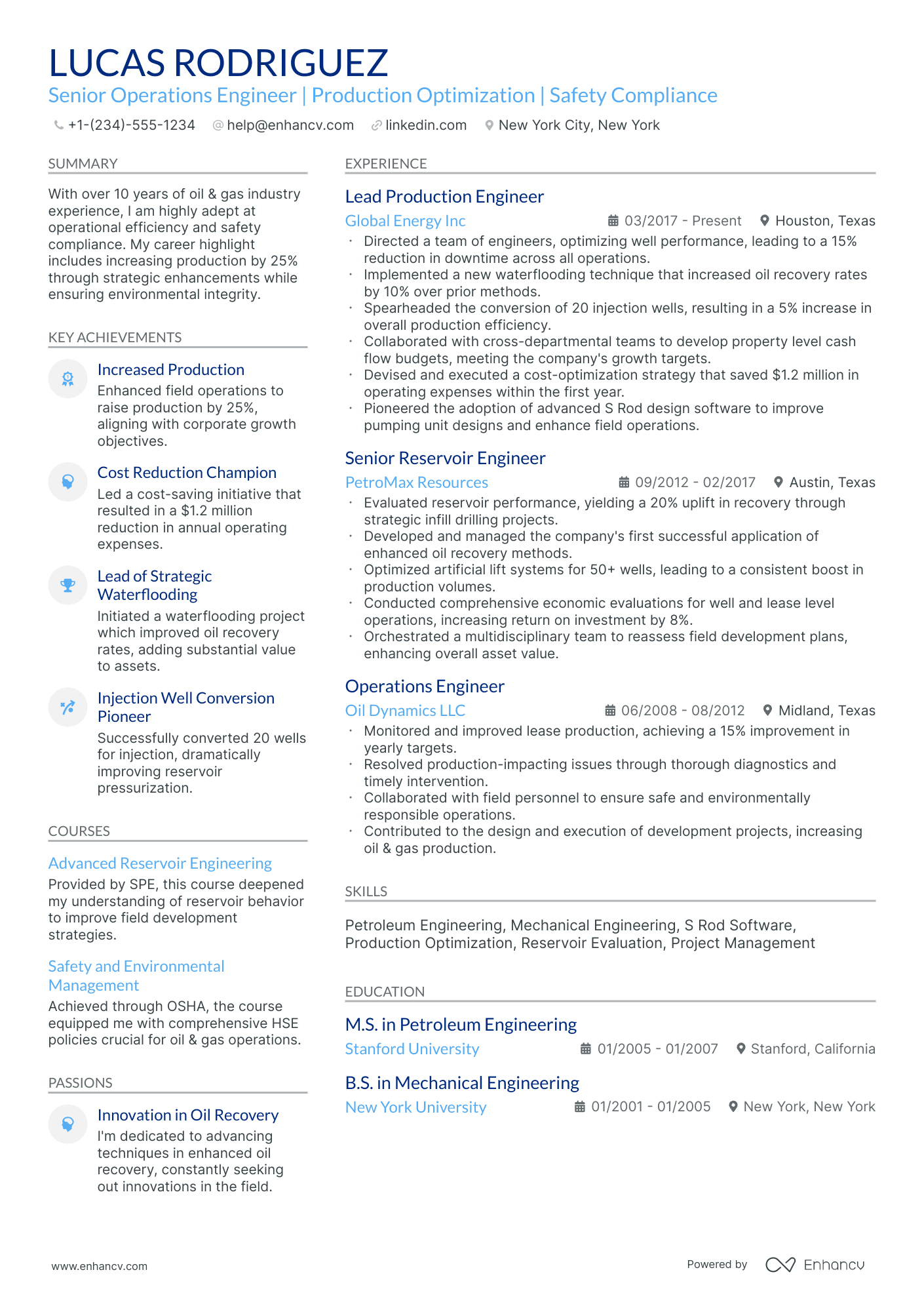
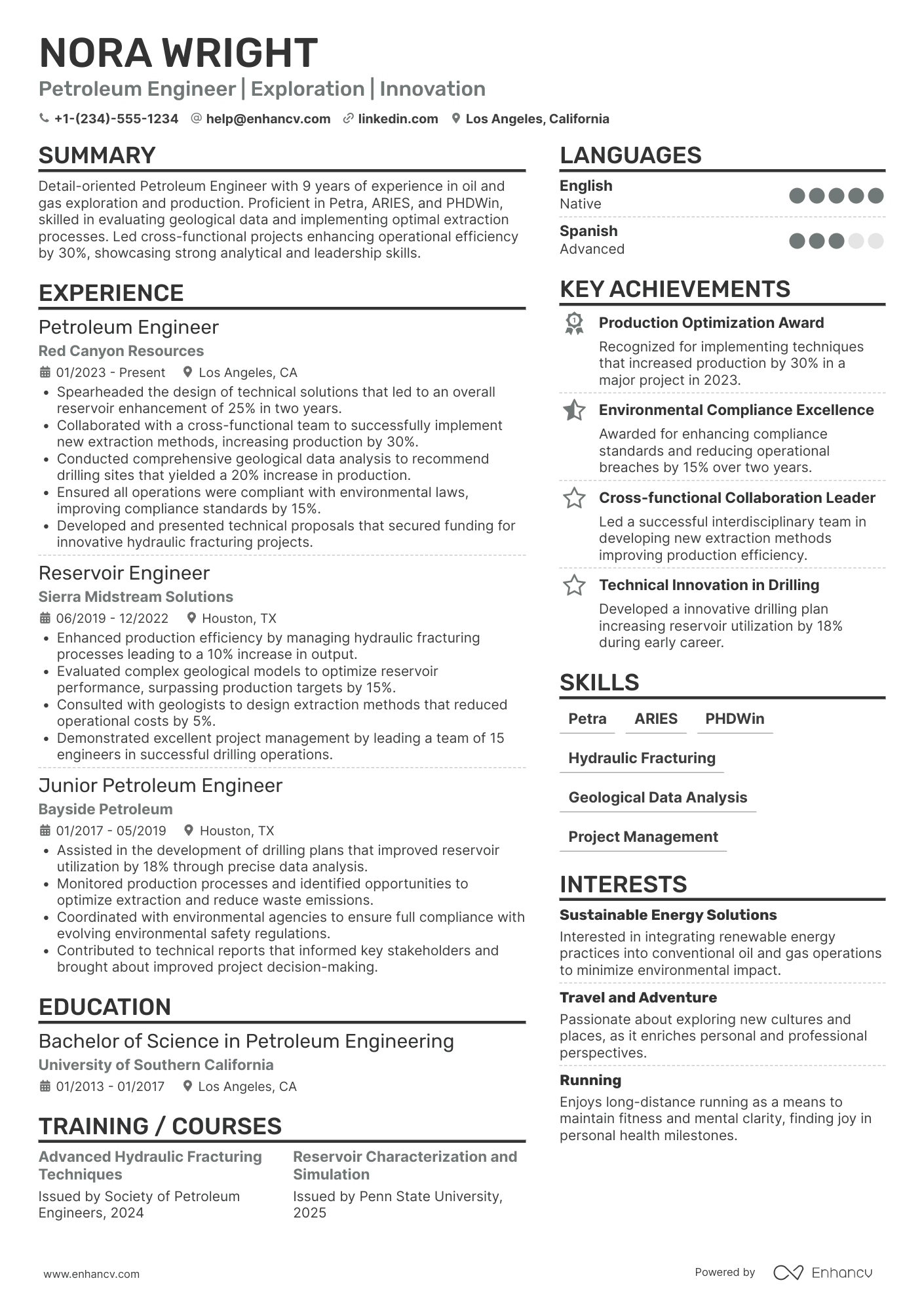
Many petroleum engineer resume drafts fail because they read like project logs, not decision tools. That buries impact and keywords, so ATS screening and fast recruiter scans miss your fit in a crowded market.
A strong resume shows what changed because of you. Understanding how to make your resume stand out starts with highlighting production uplift percentages, drilling days saved, nonproductive time reductions, reserves additions, cost per barrel improvements, HSE incident reductions, and on-time well delivery across defined well counts. Quantify scope, budgets, and reliability gains.

Key takeaways
- Quantify production uplift, cost savings, and drilling efficiency in every experience bullet.
- Use reverse-chronological format for senior roles and hybrid format for career switchers.
- Tailor resume language to match each job posting's tools, basins, and KPIs.
- Place skills above experience if you're junior, below if you're mid-level or senior.
- Tie every listed skill to a measurable outcome in your experience or projects section.
- Use AI to tighten phrasing and surface missing keywords, then stop before it overgeneralizes.
- Build your resume in Enhancv to align structure, metrics, and formatting with recruiter expectations.
How to format a petroleum engineer resume
Recruiters evaluating petroleum engineer resumes prioritize technical depth in reservoir simulation, drilling optimization, and production engineering alongside measurable project outcomes such as cost reductions, recovery improvements, and operational efficiency gains. A clear, well-structured resume format ensures these signals surface quickly during both automated screening and the initial human review.

I have significant experience in this role—which format should I use?
Use a reverse-chronological format to present your deepest and most recent petroleum engineering experience first. Do:
- Lead with your most senior roles, highlighting scope of ownership across field operations, asset management, or multi-basin portfolios.
- Feature role-specific tools and domains prominently—reservoir simulation software (Eclipse, CMG), production optimization platforms, enhanced oil recovery methods, and regulatory compliance frameworks.
- Quantify business impact in every experience entry using metrics tied to production rates, cost savings, reserve growth, or project delivery timelines.
I'm junior or switching into this role—what format works best?
A hybrid format works best, allowing you to lead with a strong technical skills section while still demonstrating relevant experience in chronological order. Do:
- Place core petroleum engineering skills—well testing, PVT analysis, drilling fluids, nodal analysis—near the top of the resume so they're immediately visible to recruiters and applicant tracking systems.
- Include academic projects, internships, or cross-industry experience that demonstrates transferable competencies such as subsurface modeling, data analysis, or field operations support.
- Connect every action to a clear outcome, even in academic or early-career contexts, to show analytical thinking and engineering judgment.
Why not use a functional resume?
A functional format strips away the chronological context that hiring managers rely on to evaluate how your petroleum engineering skills were developed and applied in real operational settings. A functional resume might be acceptable if you're transitioning from a closely related discipline (such as chemical engineering or geosciences) with no direct petroleum engineering work history, but only if every listed skill is tied to a specific project, technical outcome, or measurable result.
Now that you've established a clean, readable layout, it's time to fill it with the right sections that highlight your qualifications as a petroleum engineer.
What sections should go on a petroleum engineer resume
Recruiters expect a petroleum engineer resume to clearly show your field development impact, production results, and technical depth across subsurface and operations. Knowing what to put on a resume ensures you include the right details for maximum impact.
Use this structure for maximum clarity:
- Header
- Summary
- Experience
- Skills
- Projects
- Education
- Certifications
- Optional sections: Publications, Awards, Leadership
Your experience bullets should emphasize measurable production and cost outcomes, project scope, reservoir and well performance improvements, and the results of your technical decisions.
Is your resume good enough?
Drop your resume here or choose a file. PDF & DOCX only. Max 2MB file size.
Once you’ve organized your resume with the right components, the next step is to write your petroleum engineer experience section so it supports that structure with targeted, role-relevant details.
How to write your petroleum engineer resume experience
Your work experience section should demonstrate the reservoir analysis, drilling programs, production optimization, and field development work you've shipped—using role-relevant tools and methods alongside measurable outcomes. Hiring managers prioritize demonstrated impact over descriptive task lists, so every bullet should prove you delivered results rather than simply performed duties.
Each entry should include:
- Job title
- Company and location (or remote)
- Dates of employment (month and year)
Three to five concise bullet points showing what you owned, how you executed, and what outcomes you delivered:
- Ownership scope: the wells, reservoirs, fields, production assets, drilling programs, or completion strategies you were directly accountable for managing or optimizing.
- Execution approach: the simulation software, reservoir modeling tools, enhanced recovery techniques, drilling technologies, or data analysis methods you used to evaluate formations, design well plans, and guide operational decisions.
- Value improved: changes to production rates, recovery factors, drilling efficiency, well integrity, cost per barrel, environmental compliance, or operational safety that resulted from your engineering work.
- Collaboration context: how you coordinated with geologists, geophysicists, drilling contractors, field operations teams, regulatory agencies, or joint venture partners to align subsurface insights with surface-level execution.
- Impact delivered: outcomes expressed through production gains, cost reductions, reserve additions, project delivery timelines, or risk mitigation results rather than descriptions of routine petroleum engineering activities.
Experience bullet formula
A petroleum engineer experience example
✅ Right example - modern, quantified, specific.
Senior Petroleum Engineer (Completions & Production Optimization)
Permian Ridge Energy | Midland, TX
2021–Present
Independent operator developing multi-bench shale assets across the Permian Basin with a focus on capital-efficient growth and low-emissions operations.
- Optimized hydraulic fracturing designs using DFIT, rate transient analysis, and frac diagnostics (fiber optic, microseismic), increasing first-ninety-day oil production by 12% across twenty-two wells.
- Built and maintained decline curve analysis and type-curve models in Aries and Python, improving forecast accuracy by 9% and reducing monthly reserves update cycle time from five days to two days.
- Led cross-functional well reviews with drilling, geoscience, and facilities teams, cutting non-productive time by 18% through revised stage spacing, proppant loading, and perforation strategy.
- Implemented real-time production surveillance in AVEVA PI System and Spotfire dashboards, reducing downtime by 25% and lowering average time-to-detect artificial lift issues from eight hours to two hours.
- Negotiated and executed a chemical and artificial lift optimization program with vendors and field operations, reducing lifting costs by $0.75 per barrel and decreasing corrosion-related failures by 30%.
Now that you've seen how a strong experience section looks in practice, let's break down how to customize yours for each specific job posting.
How to tailor your petroleum engineer resume experience
Recruiters evaluate petroleum engineer resumes through applicant tracking systems and manual review, scanning for alignment between your background and the role's specific demands. Tailoring your resume to the job description ensures your most relevant qualifications surface immediately.
Ways to tailor your petroleum engineer experience:
- Match reservoir simulation software and drilling tools named in the posting.
- Mirror the exact terminology used for completion or production methods.
- Reflect specific KPIs like production rates or recovery factors mentioned.
- Highlight experience in the basin type or formation referenced.
- Emphasize HSE compliance and regulatory standards the role requires.
- Include referenced collaboration models with geoscientists or field teams.
- Align your workflow language with their enhanced oil recovery frameworks.
- Incorporate well intervention or workover techniques listed in the description.
Tailoring means aligning your real accomplishments with what the employer prioritizes, not forcing disconnected keywords into your experience.
Resume tailoring examples for petroleum engineer
| Job description excerpt | Untailored | Tailored |
|---|---|---|
| Design and optimize well completion programs using hydraulic fracturing techniques in unconventional shale reservoirs across the Permian Basin. | Worked on well completions and helped improve production results. | Designed multi-stage hydraulic fracturing completion programs for 40+ horizontal wells in Permian Basin unconventional shale formations, increasing initial production rates by 18%. |
| Conduct reservoir simulation and decline curve analysis using Petrel and Eclipse to forecast production and guide field development planning. | Performed analysis to support production forecasting and planning. | Built and calibrated reservoir simulation models in Petrel and Eclipse, running decline curve analysis across 12 well pads to forecast EUR and inform a $50M field development plan. |
| Collaborate with drilling engineers to reduce nonproductive time and optimize mud weight programs for HPHT wellbore stability. | Assisted with drilling operations and helped reduce downtime. | Partnered with drilling engineers to redesign mud weight programs for high-pressure, high-temperature wells, cutting nonproductive time by 22% across a six-well HPHT campaign. |
Once you’ve aligned your experience with the role’s requirements, quantify your petroleum engineer achievements to show the measurable impact behind that fit.
How to quantify your petroleum engineer achievements
Quantifying your achievements proves field impact beyond responsibilities. Focus on production uplift, decline reduction, drilling and completion efficiency, reliability, safety risk reduction, and cost per barrel improvements across wells, pads, and assets.
Quantifying examples for petroleum engineer
| Metric | Example |
|---|---|
| Production uplift | "Increased oil production by 1,250 barrels per day across eight wells by optimizing gas lift valves and choke settings using Prosper and WellFlo." |
| Drilling efficiency | "Cut average drill-to-total-depth time by 18% on six horizontals by tuning bit/BHA design and real-time parameters in WITSML dashboards." |
| Cost savings | "Reduced completion cost by $1.6M per pad by redesigning plug-and-perf stages and negotiating proppant logistics without lowering stage count." |
| Reliability | "Improved ESP run life from 140 to 210 days by standardizing intake gas handling and setting alarms in the historian for vibration and temperature." |
| Safety risk | "Lowered recordable incident rate by 25% by updating JSA checklists and implementing a permit-to-work audit cadence across three rigs." |
Turn vague job duties into measurable, recruiter-ready resume bullets in seconds with Enhancv's Bullet Point Generator.
With strong, measurable bullet points in place, the next step is ensuring your skills section highlights the right mix of technical and interpersonal strengths employers expect from a petroleum engineer.
How to list your hard and soft skills on a petroleum engineer resume
Your skills section shows you can evaluate reservoirs, design wells, and optimize production—recruiters and ATS scan this section to match you to the job post, so aim for a balanced mix of role-specific hard skills and execution-focused soft skills. petroleum engineer roles require a blend of:
- Product strategy and discovery skills.
- Data, analytics, and experimentation skills.
- Delivery, execution, and go-to-market discipline.
- Soft skills.
Your skills section should be:
- Scannable (bullet-style grouping).
- Relevant to the job post.
- Backed by proof in experience bullets.
- Updated with current tools.
Place your skills section:
- Above experience if you're junior or switching careers.
- Below experience if you're mid/senior with strong achievements.

Hard skills
- Reservoir simulation: Eclipse, CMG
- Decline curve analysis, type curves
- Material balance, volumetrics
- Nodal analysis, well performance
- Artificial lift design and optimization
- Well test analysis, pressure transient
- Drilling hydraulics, torque and drag
- Wellbore integrity, casing design
- Production surveillance, SCADA data
- PVT analysis, fluid characterization
- Integrated asset modeling
- Reserves estimation, SEC reporting
Soft skills
- Cross-functional alignment with drilling and operations
- Risk-based decision-making under uncertainty
- Clear technical writing for field and leadership
- Structured problem solving in root-cause reviews
- Ownership of production targets and action plans
- Prioritization across wells and workovers
- Stakeholder management with service companies
- Data-driven tradeoff communication
- Safety-first planning and stop-work authority
- Rapid escalation and issue triage in the field
- Mentoring technicians and junior engineers
- Constructive challenge in peer reviews
How to show your petroleum engineer skills in context
Skills shouldn't live only in a bulleted list on your resume. Explore resume skills examples to see how top candidates integrate their abilities throughout every section.
They should be demonstrated in:
- Your summary (high-level professional identity)
- Your experience (proof through outcomes)
Here's what that looks like in practice.
Summary example
Senior petroleum engineer with 12 years in reservoir simulation and production optimization. Skilled in Eclipse, Petrel, and nodal analysis. Led waterflood redesign across three mature fields, boosting recovery rates by 14% while cutting lifting costs.
- Reflects senior-level expertise clearly
- Names industry-standard tools directly
- Quantifies impact with real metrics
- Signals leadership and collaboration
Experience example
Senior Reservoir Engineer
Meridian Energy Partners | Houston, TX
June 2018–Present
- Optimized waterflood injection strategies using Eclipse and Petrel, increasing field recovery by 11% across 40 wells.
- Collaborated with drilling and completions teams to redesign well spacing, reducing per-well development costs by $1.2 million.
- Built decline curve analysis models that improved EUR forecasting accuracy by 18%, guiding annual capital allocation decisions.
- Every bullet includes measurable proof
- Skills surface naturally through outcomes
Once you’ve tied your technical abilities to specific coursework, projects, and results, the next step is applying that approach to a petroleum engineer resume with no experience.
How do I write a petroleum engineer resume with no experience
Even without full-time experience, you can demonstrate readiness through building a strong resume without work experience that leverages academic and extracurricular achievements:
- Senior design reservoir simulation project
- Well log interpretation lab reports
- Drilling hydraulics coursework calculations
- Production decline analysis case study
- Internship in energy operations
- Society of Petroleum Engineers membership leadership
- Research assistantship in enhanced recovery
- Field visit reports to rigs
Focus on:
- Reservoir modeling and forecasting results
- Well planning and drilling calculations
- Data analysis with industry tools
- Safety and regulatory documentation exposure
Resume format tip for entry-level petroleum engineer
Use a skills-first hybrid resume format. It highlights technical projects and coursework while still showing internships, research, and leadership in a clear timeline. Do:
- Lead with a technical skills section.
- List projects with tools and outputs.
- Quantify results using clear metrics.
- Add relevant coursework with outcomes.
- Include certifications and safety training.
- Built a CMG reservoir simulation model from core and log data, ran sensitivity cases, and improved oil recovery forecast accuracy by 12% versus baseline assumptions.
Even without professional experience, your education section can carry significant weight on your resume—so presenting it strategically is essential.
How to list your education on a petroleum engineer resume
Your education section lets hiring teams confirm you hold the technical foundation a petroleum engineer needs. It validates core engineering knowledge and relevant academic training quickly.
Include:
- Degree name
- Institution
- Location
- Graduation year
- Relevant coursework (for juniors or entry-level candidates)
- Honors & GPA (if 3.5 or higher)
Skip month and day details—list the graduation year only.
Here's a strong education entry tailored for a petroleum engineer resume.
Example education entry
Bachelor of Science in Petroleum Engineering
Texas A&M University, College Station, TX
Graduated 2022
GPA: 3.7/4.0
- Relevant Coursework: Reservoir Engineering, Drilling Engineering, Production Optimization, Petrophysics, Fluid Mechanics
- Honors: Magna Cum Laude, Dean's List (six semesters)
How to list your certifications on a petroleum engineer resume
Certifications on your resume show your commitment to learning, confirm tool proficiency, and signal industry relevance as a petroleum engineer, especially in safety, well operations, and subsurface workflows.
Include:
- Certificate name
- Issuing organization
- Year
- Optional: credential ID or URL
- Place certifications below education when they are older, less relevant, or secondary to your degree and core petroleum engineer experience.
- Place certifications above education when they are recent, highly relevant, or required for the petroleum engineer roles you target.
Best certifications for your petroleum engineer resume
- IWCF Well Control Certification
- IADC WellSharp Well Control Certification
- API 510 Pressure Vessel Inspector
- API 570 Piping Inspector
- API 653 Aboveground Storage Tank Inspector
- NACE CIP Level 1 Coating Inspector
- OSHA 30-Hour General Industry
Once you’ve positioned your credentials where hiring managers will see them, turn to your petroleum engineer resume summary to quickly connect those qualifications to the value you bring.
How to write your petroleum engineer resume summary
Your resume summary is the first thing a recruiter reads. A strong one immediately signals you're qualified for the petroleum engineer role.
Keep it to three to four lines, with:
- Your title and relevant years of engineering experience.
- Domain focus, such as upstream operations, reservoir management, or drilling optimization.
- Core tools and skills like Eclipse, Petrel, PROSPER, nodal analysis, or decline curve analysis.
- One or two quantified achievements that demonstrate measurable impact.
- Soft skills tied to real outcomes, such as cross-functional collaboration that reduced project timelines.

PRO TIP
At this level, focus on technical proficiency, relevant coursework or internships, and any early contributions to real projects. Highlight specific tools you've used and results you helped achieve. Avoid vague phrases like "passionate self-starter" or "eager to learn." Recruiters want concrete skills and measurable impact, not motivation statements.
Example summary for a petroleum engineer
Entry-level petroleum engineer with hands-on Petrel and Eclipse experience from two internships. Assisted in optimizing well placement models, contributing to a 9% production increase across three pilot wells.
Optimize your resume summary and objective for ATS
Drop your resume here or choose a file.
PDF & DOCX only. Max 2MB file size.
Now that your summary captures your professional value, make sure recruiters can easily reach you by setting up a clear, complete header.
What to include in a petroleum engineer resume header
A resume header lists your key identifiers and contact details, helping petroleum engineer candidates boost visibility, establish credibility, and pass recruiter screening fast.
Essential resume header elements
- Full name
- Tailored job title and headline
- Location
- Phone number
- Professional email
- GitHub link
- Portfolio link
A LinkedIn link helps recruiters verify experience quickly and supports screening with consistent dates, titles, and project details.
Don't include a photo on a petroleum engineer resume unless the role is explicitly front-facing or appearance-dependent.
Keep your header on one to two lines, use a job-matched title, and ensure every link works on mobile and desktop.
Example
Petroleum engineer resume header
Jordan Taylor
Petroleum engineer | Reservoir engineering and production optimization
Houston, TX
(713) 555-01XX
jordan.taylor@enhancv.com github.com/jordantaylor yourwebsite.com linkedin.com/in/jordantaylor
Once your contact details and key identifiers are in place, add relevant additional sections to round out your petroleum engineer resume and support the rest of your content.
Additional sections for petroleum engineer resumes
Adding extra sections helps you stand out when your core qualifications match other candidates, especially for roles requiring niche expertise or international experience.
- Languages
- Publications and technical papers
- Professional affiliations (such as SPE membership)
- Certifications and licenses
- Field training and HSE courses
- Conferences and industry presentations
- Volunteer work in STEM education
Once you've strengthened your resume with relevant additional sections, pairing it with a well-crafted cover letter can further set your application apart.
Do petroleum engineer resumes need a cover letter
A cover letter isn't required for a petroleum engineer, but it often helps. If you're unsure what a cover letter is and how it supports your application, it matters most for competitive roles, selective operators, and teams with strict hiring expectations. It can make a difference when your resume needs context.
Use a cover letter when you can add clear value:
- Explain role and team fit by connecting your reservoir, drilling, or production focus to the role's priorities and workflows.
- Highlight one or two relevant projects with outcomes, such as improved recovery, reduced nonproductive time, or lower lifting costs.
- Show you understand the business context by referencing the asset, basin, operating constraints, safety culture, and key performance metrics.
- Address career transitions or non-obvious experience by explaining your path from research, field service, or adjacent disciplines into petroleum engineer work.
Drop your resume here or choose a file.
PDF & DOCX only. Max 2MB file size.
Even if you decide a separate letter won’t add value to your application, you can use AI to improve your petroleum engineer resume by sharpening the content and tailoring it to the role.
Using AI to improve your petroleum engineer resume
AI can sharpen your resume's clarity, structure, and impact. It helps tighten language and highlight measurable results. But overuse strips authenticity. Once your content reads clearly and aligns with real petroleum engineer responsibilities, step away from AI. If you're wondering which AI is best for writing resumes, focus on tools that support editing over generating content from scratch.
Here are 10 practical prompts to strengthen specific sections of your petroleum engineer resume:
- Strengthen your summary. "Rewrite my petroleum engineer resume summary to highlight my top three technical strengths and years of field experience in under four sentences."
- Quantify experience bullets. "Review my petroleum engineer experience bullets and suggest where I can add specific metrics like production increases, cost savings, or efficiency gains."
- Tighten bullet phrasing. "Shorten each petroleum engineer experience bullet to one concise line using strong action verbs and removing filler words."
- Align skills strategically. "Compare my petroleum engineer skills section against this job description and identify missing technical keywords I should add."
- Improve project descriptions. "Rewrite my petroleum engineer project descriptions to emphasize scope, my specific role, and measurable outcomes."
- Clarify education details. "Refine my petroleum engineer education section to highlight relevant coursework, honors, and research that support this target role."
- Showcase certifications clearly. "Reorganize my petroleum engineer certifications section by relevance to upstream operations and include issuing bodies and dates."
- Remove redundant content. "Identify and remove any repeated or overlapping information across all sections of my petroleum engineer resume."
- Tailor for reservoir focus. "Adjust my petroleum engineer resume bullets to emphasize reservoir simulation, well testing, and production optimization experience."
- Strengthen action verbs. "Replace weak or passive verbs in my petroleum engineer experience section with specific, high-impact alternatives relevant to oil and gas."
Stop using AI once your resume sounds accurate, specific, and aligned with real experience. AI should never invent experience or inflate claims—if it didn't happen, it doesn't belong here.
Conclusion
A strong petroleum engineer resume shows measurable outcomes, role-specific skills, and a clear structure. Use metrics to prove impact on production, recovery, costs, safety, and uptime. Keep sections easy to scan, and align each bullet with the role.
This approach signals readiness for today’s hiring market and near-future needs. It helps recruiters see how you solve field and reservoir problems, collaborate across teams, and deliver results under constraints. Keep it focused, accurate, and consistent throughout.