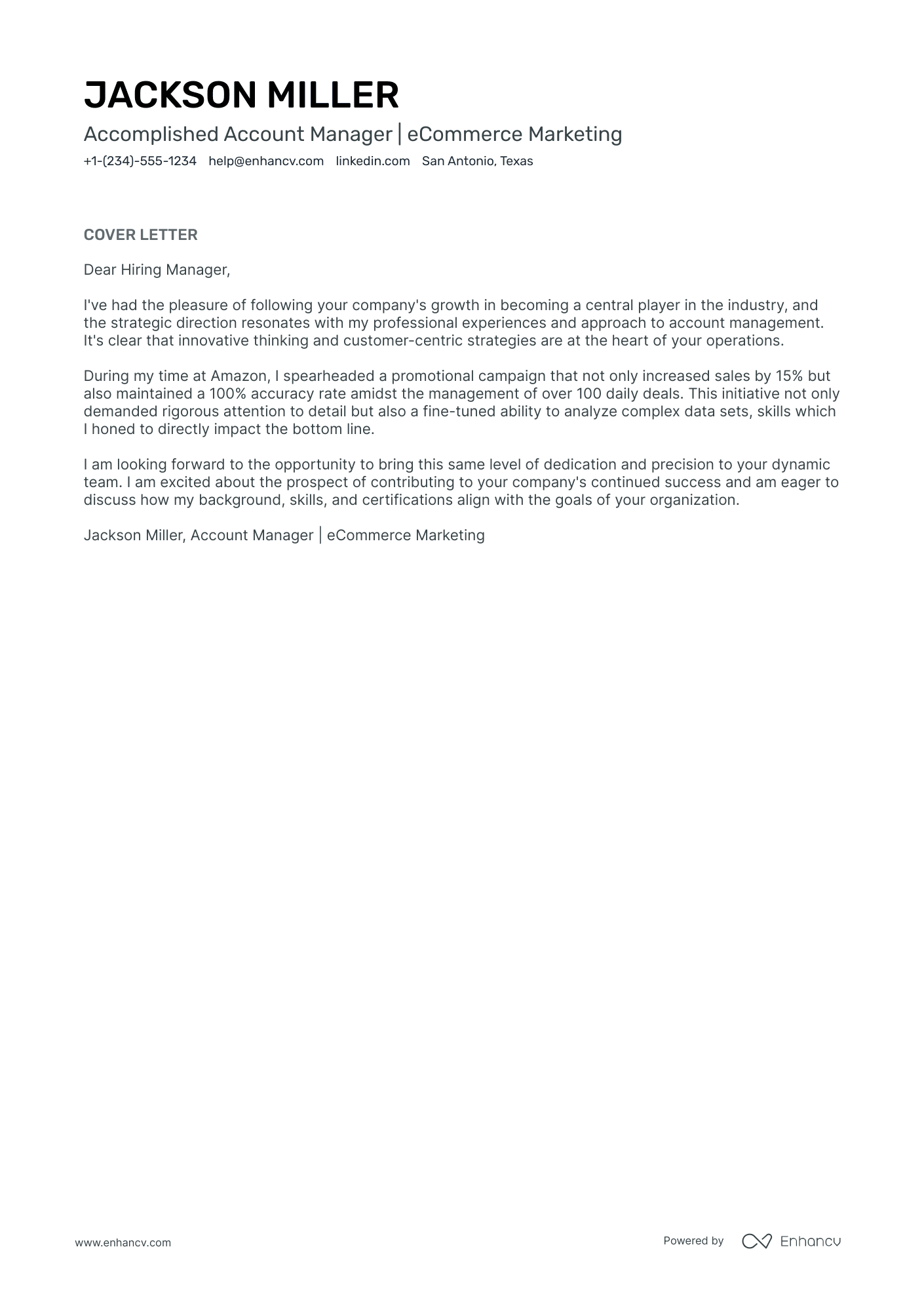
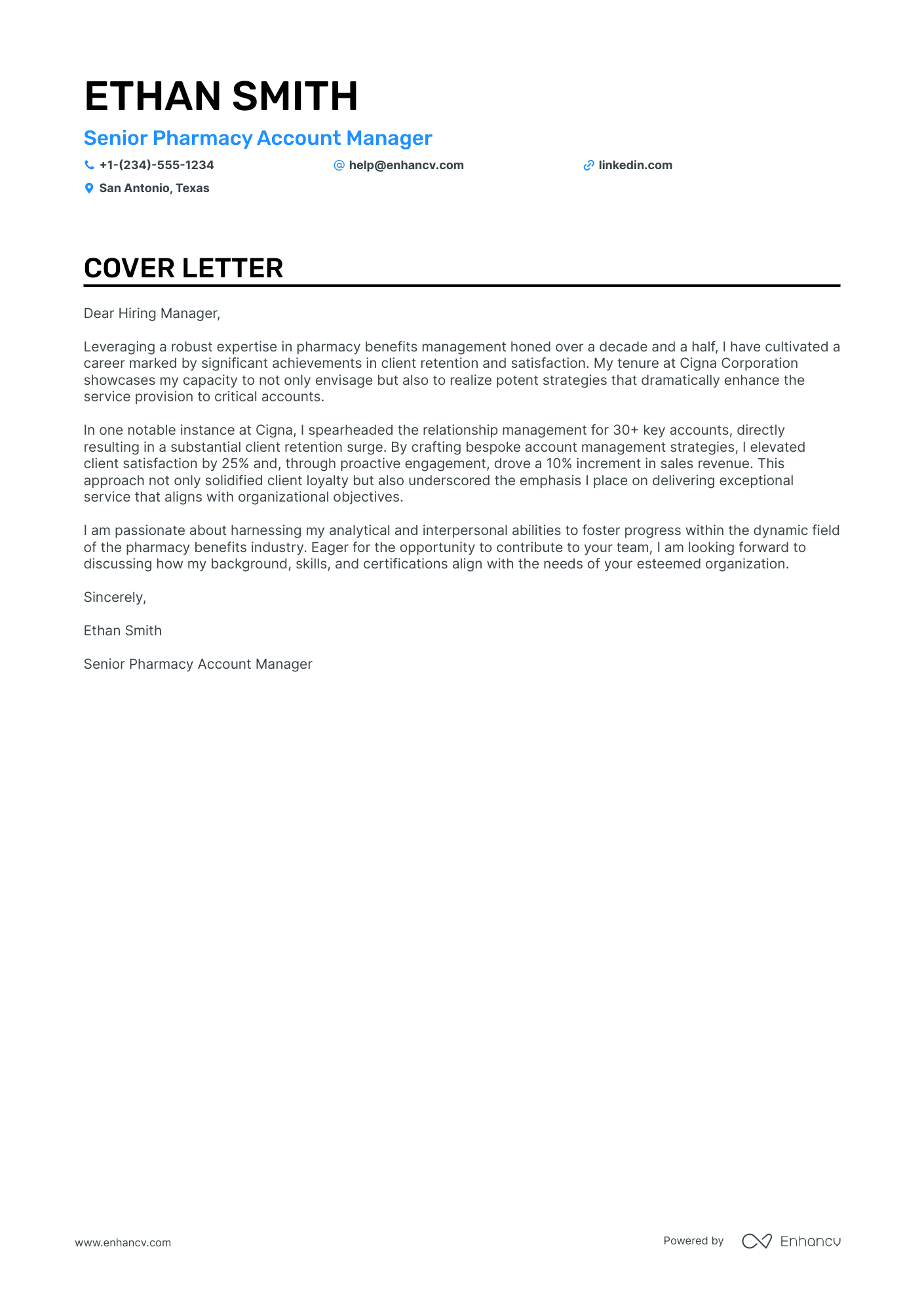
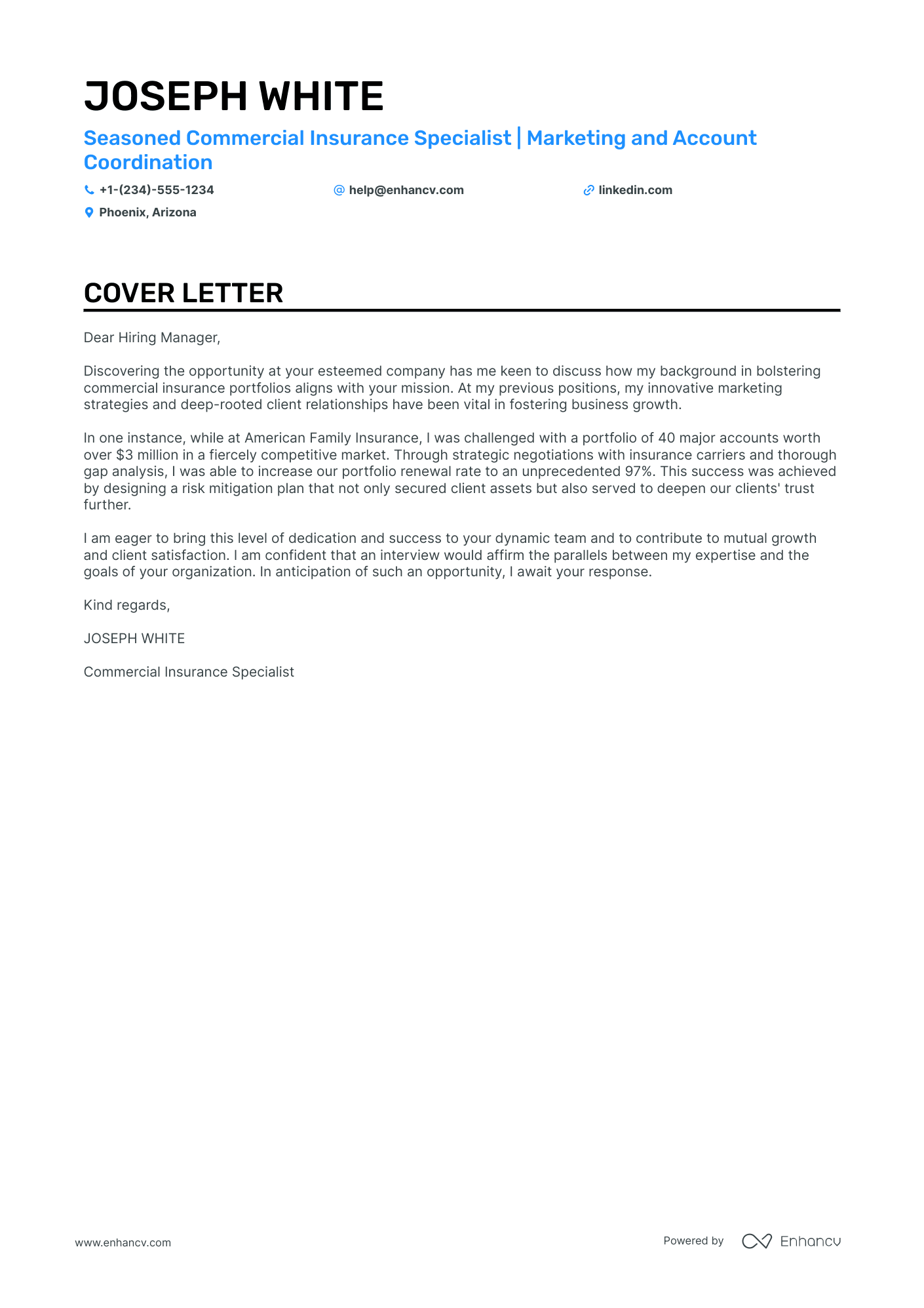
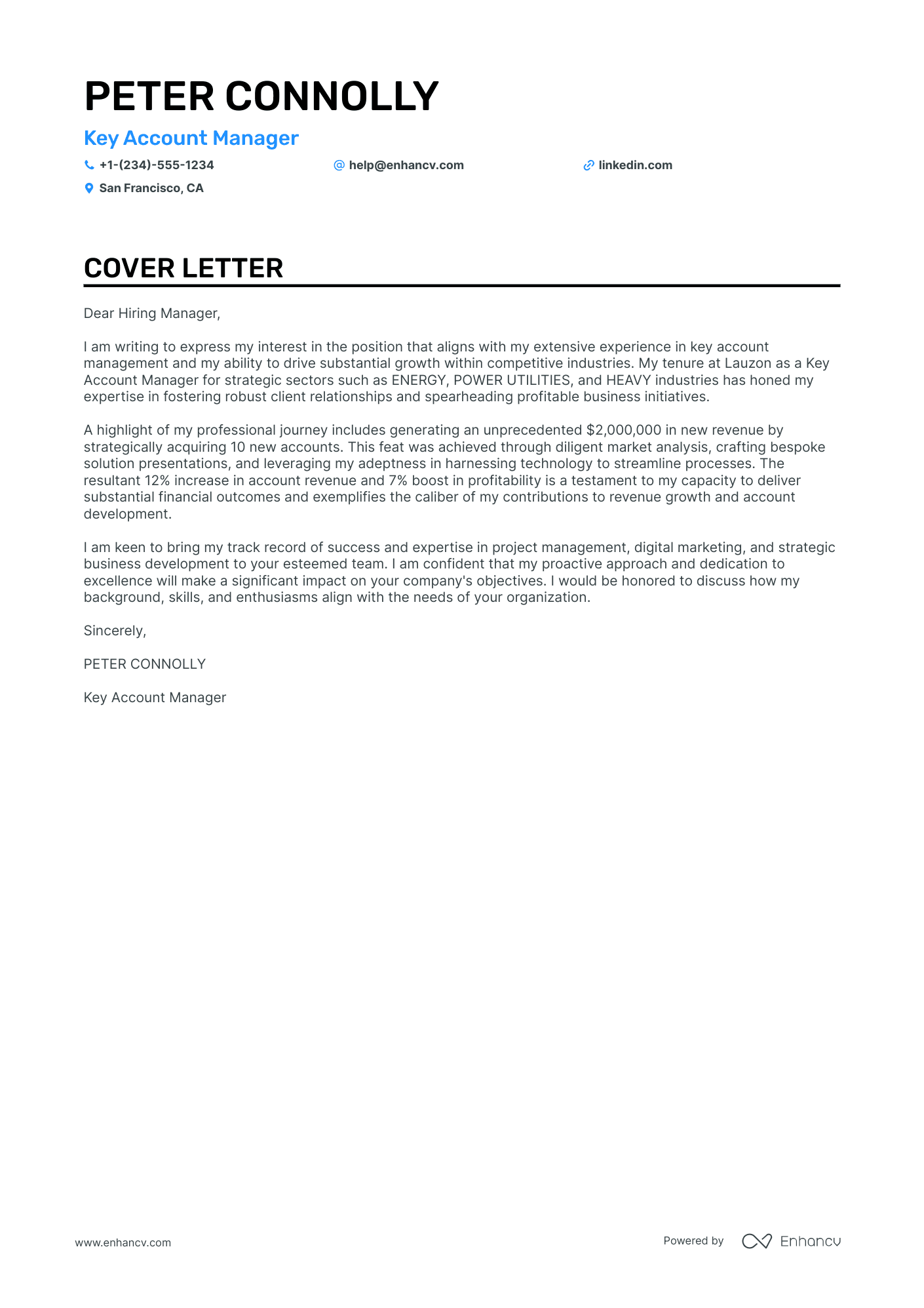
The last account manager cover letter that made a recruiter stop and actually read it probably opened with a specific number. Not a greeting. And you can be sure it wasn’t a cliche like "I'm passionate about building client relationships." Maybe it was about retention rate. But that single number said more about the candidate than three paragraphs of relationship-management buzzwords ever could.
Account management is all about the numbers. Retention, expansion, ARR growth, net revenue retention (NRR). So if your cover letter reads like a personality profile instead of a performance report, you're losing to someone who led with their book of business. To build cover letters that make a VP of Sales pause, you need to think like someone managing a P&L.

Key takeaways
- Open with your strongest revenue metric: ARR growth, NRR, or expansion revenue
- Name the company, the role, and the person you're writing to. Generic letters get generic rejections
- Include your book of business size and account count to establish scope
- Show at least one save-and-expand story with dollar amounts
- Mention the tools you run on: Salesforce, HubSpot, Gainsight, Gong
- Keep it to one page. Hiring managers in sales orgs move fast
Let’s start with a real example.
Account manager cover letter sample — Enterprise SaaS
Jordan Mercer
jordan.mercer@email.com | (312) XYZ-0194 | LinkedIn
May 27, 2026
Hiring Manager Veridian Software
Dear Frank,
I currently manage a $4.2M book of business across 28 mid-market accounts at Fenwick Analytics, where I've owned the full post-sale relationship — from onboarding through renewal and expansion — for the past four years. I'm writing because the Senior Account Manager role at Veridian is the first opening I've seen that's explicitly built around Industry Cloud, and that's the exact segment where most of my work lives.
Last year, my largest account — a $680K ARR healthcare analytics platform — flagged they were evaluating a competitor at renewal. The friction wasn't price. Their internal data team had changed twice in eighteen months and no one had re-scoped the implementation to match the new team's workflows. I went back to basics: two days onsite, a full audit of how they were actually using the product versus how we'd set it up. We rebuilt three core dashboards together, rescheduled their QBR cadence, and introduced them to two peer customers in their vertical who'd solved similar problems. They renewed at full contract value and expanded by $110K six months later. The issue was never the product — it was that no one had checked in at the relationship level in over a year.
On the growth side: earlier this year I closed a $340K expansion with a fintech account that had originally come in at $95K. That one started with a single conversation about a compliance reporting gap they'd discovered after a regulatory audit. I brought in our solutions team to scope a custom build, managed the internal approval process on their side over eleven weeks, and closed it in Q1. That account is now one of our three largest.
I want to make a move mostly because I think the line between account management and CS strategy is disappearing — and Veridian seems to be building for that. The way your Industry Cloud team structures the post-sale motion, with AMs owning expansion targets alongside retention, is closer to how I actually work than anything in my current org chart.
I'd welcome the chance to talk about how I approach books of business at this scale.
Warmly,
Jordan Mercer
Let’s break down this example and see why it’s good:
- Revenue metrics in the first paragraph: $4.2M book of business, 28 accounts. The VP knows the scope before the second paragraph.
- One retention story, fully developed: Not "saved at-risk accounts." The $680K save gets the full treatment: what was broken, what the candidate did, what happened.
- An expansion story with a dollar amount: The $340K fintech deal shows the candidate doesn't just retain, they grow.
- Company-specific research: The Industry Cloud reference signals genuine homework, not a mass-mailed letter.
- Growth mention that sounds human: "Mostly because I think the line between account management and CS strategy is disappearing" reads like a real person explaining a real decision.
You can apply the same logic to your cover letter. Here’s how.

Account manager cover letter writing formula
- Lead with book size, ARR, and NRR, not a personality statement.
- Include one save story with the at-risk dollar amount and what you did.
- Name the CRM tools you work in: Salesforce, Gainsight, Gong, Clari.
- Tailor to the company, name a product, a market move, a specific team.
- Sign off with your name and any relevant certifications.
What your account manager cover letter needs to cover
VPs of Sales ask four questions when they pick up your cover letter. Answer all four and you're ahead of 90% of applicants.
1. What's the size and shape of your book?
Thin in terms of dollar amount, account count, segment (SMB, mid-market, enterprise), and industry vertical. A $4.2M book across 28 mid-market SaaS accounts tells a completely different story than a $4.2M book across three enterprise manufacturing accounts. The VP needs to know which one you are.
2. Do you retain, or do you grow?
At this point, retention is table stakes. Every account manager claims strong relationships. The ones who get hired show NRR above 100%, expansion revenue, and upsell deals with real numbers. If your NRR is above 110%, lead with it.
3. Can you save a deal that's going sideways?
Every VP has lost a logo they shouldn't have. They want to know you've been in the room when a client is halfway out the door and pulled them back. The save story, with dollar amount, root cause, and what you did, is the most powerful paragraph in your letter.
4. Why this company and not the 50 others hiring AMs right now?
Account manager roles are everywhere. If your letter could be sent to any SaaS company with the name swapped out, then it's not tailored. To contrast that, name a product launch, a market move, a specific team. Ten minutes of research separates you from every other applicant with a generic letter.
Sections to include in your account manager cover letter
An account manager cover letter follows the same structure as any professional letter, but the content inside each section is what earns the interview.
Let’s go over each section and see what matters:
Header
Include your name, phone, email, city and state, LinkedIn URL. Match the design to your account manager resume. If you have a Salesforce or HubSpot certification, add it to the header line after your name.
Salutation
Use the hiring manager's name. You could probably find it on LinkedIn in two minutes.
Opening paragraph
State the role, the company, your current title, and your book of business. Two to three sentences. No filler.
Body paragraphs
One paragraph for your strongest revenue achievement with numbers. One paragraph for why this specific company matters to you and you want to work there. This is where the letter lives or dies.
Closing
Request a conversation. Mention your availability. Keep it short. Sign off.
How to address your account manager cover letter
Starting your letter with "Dear Hiring Manager" in a sales org is ironic. After all, you're applying for a role built on finding the right person and building a relationship. So not finding the VP's name tells them everything about your prospecting skills.
This requires a proactive approach. So take the time to check the job posting, LinkedIn, and the company’s leadership page.
In most cases, the hiring manager for an account manager role is the VP of Sales, Director of Account Management, or a Regional Sales Leader.
Use "Dear [Title] + [Name]" or simply "Dear [First Name]." Getting the cover letter salutation right takes two minutes and signals exactly the kind of attention to detail AM roles require.
How to open your account manager cover letter
Your opening gets six seconds. Maybe less from a VP reviewing between pipeline calls.
Strong opening for an account manager cover letter
I manage a $4.2M book of business across 28 mid-market accounts at HubSpot, with a net revenue retention rate of 118% over the last four quarters. I'm applying for the Strategic Account Manager role on Salesforce's Enterprise West team because I'm ready to run the same expansion playbook at enterprise scale.
Weak opening to avoid
I am writing to express my interest in the Account Manager position at your company. I am a dedicated professional with strong relationship-building skills and a proven track record of success. I believe my experience makes me an ideal candidate for this exciting opportunity.
The bad example could be sent to any company for any role. Zero revenue metrics, zero specifics, zero proof.
The good one names the book size, NRR, current employer, and target role in two sentences. That's how to start a cover letter in a numbers-driven role.
How to write the body of your account manager cover letter
The body is where you prove you don't just manage accounts but you’re also able to grow them.
Structure your best story like this:
- Problem
- Action
- Result
Don't say you "maintained strong client relationships." Walk them through a deal. For example, what was the account situation? What did you do? What changed in the revenue?
Example:
"Two accounts worth $680K combined were flagged for churn after a product migration went poorly. I restructured the QBR cadence from quarterly to monthly, brought in executive sponsors on both sides, and rebuilt the ROI case with their actual usage data. Both renewed. One expanded by $120K."
That's a paragraph a VP of Sales will remember.

PRO TIP
Paste the job posting into Enhancv's Tailoring Tool before writing the body. It surfaces the skills and keywords the role prioritizes, so you focus your story on what actually matters to this specific VP.
Tailoring your letter to the job posting
Every job posting tells you exactly what to write about. Mirror their priorities with your proof points.
Matching your letter to the job posting
| Job description says | What to include | Example phrasing |
|---|---|---|
| Manage enterprise accounts | Book size, account count, ARR, and segment experience | I manage a $4.2M portfolio across 28 mid-market accounts and am ready to apply the same rigor at enterprise scale |
| Drive expansion revenue | A specific upsell or cross-sell deal with dollar amount | Closed a $340K platform expansion with a fintech client — the largest upsell in our mid-market segment |
| Reduce churn | A save story with the at-risk dollar amount and what you did | Saved two at-risk accounts worth $680K combined by restructuring QBR cadence and rebuilding executive alignment |
| Cross-functional collaboration | Name the teams: product, CS, solutions engineering, marketing | Partnered with product and solutions engineering to build a custom integration roadmap that unlocked the expansion |
| Strategic account planning | QBR process, stakeholder mapping, executive engagement | I run formal QBRs with documented success metrics and maintain stakeholder maps for every account in my portfolio |
How to close your account manager cover letter
Your cover letter closing should do two things: suggest a next step and reinforce the value you bring.
Strong closing for an account manager cover letter
I'd welcome a conversation about how my mid-market expansion playbook — 35% ARR growth, 118% NRR, and a $340K upsell — translates to Salesforce's enterprise accounts. I'm available anytime this month.
Best,
Morgan Reeves, Salesforce Certified Administrator
Weak closing to avoid
Thank you so much for considering my application. I am very excited about this opportunity and I know I would be a valuable addition to your amazing team. I look forward to hearing from you soon.
Sincerely,
Morgan
The weak version is enthusiasm without evidence. "I know I would be a valuable addition" is an empty claim. The strong one restates three metrics and proposes a specific next step. That's how account managers close.
Account manager cover letter with no experience
When writing a cover letter with no experience, you have more to work with than you think. If you've been in any client-facing role like sales development, customer success, support, even retail management, then you've managed relationships and driven outcomes.
So here’s how you can approach writing your letter.
Account manager cover letter formula for career changers
In my role as [current title] at [company], I managed [number of accounts/clients/relationships] and [revenue-relevant action: retained, grew, renewed, upsold]. One example: [specific story with a dollar amount or percentage]. This resulted in [measurable outcome].
Here's what that looks like in writing:
"As an SDR at Datadog, I managed handoffs for 45 qualified opportunities per quarter to our mid-market AE team. When three deals stalled post-demo, I built custom ROI models for each prospect and re-engaged the champions directly. Two of those three closed, totaling $180K in new ARR."
That's real account work, even if the role itself wasn't account manager.
Also, don't apologize for being early in your career. Hiring managers looking at junior AM candidates want commercial instincts, client empathy, and the ability to tell a revenue story.
Frequently asked questions about account manager cover letters
What should I include in an account manager cover letter?
Your book of business size, account count, net revenue retention rate, one specific expansion or save story with dollar amounts, and a reason you want to work at that particular company. Skip the relationship adjectives. Show the revenue.
How long should an account manager cover letter be?
One page. Four to five paragraphs. 300–450 words. VPs of Sales skim. If your letter spills onto a second page, cut the paragraph that sounds most like a template. Cover letter templates from Enhancv are built to stay within one page.
What makes an account manager cover letter stand out?
A real number and a real story in the first two paragraphs. Book size, NRR, and one deal narrative with a dollar amount. That combination is rarer than it should be, and it gets read.
How do I write an account manager cover letter with no experience?
Translate client-facing work you've already done. SDR handoffs, support escalations handled, consulting engagements — all of these have revenue implications. Frame them as account work, lead with any number you can attach, and name one client outcome. The title doesn't have to say "account manager" for the work to count.