

Your resume education section needs four fields: full degree name, institution, location, and graduation date. Everything beyond that (GPA, honors, coursework, extracurriculars) is optional and depends on your career stage. Recent graduates lead with education. Mid-career and senior professionals cut it to two lines and move it below work experience.
I'm a Certified Professional Resume Writer (CPRW), and education is the section where I see the most wasted real estate. Candidates either bury their strongest credential or pad the section with details that haven't been relevant in fifteen years. Most of the bad advice that drives those mistakes treats the section as a fill-in-the-blank form. It isn't. The rules genuinely shift by career stage, and the cost of getting them wrong shows up in callback rates.
This guide gives you the four required fields, the career-stage decision framework I use day-to-day with candidates, the ATS-safe formatting Enhancv has actually tested, and the edge cases other guides skip: partial degrees, bootcamps, MOOCs, study abroad, and career-change majors. By the end you'll know what to keep, what to cut, and where the section belongs relative to everything else on your resume.

Key takeaways
- Four required fields. Degree name (spelled out), institution, location, and graduation date. GPA, honors, coursework, thesis, and minor are optional and earn their place only when they strengthen your case at your current career stage.
- Placement is a career-stage decision. Lead with education for 0–3 years out, push it below work history at 3–10 years, run it as a compact two-line block past 10 years. In Enhancv's product data (670,000+ job seekers, last 90 days), senior pros rearrange resume sections less often than recent graduates do; most accept the template default.
- Modern ATS handles columns, photos, and graphics. In Enhancv's own ATS testing across Google Docs, MS Office, Canva, and our builder, education sections parsed at near 100% in single-column resumes and 88% in double-column. In a separate Enhancv study of 25 recruiters using Workday, Greenhouse, iCIMS, and seven other ATS platforms, 92% said they personally read every resume that comes in; their systems don't auto-reject.
- Include GPA only when it's 3.5+, recent, and the industry expects it. Outside finance, consulting, law, and academia, recruiters don't read it. Past three years of experience, I tell most candidates to skip GPA entirely.
- Every edge case has a one-line rule. In-progress, dropped out, no degree, bootcamps, study abroad, MOOCs, international credentials, unrelated major: don't hide them. Frame them.
- Tailor before you send. A correctly formatted education entry that doesn't echo the employer's stated credentials still leaves points on the table.
What does a resume education section include?
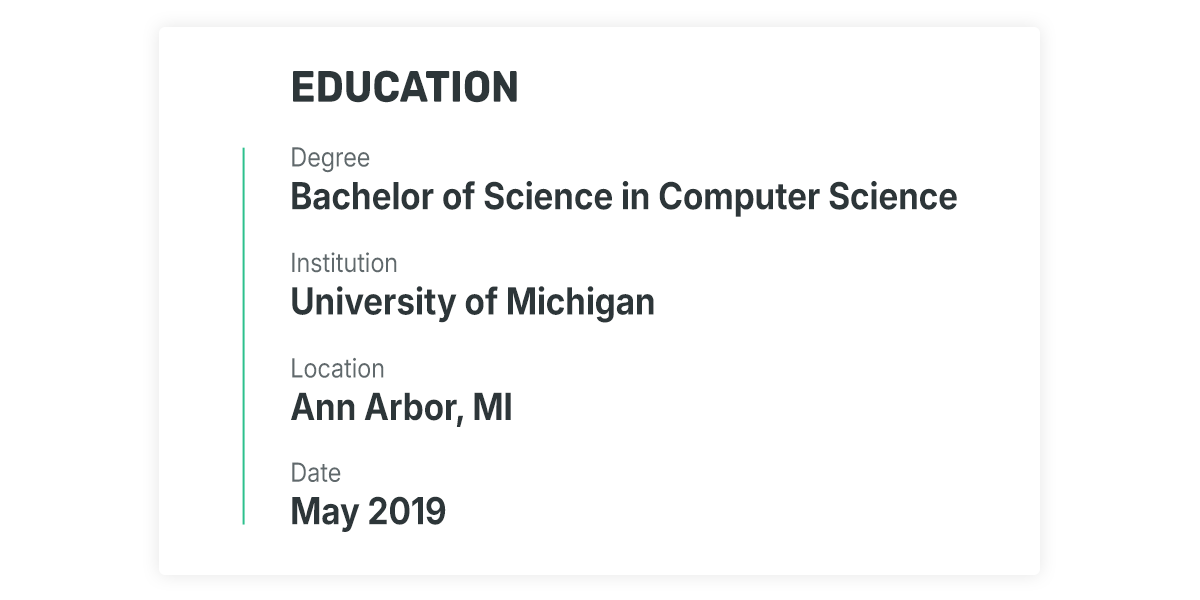
Every education entry has four required fields and a short list of optional ones. Whether the optional fields belong on your resume depends on your career stage and the role you're chasing.
The four required fields
Lead with the degree name spelled out in full. Write "Bachelor of Science in Computer Science," not "BS in Computer Science." Spelled-out names parse cleanly across every Applicant Tracking System (ATS), read faster to a human, and avoid the rare edge case where an older parser trips on "BA" or "BS."
Follow the degree with the institution name, city and state (or country if you studied abroad), and your graduation month and year. A clean, complete entry looks like this:
 08/2015 - 05/2019
What you can add
A few extras are worth including when they strengthen your candidacy. Looking at the same dataset, the most-added education-adjacent sections were Coursework (34,610 users), Certificates (26,132), and Achievements (22,884). Awards (8,204) and Publications (5,218) trailed by 3–7x. Most candidates already include what works, and the rare adds tend to belong only to people for whom they actually move the needle.
- GPA: Include it if it's 3.5 or above and you graduated within the last five years.
- Latin honors: Cum laude, magna cum laude, and summa cum laude are always worth listing inline with the degree.
- Relevant coursework: Add two to four courses when they connect directly to the role you're targeting.
- Thesis or dissertation title: Useful in research-heavy or academic job searches.
- Minors and double majors: Include them when they add context the major alone doesn't carry.
What should you leave out?
Drop your high school the moment you have a college degree. Skip the GPA if it's below 3.5 or more than five years old. Leave out coursework that has no clear tie to the role. When in doubt, ask whether the detail helps a recruiter say yes. If it doesn't, cut it.
The single most common fix I make on mid-career resumes is removing the high school entry. Three lines of "Honors Diploma, Lincoln High School, 2004" sitting under a Master's degree because no one told the candidate they were allowed to remove it. Deleting it almost always improves the section more than anything I write.
Author's Take
How should you tailor your education section to your career stage?
Where your education section sits on the page, how long it runs, and what details you include should all shift as your career grows. Recruiters weight credentials differently depending on how much you've done since graduation, so a section that impresses at 22 can actively hurt you at 42.
One thing worth flagging up front, because it cuts against the prevailing narrative: in the same data, recent graduates with 1–5 years of experience rearrange resume sections at a 32–35% rate, while senior professionals at 10–14 years do so at 27–30%. The standard advice would predict the opposite, that senior pros must override the default template to push education down the page. Our data says they mostly don't. They accept the order their template gives them and spend their editing time elsewhere. The placement advice that follows still holds. If you're senior and your template puts education in a sensible place by default, you may not need to move it at all.
Early career (0 to 3 years): let education carry weight
The 0-to-3-year window isn't arbitrary. The U.S. Department of State Recent Graduates Program defines a recent graduate as someone within two to three years of finishing college, and most recruiters apply the same mental cutoff.
When your work history is thin, your education section does more of the selling. Put it above your experience, or immediately after a summary, and expand it.
This is the one career stage where GPA, honors, relevant coursework, and student leadership all belong. Four relevant courses, a cum laude notation, and one leadership role (president of the finance club, editor of the student paper) give recruiters something concrete to evaluate when your work history is a summer internship and a part-time job.
A complete entry at this stage might include your degree name, institution, graduation year, GPA (if 3.5 or above), Latin honors, three to four relevant courses, and one extracurricular in a leadership capacity. Here's how it looks on the page:
08/2019 - 05/2023 - •Relevant coursework: Consumer Behavior, Digital Marketing Analytics, Brand Strategy, Market Research.
- •President, Marketing Society — led 40-member student org and ran three campus campaigns.
- •GPA: 3.7/4.0.
Mid-career (3 to 10 years): strip it back
Once you have three or more years of real work experience, your education section earns less space. Move it below your work history and cut it to the core four: degree, institution, location, graduation year.
Drop the coursework. Drop the extracurriculars. Drop the GPA unless the role explicitly asks for it or you graduated within the last five years. A clean two-line entry is the right call here. Recruiters at this stage are looking at what you've built, not what you studied. Here's the stripped-down version:
08/2010 - 05/2014 A pattern I see all the time with mid-career candidates: six lines of education at the top of a one-page resume — degree, GPA, three relevant courses, one Dean's List notation — for a credential everyone in the running already has. It pushes the actual selling point, the most recent senior-track promotion, below the fold. Cut the section to two lines, move it to the bottom, lead with the promotion. Callback rates jump. The fix isn't the writing. It's the real estate.
Teya Vasileva, CPRW at Enhancv
Senior and executive (10+ years): compact and discreet
At ten or more years into your career, education moves to the bottom of the resume in a tight two-line block. The degree is still there because it signals a baseline credential, but it no longer needs to justify your candidacy.
You can omit your graduation year entirely past 20 years of experience. My rule has two thresholds. At 15–20 years, keep the year, the math isn't dramatic and removing it can feel like hiding. Past 20 years, drop it. Past 25 years, your work history is the proof; the graduation year is just an age input for unconscious bias and adds nothing the job description was screening for. I've yet to see a candidate flagged for omitting an old graduation year. Our broader take on this lives in our guide on hiding age on your resume.
If you hold an MBA or completed a recognized executive education program (Harvard Business School AMP, Stanford GSB Executive Program, MIT Sloan), list it first, above your undergraduate degree. Those credentials carry more weight at the senior level and deserve the top line.
What if the role requires a specific degree?
For regulated professions including law (JD), medicine (MD), and academia (PhD), the degree isn't background detail. It's a prerequisite. Keep education higher on the page regardless of how many years of experience you have.
The same applies if a job posting calls out a specific credential explicitly. When a recruiter is screening for a JD or an MD, your education section belongs near the top so the hard filter clears quickly.
The rule of thumb
Whichever section is stronger leads. For most professionals past year three, work experience wins. If you're genuinely unsure which applies to you, ask whether a recruiter reading your resume for 30 seconds would find more signal in your degree or in your job history.
If you understand the career-stage logic but aren't sure how to physically restructure your resume, Enhancv's resume builder lets you drag and reorder sections to match your experience level, so your education lands exactly where it should relative to your work history.
Where does the education section go on a resume?
Placement is a career-stage decision. The section that proves you're the right person for the job should lead, and for most professionals beyond their first few years, that's work experience, not education.
The rule is simple: whichever section is stronger goes first.
Recent graduates (0 to 3 years out): Put education above or immediately after a summary. Your degree is your primary credential and recruiters expect to see it early.
Mid-career professionals (3 to 10 years): Move education below work experience. By this point, your track record outweighs your coursework. Skills and accomplishments carry the argument now.
Senior and executive professionals (10+ years): Education goes at the bottom, usually in a compact two-line block. Recruiters hiring at this level care about what you've built and led, not where you studied 20 years ago.
Should you lead with a prestigious school?
No. A Harvard MBA listed above 20 years of C-suite experience still reads as burying the lead. Let the career history speak first. The degree will get seen.
How do modern ATS read your education section?
We have actual numbers on this. Enhancv ran two separate studies on what ATS systems actually do with resumes.
In the first, Enhancv tested resumes built in Google Docs, MS Office, Canva, and our own builder against external Applicant Tracking System (ATS) platforms. Modern parsers handle education sections cleanly: single-column entries parsed at nearly 100%, double-column at 88%. The full results are in our ATS myth-busting study.
In the second, Enhancv asked 25 recruiters who work day-to-day with Workday, Greenhouse, iCIMS, Bullhorn, BambooHR, SuccessFactors, and four other ATS platforms a simple question: do your systems auto-reject resumes? 92% said no — they personally read every resume that comes in. The "your resume got auto-rejected by a robot" story is mostly a misread of how the hiring side actually works.
Here's what a recruiter scans in the first five seconds: degree level (bachelor's, master's, doctorate) and school name. That's the conscious read. Graduation year is a passive check, they're not focusing on it, but if it's missing or doesn't square with their mental math on your experience years, it registers. Honors, coursework, GPA, and club involvement only matter if the recruiter slows down for a second pass, which mostly happens for entry-level candidates.
What does the ATS actually see?
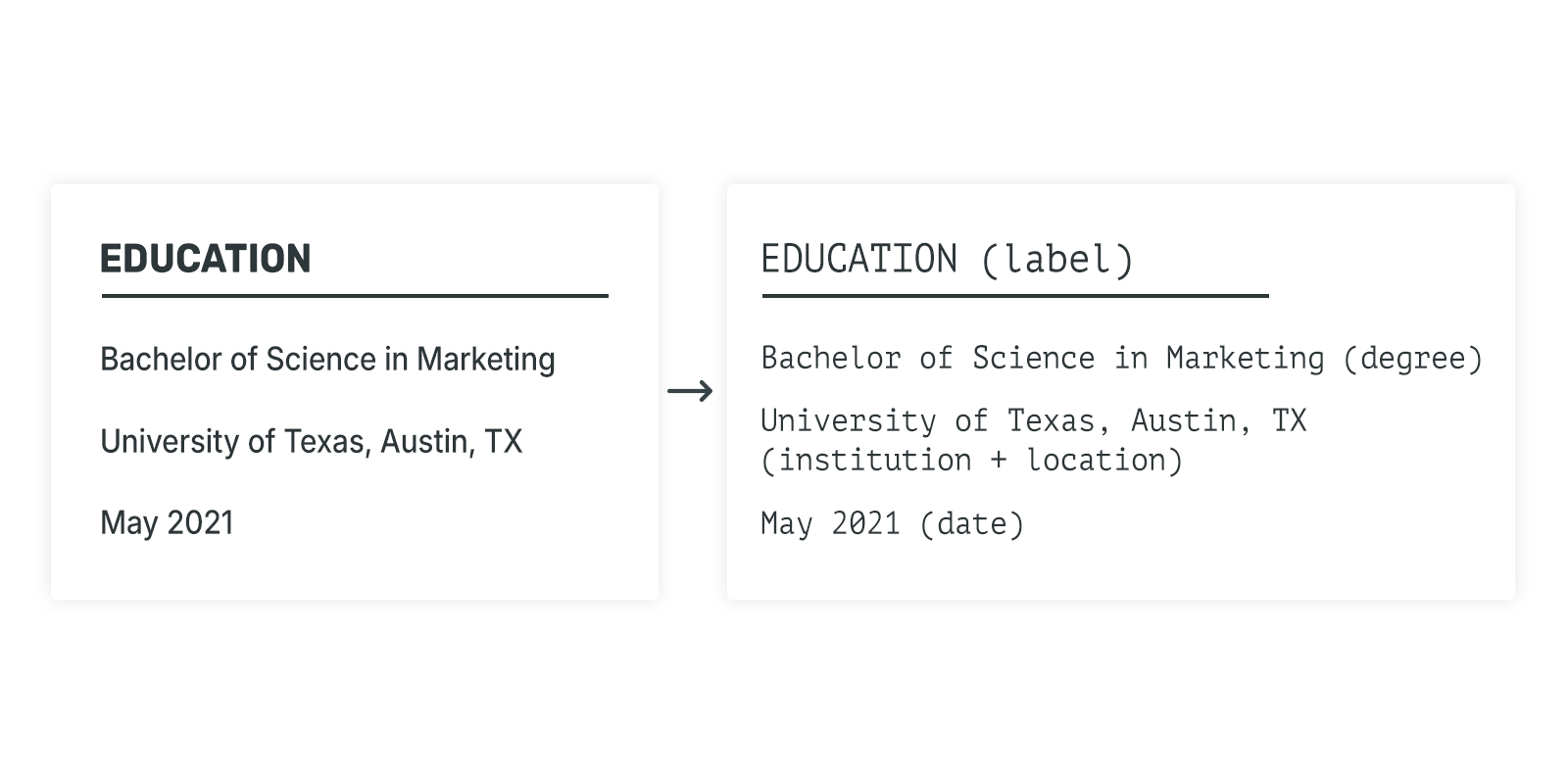
When an ATS extracts your education section from a cleanly written resume format, it pulls something like this:
EDUCATION
Bachelor of Science in Marketing
University of Texas, Austin, TX
May 2021
Four fields, four roles: section header, degree, institution and location, graduation date. A recruiter sees a stylized layout; the ATS sees clean key-value pairs. The two aren't in tension.
What actually helps the parser?
- Label the section "Education." Standard headers are the ones every ATS recognizes. "Academic Background," "Schooling," and "Credentials" land less consistently.
- Spell out degree names in full. "Bachelor of Science in Computer Science" parses more reliably than "BS."
- Use a consistent date format. May 2021, 05/2021, or 2021. Pick one and keep it the same across your resume.
- List entries in reverse chronological order, most recent first.
Should you include your GPA on a resume?
The column question, with actual data. Most articles will tell you two-column templates guarantee an ATS reject. Our tests say something more honest. For the education section specifically, single-column entries parsed at near 100%, double-column at 88%, a real gap, but not the apocalypse. The same study showed Enhancv's double-column templates parsing at 98%, ahead of most single-column resumes built elsewhere. And in our study of 25 recruiters across ten ATS platforms, 92% said they personally read every resume — their systems don't auto-reject. So columns cost you a few percentage points of parse fidelity in the worst case, not your application. Pick the layout that reads best to a human. If you want belt-and-braces certainty for education specifically, single-column has a small edge.
If you want a check before you send, Enhancv's Resume Checker runs 27 in-depth checks across content, layout, formatting, and style, and shows exactly what the parser reads.
Want to see exactly what an ATS reads from your resume?
Drop your resume here or choose a file. PDF & DOCX only. Max 2MB file size.
Should you include your GPA on a resume?
Include your GPA only when it clears three hurdles at once: it's 3.5 or above, your degree is recent (within the last three to five years), and the role or industry actually expects it.
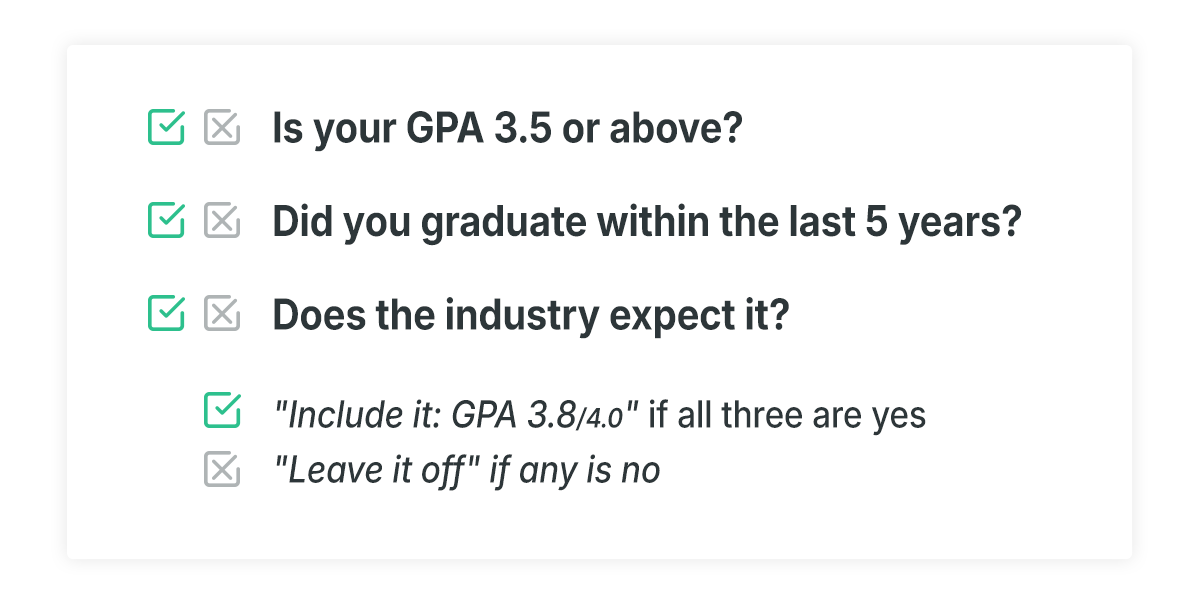
Include your GPA only when it clears three hurdles at once: it's 3.5 or above, your degree is recent (within the last three to five years), and the role or industry actually expects it.
The "always include GPA above 3.5" rule is outdated for most candidates past three years of experience. Outside finance, consulting, law, academia, and select federal government roles, recruiters don't read it. Past three years out, the GPA conversation is over — drop it and let your work history carry the section.
Rory Miller, CPRW at Enhancv
The 3.5 threshold is the widely accepted floor. Below that, listing your GPA draws attention to a number that works against you. Leave it off and let your experience carry the weight.
Recency matters as much as the number. A 3.9 from 2003 tells a recruiter nothing useful about what you can do today. If anything, it signals you're reaching back two decades for credentials because your recent work can't speak for itself.
Which industries still care about GPA?
Finance, consulting (McKinsey, Bain, BCG), law, academia, and some federal government roles still screen for GPA, especially at entry level. Outside those fields, most hiring managers won't notice if it's missing.
If you include your GPA, format it this way: GPA: 3.8/4.0. Always show the scale. A "3.8" with no denominator is ambiguous, and ambiguity creates friction.
One option worth knowing: if your major GPA is significantly higher than your cumulative GPA, you can list it as Major GPA: 3.9/4.0 with a brief note identifying it as such. It's an honest way to highlight where you actually excelled.
One exception overrides everything above. If the job posting explicitly asks for GPA, include it regardless of the number. Omitting a field the employer specifically requested raises more questions than a lower GPA ever would.
How do you handle an incomplete degree, no degree, or an unrelated major?
An incomplete degree, no degree, or an unrelated major isn't a disqualifier. It's a formatting and framing decision.
Degree in progress
This is a smaller cohort than most articles assume. In Enhancv's data, only about 2.7% of job seekers at the buying-decision stage had an in-progress education entry. Smaller, but real, and the formatting matters when you're in it.
List it with an expected graduation date. "Bachelor of Arts in Economics, University of Texas, Expected May 2026" is all you need. Never leave the date blank. A missing date reads as an incomplete entry to both the parser and a human recruiter. Here's the format:
08/2022 - Expected - •Relevant coursework: Macroeconomic Theory, Game Theory, Econometrics.
- •Current GPA: 3.8/4.0.
Dropped out before finishing
My threshold rule: if you completed 60% or more of the credits and the field is relevant to the target role, list it as "Coursework toward [degree], [school], [years]." Below 60%, name the school and dates only, drop the degree-related framing. Past ten years with no follow-up education, drop it entirely. By then your work history fills the gap and the partial degree just raises questions you don't want to answer in a phone screen. We cover the nuances in our guide on listing an incomplete degree on a resume. Here's the format I recommend:
08/2015 - 05/2017 - •Relevant coursework: Healthcare Economics, Healthcare Management, Health Policy.
- •Dean's List, Spring 2016.
No degree at all
Omit the education section entirely, or replace it with a "Certifications and Professional Development" section. A bootcamp credential from Flatiron School, two industry certifications (PMP, CISSP, AWS Solutions Architect), and one relevant Coursera course tells a stronger story than a blank education block.
Unrelated major
My rule for career changers: lead with the unrelated degree only in the true early stage of the change, less than two years into the new field. Bury it the moment you have post-pivot work to point to. That work is the proof, not the degree. Reframing through coursework only works if the courses are genuinely relevant. Otherwise it looks like stretching, and stretching reads worse than honest. For career changers specifically, Enhancv's AI Resume Tailoring analyzes the job description and surfaces the skills and experience keywords you should be foregrounding in other sections to offset a degree that doesn't map directly to the role.
Bootcamps and coding schools
The recruiter perception of bootcamps shifted noticeably in the last two years. In 2024 I'd pair a bootcamp with self-taught projects, certifications, and an explanation of why no CS degree. In 2026 the bootcamp stands alone for product, frontend, and full-stack roles. Backend infrastructure, systems, and ML still expect a CS-style background, and a bootcamp on its own can read as light there unless paired with a strong project portfolio. The project work matters more than the bootcamp brand now.
Author's Take
List the program name, institution, and completion date under Education or a separate Certifications section. Our full guide is on how to put a coding bootcamp on a resume. Here's how the entry looks:
01/2023 - 06/2023 - •Capstone project: real-time chat app built with React, Node.js, and PostgreSQL.
- •Curriculum: JavaScript, React, Node.js, Express, SQL, and modern Git workflows.
Online degrees and MOOCs
Accredited online degrees from regionally accredited institutions (Penn State World Campus, Arizona State Online, UMass Online) list identically to in-person degrees. MOOCs from Coursera, edX, or Udacity belong in a "Certifications" or "Professional Development" section, not the main education block. For a deeper dive, see how to list continuing education on a resume.
International credentials
List the credential as it's named in the issuing country, then add a parenthetical if the title won't translate cleanly: "Licenciatura in Business Administration (equivalent to Bachelor of Business Administration)."
Study abroad programs
A semester or year abroad belongs on the resume when the coursework or the cultural exposure maps to the role. Hiring managers in global, multilingual, or cross-cultural roles read it as a signal of adaptability. List it as a sub-entry under your main degree: "Study Abroad, University of Toronto, Fall 2019. Coursework in international marketing and cross-cultural management." One line under the parent degree, not a standalone block.
How do you list multiple degrees and honors without cluttering your resume?
Multiple credentials follow reverse chronological order. Honors attach to the degree entry they belong to. Certifications either live in the education section or get their own section, depending on volume.
How do you list multiple degrees?
Each degree gets its own entry. List them in reverse chronological order, most recent first. Don't combine them into one block even if they're from the same school. A recruiter scanning quickly needs to see each credential as a discrete line item.
What about a double major or minor?
A double major belongs on one line: "Bachelor of Science in Finance and Economics" is cleaner than two separate entries for the same degree. A minor follows the same logic. Include it on the same line as your major, but only if it's relevant. "Minor in Data Analytics" adds real signal for a business analyst role. For a graphic design role, it's noise.
How do you format Latin honors?
Attach them directly to the degree entry. The format looks like this: "Bachelor of Arts in English, cum laude." Keep the capitalization standard: cum laude, magna cum laude, summa cum laude, all lowercase. If you graduated with academic distinctions beyond Latin honors, our guide on how to graduate with honors on a resume walks through the full set.
Where do certifications go?
One or two certifications can sit as sub-entries under your education block. Three or more deserve their own "Certifications" section. Crowding six credentials (PMP, CISSP, AWS Solutions Architect, CFA Level II, Six Sigma Black Belt, Google Analytics) into one block makes the whole section harder to scan for both a recruiter and an ATS.
Frequently asked questions
What counts as your level of education on a resume?
The highest credential you've completed. That can be a high school diploma, a GED, an associate degree, a bachelor's, a master's, a doctorate, or a recognized professional certification. List the highest one first. Older or lower-tier credentials become optional once a higher one exists.
When should you leave education off a resume entirely?
When it's either irrelevant to the role and your experience already clears the credential bar, or when the only entry would actively work against you (an incomplete degree from many years ago with no related work since). For most applicants, even a partial or distant degree is worth a one-line mention.
How do employers verify the education on a resume?
Most run a background check that pings the institutions you listed, either through an internal HR team or a third-party verification service like HireRight or Sterling. Some ask for transcripts directly. Misrepresenting a degree shows up quickly and is one of the few resume issues that gets a candidate withdrawn after an offer.
Should you list a college you didn't finish?
Yes, when the coursework supports the role. Frame it as completed coursework with dates attended rather than as a degree. List any relevant courses, projects, or honors from your time there. Hiding attended schooling reads worse than naming it accurately.
If the framework is clear but the formatting feels like a hassle, that's what the tool is for — create your resume on Enhancv and your education section lands in the right place by default, whatever your career stage.
Your education section, in one line
For most professionals, education is a supporting detail. For recent graduates, it's the main credential. Knowing which role it plays on your resume drives every decision in this guide: what to include, where to place it, how much space to give it, and when to leave things out entirely. The single highest-ROI step most applicants skip is tailoring the section to the job description before sending. A correctly formatted entry that doesn't echo the employer's required credentials still leaves points on the table.
Make one that's truly you.