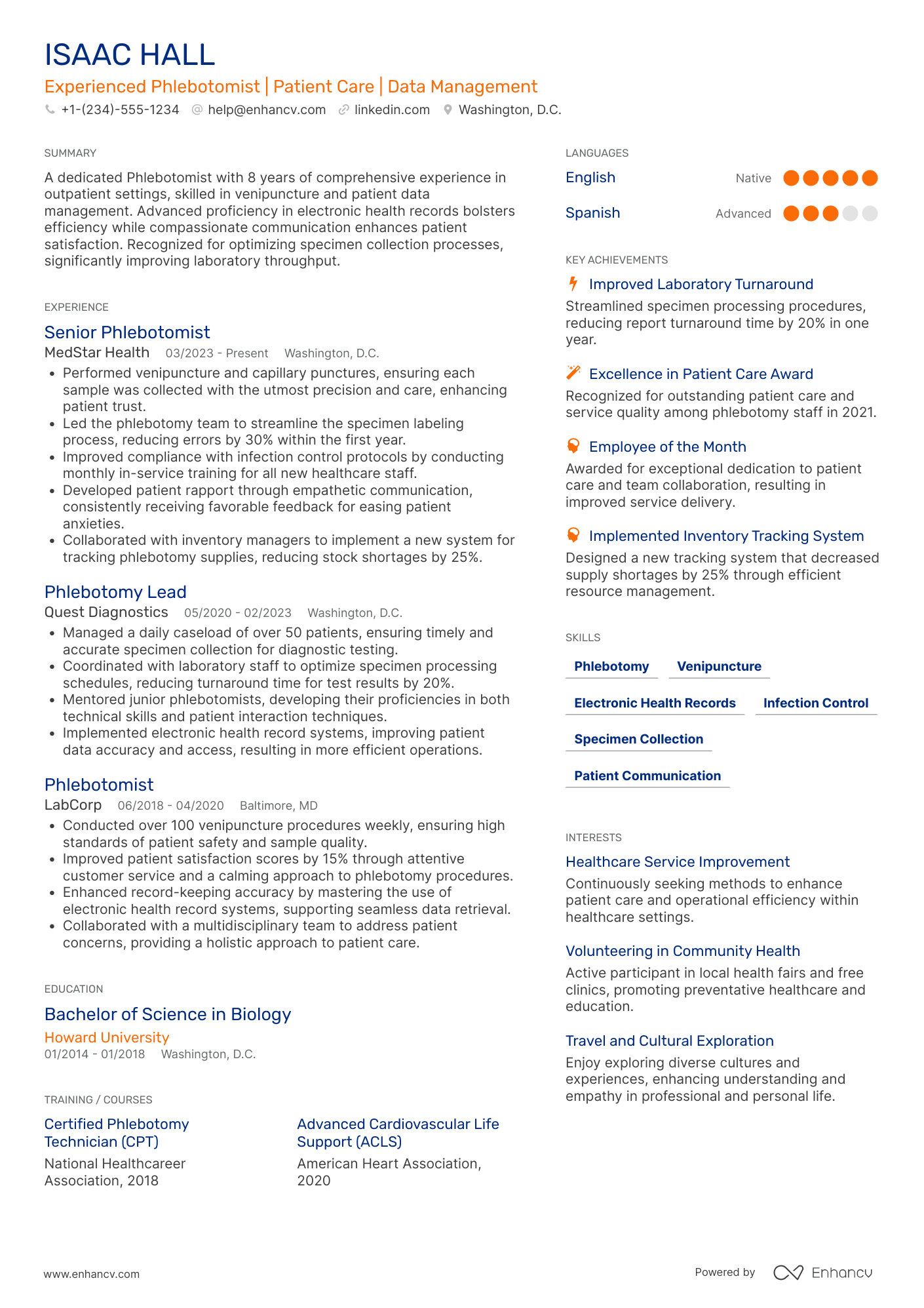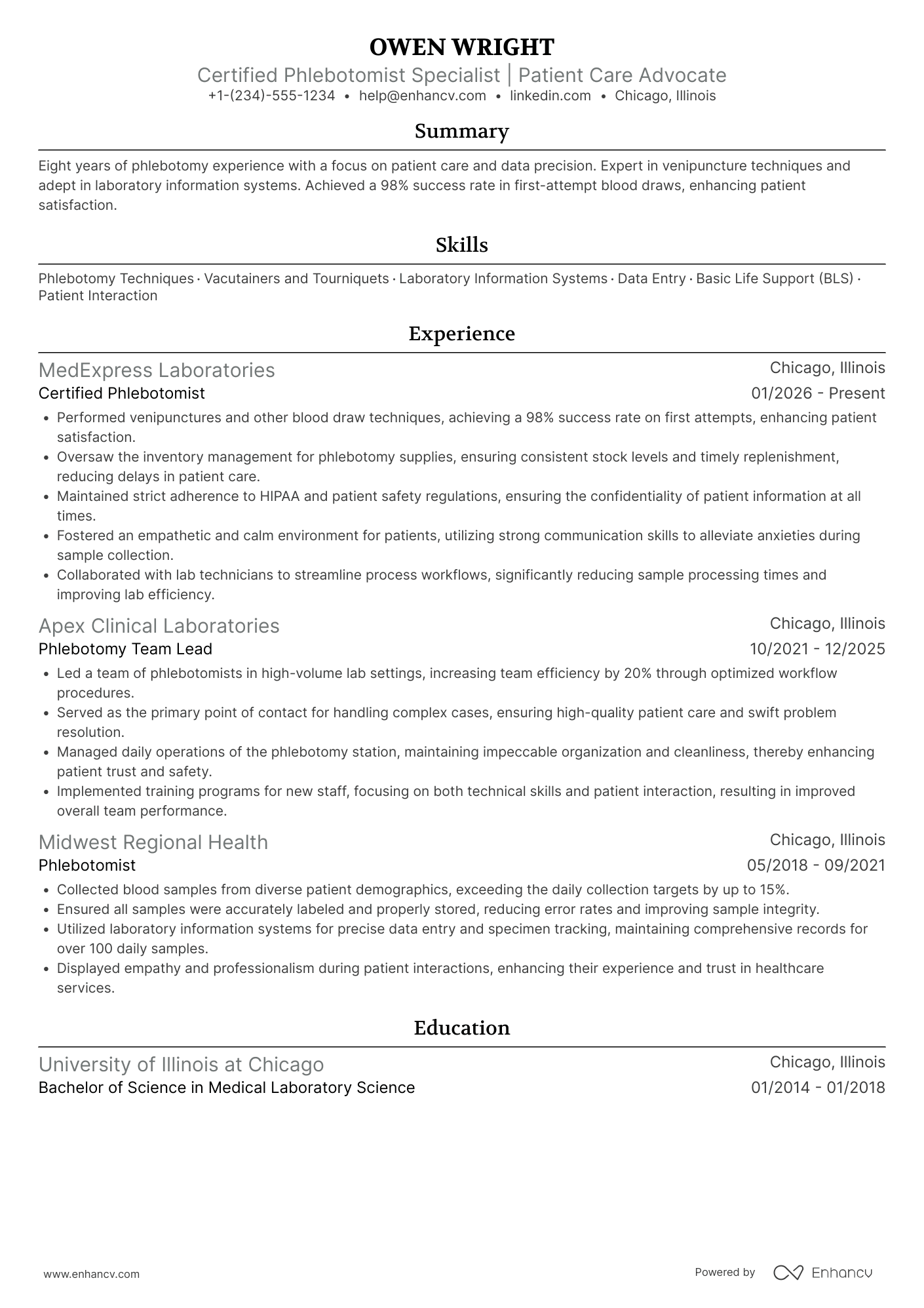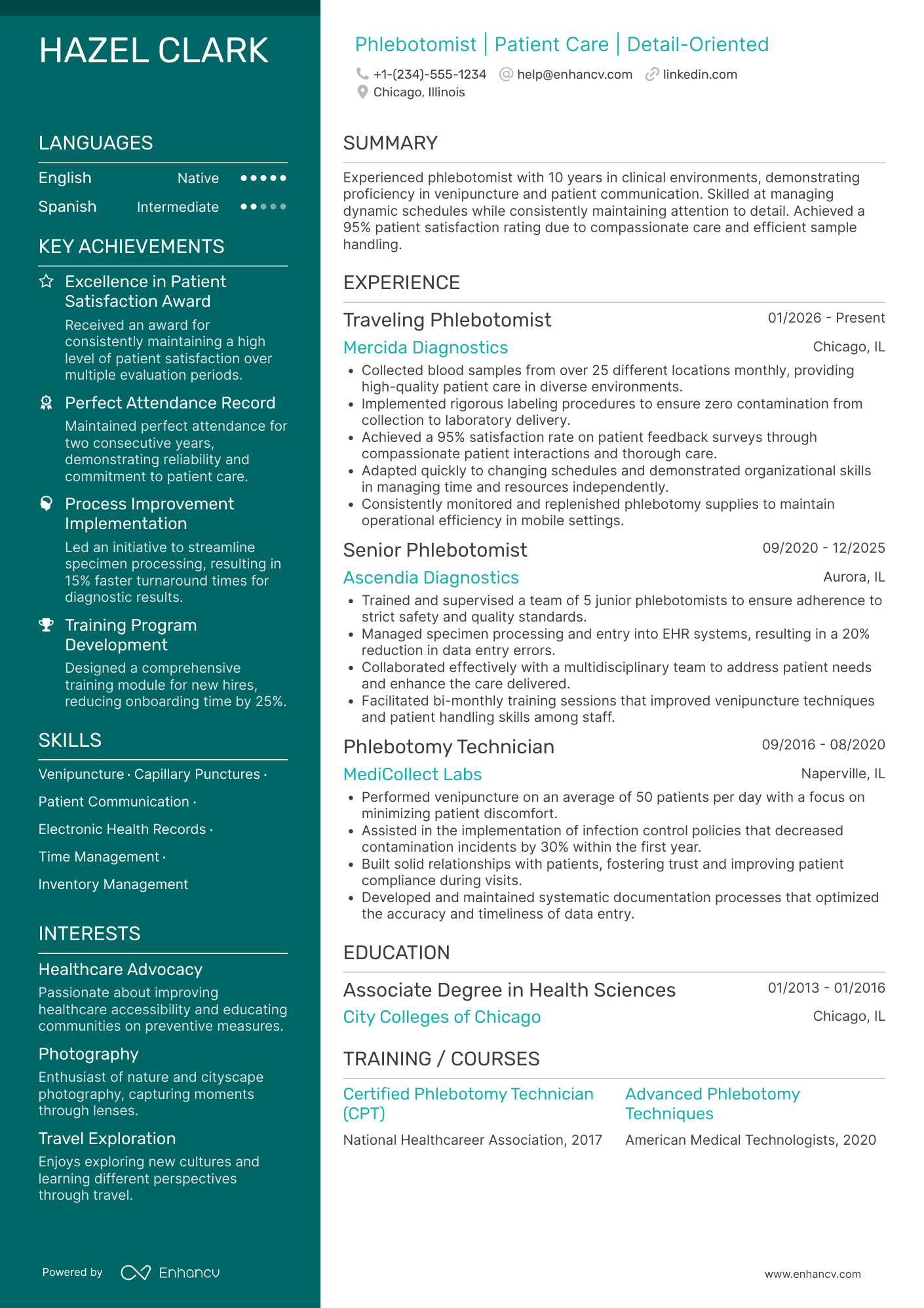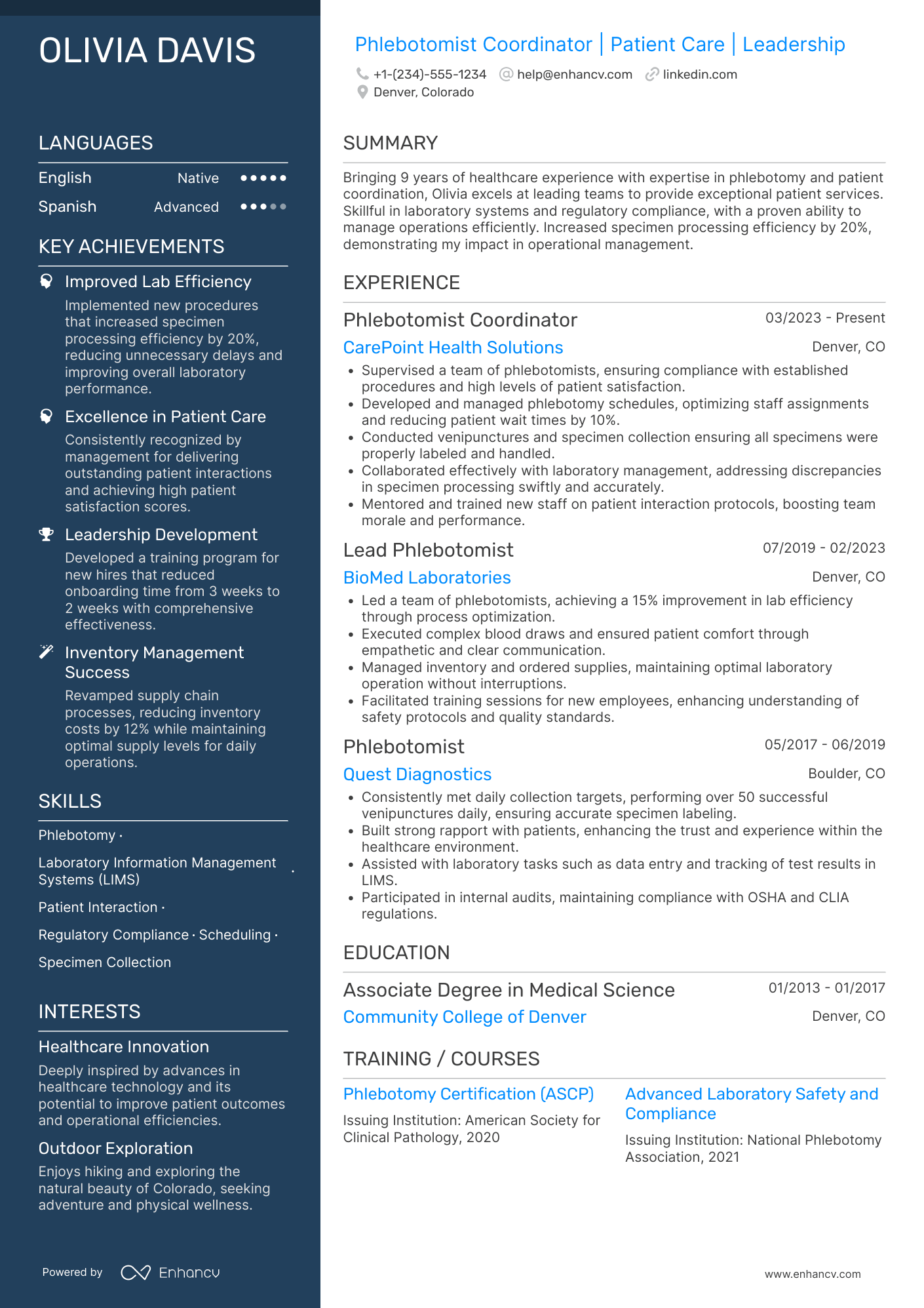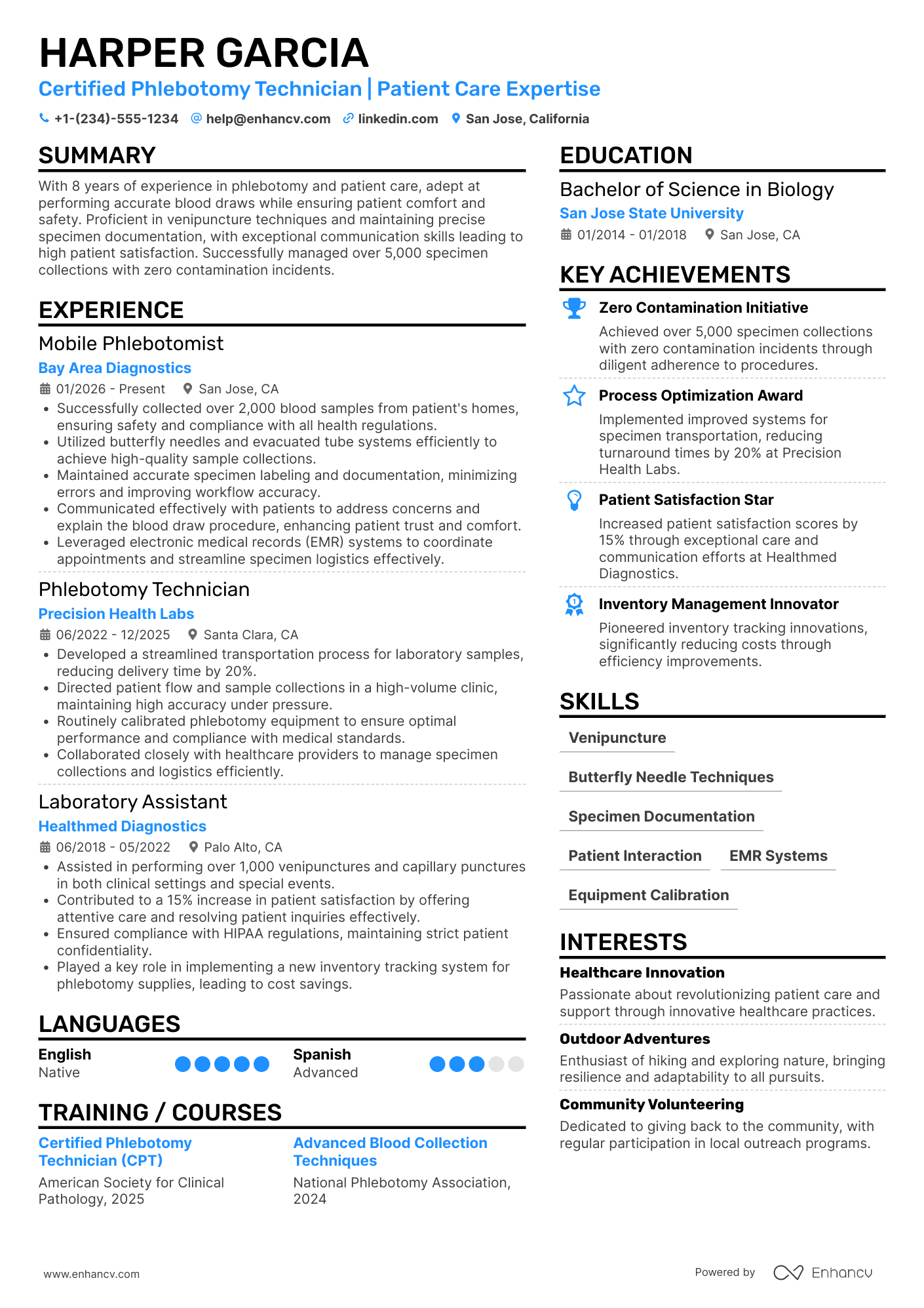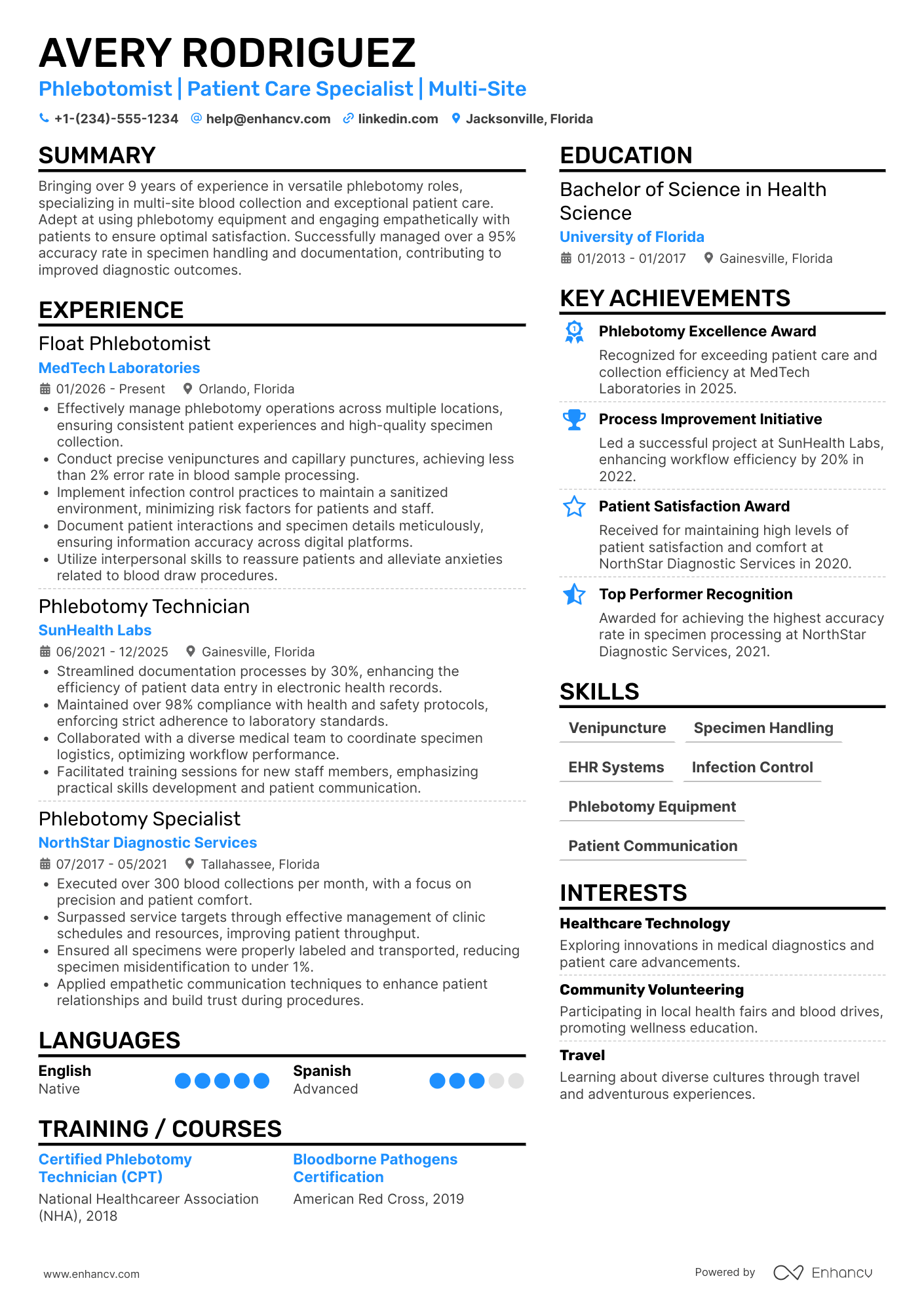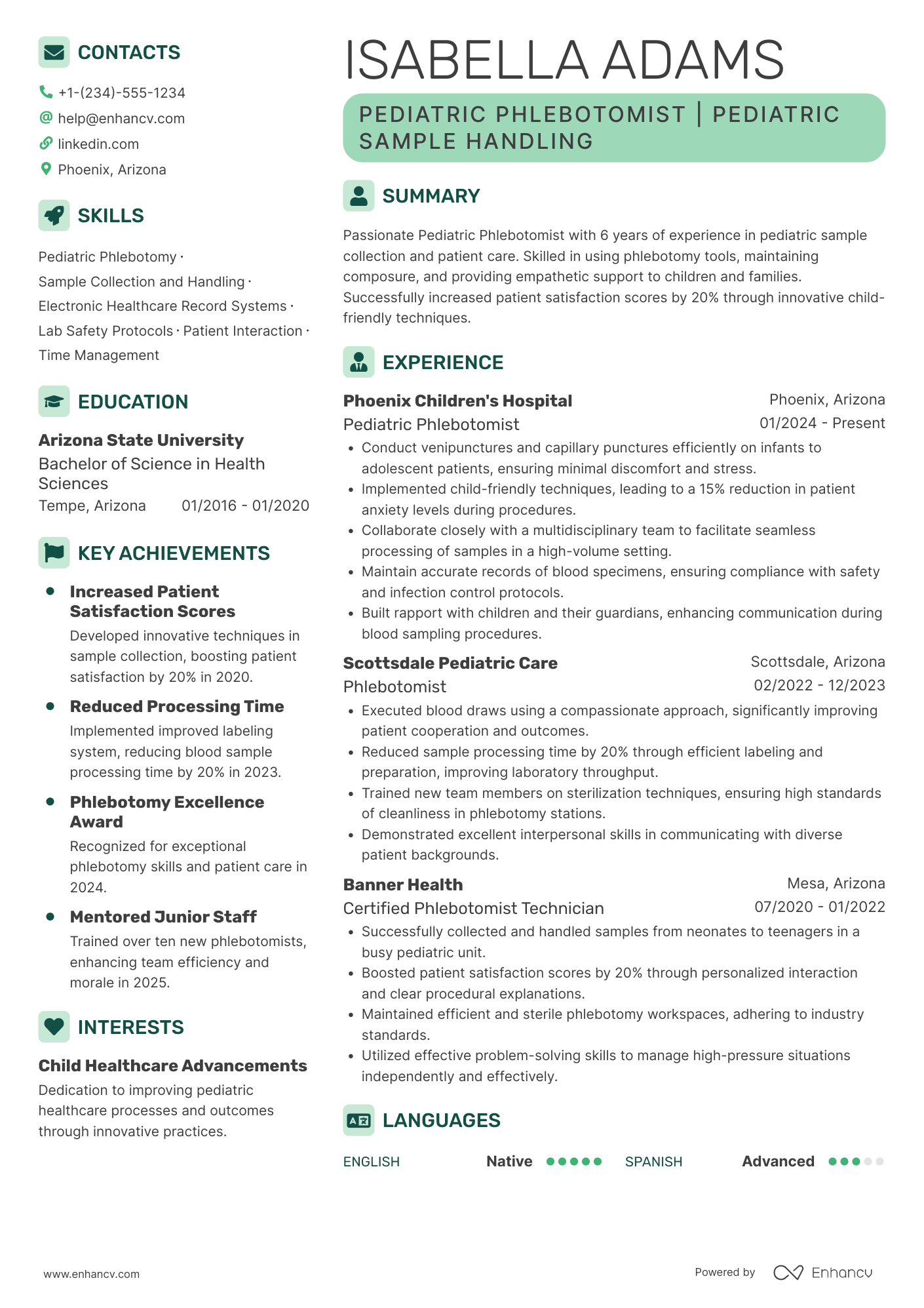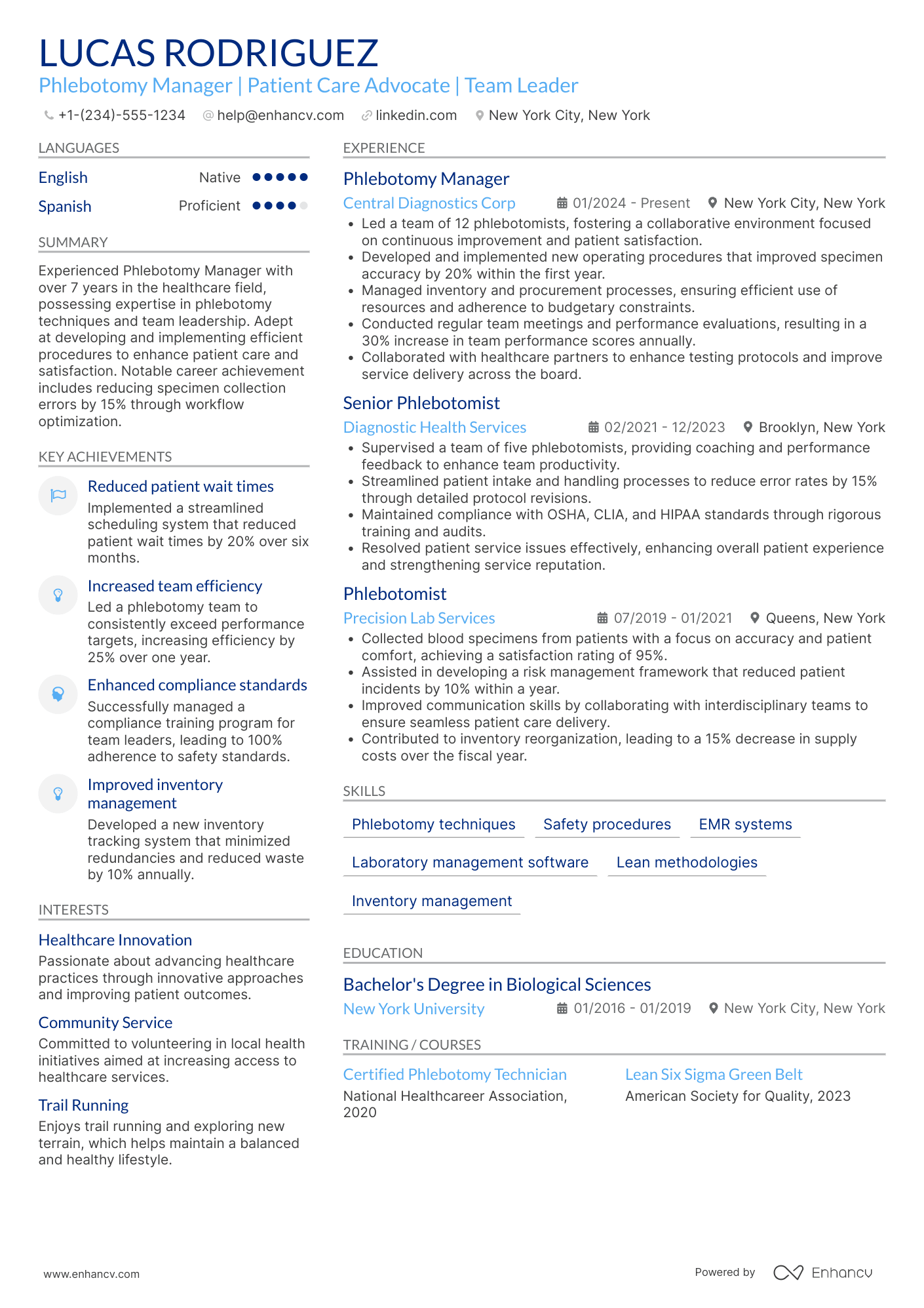
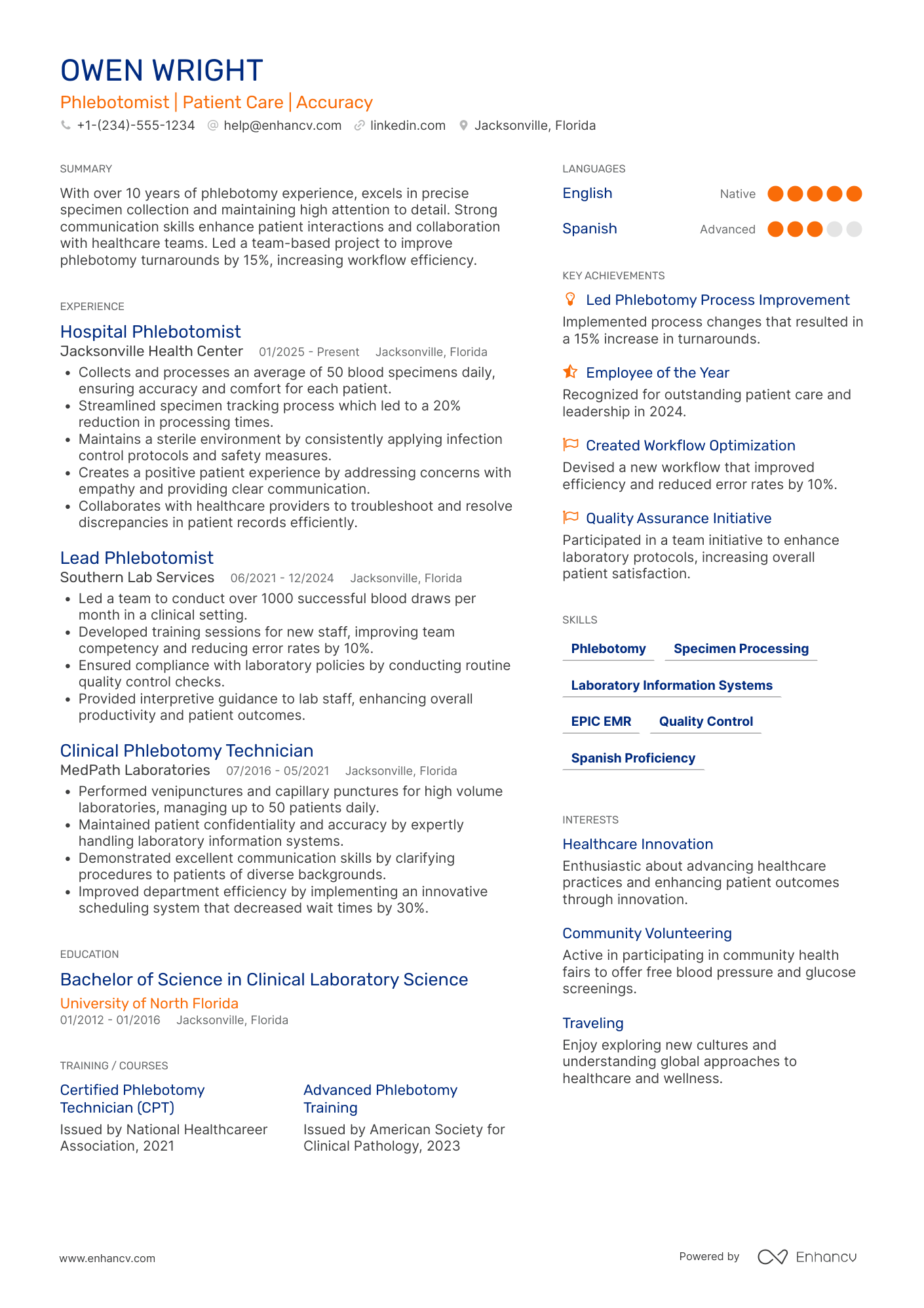
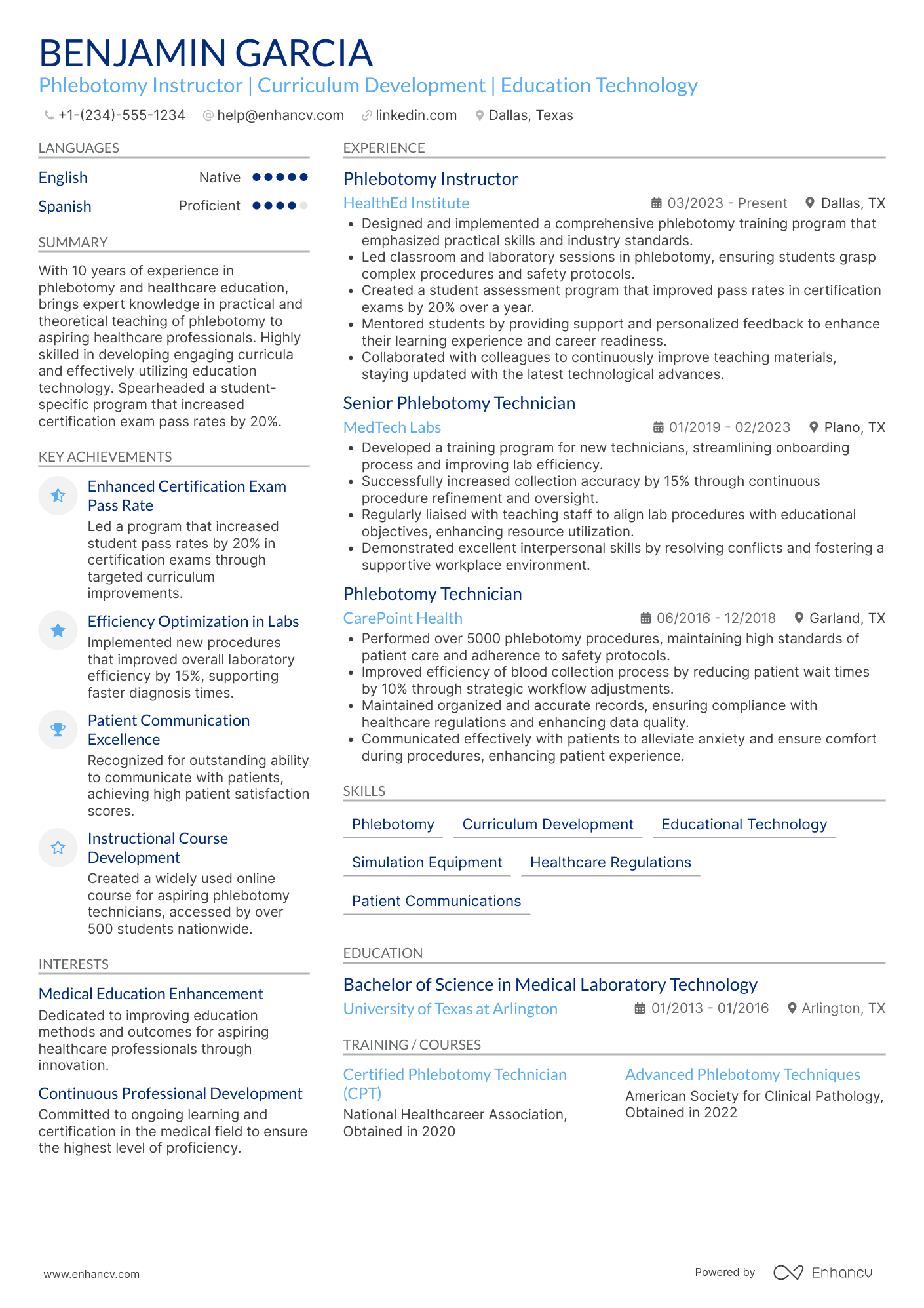
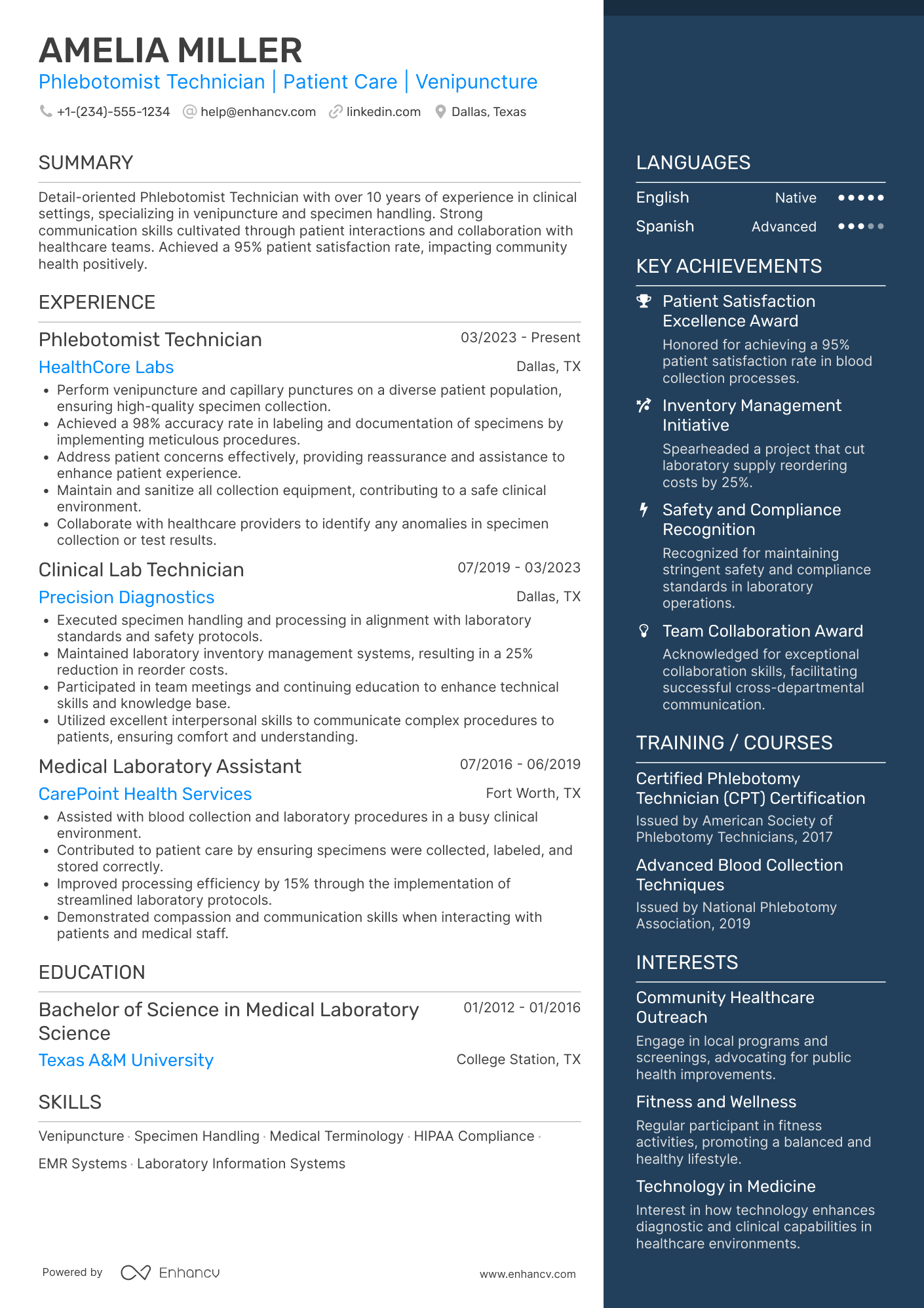
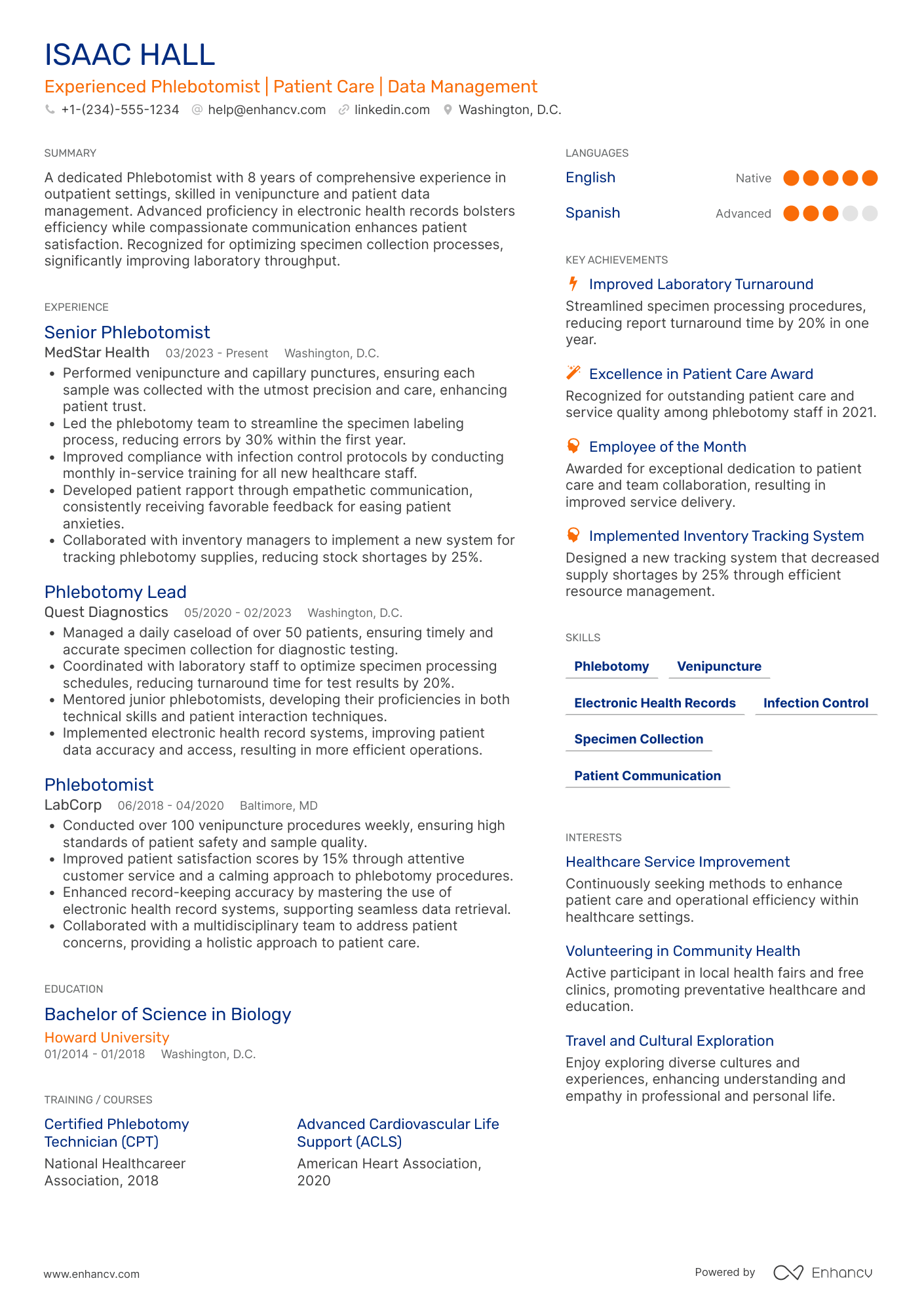
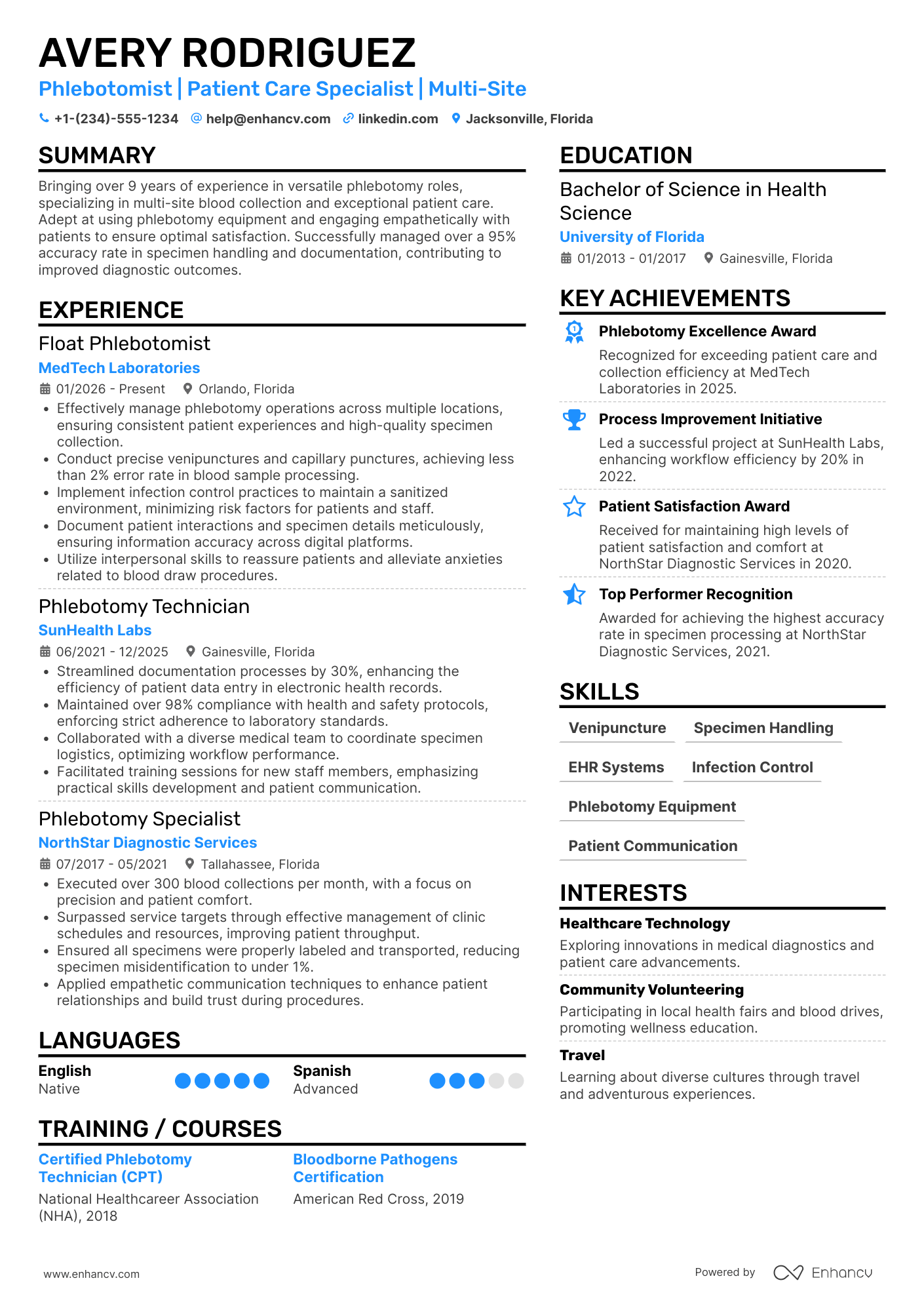
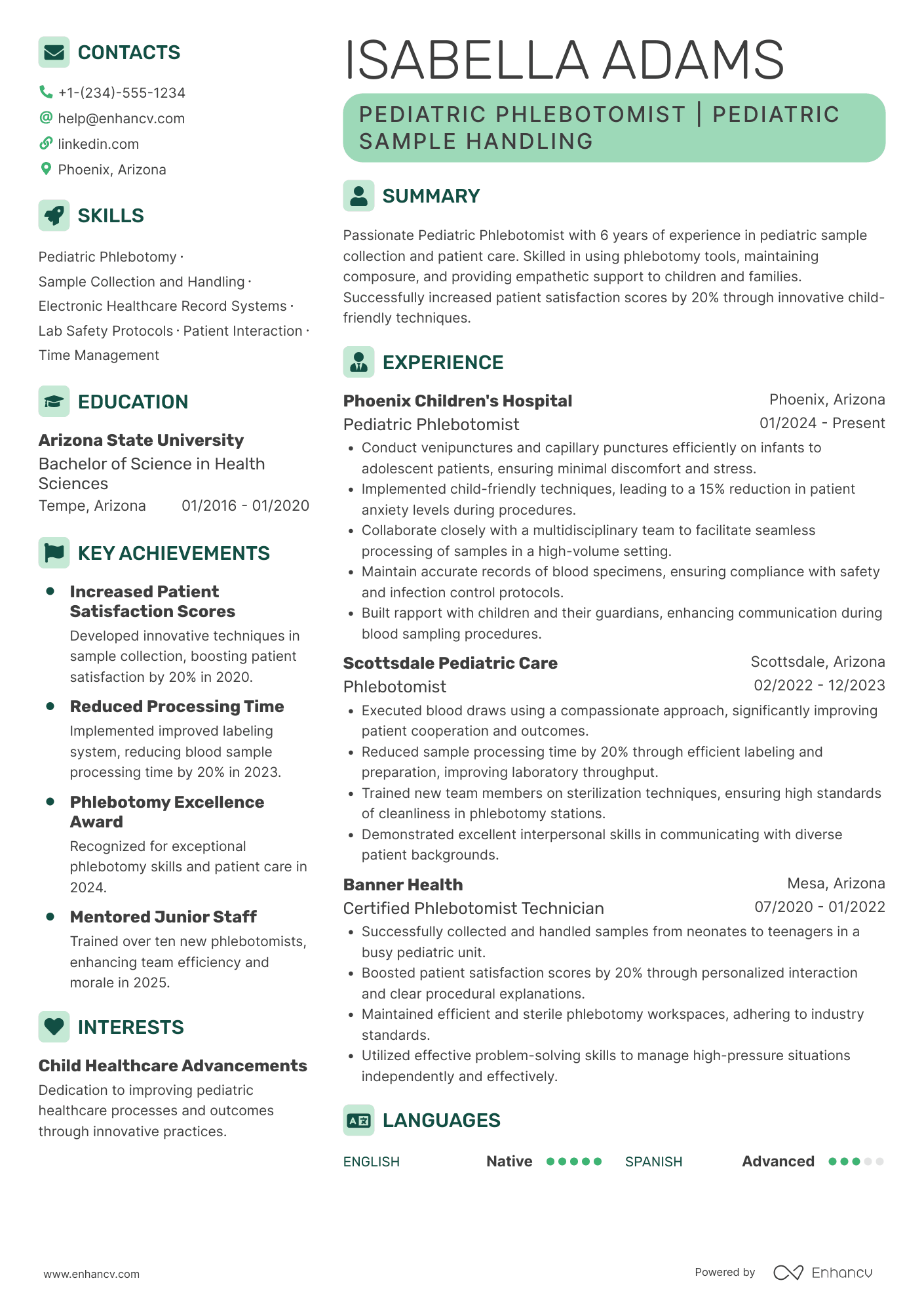
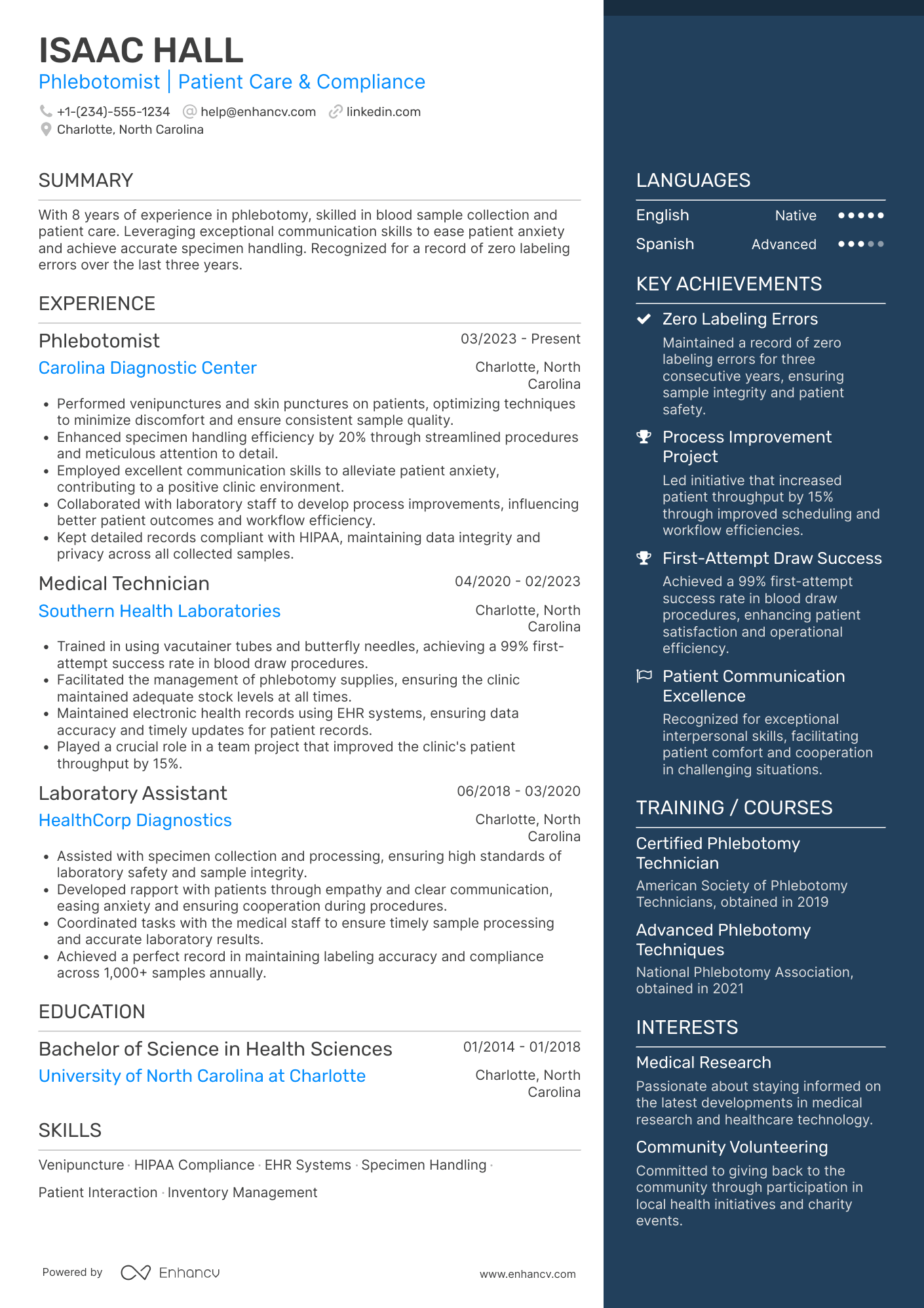
Most phlebotomist resumes fail because they list tasks but miss the exact keywords and proof of competency employers screen for. ATS filters and fast recruiter scans push vague resumes aside, especially when openings draw many qualified applicants.
A strong resume shows outcomes and reliability, not just tools used. Understanding how to make your resume stand out is essential when competing for phlebotomist roles. You'll highlight draw volume per shift, first-stick success rate, specimen rejection reductions, turnaround time improvements, and calm performance with pediatrics, geriatrics, and high-acuity patients.

Key takeaways
- Quantify draw volume, first-stick success rate, and specimen rejection reductions in every experience bullet.
- Use reverse-chronological format with consistent experience; switch to hybrid only if entering phlebotomy.
- Tailor each resume to the job posting's exact terminology, systems, and patient populations.
- Place certifications like CPT or PBT where recruiters see them fastest—above or below education based on relevance.
- Back every listed skill with a measurable outcome in your experience or summary section.
- Write a three- to four-line summary featuring your setting, core technique, and a specific achievement.
- Use Enhancv's tools to turn vague duty descriptions into recruiter-ready, quantified resume bullets.
Job market snapshot for phlebotomists
We analyzed 4,471 recent phlebotomist job ads across major US job boards. These numbers help you understand skills in demand, experience requirements, top companies hiring at a glance.
What level of experience employers are looking for phlebotomists
| Years of Experience | Percentage found in job ads |
|---|---|
| 1–2 years | 14.2% (635) |
| 3–4 years | 2.5% (111) |
| 5–6 years | 0.6% (27) |
| 10+ years | 2.1% (93) |
| Not specified | 79.2% (3542) |
Phlebotomist ads by area of specialization (industry)
| Industry (Area) | Percentage found in job ads |
|---|---|
| Healthcare | 57.8% (2584) |
| Finance & Banking | 41.2% (1842) |
| Education | 0.5% (24) |
| Government | 0.3% (15) |
Top companies hiring phlebotomists
| Company | Percentage found in job ads |
|---|---|
| Quest Diagnostics Incorporated | 29.9% (1337) |
| LabCorp | 15.0% (672) |
| Actalent | 3.8% (169) |
| Grifols SA | 2.3% (101) |
| OneBlood | 2.1% (92) |
| Sonic Healthcare USA | 1.9% (87) |
| BioLife | 1.3% (58) |
| Premise Health Systems | 1.2% (54) |
| One Medical | 1.2% (52) |
| American Red Cross | 1.1% (51) |
Role overview stats
These tables show the most common responsibilities and employment types for phlebotomist roles. Use them to align your resume with what employers expect and to understand how the role is structured across the market.
Day-to-day activities and top responsibilities for a phlebotomist
| Responsibility | Percentage found in job ads |
|---|---|
| Phlebotomy | 63.2% (2826) |
| Data entry | 34.0% (1518) |
| Venipuncture | 29.0% (1296) |
| Specimen collection | 19.4% (868) |
| Customer service | 15.4% (690) |
| Billing | 14.9% (666) |
| Computer navigation | 14.7% (659) |
| Capillary techniques | 9.6% (431) |
| Inventory management | 8.9% (400) |
| Specimen processing | 8.0% (358) |
| Communication | 6.7% (300) |
| Microsoft office | 5.2% (232) |
How to format a phlebotomist resume
Recruiters reviewing phlebotomist resumes prioritize clinical skills, certification status, venipuncture proficiency, and patient interaction ability—typically within the first few seconds of a scan. A clean, well-structured resume format ensures these signals surface immediately, improving both human readability and applicant tracking system (ATS) compatibility.

I have significant experience as a phlebotomist—which format should I use?
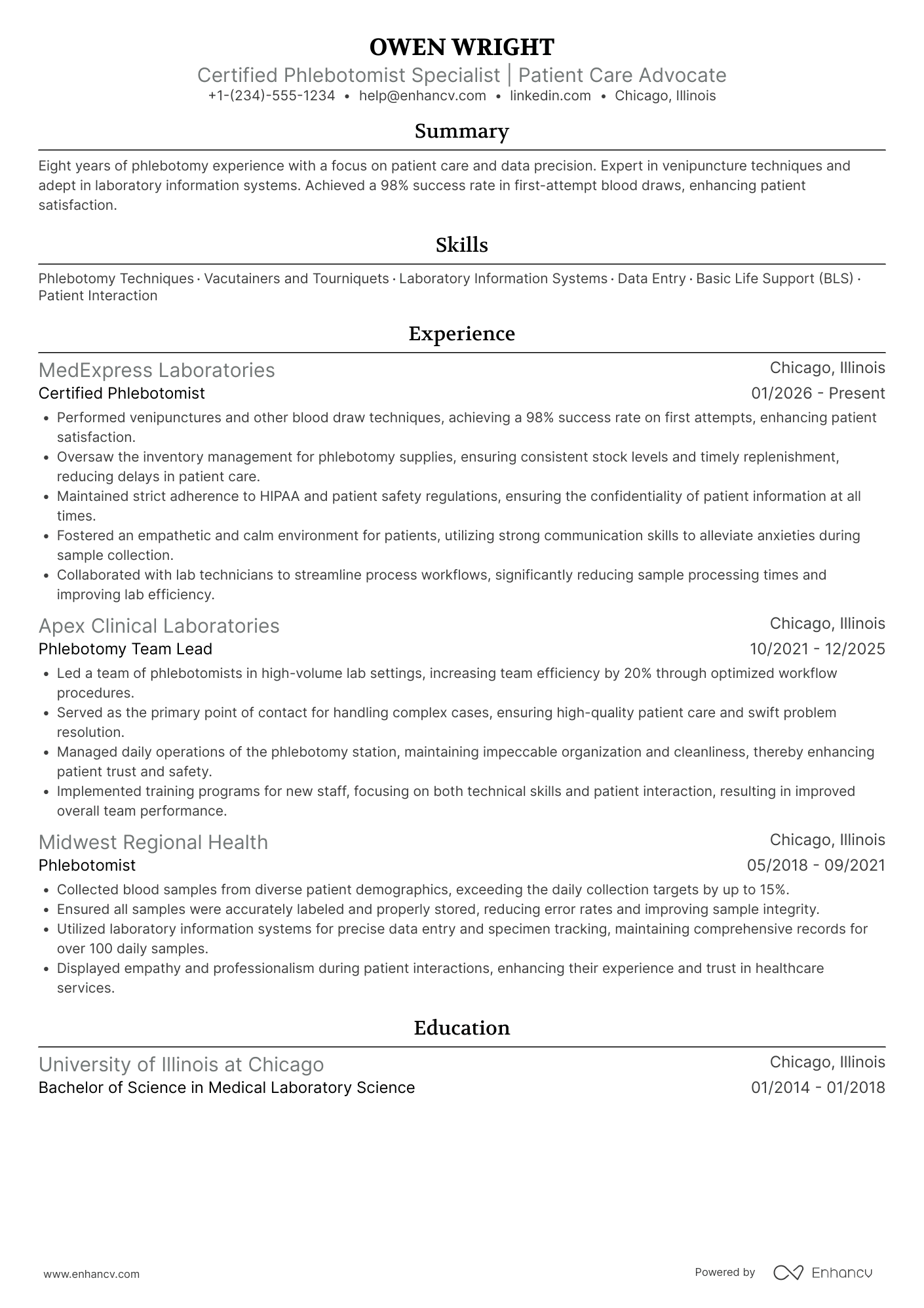
Use a reverse-chronological format to showcase your depth of clinical experience and professional growth in specimen collection and patient care. Do:
- Lead with your most recent role and emphasize scope—daily draw volumes, facility type, and department coverage.
- Highlight role-specific proficiencies such as venipuncture, capillary collection, pediatric draws, specimen processing, and laboratory information systems (LIS).
- Quantify outcomes tied to accuracy, efficiency, or patient satisfaction improvements.
I'm junior or switching into phlebotomy—what format works best?
A hybrid format works best, letting you lead with relevant clinical skills and certifications while still showing your work or practicum timeline. Do:
- Place a skills section near the top featuring certifications (CPT, NHA), venipuncture technique, specimen handling, and infection control protocols.
- Include clinical externships, practicum hours, volunteer work, or healthcare-adjacent roles that demonstrate patient-facing experience.
- Connect each listed skill or experience to a specific action and a tangible result.
Why not use a functional resume?
A functional format strips away the clinical timeline recruiters rely on to verify hands-on phlebotomy experience, making it harder to confirm your draw volume, setting familiarity, and progression through increasingly complex patient populations.
- A functional format may be acceptable if you're transitioning from a related healthcare role (such as medical assisting or nursing assistance), returning to work after an extended gap, or have limited formal employment history but hold a current phlebotomy certification—provided you still tie every listed skill to specific clinical projects, externship outcomes, or measurable results.
Once your layout and formatting choices are in place, the next step is deciding which sections to include so each one reinforces your qualifications.
What sections should go on a phlebotomist resume
Recruiters expect a phlebotomist resume to show you can collect specimens safely, accurately, and efficiently while following protocols and supporting patient care. Knowing what to put on a resume helps you prioritize the most impactful information.
Use this structure for maximum clarity:
- Header
- Summary
- Experience
- Skills
- Projects
- Education
- Certifications
- Optional sections: Awards, Volunteering, Languages
In your experience bullets, emphasize measurable outcomes, patient volume, error reduction, compliance, and how your work improved turnaround times and patient experience.
Is your resume good enough?
Drop your resume here or choose a file. PDF & DOCX only. Max 2MB file size.
Now that you’ve organized the key resume components, focus on writing your phlebotomist experience section to show how you applied those qualifications in patient care settings.
How to write your phlebotomist resume experience
Your work experience section proves you can perform blood draws safely, operate collection equipment with precision, and maintain the specimen integrity that labs depend on. Hiring managers prioritize demonstrated impact—patient volumes handled, error rates reduced, compliance standards met—over generic task lists that simply describe daily duties.
Each entry should include:
- Job title
- Company and location (or remote)
- Dates of employment (month and year)
Three to five concise bullet points showing what you owned, how you executed, and what outcomes you delivered:
- Ownership scope: the patient populations, draw stations, specimen processing workflows, or collection site operations you were directly accountable for as a phlebotomist.
- Execution approach: the venipuncture techniques, capillary collection methods, specimen labeling systems, electronic health record platforms, or infection control protocols you applied to complete draws accurately and safely.
- Value improved: the changes you drove in specimen rejection rates, patient wait times, collection accuracy, compliance adherence, or workflow efficiency within your phlebotomy setting.
- Collaboration context: how you coordinated with laboratory technicians, nurses, physicians, patients, and quality assurance teams to ensure proper specimen handling and timely diagnostic results.
- Impact delivered: the measurable outcomes your work produced—expressed through patient throughput, error reduction, safety improvements, or contributions to lab turnaround performance rather than routine activity descriptions.
Experience bullet formula
A phlebotomist experience example
✅ Right example - modern, quantified, specific.
Phlebotomist
Riverside Medical Center | Columbus, OH
2022–Present
Two-hundred-bed acute care hospital supporting emergency, inpatient, and outpatient lab services.
- Performed one hundred twenty to one hundred sixty venipunctures and capillary draws per shift using Vacutainer systems and butterfly needles, sustaining a ninety-eight percent first-stick success rate and cutting redraws by twenty-two percent.
- Implemented bedside label printing and barcode scanning in Epic Beaker, reducing specimen mislabeling from 0.6 percent to 0.2 percent and preventing an average of eight recollects per week.
- Standardized specimen handling for coagulation and blood culture collections—correct order of draw, timed draws, and transport on ice when required—improving sample acceptance by seventeen percent and lowering hemolysis to under two percent.
- Coordinated with nurses, emergency department clinicians, and couriers to prioritize STAT and timed collections, decreasing emergency department lab turnaround time by twelve minutes and improving on-time draws to ninety-four percent.
- Trained six new hires on infection control, personal protective equipment, and Joint Commission-aligned protocols, raising team compliance audit scores from ninety-one percent to ninety-seven percent within one quarter.
Now that you've seen how a strong experience section comes together, let's look at how to adjust those details to match the specific phlebotomist role you're applying for.
How to tailor your phlebotomist resume experience
Recruiters evaluate phlebotomist resumes through both human review and applicant tracking systems (ATS), so tailoring your resume to the job description increases your chances of advancing. Aligning your listed skills and accomplishments with the specific role ensures your resume speaks directly to what the employer needs.
Ways to tailor your phlebotomist experience:
- Match venipuncture and capillary collection methods listed in the posting.
- Mirror the exact specimen processing systems the employer names.
- Use the same terminology for infection control standards referenced.
- Highlight experience with the specific patient populations they serve.
- Emphasize HIPAA compliance and quality assurance protocols when mentioned.
- Reference the electronic health record platform stated in the description.
- Include pediatric or geriatric draw experience if the role requires it.
- Align your workflow descriptions with their laboratory information system.
Tailoring means aligning your real achievements with each job's specific requirements, not forcing keywords where they don't naturally belong.
Resume tailoring examples for phlebotomist
| Job description excerpt | Untailored | Tailored |
|---|---|---|
| Perform venipuncture and capillary draws on patients of all ages using butterfly needles, evacuated tubes, and syringes while maintaining a 97%+ first-stick success rate. | Responsible for drawing blood from patients in a clinical setting. | Performed 40+ daily venipunctures and capillary draws on pediatric through geriatric patients using butterfly needles, evacuated tubes, and syringes, maintaining a 98.2% first-stick success rate. |
| Process and label specimens according to CLIA and OSHA standards, ensuring proper chain of custody and accurate data entry into the Cerner LIS system. | Handled lab specimens and entered patient information into the computer system. | Processed and labeled 120+ daily specimens in compliance with CLIA and OSHA regulations, maintaining chain-of-custody protocols and achieving 99.7% data entry accuracy in the Cerner LIS system. |
| Provide compassionate patient care during blood collection, with a focus on calming anxious patients and those with needle phobia, while educating them on pre-test requirements such as fasting. | Interacted with patients and answered their questions during procedures. | Applied de-escalation and distraction techniques to calm anxious patients and individuals with needle phobia during blood collection, while clearly communicating pre-test fasting requirements to reduce sample rejection rates by 15%. |
Once you’ve aligned your experience with the role’s priorities, quantify your phlebotomist achievements to show the measurable impact of that work.
How to quantify your phlebotomist achievements
Quantifying your achievements shows how you improve patient safety, speed, and lab reliability. Focus on draw volume, first-stick success, specimen rejection rates, turnaround time, and compliance outcomes.
Quantifying examples for phlebotomist
| Metric | Example |
|---|---|
| Volume handled | "Collected 45–60 venipunctures per shift across emergency department and inpatient units while maintaining complete specimen labeling and chain-of-custody documentation." |
| First-stick success | "Improved first-stick success from 86% to 93% in three months by standardizing vein assessment and using butterfly sets for difficult-access patients." |
| Specimen quality | "Reduced hemolysis and clotting rejections by 28% by reinforcing tube inversion timing and using 21–23 gauge needles per protocol." |
| Turnaround time | "Cut average STAT draw-to-lab handoff time from 18 minutes to 11 minutes by batching runs and coordinating pickups with couriers." |
| Compliance and safety | "Maintained zero needlestick injuries for twelve months by following sharps disposal steps and completing annual OSHA bloodborne pathogen training on time." |
Turn vague job duties into measurable, recruiter-ready resume bullets in seconds with Enhancv's Bullet Point Generator.
With your bullet points sharpened to highlight measurable achievements, it's time to ensure the right mix of hard and soft skills backs them up throughout your phlebotomist resume.
How to list your hard and soft skills on a phlebotomist resume
Your skills section shows you can collect, label, and process specimens safely and efficiently, and recruiters and an ATS (applicant tracking system) scan this section to confirm role fit—aim for mostly hard skills with a smaller set of role-specific soft skills. phlebotomist roles require a blend of:
- Product strategy and discovery skills: Patient intake, test order verification, and workflow triage.
- Data, analytics, and experimentation skills: Specimen tracking accuracy, quality control checks, and error reduction.
- Delivery, execution, and go-to-market discipline: High-volume draw execution, turnaround time support, and protocol compliance.
- Soft skills: Patient communication, de-escalation, and cross-team coordination.
Your skills section should be:
- Scannable (bullet-style grouping).
- Relevant to the job post.
- Backed by proof in experience bullets.
- Updated with current tools.
Place your skills section:
- Above experience if you're junior or switching careers.
- Below experience if you're mid/senior with strong achievements.

Hard skills
- Venipuncture, capillary puncture
- Order verification, patient identification
- Specimen labeling, chain of custody
- Tube selection, order of draw
- Aseptic technique, infection control
- PPE use, exposure control plan
- Specimen processing, centrifugation, aliquoting
- Point-of-care testing support
- Laboratory information system documentation
- Electronic health record documentation
- CLIA, HIPAA compliance
- Quality control logs, specimen rejection criteria
Soft skills
- Explain procedures in plain language
- Calm anxious or pediatric patients
- De-escalate difficult patient interactions
- Verify details under time pressure
- Coordinate handoffs with nurses and lab staff
- Escalate critical issues promptly
- Maintain patient privacy in conversations
- Prioritize draws by urgency and stability
- Follow protocols without shortcuts
- Document clearly and consistently
- Adapt communication across cultures and ages
- Manage high-volume workflow safely
How to show your phlebotomist skills in context
Skills shouldn't live only in a bulleted list on your resume. Explore resume skills examples to see how other phlebotomists present their abilities effectively.
They should be demonstrated in:
- Your summary (high-level professional identity)
- Your experience (proof through outcomes)
Here's how that looks in practice.
Summary example
Senior phlebotomist with 10 years in hospital and outpatient settings. Skilled in venipuncture, capillary collection, and pediatric draws using butterfly needles. Reduced specimen rejection rates by 32% through strict labeling protocols and patient-centered communication.
Why it works:
- Reflects senior-level experience clearly
- Names specific tools and techniques
- Includes a measurable quality outcome
- Highlights patient communication skills
Experience example
Senior Phlebotomist
Mercy Health Regional Medical Center | Toledo, OH
March 2018–Present
- Performed 60+ daily venipunctures and capillary draws, maintaining a 98.5% first-stick success rate using vacuum and butterfly needle systems.
- Collaborated with lab technicians and nursing staff to reduce specimen processing turnaround time by 20% through improved collection workflows.
- Trained 12 new phlebotomists on pediatric draw techniques and electronic order verification in the Cerner laboratory information system.
Why it works:
- Every bullet includes measurable proof.
- Skills appear through real accomplishments.
Once you’ve woven your phlebotomy abilities into real examples, the next step is to apply that same approach to building a phlebotomist resume with no experience so your strengths still come through clearly.
How do I write a phlebotomist resume with no experience
How do I write a phlebotomist resume with no experience? Even without full-time experience, you can demonstrate readiness through clinical training and hands-on practice. If you're building a resume without work experience, focus on these areas:
- Clinical externship blood draws
- Phlebotomy lab venipuncture practice
- Capillary puncture skills checkoffs
- Specimen labeling and handling drills
- Electronic health record charting labs
- Infection control competency assessments
- CPR certification and first aid
Focus on:
- Venipuncture volume and accuracy
- Specimen handling and chain-of-custody
- Safety compliance and documentation
- Patient ID verification process
Resume format tip for entry-level phlebotomist
Use a combination resume format. It highlights training and skills first, while still showing clinical hours, projects, and certifications. Do:
- Lead with certifications, clinical hours, and scope.
- Add a skills section with venipuncture, capillary puncture, and specimen processing.
- Quantify draws, success rate, and error-free labeling.
- List tools used: tourniquet, vacutainer system, butterfly needle.
- Include compliance details: gloves, sharps disposal, and patient ID checks.
- Completed phlebotomy lab venipuncture practice using vacutainer system and butterfly needle; performed 40 successful draws with zero labeling errors per instructor audit.
Even without hands-on work history, your education and certifications carry significant weight—so presenting them effectively on your resume is essential.
How to list your education on a phlebotomist resume
Your education section helps hiring managers confirm you have the foundational knowledge required for safe, effective phlebotomy practice. It validates your training at a glance.
Include:
- Degree name
- Institution
- Location
- Graduation year
- Relevant coursework (for juniors or entry-level candidates)
- Honors & GPA (if 3.5 or higher)
Skip month and day details—list the graduation year only.
Here's a strong education entry tailored for a phlebotomist resume:
Example education entry
Associate of Applied Science in Phlebotomy Technology
Brookline Community College, Boston, MA
Graduated 2022
GPA: 3.7/4.0
- Relevant Coursework: Clinical Phlebotomy Procedures, Human Anatomy & Physiology, Medical Terminology, Infection Control Practices
- Honors: Dean's List, 2021–2022
How to list your certifications on a phlebotomist resume
Certifications on your resume show your commitment to learning, your proficiency with collection tools, and your relevance to current clinical standards as a phlebotomist.
Include:
- Certificate name
- Issuing organization
- Year
- Optional: credential ID or URL
- Place certifications below education when your degree is recent and your certifications are older or less relevant to phlebotomist work.
- Place certifications above education when they are recent, highly relevant, or required for phlebotomist roles in your state or employer.
Best certifications for your phlebotomist resume
- Certified Phlebotomy Technician (CPT)
- Phlebotomy Technician (PBT)
- Certified Phlebotomist (CP)
- Registered Phlebotomy Technician (RPT)
- Basic Life Support (BLS)
- CPR and First Aid Certification
Once you’ve positioned your credentials where hiring managers can spot them quickly, shift to your phlebotomist resume summary to connect those qualifications to the value you deliver.
How to write your phlebotomist resume summary
Your resume summary is the first thing a recruiter reads, so it needs to earn their attention fast. A strong opening frames you as a capable phlebotomist who delivers reliable results.
Keep it to three to four lines, with:
- Your title and total years of phlebotomy experience.
- The clinical setting or patient population you've worked with most.
- Core skills like venipuncture, capillary collection, or specimen processing.
- One or two measurable achievements, such as collection accuracy rates or patient volumes.
- Soft skills tied to real outcomes, like patient communication that reduced draw anxiety.

PRO TIP
At the phlebotomist level, emphasize technical proficiency, relevant certifications, and early wins that show dependability. Highlight specific tools and procedures you've mastered. Avoid vague descriptors like "hard-working" or "passionate about healthcare." Recruiters want proof of competence, not motivation statements.
Example summary for a phlebotomist
Certified phlebotomist with two years of experience in high-volume outpatient clinics. Skilled in venipuncture, capillary draws, and specimen handling. Maintained a 99.2% first-stick success rate across 80+ daily collections.
Optimize your resume summary and objective for ATS
Drop your resume here or choose a file.
PDF & DOCX only. Max 2MB file size.
Before your summary can make an impact, though, your resume header needs to ensure recruiters know exactly who you are and how to reach you.
What to include in a phlebotomist resume header
A resume header lists your key contact and professional details, helping recruiters spot you fast, trust your information, and screen you accurately.
Essential resume header elements
- Full name
- Tailored job title and headline
- Location
- Phone number
- Professional email
- GitHub link
- Portfolio link
A LinkedIn link helps recruiters confirm your work history quickly and supports faster screening.
Don't include a photo on a phlebotomist resume unless the role is explicitly front-facing or appearance-dependent.
Match your header title to the posting and include your phlebotomist credentials in the headline to improve search visibility.
Example
Phlebotomist resume header
Jordan Lee
Phlebotomist | Certified Phlebotomy Technician (CPT) | Specimen Collection & Patient Care
Chicago, IL
(312) 555-01XX
your.name@enhancv.com
github.com/yourname
yourwebsite.com
linkedin.com/in/yourname
Once your contact details and credentials are clearly presented at the top, you can strengthen the rest of your application with additional sections that support your phlebotomy experience and qualifications.
Additional sections for phlebotomist resumes
Adding extra sections helps you stand out when your core qualifications match other candidates and you need a competitive edge.
- Certifications and licenses
- Languages
- Volunteer experience
- Professional affiliations
- Continuing education
- Hobbies and interests
- Awards and recognitions
Beyond strengthening your resume with relevant extra sections, pairing it with a well-crafted cover letter can further set your application apart.
Do phlebotomist resumes need a cover letter
A cover letter isn't required for a phlebotomist, but it helps in competitive roles or when employers expect one. It can make a difference when your resume needs context or when you want to stand out in a high-volume applicant pool.
Use these tips to decide when a cover letter adds value:
- Explain fit for the role and team: Match your shift flexibility, patient population experience, and pace to the site's workflow and expectations.
- Highlight one or two outcomes: Share a specific result, like reducing redraws, improving patient satisfaction, or supporting high-volume draws during peak hours.
- Show you understand the setting: Reference the lab, clinic, or hospital environment, the patient mix, and how accuracy and compliance affect operations.
- Address transitions or non-obvious experience: Connect related work, training, or gaps to phlebotomist responsibilities, such as specimen handling, documentation, or patient communication.
Drop your resume here or choose a file.
PDF & DOCX only. Max 2MB file size.
Even if you decide a cover letter won’t add value for this application, using AI to improve your phlebotomist resume is the next step to strengthen the document employers will review first.
Using AI to improve your phlebotomist resume
AI can sharpen your resume's clarity, structure, and impact. It's useful for tightening language and aligning content with phlebotomist roles. But overuse dulls authenticity. Once your resume reads clearly and fits the role, step away from AI. For practical guidance, explore these ChatGPT resume writing prompts tailored to healthcare professionals.
Here are 10 practical prompts to strengthen specific sections of your phlebotomist resume:
Strengthen your summary
Quantify experience bullets
Tailor skills to the job
Improve action verbs
Refine certification details
Tighten education entries
Clarify project contributions
Remove redundant phrasing
Align with job descriptions
Check for consistency
Conclusion
A strong phlebotomist resume shows measurable outcomes, role-specific skills, and a clean structure. Highlight draw volume, first-stick success, specimen accuracy, and turnaround times. Pair results with skills like venipuncture, capillary collection, labeling, and infection control.
Keep sections easy to scan, with consistent dates, clear headings, and focused bullets. A resume that proves safe, efficient work helps you compete in today’s hiring market. It also shows you can adapt to new workflows and growing patient needs.
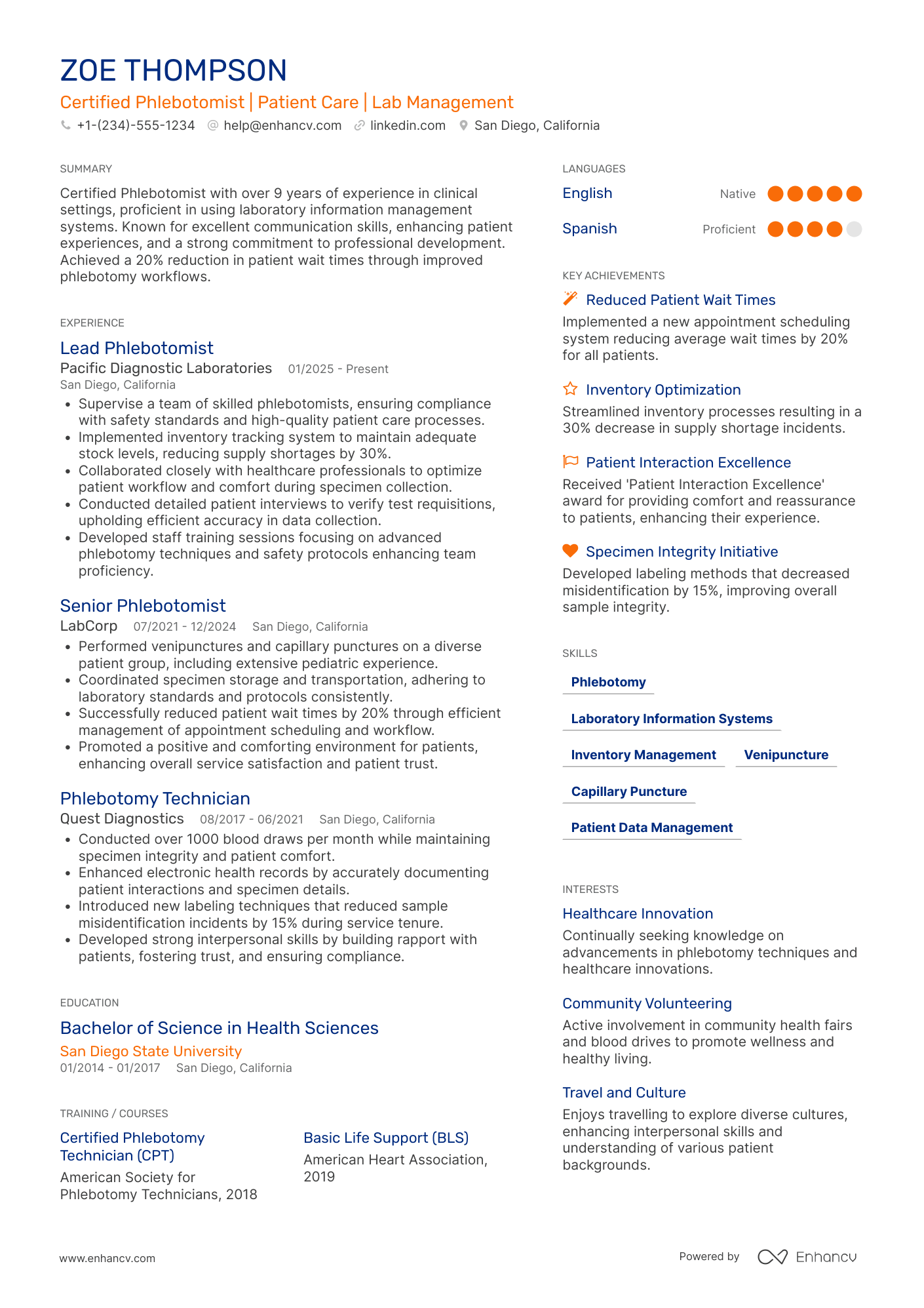
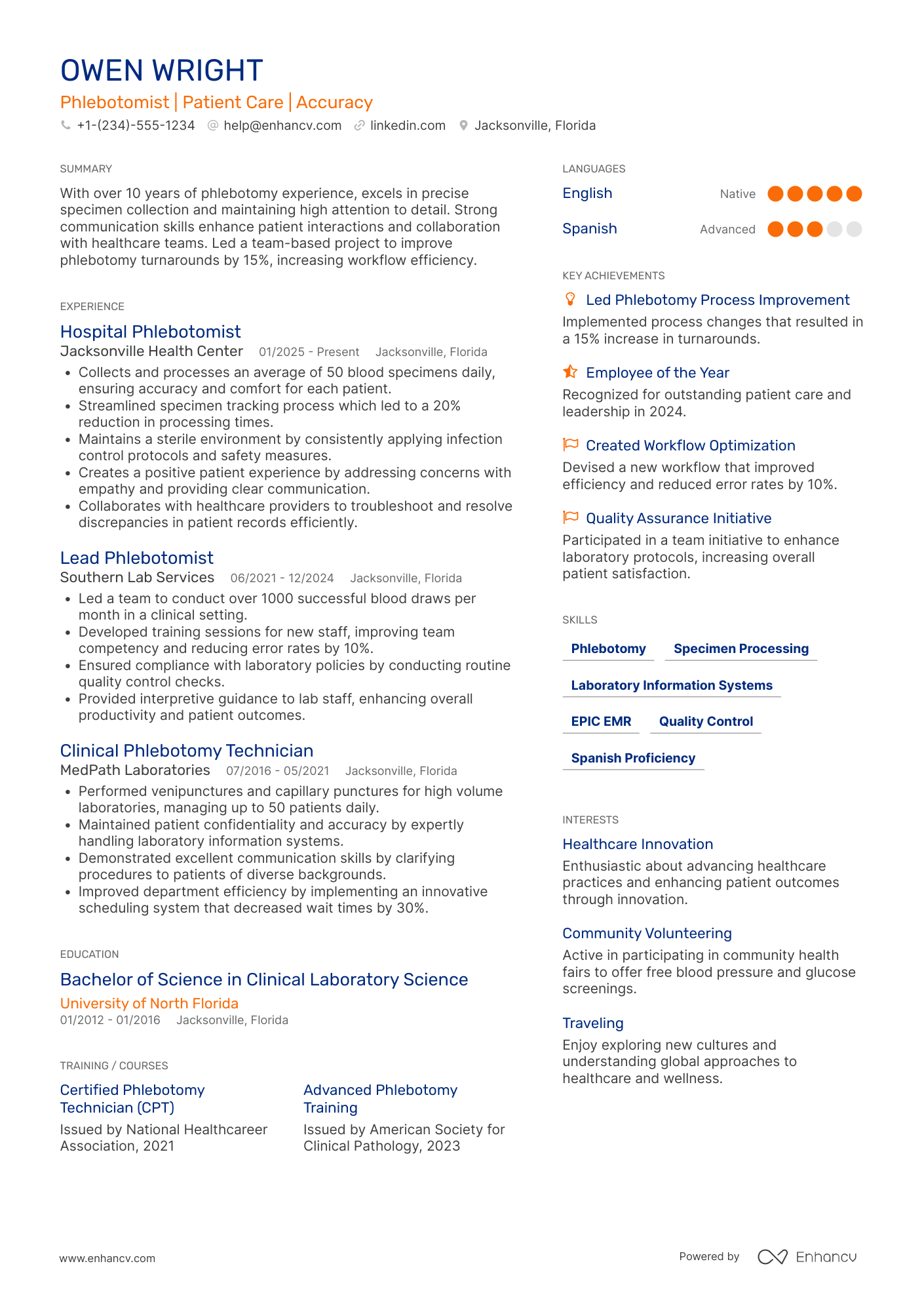
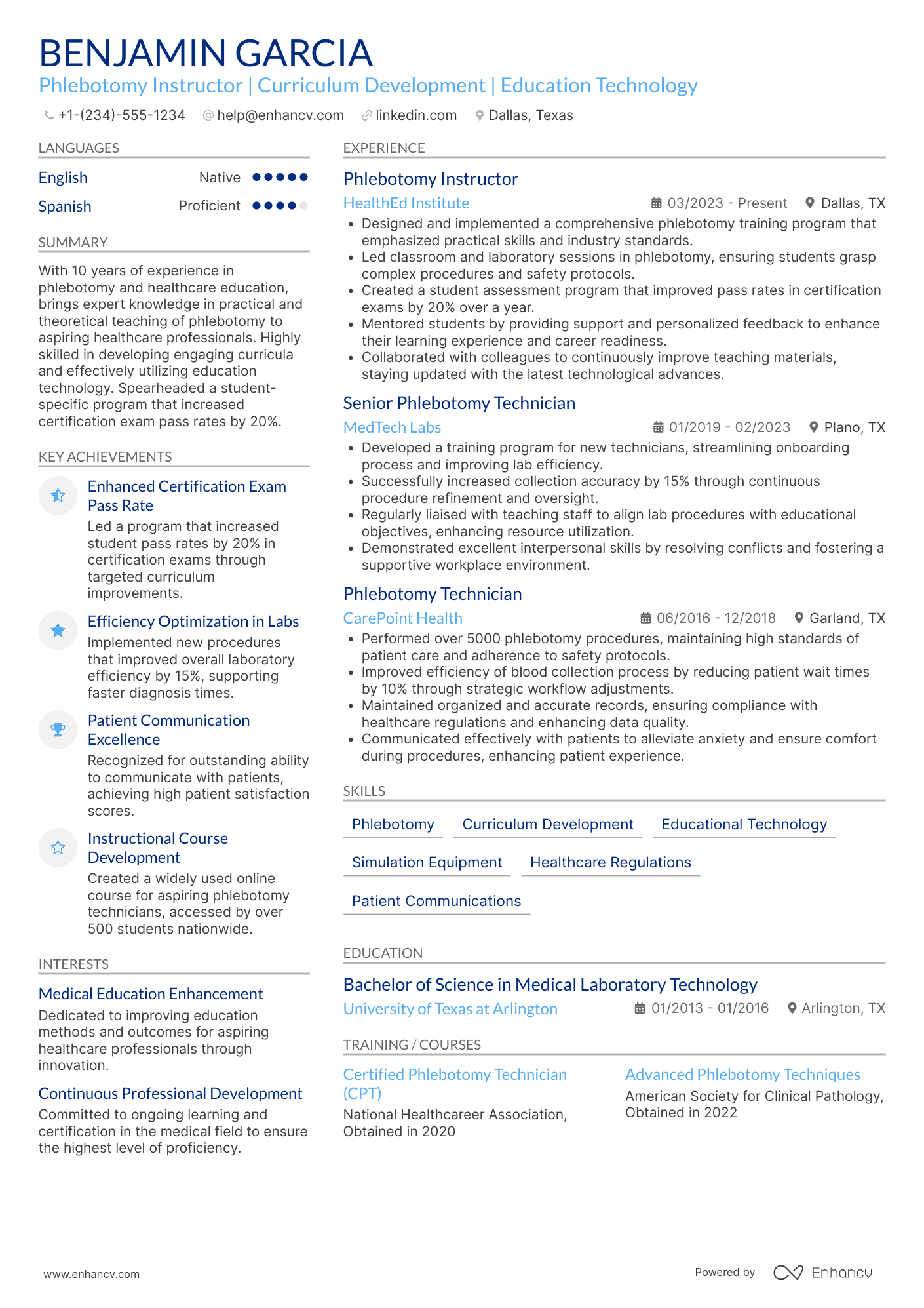
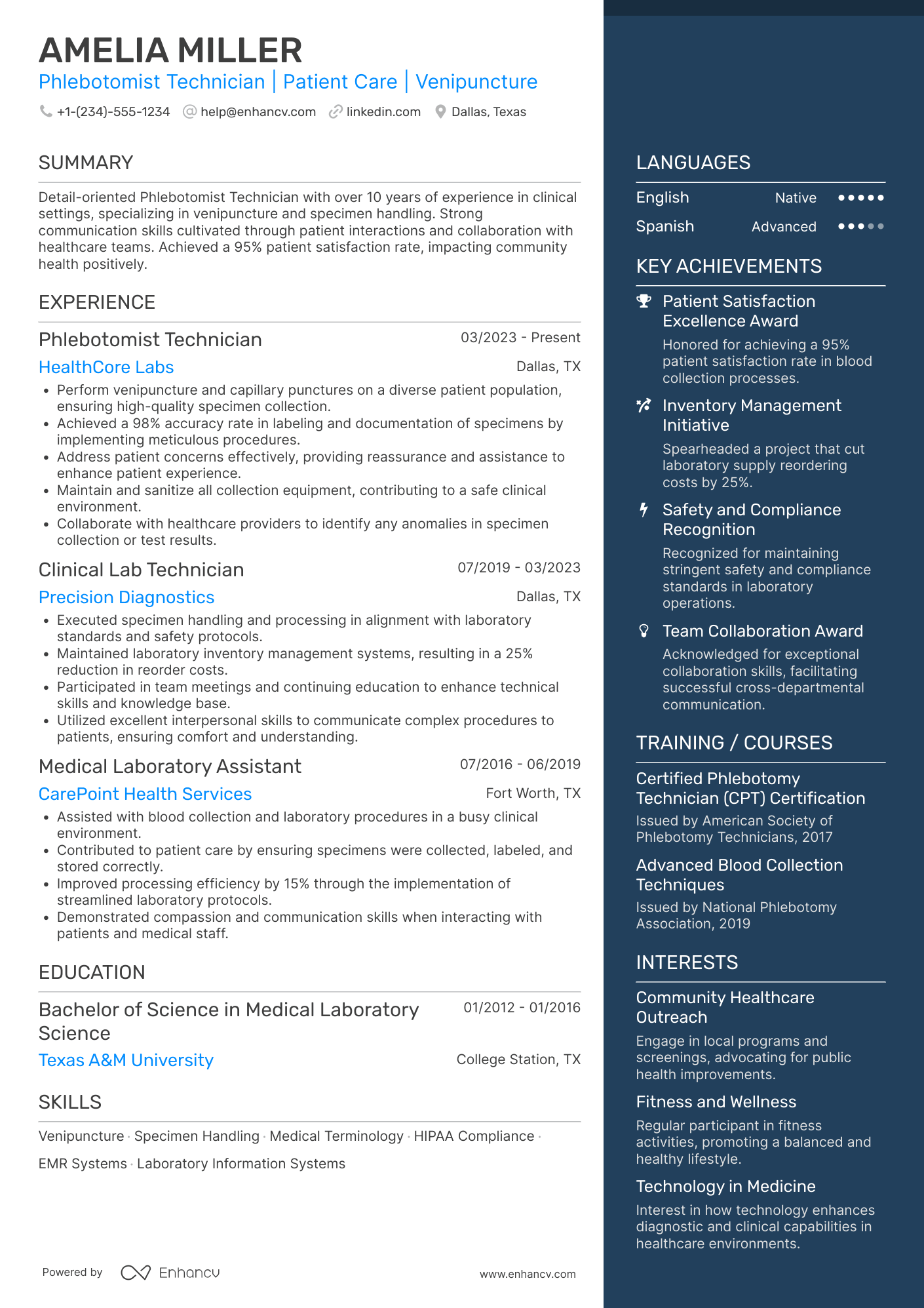
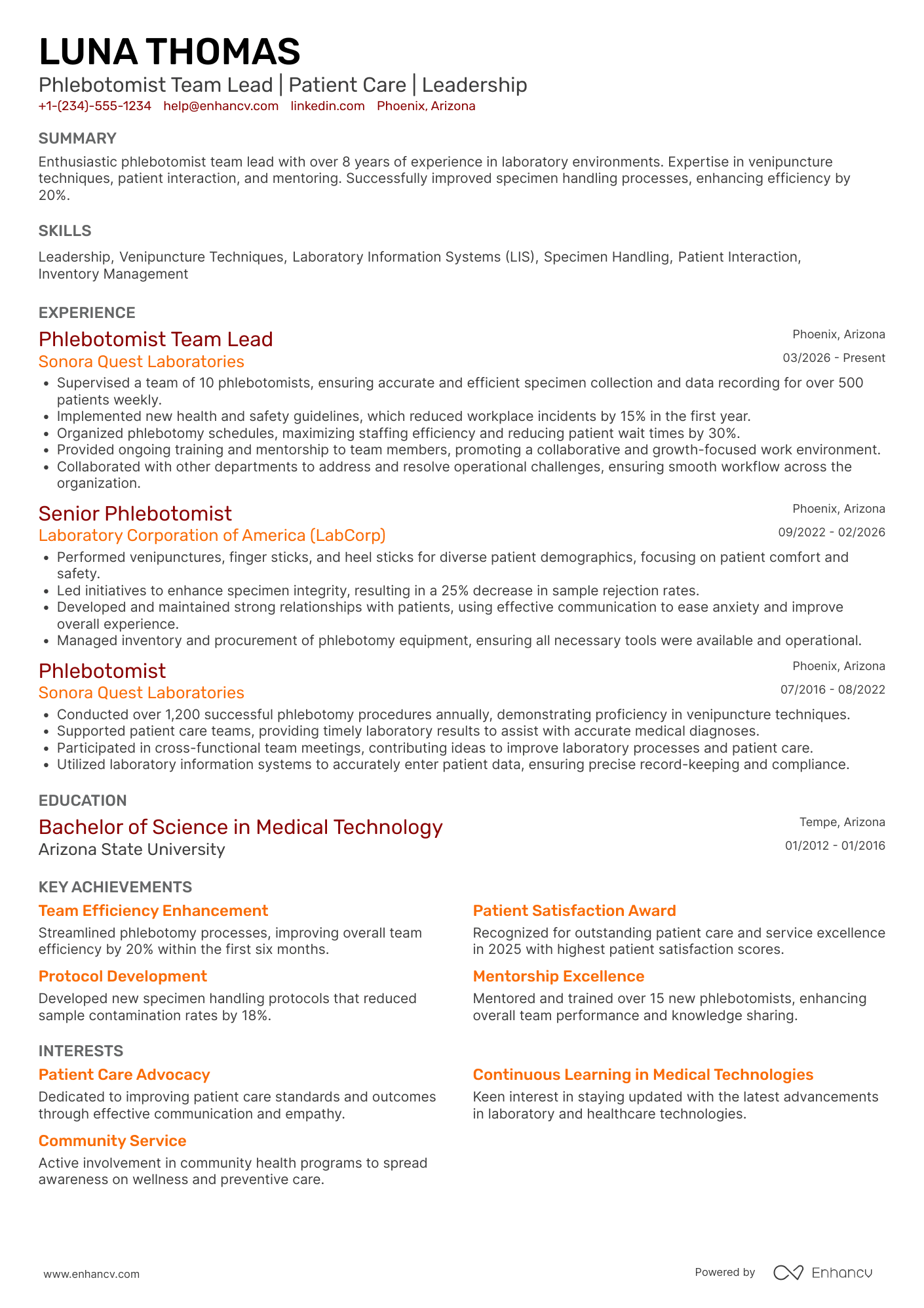
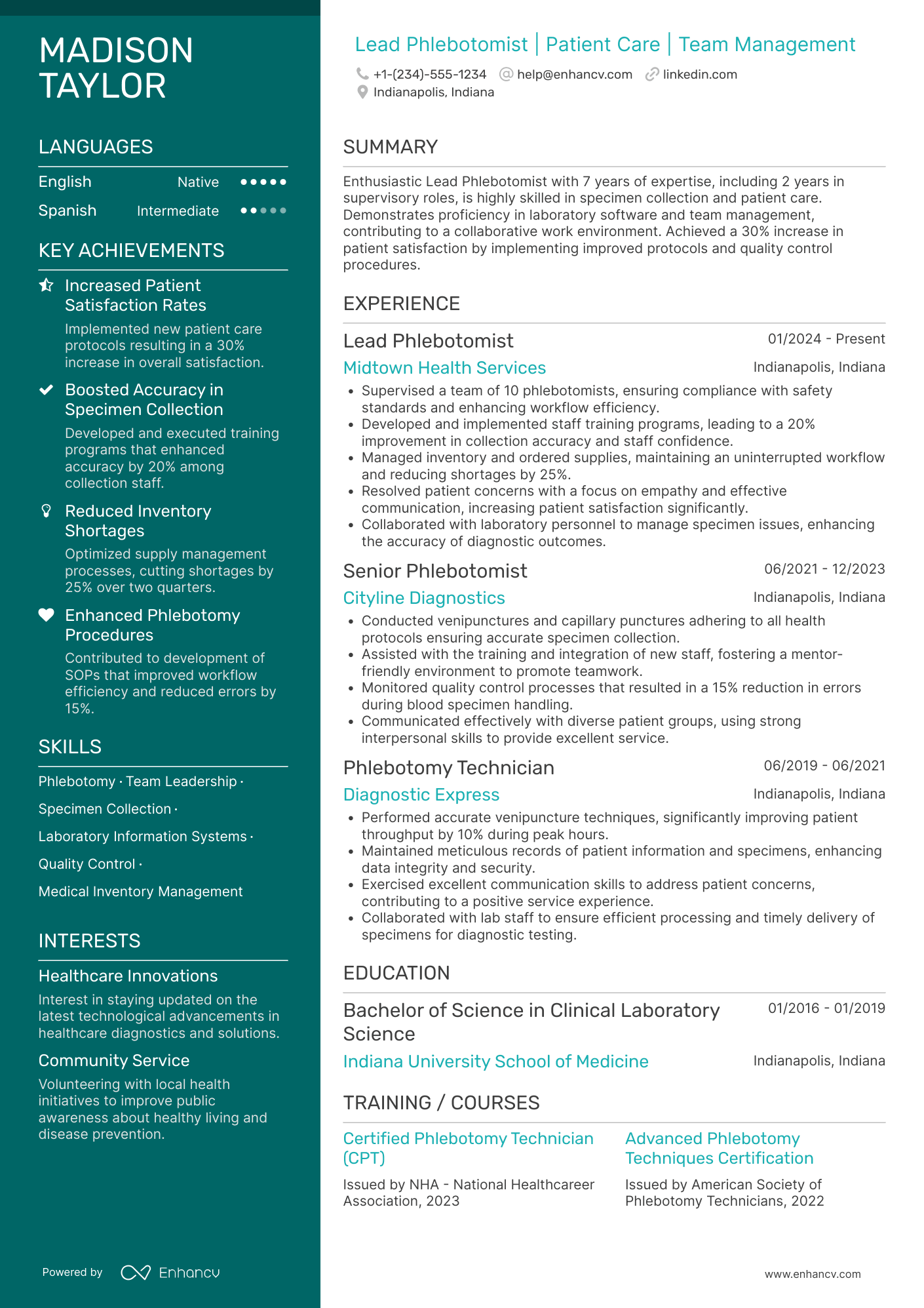
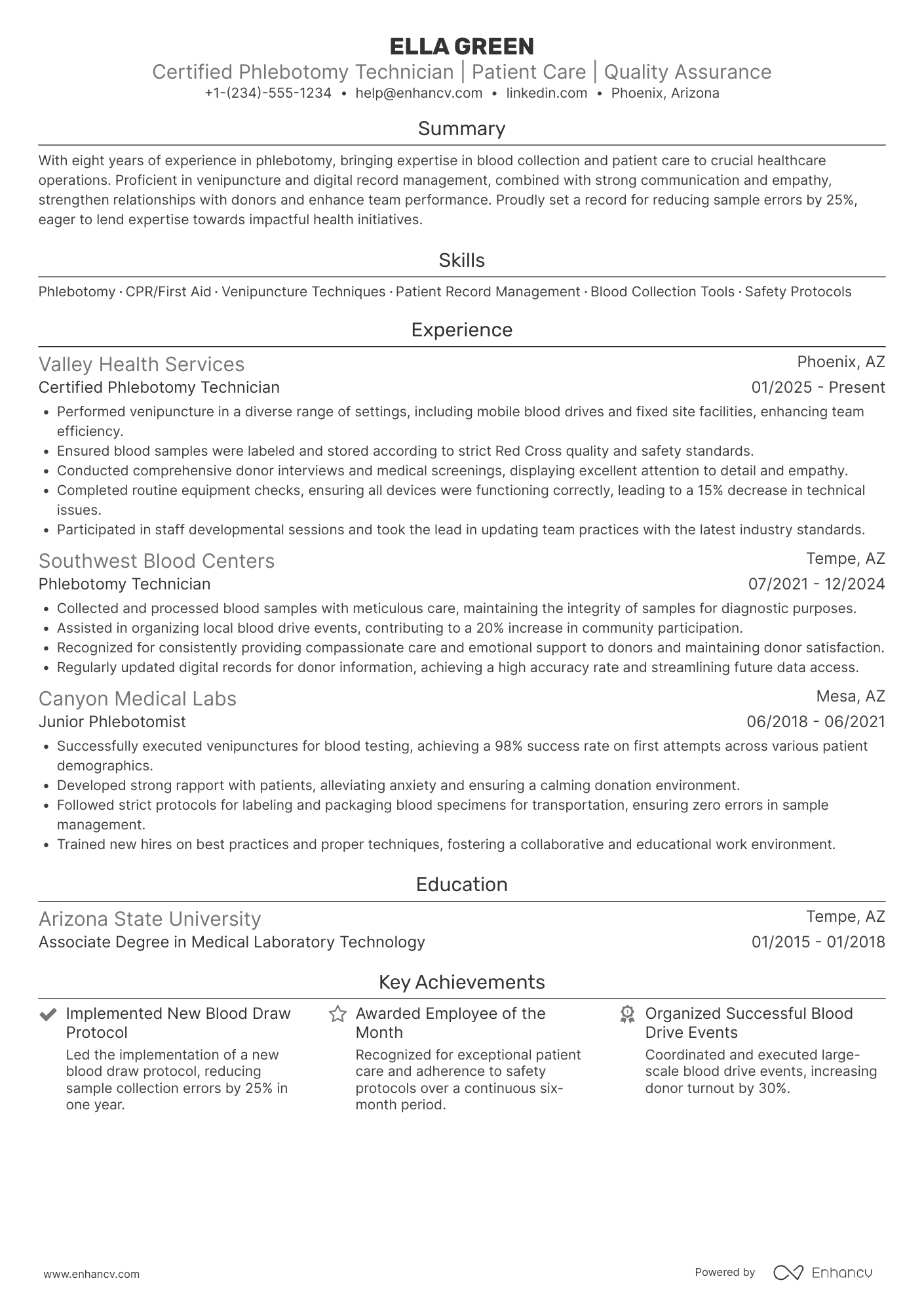
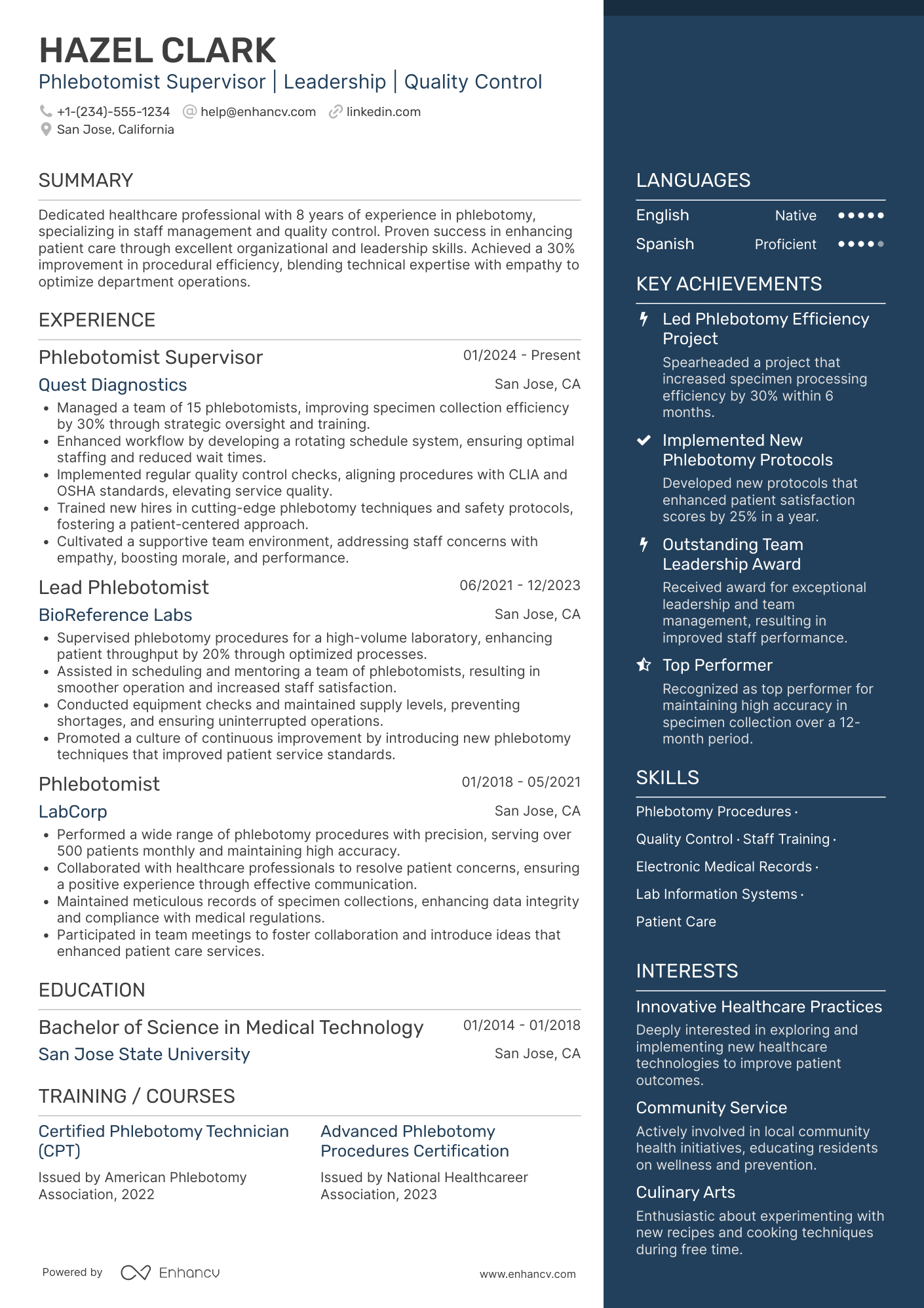
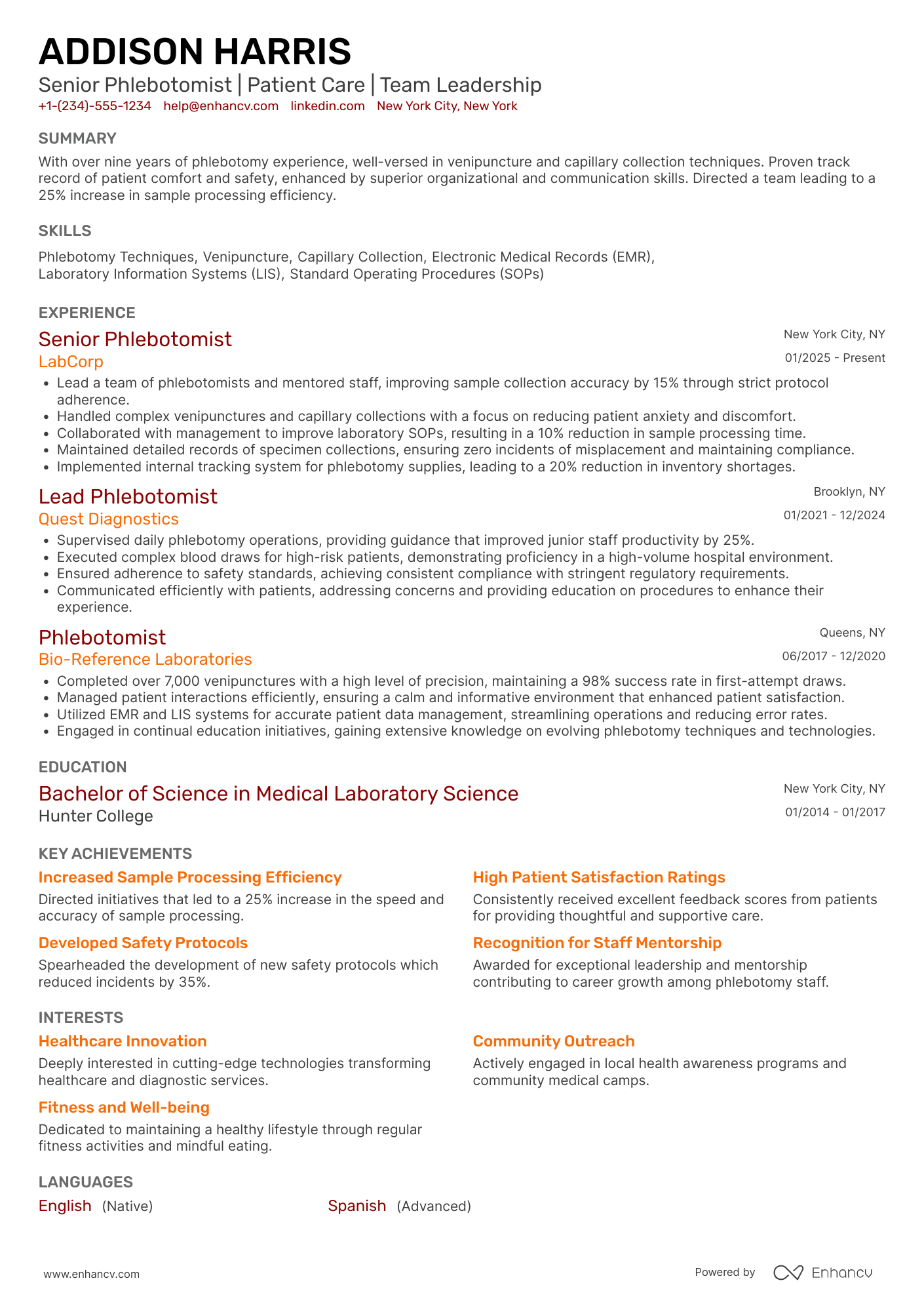
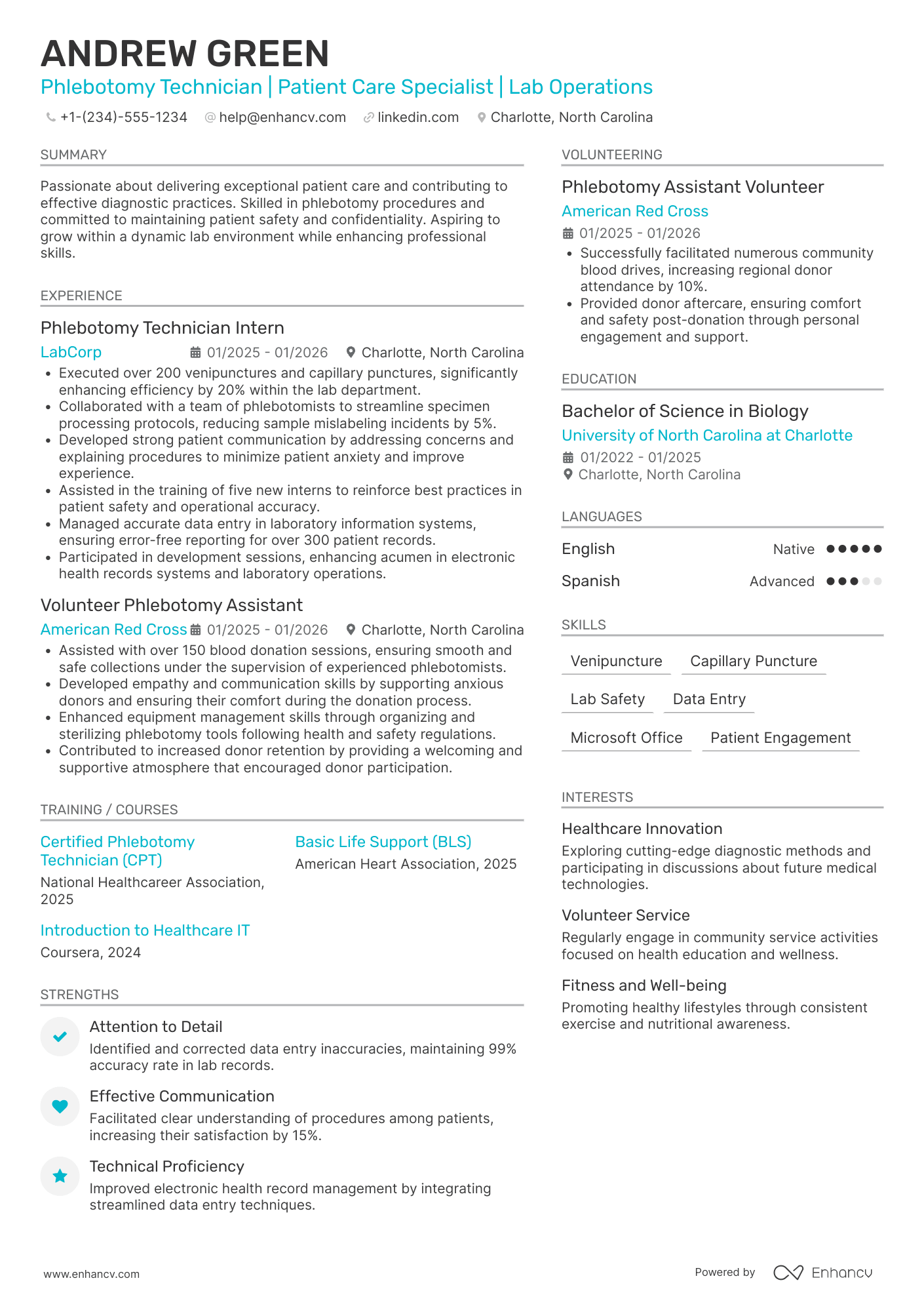
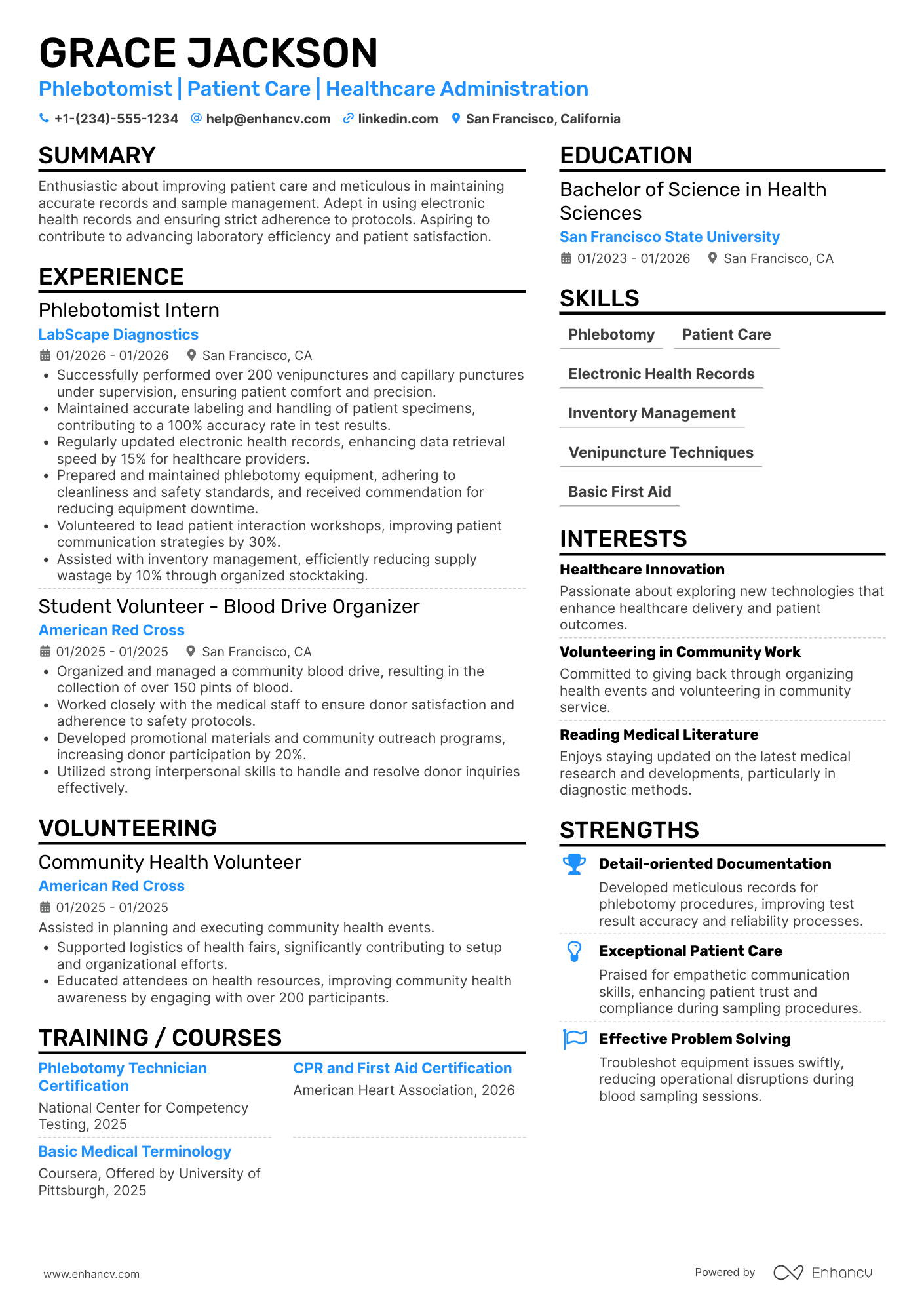
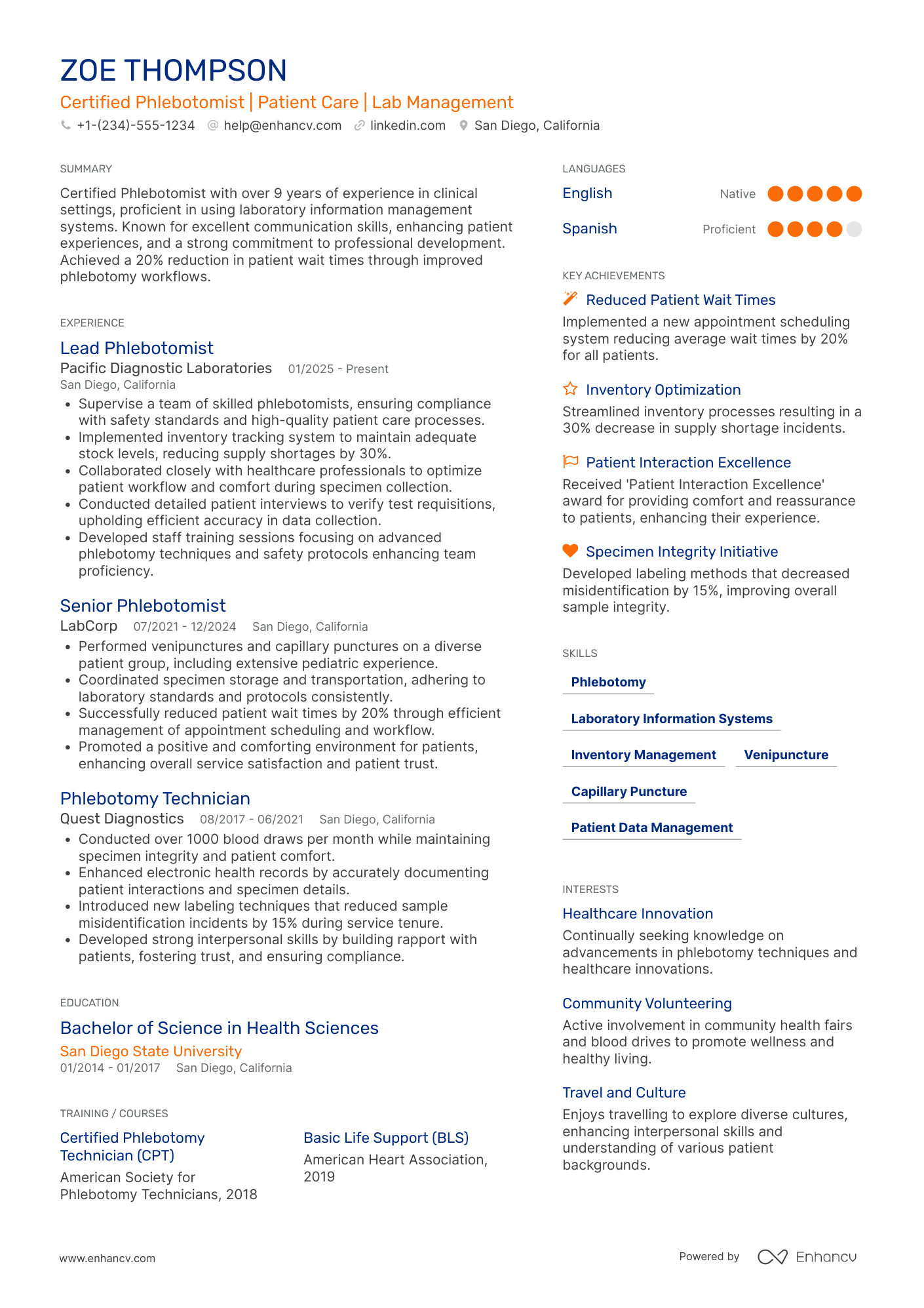
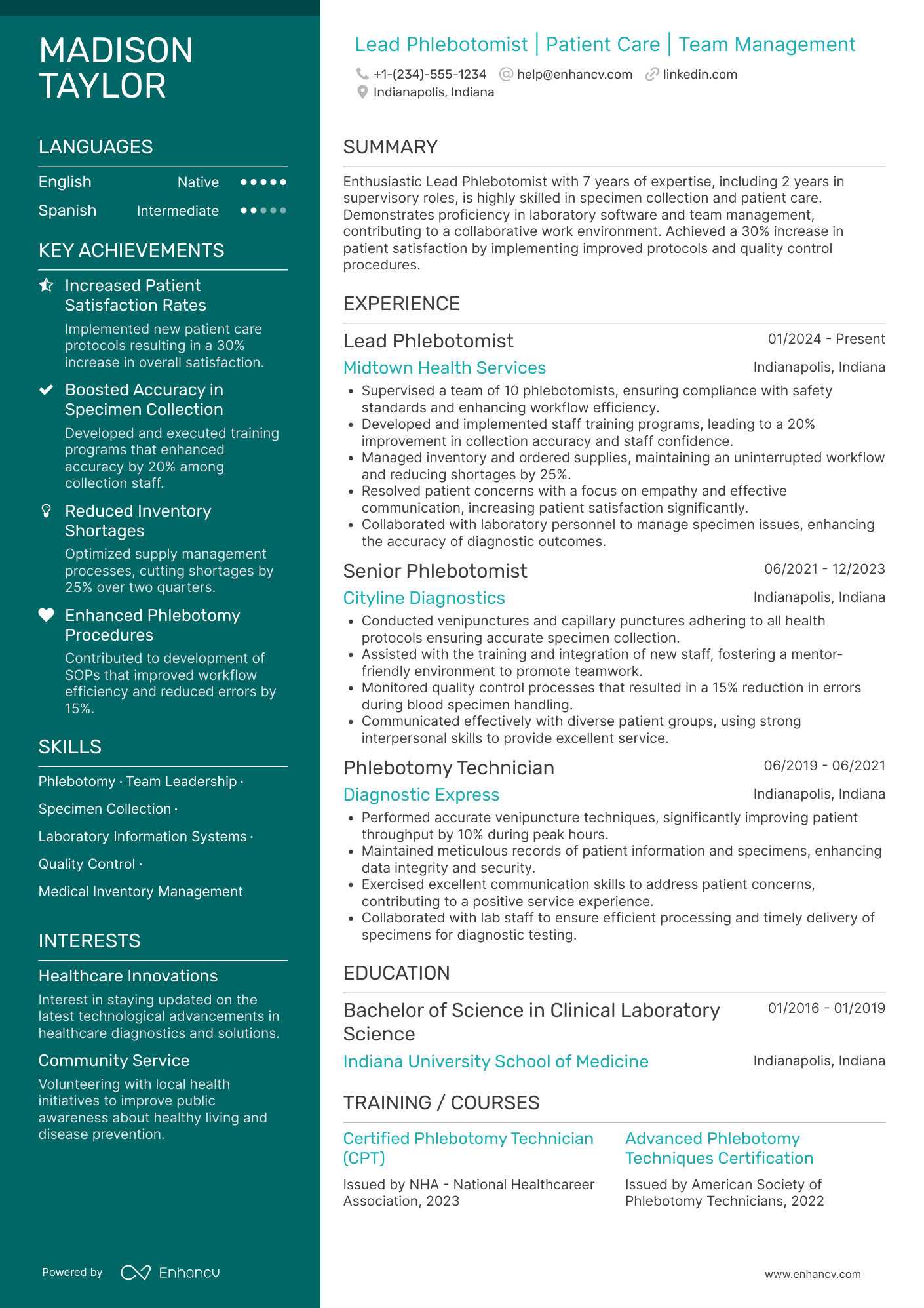
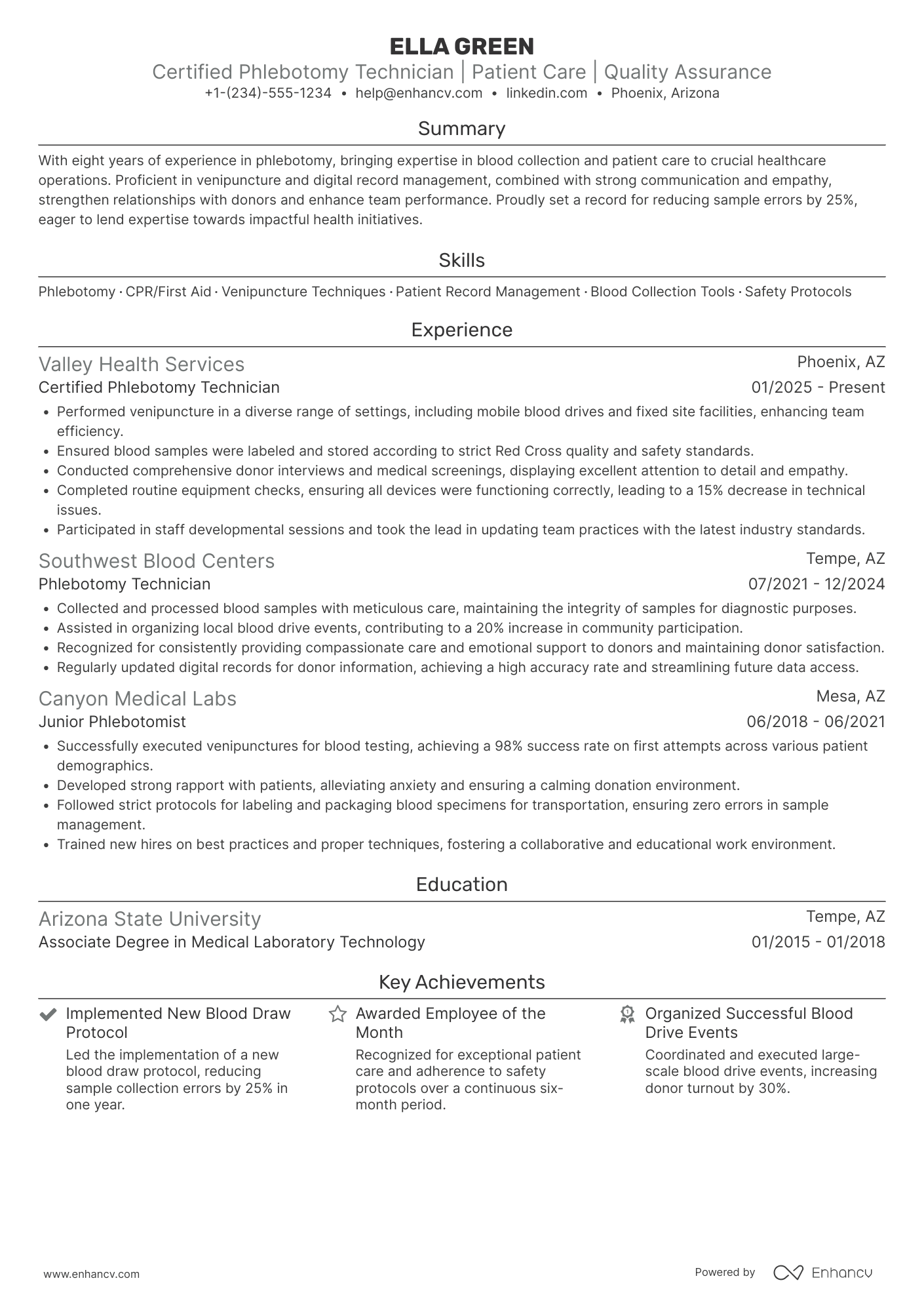
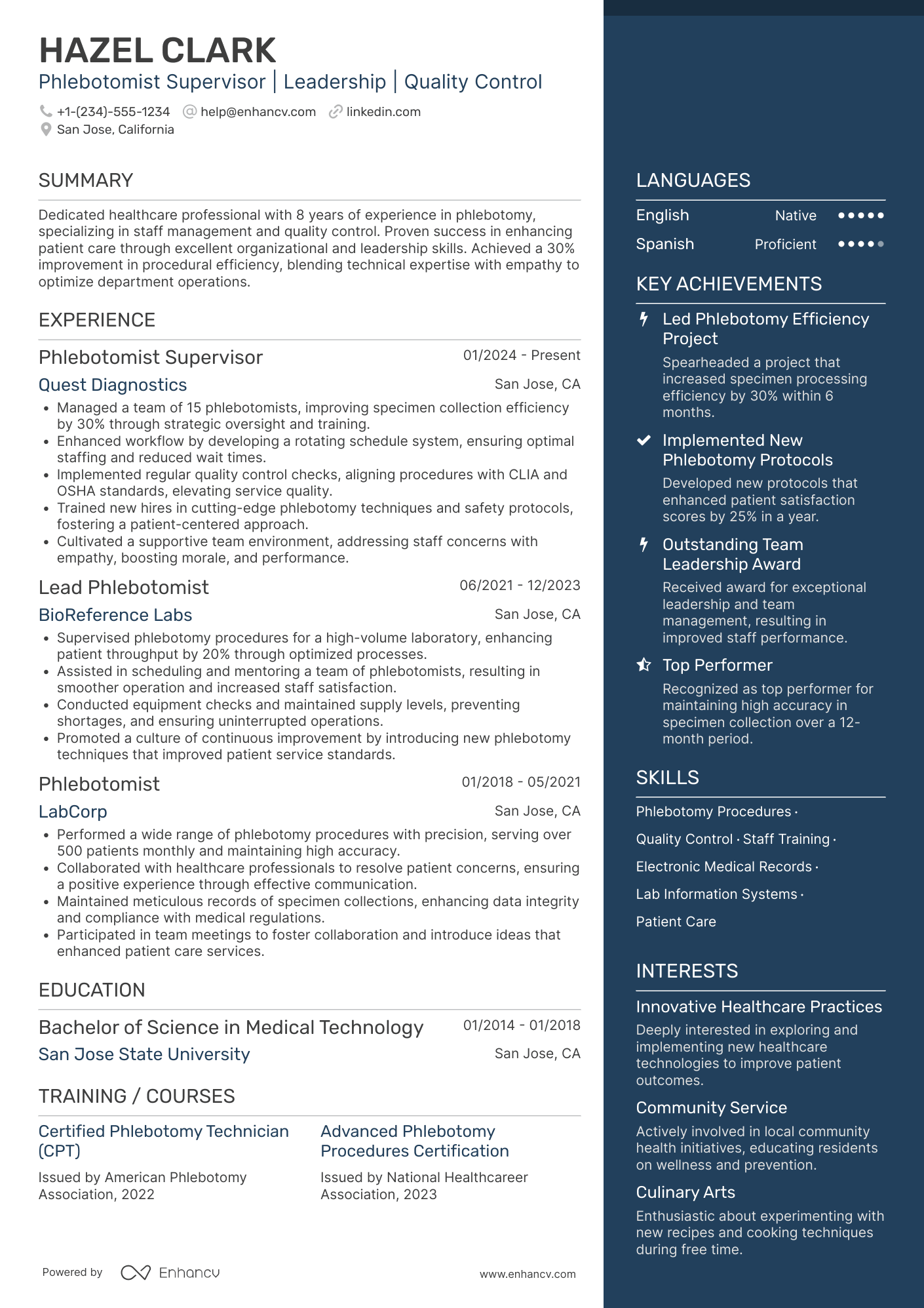
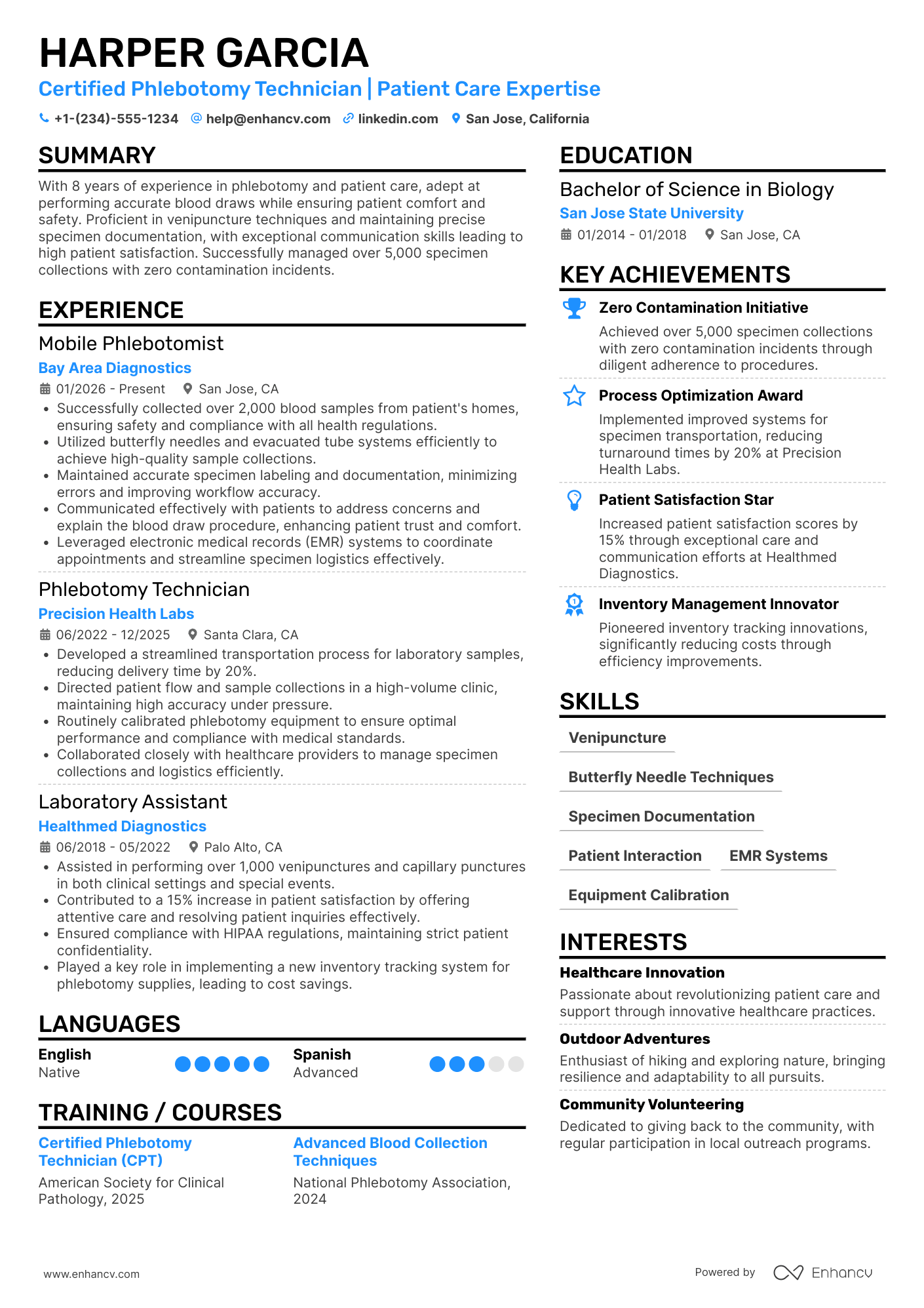
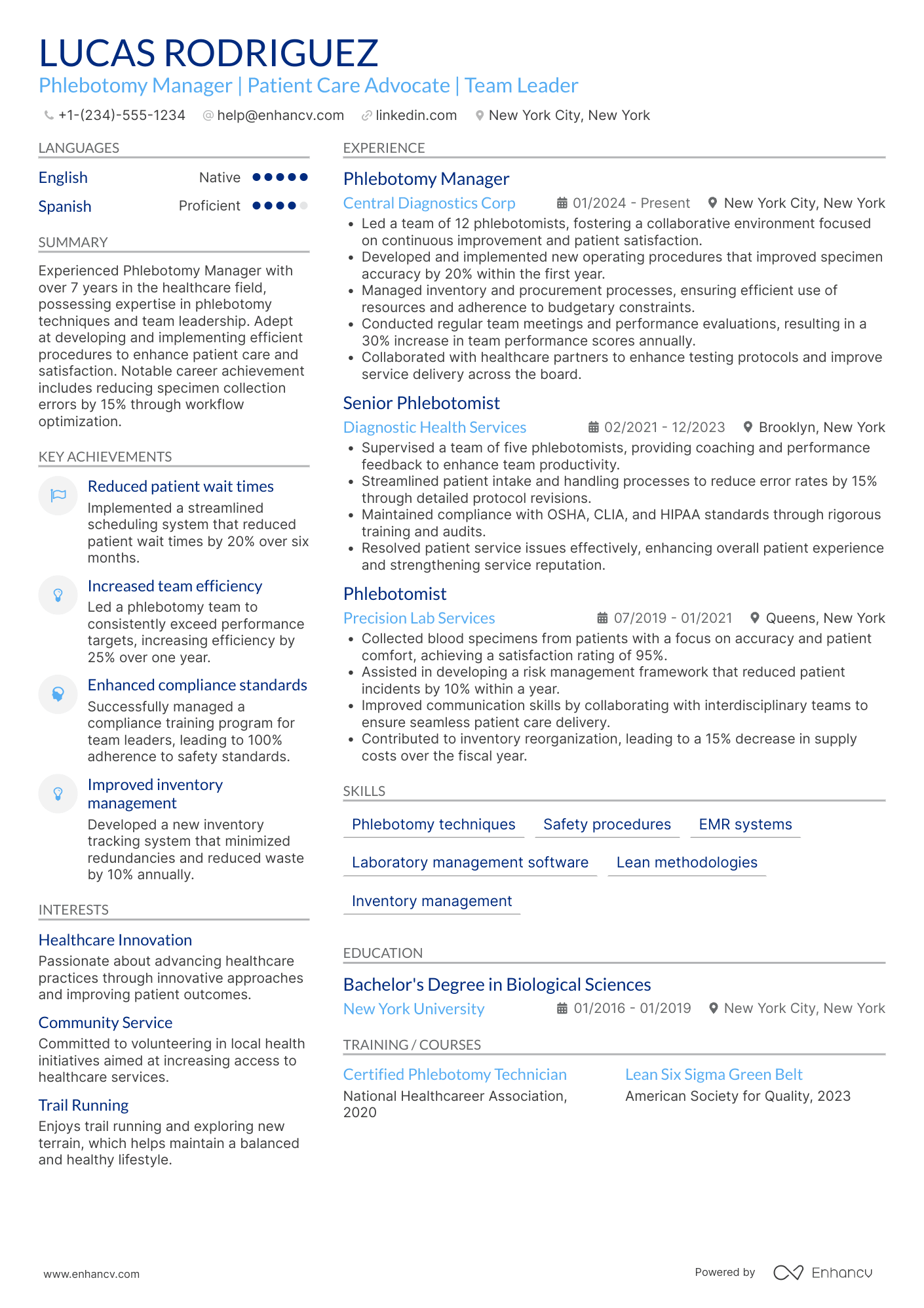
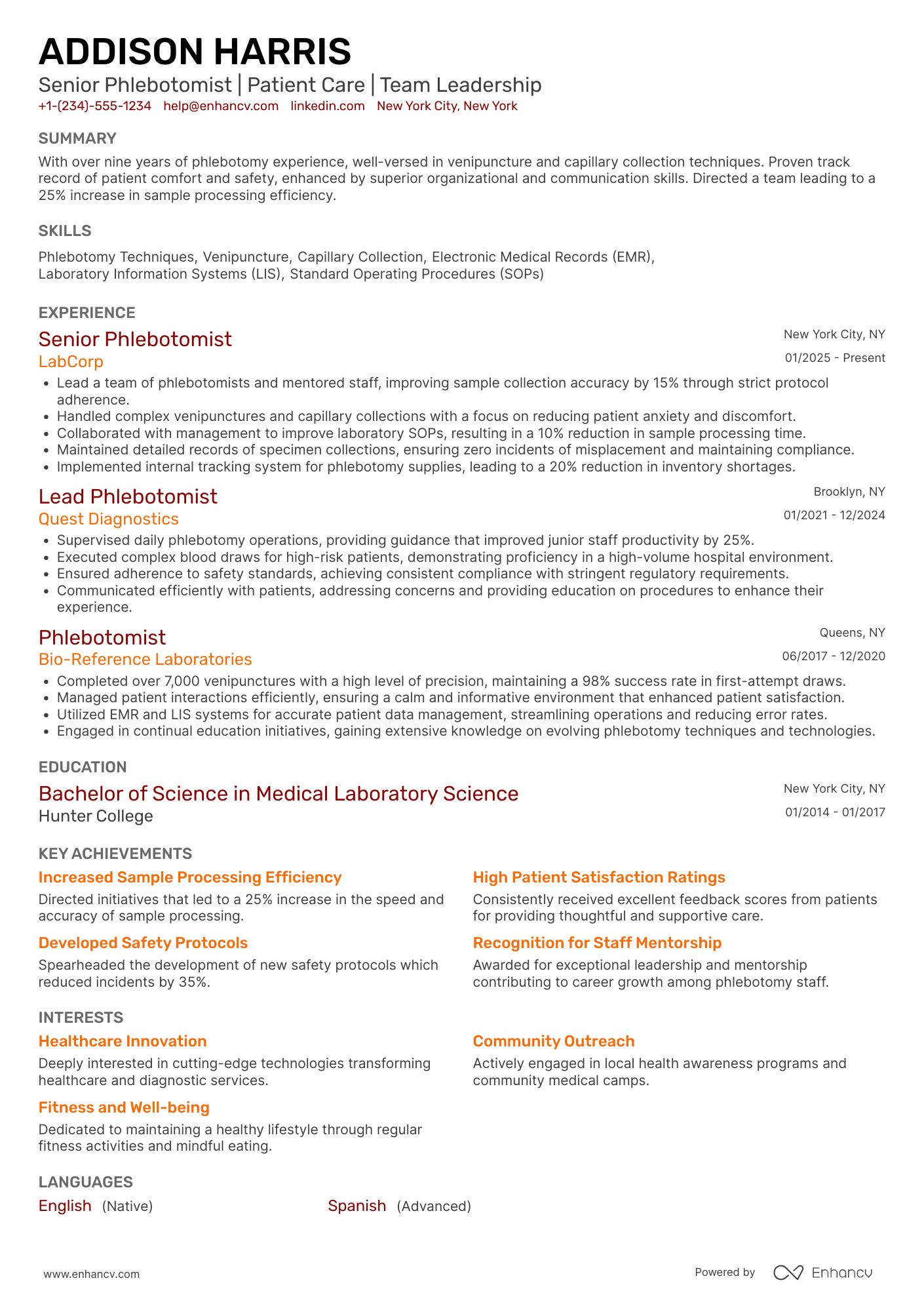
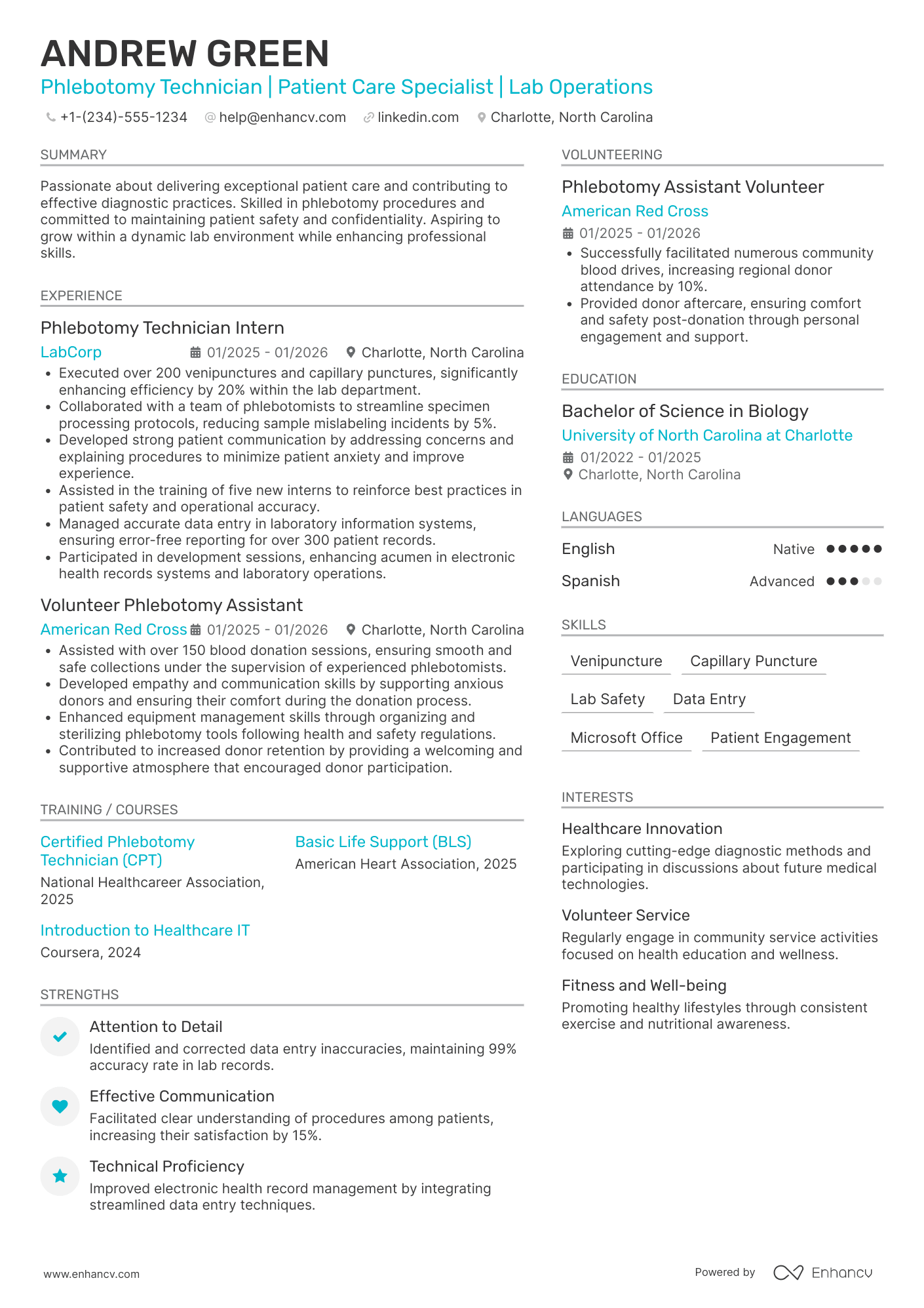
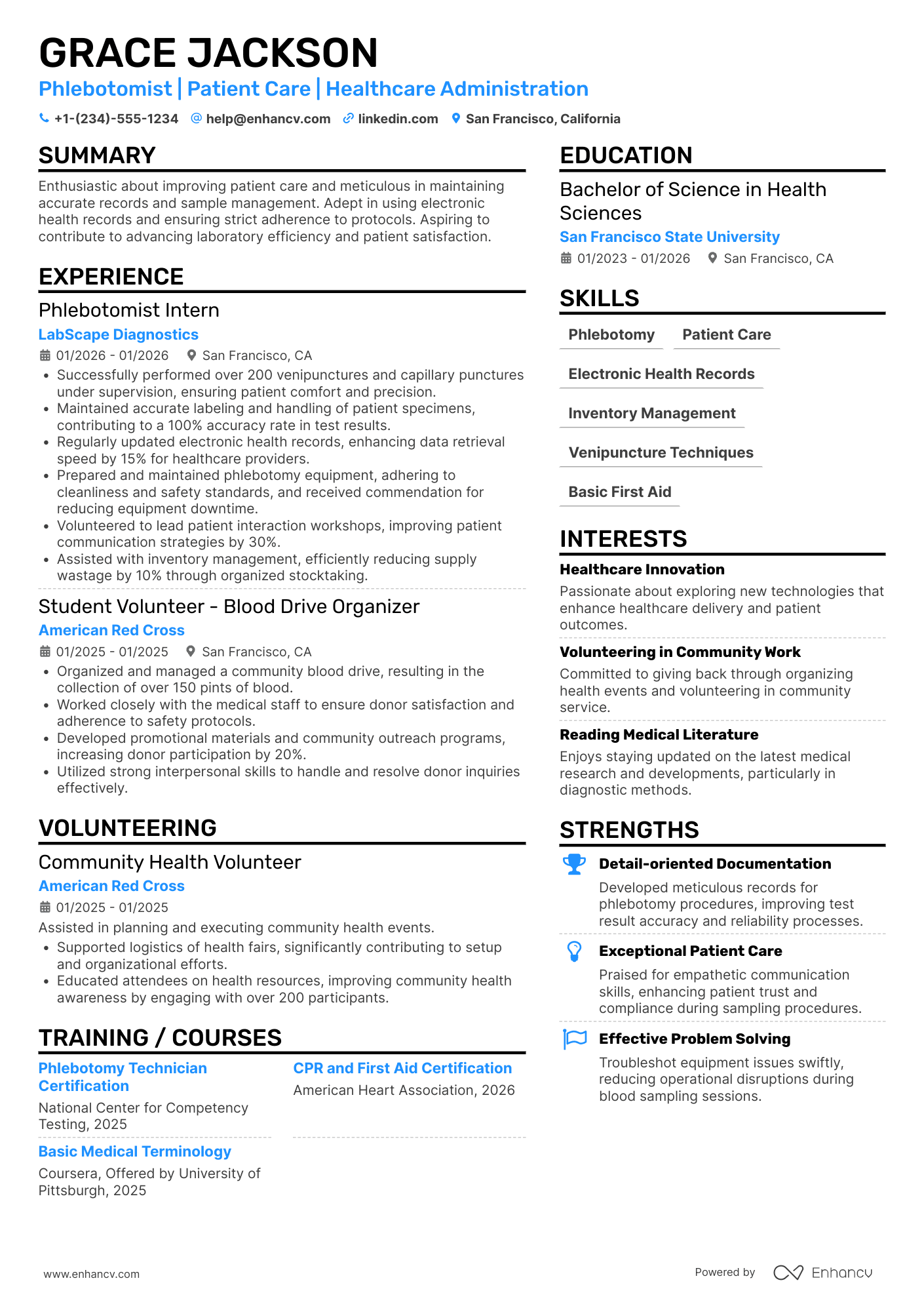
Phlebotomist resume examples
By Experience
By Role