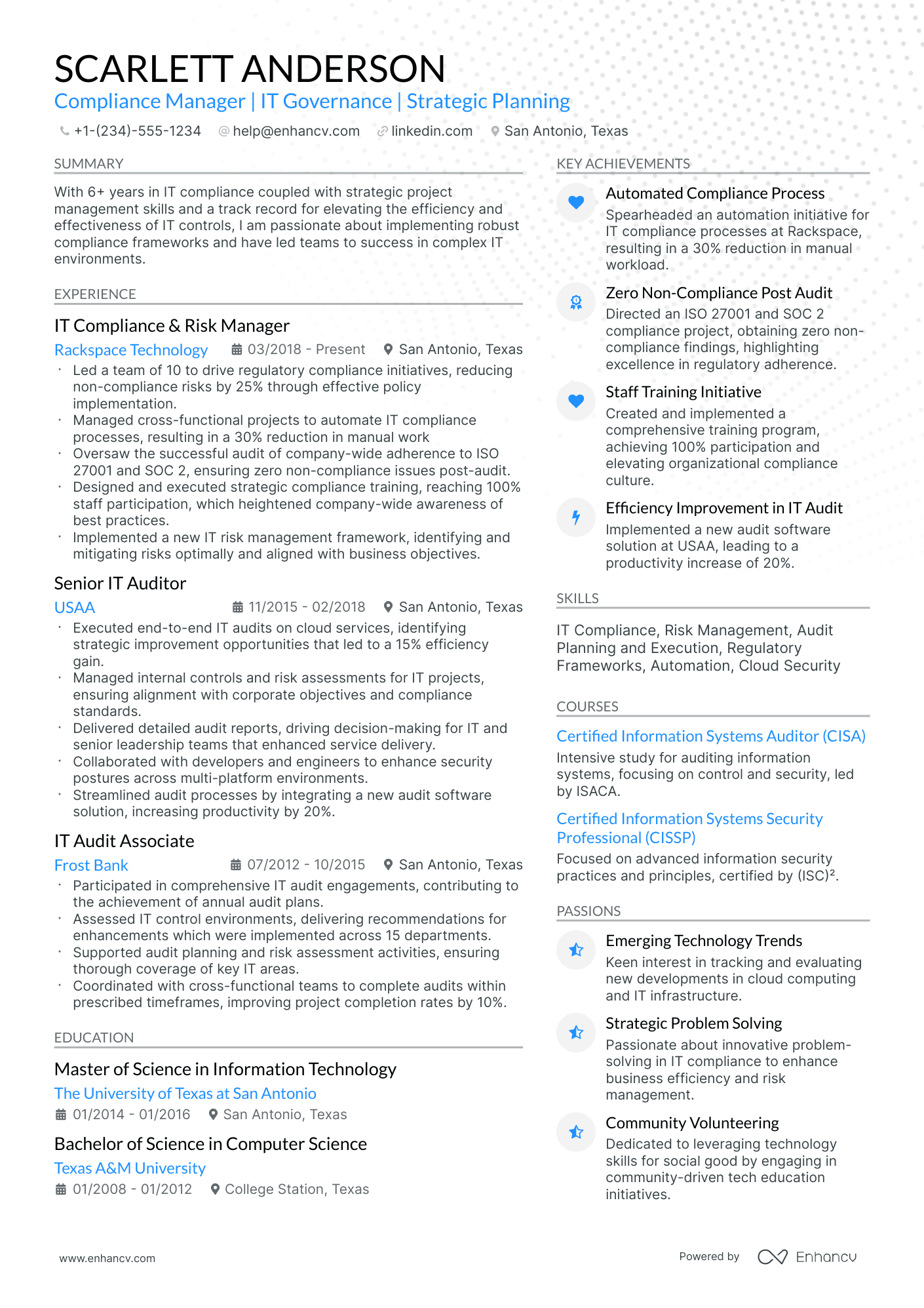
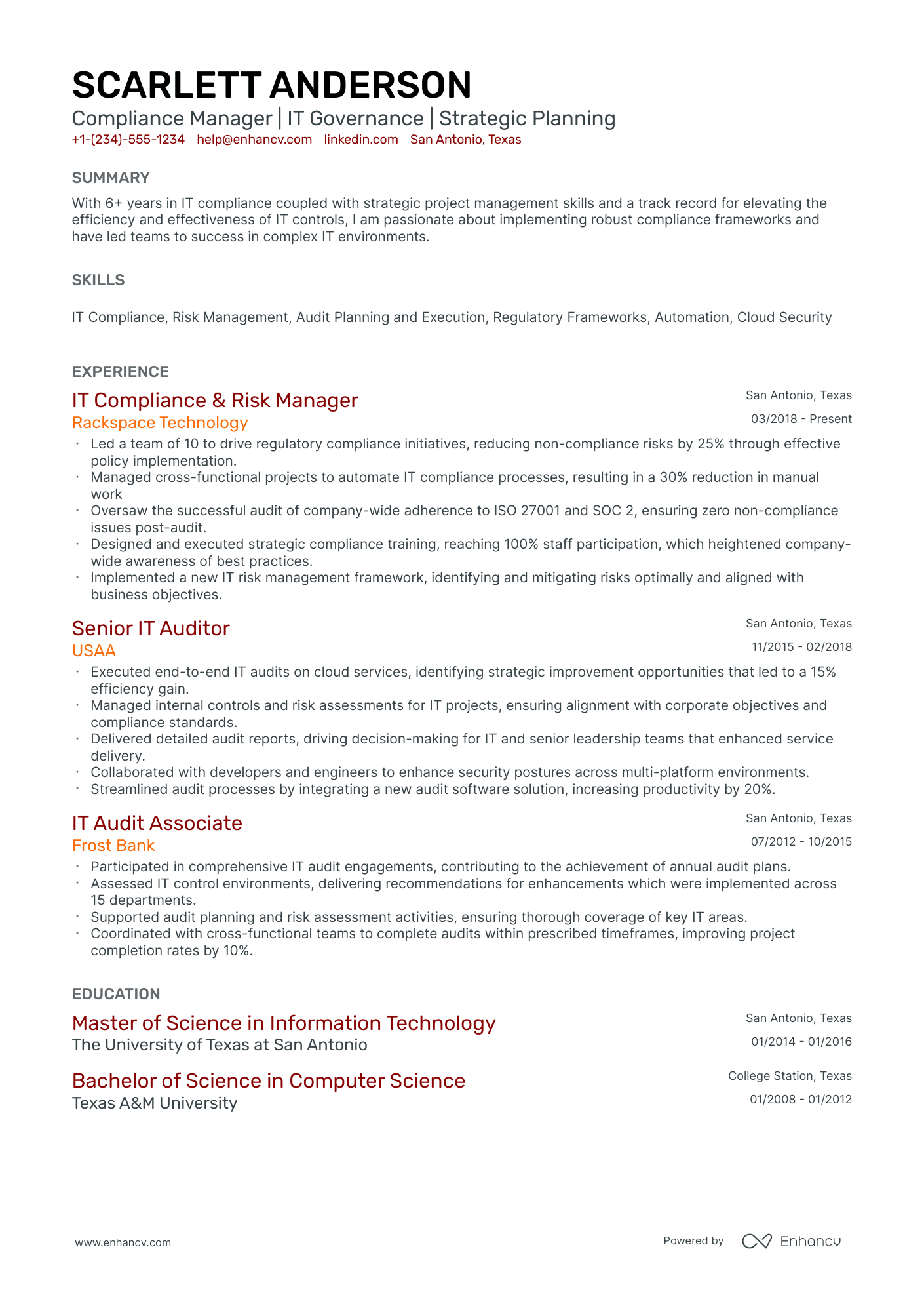
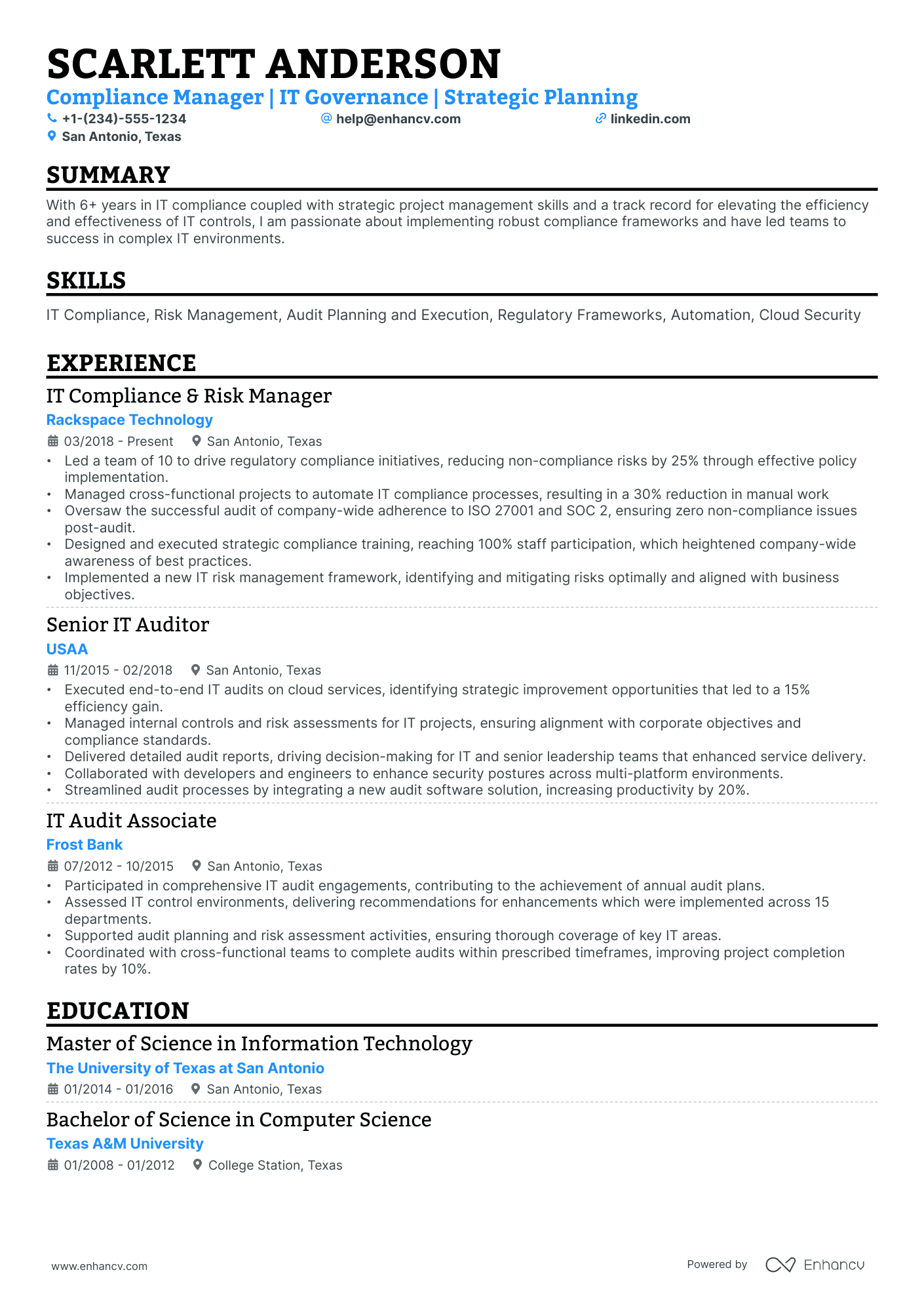
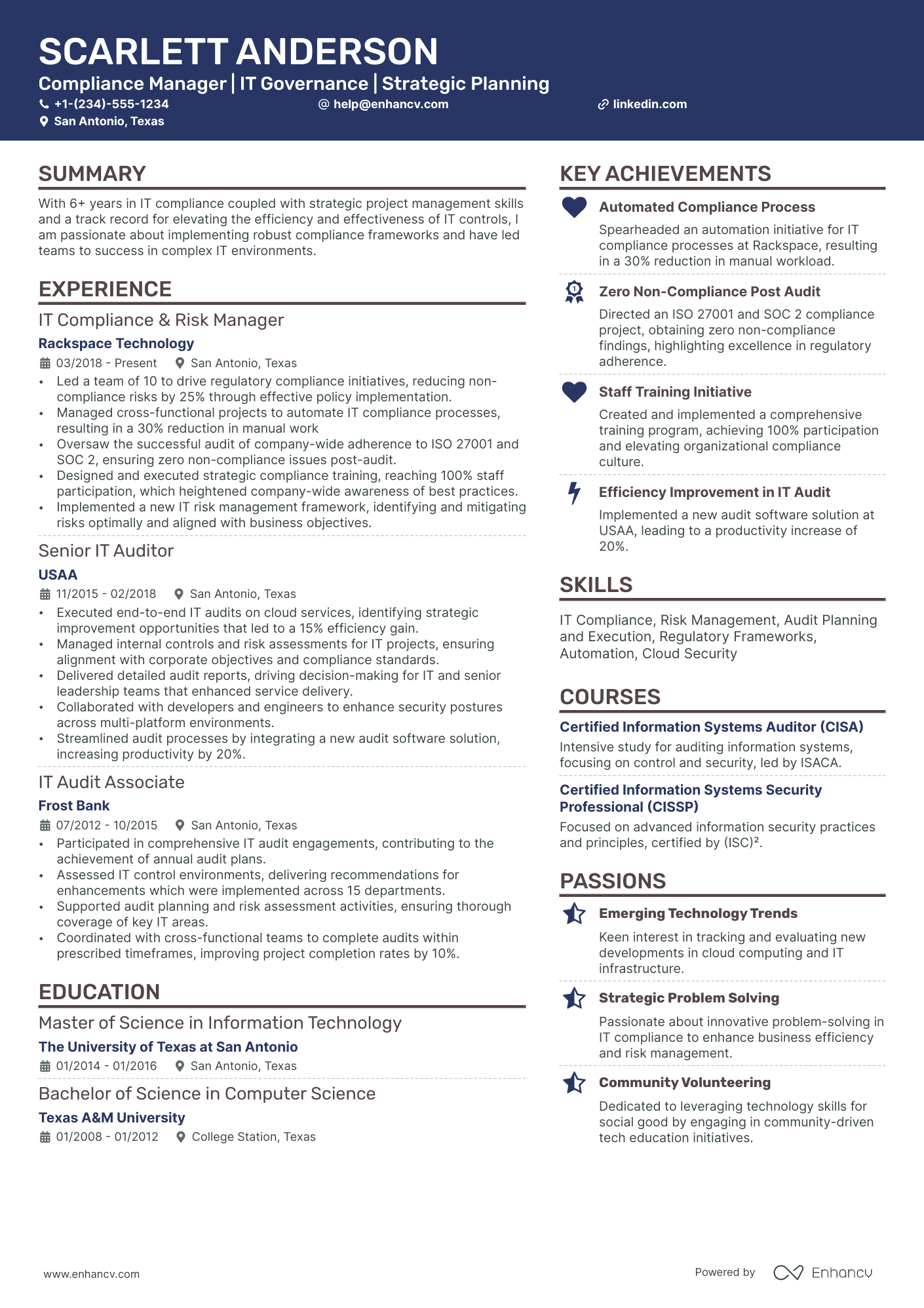
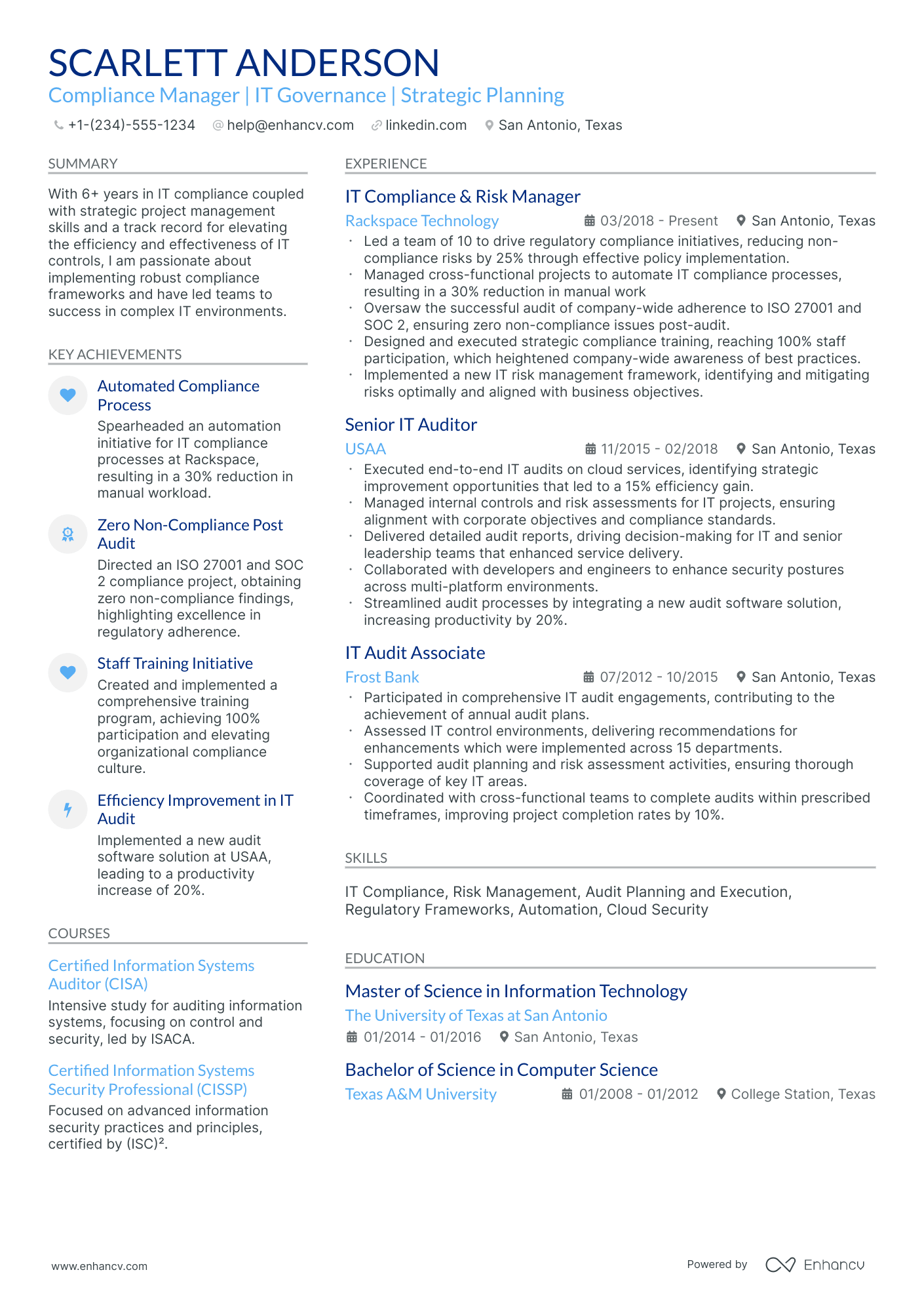
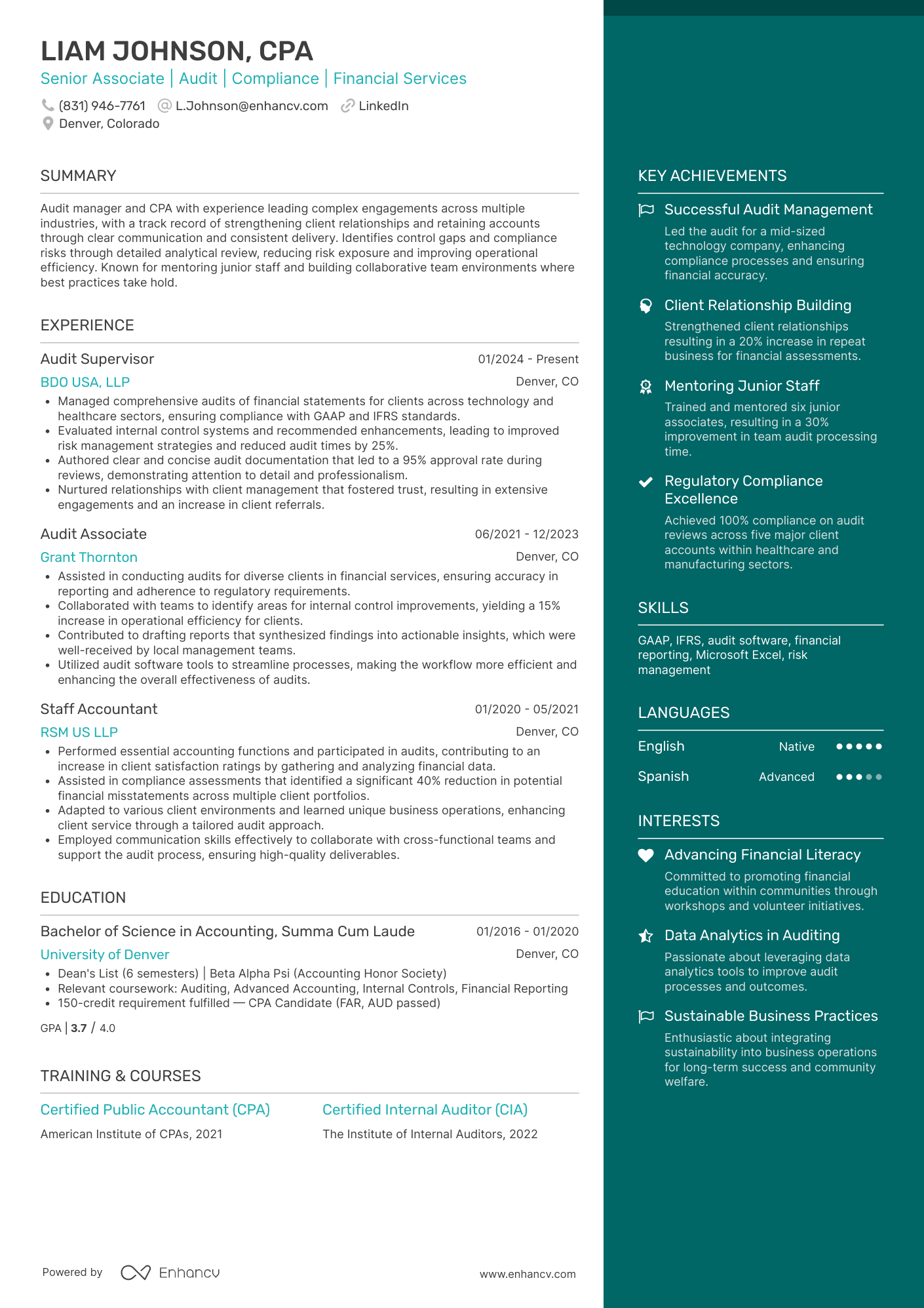
Big 4 auditor resumes fail for one consistent reason: they list what candidates did instead of proving what they delivered. Recruiters reviewing Deloitte, PwC, EY, and KPMG applications scan for engagement scope, credential status, and measurable outcomes. If those signals aren't visible in the first ten seconds, the resume doesn't move forward.
A strong Big 4 auditor resume shows technical credibility and commercial impact. That means client asset size, SOX controls tested, team responsibility, findings identified, and the certifications that confirm you meet the firm's standard.

Key takeaways
- Use reverse-chronological format and lead with your most recent engagement scope.
- Build every experience bullet around an outcome, not a duty.
- Put your CPA status directly after your name—recruiters scan for it immediately.
- Name the audit standard (GAAS, PCAOB, IFRS), your industry vertical, and client size in every experience entry.
- Tailor your summary and leading bullets to the specific firm and practice area you're applying to.
- Use Enhancv to tailor, test, and polish your resume into an ATS-friendly PDF before you submit.
If you want to see how other auditors present their credentials and engagement history, browse the additional resume examples.
Before writing a single bullet, you need a resume format that puts your credentials and engagement track record where recruiters can find them immediately.
How to choose the best Big 4 auditor resume format
Recruiters reviewing Big 4 audit applications look for three signals first: credential status, engagement scope, and measurable outcomes. The format you choose determines whether they find those signals in the first pass—or miss them entirely.

I have external audit experience and a CPA. Which format should I use?
The formula:
Most recent role → Engagement type + client size → Standards applied → Outcomes
In practice:
"Led SOX 404 testing for three PCAOB-registered clients across 40+ key controls; no material weaknesses or significant deficiencies issued."
I'm moving into Big 4 from a regional or midsize firm. What format works best?
Use a hybrid format.
The formula:
Skills section (certifications + standards + software) → Reframed experience (engagement-level outcomes) → Any client scope you can name and defend
In practice:
"Executed financial statement audits for four mid-market clients across manufacturing and retail (combined revenue ~$680M), with zero carry-forward review notes."
Why not use a functional resume?
Use reverse-chronological or hybrid—not functional.
The formula:
Timeline of engagements → Standards and verticals per role → Credential progression
In practice:
A recruiter scanning three roles with visible engagement types and client sizes reads your career as a clear professional progression. A functional resume with skills floating above a thin engagement history reads as a red flag at every Big 4 level.
With your format decision made, here's exactly what to include and where.
What sections should go on a Big 4 auditor resume?
Use this structure of resume sections for maximum clarity:
- Header (name + credentials, title, contact info, LinkedIn, location)
- Summary
- Experience
- Certifications (CPA, CISA, CIA, CFE)
- Education
- Skills (audit software, ERP platforms, data tools)
- Optional add-ons:
- Professional affiliations (AICPA, IIA, ISACA)
- Languages (for international practice area roles)
- Publications or presentations (manager level and above)
- Notable findings or strategic engagements
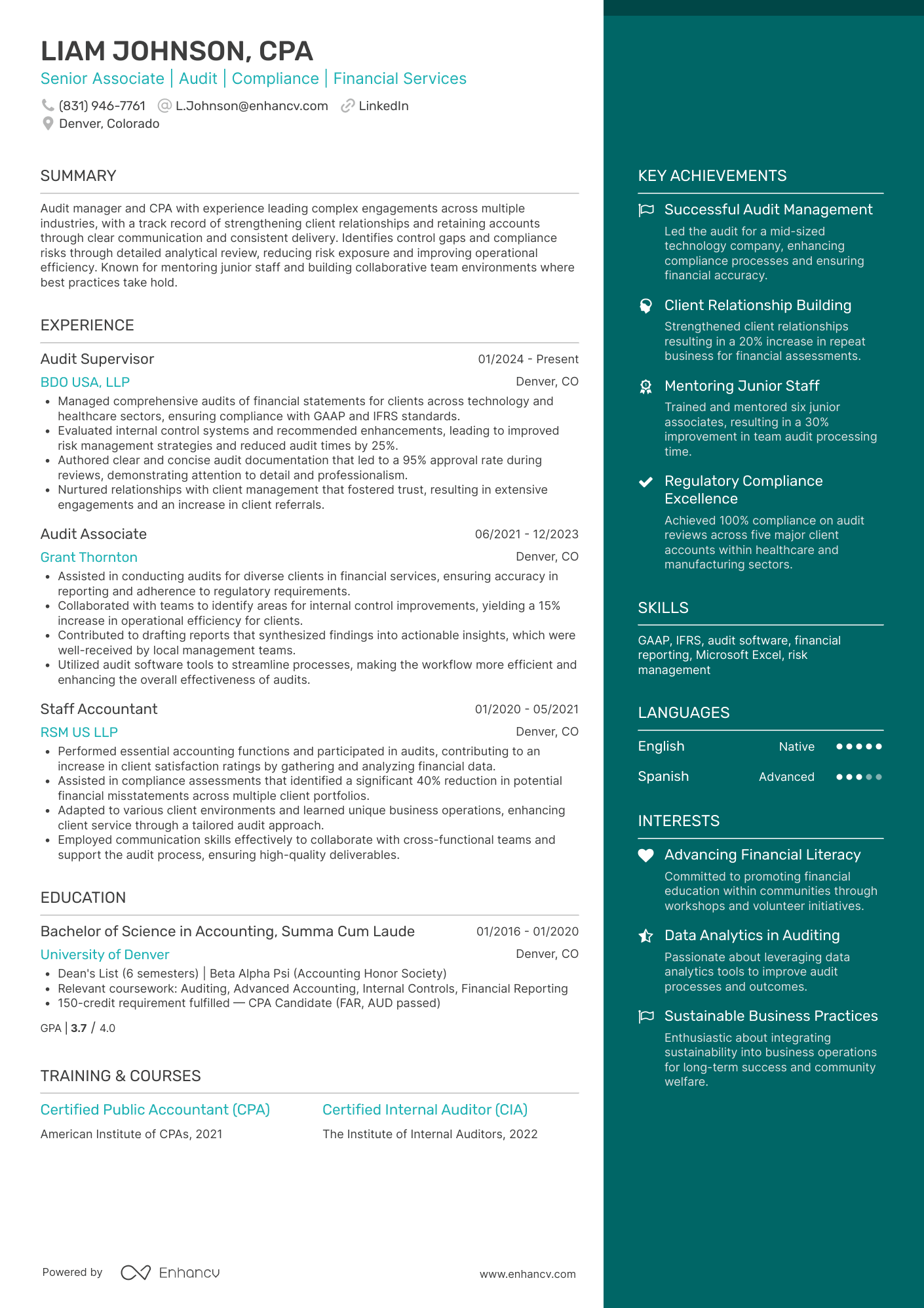
With your resume layout in place, the next step is writing experience bullets that show engagement scope, standards applied, and the measurable outcomes that set you apart.
How to write your Big 4 auditor resume experience
Your experience section is where Big 4 applications win or lose. Recruiters are scanning for named engagement types, client scope, team responsibility, and outcomes. If those signals aren't in the first few lines of each role, the resume stalls.
Each entry should clearly show:
- Job title (Auditor, Senior Associate, In-Charge Auditor, Audit Manager, etc.)
- Firm name + location (or remote)
- Dates (month + year)
- Three to five concise bullets covering:
- Engagement scope (client revenue or asset size, industry vertical, entity count)
- Standards applied (GAAS, PCAOB, IFRS, SOX 404/302)
- Team responsibility (associates supervised, workpaper review, engagement timeline ownership)
- Measurable outcomes (controls tested, findings elevated, efficiency improvements, zero review notes)

PRO TIP
Your bullets should follow this formula: action verb + engagement context + result in numbers
Experience entries make or break a Big 4 auditor resume.
Here's one that works and why:
Big 4 auditor experience example
Senior Audit Associate
Grant Schaefer LLP, Chicago, IL │ 2022–2025
Regional accounting firm serving mid-market and public company clients across financial services, healthcare, and manufacturing.
- Led fieldwork on 7 annual engagements totaling over $3.1B in combined client assets across financial services and healthcare verticals.
- Managed a team of 2–4 staff associates per engagement; responsible for workpaper review, coaching, and on-time completion.
- Identified a $1.7M unrecorded liability at a healthcare client during substantive procedures; finding elevated to partner with correcting journal entry recorded.
- Executed SOX 404 testing for three PCAOB-registered clients across 40+ key controls; no material weaknesses or significant deficiencies issued.
- Supervised quarterly review procedures for two SEC registrants under AS 4105.
Why it works:
- Engagement scope and client size appear before the first bullet—the recruiter knows the level immediately.
- Every bullet leads with a named outcome or engagement type, not a duty.
- The $1.7M finding bullet demonstrates professional skepticism in practice, not just as a claimed trait.
- Team supervision (2–4 associates) signals readiness for the Big 4 model, where seniors are expected to develop staff.
- SOX and PCAOB references confirm the candidate is working to the right standard for public company audit.
Once your bullets show clear engagement data, the next step is tailoring your experience to each job description—this is where most candidates gain or lose interviews at the Big 4 level.
How to tailor your Big 4 auditor resume experience
Recruiters compare your resume against the job posting using both human review and applicant tracking system keyword matching. A resume that mirrors the firm's practice area language, audit standard, and client type reads as a direct match.
Ways to tailor your Big 4 auditor resume experience:
- Match the audit standard referenced in the posting (PCAOB for public company roles, GAAS for private companies, IFRS for international engagements).
- Use the same industry vertical language the posting uses (financial services, technology, healthcare, manufacturing, consumer products).
- Align your client size to the firm's known portfolio—Deloitte and PwC tend toward large-cap and global; KPMG has deep mid-market exposure.
- Reflect the team scope the role involves (if the posting mentions managing staff, lead with supervision experience).
- Call out your software fit if the firm's posting names specific platforms (CaseWare, AuditBoard, Teammate, Galvanize).
Tailoring your resume is one of the highest-leverage things you can do before submitting to a Big 4 role.
Resume tailoring examples for Big 4 auditors
| Job description excerpt | Tailored bullet |
|---|---|
| "SOX 404 testing and internal controls documentation for public company clients." | "Executed SOX 404 testing for three PCAOB-registered clients across 40+ key controls; no material weaknesses or significant deficiencies issued." |
| "Financial statement audit experience in financial services, including banks and investment managers." | "Led financial statement audits for four financial services clients (combined AUM: $8.2B), including two SEC-registered investment advisers under PCAOB standards." |
| "Ability to manage junior staff and review workpapers on multi-entity engagements." | "Supervised 2–3 staff associates per engagement; reviewed all workpapers before senior review, with zero carry-forward notes from the manager." |
| "Experience with ERP walkthroughs and IT general controls in a manufacturing environment." | "Completed 12 ERP process walkthroughs across SAP and Oracle environments for two manufacturing clients; documented ITGC findings across access management and change control cycles." |
Instead of rewriting from scratch for every application, use Enhancv's One-Click Tailoring Tool: paste the job description, and it updates your bullets, skills, and summary to match the specific posting.
How to quantify your experience on a Big 4 auditor resume
Numbers give recruiters the context they need to assess your level. A bullet that says "performed audit procedures" could describe anyone at any firm. A bullet with client size, control count, or a named outcome tells the recruiter exactly where you sit.
Examples of how to quantify Big 4 auditor achievements on your resume
| How to quantify | Example bullet point |
|---|---|
| Client revenue or asset size | "Led financial statement audits for six clients with combined revenues exceeding $2.4B across manufacturing and retail." |
| Controls tested | "Executed SOX 404 compliance testing for two public clients, covering 47 key controls across three business cycles—revenue, procurement, and financial close." |
| Team managed | "Supervised a fieldwork team of four staff associates and one intern; responsible for workpaper review, daily status updates, and on-time delivery across a six-week engagement window." |
| Finding identified | "Identified a $1.7M unrecorded liability during substantive testing of accrued liabilities; finding documented and elevated to the engagement partner with a correcting journal entry recorded before issuance." |
| Efficiency improvement | "Reduced average fieldwork cycle time by 11 days over two engagement seasons by redesigning the lead schedule template and completing risk assessment procedures before fieldwork kickoff." |
| Workpaper quality | "Completed all assigned workpapers across seven engagements with zero carry-forward review notes from senior review—in two consecutive busy seasons." |
If you're unsure how to quantify your achievements, Enhancv's Bullet Point Generator can help you convert audit activity into measurable, recruiter-ready statements.
Your next step is highlighting the Big 4 auditor skills for your resume—the technical tools, standards, and professional capabilities that signal immediate readiness to hiring managers.
How to list your hard and soft skills on a Big 4 auditor resume
Skills help recruiters and ATS verify whether your technical and professional foundation matches the role. A Big 4 audit position requires a blend of hard skills—audit standards, software platforms, financial regulations—and soft skills like professional skepticism, client communication, and judgment under pressure.
Hard skills get picked up in ATS keyword scans. Soft skills get evaluated in the interview. Both need to appear on your resume.
PRO TIP
List certifications and standards in your skills section, not only in a dedicated certifications section. When "PCAOB" and "SOX 404" appear in both your skills and your experience bullets, they reinforce each other for ATS matching—and give the recruiter two confirmation points at a glance.
Your skills section should be:
- Scannable (grouped by category, not a wall of text)
- Relevant to the specific posting and practice area
- Backed by proof in your experience bullets
- Current (CaseWare + AuditBoard beats a generic "audit software" entry)

Best hard skills for your Big 4 auditor resume
- Audit standards: GAAS, PCAOB, IFRS, GAAP, SOX 404/302
- Internal controls (ICFR) testing
- Risk-based audit approach
- Substantive procedures
- Financial statement audit
- Going concern assessment
- Workpaper documentation
- Management letter preparation
- Audit software: CaseWare, AuditBoard, Teammate, Galvanize (ACL)
- ERP platforms: SAP, Oracle, NetSuite
- Data tools: Excel (pivot tables, Power Query), Alteryx, Power BI
- Certifications: CPA, CISA, CIA, CFE
Best soft skills for your Big 4 auditor resume
- Professional skepticism
- Attention to detail
- Client communication and relationship management
- Staff supervision and coaching
- Deadline management across concurrent engagements
- Judgment under ambiguity
- Cross-functional coordination (legal, finance, IT)
- Executive-level communication (manager level and above)
- Adaptability across industries and client types
How to showcase your Big 4 auditor skills in context
Skills shouldn't only appear in a list—they should be demonstrated through your summary and proved through outcomes in your experience bullets.
Summary
CPA with four years in external audit, leading fieldwork on public company and PE-backed engagements in financial services and healthcare. Proficient in PCAOB and GAAS standards; executed SOX 404 testing across 40+ key controls with no material weaknesses issued. Known for zero carry-forward notes from manager review and for developing two staff associates who promoted ahead of schedule. Targeting a senior associate role in Big 4 financial services audit.
Why it works:
- States the credential, standard, and vertical upfront—the recruiter knows the practice group fit immediately.
- Names SOX 404 and PCAOB with a quantified outcome, not as a bare skills claim.
- The staff development note signals readiness for Big 4's promotion-from-within model.
Now, let’s have a look at what a professional experience entry should display.
Experience entry
Audit Manager
Regional Practice, New York, NY │ 2020–Present
Managed a portfolio of 8 annual audit engagements (combined client revenue: $9.4B) across SaaS and fintech verticals.
- Supervised and reviewed work of 3–5 seniors and 6–10 staff associates per engagement season; responsible for budget, timeline, and partner reporting.
- Reduced average engagement close time by 18% over two years through standardized workpaper templates and earlier planning cycle kickoffs.
- Coordinated with Big 4 component auditors on three multinational engagements (UK, India, Singapore), delivering consolidated workpapers ahead of internal deadlines.
- Delivered 11 management letters with actionable control recommendations across two busy seasons; zero client escalations.
Why it works:
- Portfolio scope ($9.4B combined revenue) establishes the level before the first bullet.
- Org structure (3–5 seniors, 6–10 staff) gives scale context without a separate explanation.
- The 18% efficiency improvement bullet shows the candidate manages the engagement as a business problem, not just a compliance checklist.
- Component auditor coordination signals readiness for Big 4's multinational engagement model.
With your skills section in place, the next step is listing the credentials and academic background that confirm your technical foundation.
How to list your certifications and education on a Big 4 auditor resume
Your education section validates your foundational background. At the associate and senior associate level, keep it clean: degree name, school, and graduation year. GPA (3.5 and above) is worth including within five years of graduation—particularly from a target school. Beyond that window, leave it off.
If you graduated with honors, include it. Cum laude, magna cum laude, and summa cum laude go on the same line as your degree—"B.S. Accounting, Magna Cum Laude." If your school uses a dean's list designation instead, list it the same way. For entry-level candidates, these signals matter when the experience section is still thin.
Relevant coursework is worth adding if you're a recent grad without audit internship experience—auditing, advanced accounting, internal controls, financial reporting. Drop it once you have two or more years of professional experience.
If you've completed your 150 credit hours but haven't yet sat the CPA exam, note "CPA Eligible" or "150-credit requirement fulfilled" in the education entry. It signals to recruiters that you're on track without overclaiming.
Education entry sample
B.S. Accounting, Magna Cum Laude
University of Illinois Urbana-Champaign│2021 | GPA: 3.71
- Dean's List (6 semesters) | Beta Alpha Psi (Accounting Honor Society)
- Relevant coursework: Auditing, Advanced Accounting, Internal Controls, Financial Reporting
- 150-credit requirement fulfilled — CPA Candidate (FAR, AUD passed)
The CPA license is the most important credential on a Big 4 auditor resume. If you're licensed, put it directly after your name in the header—Marcus Williams, CPA—not buried in a certifications section. Recruiters scan for it immediately. If you're a candidate, "CPA Candidate" belongs in both the summary and the certifications section, with exam sections passed listed.
Certifications beyond the CPA signal that you invest in your craft beyond the engagement work. List them with the issuing organization and year earned.
Certification sample
Certified Information Systems Auditor (CISA)
ISACA│2023
Best certifications for your Big 4 auditor resume
- CPA (Certified Public Accountant) | AICPA: required or strongly preferred for most Big 4 audit roles.
- CISA (Certified Information Systems Auditor) | ISACA: high value for IT audit, risk advisory, and technology sector engagements.
- CIA (Certified Internal Auditor) | IIA: relevant for internal audit and risk functions
- CFE (Certified Fraud Examiner) | ACFE: valued in forensic, investigations, and financial crimes practices.
- CFA (Chartered Financial Analyst) | CFA Institute: relevant for financial services and capital markets audit.
- CGMA (Chartered Global Management Accountant) | AICPA-CIMA: relevant for finance-adjacent advisory roles.
Place certifications above education when they're recent and directly relevant to the practice area named in the posting. Place them below education if your undergraduate accounting program or MAcc is your strongest current credential for the role.
The last piece is a summary that pulls your credentials and education together into a clear opening statement for recruiters.
How to write your Big 4 auditor resume summary
For Big 4 applications, the resume summary is the first signal a recruiter uses to decide whether to keep reading. It needs to confirm your credential status, your audit standard, and your vertical fit within two to three lines.
A strong Big 4 auditor summary should include:
- Your current title and years of relevant experience.
- The audit standard you work under (GAAS, PCAOB, IFRS).
- Your primary industry vertical or client type.
- One or two quantified proof points (client size, controls tested, team scope, findings identified).
- What you're targeting (level and practice area)—for associate and senior associate applications.
PRO TIP
Avoid openers like "detail-oriented accounting professional with strong analytical skills." They say nothing a recruiter can use. Start with your credential, your standard, and the scope of engagements you've worked—in that order.
Resume summary example
Audit manager with eight years in external audit at a regional firm, overseeing a portfolio of public company and multinational engagements in technology and manufacturing. Built and managed integrated fieldwork teams of up to 12, coordinated component auditors across three continents, and delivered $9.4B in combined client revenue coverage without a single late issuance. Reduced engagement close time by 18% over two busy seasons through earlier planning cycles and standardized workpaper design.
Why it works:
- Opens with level and tenure before naming verticals. A manager-level recruiter knows within five words whether this candidate is in the right ballpark.
- Portfolio scope ($9.4B combined revenue) does the credentialing work that a job title alone can't. It tells the recruiter the size of engagements this person is trusted to run.
- The component auditor detail (three continents) signals multinational engagement experience without needing a separate section to explain it.
- "Without a single late issuance" is a humble but specific claim showing deadline ownership at the portfolio level, not just the engagement level.
- The final sentence leads with a number (18%) and names both the mechanism and the outcome, so it reads as a deliberate operational improvement rather than a lucky result.
Get a resume summary that passes Big 4 ATS screening
Drop your resume here or choose a file.
PDF & DOCX only. Max 2MB file size.
Frequently asked questions about Big 4 auditor resumes
Answers to what accounting professionals ask most when building a resume for Deloitte, PwC, EY, or KPMG.
What should your Big 4 auditor resume header include?
Your header should include your full name with credentials after it (CPA, CISA), your current or target title, location (city + state or "Remote"), phone number, professional email, and a LinkedIn profile link.
LinkedIn matters at the Big 4 level—recruiters and campus recruiting teams check it alongside the resume. Make sure your profile is current, shows the same engagement history, and includes at least one or two recommendations from managers or senior colleagues.
Use Enhancv's LinkedIn Coach to align your profile with your resume before you apply.
How long should a Big 4 auditor resume be?
One page for staff associates and senior associates. Two pages is appropriate for managers and senior managers with an extensive engagement portfolio. Don't pad a one-page career into two with thin bullets, and don't squeeze a manager-level history into small fonts to hit one page. Let the depth of your engagement history determine the length.
Should I apply to all four firms with the same resume?
Keep the format the same, but adjust the framing.
Deloitte has the largest financial services audit practice in the US—if you have banking or asset management experience, lead with it. PwC is strong in technology and capital markets. EY values transformation and advisory-adjacent skills alongside assurance. KPMG has deep mid-market and private equity-backed client exposure.
Match your summary and leading bullets to each firm's practice area before submitting.
Do Big 4 auditors need a cover letter?
Not always required, but worth submitting for competitive roles or when applying through a referral. Keep your cover letter to three short paragraphs: why audit at this firm, what your specific engagement experience contributes to their practice area, and one forward-looking sentence. Don't repeat the resume—add something it doesn't say.
Drop your resume here or choose a file.
PDF & DOCX only. Max 2MB file size.
How should I format a Big 4 auditor resume for ATS?
Use a clean single-column or light two-column layout with standard resume fonts, consistent margins of 0.75–1 inch, and standard section headers. Avoid tables, text boxes, graphics, and non-standard formatting in the file you submit to ATS.
Running it through an ATS-friendly resume check before submitting catches formatting issues that are easy to miss after many edits.
How much do Big 4 auditors earn?
Compensation varies by level, location, and firm, but ranges are fairly consistent across all four. Higher starting salaries apply in New York, San Francisco, and Chicago. Demonstrating engagement scope—client size, controls covered, team managed—is the clearest way to position yourself for the top of those bands when negotiating.
Big 4 auditor salary ranges by level
| Level | Salary range | Years of experience |
|---|---|---|
| Staff Associate | $65,000–$80,000 | 0–2 years |
| Senior Associate | $85,000–$110,000 | 2–5 years |
| Manager | $120,000–$160,000 | 5–9 years |
| Senior Manager | $160,000–$210,000 | 8–12 years |
Final thoughts
Big 4 hiring is competitive and evidence-driven. Recruiters at Deloitte, PwC, EY, and KPMG decide quickly whether your credential status, engagement scope, and professional standard match what they need for the role and practice area.
The resume that gets interviews is the one that puts the right credentials in the header, names engagement scope in every bullet, and is tailored to the specific firm and practice area before each submission.
Enhancv's AI Resume Builder can help you convert your audit engagement history into concise, impact-driven bullets and build an ATS-friendly layout that recruiters can scan in seconds.
You've done the engagement work. Now build the resume that proves it.