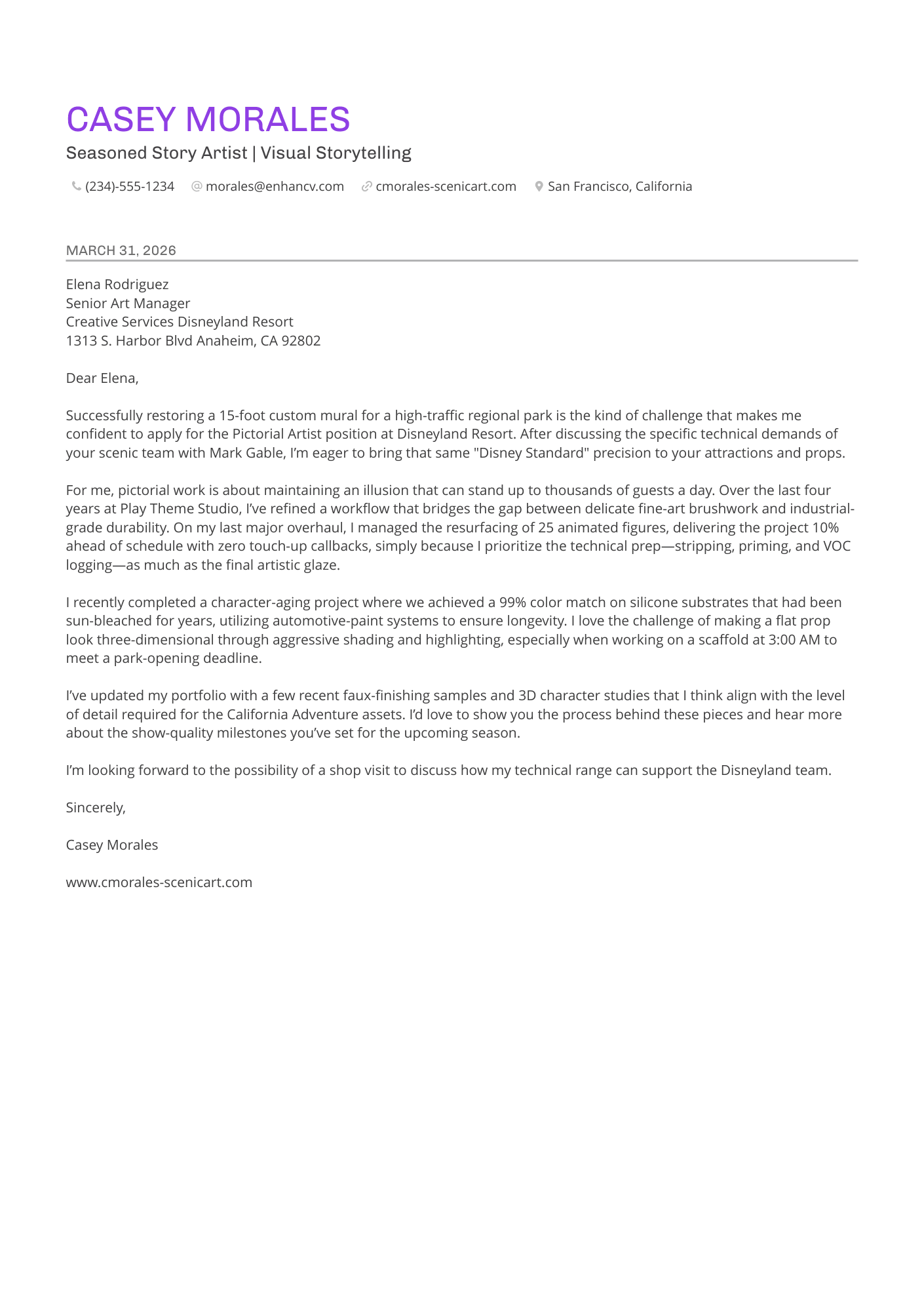
Cover letters for artist roles are different. The usual advice—lead with your biggest metric, quantify everything—doesn't always translate to a field where the work speaks through a portfolio, not a dashboard.
But that doesn't mean the artist cover letter gets a pass on specificity. What changes is the currency. Instead of revenue numbers, you're anchoring the letter in commissions completed, exhibition history, media coverage, client outcomes, or critical recognition. The principle is the same—evidence over assertion.
An artist's cover letter that opens with "I am a passionate and versatile artist with a unique visual style" has already lost. The letters that get responses open with a project, a recognition, or a moment where the work had a real-world effect.

Key takeaways
- Replace self-proclaimed labels like "passionate" or "versatile" with specific milestones, such as successful commissions or pieces acquired for permanent collections.
- Show that you understand how your work fits into the broader production pipeline or curatorial mission of the organization.
- Avoid generic praise by mentioning a specific past exhibition at a gallery or a particular stylistic choice in a studio’s recent title to prove you’ve done your homework.
- Start your letter with a hook—a moment where your work solved a problem or gained significant recognition—to ensure the reader actually makes it to your portfolio.
- Use the cover letter to address skills like iteration speed, feedback integration, and technical software mastery that your portfolio images can't communicate alone.
- Instead of waiting to be noticed, conclude by suggesting a specific next step, such as a portfolio walkthrough or a studio visit.
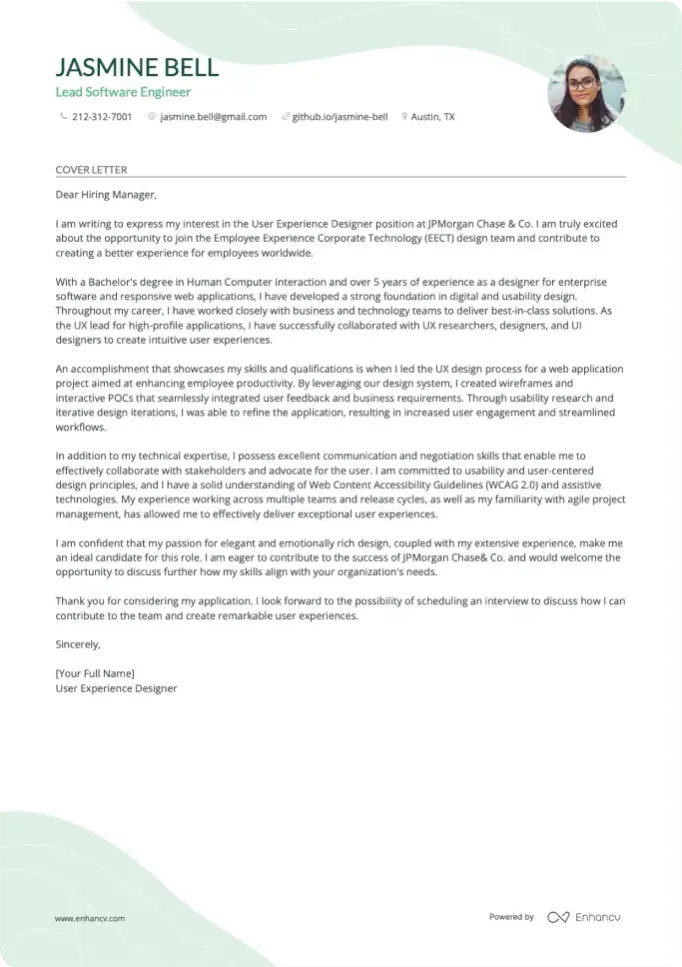
To see these tips in action, check out the example below.
Artist cover letter example
Feel free to adapt this artist cover letter sample to fit your practice. You can copy and edit the text yourself, or use Enhancv’s Cover Letter Builder to generate a perfectly formatted, gallery-ready letter in minutes.
September 30, 2025
Marcus Thorne
Art Director
EA Sports
209 Redwood Shores Pkwy
Redwood City, CA 94065
Dear Mr Thorne,
I am reaching out following a conversation with Alex Chen from your environment team, who mentioned you’re looking for someone to help define the visual DNA of the new American Football project. Alex described a workspace that values both the raw energy of a first sketch and the technical discipline required to hit a deadline, which is exactly where I do my best work.
For me, concept art is about visual problem-solving. Over the last three years at Blick Design Studio, I’ve refined a workflow that bridges the gap between a high-level brief and a 3D asset that actually works. On my last project, I delivered over 40 environment turnarounds that went straight into production with zero major topology revisions, simply because I prioritize the "why" behind the design—focusing on silhouettes that read clearly even in high-motion sports gameplay.
In my current Photoshop and Blender pipeline, I’ve learned to embrace strict technical constraints. I recently managed a character design sprint where we reduced iteration time by 20% by implementing a modular prop system for player gear. I love the challenge of making a linebacker feel "heavy" and imposing through lighting and shade, even when working within tight polygon budgets. My obsession with football also helps me skip the guesswork—I know exactly how a jersey should stretch during a tackle or how stadium lights catch the grit on a helmet, ensuring the designs feel authentic to fans from the first sketch.
I’ve updated my portfolio with a few recent character studies and environment layouts that I think align with the direction EA is headed. I’d love to show you the process behind these pieces and hear more about the stylistic milestones you’ve set for this project.
I'm looking forward to hearing about your vision for the project and discussing how I can help bring these new environments to life.
Sincerely,
Jordan Rivera
www.jrivera-portfolio.com
This cover letter works because it stops asking for a job and starts offering solutions.
Here’s the quick breakdown of why it hits the mark:
- It starts with a referral (Alex Chen), and it instantly builds trust. It feels like a conversation between two professionals rather than a formal petition.
- Instead of saying "I am a hard worker," it says "I delivered 40 turnarounds with zero revisions." It uses numbers to prove that the artist's work saves the studio time and money.
- The letter mentions "polygon budgets" and "3D asset workflows." This tells the Art Director that the artist understands the entire pipeline, not just their own drawing tablet.
- Talking about the specific stretch of a jersey or the grit on a helmet shows a genuine passion for the subject matter (American Football) that you just can't fake.
- It explains the logic behind the art. For a concept artist, the ability to explain why a design works is just as important as the drawing itself.
What your artist cover letter needs to cover
Hiring managers and creative directors reviewing artist applications are asking four questions. Most cover letters don’t answer all of them.
1. What have you actually made and for whom?
2. What's your technical range and depth?
3. Why this organization, gallery, or opportunity specifically?
4. Where is your practice headed?
It’s tempting to lean on a basic AI-generated draft to save time, assuming the cover letter is just a formality. But in a creative field, a "standard" letter is a missed opportunity. AI often strips away the very thing that gets you hired: your perspective. As an artist, you know that personality is your greatest asset—don’t let a bot buff out the edges of your true self.
In the next sections, we’ll show you how to structure and format your letter so you can answer these questions with the same intent and authenticity you bring to your portfolio.
If you need a jumpstart, our Cover Letter Generator will help you lay down a solid underdrawing for your letter in minutes, so you can spend your energy on the part that matters: adding your unique creative voice and finishing touches.
Drop your resume here or choose a file.
PDF & DOCX only. Max 2MB file size.
How to structure your artist cover letter
An artist cover letter has the same five-section structure as any professional letter. What changes is what goes in each section.
- Header: Full name, email, phone, city/state, LinkedIn, and—critically—your portfolio URL.
- Salutation: Name the creative director, gallery director, or hiring manager. For studio and gallery roles, these names are almost always public. A direct cover letter salutation signals that you treated this application as a real professional communication.
- Opening paragraph: A specific project outcome like a commission, an exhibition result, or a documented public response. The opening paragraph should make the reader want to open your portfolio before they finish the sentence.
- Body paragraph(s): Two paragraphs: one on the scope and range of your practice with specific commissions and contexts; one on why this organization, program, or role is the right fit for where your work is going.
- Closing paragraph: Ask for a portfolio walkthrough or studio visit. That's the right next step for artist applications—not a generic "interview." For general closing language, our cover letter ending guide has phrasing that can be adapted for creative roles.

PRO TIP
Keep your artist cover letter and portfolio URL in sync. If your portfolio has been updated recently, mention one new project from it in the letter so the reader knows where to look first.
Creative directors and gallery directors reviewing artist applications are screening for credibility signals that look different from corporate roles—but the underlying logic is the same.
Here’s what you need to know:

What hiring managers look for in an artist’s cover letter:
- Documented output: Commissions completed, exhibitions mounted, pieces in collections, press mentions. Not "extensive exhibition history" but names, venues, and years.
- Client and institutional relationships: An artist who’s worked with public institutions, commercial clients, or cultural organizations has demonstrated they can translate a brief and deliver. That's a professional signal, not just an artistic one.
- Portfolio alignment with their program: Every hiring decision for an artist role or residency is partly a fit decision. The letter needs to show you understand what the organization makes and why your work belongs in that conversation.
With that in mind, let’s see how to build a strong cover letter step by step.
How to address your artist cover letter
Addressing your cover letter to a specific person is crucial, but it’s a step many job seekers skip or get wrong. The goal is to identify the specific individual whose creative vision you'll be supporting—whether that’s the art director, lead concept artist, or gallery manager. Their name is usually listed on the organization’s website, so use it.
For competitive residency and commission applications, the program contact is almost always named in the application materials. Finding it shows you read the brief carefully, which is itself a signal.
When a name genuinely isn't available, "Dear Studio/Gallery Name] Creative Team" is professional. "To whom it may concern" is not.
How to open your artist cover letter
The worst artist cover letter openers are statements of identity: "I am a multidisciplinary artist working at the intersection of identity, memory, and materiality."
That's a bio, not an opening.
The best openers are outcome-led. What did a specific piece do? What did a commission produce? What happened when the work hit an audience? The how to start a cover letter principle—open with evidence, not intention—holds for creative applications.
See the difference below:
Weak artist cover letter opening
I am a multidisciplinary artist with a BFA from the Pacific Northwest College of Art and a deep commitment to socially engaged practice. I am excited to apply for the artist-in-residence position at your organization.
Strong artist cover letter opening
When the Portland Art Museum commissioned me for a six-week temporary textile installation, I didn’t expect it to end with the piece being acquired for their permanent collection. That project started a conversation about material impermanence that resonated far beyond the initial brief—and it’s that same drive for creating work with lasting impact that brings me to Impressionista.
Alternatively, if a peer or collaborator suggested you apply, lead with that referral. Starting with a shared professional connection is one of the fastest ways to build immediate trust and skip the "stranger" phase of the pile.
How to write the body of your artist cover letter
The body of an artist's cover letter needs to do two things that most letters get wrong.
Show scope and professional range
This is where you document the breadth and depth of your practice. Not a bio but a track record. How many commissions? What contexts? What client types? What technical range? Give the reader a clear picture of what working with you looks like. The artist resume level of specificity applies here: real numbers, real venues, real outcomes.
Say why you’ve chosen this organization
Name something real. Their most recent show. A specific artist in their program whose work intersects with yours. A commission project you read about.
Generic alignment statements ("I admire your commitment to supporting emerging artists") get skipped because they appear in every application.
How to match your artist background to application requirements
| Application asks for | What to highlight in your letter | Example phrasing |
|---|---|---|
| Demonstrated exhibition history | Venues, years, and any acquisitions or press | Six solo exhibitions since 2020, including a gallery show at PNCA that was reviewed in Oregon Arts Watch |
| Experience with public or site-responsive work | Commission scope and community engagement | Completed four public murals for Portland's Office of Community and Civic Life, serving neighborhoods totaling 80,000 residents |
| Collaboration with institutional clients | Brief translation and first-round approval process | Developed a concept presentation process that gets first-round client approval 90% of the time—which matters at scale |
| Active studio practice | Current body of work and material direction | Current body of work explores natural dye extraction as a formal process—14 new pieces completed in the last eight months |
How to close your artist cover letter
Artist cover letters often end with something vague and soft, like "I hope to have the opportunity to share more about my practice." That sounds more like a retreat, not a closing.
A strong closing for an artist application asks for the specific next step: a portfolio walkthrough, a studio visit, or a call to discuss project fit. Name the format and make the ask directly.
The cover letter ending principle applies here as much as anywhere: state what you want, explain why it makes sense, and ask for it without hedging.
Artist cover letter with no experience
"No experience" in artist applications usually means no commercial commissions or institutional history, not no work. And for artist applications, work is the experience.
A student artist with a strong body of studio work, a campus exhibition record, and one freelance commission is not inexperienced. The cover letter needs to present what actually exists, not apologize for what doesn't.
Here are three things that work for cover letters with no experience:
- Lead with any documented outcome. A sold piece, a campus acquisition, a press mention in a school publication—anything with a third-party signal of quality.
- Show the body of work is real and active. Mention current projects, recent completions, or work in progress. A practice that's producing work right now reads differently than a portfolio of old student projects.
- Name your technical preparation. Materials you've mastered, processes you've trained in, technical skills that transfer to professional contexts. Use Enhancv's cover letter templates to frame these cleanly. Professional formatting signals readiness even when the career is early.
Frequently asked questions on artist cover letters
Here are a few more aspects of cover letter writing you might want to consider:
How should I format my cover letter?
Keep it to one page (no more than 300 words), even for artists with extensive exhibition histories. The design of your portfolio communicates your visual sensibility. The cover letter doesn't need to carry that weight.
Use a clean, readable font such as Arial, Rubik, or Lato, left-aligned, 10–12 pt, with standard margins.
What should an artist cover letter include?
A strong artist cover letter includes:
- A specific project outcome in the opening.
- А paragraph documenting your practice scope with real commissions or exhibitions.
- А paragraph showing why this organization fits your work.
- А direct closing ask for a portfolio review.
What makes an artist's cover letter stand out?
Most art applications lead with creative philosophy or stylistic description, which tells a hiring manager nothing they couldn't infer from the portfolio. A letter that opens with a real commission result, an exhibition acquisition, or a public response metric stands out immediately because it treats the application as a professional document, not an artistic statement.
Final thoughts
Your cover letter is the bridge that connects your creative vision to a studio’s production needs or a gallery’s curatorial mission. Trade vague stylistic descriptions for concrete project wins and technical reliability to prove you’re as professional as you’re imaginative.
Ultimately, a great letter doesn't just describe your art—it demonstrates that you have the clarity and drive to make that art happen within a professional framework.