Cover letters for photography roles are different. The usual advice doesn't apply here. Your portfolio does the heavy lifting—it proves you can shoot. The photographer cover letter has one job: prove you can think, collaborate, and deliver under pressure.
Most photographers skip this distinction and write a paragraph version of their shot list. Gear owned, genres covered, software known. That's not a cover letter. That's a spec sheet with punctuation.
Pair this guide with your photographer resume to build the strongest possible application package.
Photographer cover letter examples
When writing a cover letter for a photography role, context is everything. Below are targeted examples demonstrating how to approach different specialties within the industry.
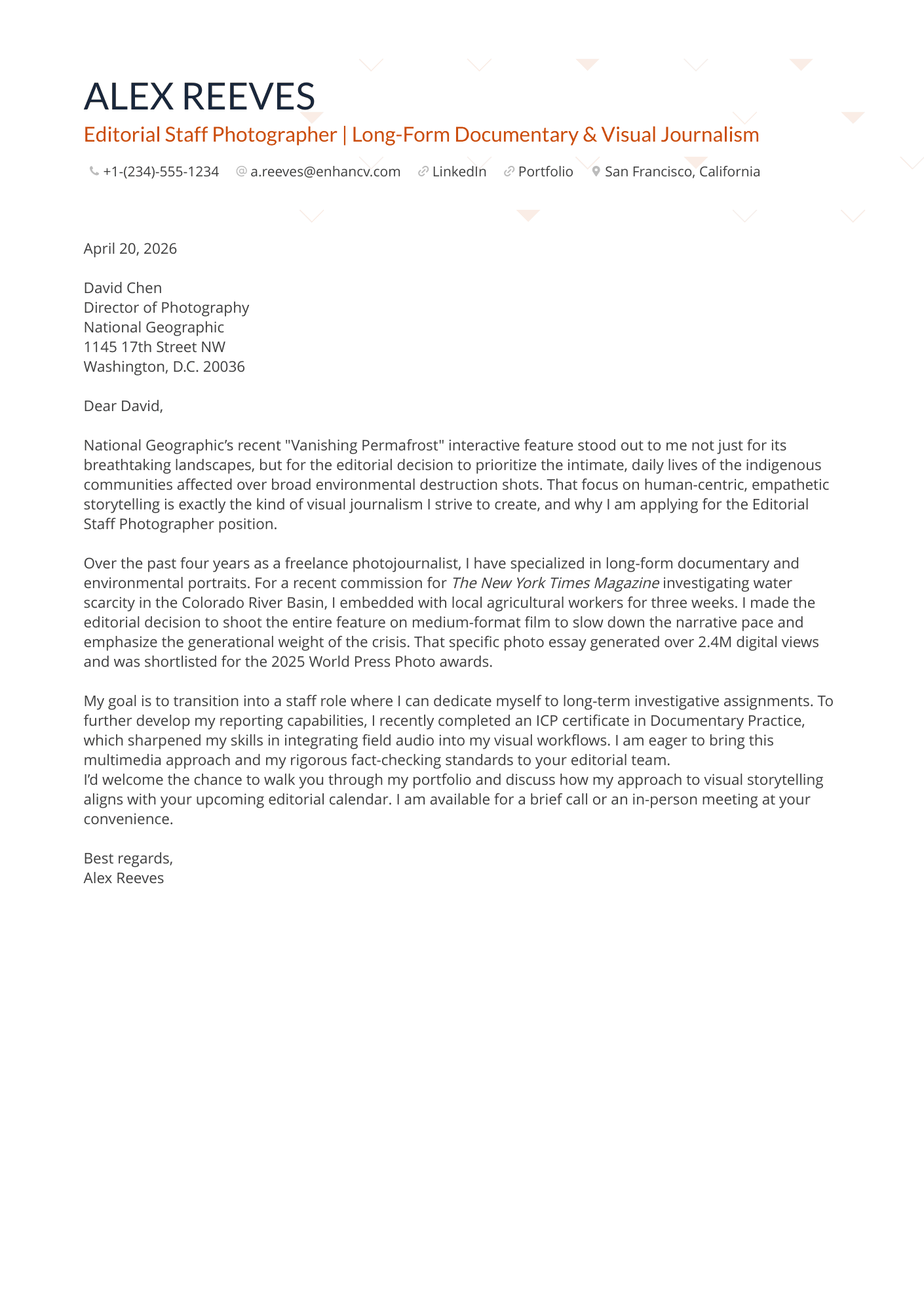
ALEX REEVES
San Francisco, California
+1-(234)-555-1234
а.reeves@enhancv.com


Here's what makes this photographer cover letter work:
- Opens with a specific reason for applying tied to National Geographic's actual work—not generic admiration
- The NYT Magazine piece is unpacked fully: scope, method, outcome, and the editorial decision that mattered
- 2.4M views and a World Press Photo shortlist are credible, relevant numbers for an editorial role
- The ICP certificate explains a growth direction without sounding like a pivot
- Closes with a specific ask, not vague enthusiasm
Here’s another photographer cover letter sample, this time focusing on commercial photography.
Morgan Hayes
San Francisco, California
+1-(234)-555-1234
m.hayes@enhancv.com
Casey Morgan
San Francisco, California
+1-(234)-555-1234
m.hayes@enhancv.com

Key takeaways for your photographer cover letter
- Open with something specific about the employer's work—one real reference beats three generic compliments.
- Include at least one number tied to a real outcome: views, click rate, bookings, rebook rate, or campaign performance.
- Name your specialty clearly—commercial, portrait, editorial, and documentary require different skills.
- Show your post-production workflow and delivery standards, not just your shooting ability.
- Keep it to one page—250–400 words in the body is the right target.
- Match the tone to the employer—a fine art gallery gets a different register than an e-commerce brand.
What your photographer cover letter needs to cover
Hiring managers and photo editors reviewing photographer cover letters are working through a specific mental checklist. Your letter needs to answer four questions:
- Can you shoot for our specific context? Commercial, portrait, documentary, and editorial photography are distinct disciplines. State your specialty and name work that matches what this employer actually produces.
- What does your output look like in production? Sessions per week, turnaround time, campaigns delivered, images licensed. The hiring manager needs to picture your workflow in their operation.
- Do you understand their visual language? The fastest way to prove this is to name something specific about their existing work that you genuinely respond to. One real reference beats three generic compliments.
- Are you reliable and professional? Creative skills are assumed at the application stage. What isn't assumed: that you deliver on time, handle post-production consistently, and communicate clearly with clients or art directors. One story that proves this is worth more than five adjectives.
Sections to include in your photographer cover letter
A photographer cover letter follows the same professional structure as any other, but the content of each section should reflect the creative context.
- Header: Full name, professional credentials (CPP, MFA, BFA, or FAA Part 107 if applicable), email, phone, city/state, and portfolio or LinkedIn URL. Include the date and full recipient block: name, title, company, mailing address.
- Salutation: Address the specific person reviewing your application. Photo editor, creative director, or studio manager—research who it is. A personalized cover letter salutation signals you've done your homework before the first sentence.
- Opening paragraph: Name something specific about the employer's work that connects to yours. Not flattery—specific knowledge. One concrete reference to a campaign, story, or project you've followed.
- Body paragraphs: Two paragraphs. The first covers relevant experience and a concrete outcome with a number. The second addresses fit and where you're headed professionally.
- Closing: State what you're asking for. A portfolio review, a call, a meeting. Direct is better than vague. A confident cover letter ending moves things forward.
- Formatting tips: Keep your letter to one page. Use a clean, readable font—Rubik, Garamond, or Helvetica at 10–12 pt. Single spacing within paragraphs, double between them. Left-align everything. The cover letter format matters more than most applicants realize—a cluttered layout from someone whose job is visual sends the wrong signal. On cover letter length: 250–400 words in the body is right.
What photographer recruiters look for
Creative directors and photo editors are looking past the equipment list. Here's what actually moves a photographer cover letter from the maybe pile to the call pile:
- Evidence of a consistent visual point of view—not versatility in every genre, but clarity in one
- Demonstrated understanding of client or editorial needs, not just aesthetic preferences
- Production reliability: delivery timelines, post-production consistency, file delivery standards
- Client-facing communication skills, especially for studio and commercial roles that involve directing subjects
- Licensing and rights knowledge for editorial and stock-focused positions
- Business-side credibility: invoicing practices, client retention rates, equipment management

PRO TIP
Use Enhancv's Cover Letter Builder to handle formatting. Skip the layout work and spend the time on the content that actually gets you hired.
How to address your photographer cover letter
Find the name of the person who will actually read your application. For studio roles, that's usually the studio manager or creative director. For editorial positions, it's the photo editor. For agency or in-house positions, it might be the creative director or an HR contact.
Use "Dear [First Name Last Name]," or "Dear [First Name]," depending on the culture—agency and editorial environments are generally on first-name basis. If you genuinely cannot find a name after checking the company website, LinkedIn, and the job posting, "Dear Hiring Team," is acceptable. "To Whom It May Concern" is not.
Avoid "Dear Sir or Madam." It's dated and assumes gender. Taking five minutes to find the right salutation sets the right tone for everything that follows.
How to open your photographer cover letter
The opening is where most photographer cover letters fail. The common mistake: starting with "I am a photographer with X years of experience." That sentence tells the reader nothing they couldn't infer from the resume.
Instead, open with something specific to the employer. The best openings do one of three things:
- Name a piece of the employer's work and connect it to your own practice
- Start with a concrete result from your own work that directly maps to what they do
- Reference a specific challenge or visual direction the employer is actively pursuing
- What you're signaling with a strong opening: you've done research, you have a perspective, and you're not sending this letter to fifty studios.
For tactical help on the first sentence, the how to start a cover letter guide has strong examples across multiple opener types.
How to write the body of your photographer cover letter
The body is two paragraphs. That's usually enough.
Paragraph one: your experience and one result. Be specific. Name the type of work, the volume or context, and one outcome tied to a creative decision you made. "I shot 14 product campaigns in 18 months" is better than "I have extensive commercial photography experience."
Paragraph two: your fit and direction. Connect your background to what this employer specifically does. Name something about the role or company that draws you to it—concretely, not generically. Add one sentence about where you're headed professionally.
Resist the urge to add a third paragraph that summarizes what you just said. That paragraph always makes the letter worse.
How to close your photographer cover letter
Close with a direct ask. A portfolio review, a brief call, an in-person meeting. Don't hedge with "I hope to hear from you" or "I would love the opportunity to perhaps discuss." Those phrases make it easy for the reader to do nothing.
A closing that works: "I'd welcome the chance to walk you through my portfolio and discuss what a busy production season looks like for your team. Happy to connect by phone or in person."
Then your sign-off: "Best," or "Sincerely," followed by your full name. More detail in the cover letter ending guide.
Photographer cover letter with no experience
If you're early in your photography career—recent graduate, career changer, or moving from assisting to shooting—the structure is the same but the sourcing shifts.
Lead with your portfolio, not your employment history. A strong body of work speaks louder than job titles. In your opening, name a specific project you completed: a self-directed series, a student commission, or a personal project with a real subject and a real brief. Tell the reader what it required of you.
For the outcome, use what you have: images selected for a final edit, a show or publication the work appeared in, client feedback, or a creative decision you made and why. "I shot the entire series at dusk to match the brand's palette," which shows judgment even without a job title behind it.
Address the lack of experience briefly and directly: "I'm in the early stages of my commercial career, and I'm looking for a studio where I can contribute while building the production volume that sharpens real expertise." That's honest and more effective than pretending you’re more experienced than you are.
Pair your input with our Cover Letter Generator—the templates keep you within one page and handle the formatting while you focus on the content. For more strategies, the full how to write a cover letter guide is worth reading before you draft.
Drop your resume here or choose a file.
PDF & DOCX only. Max 2MB file size.
FAQs about writing a photographer cover letter
Still have questions about crafting the perfect pitch? Here are the most common questions photographers ask when putting together their application packages.
What should a photographer cover letter include?
A photographer cover letter should include your specialty and relevant experience, one concrete outcome tied to your work, a specific reference to the employer's actual projects, and a direct closing ask. Keep it to one page and use a clean, readable format. Visual professionals are evaluated on their eye for design even in text documents.
How long should a photographer cover letter be?
One page. The body text should run 250–400 words. Shorter is usually better in creative fields. If you're struggling to cut it down, work through the cover letter format guide and identify what's filler.
What makes a photographer cover letter stand out?
Specificity. Name a real piece of work from the employer. Include a real number from your own work. State your specialty clearly. Generic letters that could apply to any photography job are the most common format in the pile—and the easiest to skip.
How do I write a photographer cover letter with no experience?
Lead with your portfolio. Describe a specific project you completed and what creative decisions it required. Use whatever measurable outcome you have: images selected, publication or show placement, client feedback. Be direct about where you are in your career without apologizing for it. Hiring managers hire potential when the portfolio backs it up—the cover letter's job is to point them to the right work and explain the thinking behind it.