Most LPN cover letters focus on compassion, whereas Directors of Nursing focus on competence.
They want to know whether you can safely manage a med pass, document accurately, identify changes in resident condition, and support patients through an entire shift without compromising care. Those responsibilities carry serious consequences, and hiring managers evaluate them carefully.
The strongest LPN cover letters don't describe nursing in general. They show evidence of nursing practice. Medication accuracy, wound care outcomes, resident safety improvements, and facility-specific experience are the details that earn interviews.
This guide shows you how to outline your cover letter around those signals so hiring managers can quickly understand the value you bring to the floor.

Key takeaways
- Lead with your LPN license, certifications, and care setting.
- Include one measurable clinical outcome tied to patient care.
- Show your scope of practice clearly and specifically.
- Mention the facility, unit type, and shift when possible.
- Connect your experience to the facility's patient population.
- Keep your cover letter to one page and focus on outcomes.
What is an LPN cover letter?
An LPN cover letter is a one-page document that explains how your clinical skills, patient care experience, and nursing judgment make you a perfect fit for a specific facility.
While your LPN resume lists responsibilities and credentials, your cover letter provides context by showing how you've improved patient outcomes, maintained safety standards, and contributed to the success of a nursing unit.
Why most LPN cover letters fail:
- They rely on generic nursing language.
- They don't include measurable outcomes.
- They fail to define clinical scope.
- They don't explain why the applicant wants that facility specifically.
LPN cover letter example
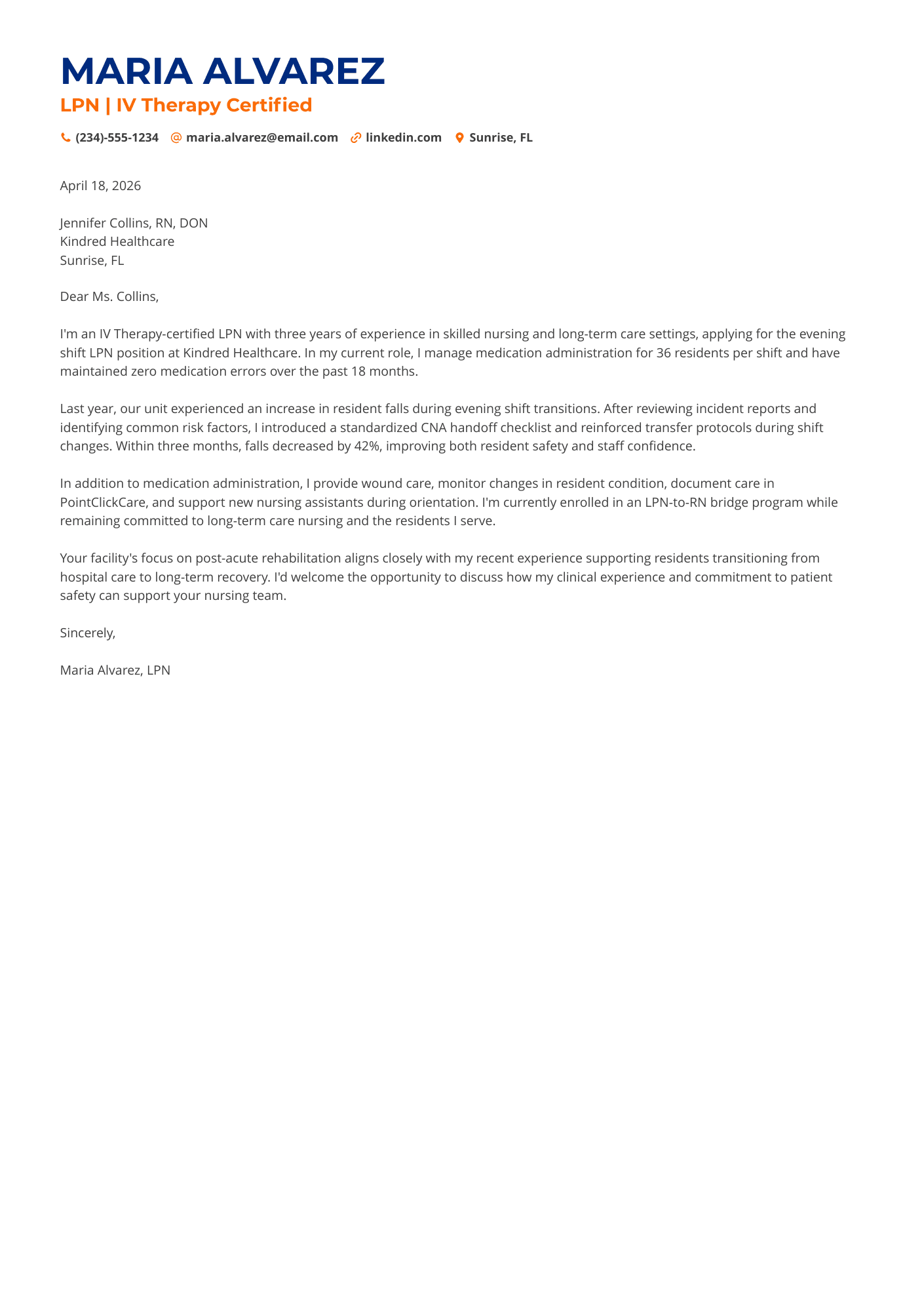
Before breaking down structure, it helps to see what a strong LPN cover letter looks like in practice. The best examples combine clinical competence, measurable outcomes, and a clear understanding of the facility's needs.
LPN cover letter example | Skilled Nursing Facility
Maria Alvarez, LPN, IV Therapy Certified
(954) 555-0189 | maria.alvarez@email.com | Sunrise, FL
April 18, 2026
Jennifer Collins, RN, DON
Kindred Healthcare
Sunrise, FL
Dear Ms. Collins,
I'm an IV Therapy-certified LPN with three years of experience in skilled nursing and long-term care settings, applying for the evening shift LPN position at Kindred Healthcare. In my current role, I manage medication administration for 36 residents per shift and have maintained zero medication errors over the past 18 months.
Last year, our unit experienced an increase in resident falls during evening shift transitions. After reviewing incident reports and identifying common risk factors, I introduced a standardized CNA handoff checklist and reinforced transfer protocols during shift changes. Within three months, falls decreased by 42%, improving both resident safety and staff confidence.
In addition to medication administration, I provide wound care, monitor changes in resident condition, document care in PointClickCare, and support new nursing assistants during orientation. I'm currently enrolled in an LPN-to-RN bridge program while remaining committed to long-term care nursing and the residents I serve.
Your facility's focus on post-acute rehabilitation aligns closely with my recent experience supporting residents transitioning from hospital care to long-term recovery. I'd welcome the opportunity to discuss how my clinical experience and commitment to patient safety can support your nursing team.
Sincerely,
Maria Alvarez, LPN
Why this works:
- Opens with license, certification, and clinical setting.
- Includes a measurable medication safety metric.
- Demonstrates problem-solving through a patient safety initiative.
- Shows practical clinical responsibilities.
- Addresses ongoing professional development.
- Connects directly to the facility's patient population.
What your LPN cover letter needs to show
Directors of Nursing review applications with a specific set of questions in mind. Most candidates answer one or two. The strongest cover letters, however, address all of them clearly and provide evidence rather than assumptions.
1. Can you safely manage medication administration?
- Include resident census when relevant.
- Mention medication accuracy or compliance metrics.
- Demonstrate attention to detail through outcomes.
- Show that you can manage time-sensitive responsibilities safely.
2. What is your clinical scope?
- Name certifications such as IV Therapy or CPR/BLS.
- Mention wound care, documentation, or assessments.
- Clarify the patient populations you've supported.
- Help the DON understand what you can do independently.
3. Why this facility?
- Reference the facility type or specialty.
- Mention a patient population you enjoy serving.
- Connect your background to their environment.
- Show that you've done your research.
4. Are you reliable and likely to stay?
- Mention tenure when applicable.
- Address bridge programs proactively.
- Demonstrate shift flexibility.
- Highlight consistency and dependability.
Once you understand what hiring managers are looking for, the next step is structuring your cover letter so those strengths are easy to identify.
Drop your resume here or choose a file.
PDF & DOCX only. Max 2MB file size.
Sections to include and how to format your cover letter
A strong LPN cover letter follows a standard structure, but each section should reinforce your clinical competence and fit for the role. The goal isn't creativity—it's clarity. Hiring managers need to quickly understand your qualifications, experience, and value to the nursing team.
Required sections
- Header with contact information and credentials
- Date and employer information
- Named salutation
- Opening paragraph
- Clinical achievement paragraph
- Facility alignment paragraph
- Closing paragraph
- Professional sign-off
Formatting rules
- One page
- 250–350 words
- Left-aligned text
- Standard professional font
- Clear paragraph spacing
A strong structure helps hiring managers find the right information quickly, but understanding which details they prioritize is just as important.
What recruiters look for in LPN candidates
Directors of Nursing and nurse managers evaluate applications differently than recruiters in many other fields. Clinical competence, reliability, and patient safety often outweigh personality-driven claims or generic nursing language.
What DONs scan for first
- Active LPN license
- Relevant certifications
- Medication administration experience
- Wound care and patient monitoring
- Documentation accuracy
- EMR proficiency
- Reliability and tenure
- CNA supervision or mentoring experience
How to address an LPN cover letter
Most LPN hiring decisions are made by a Director of Nursing, unit manager, or nursing leadership team. Taking the time to identify the correct recipient demonstrates professionalism and attention to detail—qualities that matter in clinical environments.

Salutations
Use:
- Dear Jennifer Collins
- Dear Jennifer Collins, RN, DON
- Dear Nursing Leadership Team
Avoid:
- To Whom It May Concern
Once your letter reaches the right person, the next challenge is making sure they keep reading.
How to open an LPN cover letter
Your opening paragraph should establish your qualifications and immediately demonstrate clinical value.
Strong example
I'm an IV Therapy-certified LPN with three years of skilled nursing experience, currently managing medication administration for 36 residents per shift with zero medication errors over the past 18 months.
Weak example
I am writing to express my interest in the LPN position at your facility. I am a compassionate nurse who enjoys helping patients.
A strong opening gets attention. The body is where you prove you can deliver results.
How to write the body of your LPN cover letter
The body should demonstrate how your work improves patient outcomes. Instead of describing responsibilities, focus on situations where your actions led to measurable improvements in safety, quality of care, or unit performance.
Paragraph 1: Clinical impact
Structure:
- challenge
- action
- measurable result
Clinical impact example
Our unit experienced an increase in resident falls during evening shift transitions. After reviewing incident reports and implementing a structured CNA handoff process, falls decreased by 42% within three months.
Paragraph 2: Facility alignment
Show:
- Why this facility
- How your experience fits
Facility alignment example
Your facility's focus on post-acute rehabilitation aligns closely with my recent experience supporting residents recovering from orthopedic procedures and extended hospital stays.
Every facility emphasizes different skills, which makes tailoring your cover letter especially important.
How to tailor your LPN cover letter to the job description
Most nursing job postings tell you exactly what clinical experience they value. Matching your examples to those priorities makes your cover letter more relevant and easier to evaluate.
Match job posting language to your LPN cover letter
| Job posting says | Your cover letter should include |
|---|---|
| Medication administration | Resident census, accuracy metrics, med pass experience |
| Wound care | Types of wounds treated and outcomes |
| Long-term care experience | Facility type and patient population |
| CNA supervision | Delegation and training experience |
| EMR documentation | PointClickCare, MatrixCare, Epic, etc. |
| IV Therapy certification | Relevant certifications and clinical application |

PRO TIP
Enhancv's Tailoring Tool scans a nursing job description and highlights which parts of your clinical experience to emphasize—saving time when you're applying to multiple facilities.
How to close an LPN cover letter
Your closing should reinforce your strongest qualifications and make it easy for the employer to take the next step.
Strong closing example
I'd welcome the opportunity to discuss how my medication administration experience and patient safety initiatives can support your nursing team. I'm available for a call or in-person interview at your convenience.
Weak closing example
Thank you for considering my application. I'm very passionate about nursing and hope to hear from you soon.
PRO TIP
Use a professional sign-off and include your credentials after your name. It reinforces your qualifications and helps nursing leaders immediately identify your licensure level.
The details can make a big difference in healthcare hiring. These are some of the most common questions LPNs have when preparing a cover letter.
Frequently asked questions
Even experienced LPNs have questions about what belongs in a cover letter. These are the areas hiring managers pay the most attention to and where many applicants miss opportunities to strengthen their application.
What should an LPN cover letter include?
Your cover letter should include your LPN license, relevant certifications, care setting experience, and at least one measurable clinical outcome. Directors of Nursing want evidence of competence, not generic descriptions of patient care.
What makes an LPN cover letter stand out?
Specific clinical outcomes. Medication accuracy rates, fall prevention initiatives, wound care improvements, and documentation compliance are all stronger than personality traits or generic nursing statements.
Should I include medication error rates?
Yes. Medication administration is one of the most important responsibilities of an LPN. If you've maintained a strong accuracy record, include it. It's one of the clearest indicators of competence.
How do I address being in an LPN-to-RN bridge program?
Address it directly. Most directors of nursing view bridge programs positively. The key is reassuring employers that you're committed to your current role and not immediately planning to leave.
Should I mention EMR systems?
Absolutely. Familiarity with PointClickCare, MatrixCare, Epic, or other systems can shorten onboarding time and demonstrate practical readiness.
What clinical achievements should I include?
The strongest examples involve:
- medication accuracy
- falls reduction
- wound care outcomes
- documentation improvements
- patient safety initiatives
- CNA training or supervision
What should I check before sending my cover letter?
- License and certifications included
- One measurable clinical outcome
- Facility-specific language
- Proper recipient
- Clean formatting
- Credential after your name
Final thoughts
A strong LPN cover letter doesn't try to convince a Director of Nursing that you're caring. That's assumed.
What hiring managers need to see is evidence that you can manage medication administration safely, document accurately, recognize changes in resident condition, and contribute to a well-run unit.
If your letter makes those capabilities easy to understand, you'll stand out from most applicants. They’ll notice because you'll be writing like a practicing nurse, not someone trying to sound like one.