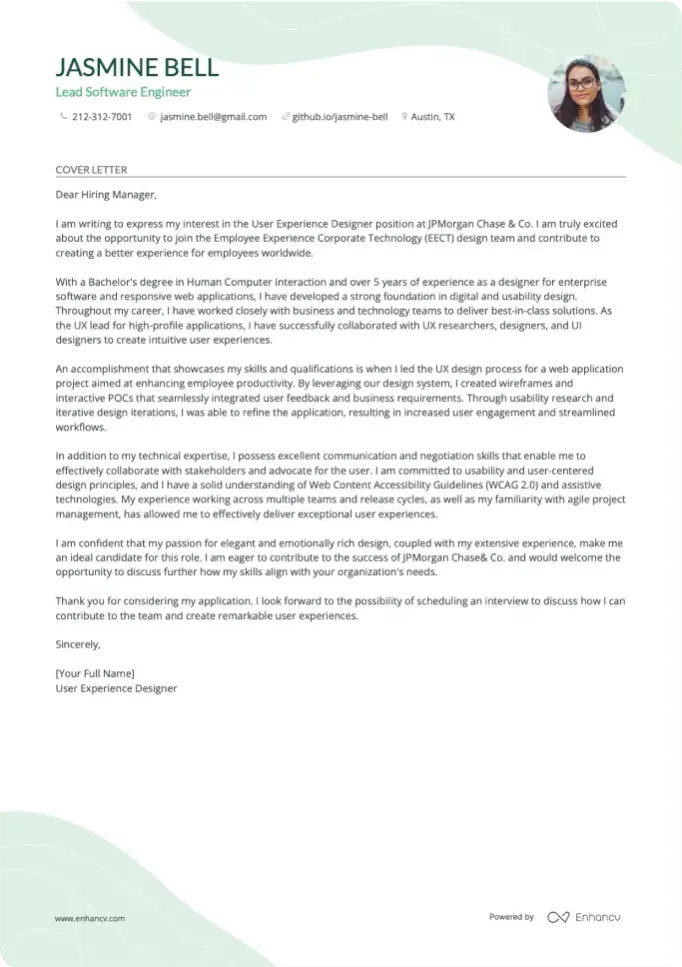
Hiring for a nursing assistant moves fast, and the screener reads your cover letter to answer one question: can this person care for patients safely on day one? Your CNA certification is the proof, but the letter is where you show what you actually did with it. This page gives you a real nursing assistant example, a no-experience version built around clinical hours, and the credential details recruiters scan for first.
It pairs with your application, so build the matching Nursing Assistant resume example alongside it. The two should tell one story: same certifications, same numbers, no contradictions.

Key takeaways
- Lead with your CNA certification and active state Nurse Aide Registry status. It's the first thing the screener confirms.
- No paid experience? Treat clinical hours as real work and quantify them (vitals taken, patients repositioned, hours logged).
- Name your BLS for Healthcare Providers card and any EHR you've charted in, like PointClickCare or Epic.
- Keep it to one page, three or four short paragraphs, and address a real charge nurse or HR contact by name.
- Mirror your resume exactly, especially certifications and dates, so nothing contradicts.
Drop your resume here or choose a file.
PDF & DOCX only. Max 2MB file size.

Who actually reads a nursing assistant cover letter
- An HR screener or recruiter: confirms your CNA certification is active and current before anything else.
- The charge nurse or DON: wants to know you can take vitals, transfer patients, and chart without supervision.
- A staffing coordinator: checks your availability for nights, weekends, and the shifts they actually need filled.
- The ATS: first pass looks for terms like CNA, BLS, vital signs, and ADLs, so use them naturally. Run a draft through a free ATS resume scanner to check.
Which credentials to name (and when)
- CNA certification: always name it in the first or second paragraph, with your state. This is the spine of the letter.
- State Nurse Aide Registry number: include it if the posting asks; otherwise say your registration is active and in good standing.
- BLS or CPR: name the issuer (American Heart Association) and that the card is current.
- Optional add-ons: dementia care, phlebotomy, or first aid certifications, only if relevant to the unit.
- List the full set on your resume too. See how to format certifications on resume and, if you have one, a driver's license on resume for home-care roles.
What leads your letter: with vs without experience
| No paid experience yet | Some experience |
|---|---|
| Open with CNA certification and clinical hours | Open with months or years on a specific unit |
| Quantify training: vitals taken, patients repositioned | Quantify results: residents per shift, fall-rate reductions |
| Cite your instructor's feedback or a clinical evaluation | Cite a supervisor or a performance review |
| Emphasize reliability, learning speed, and protocols | Emphasize independence and complex-care experience |
If you're applying straight out of a program, lean on the left column without apology. Clinical placement is supervised patient care, and a resume with no work experience can still be strong when you frame training as the work it is.
Nursing assistant cover letter example
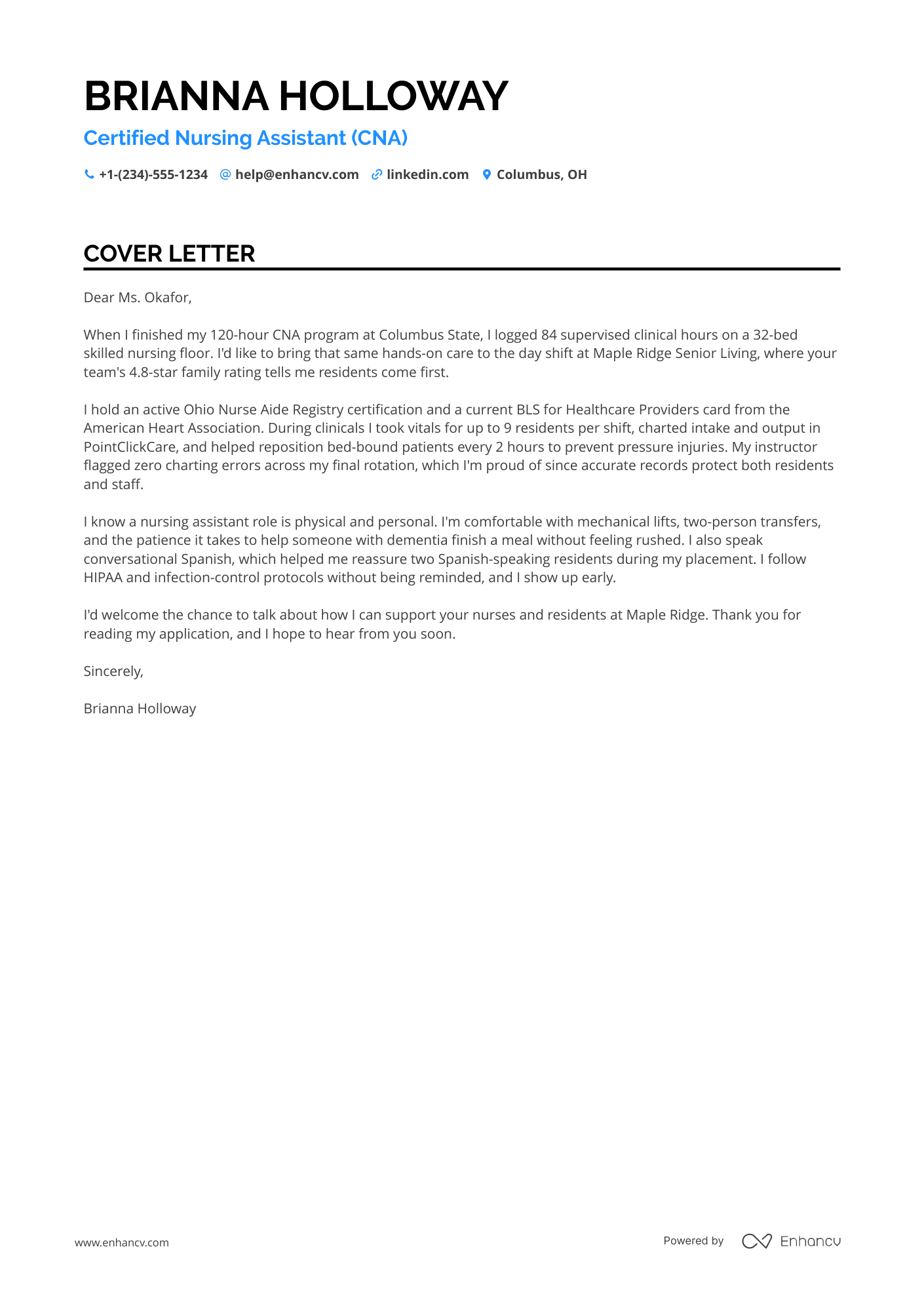
Here's a full no-experience example for a recent CNA graduate. Notice how it leads with the certification, turns clinical hours into proof, and keeps every paragraph short.
Brianna Holloway
Columbus, OH
+1-(234)-555-1234
help@enhancv.com


How to format a nursing assistant cover letter
Match the formatting to your resume so the application looks like one set. Use a clean header with your name, phone, professional email, and city. One page, half a page is fine. Three or four short paragraphs, left-aligned, with a real greeting and a real sign-off.
For the mechanics, our guides on cover letter format, cover letter spacing, and the cover letter header cover the details. Save and send it as a PDF unless the posting asks for a Word file, since a resume in pdf or doc follows the same rule.
The top sections on a nursing assistant cover letter
- Header: your contact info and the date, matched to your resume.
- Greeting: a named charge nurse, DON, or HR contact.
- Opening: the role, your CNA certification, and one reason you want this employer.
- Body: clinical proof with numbers, plus the skills the unit needs.
- Closing: a clear request for an interview and a thank-you.
Find the hiring contact on the job post or the facility's staff page before defaulting to a title. A name beats "To whom it may concern" every time. Our guide on how to address a cover letter and the cover letter salutation breakdown help when you can't find one.

Professional greetings for a nursing assistant cover letter
- Dear Ms. Okafor,
- Dear Charge Nurse Daniels,
- Dear Maple Ridge Hiring Team,
- Dear Mr. Alvarez, Director of Nursing,
Your opening has about six seconds to land. Name the role and your certification in the first line, then give one specific reason you chose this employer. Skip the generic windup. For more angles, see how to start a cover letter.
Cover letter intro
When I finished my 120-hour CNA program at Columbus State, I logged 84 supervised clinical hours on a 32-bed skilled nursing floor. I'd like to bring that same hands-on care to the day shift at Maple Ridge Senior Living, where your 4.8-star family rating tells me residents come first.
Cover letter intro
I am writing to apply for the nursing assistant position I saw advertised. I am a hard worker and a people person, and I believe I would be a great fit for your team.
The weak version names nothing real: no certification, no hours, no facility detail. The strong one proves the candidate before the reader reaches paragraph two.
The body is where clinical hours become evidence. Pick two or three things you actually did, attach a number, and tie them to patient safety. Use resume action verbs and quantify achievements the same way you would on the resume.
Cover letter body example #1
I hold an active Ohio Nurse Aide Registry certification and a current BLS card from the American Heart Association. During clinicals I took vitals for up to 9 residents per shift, charted intake and output in PointClickCare, and repositioned bed-bound patients every 2 hours to prevent pressure injuries. My instructor flagged zero charting errors across my final rotation.
Pro tip: Name the EHR you trained on (PointClickCare, Epic, MatrixCare). It signals you can chart on day one and tells the ATS you speak the unit's language.
Close by asking for the interview and thanking the reader. Keep it warm and short. Avoid restating the whole letter. Our cover letter ending guide has more closers that work.
Cover letter closing
I'd welcome the chance to talk about how I can support your nurses and residents at Maple Ridge. Thank you for reading my application, and I hope to hear from you soon.
Professional sign-offs for a nursing assistant cover letter
- Sincerely,
- Best regards,
- Respectfully,
- Thank you for your time,
Common nursing assistant cover letter mistakes
- Burying the certification: if the screener can't find your CNA status fast, you lose the first pass.
- Apologizing for no experience: frame clinical hours as work instead of explaining what you lack.
- Vague care claims: "I love helping people" means nothing without vitals, transfers, or charting to back it.
- Contradicting your resume: mismatched dates or certifications read as careless. Avoid common resume mistakes and proofread for any typo on resume.
- One generic letter for every facility: a targeted resume and a tailored letter beat mass applications.
Once the letter reads clean, line it up with your application and submit them together. Use the same certifications, the same numbers, and the same voice, then build the Nursing Assistant resume so the two documents reinforce each other. For a final polish, the cover letter checklist catches anything you missed before you hit send.
Next step: with your letter ready, build the resume to match. See the matching Nursing Assistant resume example.