

Two years ago, we noticed something in Enhancv's data that didn't get much attention: senior professionals were already more likely to include a photo on their resume than anyone else.
At the time, it looked like an outlier. The new data suggests it's a trend—and one that may point at something the standard resume advice has been getting wrong for a specific kind of job seeker.
We looked at 6,684 real job outcomes from paying customers who found a job and shared the resume that got them employed. In the U.S.—the market with the strongest "no photo" norm—the people who got hired were 60% more likely to have included one. These are real outcomes, self-reported, no survey prompting.
The standard advice, backed by decades of audit research, says don't do it. We wanted to understand what was really happening in the segment where that advice is most contested.

Key takeaways
- In 21 of 23 countries analyzed, winning resumes included a photo at a higher rate than the broader download base.
- In the U.S., job-finding customers were 60% more likely to have used a photo than the average paying customer, within the same country, controlling for cultural norms.
- Canada, the most photo-averse market in the dataset, showed the same pattern: 30% of winning resumes included a photo, compared to 17.5% of all paid downloads.
- Among U.S. professionals, photo use rises steadily with career length—from 15.2% among those with two years of experience or less, to 37.3% among those with 21 or more.
- Photo users and non-photo users found jobs in the same median time (30.9 days), suggesting photos correlated with outcome, not speed.
- The discrimination research that drives conventional no-photo advice was built on a different population—the effect operates most strongly in segments where visible identity diverges from hiring norms.
- For senior professionals in low-photo-norm markets, the blanket "no photo" rule has the weakest evidence behind it.
What we measured and why it's different
Most resume advice is built on opinions: what HR professionals say they prefer, what career coaches recommend, what feels right. We wanted to work with something harder than that.
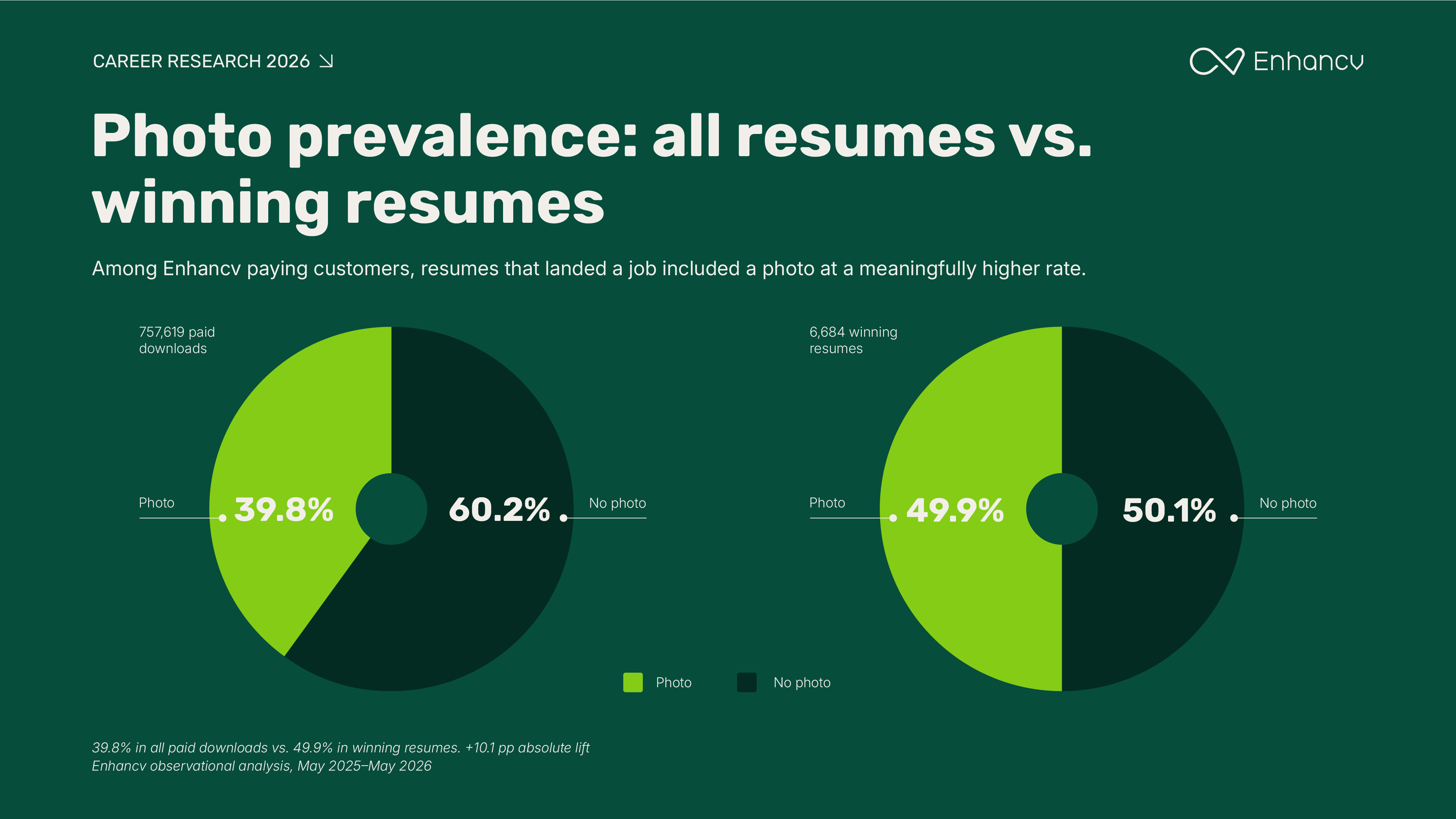
We compared two populations. The first: 757,619 resumes downloaded by our paying customers. The second: 6,684 resumes that customers flagged (over a 12-month window) as the resume that got them hired.
They had no incentive to perform for us—no survey, no prompt, no audience. Just people who found a job and named the resume behind it. Which means what we're looking at isn't what job seekers think helps—it's what correlated with the outcome they were actually trying to reach.
What the data really shows
Interestingly, photos appeared in 49.9% of winning resumes, vs. 39.8% of the broader download base. A 10.1 percentage point gap, or roughly a 25% relative increase.
By itself, that's easy to dismiss. Enhancv has customers all over the world, and in many countries, like Germany, France, and Switzerland, photos on a resume are standard. If winners skew toward those markets, the gap could just reflect where jobs are being found.
So we went a level deeper.
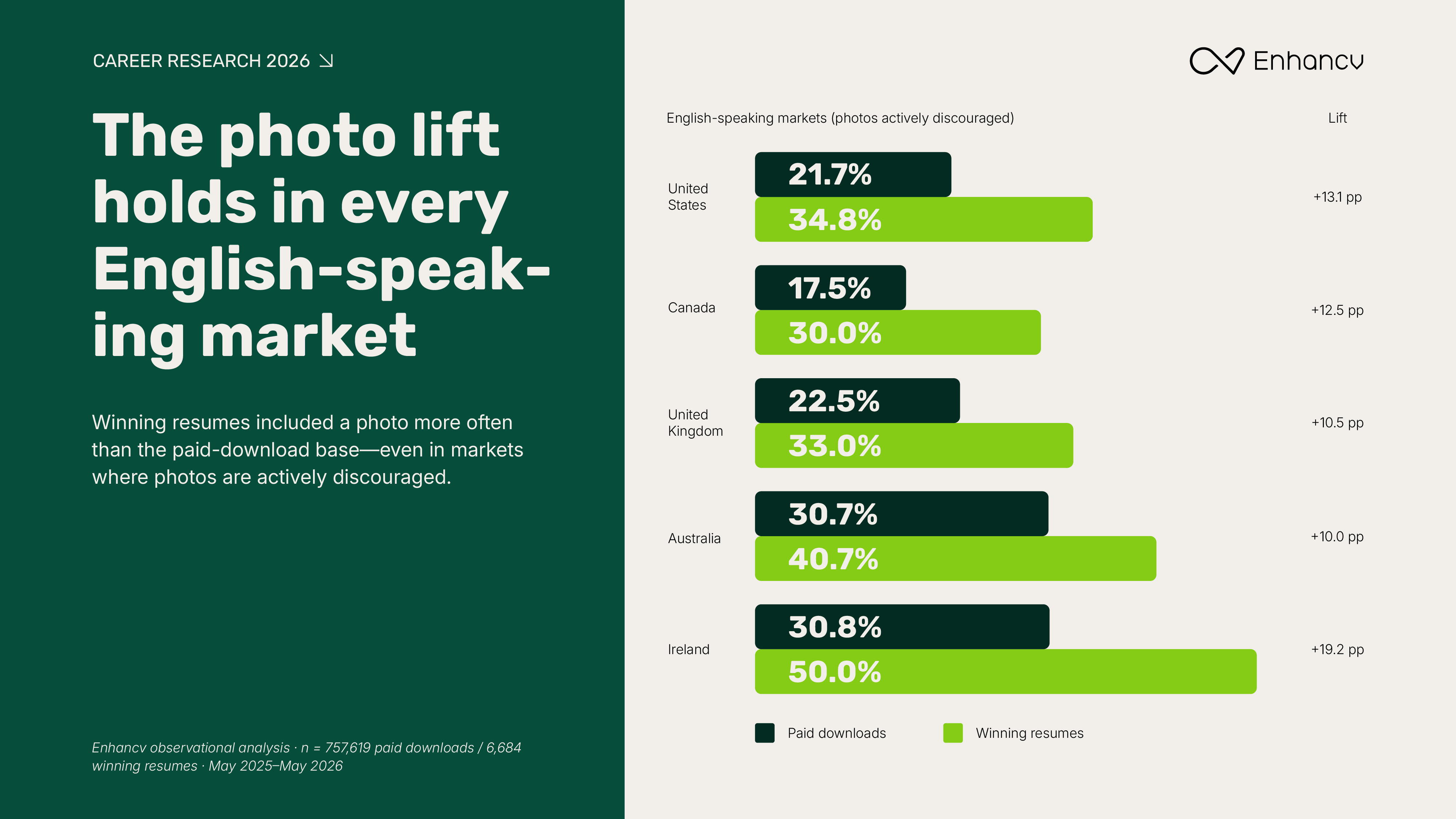
The photo lift holds in 21 of the 23 countries we had data for, including every English-speaking market where adding a photo is a conscious deviation from the norm.
In the U.S. specifically, 21.7% of paid downloads included a photo. Among customers who reported finding a job, that figure was 34.8%—a 60% relative increase, measured within the same country, so the cultural confound is already controlled for. That's the comparison that survives scrutiny.
The pattern holds across the border too. In Canada—where only 17.5% of paid downloads included a photo, making it the most photo-averse market in our dataset—winners still came in at 30%.
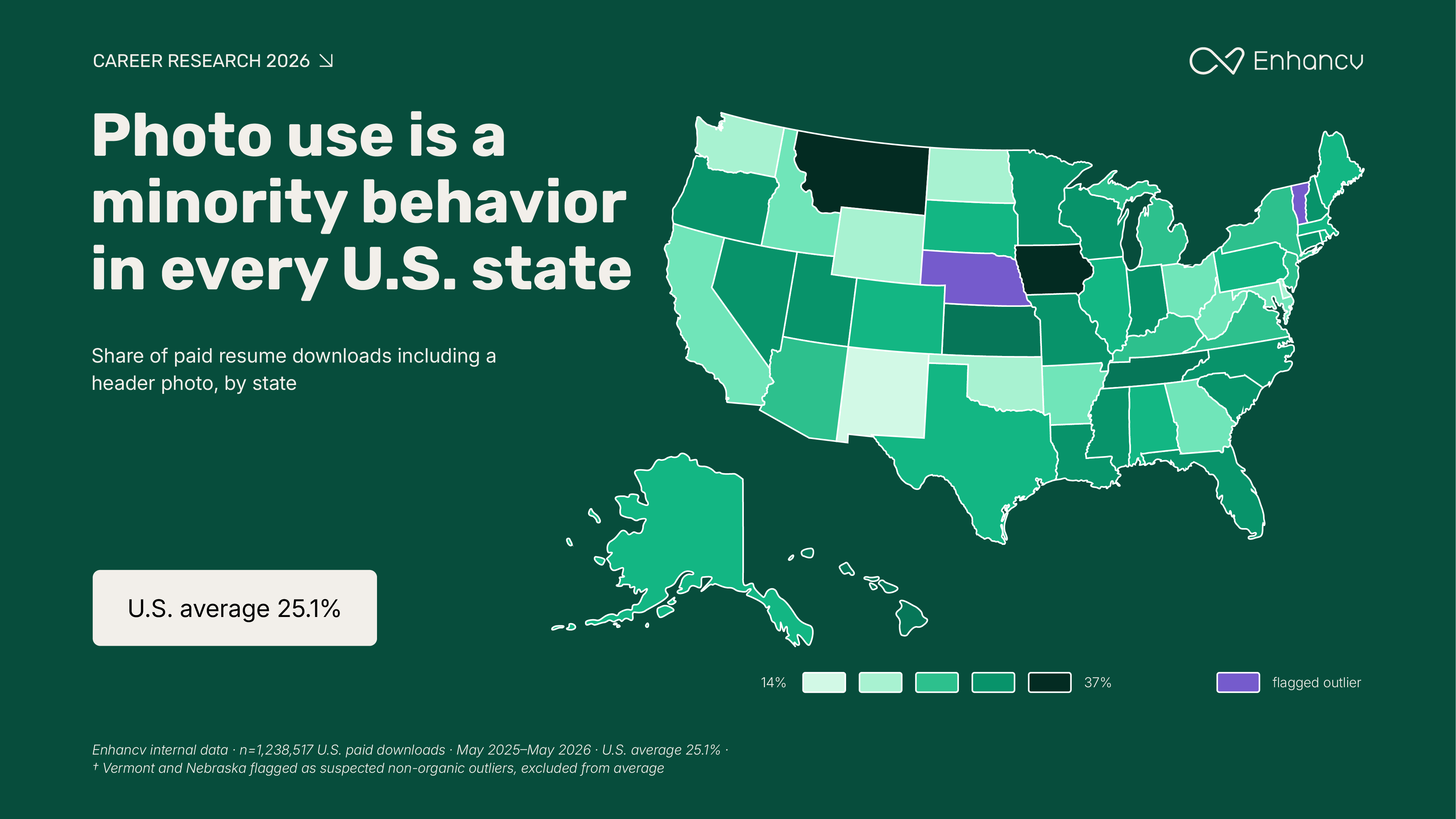
To see whether that held at a finer level, we broke the U.S. down by state. The answer is that it does—and more uniformly than you might expect. Across all 50 states, photo use clusters in a narrow band, roughly one resume in five to one in four, with no meaningful regional outliers.
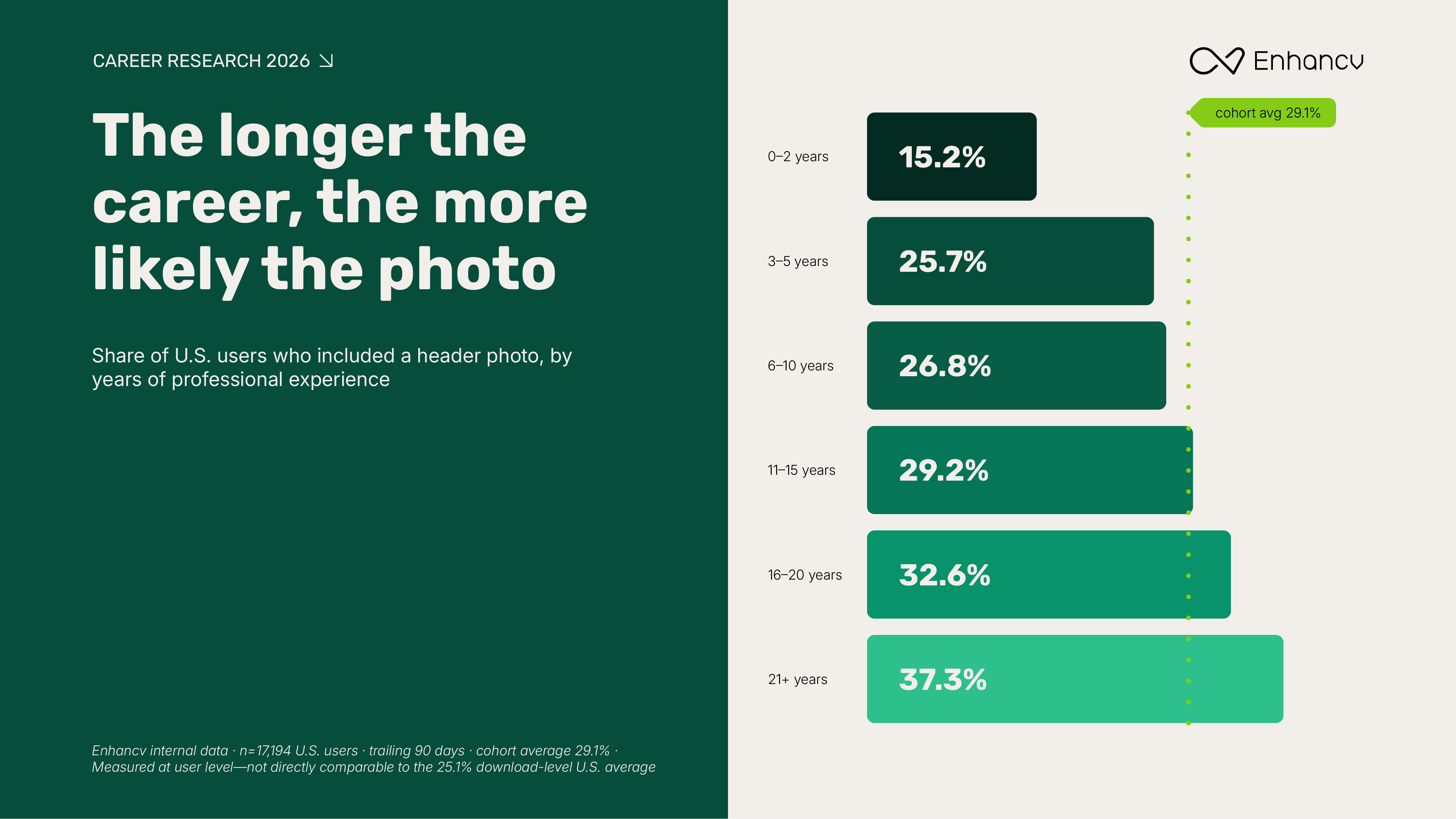
The same gradient appears when you look at individual careers rather than geography. Among U.S. users, photo use rises steadily with career length—from 15.2% among those with two years of experience or less, to 37.3% among those with 21 or more. Every band higher than the last, without exception.
The longer someone has been in the workforce, the more likely they are to put a face to the resume.
One more number worth flagging: among winners, photo users and non-photo users found jobs in a median of 30.9 days each. Photos didn't make the search faster—they correlated with ending up in the winning group at all.
Why this doesn't contradict 40 years of research
The audit-study literature on resume photos is real, documented, and worth taking seriously.
Bertrand and Mullainathan's foundational 2004 study found that identical resumes with stereotypically Black-sounding names received far fewer callbacks than those with white-sounding names. Photo-specific research followed: Rooth (2009) linked photo-revealed Middle Eastern ancestry to reduced callbacks in Sweden, and Booth and Leigh (2010) found similar patterns in Australia.
The synthesis that emerged: avoid photos in markets with anti-discrimination enforcement. Sound advice, at the population level.
That research measures the effect of visible identity on callback rates across a broad applicant pool—and the penalty is sharpest when a candidate's characteristics trigger statistical discrimination. That's not who Enhancv's data describes.
The average Enhancv paying customer is U.S.-based, senior, and professionally established—not the population the audit studies were built on. And that matters, because it's exactly the profile we flagged two years ago: senior professionals were already more likely to include a photo than anyone else.
Enhancv
In a comparatively homogeneous segment, what we're more likely to be measuring is something different: whether a polished photo signals preparation and self-presentation discipline in a context where photos are rare enough to stand out.
We're not overturning the research. We're measuring a different slice of the labor market, and finding that advice built for one population doesn't obviously transfer to another.
Who does this finding apply to?
The data points to a specific kind of job seeker: senior, U.S.-based, in a professional field where LinkedIn headshots are already normalized, applying for roles where a refined self-presentation reads as relevant rather than risky.
Industry adds another layer: client-facing fields like sales and marketing sit well above the U.S. average for photo use. Sales and business development leads at 31.0%, while HR sits lowest at 18.8%, followed by finance and tech at 20.1% and 21.1% respectively. The signal is stronger in roles where visible personal brand already plays a part.
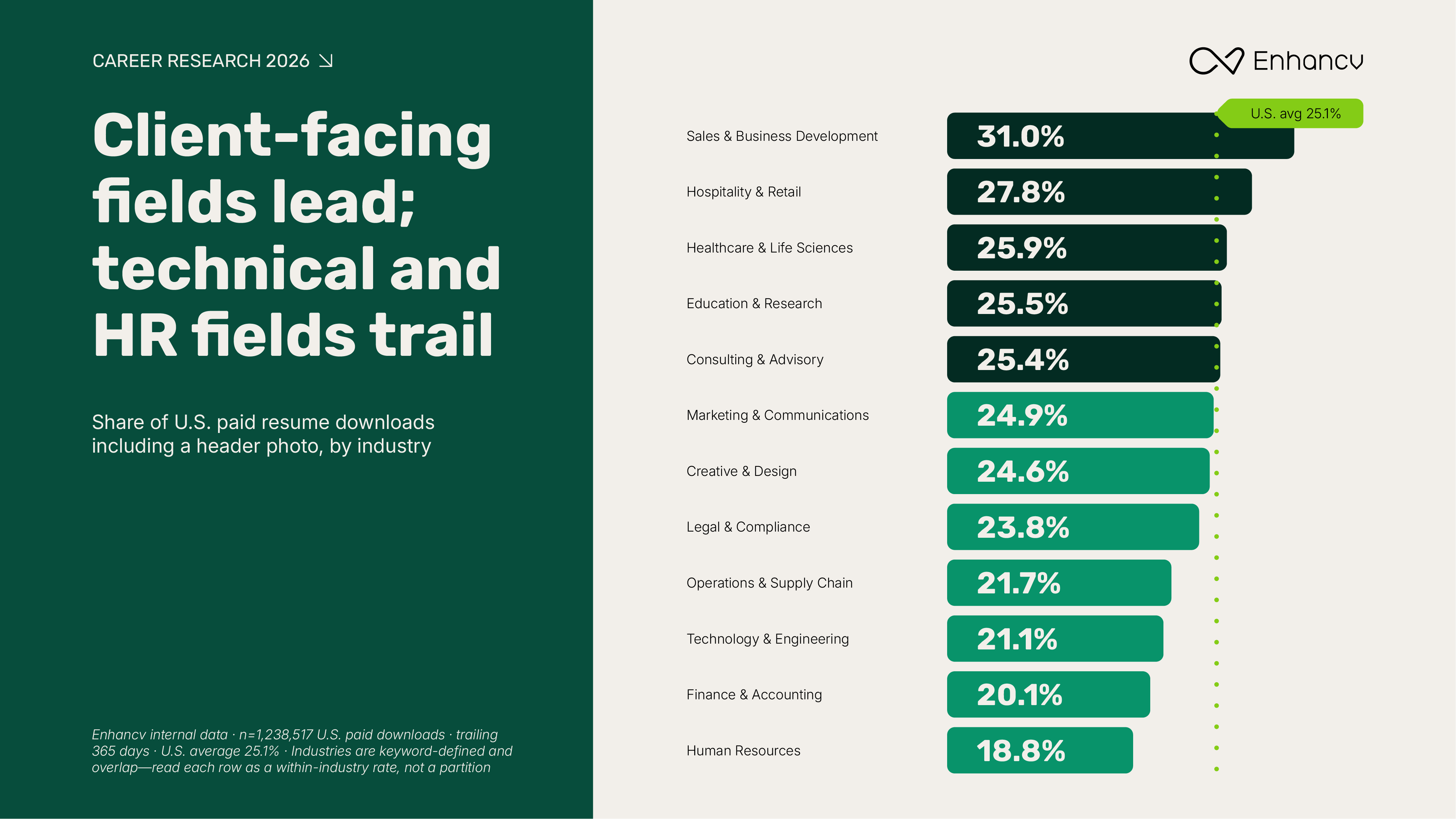
If that describes you, the blanket "no photo" rule has the weakest evidence behind it, and the people who ignored it found jobs at a meaningfully higher rate. That's a signal worth taking seriously.
It doesn't describe everyone reading this.
If you're earlier in your career, the calculus is less clear because the data is dominated by senior professionals. If you're applying across markets with different photo norms, the within-country analysis still applies, but country matters. And if your visible identity makes you subject to the discrimination effects documented in the audit literature—which are real, and ongoing—the conventional advice still holds, for reasons that go well beyond Enhancv's dataset.
The no-photo rule wasn't written for everyone. It's worth knowing which group you're in.
Conclusion
We're not declaring the resume photo debate settled. Observational data can't do that.
What it can do is add a data point the career advice industry has been missing: what actually happened, at scale, for a specific kind of job seeker. Not what they said they preferred, not what career coaches recommend, but what they did and when it counted.
For senior professionals in low-photo-norm markets, the evidence is at minimum inconclusive—and possibly pointing the other way.
Methodology
This analysis compares two populations drawn from Enhancv's customer base over a combined observation period.
Population 1 — paid downloads (n = 757,619): Resumes downloaded by paying Enhancv customers during a 90-day window. This is the baseline: a broad, unfiltered snapshot of what paying customers actually build.
Population 2 — winning resumes (n = 6,684): Resumes identified by customers who canceled their subscription and selected "found a job" as their reason for leaving. At cancellation, customers are prompted to indicate which resume version was active when they received their offer. No incentive was offered for this disclosure.
What we measured: The share of resumes in each population that included a header photo, broken down overall and by country.
Limitations worth noting:
- Both populations are drawn from paying customers only, which skews the sample toward more motivated, higher-investment job seekers.
- Country-level comparisons are within-country (paid downloads vs. winners from the same country), controlling for the effect of photo norms varying by market.
- The analysis is observational. Photo prevalence correlates with appearing in the winning population—causality cannot be established from this data.
- Time-to-hire (median 30.9 days for both photo and no-photo winners) was calculated from first paid billing date to cancellation date among customers who selected "found a job."
- The years-of-experience breakdown uses a 90-day trailing window and is measured at the user level on a separate cohort—it should not be compared directly to the 25.1% U.S. download average used in the industry and seniority cuts, which use a 365-day window. The experience cut is reported against its own cohort average of 29.1%.
Make one that's truly you.