


TL;DR
More than half of remote workers surveyed made at least one concrete career decision in the past 12 months to avoid an in-person professional situation—declining interviews, withdrawing from hiring processes, passing on promotions. 42.4% of active job-seekers apply a hard filter against any meaningful office presence. And 55.6% used AI to handle a communication task they say they would have managed independently before going remote.
Enhancv’s data shows, in specific behavioral terms, that a large share of the remote workforce has reorganized its professional life around avoiding in-person exposure. That reorganization is showing up in the jobs people apply for, the interviews they take, and the career moves they make.
Why we ran this study
The conversation about remote work and well-being has been dominated by two camps since the pandemic: those who see remote work as an unqualified gain for workers, and those warning it's slowly eroding the social fabric of professional life.
Neither camp has had much first-party data about what remote workers are actually doing differently—the concrete professional decisions they've made because in-person interaction now feels harder.
That's the gap this survey fills. Enhancv commissioned original research through Pollfish in June 2026, surveying 1,000 fully and predominantly remote U.S. workers. The questions were behavioral: not "Do you feel lonely?" but "Did you withdraw from a hiring process when you found out it was on-site?" Not "Are you anxious about in-person work?" but "Did you avoid applying for a promotion that involves managing people in person?"
The answers reveal a pattern of professional avoidance that goes well beyond preference.

Who we surveyed
Survey platform: Pollfish
Field dates: June 10, 2026
Sample size: n = 1,000
Country: United States
Screening criteria: Respondents qualified only if they worked fully remote (zero required in-office days) or predominantly remote (one required in-office day per week or less). Hybrid, fully in-person, and not currently employed respondents were screened out at Q1.
Weighting: Responses were stratified and weighted by Pollfish to correct for demographic imbalances in the panel. Stratified figures are included alongside raw counts throughout.
Margin of error: ±3.1 percentage points at the 95% confidence level for the full sample of 1,000.
Sample composition:
- Fully remote: 74.4% (n=744)
- Predominantly remote: 25.6% (n=256)
- Remote tenure: 5+ years, 48.3%; 3–4 years, 25.7%; 1–2 years, 20.4%; less than 1 year, 5.6%
The survey measures self-reported behavior and perception among people who already work remotely. It’s not a randomized controlled study comparing remote and in-person workers. Causal claims—that remote work caused the behaviors described—are NOT supported by this design. What the data shows is that a meaningful share of remote workers associate the behaviors described with discomfort around in-person interaction.
Remote work is shrinking the careers workers will consider
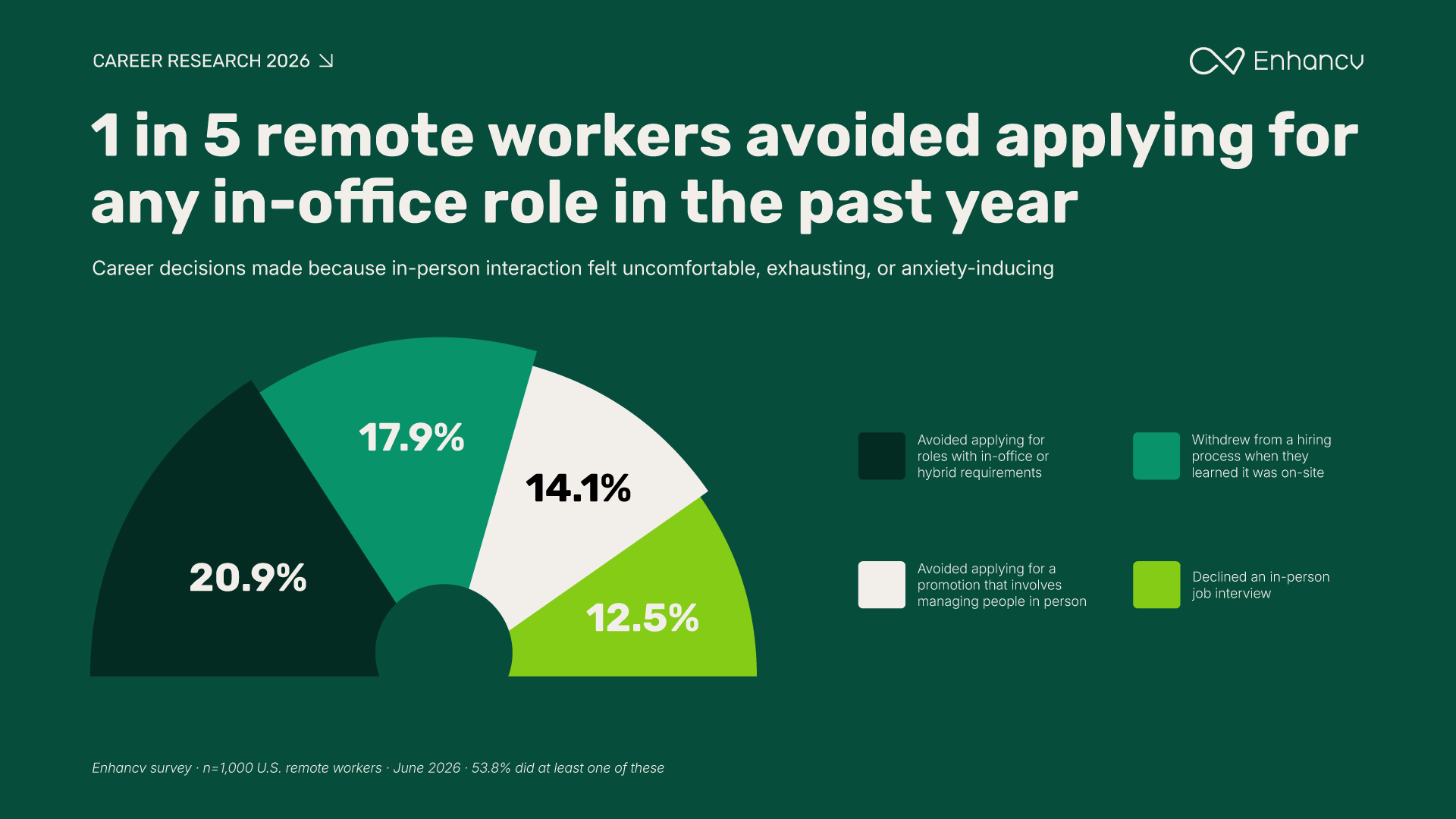
53.8% of respondents made at least one concrete career decision in the past 12 months to avoid an in-person professional situation. The most common was avoiding roles with any in-office or hybrid requirements—not a marginal inconvenience, but an active filter applied at the job-search stage.
Nearly one in five also withdrew from an active hiring process after learning it was on-site, meaning the avoidance is happening mid-application.
What larger research says
These behavioral findings land in a context where the social and psychological costs of extended remote work are increasingly well-documented.
The previously mentioned Science study of 588,322 U.S. workers found that remote work substantially increased time spent alone and worsened mental health—workers in remote-capable jobs spent an average of 1.1 additional waking hours alone each workday. When that's your baseline for years, a high-stakes in-person moment lands differently.
The avoidance behaviors in our data make more sense against that backdrop. When a worker's baseline of unscripted social contact drops significantly over several years, the cognitive and emotional load of a high-stakes in-person interaction—a job interview, a presentation, a networking event—is likely to feel heavier than it did before.
Remote workers are competing for a shrinking slice of available jobs
Among active job seekers in our sample, 42.4% apply a hard filter against any meaningful office presence. Another 25.7% would consider in-person only under the right conditions. Just 10.5% apply no location filter at all.
When asked how they approach job searching today:
- 23.0% filter out anything that isn't fully remote
- 19.4% filter out anything more than 1 office day per week
- 25.7% would consider in-person for the right role and pay
- 10.5% apply broadly regardless of location
- 21.4% are not currently job searching
The problem is supply. Fully remote roles represent just 12% of new U.S. job postings as of mid-2025, according to Robert Half data cited in The Interview Guys' State of Remote Work 2025 report, while demand remains far higher. A candidate filtering out most of the market on location grounds is, by definition, competing in the most crowded corner of it.
Remote work has become worth a pay cut
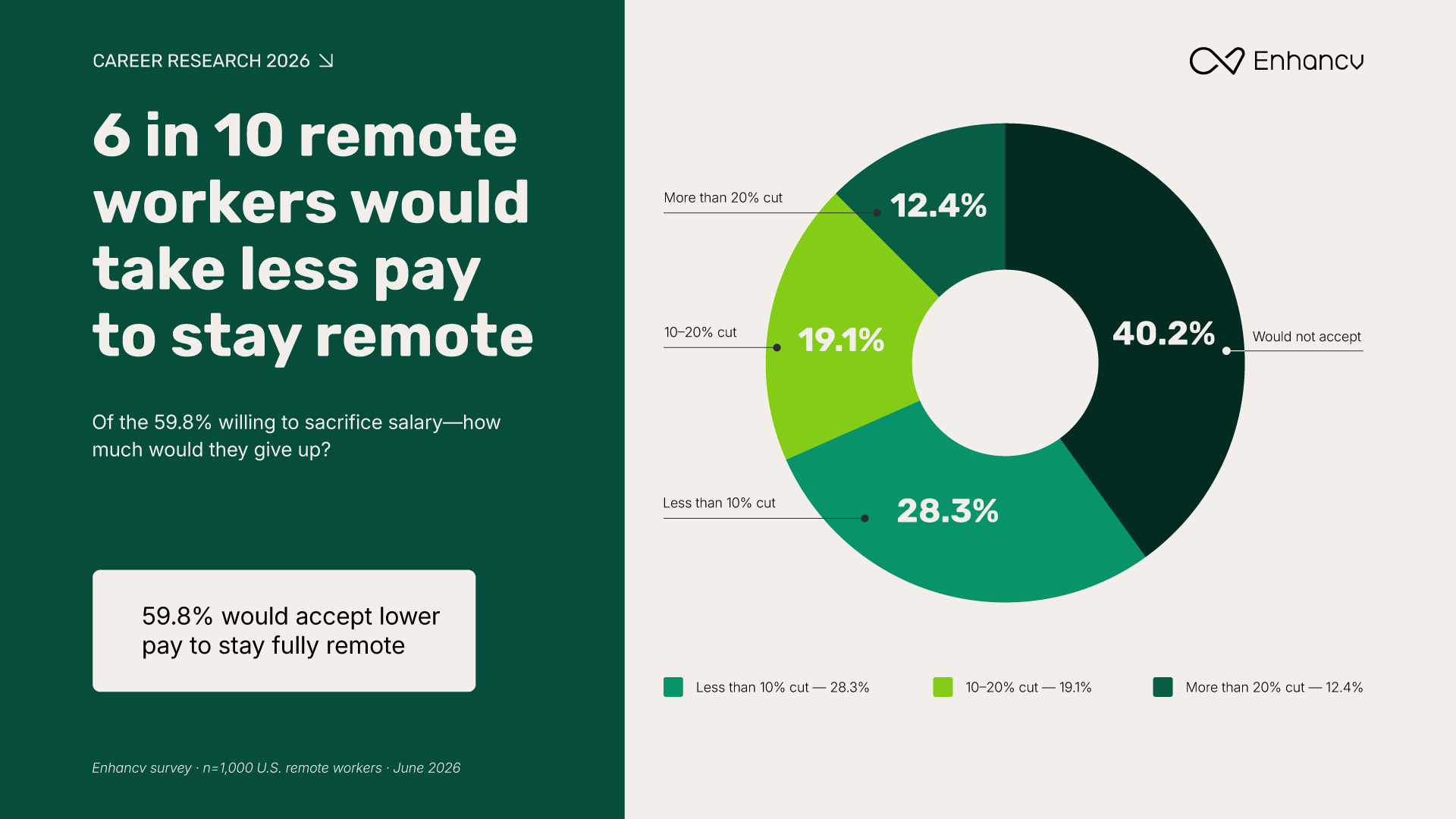
59.8% of respondents would trade salary for remote flexibility. Of that group, 12.4% would sacrifice more than 20% of their income—a figure too large to explain away with commute savings or cost-of-living arbitrage.
That framing matters for interpreting the filtering behaviors elsewhere in this data. Workers aren't avoiding in-office roles purely out of habit or convenience. For a substantial share of the sample, remote work is worth protecting at real financial cost, and the career decisions that protect it follow from that.
One in eight would quit before returning to the office full-time
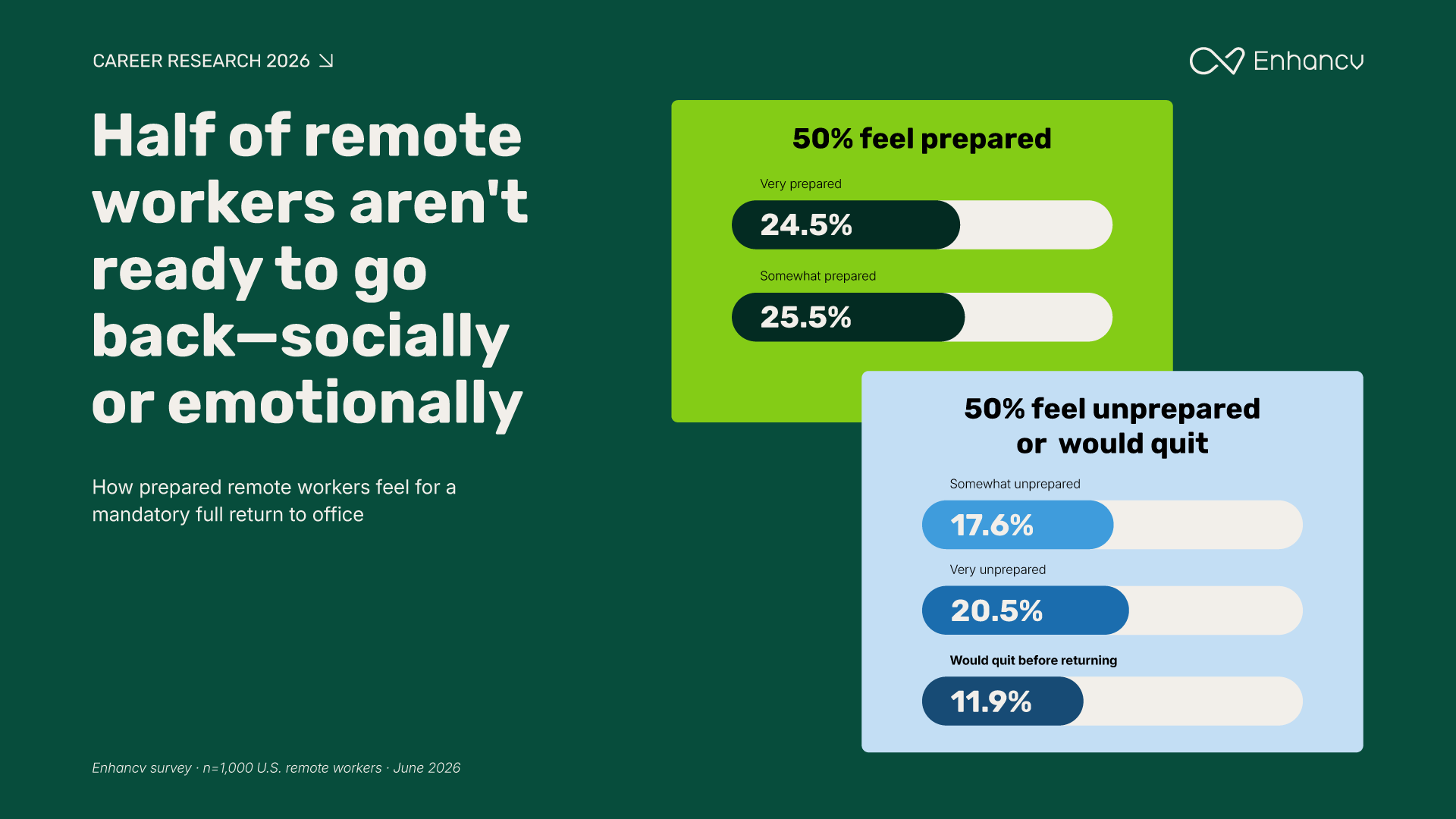
The split on this question is almost exactly even: 50% feel at least somewhat prepared for a full-time return to the office, and 50% feel unprepared or would quit outright. Let’s hear what the unprepared half had to say.
The question asked specifically about social and emotional readiness, not workload or logistics.
Respondents who said they were unprepared weren't necessarily saying they couldn't do the work in an office. They were saying they don't feel ready for the social and emotional weight of full-time in-person presence. That's a different admission. The 11.9% who said they'd quit before returning aren't expressing a preference but drawing a line.
For context: А UK study by King's College London tracking over one million responses found that the share of workers who would quit straight away rather than return to the office full-time doubled from 5% in early 2022 to 10% by mid-2024.Our 11.9% figure, drawn in June 2026, continues that trajectory.
Parental status cuts against expectation here. Parents of young kids filter their job search harder for remote roles (50.8% vs. 38.2% for childless workers) and tolerate the biggest pay cuts to keep it. Yet only 8% say they'd quit over a return-to-office mandate, against 14.8% of childless respondents. Remote work matters more to parents. Walking away from it is a harder call when a paycheck supports a household.
How much in-person contact are remote workers really getting?
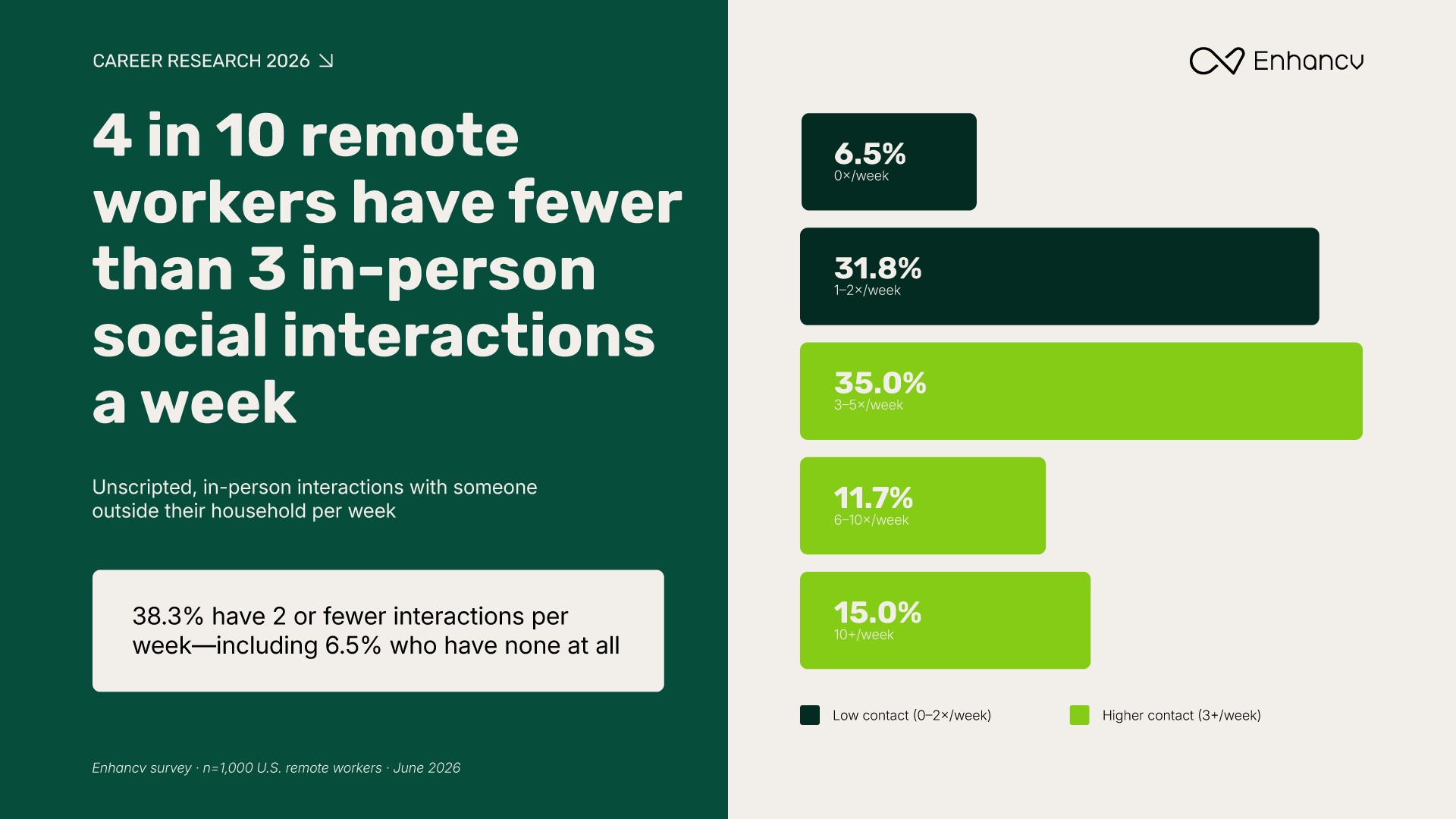
38.3% of respondents have two or fewer unscripted, in-person interactions per week with someone outside their household. 6.5% have none at all.
These aren't workers who are socially isolated in every dimension of their lives—but in terms of the low-stakes, spontaneous social contact that keeps professional social fluency practiced, the baseline is strikingly low for a large share of the sample.
Social fluency, like reading a room, managing small talk, or holding eye contact through an uncomfortable moment, is a skill that requires repetition. A worker averaging fewer than three brief, spontaneous interactions a week for several years is being asked to perform at full professional capacity in situations that draw on exactly those low-frequency skills.
Gallup's 2025 State of the Global Workplace report puts a number on the broader pattern: fully remote employees report daily loneliness at 27%, compared to 16% for fully on-site workers, across data from 183,000 business units in 90 countries.
A separate 2024 study using U.S. Census Bureau Household Pulse Survey data (n=87,317) found that people who work from home three to four days per week had significantly higher odds of loneliness than those not working remotely at all.
More than half have developed workarounds to avoid direct interaction
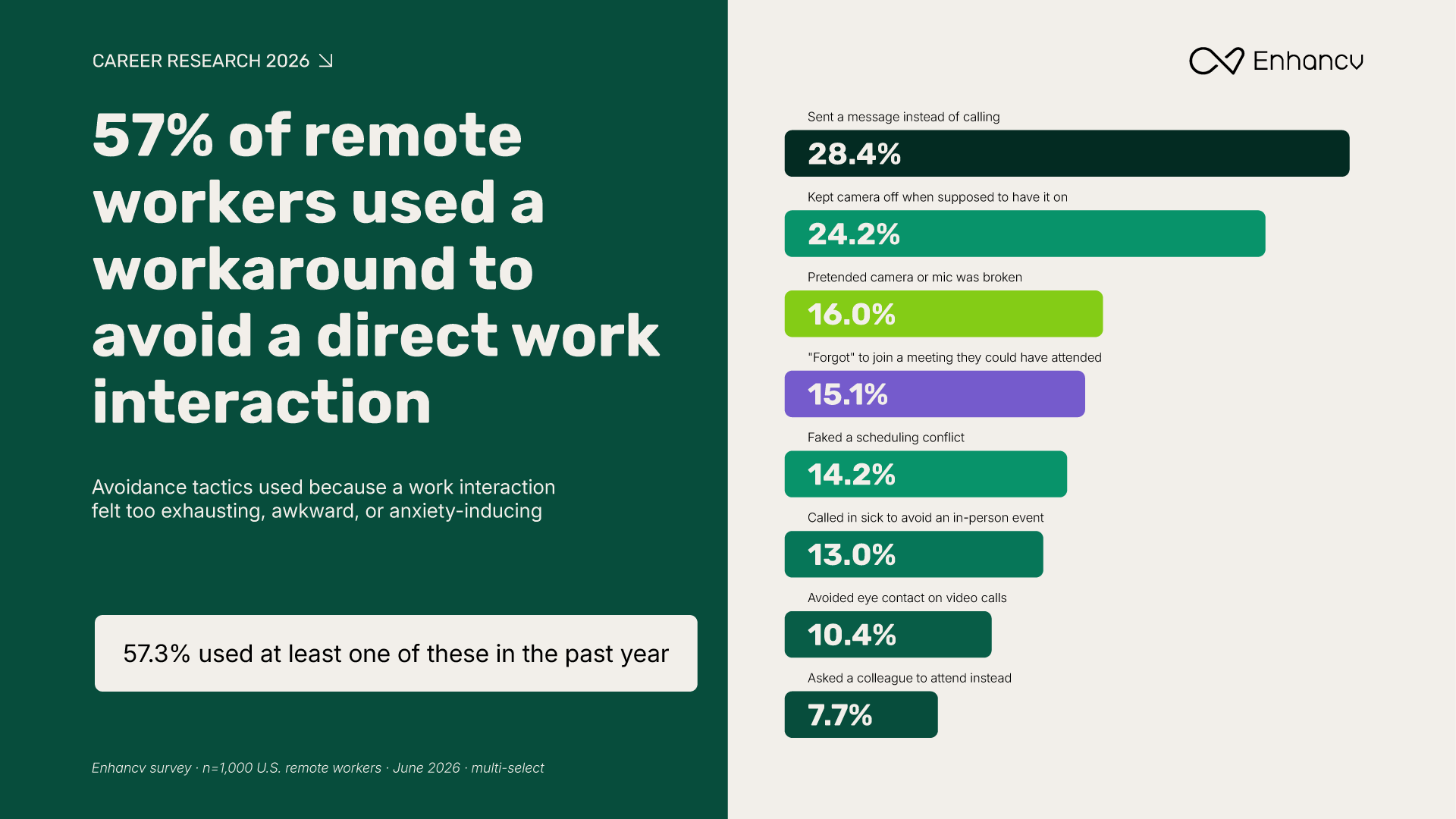
57.3% of respondents used at least one digital avoidance tactic in the past year—and the pattern of which tactics is as revealing as the number itself.
The most common is the most passive: defaulting to text when a call was clearly the right tool. That's not a productivity choice. For 28.4% of workers, it's a way to avoid the real-time exposure that even a brief phone call requires.
From there, the behaviors become harder to write off as coincidence.
Faking a broken camera. Manufacturing a scheduling conflict. Calling in sick to avoid an in-person event. These are the workarounds that require a small but deliberate act of deception. The fact that they cluster together in the same dataset suggests something consistent underneath them.
It's worth noting what many of these workarounds have in common: they're ways of buying time or avoiding the moment entirely. The effort of translating thought into spoken or written professional exchange shows up in a different form in the next finding.
Remote workers are using AI to fill a communication gap
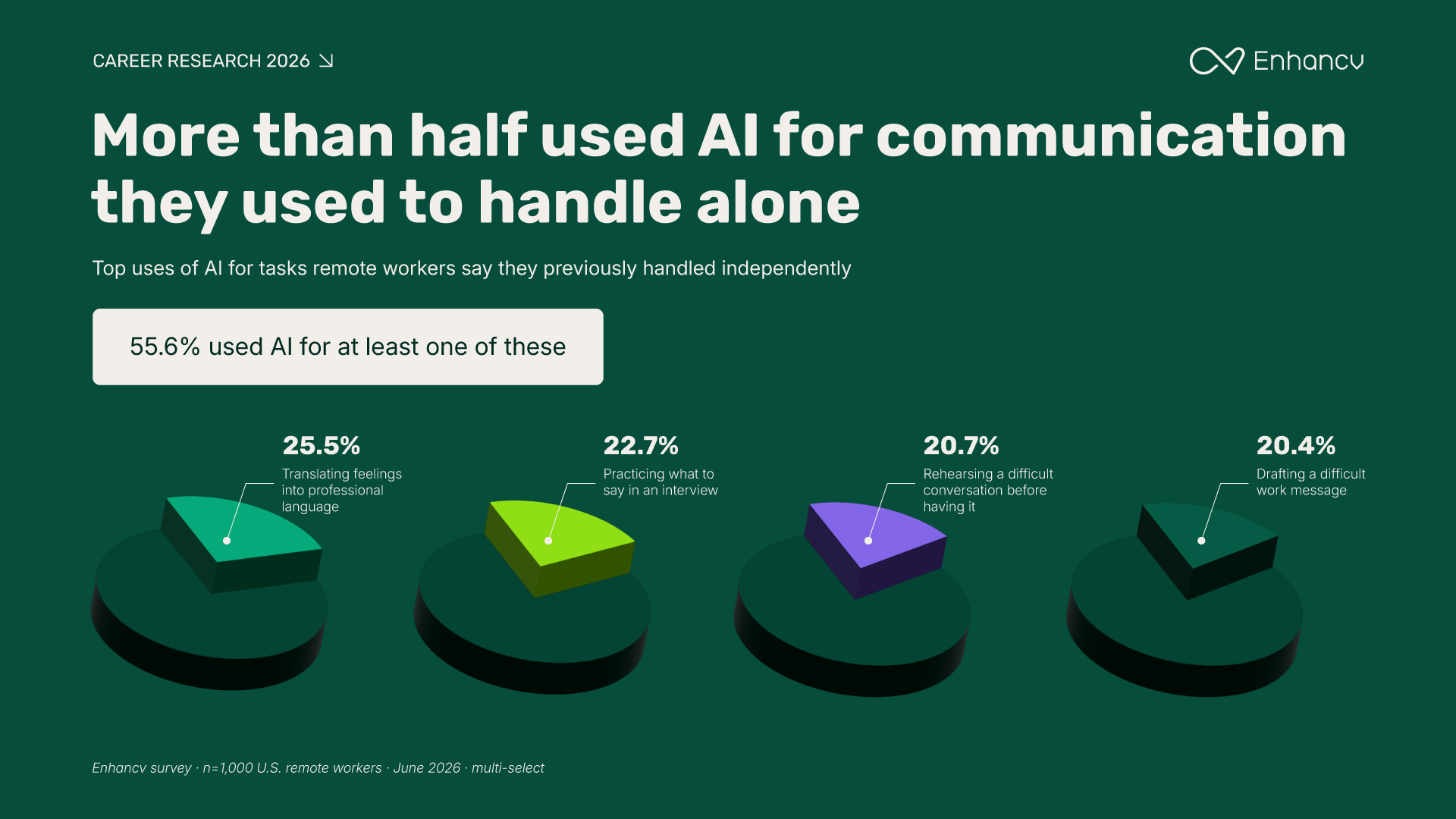
55.6% of respondents used AI to handle at least one communication task they say they would have managed independently before going remote. Surprisingly or not, the most common use is translating feelings into professional language—something that points to more than writing efficiency.
For a significant share of remote workers, professional communication has become a task that benefits from a draft, and that reliance skews younger. Respondents under 35 used AI for a communication task at nearly double the rate of those 50 and older: 73.5% versus 39.2%. The gap holds even when we compare workers with identical remote tenure. Age, not just experience with remote work, is driving the difference.
The job search implications are direct: 22.7% used AI to practice what to say in an interview, and 20.7% used it to rehearse difficult conversations. For workers who haven't sat for an in-person interview in years, AI rehearsal has become the primary preparation tool.
This isn't a criticism of AI use. It’s paying attention to how respondents framed it—not as a shortcut, but as a replacement for something they used to handle on their own. For job seekers specifically, that gap becomes most visible the moment remote work's adaptations run out: the in-person interview.
Four in ten haven't done an in-person interview since going remote
Among those who have done in-person interviews since going remote, performance is broadly stable. Just 6.9% say it goes worse.
When asked how in-person interviews compare to before they went remote, respondents said:
- 40.9% haven't done one at all since going remote
- 34.1% say the experience is about the same
- 18.1% say it goes better now
- 5.0% say it goes somewhat worse
- 1.9% say it goes significantly worse
The more revealing number is the 40.9% who haven't done one at all—for whatever reason. What we can say is that a significant share of the remote workforce has had limited recent exposure to in-person interviewing, whether by circumstance or by choice.
That matters because most jobs still carry some in-person weight at the hiring stage, even when the day-to-day role is remote. Senior positions, client-facing roles, and team leadership tend to involve in-person interviews—and that gap compounds the longer it goes unaddressed.
The bigger picture
Remote work didn't just change where people work. For a significant share of the workforce, it changed what feels possible. The behaviors in this data are the logical outcome of years spent in an environment that quietly removed the friction that professional confidence is built on. Small talk, eye contact, walking into a room full of strangers—none of it feels high-stakes until you haven't done it in a while.
The issue isn't that remote workers can't perform. It's that the career ladder still has rungs that require showing up in person, and a growing number of people have stopped reaching for them.

Methodology note
- Design: The survey was designed by the Enhancv content team and administered by Pollfish in June 2026. Pollfish uses a random device engagement (RDE) methodology that reaches respondents through mobile apps rather than traditional email panels. For methodology details, see Pollfish's research methodology documentation.
- Screening: Q1 was a hard screen. Respondents who selected "hybrid (2+ required in-office days per week)," "fully in-person," or "not currently employed" were disqualified. Only fully remote and predominantly remote workers continued to Q2–Q11.
- Multi-select questions: Q3, Q7, and Q8 were multi-select ("select all that apply"). Percentages for these questions are reported as a share of total respondents (n=1,000), not as a share of the answers given. A respondent selecting three options from Q3 counts as one respondent who engaged with the question, not three separate data points.
- Weighting: Pollfish applied stratification weights to correct for panel demographic imbalances. Both raw counts and stratified figures appear in the source data. This article uses stratified percentages where they differ materially from raw figures.
- Sample size and margin of error: n=1,000, with a margin of error of ±3.1 percentage points at the 95% confidence level. Most subgroup breakouts, including remote tenure and industry, carry wider margins of error and should be read as directional rather than precise. Two exceptions are reported in this piece: the parental-status split (n=364 parents of children under 18; n=521 with no children) and the age split on AI use (n=211 under 35; n=357 age 50+, confirmed within matched remote-tenure brackets). Both cleared conventional significance thresholds at these sample sizes.
- Limitations: This is a cross-sectional survey of self-selected remote workers. It cannot establish causation, cannot confirm that behaviors described are new (vs. pre-existing tendencies attributed to remote work in retrospect), and does not include a comparison group of in-person workers. All figures reflect self-reported behavior and perception as of June 2026.
About Enhancv
Enhancv is a global AI Resume Builder that helps job seekers create modern, ATS-friendly resumes and cover letters. The company combines career data, user insights, and expert guidance to make job applications more effective and human.
Make one that's truly you.