


Enhancv analyzed 65,838 U.S. resumes and surveyed 500 U.S. managers to separate leadership on paper from leadership in practice.
Most managers believe their title means what it says. When Enhancv surveyed 500 U.S. managers, 92% said their decision-making power fully or mostly matches their job title. Yet when we asked which decisions they can make without someone above them signing off, the picture changed quickly. Only 8% can hire, let people go, set a budget, approve spending over $10,000, approve raises, set strategy, and sign contracts on their own.
That distance between the title and the authority behind it shows up well beyond the survey. “Manager” is the most common seniority word on the 65,838 U.S. resumes we analyzed. It appears on 9,306 of them, in 7,236 different job titles, and only about one in five of those managers mention leading a team in their job description. Employers hand the word out freely, and much of the work it describes centers on projects, accounts, and results.
The titles at the very top have stayed scarce. Across all 65,838 resumes, only one in 13 (7.8%) carries an executive title, such as C-suite, Vice President, President, Managing Director, Partner, Founder, or Owner, and reaching the first one took a median of 10 years and three job changes. Leadership language has spread across the org chart, while the climb to a seat at the top still takes about a decade.
This report sets what people write on their resumes beside what managers say their titles let them do and checks both against public data from the Bureau of Labor Statistics (BLS) and executive search research.

Key takeaways
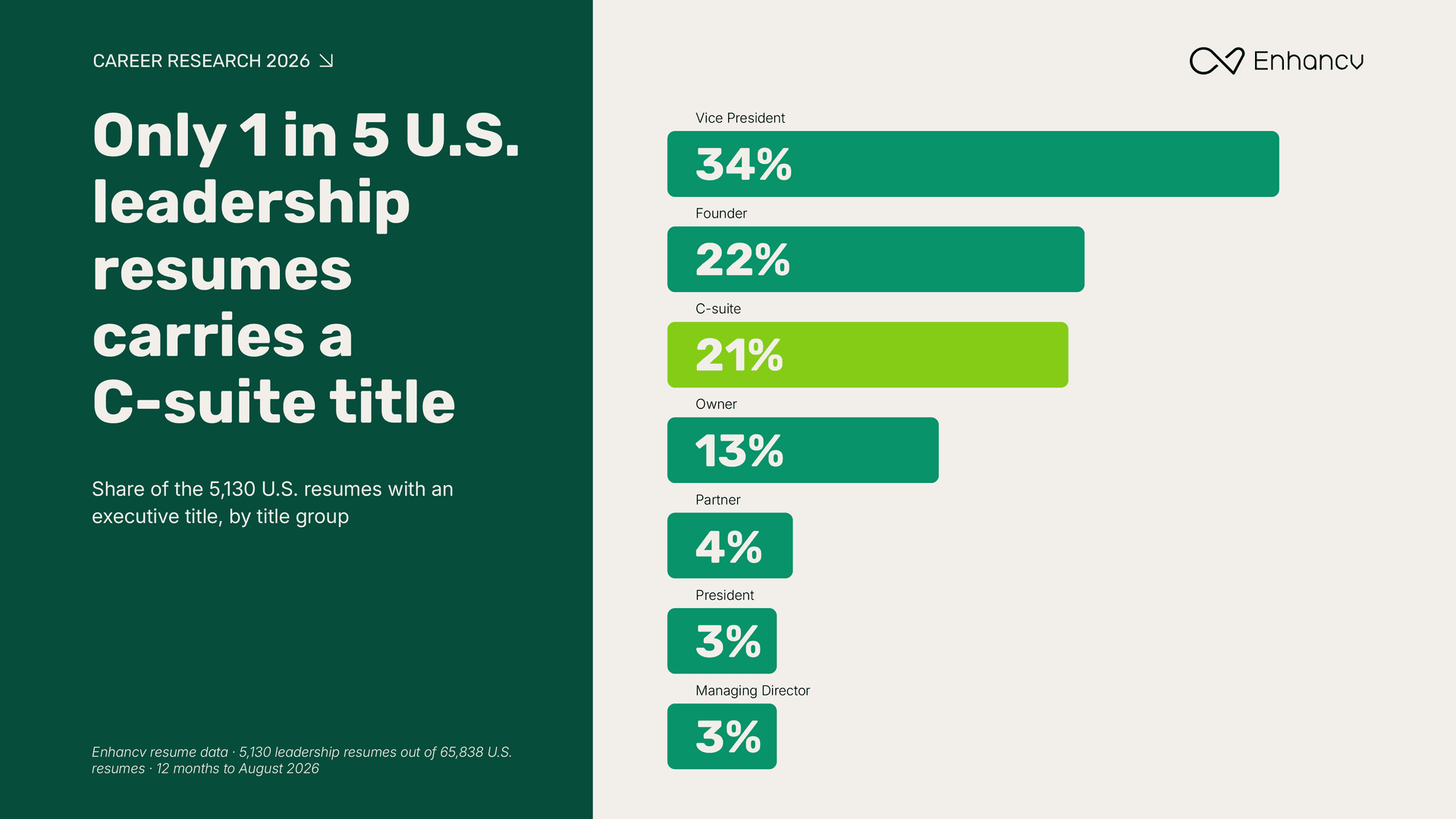
- Real leadership titles are rare. Only 1 in 13 of all 65,838 U.S. resumes we analyzed (5,130 resumes, or 7.8%) carries a leadership title. VPs make up 34% of that group, founders 22% and the C-suite 21%.
- The climb takes a decade. The median path from first job to first leadership title is 10 years and 3 job changes. The fastest 10% take 3 years or less, and the slowest 10% need 20 or more.
- Managers come first and come sooner. 71% of respondents said they got their first leadership title within 7 years of starting their career, which puts the executive title one more rung up the ladder.
- Titles often arrive before the power. Only 8% of managers can make all seven core decisions we tested on their own, and 51% waited a month or more after starting before they had full authority.
- The language changes on the way up. "Strategic Planning" is three times as common on leadership resumes, while Python appears half as often.
- An MBA opens doors, doesn’t speed up the clock. 14% of leaders hold an MBA, against 5% of everyone else, yet MBA holders reached the title no faster (11 years against 10).
Why we did this and what we compared
We wanted to know how long it really takes to reach a leadership title and whether that title carries the weight people assume it does. Public research tends to look at one end of the ladder. Government data counts how many people work in management jobs, and executive search firms such as Spencer Stuart track the CEOs of the largest listed companies.
Very little covers the path most professionals actually walk.
So we put two of our own sources side by side:
- What people write: 65,838 resumes from people in the United States, built on Enhancv over the 12 months to August 2026. They show the titles people hold, the order they held them in, and how long each step took.
- What people say: A Pollfish survey of 500 U.S. managers, fielded on September 24, 2026. It asked how they got their first leadership title, what that title lets them decide, and how long it took for the authority to arrive.
Resumes tell us the path, and the survey tells us what the title is worth once you have it. Where it helps, we set both against public benchmarks from the U.S. Bureau of Labor Statistics and executive search research. Each chart and figure in this article names the source it comes from.
Survey figures come with a margin of error in brackets, such as ±4.0 points: it means the true share among U.S. managers like those we surveyed is likely within that many percentage points of the number shown, at 95% confidence.
What counts as a leader here
In this article, a leader holds an executive title: someone in the C-suite, a Vice President, President, Managing Director, Partner, Founder, or Owner. Manager, Director, and "Head of" titles are steps toward that point, and we count them as the ladder rather than the top of it.
Who counts as a leader in this study
| Rung | Example titles | Where it appears in this article | Closest BLS category |
|---|---|---|---|
| Executive leadership | CEO, CFO, COO, CTO, President, VP, Managing Director, Partner, Founder, Owner | Resume data: "leaders" | Chief executives; VPs fall under several management categories |
| Senior management | Director, Head of, Executive Director | Resume data: the step before the title | Functional managers, such as sales, finance, or operations managers |
| Management | Manager, Supervisor, Team Lead | Survey: "managers" | General and operations managers and first-line supervisors |
We draw the line here for two reasons. A "Director" at a 20-person agency and one at a Fortune 500 company do very different jobs, so the title alone isn’t an accurate measure. Executive titles also come with clearer responsibility for a whole business or function.
Founders and owners count because they hold the top job in their company, even when the company is small. The C-suite is one part of that group, at 21% of the U.S. leadership resumes we analyzed.
A real leadership title is rare
Only 5,130 of 65,838 U.S. resumes (7.8%) carry an executive leadership title, about one in 13. The other 60,708 people, 92.2%, may manage projects, accounts, or teams, but they don’t hold executive titles.
Government data shows a similarly steep pyramid. The U.S. had 291,600 chief executives in 2025, against 3.6 million general and operations managers, according to the BLS. That works out to about 12 general and operations managers for every chief executive.
The 7.8% describes Enhancv users, and Enhancv is built for experienced professionals, so it should not be read as the share of executives in the whole U.S. workforce.
The 10-year clock
On the resumes we analyzed, the typical climb from first job to first leadership title takes 10 years and three job changes. Counted from the year people finished their studies instead of their first job, the median climb is nine years.
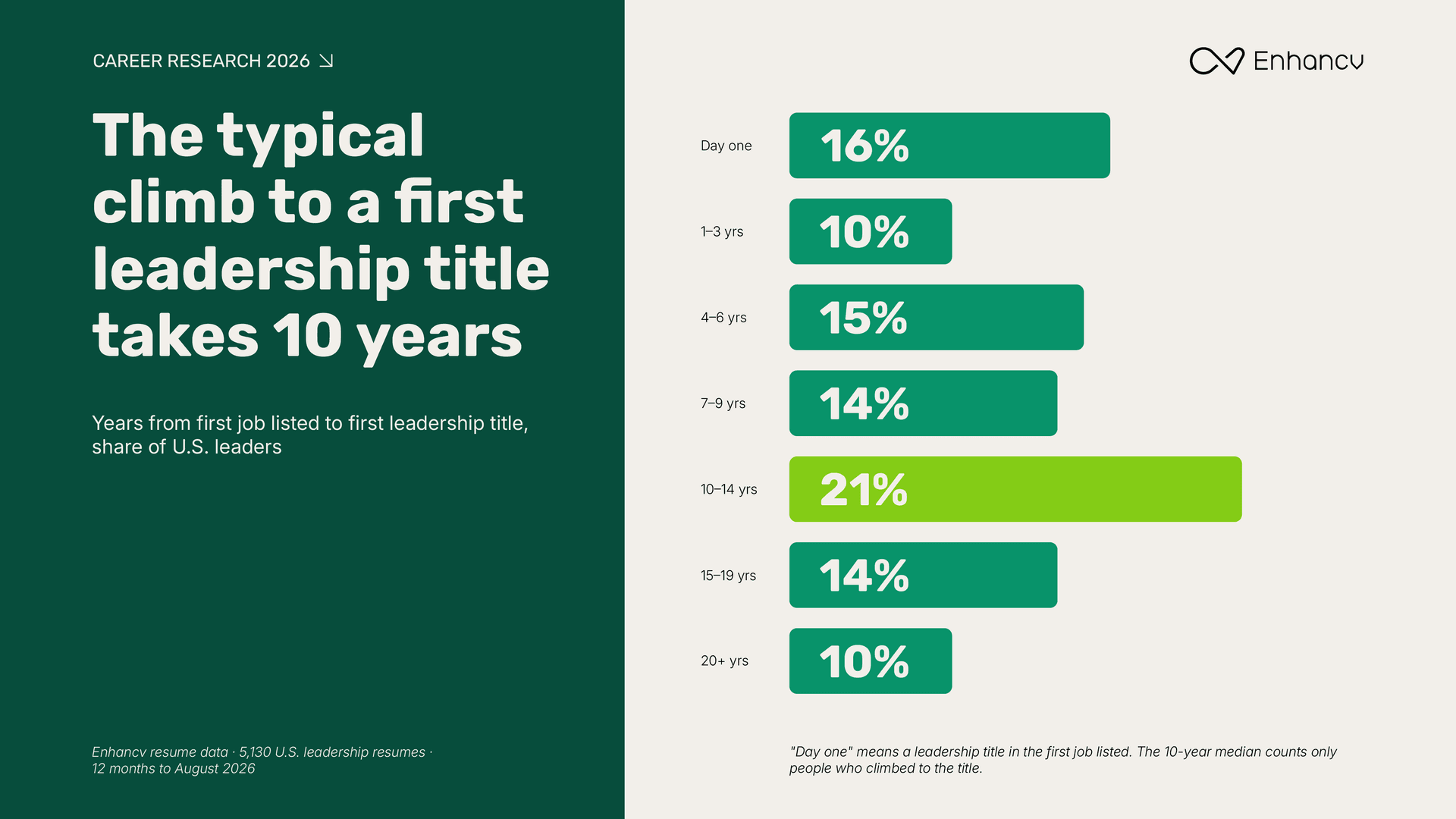
The spread is wide. The fastest 10% of climbers reached the title in three years or less, while the slowest 10% needed 20 or more. Leaving out everyone who got there within two years of their first job, the median rises to 11 years, and the middle half of those 3,702 careers took 7 to 15 years.
The manager rung comes sooner
Our survey asked managers when they got their first leadership title, as each of them defines it. 71% said within 7 years (±4.0 points), and 41% within 4 (±4.3 points).
Those answers sit one step below our resume definition, so together the two sources describe a ladder: roughly five to seven years to manage people, and about ten to reach an executive title.
There’s a difference between tenure and experience. The people I've seen progress quickly don't necessarily wait until somebody decides they're ready. They start accumulating scope before they accumulate titles.
Andrew May, Founder & Executive Coach at Parallel Perspective
The top of the pyramid takes far longer
In 2025, new CEOs of S&P 1500 companies were 54.4 years old on average, and 84% were first-time CEOs, according to Spencer Stuart. Our resumes track the first step into the executive suite, most often a VP or founder title. Becoming CEO of a large listed company is a much later step on the same ladder.
People at that level are also likely to be underrepresented in any resume data, ours included, since top roles are more often filled through board searches, executive recruiters, and referrals than through applications. A sitting CEO also likely needs a new resume far less often than someone still working toward the role.
Three job changes is a modest number
People born between 1957 and 1964 held an average of 12.7 jobs between ages 18 and 56, and nearly half of those jobs came before age 25, according to the BLS National Longitudinal Survey of Youth. Resumes usually leave out early jobs, which is one reason our count is lower.
Stay to manage, leave to lead
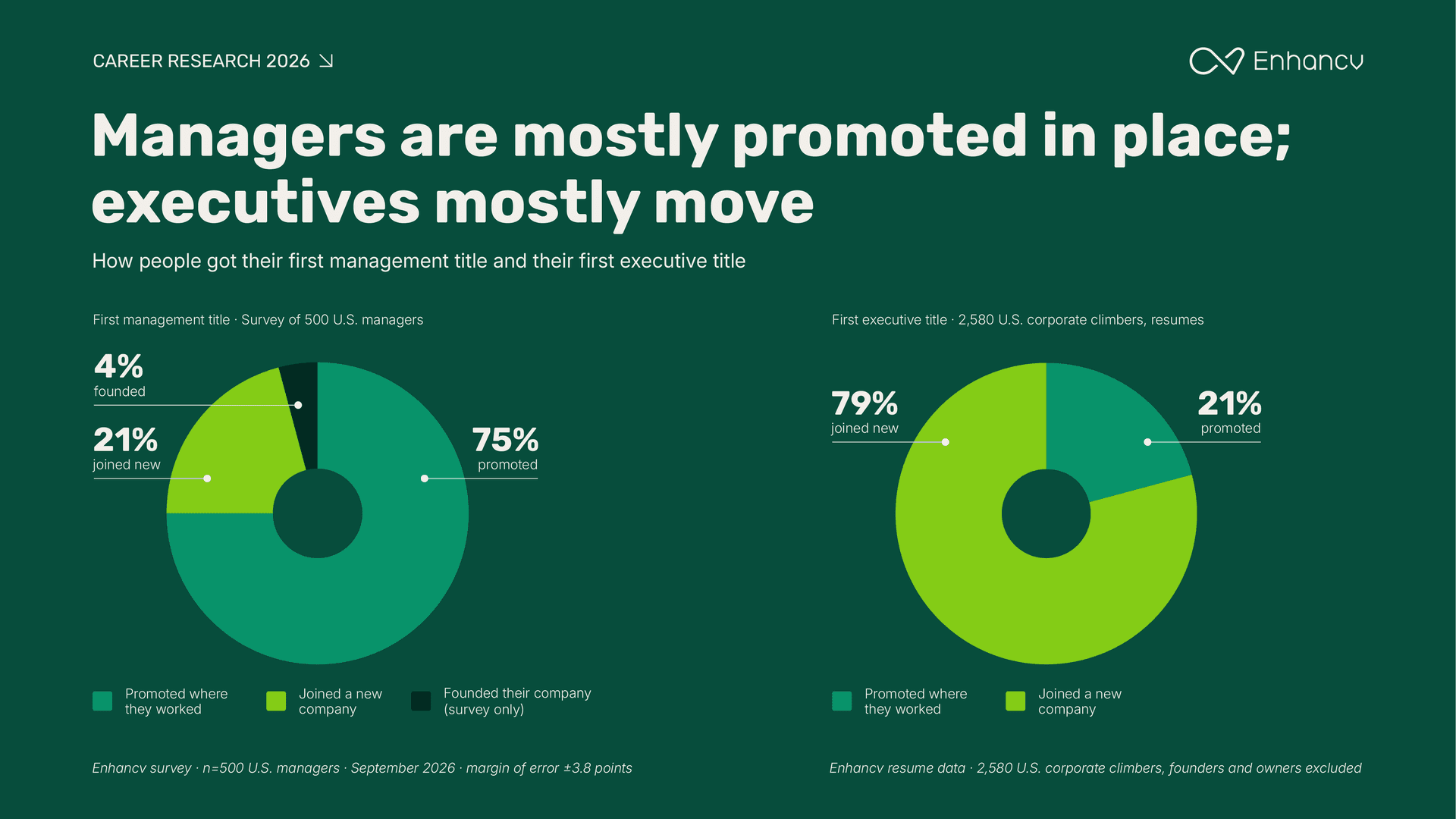
Our two sources point in opposite directions on how people get their first big title. Most managers were promoted where they already worked, while most executives on our resumes changed companies to get the title.
In our survey, 75% of managers (±3.8 points) got their first leadership title, as they define it, at a company where they already worked. On their resumes, only 21% of 2,580 corporate climbers took their first executive title at the same employer, and 79% moved.
Why the two numbers differ:
- Different rungs: A first management title is usually a step inside an existing team, so employers can give it to someone they already know. Executive roles are rarer, often a single seat, so a candidate may need to change employers to find one.
- Different measurement: The survey asks people directly. On a resume, we count a promotion as internal only when both jobs name the same employer, so a company written twice reads as a move. The resume figure of 21% promoted internally should be viewed as a minimum, with the true number likely being higher.
Neither source is large enough to settle the question alone, so we report both. Read together, they suggest that people tend to earn their first management title where they already work, and more often change companies to step into the executive suite.
Organizations can become strangely attached to the version of an employee they originally hired… That is one reason job changes can accelerate advancement. It isn’t necessarily job-hopping. Sometimes, it’s career correction.
Tara Furiani, CEO & Creator of Not the HR Lady and SAIL for Leaders & Teams
Waiting for a promotion also took longer
People promoted from within reached their first executive title after a median of 12 years, two years later than those who changed companies (10 years). Before that promotion, they had typically spent about five years at the same company.
That’s a normal stay for managers: people in U.S. management jobs have been with their current employer for a median of 6.1 years, against 4.1 years for all workers, according to the BLS. These numbers show who got there faster, not that switching jobs leads to faster career growth.
The largest companies lean the other way at the very top. According to Spencer Stuart, 73% of new S&P 500 CEOs in 2025 were insiders, and 60% across the S&P 1500. The BLS also notes that "many top executives advance within their own organizations."
Company size is one likely reason for the difference: the largest employers have deep benches to promote from, while at a smaller firm the next title up may simply not exist.
Moving has a cost once you arrive
Managers hired from another company were about twice as likely to wait six months or more for full authority in their current role: 23.9% of 109 external hires, against 11.7% of 332 internal promotions.
The gap is statistically significant at 95% confidence (a difference of 12.2 points, ±8.7). That matches research by Wharton's Matthew Bidwell, who found external hires were paid 18% to 20% more than internal promotees in similar jobs but received lower performance ratings for their first two years.
Their eagerness to step into the role and take on a challenge leaves their team behind in understanding goals and alignment. They need to slow down to be able to move fast.
Janice Perkins, CEO & Founder at Capacity Communication
Is the title real?
Title inflation shows up on both sides of our research.
On resumes, "manager" is the most common seniority word: 9,306 U.S. resumes use it (14% of all the resumes we analyzed), in 7,236 different job titles built around it—from Project Manager to Customer Success Manager. Most of these titles sit below our executive line, so the managers here are a separate group from the 1 in 13 who hold a leadership title.
Yet when these managers describe their current job, only about 21% mention managing people or a team. Directors (22%) and VPs (20%) land in the same range, while supervisors (32%) mention it most.
The survey shows the same gap from the inside. 92% of managers (±2.3 points) said their decision-making power fully or mostly matches their title, yet most can't make the core people and money decisions without someone above them signing off.
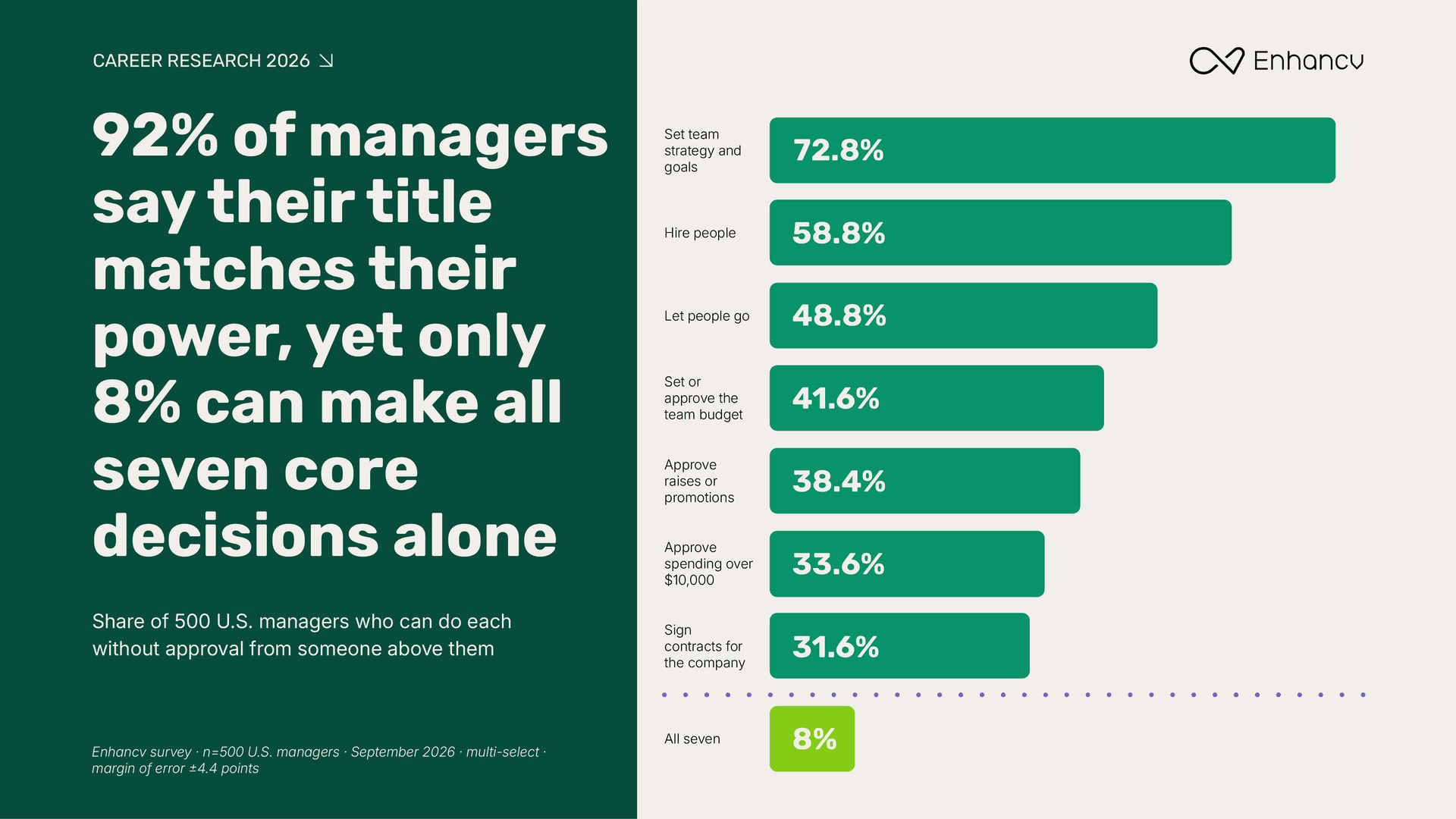
Only 8% can do all seven (±2.4 points), and 37% can make no more than two of the seven on their own (±4.2 points). Even among managers who say their title matches their power, 40% can't hire and 50% can't let anyone go without sign-off.
Interestingly, managers also tend to see hollow titles around them rather than in their own job. 74% (±3.8 points) say leadership titles without real power are common in their industry. Yet, 67% of all respondents said that their own title matches their actual authority, even while insisting that ‘hollow’ titles are common in their industry.
A senior title without real decision-making power often reveals itself in the verbs. Are you actually deciding, setting direction, allocating resources? Or are you mainly recommending, coordinating, and escalating decisions to someone else?
Joel B. Feldman, Founder & Principal Coach, Look Newly
The authority also arrives late. Only 31% (±4.1 points) had full authority as soon as they accepted their current role, and 51% (±4.4 points) waited a month or more. The most common delays were learning the business (29%), building trust with the team (27%), and a probation period (22%).
41% (±4.3 points) had no structured transition plan.
The Director door and the change in language
Director is the most common title just before Executive. 31% of U.S. climbers held a Director title in the job right before their first leadership title, 20% held a Manager title, and 34% stepped up from a title with no seniority word at all, such as a senior engineer or an account executive. They spent a median of three years in that last job.
The most common titles at that step were Director of Operations, General Manager, Director of Sales, Project Manager, Operations Manager, and Director of Finance. The first executive title itself was most often a VP role (38%), followed by founder (23%), C-suite (15%), and owner (14%).
The biggest gap I hear from executives is the ability to think strategically—how to see beyond your own function, understand the broader system, and communicate a clear recommendation.
Sarah Noll Wilson, President & Founder at The Noll Wilson Group
The vocabulary changes along the way. Leadership resumes list strategy and commercial skills far more often, and coding tools about half as often. The terms that separate leaders most sharply are about money and scale: Go-to-Market Strategy, Strategic Partnerships, P&L Management, and Digital Transformation each appear about six times as often on leadership resumes.
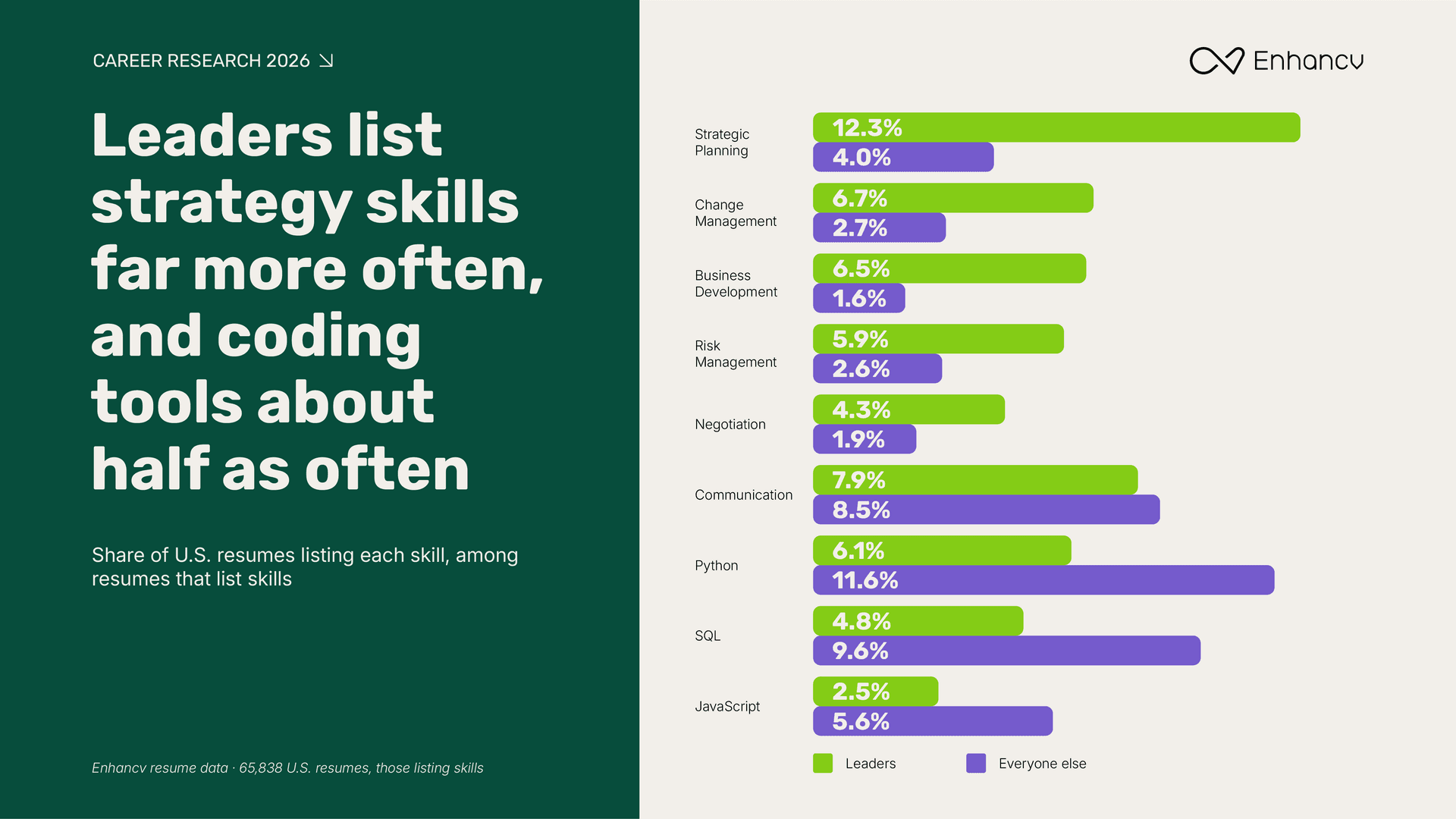
The pattern holds inside each field. Tech leaders list Python at about half the rate of engineering and data staff (22% against 43%) and Strategic Planning far more often (10% against 1%).
Managers in our survey described the same shift in their own words. When going for their first leadership role, 42% emphasized people leadership and 33% strategic thinking, against 18% who led with technical expertise (each ±4.4 points or less).
The MBA opens doors, not the clock
According to Enhancv’s data, 14% of U.S. leaders hold an MBA, against 5% of everyone else. The degree usually comes well before the title: when an MBA appears on a leader's resume, it was finished before the first leadership title 82% of the time. Among corporate climbers who list the year, the median gap between the MBA and the title is eight years.
The degree doesn't shorten the climb. MBA holders reached their first leadership title in a median of 11 years, a year more than leaders whose highest degree is a bachelor's (10 years). Leaders are also more likely to hold any business or management degree (34% against 21%), while certifications don't separate the groups at all: 31% of leaders list one, and so do 31% of everyone else.
Managers in our survey value their credentials, though few credit them with the promotion. 65% (±4.2 points) called their degree and credentials essential or very important in getting their current role, yet only 6% (±2.1 points) named education the single biggest factor in reaching leadership. 62% (±4.3 points) pointed to performance and results.
Founders and corporate leaders take different routes
Founders and owners hold 35% of the leadership titles in our U.S. data, and they reach the top sooner. Those who worked for someone else first founded or bought their company after a median of eight years, against 11 years for corporate climbers.
Founders vs. corporate leaders: how their paths compare
| U.S. leaders in our data | Founders and owners | Corporate leaders |
|---|---|---|
| Number of resumes in the group | 1,779 | 3,351 |
| Held a leadership title from their first job | 19% | 14% |
| Median climb to leadership title* | 8 years | 11 years |
| Median career length on the resume | 15 years | 19 years |
| Hold an MBA | 7% | 18% |
*Counts only people who worked in a non-leadership job first. Source: Enhancv resume data, 5,130 U.S. leadership resumes.
Their resumes read differently too. Strategic Planning is the top skill for corporate leaders (15%), while founders list hands-on tools such as JavaScript and Canva far more often.
Where leaders start
People who started in marketing reached a leadership title fastest, in a median of nine years, against 10 for sales and finance and 11 for engineering. By starting industry, tech was quickest at eight years, ahead of media and marketing and finance (10 each).
Leadership by state: share of resumes, founders, and climb time in the four largest states
| State | Leadership share of resumes | Founders among leaders | Corporate climb, median |
|---|---|---|---|
| New York | 9.0% | 30% | 9 years |
| Florida | 8.5% | 35% | 11 years |
| California | 7.0% | 40% | 10 years |
| Texas | 6.2% | 33% | 10 years |
New York has both the highest share of leadership resumes and the fastest corporate climb. California has the highest share of founders among its leaders, at 40%. Only these four states have enough corporate climbers to compare. For the U.S. as a whole, the median corporate climb is 11 years.
Methodology
We analyzed 65,838 finished resumes from people in the United States, created on Enhancv in the 12 months to August 2026, one per person. A resume counts as U.S. when its location names a U.S. state, a U.S. ZIP code, or the United States. We left out 9,974 resumes whose full career history matched at least two others word for word, since those read as downloaded examples rather than real careers.
A resume counts as leadership when its current title is C-suite, Vice President, President, Managing Director, Partner, Founder, or Owner. Time to leadership runs from the first job listed to the first leadership title. "Promoted where they already worked" means the job before the leadership title and the leadership job name the same employer. Mentions of managing people come from what people wrote about their own jobs, so those shares are a floor.
Survey
Enhancv surveyed 500 U.S. adults whose Pollfish profile job title is manager, on September 24, 2026. 97% have at least one direct report. The question about their first leadership title mentioned “Director level or above” but offered no “not yet” option, so all 500 answered about the first title they themselves consider leadership. We therefore treat the survey as describing the management rung of the ladder, and the resumes as describing the executive rung.
Percentages are unweighted; Pollfish's weighted figures differ by about 2 points or less on every headline number.
The margin of error is ±4.4 percentage points at 95% confidence for the full sample, and smaller for figures far from 50% (for example, ±2.4 points on the 8% who can make all seven decisions).
Because Pollfish is an opt-in online panel, these margins assume a random sample and should be read as a guide. Comparisons between subgroups, such as external hires against internal promotions, are reported only where the difference is statistically significant at 95% confidence.
Limits
The resume sample is large, so random error on its percentages is small (about ±0.2 points on the 7.8% leadership share), but it describes Enhancv users rather than a random sample of U.S. workers. Resumes are self-written and not independently verified, and careers with early jobs left off will look shorter.
Both sources describe who reached leadership and how; neither shows what causes a faster climb. Survey and resume figures are reported separately and describe different rungs of the ladder.
About Enhancv
Enhancv is a global AI Resume Builder with career tools that helps job seekers create modern, recruiter-approved resumes and cover letters. The company combines career data, user insights, and expert guidance to make job applications more effective and human.
Make one that's truly you.