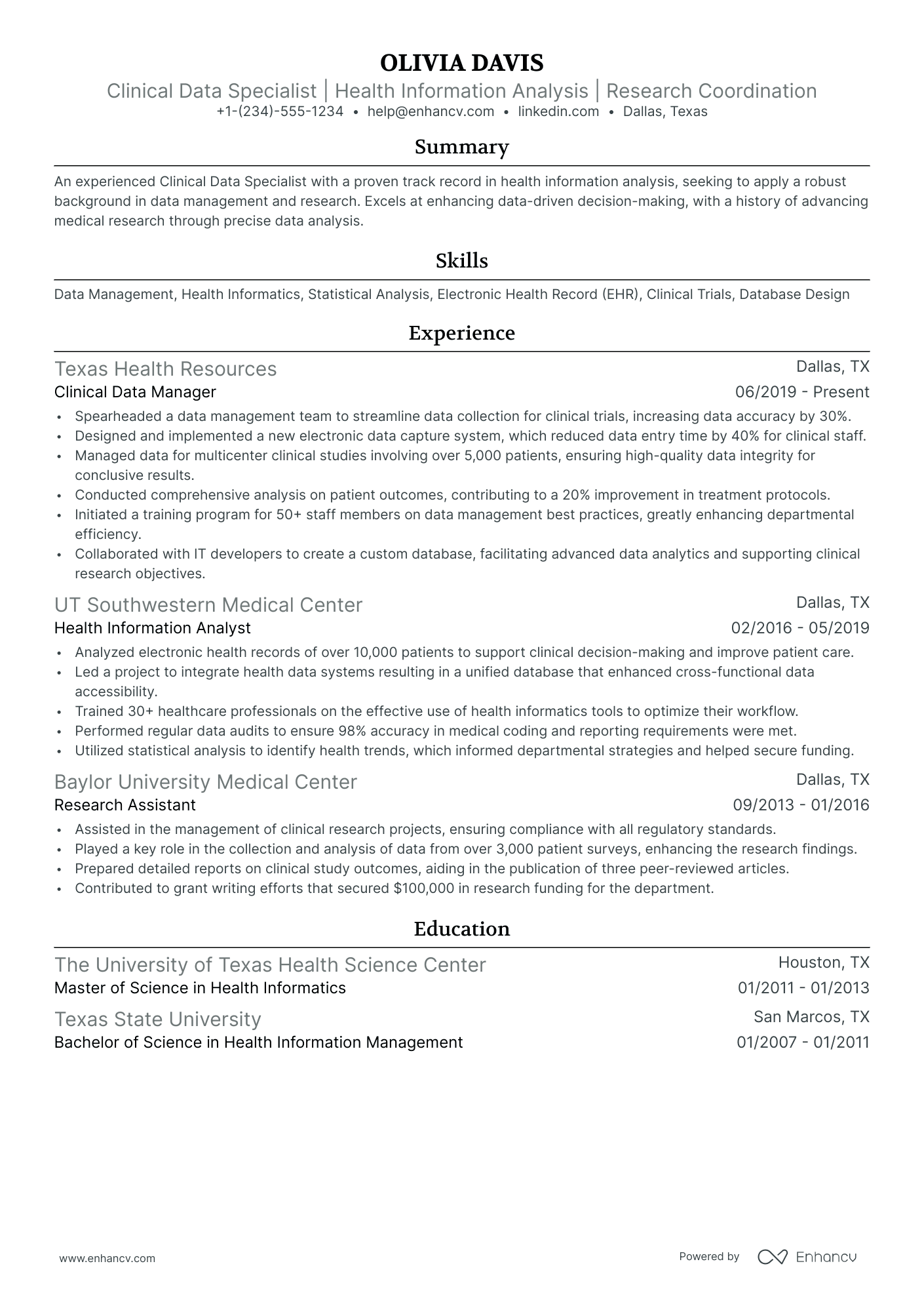
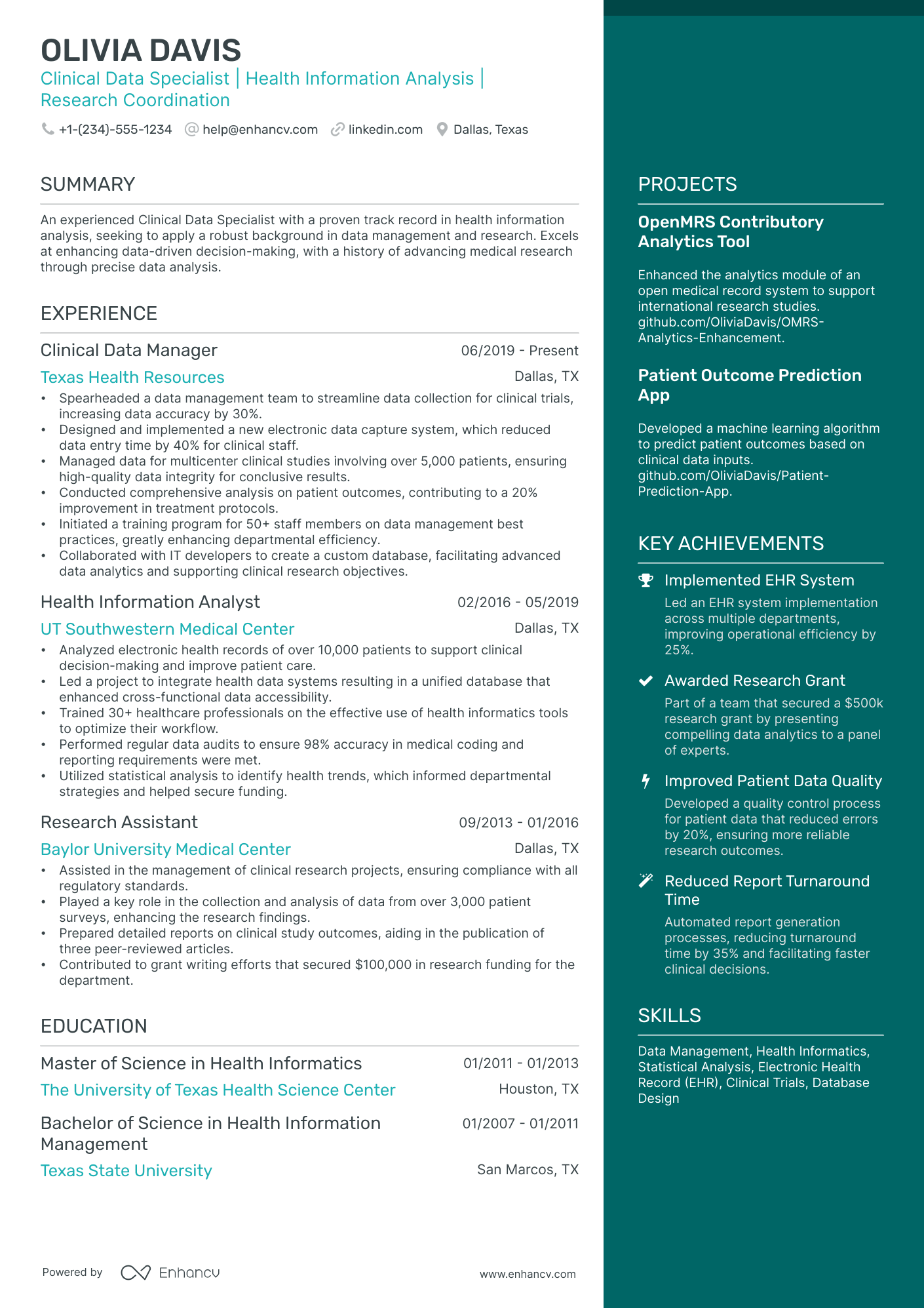
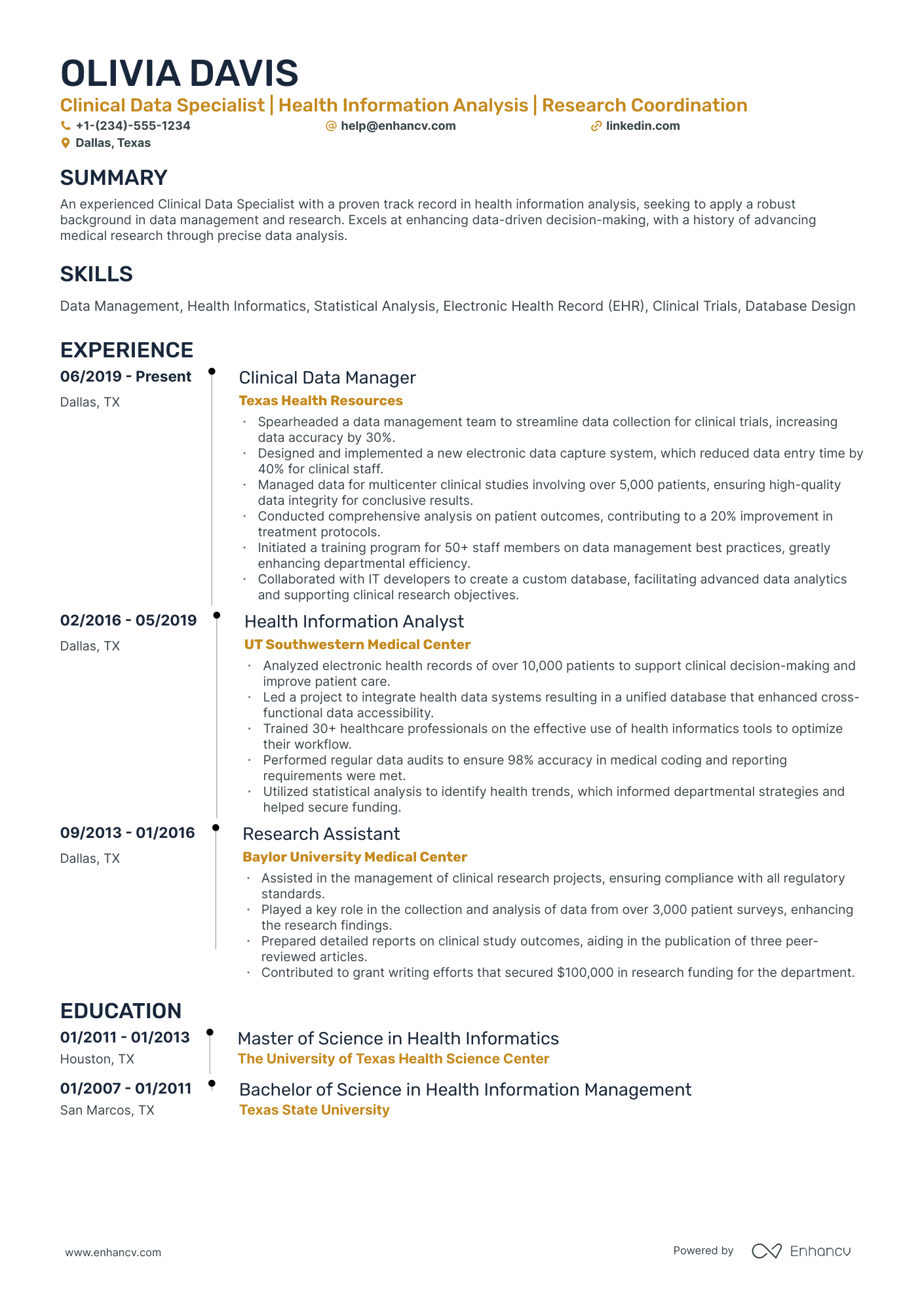
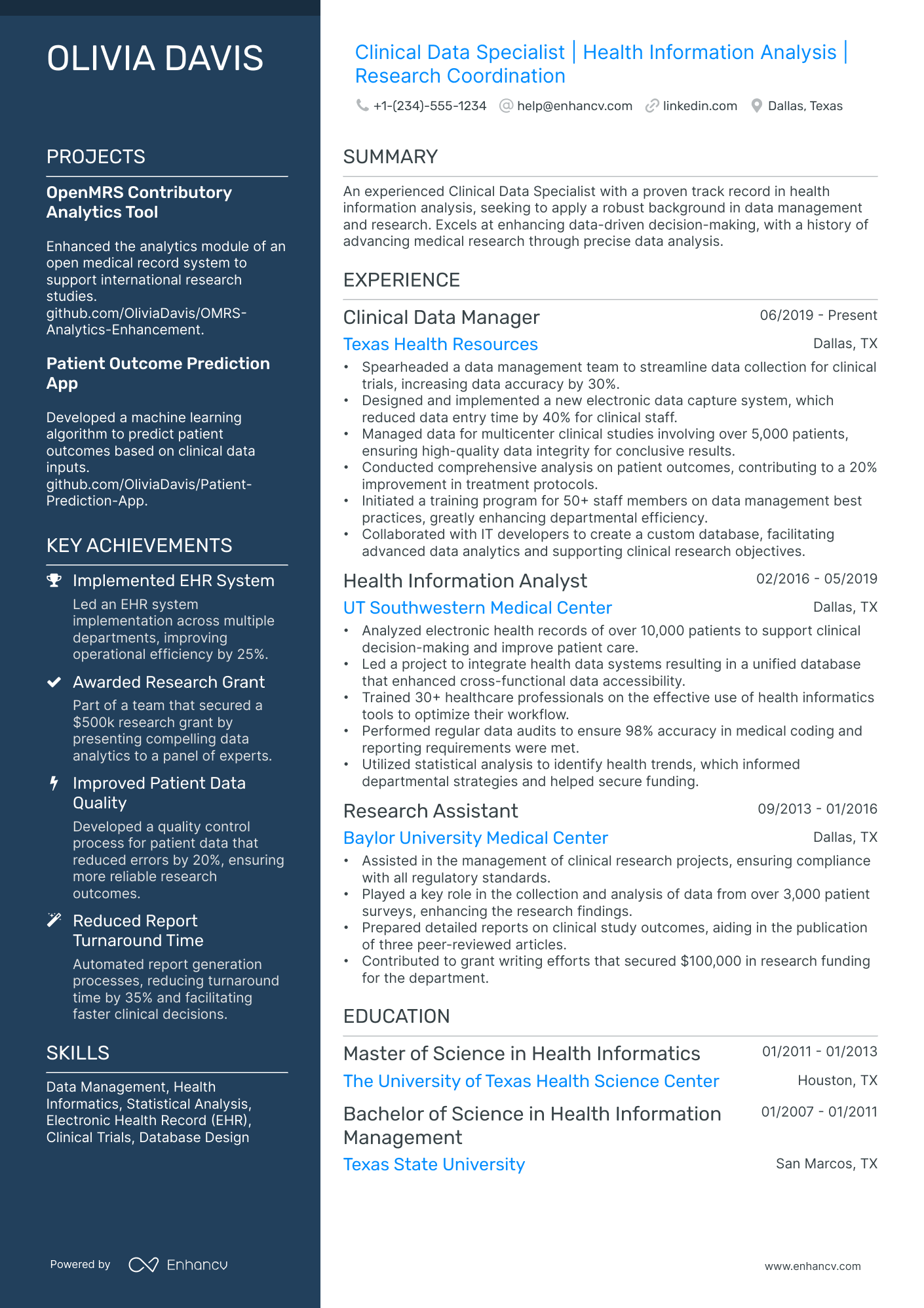
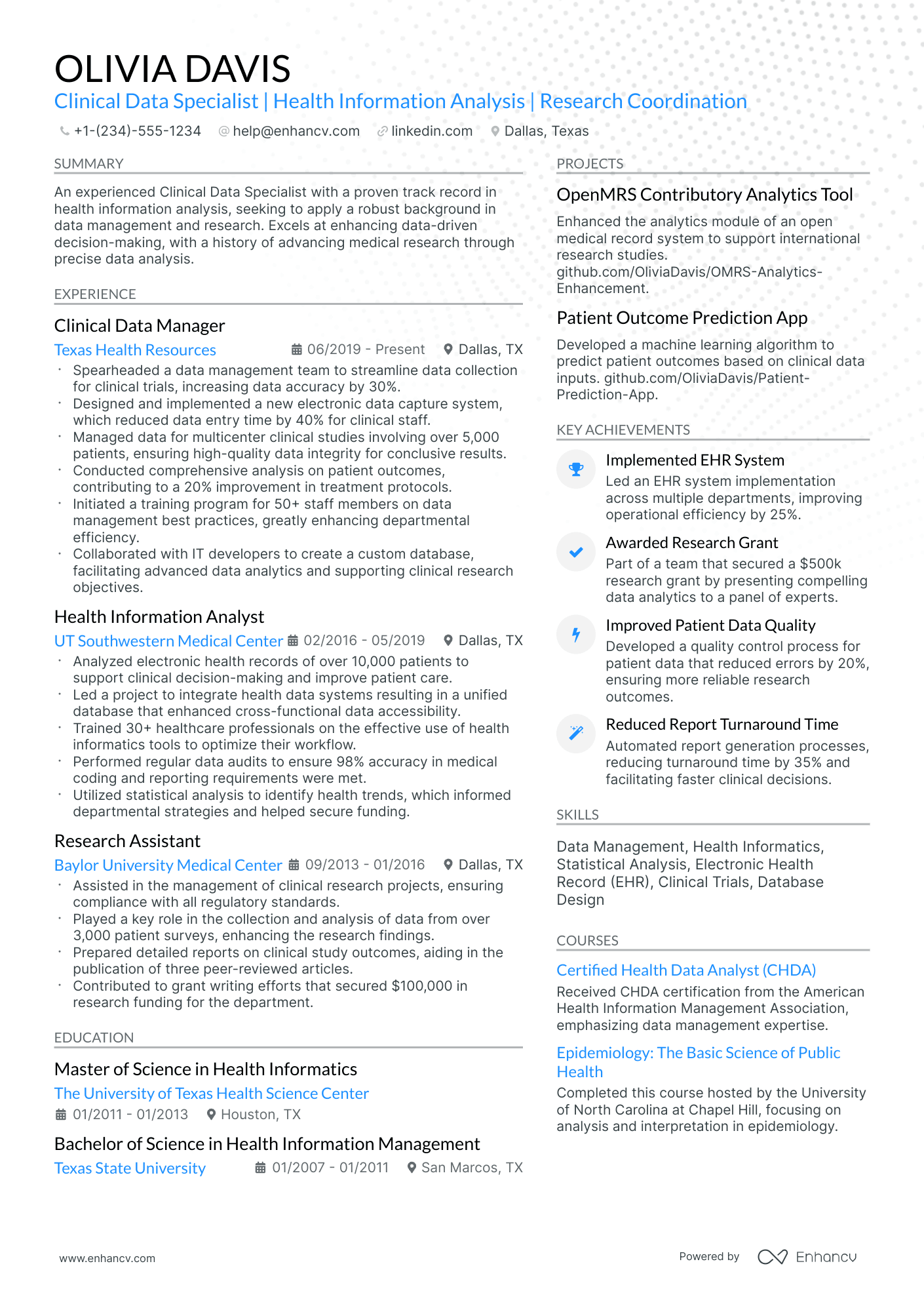
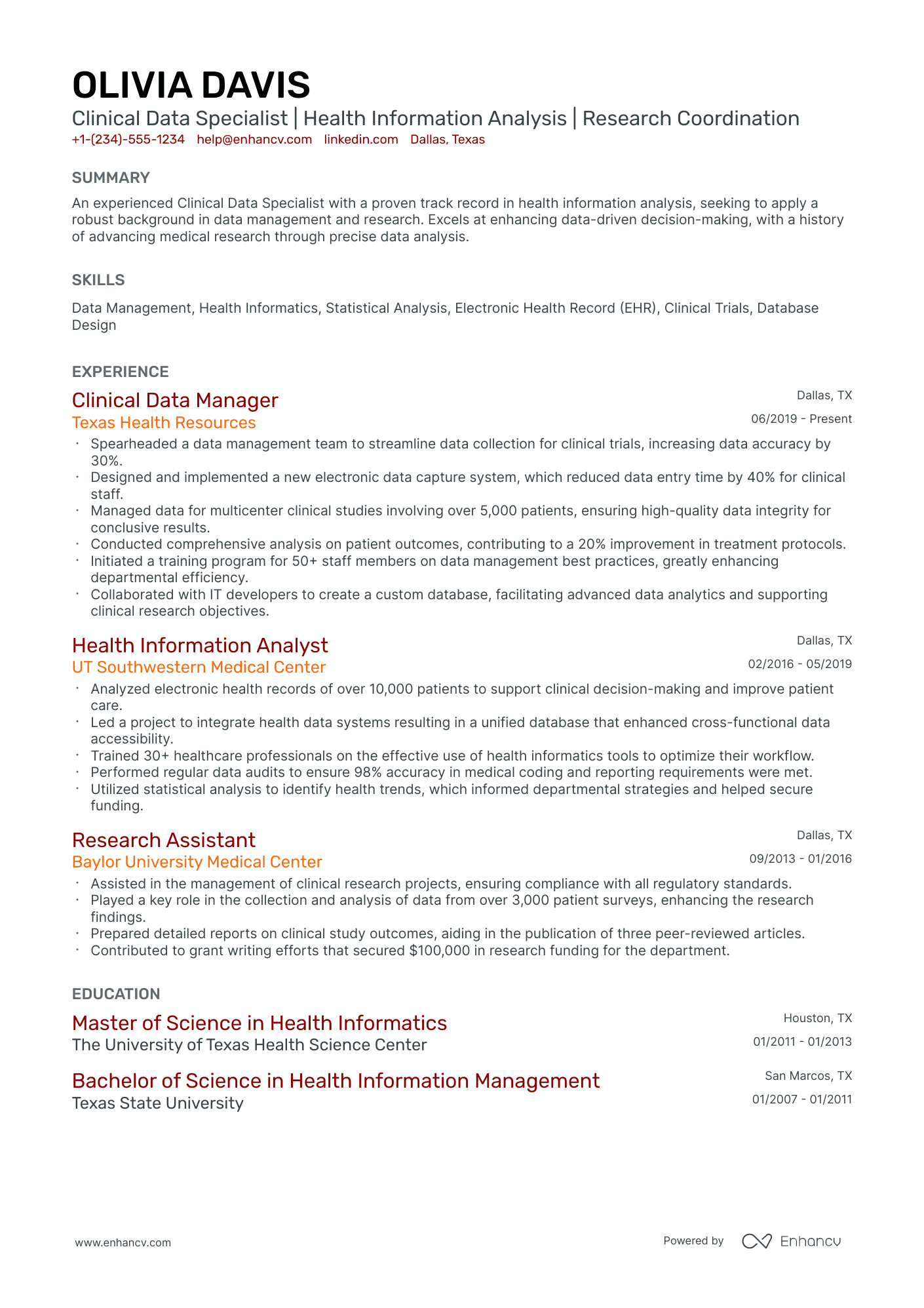
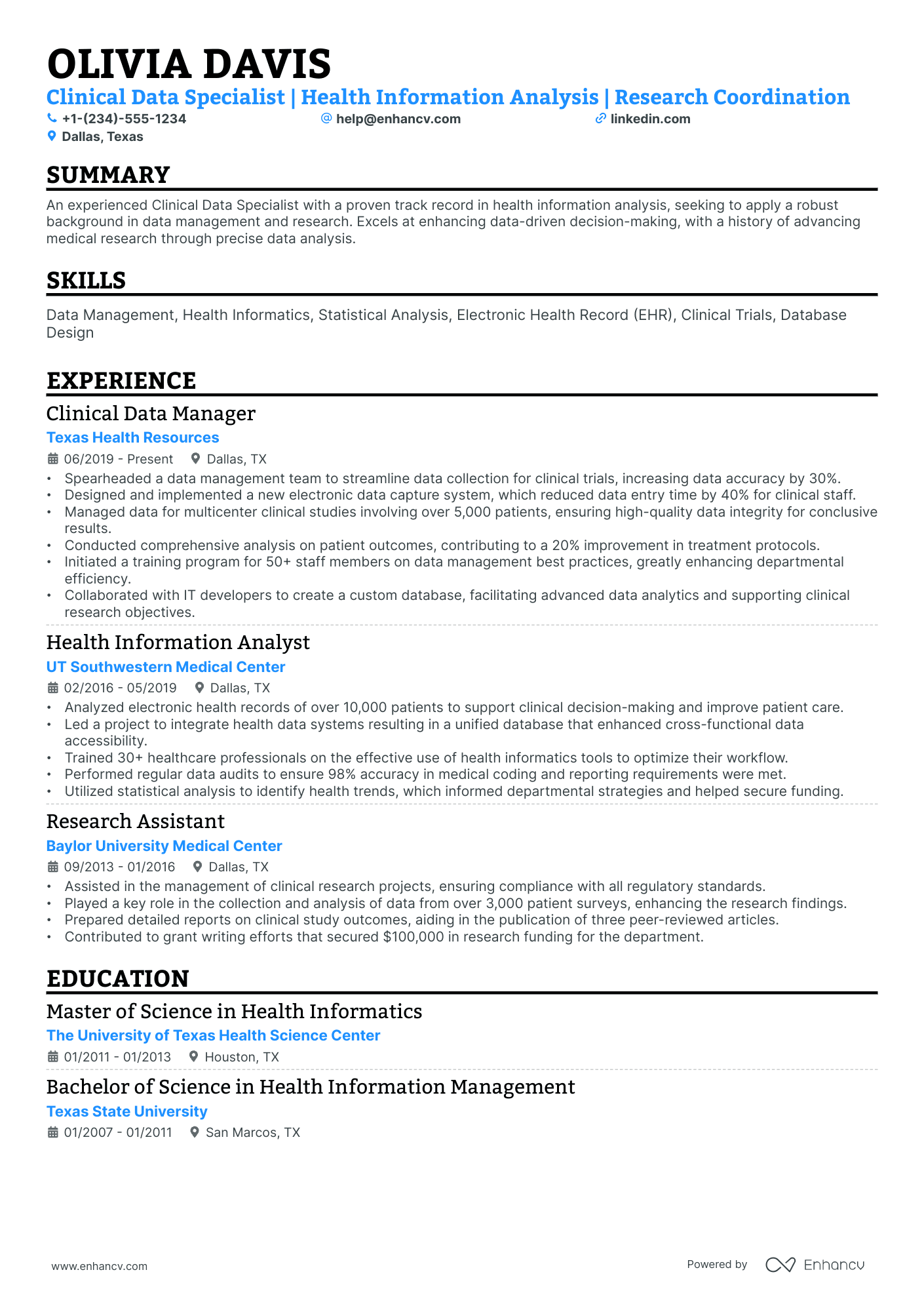
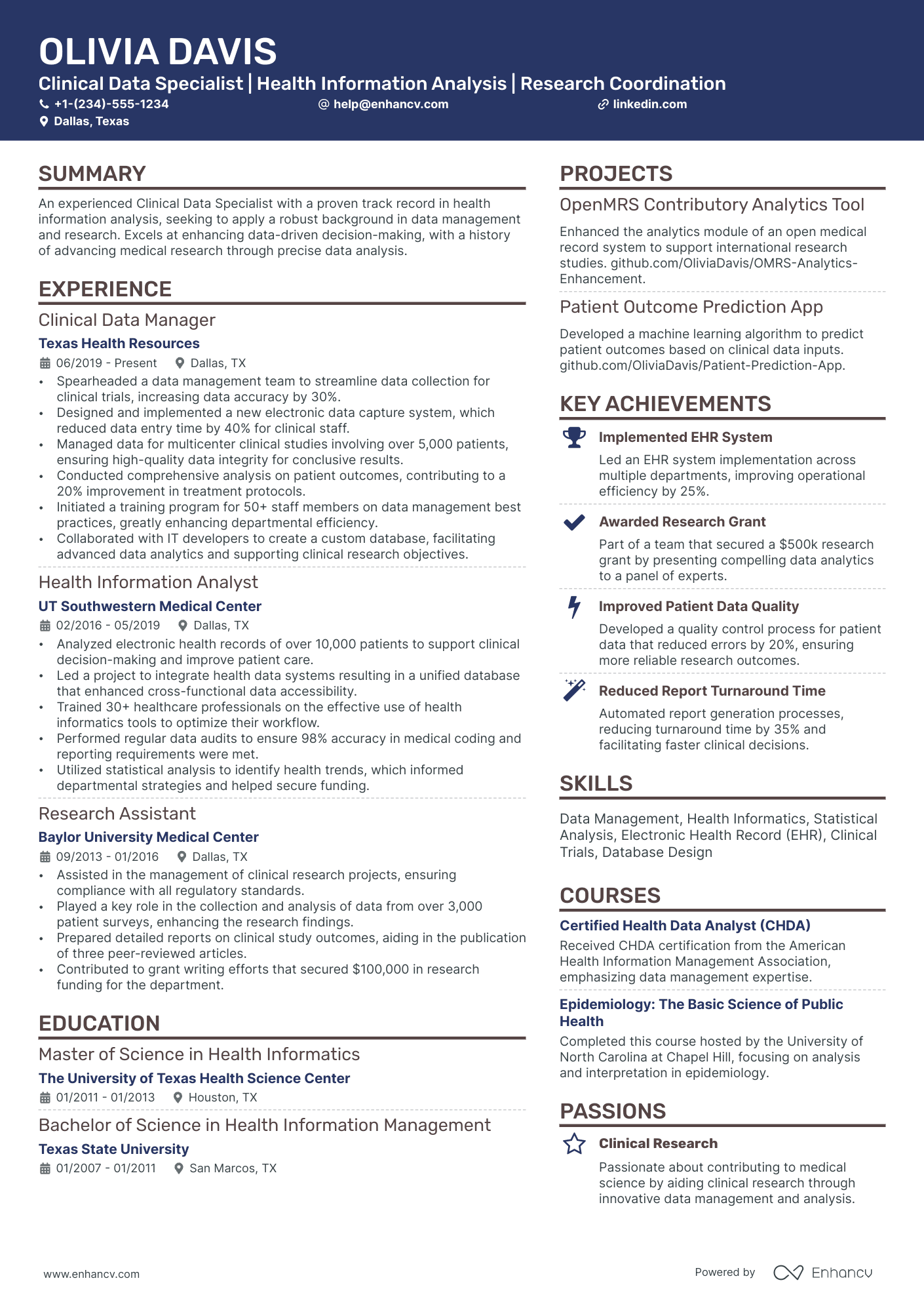
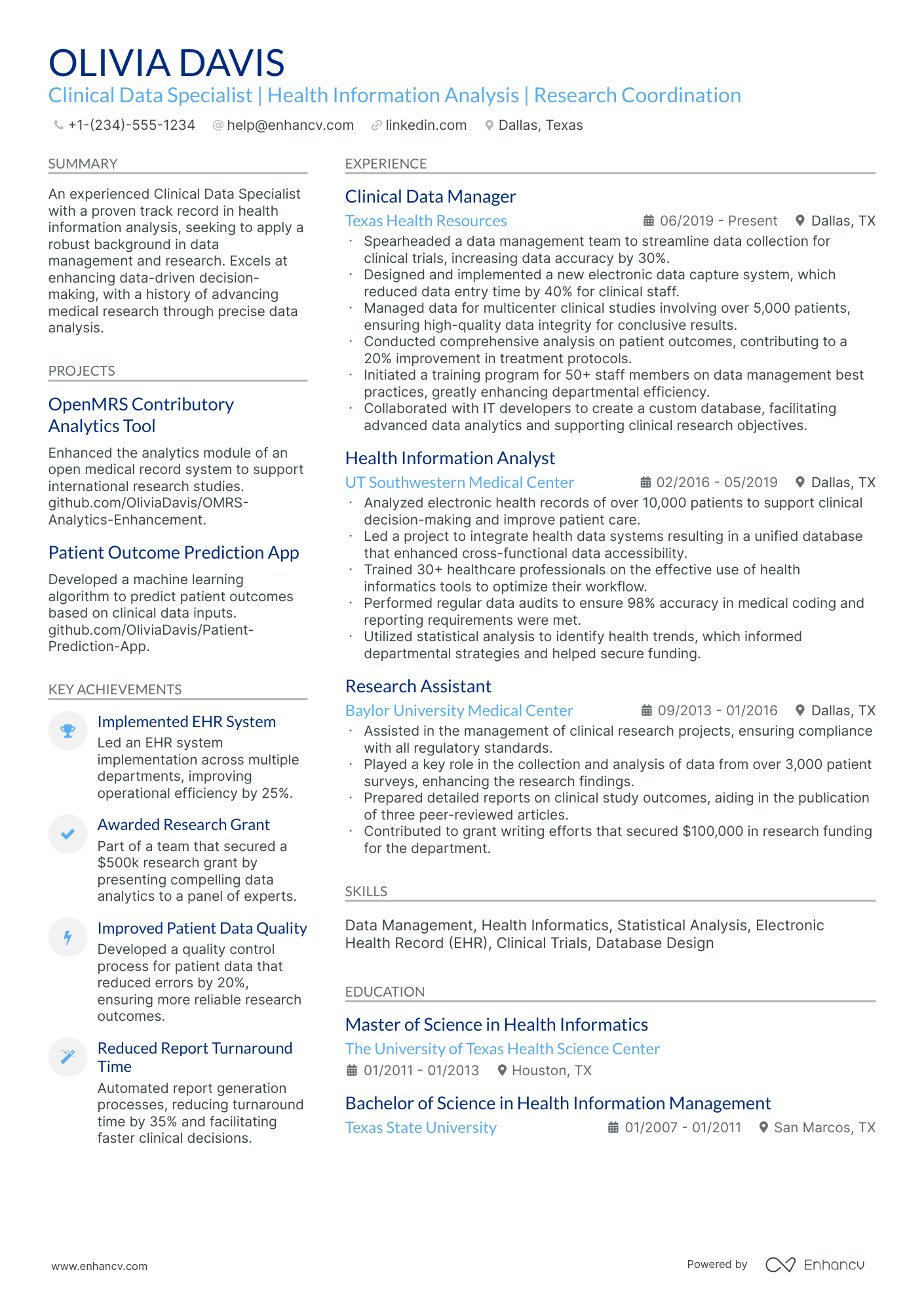
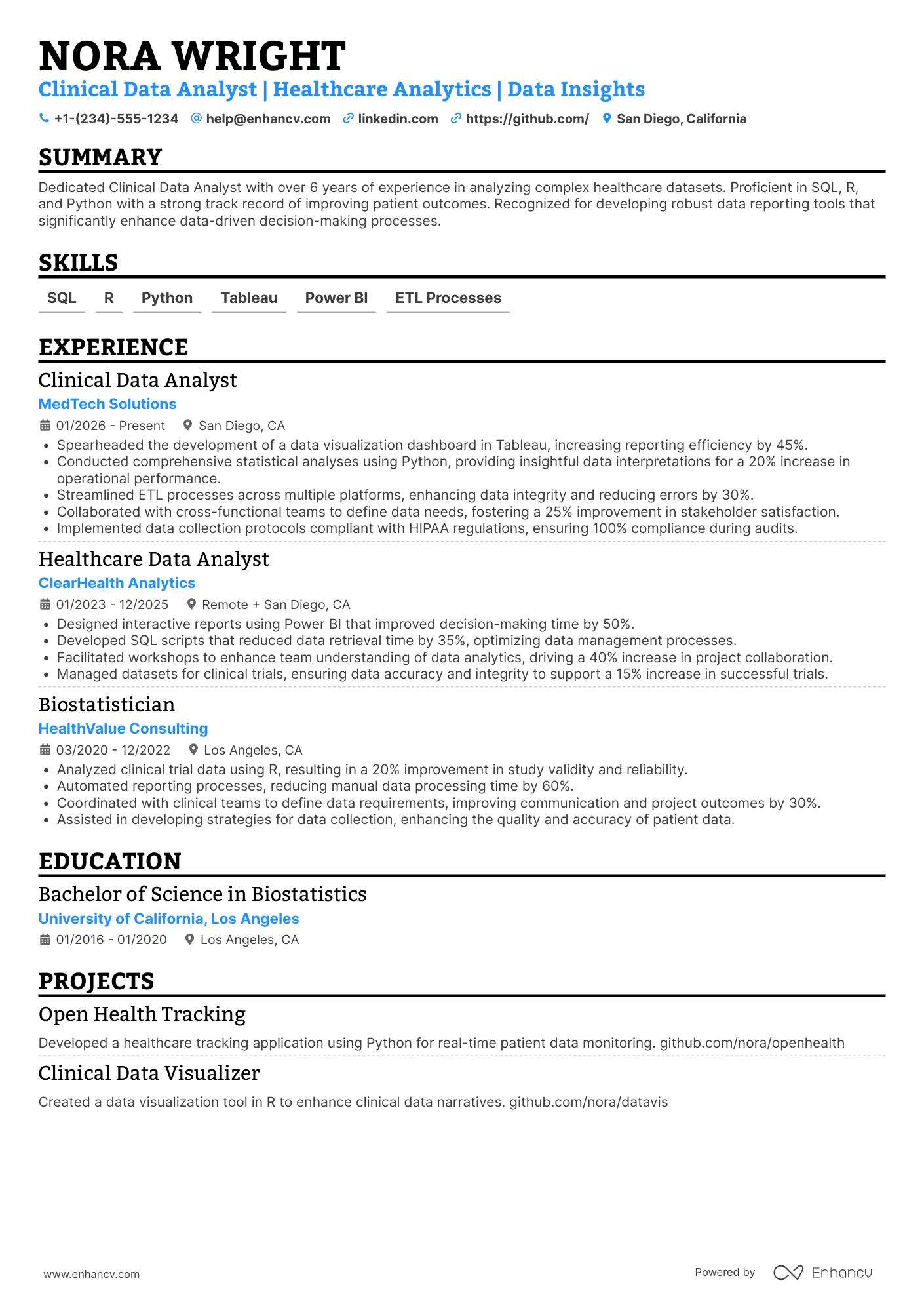
Clinical data analyst resume drafts often fail because they bury results under tool lists and generic study tasks. That blocks keyword matching in ATS screening and gets missed in rapid recruiter scans, especially in a crowded applicant pool.
A strong resume shows what changed because of your work. Knowing how to make your resume stand out means you should highlight faster database locks, fewer query cycles, improved data quality rates, on-time deliverables across studies, audit-ready documentation, and clearer dashboards that drove decisions.

Key takeaways
- Quantify data quality, query resolution, and timeline outcomes in every experience bullet.
- Use reverse-chronological format if experienced; use a hybrid format when switching careers.
- Tailor each bullet to mirror the job posting's tools, standards, and therapeutic areas.
- Place skills above experience for junior roles and below it for senior ones.
- Tie every listed skill to a specific project, dataset, or measurable result.
- Academic projects and internships can demonstrate readiness when direct experience is limited.
- Use Enhancv to turn vague clinical data duties into metric-driven, recruiter-ready bullets.
How to format a clinical data analyst resume
Recruiters hiring for clinical data analyst roles prioritize hands-on experience with clinical databases (such as CDISC standards, SAS, R, or SQL), familiarity with regulatory submissions, and the ability to translate raw clinical trial data into actionable insights. A clean, well-structured resume format ensures these signals surface quickly during both automated applicant tracking system (ATS) scans and the initial human review.

I have significant experience in this role—which format should I use?
Use a reverse-chronological format to showcase your deepening expertise across clinical studies, therapeutic areas, and data management platforms. Do:
- Lead each role entry with your scope of ownership—number of trials supported, team size, or phase coverage (Phase I–IV).
- Highlight proficiency in role-specific tools and standards such as SAS, R, Python, SQL, CDISC SDTM/ADaM, Medidata Rave, or Oracle Clinical.
- Quantify outcomes tied to data quality, timeline adherence, or regulatory milestones.
I'm junior or switching into this role—what format works best?
A hybrid format works best, allowing you to lead with a targeted skills section while still presenting your work or project history in chronological order. Do:
- Place a skills section near the top that groups clinical data competencies—CDISC standards, statistical programming languages, EDC systems—so recruiters and ATS software find them immediately.
- Include academic research, internships, clinical data coordination roles, or relevant projects (such as building analysis datasets or cleaning trial data) to demonstrate transferable experience.
- Connect every listed skill or project to a specific action and a measurable or observable result.
Why not use a functional resume?
A functional format strips away the timeline context that hiring managers need to evaluate your growth in clinical data standards, programming tools, and regulatory knowledge—making it harder for them to trust the depth of your experience.
- Edge-case exception: A functional resume may be acceptable if you're transitioning from a non-clinical analytics role (such as biostatistics research or health informatics) and have no direct clinical trial work history, or if you're re-entering the workforce after an extended gap—but even then, every listed skill must be tied to a specific project, dataset, or outcome rather than stated in isolation.
Once your layout and formatting choices are in place, the next step is deciding which sections to include so each one reinforces your qualifications effectively.
What sections should go on a clinical data analyst resume
Recruiters expect you to present clinical data analysis experience that proves accuracy, compliance, and measurable results across studies and datasets. Understanding what to put on a resume for this role is critical to passing both ATS and human review.
Use this structure for maximum clarity:
- Header
- Summary
- Experience
- Skills
- Projects
- Education
- Certifications
- Optional sections: Publications, Research, Languages
Strong experience bullets should emphasize study or data scope, data quality and compliance outcomes, process improvements, and measurable impact on timelines, accuracy, and stakeholder decisions.
Is your resume good enough?
Drop your resume here or choose a file. PDF & DOCX only. Max 2MB file size.
Now that you’ve organized the key resume components, the next step is to write your clinical data analyst resume experience so those sections clearly show your impact and fit.
How to write your clinical data analyst resume experience
Your experience section should highlight clinical data work you've delivered—regulatory submissions supported, databases managed, analyses completed—using the specific tools, standards, and methodologies that define the role. Building a targeted resume means hiring managers prioritize demonstrated impact on data quality, patient safety, or trial efficiency over descriptive task lists that simply catalog daily responsibilities.
Each entry should include:
- Job title
- Company and location (or remote)
- Dates of employment (month and year)
Three to five concise bullet points showing what you owned, how you executed, and what outcomes you delivered:
- Ownership scope: the clinical datasets, trial phases, therapeutic areas, reporting systems, or data management plans you were directly accountable for as a clinical data analyst.
- Execution approach: the tools, platforms, and standards you used to execute your work—such as EDC systems, SAS, SQL, CDISC frameworks, or data validation procedures that shaped how you collected, cleaned, and analyzed clinical data.
- Value improved: the measurable changes you drove in data quality, query resolution timelines, regulatory compliance, database lock efficiency, or patient data accuracy through your analytical contributions.
- Collaboration context: how you partnered with clinical operations teams, biostatisticians, medical monitors, CROs, sponsors, or regulatory affairs professionals to ensure data integrity and alignment across trial milestones.
- Impact delivered: the tangible outcomes your work produced—expressed through improved trial timelines, audit readiness, submission quality, data completeness, or risk reduction rather than routine activity descriptions.
Experience bullet formula
A clinical data analyst experience example
✅ Right example - modern, quantified, specific.
Clinical Data Analyst
Meridian Clinical Research | Boston, MA
2022–Present
Multi-site oncology and cardiology research network running twenty-plus concurrent Phase II–IV studies across eight hospitals.
- Built SDTM and ADaM datasets in SAS and SQL using Medidata Rave exports, cutting data cleaning cycle time by 28% and enabling on-time interim analysis for three trials.
- Automated edit checks and discrepancy management with SAS macros and Python, reducing open queries by 35% and lowering average query resolution time from nine days to six days.
- Developed Power BI dashboards for enrollment, protocol deviations, and safety signals, improving stakeholder visibility and increasing weekly site compliance reporting from 62% to 90%.
- Validated EDC, laboratory, and electronic health record integrations against data transfer specifications, decreasing data transfer errors by 41% and eliminating two recurring serious adverse event reconciliation issues.
- Partnered with biostatisticians, clinical operations, and data managers to define analysis-ready endpoints and data review workflows, accelerating database lock by twelve days and supporting two successful regulatory submissions.
Now that you've seen how a strong experience section comes together, let's look at how to adjust yours based on the specific job posting you're targeting.
How to tailor your clinical data analyst resume experience
Recruiters evaluate your clinical data analyst resume through applicant tracking systems and manual review, scoring how closely your experience matches the posting. Tailoring your resume to the job description in each bullet to reflect the job's specific language and priorities increases your chances of passing both screenings.
Ways to tailor your clinical data analyst experience:
- Mirror the exact clinical database platforms named in the job posting.
- Match regulatory compliance standards like GCP or ICH guidelines referenced.
- Use the same terminology for data cleaning and validation processes listed.
- Highlight therapeutic areas or disease categories relevant to the role.
- Reflect specific reporting tools or statistical software the employer requires.
- Align your CDISC or SDTM experience with stated data standards expectations.
- Emphasize cross-functional collaboration with clinical operations teams when referenced.
- Include query management or discrepancy resolution workflows the posting describes.
Tailoring means aligning your real accomplishments with what the employer prioritizes, not forcing keywords into bullets where they don't belong.
Resume tailoring examples for clinical data analyst
| Job description excerpt | Untailored | Tailored |
|---|---|---|
| "Extract, clean, and analyze clinical trial data using SAS and SQL to support regulatory submissions." | Analyzed data and created reports for various projects. | Extracted and cleaned clinical trial datasets using SAS and SQL, delivering analysis-ready files that supported three FDA regulatory submissions on schedule. |
| "Develop and validate CDISC-compliant datasets (SDTM/ADaM) in collaboration with biostatistics and programming teams." | Worked with team members to prepare datasets in required formats. | Built and validated 12 CDISC-compliant SDTM and ADaM datasets per study, collaborating directly with biostatistics and statistical programming teams to resolve 95% of discrepancies before sponsor review. |
| "Monitor data quality across EDC systems such as Medidata Rave, generating discrepancy reports and ensuring protocol compliance." | Performed quality checks on data and flagged issues when found. | Monitored data quality across four active studies in Medidata Rave, generating weekly discrepancy reports that reduced unresolved queries by 40% and ensured full protocol compliance through database lock. |
Once you’ve aligned your experience with the role’s priorities, the next step is to quantify your clinical data analyst achievements so employers can see the impact of that work.
How to quantify your clinical data analyst achievements
Quantifying your achievements proves clinical impact and operational value. Focus on data quality, turnaround time, query performance, compliance risk reduction, and stakeholder adoption across studies, sites, and reporting pipelines.
Quantifying examples for clinical data analyst
| Metric | Example |
|---|---|
| Data quality | "Reduced electronic data capture edit-check discrepancies by 28% by rewriting SAS validation rules and partnering with data management on root-cause fixes across three Phase III studies." |
| Delivery speed | "Cut weekly safety listing turnaround from two days to six hours by automating SDTM-to-ADaM refreshes in Python and scheduling runs in Airflow." |
| Query performance | "Improved SQL query runtime from eighteen minutes to three minutes by indexing key tables and refactoring joins for a 120-million-row clinical warehouse." |
| Compliance risk | "Achieved 100% audit-ready traceability for twenty key endpoints by implementing versioned specs, change logs, and access controls aligned to 21 CFR Part 11." |
| Stakeholder adoption | "Increased study team self-serve reporting from 15 to 60 weekly users by launching a Tableau dashboard suite with role-based filters and data dictionary notes." |
Turn vague job duties into measurable, recruiter-ready resume bullets in seconds with Enhancv's Bullet Point Generator.
Once your bullet points clearly convey your impact, the next step is ensuring your skills section reinforces that expertise with the right mix of hard and soft skills.
How to list your hard and soft skills on a clinical data analyst resume
Your skills section shows you can manage clinical data end-to-end, and recruiters and ATS scan it to confirm you match the study, platform, and compliance requirements, so aim for a mix of technical hard skills and job-specific soft skills. Clinical data analyst roles require a blend of:
- Product strategy and discovery skills.
- Data, analytics, and experimentation skills.
- Delivery, execution, and go-to-market discipline.
- Soft skills.
Your skills section should be:
- Scannable (bullet-style grouping).
- Relevant to the job post.
- Backed by proof in experience bullets.
- Updated with current tools.
Place your skills section:
- Above experience if you're junior or switching careers.
- Below experience if you're mid/senior with strong achievements.

Hard skills
- CDISC SDTM, CDISC ADaM
- SAS Base, SAS Macro
- SQL querying and optimization
- R, tidyverse
- Python, pandas
- Data cleaning and validation
- Edit checks, discrepancy management
- EDC systems, eCRF review
- Clinical data standards mapping
- MedDRA, WHO Drug
- Data visualization: Tableau, Power BI
- ICH E6 GCP compliance
Soft skills
- Translate protocol into data rules
- Clarify requirements with clinical teams
- Document assumptions and decisions
- Communicate findings to nontechnical partners
- Prioritize defects by patient and study risk
- Drive issue resolution with vendors
- Maintain audit-ready traceability
- Challenge inconsistencies with evidence
- Manage timelines across study milestones
- Coordinate handoffs across functions
- Ask precise, testable questions
- Own data quality outcomes end-to-end
How to show your clinical data analyst skills in context
Skills shouldn't live only in a dedicated skills list. Explore resume skills examples to see how top candidates weave competencies throughout their application.
They should be demonstrated in:
- Your summary (high-level professional identity)
- Your experience (proof through outcomes)
Here's what strong, skill-rich entries look like in practice.
Summary example
Senior clinical data analyst with eight years in oncology trials. Skilled in SAS, CDISC standards, and cross-functional data governance. Reduced query resolution time by 34% across three Phase III studies by streamlining edit check logic and vendor coordination.
- Reflects senior-level expertise clearly
- Names industry-standard tools and frameworks
- Leads with a measurable outcome
- Signals collaboration and leadership
Experience example
Senior Clinical Data Analyst
Meridian Health Sciences | Remote
June 2019–March 2024
- Built automated SAS edit checks that cut data discrepancies by 41% across two Phase III cardiovascular trials.
- Partnered with biostatisticians and medical monitors to redesign case report forms, reducing site queries by 28%.
- Led CDISC SDTM mapping for five study databases, accelerating submission-ready dataset delivery by three weeks.
- Every bullet includes measurable proof
- Skills surface naturally through real outcomes
Once you’ve tied your clinical data analyst skills to measurable outcomes and relevant workflows, the next step is applying that same approach to build a clinical data analyst resume with no experience.
How do I write a clinical data analyst resume with no experience
Even without full-time experience, you can demonstrate readiness through academic projects and transferable work. Our guide on writing a resume without work experience covers this in detail. Consider showcasing:
- Clinical research internship data cleaning
- Electronic health record data extracts
- Clinical trial database practice builds
- Biostatistics or epidemiology coursework projects
- Health data capstone dashboards
- Data quality audits with rules
- Volunteer registry data entry validation
- Public health dataset analysis portfolio
Focus on:
- Clinical data analyst tool stack
- Data cleaning and validation evidence
- Healthcare domain data familiarity
- Measurable project outcomes and scope
Resume format tip for entry-level clinical data analyst
Use a combination resume format because it highlights projects and technical skills first while still showing education and any relevant experience. Do:
- Lead with a skills section tied to tools.
- Add two to four project bullets.
- Mirror keywords from the job posting.
- Quantify datasets, error rates, and timelines.
- List coursework only if relevant.
- Analyzed one hundred thousand-row MIMIC-IV dataset in SQL and Python, built validation rules, and reduced missing-value rate from twelve percent to four percent.
Even without direct experience, your academic background can demonstrate the analytical foundation employers seek, making how you present your education especially important.
How to list your education on a clinical data analyst resume
Your education section helps hiring teams confirm you have the foundational knowledge needed. It validates your analytical training and understanding of clinical research principles relevant to the clinical data analyst role.
Include:
- Degree name
- Institution
- Location
- Graduation year
- Relevant coursework (for juniors or entry-level candidates)
- Honors & GPA (if 3.5 or higher)
Skip month and day details—list the graduation year only.
Here's a strong education entry tailored for a clinical data analyst resume.
Example education entry
Bachelor of Science in Biostatistics
University of North Carolina at Chapel Hill, Chapel Hill, NC
Graduated 2021
GPA: 3.7/4.0
- Relevant Coursework: Clinical Trial Design, Epidemiology, SAS Programming, Database Management, Biomedical Data Analysis
- Honors: Dean's List (six consecutive semesters), Phi Beta Kappa Honor Society
How to list your certifications on a clinical data analyst resume
Certifications on your resume show your commitment to learning, prove tool proficiency, and signal industry relevance as a clinical data analyst. They help recruiters trust your ability to work with regulated data and modern analytics workflows. Include:
- Certificate name
- Issuing organization
- Year
- Optional: credential ID or URL
- Put certifications below education when your degree is recent and your certifications add minor support.
- Put certifications above education when they are recent, highly relevant, or required for clinical data analyst roles.
Best certifications for your clinical data analyst resume
- SAS Certified Specialist: Base Programming Using SAS 9.4
- Microsoft Certified: Power BI Data Analyst Associate
- Certified Clinical Data Manager (CCDM)
- Society of Clinical Data Management (SCDM) Certified Clinical Data Associate (CCDA)
- Certified Health Data Analyst (CHDA)
- Certified Clinical Research Professional (CCRP)
- Certified Professional in Healthcare Quality (CPHQ)
Once you’ve positioned your credentials where recruiters will see them quickly, shift to your clinical data analyst resume summary to reinforce those qualifications upfront and tie them to the role.
How to write your clinical data analyst resume summary
Your resume summary is the first thing a recruiter reads. A strong one instantly connects your skills and experience to the clinical data analyst role.
Keep it to three to four lines, with:
- Your title and relevant years of experience in clinical data analysis.
- The domain you work in, such as clinical trials, pharma, or medical devices.
- Core tools like SAS, R, Python, SQL, or clinical data management systems.
- One or two measurable achievements, such as error reduction or faster data locks.
- Soft skills tied to real outcomes, like cross-functional collaboration that improved timelines.

PRO TIP
At this level, focus on specific tools, relevant coursework, and early wins that show you can handle real clinical data. Avoid vague phrases like "passionate self-starter" or "detail-oriented team player." Instead, quantify contributions and name the systems you've used.
Example summary for a clinical data analyst
Clinical data analyst with two years of experience supporting phase II oncology trials. Skilled in SAS, SQL, and Medidata Rave. Reduced query resolution time by 30% through standardized edit checks.
Optimize your resume summary and objective for ATS
Drop your resume here or choose a file.
PDF & DOCX only. Max 2MB file size.
Now that your summary captures your professional value, make sure the header above it presents your contact details and credentials clearly so recruiters can quickly identify and reach you.
What to include in a clinical data analyst resume header
A resume header is the top section with your identity and contact details, and it drives visibility, credibility, and recruiter screening for a clinical data analyst.
Essential resume header elements
- Full name
- Tailored job title and headline
- Location
- Phone number
- Professional email
- GitHub link
- Portfolio link
Including a LinkedIn link helps recruiters verify your experience quickly and supports screening.
Do not include photos on a clinical data analyst resume unless the role is explicitly front-facing or appearance-dependent.
Keep the header on one to two lines, use a clear tailored job title, and match your name and links across all profiles.
Example
Clinical data analyst resume header
Jordan Lee
Clinical Data Analyst | EDC, SQL, and Trial Data Cleaning
Boston, MA
(617) 555-01XX
jordan.lee@enhancv.com
github.com/jordanlee
jordanlee.com
linkedin.com/in/jordanlee
Once your contact details and role identifiers are in place at the top of your resume, add the additional sections to round out the rest of your application.
Additional sections for clinical data analyst resumes
When your core qualifications match other applicants, well-chosen additional sections can set your clinical data analyst resume apart with role-specific credibility. For example, listing language skills can be especially valuable for roles supporting multi-region clinical trials.
- Languages
- Publications
- Certifications
- Professional affiliations
- Conferences and presentations
- Volunteer experience in healthcare or research
- Continuing education
Once you've strengthened your resume with relevant additional sections, pairing it with a well-crafted cover letter can further set your application apart.
Do clinical data analyst resumes need a cover letter
A cover letter isn't required for a clinical data analyst, but it helps in competitive roles or when hiring managers expect one. If you're unsure where to start, understanding what a cover letter is and how it complements your resume can clarify when it adds value. It can make a difference when your resume needs context, or when you must show fit fast.
Use a cover letter when it adds clear, role-specific value:
- Explain role or team fit by linking your workflows to the posting, such as clinical data review, query management, and stakeholder communication.
- Highlight one or two relevant projects or outcomes, including metrics like reduced query aging, improved data quality, or faster database lock timelines.
- Show understanding of the product, users, or business context, such as the trial phase, therapeutic area, and how teams use reports and listings.
- Address career transitions or non-obvious experience by mapping transferable skills to clinical data analyst work, and naming the tools and standards you used.
Drop your resume here or choose a file.
PDF & DOCX only. Max 2MB file size.
Even if you decide a cover letter won’t add value for your application, using AI to improve your clinical data analyst resume is the next step because it helps you strengthen the document hiring teams will evaluate first.
Using AI to improve your clinical data analyst resume
AI can sharpen your resume's clarity, structure, and impact. It helps you refine language and highlight measurable results. But overuse can strip away authenticity. Once your content is clear and role-aligned, step away from AI. If you're wondering which AI is best for writing resumes, the answer depends on how you use it—always review and personalize the output.
Here are 10 prompts you can copy and paste to strengthen specific sections of your resume:
Strengthen your summary
Quantify experience bullets
Align skills to the role
Tighten project descriptions
Improve action verbs
Tailor to a job posting
Refine education details
Clarify certification entries
Remove filler language
Sharpen technical context
Conclusion
A strong clinical data analyst resume proves impact with measurable outcomes, role-specific skills, and clean structure. Use metrics for quality, speed, cost, and compliance. Highlight clinical data management, validation, SQL, and reporting, and keep every section easy to scan.
This approach shows you can deliver accurate insights, protect data integrity, and support trials and care decisions. It also signals readiness for today’s hiring market and near-future needs. When your results and skills align, your clinical data analyst resume stands out.