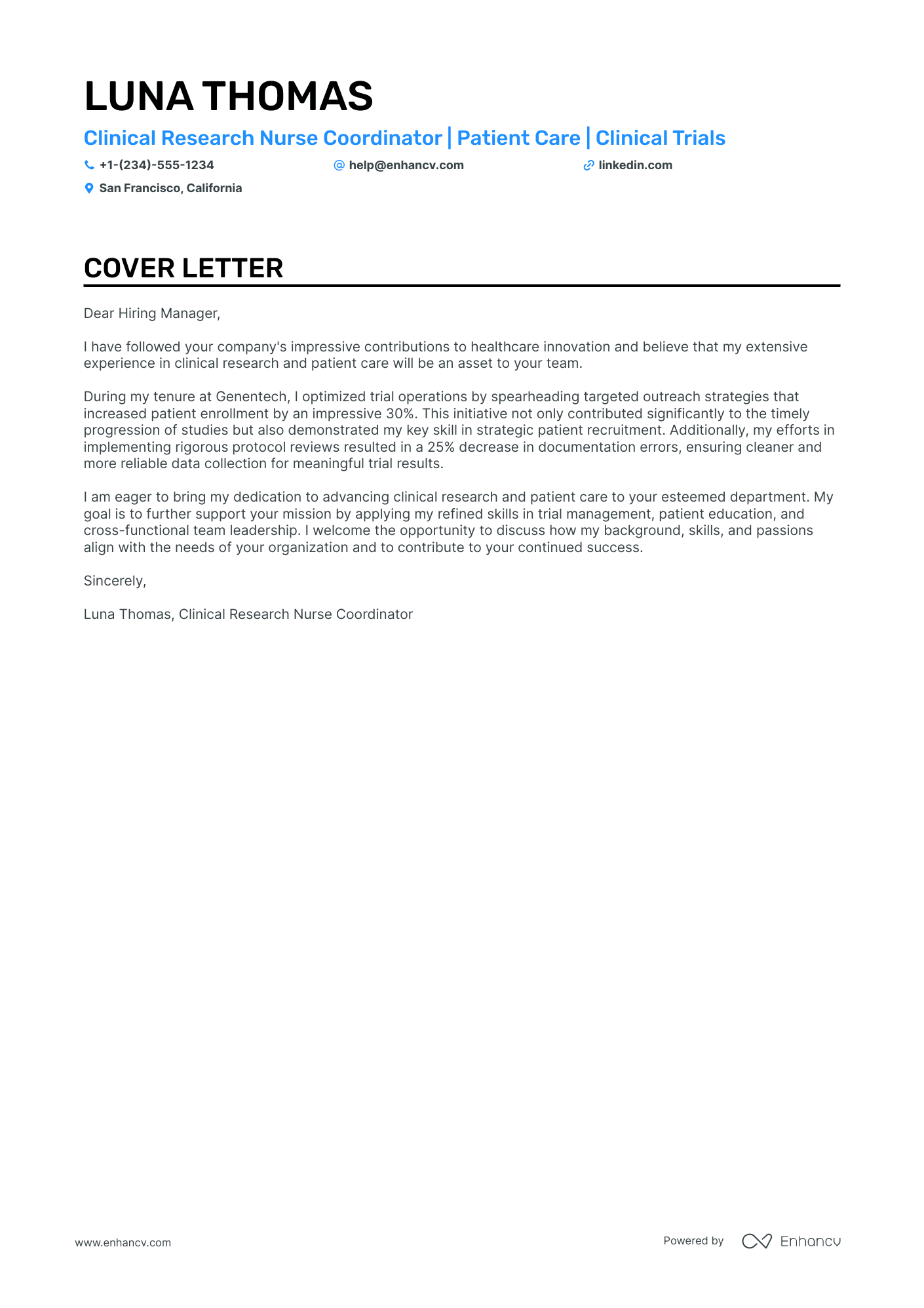
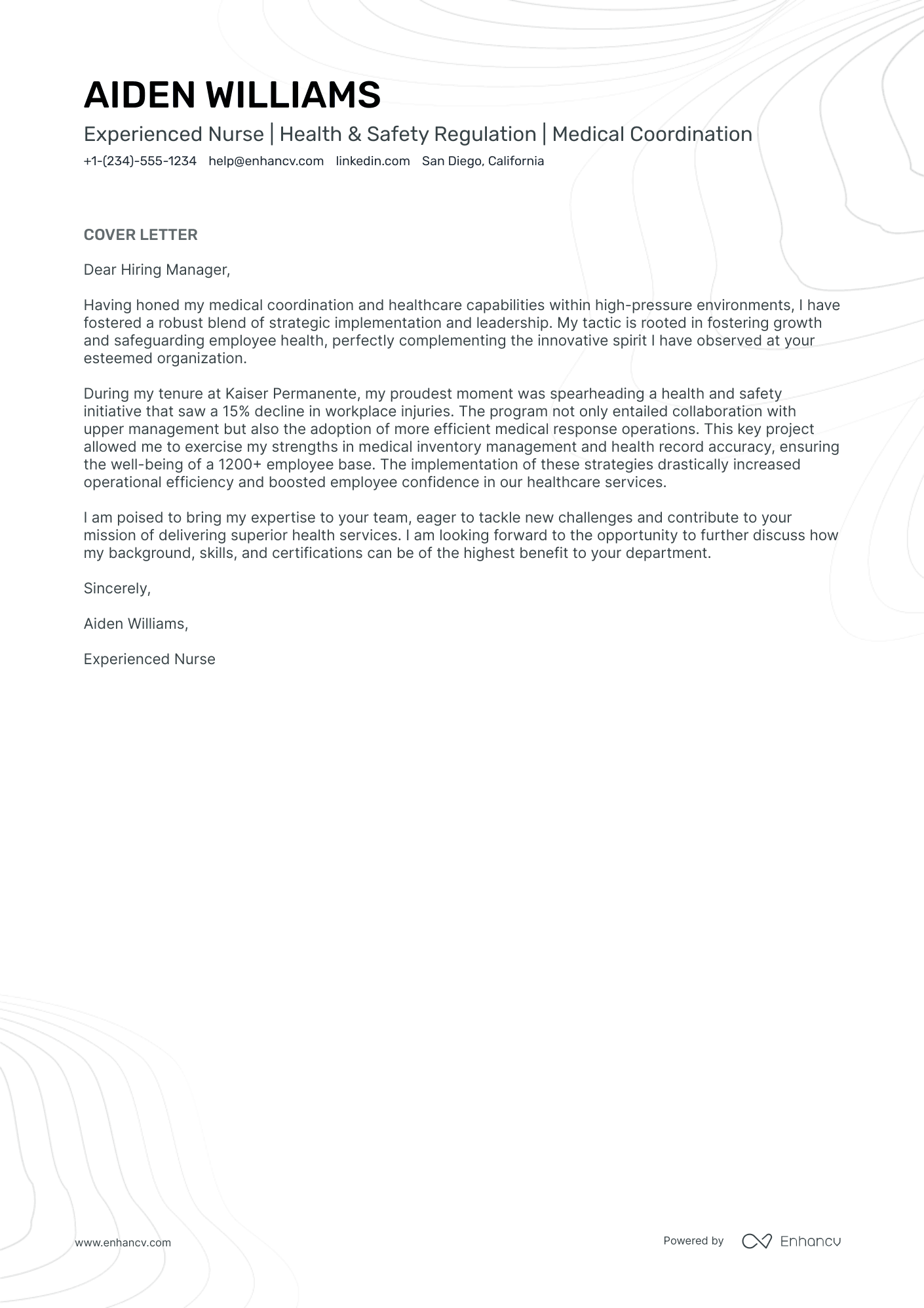
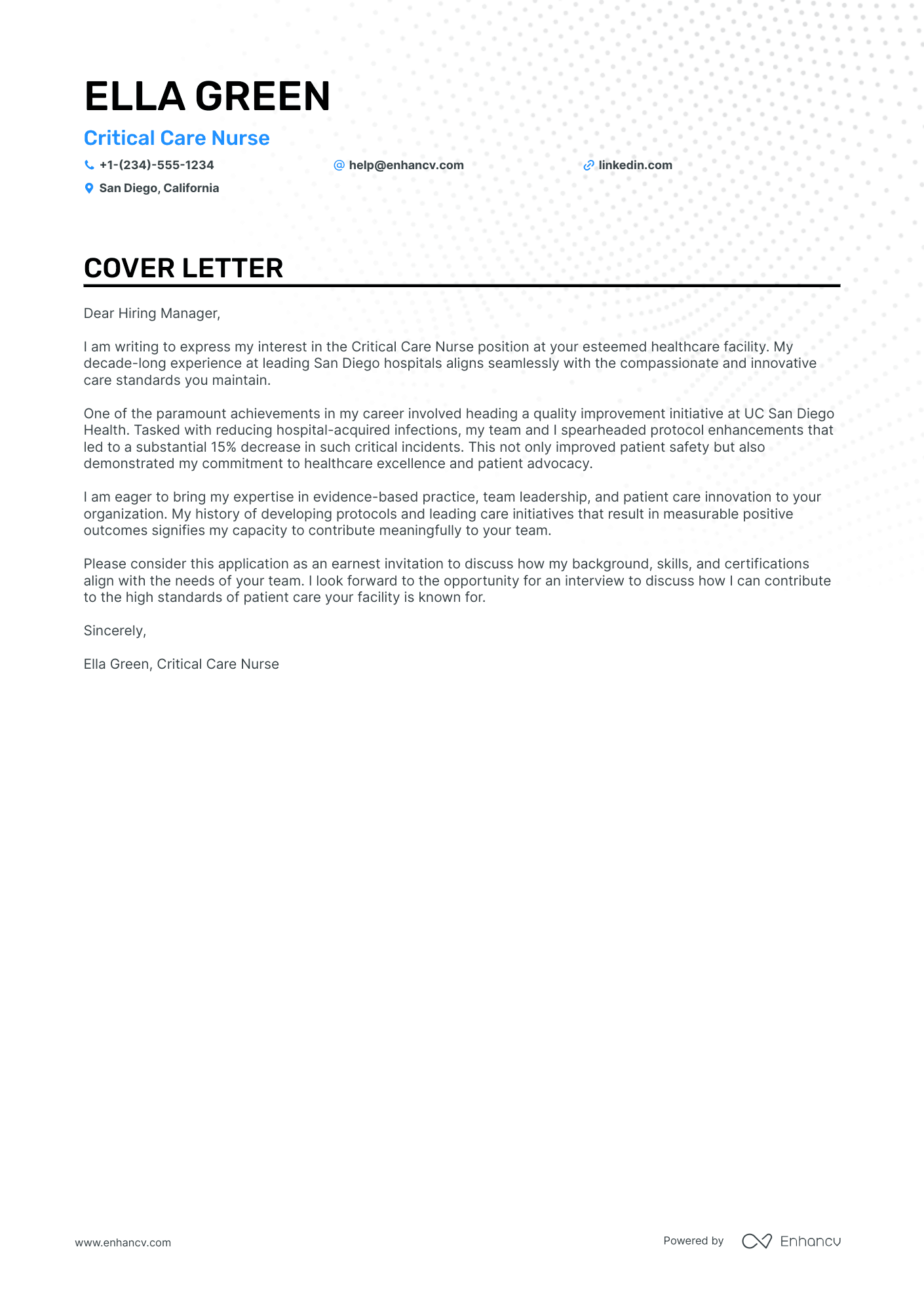
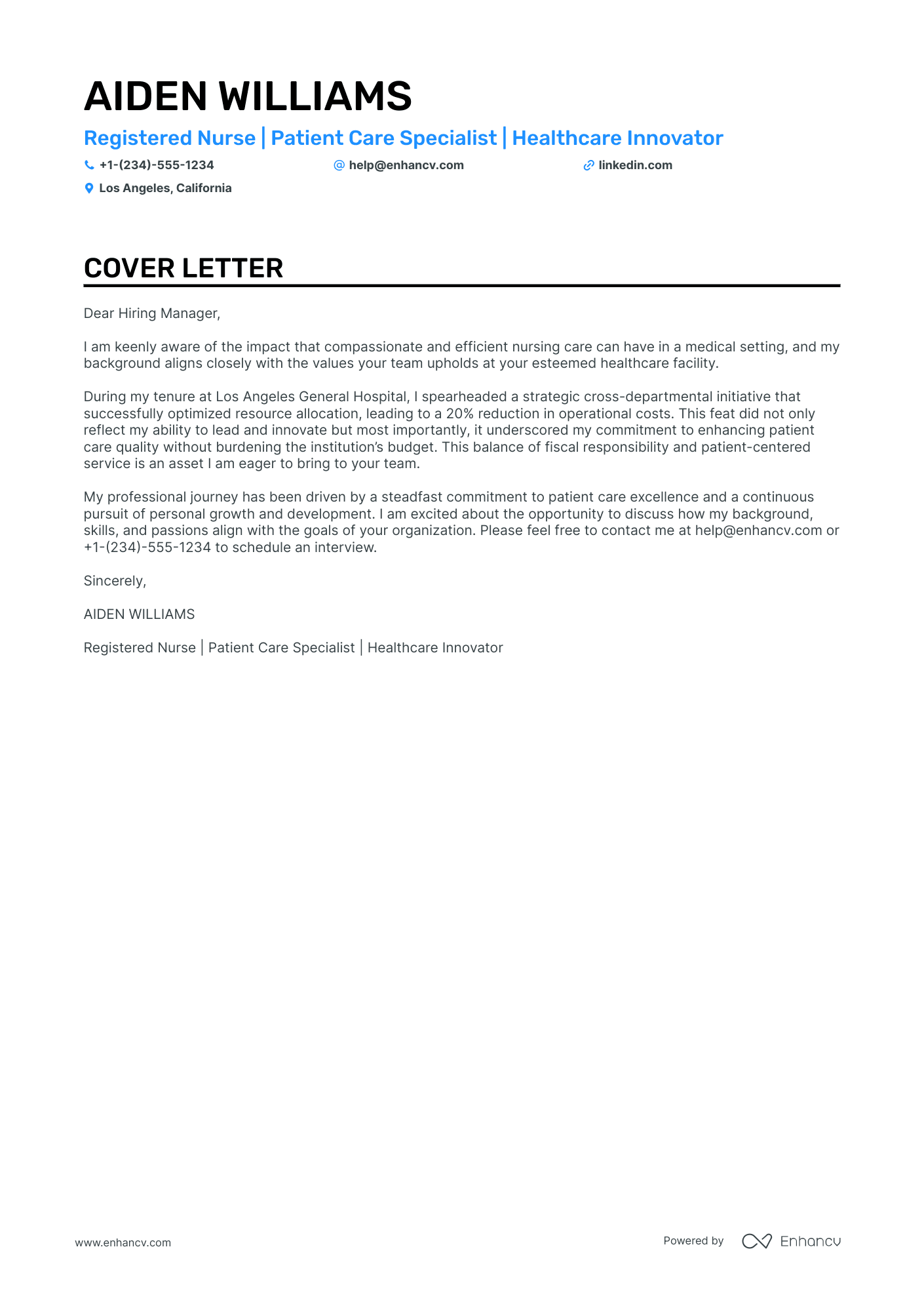
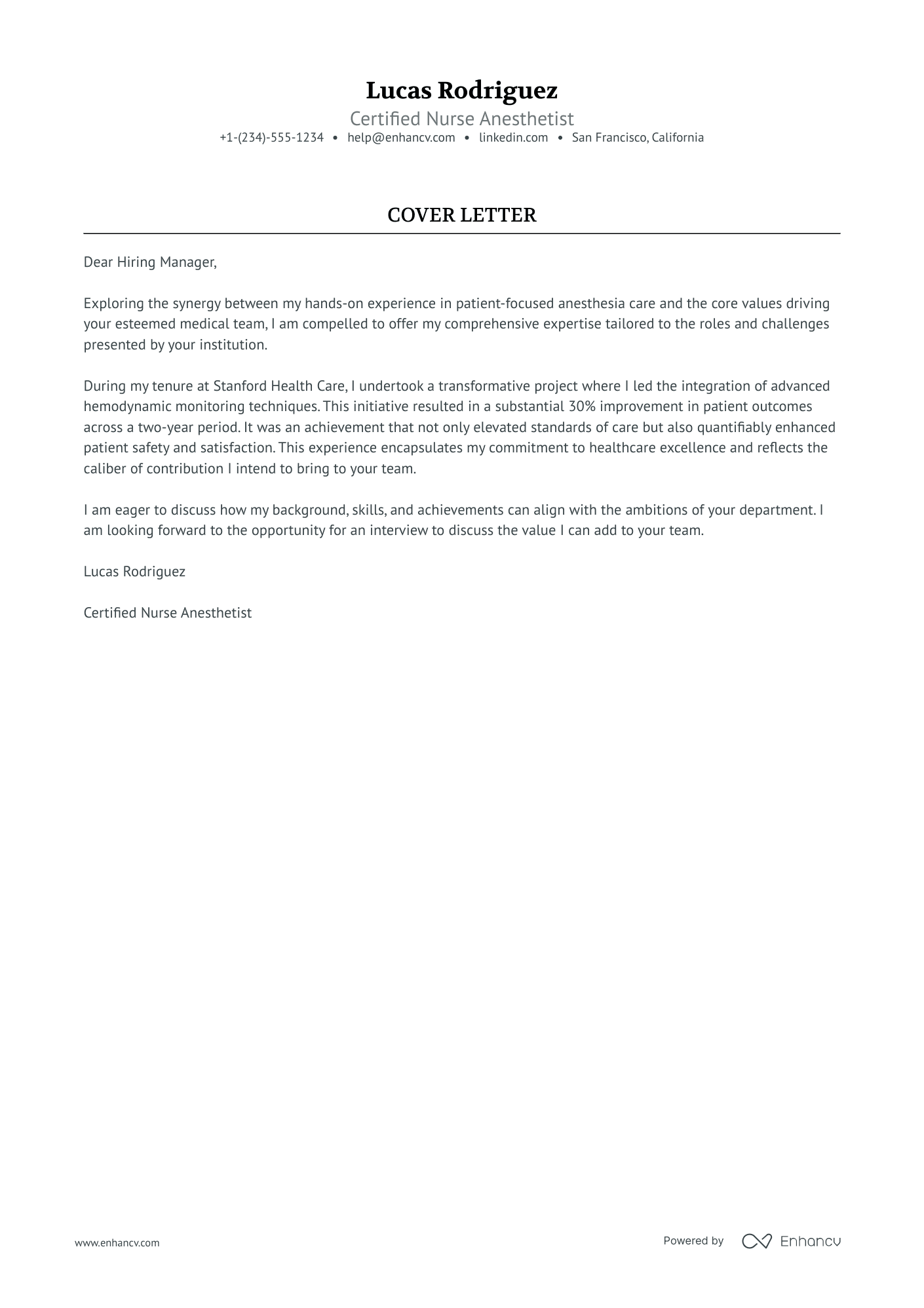
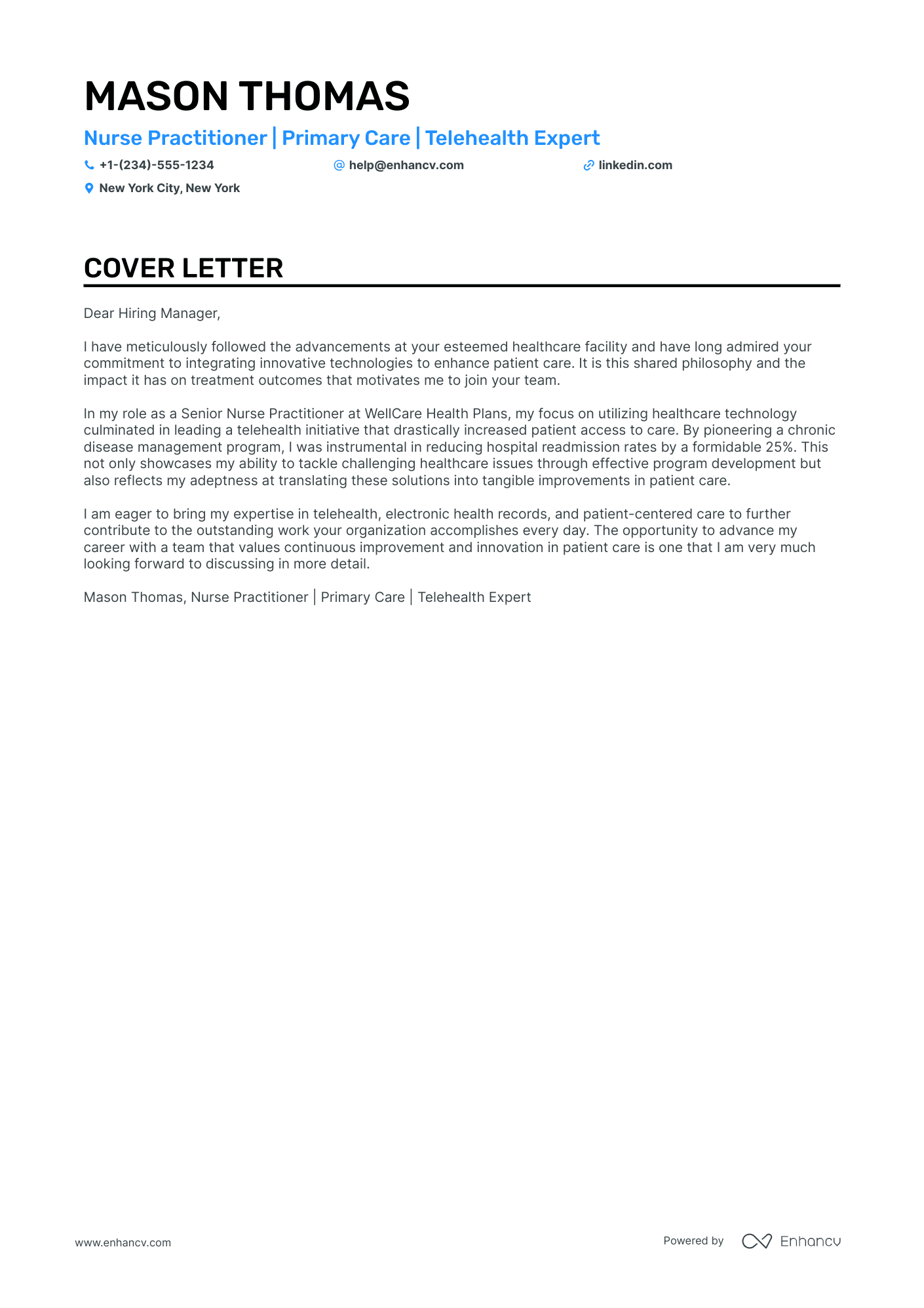
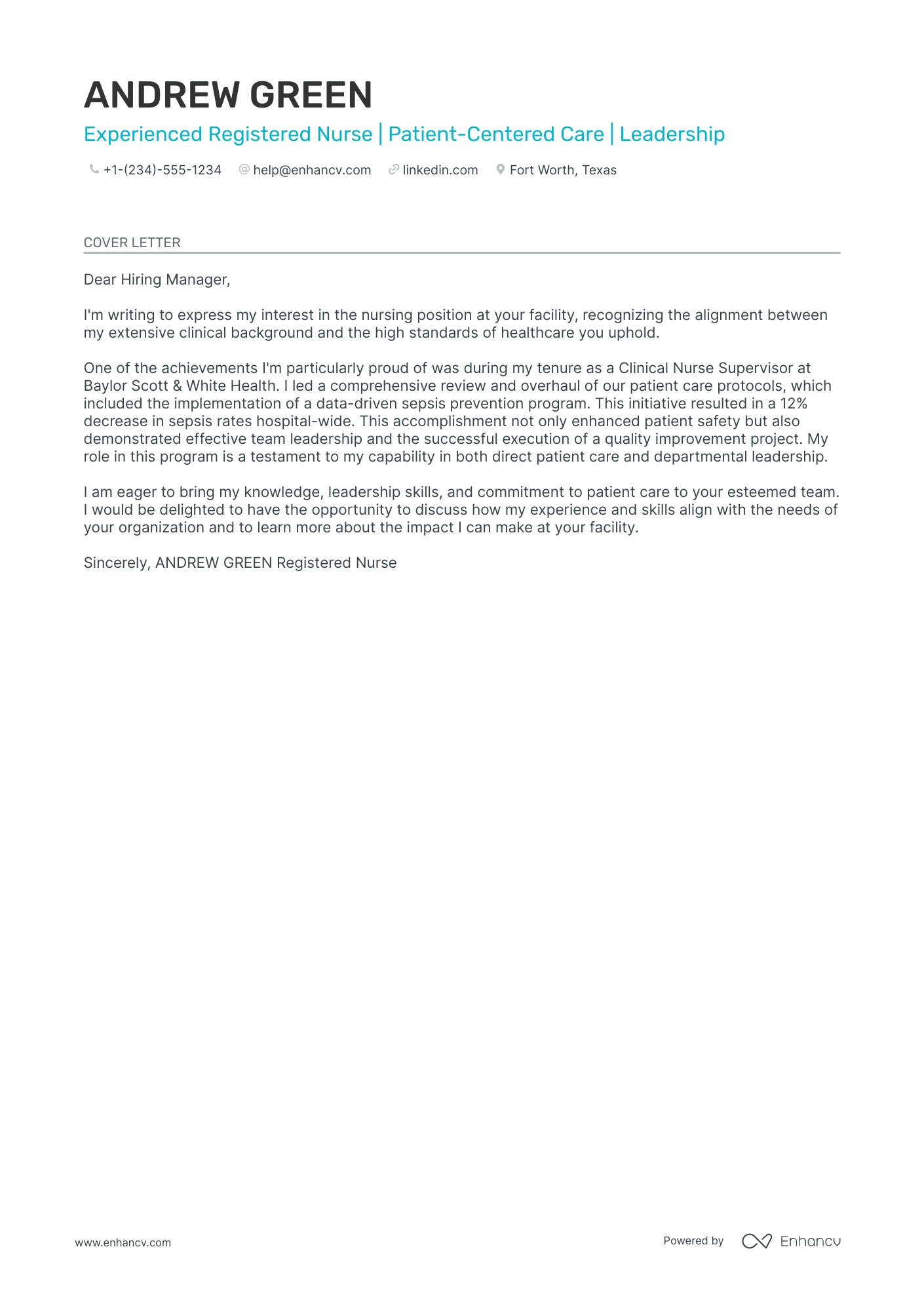
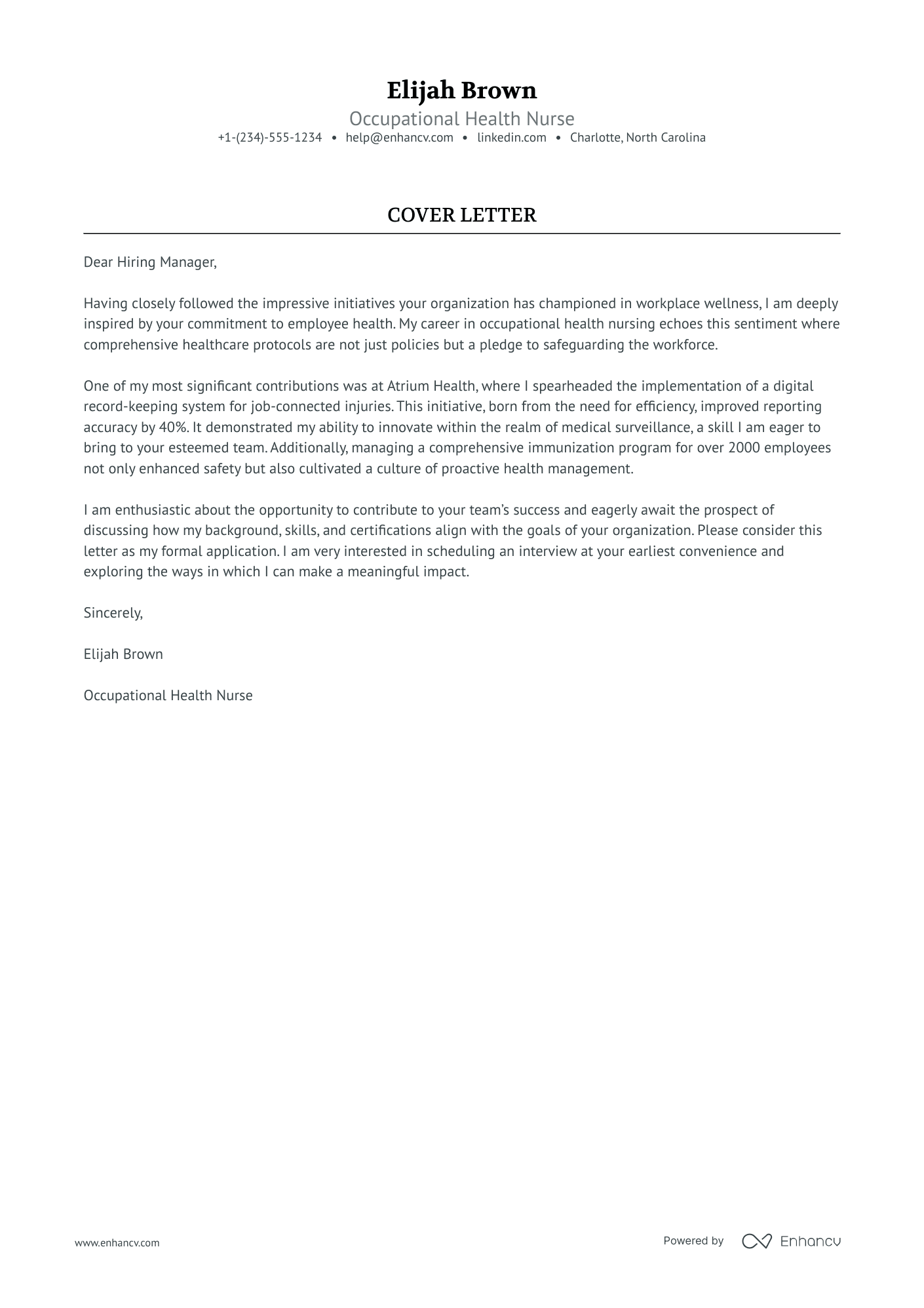
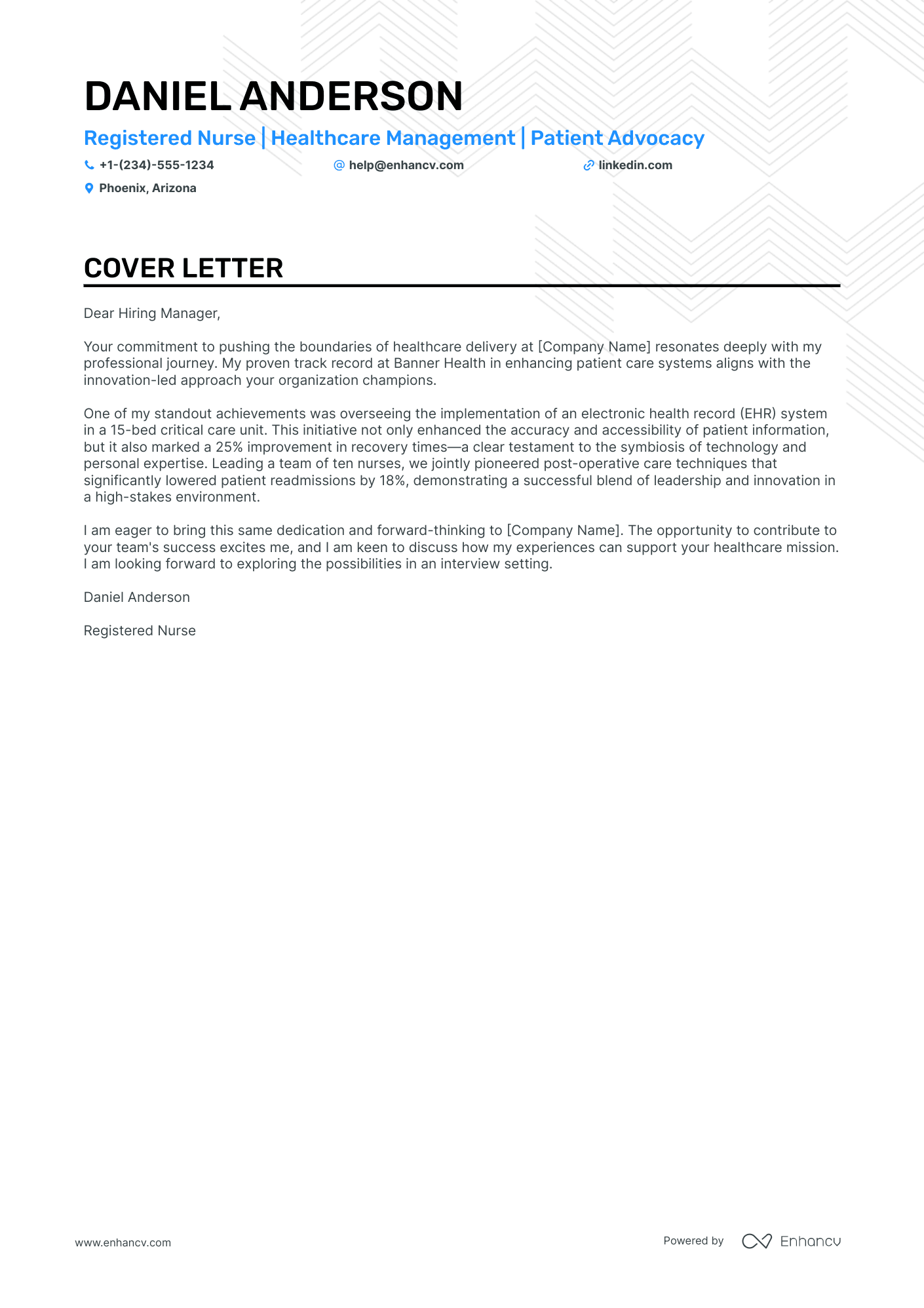
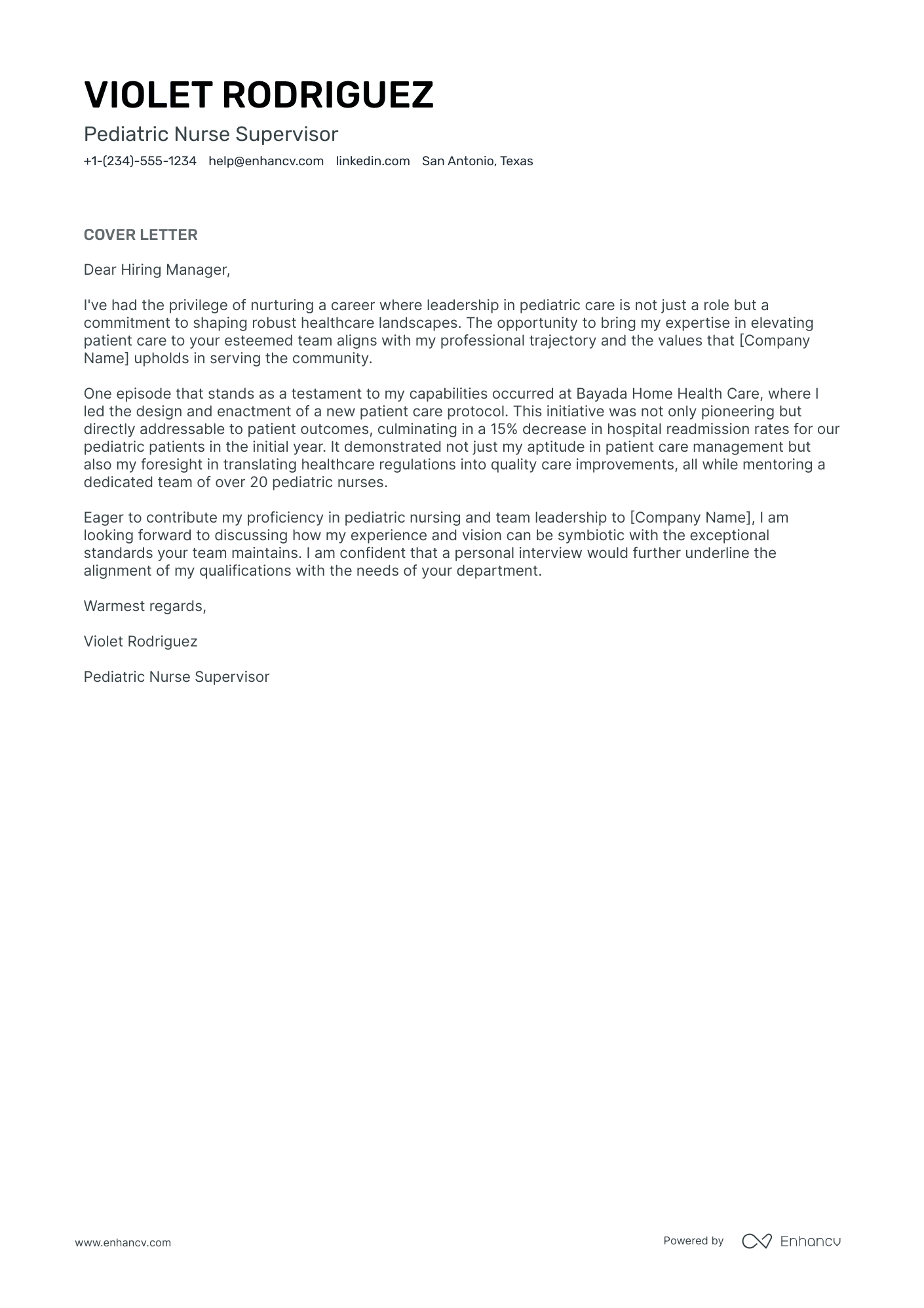
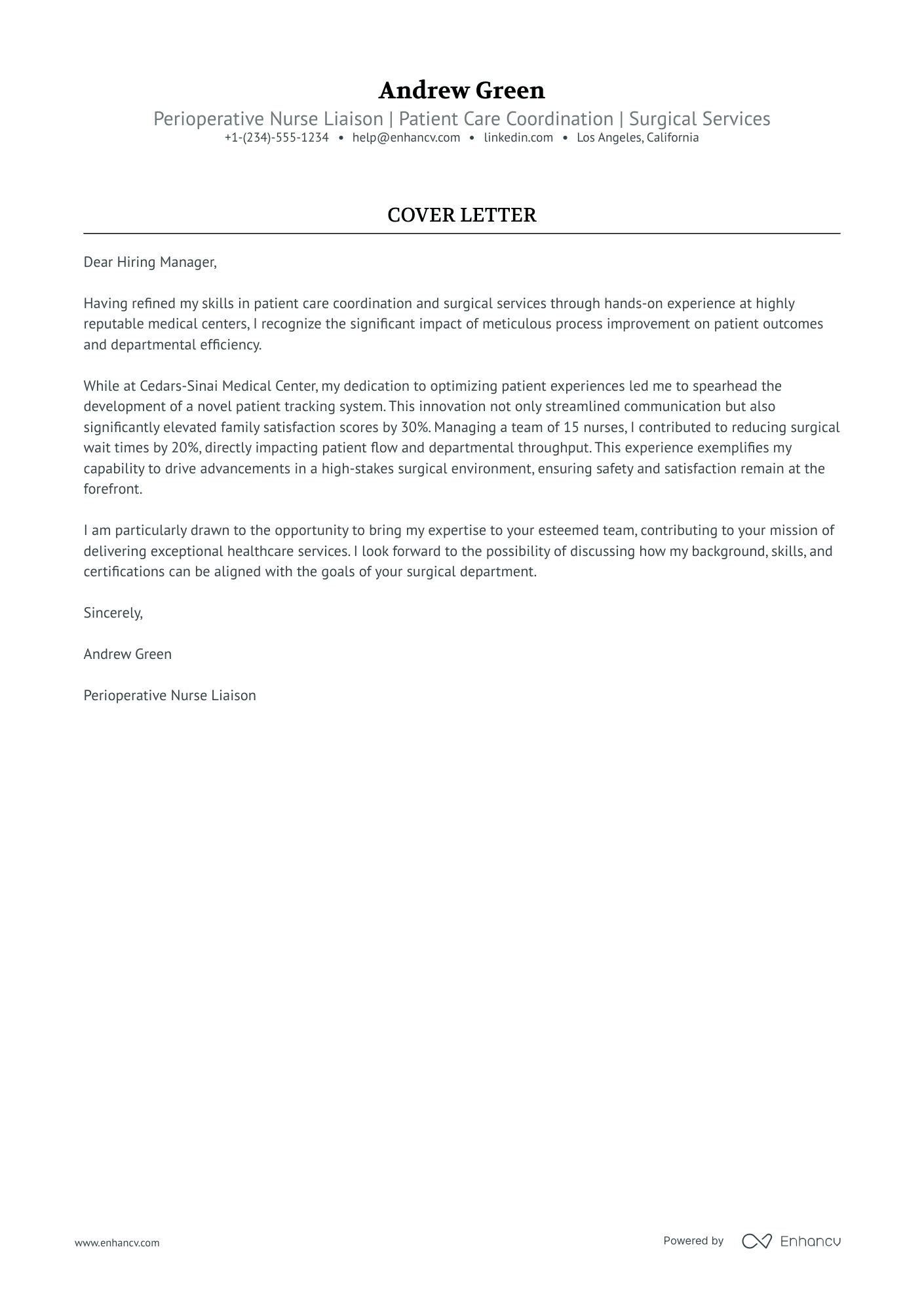
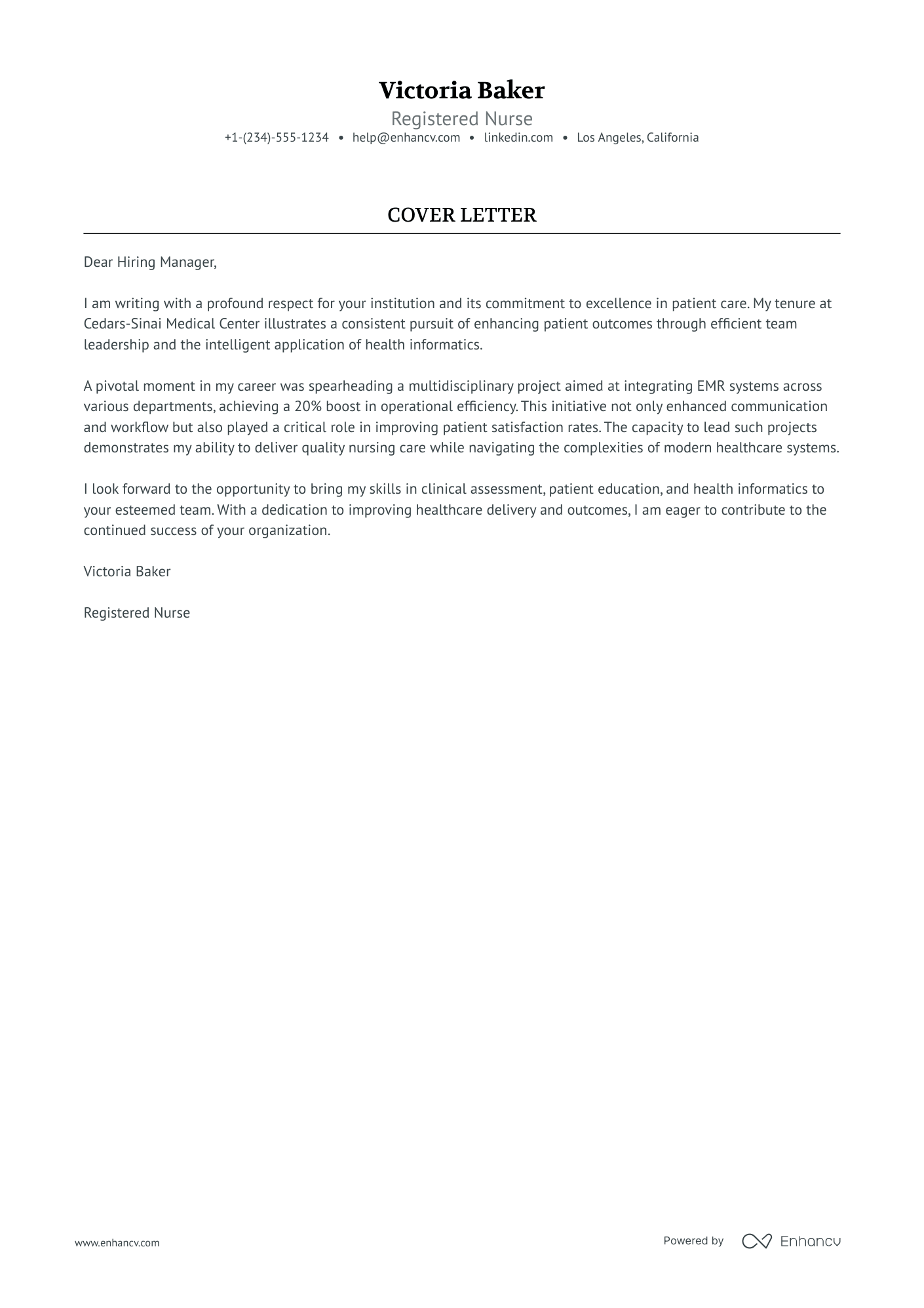
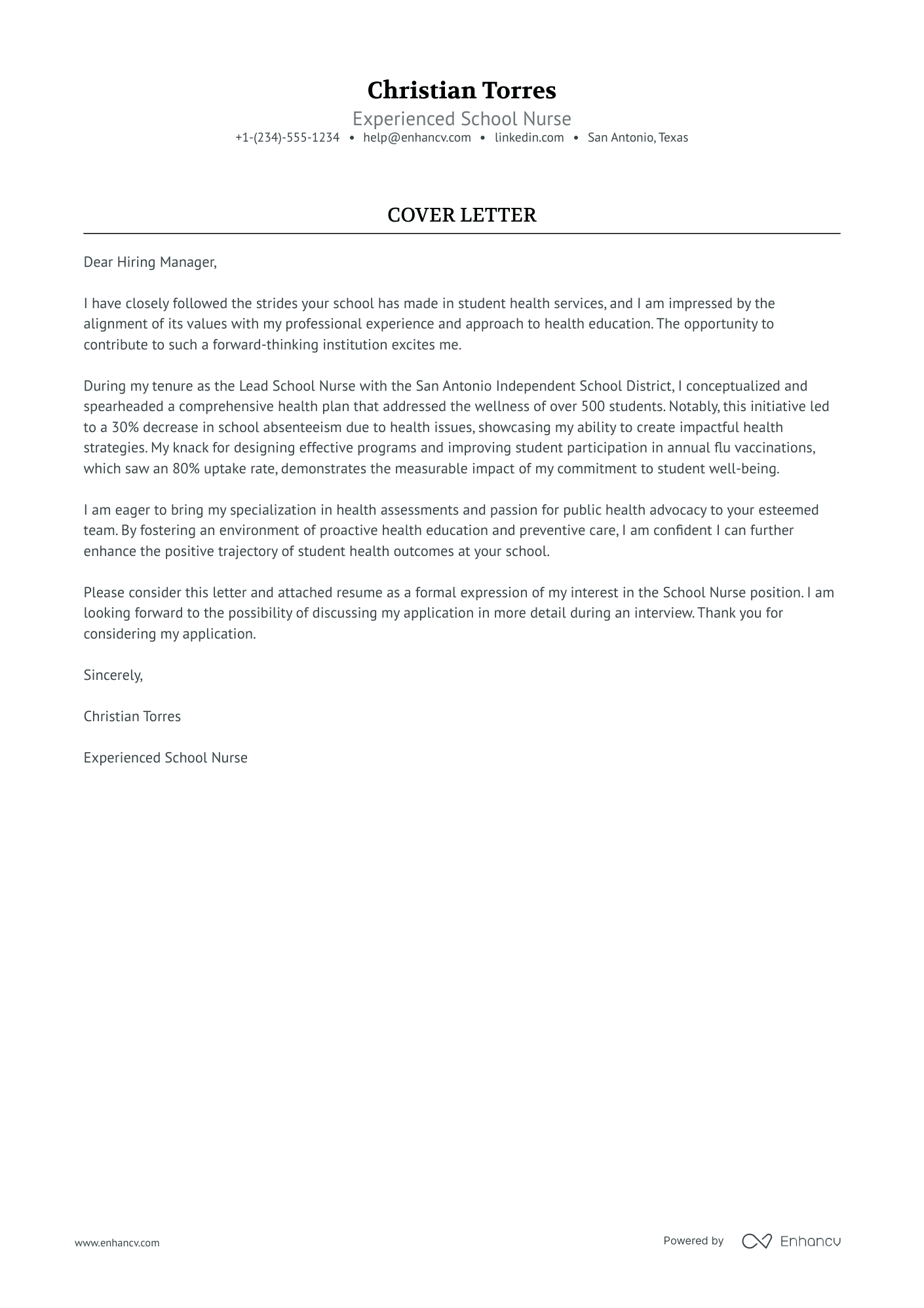
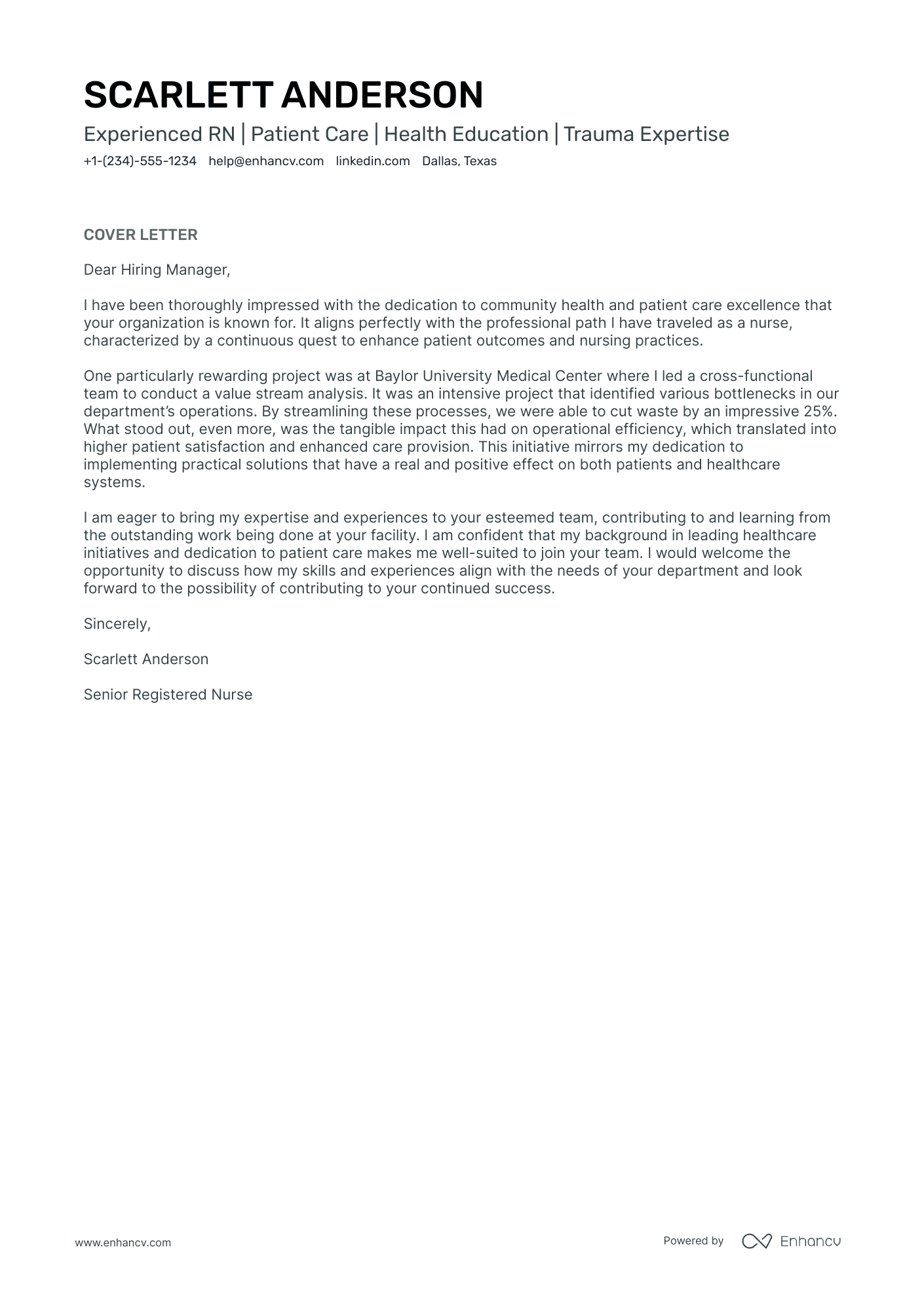
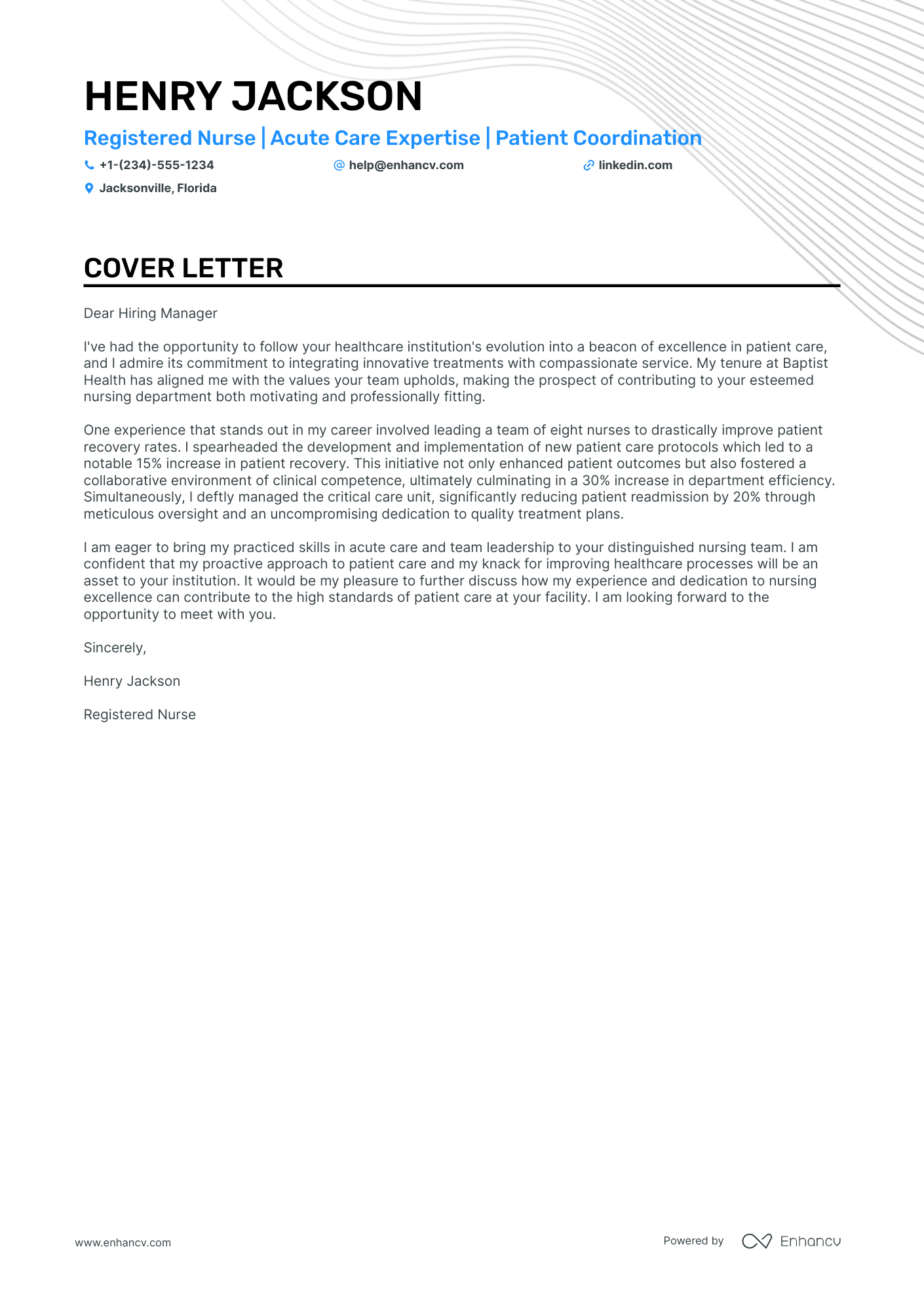
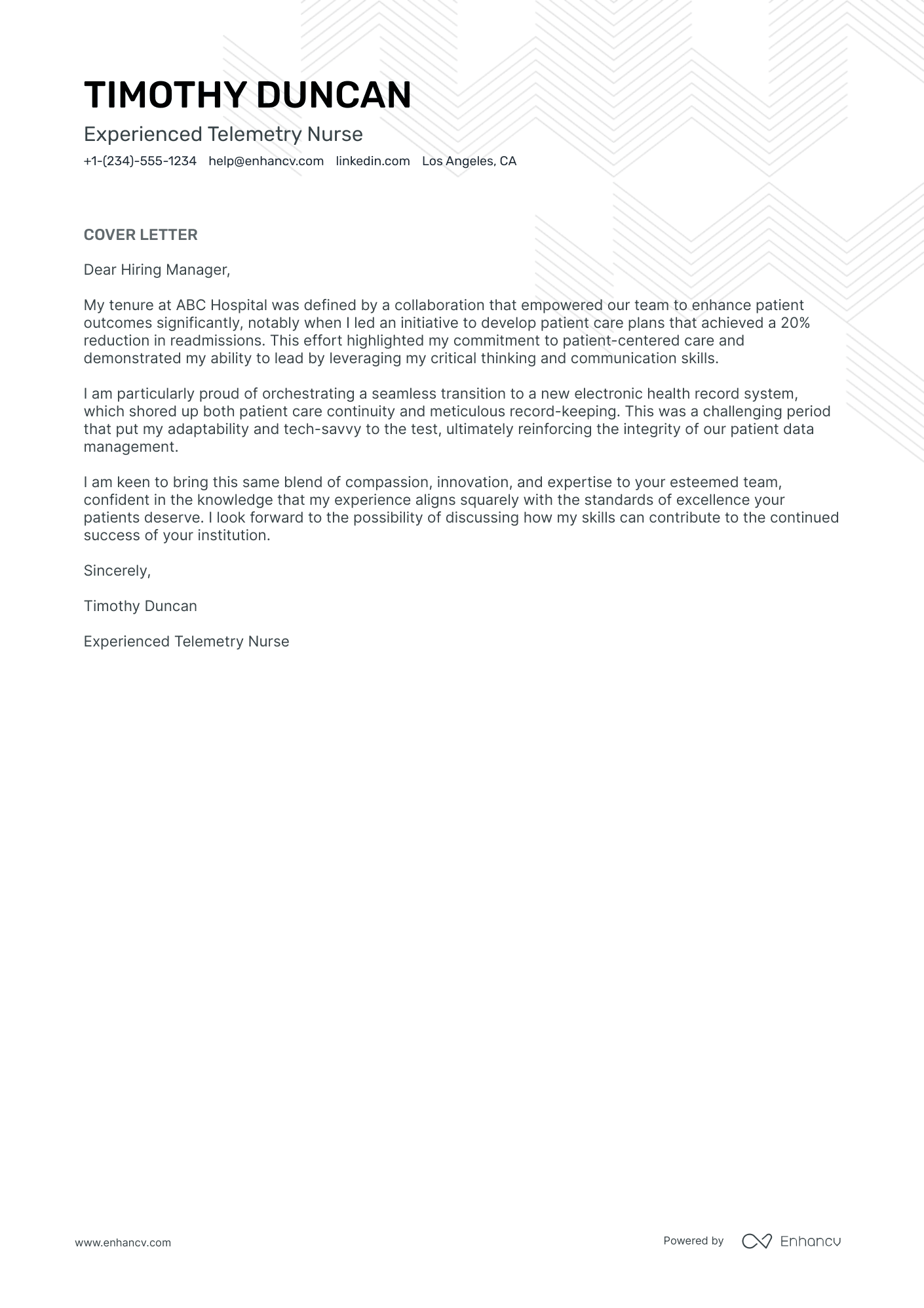
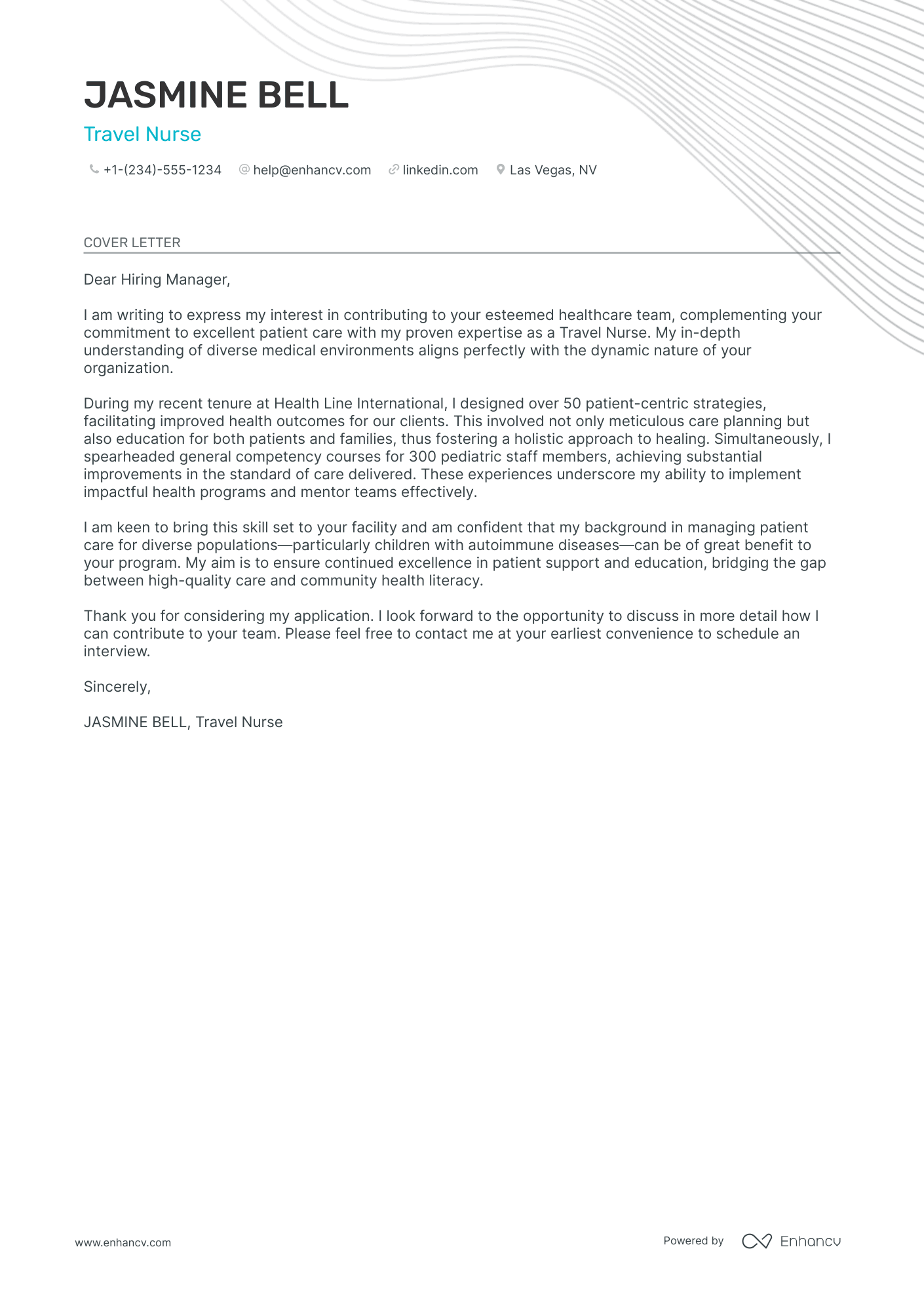
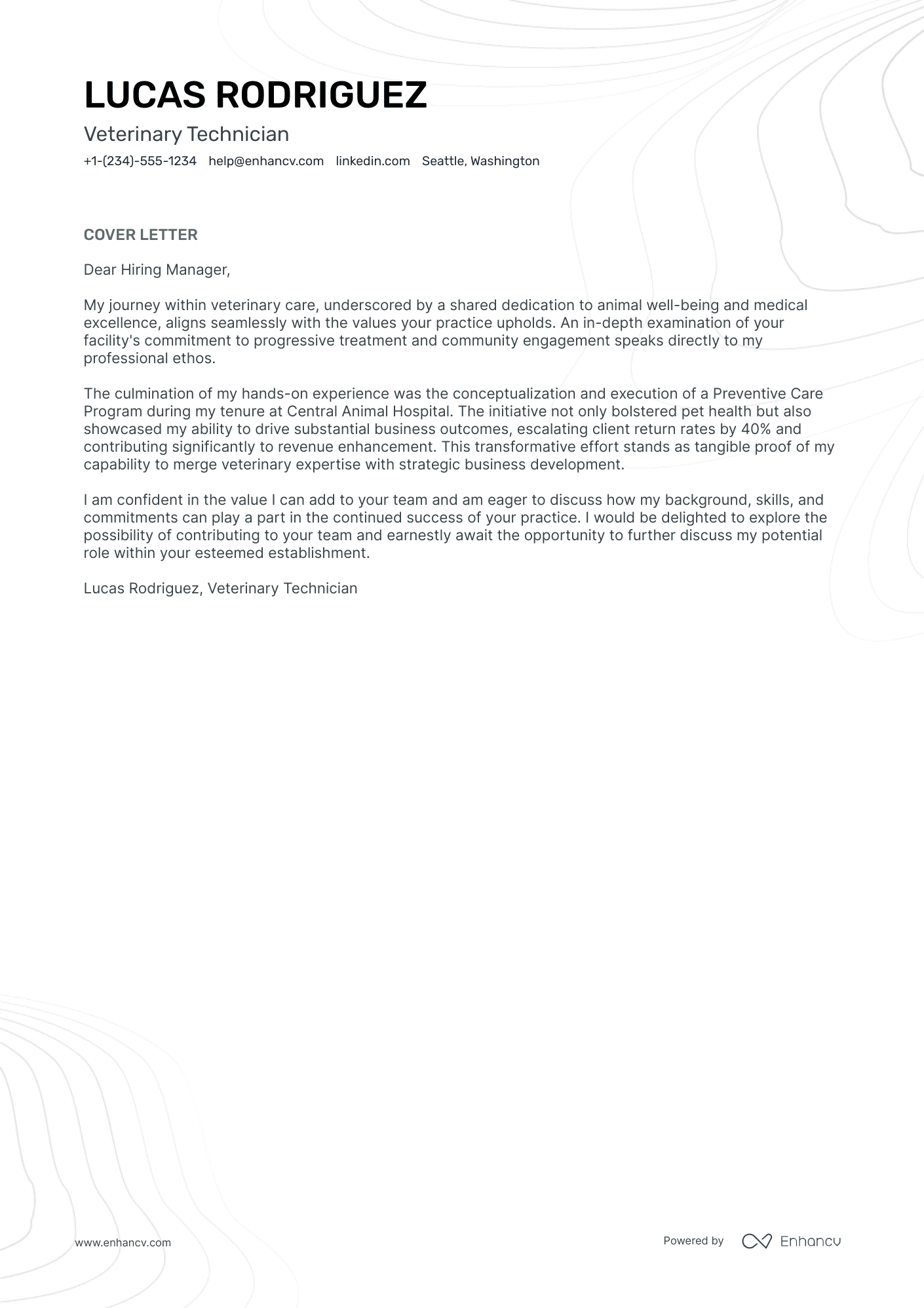
What makes a nurse cover letter actually get read?
A nurse cover letter is basically a one-page pitch. You’re trying to tell a unit manager a few things at once — that you’ve got the right license for the unit, that your specialty experience is a fit, that your shift availability isn’t going to be a problem, and, ideally, one specific thing you’ve actually done on your last unit. The person reading it, usually the unit manager (though sometimes a nurse recruiter first, and sometimes HR as well, depending on the hospital), gets through the letter in about 30 seconds on the first pass.
The issue with most nurse cover letters is that they open with some version of the same five soft skills. Compassion. Communication. Attention to detail. Teamwork. Critical thinking. Maybe adaptability if the applicant’s feeling adventurous. And none of those really tell the unit manager whether you can handle a six-patient telemetry load on a Saturday night.
So that’s the gap a nurse cover letter has to close, more or less. Under a page, credentialed and documented, concrete about what you’ve actually done on past units — that’s pretty much the whole job.

Five things a nurse cover letter has to do in under 400 words
- Get your credentials in the first couple of sentences — RN, BSN if you’ve got it, any specialty certs worth naming.
- Say what patient ratios you’ve actually carried. The actual number, or as close as you can get to it. “A variety of loads” doesn’t count.
- One outcome in the body, ideally with a number attached. Fall rate, HAI rate, discharge turnaround time, pick one.
- Show you know what kind of hospital this is. A Magnet reads differently than a for-profit, and both read differently than a VA or a small community hospital, more or less.
- Three-quarters of a page, give or take. Full page is still fine. Longer isn’t.
Nurse cover letter example — RN applying to a med-surg role
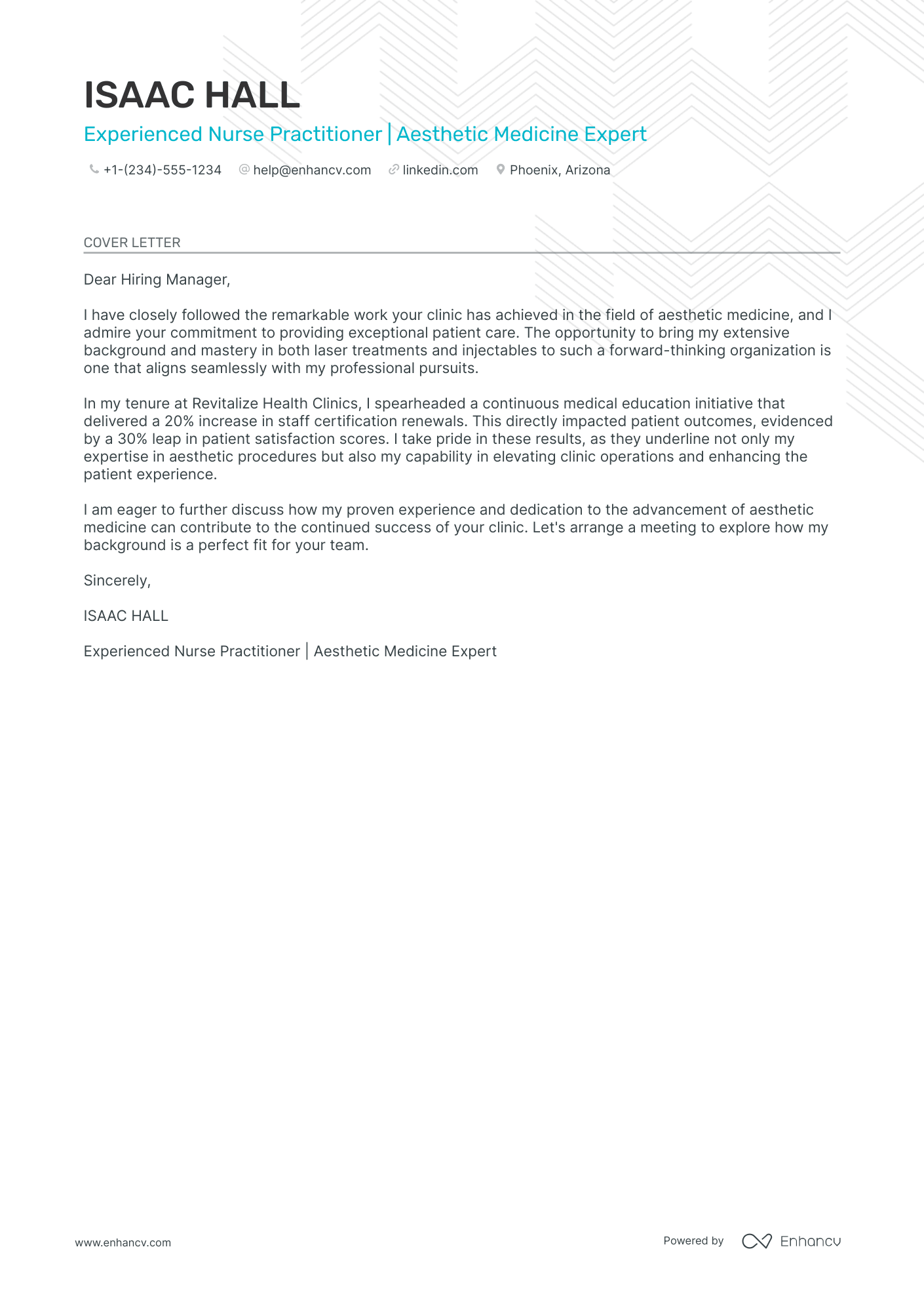
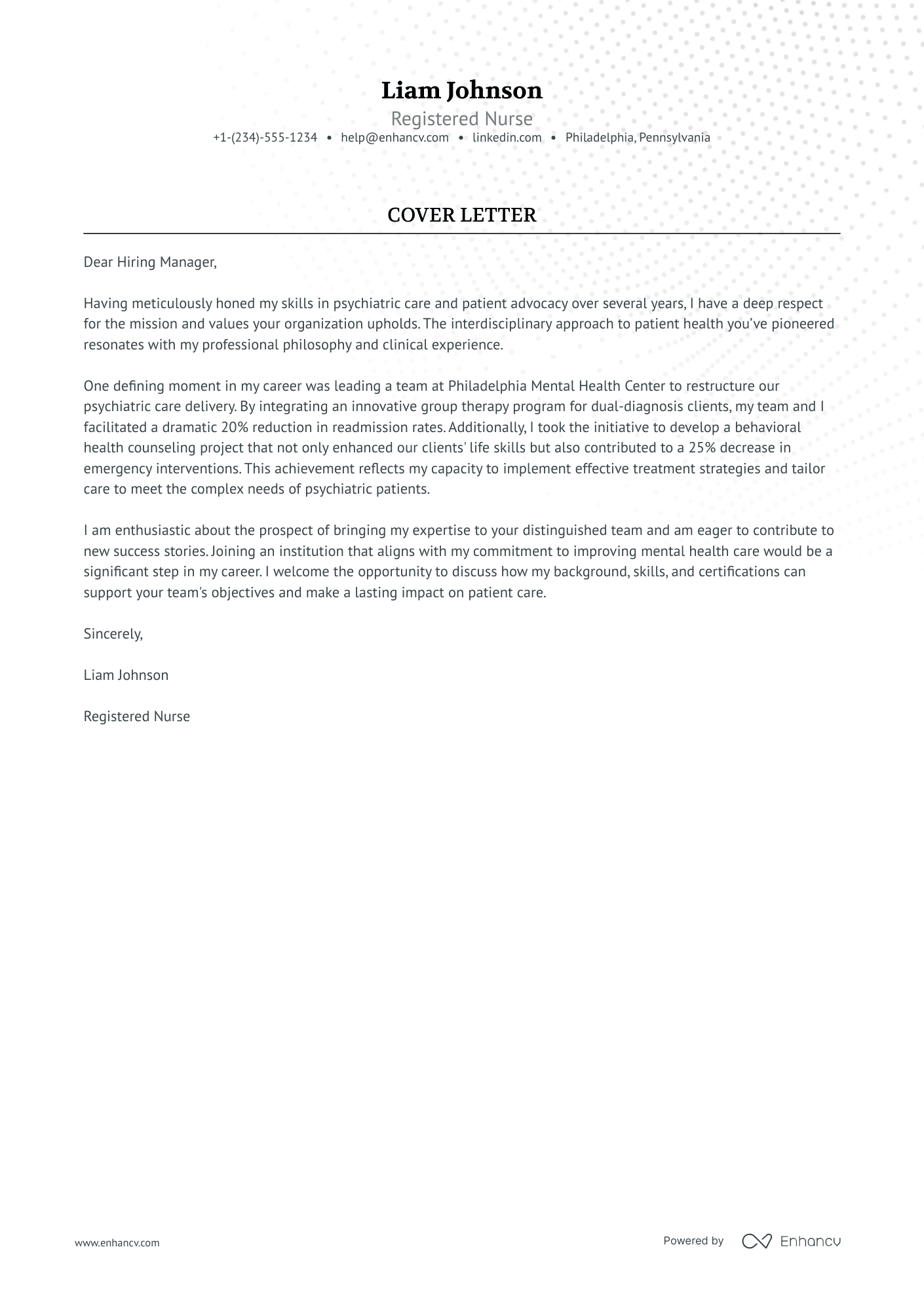
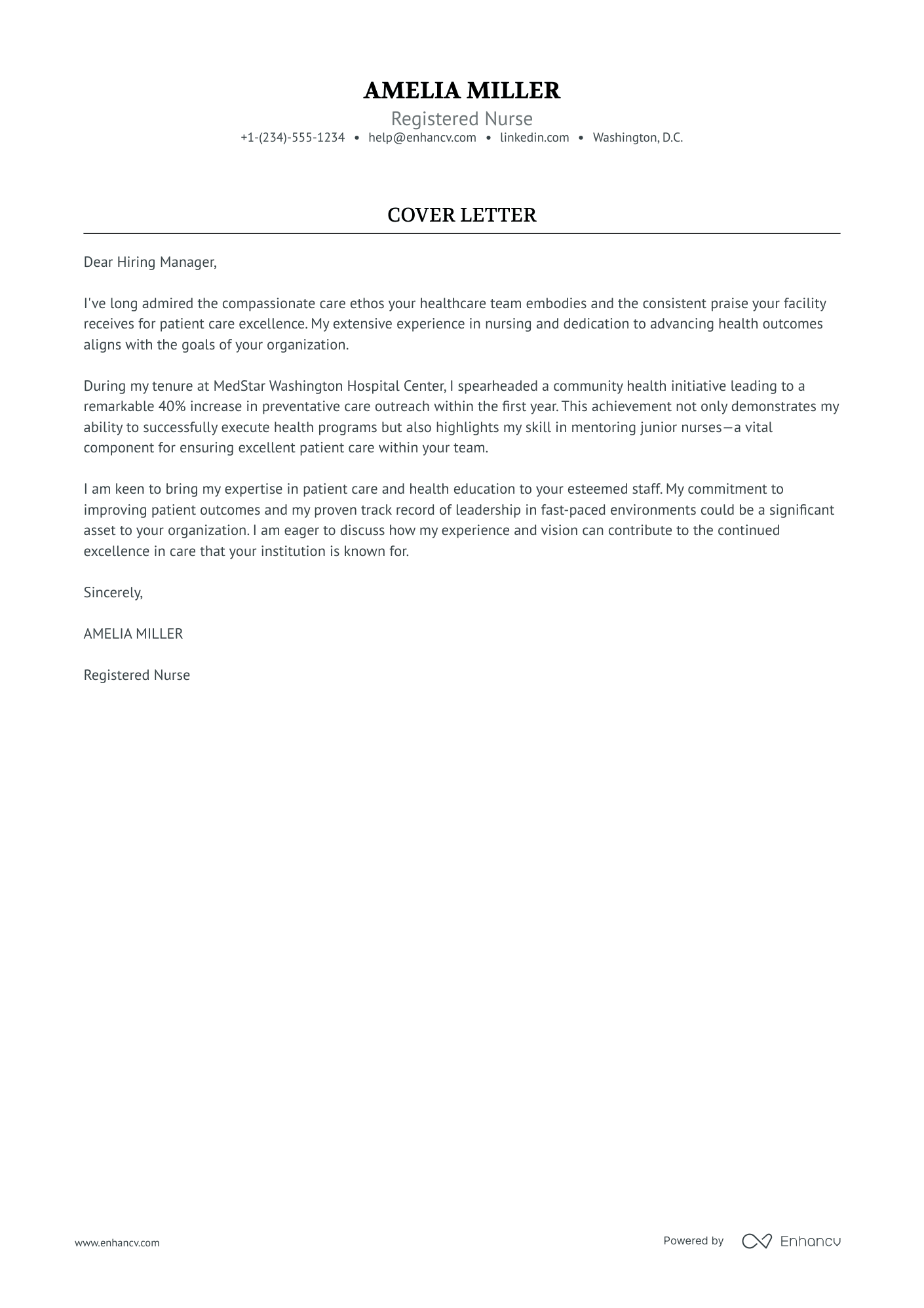
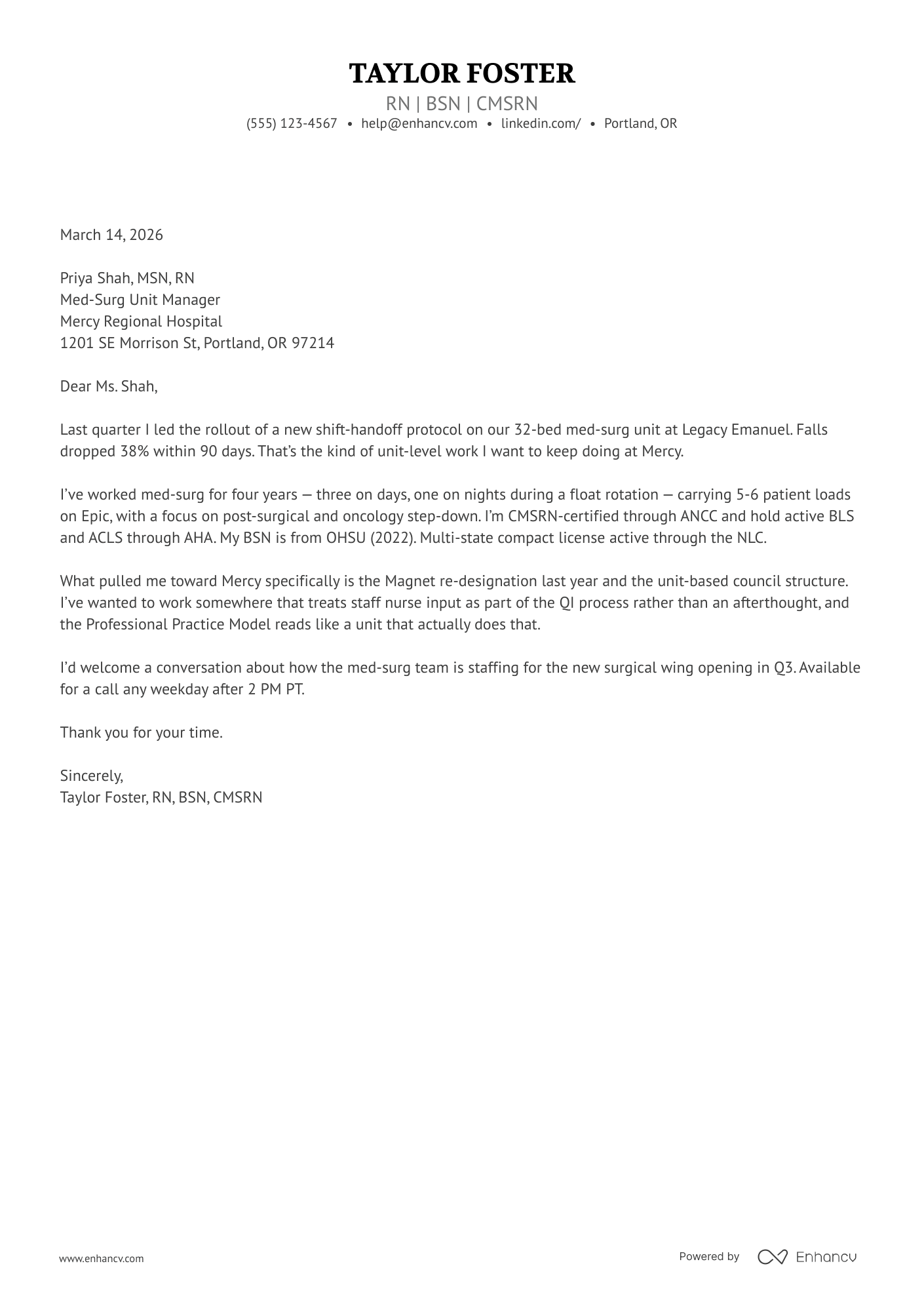
Below is a full letter — senior RN going for a 28-bed med-surg unit at a Magnet-designated hospital. A few things worth noting in it: the header block with contact info, date, recipient address (nurses sometimes skip some of this, but honestly, it shouldn’t be skipped), the outcome sitting in paragraph one, the way the closing ties back to the specialty. The usual cover letter format rules still apply, though the format itself is pretty much the easy part. The substance is what the unit manager is actually reading for.
Taylor Foster
Portland, OR
(555) 123-4567
help@enhancv.com
1201 SE Morrison St, Portland, OR 97214
Taylor Foster, RN, BSN, CMSRN


Worth noting what the letter doesn’t do. No “I am writing to express,” obviously. No long strings of adjectives. Nothing about “fast-paced environments” or whatever the stock phrase of the year happens to be. Every sentence in the letter is either a fact a unit manager could verify later, or a specific match to Mercy as a hospital. And that’s what makes it usable — somebody reading it can check items against the job posting and move on without squinting at vague language.
The letter only does half the work, of course — the claims it makes (ratios, certs, unit type) have to line up with what a recruiter sees on the nurse resume sitting next to it, or the package falls apart on the second read.
What should a nurse cover letter cover?
There’s a rough order that most unit managers read a nurse cover letter in, and it tracks four questions pretty closely. They’re not always conscious about it — but in practice, if a letter misses one of the four, it tends to get filtered out before anyone reads the body paragraphs properly.

The four questions a unit manager is asking
- License and cert currency. RN, BSN if you’ve got it, any specialty certs current through ANCC or whichever credentialing body is relevant. If you’re CCRN, that belongs up top in the opening sentence, not buried in the signature block where it’s easy to miss.
- Actual patient loads, with the ratio named. A 6-patient med-surg load is genuinely different work than a 2-patient ICU load, so say the specific ratio you’ve actually carried. “Variety of patient loads” tells the unit manager basically nothing useful.
- One concrete outcome from your last unit. Something with a number attached, ideally — fall reduction, HAI rate, throughput improvement, discharge timing, that kind of thing. It doesn’t have to be flashy. It just has to be specific, and ideally verifiable against the resume.
- Why this hospital, specifically. Magnet status, union versus non-union, teaching versus community, whether there’s a new wing opening or some recent QI initiative worth naming. Show you’ve done the five minutes of research on the place. Most applicants, frankly, haven’t.
That’s more or less the whole job on the unit-manager side. If you’ve got those four answered somewhere in the first two paragraphs, you’re past the first filter. The general mechanics of how to write a cover letter take care of the rest — but the nurse-specific work is front-loaded, and it’s the part most applicants tend to get wrong.
Which nursing credentials should you mention — and when?
Credentials might look like padding at first glance, but in practice they’re the first thing a nurse recruiter checks against the posting, usually before a full sentence of prose gets read. That’s why they belong in the signature block and header, and the essentials should probably get repeated in the opening paragraph — basically anywhere but paragraph three.
Credentials nurses should mention in a cover letter
| Credential | Where it goes | When to mention |
|---|---|---|
| RN license + state | Signature + opening | Every letter. Note NLC compact status if you’re applying out of state. |
| BSN or MSN | Signature + opening | Every letter. BSN is basically the floor for most Magnet hospitals at this point. |
| Specialty cert (CCRN, PCCN, CMSRN, CEN, CNOR, RNC-OB) | Opening paragraph | When it matches the unit. CCRN for ICU, CMSRN for med-surg, CEN for ED, CNOR for OR. |
| BLS, ACLS, PALS, NRP | Body or signature | List the ones the posting actually requires. PALS for peds, NRP for L&D and NICU, ACLS for most adult critical care. |
| Precepting or charge experience | Body | Name it explicitly. Charge nurse and preceptor roles carry their own signal, separate from tenure. |
Certs with no expiration date tend to read as stale, even if they’re current — put the year next to each one on your nurse resume. You can probably skip the year in the cover letter itself, but the recruiter will be checking the resume right after, so the two need to line up.
A nurse-specific thing worth mentioning: the NLC (Nurse Licensure Compact) covers around 41 states now, give or take depending on when you’re reading this. If you’re licensed in a compact state and applying in another compact state, mention it somewhere in the opening line. It quietly removes one credentialing step the recruiter would otherwise have to flag, and those small things actually tend to add up.
How do you match a nurse cover letter to the specialty, shift, and hospital type?
This is where a lot of nurse cover letters fall apart. Someone writes one reasonable letter and then sends some version of it to a Magnet teaching hospital, a for-profit HCA system, a Kaiser HMO, a VA facility — which, practically speaking, are four pretty different jobs. The letter should read that way.
Specialty first. An ICU nurse cover letter tends to lead with CCRN, the ratios you’ve run (1:1 or 1:2 usually), some vent and drip experience, maybe ECMO if you’ve done it. Med-surg is a different opener — CMSRN, 5–6 patient loads, post-op protocols, discharge coordination, which is more or less what a medical-surgical nurse cover letter should be leading with. ER is usually CEN plus triage volumes, trauma-center level (I through V), and throughput numbers if you’ve actually tracked them. L&D and NICU want RNC-OB or NRP, and delivery volume tends to matter more than applicants realize.
Shift. If the posting is nights-only, say you’ve run nights — and say it as a fit, rather than as a concession. “I prefer the 7p–7a rhythm and the smaller cross-functional team at night” lands very differently than “I’m flexible on shift.” Float-pool experience is its own kind of credential, and it’s worth naming if you have it.
Hospital type. Each kind of employer tends to read a nurse cover letter through a slightly different lens. The table below is a rough sketch — not exhaustive, but it covers most of what tends to land and what tends to get cut at each of them.
Hospital type — what each one looks for in a nurse cover letter
| Hospital type | What they look for | What to avoid |
|---|---|---|
| Magnet (academic or teaching) | Evidence-based practice language, shared governance, BSN, professional certifications, QI project leadership | Listing tasks instead of outcomes; no mention of evidence-based practice anywhere |
| For-profit system (HCA, Tenet, CHS) | Productivity metrics, throughput, staffing flexibility, cost-of-care awareness | Over-academic language; ignoring efficiency signals in the posting |
| Integrated HMO (Kaiser Permanente) | Care coordination, prevention focus, panel management, team-based care | Acute-only framing; ignoring continuity of care |
| VA or federal | Veteran population familiarity, federal credentialing (Title 38), trauma and PTSD awareness | Generic patient-centered language; no veteran-specific experience at all |
| Community hospital | Breadth over specialty, cross-coverage, community ties, tenure | Over-specialization; no mention of float or cross-coverage experience |
What the matching actually tells the unit manager is something specific — that you know what kind of unit you’re applying to, which, frankly, most applicants don’t bother to demonstrate.
What mistakes get nurse cover letters rejected?
There are four patterns that show up on more than half the nurse cover letters a unit manager reads on any given week, more or less. All four are reasonably fixable in an edit pass, assuming the applicant catches them before hitting submit.
The opener that burns the first sentence
“I am writing to express my interest in the registered nurse position at your facility. With my dedication to patient care and attention to detail, I believe I would be a great fit for your team.”
No credentials. No specialty. No hospital name. No number. A nurse recruiter is pretty much guaranteed to move on.
The opener that holds attention
“I’m a CMSRN with four years on a 32-bed med-surg unit at Legacy Emanuel, carrying 5-6 patients on days. Last quarter our shift-handoff protocol change cut falls 38% — I’d like to bring that kind of unit-level work to Mercy’s Professional Practice Model.”
A few other patterns worth cutting:
- Skill-list soup. “Compassionate, detail-oriented, excellent communicator, team player” — every second nurse applicant writes some version of that, which means it’s basically noise by the time the unit manager gets to the fifth letter of the day, and arguably earlier than that.
- Ratios missing. If you don’t name a patient ratio, the unit manager has to guess, and that’s never really the impression you’re trying to leave. Worth noting — a 1:2 ICU nurse applying to a 1:6 med-surg job is honestly a different conversation than a 1:6 nurse applying to 1:6, so naming the ratio matters even when it feels sort of obvious.
- One-page rule broken. Short cover letters tend to beat long ones for nurse applications in most cases. Hiring managers usually don’t read past about three-quarters of a page anyway, so padding past that tends to work against you more than it helps.

Before you send
Before sending, do a quick find-and-replace pass on the letter for words like “passionate,” “detail-oriented,” and “team player.” If any of them show up, rewrite that sentence with something concrete — a credential, a patient ratio, maybe an outcome from your last unit, or honestly any specific fact a unit manager could verify against the resume later.
Is a new grad nurse cover letter different from an experienced one?
Yes — or at least it should be, and treating them the same is one of the more common mistakes. A nursing student cover letter can’t really lean on patient-load numbers or QI wins, because there aren’t any yet, which is fine and expected. An experienced nurse, especially one applying to a nurse manager role, can lead with exactly that, and probably should.
New grad vs. experienced nurse — what leads the letter
| Writer | Leads with | Skips |
|---|---|---|
| New grad nurse | NCLEX-RN pass month (or scheduled date), BSN institution and graduation year, clinical rotation hours and settings (e.g., 520 hours across med-surg, ICU, and L&D at OHSU Hospital), capstone project if specialty-relevant, preceptorship, BLS/ACLS status | Years of experience; patient ratios; QI outcomes |
| Experienced nurse | Years in specialty, patient ratios carried, one outcome with a number, specialty cert (CCRN, CMSRN, CEN), charge or preceptor experience, a specific reason for the new hospital | General enthusiasm for nursing; clinical rotation hours from school |
New grads — one thing worth noting: even if you haven’t sat NCLEX yet, name the scheduled date. “Sitting for NCLEX-RN on May 12, 2026” gives the recruiter something concrete about when you’d actually be clear to start. Skipping that tends to cost interviews more often than people realize.
Who actually reads nurse cover letters?
Three people usually, more or less in this order — the nurse recruiter first, then the unit manager, and sometimes HR after that (or in parallel, depending on how the hospital runs things). Each one is looking for something a bit different.
The nurse recruiter is basically doing compliance work. They’ve got about 30 seconds per letter, and they’re checking credentials against the posting, license status, specialty match, whether your shift availability lines up with what’s open. If any of those don’t really line up, the letter doesn’t advance — and the recruiter isn’t checking for cultural fit, which is someone else’s call later in the hiring process.
The unit manager is the one reading the letter that actually made it through the recruiter stage. They’re looking at patient-load experience, what specialty certs you’ve got, and whether you’ve worked the kind of unit they’re running. Magnet is different from a for-profit HCA-style system, and teaching hospitals read differently than community ones. Day versus night shift matters too, though that’s often filtered at the recruiter level before the unit manager even sees the letter. And on top of all that, the unit manager is reading for whether you’d fit culturally with the team already on the floor.
HR reads last, mostly — and mostly looking for red flags. Employment gaps that don’t add up, license issues, phrasing that raises questions, the small stuff. HR rarely makes the yes call, but they can make the no call pretty easily, so the basics need to be clean. Dates that add up, credentials that are current, a phone number and email that match the resume, ideally no typos in the recipient’s name.
Nurse cover letter FAQ
How long should a nurse cover letter be?
Three-quarters of a page, give or take. A full page is still fine if you need the room for it. The general cover letter length guidance mostly applies here too — anything longer and the unit manager tends to stop reading before the interesting parts, which, practically, means the letter does the opposite of what you actually want it to do.
Do I need to customize a cover letter for every nurse application?
Yes, though honestly, not from scratch every time. Keep the credentials block and the outcome paragraph stable across applications — what changes is the opening sentence and the “why this hospital” paragraph, and those actually need to be rewritten for each one. Ten to fifteen minutes per letter in practice, not an hour, unless you’re pivoting specialties.
Should I mention salary in a nurse cover letter?
No — not in the letter, not in the signature, not anywhere, really. Some estimates put the BLS median RN wage around $86,070, though it varies quite a bit by metro and by specialty. Either way, negotiation happens off the posting and during the interview, not off the letter itself.
What if the posting doesn’t list a hiring manager name?
“Dear [Unit] Hiring Team” is probably the cleanest fallback. “To Whom It May Concern” reads a bit stale these days. “Dear Hiring Manager” is fine in some respects, though a bit impersonal. The standard salutation rules for a nurse cover letter aren’t really different from any other kind of cover letter — and for smaller hospitals, a quick LinkedIn search often turns up the unit manager by name in five minutes or less.
The bottom line
So to pull it together — a nurse cover letter earns its keep, more or less, when it does a few specific things in under a page. Your credentials and specialty certs need to be up in the opening, not buried somewhere in paragraph three. There needs to be at least one patient-outcome number in the body, ideally a concrete one. And the letter has to show the unit manager you know what kind of unit you’re applying to — Magnet, for-profit, integrated HMO, VA, community hospital, and they really are all pretty different. Get those few things in place and the standard soft-skill adjectives mostly become optional.