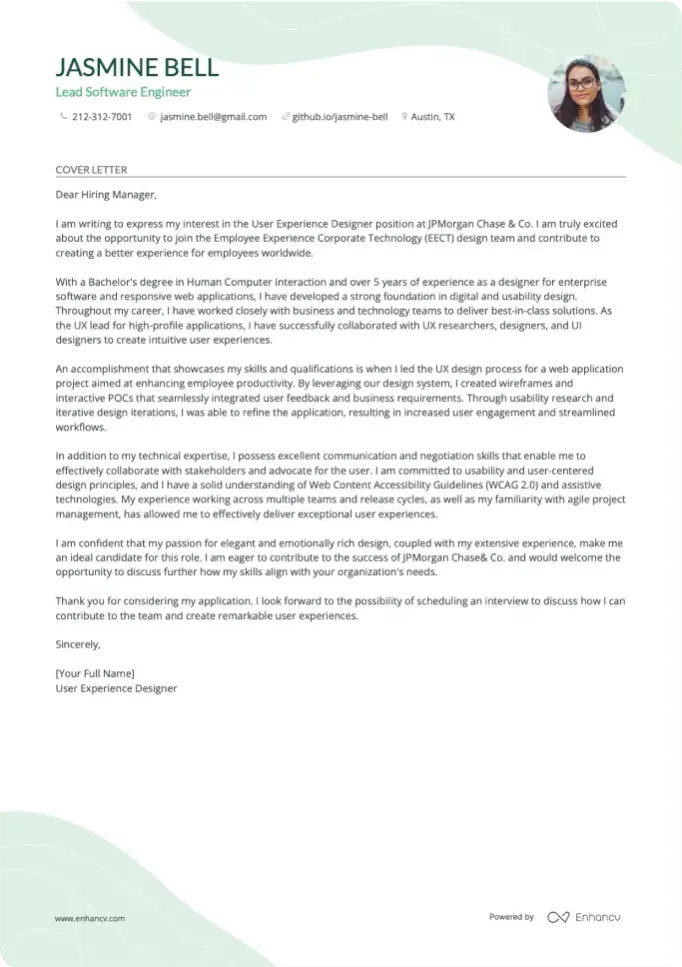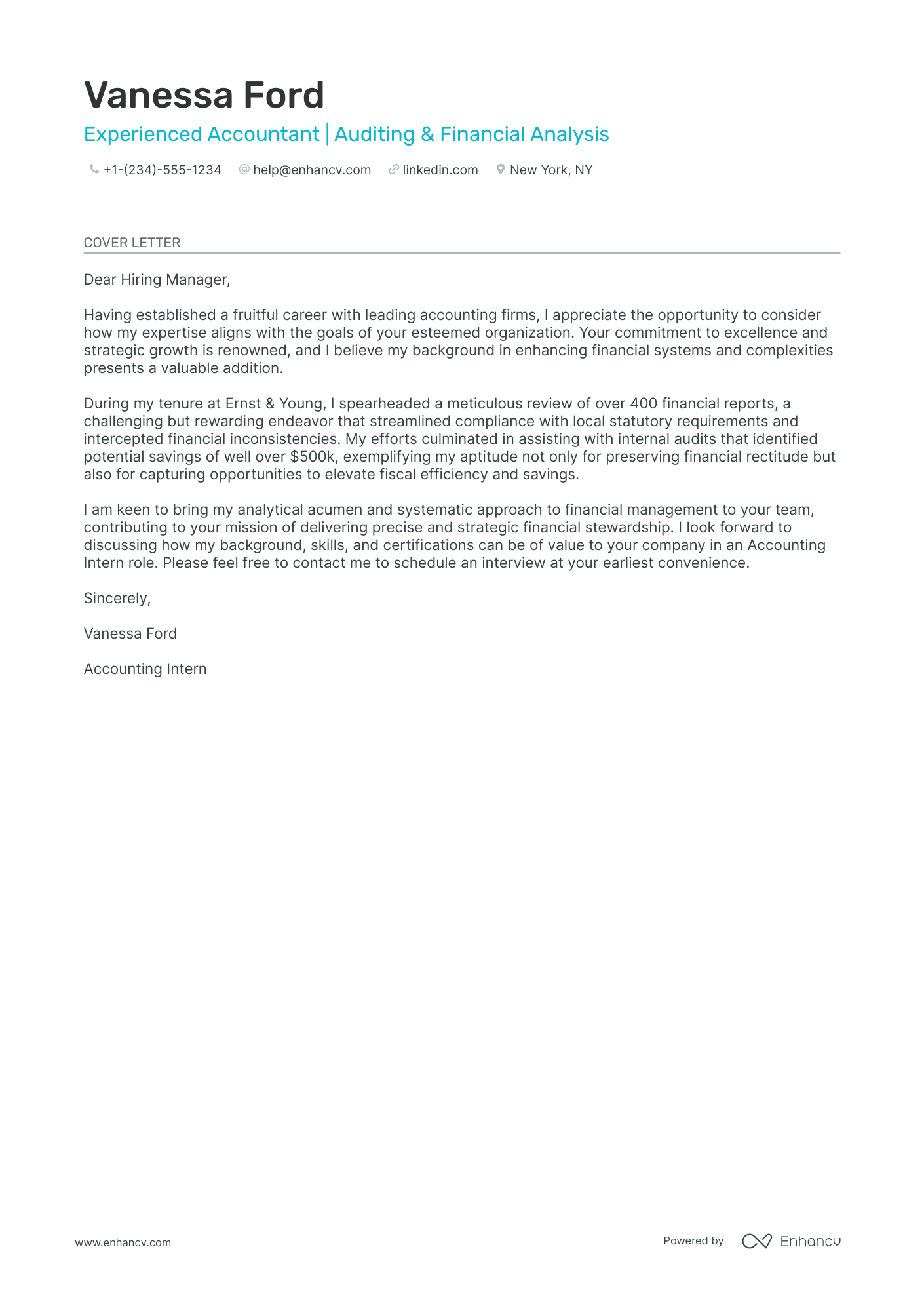
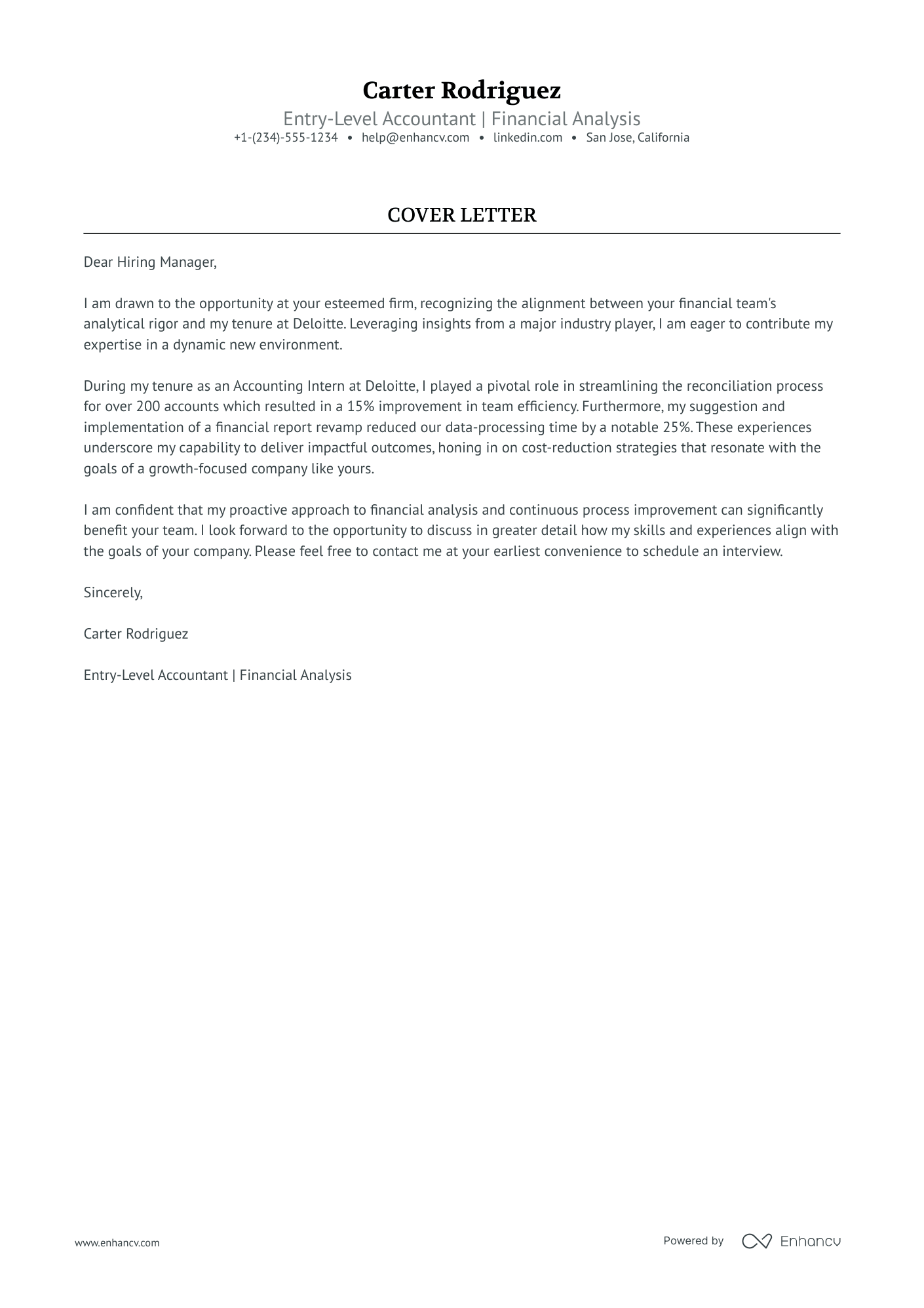
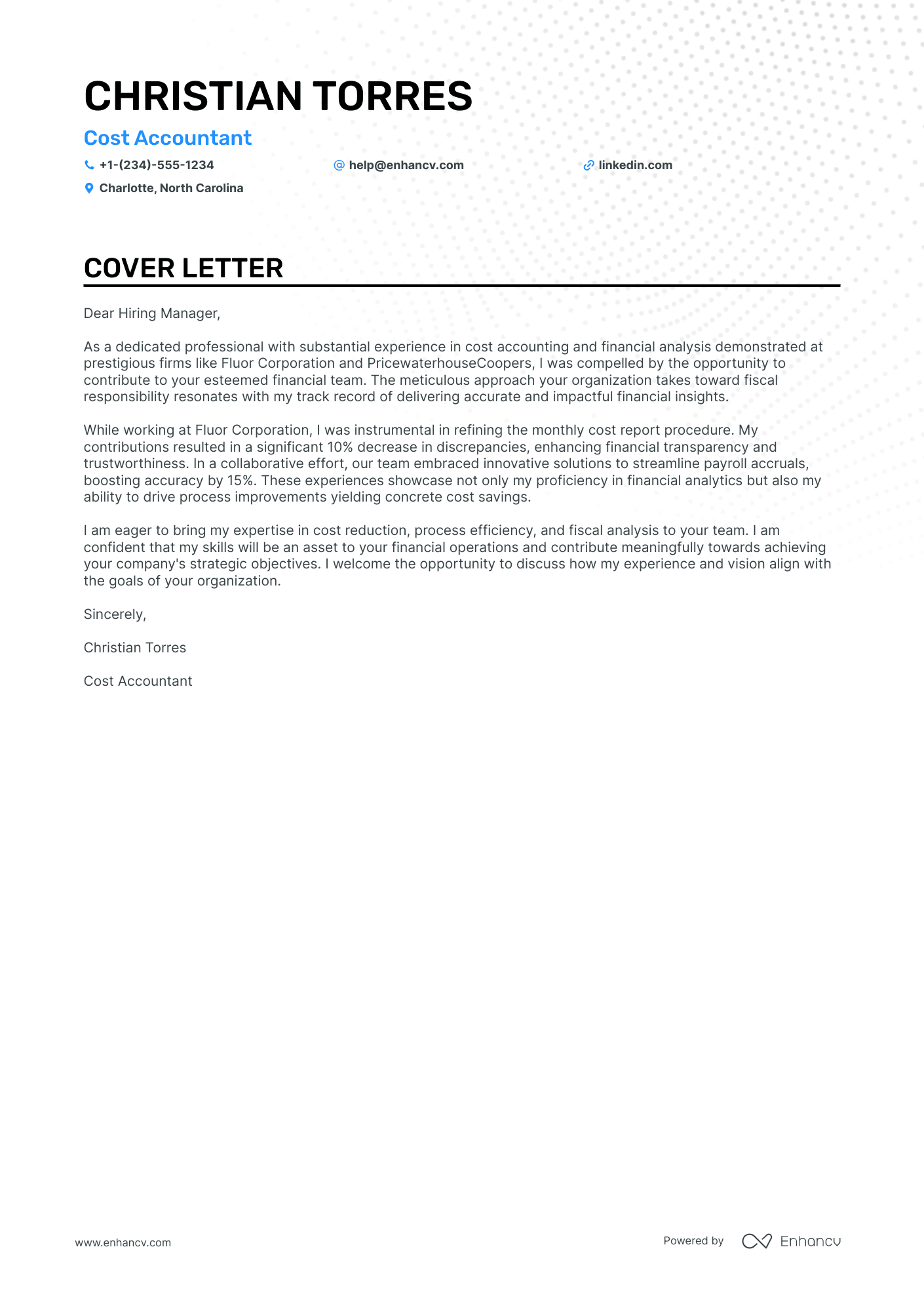
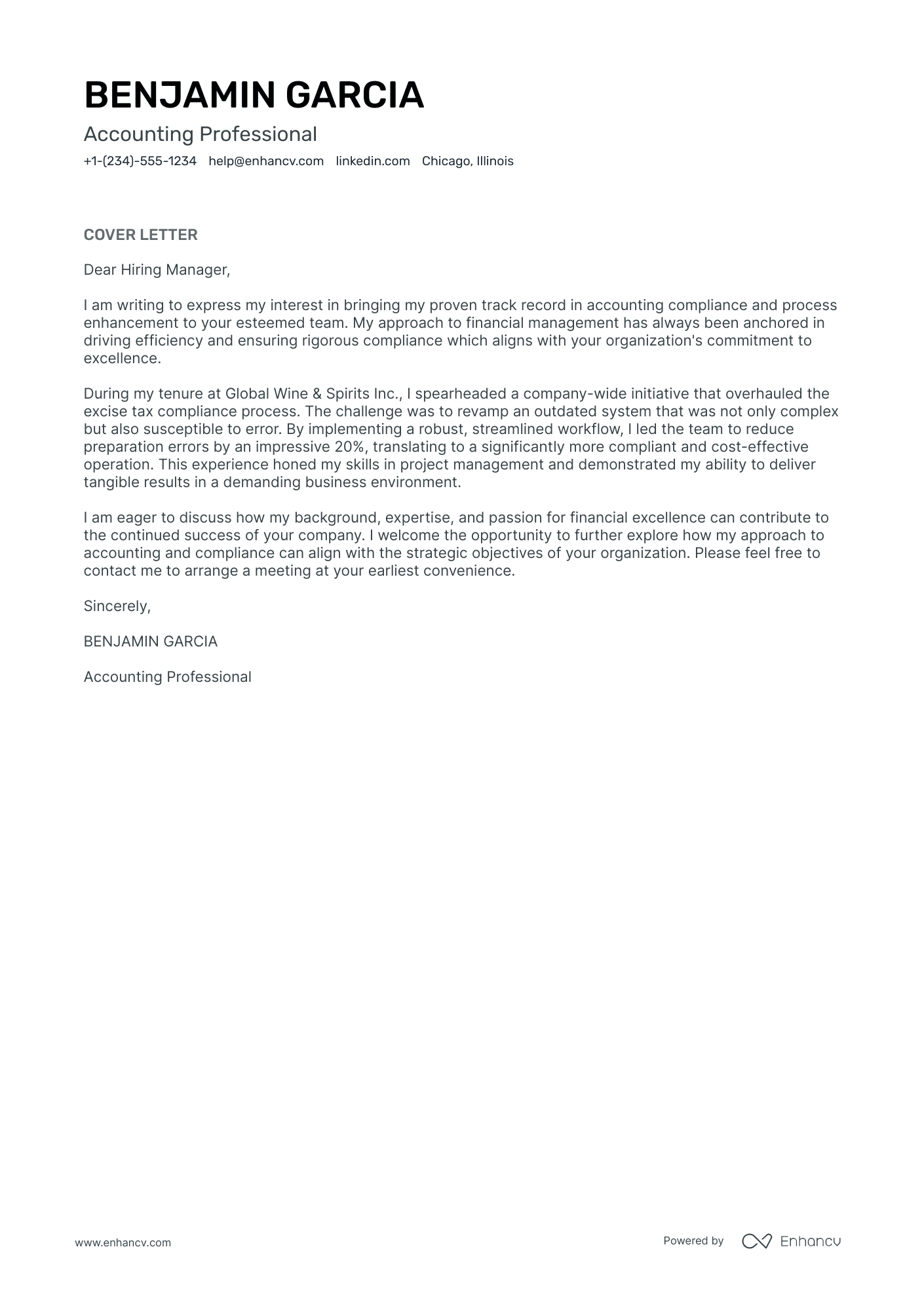
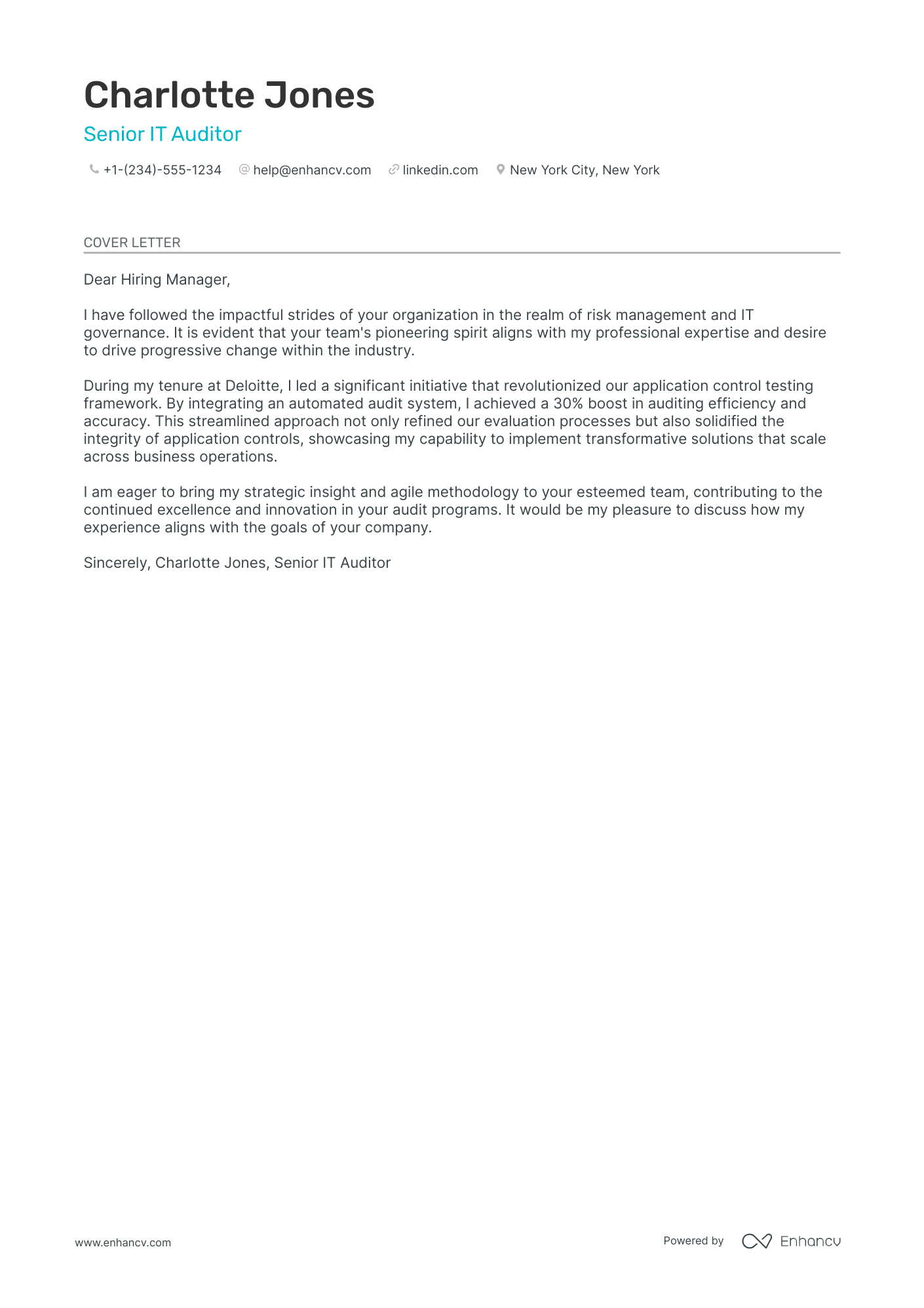
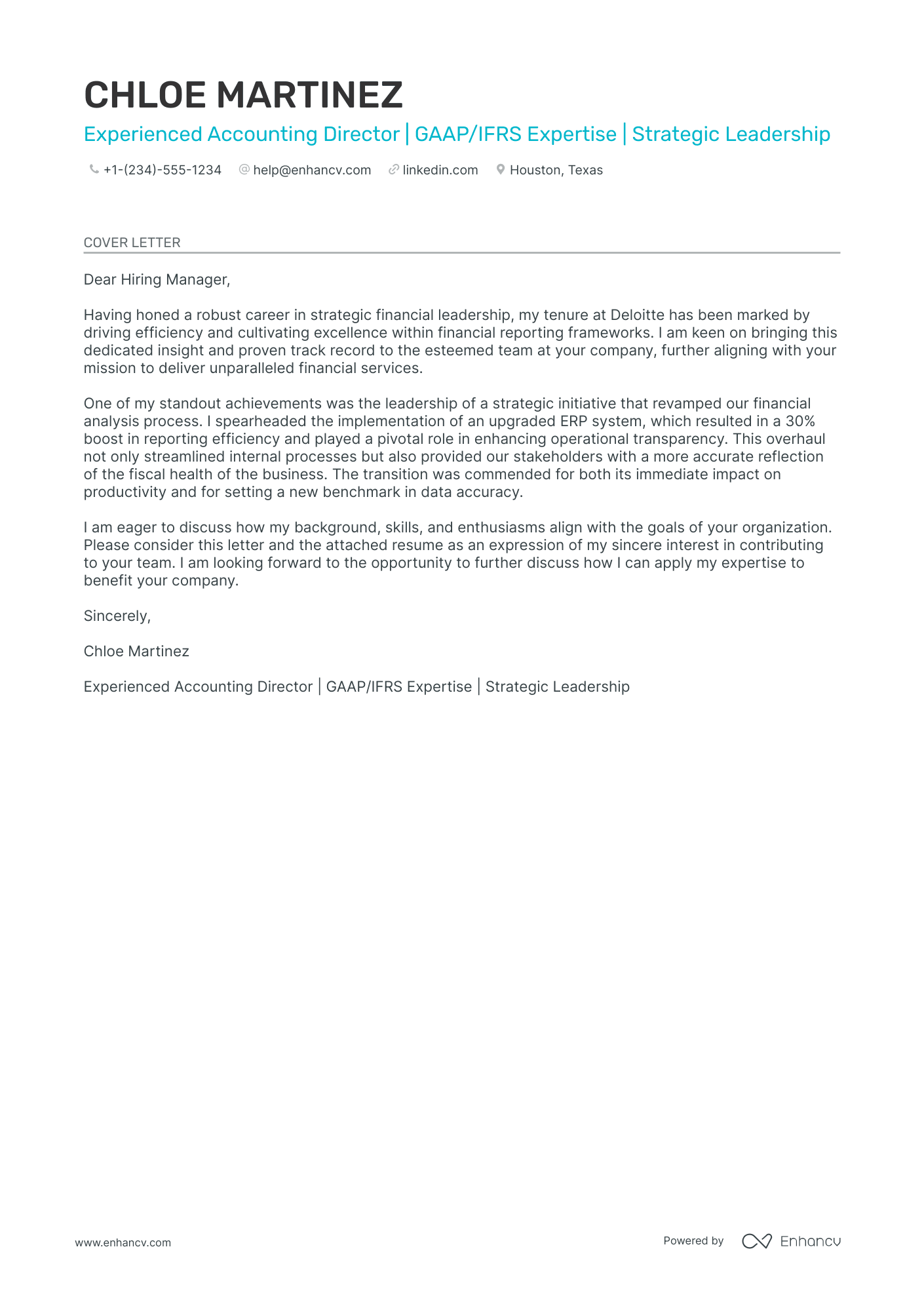
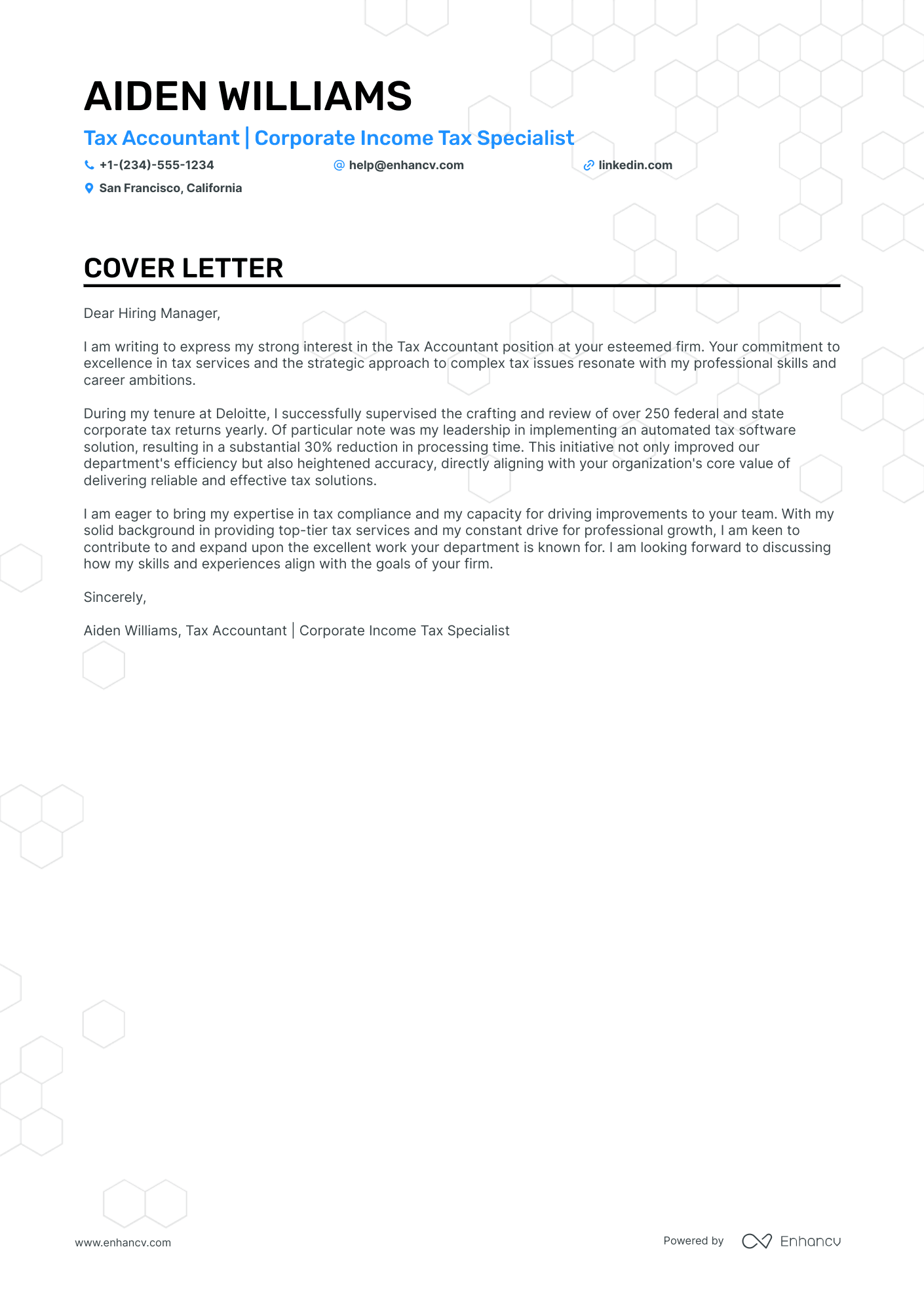
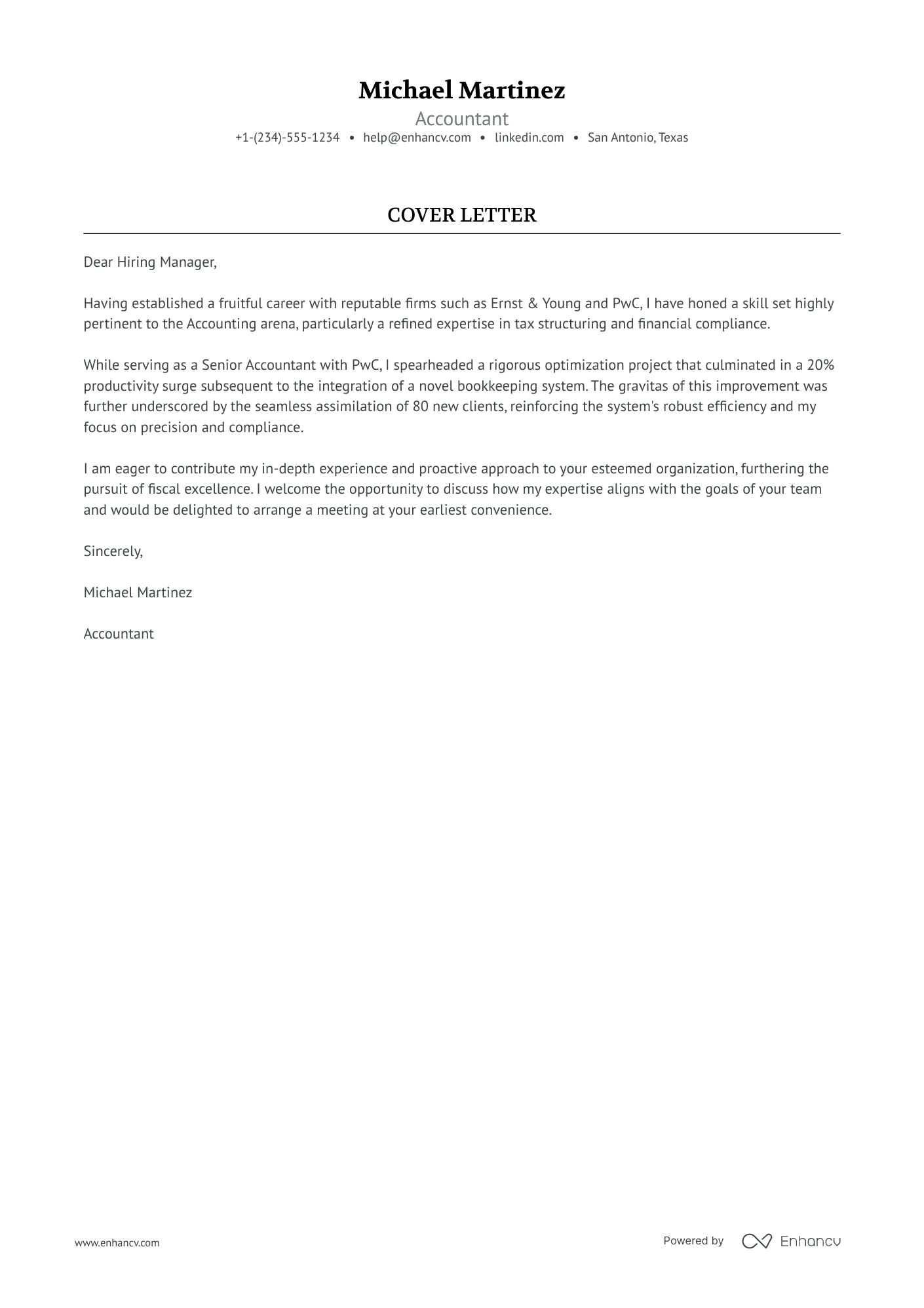
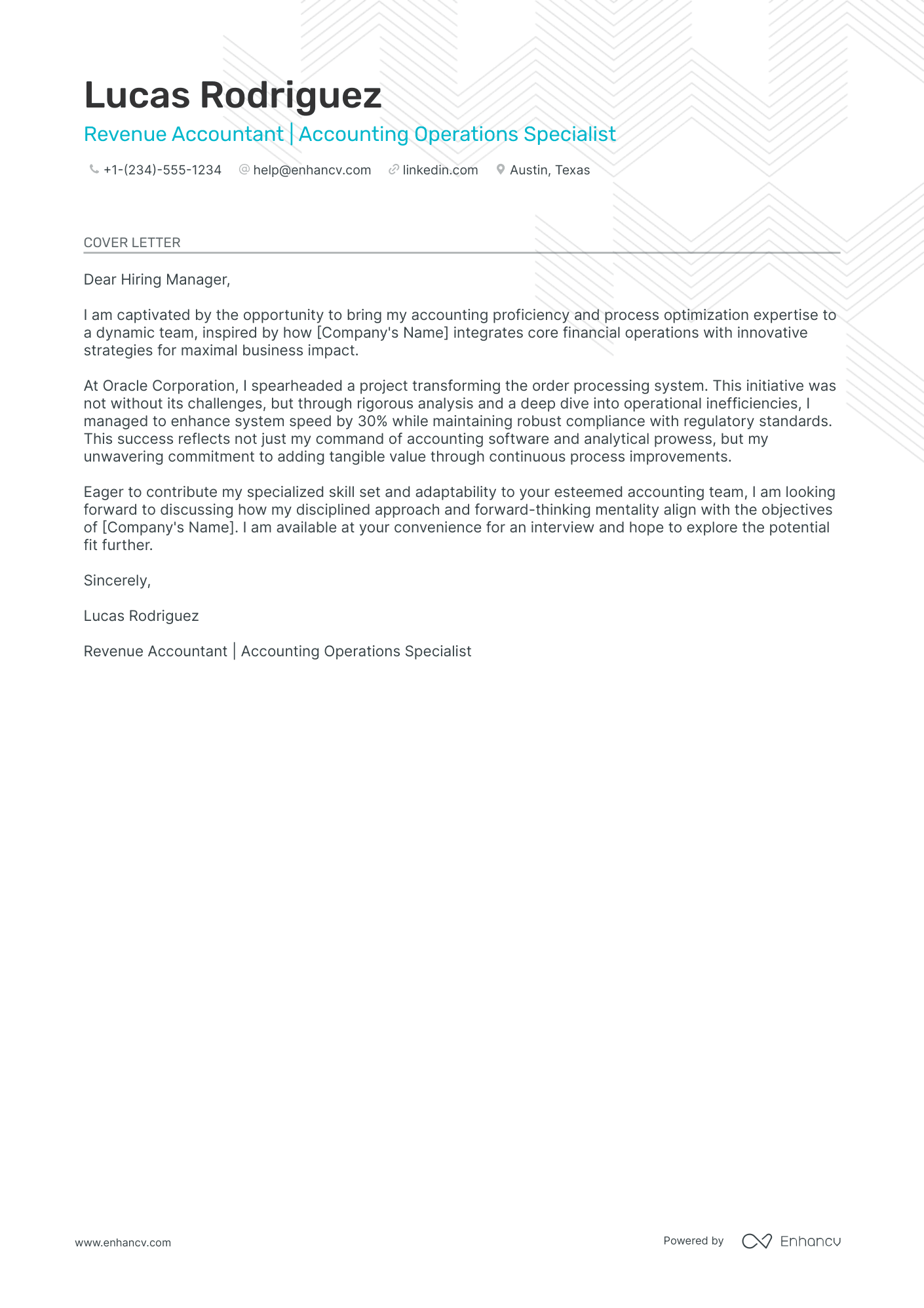
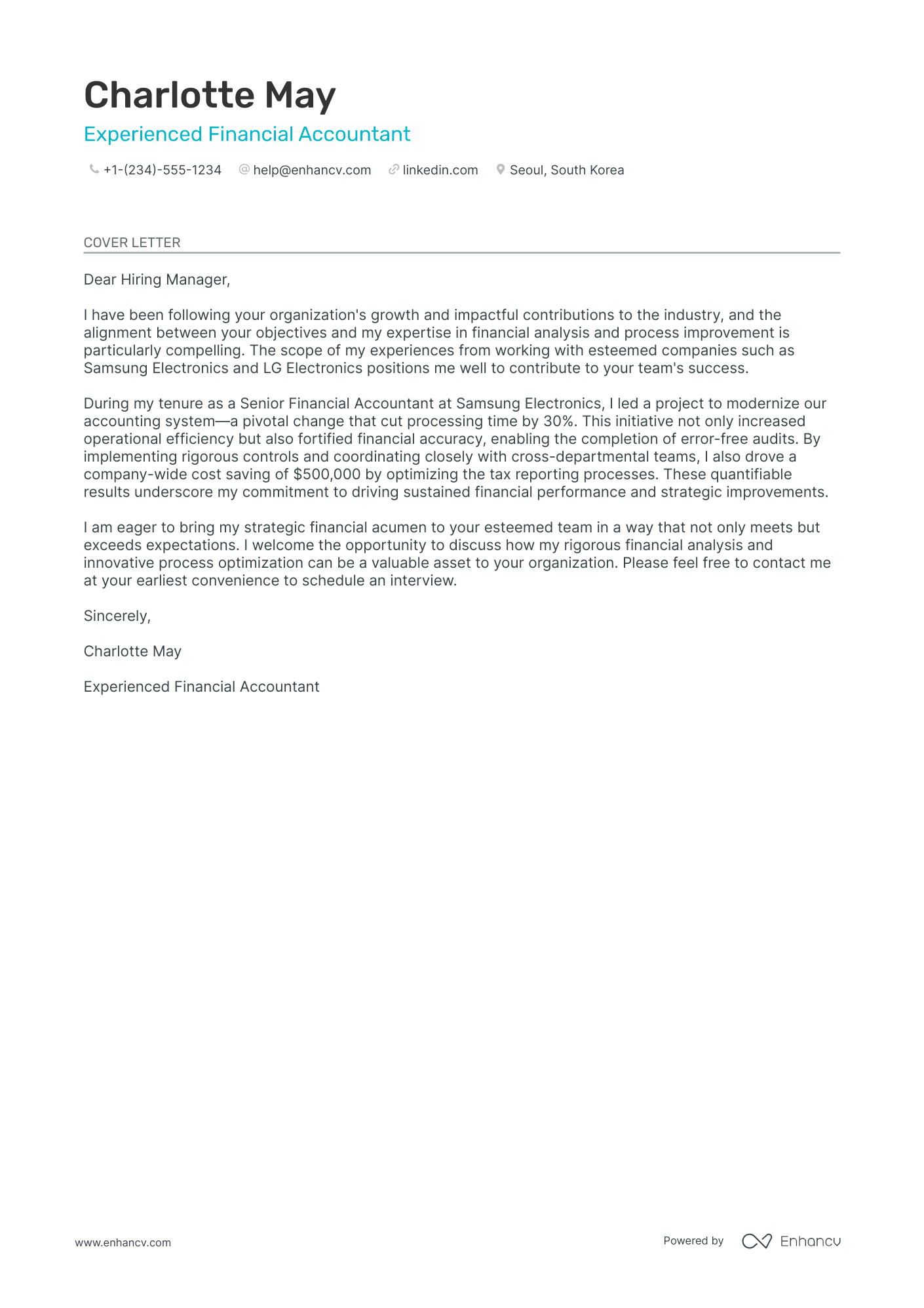
An accountant cover letter is a one-page document paired with your resume that tells the reader (a controller, the audit partner who signs off, sometimes a finance director at a county office) what your numbers meant in context.
The Bureau of Labor Statistics projects 124,200 accountant openings each year through 2034, and what wins one of those readers gets rejected by another.

Key takeaways
- Different sectors prioritize different traits—Big 4 looks for "busy season" stamina, while corporate controllers hunt for ERP fluency and month-end close speed.
- Skip generic introductions in favor of a quantifiable achievement, such as reducing the close cycle by a specific number of days or managing a multimillion-dollar audit.
- With fewer candidates entering the field, explicitly stating your CPA exam status or licensure in the first paragraph is often more influential than your alma mater.
- Use the cover letter to bridge the gap between your resume and the job description by naming their specific ERP and citing experience with relevant standards.
- Keep your letter between 250–400 words. Аccounting managers view padding and fluff as a sign of poor communication and lack of focus.
Four types of accounting cover letter audiences
Tailoring your cover letter is about knowing who is holding the red pen. In 2026, with the CPA shortage reaching critical levels, clarity on your credentials matters more than ever.
Before you tailor the letter, make sure the document next to it pulls its weight — our accountant resume guide walks through the format, metrics, and ERP keywords that should mirror what you claim in the cover letter.
Here’s how to adapt your pitch for the four primary accounting audiences:
1. The Big 4
Recruiters at firms like Deloitte or PwC handle thousands of applications on a rigid campus cycle. They aren't looking for stamina and trajectory.
Look at an example strategy:
- Skip the "I am writing to express interest" cliché. State your specific office and service line immediately (e.g., Boston Audit or Chicago Tax).
- Mention your CPA exam status (started or scheduled) and a leadership role in a school org or case competition.
- Demonstrate that you understand "busy season." Highlight a time you managed a heavy workload or a client-facing role.
2. Corporate and industry
Controllers at SaaS or manufacturing firms want to know if you can handle the Monthly Close without hand-holding.
- Name their ERP system (NetSuite, SAP, etc.) early—it’s often the secret password in the job description.
- Mention one concrete improvement you made to a close cycle or a specific instance where you reconciled a complex account.
- If moving from public to industry, explain why this specific company interests you so they don't view you as a "flight risk" just looking for any exit.
3. Government and public sector
Government finance directors often use HR scoring rubrics. If you don't mention specific technical standards, you may not even make it to their desk.
- Use a strictly formal layout and the exact role title from the posting.
- Explicitly mention GASB statements, fund accounting, or budgetary controls.
- Focus on mission alignment. Don't be vague. Mention a specific agency project or community impact.
4. Nonprofits
Nonprofit hiring managers need to know you can navigate the unique red tape of mission-driven funding.
So:
- Demonstrate a genuine interest in their specific cause, but pivot quickly to technical competence.
- Highlight experience with grant accounting, OMB uniform guidance, and the distinction between restricted and unrestricted funds.
- If you’ve survived an A-133 Single Audit (either as the auditor or the client), make that a centerpiece of your letter.

PRO TIP
Regardless of the audience, the CPA shortage is your leverage. If you have passed the exam or are currently sitting for sections, put that information in the first paragraph. In the current market, your certification status is often more important than where you went to school.
Your reader gives you about thirty seconds before deciding. Lead with the result they'd care about—and pair the letter with the accountant resume sitting next to it. The rest of the letter just keeps you from getting cut.
If you've never written one before, thestep-by-step on writing a cover letter covers the bones. This page is about the accounting-specific calibration.
What does a strong accountant cover letter actually look like?
The version below is for a senior staff accountant moving from a regional public firm into industry—the most common search demand on this page. Adapt the persona to your situation, but the architecture (numeric hook, ERP-specific body, judgment story, dated availability) holds for most accounting letters in 2026.
JORDAN REYES, CPA
Cleveland, OH
(216) 555-0184
jordan.reyes@email.com


This example is highly effective because it treats the cover letter as a technical case study rather than a polite formality. It prioritizes evidence over adjectives.
Why this letter works:
- The hook is a metric: Instead of a generic intro, it opens with a quantifiable achievement (reducing a close from 11 days to six).
- Software as a keyword: It mentions NetSuite and Sage Intacct naturally within the narrative, signaling immediate technical ROI.
- Anticipates concerns: It addresses the public-to-industry transition head-on by discussing judgment and escalation, proving the candidate isn't just a numbers robot.
- Active closing: It suggests a specific interview window and asks a high-level question about the team’s development, showing professional intent.
How to build your accountant cover letter
The opening is your value proposition. Don't tell them you want the job—show them you can solve their specific problem.
- Lead with a specific project or metric related to the role’s primary pain point (e.g., "I reduced DSO by 12 days…").
- Use numbers to show scale (e.g., "$180M manufacturer") so the hiring manager can see themselves in your experience.
The body paragraphs need to show your technical alignment. This is where you bridge the gap between your resume and their job description.
Here, you need to:
- Explicitly reference their asks and provide a one-sentence proof of your experience.
- Mention their ERP or tech stack by name to pass the mental fluency test.
- Include a brief anecdote about a time things went wrong. In accounting, showing how you handle a $200K error is more impressive than claiming you never make mistakes.
In the closing paragraph, you move away from "I look forward to hearing from you" and take the lead.
- Ask about their specific processes, such as their close cycle or professional development pipeline.
- Give two or three specific windows for a call. This reduces the calendar tennis that often stalls the hiring process.
- In the sign-off, include your CPA/CMA or exam status right next to your name.
Drop your resume here or choose a file.
PDF & DOCX only. Max 2MB file size.
How long should an accountant cover letter be, and what format works?
An accounting cover letter should run between 250 and 400 words. Three to four short paragraphs, single page, single-spaced, one-inch margins. Thegeneral cover letter format guide has the full mechanics. The accounting-specific note is just that controllers and audit partners are reading dozens of these and a tight letter wins on length alone.
If the role is internal at your current firm or a referral, you can go shorter. Theshort cover letter samples show 150-word versions that work when the reader already knows you. Don't pad to look thorough—accounting hiring managers read padding the same way they read a bloated GL: as something to clean up.
Common mistakes in accounting cover letters
- Sending the same letter to all employers: A letter that opens with "experience preparing financial statements in accordance with GAAP" is fine for a county finance office, but dead on arrival at PwC. The Big 4 recruiter assumes GAAP. They want to know whether you'll survive busy season.
- Skipping the hiring manager's name: The guide onaddressing the salutation walks through how to find one. Most public accounting firms list office leadership on the firm website, and corporate finance teams are easy to map on LinkedIn. "Dear Hiring Manager" reads as the letter you didn't bother to research.
- Leading with the wrong credentials: If you're an EA applying for a tax role, lead with EA, not CPA-in-progress. If you're a CMA targeting corporate, lead with CMA. The CPA isn't the only credential that matters in 2026, and defaulting to it reads off when the controller cares more about close-cycle experience than licensure.
- Padding: A senior staff accountant's cover letter that runs to 600 words is signaling something the reader didn't ask for. Get to the close-cycle improvement, the audit you ran cleanly, the system implementation that actually shipped, the variance review where you caught something the auditor missed. Cut the rest.
- Overpolishing: A letter scrubbed to perfect parallelism, where every paragraph runs the same length and every sentence carries the same rhythm, reads as if an AI generator wrote it. A clipped sentence here, a slightly informal aside there, signals an actual person at the keyboard.
Frequently asked questions about accountant cover letters
Even after you have mastered the high-level strategy of targeting your audience, specific logistical questions often arise during the final submission process.
Do I need a cover letter for a Big 4 online application?
Most Big 4 application portals mark cover letters as optional, but a senior associate reading hundreds of applications uses the letter to tiebreak. Submit one. Two short paragraphs is enough if you're tight on time.
Should I list every accounting software I know?
No—the resume handles that. In the cover letter, name the one or two systems the job posting actually uses. NetSuite for a NetSuite shop. SAP S/4HANA for an SAP shop. The cover letter is a relevance check.
How do I write one with no internship?
Lead with coursework that mapped onto real work—auditing simulations, tax research projects, a Beta Alpha Psi case competition, a Volunteer Income Tax Assistance shift. Тhen, a relevant non-accounting role where you handled detail and judgment. A bookkeeper job at a family business or the campus credit union counts more than people think.
Should I mention my CPA exam progress if I've only passed one section?
Yes. Hiring managers in 2026 are tracking exam progress because so few candidates start. "Passed FAR in March, sitting for AUD in July" is more useful than silence.
How do I address a salary expectation if the job posting asks?
If the posting demands a number, give a range tied to your most recent role's compensation and one rung above. If the posting doesn't ask, leave it out entirely—the cover letter is the wrong place to negotiate.
Conclusion
An accounting cover letter that lands somewhere has done specific work first. It tells the reader you've thought about which type of person will see it ahead of the controller—and what evidence will earn their thirty seconds.
Big 4 wants survival signals and a CPA path. Corporate wants ERP fluency and a close-cycle number you can name. Government cares about compliance and mission specifics. Nonprofit reads on top of all of that for grant-accounting fluency and a clean A-133.
Pick your reader, write to that reader, send.
Build your accounting cover letter in Enhancv's Cover Letter Builder, or pull a draft from your existing resume in under a minute.