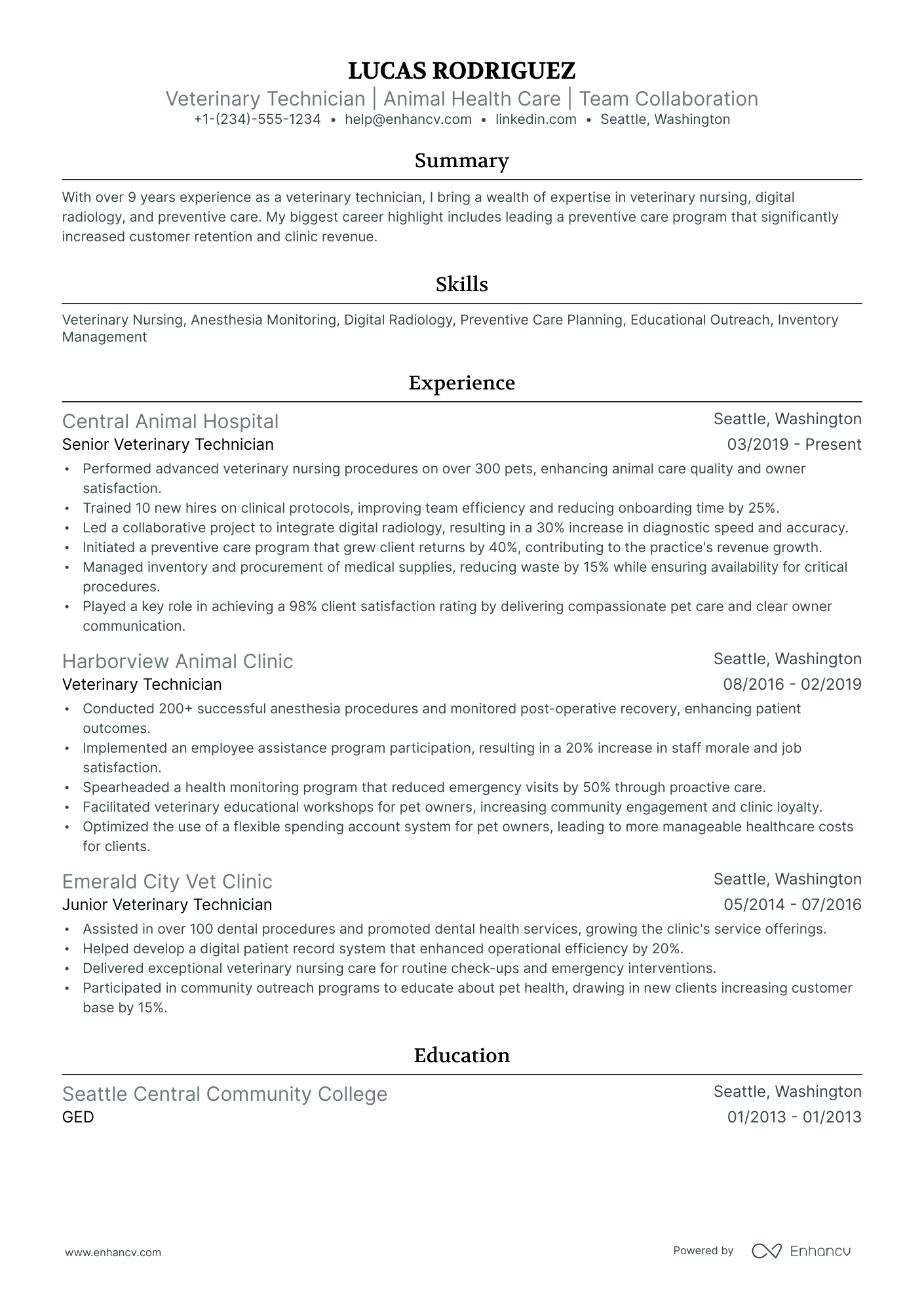
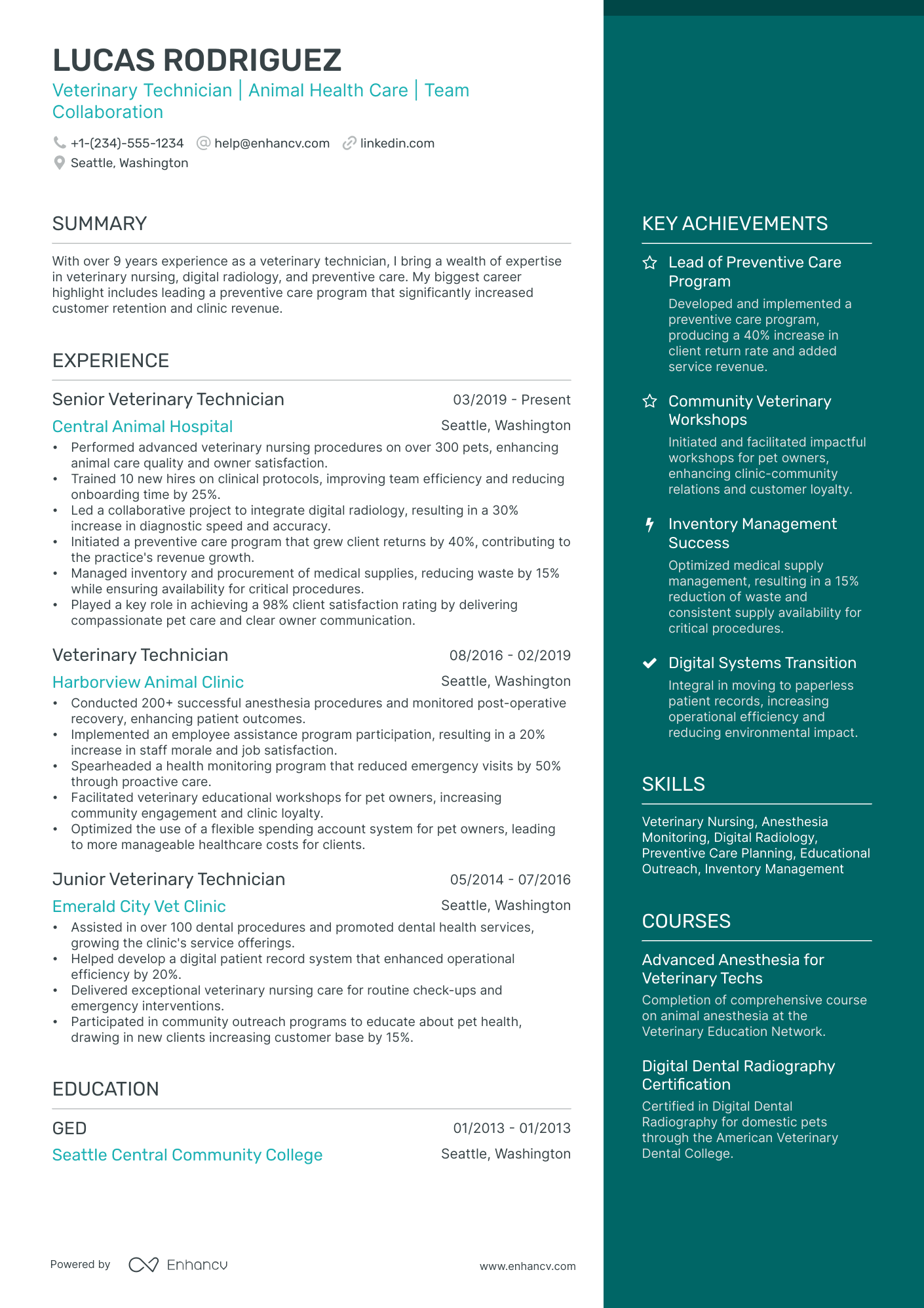
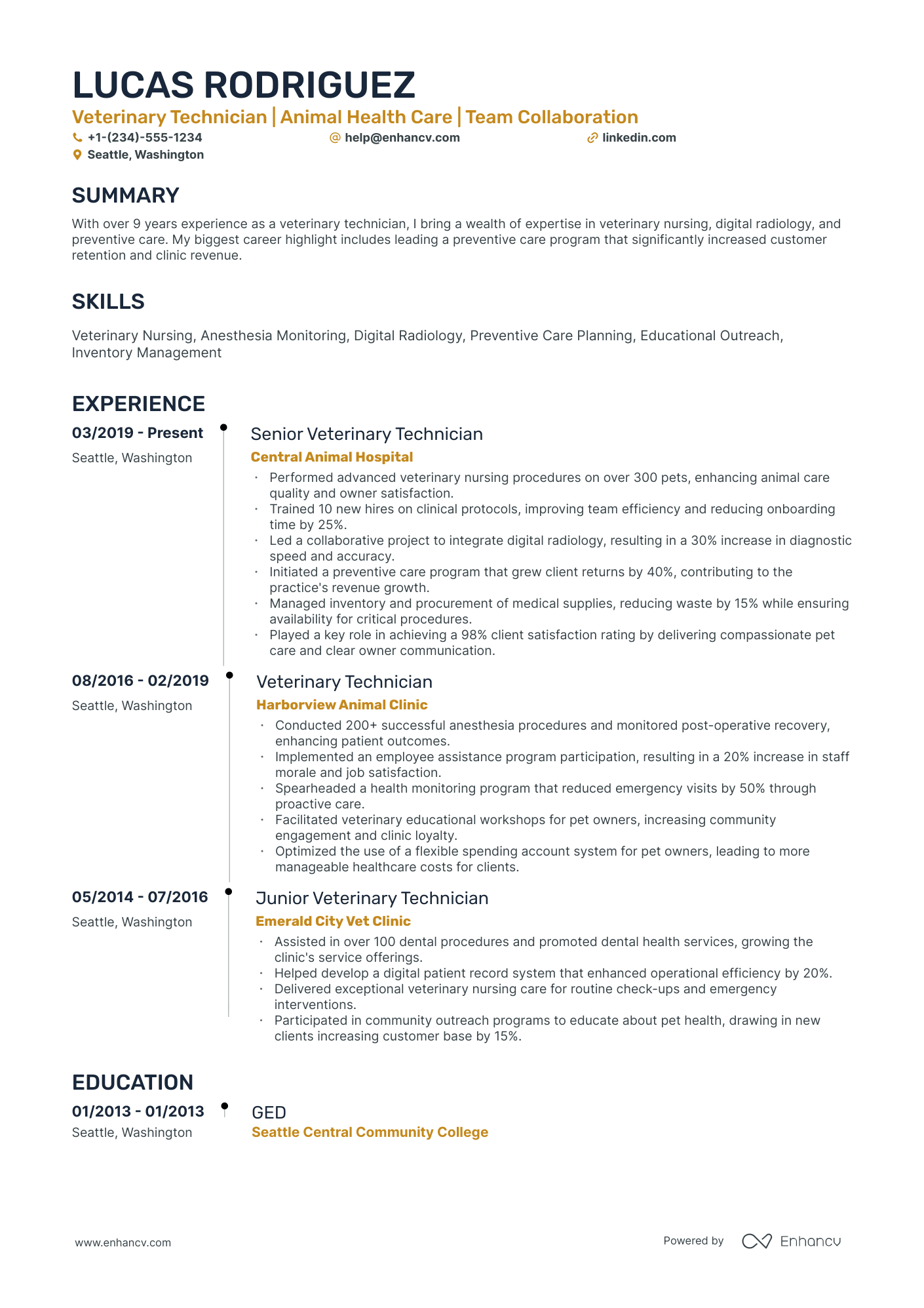
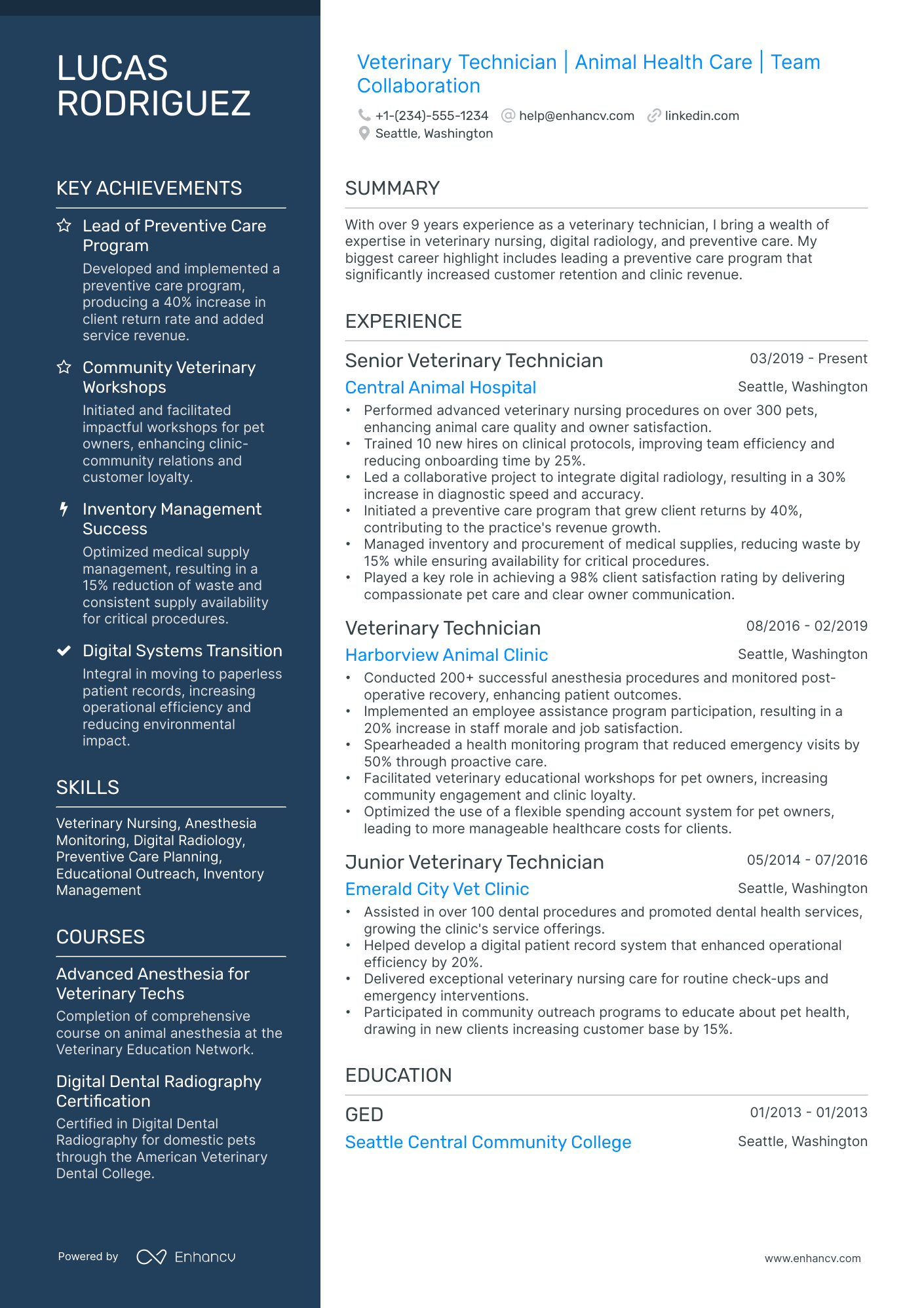
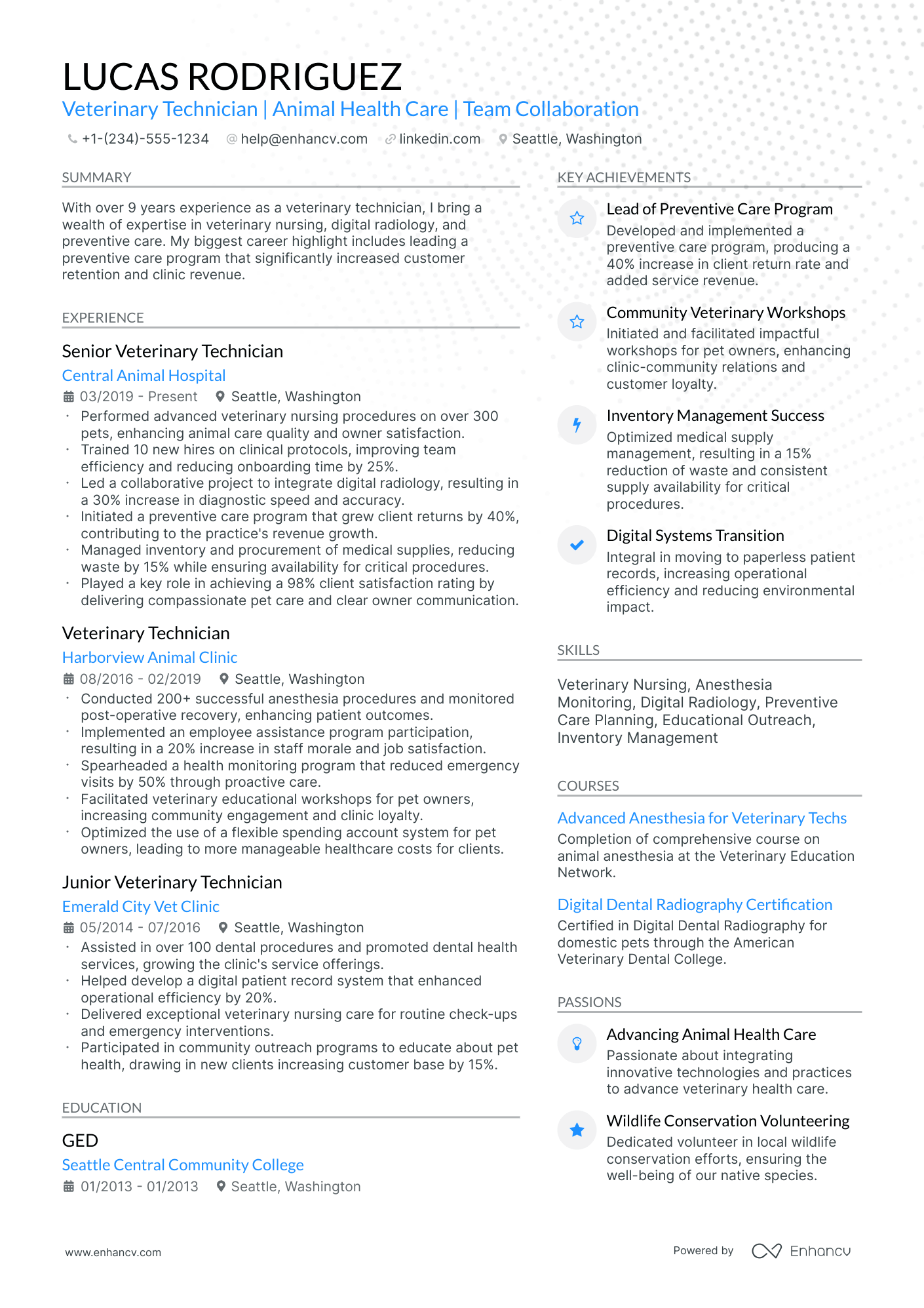
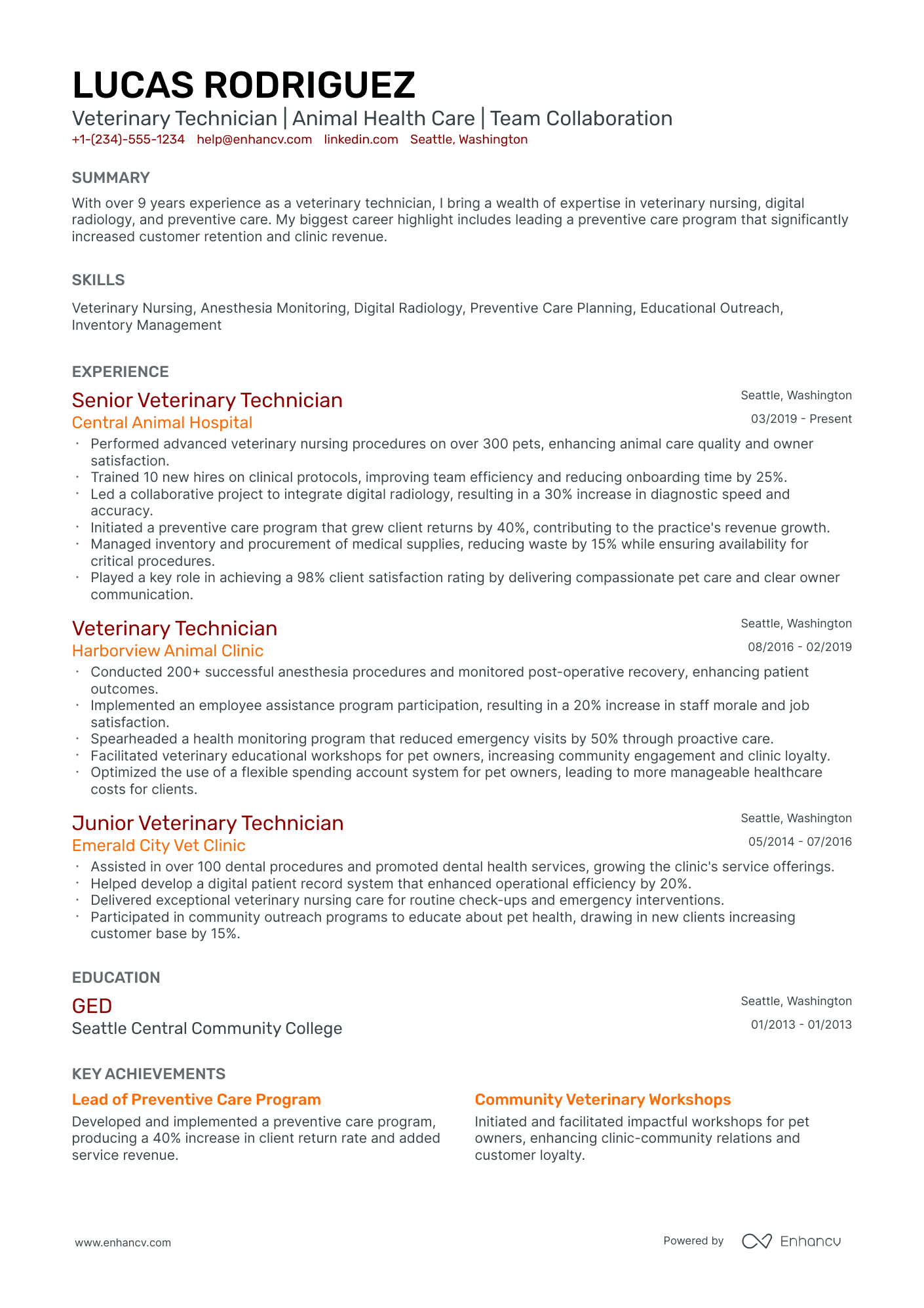
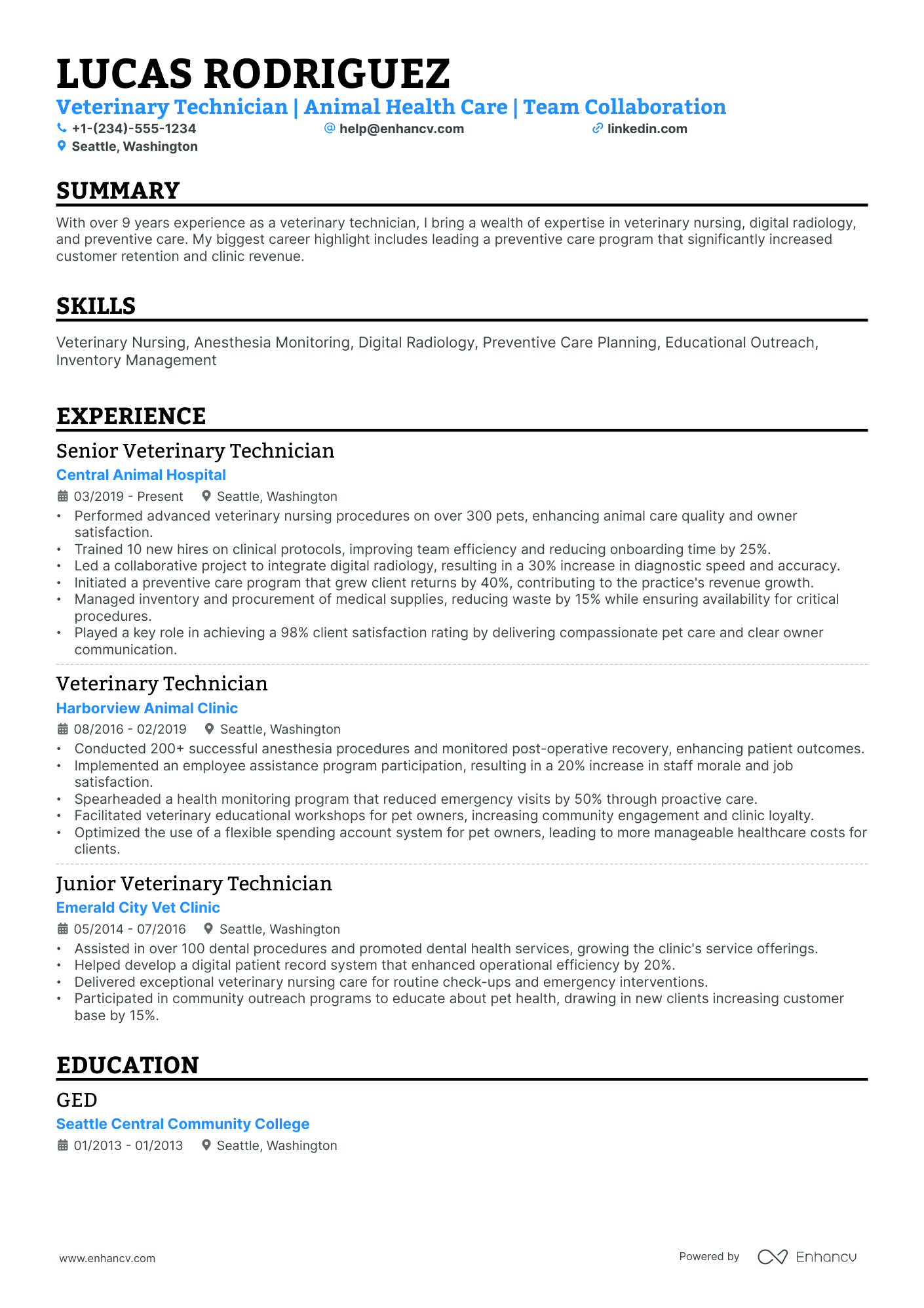
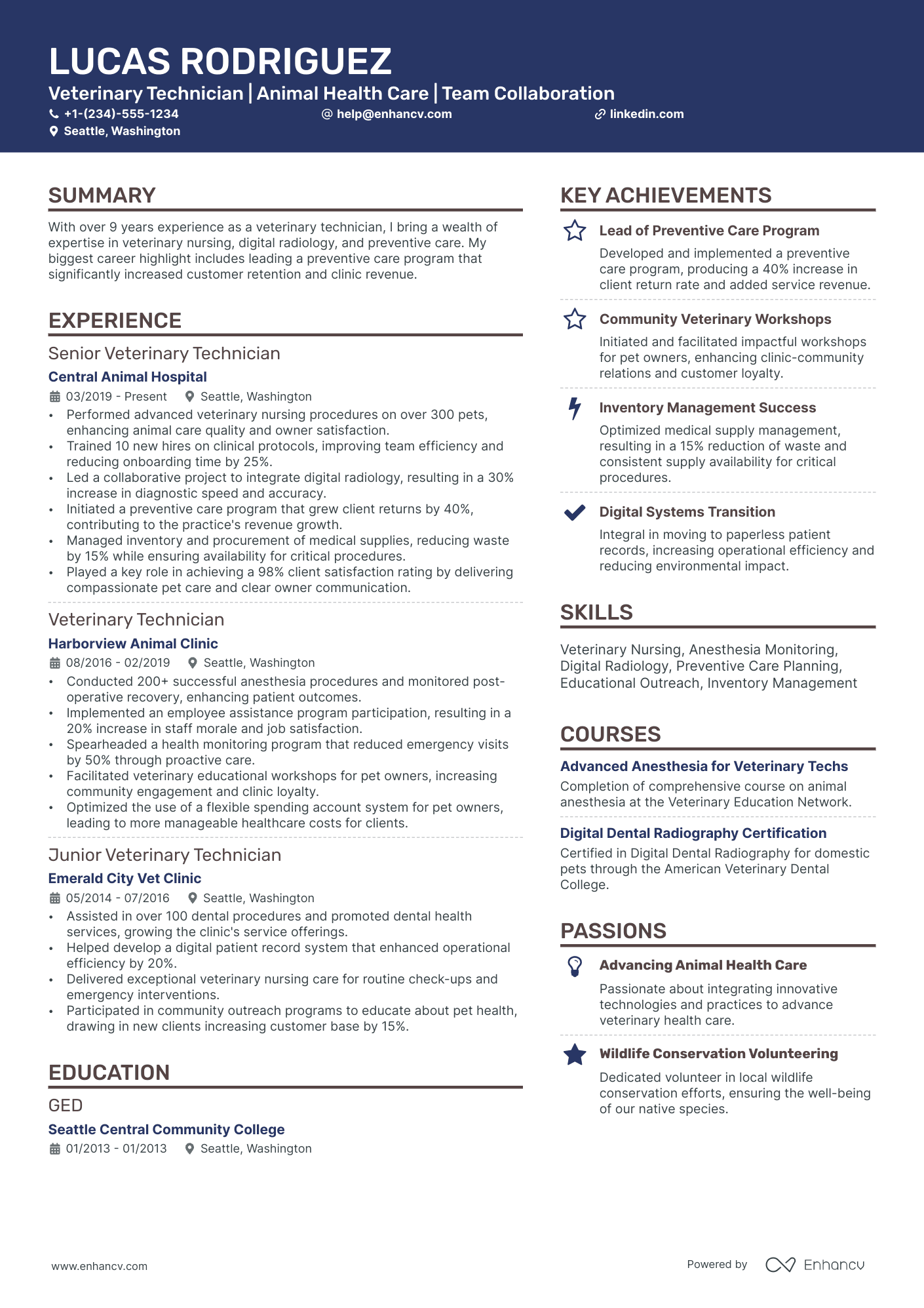
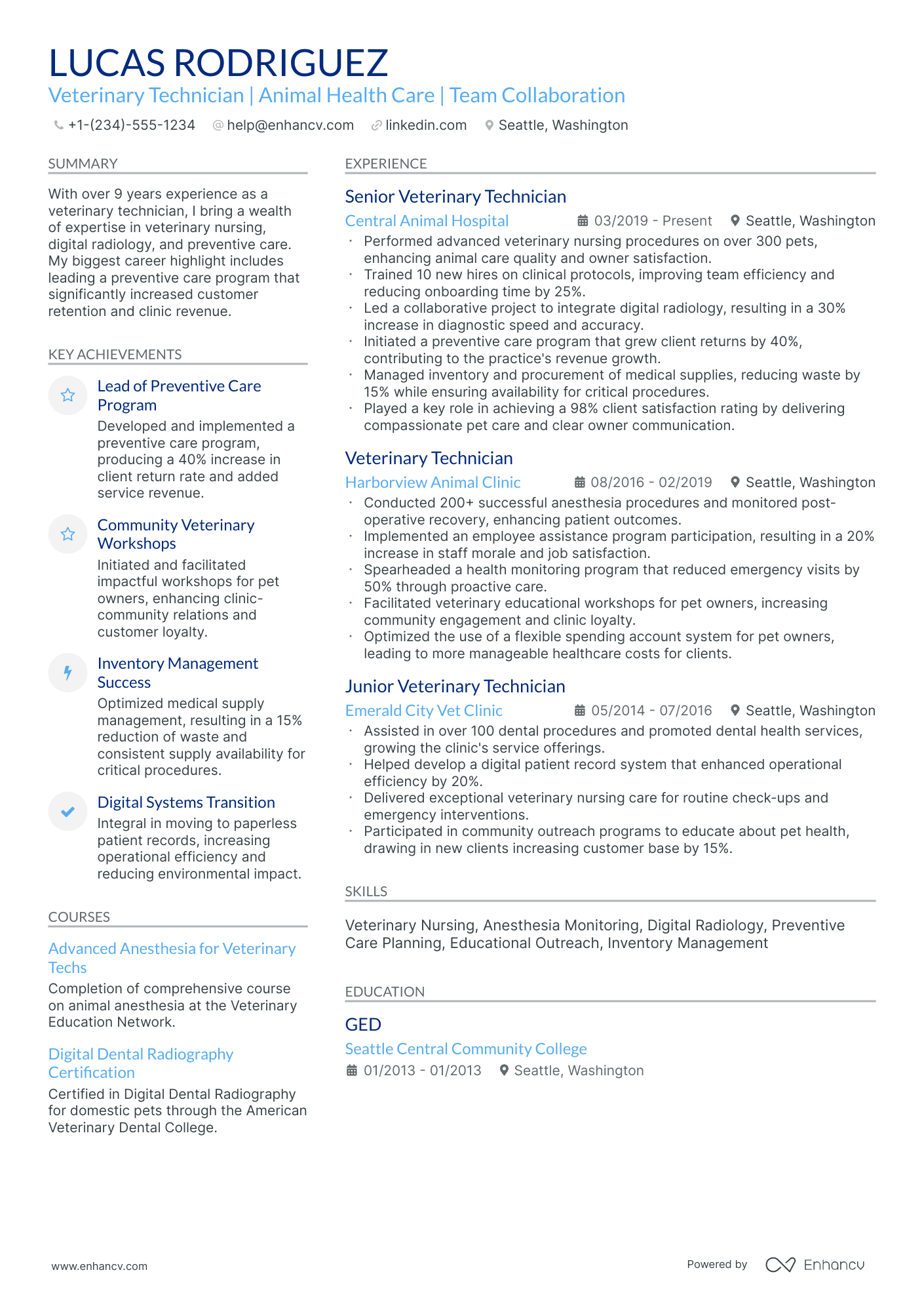
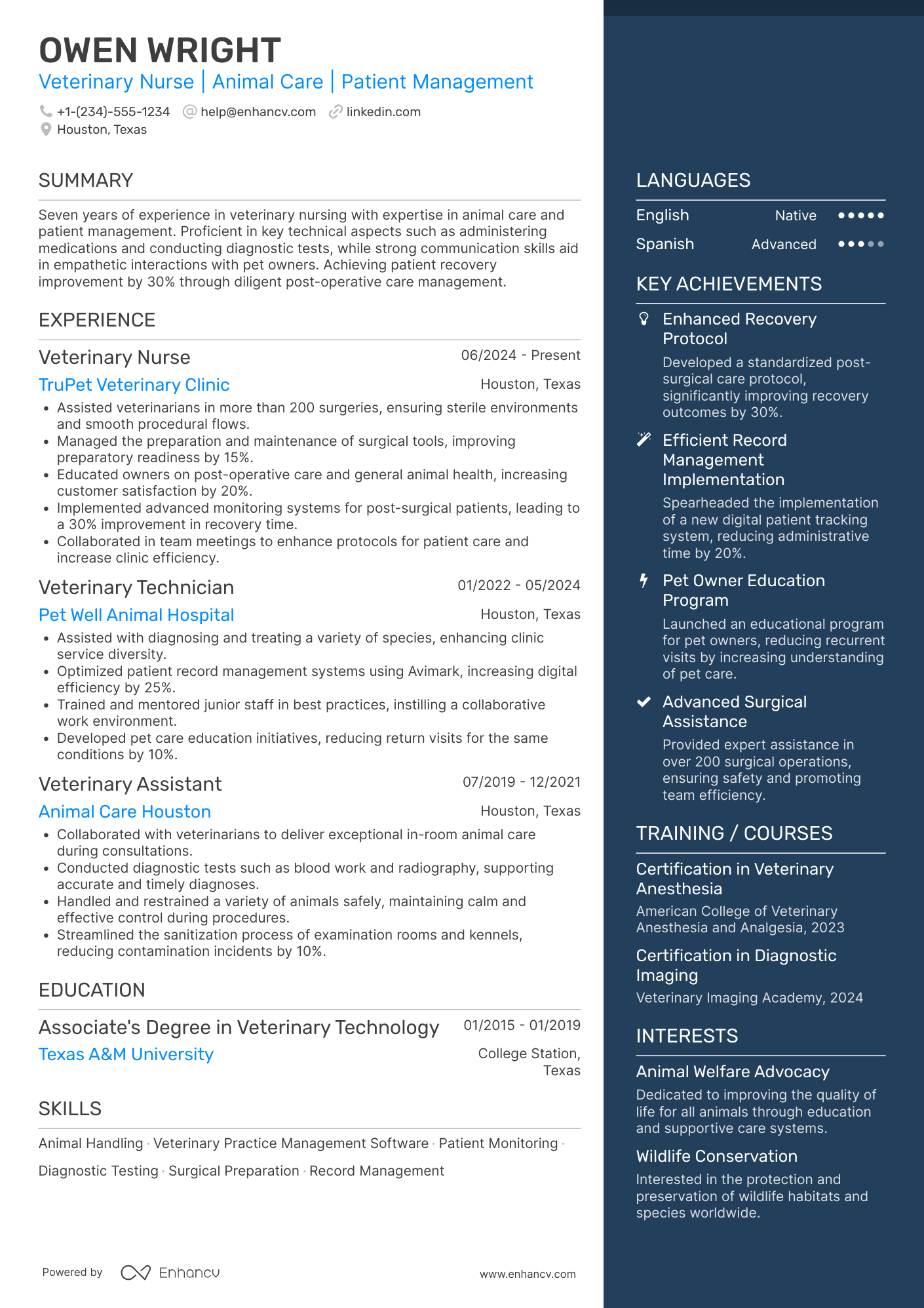
Many veterinary nurse resume drafts fail because they bury clinical impact under task lists and generic skills. That misses ATS keyword matches and gives recruiters nothing to scan fast in a crowded applicant pool.
A strong resume shows how you improved care and workflow, not just what you did. Knowing how to make your resume stand out means you should highlight reduced patient wait times, higher anesthesia monitoring compliance, lower medication errors, faster lab turnaround, smoother surgical prep, and improved client satisfaction scores.

Key takeaways
- Quantify patient care outcomes like recovery rates and error reductions instead of listing daily duties.
- Use reverse-chronological format for experienced nurses and hybrid format for career changers.
- Mirror exact terminology, software names, and clinical protocols from each job posting.
- Tie every listed skill to a measurable result in your experience bullets.
- Place certifications above education when they're recent and directly relevant to the role.
- Build your resume faster with Enhancv's tools to align bullets with recruiter expectations.
- Stop using AI once your resume accurately reflects real experience without inflated claims.
How to format a veterinary nurse resume
Recruiters hiring veterinary nurses prioritize clinical competencies, hands-on patient care experience, and familiarity with veterinary practice workflows. Choosing the right resume format ensures these signals—along with certifications, technical proficiencies, and care outcomes—are easy to identify during a quick scan and parse correctly through an applicant tracking system (ATS).

I have significant experience in this role—which format should I use?
Use a reverse-chronological format to lead with your most recent and relevant veterinary nursing experience. Do:
- Highlight the scope of your clinical responsibilities, including species handled, caseload volume, and any mentoring or team coordination duties.
- Feature role-specific skills such as anesthesia monitoring, surgical assistance, dental prophylaxis, radiography, and proficiency with practice management software like Cornerstone or AVImark.
- Quantify patient care outcomes, efficiency improvements, or contributions to practice operations wherever possible.
I'm junior or switching into this role—what format works best?
A hybrid format works best, allowing you to lead with relevant clinical skills and certifications while still showing your work or practicum history in chronological order. Do:
- Place a dedicated skills section near the top of your resume, listing credentials (such as your Veterinary Technician National Examination or state licensure), technical competencies, and species-specific experience.
- Include clinical rotations, externships, volunteer work at shelters or animal hospitals, and any hands-on projects that demonstrate practical veterinary nursing abilities.
- Connect each skill or experience to a specific action and a measurable or observable result to show real-world application.
Why not use a functional resume?
A functional format strips away the timeline of your clinical development, making it difficult for hiring managers to verify where and when you gained hands-on veterinary nursing skills—a major concern in a credential-driven, patient-safety-focused profession. A functional format may be acceptable if you're transitioning from a related field (such as human nursing or animal shelter work), have a significant gap in employment, or have limited formal veterinary nursing history—but only if every listed skill is tied to a specific project, rotation, or documented outcome rather than presented in isolation.
Once your format establishes a clean, readable structure, the next step is filling it with the right sections to showcase your qualifications effectively.
What sections should go on a veterinary nurse resume
Recruiters expect a veterinary nurse resume to clearly show your clinical support experience, patient care skills, and compliance with veterinary protocols. Understanding what to put on a resume helps you prioritize the right details. Use this structure for maximum clarity:
- Header
- Summary
- Experience
- Skills
- Projects
- Education
- Certifications
- Optional sections: Awards, Volunteering, Languages
Strong experience bullets should emphasize measurable patient care outcomes, caseload scope, efficiency gains, and contributions to safe, compliant clinic operations.
Is your resume good enough?
Drop your resume here or choose a file. PDF & DOCX only. Max 2MB file size.
With your resume structure in place, the next step is to write your veterinary nurse experience section so employers can quickly see how you’ve applied those details in practice.
How to write your veterinary nurse resume experience
Your experience section should highlight the clinical work you've delivered, the veterinary tools and protocols you've applied, and the measurable outcomes you've achieved in patient care, client communication, and practice operations. Building a targeted resume ensures hiring managers see demonstrated impact—improved recovery rates, streamlined workflows, or enhanced patient safety—over descriptive task lists that simply catalog daily duties.
Each entry should include:
- Job title
- Company and location (or remote)
- Dates of employment (month and year)
Three to five concise bullet points showing what you owned, how you executed, and what outcomes you delivered:
- Ownership scope: the caseloads, treatment areas, patient populations, surgical suites, diagnostic workflows, or support teams you were directly accountable for within the veterinary practice.
- Execution approach: the clinical instruments, anesthesia monitoring systems, diagnostic imaging equipment, laboratory protocols, electronic medical records, or triage frameworks you used to guide patient care decisions and deliver consistent treatment.
- Value improved: the changes you drove in patient recovery, surgical safety, diagnostic accuracy, appointment efficiency, infection control compliance, or overall standard of care within your practice.
- Collaboration context: how you coordinated with veterinarians, veterinary technicians, front-desk staff, laboratory teams, pharmaceutical suppliers, or pet owners to ensure seamless care delivery and clear communication throughout the treatment process.
- Impact delivered: the results your contributions produced—expressed through patient outcomes, practice capacity, client retention, operational reliability, or quality benchmarks rather than routine activity descriptions.
Experience bullet formula
A veterinary nurse experience example
✅ Right example - modern, quantified, specific.
Veterinary Nurse
Paws & Whiskers Animal Hospital | Austin, TX
2022–Present
High-volume small animal hospital delivering preventive care, urgent care, and surgical services for dogs and cats.
- Triaged twenty to thirty urgent cases per shift using SOAP notes and pain scoring, cutting average wait time from forty minutes to twenty-six minutes while maintaining a 98 percent client satisfaction score.
- Monitored anesthesia for eight to twelve procedures weekly using multiparameter monitors (electrocardiogram, pulse oximetry, capnography) and standardized checklists, reducing perioperative complications by 22 percent.
- Administered vaccines, microchips, and medication protocols using Cornerstone practice management software and barcode medication checks, lowering documentation errors by 35 percent.
- Ran in-house diagnostics (complete blood count, chemistry panel, urinalysis) on IDEXX analyzers and coordinated send-outs, improving same-day treatment decisions by 30 percent in collaboration with veterinarians.
- Rebuilt discharge education and follow-up workflows with veterinarians and client care staff, increasing post-op recheck adherence from 62 percent to 78 percent and reducing repeat call volume by 18 percent.
Now that you've seen how a strong experience section comes together, let's look at how to adjust yours to match the specific job you're applying for.
How to tailor your veterinary nurse resume experience
Recruiters evaluate veterinary nurse resumes through both human review and applicant tracking systems (ATS). Tailoring your resume to the job description increases your chances of passing both screening layers.
Ways to tailor your veterinary nurse experience:
- Match specific veterinary software or practice management systems listed in the posting.
- Mirror the exact terminology used for clinical procedures or treatment protocols.
- Reflect patient care metrics or caseload volumes the employer highlights.
- Include species-specific experience when the role focuses on particular animal types.
- Emphasize anesthesia monitoring or surgical assistance skills if the posting requires them.
- Highlight compliance with veterinary standards or controlled substance regulations mentioned.
- Align your triage or emergency response experience with stated workflow expectations.
- Reference client education or communication responsibilities the employer prioritizes.
Tailoring means aligning your real accomplishments with what the employer values—not forcing keywords into your experience where they don't belong.
Resume tailoring examples for veterinary nurse
| Job description excerpt | Untailored | Tailored |
|---|---|---|
| Administer anesthesia, monitor patients during surgery using pulse oximetry and capnography, and manage post-operative recovery for small animal procedures. | Assisted with surgical procedures and helped monitor animals during operations. | Administered and monitored anesthesia for 15+ small animal surgeries per week, tracking vitals via pulse oximetry and capnography and managing post-operative recovery to reduce complication rates by 20%. |
| Perform dental prophylaxis, capture and interpret digital dental radiographs, and educate pet owners on at-home oral care plans. | Helped with dental cleanings and talked to pet owners about their animals' health. | Performed full-mouth dental prophylaxis and captured digital dental radiographs using Sopix sensors, then developed individualized at-home oral care plans that improved client compliance scores by 30%. |
| Place and maintain IV catheters, calculate and prepare drug dosages using VetCalc, and assist the veterinarian with emergency triage following the Veterinary Triage List protocol. | Provided support during emergencies and helped prepare medications for patients. | Placed IV catheters and calculated precise drug dosages in VetCalc for critical patients, supporting emergency triage of 10+ cases monthly following the Veterinary Triage List protocol to stabilize patients within target response windows. |
Once you’ve aligned your experience with the role’s priorities, quantify your veterinary nurse achievements to show the measurable impact behind those responsibilities.
How to quantify your veterinary nurse achievements
Numbers prove your impact on patient safety, clinic efficiency, and client experience. Learning how to use numbers on your resume effectively means tracking caseload volume, medication and anesthesia accuracy, turnaround times, compliance rates, and revenue protected through fewer errors and better follow-up.
Quantifying examples for veterinary nurse
| Metric | Example |
|---|---|
| Patient volume | "Triaged and supported an average of 18–22 appointments per shift, assisting in exams, sample collection, and discharge instructions for a three-doctor practice." |
| Medication accuracy | "Reduced medication labeling errors from five per month to one per month by standardizing double-checks and using Cornerstone dose templates." |
| Anesthesia safety | "Monitored anesthesia for 12–15 procedures weekly using multiparameter monitors, maintaining zero anesthesia-related incidents over nine months." |
| Turnaround time | "Cut in-house laboratory turnaround from 45 minutes to 25 minutes by batching IDEXX runs and pre-labeling tubes during intake." |
| Revenue protection | "Recovered about $1,800 monthly by improving charge capture for injections, nail trims, and lab add-ons through end-of-visit checklisting in the practice management system." |
Turn vague job duties into measurable, recruiter-ready resume bullets in seconds with Enhancv's Bullet Point Generator.
Once you've crafted strong bullet points for your experience section, it's equally important to highlight the right hard and soft skills throughout your veterinary nurse resume.
How to list your hard and soft skills on a veterinary nurse resume
Your skills section shows you can deliver safe patient care and support clinical workflow, and recruiters and applicant tracking systems scan it for job-match keywords; aim for a balanced mix of technical, clinical, and communication skills.
veterinary nurse roles require a blend of:
- Product strategy and discovery skills
- Data, analytics, and experimentation skills
- Delivery, execution, and go-to-market discipline
- Soft skills
Your skills section should be:
- Scannable (bullet-style grouping).
- Relevant to the job post.
- Backed by proof in experience bullets.
- Updated with current tools.
Place your skills section:
- Above experience if you're junior or switching careers.
- Below experience if you're mid/senior with strong achievements.

Hard skills
Your hard skills demonstrate technical proficiency in clinical veterinary settings:
- Anesthesia monitoring, ECG, capnography
- Venipuncture, IV catheter placement
- Medication administration, dosage calculations
- Fluid therapy, infusion pumps
- Radiography positioning, digital imaging
- Laboratory sample handling, hematology, urinalysis
- Surgical prep, aseptic technique
- Dental prophylaxis, dental radiographs
- Triage, vital signs assessment
- Medical records, practice management software
- Controlled substance logs, DEA compliance
- Infection control, sterilization protocols
Soft skills
Equally important, your soft skills reflect how you collaborate and communicate in high-pressure clinical environments:
- Client education and discharge instructions
- Calm de-escalation with anxious owners
- Clear handoffs to veterinarians
- Prioritization during high-volume intake
- Rapid escalation of patient deterioration
- Closed-loop communication in surgery
- Cross-training and mentoring new staff
- Documentation discipline under pressure
- Coordination with reception and kennel teams
- Consent and expectation setting with clients
- Follow-through on treatment plans
- Bias-aware, compassionate patient handling
How to show your veterinary nurse skills in context
Skills shouldn't live only in a bulleted list on your resume. Explore resume skills examples to see how other professionals present theirs effectively.
They should be demonstrated in:
- Your summary (high-level professional identity)
- Your experience (proof through outcomes)
Here's how that looks in practice.
Summary example
Senior veterinary nurse with 10 years in emergency and critical care. Skilled in anesthesia monitoring, triage protocols, and client education. Reduced post-surgical complication rates by 18% through standardized recovery workflows and cross-team collaboration.
- Reflects senior-level expertise clearly
- Names specific tools and protocols
- Includes a measurable clinical outcome
- Highlights collaboration as a soft skill
Experience example
Senior Veterinary Nurse
Bridgeway Animal Emergency | Portland, OR
March 2019–Present
- Administered anesthesia monitoring for 1,200+ surgeries annually, maintaining a 99.4% complication-free recovery rate using standardized checklists.
- Collaborated with a five-member veterinary team to redesign triage protocols, cutting average patient intake time by 22%.
- Trained 8 junior nurses on digital radiography systems and IV catheter placement, improving onboarding efficiency by 30%.
- Every bullet contains measurable proof
- Skills appear naturally within achievements
Once you’ve demonstrated your nursing strengths through real tasks and outcomes, the next step is learning how to write a veterinary nurse resume with no experience by presenting those same strengths without relying on formal job history.
How do I write a veterinary nurse resume with no experience
Even without full-time experience, you can demonstrate readiness through clinical rotations, volunteer work, and academic projects. Our guide on writing a resume without work experience covers this approach in detail. Consider leveraging:
- Clinical rotations in veterinary settings
- Volunteer shifts at animal shelters
- Externships at veterinary hospitals
- Coursework labs: restraint, venipuncture
- Pet first aid certification training
- Student-run clinic intake support
- Shadowing veterinary nurse procedures
- Animal handling in rescue foster care
Focus on:
- Hands-on patient handling hours
- Documented clinical skills checklists
- Safety, sanitation, infection control
- Accurate charting and medication math
Resume format tip for entry-level veterinary nurse
Use a skills-based resume format because it highlights clinical training, lab competencies, and supervised hours when your work history is limited. Do:
- Lead with a "Clinical Skills" section.
- List supervised hours by setting.
- Add relevant coursework with lab outcomes.
- Include tools: AVImark, syringe pumps.
- Quantify volume: patients, shifts, tasks.
- Completed 40 shelter volunteer hours, recorded vitals for 60 animals, and entered treatments in AVImark with zero charting corrections from the supervising veterinary nurse.
Even without hands-on experience, your academic background can demonstrate the foundational knowledge employers need—so presenting your education effectively is essential.
How to list your education on a veterinary nurse resume
Your education section lets hiring teams quickly confirm you have the foundational training needed. It validates your clinical knowledge, animal care skills, and readiness for veterinary nurse responsibilities.
Include:
- Degree name
- Institution
- Location
- Graduation year
- Relevant coursework (for juniors or entry-level candidates)
- Honors & GPA (if 3.5 or higher)
Skip month and day details—list the graduation year only.
Here's a strong education entry tailored for a veterinary nurse resume:
Example education entry
Associate of Applied Science in Veterinary Technology
Purdue University Global, West Lafayette, IN
Graduated 2022
GPA: 3.7/4.0
- Relevant Coursework: Animal Anatomy & Physiology, Pharmacology, Surgical Nursing, Veterinary Radiology, Clinical Laboratory Procedures
- Honors: Dean's List (four consecutive semesters), Outstanding Veterinary Technology Student Award
How to list your certifications on a veterinary nurse resume
Certifications show your commitment to ongoing learning, hands-on tool proficiency, and current industry standards as a veterinary nurse. They also help employers quickly confirm specialized skills and readiness for patient care.
Include:
- Certificate name
- Issuing organization
- Year
- Optional: credential ID or URL
- Place certifications below education when they're older, less relevant to the role, or when your education is your strongest, most recent credential.
- Place certifications above education when they're recent, highly relevant to the job posting, or required for the veterinary nurse role you want.
Best certifications for your veterinary nurse resume
- Veterinary Technician Specialist (VTS)
- RECOVER Basic Life Support (BLS)
- RECOVER Advanced Life Support (ALS)
- Fear Free Certified Professional
- Low Stress Handling Silver Certification
- Certified Veterinary Pain Practitioner (CVPP)
- International Association of Animal Behavior Consultants (IAABC) Animal Behavior Consultant Certification
Once you’ve presented your credentials in a clear, easy-to-scan format, use that foundation to write your veterinary nurse resume summary so it quickly highlights your qualifications.
How to write your veterinary nurse resume summary
Your resume summary is the first thing a recruiter reads. A strong one instantly signals you're qualified for the veterinary nurse role.
Keep it to three to four lines, with:
- Your title and total years of hands-on veterinary nursing experience.
- The type of practice, such as small animal, equine, emergency, or exotic.
- Core clinical skills like anesthesia monitoring, surgical assistance, or radiology.
- One or two measurable achievements that show your impact on patient care or operations.
- Soft skills tied to real outcomes, such as client communication that improved compliance rates.

PRO TIP
At this level, emphasize clinical competencies, relevant certifications, and early wins that prove your value. Highlight specific tools or procedures you've mastered. Avoid vague phrases like "passionate animal lover" or "hard worker." Recruiters want concrete skills and measurable contributions, not motivation statements.
Example summary for a veterinary nurse
Licensed veterinary nurse with three years of small animal clinical experience. Skilled in anesthesia monitoring, dental prophylaxis, and digital radiology. Reduced patient recovery times by 15% through improved post-operative care protocols.
Optimize your resume summary and objective for ATS
Drop your resume here or choose a file.
PDF & DOCX only. Max 2MB file size.
Now that your summary captures your clinical strengths and experience, make sure recruiters can actually reach you by setting up a clear, complete header.
What to include in a veterinary nurse resume header
A resume header is the contact block at the top of your resume, and it boosts visibility, credibility, and fast recruiter screening for a veterinary nurse.
Essential resume header elements
- Full name
- Tailored job title and headline
- Location
- Phone number
- Professional email
- GitHub link
- Portfolio link
A LinkedIn link helps recruiters verify your experience quickly and supports screening.
Do not include a photo on a veterinary nurse resume unless the role is explicitly front-facing or appearance-dependent.
Match your job title and headline to the posting and keep all links short, readable, and consistent across your application materials.
Veterinary nurse resume header
Jordan Taylor
Veterinary Nurse | Emergency and Surgical Support
Austin, TX
(512) 555-13XX
jordan.taylor@enhancv.com github.com/jordantaylor yourwebsite.com linkedin.com/in/jordantaylor
Once your contact details and professional identifiers are set at the top, add optional resume sections to highlight relevant strengths that do not fit in the main entries.
Additional sections for veterinary nurse resumes
When your core qualifications match other applicants, well-chosen additional sections can highlight what makes you a stronger veterinary nurse candidate.
- Languages
- Volunteer experience (animal shelters, wildlife rehabilitation, or veterinary outreach)
- Certifications and continuing education
- Professional affiliations (such as NAVTA membership)
- Publications or conference presentations
- Hobbies and interests related to animal care
Once you've strengthened your resume with relevant additional sections, the next step is pairing it with a cover letter to give hiring managers a fuller picture of your qualifications.
Do veterinary nurse resumes need a cover letter
A cover letter isn't required for a veterinary nurse, but it helps in competitive roles or clinics that expect one. If you're unsure where to start, learn what a cover letter is and how it complements your resume. It can make a difference when your resume doesn't show fit, context, or a clear match for the team.
Use it to add details your resume can't:
- Explain role and team fit: Match your strengths to the clinic's caseload, shift needs, and care standards.
- Highlight one or two outcomes: Share a specific project, protocol change, or patient-care result, and state what improved.
- Show clinic understanding: Reference the clinic's services, patient population, and workflow, and connect them to your experience.
- Address transitions or gaps: Clarify a career change, relocation, return to work, or non-obvious experience that supports veterinary nurse duties.
Drop your resume here or choose a file.
PDF & DOCX only. Max 2MB file size.
Even if you decide to include a cover letter to add context beyond your resume, using AI to improve your veterinary nurse resume helps you strengthen the document employers review first and align it with the role.
Using AI to improve your veterinary nurse resume
AI can sharpen your resume's clarity, structure, and overall impact. It helps tighten language and highlight relevant strengths. But overuse strips authenticity fast. Once your content reads clearly and aligns with the role, step away from AI. If you're wondering which AI is best for writing resumes, focus on tools that help you refine rather than fabricate.
Here are 10 practical prompts you can copy and paste to strengthen specific sections of your veterinary nurse resume:
- Strengthen your summary: "Rewrite my veterinary nurse resume summary to highlight clinical skills, patient care experience, and value in under four sentences."
- Quantify experience: "Add measurable outcomes to these veterinary nurse experience bullets, focusing on patient volume, recovery rates, or efficiency improvements."
- Tailor to a posting: "Compare my veterinary nurse resume experience section to this job description and suggest edits that improve alignment."
- Improve skills relevance: "Review my veterinary nurse skills section and remove generic entries. Suggest replacements specific to veterinary clinical settings."
- Tighten bullet points: "Shorten each veterinary nurse experience bullet to one line. Start every bullet with a strong, specific action verb."
- Highlight certifications: "Reorganize my veterinary nurse certifications section by relevance. Briefly note why each credential matters for clinical roles."
- Refine education details: "Edit my veterinary nurse education section to emphasize relevant coursework, clinical rotations, and academic honors only."
- Showcase projects: "Rewrite this veterinary nurse project description to emphasize my specific role, tools used, and measurable patient care outcomes."
- Eliminate filler language: "Identify and remove vague or redundant phrases throughout my veterinary nurse resume. Replace them with direct, specific language."
- Check overall consistency: "Review my full veterinary nurse resume for inconsistent formatting, tense shifts, and tone mismatches. Suggest corrections."
Stop using AI once your resume sounds accurate, specific, and aligned with real experience. AI should never invent experience or inflate claims—if it didn't happen, it doesn't belong here.
Conclusion
A strong veterinary nurse resume shows measurable outcomes, role-specific skills, and a clear structure. It highlights patient care, anesthesia support, lab work, client education, and teamwork. It uses clean headings, consistent formatting, and easy-to-scan bullet points.
This approach shows you can deliver results and work safely in a fast clinic setting. It also signals you’re ready for today’s hiring market and near-future expectations. Keep it focused, specific, and easy to review.