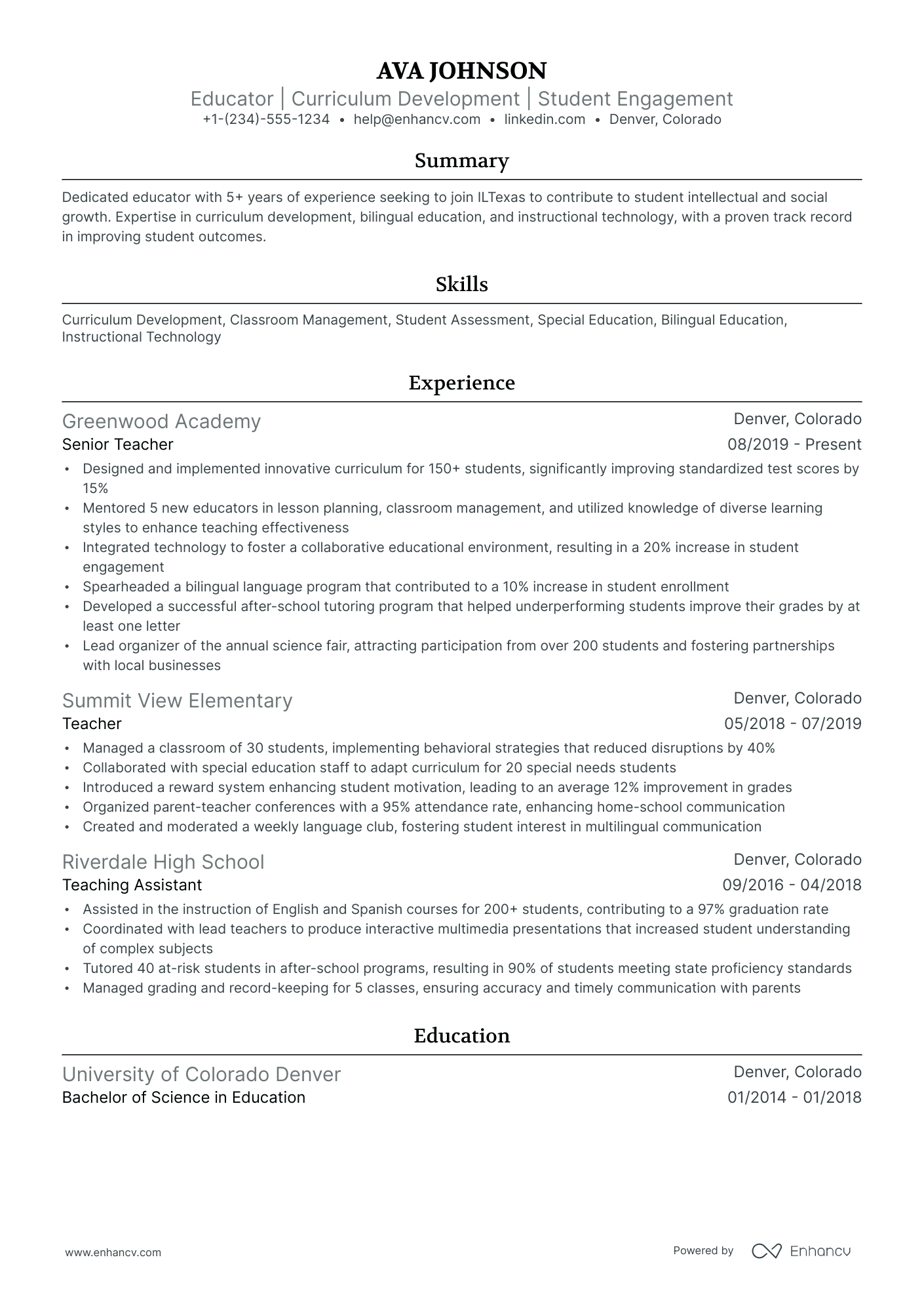
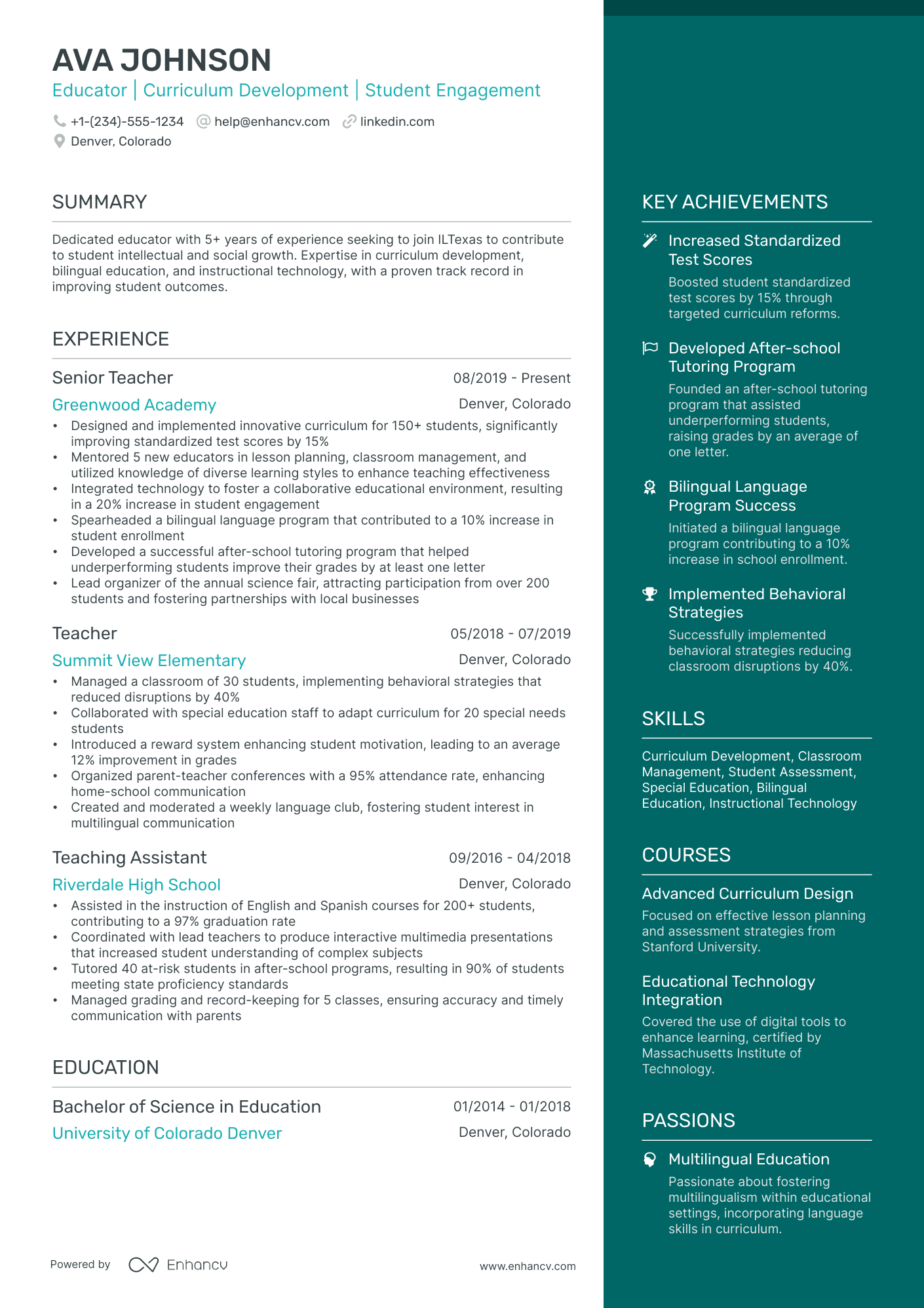
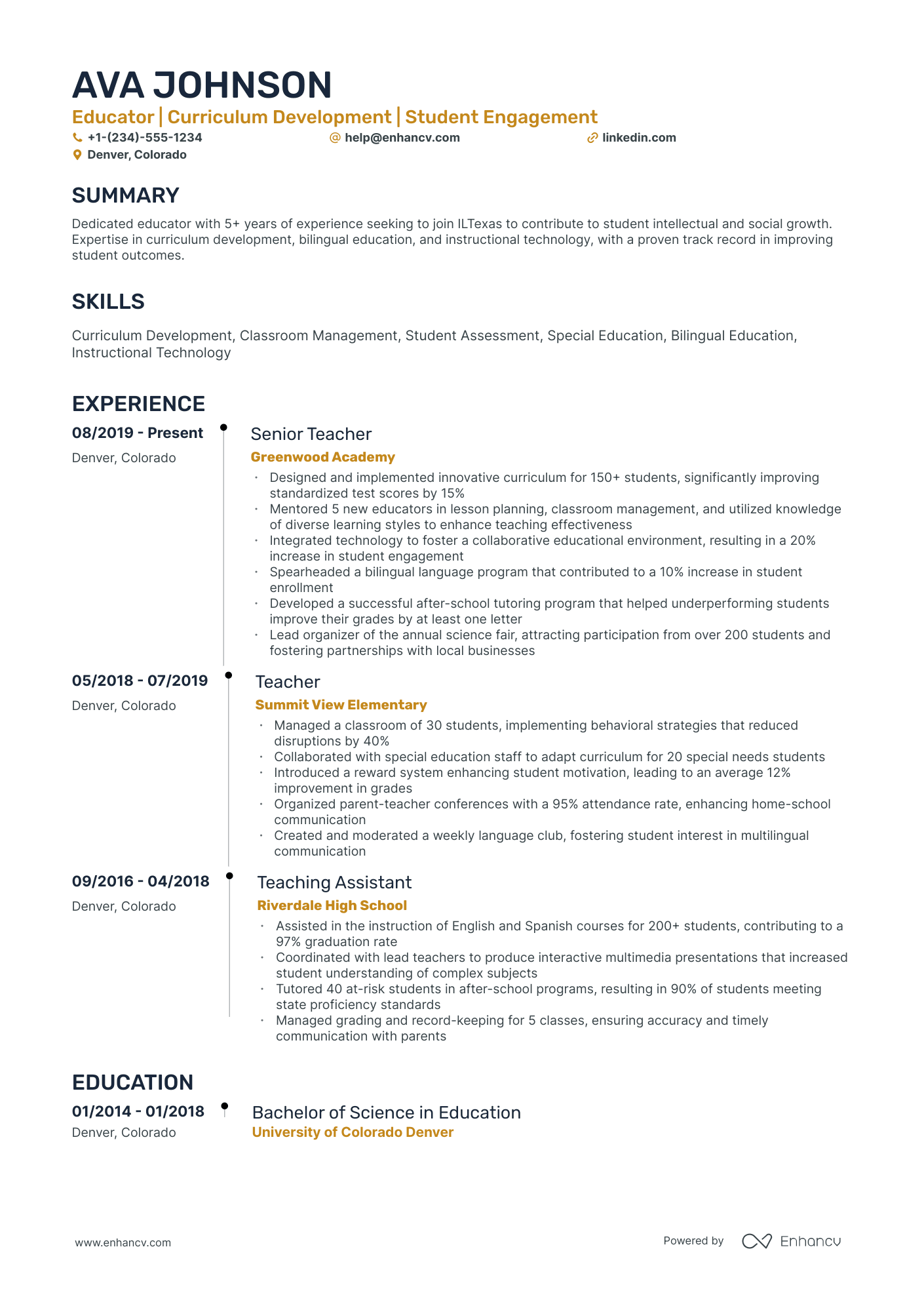
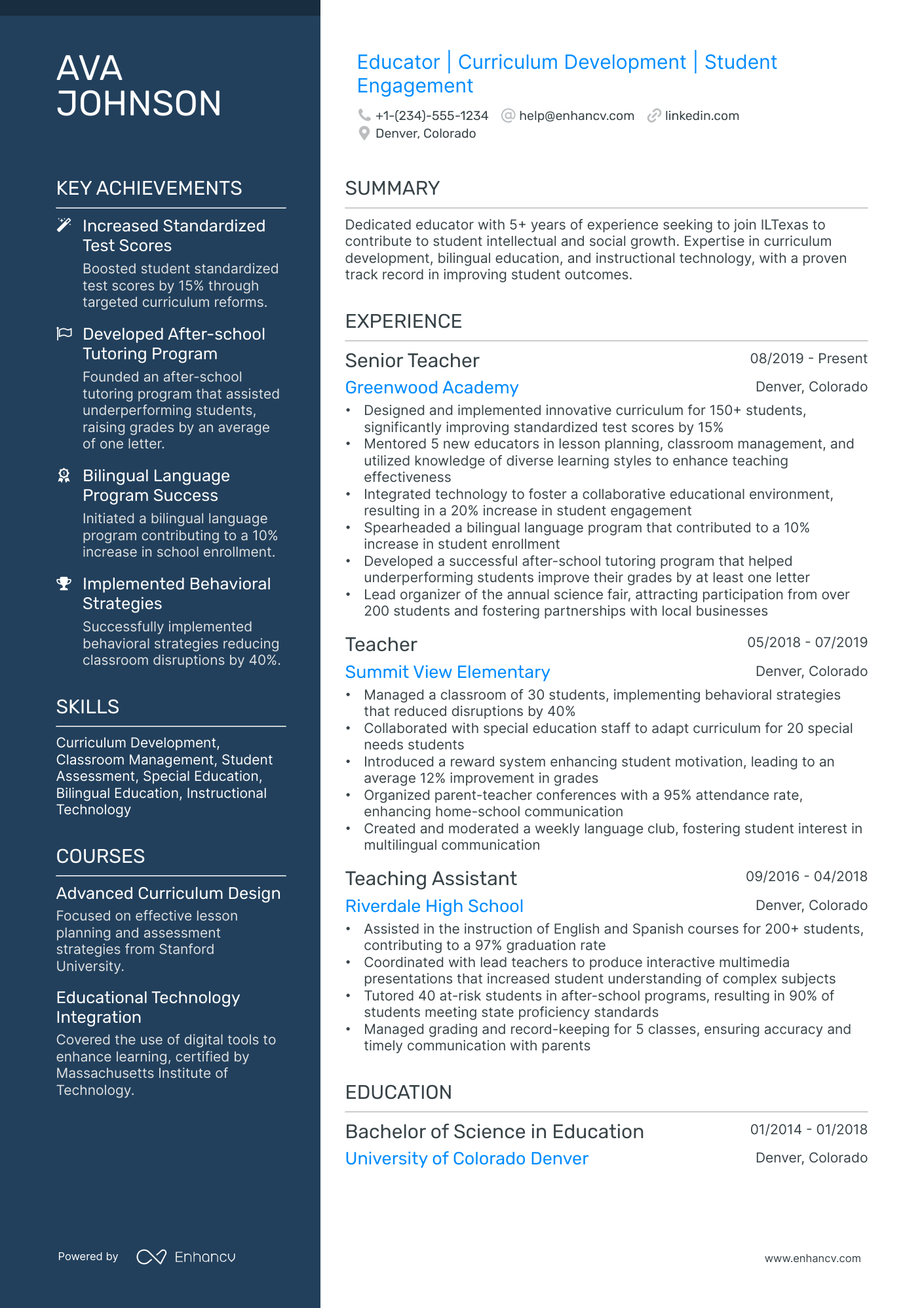
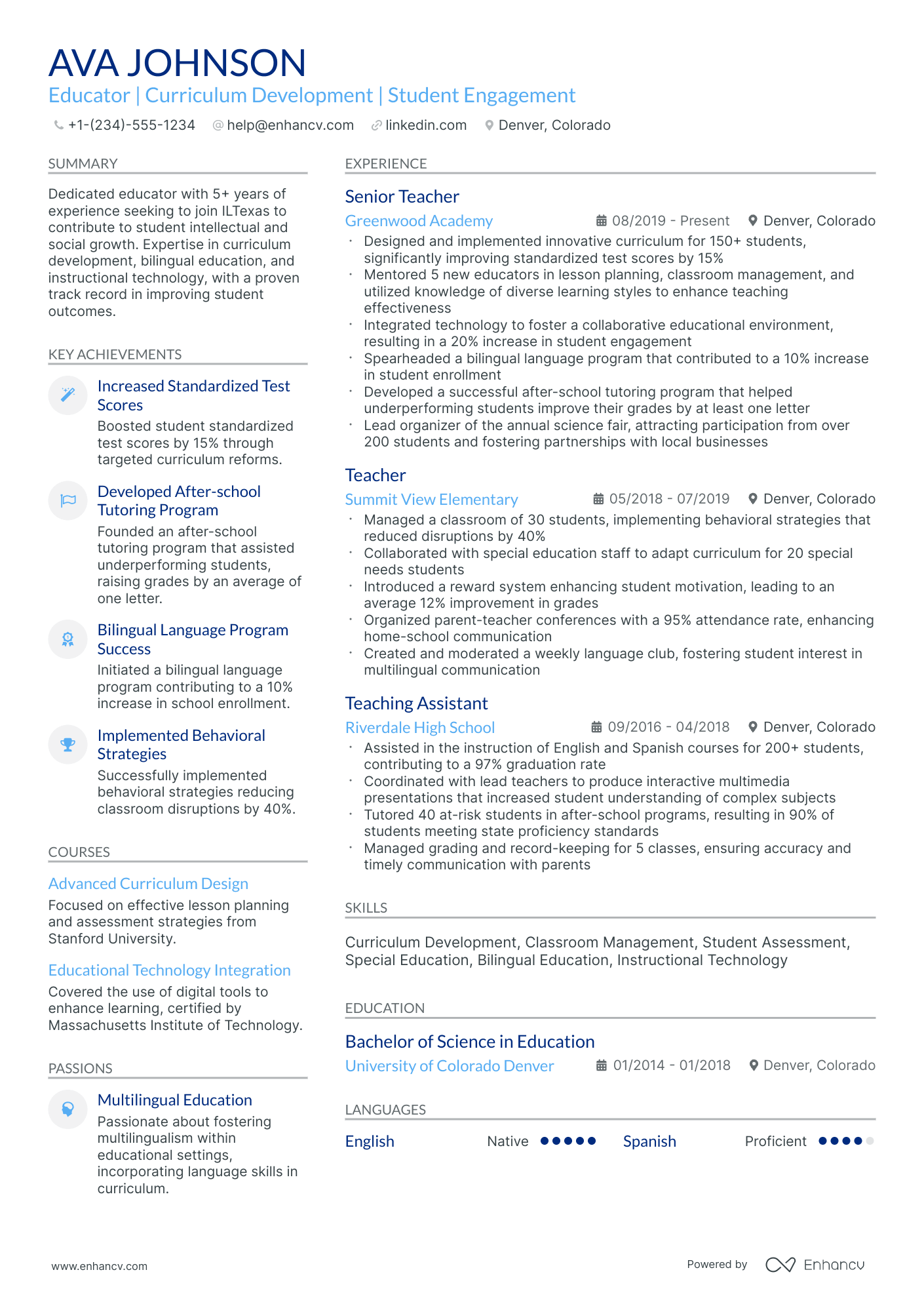
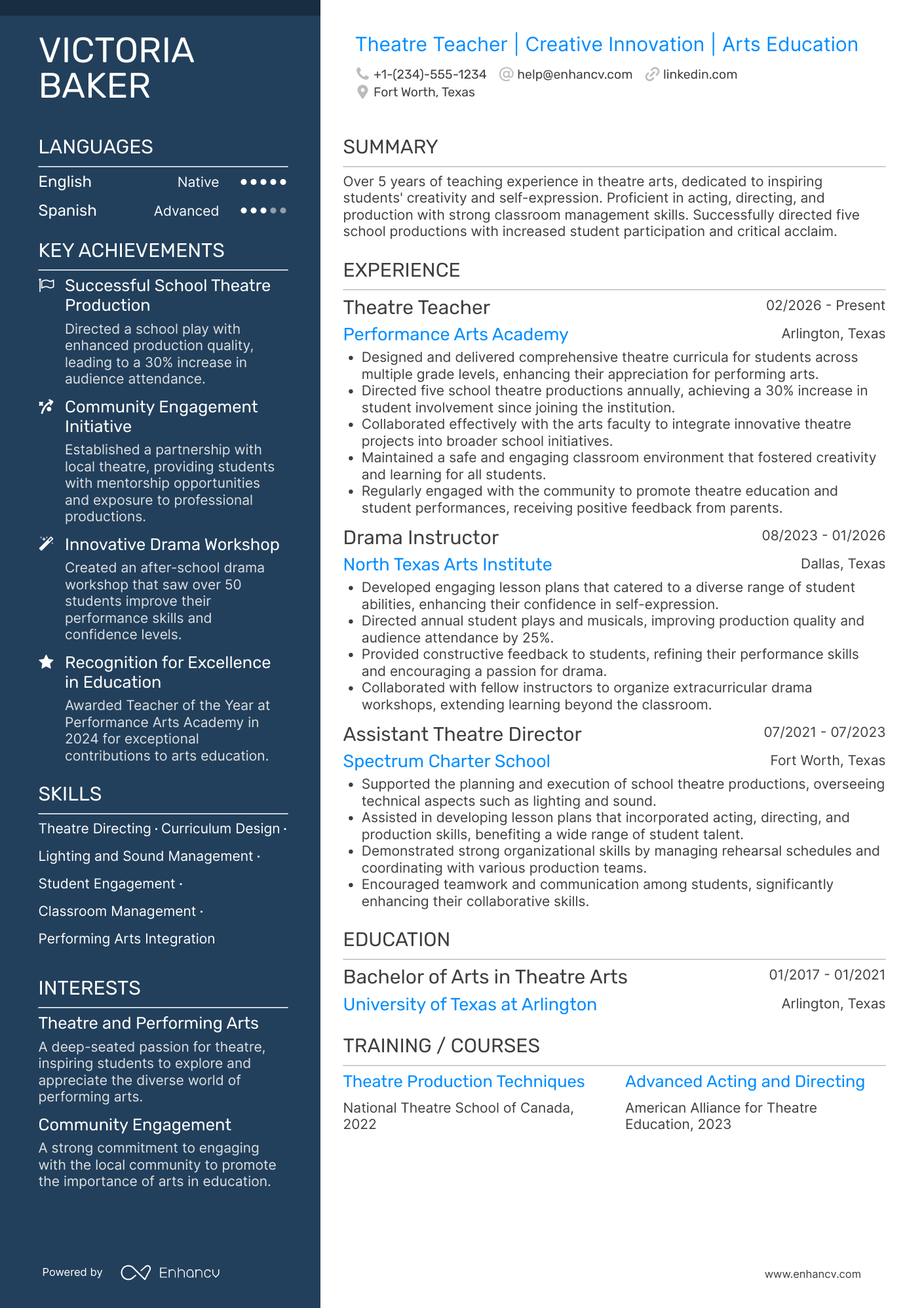
Many theatre teacher resume drafts fail because they bury directing, curriculum, and student outcomes under long duty lists and dense formatting. That hurts you when an applicant tracking system screens keywords and recruiters scan fast.
A strong resume shows what changed because of your work. Knowing how to make your resume stand out means you should highlight production attendance growth, competition placements, improved audition pass rates, budgets managed, rehearsal hours delivered, and measurable gains in student confidence. Focus on scope, quality, and results.

Key takeaways
- Quantify directing, enrollment, and student performance outcomes instead of listing duties.
- Use reverse-chronological format if you have teaching experience; use hybrid if switching careers.
- Mirror the job posting's exact language for standards, tools, and grade levels in your bullets.
- Place skills above experience when you're entry-level; below experience when you're mid-career or senior.
- Pair every listed skill with a measurable result in your experience or summary section.
- Use Enhancv to turn vague responsibilities into specific, recruiter-ready resume bullets faster.
- Stop using AI once your resume accurately reflects real experience—never fabricate outcomes.
How to format a theatre teacher resume
Recruiters evaluating theatre teacher resumes prioritize classroom teaching experience, production direction credits, and the ability to engage students across performance disciplines like acting, stagecraft, and design. A clean, well-organized resume format ensures these signals surface quickly during both human review and applicant tracking system (ATS) scans.

I have significant experience as a theatre teacher—which format should I use?
Use a reverse-chronological format to highlight your teaching tenure, program growth, and progressive leadership across productions and curriculum development. Do:
- Lead with your most recent teaching role and clearly define scope: grade levels served, department size, and number of productions directed per year.
- Feature role-specific skills and domains such as curriculum design, directing, stage management, arts integration, and experience with platforms like Google Classroom or theatrical design software (e.g., Vectorworks, QLab).
- Quantify outcomes tied to student achievement, program growth, or community engagement.
I'm junior or switching into a theatre teacher role—what format works best?
A hybrid format works best, letting you lead with relevant skills and training while still showing a chronological work history that demonstrates teaching or performance experience. Do:
- Place a skills section near the top highlighting competencies like lesson planning, ensemble direction, stage combat choreography, and classroom management.
- Include student teaching placements, community theatre directing credits, drama workshop facilitation, or related freelance work as transitional experience.
- Connect every listed action to a student or program outcome, even in non-traditional settings.
Why not use a functional resume?
A functional format strips away the teaching timeline and production history that hiring committees rely on to assess your readiness for a theatre classroom, making it harder to verify where and how you built your skills. A functional format may make sense in a narrow set of circumstances:
- You're transitioning from professional acting, directing, or stage management into K–12 education with no formal teaching roles yet.
- You have gaps in employment but continued building relevant experience through community theatre, freelance directing, or arts nonprofit work.
- You completed a career-change certification program and lack a traditional teaching work history.
- A functional format is acceptable only if you're entering theatre education from a non-teaching background and have no chronological teaching history—but even then, tie every listed skill to a specific project, production, or measurable outcome.
With your format established, the next step is filling it with the right sections to showcase your qualifications effectively.
What sections should go on a theatre teacher resume
Recruiters expect a theatre teacher resume to show clear teaching experience, production leadership, and student outcomes. Understanding which resume sections to include helps you organize this information effectively.
Use this structure for maximum clarity:
- Header
- Summary
- Experience
- Skills
- Projects
- Education
- Certifications
- Optional sections: Awards, Leadership, Volunteering
Strong experience bullets should emphasize measurable student growth, production outcomes, program scope, and results across instruction, directing, and technical theatre.
Is your resume good enough?
Drop your resume here or choose a file. PDF & DOCX only. Max 2MB file size.
Once you’ve organized your resume with the right components in place, the next step is to write your theatre teacher experience section so each role supports those elements with clear, relevant detail.
How to write your theatre teacher resume experience
The experience section is where you prove you've delivered meaningful results as a theatre teacher—through the curricula you've built, the production methods you've applied, and the student outcomes you've driven. Hiring managers in education and the performing arts prioritize demonstrated impact over descriptive task lists, so every line should point to work you shipped, not duties you held. Building a targeted resume ensures each bullet aligns with the specific role you're pursuing.
Each entry should include:
- Job title
- Company and location (or remote)
- Dates of employment (month and year)
Three to five concise bullet points showing what you owned, how you executed, and what outcomes you delivered:
- Ownership scope: the theatre programs, course curricula, production seasons, student ensembles, or departmental budgets you were directly accountable for as a theatre teacher.
- Execution approach: the pedagogical frameworks, rehearsal methodologies, directing techniques, performance assessment tools, or arts-integration strategies you used to plan instruction and stage productions.
- Value improved: the changes you drove in student performance quality, audience engagement, program enrollment, production accessibility, or classroom learning outcomes through your theatre teaching practice.
- Collaboration context: how you partnered with school administrators, fellow arts educators, technical crew, parent volunteers, community arts organizations, or guest artists to elevate the theatre program.
- Impact delivered: the tangible results your work produced—expressed through program growth, student achievement, audience reach, or institutional recognition—rather than a list of activities you performed.
Experience bullet formula
A theatre teacher experience example
✅ Right example - modern, quantified, specific.
Theatre Teacher
Ridgeview Public High School | Austin, TX
2021–Present
Four-year public high school serving 1,800 students with a competitive performing arts program and community-facing productions.
- Directed six mainstage productions using Google Workspace, Notion, and QLab; increased average ticket revenue 22% year over year and achieved 95% seat utilization across twelve performances.
- Built a standards-aligned curriculum in Canvas and managed assessment rubrics in Google Classroom; improved student performance juries by 18% and raised course pass rates from 92% to 97%.
- Implemented StageWrite and a shared digital prompt book workflow; reduced rehearsal stoppages 30% and cut tech week cueing errors 40% through consistent calling scripts and cue-to-cue planning.
- Coordinated with the technical director, front office, and parent boosters in Trello to manage budgets, purchase orders, and volunteer staffing; delivered productions 8% under budget while meeting all district compliance deadlines.
- Led student designers on Vectorworks and Adobe Creative Cloud for set, lighting, and marketing assets; shortened design-to-build cycle by two weeks and increased social media-driven ticket sales 15%.
Now that you've seen what a strong experience section looks like, let's break down how to adapt yours to match the specific job you're applying for.
How to tailor your theatre teacher resume experience
Recruiters evaluate theatre teacher resumes through both human review and applicant tracking systems, scanning for alignment between your background and the specific role. Tailoring your resume to the job description ensures your qualifications register with both audiences.
Ways to tailor your theatre teacher experience:
- Match directing or choreography methods named in the posting.
- Use the exact curriculum framework or standards terminology listed.
- Mirror student performance metrics or assessment criteria referenced.
- Include experience with specific theatre technologies or lighting systems mentioned.
- Highlight collaboration with departments or community partners described.
- Reflect any accessibility or inclusion initiatives the posting prioritizes.
- Reference production management workflows or scheduling tools specified.
- Emphasize experience with the grade levels or programs outlined.
Tailoring means aligning your real accomplishments with the language and priorities of the job posting, not forcing in keywords where they don't belong.
Resume tailoring examples for theatre teacher
| Job description excerpt | Untailored | Tailored |
|---|---|---|
| Direct and produce mainstage productions each semester, managing all aspects from auditions through closing night, with a budget of up to $15,000 per show. | Helped with school plays and other theatre events. | Directed and produced four mainstage productions annually, overseeing casting, rehearsals, set construction, and performances while managing per-show budgets of up to $15,000 and coordinating crews of 30+ students. |
| Teach acting, stagecraft, and theatre history courses for grades 9–12 using backward design aligned to state fine arts standards. | Taught various theatre classes to high school students. | Designed and taught acting, stagecraft, and theatre history curricula for grades 9–12 using backward design, aligning all units to state fine arts standards and assessing student growth through performance-based rubrics. |
| Build and sustain a competitive one-act play program, preparing students for UIL theatrical competition at the district and regional levels. | Coached students for drama competitions. | Built a UIL one-act play program from the ground up, advancing student ensembles to regional competition three consecutive years by running intensive script analysis, blocking, and character development workshops. |
Once you’ve aligned your experience with the role’s priorities, quantify your theatre teacher achievements to show the measurable impact of that work.
How to quantify your theatre teacher achievements
Numbers show how your direction changed student outcomes and program results. Quantifying your achievements through counts, time saved, dollars managed, and survey scores makes your impact undeniable. Track participation, production quality, rehearsal efficiency, budget impact, and audience response.
Quantifying examples for theatre teacher
| Metric | Example |
|---|---|
| Student engagement | "Raised audition turnout from 28 to 47 students by adding a two-day workshop series and posting sign-ups in Google Classroom." |
| Production quality | "Improved adjudication scores from 82 to 91 out of 100 by implementing weekly rubric-based notes and peer critique circles." |
| Rehearsal efficiency | "Cut tech week cue-to-cue time from five hours to three hours by using a shared Google Sheets cue list and timed transitions." |
| Budget management | "Delivered three productions under a $3,500 budget and reduced prop spend by 18% through a tracked inventory and reuse plan." |
| Audience satisfaction | "Increased post-show survey ratings from 4.1 to 4.7 out of five across 220 responses by tightening pacing and clarifying program notes." |
Turn vague job duties into measurable, recruiter-ready resume bullets in seconds with Enhancv's Bullet Point Generator.
Once you've crafted strong bullet points for your experience section, you'll want to apply the same precision to presenting your hard and soft skills throughout your theatre teacher resume.
How to list your hard and soft skills on a theatre teacher resume
Your skills section shows you can teach performance safely and effectively, and recruiters and an ATS (applicant tracking system) scan it to match keywords to the job post, with most theatre teacher resumes leaning slightly toward hard, classroom-ready skills. theatre teacher roles require a blend of:
- Product strategy and discovery skills
- Data, analytics, and experimentation skills
- Delivery, execution, and go-to-market discipline
- Soft skills
Your skills section should be:
- Scannable (bullet-style grouping).
- Relevant to the job post.
- Backed by proof in experience bullets.
- Updated with current tools.
Place your skills section:
- Above experience if you're junior or switching careers.
- Below experience if you're mid/senior with strong achievements.

Hard skills
- Lesson planning, curriculum mapping
- Standards-aligned instruction
- Script analysis, dramaturgy
- Acting methods: Stanislavski, Meisner
- Voice, diction, vocal health
- Movement, stage combat basics
- Directing, blocking, staging
- Stage management, prompt book creation
- Audition casting, rubrics
- Lighting, sound, cueing
- Set, props, costume coordination
- Google Classroom, Canvas
Soft skills
- Give clear performance notes
- Coach students through anxiety
- Lead rehearsals with structure
- Facilitate ensemble collaboration
- Set expectations and boundaries
- De-escalate conflicts in class
- Adapt instruction in real time
- Communicate with parents and admins
- Coordinate across school departments
- Manage time across productions
- Make fair casting decisions
- Model professionalism and accountability
How to show your theatre teacher skills in context
Skills shouldn't live only in a bulleted list on your resume. Explore examples of resume skills to see how top candidates present their abilities effectively.
They should be demonstrated in:
- Your summary (high-level professional identity)
- Your experience (proof through outcomes)
Here's what this looks like in practice.
Summary example
Theatre educator with 12 years of experience directing student productions, teaching Stanislavski-based acting techniques, and integrating stagecraft curricula. Boosted student participation in performing arts programs by 45% through inclusive, ensemble-driven pedagogy.
- Reflects senior-level experience clearly
- Names specific methods and techniques
- Includes a measurable participation outcome
- Highlights inclusive, collaborative teaching style
Experience example
Senior Theatre Teacher
Ridgewood Preparatory Academy | Portland, OR
August 2017–June 2024
- Directed 18 full-scale student productions using Viewpoints and Meisner techniques, earning three regional drama festival awards.
- Collaborated with music and visual arts departments to launch an interdisciplinary arts showcase, increasing audience attendance by 60%.
- Designed a digital stagecraft curriculum using QLab and Google Classroom, improving student technical proficiency scores by 35%.
- Every bullet contains measurable proof.
- Skills emerge naturally through outcomes.
Once you’ve demonstrated your theatre teaching strengths through specific examples and results, the next step is to apply that same approach to writing a theatre teacher resume with no experience.
How do I write a theatre teacher resume with no experience
Even without full-time experience, you can demonstrate readiness through building a resume without work experience that highlights transferable skills:
- Student teaching or classroom observation
- Directed school or community productions
- Coached auditions and cold reads
- Planned lesson plans for drama units
- Led improv workshops for youth
- Managed stage crew and safety
- Designed costumes, props, and sets
- Tutored acting, voice, or movement
Focus on:
- Standards-aligned theatre lesson planning
- Classroom management with clear routines
- Production leadership with documented results
- Assessment methods and student growth
Resume format tip for entry-level theatre teacher
Use a combination resume format because it highlights theatre teacher skills and projects while still showing transferable experience from education and production work. Do:
- Lead with a theatre teacher summary and target role.
- Add a Projects section with productions and workshops.
- List lesson plans, rubrics, and assessment tools.
- Quantify outcomes: attendance, roles cast, growth.
- Include relevant coursework and certifications.
- Directed a student one-act production, taught blocking and vocal projection, and increased rehearsal attendance from twelve to eighteen students over six weeks.
Even without formal teaching roles, your education section can demonstrate the foundational training and credentials that qualify you for a theatre teacher position.
How to list your education on a theatre teacher resume
Your education section helps hiring teams confirm you have the foundational training needed for a theatre teacher role. It validates your academic preparation in performance, pedagogy, and dramatic arts.
Include:
- Degree name
- Institution
- Location
- Graduation year
- Relevant coursework (for juniors or entry-level candidates)
- Honors & GPA (if 3.5 or higher)
Skip month and day details—list the graduation year only.
Here's a strong education entry tailored for a theatre teacher resume.
Example education entry
Bachelor of Fine Arts in Theatre Education
University of Minnesota, Minneapolis, MN
Graduated 2019
GPA: 3.7/4.0
- Relevant Coursework: Directing for the Stage, Theatre History, Acting Pedagogy, Stagecraft, and Dramatic Literature
- Honors: Magna Cum Laude, Dean's List (six semesters)
How to list your certifications on a theatre teacher resume
Certifications show your commitment to learning, proficiency with teaching tools, and current industry relevance as a theatre teacher. They also highlight specialized training that supports safer, stronger instruction.
Include:
- Certificate name
- Issuing organization
- Year
- Optional: credential ID or URL
- Place certifications below education when your degree is recent and more relevant than older certifications.
- Place certifications above education when they are recent, highly relevant, or required for your theatre teacher role.
Best certifications for your theatre teacher resume
- State Teaching Certification in Theatre Arts
- CPR and First Aid Certification
- Child Abuse Recognition and Reporting Training
- Certified Teacher of English to Speakers of Other Languages (TESOL)
- Google Certified Educator Level 1
- Mental Health First Aid Certification
- OSHA General Industry Safety and Health Certificate
Once you’ve positioned your credentials where hiring teams can spot them quickly, shift to your theatre teacher resume summary to connect those qualifications to the impact you’ll bring in the role.
How to write your theatre teacher resume summary
Your resume summary is the first thing a recruiter reads. A strong one immediately signals you're qualified to educate and inspire students through theatre arts.
Keep it to three to four lines, with:
- Your title and total years of theatre teaching experience.
- The educational setting, such as public school, private academy, or community program.
- Core skills like curriculum design, directing, stagecraft, and performance coaching.
- One or two measurable achievements, such as enrollment growth or competition results.
- Soft skills tied to real outcomes, like mentorship that improved student retention.

PRO TIP
At this level, emphasize hands-on classroom skills, relevant training, and early wins. Highlight specific tools or methods you've used, like directing student showcases. Avoid vague phrases like "passionate educator" or "team player" without concrete examples backing them up.
Example summary for a theatre teacher
Theatre teacher with three years of experience leading drama curriculum for grades 9–12. Directed 10 student productions, boosting program enrollment by 35%. Skilled in stagecraft instruction, improvisation techniques, and arts-integrated lesson planning.
Optimize your resume summary and objective for ATS
Drop your resume here or choose a file.
PDF & DOCX only. Max 2MB file size.
Now that your summary captures the essence of your teaching expertise and theatrical strengths, it's time to ensure your resume header presents the essential contact and identification details that make it easy for hiring managers to reach you.
What to include in a theatre teacher resume header
A resume header lists your key contact and professional links, boosting visibility, credibility, and recruiter screening for a theatre teacher role.
Essential resume header elements
- Full name
- Tailored job title and headline
- Location
- Phone number
- Professional email
- GitHub link
- Portfolio link
A LinkedIn link helps recruiters verify experience quickly and speeds up screening.
Do not include photos on a theatre teacher resume unless the role is explicitly front-facing or appearance-dependent.
Use a clear job title that matches the posting and keep the header consistent with your byline across your links.
Theatre teacher resume header
Jordan Avery
Theatre Teacher | Directing, Stagecraft, and Student Productions
Chicago, IL
(312) 555-01XX
jordan.avery@enhancv.com
github.com/jordanavery
jordanavery.com
linkedin.com/in/jordanavery
Once your contact details and role are clear at the top, add additional sections to showcase relevant strengths that don’t fit in the main resume sections.
Additional sections for theatre teacher resumes
Extra resume sections help you stand out when your core qualifications match other candidates. They showcase unique strengths that prove your fit for a theatre teacher role.
- Languages
- Hobbies and interests
- Publications
- Directing and production credits
- Professional affiliations and memberships
- Awards and honors
- Workshops and masterclasses
Once you've rounded out your resume with the right supplementary sections, it's worth pairing it with a strong cover letter to make an even greater impact.
Do theatre teacher resumes need a cover letter
A cover letter isn't required for every theatre teacher role, but it often helps. If you're unsure what a cover letter is and when it matters, it's most useful in competitive openings or districts that expect one. It also helps when your resume doesn't clearly show fit.
Use a cover letter to add context your resume can't:
- Explain role and team fit by naming the program needs you match and how you collaborate with arts staff and administrators.
- Highlight one or two outcomes, such as a production you directed, measurable student growth, or a successful fundraising or community partnership.
- Show you understand the school's context by referencing its students, course offerings, and constraints like budget, space, or scheduling.
- Address career transitions or non-obvious experience by connecting prior roles to classroom management, curriculum design, and student-centered theatre instruction.
Drop your resume here or choose a file.
PDF & DOCX only. Max 2MB file size.
Even if you submit a cover letter to add context beyond your resume, using AI to improve your theatre teacher resume can help you sharpen your content and tailor it faster for each role.
Using AI to improve your theatre teacher resume
AI can sharpen your resume's clarity, structure, and overall impact. It helps tighten language and highlight relevant accomplishments. But overuse strips authenticity. Once your content reads clearly and aligns with the role, step away from AI. If you're wondering which AI is best for writing resumes, focus on tools that enhance rather than fabricate.
Here are 10 practical prompts you can copy and paste to strengthen specific sections of your resume:
- Strengthen your summary: "Rewrite my theatre teacher resume summary to highlight my directing experience, classroom management style, and student engagement approach in three concise sentences."
- Quantify experience bullets: "Add measurable outcomes to these theatre teacher experience bullets, focusing on student participation rates, production attendance numbers, and program growth."
- Align skills to the role: "Review this skills section and remove anything not directly relevant to a theatre teacher position. Suggest replacements tied to curriculum design and performance coaching."
- Tighten action verbs: "Replace weak or repetitive verbs in my theatre teacher experience section with strong, specific action verbs that reflect teaching, directing, and mentoring."
- Refine project descriptions: "Rewrite these theatre production descriptions on my theatre teacher resume to emphasize my leadership role, creative decisions, and student learning outcomes."
- Improve education details: "Reorganize my education section to highlight coursework, training, and degrees most relevant to a theatre teacher position."
- Clarify certification entries: "Format my theatre teacher certifications section for easy scanning. Include credential names, issuing organizations, and renewal dates in consistent order."
- Cut unnecessary filler: "Identify and remove filler words, redundant phrases, and vague descriptors across my entire theatre teacher resume."
- Target a specific posting: "Compare my theatre teacher resume against this job description. Flag missing keywords, skills gaps, and misaligned experience bullets."
- Polish final formatting: "Review my theatre teacher resume for inconsistent punctuation, tense shifts, and formatting errors across all sections. Suggest specific corrections."
Stop using AI once your resume sounds accurate, specific, and aligned with real experience. AI should never invent experience or inflate claims—if it didn't happen, it doesn't belong here.
Conclusion
A strong theatre teacher resume highlights measurable outcomes, role-specific skills, and a clear structure. Lead with results like student participation, production success, and improved performance skills. Support them with directing, curriculum planning, classroom management, and collaboration.
Keep each section easy to scan, with consistent formatting and specific details. This approach shows you can meet today’s expectations and adapt to near-future needs. It helps hiring teams see your readiness and impact quickly.