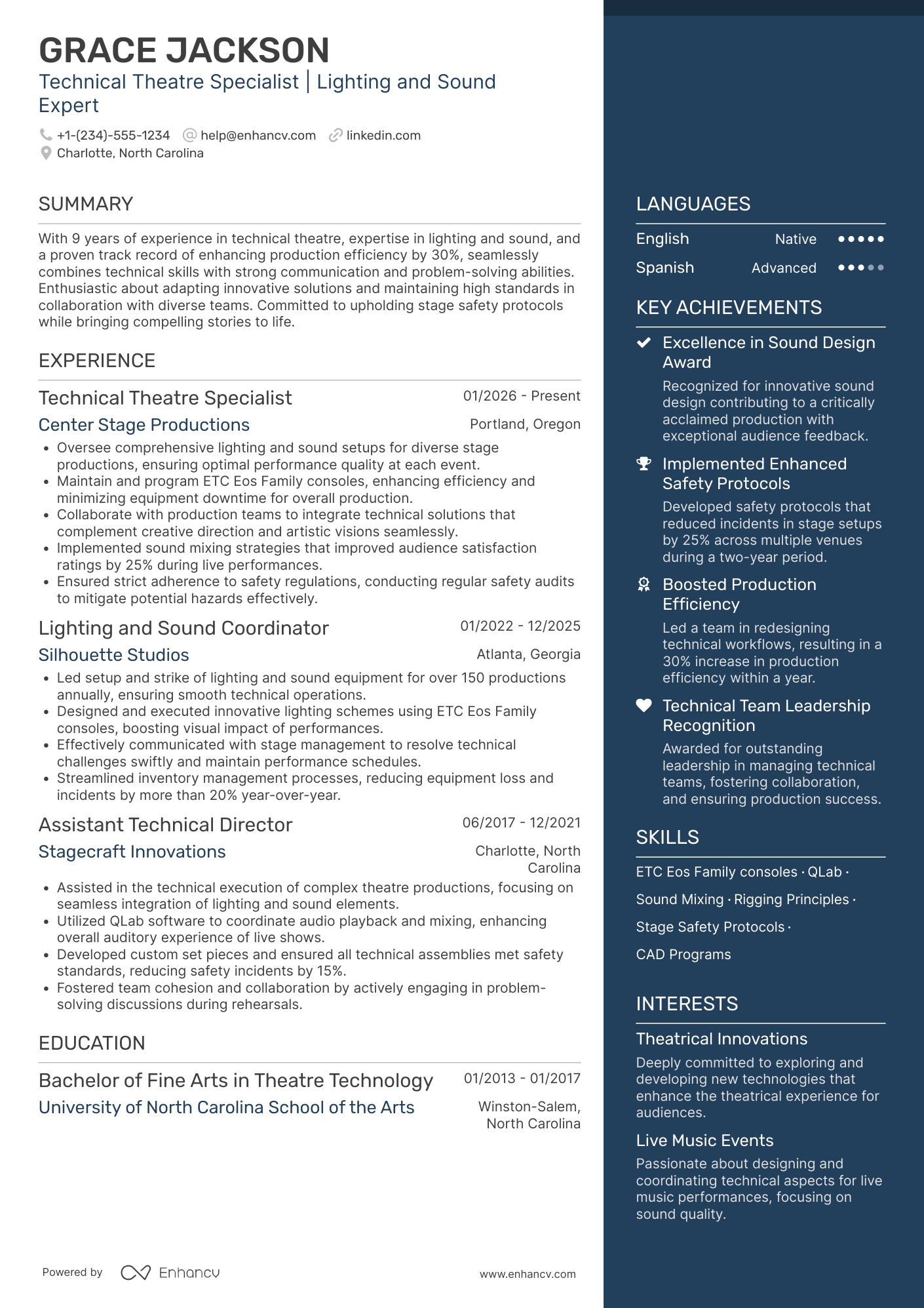


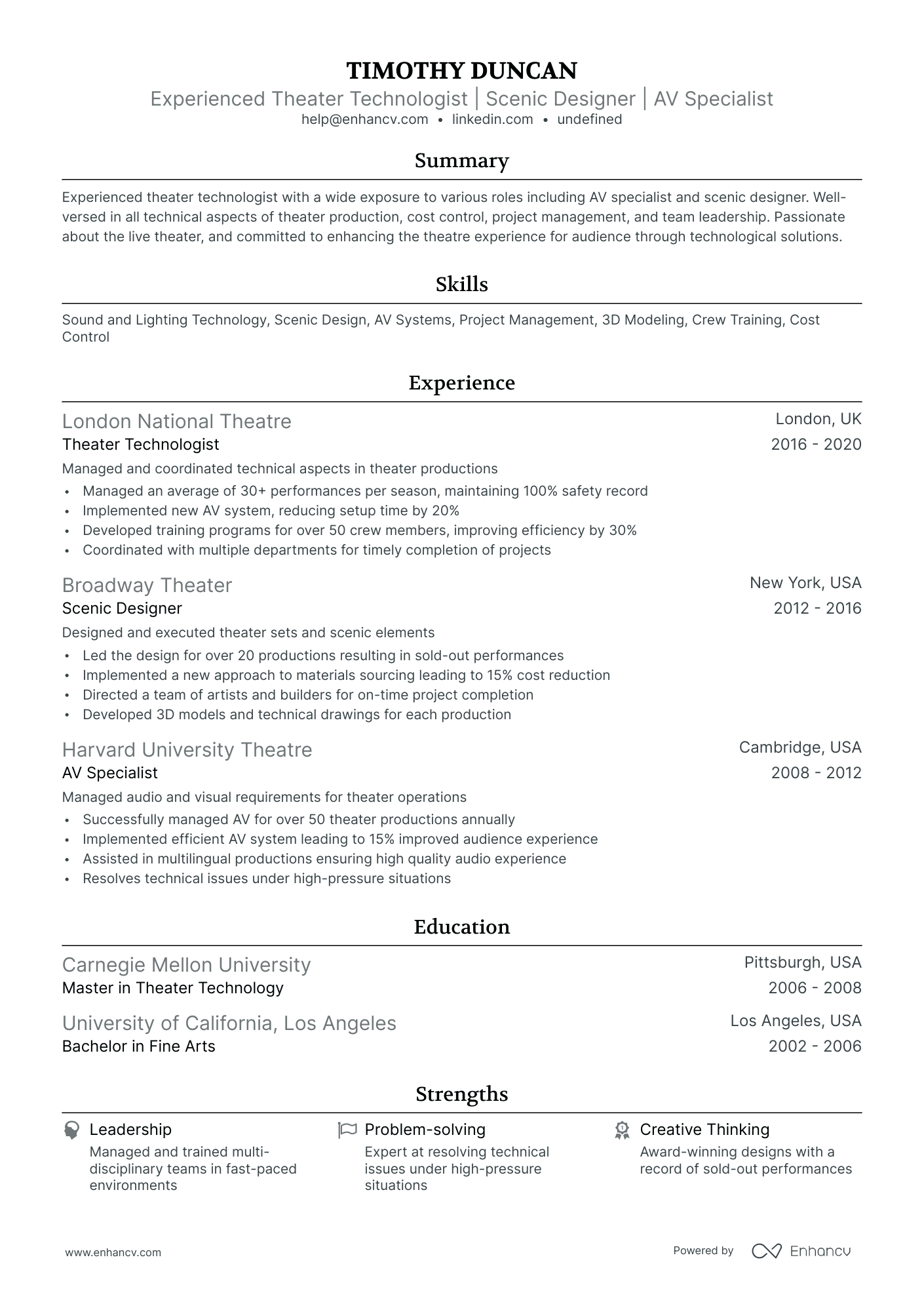
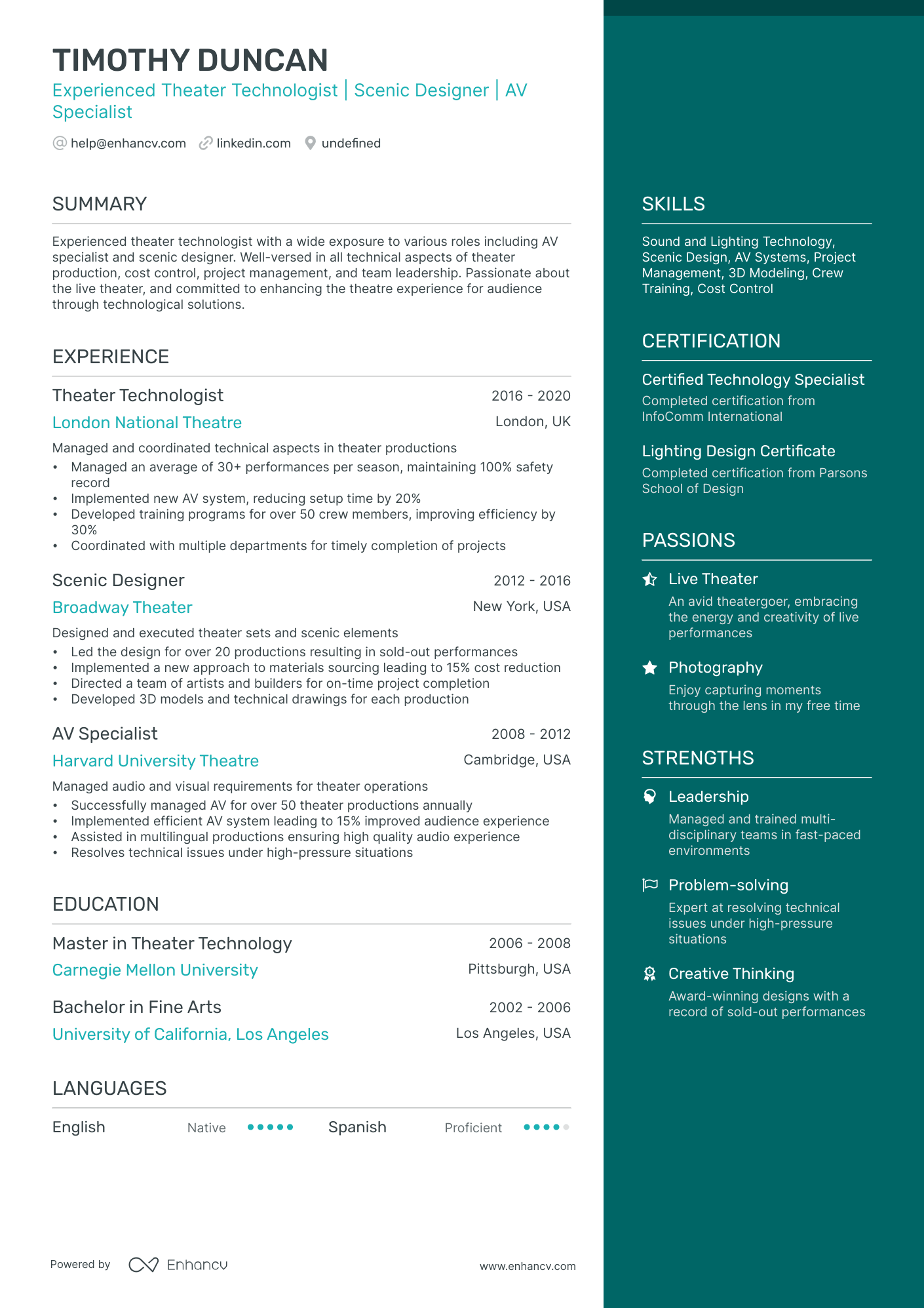
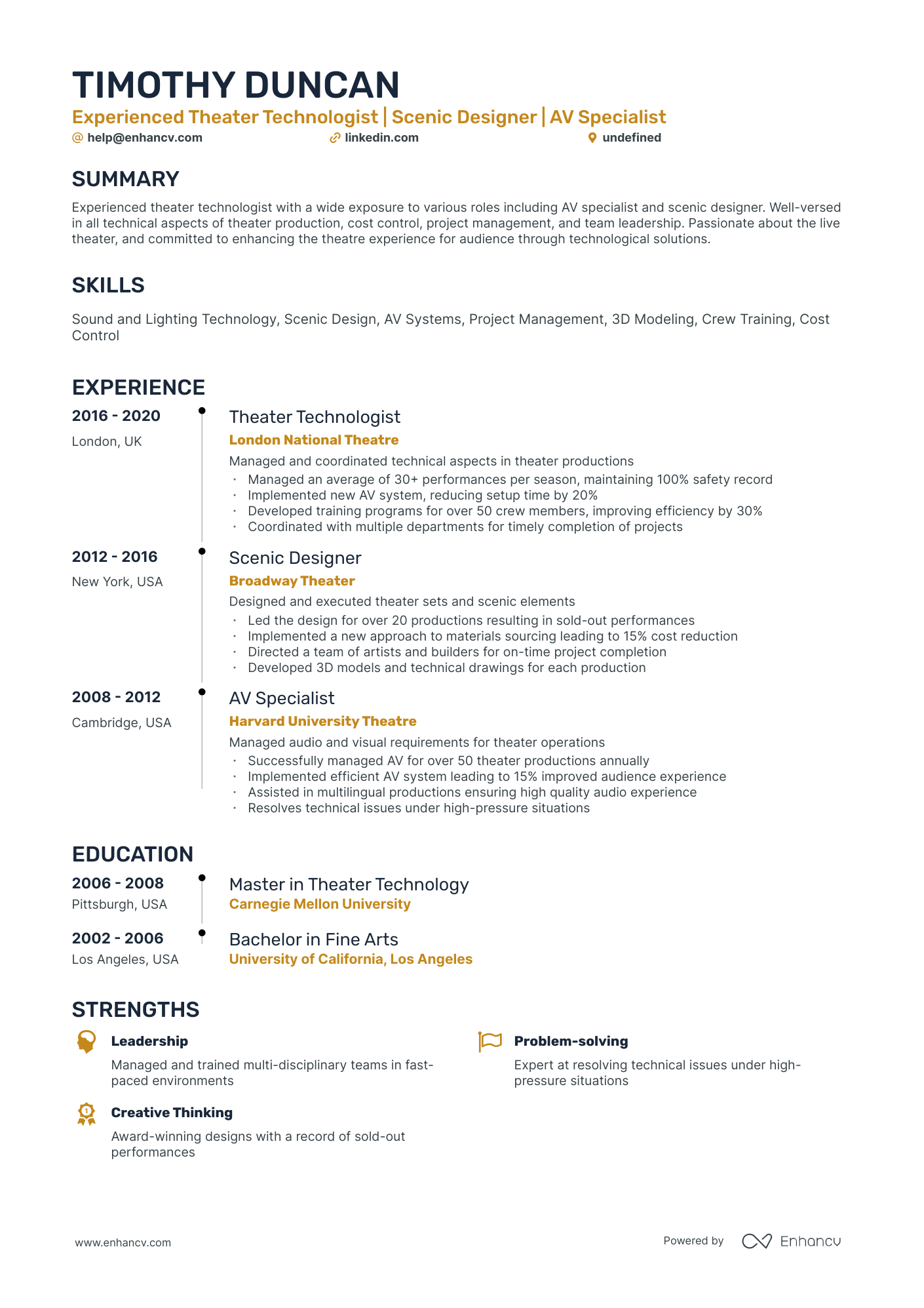
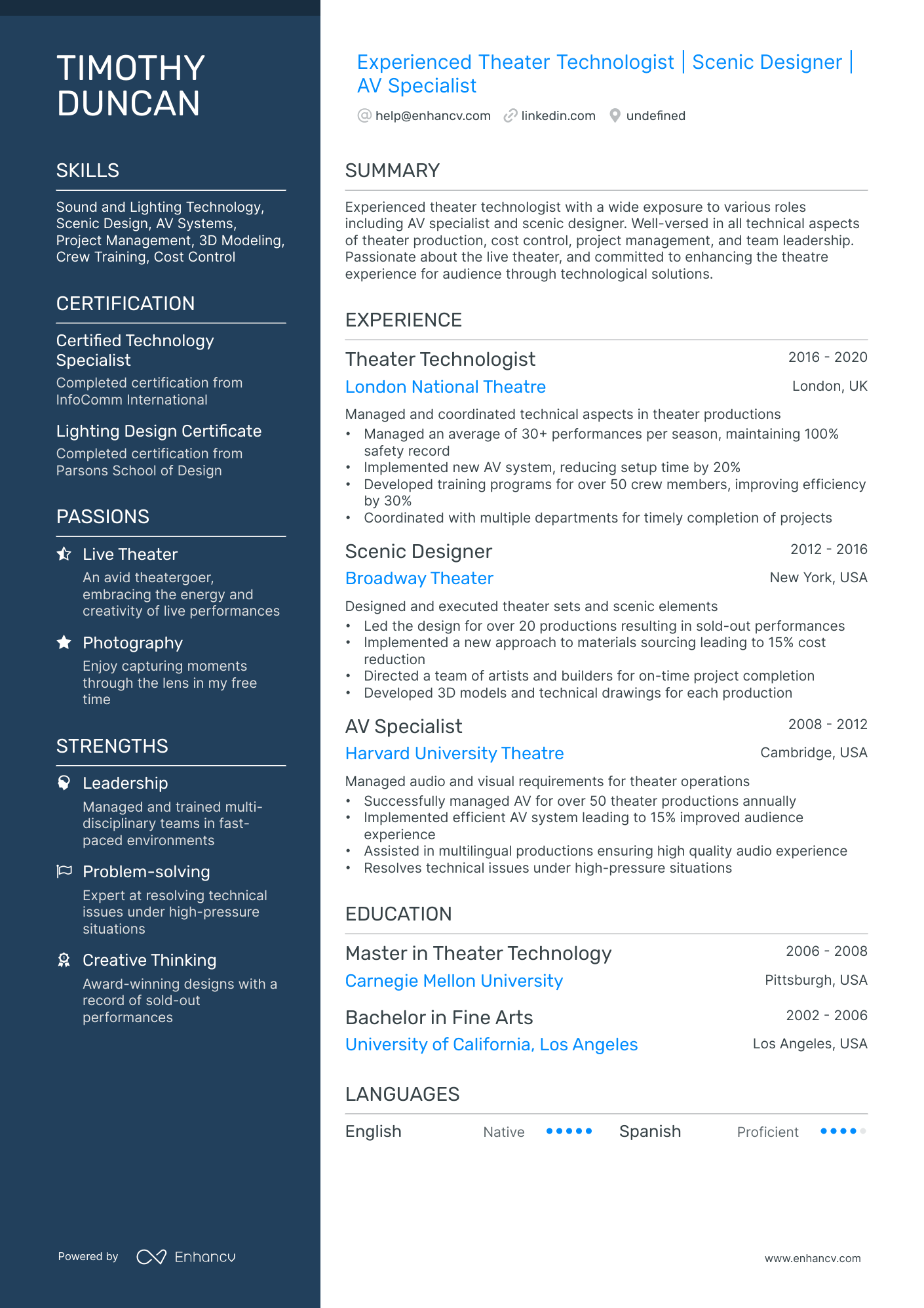
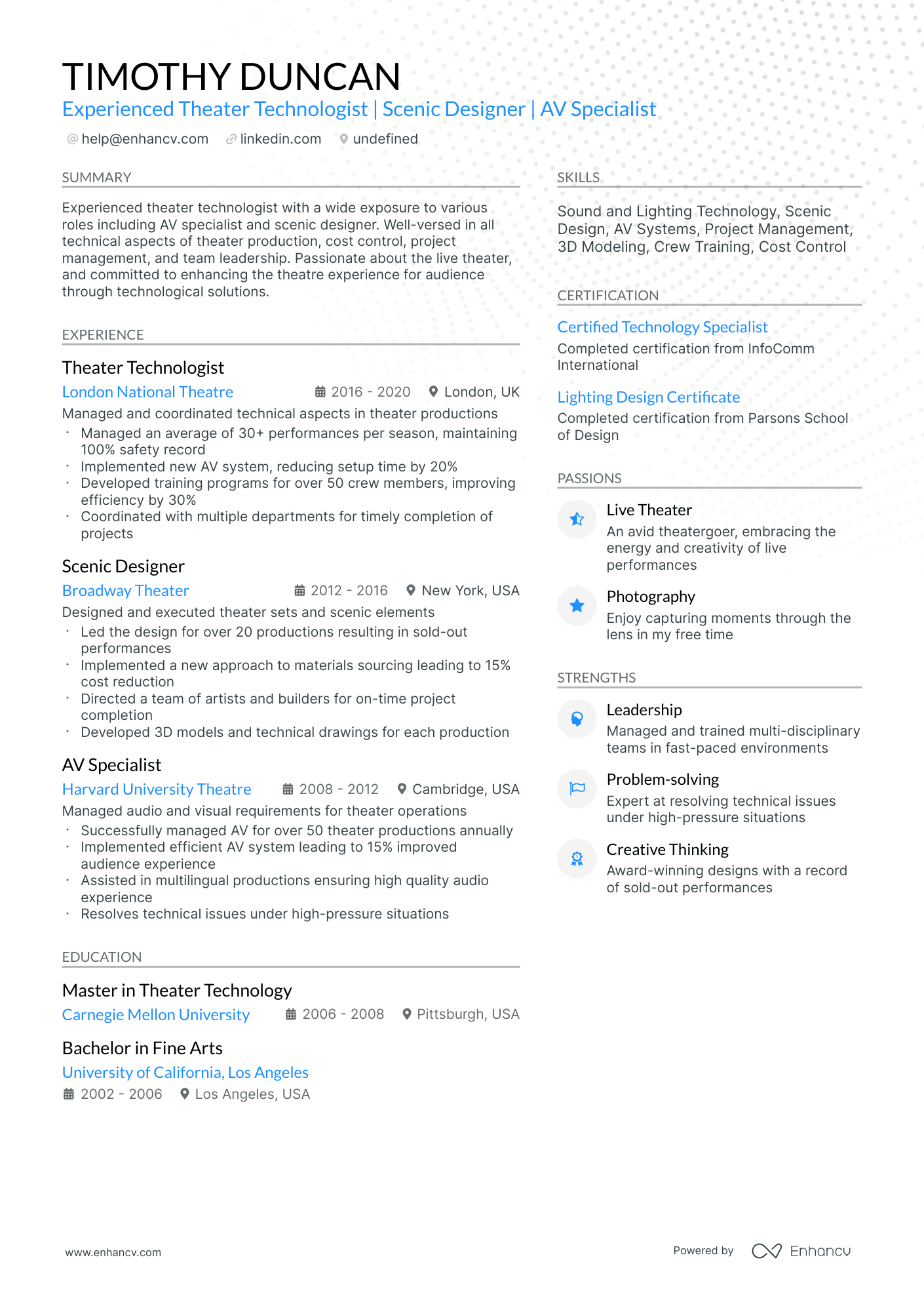
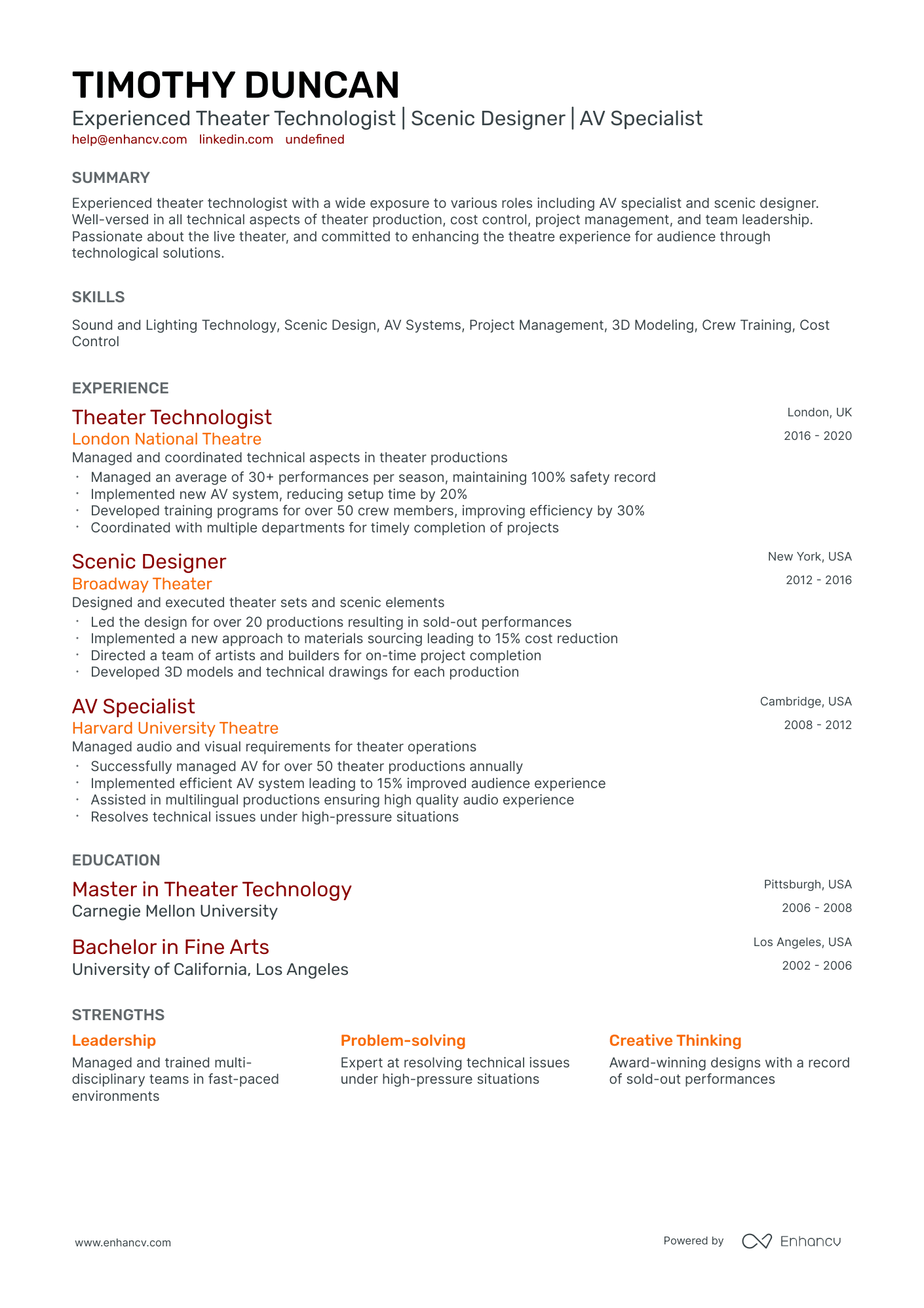
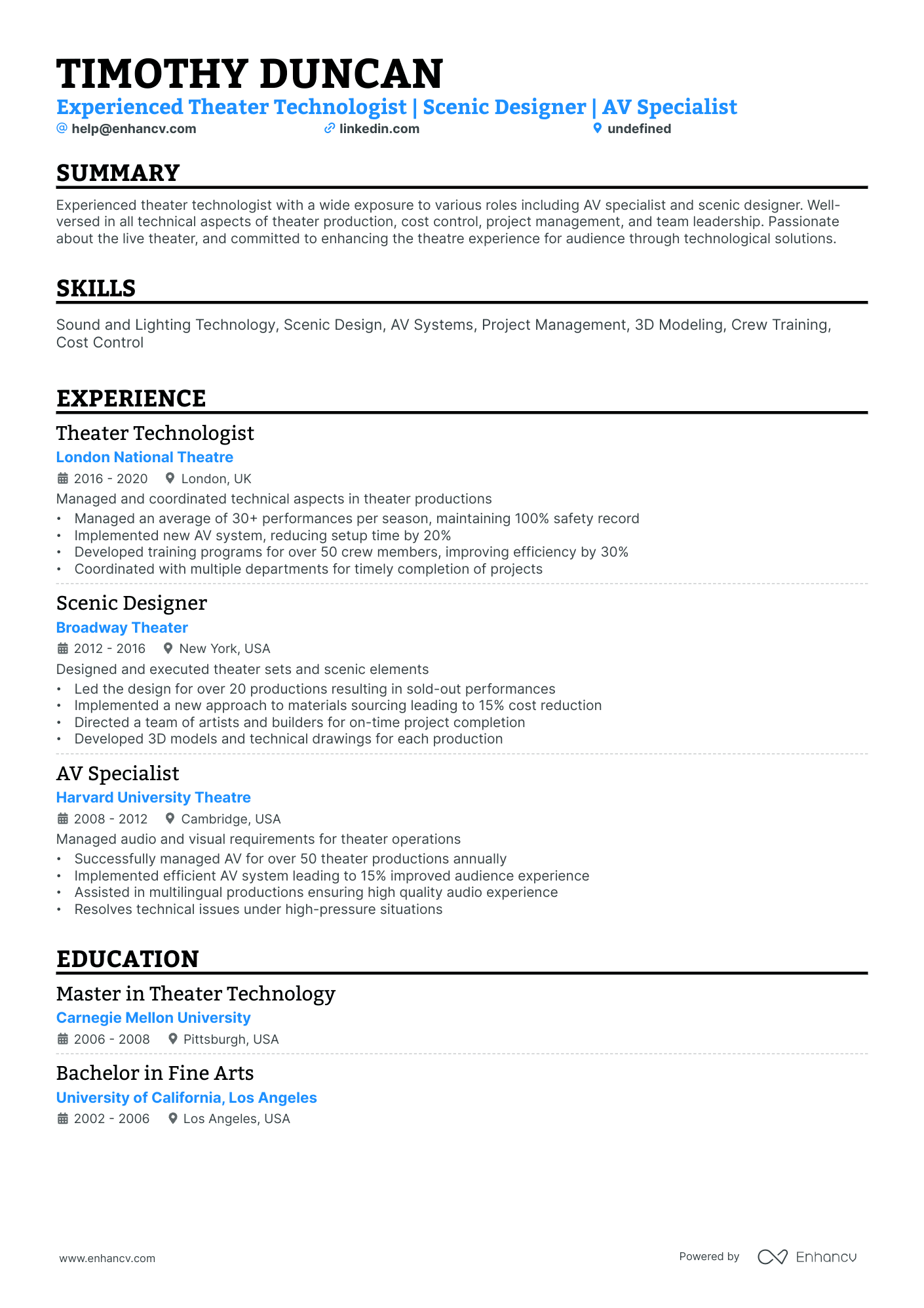
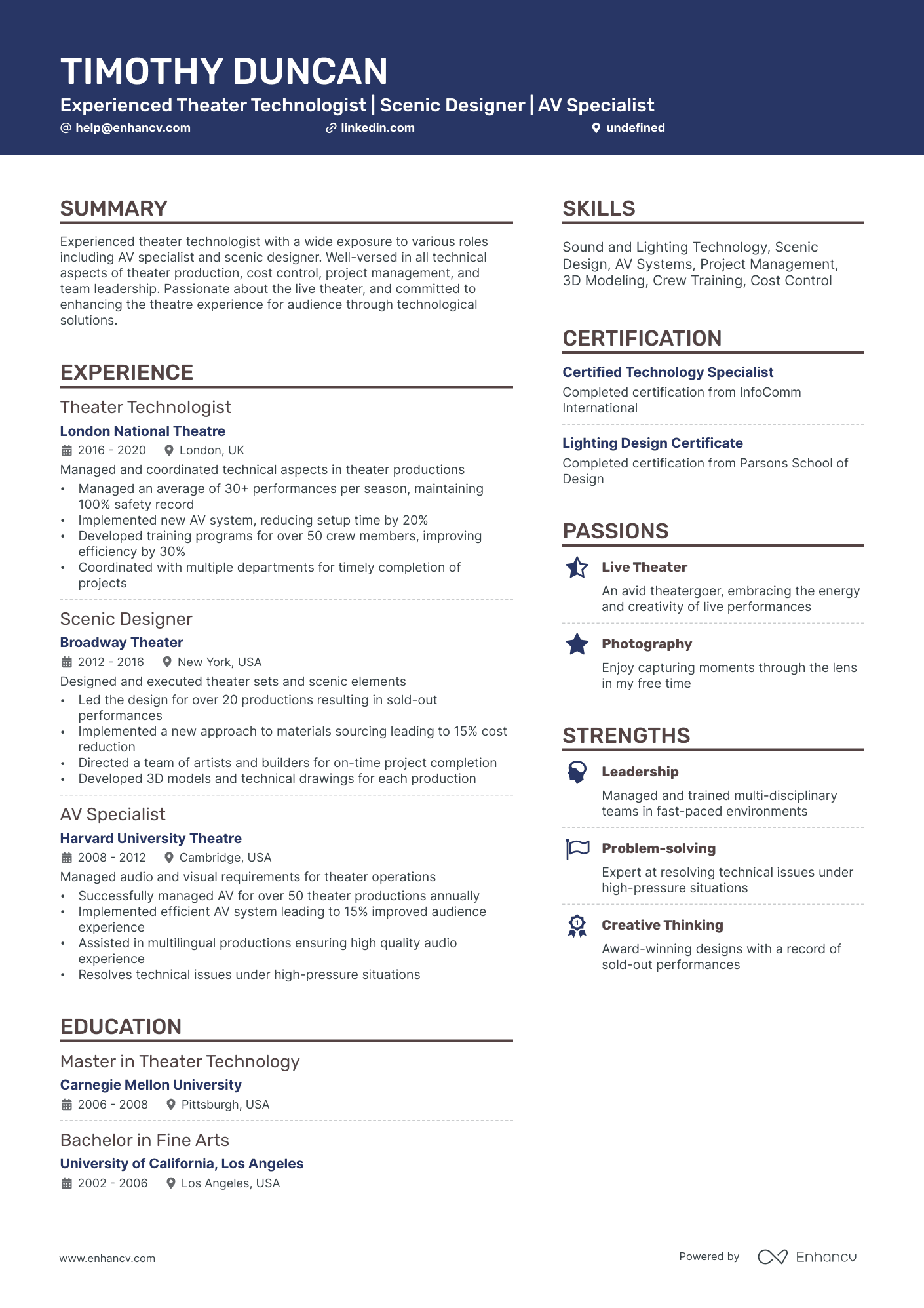
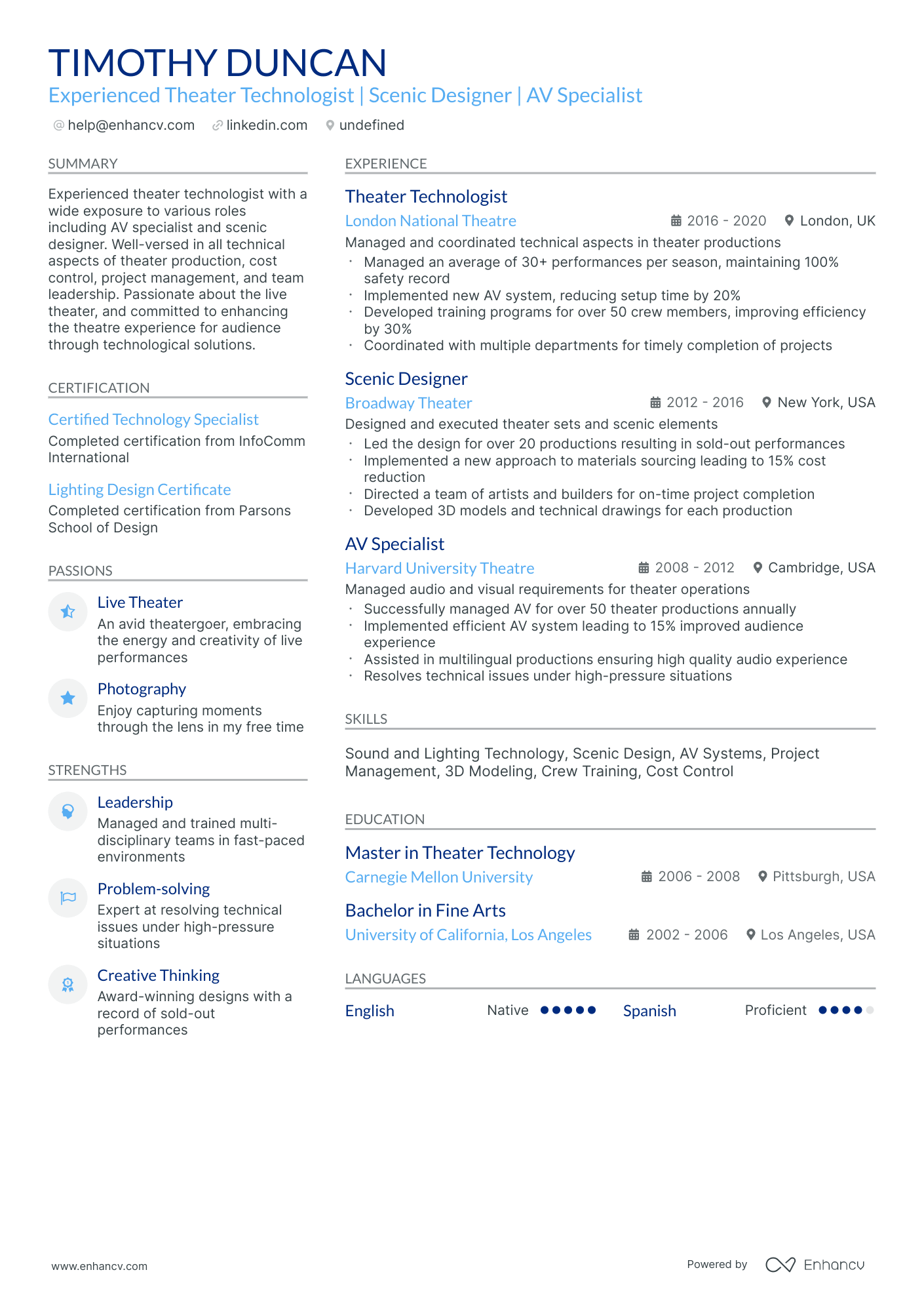
Many technical theatre resume drafts fail because they read like crew calls, not evidence of delivery. A technical theatre resume must pass applicant tracking system filters and quick recruiter scans in a crowded market. Understanding how to make your resume stand out is critical in this competitive field.
You should emphasize outcomes: shows supported, cues executed cleanly, and problems solved under pressure. Quantify scope with run length, venue size, crew size, budget, load-in time, and safety record, plus on-time openings and reduced changeover minutes.

Key takeaways
- Quantify production outcomes like changeover time, cue accuracy, and budget variance in every experience bullet.
- Choose reverse-chronological format with deep experience or hybrid format when switching into technical theatre.
- Tailor each resume to the posting by mirroring specific consoles, software, venue types, and rigging systems named.
- Group hard and soft skills by category, then back each one with proof in your experience section.
- Lead your summary with role title, years of experience, core tools, and one measurable achievement.
- List certifications like ETCP or OSHA directly after education to signal verified, hands-on readiness.
- Use Enhancv to turn vague duties into measurable, recruiter-ready bullets that pass applicant tracking systems.
How to format a technical theatre resume
Recruiters reviewing technical theatre resumes prioritize hands-on production skills, familiarity with industry-standard tools and techniques, and evidence that you can deliver reliable results under tight deadlines. A clean, well-organized resume format ensures these signals aren't buried—especially since many theatres and production companies use applicant tracking systems (ATS) that parse standard layouts more accurately.

I have significant experience in this role—which format should I use?
Use a reverse-chronological format to put your deepest, most relevant production experience front and center. Do:
- Lead each role entry with your scope of responsibility—crew size managed, number of productions per season, and departments coordinated (scenic, lighting, sound, rigging).
- Highlight proficiency with role-specific tools and domains such as AutoCAD, Vectorworks, ETC Eos consoles, CNC fabrication, or fly system operations.
- Quantify outcomes that reflect efficiency, safety, or budget stewardship.
I'm junior or switching into this role—what format works best?
A hybrid format works best, letting you lead with a focused skills section while still showing relevant production history or adjacent experience in chronological order. Do:
- Place a targeted skills section near the top—group competencies by category (e.g., Lighting, Scenic Construction, Stage Management Software) so hiring managers find them immediately.
- Include academic productions, community theatre credits, apprenticeships, or transferable project work such as event rigging or construction to demonstrate hands-on capability.
- Connect every listed skill to a specific action and its result so reviewers see practical application, not just a keyword list.
Why not use a functional resume?
A functional format strips away the production-by-production context that hiring managers rely on to gauge your reliability, growth, and ability to work within real technical theatre timelines.
- Career changers with transferable skills: If you're moving from construction, live events, or film production and have no theatre credits yet, a functional layout can group relevant competencies—rigging, electrical work, scenic painting—while you build your theatre-specific credit list.
- Limited formal work history: If your experience is primarily academic or volunteer-based, a functional format lets you spotlight skills demonstrated across coursework, workshops, or short-run community productions.
- A functional format is acceptable when you have significant resume gaps—such as time away from production work—but only if every skill entry references a concrete project, production, or documented result rather than standing alone as a keyword.
Once your layout and formatting choices are in place, the next step is deciding which sections to include so each one reinforces your technical theatre expertise.
What sections should go on a technical theatre resume
Recruiters expect you to present your backstage and production work clearly, with credits and technical capabilities easy to scan. Knowing which resume sections to include ensures maximum clarity. Use this structure:
- Header
- Summary
- Experience
- Skills
- Projects
- Education
- Certifications
- Optional sections: awards, leadership, volunteering
Strong experience bullets should emphasize your impact on production outcomes, the scope of your responsibilities, and measurable results such as load-in efficiency, safety improvements, and show reliability.
Is your resume good enough?
Drop your resume here or choose a file. PDF & DOCX only. Max 2MB file size.
Now that you’ve organized the key resume elements employers expect, you can focus on writing your technical theatre experience section so it supports those details with clear, role-specific impact.
How to write your technical theatre resume experience
Your experience section proves you can deliver production-ready work—not just participate in it. Hiring managers in technical theatre prioritize demonstrated impact, looking for evidence that you've built, rigged, programmed, or managed systems that made it to opening night, on time and within budget, over generic task descriptions. Writing a targeted resume for each opportunity ensures your most relevant accomplishments take center stage.
Each entry should include:
- Job title
- Company and location (or remote)
- Dates of employment (month and year)
Three to five concise bullet points showing what you owned, how you executed, and what outcomes you delivered:
- Ownership scope: the productions, departments, builds, systems, or crews you were directly accountable for—whether that means an entire scenic shop, a lighting plot, a sound design, or a full run of performances.
- Execution approach: the tools, technologies, platforms, or methods you relied on to plan and deliver work, such as CAD drafting software, lighting consoles, rigging hardware, CNC fabrication, or stage management communication protocols.
- Value improved: the changes you drove in production quality, turnaround time, safety compliance, load-in efficiency, equipment reliability, or audience experience as a direct result of your technical decisions.
- Collaboration context: how you coordinated with directors, designers, stage managers, union crews, venue staff, or outside vendors to align technical execution with the creative vision and production schedule.
- Impact delivered: the tangible outcomes your work produced—expressed through scale of production, audience capacity served, budget adherence, safety record, or successful technical elements that elevated the final product—rather than a list of duties performed.
Experience bullet formula
A technical theatre experience example
✅ Right example - modern, quantified, specific.
Technical director
Riverside Repertory Theatre | Chicago, IL
2022–Present
Two-hundred-seat producing theatre mounting six mainstage shows per season plus rentals and events.
- Led build, load-in, and strike for twenty-four productions using Vectorworks, AutoCAD, and CNC routing; cut average scenery fabrication time by 18% while holding rework under 2% per show.
- Implemented ETC Eos cueing standards and a QLab playback template with version control; reduced tech rehearsal overruns by 25% and eliminated show-stopping playback errors across one hundred twenty performances.
- Engineered rigging plots and load calculations in collaboration with designers and house staff; passed three third-party safety inspections with zero findings and reduced rigging-related incident risk by 40%.
- Introduced a barcode-based prop and hardware tracking system integrated with SharePoint; improved inventory accuracy from 78% to 96% and cut weekly shop search time by four hours.
- Negotiated vendor bids and optimized material takeoffs with the production manager; lowered scenic spend by 12% (about $18K annually) without compromising finish quality or schedule.
Now that you've seen how a strong experience entry looks in practice, let's break down how to tailor each element to match the specific role you're targeting.
How to tailor your technical theatre resume experience
Recruiters evaluate technical theatre resumes through both human review and applicant tracking systems, so tailoring your resume to the job description is essential. Tailoring ensures your most relevant skills and accomplishments stand out against the specific requirements listed.
Ways to tailor your technical theatre experience:
- Match lighting or sound consoles and software named in the posting.
- Mirror the venue type such as thrust proscenium or black box.
- Use the exact rigging or automation systems the job references.
- Highlight scenic construction methods or materials the posting specifies.
- Emphasize safety compliance and code adherence when the listing requires it.
- Reflect the production workflow or collaborative model described in the posting.
- Include union affiliation or classification when the employer mentions it.
- Align your experience with the performance scale or season structure listed.
Tailoring means connecting your real accomplishments to what the employer needs—not forcing unrelated keywords into your experience section.
Resume tailoring examples for technical theatre
| Job description excerpt | Untailored | Tailored |
|---|---|---|
| "Operate and program ETC Ion lighting consoles for mainstage productions; collaborate with lighting designers to execute cue sequences for repertory scheduling." | Worked with lighting equipment for various shows. | Programmed and operated ETC Ion consoles across 12 mainstage repertory productions per season, building and executing 200+ cue sequences in collaboration with lighting designers under tight changeover schedules. |
| "Oversee scenic construction using AutoCAD drafting and CNC fabrication; manage a team of carpenters to build, install, and strike sets within a two-week turnover cycle." | Helped build sets and worked with a construction team. | Led a four-person carpentry team through full build-to-strike cycles on a 14-day turnover, drafting scenic pieces in AutoCAD and running CNC router fabrication for precision-cut flats, platforms, and structural components. |
| "Mix live sound for 500-seat thrust theatre using a Yamaha CL5 digital console; manage wireless microphone systems (Shure Axient Digital) for 20+ actor musical productions." | Responsible for sound during performances. | Mixed live sound on a Yamaha CL5 for musical productions with 24-member casts in a 500-seat thrust house, managing 22 channels of Shure Axient Digital wireless body mics with zero signal dropouts across 30-performance runs. |
Once you’ve aligned your experience with the role’s requirements, quantify your technical theatre achievements to show the measurable impact of that work.
How to quantify your technical theatre achievements
Quantifying achievements shows how your work improved show quality, reliability, and delivery speed. Track on-time cues, downtime, changeover minutes, rework rates, safety incidents, budget variance, and audience or stakeholder satisfaction scores.
Quantifying examples for technical theatre
| Metric | Example |
|---|---|
| Cue accuracy | "Programmed 180 lighting cues in ETC Eos and reduced missed cues from eight per week to one per week across a six-show run." |
| Changeover time | "Cut scene changeovers by 35% (six minutes to four) by reblocking backstage traffic and labeling deck tracks for a 12-piece set." |
| System uptime | "Maintained 99.7% audio system uptime by standardizing QLab checklists and replacing two failing DI boxes before tech week." |
| Safety risk | "Reduced recordable safety incidents from three to zero by enforcing lockout-tagout and adding cable ramps on four high-traffic runs." |
| Budget efficiency | "Delivered a $28,000 build at 4% under budget by reusing stock flats, renegotiating lumber orders, and tracking spend in Excel." |
Turn vague job duties into measurable, recruiter-ready resume bullets in seconds with Enhancv's Bullet Point Generator.
Once you've refined how your experience reads, it's equally important to ensure the skills section of your technical theatre resume presents the right mix of hard and soft skills.
How to list your hard and soft skills on a technical theatre resume
Your skills section shows you can run safe, reliable, cue-accurate shows, and recruiters and an ATS (applicant tracking system) scan this section for role keywords; aim for a balanced mix of technical competencies and on-show collaboration skills. Technical theatre roles require a blend of:
- Hard skills covering tools, systems, and production techniques.
- Data, analytics, and experimentation skills.
- Delivery, execution, and go-to-market discipline.
- Soft skills that support teamwork and communication under pressure.
Your skills section should be:
- Scannable (bullet-style grouping).
- Relevant to the job post.
- Backed by proof in experience bullets.
- Updated with current tools.
Place your skills section:
- Above experience if you're junior or switching careers.
- Below experience if you're mid/senior with strong achievements.

Hard skills
- Lighting console programming, ETC Eos
- DMX, sACN, Art-Net networking
- Vectorworks Spotlight drafting
- Lightwright paperwork, circuiting
- Focus, hang, and patch workflows
- Audio mixing, Yamaha, QLab
- Wireless microphone coordination, RF
- Intercom systems, Clear-Com
- Stage management cueing, calling
- Rigging basics, counterweight systems
- Power distribution, cable management
- OSHA safety compliance
Soft skills
- Call and execute cues precisely
- Coordinate departments under time pressure
- Communicate changes in real time
- Prioritize fixes during tech rehearsals
- Document updates in run paperwork
- Escalate safety risks immediately
- Troubleshoot calmly during live shows
- Take ownership of pre-show checks
- Give clear, actionable notes
- Align crews on shift handoffs
- Manage conflict during load-in
- Adapt plans to director notes
How to show your technical theatre skills in context
Skills shouldn't live only in a bulleted list on your resume. Explore resume skills examples to see how other professionals present their competencies effectively.
They should be demonstrated in:
- Your summary (high-level professional identity)
- Your experience (proof through outcomes)
Here's how that looks in practice.
Summary example
Technical director with 12 years of experience in scenic construction, rigging design, and production management for regional and touring productions. Proficient in AutoCAD and Vectorworks. Led a 15-person shop team, reducing build timelines by 20% across three seasons.
- Establishes senior-level professional identity
- Names industry-standard tools immediately
- Leads with a measurable efficiency gain
- Highlights team leadership and collaboration
Experience example
Technical Director
Steppenwolf Theatre Company | Chicago, IL
June 2018–Present
- Managed scenic builds for 8 mainstage productions annually using Vectorworks, cutting material waste by 15% through precise drafting workflows.
- Coordinated with lighting and sound departments to streamline load-ins, reducing changeover time from 5 days to 3.
- Supervised a crew of 12 stagehands and carpenters, improving on-time build completion rates to 95% over four consecutive seasons.
- Every bullet contains measurable proof
- Skills appear naturally within real outcomes
Once you’ve framed your technical theatre abilities through specific tasks and outcomes, the next step is learning how to build a technical theatre resume with no experience so that same evidence still reads as credible.
How do I write a technical theatre resume with no experience
Even without full-time experience, you can demonstrate readiness through:
- Student-run productions crew roles
- Community theatre tech crew shifts
- School stagecraft shop assignments
- Departmental equipment inventory projects
- Lighting console programming practice logs
- Sound system setup and strike
- Prop build or scenic paint calls
- Safety training and work permits
If you're starting out, our guide on building a resume without work experience walks you through structuring these entries effectively.
Focus on:
- Tools used and proficiency level
- Show credits with clear role
- Safety practices and compliance records
- Measurable results and reliability metrics
Resume format tip for entry-level technical theatre
Use a combination resume format because it highlights technical theatre skills first, then backs them up with show credits and projects. Do:
- Put a "Technical Skills" section first.
- List console, software, and systems used.
- Add show credits with dates, venue.
- Quantify outcomes: cues, channels, setup time.
- Include safety training and certifications.
- Programmed 45 lighting cues on ETC Ion for student-run production, cutting cue-to-cue timing errors by 30% during tech week.
Even without formal work history, your education section can demonstrate relevant training and coursework that strengthens your candidacy—here's how to present it effectively.
How to list your education on a technical theatre resume
Your education section helps hiring teams confirm you have foundational training in technical theatre. It validates core knowledge in stagecraft, design, and production management.
Include:
- Degree name
- Institution
- Location
- Graduation year
- Relevant coursework (for juniors or entry-level candidates)
- Honors & GPA (if 3.5 or higher)
Skip month and day details—list the graduation year only.
Here's a strong education entry tailored to technical theatre:
Example education entry
Bachelor of Fine Arts in Technical Theatre
Carnegie Mellon University, Pittsburgh, PA
2022 | GPA: 3.7
- Relevant Coursework: Scenic Construction, Lighting Design, Stage Rigging Systems, Sound Engineering for Live Performance
- Honors: Dean's List (six semesters), Outstanding Achievement in Stage Production Award
How to list your certifications on a technical theatre resume
Certifications show your commitment to learning, your proficiency with technical theatre tools, and your alignment with current industry standards. They help hiring managers trust your readiness for complex production work. Include:
- Certificate name
- Issuing organization
- Year
- Optional: credential ID or URL
- Place certifications below education when your degree is recent and directly supports your technical theatre role.
- Place certifications above education when they are recent, highly relevant, or required for the technical theatre role.
Best certifications for your technical theatre resume
- OSHA 10-Hour General Industry
- OSHA 30-Hour General Industry
- ETCP Certified Entertainment Electrician
- ETCP Certified Rigger—Theatre
- Dante Certification Level 1
- QLab Level 1 Certification
- Autodesk Certified User: AutoCAD
Once you’ve positioned your credentials where they’ll be easy to spot, shift to your technical theatre resume summary to connect them to your overall value at a glance.
How to write your technical theatre resume summary
Your resume summary is a recruiter's first look at what you bring to a production. A strong opening signals you understand the craft and can deliver under pressure.
Keep it to three to four lines, with:
- Your title and total years of hands-on technical theatre experience.
- Domain focus such as scenic construction, lighting design, or stage management.
- Core tools and skills like AutoCAD, ETC Ion, rigging systems, or paint techniques.
- One or two measurable achievements that show real production impact.
- Soft skills tied to outcomes, such as crew coordination that kept builds on schedule.

PRO TIP
At the entry level, lead with specific skills, tools, and early wins from coursework or first productions. Avoid vague descriptors like "passionate" or "hardworking." Instead, name the equipment you've operated and the results you helped deliver. Clarity and relevance matter more than enthusiasm.
Example summary for a technical theatre
Detail-oriented technical theatre professional with two years of experience in scenic construction and lighting setup. Proficient in AutoCAD and ETC Ion consoles. Assisted builds for 12 productions, reducing load-in time by 15% through improved crew scheduling.
Optimize your resume summary and objective for ATS
Drop your resume here or choose a file.
PDF & DOCX only. Max 2MB file size.
Now that your summary captures your technical expertise and value, make sure the header above it presents your contact details correctly so hiring managers can reach you.
What to include in a technical theatre resume header
A resume header is the top section with your key contact details, and it drives visibility, credibility, and fast recruiter screening in technical theatre.
Essential resume header elements
- Full name
- Tailored job title and headline
- Location
- Phone number
- Professional email
- GitHub link
- Portfolio link
A LinkedIn link helps recruiters verify roles, dates, and references quickly, which supports screening.
Don't include a photo on a technical theatre resume unless the role is explicitly front-facing or appearance-dependent.
Keep your header to one or two lines, match the job title to the posting, and use links that open cleanly on mobile.
Example
Technical theatre resume header
Jordan Rivera
Technical theatre electrician | Touring and venue power distribution, dimming, and networking
Chicago, IL
(312) 555-01XX
jordan.rivera@enhancv.com
github.com/jordanrivera
jordanrivera.com
linkedin.com/in/jordanrivera
Once your contact details and role focus are clear at the top, you can strengthen the rest of your application by adding the most relevant additional sections for technical theatre resumes.
Additional sections for technical theatre resumes
When your core qualifications match other candidates, well-chosen additional sections can set your technical theatre resume apart. For example, listing language skills can be valuable if you work with international touring companies or multilingual crews.
- Languages
- Certifications and safety training
- Professional affiliations and union memberships
- Notable productions and credits
- Technical skills and software proficiencies
- Hobbies and interests
- Publications and presentations
Once your resume's additional sections are in place, pairing it with a cover letter can further strengthen your application.
Do technical theatre resumes need a cover letter
A cover letter isn't required for most technical theatre roles. If you're unsure about what a cover letter is and when it adds value, it helps when the role is competitive, the posting asks for it, or the hiring team expects context. It can make a difference when your resume needs a clear thread.
Use a cover letter to add context your resume can't:
- Explain role and team fit: connect your strengths to the venue, production scale, schedule, and collaboration style.
- Highlight one or two relevant projects or outcomes: cite a specific build, run, or troubleshooting win, plus the measurable result.
- Show you understand the production, audience needs, and constraints: reference the venue, safety standards, budget realities, and the show's technical demands.
- Address career transitions or non-obvious experience: translate skills from other work into technical theatre tasks, tools, and workflow.
Drop your resume here or choose a file.
PDF & DOCX only. Max 2MB file size.
Once you’ve decided whether to include a cover letter and what it should add, using AI to improve your technical theatre resume helps you strengthen the document that carries most of the hiring weight.
Using AI to improve your technical theatre resume
AI can sharpen your resume's clarity, structure, and impact. It helps you find stronger phrasing and tighten loose descriptions. But overuse dulls authenticity. If you're wondering which AI is best for writing resumes, the answer depends on the level of customization you need. Once your content reads clearly and aligns with the role, step away from AI.
Here are 10 practical prompts you can copy and paste to strengthen specific sections of your technical theatre resume:
- Strengthen your summary: "Rewrite my technical theatre resume summary to highlight my top production skills and years of relevant experience in under four sentences."
- Quantify experience bullets: "Add measurable results to these technical theatre experience bullets, focusing on crew sizes managed, budgets handled, or turnaround times improved."
- Tighten skills formatting: "Reorganize my technical theatre skills section into clear categories such as lighting, rigging, sound, and scenic construction."
- Align with job postings: "Compare my technical theatre resume experience section to this job description and suggest edits that better match the listed requirements."
- Clarify project descriptions: "Rewrite these technical theatre project descriptions to clearly state my specific role, tools used, and the production outcome."
- Remove filler language: "Identify and remove vague or redundant words from my technical theatre resume without changing the original meaning."
- Improve action verbs: "Replace weak verbs in my technical theatre experience bullets with precise, industry-specific action verbs."
- Refine education details: "Edit my education section to emphasize technical theatre coursework, studio hours, and faculty-directed productions I contributed to."
- Highlight certifications: "Reformat my certifications section to clearly present each technical theatre credential, issuing body, and date earned."
- Fix inconsistent formatting: "Standardize tense, punctuation, and date formats across all sections of my technical theatre resume."
Stop using AI once your resume sounds accurate, specific, and aligned with real experience. AI should never invent experience or inflate claims—if it didn't happen, it doesn't belong here.
Conclusion
A strong technical theatre resume shows measurable outcomes, role-specific skills, and a clear structure. It highlights what you built, fixed, or improved, with numbers when possible. It stays easy to scan, with consistent headings and focused bullet points.
This approach matches today’s and near-future hiring market, where teams need proof you can deliver under pressure. Your resume should show reliable technical theatre work, clean documentation habits, and collaboration across departments. Keep it direct, accurate, and ready to submit.