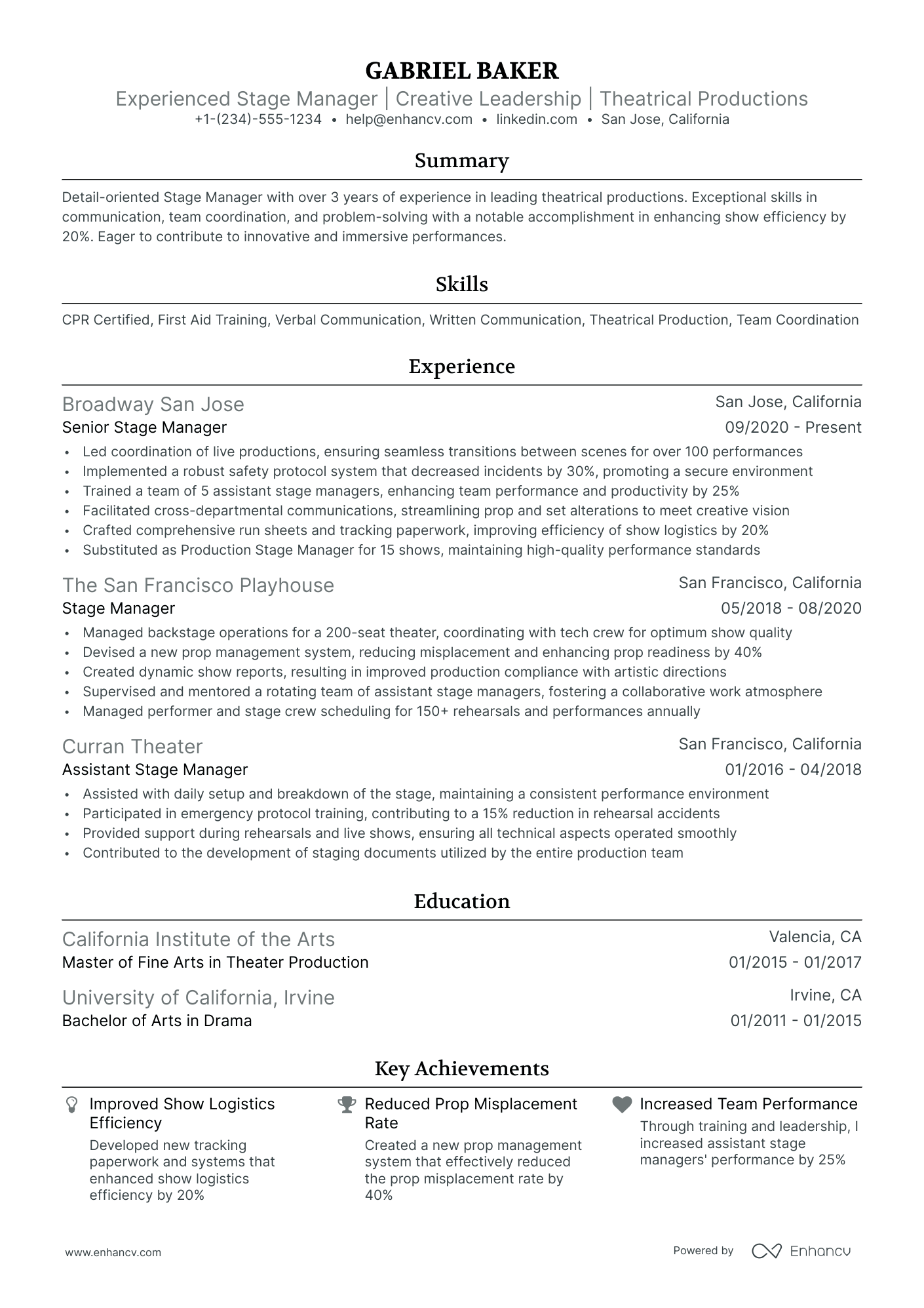
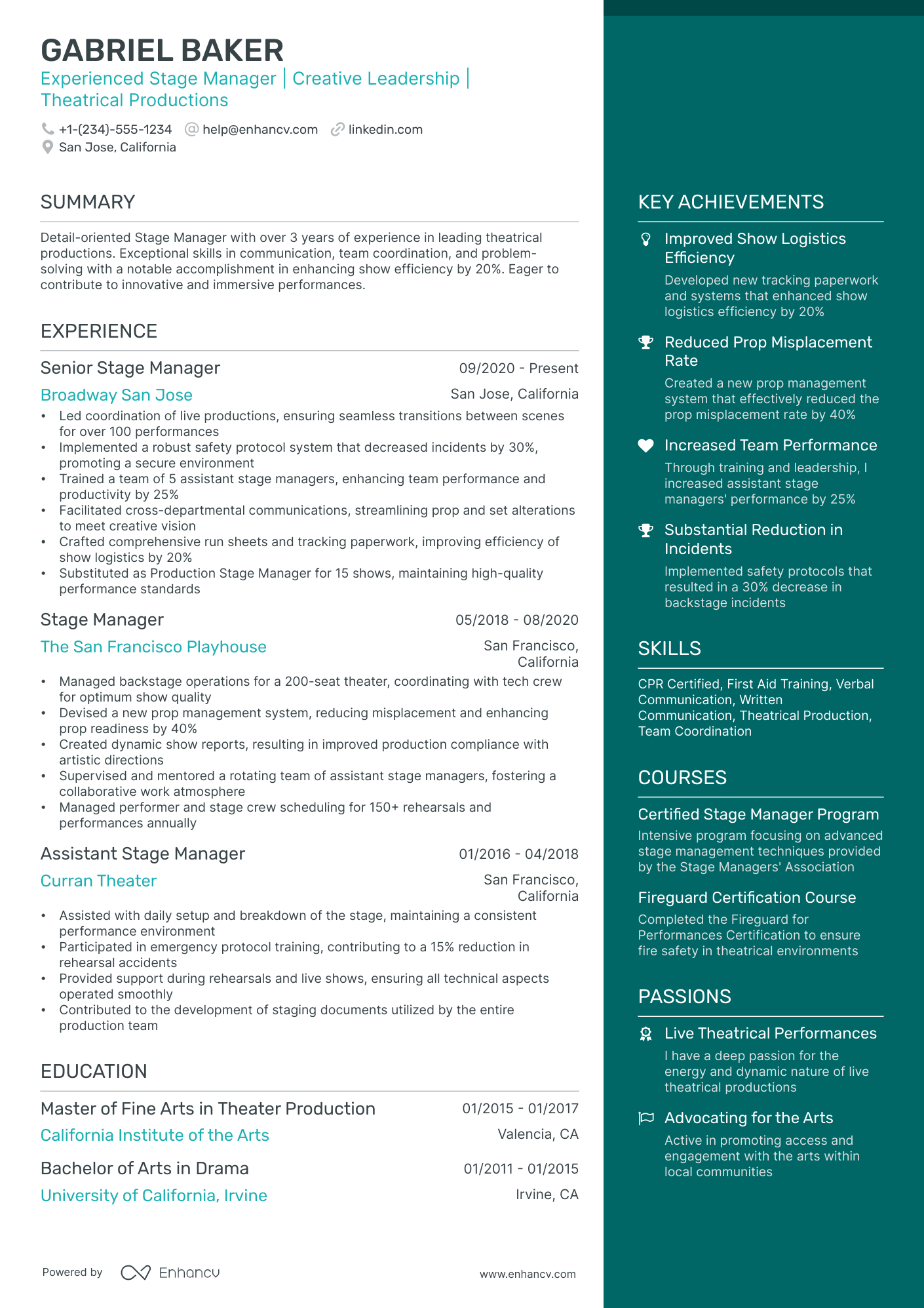
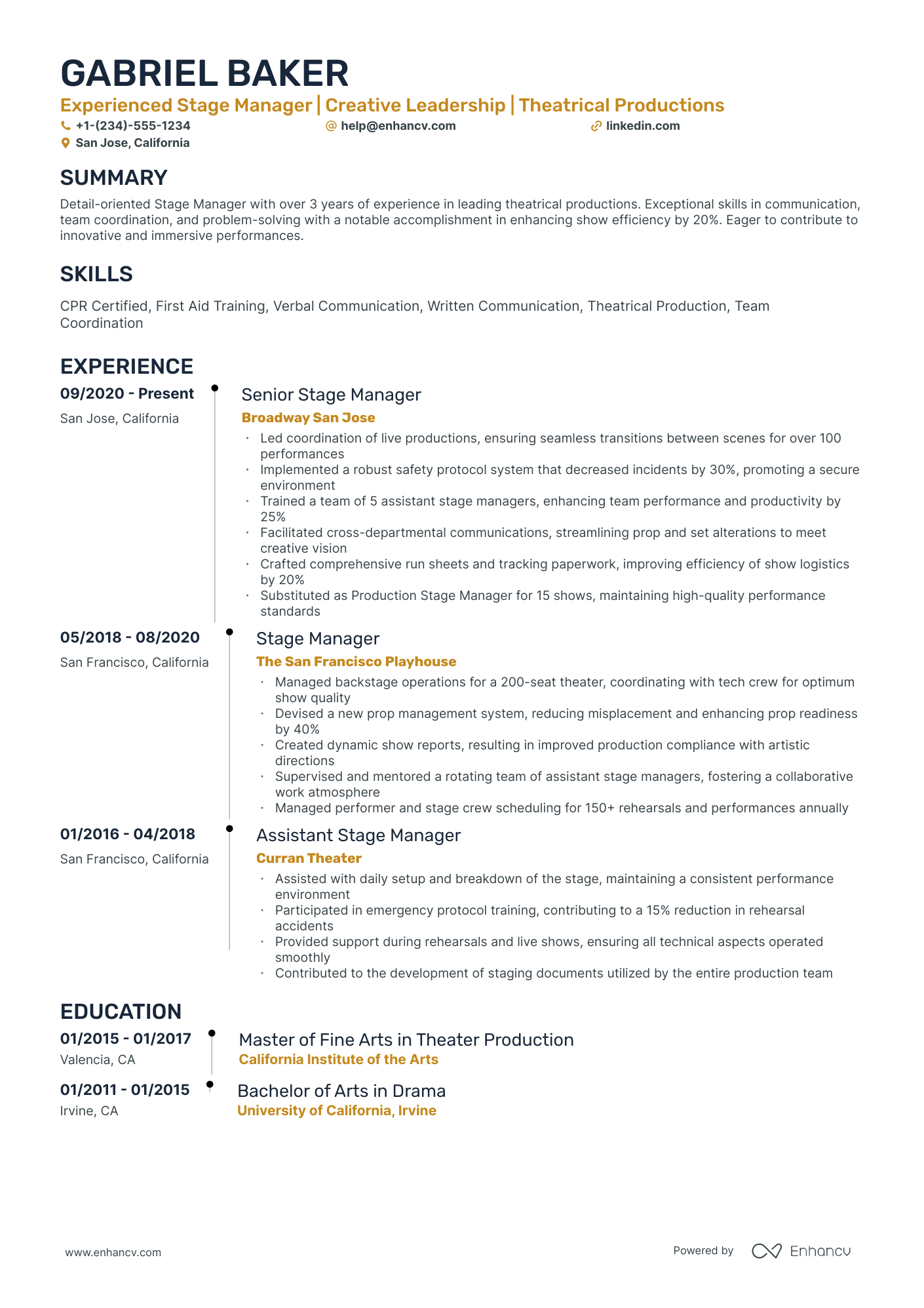
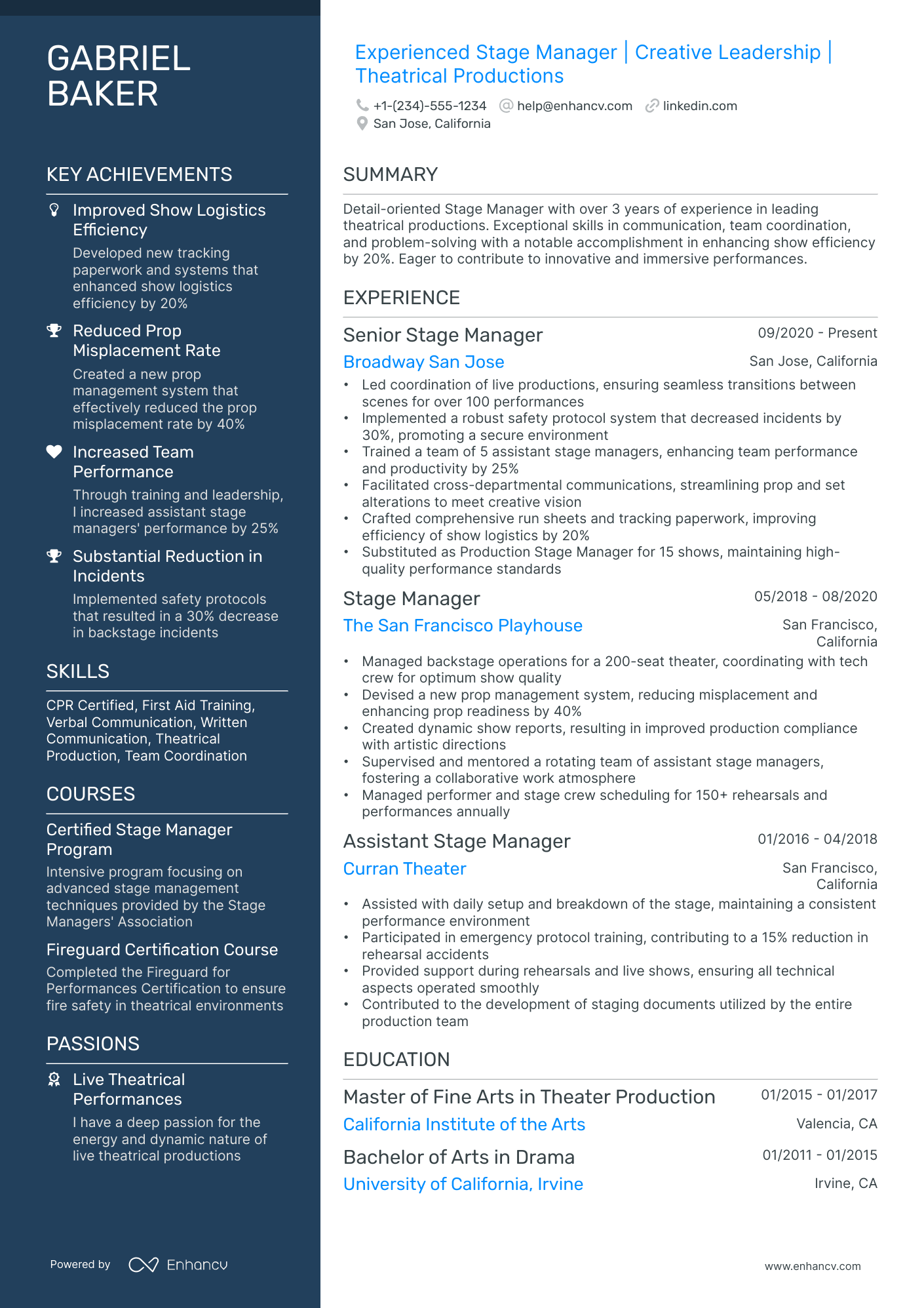
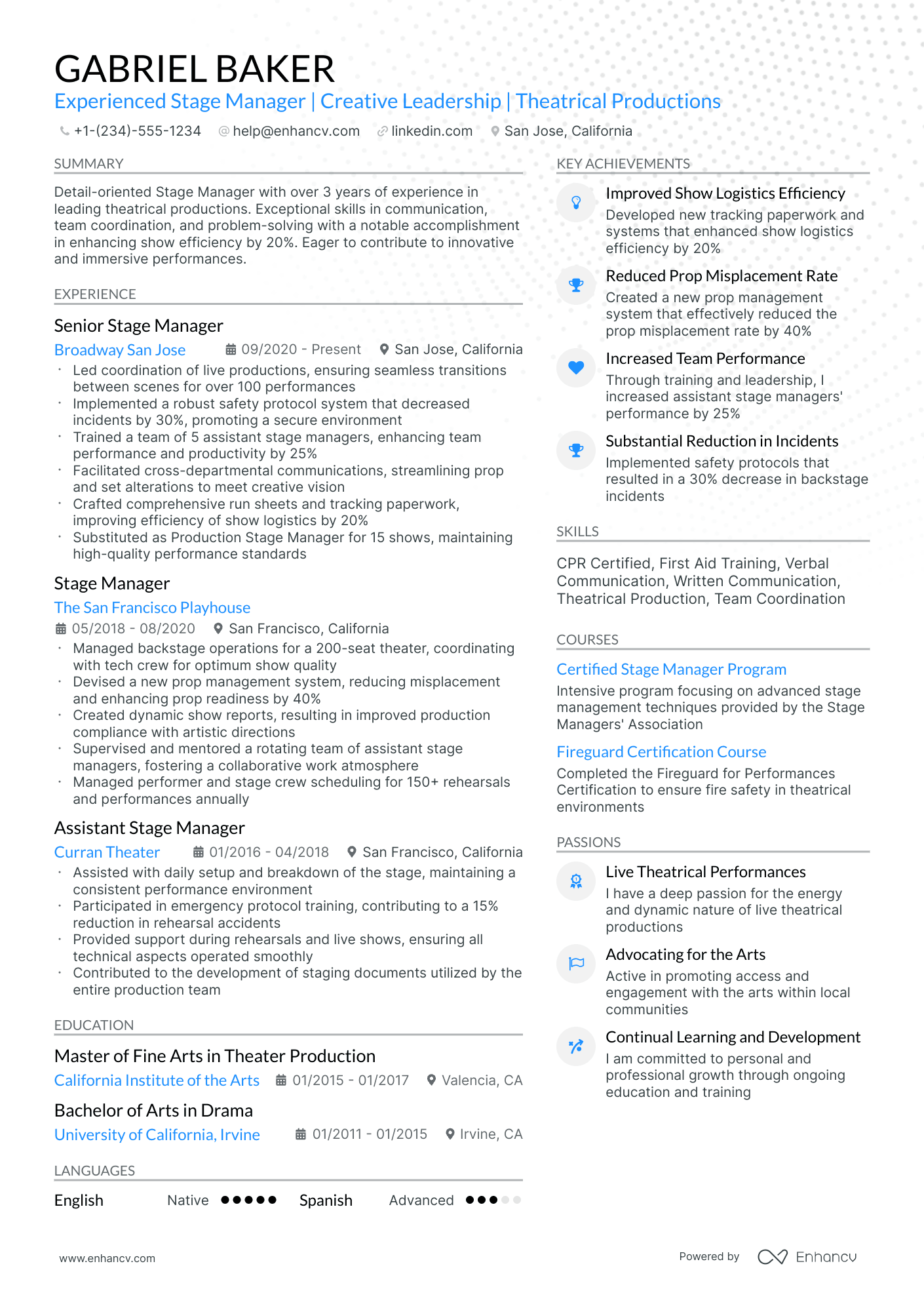
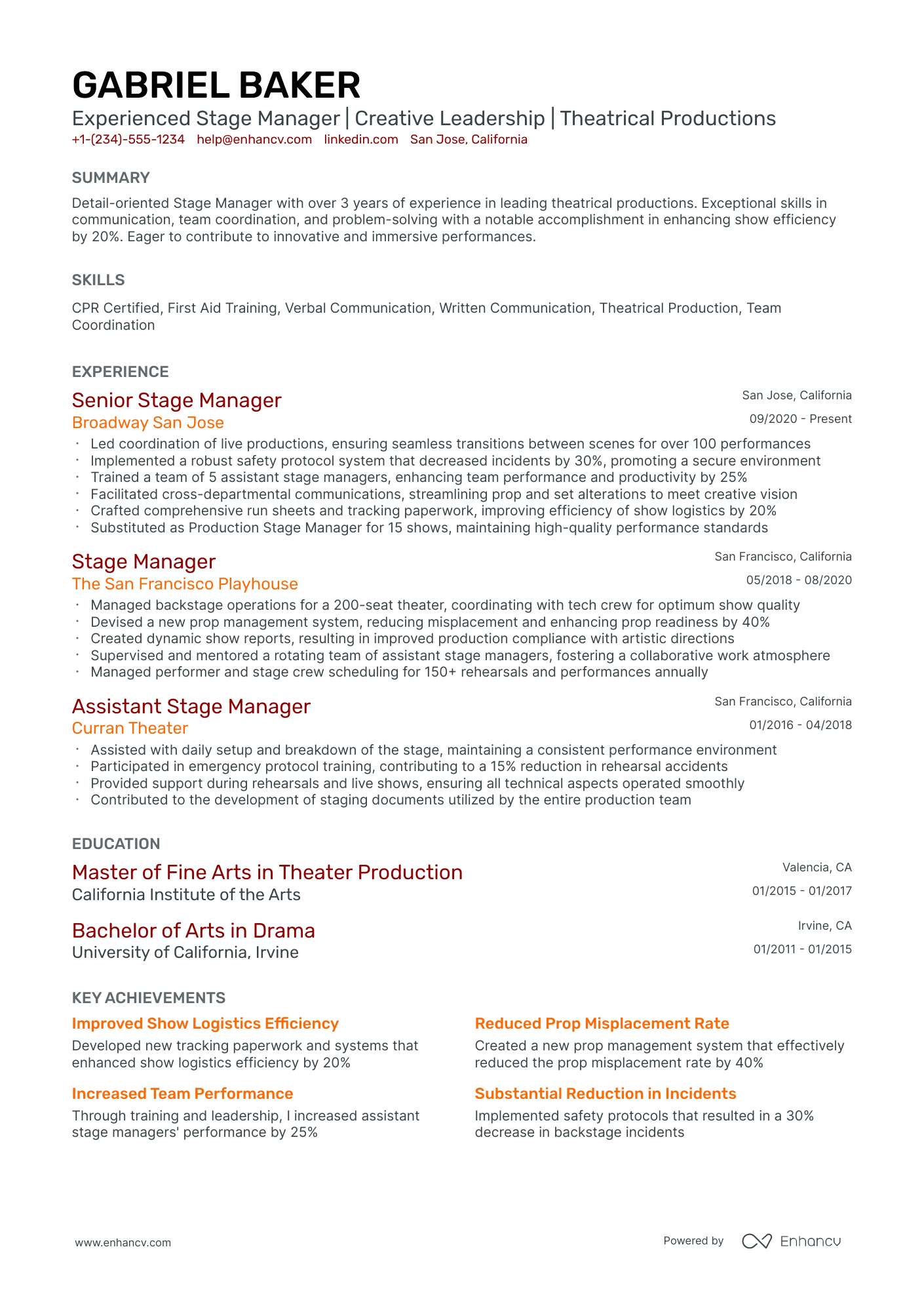
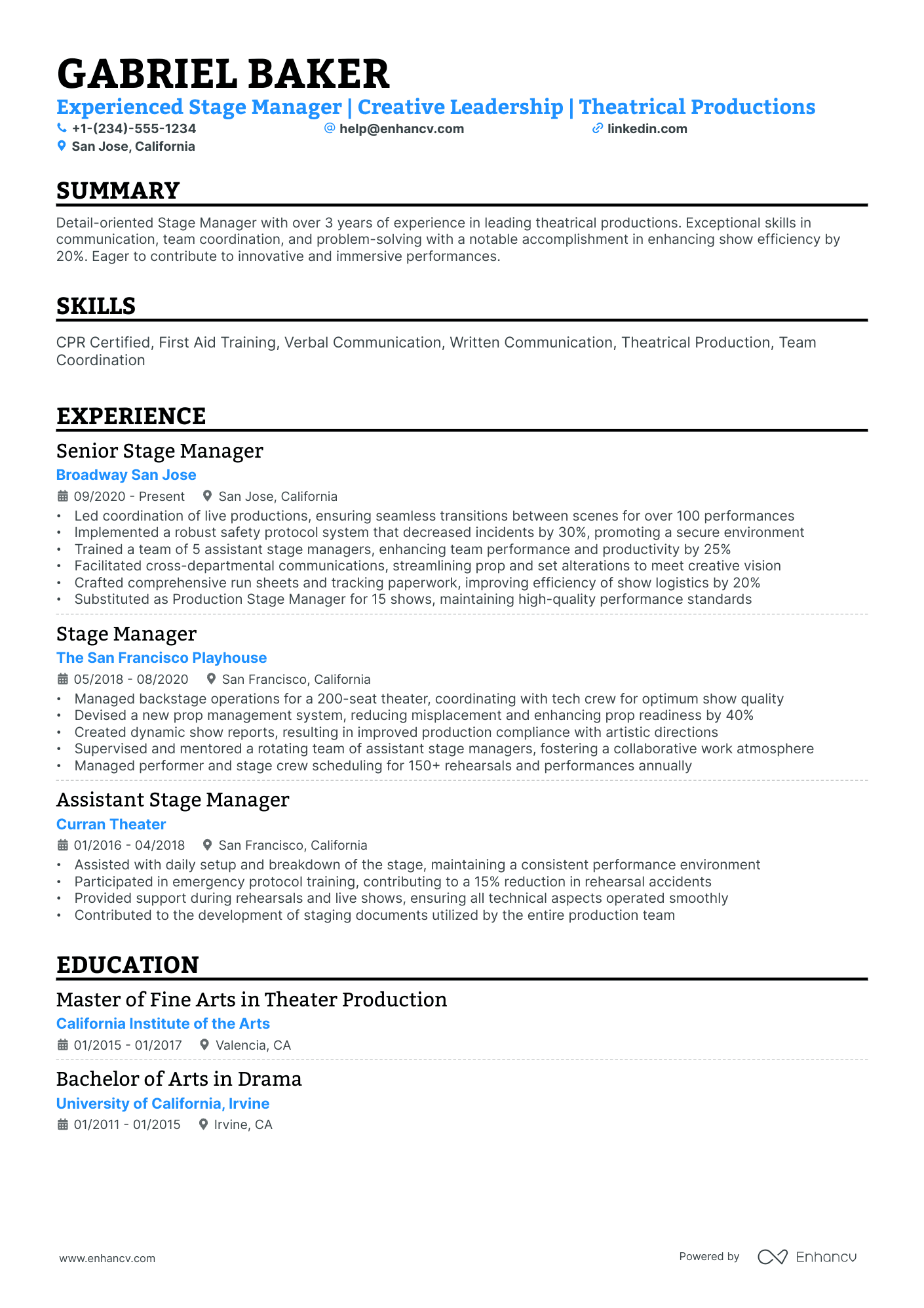
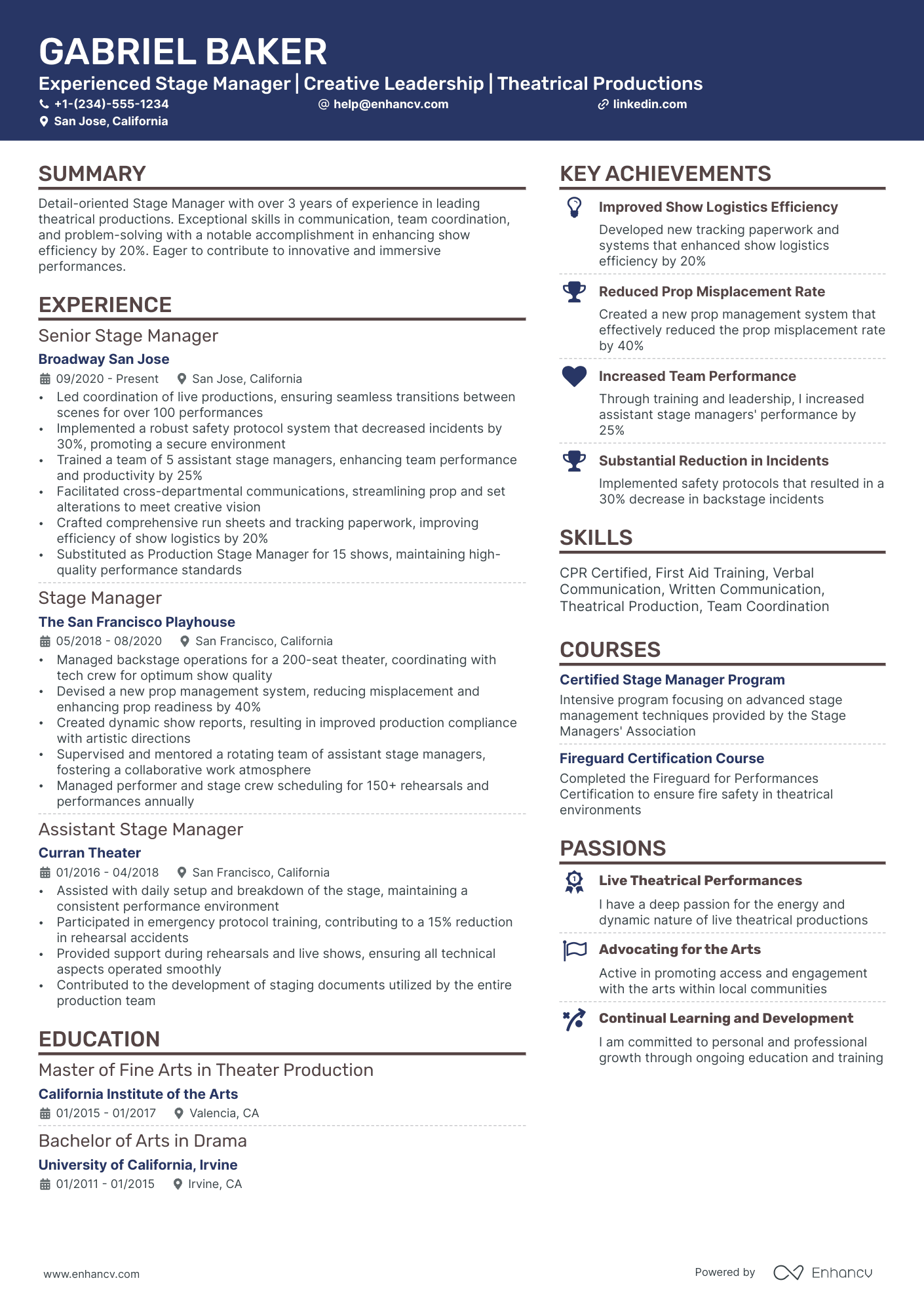
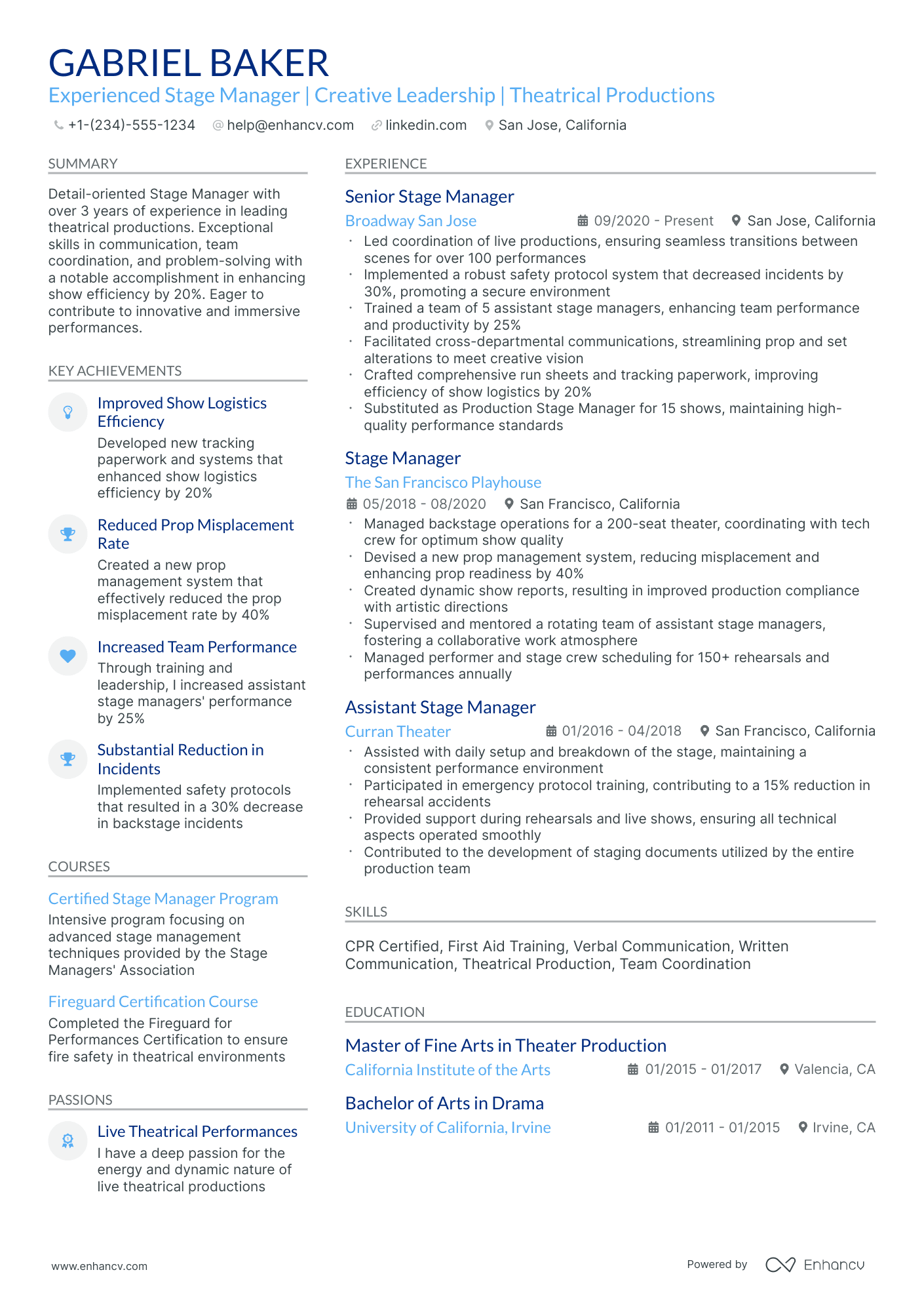
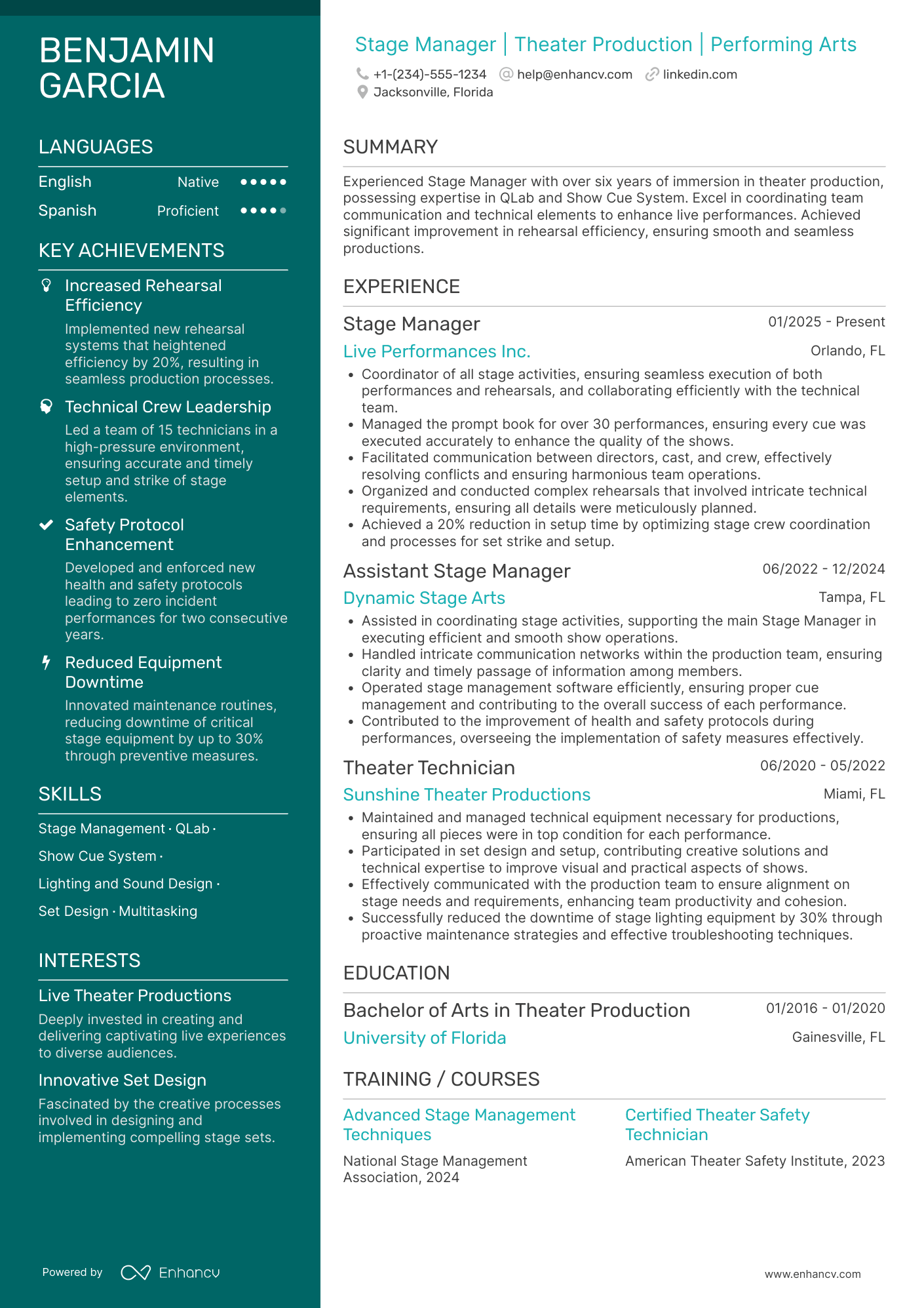
Many stage manager resume submissions fail because they read like crew call sheets, not hiring documents. A stage manager resume gets filtered by applicant tracking systems and skimmed fast, so vague duties and missing outcomes cost interviews.
A strong resume shows what changed because you ran the room. Knowing how to make your resume stand out means you'll highlight on-time openings, reduced overtime hours, fewer safety incidents, smoother scene changes, tighter cue accuracy, faster turnover, larger cast sizes managed, and cleaner backstage communication.

Key takeaways
- Quantify production outcomes like cue accuracy, on-time curtains, and safety records in every bullet.
- Use reverse-chronological format if you have experience; use hybrid format if you're entry-level.
- Tailor each resume to the job posting by mirroring its tools, terminology, and production scope.
- Demonstrate skills inside your experience and summary sections, not only in a standalone list.
- Include certifications like OSHA 10-Hour and CPR directly after or before your education section.
- Write a three- to four-line summary stating your title, production type, tools, and a measurable win.
- Use Enhancv to turn vague stage management duties into focused, results-driven resume bullets.
How to format a stage manager resume
Recruiters reviewing stage manager resumes look for clear production histories, the scope of each show (venue size, cast and crew count, budget), and evidence of organizational leadership under pressure. Choosing the right resume format makes these signals immediately visible, while the wrong one buries them beneath generic skills or disconnected summaries.

I have significant experience in this role—which format should I use?
Use a reverse-chronological format—it's the strongest choice for showcasing a proven track record of managing productions from pre-production through closing. Do:
- Lead with your most recent credits, listing venue or company name, production title, and the scope of your responsibilities (number of departments coordinated, cast size, budget oversight).
- Highlight role-specific tools and domains such as production management software (ProductionPro, StagWrite), Equity rulebook compliance, union call management, and prompt book development.
- Quantify outcomes and business impact wherever possible—on-time opening rates, budget adherence, safety incident reductions, or rehearsal efficiency gains.
I'm junior or switching into this role—what format works best?
A hybrid format works best because it lets you lead with transferable stage management skills while still showing a chronological work or production history. Do:
- Place a focused skills section near the top, featuring calling cues, blocking notation, rehearsal scheduling, conflict resolution, and any production software proficiency.
- Include relevant projects, assistant stage management credits, university productions, or community theater work—even unpaid credits count as legitimate production experience.
- Connect every action to a result so hiring managers see impact, not just task lists.
Why not use a functional resume?
A functional format strips away the production-by-production context that hiring managers need to evaluate your readiness for a stage management role, making it nearly impossible to assess where and how you developed your skills. Avoid a functional format unless you have no other way to present your qualifications coherently.
- A functional resume may be acceptable if you're transitioning from a related field (assistant directing, production assisting, event management) with no formal stage management credits, or if you have significant resume gaps—but even then, tie every listed skill to a specific project, production, or measurable outcome rather than presenting skills in isolation.
With your format established, the next step is filling it with the right sections to give hiring managers exactly what they're looking for.
What sections should go on a stage manager resume
Recruiters expect a stage manager resume to show clear production credits, reliable execution, and strong coordination across teams. Understanding which resume sections to include ensures you present your qualifications in the order hiring managers expect.
Use this structure for maximum clarity:
- Header
- Summary
- Experience
- Skills
- Projects
- Education
- Certifications
- Optional sections: Awards, Volunteering, Languages
Strong experience bullets should emphasize show scale, responsibilities owned, problems solved under pressure, and measurable outcomes like on-time cues, reduced delays, and smoother rehearsals.
Is your resume good enough?
Drop your resume here or choose a file. PDF & DOCX only. Max 2MB file size.
Once you’ve organized the essential resume components, the next step is to write your stage manager resume experience section so those details clearly show your impact and responsibilities.
How to write your stage manager resume experience
Your work experience section proves you can run a production from pre-production through closing night—on time, on budget, and without dropped cues. Hiring managers prioritize demonstrated impact over descriptive task lists, so focus each entry on work you shipped, the tools and methods you used to keep rehearsals and performances on track, and measurable outcomes that show your reliability under pressure.
Each entry should include:
- Job title
- Company and location (or remote)
- Dates of employment (month and year)
Three to five concise bullet points showing what you owned, how you executed, and what outcomes you delivered:
- Ownership scope: the productions, rehearsal processes, calling scripts, backstage operations, or department teams you were directly accountable for as stage manager.
- Execution approach: the tools, frameworks, and methods you used to maintain production schedules—prompt books, blocking notation systems, production management software, communication protocols, and cueing technologies.
- Value improved: changes to rehearsal efficiency, cue accuracy, technical changeover speed, safety compliance, or overall production quality that resulted from your coordination and leadership.
- Collaboration context: how you served as the communication hub between directors, designers, crew heads, cast members, front-of-house staff, and producers to keep every department aligned throughout the production lifecycle.
- Impact delivered: outcomes expressed through the scale of productions managed, the number of performances called without error, improvements to turnaround times, or contributions to a show's successful run—rather than a list of duties performed.
Experience bullet formula
A stage manager experience example
✅ Right example - modern, quantified, specific.
Stage Manager
Aurora Repertory Theatre | Chicago, IL
2022–Present
Equity theater producing eight mainstage productions per season across a five-hundred-seat venue and two studio spaces.
- Directed rehearsals and performances using prompt book, calling script, and headset intercom (Clear-Com), delivering one hundred sixty-plus performances with ninety-eight percent on-time curtain.
- Built and maintained show paperwork in Google Workspace and Excel—run of show, scene shift plots, and prop tracking—cutting rehearsal reset time by twenty percent and reducing missed preset incidents by forty percent.
- Coordinated daily schedules, reports, and change logs with directors, designers, and production management in Slack and Trello, resolving an average of fifteen cross-department issues per week with a sub-twenty-four-hour turnaround.
- Led safety and compliance workflows—fight call, intimacy call, and rigging checks—in partnership with fight director and technical director, reducing reportable backstage incidents by fifty percent season over season.
- Implemented digital sign-in and timekeeping for cast and crew, improving callboard accuracy to ninety-nine percent and preventing two payroll corrections per production.
Now that you've seen how to structure a strong experience entry, let's look at how to adapt it for different stage management roles and job postings.
How to tailor your stage manager resume experience
Recruiters evaluate stage manager resumes through both human review and applicant tracking systems, so tailoring your resume to the job description is essential. Tailoring ensures the specific tools, workflows, and production methods you've used match what the employer is actively seeking.
Ways to tailor your stage manager experience:
- Mirror the exact production management software listed in the posting.
- Match the terminology used for rehearsal processes and calling methods.
- Reflect specific venue types or production scales the employer references.
- Include union affiliations or compliance standards mentioned in the listing.
- Highlight collaboration frameworks with directors and design teams described.
- Emphasize scheduling or budgeting responsibilities that align with stated duties.
- Reference the performance tracking or reporting metrics they prioritize.
- Note genre or industry experience when the posting specifies a focus.
Tailoring means aligning your real production achievements with the role's stated requirements, not forcing disconnected keywords into your experience section.
Resume tailoring examples for stage manager
| Job description excerpt | Untailored | Tailored |
|---|---|---|
| "Manage all rehearsal and performance schedules for a 12-show repertory season using Production Pro and coordinate cue-to-cue technical rehearsals across three venue spaces." | Managed schedules and coordinated rehearsals for multiple productions. | Built and maintained rehearsal and performance schedules for a 12-show repertory season in Production Pro, coordinating cue-to-cue technical rehearsals across three venue spaces with zero scheduling conflicts. |
| "Call all lighting, sound, and fly cues for mainstage productions and supervise a running crew of 8–10 members using a clear communication protocol on headset." | Called cues during shows and worked with crew members backstage. | Called 150+ lighting, sound, and fly cues per mainstage performance while supervising a running crew of 10, enforcing a standardized headset communication protocol that reduced missed cues by 30%. |
| "Distribute and track script revisions through rehearsal reports in sync with the director and design team, ensuring all departments receive updated blocking notes within 24 hours." | Created reports and kept the team updated on changes during the production process. | Issued daily rehearsal reports documenting script revisions and blocking updates, coordinating with the director and four design departments to confirm distribution within 24 hours of each rehearsal. |
Once you’ve aligned your experience with the role’s priorities, quantify your stage manager achievements to show the measurable impact of that work.
How to quantify your stage manager achievements
Quantifying achievements shows how you kept performances on time, safe, and consistent under pressure. Focus on schedule adherence, cue accuracy, incident prevention, turnaround speed, and team coordination volume across rehearsals and show runs.
Quantifying examples for stage manager
| Metric | Example |
|---|---|
| Schedule adherence | "Hit 98% on-time curtain across a 36-show run by tightening preset checklists and running five-minute standups with department heads." |
| Cue accuracy | "Called 1,250+ lighting, sound, and automation cues with 99.6% accuracy, using QLab and a standardized cue-to-script verification pass each week." |
| Turnaround speed | "Cut scene-change time from 85 seconds to 55 seconds by reblocking traffic patterns and color-coding deck marks and prop tables." |
| Safety risk reduction | "Reduced backstage safety incidents from four to zero over three months by enforcing harness checks, updating rail protocols, and logging near-misses after each show." |
| Volume managed | "Coordinated twelve cast members, nine crew, and three understudies per performance, maintaining 100% completed pre-show checks across sixty rehearsals." |
Turn vague job duties into measurable, recruiter-ready resume bullets in seconds with Enhancv's Bullet Point Generator.
Now that your bullet points clearly convey your impact, it's time to ensure the skills section of your stage manager resume highlights the right mix of hard and soft skills.
How to list your hard and soft skills on a stage manager resume
Your skills section shows you can run rehearsals and performances safely and on time, and recruiters and ATS scan this section to confirm role fit fast; aim for a balanced mix of hard skills and operational soft skills.
stage manager roles require a blend of:
- Product strategy and discovery skills.
- Data, analytics, and experimentation skills.
- Delivery, execution, and go-to-market discipline.
- Soft skills.
Your skills section should be:
- Scannable (bullet-style grouping).
- Relevant to the job post.
- Backed by proof in experience bullets.
- Updated with current tools.
Place your skills section:
- Above experience if you're junior or switching careers.
- Below experience if you're mid/senior with strong achievements.

Hard skills
- Prompt book creation and maintenance
- Calling cues: lights, sound, fly, video
- Rehearsal scheduling and tracking
- Run-of-show and cue sheet prep
- Production reports and daily calls
- Union rule compliance (AEA, IATSE)
- Stage management software: Stage Write, Shoflo
- Communication tools: Slack, Google Workspace, Microsoft Teams
- Show control and intercom: QLab, Clear-Com
- Script and score markup standards
- Safety checks and incident reporting
- Deck traffic and backstage logistics
Soft skills
- Lead calm, decisive cue calls
- Coordinate cross-department priorities
- Communicate changes with precision
- Anticipate risks and prevent delays
- Resolve conflicts in the moment
- Hold teams accountable to timing
- Maintain focus under live pressure
- Escalate issues with clear options
- Align stakeholders on show notes
- Protect performer and crew safety
- Manage up with concise updates
- Drive rehearsals to clear outcomes
How to show your stage manager skills in context
Skills shouldn't live only in a bulleted list on your resume.
They should be demonstrated in:
- Your summary (high-level professional identity)
- Your experience (proof through outcomes)
Here's what that looks like in practice. You can also explore common resume skills by role to see how other professionals present their abilities.
Summary example
Senior stage manager with 12 years in regional theater, skilled in Equity protocols, QLab programming, and cross-departmental scheduling. Led production teams of 40+ across 15 seasons, reducing technical rehearsal overtime by 30% through proactive communication and precise blocking notation.
- Reflects senior-level experience clearly
- Names industry-specific tools and methods
- Includes a concrete, measurable metric
- Highlights communication as a soft skill
Experience example
Production Stage Manager
Steppenwolf Theatre Company | Chicago, IL
June 2018–August 2024
- Coordinated 25+ productions across three venues, cutting rehearsal setup time by 20% using detailed QLab cue sheets and pre-set diagrams.
- Partnered with directors, designers, and a 35-person crew to maintain show consistency, achieving zero missed cues across two full seasons.
- Streamlined daily rehearsal reports in StagePro, reducing director response time by 40% and improving interdepartmental clarity.
- Every bullet contains a measurable outcome.
- Skills appear naturally within real achievements.
Once you’ve demonstrated your stage manager abilities through specific examples, the next step is translating those strengths into a stage manager resume when you don’t have formal experience.
How do I write a stage manager resume with no experience
Even without full-time experience, you can demonstrate readiness through the strategies outlined in our guide on building a resume without work experience:
- Student theater stage manager roles
- Community theater production support
- Assistant stage manager shadowing
- Rehearsal report and callboard ownership
- Cue calling in showcases
- Prompt book and script annotation
- Run crew and backstage shifts
- Production meeting notes and tracking
Focus on:
- Prompt book samples and templates
- Rehearsal reports with action items
- Cue sheets and run-of-show
- Scheduling tools and version control
Resume format tip for entry-level stage manager
Use a combination resume format because it highlights stage manager skills and project work before limited job history. Do:
- Lead with a stage manager skills section.
- Add a projects section with show credits.
- Quantify scope: cast size, rehearsals, cues.
- Name tools: Google Sheets, QLab, Slack.
- Attach a portfolio link to documents.
- Built a prompt book and cue sheet in Google Sheets for a student theater showcase, tracked forty cues, and reduced missed entrances from five to zero across three performances.
Even without formal work experience, your education section can demonstrate relevant training and qualifications that strengthen your candidacy.
How to list your education on a stage manager resume
Your education section helps hiring teams confirm you have foundational training in theater, production management, or related disciplines essential to the stage manager role.
Include:
- Degree name
- Institution
- Location
- Graduation year
- Relevant coursework (for juniors or entry-level candidates)
- Honors & GPA (if 3.5 or higher)
Skip month and day details—list the graduation year only.
Here's a strong education entry tailored for a stage manager resume:
Example education entry
Bachelor of Fine Arts in Stage Management
Carnegie Mellon University, Pittsburgh, PA
Graduated 2021
GPA: 3.7/4.0
- Relevant Coursework: Production Management, Lighting Design, Stage Combat Coordination, Technical Theater, and Script Analysis
- Honors: Dean's List (six semesters), Outstanding Stage Management Student Award
How to list your certifications on a stage manager resume
Certifications show a stage manager's commitment to learning, proficiency with essential tools, and alignment with current industry standards, which helps hiring teams trust your readiness on day one. Include:
- Certificate name
- Issuing organization
- Year
- Optional: credential ID or URL
- Place certifications below education when your degree is recent and your certifications add supporting, secondary value.
- Place certifications above education when they are recent, highly relevant, or required for the stage manager roles you target.
Best certifications for your stage manager resume
- OSHA 10-Hour General Industry
- CPR/AED and First Aid Certification
- ETCP Certified Entertainment Electrician
- ESTA Entertainment Rigging Certification
- Dante Certification (Level 1)
- QLab Certification
Once you’ve placed your credentials where hiring teams can quickly verify them, use that foundation to write your stage manager resume summary that highlights your value at a glance.
How to write your stage manager resume summary
Your resume summary is the first thing a recruiter reads, so it needs to prove your value fast. A sharp, specific opening sets the tone and decides whether the rest of your resume gets attention.
Keep it to three to four lines, with:
- Your title and total years of stage management experience.
- The type of productions you've managed, such as theater, touring, or live events.
- Core tools and skills like calling cues, scheduling software, and union protocols.
- One or two measurable achievements that show real production impact.
- Collaborative skills tied to actual outcomes, like resolving conflicts or streamlining rehearsals.

PRO TIP
At this level, focus on demonstrating hands-on skills, relevant training, and early contributions to real productions. Highlight tools you've used and problems you've solved. Avoid vague phrases like "passionate team player" or "hard-working self-starter." Recruiters want proof, not personality descriptors.
Example summary for a stage manager
Detail-oriented stage manager with two years of experience in regional theater. Coordinated rehearsal schedules for 15-member casts using StageTracks. Reduced technical setup time by 20% through streamlined cue sheet processes.
Optimize your resume summary and objective for ATS
Drop your resume here or choose a file.
PDF & DOCX only. Max 2MB file size.
Now that your summary captures your professional value, make sure the header above it presents your contact details correctly so recruiters can actually reach you.
What to include in a stage manager resume header
A resume header lists your key contact and professional details, boosting visibility, credibility, and fast recruiter screening for a stage manager role.
Essential resume header elements
- Full name
- Tailored job title and headline
- Location
- Phone number
- Professional email
- GitHub link
- Portfolio link
A LinkedIn link helps recruiters verify experience quickly and supports screening.
Don't include a photo on a stage manager resume unless the role is explicitly front-facing or appearance-dependent.
Keep your header consistent with your file name and application profiles so recruiters can match your stage manager materials in seconds.
Stage manager resume header
Jordan Lee
Stage Manager | Equity Stage Manager with touring and repertory experience
Chicago, IL
(312) 555-01XX
your.name@enhancv.com github.com/yourname yourwebsite.com linkedin.com/in/yourname
Once your contact details and key identifiers are in place at the top of your resume, add relevant additional sections to round out your stage management profile.
Additional sections for stage manager resumes
When your core qualifications match other candidates, well-chosen additional sections can set your stage manager resume apart with unique credibility.
- Languages
- Industry certifications (OSHA, CPR/First Aid)
- Technical proficiencies (lighting boards, communication systems, stage management software)
- Notable productions
- Professional affiliations (Actors' Equity Association, USITT)
- Volunteering and community theater involvement
Once you've rounded out your resume with the right supplementary sections, it's worth ensuring your application is equally strong by pairing it with a well-crafted cover letter.
Do stage manager resumes need a cover letter
A cover letter isn't required for every stage manager role, but it helps in competitive postings or when hiring teams expect one. If you're unsure what a cover letter is or when to include one, it can make a difference when your resume needs context, or when you want to show clear fit fast.
Use a cover letter to add context your stage manager resume can't show:
- Explain role and team fit by naming the production type, pace, and collaboration style you work best in.
- Highlight one or two relevant projects or outcomes, such as smoother tech weeks, fewer cue errors, or tighter changeovers.
- Show you understand the organization's audience, venue constraints, and business goals, like safety, consistency, and show quality.
- Address career transitions or non-obvious experience by connecting transferable skills to stage manager responsibilities and results.
Drop your resume here or choose a file.
PDF & DOCX only. Max 2MB file size.
Once you’ve decided whether to include a cover letter based on the role and application requirements, the next step is using AI to improve your stage manager resume so it meets those same expectations more efficiently.
Using AI to improve your stage manager resume
AI can sharpen your resume's clarity, structure, and impact. It helps tighten language and highlight relevant strengths. But overuse strips authenticity fast. Once your content feels clear and role-aligned, step away from AI. For specific guidance, explore our recommendations on ChatGPT resume writing prompts tailored to different resume sections.
Here are 10 prompts you can copy and paste to strengthen specific sections of your stage manager resume:
- Sharpen the summary. "Rewrite my stage manager resume summary to emphasize leadership, production coordination, and collaboration in under four sentences."
- Quantify experience bullets. "Add measurable outcomes to these stage manager experience bullets, focusing on cast size, crew count, and rehearsal efficiency."
- Tighten action verbs. "Replace weak verbs in my stage manager experience section with strong, production-specific action verbs."
- Align skills to postings. "Compare my stage manager skills section against this job posting and suggest missing relevant technical or interpersonal skills."
- Strengthen project descriptions. "Rewrite my stage manager project entries to clearly state my role, the production scale, and the final outcome."
- Refine certification entries. "Format my stage manager certifications section for consistency, listing credential name, issuing body, and date earned."
- Cut redundant phrasing. "Remove filler words and redundant phrases from my stage manager resume without changing the original meaning."
- Improve education relevance. "Highlight coursework and training in my education section that directly supports a stage manager role."
- Tailor for ATS clarity. "Rewrite my stage manager resume bullets using clear, standard industry terminology likely recognized by applicant tracking systems."
- Focus rehearsal experience. "Revise my stage manager experience entries to better reflect rehearsal management, scheduling, and real-time problem-solving skills."
Stop using AI once your resume sounds accurate, specific, and aligned with real experience. AI should never invent experience or inflate claims—if it didn't happen, it doesn't belong here.
Conclusion
A strong stage manager resume shows measurable outcomes, role-specific skills, and a clear structure. It highlights schedule accuracy, smooth scene shifts, and fewer rehearsal delays. It also reflects strong communication, calm problem-solving, and reliable documentation.
Keep your stage manager resume easy to scan and consistent from top to bottom. Use clear headings, focused bullets, and results that hiring teams can verify. This approach shows you’re ready for today’s hiring needs and near-future expectations.