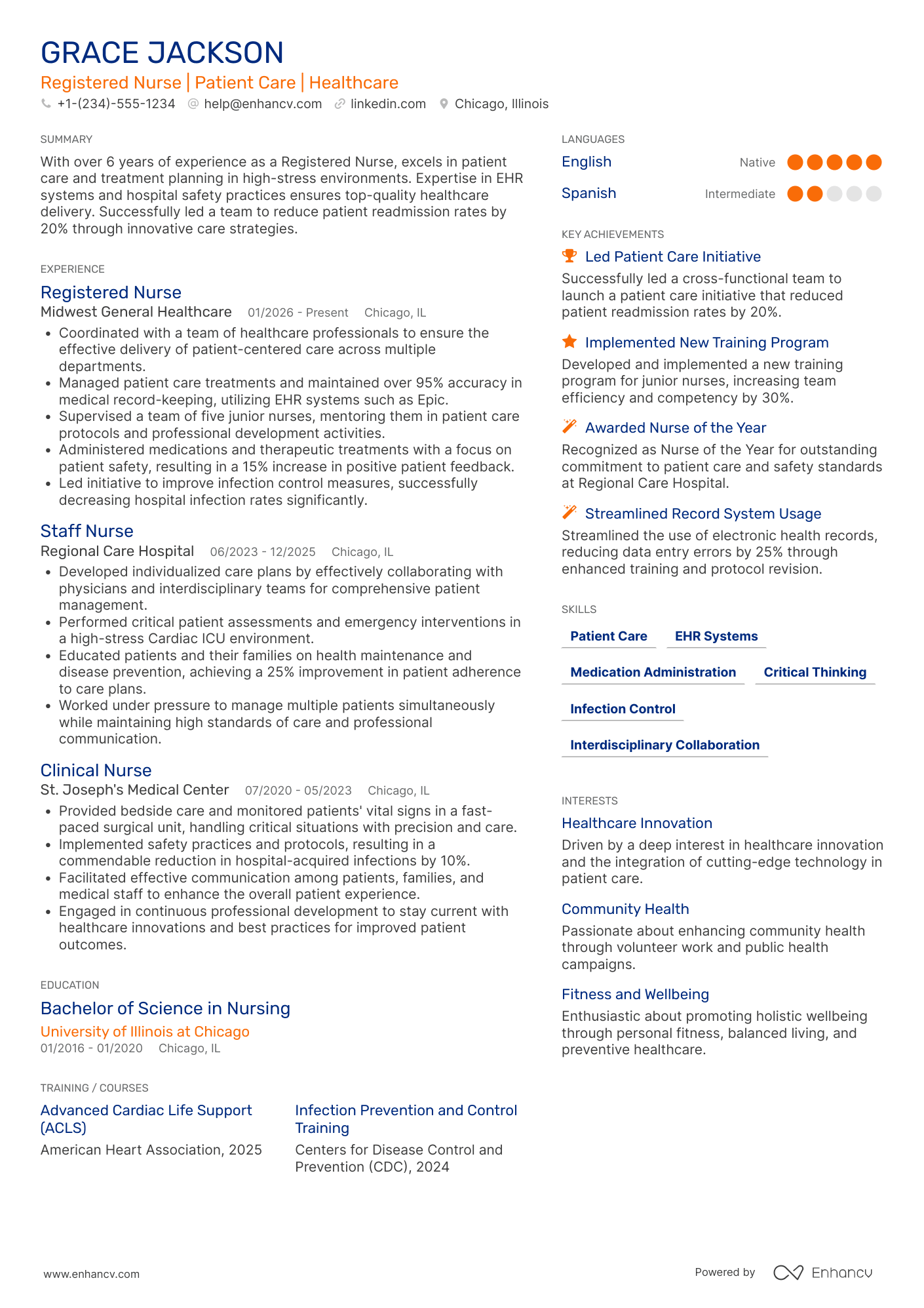


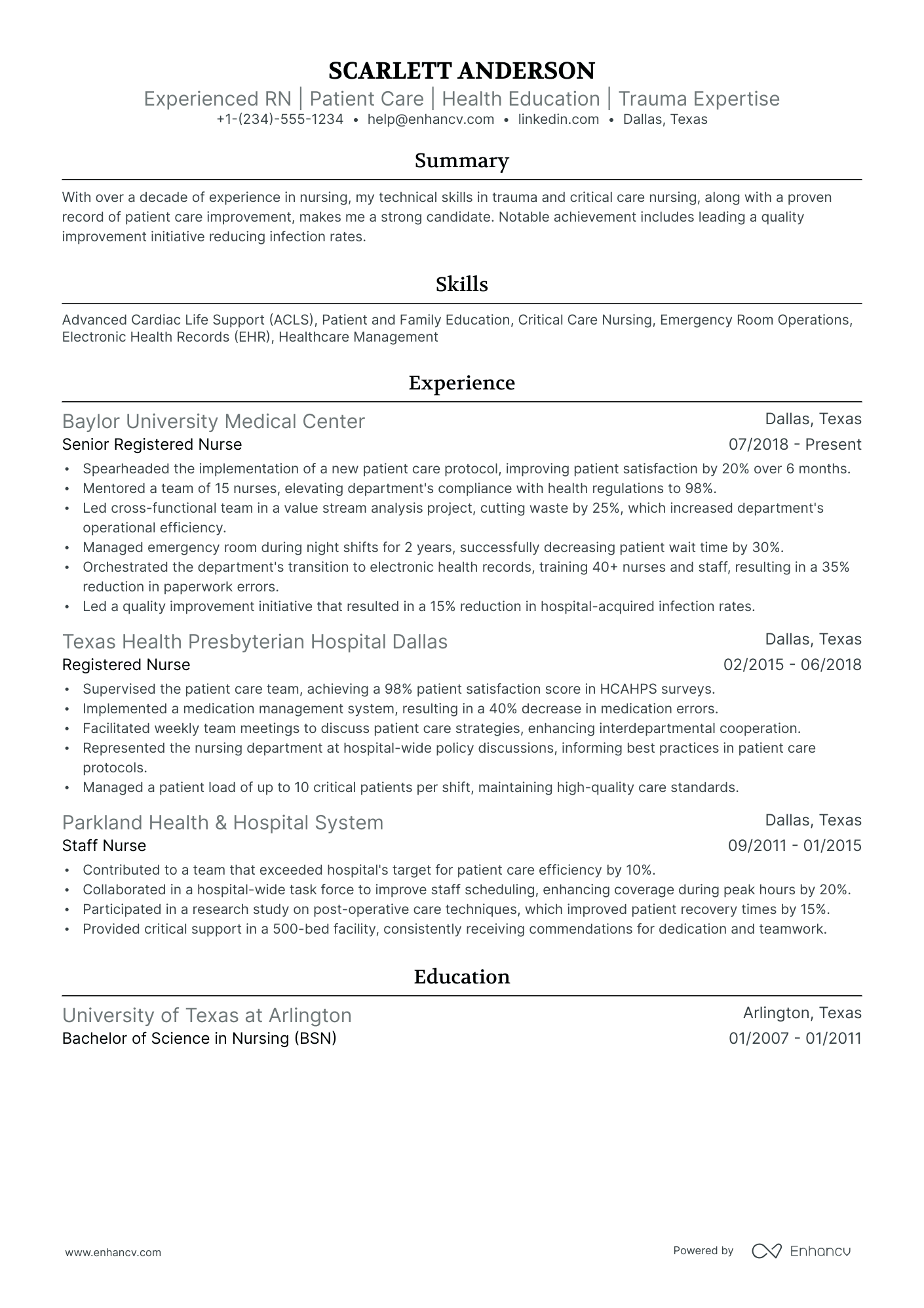
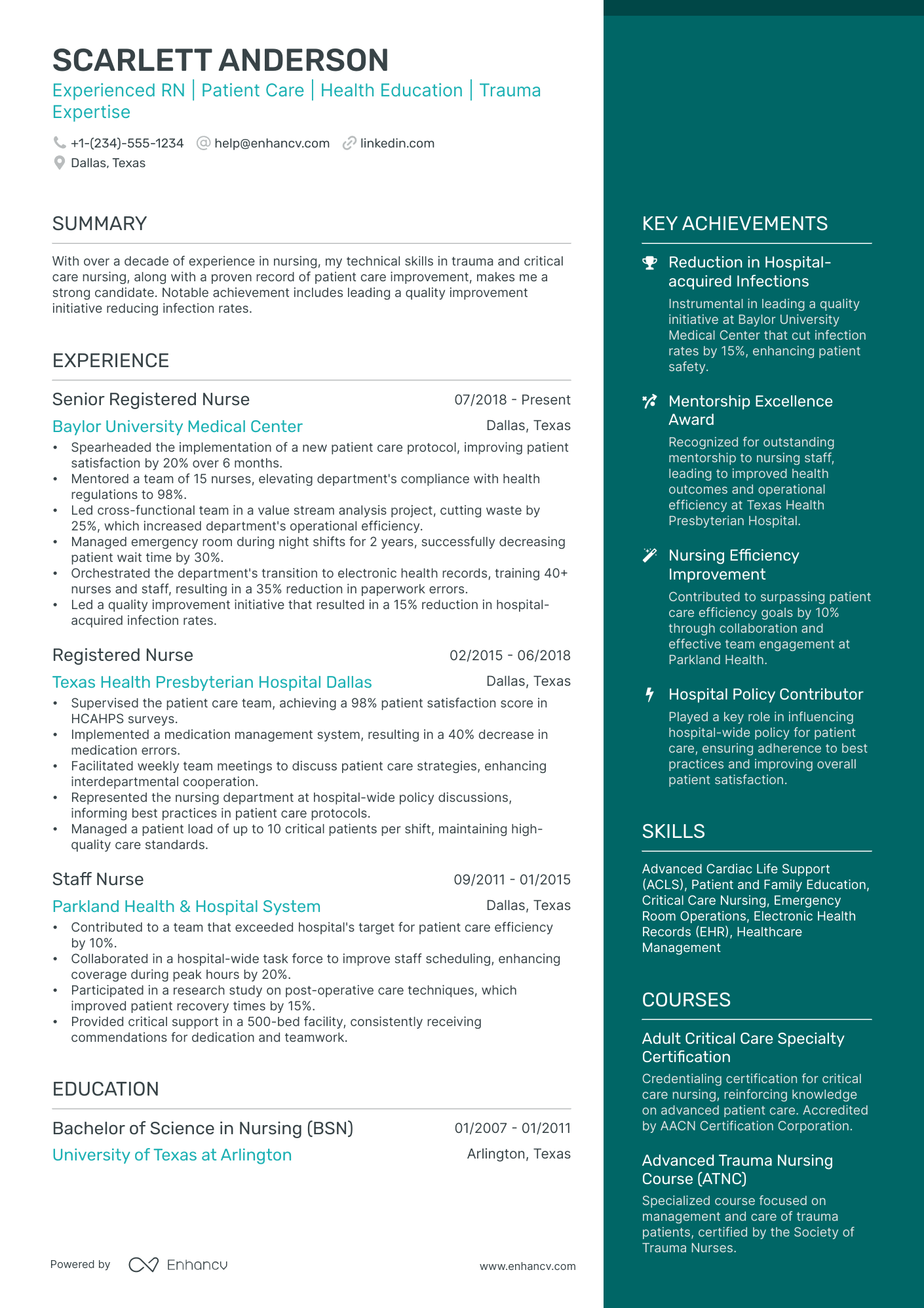
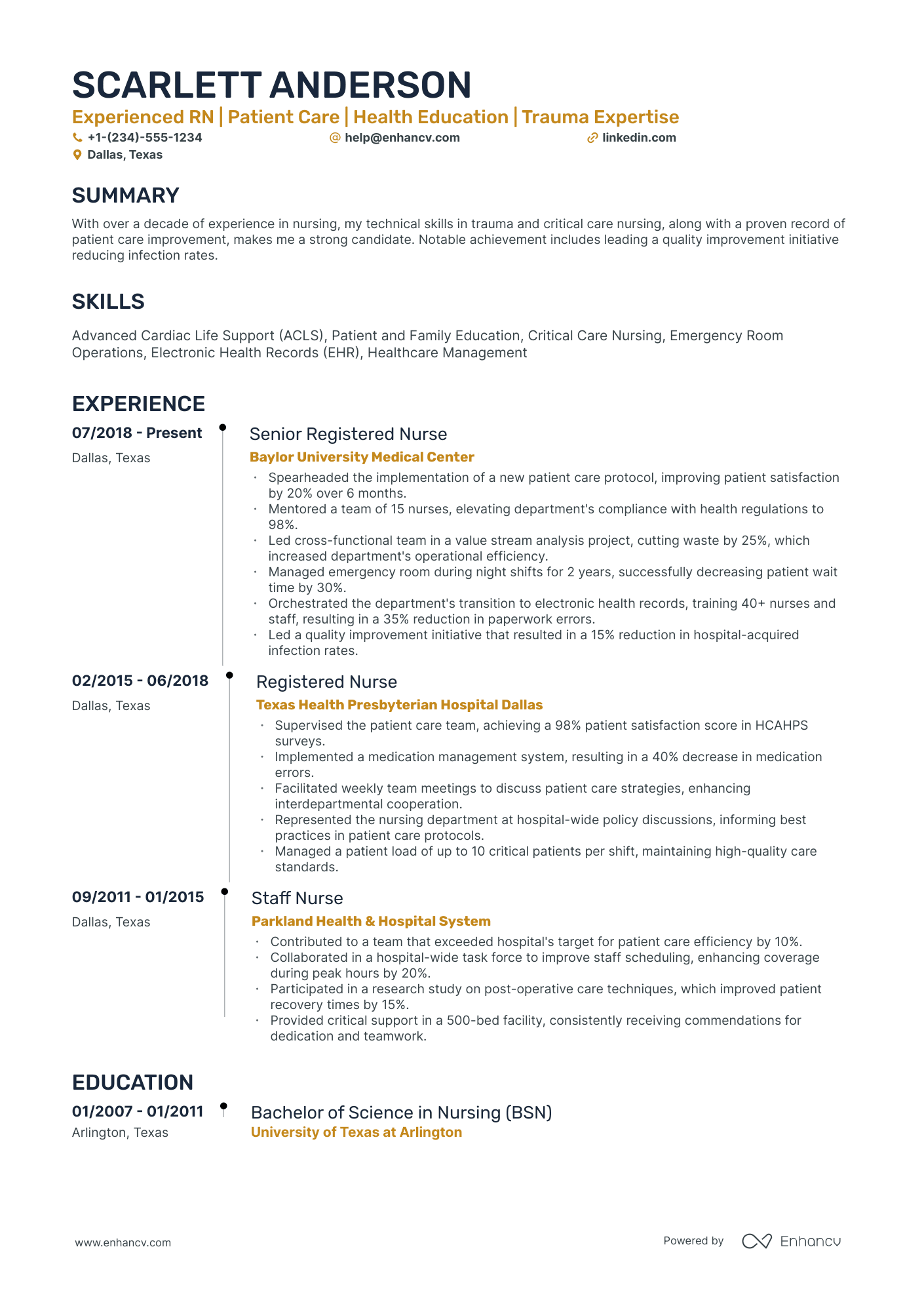
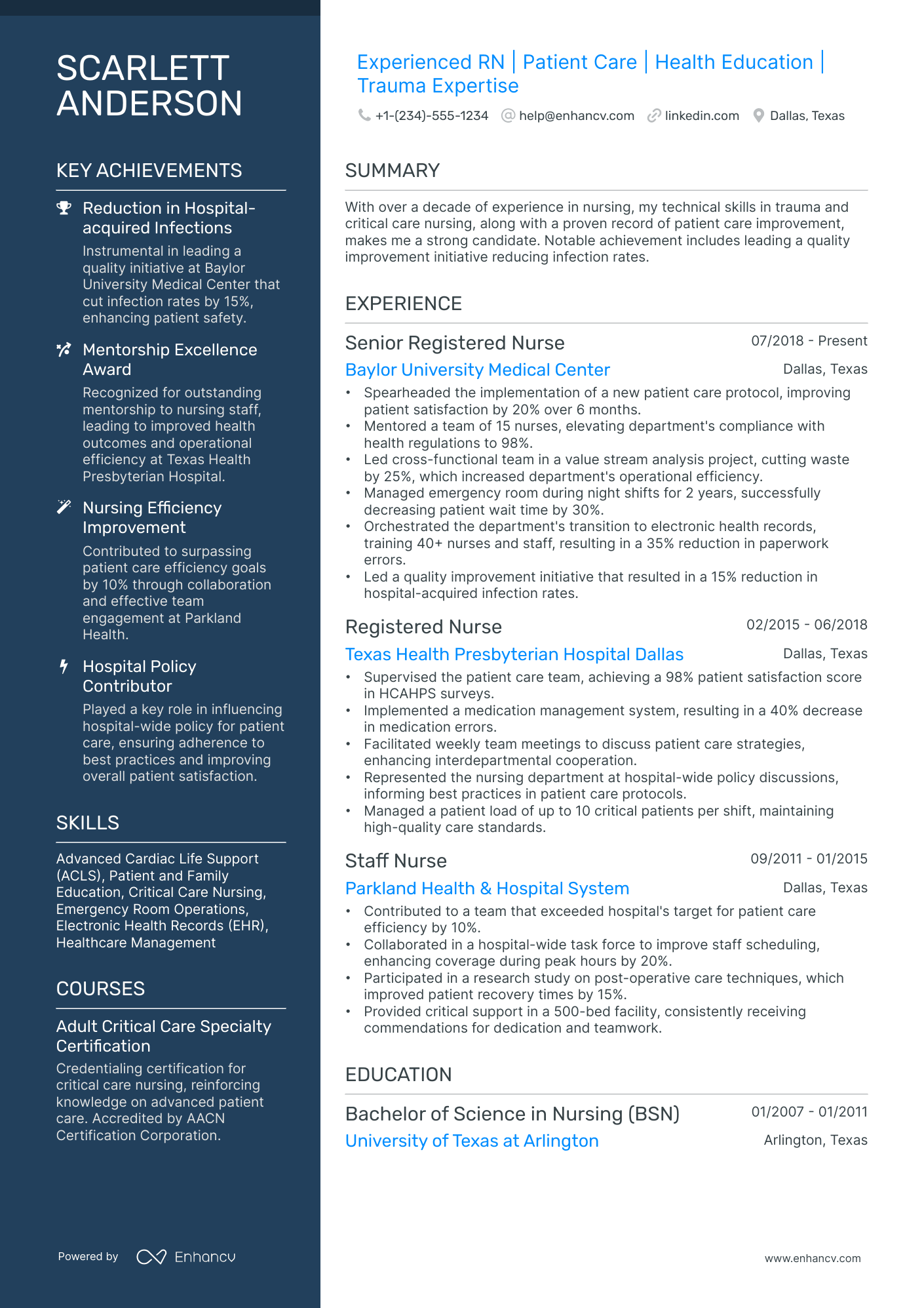
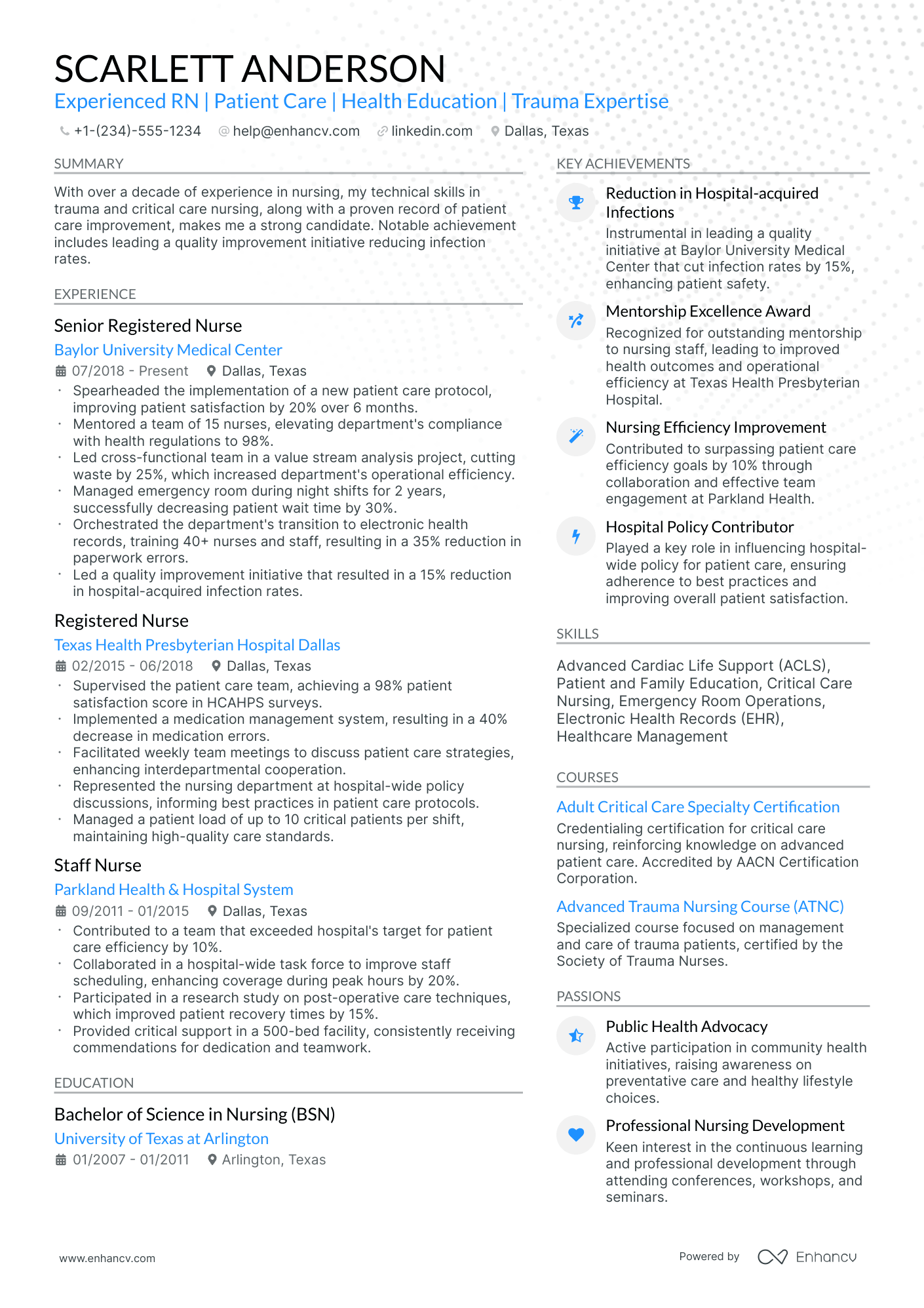
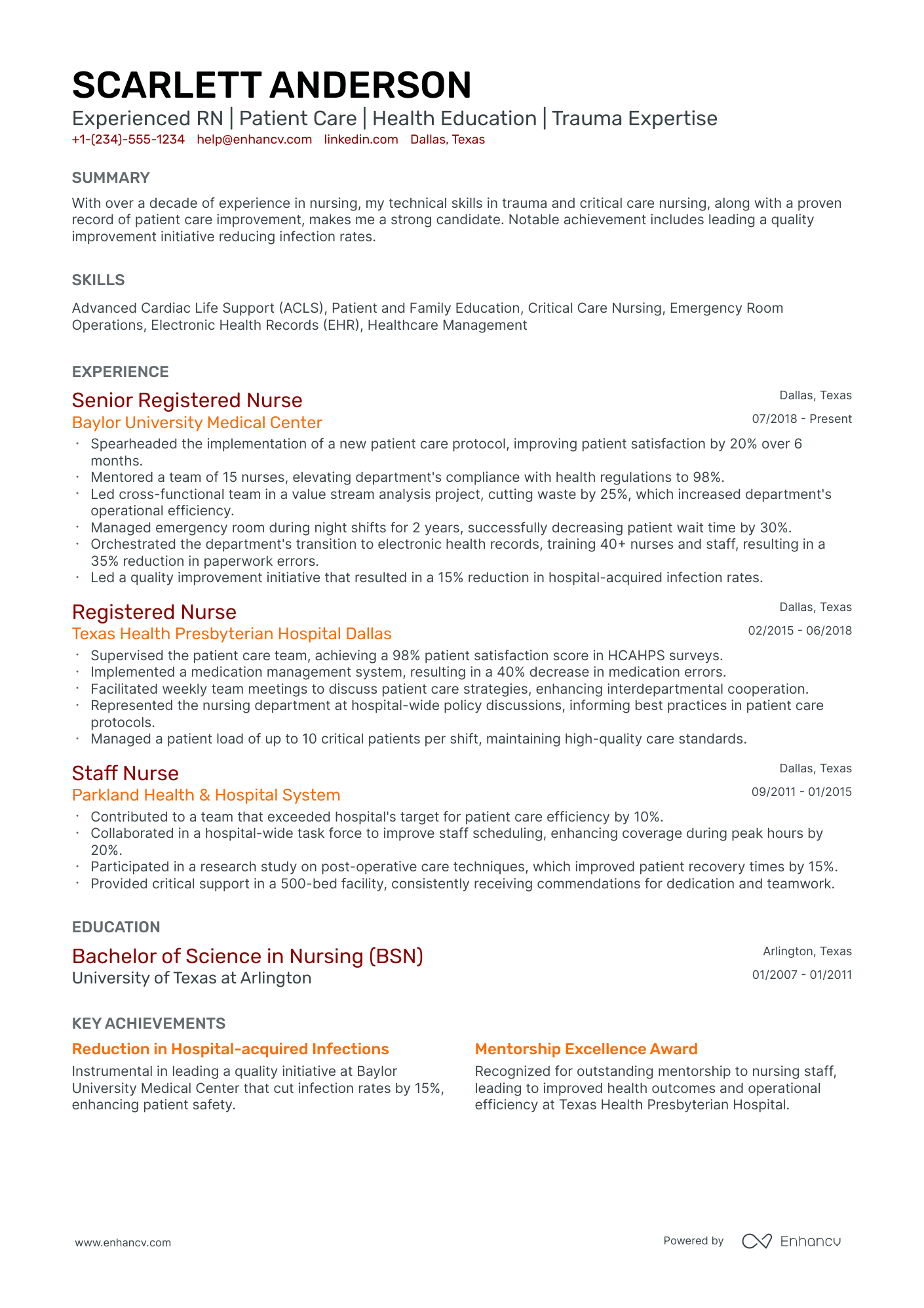
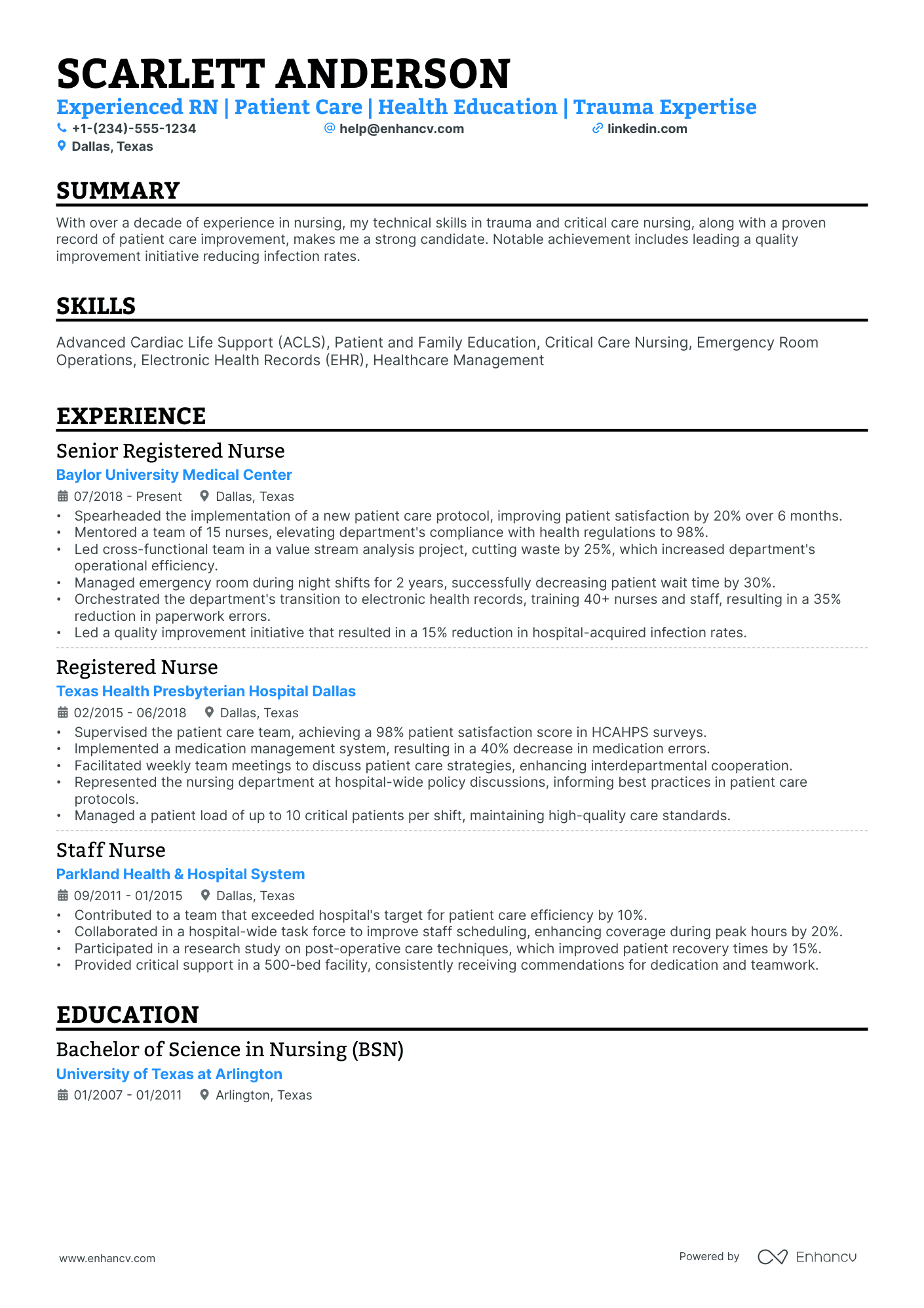
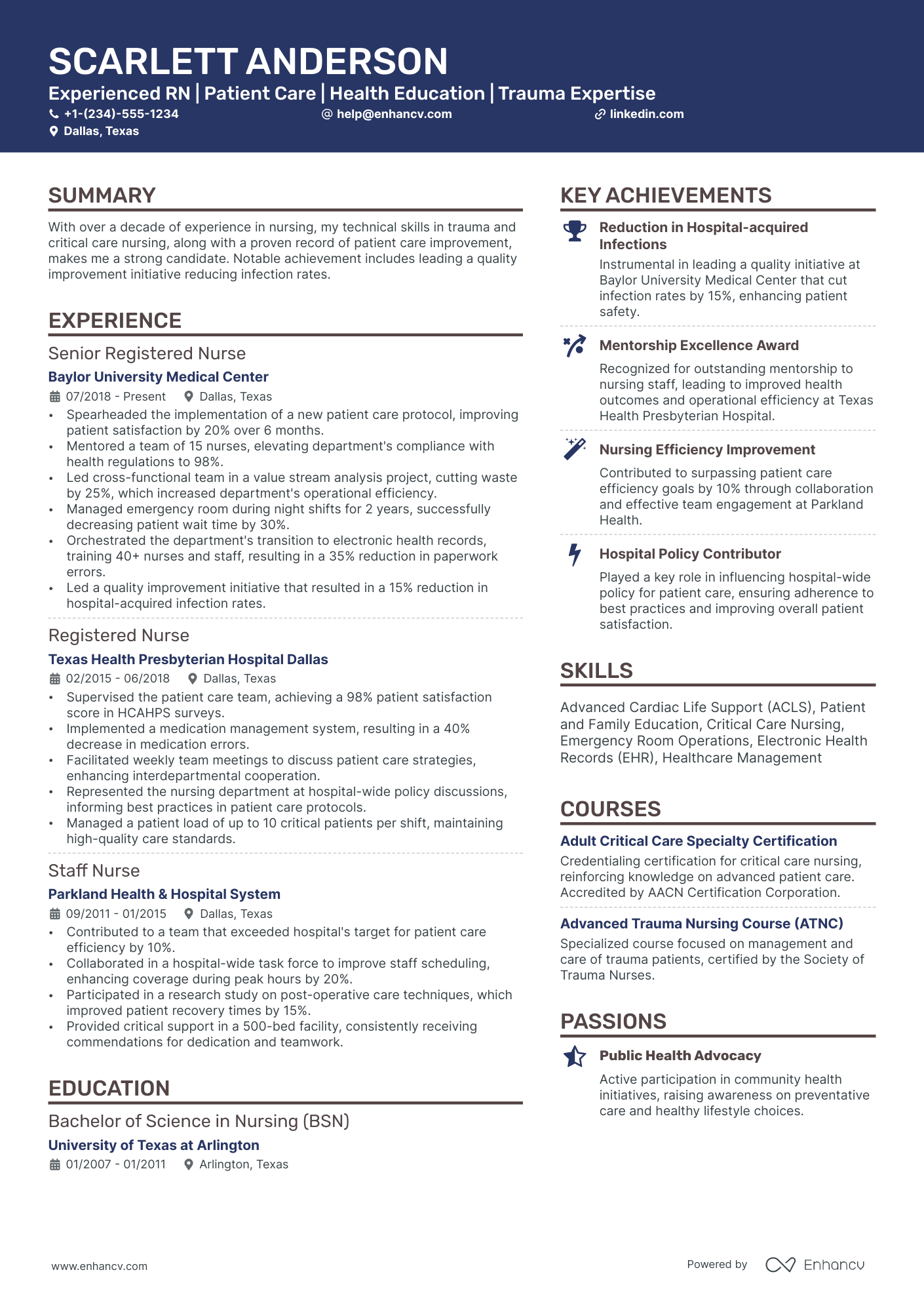
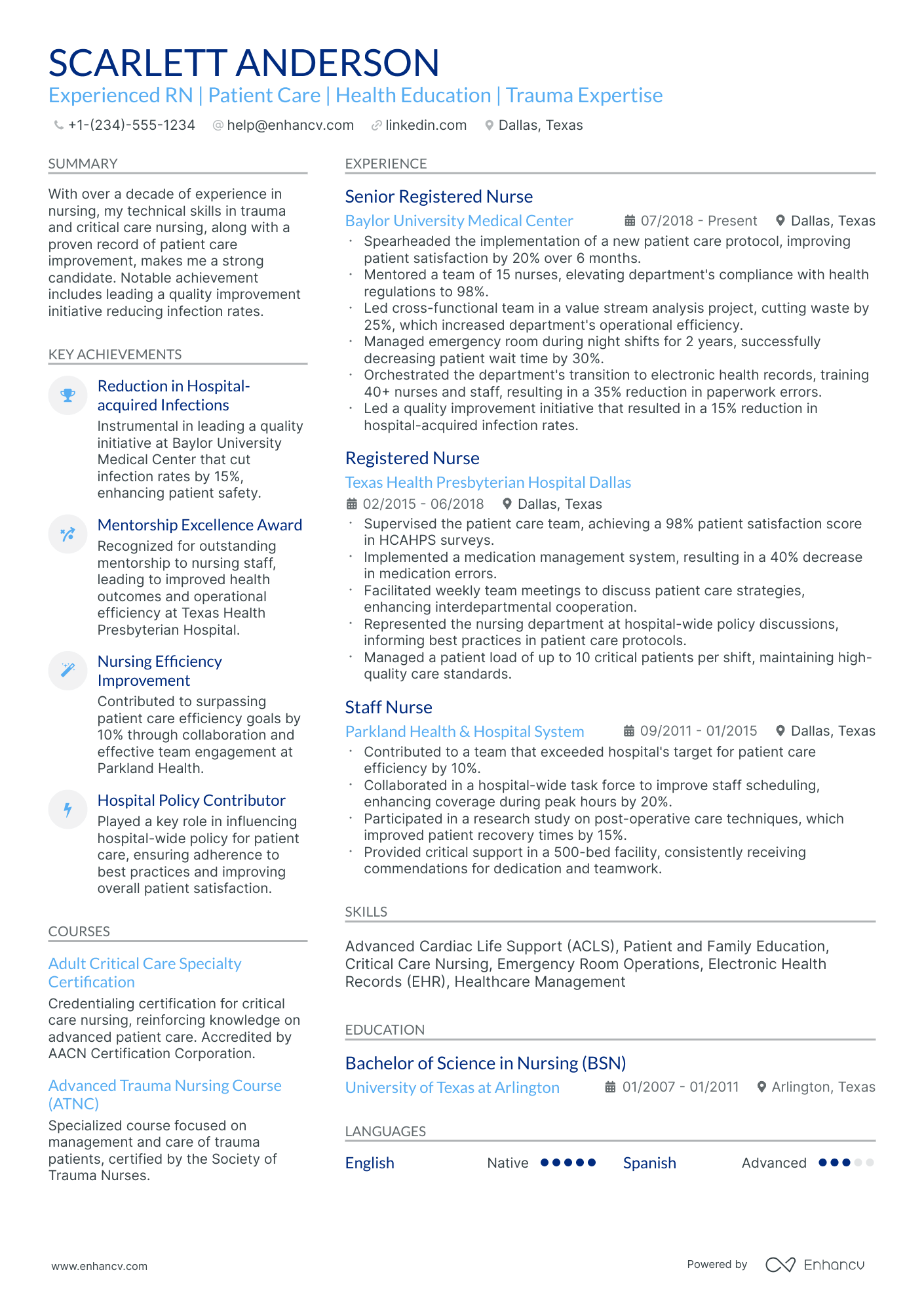
Staff nurse resume drafts often fail because they read like task lists and bury clinical impact. That matters when an ATS filters keywords and recruiters scan in seconds amid heavy competition.
A strong resume shows how you improved patient outcomes, safety, and throughput. Highlight results like reduced falls, faster discharge times, higher patient satisfaction, fewer medication errors, larger patient loads, stronger audit scores. Include scope, acuity, and measurable quality gains.

Key takeaways
- Quantify patient outcomes, safety improvements, and throughput gains in every experience bullet.
- Use reverse-chronological format to showcase clinical progression and expanding scope clearly.
- Mirror the job posting's exact charting systems, unit types, and clinical terminology throughout your resume.
- Anchor each listed skill to a measurable achievement in your summary or experience section.
- Place certifications above education when they're recent, role-specific, or required by the posting.
- Replace vague duties like "responsible for" with direct statements showing ownership and results.
- Use Enhancv's tools to tighten bullet points and align your resume with each job description efficiently.
Job market snapshot for staff nurses
We analyzed 1,232 recent staff nurse job ads across major US job boards. These numbers help you understand regional hotspots, salary landscape, employment type trends at a glance.
What level of experience employers are looking for staff nurses
| Years of Experience | Percentage found in job ads |
|---|---|
| 1–2 years | 17.5% (216) |
| 3–4 years | 2.9% (36) |
| 5–6 years | 0.2% (3) |
| 10+ years | 0.1% (1) |
| Not specified | 78.7% (969) |
Staff nurse ads by area of specialization (industry)
| Industry (Area) | Percentage found in job ads |
|---|---|
| Healthcare | 78.7% (970) |
| Education | 17.5% (215) |
| Finance & Banking | 3.7% (45) |
Top companies hiring staff nurses
| Company | Percentage found in job ads |
|---|---|
| University of Iowa | 11.9% (147) |
| University of Pittsburgh Medical Center | 9.5% (117) |
| UPMC Health System | 9.3% (114) |
| Sutter Health | 7.6% (94) |
| Kaiser Permanente | 5.7% (70) |
| Erlanger Health | 4.0% (49) |
| New York Presbyterian | 3.4% (42) |
| University Health System | 2.8% (35) |
| UNC Health Care Systems | 2.8% (34) |
| Brigham and Women's Hospital | 2.7% (33) |
Role overview stats
These tables show the most common responsibilities and employment types for staff nurse roles. Use them to align your resume with what employers expect and to understand how the role is structured across the market.
Day-to-day activities and top responsibilities for a staff nurse
| Responsibility | Percentage found in job ads |
|---|---|
| Patient care | 26.1% (321) |
| Nursing | 25.0% (308) |
| Basic life support | 24.9% (307) |
| Bls | 19.6% (242) |
| Cpr | 17.9% (221) |
| Acls | 16.2% (199) |
| Registered nurse | 15.5% (191) |
| Critical thinking | 15.0% (185) |
| Nursing process | 10.1% (125) |
| Pals | 9.1% (112) |
| Documentation | 9.0% (111) |
| Computer skills | 8.9% (110) |
How to format a staff nurse resume
Recruiters evaluating staff nurse candidates prioritize clinical progression, unit-level leadership, mentorship contributions, and measurable patient outcomes. A well-chosen resume format ensures these signals are immediately visible rather than buried beneath formatting that obscures your career trajectory.

I have significant experience in this role—which format should I use?
Use the reverse-chronological format—it's the only structure that accurately communicates your clinical depth and progressive responsibility. Do:
- Lead with your most recent role and clearly define your scope: unit type, bed count, patient acuity, charge nurse duties, and oversight responsibilities.
- Highlight specialized clinical domains, certifications (CCRN, PCCN, OCN), EHR proficiency (Epic, Cerner, Meditech), and evidence-based practice contributions.
- Quantify outcomes tied to patient safety, quality metrics, or operational improvements.
Why hybrid and functional resumes don't work for senior roles
Hybrid and functional formats fragment your career timeline and strip away the context that hiring managers need to evaluate clinical progression, charge responsibilities, preceptor roles, and unit-level accountability. For a staff nurse with meaningful experience, these formats dilute the leadership impact and decision ownership that distinguish you from less experienced candidates. Avoid hybrid and functional formats entirely if you have three or more years of progressive nursing experience with demonstrable outcomes and expanding scope.
- Edge-case exception: A functional format may be acceptable only if you're a seasoned nurse re-entering clinical practice after an extended absence or transitioning from a non-bedside role (case management, utilization review), and only if every listed skill is anchored to specific projects, patient outcomes, or quality improvement results.
Now that you've established a clean, readable layout, it's time to fill each part of your resume with the right content.
What sections should go on a staff nurse resume
Recruiters expect a staff nurse resume to show safe, efficient patient care, strong clinical judgment, and reliable teamwork at a glance.
Use this structure for maximum clarity:
- Header
- Summary
- Experience
- Skills
- Projects
- Education
- Certifications
- Optional sections: Awards, Leadership, Volunteering
Strong experience bullets should emphasize patient outcomes, measurable impact, patient volume and acuity, unit scope, and results tied to safety, quality, and efficiency.
Is your resume good enough?
Drop your resume here or choose a file. PDF & DOCX only. Max 2MB file size.
With your resume’s key components in place, the next step is to write your staff nurse resume experience section so your qualifications show up clearly and consistently.
How to write your staff nurse resume experience
Your experience section is where you prove you've delivered real patient care outcomes—not just performed routine tasks. Hiring managers in nursing prioritize demonstrated impact, including the clinical tools and methods you've applied and the measurable improvements you've driven in patient safety, recovery, and unit performance.
Each entry should include:
- Job title
- Company and location (or remote)
- Dates of employment (month and year)
Three to five concise bullet points showing what you owned, how you executed, and what outcomes you delivered:
- Ownership scope: the patient populations, care units, caseloads, or clinical programs you were directly accountable for as a staff nurse.
- Execution approach: the clinical protocols, charting systems, assessment frameworks, or evidence-based practices you used to guide patient care decisions and deliver treatment.
- Value improved: changes to patient outcomes, care quality, infection rates, medication safety, discharge efficiency, or compliance relevant to bedside nursing.
- Collaboration context: how you coordinated with physicians, specialists, therapists, social workers, or family members to ensure cohesive, patient-centered care plans.
- Impact delivered: outcomes expressed through improvements in patient recovery, unit performance, safety benchmarks, or resource utilization rather than a list of daily duties.
Experience bullet formula
A staff nurse experience example
✅ Right example - modern, quantified, specific.
Staff Nurse (Telemetry)
Mercy General Hospital | St. Louis, MO
2022–Present
Three-hundred-fifty-bed community hospital with a thirty-two-bed telemetry unit serving high-acuity cardiac and medical-surgical patients.
- Delivered care for four to six telemetry patients per shift using Epic electronic health record (electronic health record), SBAR handoffs, and NIH Stroke Scale documentation, reducing missed critical-value follow-ups by twenty-five percent.
- Coordinated rapid response activations with hospitalists, respiratory therapy, and pharmacy, cutting time-to-intervention for sepsis bundles from fifty-five to forty minutes and improving bundle compliance from eighty-one to ninety-two percent.
- Implemented barcode medication administration (barcode medication administration) and smart pump guardrails (Alaris) to standardize high-alert infusions, decreasing medication-administration variances by thirty percent over six months.
- Partnered with physical therapy, case management, and social work to execute daily interdisciplinary rounds and discharge planning in Epic, reducing average length of stay for heart failure patients by point four days.
- Led bedside education using teach-back and MyChart discharge instructions for anticoagulation and heart failure self-management, increasing seventy-two-hour post-discharge follow-up completion from sixty to eighty-four percent.
Now that you've seen how to structure your experience entries, let's focus on aligning them with the specific requirements of each job posting.
How to tailor your staff nurse resume experience
Recruiters evaluate staff nurse resumes through both human review and applicant tracking systems (ATS), so aligning your experience with the specific job posting increases your chances of moving forward. Tailoring means adjusting how you present real accomplishments to reflect the language and priorities each employer uses.
Ways to tailor your staff nurse experience:
- Mirror the exact charting system listed like Epic or Cerner.
- Match clinical terminology the posting uses for patient care processes.
- Reflect specific patient population or unit type mentioned.
- Highlight compliance with HIPAA or Joint Commission standards if referenced.
- Include quality metrics or patient outcome measures the role prioritizes.
- Use the same language for interdisciplinary collaboration or care coordination.
- Emphasize infection control or safety protocols named in the description.
- Align your documentation practices with the workflows they describe.
Tailoring your experience means framing your real achievements in the employer's own language, not forcing keywords where they don't belong.
Resume tailoring examples for staff nurse
| Job description excerpt | Untailored | Tailored |
|---|---|---|
| Administer medications and IV therapy using the Pyxis MedStation system, ensuring compliance with the five rights of medication administration. | Responsible for giving medications to patients on the unit. | Administered oral, IM, and IV medications to 6–8 patients per shift using the Pyxis MedStation, maintaining 100% compliance with the five rights of medication administration. |
| Collaborate with interdisciplinary care teams to develop and update individualized patient care plans using Epic EHR documentation. | Worked with other staff to help with patient care. | Partnered with physicians, pharmacists, and social workers to develop and update individualized care plans for a 32-bed medical-surgical unit, documenting all assessments and interventions in Epic EHR. |
| Perform continuous cardiac monitoring and early recognition of sepsis indicators per hospital early warning score (EWS) protocols. | Monitored patients and reported changes to the doctor. | Performed continuous cardiac monitoring and assessed early sepsis indicators using the hospital's early warning score protocol, escalating 15+ critical changes per month that contributed to a 20% reduction in rapid response calls. |
Once you’ve aligned your experience with the role’s priorities, quantify your achievements to show the measurable impact of that work.
How to quantify your staff nurse achievements
Quantifying your work proves patient impact and clinical reliability. Focus on patient volume, safety events, compliance, time-to-treatment, and patient experience, plus measurable improvements from protocols and tools like electronic health records.
Quantifying examples for staff nurse
| Metric | Example |
|---|---|
| Patient throughput | "Managed an average of six med-surg patients per shift, completing hourly rounding and all medication passes with zero missed doses over twelve weeks." |
| Safety risk | "Reduced patient falls from three per quarter to one by implementing a high-risk rounding checklist and bed alarm protocol on a thirty-two-bed unit." |
| Documentation accuracy | "Improved electronic health record chart completion from 85% to 98% within two hours of shift end by standardizing flowsheets and using smart phrases." |
| Time-to-treatment | "Cut sepsis bundle time-to-antibiotics from ninety minutes to fifty-five minutes by coordinating STAT labs, pharmacy, and rapid response workflows." |
| Patient experience | "Raised unit patient satisfaction communication score from 3.8 to 4.4 out of five by using bedside shift report and teach-back on discharge instructions." |
Turn vague job duties into measurable, recruiter-ready resume bullets in seconds with Enhancv's Bullet Point Generator.
With strong bullet points in place, the next step is making sure your skills section presents the right mix of hard and soft skills to match what hiring managers expect.
How to list your hard and soft skills on a staff nurse resume
Your skills section shows you can deliver safe, efficient patient care, and recruiters and applicant tracking systems scan it to confirm required competencies fast—aim for a balanced mix of hard clinical skills and role-specific soft skills. staff nurse roles require a blend of:
- Clinical assessment, patient care, and safety skills.
- Documentation, informatics, and quality improvement skills.
- Care coordination, discharge planning, and patient education discipline.
- Soft skills.
Your skills section should be:
- Scannable (bullet-style grouping).
- Relevant to the job post.
- Backed by proof in experience bullets.
- Updated with current tools.
Place your skills section:
- Above experience if you're junior or switching careers.
- Below experience if you're mid/senior with strong achievements.

Hard skills
- Electronic health records (Epic, Cerner)
- Medication administration, five rights
- Intravenous therapy, infusion pumps
- Central line care, peripherally inserted central catheter care
- Wound care, negative pressure therapy
- Vital signs, telemetry monitoring
- Blood glucose monitoring, insulin protocols
- Specimen collection, phlebotomy
- Infection prevention, isolation precautions
- Pain assessment, opioid stewardship
- Discharge planning, care transitions
- Basic life support, advanced cardiac life support
Soft skills
- Triage and prioritize patient needs
- Escalate clinical concerns fast
- Communicate clearly in handoffs
- Collaborate with physicians and pharmacists
- Coordinate care across departments
- Educate patients and families
- De-escalate conflict and anxiety
- Stay calm during emergencies
- Follow protocols with sound judgment
- Document accurately under pressure
- Advocate for patient safety
- Mentor new nurses and students
How to show your staff nurse skills in context
Skills shouldn't live only in a dedicated skills list. Browse examples of resume skills presented in context to see how top candidates integrate competencies throughout their resumes.
They should be demonstrated in:
- Your summary (high-level professional identity)
- Your experience (proof through outcomes)
Here's how that looks in practice.
Summary example
Critical care staff nurse with 10+ years in cardiac stepdown units. Skilled in hemodynamic monitoring, Epic EHR documentation, and interdisciplinary care coordination. Reduced unit fall rates by 34% through evidence-based safety protocols and patient education initiatives.
- Signals senior-level experience immediately
- Names unit-specific tools and methods
- Quantifies a patient safety outcome
- Highlights collaboration and leadership
Experience example
Staff Nurse
Mercy Health Regional Medical Center | Toledo, OH
June 2017–Present
- Managed care for 5–6 cardiac stepdown patients per shift using hemodynamic monitoring, cutting code blue events by 18% over two years.
- Collaborated with physicians, pharmacists, and respiratory therapists to standardize medication reconciliation, reducing administration errors by 25%.
- Mentored 12 new graduate nurses on Epic EHR workflows and unit protocols, improving onboarding efficiency by 30%.
- Every bullet includes measurable proof
- Skills appear naturally within achievements
Once you’ve anchored your nursing strengths in real clinical examples, the next step is learning how to build a staff nurse resume with no experience by using those examples to create credible, job-relevant content.
How do I write a staff nurse resume with no experience
Even without full-time experience, you can demonstrate readiness through clinical training and academic projects. Our guide on writing a resume without work experience walks you through strategies that apply directly to new graduate nurses. Consider including:
- Capstone clinical simulation projects
- Precepted clinical rotations in med-surg
- Senior practicum on inpatient unit
- Volunteer shifts at community clinic
- Patient education projects with outcomes
- Shadowing hours with staff nurse
- Skills lab checkoffs and validations
- Quality improvement poster presentation
Focus on:
- Clinical hours, units, patient types
- Medication safety and documentation accuracy
- Evidence-based protocols you applied
- Measurable outcomes from school projects
Resume format tip for entry-level staff nurse
Use a hybrid resume format because it highlights clinical training and skills first, while still showing a clear timeline of education and rotations. Do:
- Put clinical rotations above unrelated jobs.
- List units, hours, and patient populations.
- Add tools used: electronic health record, SBAR.
- Quantify results from projects and practicum work.
- Match keywords to the job posting.
- Led a capstone clinical simulation project using SBAR and electronic health record charting, improving medication-administration accuracy from eighty-eight percent to ninety-eight percent across four scenarios.
Even without hands-on experience, your nursing education and clinical rotations become the strongest foundation of your resume—so presenting them effectively is essential.
How to list your education on a staff nurse resume
Your education section helps hiring teams confirm you hold the foundational nursing knowledge required. It validates your clinical training and qualifies you for staff nurse positions quickly.
Include:
- Degree name
- Institution
- Location
- Graduation year
- Relevant coursework (for juniors or entry-level candidates)
- Honors & GPA (if 3.5 or higher)
Skip month and day details—list the graduation year only.
Here's a strong education entry tailored for a staff nurse resume:
Example education entry
Bachelor of Science in Nursing
University of Pennsylvania, Philadelphia, PA
Graduated 2021
GPA: 3.7/4.0
- Relevant Coursework: Pharmacology, Medical-Surgical Nursing, Pathophysiology, Community Health Nursing
- Honors: Magna Cum Laude, Dean's List (all semesters)
How to list your certifications on a staff nurse resume
Certifications show your commitment to learning, proficiency with clinical tools and protocols, and relevance to today's care standards as a staff nurse.
Include:
- Certificate name
- Issuing organization
- Year
- Optional: credential ID or URL
- Place certifications below education when they're older, broad, or less relevant than your degree and clinical training.
- Place certifications above education when they're recent, role-specific, or required for the staff nurse jobs you target.
Best certifications for your staff nurse resume
- Basic Life Support (BLS)
- Advanced Cardiovascular Life Support (ACLS)
- Pediatric Advanced Life Support (PALS)
- NIH Stroke Scale (NIHSS)
- Certified Medical-Surgical Registered Nurse (CMSRN)
- Critical Care Registered Nurse (CCRN)
- Trauma Nursing Core Course (TNCC)
Once you’ve placed your credentials where hiring managers can spot them, focus on your staff nurse resume summary to tie those qualifications to the value you bring.
How to write your staff nurse resume summary
Your resume summary is the first thing a recruiter reads, so it needs to earn their attention fast. A strong summary signals your clinical depth, leadership capacity, and the real impact you bring to patient care.
Keep it to three to four lines, with:
- Your title and total years of nursing experience.
- The clinical setting, specialty, or patient population you serve.
- Core competencies such as EHR systems, triage protocols, or care coordination.
- One or two measurable achievements that reflect scope and outcomes.
- Soft skills like mentorship or interdisciplinary collaboration tied to tangible results.

PRO TIP
At the staff nurse level, recruiters expect evidence of ownership and clinical leadership. Emphasize outcomes you drove—reduced complications, improved patient satisfaction scores, or streamlined unit workflows. Highlight mentorship of junior nurses and your role in quality improvement initiatives. Avoid vague descriptors like "passionate" or "dedicated team player" that say nothing about your actual contributions.
Example summary for a staff nurse
Staff nurse with 8+ years in cardiac stepdown units. Led a fall-prevention initiative that cut incident rates by 34%. Mentors new hires and coordinates care across interdisciplinary teams using Epic EHR.
Optimize your resume summary and objective for ATS
Drop your resume here or choose a file.
PDF & DOCX only. Max 2MB file size.
Now that your summary captures your nursing qualifications at a glance, make sure your header presents the essential contact and credential details recruiters need to reach you.
What to include in a staff nurse resume header
A resume header is the top section with your key identifiers, and it boosts visibility, credibility, and fast recruiter screening for a staff nurse.
Essential resume header elements.
- Full name
- Tailored job title and headline
- Location
- Phone number
- Professional email
- GitHub link
- Portfolio link
A LinkedIn link helps recruiters verify experience quickly and supports screening.
Don't include a photo on a staff nurse resume unless the role is explicitly front-facing or appearance-dependent.
Keep your header consistent across your resume and online profiles so recruiters can match your details in seconds.
Example
Staff nurse resume header
Jordan Taylor
Staff Nurse | Medical-Surgical RN focused on patient safety and care coordination
Austin, TX
(512) 555-01XX
jordan.taylor@enhancv.com
github.com/jordantaylor
jordantaylor.com
linkedin.com/in/jordantaylor
Once your header clearly identifies you and makes it easy to contact you, you can strengthen the rest of your application with additional sections for staff nurse resumes that support your qualifications.
Additional sections for staff nurse resumes
Extra resume sections help you stand out when multiple staff nurse candidates share similar clinical backgrounds and certifications.
They add depth, highlight specialized strengths, and reinforce your credibility beyond standard qualifications. For example, listing language skills can set you apart in facilities serving diverse patient populations.
Consider including these sections on your staff nurse resume:
- Languages
- Certifications and licenses
- Volunteer experience
- Professional affiliations
- Continuing education
- Publications
- Awards and honors
Once you've strengthened your resume with relevant additional sections, pair it with a well-crafted cover letter to give your application the full context hiring managers need.
Do staff nurse resumes need a cover letter
A cover letter isn't required for a staff nurse, but it helps in competitive roles or systems that expect one. If you're unsure where to start, learn what a cover letter is and how it complements your resume. It can make a difference when your resume needs context, or when hiring managers compare many similar candidates.
Use a cover letter to add context your staff nurse resume can't show:
- Explain role and team fit: Match your unit experience, shift preference, and patient population to the posting's priorities.
- Highlight one or two outcomes: Share a specific project, quality metric improvement, or patient safety result, and name your role and impact.
- Show context awareness: Reference the hospital's service lines, patient needs, or care model, and connect them to how you practice as a staff nurse.
- Address transitions or non-obvious experience: Clarify specialty changes, employment gaps, travel assignments, or military and clinic work that supports the staff nurse role.
Drop your resume here or choose a file.
PDF & DOCX only. Max 2MB file size.
Whether you include a cover letter or not, using AI to improve your staff nurse resume helps you strengthen your content and alignment with the role more efficiently.
Using AI to improve your staff nurse resume
AI can sharpen your resume's clarity, structure, and impact. It helps you find stronger action verbs and tighten wordy bullets. For detailed guidance, explore ChatGPT resume writing prompts tailored to healthcare professionals. But overuse strips authenticity fast. Once your content is clear and role-aligned, step away from AI entirely.
Here are 10 practical prompts you can copy, paste, and adapt to strengthen your staff nurse resume:
- Strengthen summary focus: "Rewrite my staff nurse resume summary to highlight my top clinical strengths and patient population expertise in three concise sentences."
- Quantify experience bullets: "Add measurable outcomes to these staff nurse experience bullets using patient volumes, error reduction rates, or efficiency improvements."
- Tighten action verbs: "Replace weak or passive verbs in my staff nurse experience section with strong, nursing-specific action verbs."
- Align skills section: "Compare my staff nurse skills list against this job description and flag missing keywords I should add."
- Reduce redundancy: "Identify and remove repeated ideas across my staff nurse resume experience bullets without losing important details."
- Clarify certifications: "Reformat my staff nurse certifications section so each entry includes the credential name, issuing body, and expiration date."
- Improve education details: "Rewrite my staff nurse education section to emphasize relevant clinical rotations, honors, and specialized coursework."
- Refine project descriptions: "Sharpen my staff nurse quality improvement project descriptions to focus on my specific role, actions taken, and patient outcomes."
- Tailor for specialties: "Adjust my staff nurse resume bullets to better match this posting for a medical-surgical unit position."
- Cut filler language: "Remove vague phrases like 'responsible for' and 'assisted with' from my staff nurse experience section and replace them with direct statements."
Stop using AI once your resume sounds accurate, specific, and aligned with real experience. AI should never invent experience or inflate claims—if it didn't happen, it doesn't belong here.
Conclusion
A strong staff nurse resume shows measurable outcomes, role-specific skills, and a clear structure that makes your impact easy to scan. Use metrics, precise clinical skills, and consistent formatting to highlight safe care, teamwork, and reliable documentation.
Today’s hiring market rewards clarity, proof, and fit. A focused staff nurse resume helps you stand out now and stay ready as expectations shift toward quality, efficiency, and patient-centered outcomes.