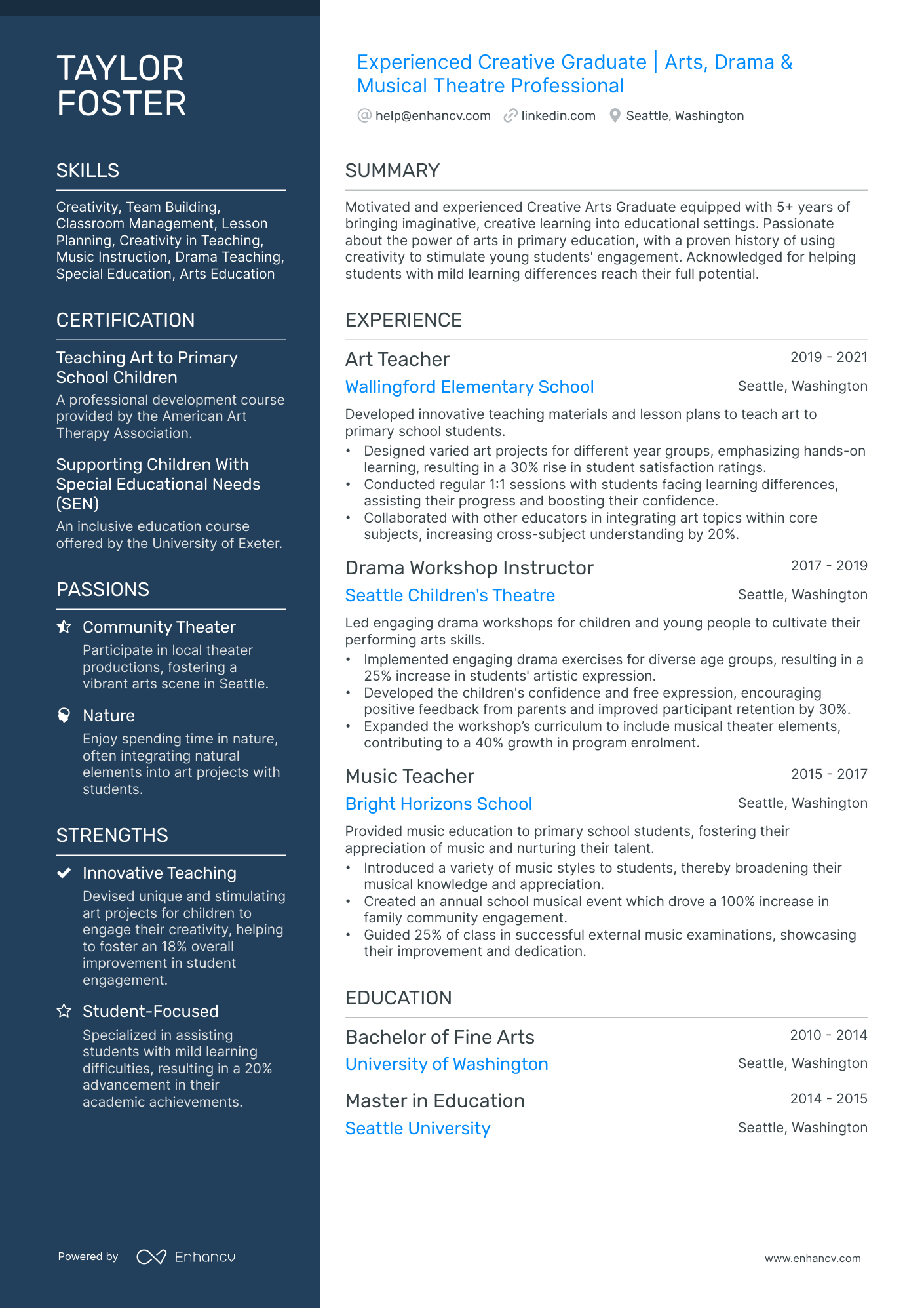
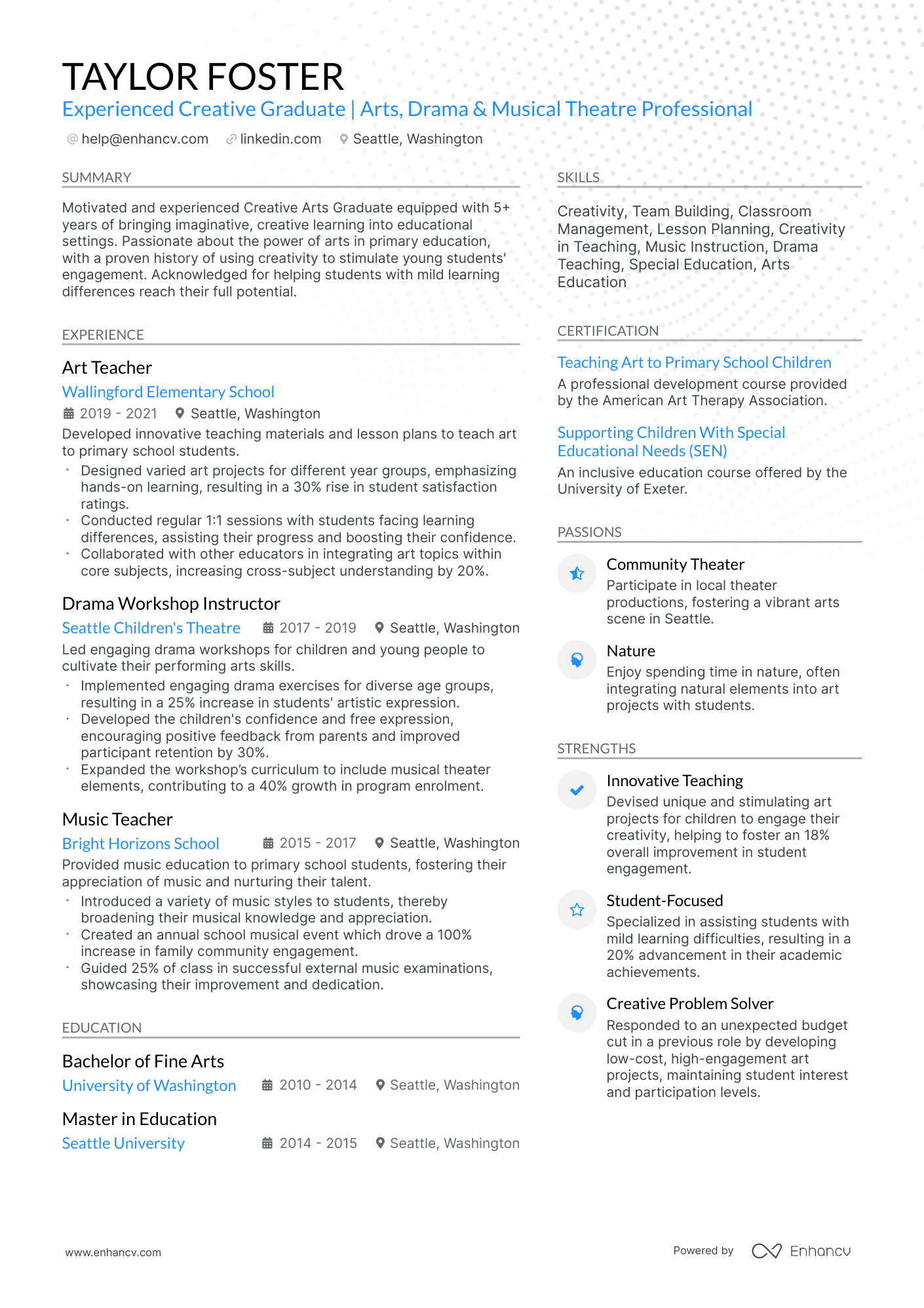
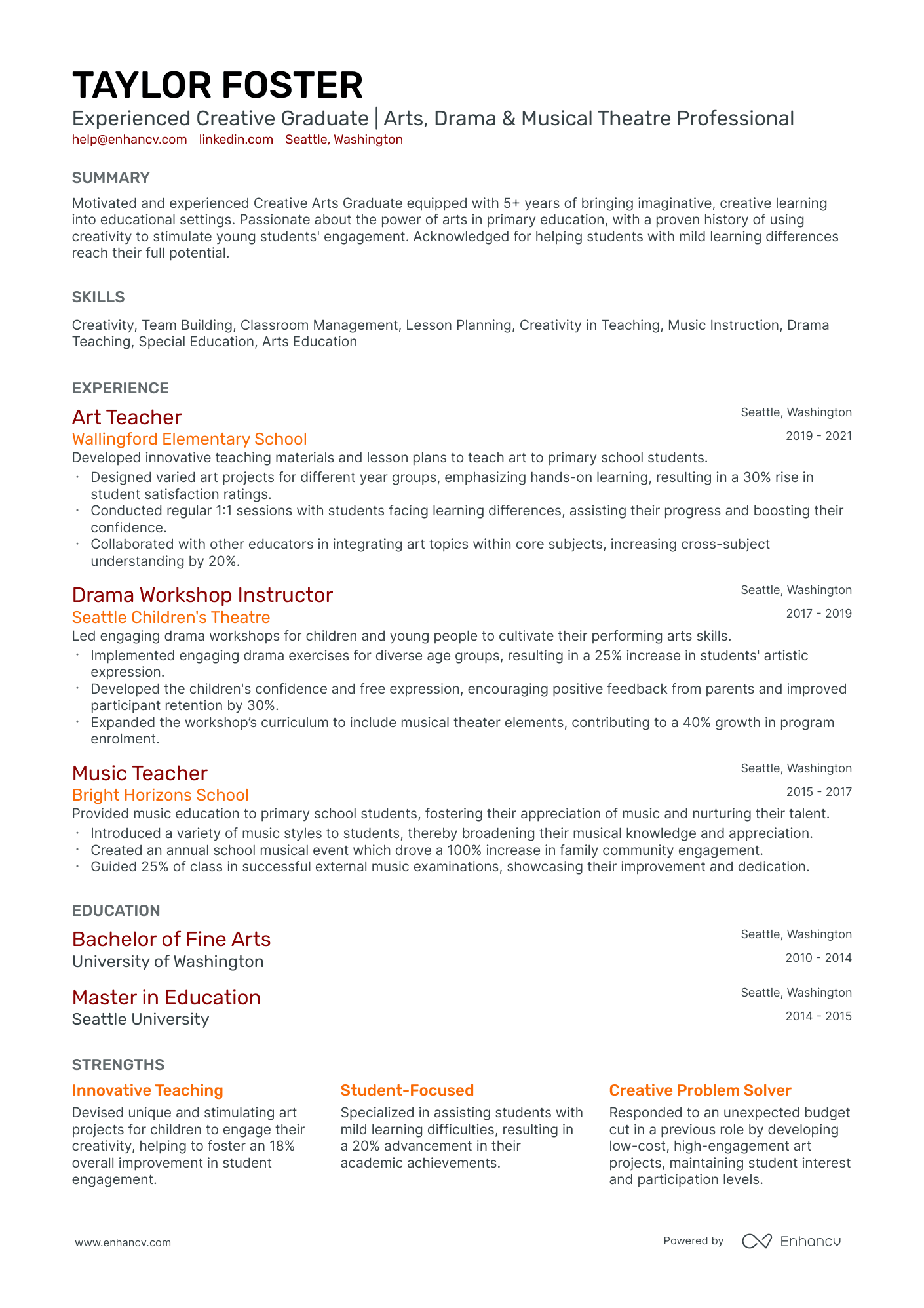
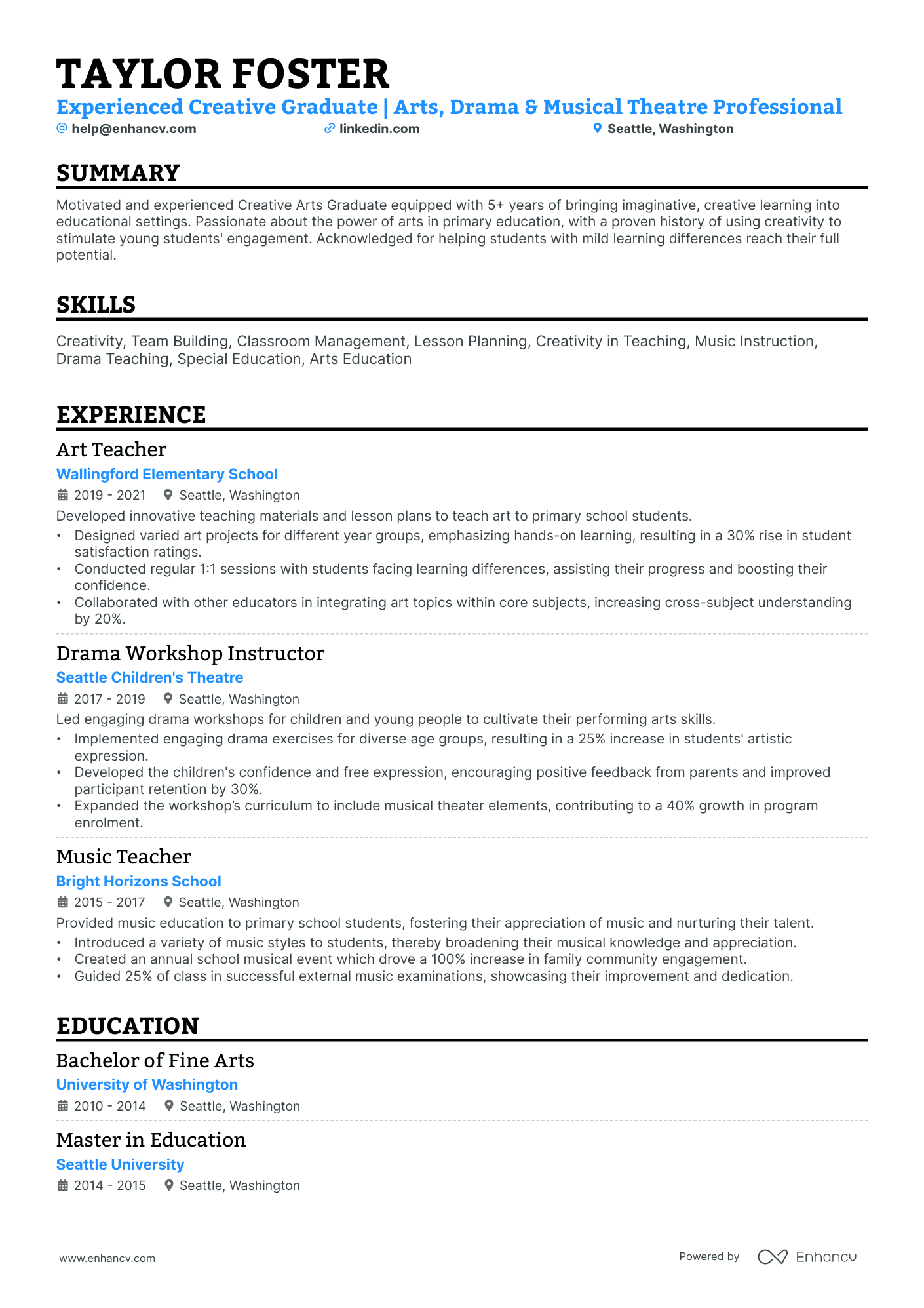
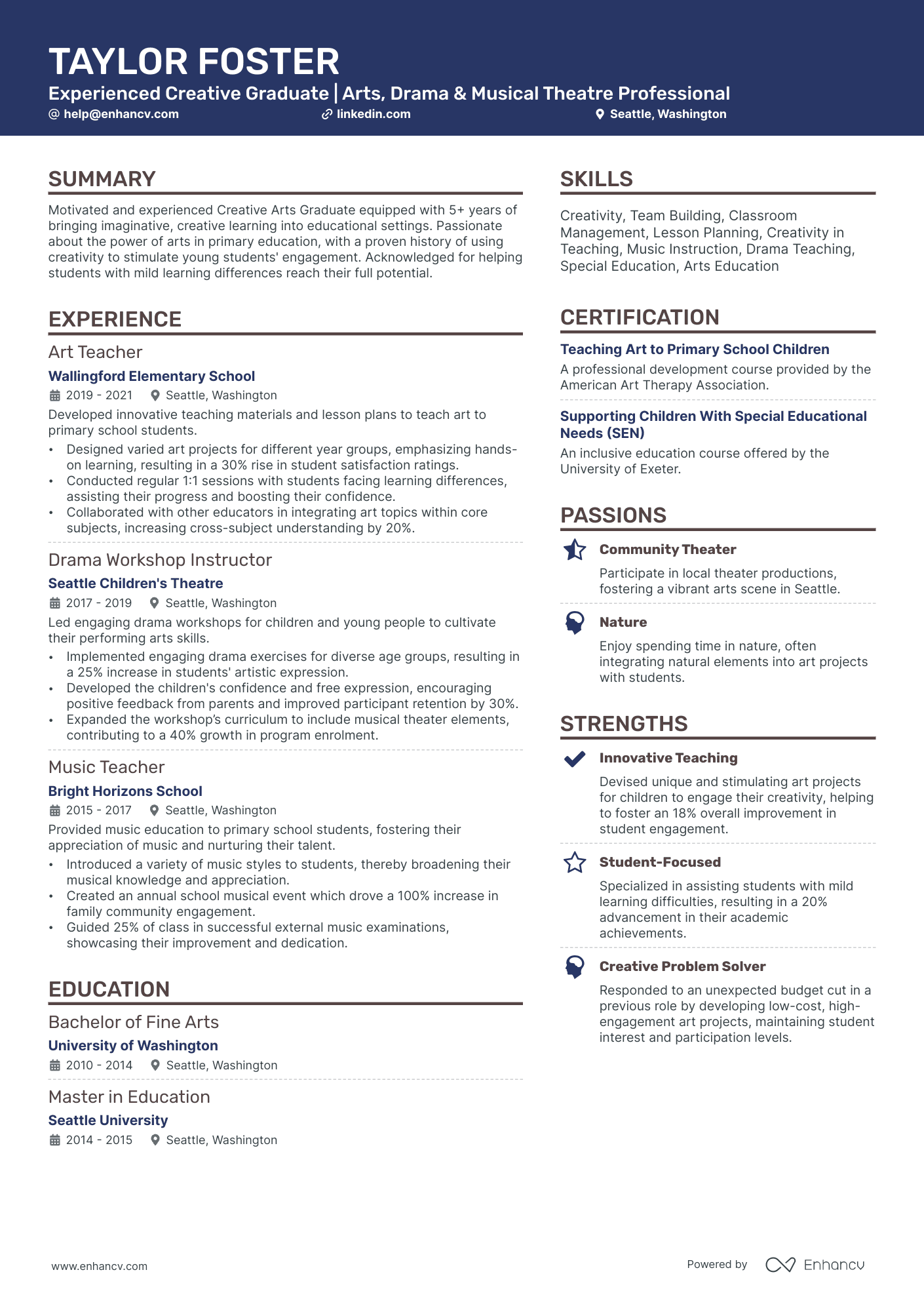

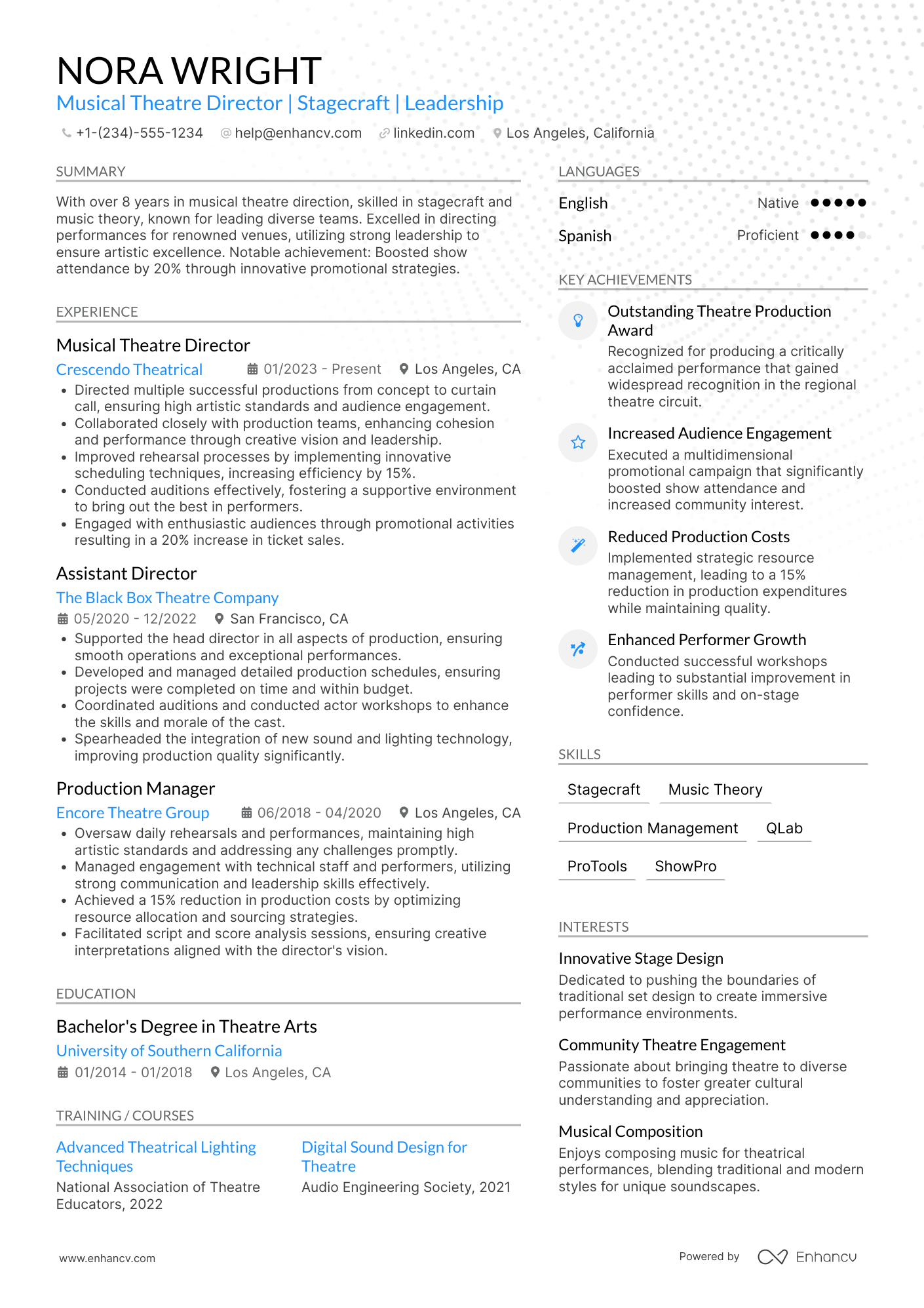
Most musical theatre resume submissions fail because they read like a program bio, not a hiring document. When your musical theatre resume buries credits and skills in dense text, recruiters skim past it fast, and ATS screening can miss key roles.
A strong resume shows what changed because you were on the team. Knowing how to make your resume stand out means you highlight box office lifts, audience attendance growth, roles covered, performance run length, swing tracks mastered, understudy call-ins handled, and consistent positive reviews. You quantify rehearsal load, tour scope, and safety compliance.

Key takeaways
- Quantify your credits with run length, audience size, and performance counts to prove impact.
- Use reverse-chronological format if experienced and hybrid format if entering the field.
- Tailor every submission by mirroring the casting breakdown's language and specific requirements.
- List vocal range, dance styles, and acting techniques as concrete, castable skills—not vague traits.
- Place training and certifications where casting directors expect them based on your experience level.
- Write a three-to-four-line summary naming your type, specialty, and a measurable achievement.
- Build your resume faster with Enhancv, then refine each version to match the specific role.
How to format a musical theatre resume
Casting directors and artistic directors scan musical theatre resumes for performance credits, training pedigree, and special skills—typically in under 30 seconds. Choosing the right resume format is essential, because a cluttered or unconventional resume layout can bury the very credits and training that get you into the audition room.

I have significant experience in this role—which format should I use?
Use a reverse-chronological format that leads with your most recent and notable performance credits. Do:
- List credits in clearly defined categories (theatre, film/TV, commercials) with the role name, production title, and producing theatre or director for each entry.
- Highlight training and special skills—vocal range, dance styles, dialects, instruments—in dedicated sections that casting directors expect to find quickly.
- Anchor your strongest credits near the top so your range and versatility are visible at a glance.
I'm junior or switching into this role—what format works best?
A hybrid format works best, letting you highlight training and skills at the top while still listing any performance credits in reverse-chronological order. Do:
- Place a strong skills section near the top that includes vocal range, dance training (ballet, jazz, tap), dialects, and any instruments—these are the first qualifiers casting directors look for.
- Feature educational theatre productions, showcases, workshops, and staged readings as legitimate credits to demonstrate stage experience even without professional union work.
- Connect each credit or training detail to a clear outcome: skill learned → role or project performed → result achieved.
Why not use a functional resume?
A functional resume strips away the production-by-production credit list that casting directors rely on to evaluate your type, range, and experience level—making it nearly impossible for them to assess your fit for a role. A functional format may make sense in narrow circumstances:
- You're transitioning from a related performance field (concert vocalist, competitive dancer, or spoken-word artist) and need to foreground transferable skills before a short credits section.
- You have significant gaps between productions due to injury, caregiving, or a non-performance career detour and want to lead with training and skills.
- Edge-case use: A functional layout is acceptable only if you have fewer than three performance credits and are actively pivoting from a non-performance background—but every skill you list must still reference a concrete project, class, or staged outcome to hold credibility with casting teams.
Now that you've established a clean, readable layout, it's time to fill each part of your resume with the right content.
What sections should go on a musical theatre resume
Recruiters expect to see your performance credits, training, and core stage skills in a format they can scan in seconds. Understanding which resume sections to include helps you organize this information for maximum clarity:
- Header
- Summary
- Experience
- Skills
- Projects
- Education
- Certifications
- Optional sections: Awards, Volunteering, Languages
Strong experience bullets should emphasize role type, production scale, your measurable contributions, and results such as casting outcomes, performance run details, or audience and critical impact.
Is your resume good enough?
Drop your resume here or choose a file. PDF & DOCX only. Max 2MB file size.
Once you’ve organized your resume with the right core categories, the next step is to write your musical theatre experience section in a way that fits that structure and highlights your work clearly.
How to write your musical theatre resume experience
Your work experience section proves you can deliver polished, audience-ready performances across singing, acting, and dance disciplines. Hiring managers and casting directors prioritize demonstrated impact—strong roles you've carried, productions you've contributed to, and measurable audience or company outcomes—over generic task descriptions.
Each entry should include:
- Job title
- Company and location (or remote)
- Dates of employment (month and year)
Three to five concise bullet points showing what you owned, how you executed, and what outcomes you delivered:
- Ownership scope: the roles, characters, ensemble parts, or choreographic responsibilities you were accountable for within a production, season, or touring company.
- Execution approach: the vocal techniques, acting methods, dance styles, rehearsal processes, or performance technologies you applied to prepare and deliver your work on stage.
- Value improved: changes to production quality, audience engagement, show pacing, cast cohesion, or artistic standards that resulted directly from your contributions to a musical theatre production.
- Collaboration context: how you worked with directors, music directors, choreographers, stage managers, fellow cast members, or production crews to shape a unified performance.
- Impact delivered: outcomes expressed through production results—such as extended runs, sold-out performances, positive critical reception, audience growth, or successful tour completions—rather than a simple list of duties you performed.
Experience bullet formula
A musical theatre experience example
✅ Right example - modern, quantified, specific.
Production Stage Manager
Riverview Musical Theatre | Chicago, IL
2022–Present
Two-hundred-seat regional musical theatre producing six mainstage shows per season with union and non-union casts and crews.
- Orchestrated rehearsals and performances for twenty-five to thirty-five cast and crew using Google Workspace, Slack, and Zoom, cutting schedule conflicts by 30% and reducing daily rehearsal overruns from twenty minutes to under five.
- Built and maintained prompt books in StageWrite and QLab, standardizing blocking, cueing, and line notes across six productions and improving cue accuracy from 94% to 99% by opening weekend.
- Implemented a cue-to-cue workflow with lighting, sound, and projection designers using Vectorworks plots and ETC Eos cue sheets, trimming technical rehearsal time by twelve hours per production.
- Led daily production meetings with the director, choreographer, music director, and department heads, resolving an average of fifteen cross-department issues per week and reducing performance holds from four per run to one.
- Audited backstage safety and changeover procedures in partnership with wardrobe, props, and carpentry, lowering near-miss incidents by 40% and cutting scene-change time by 18% without impacting artistic intent.
Now that you've seen how a strong experience entry comes together, let's look at how to adjust yours based on the specific role you're applying for.
How to tailor your musical theatre resume experience
Casting directors and production teams review musical theatre resumes through both personal evaluation and applicant tracking systems. Tailoring your resume to the job description for each audition notice or job posting ensures your strongest qualifications stand out immediately.
Ways to tailor your musical theatre experience:
- Match vocal range and style descriptions used in the casting breakdown.
- Mirror specific dance techniques or movement styles listed in the posting.
- Highlight rehearsal processes and production workflows the company uses.
- Include repertoire or show styles that align with the production season.
- Emphasize ensemble collaboration or featured role experience as requested.
- Reference relevant training in acting methods named by the creative team.
- Note experience with specific accompaniment tools or music notation software.
- Align your performance metrics with the venue size or audience scope described.
Tailoring means connecting your genuine production experience and training to what each opportunity specifically requires, not forcing irrelevant keywords into your credits.
Resume tailoring examples for musical theatre
| Job description excerpt | Untailored | Tailored |
|---|---|---|
| "Seeking a music director proficient in Finale and transposition for a 12-piece pit orchestra performing Sondheim repertoire" | Directed musicians for various live performances and rehearsals. | Music directed a 12-piece pit orchestra for *Into the Woods*, transposing 15 charts in Finale to accommodate vocal ranges and instrumentation changes across a 24-show run. |
| "Choreographer must create original staging for ensemble numbers using Fosse-inspired isolations and partner work for a 20-member cast" | Choreographed dances for multiple stage productions in different styles. | Choreographed six ensemble numbers for a 20-member cast, integrating Fosse-inspired isolations and partnered lifts that earned a regional critics' award for outstanding choreography in *Chicago*. |
| "Stage manager needed to run calling book in QLab, coordinate 40+ fly cues, and manage quick changes for a union touring production" | Managed backstage operations and kept shows running on schedule. | Called 200+ cues per performance using QLab for a union touring production of *Wicked*, coordinating 42 fly cues and supervising a quick-change team of eight dressers across 16 cities. |
Once you’ve aligned your experience with the role’s requirements, the next step is to quantify your musical theatre achievements so casting teams can quickly see the impact of your work.
How to quantify your musical theatre achievements
Quantifying your achievements shows directors and producers the scale, consistency, and results of your work. Focus on performance volume, rehearsal efficiency, audience response, revenue impact, and reliability across runs, including understudy coverage and on-time cues.
Quantifying examples for musical theatre
| Metric | Example |
|---|---|
| Performance volume | "Performed twenty-eight shows across a six-week run, maintaining vocal stamina with zero missed entrances and consistent choreography marks." |
| Rehearsal efficiency | "Cut staging rehearsal time by 20% by pre-blocking transitions in Google Sheets and sharing nightly notes within two hours." |
| Audience satisfaction | "Improved post-show survey ratings from 4.3 to 4.7 out of 5 by tightening comedic beats and adjusting pacing based on stage manager notes." |
| Revenue impact | "Helped lift merchandise revenue 12% by promoting cast-signed Playbills during curtain call and coordinating a thirty-minute meet-and-greet." |
| Reliability and coverage | "Covered two principal tracks as understudy, stepping in for five performances with zero line calls and on-time quick changes under ninety seconds." |
Turn your everyday tasks into measurable, recruiter-ready resume bullets in seconds with Enhancv's Bullet Point Generator.
Once you've crafted strong bullet points for your experience section, you'll want to apply that same precision to presenting your hard and soft skills on your musical theatre resume.
How to list your hard and soft skills on a musical theatre resume
Your skills section shows casting teams and stage management what you can deliver in rehearsal and performance, helps applicant tracking systems (ATS) surface role matches, and usually works best as a balanced mix of technical performance skills and production-ready collaboration skills. Musical theatre roles require a blend of hard skills like vocal technique, dance proficiency, and music theory alongside essential soft skills such as active listening, adaptability, and ensemble collaboration. Your skills section should be:
- Scannable (bullet-style grouping).
- Relevant to the job post.
- Backed by proof in experience bullets.
- Updated with current tools.
Place your skills section:
- Above experience if you're junior or switching careers.
- Below experience if you're mid/senior with strong achievements.

Hard skills
- Sight-reading (vocal)
- Music theory, solfège
- Harmony blending, ensemble vocals
- Belt, mix, legit technique
- IPA diction, dialect coaching
- Choreography retention, dance call prep
- Tap, jazz, ballet fundamentals
- Partnering, lifts, stage combat basics
- Audition cuts, 16-bar prep
- Mic technique, body mics
- Click track, in-ear monitoring
- Quick-change choreography, costume tracking
Soft skills
- Take direction and adjust fast
- Mark choreography to conserve voice
- Communicate notes with stage management
- Maintain focus during long tech
- Support scene partners with active listening
- Hit spacing and safety marks consistently
- Manage time across rehearsal blocks
- Keep performance consistent across runs
- Resolve backstage issues without escalation
- Give and receive peer feedback
- Stay calm under cue-heavy pressure
- Own pre-show and post-show routines
How to show your musical theatre skills in context
Skills shouldn't live only in a bulleted list on your resume. Browse examples of how other performers present their abilities on our resume skills page for additional inspiration.
They should be demonstrated in:
- Your summary (high-level professional identity)
- Your experience (proof through outcomes)
Here's how that looks in practice.
Summary example
Seasoned musical theatre performer with 15 years of experience spanning Broadway and regional productions. Skilled in vocal performance, Meisner technique, and choreography integration. Led ensemble casts in 10+ productions, boosting average ticket revenue by 22%.
- Reflects senior-level career depth
- Names specific techniques and methods
- Includes a measurable revenue outcome
- Highlights leadership as a soft skill
Experience example
Lead Performer
Roundabout Theatre Company | New York, NY
June 2019–August 2023
- Originated two principal roles across four mainstage seasons, contributing to a 30% increase in subscription renewals.
- Collaborated with directors, choreographers, and music directors using Meisner technique to shape emotionally grounded character work.
- Mentored six early-career ensemble members on vocal blending and staging, reducing rehearsal adjustment time by 18%.
- Every bullet contains measurable proof.
- Skills appear through real outcomes.
Once you’ve demonstrated your musical theatre strengths through relevant roles and outcomes, the next step is to translate that approach into a musical theatre resume when you have no experience to list.
How do I write a musical theatre resume with no experience
Even without full-time experience, you can demonstrate readiness through:
- School musical theatre productions
- Community theatre ensemble roles
- Audition workshop mock callbacks
- Voice lessons with recitals
- Dance intensives and showcases
- Stage management crew assignments
- Playbill bios and headshots
Our guide on building a resume without work experience walks you through strategies that apply directly to early-career performers.
Focus on:
- Named roles and production credits
- Training hours and instructors
- Repertoire list and voice type
- Measurable outcomes and responsibilities
Resume format tip for entry-level musical theatre
Use a combination resume format. It highlights training and credits first, while still showing relevant work and project experience. Do:
- Lead with credits, training, and special skills.
- List roles with show, venue, and dates.
- Include voice type, range, and dance styles.
- Add tools: Musicnotes, iReal Pro, Audacity.
- Quantify outcomes: performances, attendance, hours.
- Performed ensemble in community musical theatre production, learned twelve-song book using iReal Pro, and completed six shows with zero missed cues.
Even without prior credits, your education section can demonstrate relevant training and dedication to the craft, so let's break down how to present it effectively.
How to list your education on a musical theatre resume
Your education section helps casting directors and hiring teams confirm you have the foundational training in voice, dance, and acting that musical theatre demands.
Include:
- Degree name
- Institution
- Location
- Graduation year
- Relevant coursework (for juniors or entry-level candidates)
- Honors & GPA (if 3.5 or higher)
Skip month and day details—list the graduation year only.
Here's a strong education entry tailored to musical theatre:
Example education entry
Bachelor of Fine Arts in Musical Theatre
University of Michigan School of Music, Theatre & Dance, Ann Arbor, MI
2023 | GPA: 3.7
- Relevant Coursework: Advanced Scene Study, Jazz Technique, Vocal Repertoire, Music Theory for Performers, Stage Combat
- Honors: Dean's List (six semesters), recipient of the Department Award for Excellence in Performance
How to list your certifications on a musical theatre resume
Certifications on your resume show your commitment to learning, prove tool proficiency, and signal industry relevance for musical theatre. They also help casting teams and production managers understand your training beyond roles and credits.
Include:
- Certificate name
- Issuing organization
- Year
- Optional: credential ID or URL
- Place certifications below education when your degree or conservatory training is recent and more relevant than short courses.
- Place certifications above education when they are recent, role-specific, or required for the musical theatre work you target.
Best certifications for your musical theatre resume
- Society of American Fight Directors Certified Actor Combatant
- Actors' Equity Association Stage Management Workshop Certificate
- American Red Cross CPR/AED for Professional Rescuers
- Fitzmaurice Voicework Certification
- Knight-Thompson Speechwork Certification
- Stunt Performer Certification (International Stunt School)
Once you’ve placed your training credentials where casting teams can spot them, you’re ready to write your musical theatre resume summary, which ties those qualifications to the roles you’re pursuing.
How to write your musical theatre resume summary
Your resume summary is the first thing a casting director reads. A strong one sets the tone and proves you belong in the audition room.
Keep it to three to four lines, with:
- Your performer title and years of experience in musical theatre.
- Genre or style specialty, such as contemporary musicals, classic revivals, or new works.
- Core skills like vocal range, dance techniques, and acting training.
- One or two quantified achievements, such as number of productions or audience capacity.
- Collaborative soft skills demonstrated through ensemble work or rehearsal leadership.

PRO TIP
At an early-career level, emphasize your training, vocal range, and specific dance styles you've mastered. Highlight any notable productions or roles that show real stage experience. Avoid vague phrases like "passionate performer" or "hardworking artist." Replace them with concrete skills and measurable contributions.
Example summary for a musical theatre
Musical theatre performer with three years of stage experience and a mezzo-soprano belt to E5. Trained in ballet, jazz, and tap. Performed in 12 equity and non-equity productions, including houses seating over 800.
Optimize your resume summary and objective for ATS
Drop your resume here or choose a file.
PDF & DOCX only. Max 2MB file size.
Now that your summary effectively showcases your performing strengths, make sure the header above it presents your contact and professional details just as clearly.
What to include in a musical theatre resume header
Your resume header is the top section with your key details, and it drives visibility, credibility, and fast recruiter screening in musical theatre.
Essential resume header elements
- Full name
- Tailored job title and headline
- Location
- Phone number
- Professional email
- GitHub link
- Portfolio link
A LinkedIn link helps recruiters confirm credits and dates fast, which supports consistent screening.
Do not include photos on a musical theatre resume unless the role is explicitly front-facing or appearance-dependent.
Keep your header tight, readable, and consistent with your stage name so casting teams can match you across submissions and credits.
Musical theatre resume header
Jordan Avery
Musical theatre performer | Singer (baritone) and dancer (jazz, tap)
New York, NY
(212) 555-01XX
your.name@enhancv.com github.com/yourname yourwebsite.com linkedin.com/in/yourname
Once your name, contact details, and key identifiers are in place at the top, you can strengthen the rest of the document by adding additional sections that support your musical theatre experience.
Additional sections for musical theatre resumes
Extra sections help you stand out when your core training and credits don't fully capture your range or specializations.
- Languages and dialects
- Special skills (stage combat, juggling, aerial work, instruments)
- Masterclasses and intensives
- Awards and nominations
- Volunteer and community theatre involvement
- Dance styles and proficiency levels
Once your resume sections are complete, pair them with a strong cover letter to give casting directors the full picture of who you are.
Do musical theatre resumes need a cover letter
A cover letter isn't required for most musical theatre submissions, but it helps when roles are competitive or the casting team expects context. If you're unsure where to start, our guide on what is a cover letter breaks down the basics. It can make a difference when your resume needs a quick explanation or a clear fit signal.
Use a cover letter when it adds specific, role-relevant context:
- Explain role and team fit: Connect your vocal range, dance strengths, and acting style to the production's needs and rehearsal pace.
- Highlight one or two relevant projects or outcomes: Name a comparable show, role, or track, and note a measurable result like callbacks, reviews, or tour readiness.
- Show understanding of the product, users, or business context: Reference the theatre's audience, brand, and schedule realities, including understudy coverage and stamina demands.
- Address career transitions or non-obvious experience: Clarify gaps, new markets, union status changes, or cross-training that explains why you fit this musical theatre role now.
Drop your resume here or choose a file.
PDF & DOCX only. Max 2MB file size.
Once you’ve decided whether an additional letter adds value to your application, the next step is using AI to improve your musical theatre resume so it better matches each role and stays clear, consistent, and easy to scan.
Using AI to improve your musical theatre resume
AI can sharpen your resume's clarity, structure, and impact. It helps you find stronger words and tighter phrasing. But overuse strips authenticity fast. If you're curious about which AI is best for writing resumes, start with tools that let you stay in control of your content. Once your content feels clear and role-aligned, step away from AI entirely.
Here are 10 practical prompts to strengthen specific sections of your musical theatre resume:
- Strengthen your summary. "Rewrite my musical theatre resume summary to highlight my strongest performance skills in two concise sentences."
- Quantify experience bullets. "Add measurable details to my musical theatre experience bullets, such as audience size, run length, or cast size."
- Tighten skill descriptions. "Edit my musical theatre skills section to remove vague terms and replace them with specific, castable abilities."
- Clarify training credits. "Reorganize my musical theatre education section to emphasize relevant coursework, instructors, and technique styles."
- Improve role descriptions. "Rewrite my musical theatre role descriptions to clearly state character type, vocal range, and production scale."
- Refine project entries. "Revise my musical theatre project entries to highlight my specific contributions and the production's outcome."
- Align with casting needs. "Adjust my musical theatre resume summary to match the requirements listed in this specific casting call."
- Cut redundant phrasing. "Identify and remove any repetitive or filler language across all sections of my musical theatre resume."
- Highlight certifications clearly. "Format my musical theatre certifications section to show relevant training credentials with dates and institutions."
- Strengthen action verbs. "Replace weak verbs in my musical theatre experience bullets with precise, performance-specific action words."
Stop using AI once your resume sounds accurate, specific, and aligned with real experience. AI should never invent experience or inflate claims—if it didn't happen, it doesn't belong here.
Conclusion
A strong musical theatre resume stays focused, measurable, and easy to scan. It highlights role-specific skills, clear credits, and training, backed by outcomes like performance counts, run length, and notable venues.
Keep your structure consistent, your formatting clean, and your details accurate. This approach shows casting teams you’re prepared, professional, and ready for today’s musical theatre hiring market and what’s next.