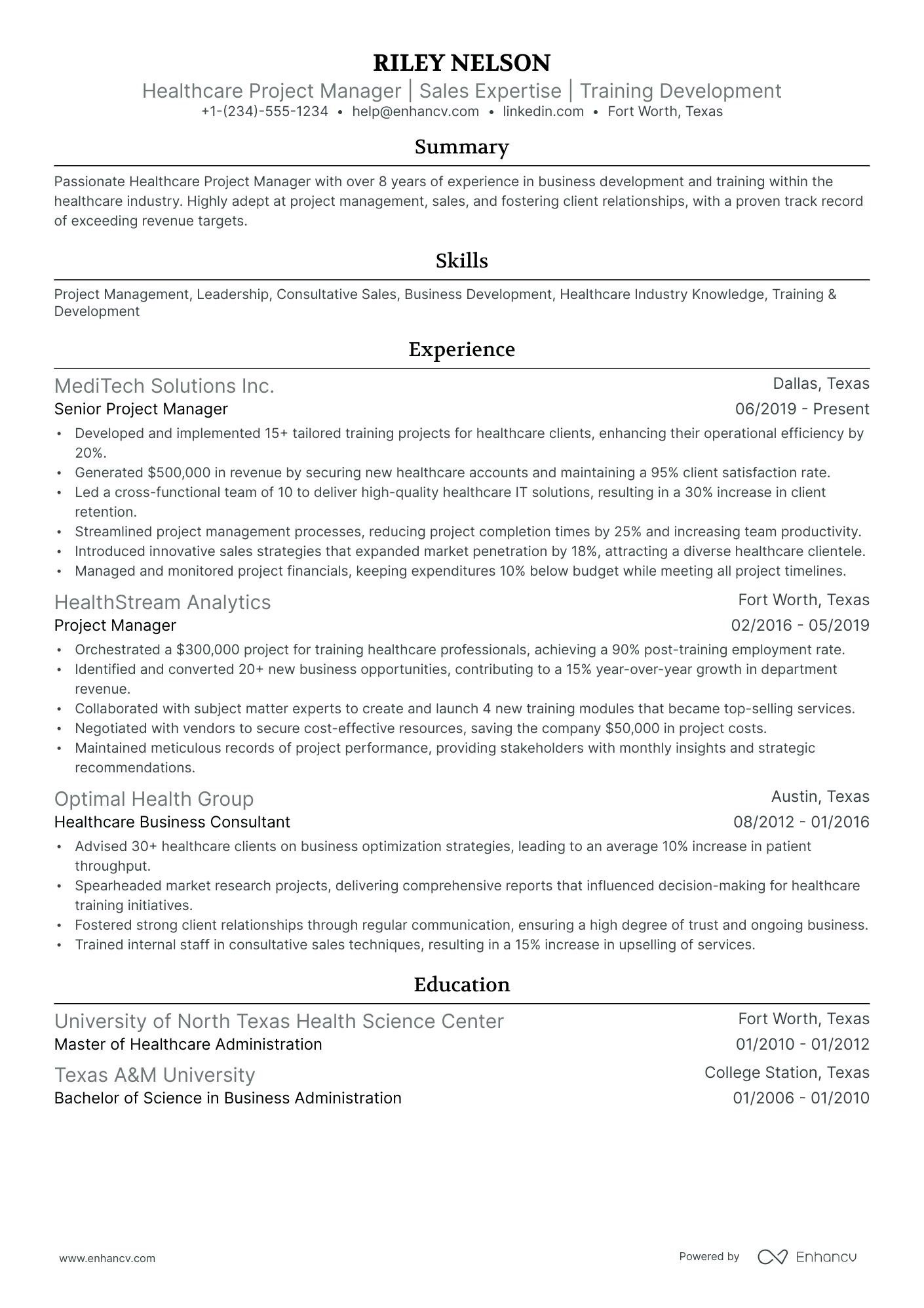
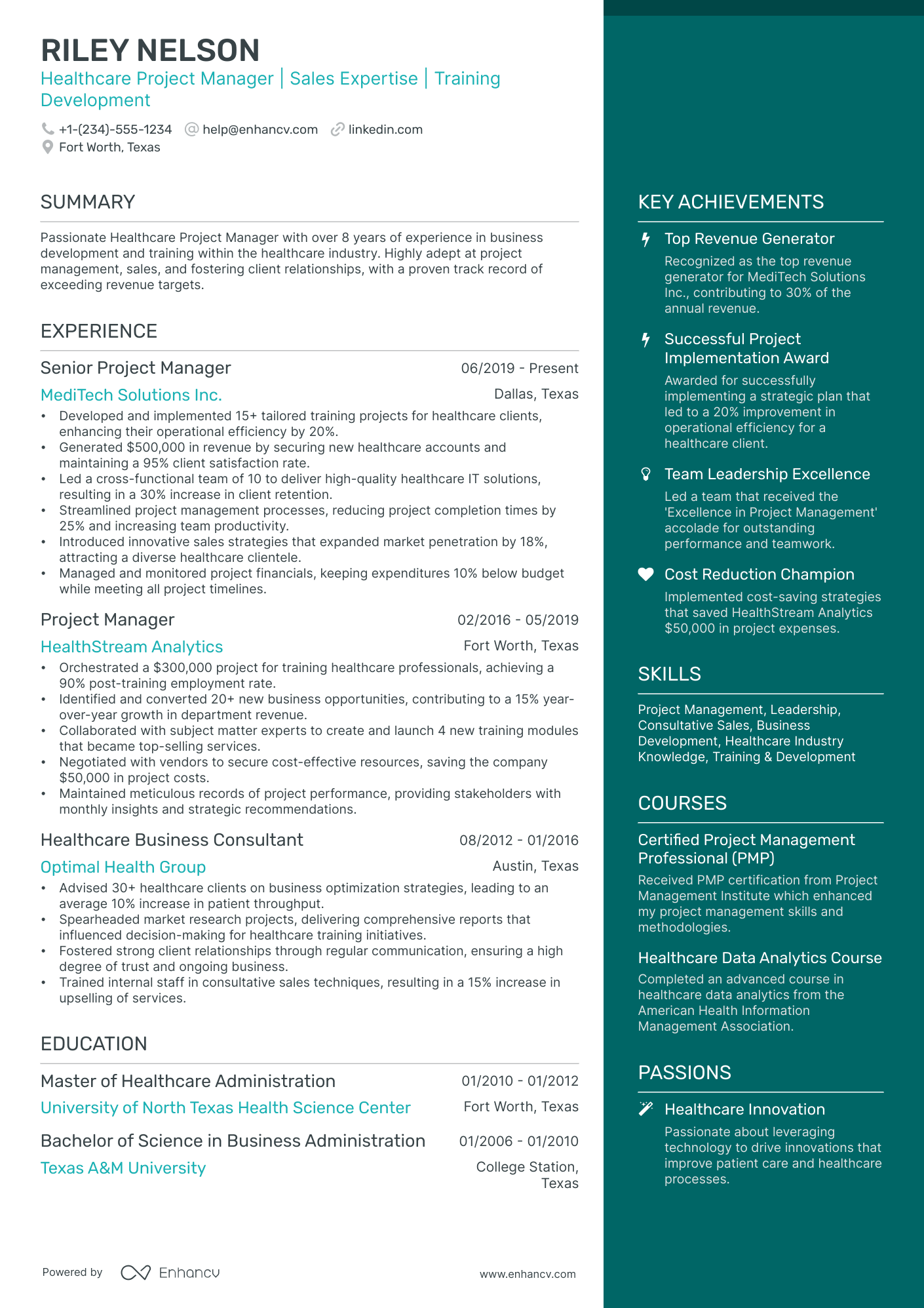
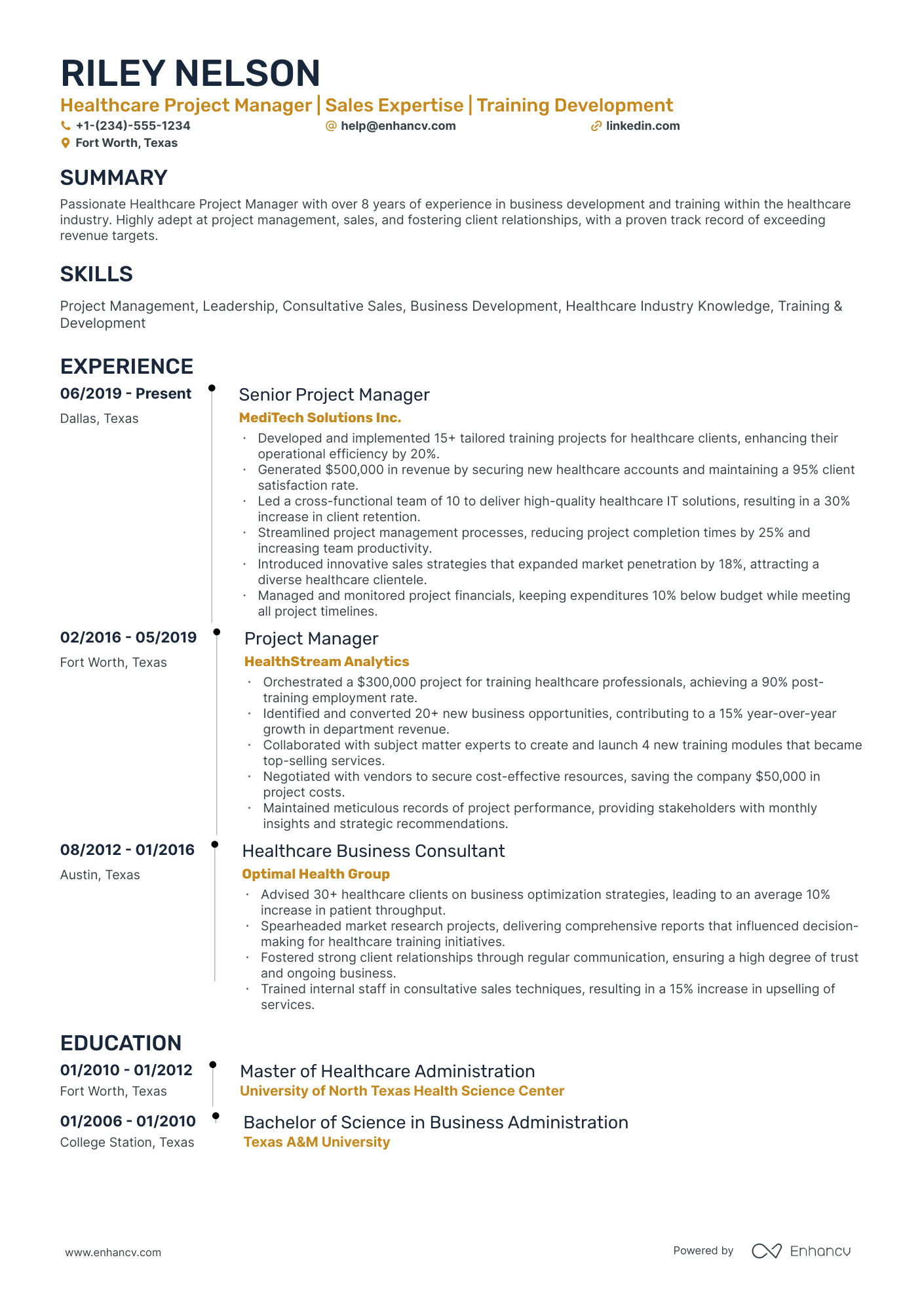
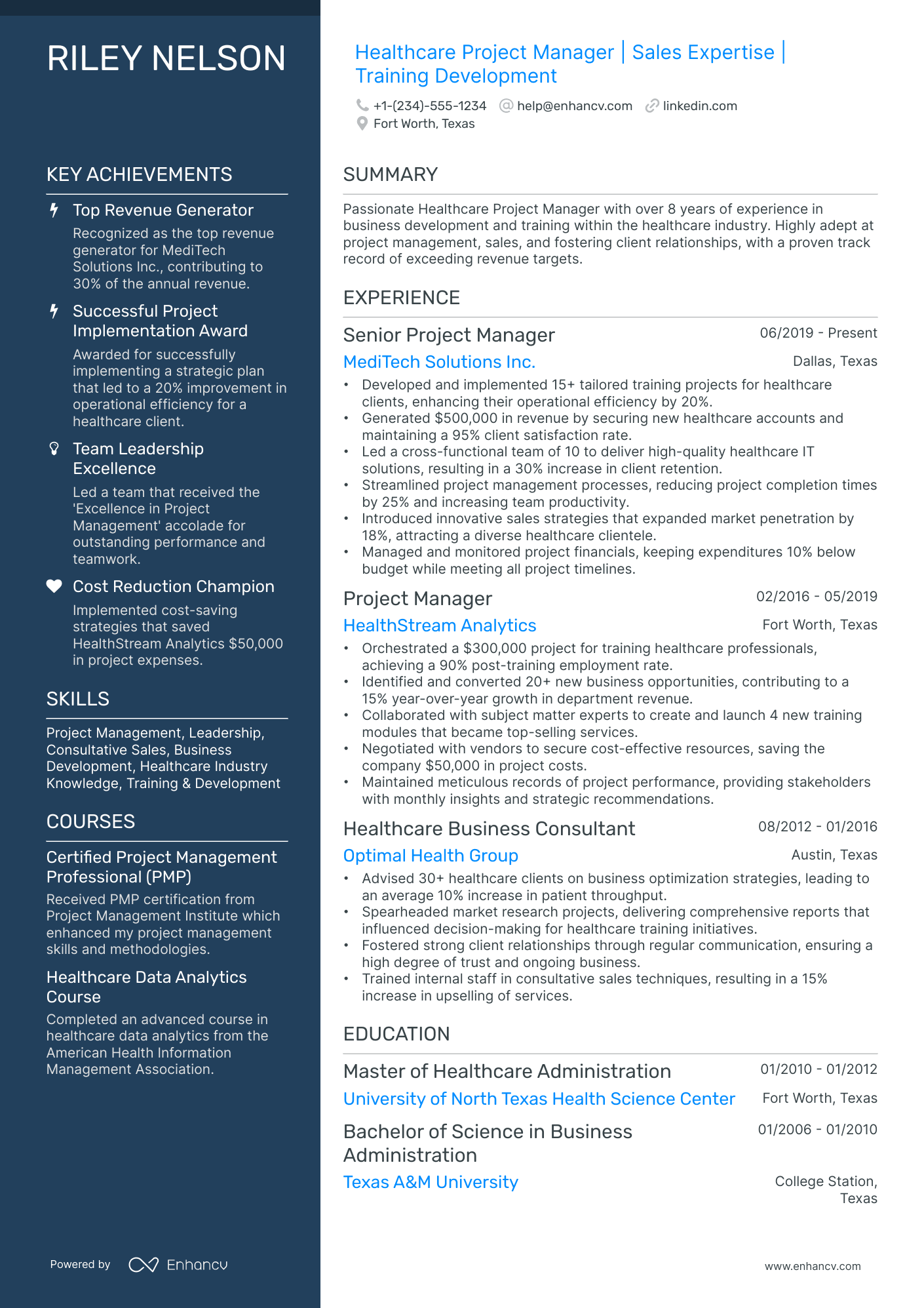
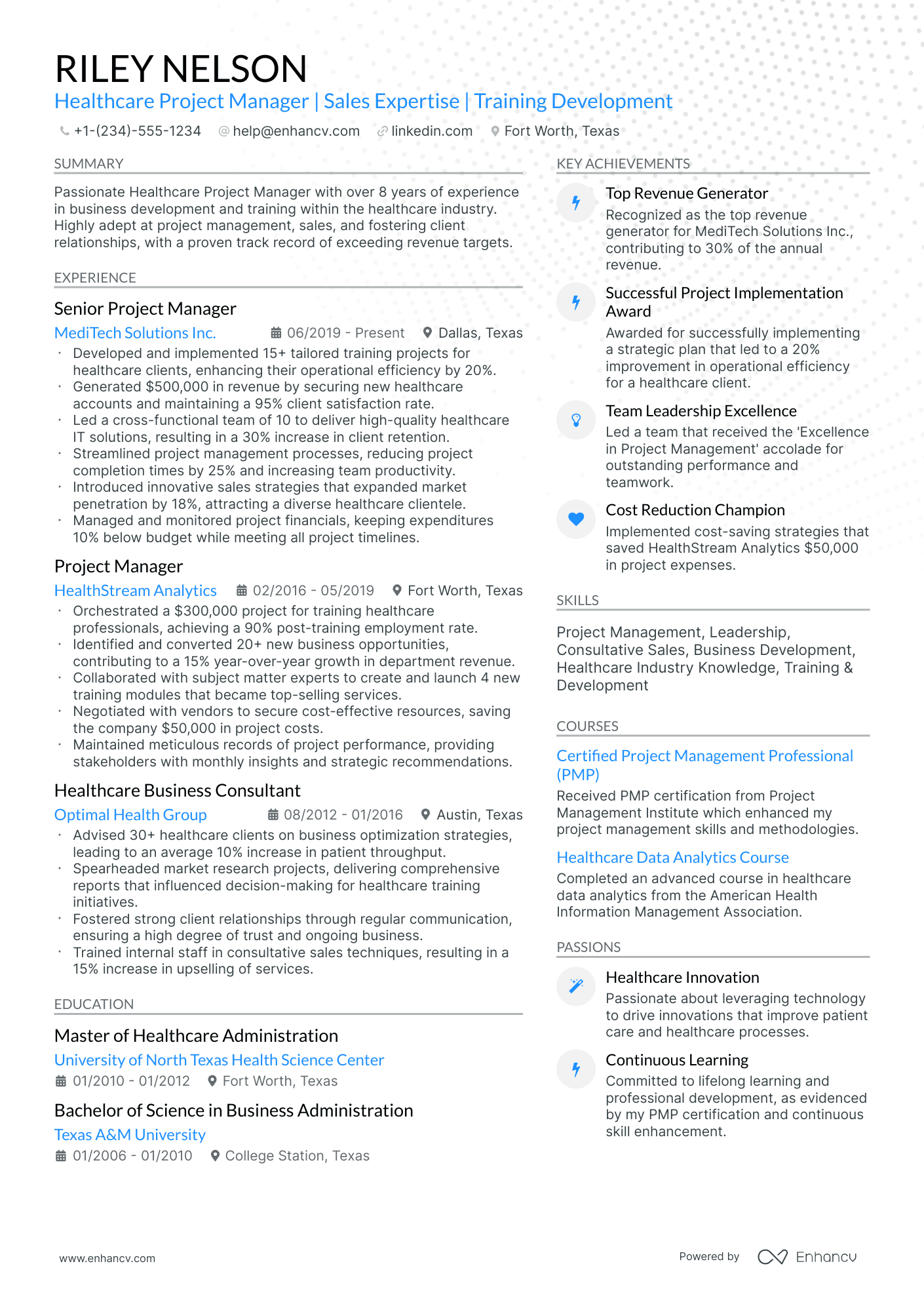
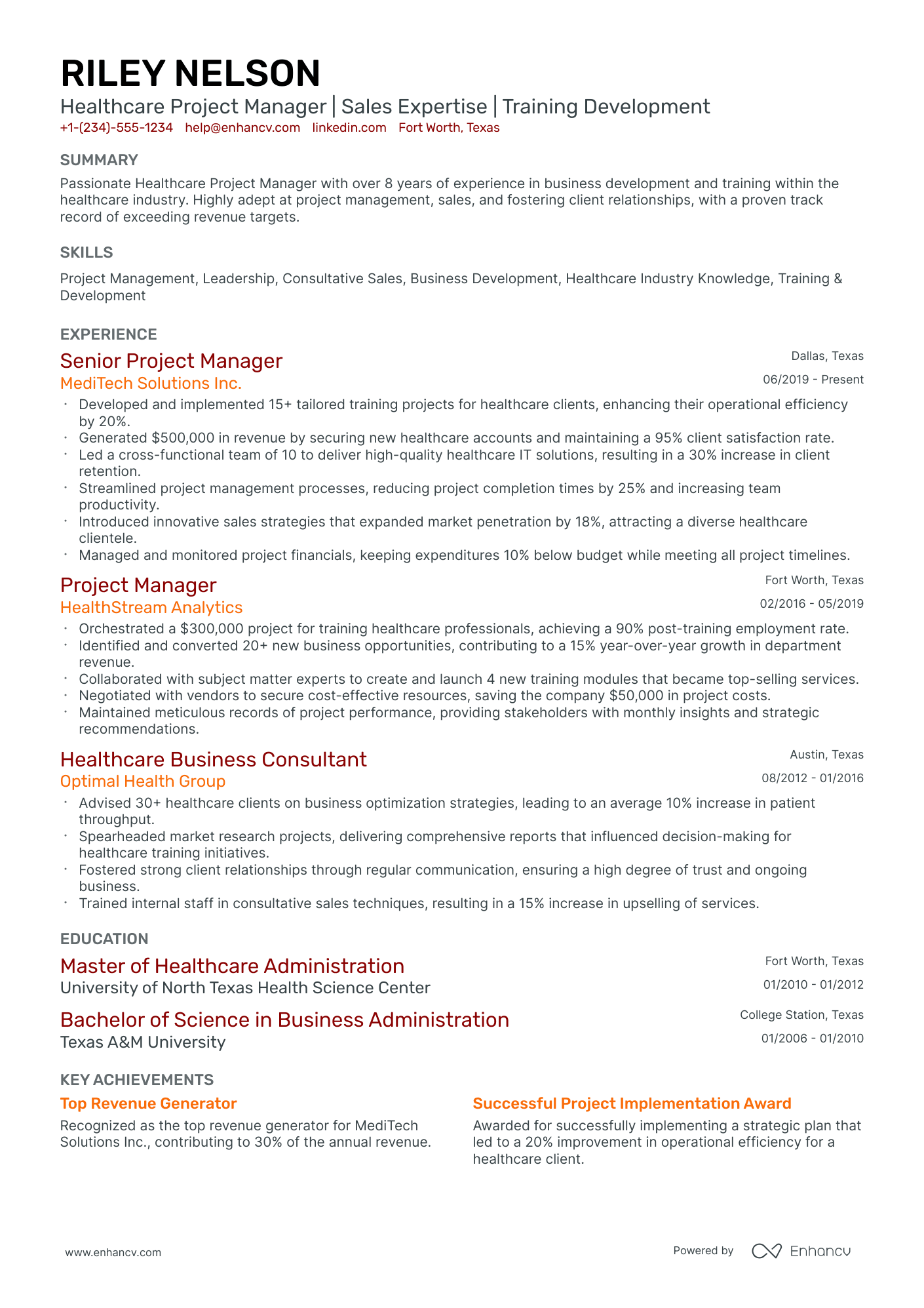
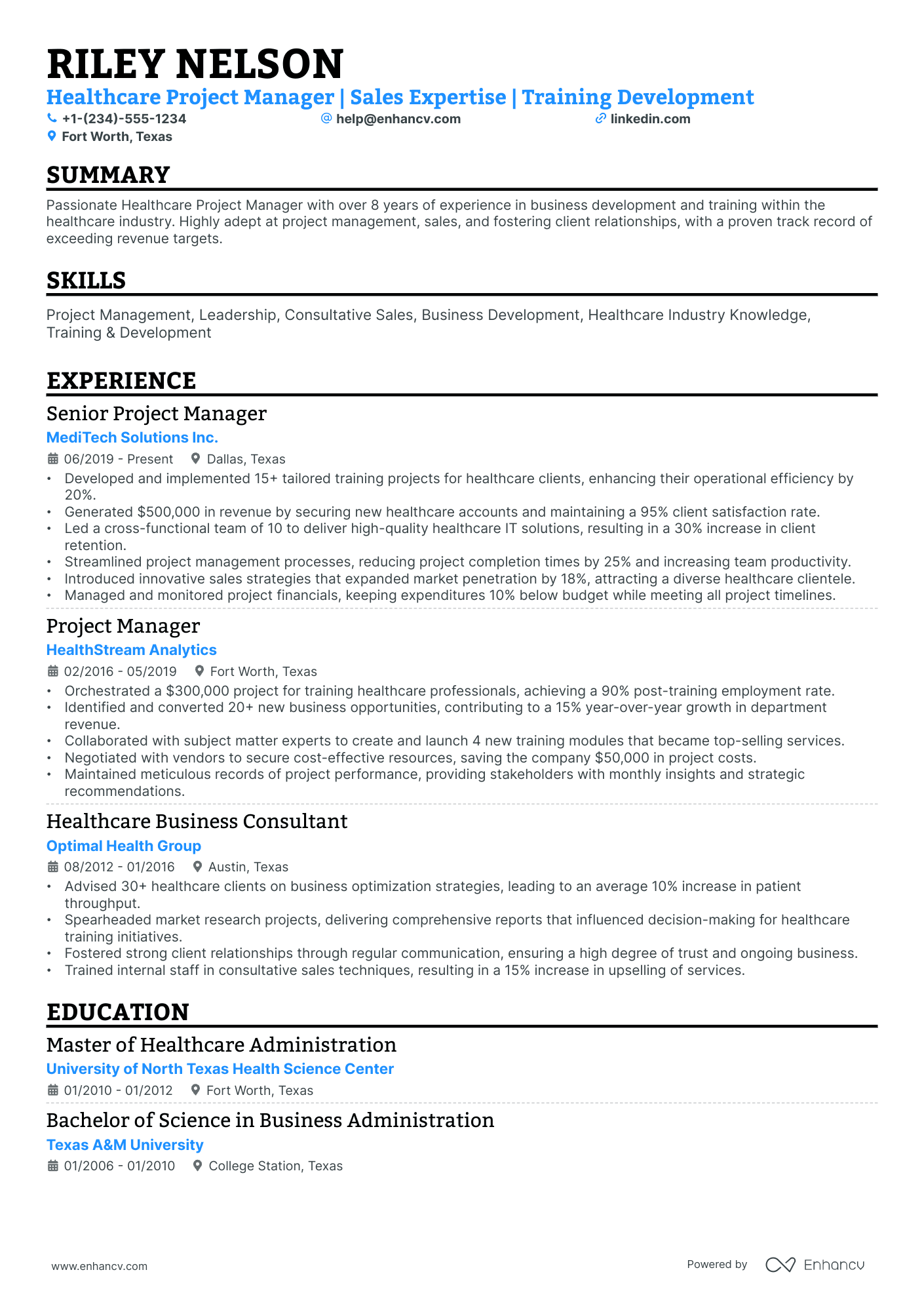
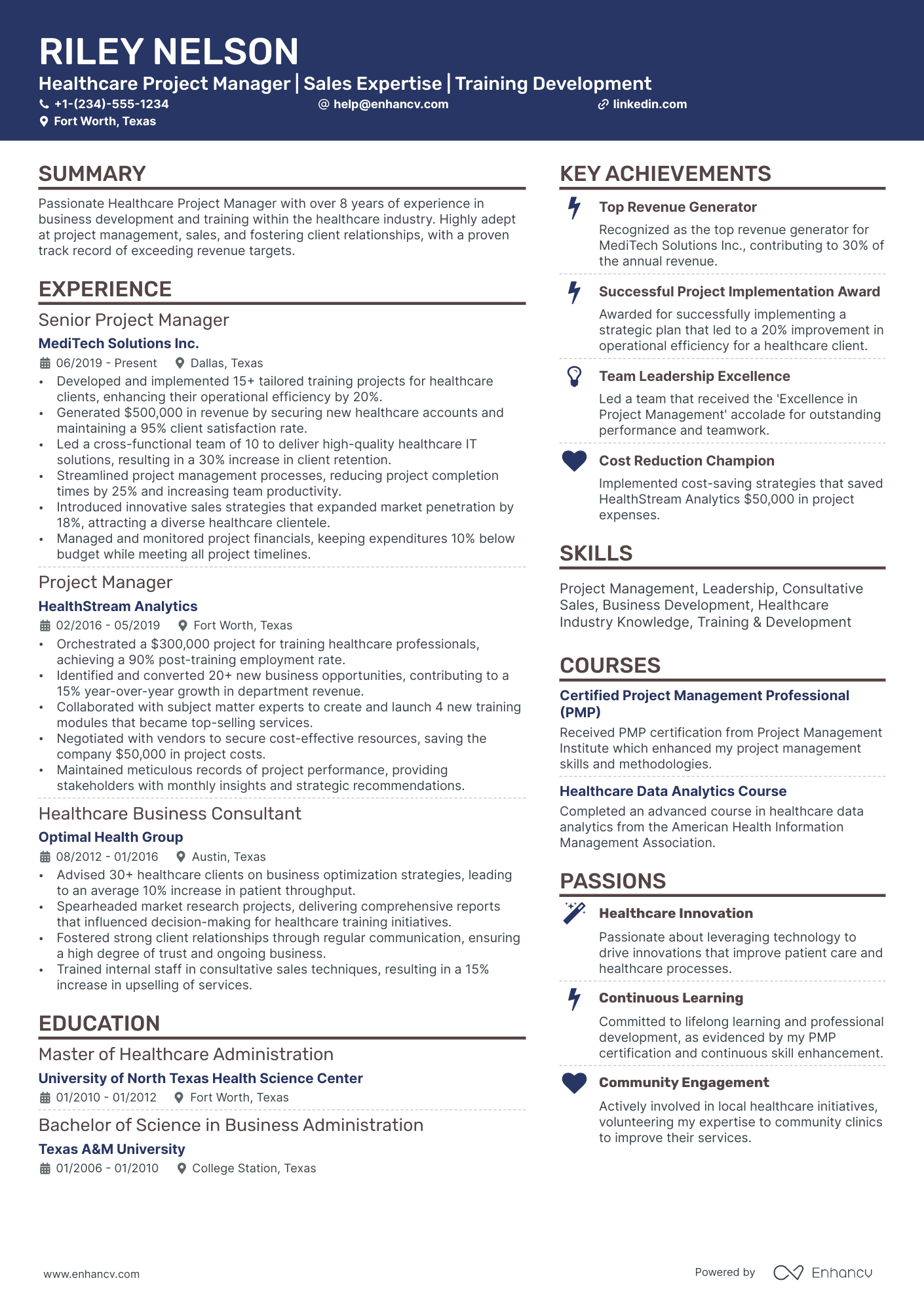
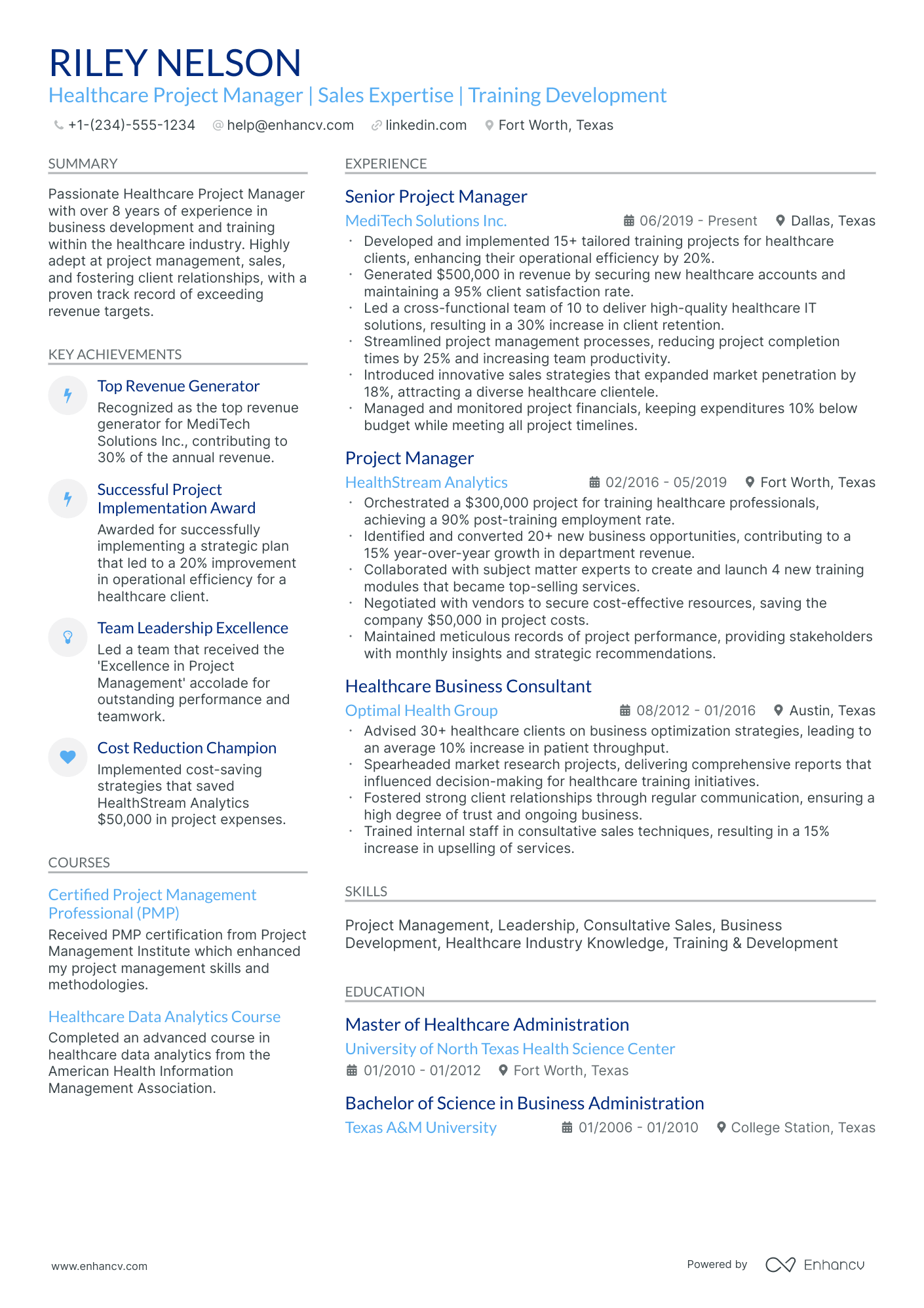
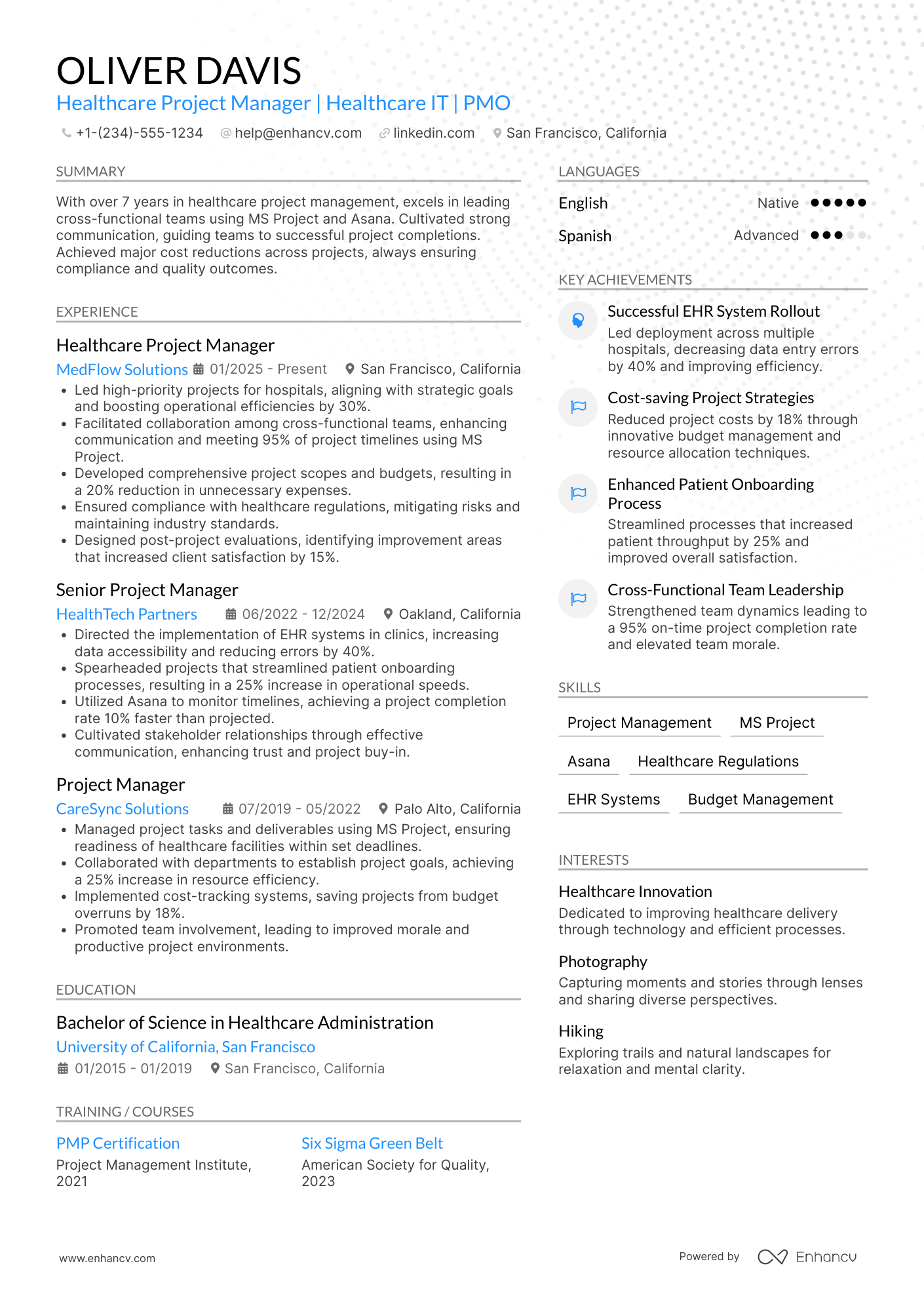
Most healthcare project manager resume drafts fail because they bury measurable delivery results under tool lists and generic responsibilities. That makes them easy to reject during ATS screening and rapid recruiter scans, especially when competition is tight.
A strong resume shows what you delivered and what changed because of your work. Understanding how to make your resume stand out means highlighting cost savings, timeline recovery, budget and scope control, reduced readmissions, improved patient throughput, higher documentation accuracy, cleaner audits, and smoother go-lives.

Key takeaways
- Lead every experience bullet with measurable outcomes, not task descriptions or tool lists.
- Use reverse-chronological format for experienced candidates and hybrid format for career switchers.
- Tailor your resume to each job posting by mirroring its exact tools, standards, and KPIs.
- Quantify achievements across cost savings, delivery speed, compliance results, and clinician adoption rates.
- Back every listed skill with a specific project, deliverable, or outcome in your experience section.
- Place certifications above education when they're recent and directly relevant to the target role.
- Use Enhancv to strengthen bullet points and align your resume structure with ATS requirements.
How to format a healthcare project manager resume
Recruiters evaluating healthcare project manager resumes prioritize evidence of cross-functional coordination, regulatory compliance knowledge, and the ability to deliver projects on time and within budget across clinical or operational settings. Choosing the right resume format ensures these signals surface quickly during both automated screening and the initial recruiter scan.

I have significant experience in this role—which format should I use?
Use a reverse-chronological format to present your healthcare project management career in a clear, progression-driven timeline. Do:
- Lead with your most recent role and emphasize scope: number of concurrent projects, team sizes, budget authority, and stakeholder groups across clinical, IT, and administrative departments.
- Highlight domain-specific tools and frameworks such as Epic or Cerner implementations, HIPAA compliance oversight, Lean Six Sigma methodology, and healthcare-specific project management platforms like Smartsheet or Microsoft Project.
- Quantify outcomes tied to operational improvement, cost reduction, patient safety metrics, or regulatory milestones.
I'm junior or switching into this role—what format works best?
Use a hybrid format that leads with a focused skills section, then supports it with a concise work history showing relevant project contributions. Do:
- Place core competencies—such as stakeholder communication, scheduling, risk management, and healthcare regulatory knowledge—near the top of the resume so recruiters and applicant tracking systems catch them immediately.
- Include academic projects, clinical internships, process improvement initiatives, or volunteer coordination that demonstrate project lifecycle involvement within healthcare or adjacent industries.
- Connect every listed skill to a specific action and a measurable or observable result.
Why not use a functional resume?
A functional format strips away the timeline and context that hiring managers need to evaluate how you applied project management skills in real healthcare settings, making it harder to verify your experience depth. A functional resume may be acceptable if you're transitioning from clinical practice or another industry into healthcare project management and have limited direct PM job titles—but only if every listed skill is tied to a specific project, deliverable, or outcome rather than presented as a standalone claim.
Once you've established a clean, readable format, the next step is determining which sections to include so each one reinforces your qualifications.
What sections should go on a healthcare project manager resume
Recruiters expect you to present healthcare project delivery, measurable outcomes, and stakeholder coordination in a clean, easy-to-scan format. Knowing what to put on a resume helps you prioritize the right content for maximum impact.
Use this structure for maximum clarity:
- Header
- Summary
- Experience
- Skills
- Projects
- Education
- Certifications
- Optional sections: Awards, Publications, Volunteering
Your experience bullets should emphasize measurable impact, delivery outcomes, project scope, timelines, budgets, compliance requirements, and cross-functional results.
Is your resume good enough?
Drop your resume here or choose a file. PDF & DOCX only. Max 2MB file size.
Once you’ve organized your resume with the right structure and supporting details, focus next on writing your healthcare project manager resume experience to show impact within that framework.
How to write your healthcare project manager resume experience
The work experience section is where you prove you've delivered real results—shipped projects, implemented clinical or operational systems, and driven measurable improvements using role-relevant tools and methodologies. Hiring managers prioritize demonstrated impact over descriptive task lists, so every line should reflect ownership, execution, and outcomes tied directly to healthcare project management.
Each entry should include:
- Job title
- Company and location (or remote)
- Dates of employment (month and year)
Three to five concise bullet points showing what you owned, how you executed, and what outcomes you delivered:
- Ownership scope: the clinical programs, health IT implementations, regulatory initiatives, facility operations, or cross-departmental teams you were directly accountable for as a healthcare project manager.
- Execution approach: the project management frameworks, healthcare-specific tools, compliance standards, EHR platforms, or workflow methodologies you used to plan, track, and deliver work.
- Value improved: the changes you drove in patient outcomes, operational efficiency, regulatory compliance, cost containment, care delivery timelines, or system reliability within healthcare settings.
- Collaboration context: how you coordinated with clinicians, IT departments, compliance officers, vendors, payers, executive leadership, or external health agencies to align priorities and move projects forward.
- Impact delivered: the outcomes you produced expressed through measurable results, project scale, organizational reach, or strategic business impact rather than a list of activities performed.
Experience bullet formula
A healthcare project manager experience example
✅ Right example - modern, quantified, specific.
Healthcare Project Manager
MercyOne Health System | Des Moines, IA
2021–Present
Integrated delivery network with eight hospitals and twenty-five clinics serving 1.2M patients across Iowa.
- Led a cross-functional rollout of Epic Ambulatory upgrades across twenty-five clinics using Agile ceremonies in Jira and Confluence, cutting post-release defects by 28% and improving on-time delivery from 76% to 93%.
- Managed a $2.4M care coordination program integrating Epic, Salesforce Health Cloud, and Twilio SMS, reducing thirty-day readmissions for congestive heart failure by 9% and increasing outreach completion by 22%.
- Directed HIPAA-aligned risk management with the compliance, security, and vendor teams using a RAID log and weekly steering committee reporting in Smartsheet, lowering high-severity audit findings from twelve to three in one year.
- Standardized project intake and governance with RACI, stage-gate approvals, and KPI dashboards in Power BI, cutting average project cycle time by 17% and improving stakeholder satisfaction from 3.8 to 4.5 out of five.
- Coordinated user acceptance testing with clinicians, informatics, and engineers using test scripts and defect triage in Azure DevOps, reducing go-live support tickets by 34% and saving 180 analyst hours per quarter.
Now that you've seen how a strong experience section comes together, let's look at how to adjust yours to match the specific healthcare project manager role you're targeting.
How to tailor your healthcare project manager resume experience
Recruiters evaluate your healthcare project manager resume through both human review and applicant tracking systems. Tailoring your resume to the job description ensures your qualifications register with both.
Ways to tailor your healthcare project manager experience:
- Match EHR platforms and health IT systems named in the posting.
- Mirror the exact compliance standards like HIPAA or Joint Commission referenced.
- Use the same project methodology terms such as Agile or Waterfall.
- Align your KPIs with the performance metrics the employer specifies.
- Highlight clinical workflow optimization if the role emphasizes process improvement.
- Include cross-functional collaboration with departments the job description names.
- Reflect quality assurance or patient safety frameworks the posting prioritizes.
- Emphasize vendor management experience when the role involves system implementations.
Tailoring means aligning your real accomplishments with what the employer asks for, not forcing keywords where they don't belong.
Resume tailoring examples for healthcare project manager
| Job description excerpt | Untailored | Tailored |
|---|---|---|
| "Lead cross-functional teams to implement Epic EHR system across multiple hospital sites, ensuring HIPAA compliance and on-time delivery within a $2M budget." | Managed projects and worked with different teams to meet goals. | Led a cross-functional team of 15 through a full Epic EHR implementation across four hospital sites, maintaining HIPAA compliance and delivering two weeks ahead of schedule under a $2M budget. |
| "Drive process improvement initiatives using Lean Six Sigma methodology to reduce patient wait times and improve clinical workflow efficiency in outpatient settings." | Helped improve processes and make operations more efficient. | Applied Lean Six Sigma Green Belt methodology to redesign outpatient clinic workflows, reducing average patient wait times by 22% and increasing daily patient throughput by 18 across three ambulatory care centers. |
| "Coordinate with IT, clinical staff, and external vendors to manage the rollout of telehealth platforms, tracking KPIs including patient adoption rates and provider satisfaction scores." | Coordinated with stakeholders on technology projects and tracked progress. | Managed the rollout of a Teladoc-integrated telehealth platform in partnership with IT, 40+ clinical staff members, and two external vendors, achieving a 68% patient adoption rate and a 4.7/5.0 provider satisfaction score within the first quarter. |
Once you’ve aligned your experience with the role’s priorities, the next step is to quantify your healthcare project manager achievements to show the impact of that work.
How to quantify your healthcare project manager achievements
Quantifying your achievements proves impact across patient care, compliance, cost, and delivery speed. Focus on cycle time, budget variance, quality defects, risk and audit outcomes, and adoption across clinicians and sites.
Quantifying examples for healthcare project manager
| Metric | Example |
|---|---|
| Delivery speed | "Cut EHR upgrade timeline from 16 to 12 weeks by re-baselining the critical path in Smartsheet and running weekly risk burndown reviews." |
| Cost savings | "Reduced vendor spend by $180,000 annually by consolidating three maintenance contracts and renegotiating service level agreements with procurement and IT." |
| Quality defects | "Lowered post-go-live incident rate from 22 to eight per month by tightening change control in ServiceNow and adding test exit criteria." |
| Compliance | "Achieved zero high-severity audit findings for HIPAA access reviews by standardizing evidence collection and closing 100% of gaps within 30 days." |
| Adoption | "Raised clinician adoption from 62% to 88% in six weeks by delivering role-based training for 240 staff and tracking completion in the learning management system." |
Turn your everyday tasks into measurable, recruiter-ready resume bullets in seconds with Enhancv's Bullet Point Generator.
With your experience clearly articulated in strong bullet points, the next step is ensuring your skills section effectively showcases the hard and soft skills that healthcare employers prioritize.
How to list your hard and soft skills on a healthcare project manager resume
Your skills section proves you can deliver regulated, cross-functional healthcare projects, helps recruiters and an ATS (applicant tracking system) quickly match you to the job, and should typically balance hard skills with role-specific soft skills. healthcare project manager roles require a blend of:
- Product strategy and discovery skills.
- Data, analytics, and experimentation skills.
- Delivery, execution, and go-to-market discipline.
- Soft skills.
Your skills section should be:
- Scannable (bullet-style grouping).
- Relevant to the job post.
- Backed by proof in experience bullets.
- Updated with current tools.
Place your skills section:
- Above experience if you're junior or switching careers.
- Below experience if you're mid/senior with strong achievements.

Hard skills
- Agile, Scrum, Kanban
- Waterfall project planning
- Project charters, business cases
- Work breakdown structures, critical path
- Jira, Confluence
- Microsoft Project, Smartsheet
- Risk registers, issue logs
- Budgeting, cost tracking
- Vendor management, contracts
- HIPAA compliance
- HL7, FHIR integration
- Epic, Cerner EHR workflows
Soft skills
- Lead cross-functional delivery
- Align stakeholders on scope
- Translate clinical needs to requirements
- Run effective steering committees
- Drive decisions with tradeoffs
- Communicate risks early
- Negotiate timelines and resources
- Manage scope changes
- Resolve conflicts quickly
- Coordinate vendors and partners
- Maintain audit-ready documentation
- Build trust with clinicians
How to show your healthcare project manager skills in context
Skills shouldn't live only in a dedicated skills list. Browse examples of resume skills shown in context to see how top candidates integrate them naturally.
They should be demonstrated in:
- Your summary (high-level professional identity)
- Your experience (proof through outcomes)
Here's what that looks like in practice.
Summary example
Healthcare project manager with 10+ years leading EHR implementations and clinical workflow redesigns. Skilled in Agile, MS Project, and cross-functional stakeholder engagement. Delivered a system migration across 12 facilities, cutting onboarding time by 35%.
- Reflects senior-level experience clearly
- Names role-relevant tools and methods
- Includes a concrete, measurable outcome
- Signals stakeholder collaboration skills
Experience example
Senior Healthcare Project Manager
Brevian Health Solutions | Remote
March 2019–January 2024
- Led an Epic EHR rollout across eight clinics, collaborating with IT and clinical teams to finish two months ahead of schedule.
- Managed a $2.4M compliance remediation project using Agile sprints, reducing audit findings by 60% within one year.
- Partnered with nursing leadership to redesign patient intake workflows in Smartsheet, decreasing average wait times by 22%.
- Every bullet includes measurable proof
- Skills surface naturally through real outcomes
Once you’ve tied your project management strengths to measurable outcomes and real healthcare workflows, the next step is applying the same approach to a healthcare project manager resume with no experience so you can still demonstrate impact through relevant projects, coursework, and transferable responsibilities.
How do I write a healthcare project manager resume with no experience
Even without full-time experience, you can demonstrate readiness through:
- Healthcare internship project coordination
- Clinic volunteer workflow improvement project
- Capstone on EHR implementation
- HIPAA compliance audit class project
- Shadowing hospital operations projects
- Scheduling and tracking in Smartsheet
- Research assistant data quality initiative
If you're building a resume without work experience, focus on:
- Measurable outcomes and metrics
- Healthcare tools and documentation
- Compliance and patient privacy exposure
- Cross-functional coordination with stakeholders
Resume format tip for entry-level healthcare project manager
Use a hybrid resume format because it highlights project work and transferable skills before limited experience, while still showing a clear timeline. Do:
- Lead with a Projects section.
- Add tools in each project bullet.
- Quantify results with before-after metrics.
- Name stakeholders, scope, and timeline.
- List healthcare project manager coursework certifications.
- Coordinated a capstone EHR implementation plan in Smartsheet, built a RACI matrix and risk log, and cut simulated intake time by 12% across three workflows.
Once you've positioned your transferable skills and relevant experiences to compensate for a non-traditional background, highlighting your education strategically becomes the next essential step in strengthening your candidacy.
How to list your education on a healthcare project manager resume
Your education section helps hiring teams confirm you have the foundational knowledge needed for the role. It validates your academic background in healthcare, management, or related fields quickly.
Include:
- Degree name
- Institution
- Location
- Graduation year
- Relevant coursework (for juniors or entry-level candidates)
- Honors & GPA (if 3.5 or higher)
Skip month and day details—list the graduation year only.
Here's a strong education entry tailored to a healthcare project manager resume.
Example education entry
Master of Health Administration
George Washington University, Washington, D.C.
Graduated 2021
GPA: 3.8/4.0
- Relevant coursework: Healthcare Operations Management, Health Informatics, Quality Improvement in Clinical Settings, Strategic Planning for Health Systems
- Honors: Dean's List, Graduate Merit Scholar
How to list your certifications on a healthcare project manager resume
Certifications on a resume show a healthcare project manager's commitment to continuous learning, proficiency with essential tools and methods, and relevance to regulated healthcare environments.
Include:
- Certificate name
- Issuing organization
- Year
- Optional: credential ID or URL
- Place certifications below education when they're older, less relevant to healthcare project manager work, or secondary to your degree and experience.
- Place certifications above education when they're recent, highly relevant to healthcare project manager roles, or required for roles you target.
Best certifications for your healthcare project manager resume
- Project Management Professional (PMP)
- Certified Associate in Project Management (CAPM)
- Certified ScrumMaster (CSM)
- Lean Six Sigma Green Belt
- Certified Professional in Healthcare Quality (CPHQ)
- Certified in Healthcare Compliance (CHC)
- ITIL 4 Foundation
Once you’ve positioned your credentials where hiring teams can spot them quickly, shift to your healthcare project manager resume summary to connect those qualifications to the value you deliver.
How to write your healthcare project manager resume summary
Your resume summary is the first thing a recruiter reads. A sharp, specific opening sets the tone and earns a closer look at your qualifications.
Keep it to three to four lines, with:
- Your title and total years of healthcare project management experience.
- The healthcare domain you specialize in, such as EHR implementations, clinical operations, or health IT.
- Core tools and methodologies like MS Project, Jira, Agile, PMP, or Lean Six Sigma.
- One or two measurable achievements, such as budget savings, timeline improvements, or successful go-lives.
- Soft skills tied to real outcomes, like cross-functional coordination that reduced delays or stakeholder communication that improved adoption rates.

PRO TIP
At this level, focus on clarity and relevance over breadth. Highlight specific tools, certifications, and early wins that prove you can deliver. Avoid vague phrases like "passionate team player" or "motivated self-starter." Replace them with concrete contributions.
Example summary for a healthcare project manager
Healthcare project manager with four years of experience leading EHR implementations. Managed cross-functional teams using Agile and MS Project, delivering three system rollouts on time and 12% under budget.
Optimize your resume summary and objective for ATS
Drop your resume here or choose a file.
PDF & DOCX only. Max 2MB file size.
Now that your summary captures your professional value, make sure the header framing it presents your contact details correctly so recruiters can reach you without friction.
What to include in a healthcare project manager resume header
A resume header is the top section with your key identifiers, and it boosts visibility, credibility, and recruiter screening for a healthcare project manager role.
Essential resume header elements
- Full name
- Tailored job title and headline
- Location
- Phone number
- Professional email
- GitHub link
- Portfolio link
Including a LinkedIn link helps recruiters verify your experience quickly and supports faster screening.
Do not include a photo on a healthcare project manager resume unless the role is explicitly front-facing or appearance-dependent.
Match your header job title to the posting and keep formatting consistent so hiring teams can scan and contact you fast.
Example
Healthcare project manager resume header
Jordan Lee
Healthcare Project Manager | EHR Implementation & Clinical Operations
Chicago, IL
(312) 555-01XX
jordan.lee@enhancv.com
github.com/jordanlee
jordanlee.com
linkedin.com/in/jordanlee
Once you’ve set your name and key contact details up top, add relevant additional sections to round out the rest of your healthcare project manager resume.
Additional sections for healthcare project manager resumes
When your core sections don't fully capture your qualifications, additional sections help demonstrate specialized expertise that sets you apart as a healthcare project manager. For example, listing language skills on your resume can be especially valuable in healthcare settings serving diverse patient populations.
- Languages
- Publications
- Professional affiliations
- Volunteer experience in healthcare settings
- Conference presentations
- Continuing education
Once you've rounded out your resume with the right supplementary sections, pairing it with a strong cover letter can further set your application apart.
Do healthcare project manager resumes need a cover letter
A cover letter isn't required for a healthcare project manager, but it often helps in competitive searches or strict hiring processes. If you're unsure about what a cover letter is and when it adds value, it makes a difference when your resume needs context, or when the employer expects a tailored narrative.
Use a cover letter when it adds specific, role-relevant detail:
- Explain role fit by naming the team's priorities and matching them to your delivery style, stakeholders, and compliance experience.
- Highlight one or two outcomes with numbers, such as reduced cycle time, improved patient access, or smoother go-live across sites.
- Show product and user understanding by referencing patients, clinicians, operations, and the business constraints that shaped your decisions.
- Address career transitions or non-obvious experience by connecting past work to healthcare project manager responsibilities and domain requirements.
Drop your resume here or choose a file.
PDF & DOCX only. Max 2MB file size.
Even when you decide a cover letter won’t add value to your application, using AI to improve your healthcare project manager resume helps you strengthen the document that carries the most weight.
Using AI to improve your healthcare project manager resume
AI can sharpen your resume's clarity, structure, and impact. It helps tighten language and highlight measurable results. But overuse strips authenticity fast. Once your content feels clear and role-aligned, step away from AI entirely. If you're wondering which AI is best for writing resumes, the answer depends on the level of control and customization you need.
Here are 10 practical prompts to strengthen specific sections of your healthcare project manager resume:
- Strengthen your summary. "Rewrite this healthcare project manager resume summary to emphasize leadership scope, clinical project types, and measurable outcomes in under four sentences."
- Quantify experience bullets. "Add specific metrics like budget size, timeline reductions, or team count to these healthcare project manager experience bullets without inventing data."
- Align skills to job posts. "Compare this healthcare project manager skills section against the following job description and suggest missing keywords that match my background."
- Tighten project descriptions. "Shorten these healthcare project manager project descriptions to one or two results-driven sentences each, focusing on scope and delivery outcomes."
- Improve action verbs. "Replace weak or repetitive verbs in these healthcare project manager experience bullets with stronger, more specific alternatives."
- Clarify certifications context. "Rewrite this healthcare project manager certifications section to briefly explain each credential's relevance to clinical or operational project delivery."
- Refine education entries. "Edit this healthcare project manager education section to highlight coursework, capstone projects, or honors directly relevant to healthcare operations."
- Remove filler language. "Identify and remove vague or redundant phrases from this healthcare project manager resume that add no measurable or specific value."
- Tailor for ATS readability. "Restructure this healthcare project manager resume using standard section headings and consistent formatting that applicant tracking systems parse correctly."
- Focus scope statements. "Rewrite these healthcare project manager bullet points to clearly state the problem addressed, action taken, and result delivered in each line."
Stop using AI once your resume sounds accurate, specific, and aligned with real experience. AI should never invent experience or inflate claims—if it didn't happen, it doesn't belong here.
Conclusion
A strong healthcare project manager resume shows measurable outcomes, role-specific skills, and a clear structure. It highlights scope, timelines, budgets, and results, plus stakeholder management, risk control, and compliance. Each section stays focused and easy to scan.
This approach matches today’s hiring market and supports near-future needs. It proves you can deliver reliable outcomes across clinical, operational, and technology projects. With clear impact and consistent formatting, your healthcare project manager resume stands ready for review.