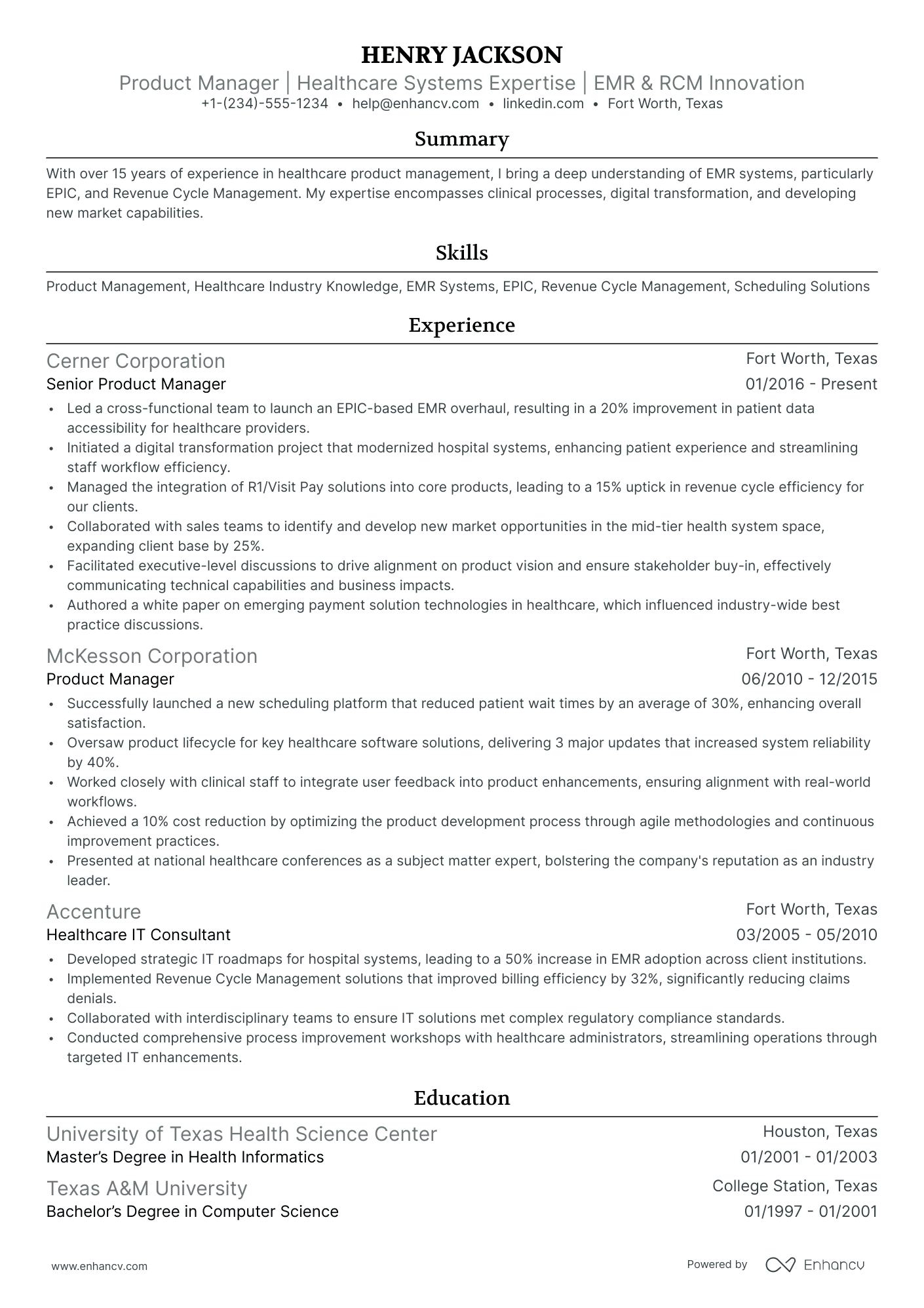
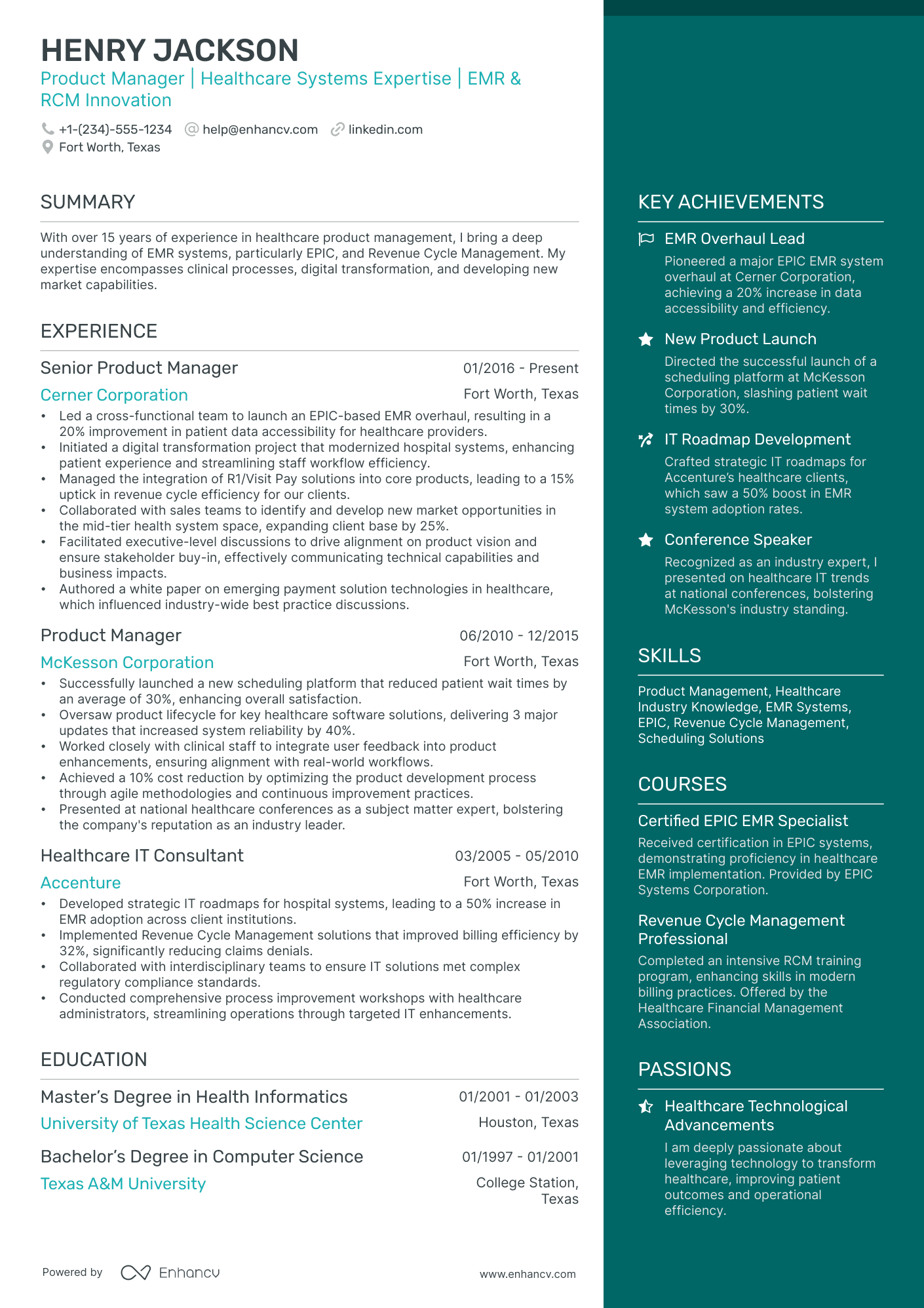
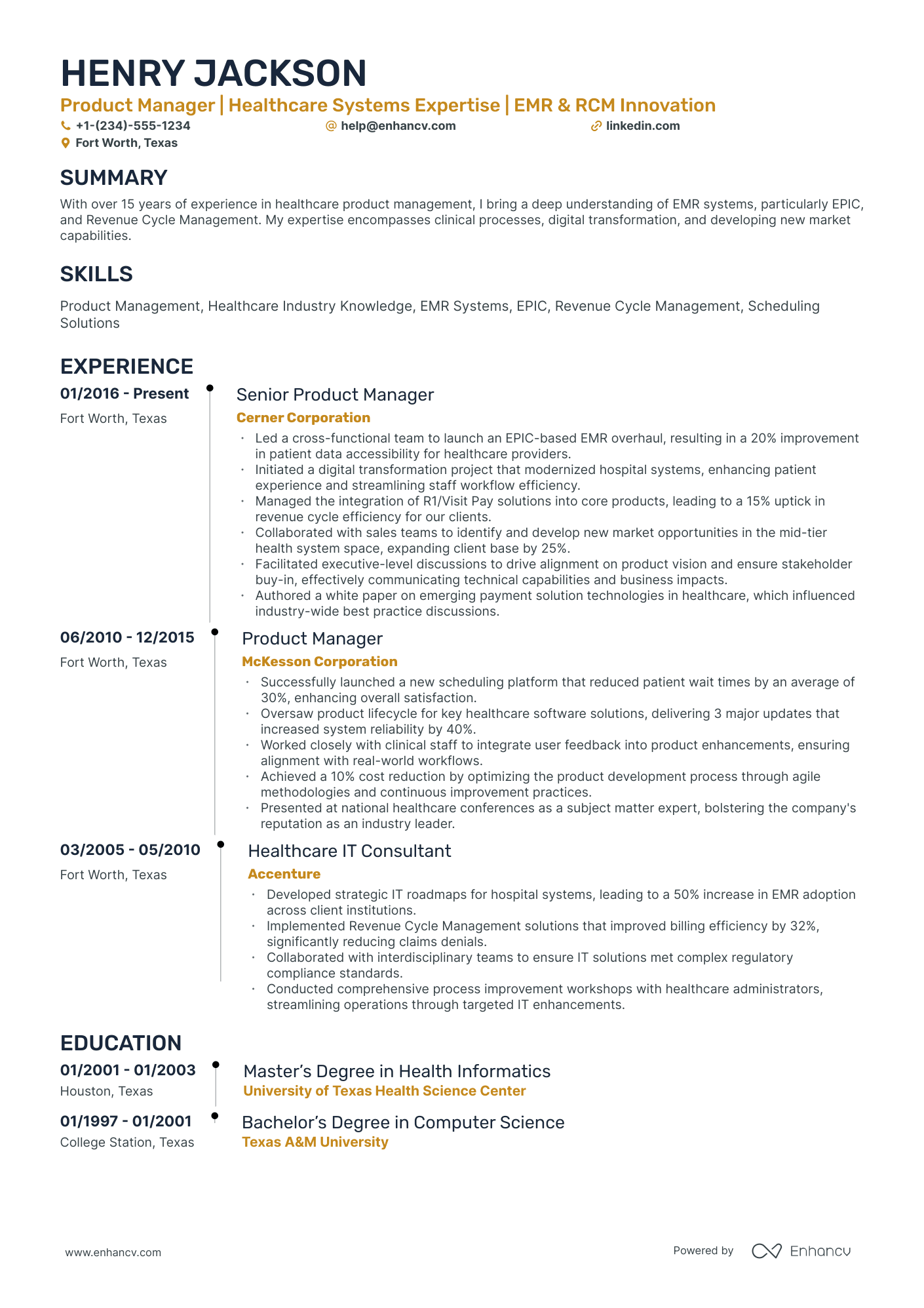
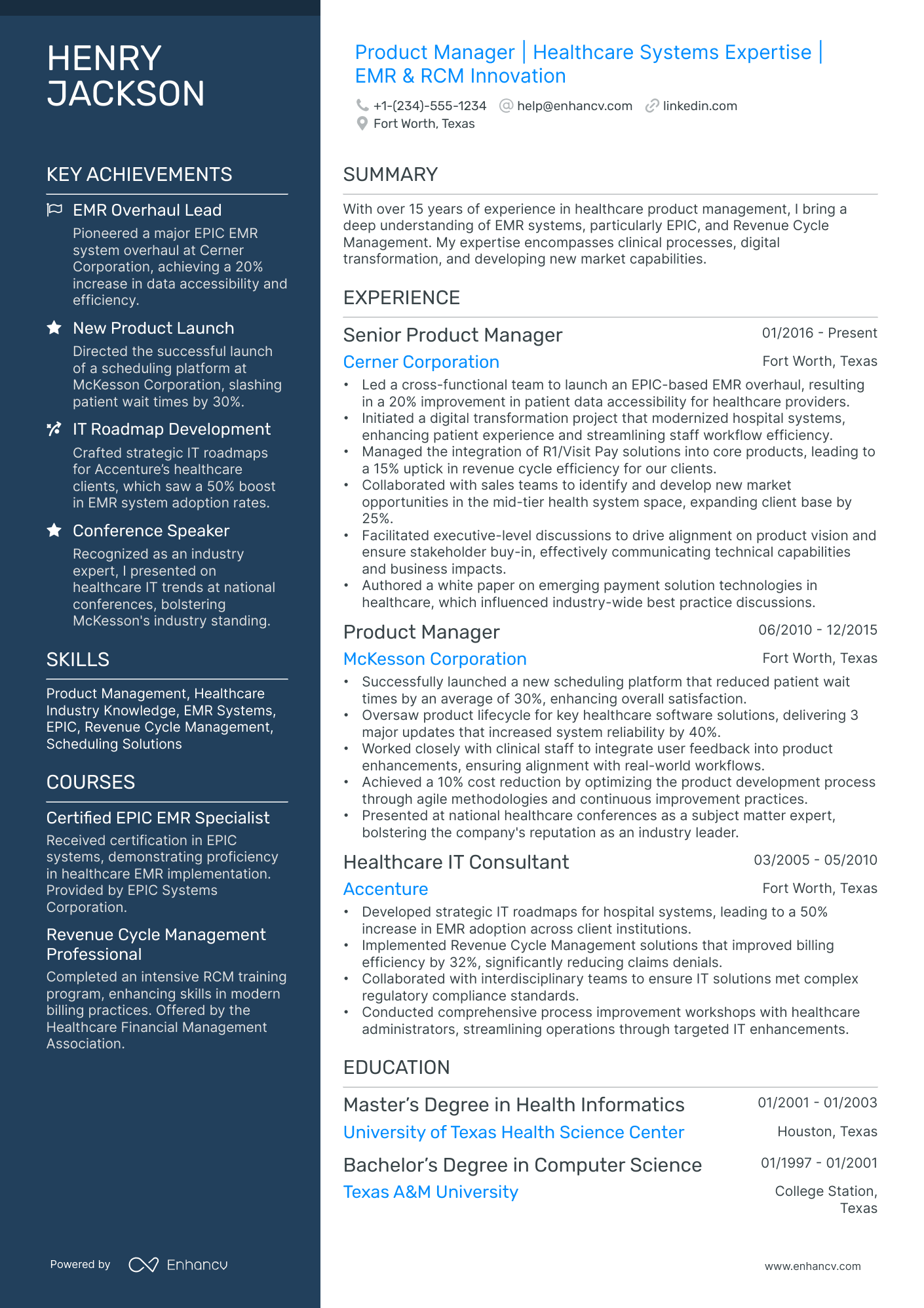
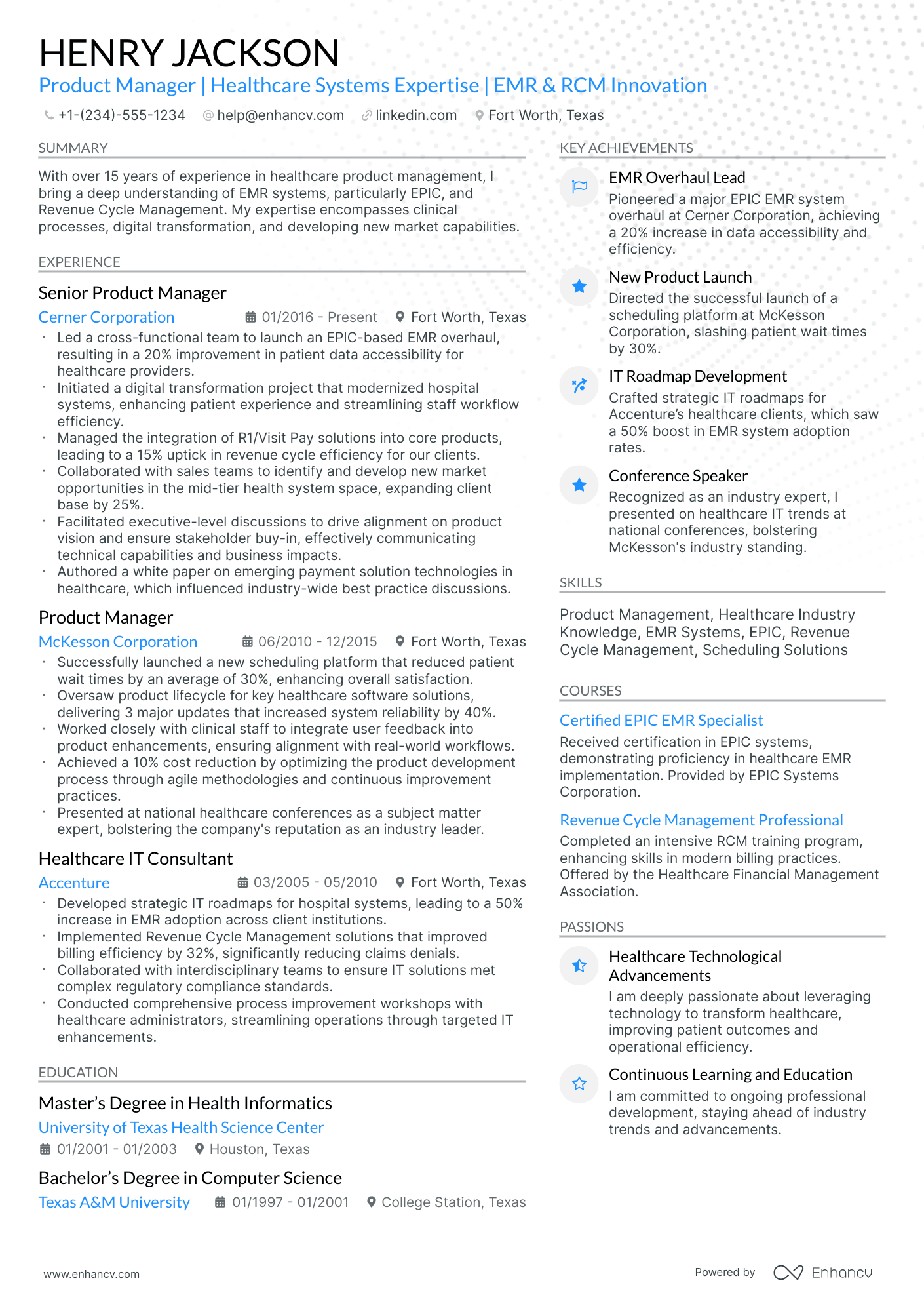
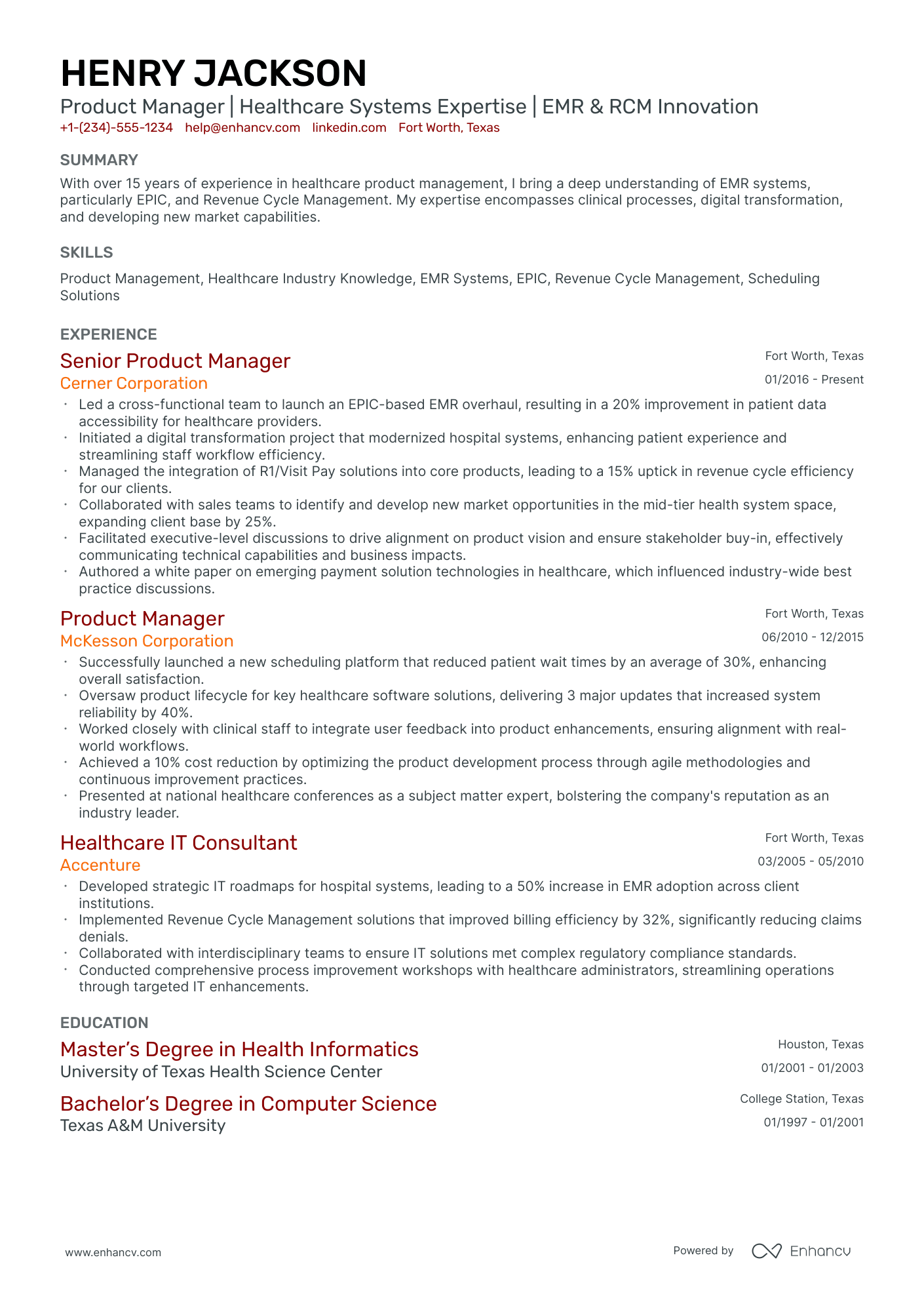
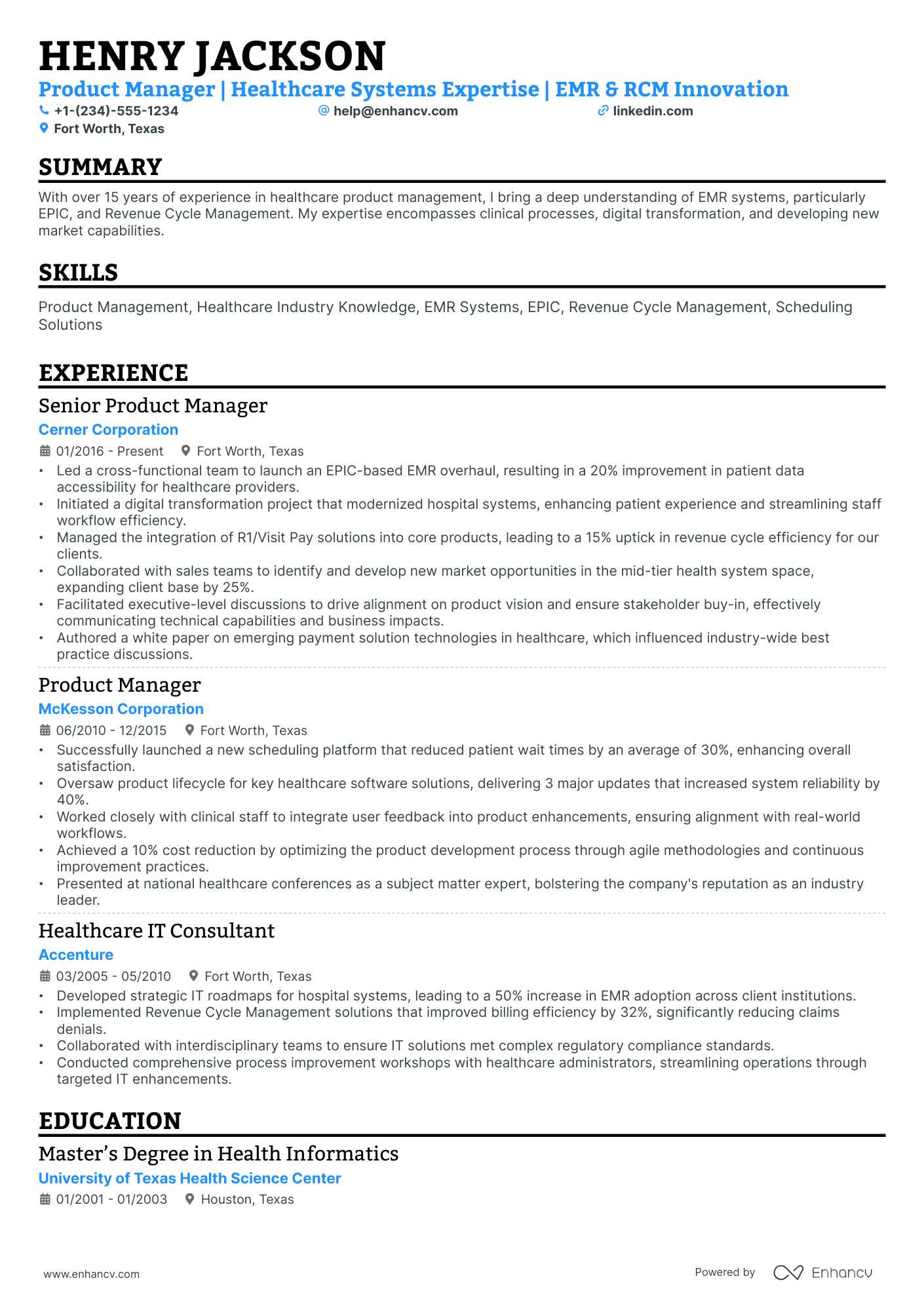
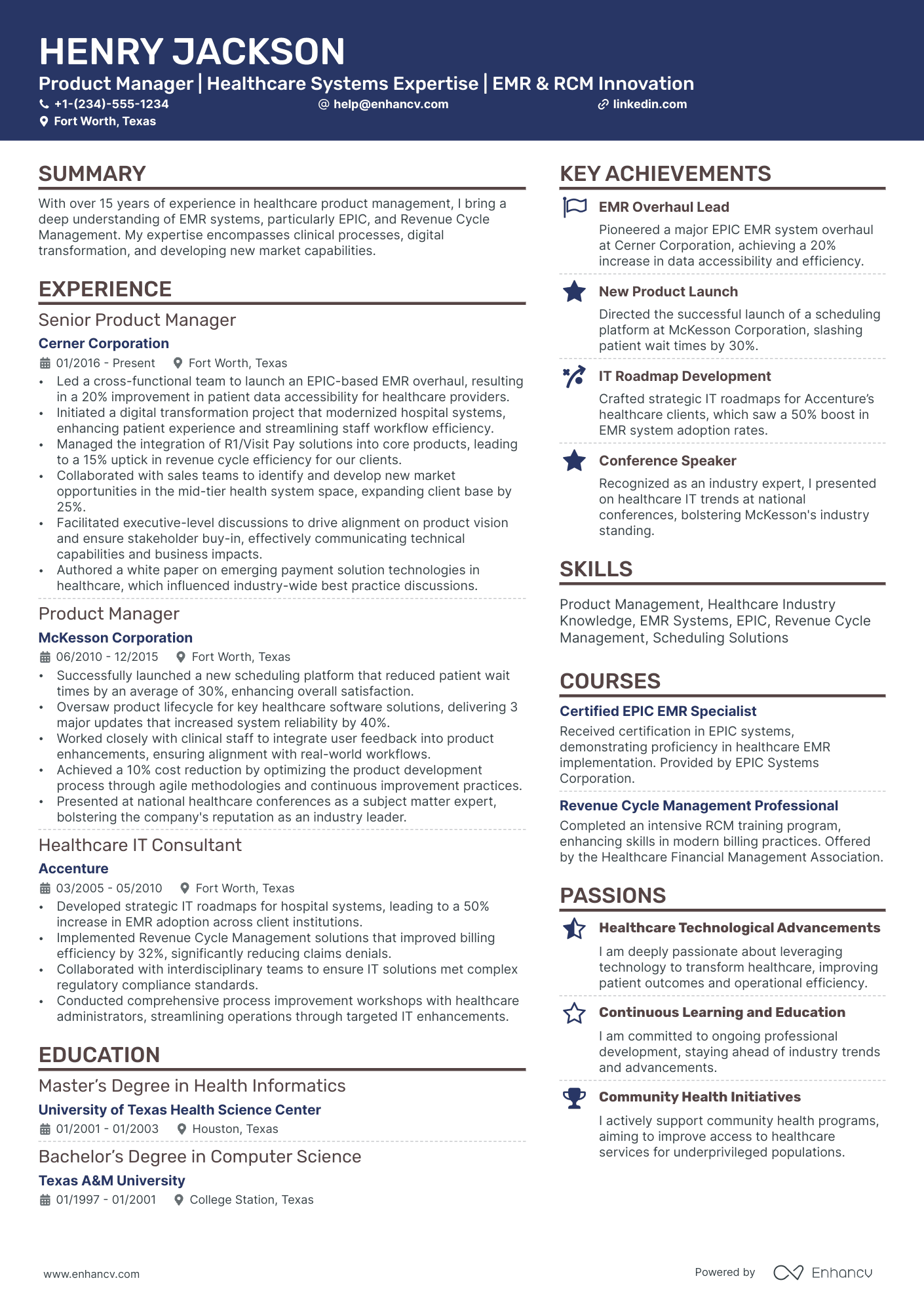
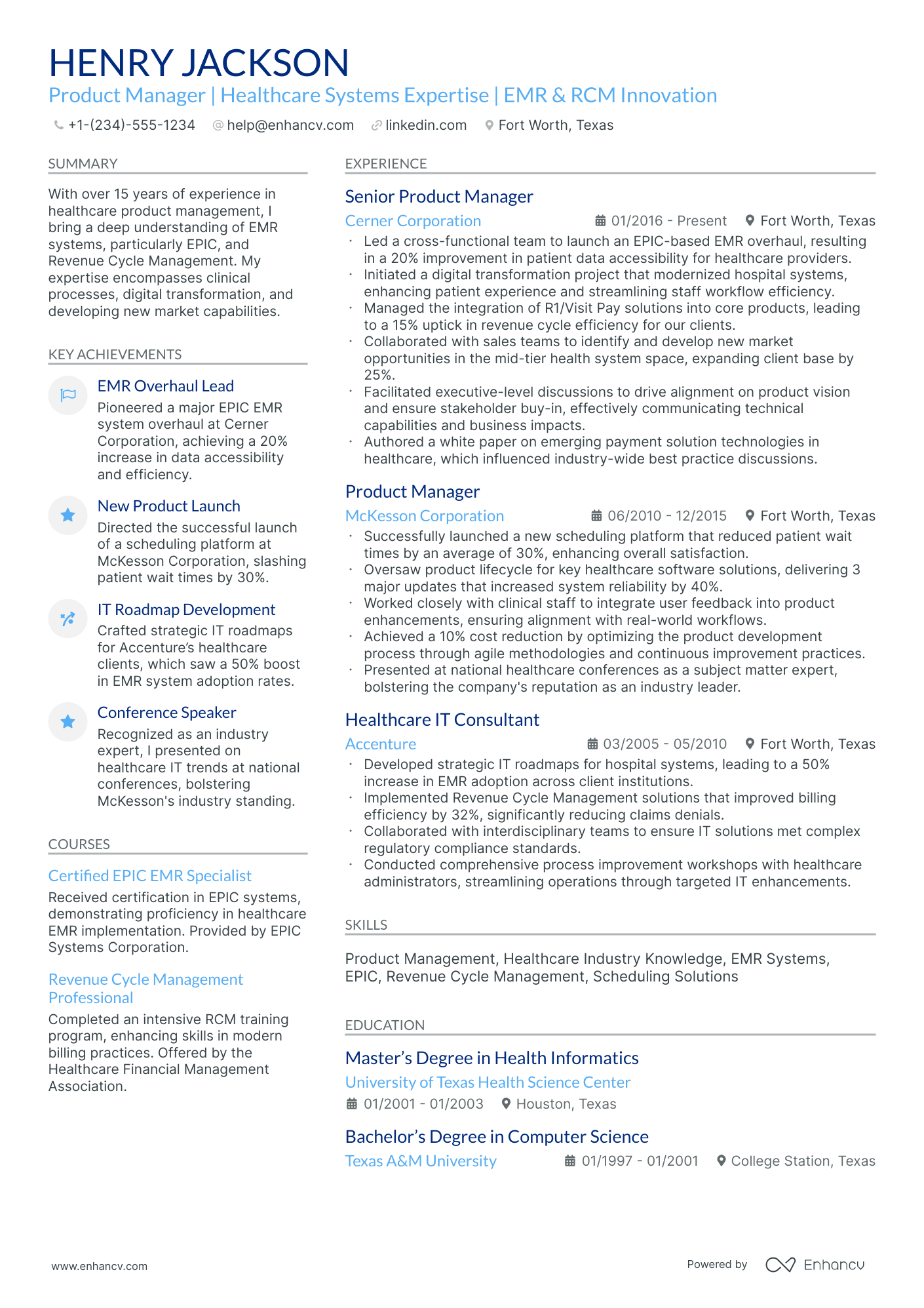
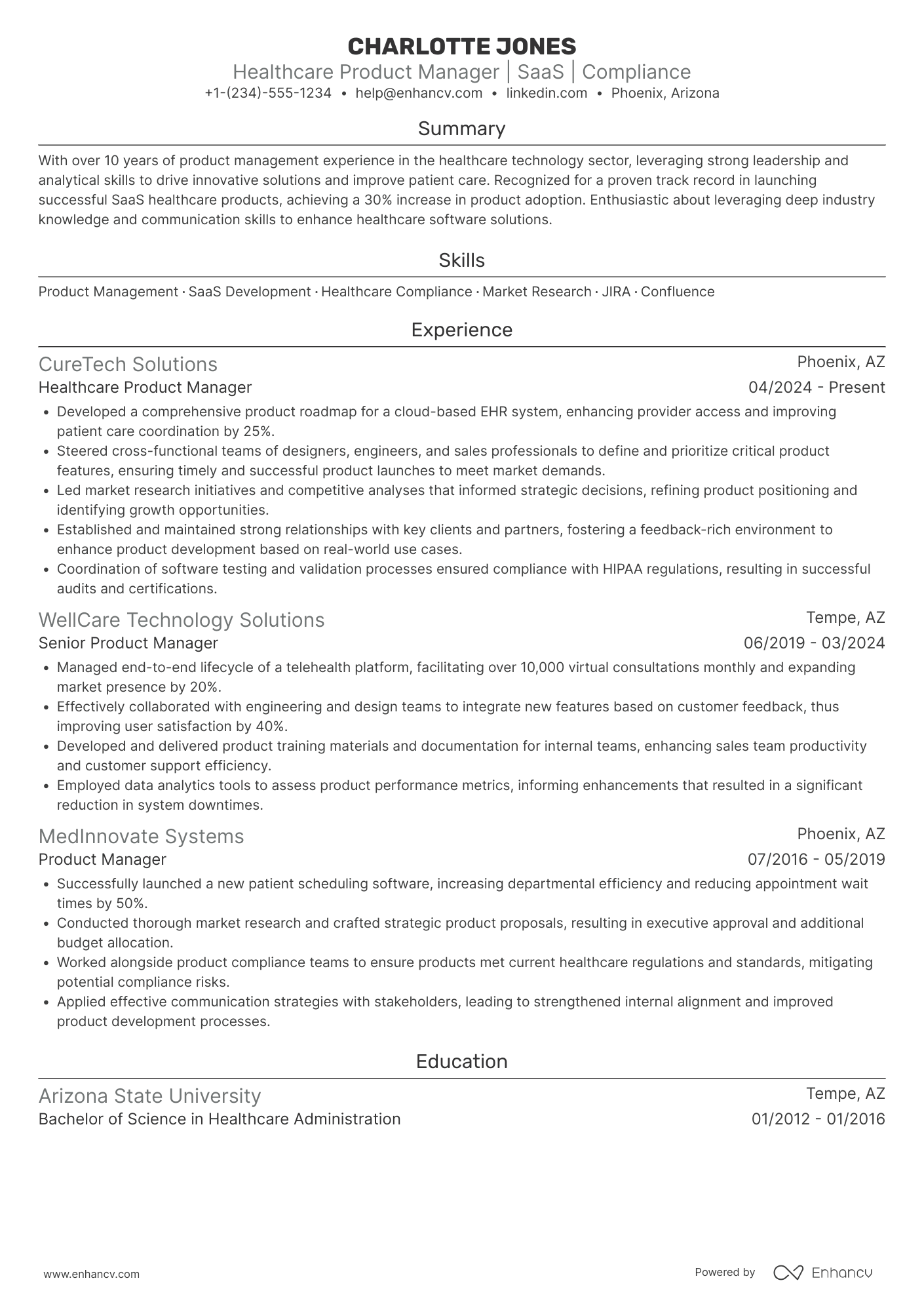
Most healthcare product manager resume submissions fail because they describe tools and tasks without tying work to regulated outcomes, patient impact, or revenue. That weakness gets filtered by ATS screening and lost in rapid recruiter scans amid intense competition.
A strong resume shows what changed because of your decisions. Knowing how to make your resume stand out starts with quantifying adoption, reduced claim denials, improved clinical quality measures, shortened release cycles, increased retention, expanded covered lives, raised net promoter score, and improved audit readiness across a defined portfolio.

Key takeaways
- Quantify every achievement with patient, clinical, or business metrics—not task descriptions.
- Choose reverse-chronological format for senior roles and hybrid format for career switchers.
- Mirror the job posting's exact regulatory terms, tools, and KPIs in your bullets.
- Anchor every listed skill to a specific project, action, and measurable result.
- Place certifications above or below education based on their relevance to the target role.
- Write a three- to four-line summary with domain focus, tools, and one standout metric.
- Use Enhancv's Bullet Point Generator to turn vague duties into recruiter-ready impact statements.
How to format a healthcare product manager resume
Recruiters evaluating healthcare product managers prioritize evidence of cross-functional leadership, regulatory fluency, and measurable product outcomes—signals that must surface within the first few seconds of a resume scan. Choosing the right resume format directly controls how quickly a hiring manager can trace your progression through increasingly complex healthcare product portfolios, making structure a strategic decision rather than an aesthetic one.

I have significant experience in this role—which format should I use?
Use a reverse-chronological format to give recruiters an immediate, linear view of your product leadership trajectory across healthcare organizations. Do:
- Lead each role entry with scope and ownership details: portfolio size, team headcount, business units influenced, and regulatory environments navigated (HIPAA, FDA, HITRUST).
- Highlight domain-specific expertise including EHR integrations, clinical workflow optimization, payer platform development, health data interoperability standards (HL7, FHIR), and cross-functional stakeholder management.
- Quantify product outcomes in terms of business impact: adoption rates, revenue influence, patient outcome improvements, time-to-market reductions, or compliance milestones achieved.
I'm junior or switching into this role—what format works best?
A hybrid format works best, letting you foreground transferable healthcare or product skills before a shorter experience section. Do:
- Place a dedicated skills section near the top, emphasizing competencies like agile product development, healthcare data privacy compliance, user research, or clinical stakeholder communication.
- Feature relevant projects, certifications (e.g., Pragmatic Institute, Certified Scrum Product Owner), or cross-functional initiatives—even from adjacent roles in health tech, clinical operations, or life sciences.
- Connect every skill or project to a concrete action and a measurable result, so recruiters see applied capability rather than abstract knowledge.
Why not use a functional resume?
A functional format strips away the timeline and context that recruiters need to evaluate how your product thinking developed within healthcare's unique regulatory and stakeholder environment, making it harder to assess your readiness for the role. Avoid a functional format unless you have no other way to present your qualifications coherently.
- A functional resume may be acceptable if you're making a significant career change into healthcare product management from a non-product discipline (e.g., clinical practice, health administration, or biotech research) and have limited formal product titles—but only if every listed skill is anchored to a specific project, stakeholder outcome, or measurable result rather than presented in isolation.
With your format establishing a clean, scannable structure, the next step is filling it with the right sections to present your qualifications effectively.
What sections should go on a healthcare product manager resume
Recruiters expect a healthcare product manager resume to show regulated product ownership, cross-functional leadership, and measurable outcomes. Understanding which resume sections to include ensures your qualifications surface clearly.
Use this structure for maximum clarity:
- Header
- Summary
- Experience
- Skills
- Projects
- Education
- Certifications
- Optional sections: Publications, Research, Volunteering
Your experience bullets should emphasize impact, outcomes, scope, and results across patient, provider, and business metrics.
Is your resume good enough?
Drop your resume here or choose a file. PDF & DOCX only. Max 2MB file size.
Once you’ve organized your resume with the right structure and essential sections, the next step is to write your healthcare product manager experience in a way that fits that layout and shows impact.
How to write your healthcare product manager resume experience
Your experience section should highlight the healthcare products, platforms, or systems you've shipped—along with the tools, frameworks, and methods you used to drive decisions and deliver results. Hiring managers prioritize demonstrated impact over descriptive task lists, so focus each entry on outcomes that prove you moved the needle for patients, providers, or the business. Building a targeted resume means shaping every bullet around the specific role you're pursuing.
Each entry should include:
- Job title
- Company and location (or remote)
- Dates of employment (month and year)
Three to five concise bullet points showing what you owned, how you executed, and what outcomes you delivered:
- Ownership scope: the healthcare products, clinical platforms, patient-facing applications, regulatory submissions, or cross-functional teams you were directly accountable for.
- Execution approach: the product management frameworks, data analytics tools, user research methods, clinical workflow analyses, or prioritization models you applied to inform decisions and move work forward.
- Value improved: the changes you drove in patient outcomes, care delivery efficiency, system reliability, regulatory compliance, clinical data accessibility, or operational risk reduction.
- Collaboration context: how you partnered with clinicians, engineering teams, compliance officers, payers, health system stakeholders, or external vendors to align priorities and ship work.
- Impact delivered: the business, clinical, or operational outcomes your work produced—expressed through measurable results, adoption scale, or strategic value rather than a list of activities performed.
Experience bullet formula
A healthcare product manager experience example
✅ Right example - modern, quantified, specific.
Senior Product Manager, Digital Health
ClearPath Health | Boston, MA (Hybrid)
2022–Present
B2B2C care navigation and telehealth platform supporting over 1.2M members across payer and employer clients.
- Led end-to-end delivery of a FHIR-based (Fast Healthcare Interoperability Resources) clinical data ingestion pipeline using AWS, Kafka, and Snowflake, cutting onboarding time from eight weeks to three weeks and improving data completeness by 22%.
- Launched prior authorization automation with EHR integrations (Epic, Cerner) and rules management in Jira and Confluence, reducing average turnaround time by 35% and lowering denial-related appeals by 18%.
- Partnered with design and engineering to ship an accessibility-compliant member triage flow (Figma, Amplitude, Optimizely), increasing appointment conversion by 14% and reducing drop-off at eligibility verification by 19%.
- Established HIPAA and SOC 2-aligned product controls with security, legal, and compliance, implementing audit logging and role-based access control, reducing high-severity incidents by 40% and cutting audit evidence collection time by 60%.
- Built a clinical outcomes dashboard with Looker and dbt, aligning stakeholders on quarterly OKRs (objectives and key results) and driving a 12% improvement in follow-up adherence for chronic care programs.
Now that you've seen what a strong experience section looks like in practice, let's break down how to customize yours for each specific healthcare product manager role you're targeting.
How to tailor your healthcare product manager resume experience
Recruiters evaluate your healthcare product manager resume through both applicant tracking systems and manual review. Tailoring your resume to the job description ensures your qualifications connect directly with what hiring teams prioritize.
Ways to tailor your healthcare product manager experience:
- Match EHR platforms or health tech tools named in the posting.
- Mirror exact terminology for HIPAA compliance or regulatory standards listed.
- Align your KPIs with the success metrics the role specifies.
- Highlight clinical workflow optimization if the description references it.
- Reference agile or product development frameworks the team uses.
- Include payer or provider domain experience when the role requires it.
- Emphasize cross-functional collaboration with engineering and clinical stakeholders mentioned.
- Reflect patient safety or data security priorities stated in the posting.
Tailoring means framing your real accomplishments in the language of the job description, not fabricating experience to match keywords.
Resume tailoring examples for healthcare product manager
| Job description excerpt | Untailored | Tailored |
|---|---|---|
| "Lead cross-functional teams to develop and launch EHR integration features that improve clinical workflow efficiency across hospital systems." | Led product development efforts and worked with various teams on software projects. | Led a cross-functional team of 12 engineers, clinicians, and designers to ship three EHR integration features adopted by 40+ hospital systems, reducing average clinical documentation time by 25%. |
| "Define product strategy for patient engagement platform using data from CAHPS surveys, utilization metrics, and clinical outcomes to drive roadmap prioritization." | Created product roadmaps and helped decide which features to build next. | Defined product strategy for a patient engagement platform serving 1.2M users, leveraging CAHPS survey data and utilization metrics to prioritize roadmap initiatives that improved patient activation scores by 18% over two quarters. |
| "Partner with regulatory and compliance teams to ensure product releases meet HIPAA, HITRUST, and FDA SaMD requirements throughout the development lifecycle." | Worked with compliance stakeholders to make sure products followed relevant regulations. | Partnered with regulatory and compliance teams to align every sprint cycle with HIPAA, HITRUST, and FDA SaMD requirements, achieving zero compliance delays across four consecutive product releases. |
Once you’ve aligned your experience with the role’s priorities and healthcare context, the next step is to quantify your healthcare product manager achievements so hiring teams can quickly see your impact.
How to quantify your healthcare product manager achievements
Quantifying your achievements shows how your decisions improved patient outcomes and business results. Focus on adoption, clinical quality, delivery speed, cost, compliance, and risk reduction across launches, integrations, and regulated workflows.
Quantifying examples for healthcare product manager
| Metric | Example |
|---|---|
| Adoption | "Increased clinician weekly active use from 1,200 to 1,650 in four months by redesigning order sets and in-app guidance in Pendo." |
| Reliability | "Improved platform uptime from 99.2% to 99.9% by defining service-level objectives and partnering with engineering on PagerDuty alerts." |
| Clinical quality | "Reduced medication order entry errors by 18% by adding FHIR-based validation rules and updating clinical decision support logic." |
| Delivery speed | "Cut release cycle time from six weeks to three by implementing two-week sprints, tighter backlog grooming, and clearer acceptance criteria." |
| Compliance risk | "Passed SOC 2 Type II and HIPAA audits with zero high-severity findings by driving threat modeling, access reviews, and audit-ready documentation." |
Turn vague job duties into measurable, recruiter-ready resume bullets in seconds with Enhancv's Bullet Point Generator.
Once your bullet points clearly convey your impact, the next step is ensuring your skills section reinforces that expertise with the right mix of hard and soft skills.
How to list your hard and soft skills on a healthcare product manager resume
Your skills section shows you can ship compliant, data-driven healthcare products; recruiters and an ATS (applicant tracking system) scan this section to confirm role fit fast, so aim for a balanced mix of hard skills and execution-focused soft skills. healthcare product manager roles require a blend of:
- Product strategy and discovery skills.
- Data, analytics, and experimentation skills.
- Delivery, execution, and go-to-market discipline.
- Soft skills.
Your skills section should be:
- Scannable (bullet-style grouping).
- Relevant to the job post.
- Backed by proof in experience bullets.
- Updated with current tools.
Place your skills section:
- Above experience if you're junior or switching careers.
- Below experience if you're mid/senior with strong achievements.

Hard skills
- Product discovery, JTBD
- Roadmapping, OKRs
- Agile delivery, Scrum, Kanban
- Jira, Confluence
- Stakeholder requirements, PRDs
- HIPAA compliance
- HL7, FHIR
- EHR workflows, Epic, Cerner
- SQL, data modeling
- Tableau, Looker
- A/B testing, experimentation design
- API integrations, webhooks
Soft skills
- Align clinical and business goals
- Lead cross-functional execution
- Write clear, decision-ready PRDs
- Run structured stakeholder reviews
- Negotiate scope, timelines, tradeoffs
- Prioritize with risk-based thinking
- Communicate with clinicians and engineers
- Translate regulations into requirements
- Drive adoption with change management
- Escalate blockers early and clearly
- Own outcomes end-to-end
- Facilitate incident postmortems and learnings
How to show your healthcare product manager skills in context
Skills shouldn't live only in a dedicated skills list. You can explore common resume skills to ensure you're not overlooking competencies that hiring teams expect.
They should be demonstrated in:
- Your summary (high-level professional identity)
- Your experience (proof through outcomes)
Here's what strong, context-driven examples look like in practice.
Summary example
Senior healthcare product manager with 10+ years in digital health and EHR integration. Skilled in Agile roadmapping, cross-functional leadership, and HIPAA-compliant design. Led a patient portal redesign that boosted engagement by 34%.
- Signals senior-level experience immediately
- Names role-relevant tools and methods
- Includes a concrete, measurable outcome
- Highlights leadership as a soft skill
Experience example
Senior Product Manager, Digital Health
Meridian Health Technologies | Remote
March 2020–August 2024
- Partnered with engineering and clinical teams to launch an Agile-built telehealth platform, increasing virtual visit adoption by 41% within six months.
- Led HIPAA-compliant EHR integration using HL7 FHIR standards, reducing provider data-entry time by 28% across 12 partner clinics.
- Defined product KPIs with analytics and marketing stakeholders, driving a 19% improvement in patient retention through data-informed roadmap prioritization.
- Every bullet contains measurable proof.
- Skills appear naturally within achievements.
Once you’ve demonstrated your healthcare product manager strengths through specific, outcome-focused examples, the next step is applying the same approach to build a healthcare product manager resume with no experience.
How do I write a healthcare product manager resume with no experience
Even without full-time experience, you can demonstrate readiness for a healthcare product manager role. If you're building a resume without work experience, focus on transferable projects and domain knowledge:
- Health tech capstone product project
- Clinical workflow shadowing notes
- Regulatory and compliance coursework projects
- Electronic health record integration prototype
- User interviews with clinicians
- Product case study portfolio
- Data dashboard using claims data
- Internship in health operations
Focus on:
- Clear product metrics and outcomes
- Healthcare domain knowledge with proof
- Structured discovery and prioritization artifacts
- Cross-functional delivery with tangible outputs
Resume format tip for entry-level healthcare product manager
Use a hybrid resume format because it highlights projects and skills first, while still showing relevant experience and education in a clear timeline. Do:
- Lead with a projects section and outcomes.
- Add a skills section with tools and methods.
- Quantify impact with baseline and results.
- Include healthcare product manager keywords from postings.
- Link to a portfolio with case studies.
- Built an electronic health record integration prototype in Figma, mapped HL7 data fields, and validated with five clinicians, cutting intake documentation time by 18%.
Once you've positioned your transferable skills and relevant projects to compensate for limited experience, presenting your education strategically becomes the next essential step in strengthening your candidacy.
How to list your education on a healthcare product manager resume
Your education section helps hiring teams confirm you have the foundational knowledge needed for a healthcare product manager role. It validates relevant academic training quickly.
Include:
- Degree name
- Institution
- Location
- Graduation year
- Relevant coursework (for juniors or entry-level candidates)
- Honors & GPA (if 3.5 or higher)
Skip month and day details—list the graduation year only.
Here's a strong education entry tailored to the healthcare product manager role.
Example education entry
Master of Science in Health Informatics
University of Michigan, Ann Arbor, MI
Graduated 2021
GPA: 3.8/4.0
- Relevant coursework: Health Systems Design, Clinical Data Analytics, Product Strategy in Healthcare, Regulatory Compliance
- Honors: Dean's List, Graduate Research Fellowship in Digital Health Innovation
How to list your certifications on a healthcare product manager resume
Certifications on your resume show your commitment to learning, proficiency with product tools, and relevance to regulated healthcare work as a healthcare product manager.
Include:
- Certificate name
- Issuing organization
- Year
- Optional: credential ID or URL
- Place certifications below education when your degrees are recent and directly tied to healthcare product manager work.
- Place certifications above education when they are recent, highly relevant, or required for healthcare product manager roles you target.
Best certifications for your healthcare product manager resume
- Certified Scrum Product Owner (CSPO)
- PMI Agile Certified Practitioner (PMI-ACP)
- Professional Scrum Product Owner (PSPO I)
- Pragmatic Institute Certified Product Manager
- Certified Associate in Healthcare Information and Management Systems (CAHIMS)
- Certified Professional in Healthcare Information and Management Systems (CPHIMS)
- Lean Six Sigma Green Belt (IASSC)
Once you’ve positioned your credentials where hiring teams can spot them quickly, shift to your healthcare product manager resume summary to tie those qualifications to your impact and fit at a glance.
How to write your healthcare product manager resume summary
Your resume summary is the first thing a recruiter reads. A sharp, specific opening signals you understand healthcare product management and deserve a closer look.
Keep it to three to four lines, with:
- Your title and total years of experience in product management.
- Healthcare domain focus, such as EHR, telehealth, medical devices, or digital therapeutics.
- Core tools and skills like Jira, SQL, HIPAA compliance, or agile methodology.
- One or two measurable achievements that prove your impact.
- Soft skills tied to real outcomes, such as cross-functional collaboration that shortened a release cycle.

PRO TIP
At a mid-level healthcare product manager role, lead with domain-specific experience and tangible results. Highlight products you shipped, metrics you moved, and stakeholders you influenced. Avoid vague phrases like "passionate leader" or "results-driven professional." Recruiters want evidence, not enthusiasm.
Example summary for a healthcare product manager
Healthcare product manager with five years of experience leading EHR and telehealth products. Drove a 30% increase in patient portal adoption through cross-functional roadmap execution and HIPAA-compliant feature launches.
Optimize your resume summary and objective for ATS
Drop your resume here or choose a file.
PDF & DOCX only. Max 2MB file size.
Now that your summary captures your healthcare product management expertise, make sure your header presents the essential contact and professional details recruiters need to find and reach you.
What to include in a healthcare product manager resume header
A resume header is the top section with your key identifiers, and it boosts visibility, credibility, and recruiter screening for a healthcare product manager.
Essential resume header elements
- Full name
- Tailored job title and headline
- Location
- Phone number
- Professional email
- GitHub link
- Portfolio link
A LinkedIn link helps recruiters verify experience quickly and supports screening.
Don't include a photo on a healthcare product manager resume unless the role is explicitly front-facing or appearance-dependent.
Align your header title and headline to the job post and include health domain keywords that match the role's scope.
Example
Healthcare product manager resume header
Jordan Lee
Healthcare product manager | EHR integrations, HIPAA compliance, and patient engagement
Boston, MA
(617) 555-01XX
jordan.lee@enhancv.com
github.com/jordanlee
jordanlee.com
linkedin.com/in/jordanlee
Once your contact details and role identifiers are clearly presented, add targeted additional sections to reinforce your fit and provide supporting context.
Additional sections for healthcare product manager resumes
When your core sections don't fully capture your qualifications, additional sections help you stand out with role-specific credibility and depth.
- Languages — listing language skills can demonstrate your ability to serve diverse patient populations
- Publications and research
- Speaking engagements and conference presentations
- Professional affiliations (e.g., HIMSS, PDMA, HL7)
- Patents
- Volunteer work in healthcare or health equity initiatives
Once you've finalized every section of your resume, pair it with a tailored cover letter to strengthen your application even further.
Do healthcare product manager resumes need a cover letter
A cover letter isn't required for a healthcare product manager, but it helps in competitive searches or when hiring teams expect one. If you're wondering what a cover letter is and how it complements your resume, it can make a difference when your resume needs context, or when you're targeting a specific product area.
Use a cover letter to add context your resume can't:
- Explain role and team fit by matching your experience to the company's product stage, collaboration model, and cross-functional partners.
- Highlight one or two relevant projects with clear outcomes, such as reduced claim denials, improved patient onboarding, or faster prior authorization turnaround.
- Show understanding of the product, users, and business context, including clinicians, patients, payers, and compliance constraints like HIPAA and security reviews.
- Address career transitions or non-obvious experience by connecting past work to healthcare product manager responsibilities and measurable product decisions.
Drop your resume here or choose a file.
PDF & DOCX only. Max 2MB file size.
Even if you choose to skip a cover letter and let your resume carry the application, the next step is using AI to strengthen your healthcare product manager resume faster and more consistently.
Using AI to improve your healthcare product manager resume
AI can sharpen your resume's clarity, structure, and measurable impact. It helps tighten language and align content with specific roles. But overuse strips authenticity. Once your resume reads clearly and fits the role, step away from AI. If you're exploring this approach, learn more about ChatGPT resume writing prompts to get started with effective, targeted prompts.
Here are 10 practical prompts to strengthen specific sections of your healthcare product manager resume:
- Strengthen summary focus. "Rewrite my resume summary to highlight my top three qualifications as a healthcare product manager in under four sentences."
- Quantify experience bullets. "Add specific metrics and measurable outcomes to each experience bullet on my healthcare product manager resume."
- Align skills section. "Compare my skills section against this healthcare product manager job description and suggest missing relevant skills."
- Tighten project descriptions. "Rewrite my project descriptions to clearly show my healthcare product manager contributions, decisions, and business results."
- Remove vague language. "Identify and replace vague words or filler phrases throughout my healthcare product manager resume with concrete alternatives."
- Improve action verbs. "Replace weak or repetitive action verbs in my healthcare product manager experience section with stronger, more precise alternatives."
- Refine education relevance. "Rewrite my education section to emphasize coursework and achievements directly relevant to a healthcare product manager role."
- Tailor certifications. "Reorganize and prioritize my certifications section to feature credentials most valued for a healthcare product manager position."
- Check regulatory language. "Review my healthcare product manager resume for accurate use of industry terms like HIPAA, FDA, and EHR compliance."
- Cut redundant content. "Identify and remove duplicate or overlapping statements across all sections of my healthcare product manager resume."
Stop using AI once your resume sounds accurate, specific, and aligned with real experience. AI should never invent experience or inflate claims—if it didn't happen, it doesn't belong here.
Conclusion
A strong healthcare product manager resume shows measurable outcomes, role-specific skills, and a clear structure. Lead with impact, such as revenue growth, adoption, retention, reduced cycle time, or improved clinical workflows. Support each result with the skills that drove it.
Keep your sections clean and consistent so hiring teams can scan fast and trust your story. Show you can deliver in today’s market and stay ready for near-future needs. With clear results and focused skills, your resume will compete well.