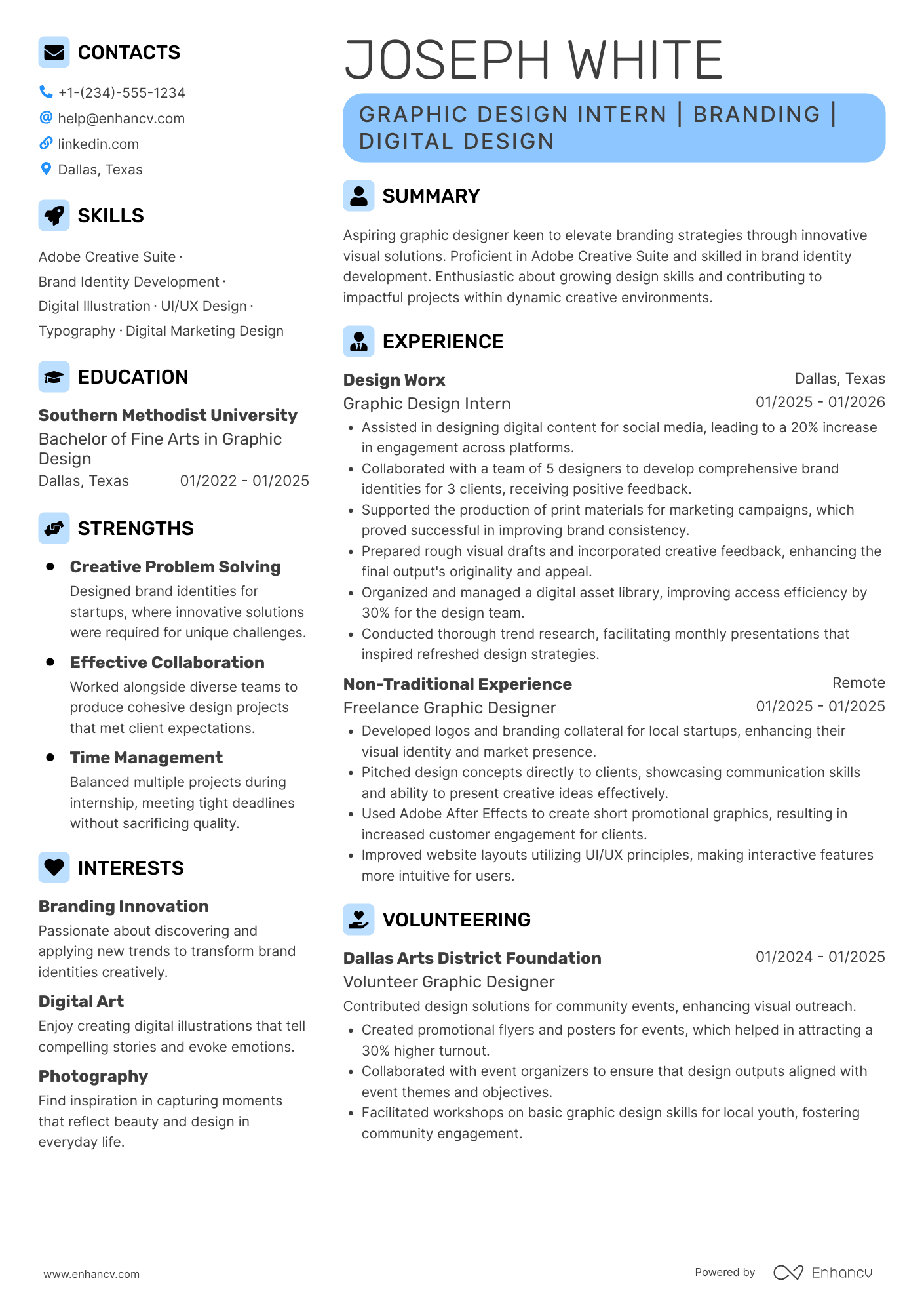


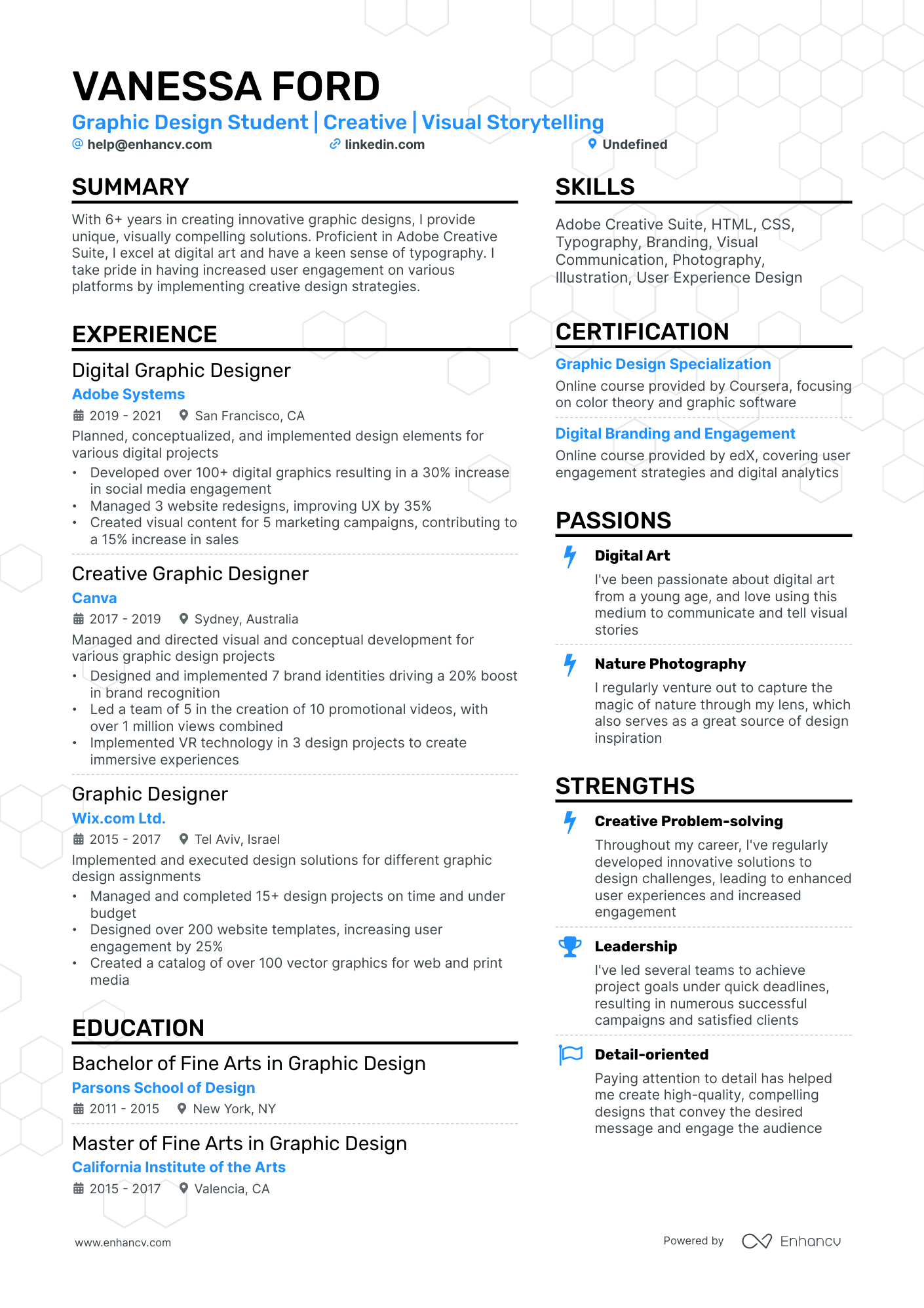
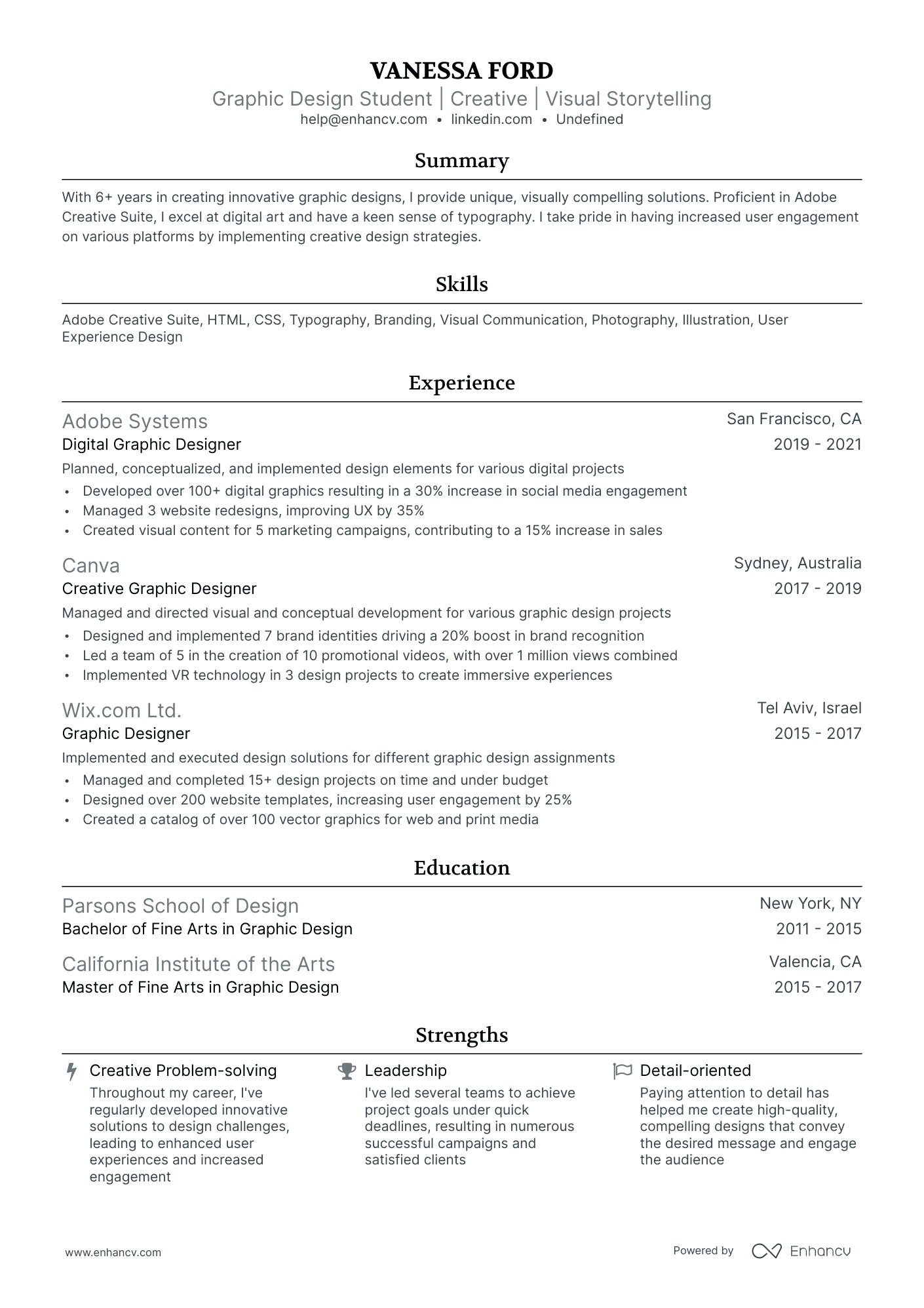
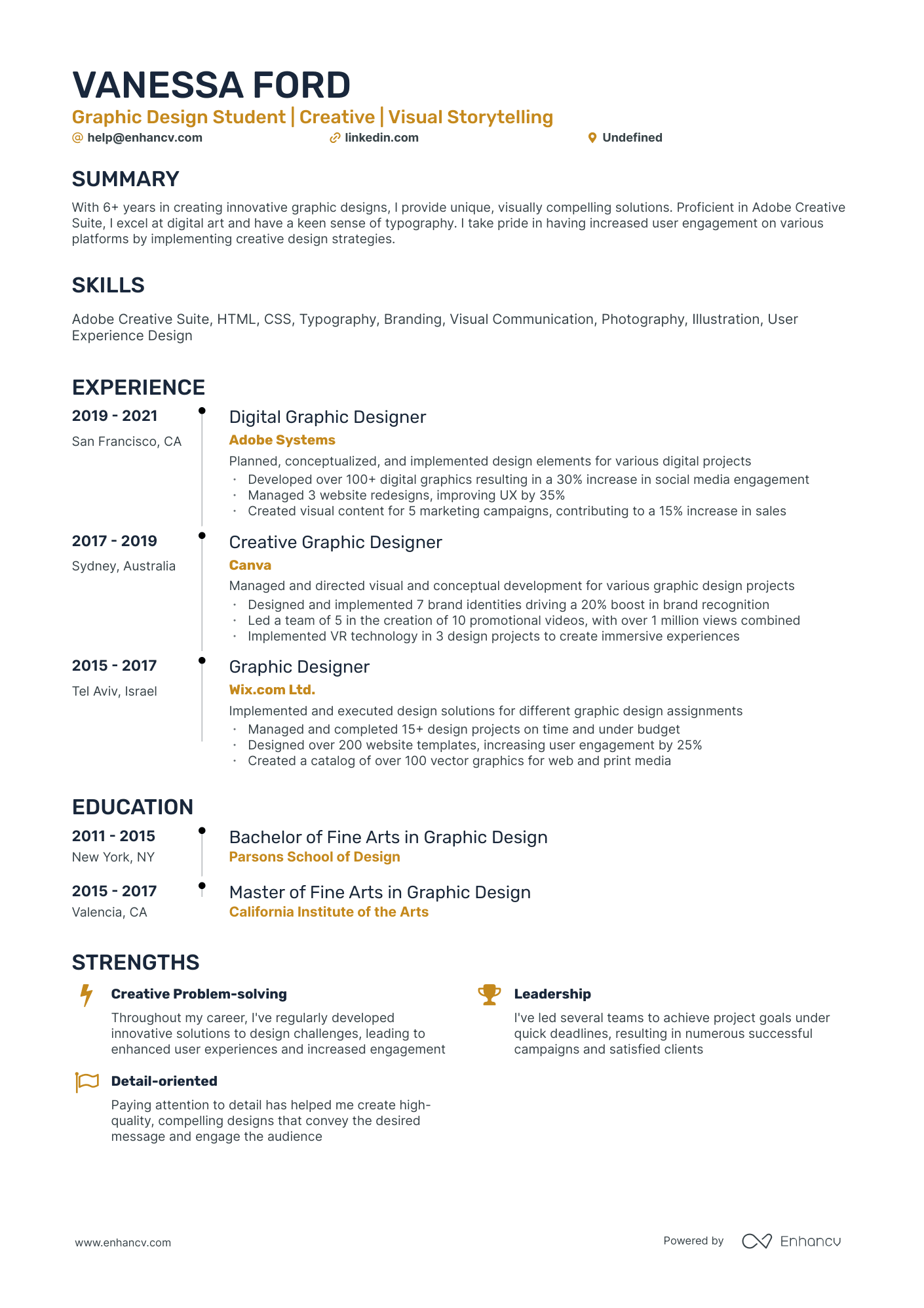
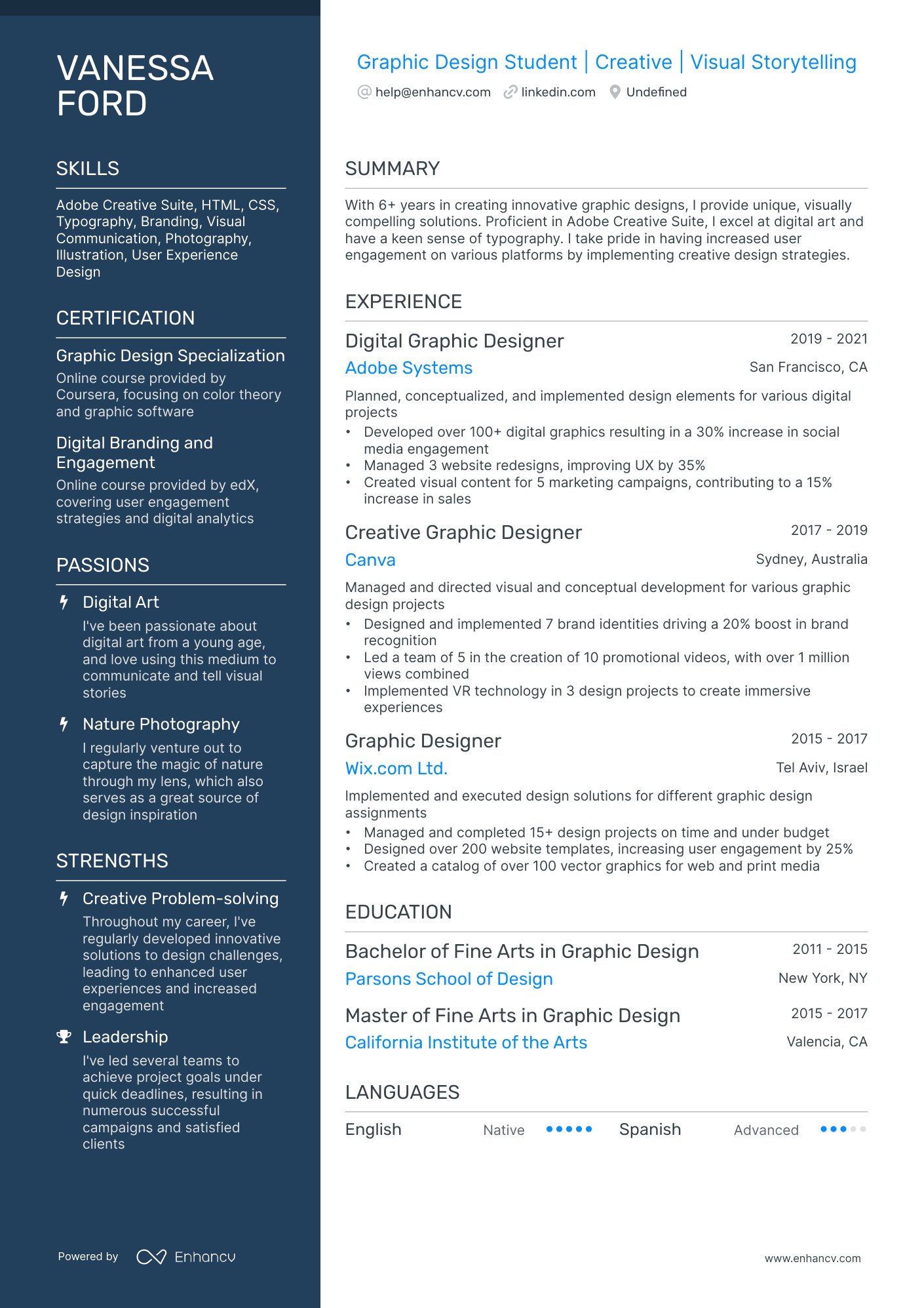
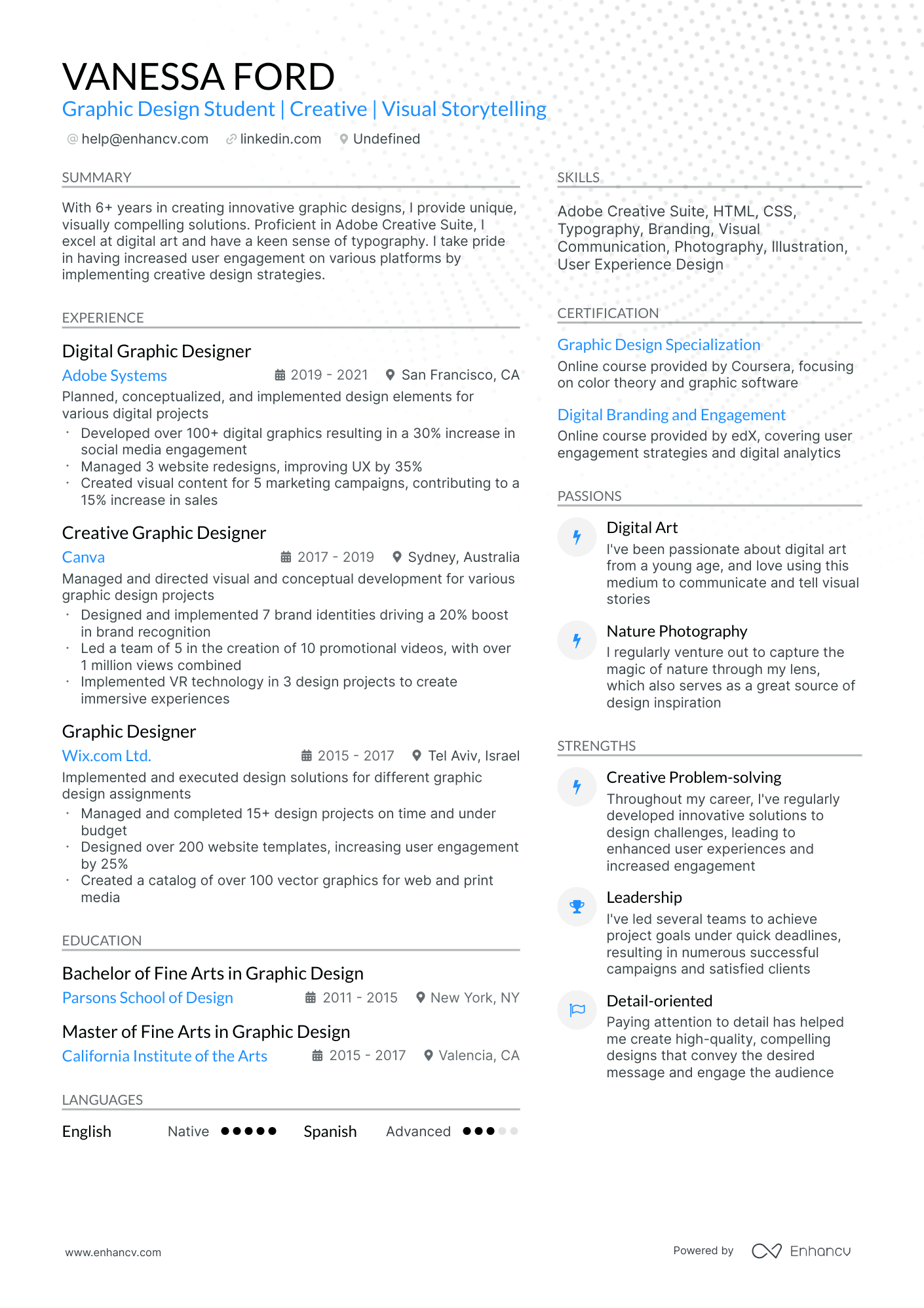
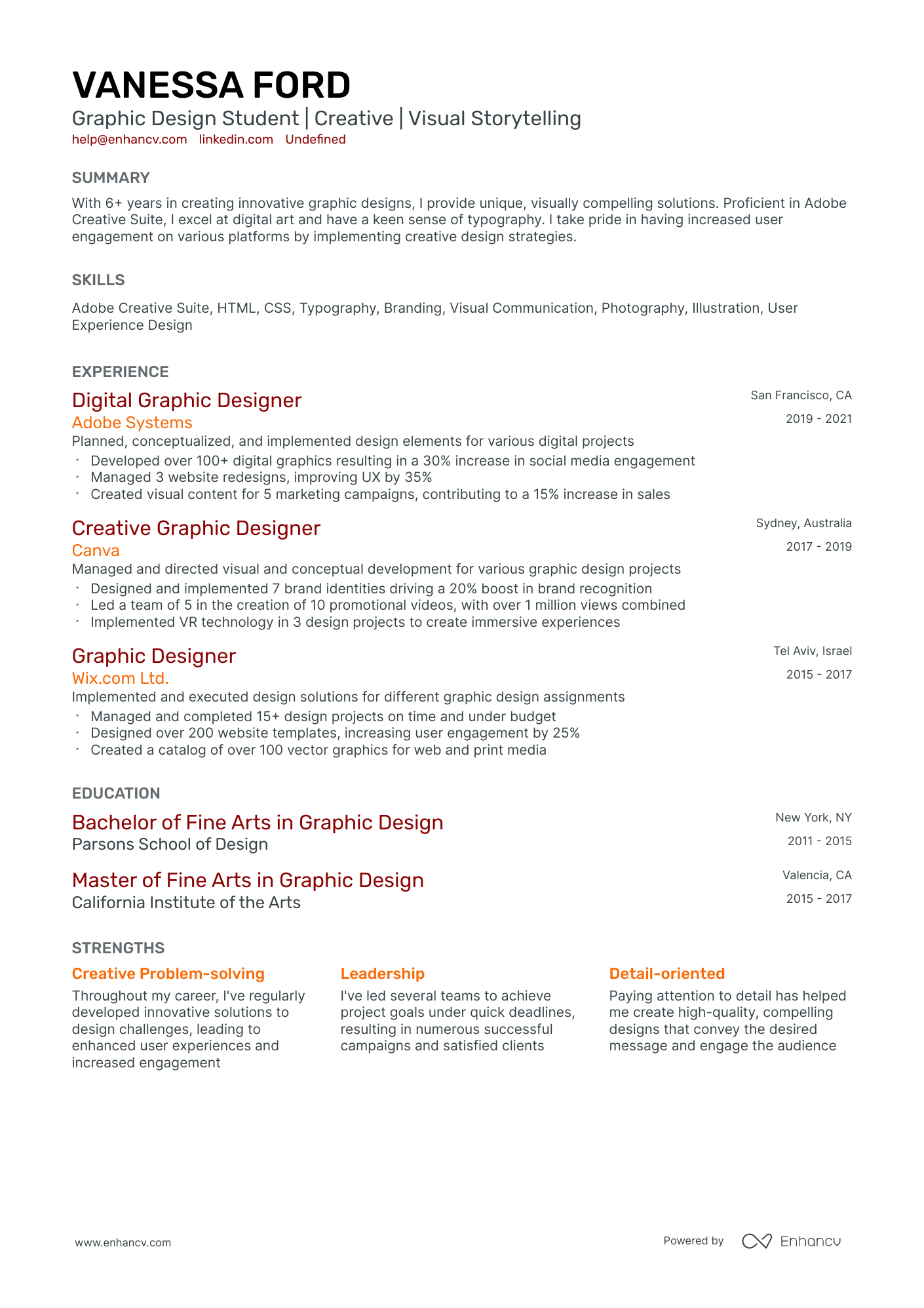
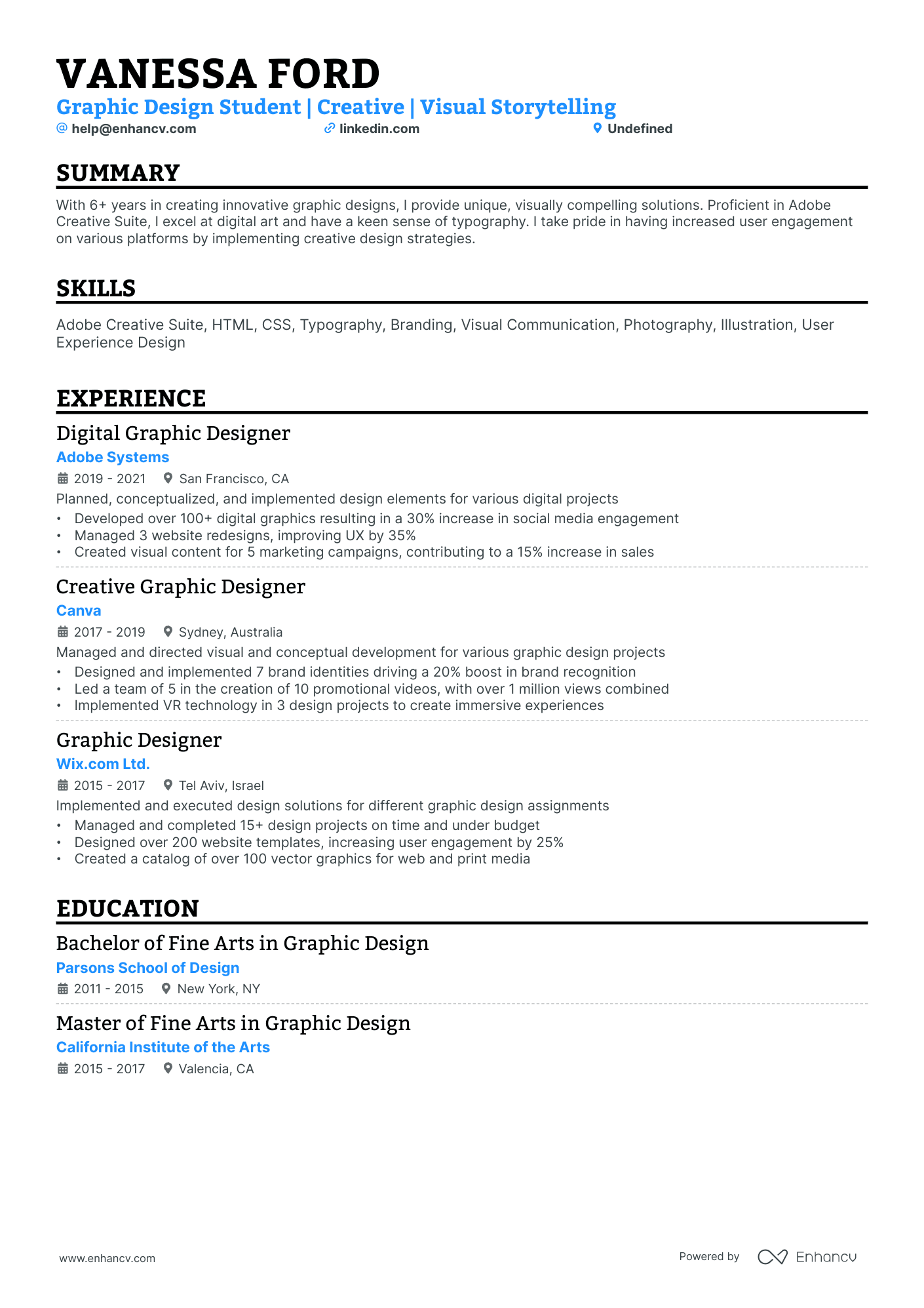
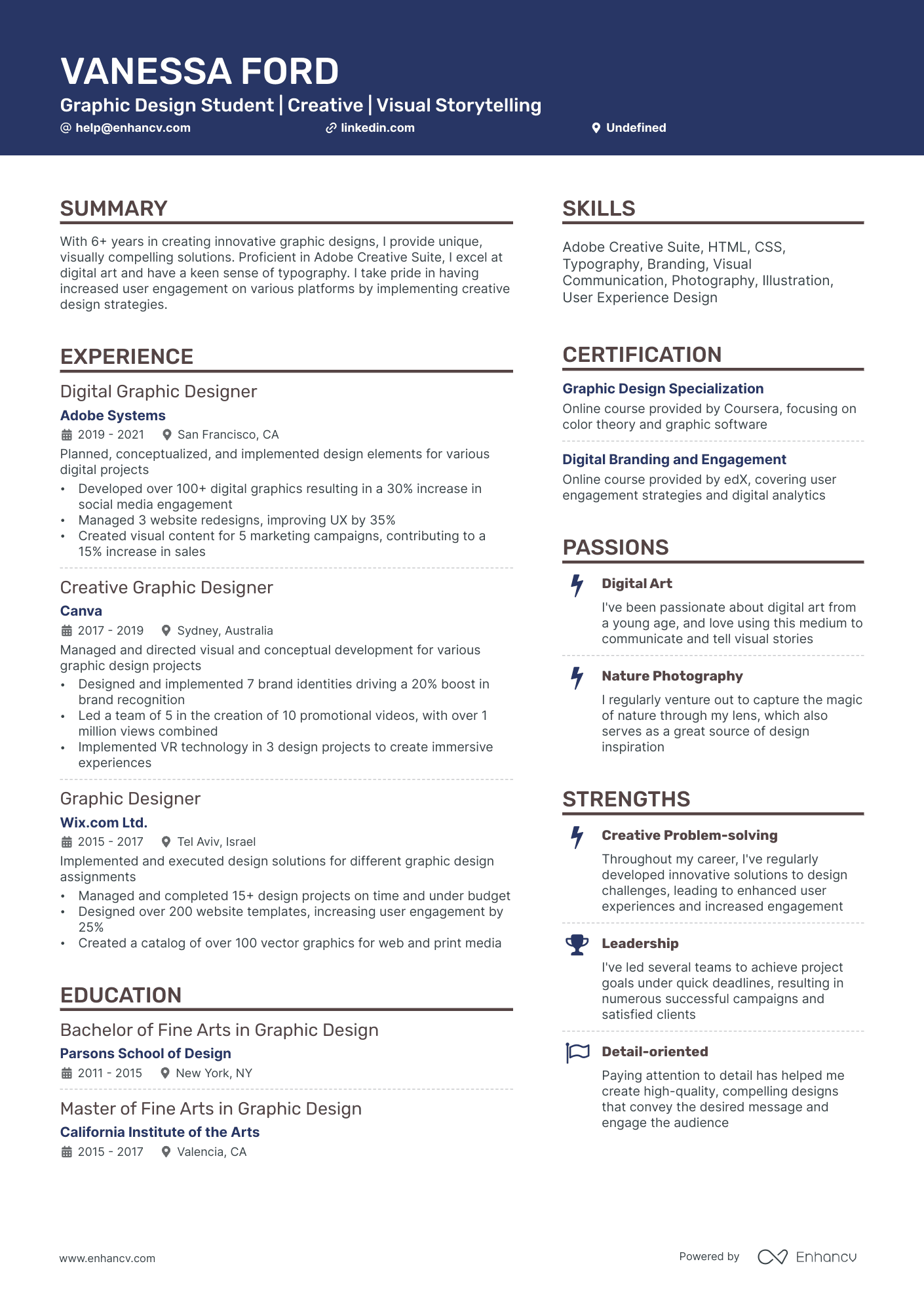
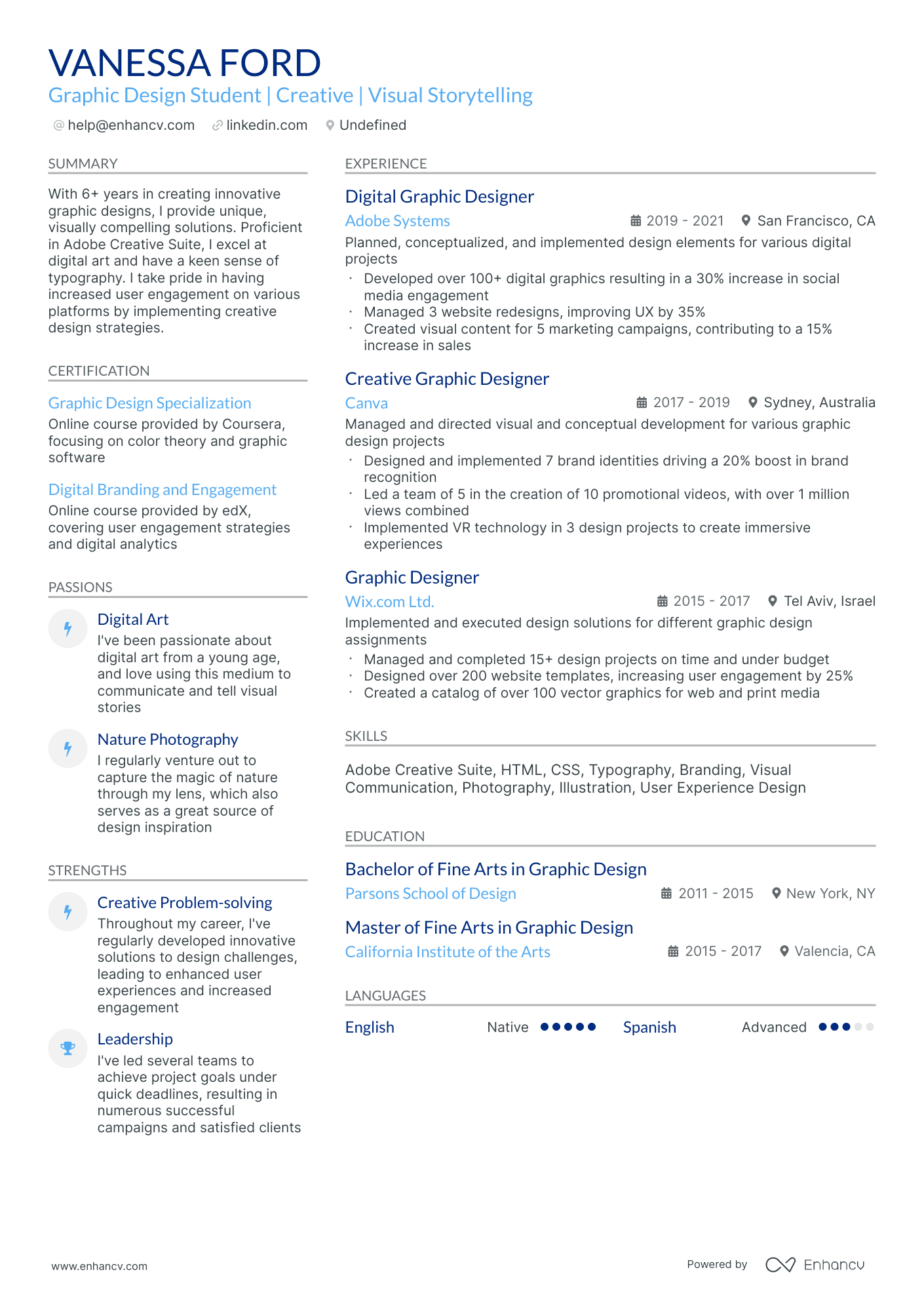
Graphic design student resumes fail because they read like class project logs and bury portfolio wins under tools and coursework. That matters now because applicant tracking systems skim keywords, recruiters scan in seconds, and competition is high.
A strong resume shows what you delivered and why it worked. Learning how to make your resume stand out starts with highlighting measurable results like faster turnaround, fewer revisions, brand consistency scores, engagement lifts, conversion gains, print accuracy, accessibility improvements, and on-time launches across multiple assets.

Key takeaways
- Quantify every design bullet with turnaround time, revision rounds, or engagement lifts.
- Tailor your resume to each job posting by mirroring its exact tools and terminology.
- Place a skills section above experience if you lack professional design roles.
- Anchor every listed skill to a specific project, course, or measurable outcome.
- Use class briefs, volunteer work, and freelance pieces as standalone experience entries.
- Add a portfolio link in your header so recruiters can verify your work instantly.
- Refine bullet phrasing and structure quickly with Enhancv's resume tools before submitting.
How to format a Graphic design student resume
Recruiters reviewing graphic design student resumes prioritize a clear showcase of design skills, relevant coursework, and project-based experience that demonstrates creative problem-solving. Your resume format directly affects how quickly a hiring manager can spot these signals, especially when you have limited professional experience and need to lead with what you've learned and built.

I have significant experience in this role—which format should I use?
Use a reverse-chronological format to present your internships, freelance work, and student roles in a clear timeline that shows growing design responsibility. Do:
- Lead each entry with the scope of your involvement—solo projects, team collaborations, or client-facing work—and specify your ownership of deliverables.
- List role-specific tools and skills (Adobe Creative Suite, Figma, typography, branding, UX fundamentals) within the context of each experience entry.
- Quantify outcomes wherever possible, including project reach, turnaround improvements, or measurable engagement results.
I'm junior or switching into this role—what format works best?
Use a hybrid format that places a targeted skills section at the top, followed by any projects, coursework, or transferable experience listed in reverse-chronological order. Do:
- Position your strongest design skills—such as layout design, color theory, prototyping, or Adobe Creative Suite proficiency—above your experience section so recruiters see them first.
- Feature academic projects, personal design challenges, volunteer work, or freelance pieces as standalone entries with clear descriptions of your role and deliverables.
- Connect every action to a result, even in a classroom context, to show how your design decisions led to tangible outcomes.
When does a functional resume make sense?
A functional format can work in narrow situations where your design abilities don't yet have a clear work history to support them:
- You're transitioning from an unrelated field into graphic design and need to foreground transferable creative skills over irrelevant job titles.
- You have significant gaps in your timeline but have built a portfolio of personal or volunteer design projects during that period.
- Your formal experience is limited to coursework alone, and organizing by skill category (branding, digital illustration, print layout) tells a more coherent story than a sparse chronological list.
- A functional format is acceptable if you're a career changer or have no design-related work history at all, but always tie each listed skill to a specific project, course, or portfolio piece with a defined outcome.
Once you've established a clean, readable format, the next step is deciding which sections to include and how to arrange them to highlight your strengths as a graphic design student.
What sections should go on a Graphic design student resume
Recruiters expect to see a clean, well-organized resume that highlights your design skills, portfolio-ready work, and measurable contributions. Understanding what to put on a resume helps you prioritize the right content from the start.
Use this structure for maximum clarity:
- Header
- Summary
- Experience
- Skills
- Projects
- Education
- Certifications
- Optional sections: Awards, Leadership, Languages
Strong experience bullets should emphasize the design problem you solved, the scope of your work, the tools you used, and the outcomes you delivered.
Is your resume good enough?
Drop your resume here or choose a file. PDF & DOCX only. Max 2MB file size.
Once you’ve organized your resume with the right components, the next step is learning how to write your graphic design student resume experience so each role supports the structure you’ve built.
How to write your Graphic design student resume experience
The experience section is where you prove you can ship real design work—not just describe coursework. Hiring managers want to see the tools you've used, the projects you've delivered, and the measurable outcomes your designs produced, because demonstrated impact always outweighs a descriptive task list.
Each entry should include:
- Job title
- Company and location (or remote)
- Dates of employment (month and year)
Three to five concise bullet points showing what you owned, how you executed, and what outcomes you delivered:
- Ownership scope: the specific design projects, brand assets, campaigns, publications, or client accounts you were directly responsible for as a graphic design student.
- Execution approach: the design software, typography principles, layout frameworks, prototyping tools, or visual research methods you applied to move work from concept to final deliverable.
- Value improved: the changes your designs drove in visual consistency, brand perception, production efficiency, accessibility compliance, or turnaround time for the teams or clients you supported.
- Collaboration context: how you partnered with art directors, copywriters, marketing teams, developers, print vendors, or clients to align creative direction and deliver cohesive visual solutions.
- Impact delivered: the tangible results your design work produced—expressed through audience reach, engagement lift, project scale, client retention, or cost savings rather than a list of tasks you performed.
Experience bullet formula
A Graphic design student experience example
✅ Right example - modern, quantified, specific.
Graphic Design Intern
Brightside Coffee Roasters | Remote
2024–2025
Direct-to-consumer coffee brand serving 50,000+ monthly site visitors and a nationwide subscription program.
- Redesigned Shopify homepage and product detail page layouts in Figma, improving add-to-cart rate by 12% and reducing bounce rate by 9% based on Google Analytics.
- Built a reusable brand asset library in Adobe Illustrator and Adobe InDesign (logos, icons, packaging dielines, social templates), cutting campaign design turnaround time by 30% across marketing requests.
- Produced three email marketing templates in Adobe Photoshop and Klaviyo, collaborating with the marketing manager and copywriter to lift click-through rate by 18% over the prior template set.
- Delivered print-ready packaging updates using prepress checklists and color-proofing workflows (CMYK, spot colors, bleed, and trim), reducing printer revision cycles from three rounds to one.
- Partnered with a front-end developer to implement accessible typography and color contrast updates (WCAG AA), decreasing accessibility-related support tickets by 20% quarter over quarter.
Now that you've seen how a strong experience section looks in practice, let's break down how to tailor each element to match the specific graphic design role you're targeting.
How to tailor your Graphic design student resume experience
Recruiters evaluate your resume through applicant tracking systems and manual review, scanning for alignment with specific job requirements. Tailoring your resume to the job description increases your chances of passing both filters.
Ways to tailor your graphic design student experience:
- Match design tools like Figma or InDesign listed in the posting.
- Mirror exact terminology the employer uses for design deliverables.
- Reference brand identity work if the role emphasizes branding.
- Highlight accessibility standards when the job description mentions them.
- Include print production experience if the posting requires print skills.
- Use the same file format or asset management terms they specify.
- Emphasize collaborative workflows with developers or marketing teams referenced.
- Showcase responsive or mobile design skills when the role requires them.
Tailoring means aligning your real coursework, projects, and achievements with what the employer asks for—not forcing irrelevant keywords into your bullets.
Resume tailoring examples for Graphic design student
| Job description excerpt | Untailored | Tailored |
|---|---|---|
| Seeking a graphic design intern to create social media assets for Instagram and TikTok using Figma and Adobe After Effects, maintaining brand consistency across 5+ product lines. | Designed graphics for social media platforms using various design tools. | Created 40+ on-brand social media assets for Instagram and TikTok in Figma and After Effects, maintaining visual consistency across five product lines during a semester-long internship. |
| Junior designer needed to develop packaging concepts for sustainable consumer goods, proficient in Adobe Illustrator and familiar with print-ready file preparation and Pantone color systems. | Worked on packaging projects and used Adobe Creative Suite for design tasks. | Developed three print-ready packaging concepts for a sustainable skincare brand in Adobe Illustrator, specifying Pantone spot colors and preparing dieline files that met vendor bleed and trim requirements. |
| Design assistant to support the UX team by producing wireframes, clickable prototypes, and icon sets in Figma for a mobile health-tracking app launching in Q3. | Helped a team with app design and created visual elements for a project. | Designed a 30-icon set and built two clickable Figma prototypes for a mobile health-tracking app, collaborating with UX researchers to refine navigation flows before the Q3 launch deadline. |
Once you’ve aligned your experience with the role’s priorities, the next step is to quantify your graphic design student achievements so hiring managers can quickly see the impact behind each bullet.
How to quantify your Graphic design student achievements
Numbers show your design choices drove results, not just aesthetics. Quantifying your achievements means tracking turnaround time, revision rounds, engagement or conversion lifts, accuracy to brand guidelines, and stakeholder approval speed across real projects.
Quantifying examples for Graphic design student
| Metric | Example |
|---|---|
| Turnaround time | "Delivered twelve social posts and three flyers in five days using Adobe Illustrator and Figma, cutting average turnaround time from three days to one." |
| Revision rate | "Reduced average revisions per asset from four to two by adding a one-page brief and Figma comments workflow for seven stakeholders." |
| Engagement lift | "Redesigned Instagram story templates in Canva and After Effects, increasing tap-forward completion rate from 62% to 74% across eight stories." |
| Brand compliance | "Audited fifty marketing assets against a brand guide and fixed one hundred twenty inconsistencies, raising compliance from 70% to 95%." |
| Approval cycle | "Built a Figma component library with thirty-two reusable components, shortening client approval from six days to three on five class-client projects." |
Turn vague job duties into measurable, recruiter-ready resume bullets in seconds with Enhancv's Bullet Point Generator.
Once you've crafted strong bullet points for your experience section, applying that same precision to how you present your hard and soft skills will ensure your entire graphic design student resume works together cohesively.
How to list your hard and soft skills on a Graphic design student resume
Your skills section shows your design range and readiness for real workflows, and recruiters and an ATS (applicant tracking system) scan this section to confirm tool fit and role keywords; aim for a mostly hard-skills mix with targeted collaboration skills.
Graphic design student roles require a blend of:
- Product strategy and discovery skills.
- Data, analytics, and experimentation skills.
- Delivery, execution, and go-to-market discipline.
- Soft skills.
Your skills section should be:
- Scannable (bullet-style grouping).
- Relevant to the job post.
- Backed by proof in experience bullets.
- Updated with current tools.
Place your skills section:
- Above experience if you're junior or switching careers.
- Below experience if you're mid/senior with strong achievements.

Hard skills
Your hard skills demonstrate the technical tools and design competencies employers need to see:
- Adobe Photoshop, Illustrator, InDesign
- Figma, FigJam
- Typography and layout systems
- Brand identity design
- Logo design and iconography
- Grid systems and composition
- Color theory and accessibility
- Print production, prepress, CMYK
- Social media design formats
- Presentation and pitch deck design
- Packaging and label design
- File prep, version control, naming conventions
Soft skills
Your soft skills show how you collaborate, communicate, and deliver within real design workflows:
- Translate briefs into concepts
- Ask focused clarifying questions
- Present work and rationale clearly
- Incorporate critique into revisions
- Manage deadlines and priorities
- Collaborate with writers and marketers
- Align designs to brand guidelines
- Document design decisions
- Communicate progress and blockers
- Take ownership of deliverables
- Iterate quickly based on feedback
- Balance creativity with constraints
How to show your Graphic design student skills in context
Skills shouldn't live only in a bulleted list on your resume. Explore resume skills examples to see how top candidates weave abilities into every section.
They should be demonstrated in:
- Your summary (high-level professional identity)
- Your experience (proof through outcomes)
Here's how that looks in practice.
Summary example
Senior graphic design student with four years of branding and editorial experience. Skilled in Adobe Creative Suite, typography, and layout design. Led a campus rebrand that boosted event attendance by 30%. Collaborative visual thinker passionate about user-centered design.
- Reflects senior-level experience clearly
- Names industry-standard tools directly
- Includes a measurable branding outcome
- Highlights collaboration as a soft skill
Experience example
Graphic Design Intern
Pinecrest Studio | Remote
June 2023–August 2024
- Designed 40+ social media assets in Figma and Illustrator, increasing client engagement rates by 22% over six months.
- Collaborated with a three-person marketing team to develop brand guidelines adopted across 12 product launches.
- Created print-ready packaging mockups in InDesign, reducing vendor revision cycles by 35% and accelerating production timelines.
- Every bullet includes measurable proof.
- Skills appear naturally through outcomes.
Once you’ve anchored your design abilities in real course projects and outcomes, the next step is structuring a graphic design student resume with no experience so those strengths read as credible and job-ready.
How do I write a Graphic design student resume with no experience
Even without full-time experience, you can demonstrate readiness through projects and transferable work. Writing a resume without work experience is possible when you leverage the right assets:
- Class design briefs and critiques
- Student organization design work
- Volunteer posters and social graphics
- Personal branding and logo projects
- Portfolio case studies with process
- Freelance gigs for local businesses
- Design competitions and submissions
- Internship-style self-directed projects
Focus on:
- Strong portfolio with case studies
- Software proficiency with examples
- Measurable results from projects
- Consistent visual systems and layouts
Resume format tip for entry-level Graphic design student
Use a combination resume format because it highlights projects and skills first while still showing education and related experience clearly. Do:
- Lead with a portfolio link.
- Add a projects section above experience.
- Write bullets with tools and outcomes.
- Mirror keywords from each job post.
- Include relevant coursework and software.
- Created a three-post Instagram campaign in Adobe Illustrator and Adobe Photoshop for a volunteer event, increasing sign-ups by 18% week over week.
Once you've structured your resume around transferable skills and relevant projects, the next step is presenting your education effectively—often the strongest section for a student without professional experience.
How to list your education on a Graphic design student resume
Your education section helps hiring teams confirm you have foundational design knowledge. It validates your training in visual principles, typography, and software skills essential for any graphic design student role.
Include:
- Degree name
- Institution
- Location
- Graduation year
- Relevant coursework (for juniors or entry-level candidates)
- Honors & GPA (if 3.5 or higher)
Skip month and day details—list the graduation year only.
Here's a strong education entry tailored for a graphic design student resume:
Example education entry
Bachelor of Fine Arts in Graphic Design
Savannah College of Art and Design, Savannah, GA
Graduation: 2025
GPA: 3.7/4.0
- Relevant Coursework: Typography, Brand Identity Systems, UX Fundamentals, Digital Illustration, Print Production
- Honors: Dean's List (six consecutive semesters), recipient of the Presidential Fellowship for Visual Arts
How to list your certifications on a Graphic design student resume
Certifications on your resume show a graphic design student's commitment to learning, proficiency with key tools, and alignment with current industry standards, especially when experience is limited.
Include:
- Certificate name
- Issuing organization
- Year
- Optional: credential ID or URL
- Place certifications below education when your coursework is newer, stronger, and more relevant than older credentials.
- Place certifications above education when they're recent, highly relevant, and closely match the roles you're targeting.
Best certifications for your Graphic design student resume
- Adobe Certified Professional in Visual Design
- Adobe Certified Professional in Graphic Design & Illustration Using Adobe Illustrator
- Adobe Certified Professional in Print & Digital Media Publication Using Adobe InDesign
- Google UX Design Professional Certificate
- HubSpot Content Marketing Certification
- Autodesk Certified User: Autodesk Fusion
- Nielsen Norman Group UX Certification
Once you’ve added your credentials in a clear, easy-to-scan format, use your graphic design student resume summary to highlight them in context and show how they support your target role.
How to write your Graphic design student resume summary
Your resume summary is the first thing a recruiter reads, so it needs to earn their attention fast. A strong opening signals you're relevant to the role and worth a closer look.
Keep it to three to four lines, with:
- Your title and relevant experience, including internships or academic projects.
- The design domain you focus on, such as branding, web, or print.
- Core tools like Adobe Creative Suite, Figma, or Canva.
- One or two measurable contributions from coursework, freelance work, or internships.
- Soft skills tied to real outcomes, such as collaboration that improved project delivery.

PRO TIP
As a graphic design student, emphasize specific tools you've used and tangible results from real projects. Highlight coursework or freelance work that mirrors professional tasks. Avoid vague phrases like "passionate creative" or "hard worker." Recruiters want proof of skill, not self-description.
Example summary for a Graphic design student
Graphic design student skilled in Adobe Illustrator, Photoshop, and Figma. Created brand assets for three campus organizations, increasing social media engagement by 35%. Strong collaborator with experience meeting tight project deadlines.
Optimize your resume summary and objective for ATS
Drop your resume here or choose a file.
PDF & DOCX only. Max 2MB file size.
Now that your summary captures your strongest design skills and goals, make sure your header presents the essential contact and identification details recruiters need to reach you.
What to include in a Graphic design student resume header
A resume header lists your key contact and identity details, helping a Graphic design student stay visible, credible, and easy to screen fast.
Essential resume header elements
- Full name
- Tailored job title and headline
- Location
- Phone number
- Professional email
- GitHub link
- Portfolio link
A LinkedIn link helps recruiters verify experience quickly and supports screening.
Don't include a photo on a Graphic design student resume unless the role is explicitly front-facing or appearance-dependent.
Place your name first, keep details on one to two lines, and match your header title to the role's job posting.
Graphic design student resume header
Jordan Lee
Graphic design student — Brand identity and editorial design
Chicago, IL
(312) 555-01XX
your.name@enhancv.com
github.com/yourname
yourwebsite.com
linkedin.com/in/yourname
Once your contact details and key identifiers are set at the top, you can strengthen the rest of your resume by adding the additional sections that support your graphic design experience and skills.
Additional sections for Graphic design student resumes
Extra resume sections help you stand out when your core experience is limited, showcasing unique strengths that prove you're more than your coursework.
- Languages
- Hobbies and interests
- Design competitions and awards
- Volunteer design work
- Professional affiliations and design communities
- Publications and featured projects
Once you've rounded out your resume with sections that showcase your full range of qualifications, it's worth pairing it with a cover letter to give those details even more context.
Do Graphic design student resumes need a cover letter
A cover letter isn't required for a Graphic design student, but it helps in competitive roles or when hiring teams expect one. Understanding what a cover letter is and when to use one can make a difference when your resume or portfolio needs context, or when your fit isn't obvious.
Use a cover letter when you need to add context fast:
- Explain role or team fit by connecting your strengths to the job's design needs and the team's workflow.
- Highlight one or two relevant projects or outcomes, and name the tools, constraints, and results you delivered.
- Show understanding of the product, users, or business context by referencing what you noticed and what you'd improve.
- Address career transitions or non-obvious experience by translating coursework, volunteer work, or other roles into design-relevant skills.
Drop your resume here or choose a file.
PDF & DOCX only. Max 2MB file size.
Whether you include a cover letter or not, using AI to improve your graphic design student resume helps you refine your content and presentation so your application stays strong.
Using AI to improve your Graphic design student resume
AI can sharpen your resume's clarity, structure, and overall impact. It helps you find stronger phrasing and tighter formatting. But overuse strips authenticity fast. Once your content feels clear and role-aligned, step away from AI entirely. If you're curious about which AI is best for writing resumes, start with tools that focus on structure and phrasing rather than content generation.
Here are 10 practical prompts to strengthen specific sections of your graphic design student resume:
Sharpen your summary
Quantify project results
Strengthen experience bullets
Align skills strategically
Refine education details
Tighten project descriptions
Improve certification entries
Remove filler language
Tailor for a posting
Clarify freelance work
Conclusion
A strong Graphic design student resume shows measurable outcomes, role-specific skills, and clean structure. It highlights impact with numbers, names the tools you use, and presents projects and experience in a clear order.
This approach shows hiring teams you can deliver now and adapt as roles evolve. With focused content, consistent formatting, and results you can prove, your Graphic design student resume reads as job-ready and easy to trust.