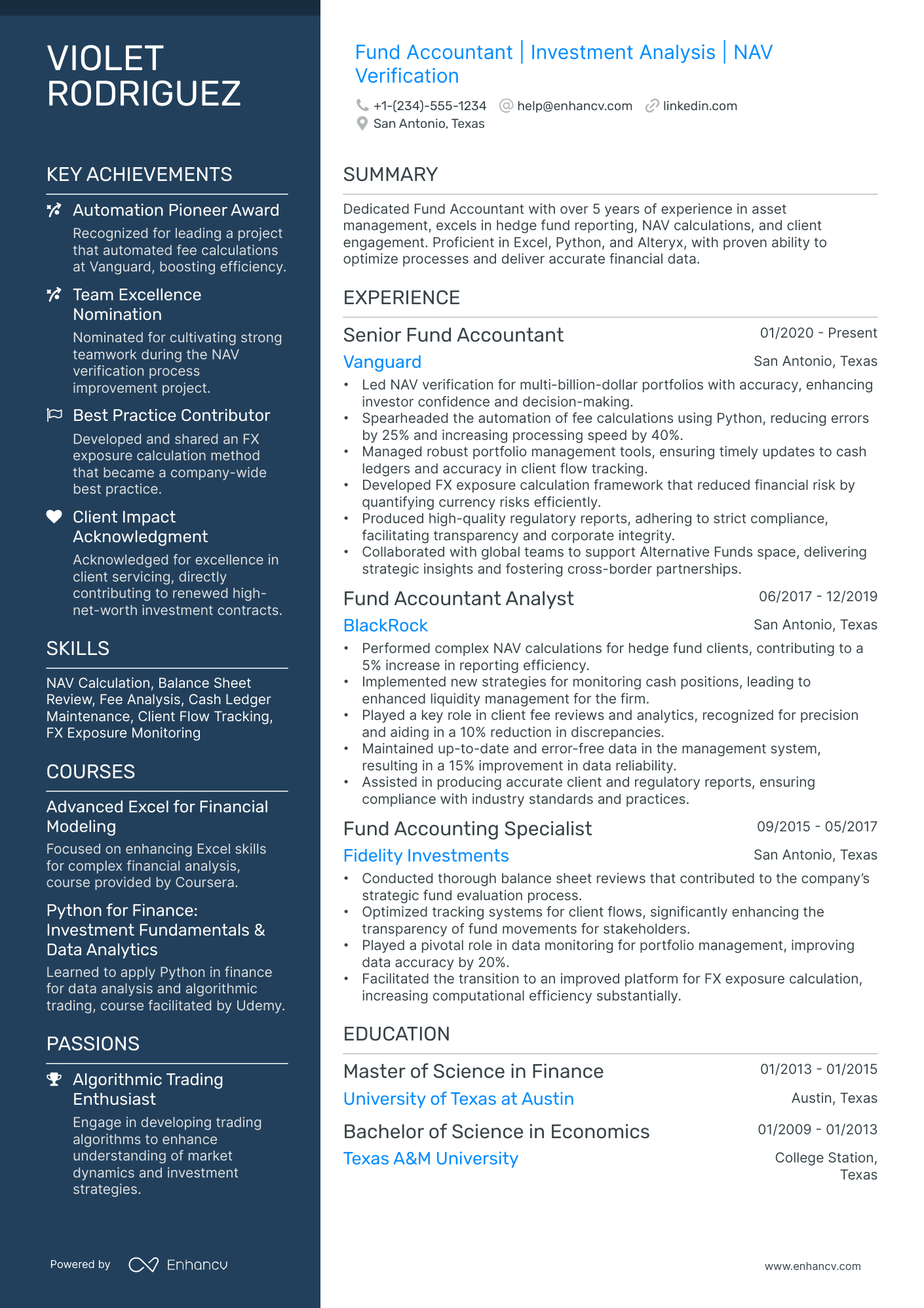
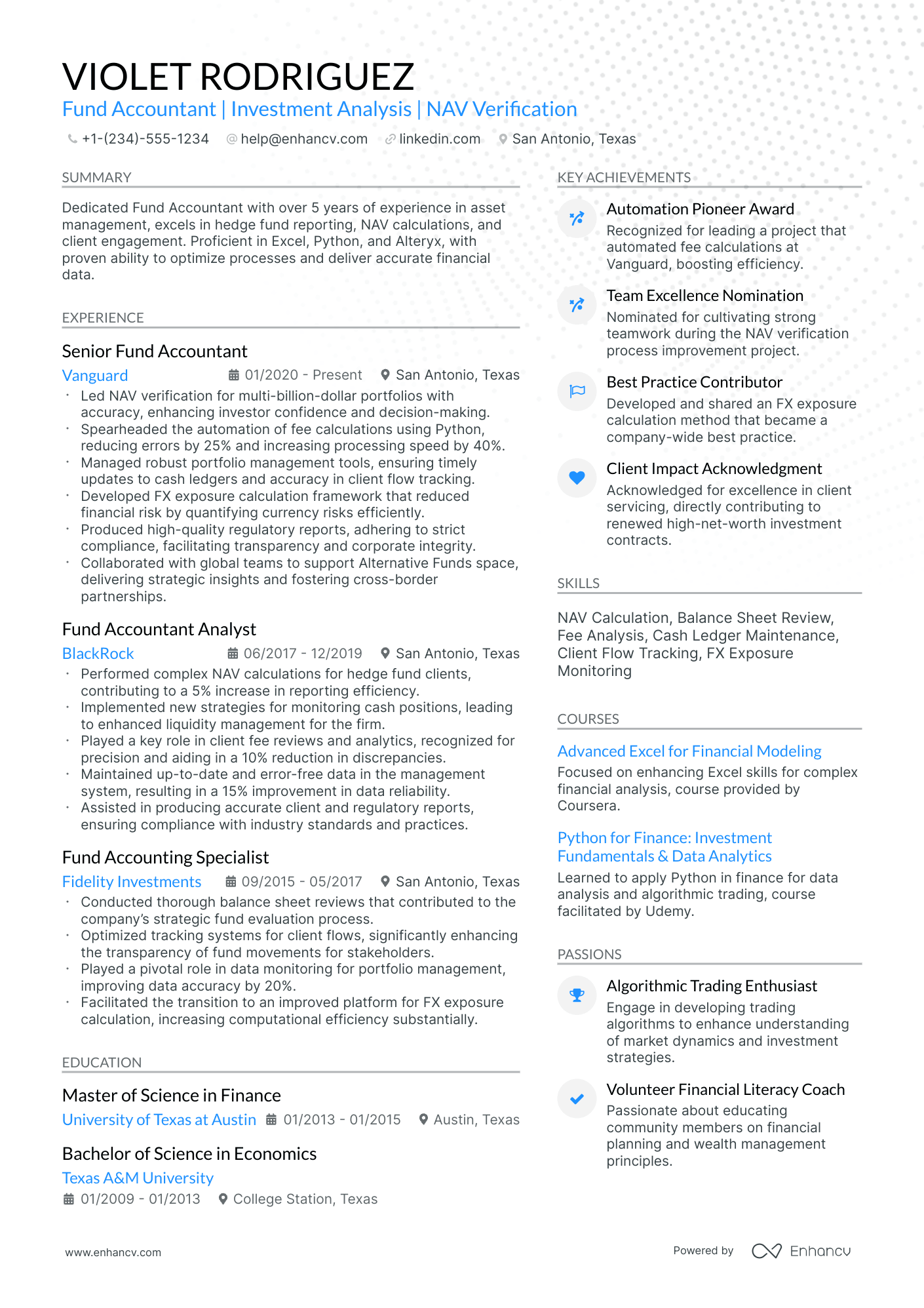
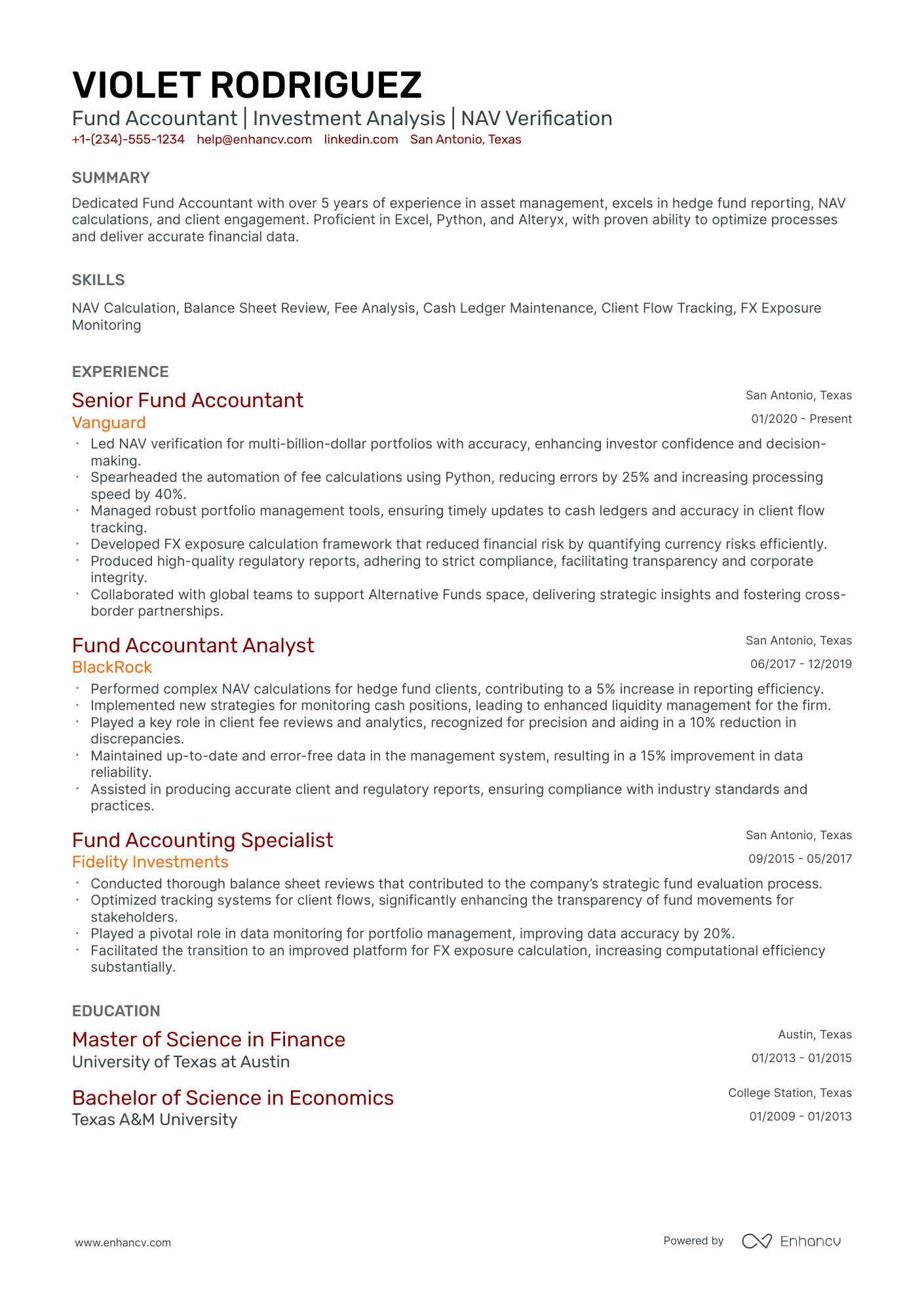
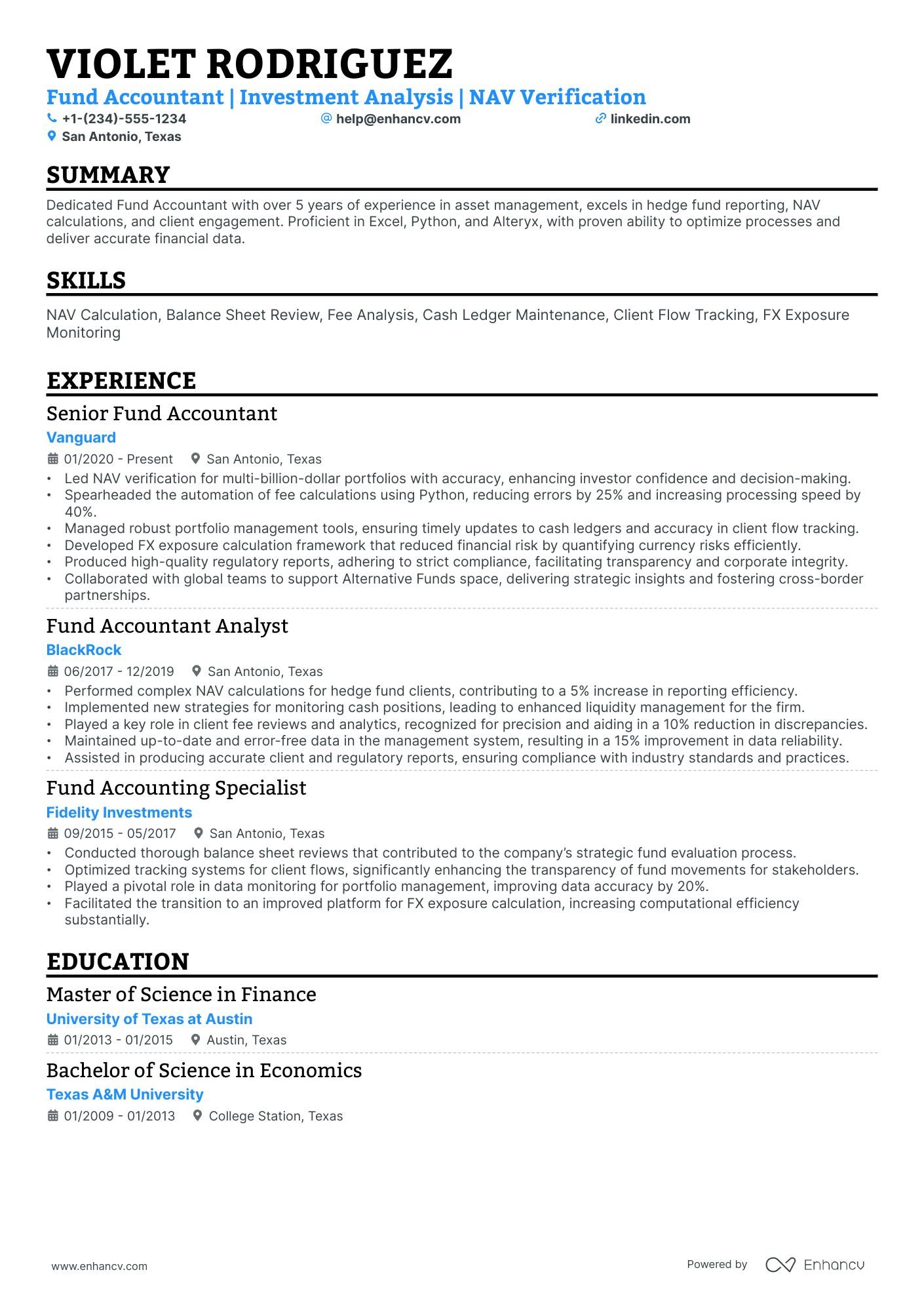
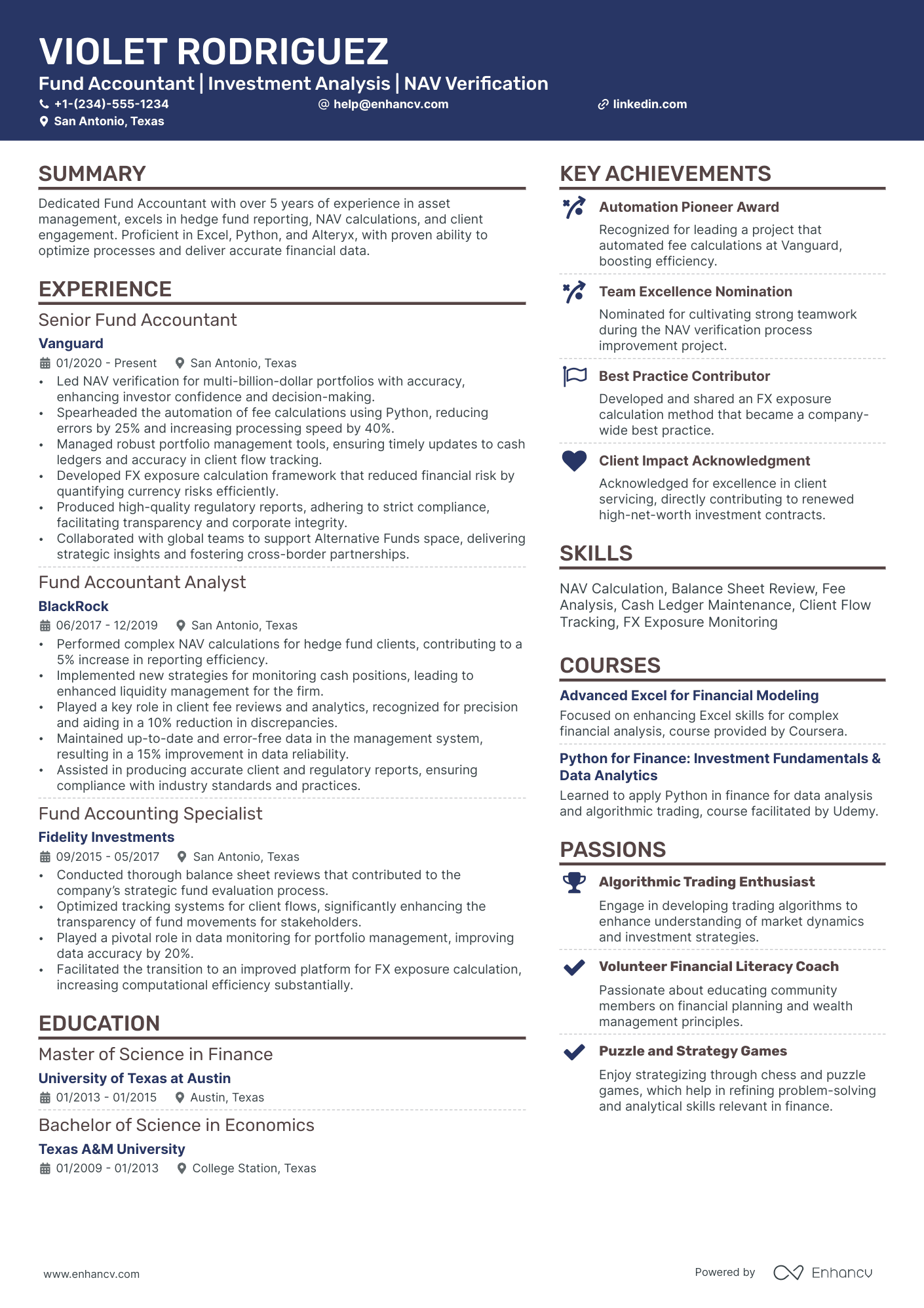
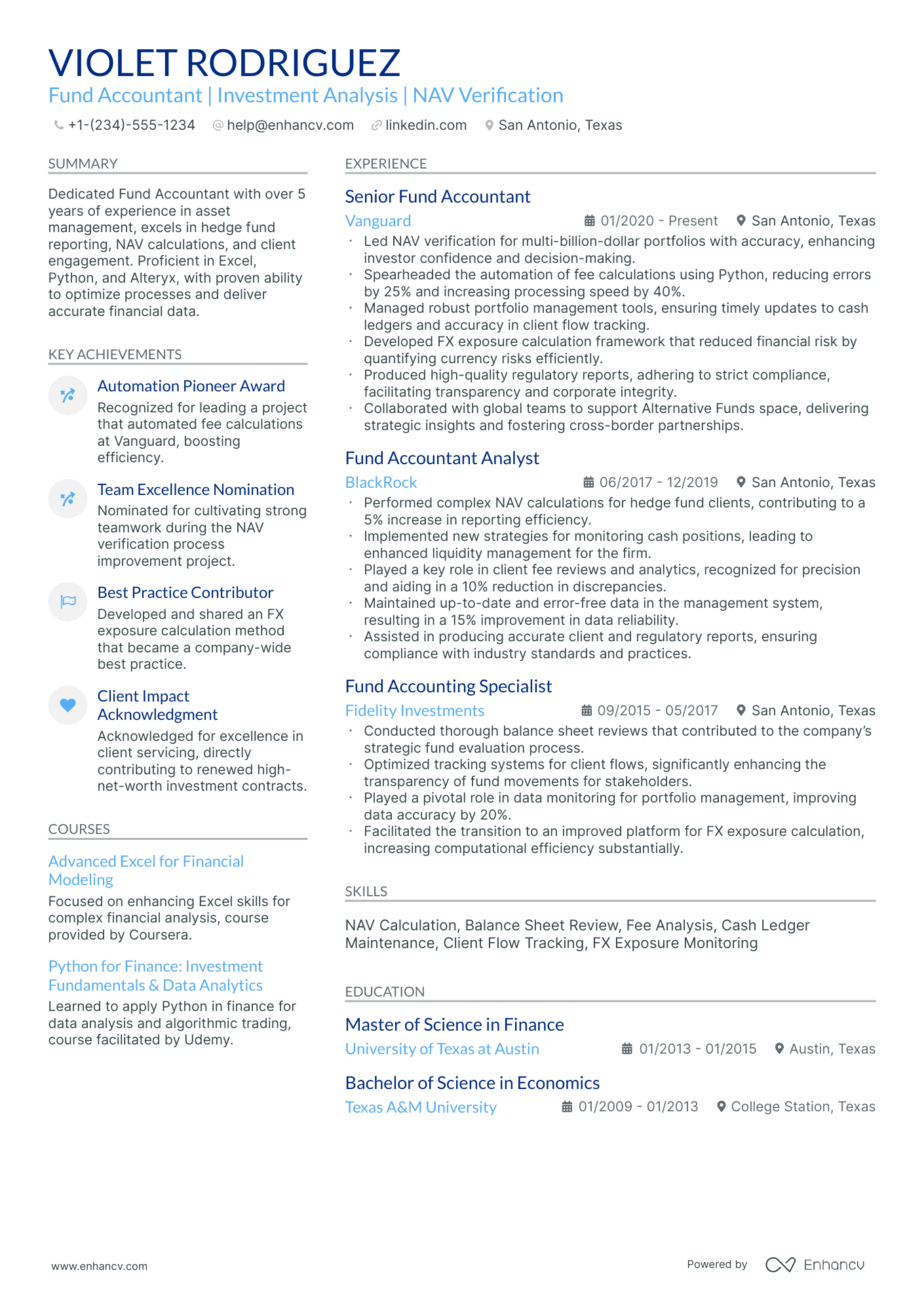
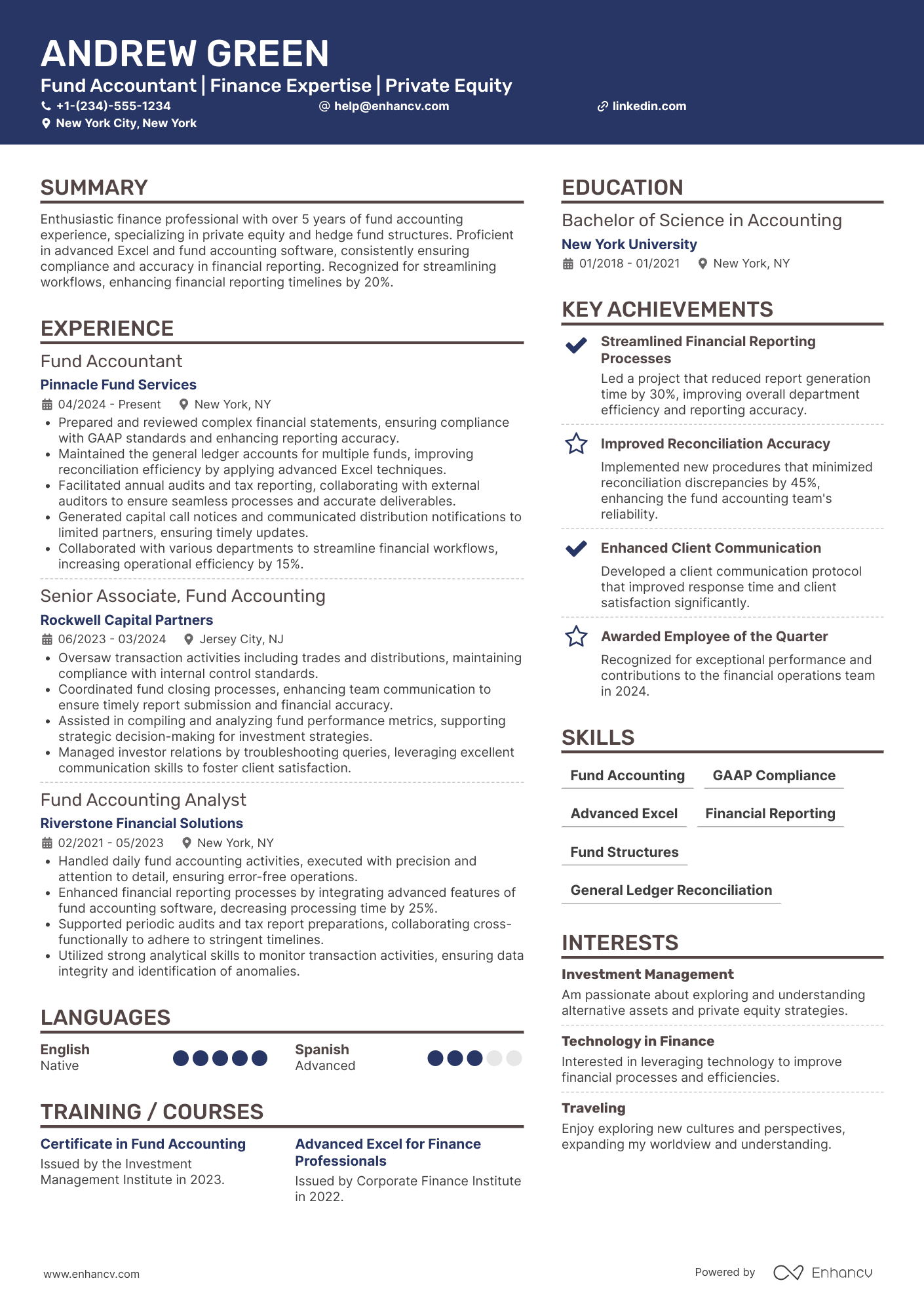
Fund accountant resume submissions often fail because they bury NAV ownership, reconciliations, and investor reporting results under task lists and software names. That makes it hard for applicant tracking systems and recruiters to spot fit quickly in a crowded pipeline.
A strong resume shows what you delivered and how well. Knowing how to make your resume stand out means you should quantify NAV cycles closed on time, break resolution speed, error rate reductions, audit adjustments avoided, funds supported by asset value, and reporting accuracy for investors.

Key takeaways
- Quantify NAV accuracy, close timelines, and reconciliation volume in every experience bullet.
- Tailor resume language to mirror each job posting's fund types, tools, and reporting terms.
- Use reverse-chronological format for experienced candidates and hybrid format for career switchers.
- Place skills above experience on junior resumes to surface fund accounting keywords early.
- Pair each listed skill with a measurable outcome in your summary or experience section.
- Add certifications like CPA or CFA near education to reinforce technical credibility fast.
- Use Enhancv to turn vague task descriptions into focused, metric-driven resume bullets.
Job market snapshot for fund accountants
We analyzed 190 recent fund accountant job ads across major US job boards. These numbers help you understand skills in demand, regional hotspots, employer expectations at a glance.
What level of experience employers are looking for fund accountants
| Years of Experience | Percentage found in job ads |
|---|---|
| 1–2 years | 2.6% (5) |
| 3–4 years | 5.3% (10) |
| 5–6 years | 3.7% (7) |
| 7–8 years | 1.6% (3) |
| 9–10 years | 1.6% (3) |
| 10+ years | 3.7% (7) |
| Not specified | 82.6% (157) |
Fund accountant ads by area of specialization (industry)
| Industry (Area) | Percentage found in job ads |
|---|---|
| Finance & Banking | 98.9% (188) |
Top companies hiring fund accountants
| Company | Percentage found in job ads |
|---|---|
| State Street Corporation | 38.9% (74) |
| US Bank | 13.7% (26) |
| EisnerAmper | 5.8% (11) |
| SS&C Technologies | 5.8% (11) |
Role overview stats
These tables show the most common responsibilities and employment types for fund accountant roles. Use them to align your resume with what employers expect and to understand how the role is structured across the market.
Day-to-day activities and top responsibilities for a fund accountant
| Responsibility | Percentage found in job ads |
|---|---|
| Accounting | 40.5% (77) |
| Fund accounting | 31.6% (60) |
| Investran | 26.3% (50) |
| Excel | 24.7% (47) |
| Financial reporting | 24.2% (46) |
| Microsoft office | 23.2% (44) |
| Financial statements | 18.9% (36) |
| Finance | 16.3% (31) |
| Geneva | 14.2% (27) |
| Fee calculations | 13.2% (25) |
| Audit | 12.6% (24) |
| Private equity | 12.1% (23) |
Type of employment (remote vs on-site vs hybrid)
| Employment type | Percentage found in job ads |
|---|---|
| On-site | 52.6% (100) |
| Hybrid | 45.8% (87) |
How to format a fund accountant resume
Recruiters evaluating fund accountant resumes prioritize technical accounting proficiency, familiarity with fund structures (mutual funds, hedge funds, private equity), and accuracy in NAV calculations, reconciliations, and financial reporting. Choosing the right resume format ensures these signals surface quickly during both human review and ATS parsing, rather than getting buried beneath generic content. A clean, well-structured layout matters just as much as content quality.

I have significant experience in this role—which format should I use?
Use a reverse-chronological format to present your fund accounting career in a clear, progressive timeline. Do:
- Lead with your most recent role and emphasize scope: fund types managed, AUM oversight, team coordination, and reporting responsibilities.
- Highlight role-specific tools and domains such as Geneva, InvestOne, Bloomberg AIM, GAAP/IFRS compliance, and multi-currency reconciliation.
- Quantify outcomes tied to accuracy, efficiency, and business impact rather than listing duties.
- "Managed daily NAV calculations for 12 fund portfolios totaling $2.4B in AUM, reducing pricing errors by 35% through implementation of automated reconciliation workflows in Geneva."
I'm junior or switching into this role—what format works best?
A hybrid format works best, placing a focused skills section above a concise work history to bridge gaps between your background and fund accounting requirements. Do:
- Position core skills—such as NAV computation, fund reconciliation, GAAP knowledge, and Excel modeling—near the top of the resume where recruiters look first.
- Include internships, academic projects, or transitional experience involving accounting, financial analysis, or fund operations, even if the job title wasn't "fund accountant."
- Connect every action to a clear result so hiring managers see capability, not just coursework.
- Financial analysis (skill) → reconciled monthly trial balances for a simulated $500M equity fund during a graduate capstone project (action) → identified and corrected three material discrepancies before final reporting deadline (result).
Why not use a functional resume?
A functional format strips away the timeline and context recruiters need to assess where, when, and how you applied your fund accounting skills, making it harder to verify your readiness for the role.
- A functional resume may be acceptable if you're transitioning from general accounting or audit into fund accounting and have limited direct fund experience—but only if you tie every listed skill to a specific project, engagement, or measurable outcome rather than presenting skills in isolation.
With your resume's structure and layout in place, the next step is filling it with the right sections to highlight your qualifications effectively.
What sections should go on a fund accountant resume
Recruiters expect to see a clean, complete resume that proves you can run accurate fund accounting close cycles and deliver reliable reporting. Understanding which resume sections to include helps you organize your qualifications for maximum clarity.
Use this structure for maximum clarity:
- Header
- Summary
- Experience
- Skills
- Projects
- Education
- Certifications
- Optional sections: Awards, Leadership, Languages
Strong experience bullets should emphasize measurable impact, reporting accuracy, close timelines, reconciliations, and the scope of funds and investors you supported.
Is your resume good enough?
Drop your resume here or choose a file. PDF & DOCX only. Max 2MB file size.
Once you’ve organized the right resume components, you can focus on writing your fund accountant resume experience section to show impact within that structure.
How to write your fund accountant resume experience
The experience section is where you prove you've delivered real results—through accurate fund reporting, NAV calculations, reconciliations, and the tools and methods that define daily fund accounting work. Hiring managers prioritize demonstrated impact over descriptive task lists, so every bullet should connect what you did to a measurable outcome. Building a targeted resume ensures each entry speaks directly to the role's requirements.
Each entry should include:
- Job title
- Company and location (or remote)
- Dates of employment (month and year)
Three to five concise bullet points showing what you owned, how you executed, and what outcomes you delivered:
- Ownership scope: the fund types, portfolios, asset classes, reporting cycles, or client accounts you were directly accountable for as a fund accountant.
- Execution approach: the accounting platforms, reconciliation systems, reporting frameworks, regulatory standards, or valuation methodologies you used to complete your work and inform decisions.
- Value improved: changes you drove in reporting accuracy, reconciliation turnaround, compliance adherence, error reduction, or process efficiency within your fund accounting responsibilities.
- Collaboration context: how you partnered with portfolio managers, auditors, custodians, compliance teams, or investor relations stakeholders to resolve discrepancies, meet deadlines, or support fund operations.
- Impact delivered: outcomes you produced expressed through portfolio scale, reporting reliability, audit readiness, client retention, or operational improvements rather than routine activity descriptions.
Experience bullet formula
A fund accountant experience example
✅ Right example - modern, quantified, specific.
Fund Accountant
NorthBridge Asset Management | Boston, MA
2022–Present
Registered investment adviser overseeing $12B across hedge funds and private credit vehicles with monthly and quarterly closes.
- Led month-end close for five funds ($2.4B AUM), reconciling custodians and prime brokers in Advent Geneva and Bloomberg, cutting close cycle from seven to five business days.
- Automated capital activity workflows in Excel Power Query and VBA, reducing subscription and redemption processing errors by 35% and improving same-day investor trade confirmations from 88% to 97%.
- Built and maintained NAV validation controls, partnering with the valuation committee and external administrators to resolve pricing breaks within twenty-four hours for 95% of exceptions.
- Prepared GAAP financial statements and footnotes in Workiva, coordinating with auditors to reduce audit adjustments by 40% and complete year-end issuance two weeks earlier.
- Streamlined management fee and performance allocation calculations using Geneva and Alteryx, improving accrual accuracy to 99.5% and preventing an estimated $120K in quarterly fee leakage.
Now that you've seen how a strong experience section comes together, let's look at how to adjust yours to match the specific fund accountant role you're targeting.
How to tailor your fund accountant resume experience
Recruiters evaluate fund accountant resumes through both human review and applicant tracking systems, so tailoring your resume to the job description is essential. Tailoring ensures the skills, tools, and achievements you highlight directly reflect what the hiring team prioritizes.
Ways to tailor your fund accountant experience:
- Mirror the specific fund types listed such as hedge or mutual funds.
- Match accounting platforms named like Geneva or Advent.
- Use the exact reconciliation terminology found in the posting.
- Reflect NAV calculation methods or reporting frequencies mentioned.
- Highlight GAAP or IFRS compliance if the role requires it.
- Include investor reporting or capital activity experience when referenced.
- Emphasize audit coordination responsibilities if listed in the description.
- Align your workflow language with their fund administration processes.
Tailoring means connecting your real accomplishments to the role's stated requirements, not forcing unrelated keywords into your experience.
Resume tailoring examples for fund accountant
| Job description excerpt | Untailored | Tailored |
|---|---|---|
| Perform daily NAV calculations for multi-strategy hedge fund portfolios using Geneva and reconcile with administrator statements | Assisted with accounting tasks and helped maintain accurate financial records for investment portfolios. | Calculated daily NAV for 12 multi-strategy hedge fund portfolios in Geneva, reconciling valuations against administrator statements with a 99.8% accuracy rate. |
| Prepare monthly investor capital activity allocations, including contributions, redemptions, and management/incentive fee computations across multiple fund structures | Handled fund reporting duties and supported the preparation of various financial documents for investors. | Prepared monthly capital activity allocations—contributions, redemptions, and management/incentive fee computations—across seven parallel fund structures serving 200+ limited partners. |
| Coordinate annual audit processes with Big Four firms, ensuring timely delivery of audited financial statements in compliance with U.S. GAAP | Participated in audit-related activities and communicated with external auditors during year-end close. | Coordinated annual audits with Deloitte for five fund entities, delivering U.S. GAAP-compliant financial statements two weeks ahead of deadline for three consecutive years. |
Once you’ve aligned your experience with the fund accountant role’s priorities, the next step is to quantify your achievements to show the impact of that work.
How to quantify your fund accountant achievements
Quantifying your achievements proves you protect accuracy, reduce risk, and speed reporting. Focus on close timelines, reconciliation volume, NAV accuracy, audit findings, and control exceptions across funds, classes, and custodians.
Quantifying examples for fund accountant
| Metric | Example |
|---|---|
| Close cycle time | "Cut month-end close from seven to five business days by automating accruals and tie-outs in Excel Power Query and the accounting system for twelve funds." |
| NAV accuracy | "Reduced NAV error rate from 0.30% to 0.05% by adding daily price tolerance checks and exception workflows across three custodians." |
| Reconciliation throughput | "Reconciled 1,200+ positions weekly across equities, fixed income, and FX, clearing 98% of breaks within twenty-four hours using Black Mountain and Excel." |
| Audit compliance | "Supported two annual audits with zero material findings by delivering PBC schedules within forty-eight hours and maintaining SOX-ready documentation for forty controls." |
| Fee leakage reduction | "Recovered $180K in annual management fees by correcting fee rate tables and share-class mappings, then validating calculations against offering documents." |
Turn vague job duties into measurable, recruiter-ready resume bullets in seconds with Enhancv's Bullet Point Generator.
With strong bullet points in place, it's equally important to showcase the right mix of hard and soft skills that hiring managers expect from a fund accountant.
How to list your hard and soft skills on a fund accountant resume
Your skills section shows you can close the books accurately, meet investor reporting deadlines, and stay audit-ready; recruiters and an ATS (applicant tracking system) scan this section for keyword match and fit, so aim for a hard-skills-heavy mix with role-specific soft skills. Fund accountant roles require a blend of:
- Product strategy and discovery skills.
- Data, analytics, and experimentation skills.
- Delivery, execution, and go-to-market discipline.
- Soft skills.
Your skills section should be:
- Scannable (bullet-style grouping).
- Relevant to the job post.
- Backed by proof in experience bullets.
- Updated with current tools.
Place your skills section:
- Above experience if you're junior or switching careers.
- Below experience if you're mid/senior with strong achievements.

Hard skills
Listing relevant hard skills is essential for fund accountant resumes:
- Net asset value calculations
- Fund accounting close
- Capital calls, distributions
- Waterfall calculations
- Management fee calculations
- Performance reporting
- GAAP financial statements
- IFRS reporting
- Investor statement preparation
- Reconciliations, variance analysis
- Excel, Power Query, pivot tables
- Bloomberg, FactSet
Soft skills
Complement your technical abilities with soft skills that demonstrate how you work:
- Own month-end deadlines
- Escalate breaks fast
- Communicate variances clearly
- Coordinate with fund administrators
- Partner with portfolio teams
- Align with auditors early
- Document processes consistently
- Prioritize high-risk accounts
- Review work for accuracy
- Resolve investor inquiries professionally
- Manage multiple fund closes
- Challenge assumptions with data
How to show your fund accountant skills in context
Skills shouldn't live only in a dedicated skills list. Explore resume skills examples to see how top candidates weave competencies throughout their documents.
They should be demonstrated in:
- Your summary (high-level professional identity)
- Your experience (proof through outcomes)
Here's what that looks like in practice.
Summary example
Senior fund accountant with 10 years in hedge fund administration. Skilled in NAV reconciliation, Bloomberg AIM, and investor reporting. Reduced month-end close cycle by 30% through automated workflow design and cross-team coordination.
- Signals senior-level expertise immediately
- Names industry-specific tools
- Quantifies a clear operational outcome
- Highlights collaboration as a strength
Experience example
Senior Fund Accountant
Apex Group | Remote
March 2019–Present
- Reconciled daily NAV across 12 multi-strategy funds using Geneva, cutting pricing discrepancies by 45% through improved broker collaboration.
- Partnered with compliance and operations teams to automate investor capital activity reporting, reducing manual entry errors by 60%.
- Led quarterly audit preparation for $2.1B in AUM, streamlining documentation workflows and shortening audit completion timelines by three weeks.
- Every bullet includes measurable proof.
- Skills surface naturally through outcomes.
Once you’ve tied your fund accountant abilities to measurable outcomes and relevant examples, the next step is to apply that approach to a fund accountant resume with no experience by highlighting transferable work and academic achievements.
How do I write a fund accountant resume with no experience
Even without full-time experience, you can demonstrate readiness. Writing a resume without work experience is possible through:
- Accounting or finance internships
- Fund administration coursework projects
- University endowment accounting assignment
- Excel-based NAV reconciliation project
- Financial statement tie-out exercises
- Audit support case study deliverables
- General ledger journal entry simulations
- Bloomberg or FactSet training labs
Focus on:
- Fund accounting terminology and workflows
- Reconciliations, tie-outs, and controls
- Excel models and data accuracy
- Reporting cadence and deadline compliance
Resume format tip for entry-level fund accountant
Use a hybrid resume format because it highlights fund accountant skills and projects first, while still showing education and any related experience. Do:
- Put "Projects" above "Experience."
- Quantify results using counts and variances.
- List tools: Excel, Bloomberg, FactSet.
- Use fund accountant keywords from postings.
- Add relevant coursework under education.
- Built an Excel NAV reconciliation for a mock equity fund, matched 120 positions to custodian data, and reduced unreconciled breaks from 18 to two.
Since your education section carries extra weight when you're entering the field without direct experience, presenting it strategically can make a strong impression on hiring managers.
How to list your education on a fund accountant resume
Your education section helps hiring teams confirm you have the accounting and finance foundation a fund accountant needs. It validates core technical knowledge quickly.
Include:
- Degree name
- Institution
- Location
- Graduation year
- Relevant coursework (for juniors or entry-level candidates)
- Honors & GPA (if 3.5 or higher)
Skip month and day details—list the graduation year only.
Here's a strong education entry tailored for a fund accountant resume.
Example education entry
Bachelor of Science in Accounting
Villanova University, Villanova, PA
Graduated 2021
GPA: 3.7/4.0
- Relevant coursework: Financial Reporting, Investment Analysis, Auditing, and Portfolio Accounting
- Honors: Magna Cum Laude, Dean's List (all semesters)
How to list your certifications on a fund accountant resume
Certifications on your resume show your commitment to learning, your proficiency with accounting tools, and your industry relevance as a fund accountant. They also help validate specialized knowledge beyond your degree.
Include:
- Certificate name
- Issuing organization
- Year
- Optional: credential ID or URL
- Place certifications below education when they are older, less relevant, or you want your degree to lead your fund accountant profile.
- Place certifications above education when they are recent, highly relevant, or required for the fund accountant roles you target.
Best certifications for your fund accountant resume
- Chartered Financial Analyst (CFA)
- Certified Public Accountant (CPA)
- Certified Management Accountant (CMA)
- Chartered Alternative Investment Analyst (CAIA)
- Financial Risk Manager (FRM)
- Investment Operations Certificate (IOC)
- Bloomberg Market Concepts (BMC)
Once you’ve positioned your credentials where they’re easy to verify, use your fund accountant resume summary to connect those qualifications to the value you’ll deliver.
How to write your fund accountant resume summary
Your resume summary is the first thing a recruiter reads. A strong one immediately signals you have the skills and experience to handle fund accounting responsibilities.
Keep it to three to four lines, with:
- Your title and total years of fund accounting experience.
- The domain you work in, such as hedge funds, private equity, or mutual funds.
- Core tools and skills like NAV calculations, Bloomberg, or Geneva.
- One or two measurable achievements that show your early impact.
- Soft skills tied to real outcomes, such as attention to detail that reduced reconciliation errors.

PRO TIP
At a junior level, emphasize technical skills, relevant tools, and any concrete contributions from internships or early roles. Avoid vague phrases like "passionate team player" or "eager to grow." Recruiters want to see what you can do, not what you hope to become.
Example summary for a fund accountant
Fund accountant with two years of experience in mutual fund NAV reporting. Skilled in Geneva and daily reconciliations. Reduced pricing discrepancies by 18% through improved validation workflows.
Optimize your resume summary and objective for ATS
Drop your resume here or choose a file.
PDF & DOCX only. Max 2MB file size.
Now that your summary captures your strongest qualifications, make sure your header presents the essential contact and identification details recruiters need to reach you.
What to include in a fund accountant resume header
Your resume header is the top section with your identifying details, and it improves visibility, credibility, and recruiter screening for a fund accountant role.
Essential resume header elements
- Full name
- Tailored job title and headline
- Location
- Phone number
- Professional email
- GitHub link
- Portfolio link
A LinkedIn link helps recruiters verify experience quickly and supports screening.
Don't include a photo on a fund accountant resume unless the role is explicitly front-facing or appearance-dependent.
Keep the header consistent with your application name, use a local United States location, and match your fund accountant title to the job posting.
Fund accountant resume header
Jordan M. Parker
Fund Accountant | Hedge Fund NAV, Reconciliations, Financial Reporting
Boston, MA
(617) 555-12XX
jordan.parker@enhancv.com
github.com/yourname
yourwebsite.com
linkedin.com/in/yourname
Once your contact details and professional identifiers are set at the top, add targeted additional sections to strengthen your fund accountant resume with relevant supporting information.
Additional sections for fund accountant resumes
Adding extra sections helps you stand out when core qualifications are similar among candidates applying for the same fund accountant role.
Choose sections that reinforce your technical credibility, industry knowledge, or professional commitment:
- Languages
- Professional certifications (CPA, CFA, CAIA)
- Industry conferences and continuing education
- Professional memberships (CFA Institute, AICPA)
- Volunteer experience in financial literacy
- Publications or research in fund accounting
- Hobbies and interests
Once you've strengthened your resume with relevant additional sections, pairing it with a well-crafted cover letter can further set your application apart.
Do fund accountant resumes need a cover letter
A cover letter isn't required for a fund accountant, but it often helps in competitive searches or firms that expect one. If you're unsure where to start, understanding what a cover letter is and how it complements your resume can make the difference when your application needs context, or when you're targeting a specific team.
Use a cover letter to add details your resume can't:
- Explain role and team fit: Match your experience to the fund accountant workflow, reporting cadence, and the stakeholders you support.
- Highlight one or two outcomes: Tie a project to a measurable result, like fewer breaks, faster closes, cleaner reconciliations, or improved investor reporting accuracy.
- Show business understanding: Reference the fund product, investors, and operational risks, and connect your work to valuation, controls, and client expectations.
- Address non-obvious experience: Clarify a career transition, a gap, or adjacent experience, and map it directly to fund accountant responsibilities.
Drop your resume here or choose a file.
PDF & DOCX only. Max 2MB file size.
Even if you decide a cover letter won’t add value for this application, using AI to improve your fund accountant resume is the next step to strengthen the document that hiring teams review first.
Using AI to improve your fund accountant resume
AI can sharpen your resume's clarity, structure, and impact. It helps tighten language and highlight measurable results. But overuse dulls authenticity. Once your content is clear and role-aligned, step away from the tool. For practical guidance, explore these ChatGPT resume writing prompts to get started.
Here are 10 prompts you can copy and paste to strengthen specific sections of your fund accountant resume:
Strengthen summary focus
Quantify experience bullets
Tighten action verbs
Align skills section
Improve certification descriptions
Refine education details
Clarify project contributions
Remove redundant phrasing
Target fund-specific language
Optimize bullet structure
Conclusion
A strong fund accountant resume shows measurable outcomes, role-specific skills, and a clear structure. It highlights NAV accuracy, timely closes, reconciliations, and audit support. It uses clean headings, consistent dates, and concise bullets that make results easy to scan.
This approach fits today’s hiring market and stays relevant as reporting demands and controls tighten. It proves you can deliver accurate work, meet deadlines, and support stakeholders with reliable financial data.