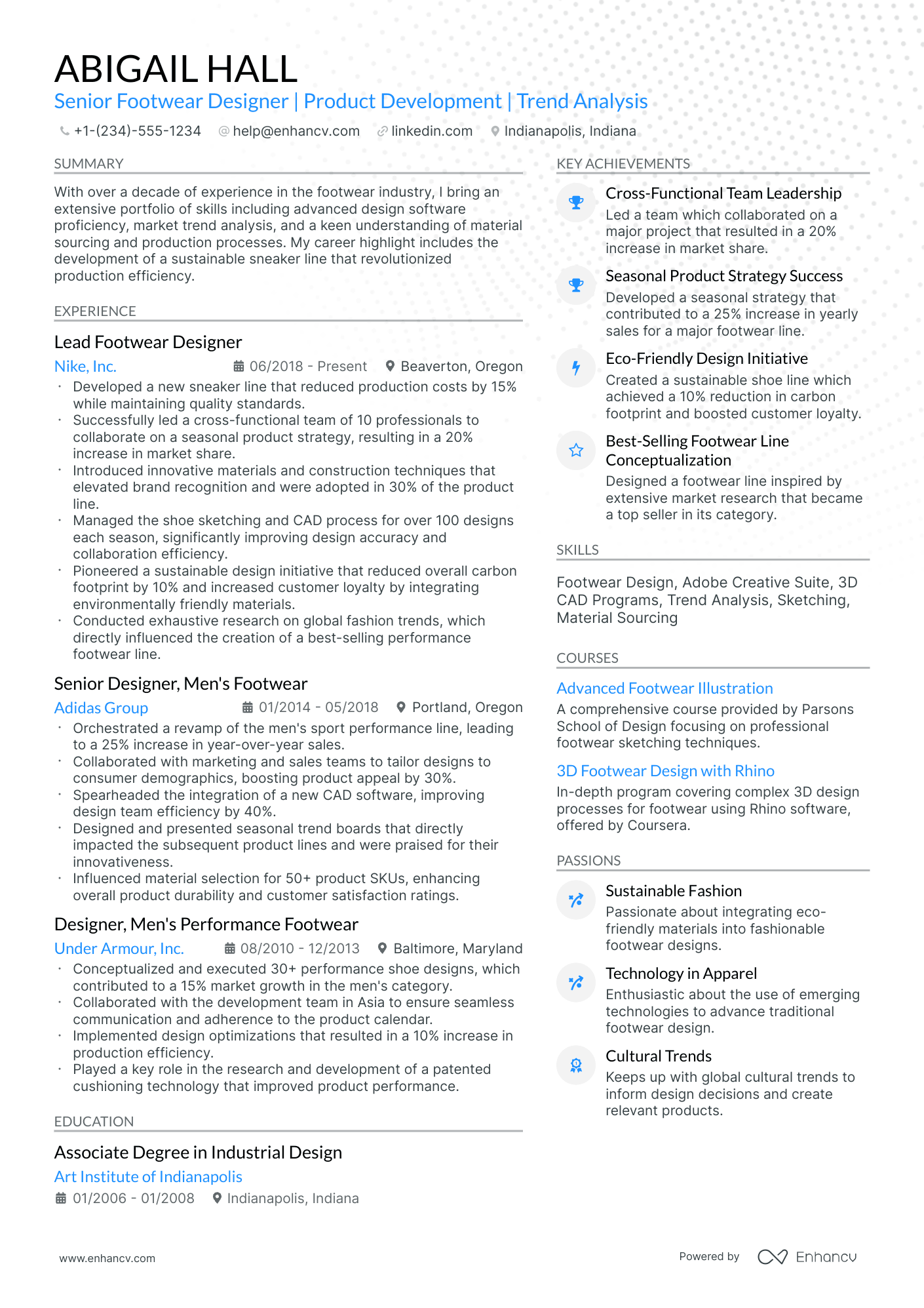
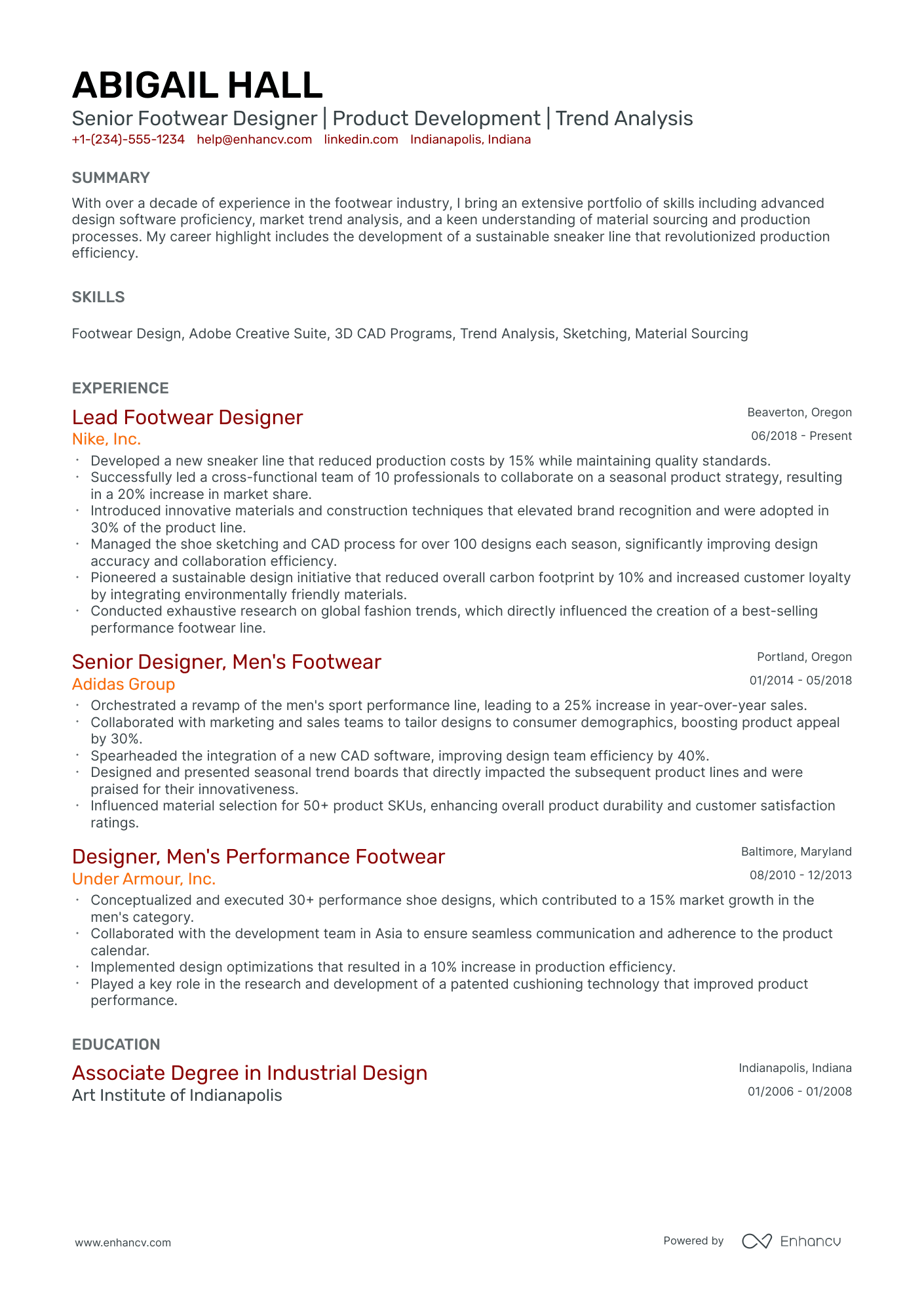
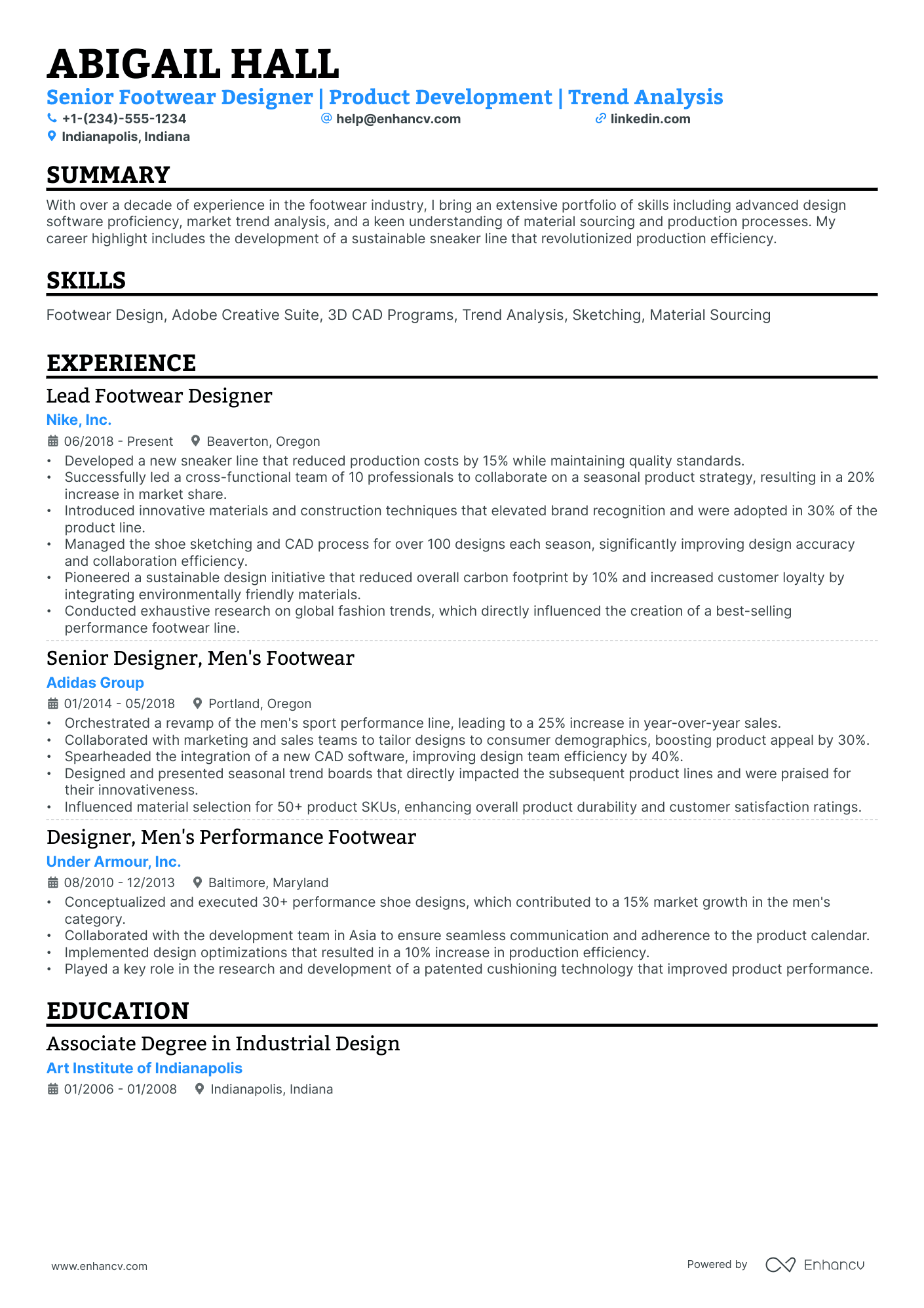
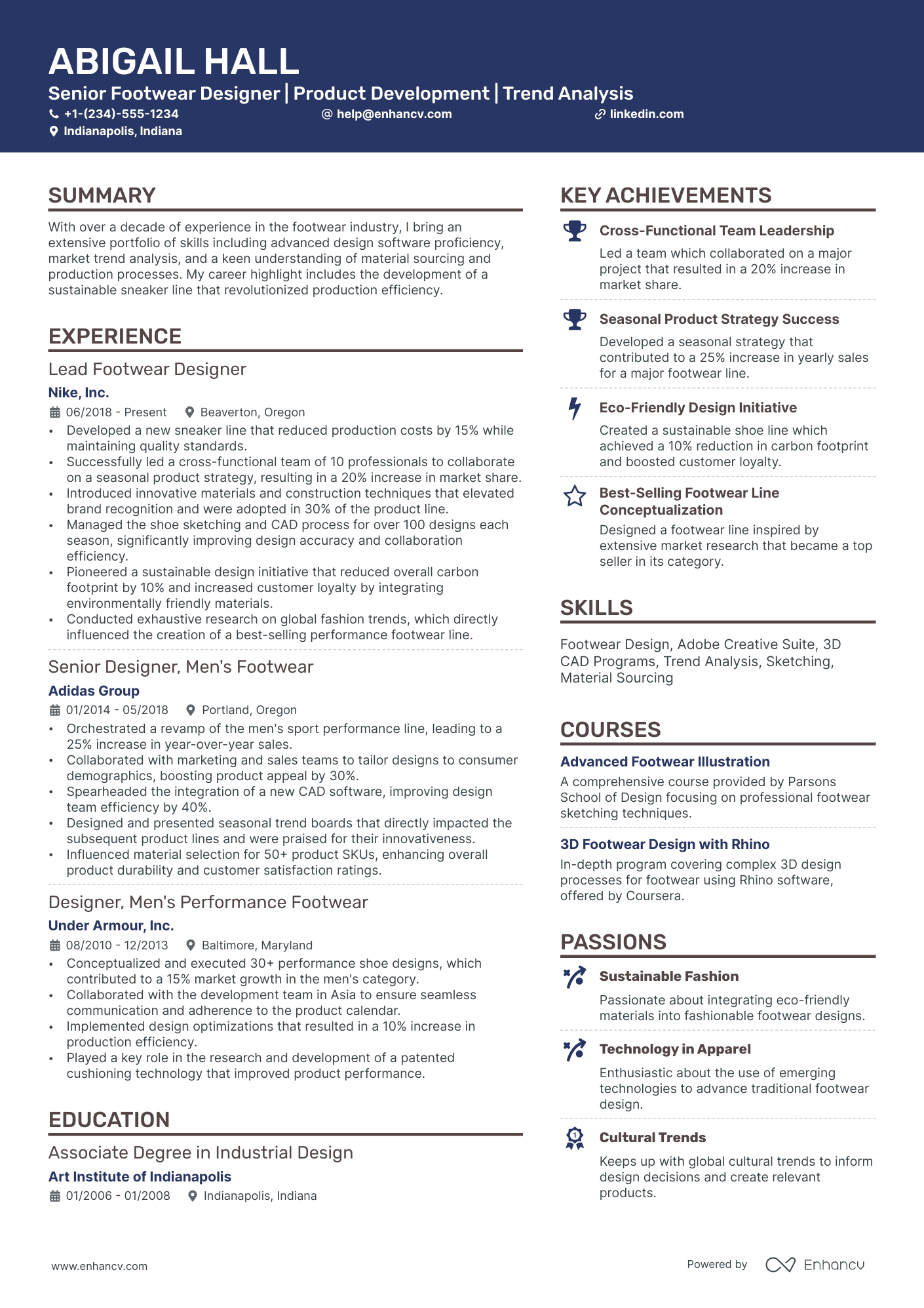
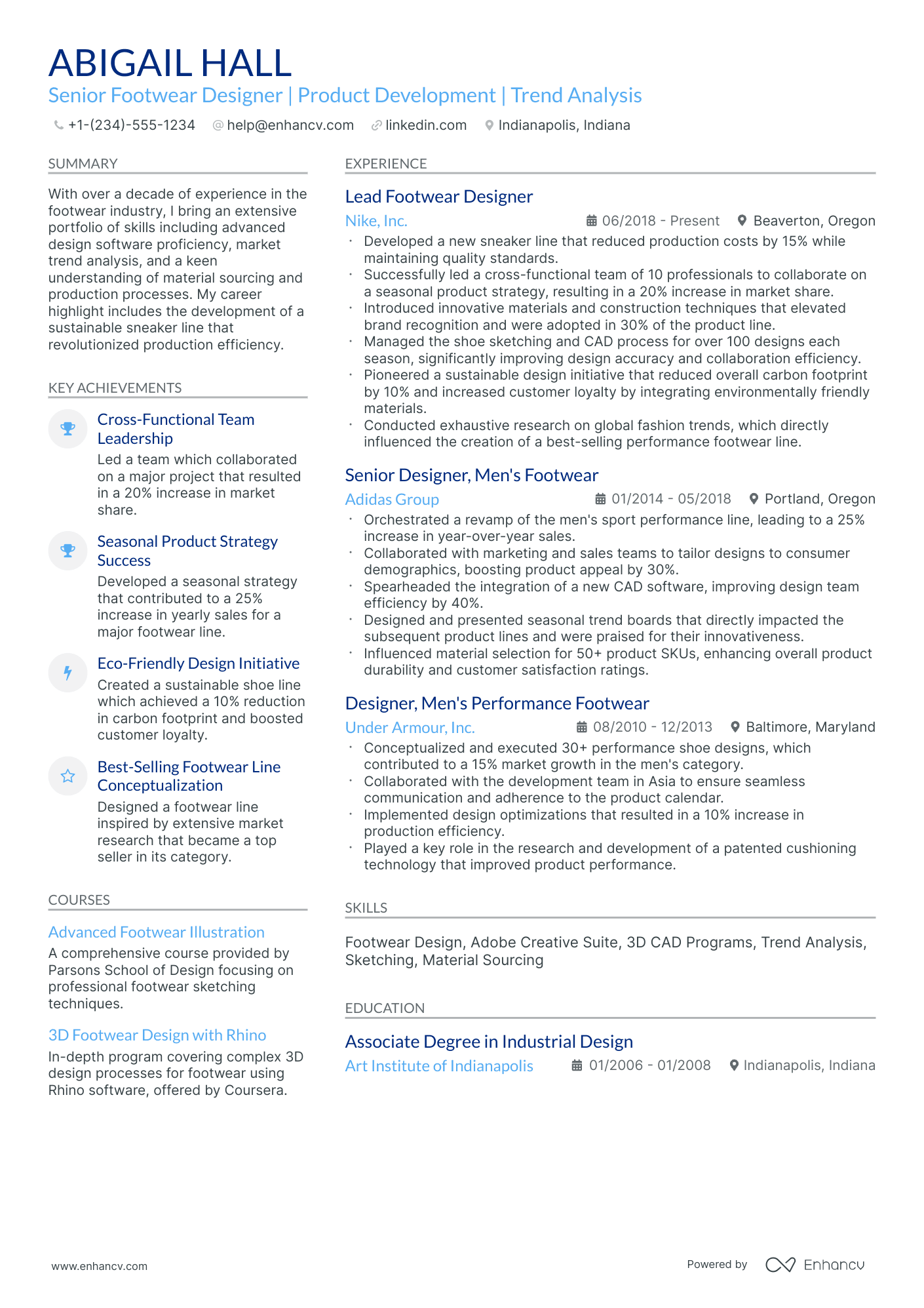
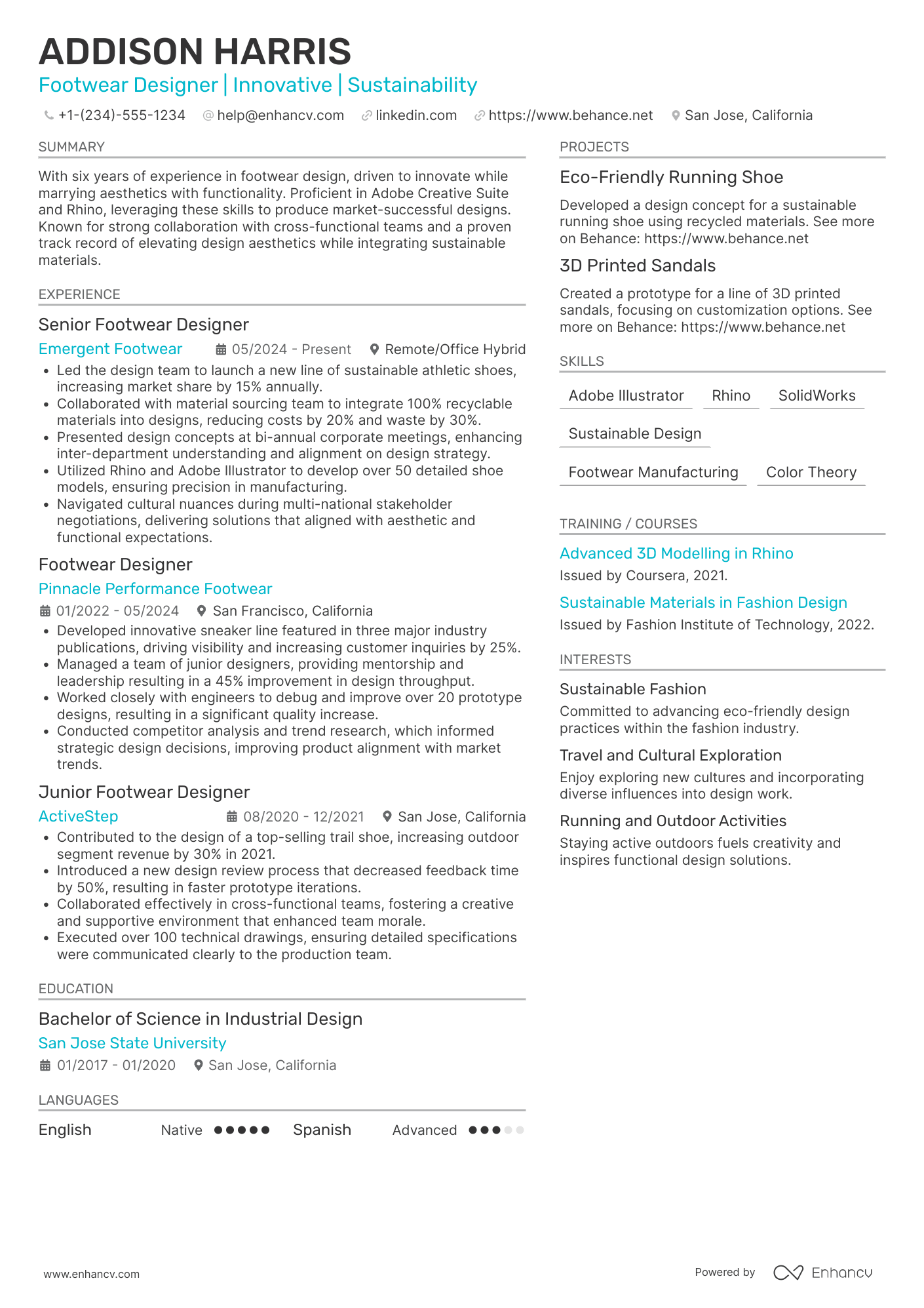
Most footwear designer resume drafts fail because they read like tool inventories, not product stories. That buries impact during ATS screening and fast recruiter scans, especially when dozens of candidates share similar brand names.
A strong resume shows what you shipped and what changed because of your work. You should highlight margin gains, cost reductions, on-time launches, fit and durability improvements, sell-through lifts, and fewer returns. Quantify scope like styles delivered, price points, factories managed, and markets supported. If you're unsure where to begin, learning how to write a resume that communicates impact is the essential first step.

Key takeaways
- Quantify design impact with sell-through rates, cost savings, and development cycle improvements in every bullet.
- Use reverse-chronological format for experienced designers and hybrid format for career changers or juniors.
- Tailor your resume to each job posting by mirroring the exact tools, materials, and methods listed.
- Anchor skills in real outcomes across your summary and experience rather than listing them in isolation.
- Include portfolio links, tech pack samples, and prototype evidence to prove hands-on design capability.
- Pair a focused three-to-four-line summary with consistent formatting so recruiters find your value fast.
- Use Enhancv to refine bullet points and align your resume with role-specific language before applying.
How to format a footwear designer resume
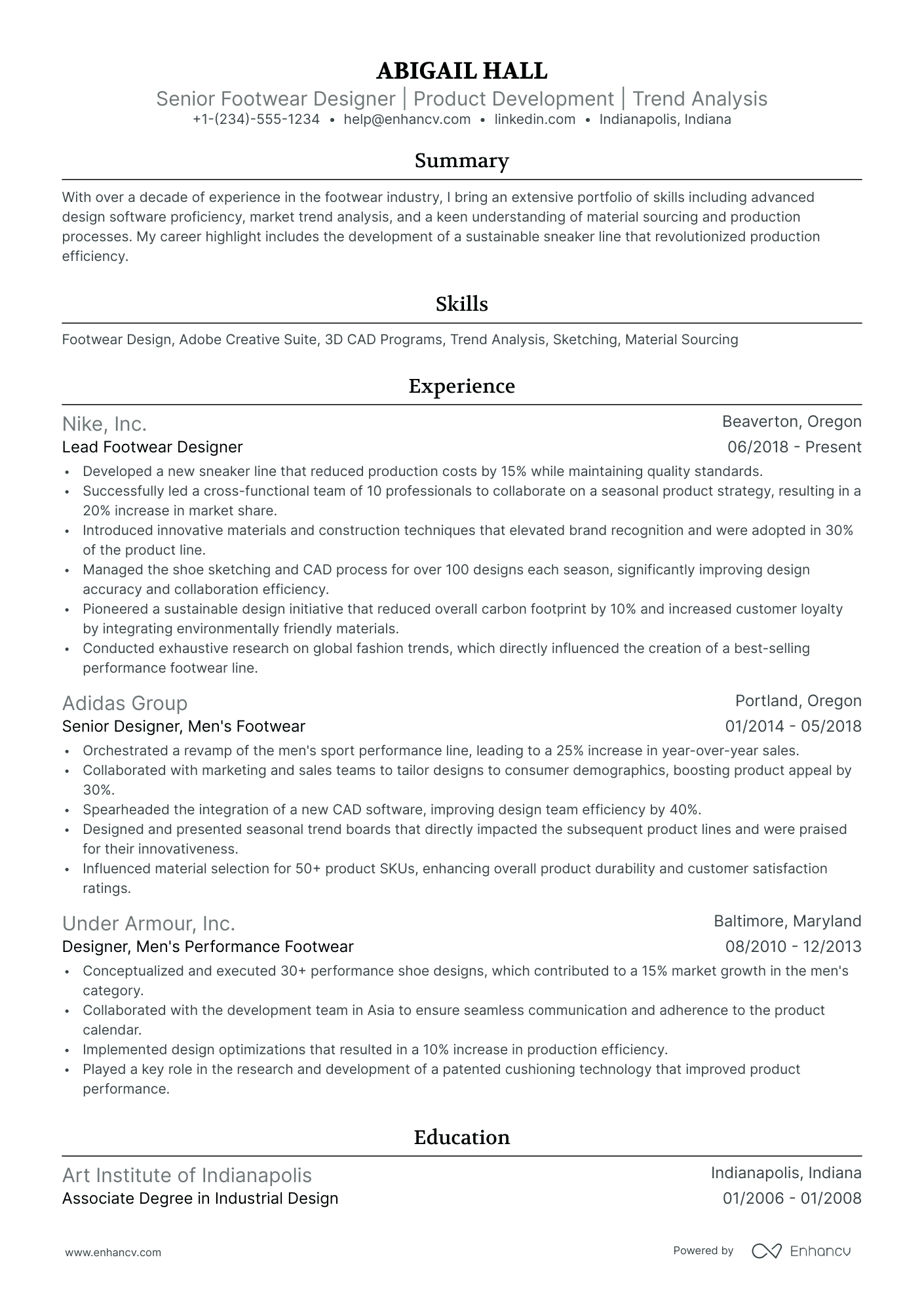
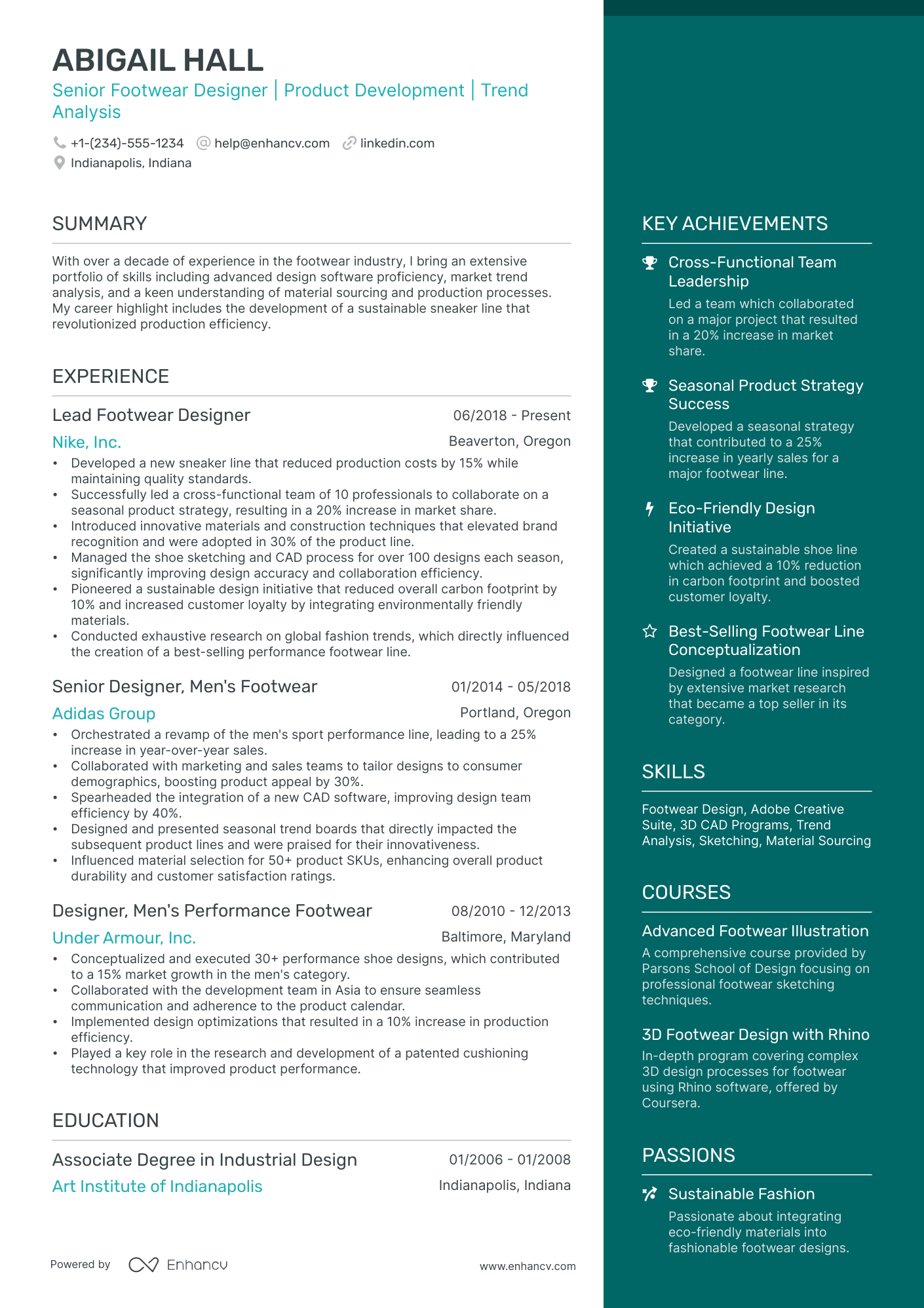
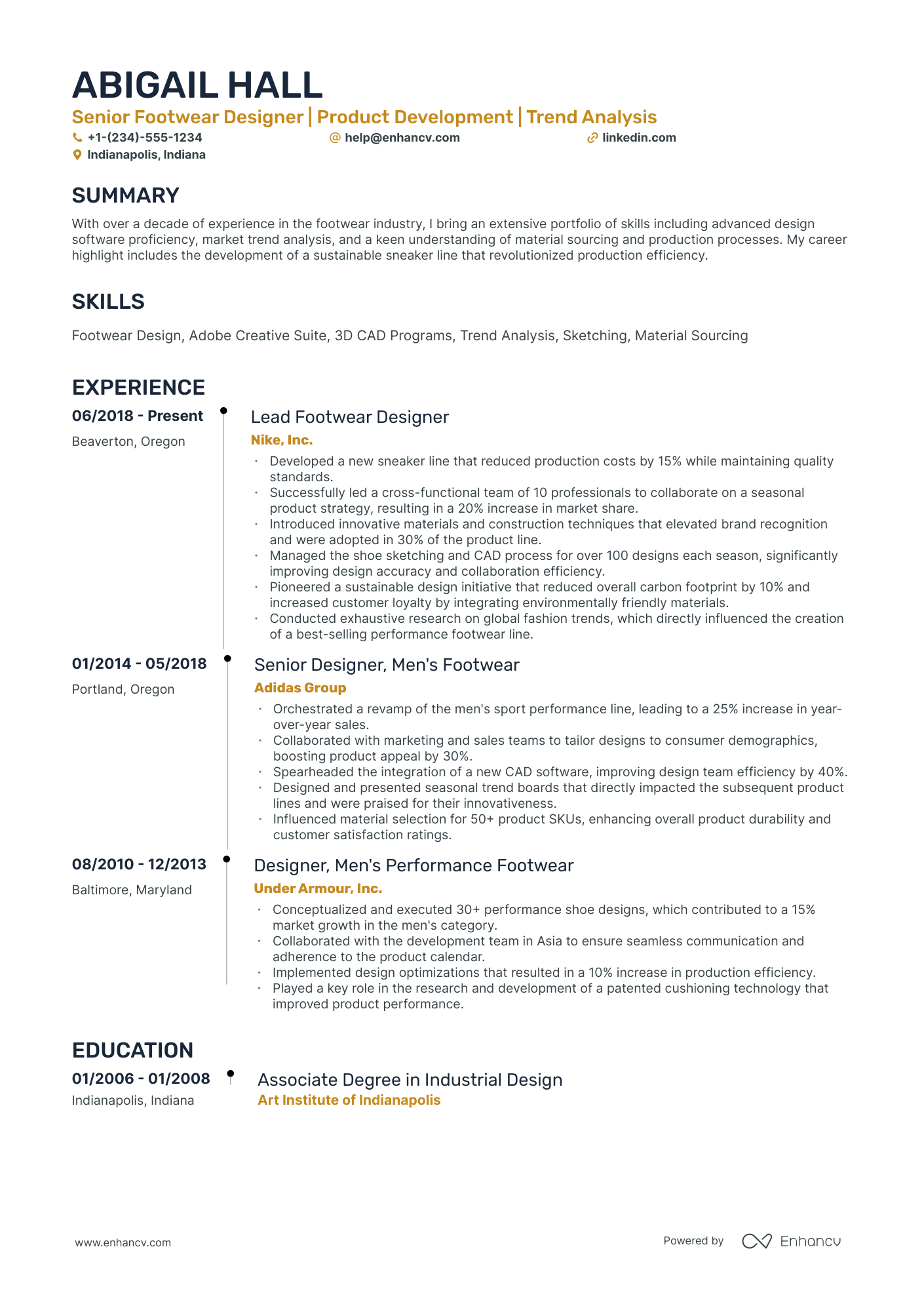
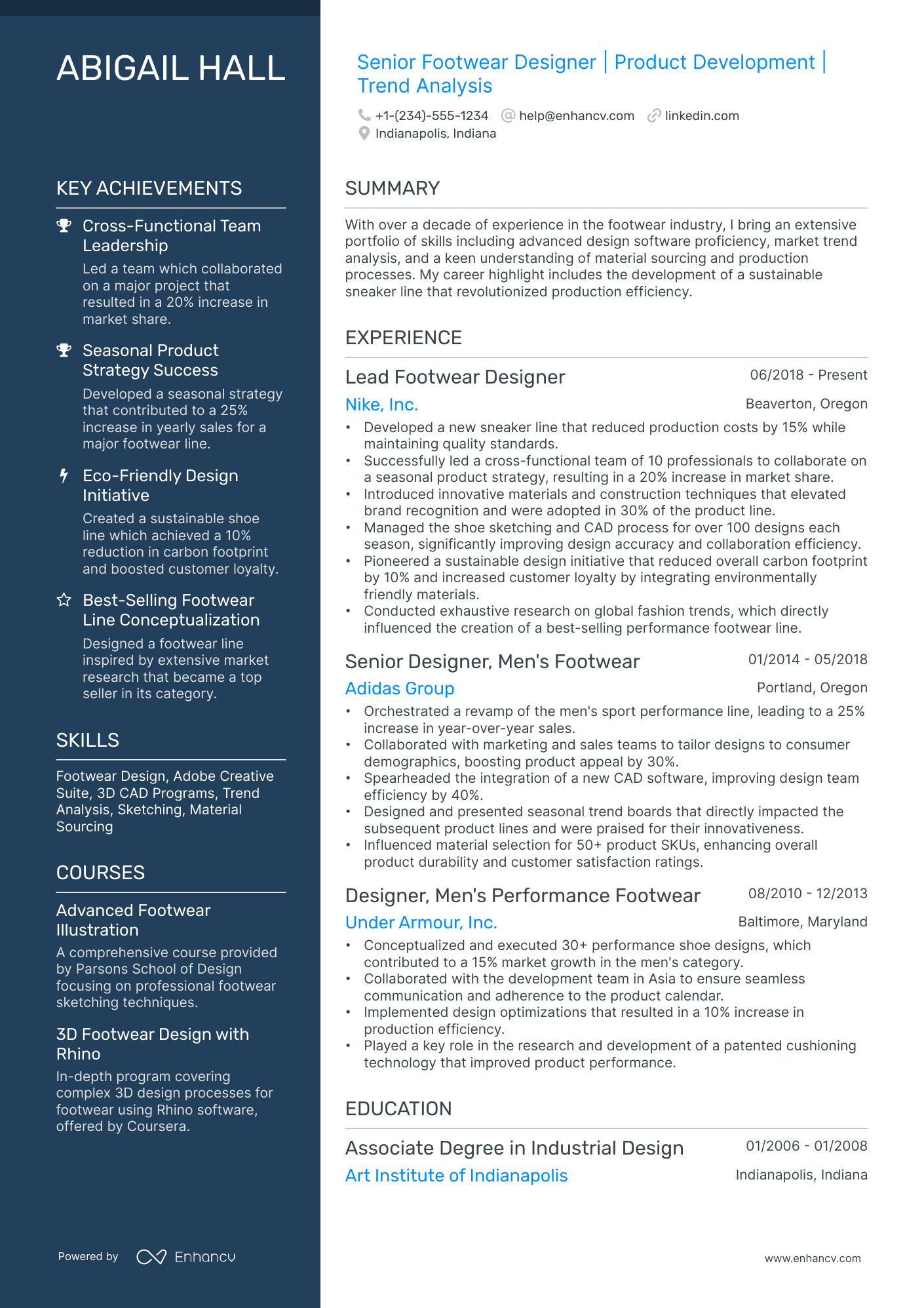
Recruiters evaluating footwear designer candidates prioritize a strong portfolio sensibility, material knowledge, technical design skills, and the ability to move a product from concept through production. A clean, well-structured resume format ensures these signals—along with brand experience and collaborative project outcomes—are immediately visible during a quick scan and parse correctly through an applicant tracking system (ATS).

I have significant experience in this role—which format should I use?
Use a reverse-chronological format to lead with your most recent and relevant footwear design positions. Do:
- Emphasize the scope of each role, including the product categories you owned, the number of styles per season, and cross-functional teams you collaborated with.
- Highlight proficiency with role-specific tools and domains such as Adobe Illustrator, Rhino, CLO 3D, last development, material sourcing, and trend forecasting.
- Quantify outcomes tied to business impact—sell-through rates, speed-to-market improvements, cost savings from material innovation, or revenue generated by product lines you designed.
I'm junior or switching into this role—what format works best?
Use a hybrid format that leads with a focused skills section, followed by a concise work history that demonstrates relevant design experience. Do:
- Place core footwear design skills—sketching, material knowledge, colorway development, Adobe Creative Suite, and 3D modeling software—near the top of the resume so recruiters and ATS filters catch them immediately.
- Feature academic projects, internships, freelance collaborations, or personal footwear design work that demonstrates hands-on product development experience, even outside traditional employment.
- Connect every action to a clear outcome so hiring managers can assess your impact, not just your participation.
Why not use a functional resume?
A functional format strips away the timeline and context of your design work, making it difficult for recruiters to assess where, when, and how you applied your skills—which weakens your candidacy even at the entry or mid level.
- Career changers entering footwear design from adjacent fields like industrial design, fashion design, or materials science, where transferable skills need clear framing.
- Candidates with limited formal work history who have strong academic portfolios, competition entries, or self-initiated footwear projects but few traditional employer listings.
- Designers with resume gaps due to relocation, further education, or personal circumstances, where a skills-led structure prevents an uneven timeline from dominating the page.
Once your resume's layout and structure are set, the next step is filling it with the right sections to showcase your qualifications as a footwear designer.
What sections should go on a footwear designer resume
Recruiters expect a footwear designer resume to show clear design expertise, end-to-end product development experience, and measurable results. Knowing exactly what to put on a resume helps you prioritize the sections that matter most for this role.
Use this structure for maximum clarity:
- Header
- Summary
- Experience
- Skills
- Projects
- Education
- Certifications
- Optional sections: Awards, Publications, Languages
Strong experience bullets should emphasize your impact on product outcomes, scope of ownership across the development cycle, and results such as sell-through, margin, cost, or timeline improvements.
Is your resume good enough?
Drop your resume here or choose a file. PDF & DOCX only. Max 2MB file size.
Once you’ve organized your resume with the right essentials, the next step is to write your footwear designer resume experience section to show how you’ve applied those elements in real roles.
How to write your footwear designer resume experience
Your experience section should spotlight shipped footwear collections, the design tools and methods you relied on to develop them, and the measurable outcomes each project produced. Hiring managers prioritize demonstrated impact—stronger sell-through rates, faster development cycles, adopted material innovations—over descriptive task lists that only recount daily duties.
Each entry should include:
- Job title
- Company and location (or remote)
- Dates of employment (month and year)
Three to five concise bullet points showing what you owned, how you executed, and what outcomes you delivered:
- Ownership scope: the footwear categories, product lines, seasonal collections, or consumer segments you were directly accountable for throughout the design lifecycle.
- Execution approach: the design software, prototyping techniques, last engineering methods, material testing processes, or trend research frameworks you used to make decisions and move concepts from sketch to production-ready specifications.
- Value improved: changes you drove in product quality, material sustainability, manufacturing efficiency, wear-test performance, cost reduction, or time-to-market across the footwear development pipeline.
- Collaboration context: how you partnered with product managers, materials engineers, factory teams, brand marketers, biomechanics specialists, or retail buyers to align design intent with commercial and technical requirements.
- Impact delivered: outcomes framed as business results—collection adoption, retail placement, production yield, consumer satisfaction, or revenue contribution—rather than a summary of activities performed.
Experience bullet formula
A footwear designer experience example
✅ Right example - modern, quantified, specific.
Footwear Designer
StrideWorks | Portland, OR
2021–2025
Designed performance running footwear for a global brand shipping over two million pairs annually across retail and direct-to-consumer channels.
- Led end-to-end design for three seasonal running franchises using Adobe Illustrator, Rhino 3D, and KeyShot, increasing sell-through by 12% year over year and reducing sample iterations from six to four.
- Built parametric last and upper studies in Rhino 3D and Grasshopper, improving fit consistency by 18% and cutting development time by three weeks through reusable tooling-ready templates.
- Partnered with materials, biomechanics, and tooling engineers to validate cushioning and traction concepts with pressure-mapping and wear-test protocols, reducing outsole delamination claims by 22%.
- Created tech packs and production-ready specs in PLM (product lifecycle management) and Excel, improving first-pass factory approvals by 15% and lowering pre-production clarification requests by 30%.
- Presented design narratives and costed options to product management and merchandising, aligning on margin targets while protecting performance features and contributing $4.8M in annualized revenue across the line.
Now that you've seen how a strong experience section comes together, let's break down how to customize yours for each specific footwear designer role you're targeting.
How to tailor your footwear designer resume experience
Recruiters evaluate your footwear designer resume through applicant tracking systems and manual review, scanning for relevant skills and terminology. Tailoring your resume to the job description ensures your strongest qualifications surface immediately.
Ways to tailor your footwear designer experience:
- Match specific CAD tools like Rhino or SolidWorks listed in the posting.
- Mirror the exact material sourcing or selection terminology used.
- Reflect any mentioned sustainability standards or eco-friendly design practices.
- Highlight experience with the footwear categories the role focuses on.
- Use the same prototyping or last development methods referenced.
- Align your collaboration language with their cross-functional team structure.
- Emphasize fit testing or wear trial processes when quality is prioritized.
- Include trend forecasting or consumer insight research the posting names.
Tailoring means aligning your actual accomplishments with the language and priorities of each role, not forcing unrelated keywords into your bullets.
Resume tailoring examples for footwear designer
| Job description excerpt | Untailored | Tailored |
|---|---|---|
| "Develop seasonal footwear collections from concept through production using SolidWorks and Adobe Illustrator, collaborating with cross-functional teams to meet tight go-to-market deadlines." | Designed shoes and worked with teams on new products. | Developed three seasonal footwear collections annually from initial concept through production, building 3D models in SolidWorks and rendering colorways in Adobe Illustrator while coordinating with materials, engineering, and merchandising teams to hit all go-to-market deadlines. |
| "Create performance running footwear that integrates biomechanical data, partnering with the sports science lab to validate cushioning and traction solutions through wear-testing protocols." | Helped design athletic shoes and tested prototypes. | Designed four performance running silhouettes informed by biomechanical gait-analysis data, partnering with the sports science lab to develop cushioning compounds and outsole traction patterns validated through 200+ hours of structured wear-testing protocols. |
| "Lead material exploration for sustainable footwear lines, sourcing plant-based and recycled alternatives that meet durability standards while reducing per-pair carbon footprint." | Researched new materials and supported sustainability goals. | Led material exploration for a 12-SKU sustainable footwear line, sourcing plant-based leather alternatives and recycled TPU that passed 50,000-cycle flex durability testing and reduced per-pair carbon footprint by 30%. |
Once you’ve aligned your experience with the role’s requirements, the next step is to quantify your footwear designer achievements so hiring teams can see the measurable impact of your work.
How to quantify your footwear designer achievements
Quantifying your achievements proves your designs drive business results, not just aesthetics. Focus on sell-through, margin impact, development cycle time, fit and wear-test results, and sample or material cost reductions.
Quantifying examples for footwear designer
| Metric | Example |
|---|---|
| Sell-through lift | "Improved first eight-week sell-through from 62% to 74% by redesigning the outsole lug geometry and updating the colorway strategy across 12 styles." |
| Cost reduction | "Reduced unit material cost by $1.35 per pair by switching to a recycled polyester lining and simplifying overlays, saving $270K on a 200K-pair run." |
| Development cycle time | "Cut development cycle from 16 to 12 weeks by standardizing Tech Pack templates in Adobe Illustrator and tightening vendor feedback loops across three factories." |
| Quality and returns | "Lowered fit-related returns from 5.1% to 3.4% by revising last specs and running two additional wear-test rounds with 25 testers per size run." |
| On-time delivery | "Raised on-time sample approval from 78% to 92% by implementing a weekly critical-path tracker and resolving pattern issues within 48 hours with the pattern engineer." |
Turn vague job duties into measurable, recruiter-ready resume bullets in seconds with Enhancv's Bullet Point Generator.
With strong, action-driven bullet points in place, the next step is ensuring your skills section highlights the right mix of hard and soft skills for a footwear designer role.
How to list your hard and soft skills on a footwear designer resume
Your skills section shows you can translate consumer and brand needs into manufacturable footwear, and recruiters and applicant tracking systems scan this section to match role keywords fast—aim for a mostly hard-skill mix supported by a focused set of collaboration skills. footwear designer roles require a blend of:
- Product strategy and discovery skills.
- Data, analytics, and experimentation skills.
- Delivery, execution, and go-to-market discipline.
- Soft skills.
Your skills section should be:
- Scannable (bullet-style grouping).
- Relevant to the job post.
- Backed by proof in experience bullets.
- Updated with current tools.
Place your skills section:
- Above experience if you're junior or switching careers.
- Below experience if you're mid/senior with strong achievements.

Hard skills
These hard skills demonstrate your technical ability to design, develop, and deliver production-ready footwear:
- Footwear concept development
- Lasting principles and fit
- Pattern engineering and grading
- Upper construction and stitching
- Outsole tooling and compounds
- Materials, textiles, and trims
- Tech packs and BOM creation
- Adobe Illustrator, Photoshop
- Rhino 3D, SolidWorks
- CLO 3D (3D prototyping)
- Color, CMF, and palette building
- Factory-ready spec sheets
Soft skills
Pair those technical capabilities with soft skills that show how you collaborate and deliver under pressure:
- Translate briefs into design directions
- Present concepts to cross-functional partners
- Align design with cost and margin targets
- Incorporate developer and factory feedback
- Make trade-offs under tight timelines
- Run structured design critiques
- Communicate changes with clear rationale
- Manage multiple seasons and calendars
- Collaborate with merchandising and marketing
- Resolve fit and quality issues quickly
- Maintain brand consistency across lines
- Own decisions through to production
How to show your footwear designer skills in context
Skills shouldn't appear only in isolated lists on your resume. Explore proven resume skills examples to see how top candidates weave competencies into every section.
They should be demonstrated in:
- Your summary (high-level professional identity)
- Your experience (proof through outcomes)
Here's what that looks like in practice.
Summary example
Senior footwear designer with 12 years creating performance and lifestyle collections using Rhino, CLO 3D, and hand-lasted prototyping. Led a cross-functional team that reduced development cycles by 30% while launching 15+ SKUs per season.
- Reflects senior-level expertise clearly
- Names industry-standard design tools
- Quantifies development efficiency gains
- Highlights cross-functional leadership ability
Experience example
Senior Footwear Designer
Stride Collective | Portland, OR
June 2019–March 2024
- Designed 40+ performance running styles in Rhino and CLO 3D, achieving a 22% increase in sell-through rates across three seasons.
- Partnered with materials engineers and brand marketing to develop a sustainable sneaker line, cutting material waste by 18%.
- Led fit sessions and factory communication using tech pack workflows, reducing prototype revisions by 35% year over year.
- Every bullet includes measurable proof
- Skills surface naturally through real outcomes
Once you’ve anchored your design abilities in real outcomes and examples, the next step is applying that approach to a footwear designer resume when you don’t have formal experience.
How do I write a footwear designer resume with no experience
Even without full-time experience, you can demonstrate readiness through projects and self-directed work. Our guide on writing a resume without work experience covers strategies that apply directly to footwear design candidates:
- Footwear design course capstones.
- Personal footwear design portfolio.
- Freelance footwear design mock briefs.
- Footwear prototyping and sample builds.
- Materials research and sourcing studies.
- Footwear concept sketches and renderings.
- Technical packs and spec sheets.
Focus on:
- Portfolio depth across footwear categories.
- Technical packs with clear specifications.
- Prototyping process and iteration evidence.
- Production-ready files and measurements.
Resume format tip for entry-level footwear designer
Use a combination resume format because it highlights projects and tools first, while still showing education and any related work. Do:
- Lead with a portfolio link and tools.
- Write project bullets with outcomes.
- Include technical packs, specs, measurements.
- List materials, lasts, and constructions used.
- Tailor keywords to each job post.
- Built a three-round prototype for a low-top sneaker in Rhino and Adobe Illustrator, delivered a complete technical pack, and cut sample revisions by 30%.
Once you've structured your resume around transferable skills and relevant projects, presenting your education effectively becomes the next step in reinforcing your qualifications.
How to list your education on a footwear designer resume
Your education section helps hiring teams confirm you have foundational design training. It validates your knowledge of materials, construction techniques, and creative principles essential for any footwear designer role.
Include:
- Degree name
- Institution
- Location
- Graduation year
- Relevant coursework (for juniors or entry-level candidates)
- Honors & GPA (if 3.5 or higher)
Skip month and day details—list the graduation year only.
Here's a strong education entry tailored for a footwear designer resume:
Example education entry
Bachelor of Fine Arts in Fashion Design
Fashion Institute of Technology, New York, NY
Graduated 2021 | GPA: 3.7
- Relevant coursework: Footwear Design Studio, Textile Science, 3D Prototyping, Materials and Sourcing, Product Development
- Honors: Dean's List, four consecutive semesters
How to list your certifications on a footwear designer resume
Certifications on your resume show a footwear designer's commitment to learning, proficiency with key tools, and alignment with industry standards for materials, sustainability, and production workflows.
Include:
- Certificate name
- Issuing organization
- Year
- Optional: credential ID or URL
- Place certifications below education when your degree is recent and your certifications add support rather than defining your current specialty.
- Place certifications above education when they are recent, highly relevant, or required for the footwear designer roles you target.
Best certifications for your footwear designer resume
- Certified SOLIDWORKS Associate (CSWA)
- Certified SOLIDWORKS Professional (CSWP)
- Autodesk Certified Professional: Fusion 360
- Adobe Certified Professional: Adobe Illustrator
- Project Management Professional (PMP)
- Lean Six Sigma Green Belt Certification
- Higg Index Facility Environmental Module (FEM) Training Certificate
Once you’ve positioned your credentials to reinforce your technical expertise, use that same focus to write a footwear designer resume summary that quickly shows the value you bring.
How to write your footwear designer resume summary
Your resume summary is the first thing a recruiter reads. A strong one instantly signals you have the skills and creative vision for the footwear designer role.
Keep it to three to four lines, with:
- Your title and years of relevant design experience.
- Domain focus, such as athletic, luxury, or casual footwear.
- Core tools like Rhino, Adobe Illustrator, or CLO 3D.
- One or two measurable achievements, like products launched or revenue generated.
- Soft skills tied to real outcomes, such as cross-functional collaboration that shortened development timelines.

PRO TIP
At the junior level, lead with your strongest technical skills and any real project contributions. Highlight your proficiency in design tools and material knowledge. Avoid vague phrases like "passionate creative" or "eager team player." Instead, show impact through specific projects or results from internships and coursework.
Example summary for a footwear designer
Footwear designer with two years of experience in athletic and lifestyle categories. Proficient in Rhino and Illustrator. Contributed to a 12-SKU collection that exceeded first-season sell-through targets by 18%.
Optimize your resume summary and objective for ATS
Drop your resume here or choose a file.
PDF & DOCX only. Max 2MB file size.
Now that your summary captures your design expertise and career value, make sure your header presents the essential contact and professional details recruiters need to reach you.
What to include in a footwear designer resume header
A resume header lists your key contact details and role focus, boosting visibility, credibility, and fast recruiter screening for a footwear designer.
Essential resume header elements
- Full name
- Tailored job title and headline
- Location
- Phone number
- Professional email
- GitHub link
- Portfolio link
Including a LinkedIn link helps recruiters verify experience quickly and supports screening.
Do not include photos on a footwear designer resume unless the role is explicitly front-facing or appearance-dependent.
Match your header job title to the posting and keep all links short, readable, and easy to copy on one line.
Example
Footwear designer resume header
Jordan Lee
Footwear designer | Performance running and lifestyle footwear
Portland, OR
(503) 555-01XX
jordan.lee@enhancv.com github.com/jordanlee jordanleefootwear.com linkedin.com/in/jordanlee
Once your name, contact details, and role focus are clear at the top, you can strengthen your application by adding additional sections for footwear designer resumes that support those essentials.
Additional sections for footwear designer resumes
Adding extra sections helps you stand out when your core experience doesn't fully capture your creative range or industry credibility. For example, listing language skills can highlight your ability to collaborate with international factories and global design teams.
- Languages
- Hobbies and interests
- Publications and features
- Awards and design competitions
- Professional affiliations and memberships
- Certifications and specialized training
- Portfolio exhibitions and showcases
Once you've strengthened your resume with relevant additional sections, it's worth pairing it with a cover letter to give hiring managers even more context about your qualifications.
Do footwear designer resumes need a cover letter
A cover letter isn't required for a footwear designer, but it often helps in competitive roles or brands that expect one. If you're wondering what a cover letter is and how it complements your resume, it can make a difference when your resume needs context, or when the team wants clearer fit and product thinking.
Use a cover letter to add details your resume can't:
- Explain role and team fit: Connect your design approach to the brand's category, workflow, and cross-functional partners.
- Highlight one or two relevant projects or outcomes: Name the product, your contribution, and a measurable result, such as cost, margin, or fit improvements.
- Show understanding of product, users, and business context: Reference the target consumer, use case, and tradeoffs like durability, materials, and price point.
- Address career transitions or non-obvious experience: Clarify how adjacent work, freelance projects, or gaps translate into footwear designer impact.
Drop your resume here or choose a file.
PDF & DOCX only. Max 2MB file size.
Even if you decide to include a cover letter, using AI to improve your footwear designer resume helps you refine the document that hiring teams review first.
Using AI to improve your footwear designer resume
AI can sharpen your resume's clarity, structure, and impact. It helps refine phrasing and highlight measurable results. But overuse strips authenticity. Once your content reads clearly and aligns with the role, step away from AI. For a deeper look at effective prompts, see our guide on ChatGPT resume writing.
Here are 10 practical prompts to strengthen specific sections of your footwear designer resume:
Strengthen your summary
Quantify experience bullets
Tailor skills for relevance
Sharpen project descriptions
Improve action verbs
Align with job postings
Refine education details
Clarify certification value
Tighten wordy bullets
Check for consistency
Conclusion
A strong footwear designer resume shows measurable outcomes, role-specific skills, and a clear structure. It highlights product wins, timeline impact, cost savings, and fit or comfort improvements. It also shows sketching, materials knowledge, prototyping, and cross-functional collaboration.
Keep every section easy to scan so hiring teams find your value fast. A focused summary, clean project entries, and consistent formatting show you’re ready for today’s hiring market and near-future demands.