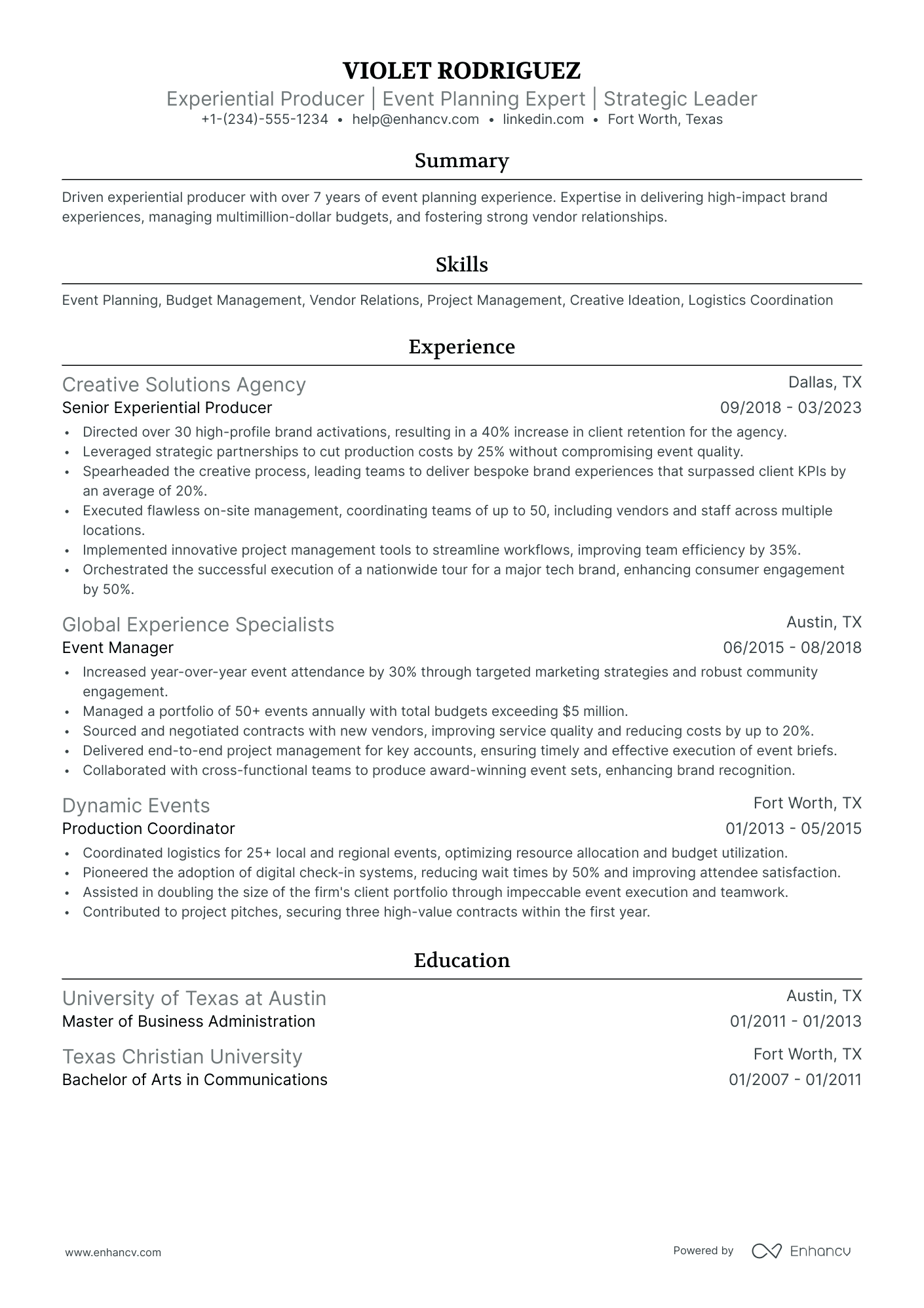
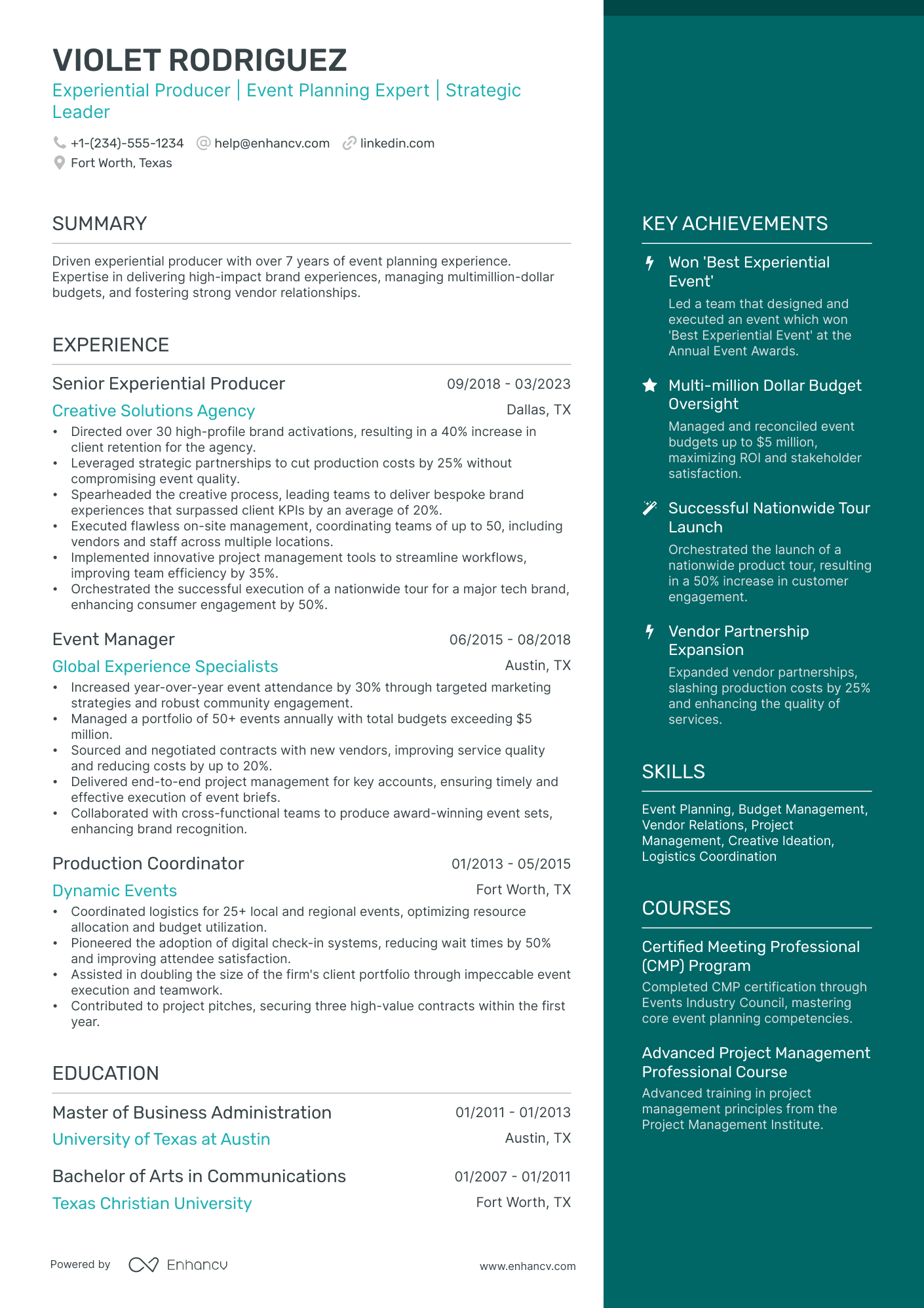
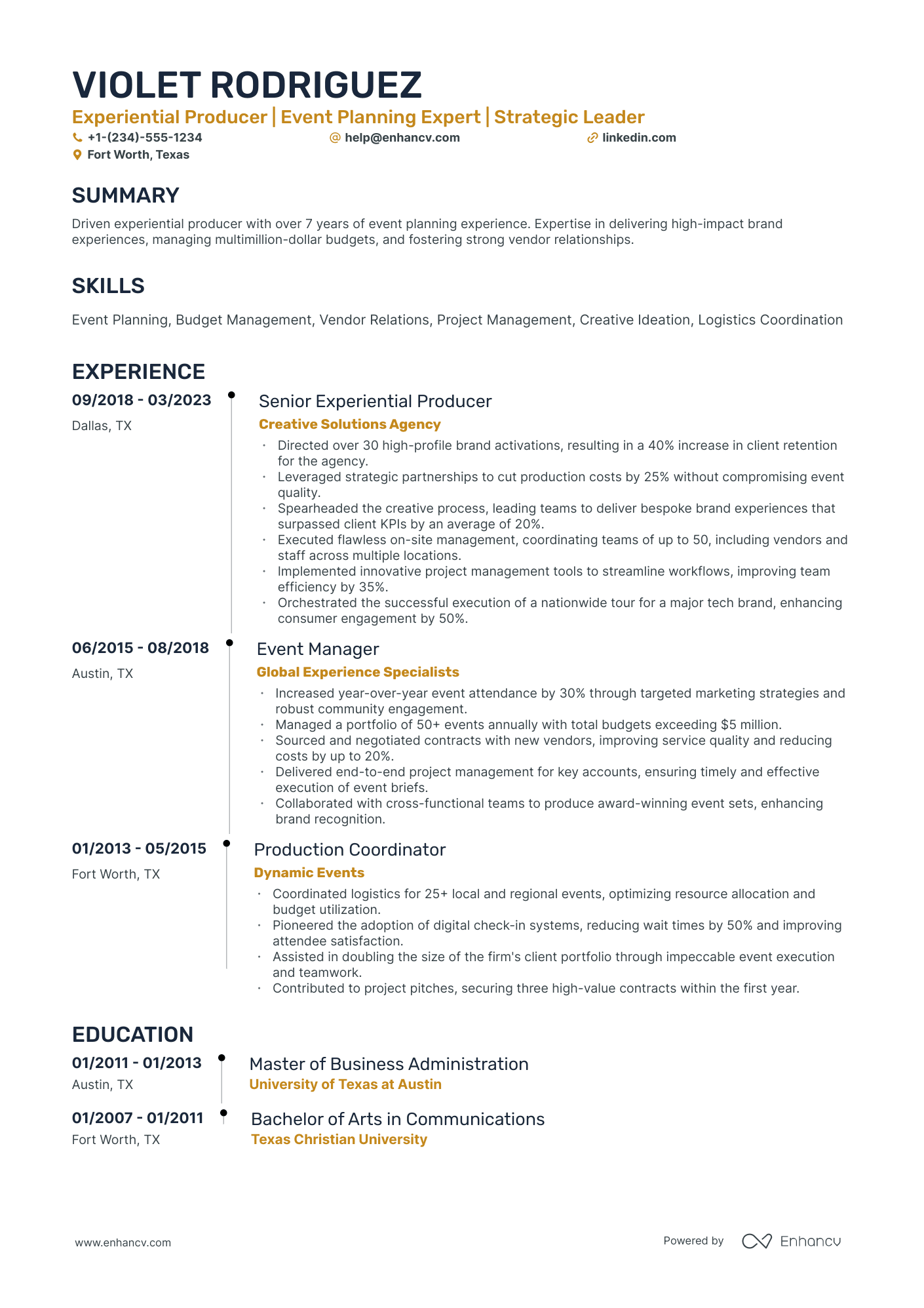
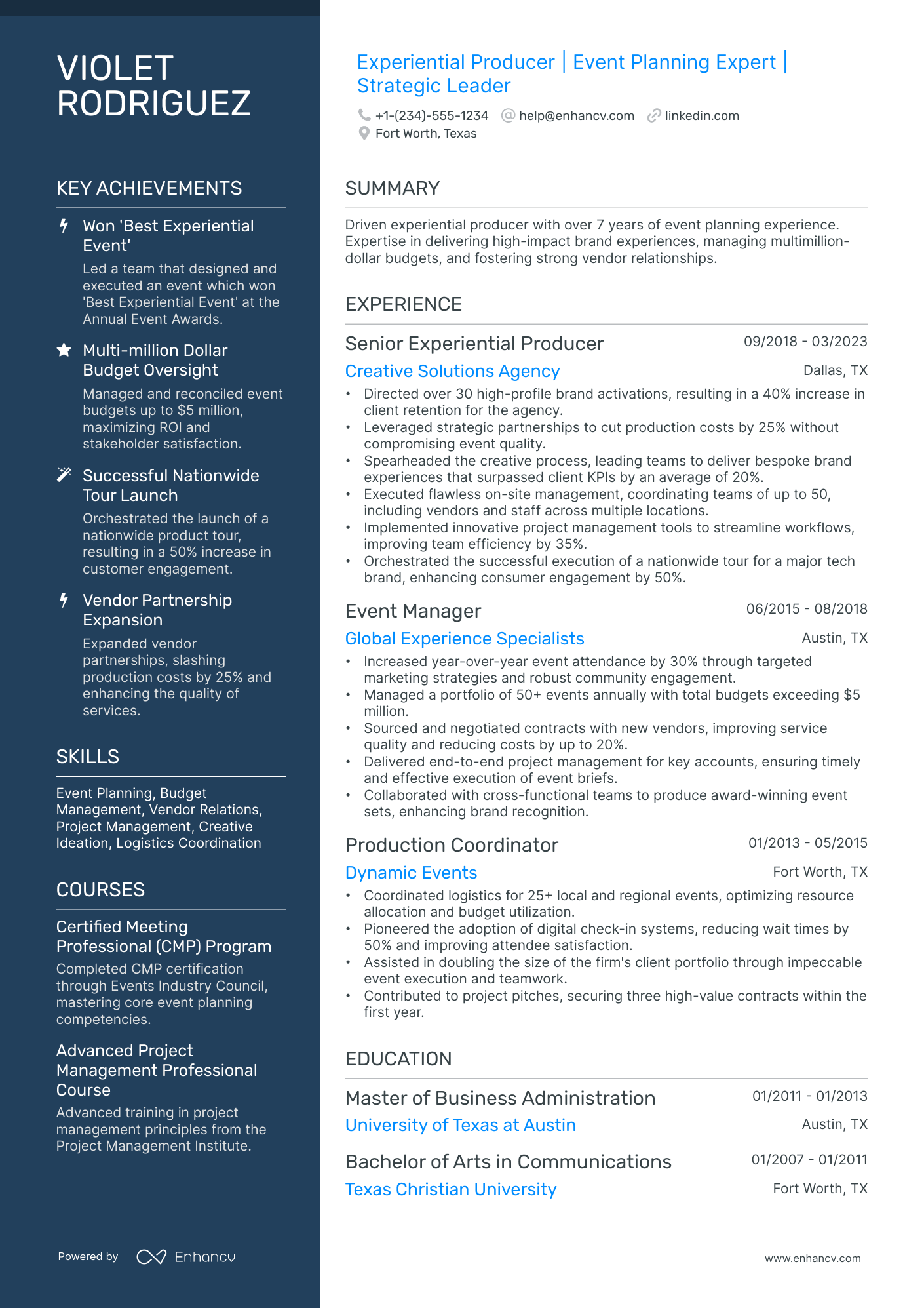
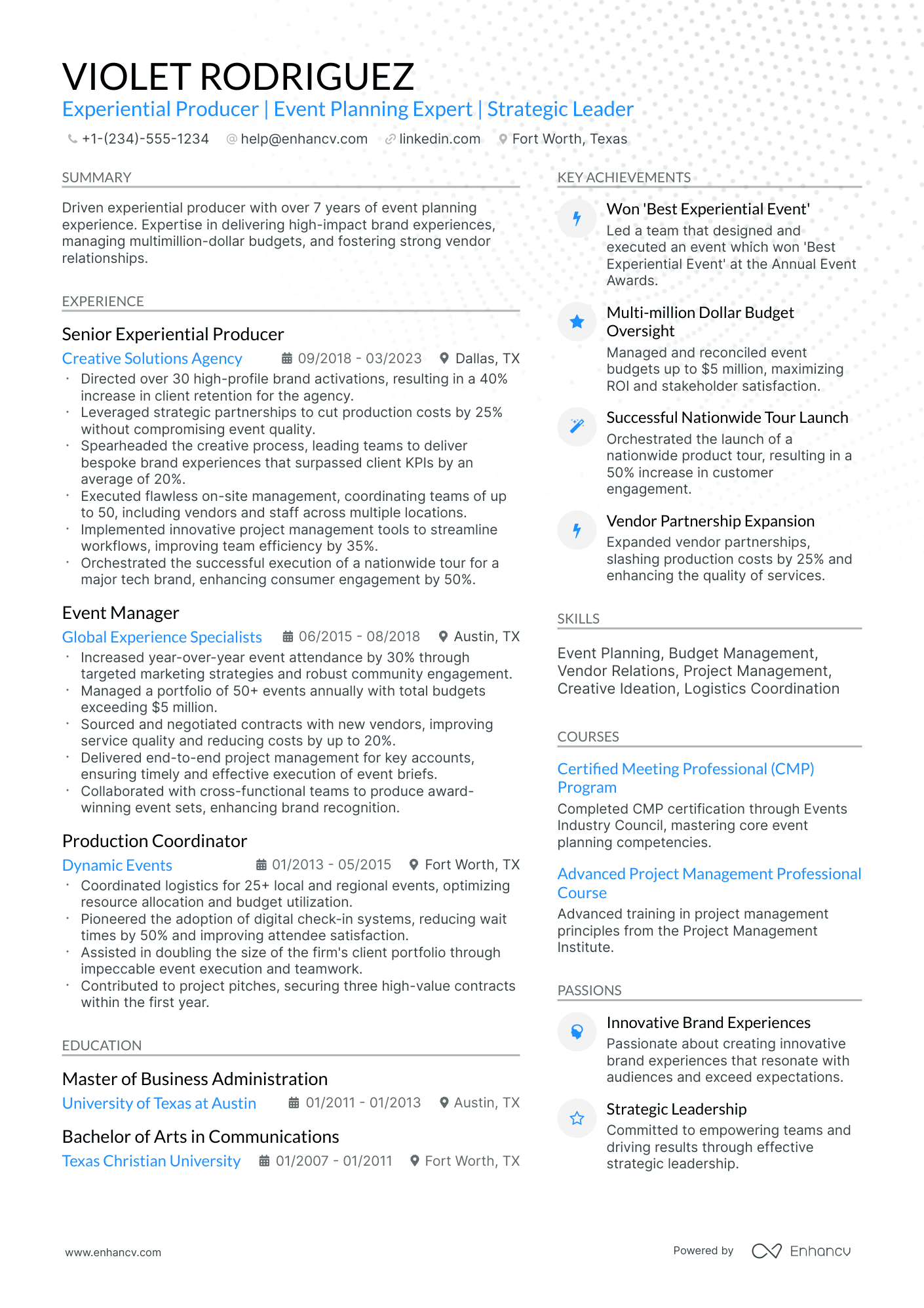
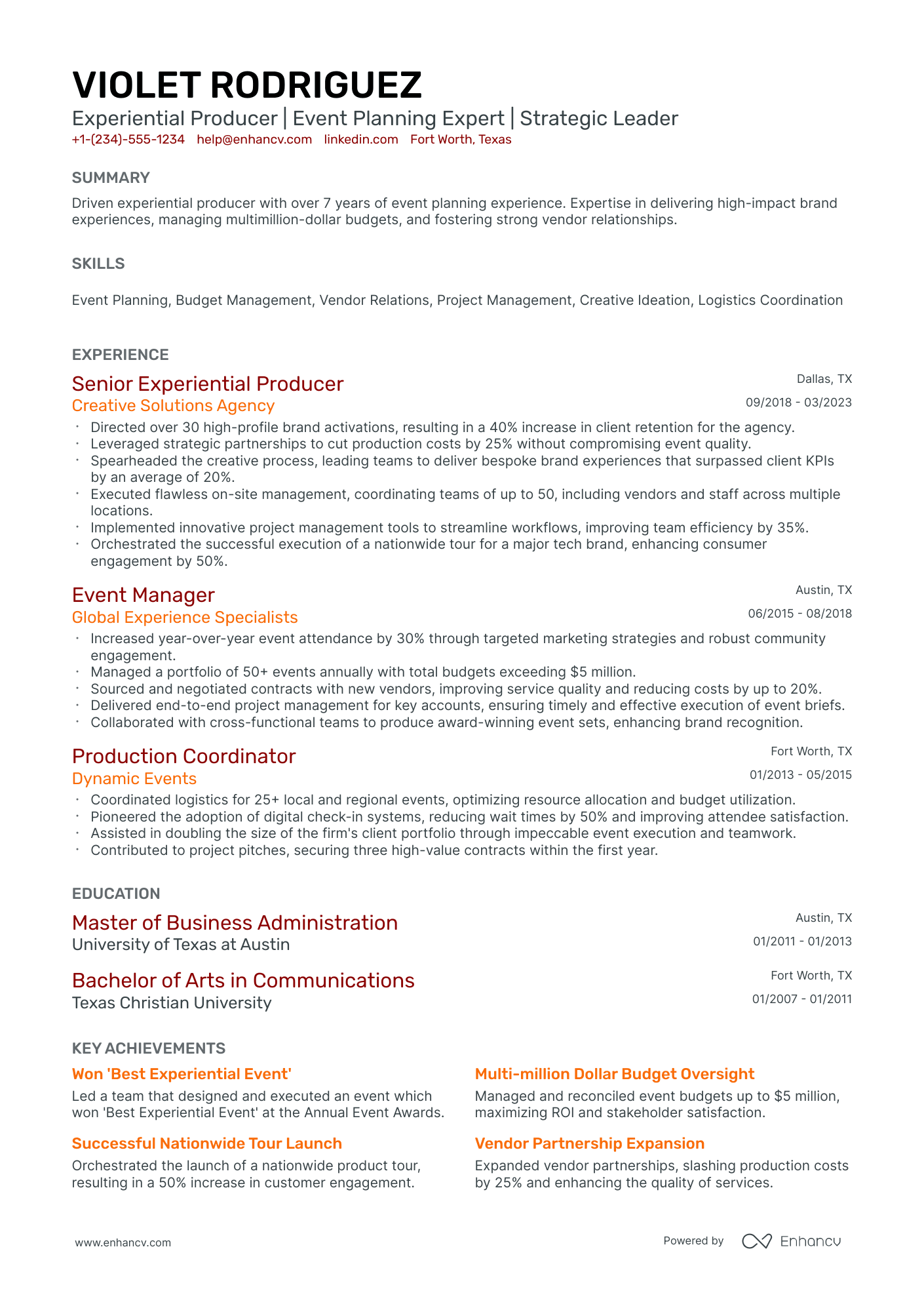
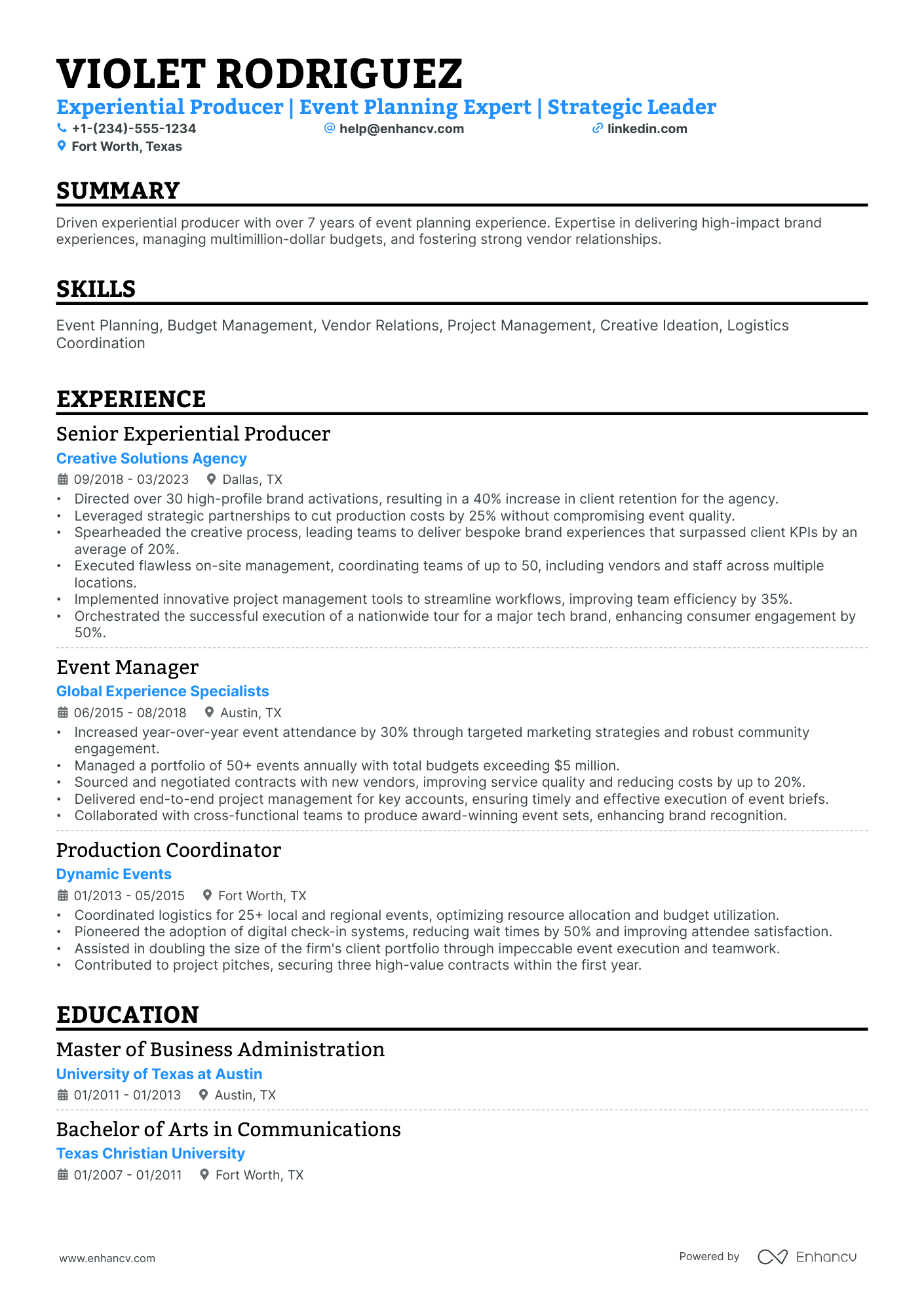
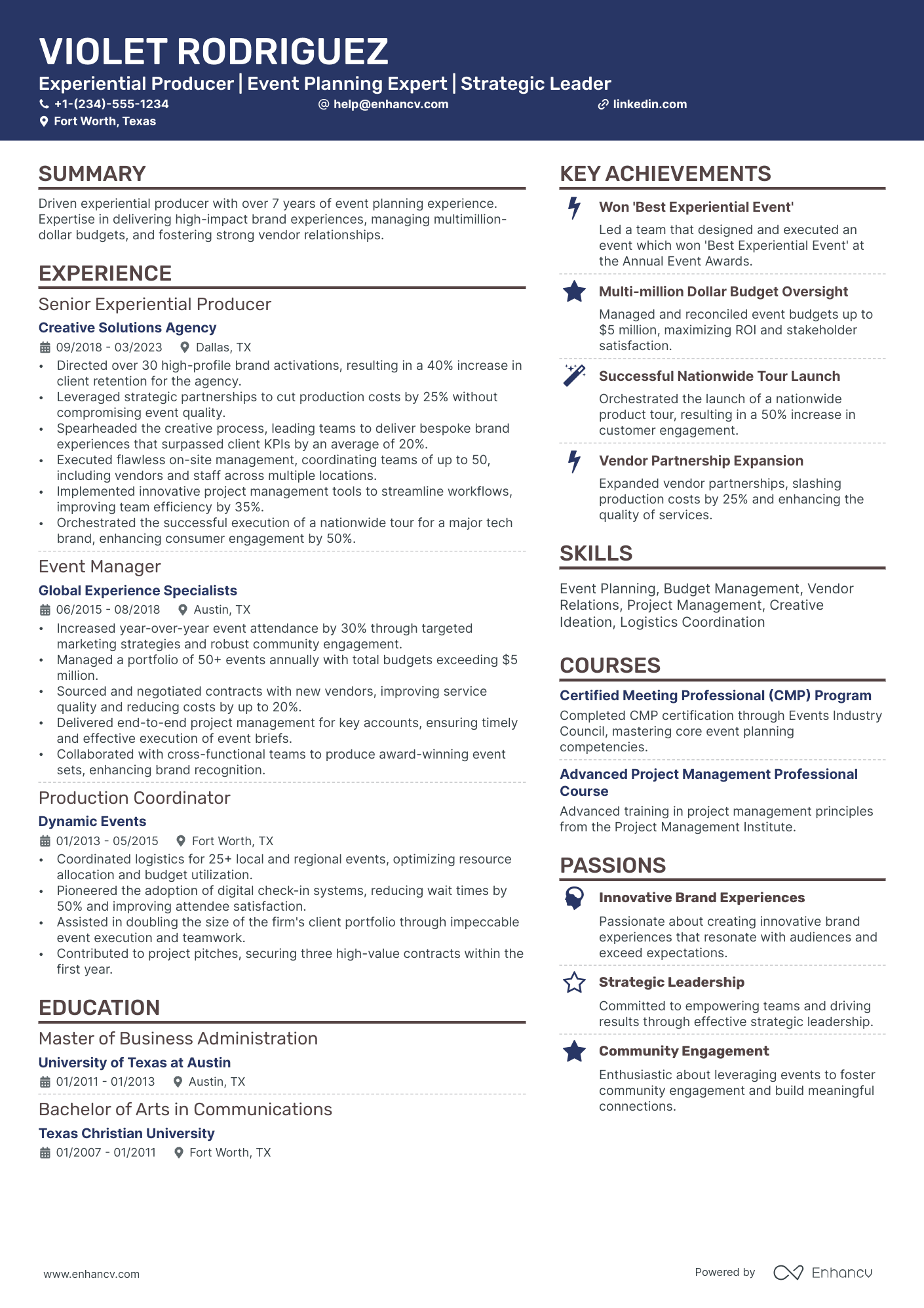
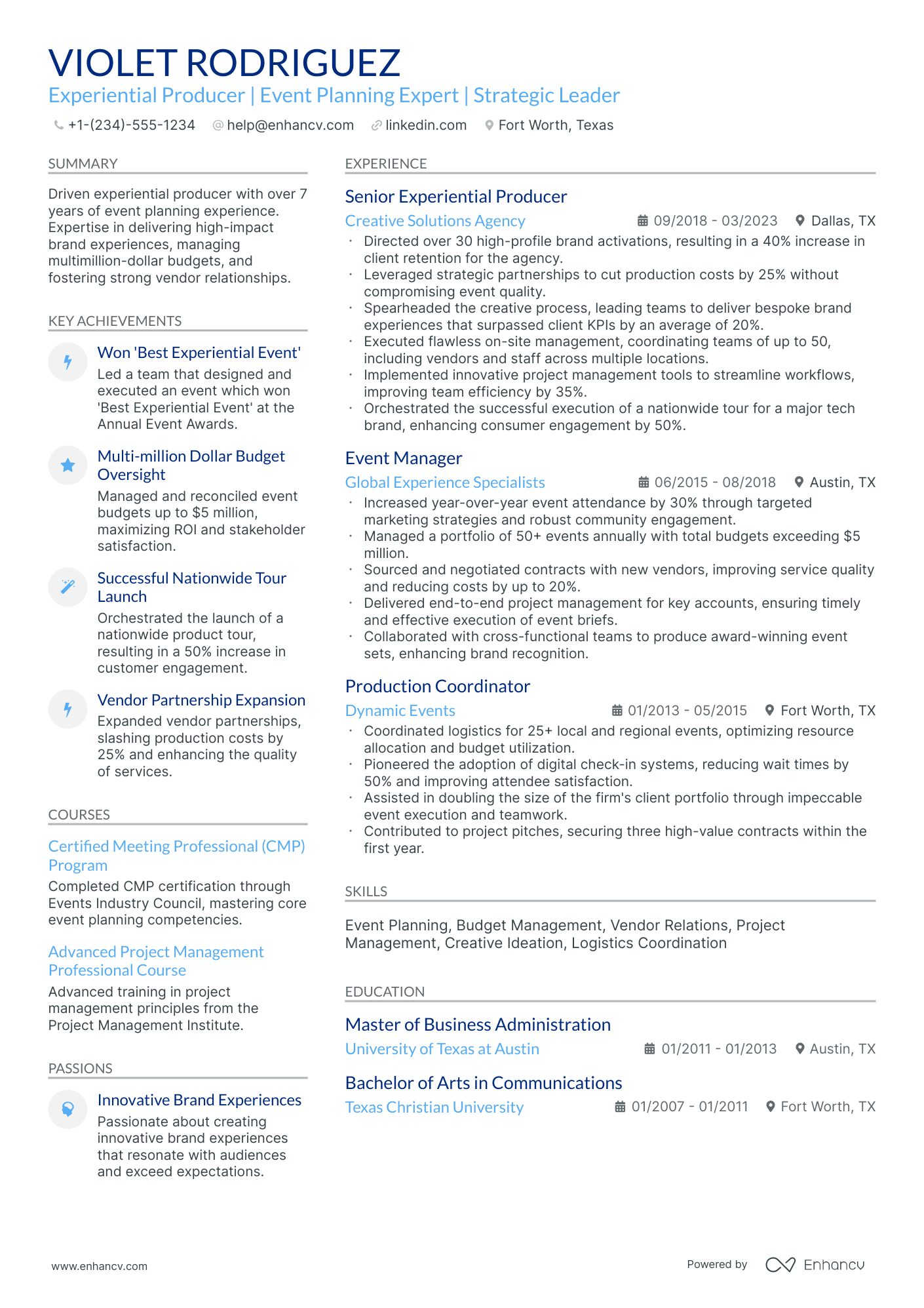
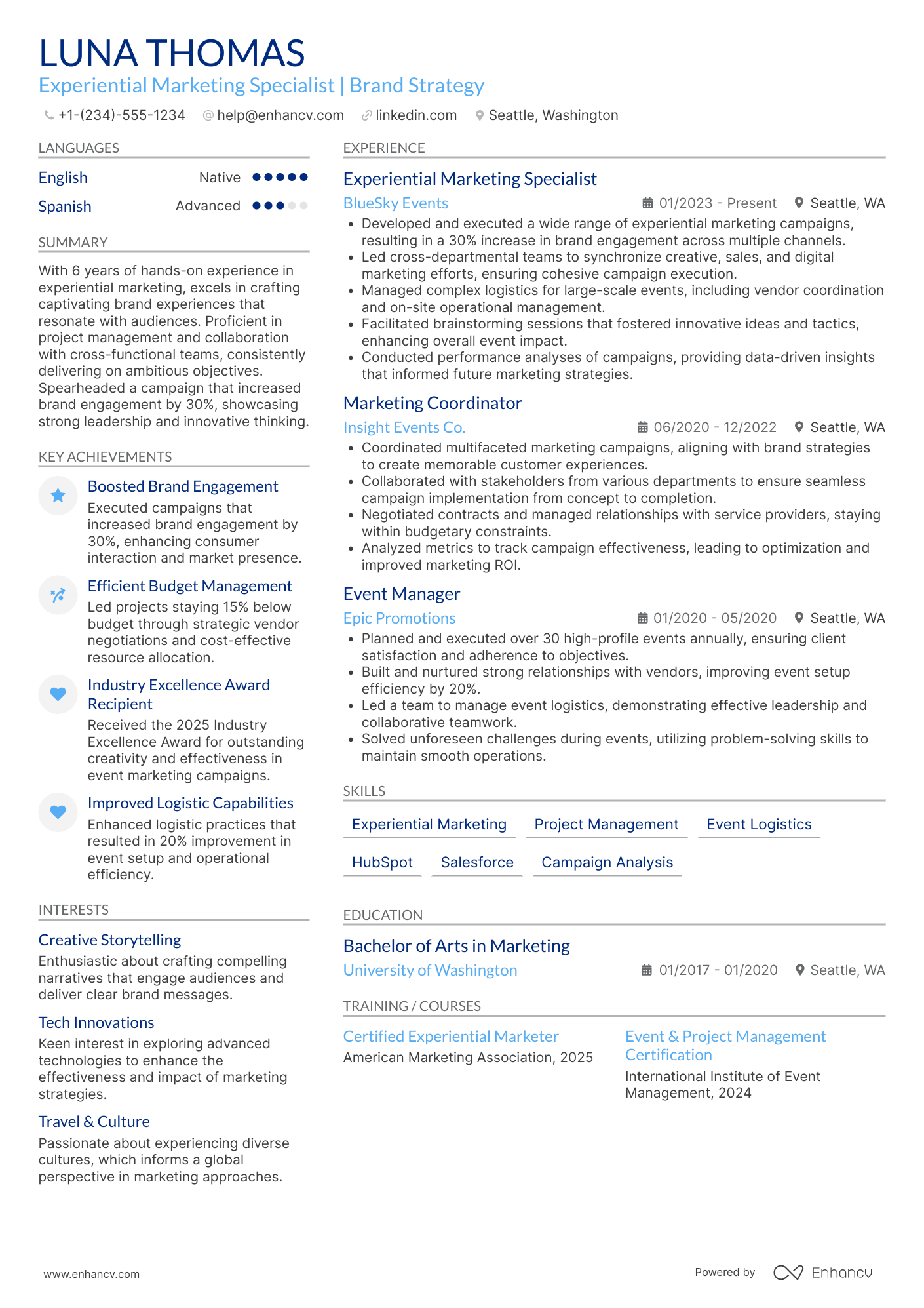
Many experiential marketing resumes fail because they read like event recaps, not business cases. When your experiential marketing resume doesn't translate activations into measurable impact, it gets filtered by ATS keywords and skipped in fast recruiter scans.
A strong resume shows what changed because of your work. Knowing how to make your resume stand out means highlighting pipeline influenced, attendance lift, conversion rate, budget managed, partner value delivered, launch timelines met, and post-event satisfaction. Tie each win to audience size, regions covered, and revenue impact.

Key takeaways
- Translate every activation into measurable impact like leads, revenue, or brand lift.
- Use reverse-chronological format when you have proven experiential marketing experience.
- Tailor experience bullets to mirror each job posting's exact language and priorities.
- Quantify results in every bullet using attendance, conversion, cost, or satisfaction metrics.
- Back up listed skills with specific outcomes in your summary and experience sections.
- Lead with a projects section if you lack full-time experiential marketing roles.
- Use Enhancv to turn everyday tasks into quantified, recruiter-ready resume bullets faster.
How to format a experiential marketing resume
Recruiters evaluating experiential marketing resumes look for evidence of campaign concepting, brand activation execution, vendor and venue management, and measurable audience engagement outcomes. A clean, well-structured resume format ensures these signals surface quickly during both ATS parsing and the initial human scan.

I have significant experience in this role—which format should I use?
Use a reverse-chronological format—it's the strongest choice for showcasing a proven track record in experiential marketing. Do:
- Lead each role entry with scope and ownership details: budget size, team headcount, number of activations managed annually, and geographic reach.
- Highlight role-specific expertise such as event production platforms (Cvent, Eventbrite), experiential design tools (SketchUp, Adobe Creative Suite), sponsorship management, and consumer journey mapping.
- Quantify business impact in every bullet using metrics tied to attendance, brand lift, earned media impressions, lead generation, or ROI.
I'm junior or switching into this role—what format works best?
A hybrid format works best—it lets you lead with relevant experiential marketing skills while still showing your work history in chronological order. Do:
- Place a dedicated skills section near the top featuring capabilities such as event logistics, brand storytelling, audience engagement strategy, and vendor coordination.
- Include project-based entries—campus activations, freelance brand events, pop-up installations, or portfolio campaigns—even if they weren't traditional full-time roles.
- Connect every action to a clear outcome so recruiters can see your ability to drive results, not just participate.
Why not use a functional resume?
A functional format strips away the timeline and context recruiters need to evaluate how your experiential marketing capabilities developed and where you applied them, making it harder to verify your readiness for the role. Avoid a functional format entirely unless you have no other way to present your qualifications coherently.
- Edge-case exception: A functional resume may be acceptable if you're pivoting from a loosely related field (such as event planning, PR, or hospitality) with no direct experiential marketing titles on your resume, or if you're re-entering the workforce after an extended gap—but even then, anchor every listed skill to a specific project, activation, or measurable outcome to maintain credibility.
Once you've established a clean, readable format, the next step is deciding which sections to include so each one reinforces your experiential marketing expertise.
What sections should go on a experiential marketing resume
Recruiters expect you to present event and campaign execution experience, measurable results, and brand-facing skills in a clean, easy-to-scan format. Understanding which resume sections to include helps you organize your qualifications for maximum impact.
Use this structure for maximum clarity:
- Header
- Summary
- Experience
- Skills
- Projects
- Education
- Certifications
- Optional sections: Awards, Leadership, Languages
Strong experience bullets should emphasize campaign impact, measurable outcomes, budget and vendor scope, and the scale of activations you delivered.
Is your resume good enough?
Drop your resume here or choose a file. PDF & DOCX only. Max 2MB file size.
Once you’ve organized the key resume components in a logical order, the next step is to write your experiential marketing resume experience section so each role clearly supports the story those sections set up.
How to write your experiential marketing resume experience
Your experience section should showcase the live events, brand activations, and immersive campaigns you've actually brought to life—along with the tools, strategies, and measurable results that prove your effectiveness. Hiring managers prioritize demonstrated impact over descriptive task lists, so focus on what you delivered rather than what you were assigned.
Each entry should include:
- Job title
- Company and location (or remote)
- Dates of employment (month and year)
Three to five concise bullet points showing what you owned, how you executed, and what outcomes you delivered:
- Ownership scope: the activations, experiential campaigns, event programs, brand partnerships, or consumer touchpoints you were directly accountable for managing from concept through execution.
- Execution approach: the event production platforms, audience engagement tools, experiential design frameworks, vendor management processes, or data capture methods you relied on to plan, coordinate, and deliver immersive brand experiences.
- Value improved: changes to attendee engagement, brand recall, lead quality, event efficiency, consumer sentiment, or post-activation conversion rates that resulted from your strategic and creative decisions.
- Collaboration context: how you partnered with creative agencies, brand strategists, venue operators, sponsors, sales teams, or production crews to align experiential activations with broader marketing objectives.
- Impact delivered: outcomes tied to audience reach, pipeline contribution, brand awareness lift, sponsor satisfaction, or revenue influence—expressed through tangible results and business impact rather than a summary of activities performed.
Experience bullet formula
A experiential marketing experience example
✅ Right example - modern, quantified, specific.
Experiential Marketing Manager
Lumen Spark Beverages | Austin, TX
2022–2025
Led national field and event marketing for a direct-to-consumer beverage brand scaling retail distribution across the United States.
- Launched a twelve-city pop-up and sampling tour using Airtable, Asana, and Sprout Social, driving a 28% lift in unaided brand awareness and capturing 18,400 opted-in leads via QR codes and SMS.
- Built an end-to-end event measurement framework in Google Tag Manager and Looker Studio, tying on-site engagement to Shopify and Klaviyo flows and increasing post-event conversion from 2.1% to 3.4%.
- Negotiated venue, fabrication, and staffing contracts with vendors and agency partners, reducing per-event costs by 17% while improving on-time build compliance from 90% to 98%.
- Partnered with creative, product, and retail sales teams to develop modular booth assets in Figma and a brand playbook in Notion, cutting setup time by 35% and improving brand standard audit scores from 82% to 94%.
- Orchestrated influencer and creator integrations across five flagship events using CreatorIQ and UTM governance, generating $410,000 in attributable revenue and a 3.8x return on event spend.
Now that you've seen how experiential marketing experience looks on a resume, here's how to tailor that section to match a specific job posting.
How to tailor your experiential marketing resume experience
Recruiters evaluate your experiential marketing resume through applicant tracking systems and manual review, scanning for alignment with specific job requirements. Tailoring your resume to the job description by mirroring the posting's language and priorities increases your chances of advancing past both screening layers.
Ways to tailor your experiential marketing experience:
- Match event technology platforms and activation tools listed in the posting.
- Mirror the exact campaign methodology or framework the employer references.
- Use the same terminology for engagement metrics and brand KPIs mentioned.
- Highlight relevant industry verticals or audience segments the role targets.
- Emphasize live event logistics or pop-up execution if the posting specifies.
- Reflect collaboration structures with creative agencies or cross-functional teams referenced.
- Include vendor management or budget oversight responsibilities when the role requires.
- Showcase ROI tracking or lead generation methods the job description prioritizes.
Tailoring means aligning your real accomplishments with the employer's stated needs, not artificially inserting keywords where they don't belong.
Resume tailoring examples for experiential marketing
| Job description excerpt | Untailored | Tailored |
|---|---|---|
| Plan and execute large-scale brand activations using Eventbrite and Salesforce, targeting 10,000+ attendees per event across multiple U.S. markets. | Helped organize marketing events and worked with cross-functional teams to deliver projects on time. | Planned and executed 12 large-scale brand activations across eight U.S. markets using Eventbrite for registration and Salesforce for lead tracking, averaging 13,500 attendees per event. |
| Design immersive pop-up experiences that integrate AR technology and social sharing walls to drive earned media impressions and increase brand recall among Gen Z consumers. | Created experiential marketing campaigns and managed event logistics for various brand initiatives. | Designed four immersive pop-up experiences featuring AR photo stations and real-time social sharing walls, generating 2.1 million earned media impressions and lifting brand recall among Gen Z audiences by 34%. |
| Manage end-to-end experiential campaign budgets of $500K+, coordinate with vendors and venue partners, and report post-event ROI using Google Analytics and Tableau dashboards. | Tracked budgets and created reports for marketing events to support the team's goals. | Managed end-to-end budgets exceeding $500K for six experiential campaigns, negotiated vendor and venue contracts to reduce costs by 18%, and built post-event ROI dashboards in Tableau integrated with Google Analytics to present results to senior leadership. |
Once you’ve aligned your experience with the role’s priorities, quantify your experiential marketing achievements to show the impact of that work in clear, measurable terms.
How to quantify your experiential marketing achievements
Quantifying your achievements proves business impact beyond creative ideas. Focus on revenue influenced, qualified leads captured, cost per attendee, build and teardown efficiency, and experience quality signals like satisfaction scores and compliance accuracy.
Quantifying examples for experiential marketing
| Metric | Example |
|---|---|
| Revenue influenced | "Drove $185,000 in pipeline from a three-city pop-up by capturing 620 badge scans in Salesforce and booking 48 demos within 14 days." |
| Lead conversion | "Improved lead-to-meeting conversion from 6% to 11% by adding a QR-first flow in Splash and retraining eight brand ambassadors." |
| Cost efficiency | "Cut cost per engaged attendee from $42 to $31 by renegotiating AV and fabricator rates and standardizing a reusable booth kit." |
| Delivery speed | "Reduced build and teardown time by 22% using a run-of-show checklist in Asana and color-coded cases, avoiding overtime on four events." |
| Experience quality | "Raised post-event satisfaction from 4.1 to 4.6 out of five by updating demo scripts and fixing queue bottlenecks, based on 310 on-site surveys." |
Turn your everyday tasks into measurable, recruiter-ready resume bullets in seconds with Enhancv's Bullet Point Generator.
Once you've crafted strong bullet points for your experience section, you'll want to apply the same precision to presenting your hard and soft skills on your experiential marketing resume.
How to list your hard and soft skills on a experiential marketing resume
Your skills section shows you can plan, deliver, and measure live brand experiences, and recruiters and an ATS (applicant tracking system) scan this section for role keywords—aim for a mix of hard skills and execution-focused soft skills.
experiential marketing roles require a blend of:
- Product strategy and discovery skills
- Data, analytics, and experimentation skills
- Delivery, execution, and go-to-market discipline
- Soft skills
Your skills section should be:
- Scannable (bullet-style grouping).
- Relevant to the job post.
- Backed by proof in experience bullets.
- Updated with current tools.
Place your skills section:
- Above experience if you're junior or switching careers.
- Below experience if you're mid/senior with strong achievements.

Hard skills
- Event production, run of show
- Budgeting, vendor procurement
- Venue sourcing, permitting, insurance
- Experiential staffing, brand ambassadors
- Sponsorship activation, partner management
- On-site operations, logistics, load in
- Safety, risk, compliance
- Post-event reporting, insights
- Lead capture, QR workflows
- Salesforce, HubSpot, Marketo
- Google Analytics 4, Looker Studio
- Asana, Monday.com, Smartsheet
Soft skills
- Align stakeholders on goals
- Translate briefs into plans
- Run cross-functional status updates
- Negotiate timelines and scope
- Manage vendors with accountability
- Make tradeoffs under pressure
- Communicate clearly on-site
- Resolve issues in real time
- Lead setup and teardown teams
- Present results to leadership
- Document processes and learnings
- Protect brand standards consistently
How to show your experiential marketing skills in context
Skills shouldn't live only in a list.
They should be demonstrated in:
- Your summary (high-level professional identity)
- Your experience (proof through outcomes)
Here's how that looks in practice. You can explore more ways to present resume skills effectively across different roles and formats.
Summary example
Senior experiential marketing strategist with 10+ years crafting immersive brand activations for consumer tech companies. Skilled in spatial design, Cvent, and cross-functional storytelling. Led a product launch experience that drove 35% higher brand recall among target audiences.
- Reflects senior-level expertise immediately
- Names role-relevant tools and methods
- Includes a concrete, measurable outcome
- Signals creative and collaborative strengths
Experience example
Senior Experiential Marketing Manager
Anthem Live Agency | Chicago, IL
June 2019–Present
- Designed and executed 12+ large-scale brand activations annually using Cvent and spatial mapping, increasing client engagement scores by 28%.
- Collaborated with creative, sales, and production teams to launch an immersive pop-up series that generated 4.2 million social impressions.
- Developed post-event analytics frameworks in Tableau, helping clients attribute $1.8M in pipeline revenue directly to experiential touchpoints.
- Every bullet includes measurable proof.
- Skills surface naturally through real outcomes.
Once you’ve demonstrated your experiential marketing abilities through specific outcomes and real-world examples, the next step is applying that same approach to building an experiential marketing resume when you have no experience.
How do I write a experiential marketing resume with no experience
Even without full-time experience, you can demonstrate readiness through projects and transferable activities. If you're building a resume without work experience, focus on showcasing relevant activations and measurable contributions:
- Campus brand ambassador programs
- Event volunteer roles and shifts
- Pop-up booth staffing experience
- Retail product demo campaigns
- Student organization event planning
- Social media event promotion
- Vendor outreach and coordination
- Class projects in marketing analytics
Focus on:
- Event execution and logistics results
- Brand activation metrics and reporting
- Audience targeting and lead capture
- Budget tracking and vendor coordination
Resume format tip for entry-level experiential marketing
Use a combination resume format. It highlights projects and measurable outcomes while keeping your limited work history clear and credible. Do:
- Lead with a projects section.
- Add metrics to every activation.
- List tools used for reporting.
- Describe your role and scope.
- Match keywords to the job.
- Planned and promoted a student organization pop-up; used QR lead capture and a post-event survey, generating 180 sign-ups and a 32% attendance rate.
Even without direct experience, your education section can demonstrate relevant knowledge and transferable skills that strengthen your candidacy—so let's cover how to present it effectively.
How to list your education on a experiential marketing resume
Your education section helps hiring teams confirm you have the foundational knowledge needed for experiential marketing. It validates your training in areas like consumer behavior, brand strategy, and event management.
Include:
- Degree name
- Institution
- Location
- Graduation year
- Relevant coursework (for juniors or entry-level candidates)
- Honors & GPA (if 3.5 or higher)
Skip month and day details—list the graduation year only.
Here's a strong education entry tailored to experiential marketing:
Example education entry
Bachelor of Science in Marketing
University of Oregon, Eugene, OR
Graduated 2022
GPA: 3.7/4.0
- Relevant Coursework: Consumer Psychology, Integrated Brand Promotions, Event Planning & Logistics, Digital Media Strategy
- Honors: Dean's List (six consecutive semesters), Outstanding Marketing Student Award
How to list your certifications on a experiential marketing resume
Certifications on your resume show your commitment to learning, prove tool proficiency, and signal industry relevance for experiential marketing roles. Include:
- Certificate name
- Issuing organization
- Year
- Optional: credential ID or URL
- Place certifications below education when they're older, less relevant, or secondary to your degree for experiential marketing roles.
- Place certifications above education when they're recent, highly relevant, or required for the experiential marketing roles you target.
Best certifications for your experiential marketing resume
- Certified Meeting Professional (CMP)
- Certified Special Events Professional (CSEP)
- Digital Event Strategist (DES)
- HubSpot Inbound Marketing Certification
- Google Analytics Certification
- Meta Certified Digital Marketing Associate
- Project Management Professional (PMP)
Once you’ve positioned your credentials where recruiters can spot them, move on to your experiential marketing resume summary to tie those qualifications to the value you deliver.
How to write your experiential marketing resume summary
Your resume summary is the first thing a recruiter reads. A strong one instantly connects your background to the experiential marketing role.
Keep it to three to four lines, with:
- Your title and years of experience in experiential or event marketing.
- The types of brands, industries, or activations you've supported.
- Core skills like event production, vendor coordination, or audience engagement platforms.
- One or two measurable results, such as attendance growth or engagement lift.
- Soft skills tied to outcomes, like cross-functional collaboration that improved launch timelines.

PRO TIP
At a junior level, lead with relevant skills, tools, and specific activations you've contributed to. Highlight early wins with numbers, even modest ones. Avoid vague phrases like "passionate team player" or "eager to grow." Recruiters want proof of what you've done, not personality declarations.
Example summary for a experiential marketing
Experiential marketing coordinator with two years of hands-on event activation experience. Skilled in vendor logistics, on-site production, and social amplification. Helped boost branded event attendance by 30% across three regional campaigns.
Optimize your resume summary and objective for ATS
Drop your resume here or choose a file.
PDF & DOCX only. Max 2MB file size.
Now that your summary captures the value you bring, make sure recruiters can actually reach you by setting up a clear, complete header.
What to include in a experiential marketing resume header
A resume header is the top section with your identity and contact details, and it drives visibility, credibility, and recruiter screening for experiential marketing roles.
Essential resume header elements
- Full name
- Tailored job title and headline
- Location
- Phone number
- Professional email
- GitHub link
- Portfolio link
A LinkedIn link helps recruiters verify experience quickly and supports screening.
Do not include photos on a experiential marketing resume unless the role is explicitly front-facing or appearance-dependent.
Use a clear job title that matches the posting, and keep links short, accurate, and easy to copy.
Experiential marketing resume header
Jordan Taylor
Experiential marketing manager | Brand activations and live events
Austin, TX
(512) 555-01XX
your.name@enhancv.com
github.com/yourname
yourwebsite.com
linkedin.com/in/yourname
Once your header quickly establishes who you are and how to reach you, you can strengthen the rest of your resume with additional sections that support your experiential marketing experience.
Additional sections for experiential marketing resumes
When your core experience doesn't fully capture your creative range, additional sections help showcase the unique skills that set you apart in experiential marketing. For example, listing language skills can highlight your ability to engage diverse audiences across global activations.
- Languages
- Certifications (event management, brand strategy, or digital marketing)
- Portfolio or campaign highlights
- Industry awards and recognitions
- Volunteer event coordination
- Professional affiliations (experiential marketing or events industry)
- Hobbies and interests (creative or performance-based)
Once you've strengthened your resume with relevant additional sections, the next step is pairing it with a cover letter that gives your experiential marketing expertise even more context.
Do experiential marketing resumes need a cover letter
Experiential marketing resumes don't always need a cover letter, but it helps for competitive roles or teams that expect one. If you're unsure where to start, understanding what a cover letter is and how it complements your resume can help you decide. It can make a difference when your fit, impact, or context needs more explanation than bullets allow.
Use a cover letter to add context and sharpen your case:
- Explain role and team fit by matching your event style, partner approach, and operating rhythm to the job's scope.
- Highlight one or two experiential marketing projects with outcomes, such as qualified leads, sign-ups, pipeline influence, retention, or brand lift.
- Show you understand the product, users, and business context by naming the audience, journey stage, and success metrics you'll optimize.
- Address career transitions or non-obvious experience by connecting transferable skills to experiential marketing execution and measurement.
Drop your resume here or choose a file.
PDF & DOCX only. Max 2MB file size.
Even when you decide a cover letter won’t add value for an experiential marketing role, using AI to improve your experiential marketing resume helps you sharpen your messaging and align it to the job faster.
Using AI to improve your experiential marketing resume
AI can sharpen your resume's clarity, structure, and impact. It helps you find stronger language and tighten loose phrasing. But overuse strips authenticity fast. Once your content sounds clear and role-aligned, step away from AI entirely. If you're exploring tools, this guide on which AI is best for writing resumes can help you choose the right one.
Here are 10 practical prompts to strengthen specific sections of your experiential marketing resume:
- Sharpen your summary: "Rewrite my resume summary to highlight my experiential marketing expertise, focusing on event strategy, audience engagement, and measurable brand outcomes."
- Quantify event results: "Add specific metrics to these experiential marketing experience bullets, emphasizing attendance growth, engagement rates, and lead generation numbers."
- Strengthen action verbs: "Replace weak verbs in my experiential marketing experience section with strong, specific action verbs that convey leadership and execution."
- Align with job posting: "Compare my experiential marketing resume to this job description and identify missing keywords for the skills and experience sections."
- Tighten skills section: "Reorganize my skills section to prioritize the most relevant experiential marketing competencies, removing anything generic or outdated."
- Refine project descriptions: "Rewrite my experiential marketing project descriptions to clearly state my role, the activation type, and the business result."
- Improve education relevance: "Highlight coursework and achievements in my education section that directly connect to experiential marketing strategy and execution."
- Clarify certification value: "Rewrite my certifications section to explain how each credential applies to experiential marketing roles and brand activation work."
- Eliminate filler language: "Remove vague or redundant phrasing from my experiential marketing resume while keeping every bullet specific and results-driven."
- Tailor for ATS: "Optimize my experiential marketing resume formatting and keyword placement so applicant tracking systems can parse it correctly."
Stop using AI once your resume sounds accurate, specific, and aligned with real experience. AI should never invent experience or inflate claims—if it didn't happen, it doesn't belong here.
Conclusion
A strong experiential marketing resume proves impact with measurable outcomes, role-specific skills, and a clear structure. Use numbers to show reach, engagement, leads, conversion, and budget control. Keep sections scannable, and align your experience with the role.
Hiring teams want experiential marketing candidates who can execute, report results, and improve programs fast. When your resume stays focused, quantified, and easy to read, it shows you’re ready for today’s market and the next hiring cycle.