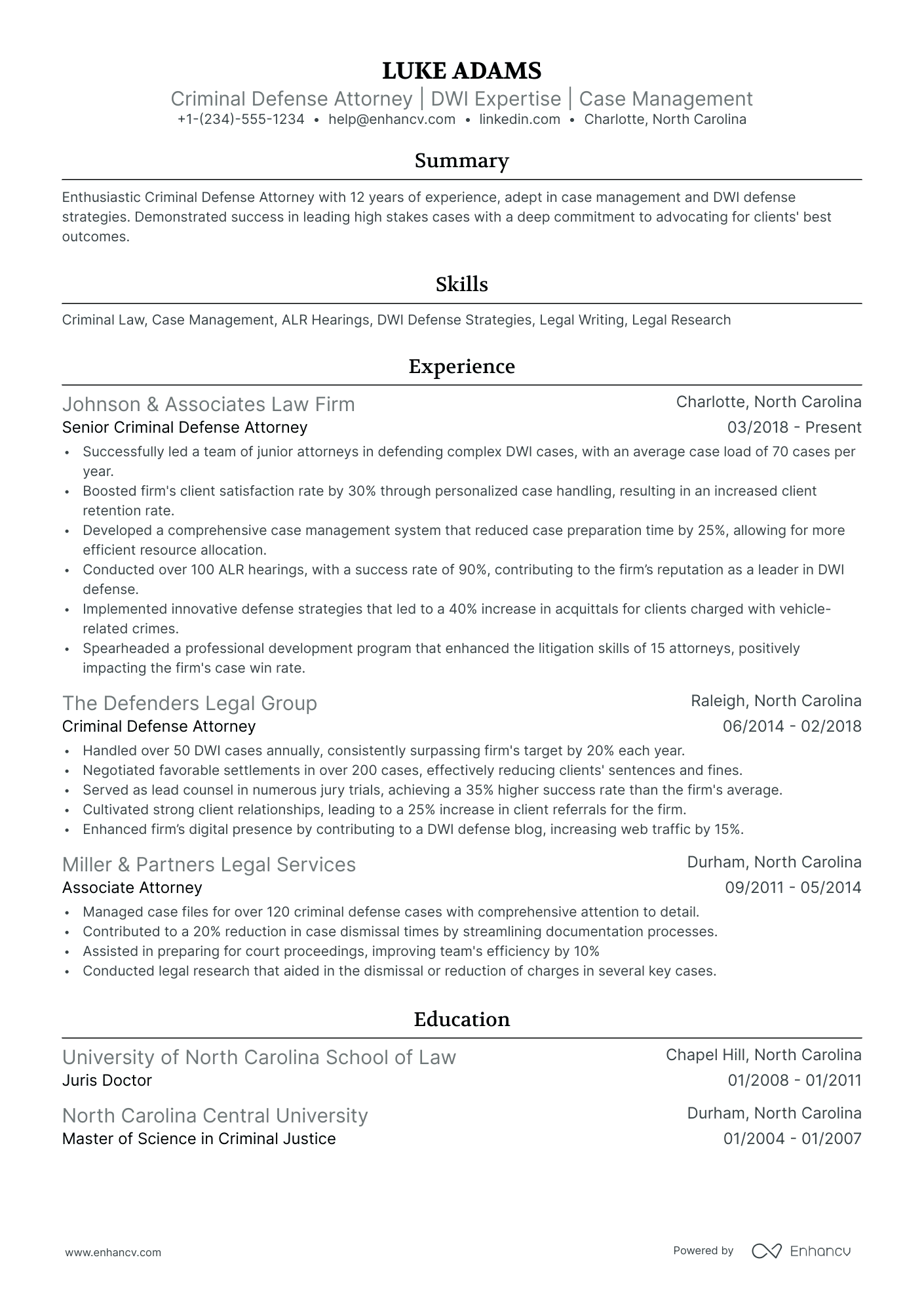
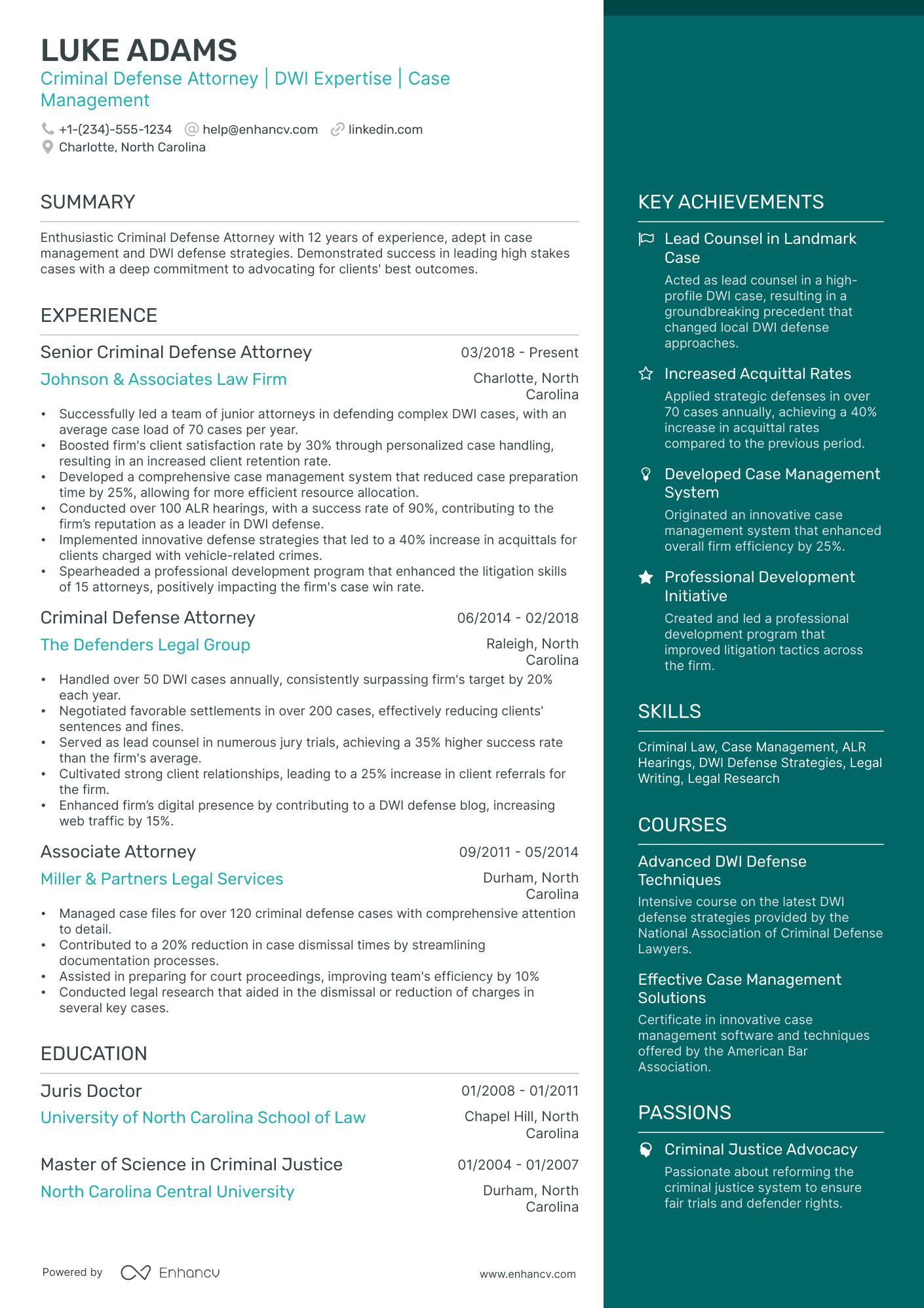
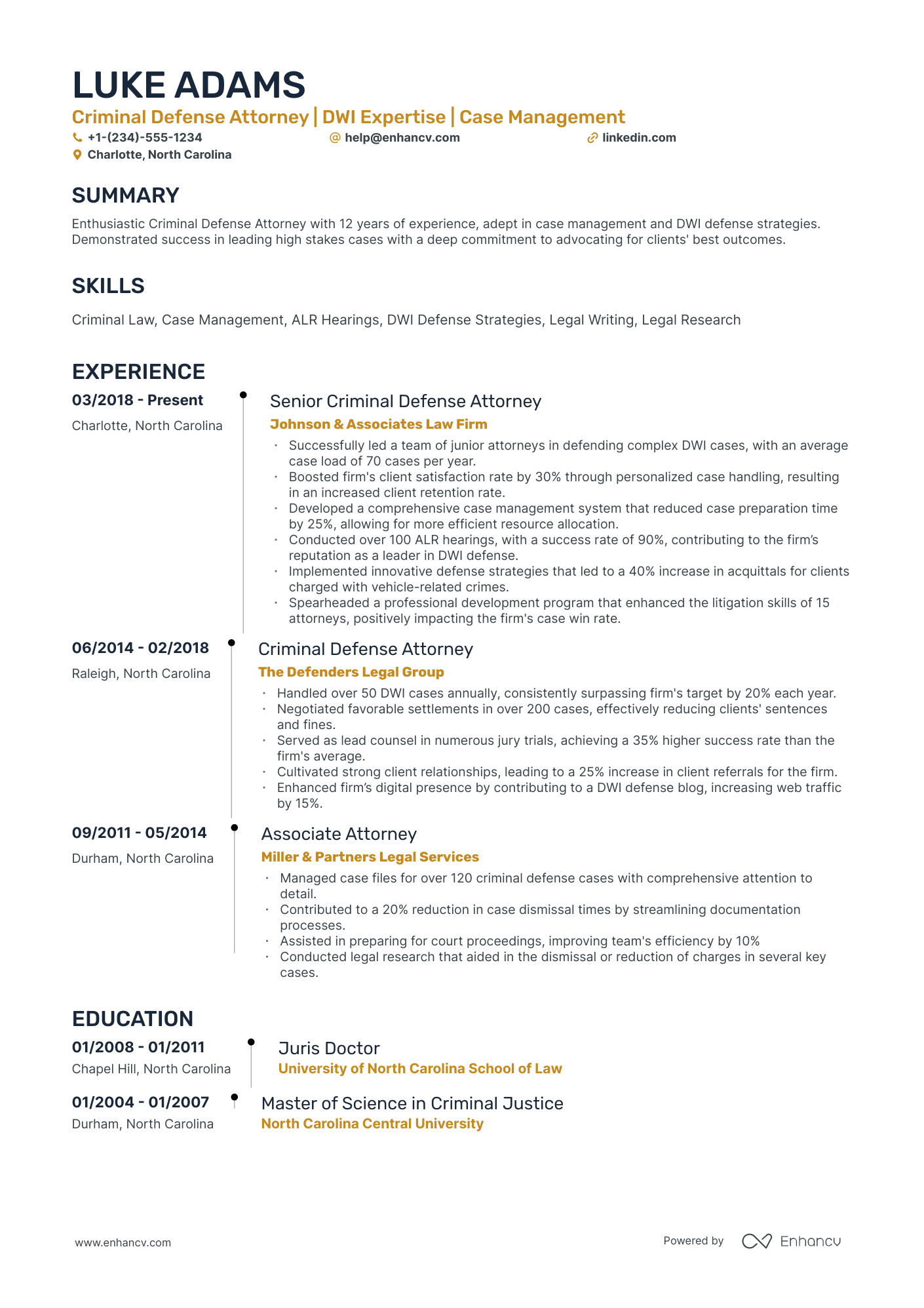
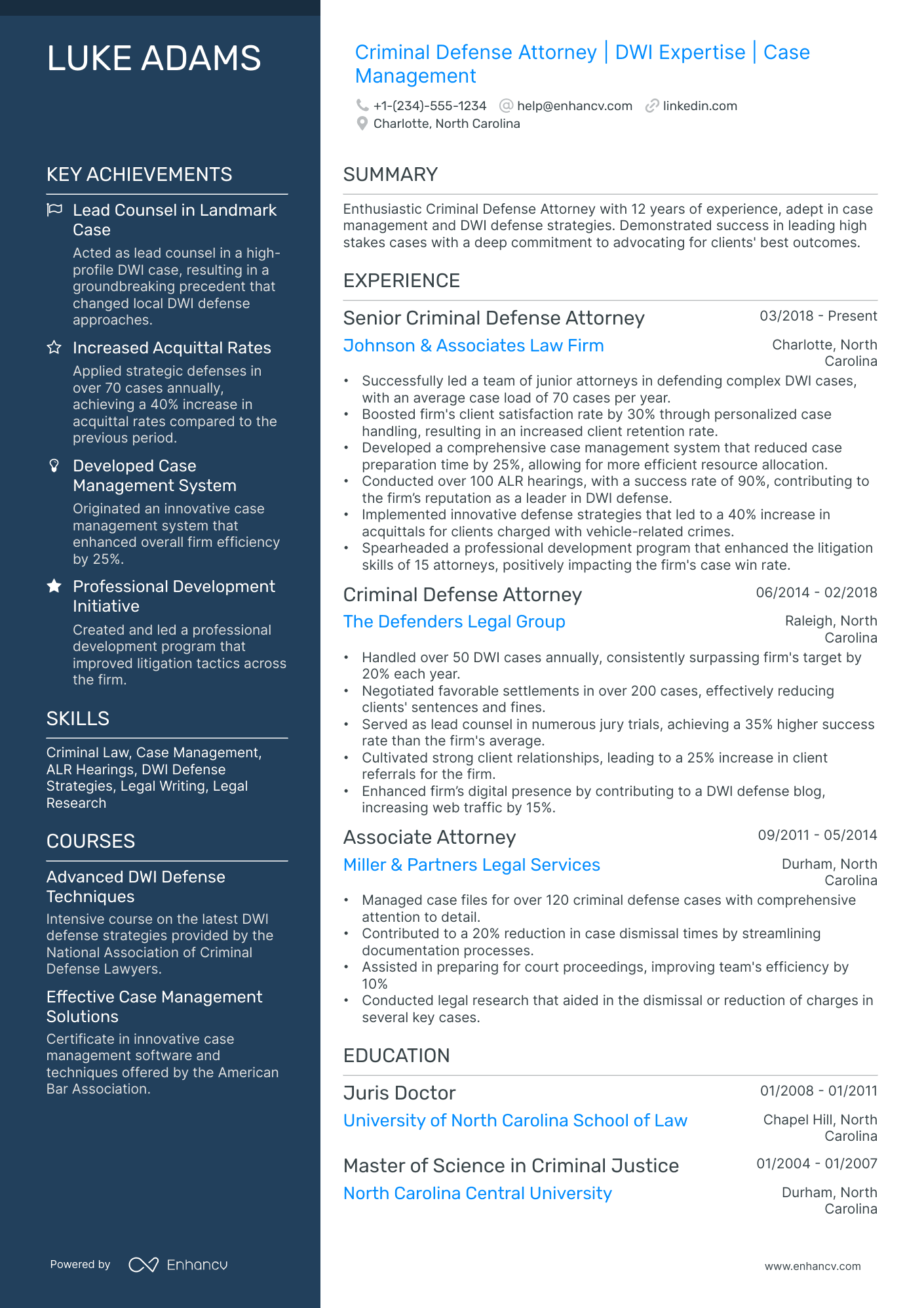
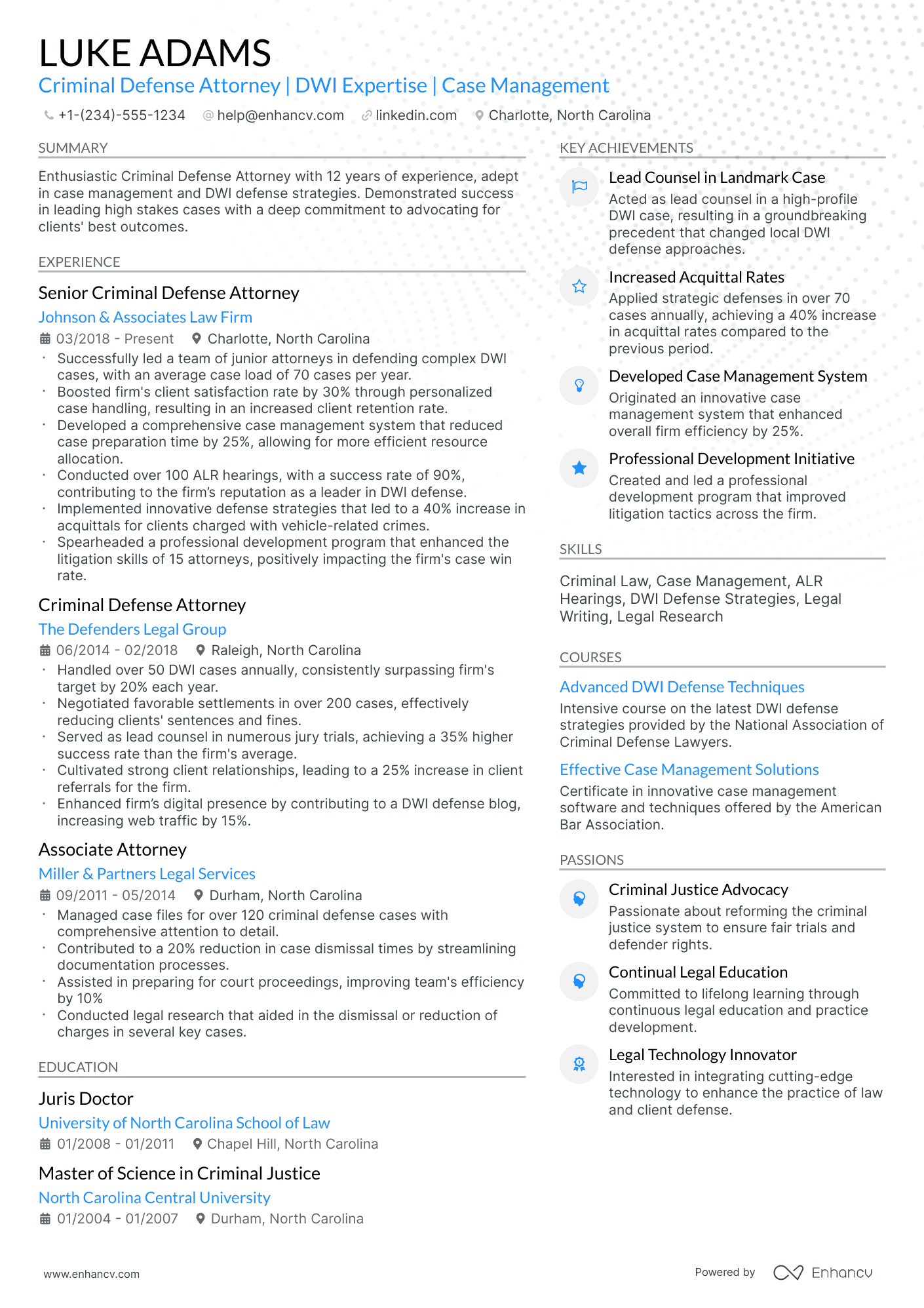
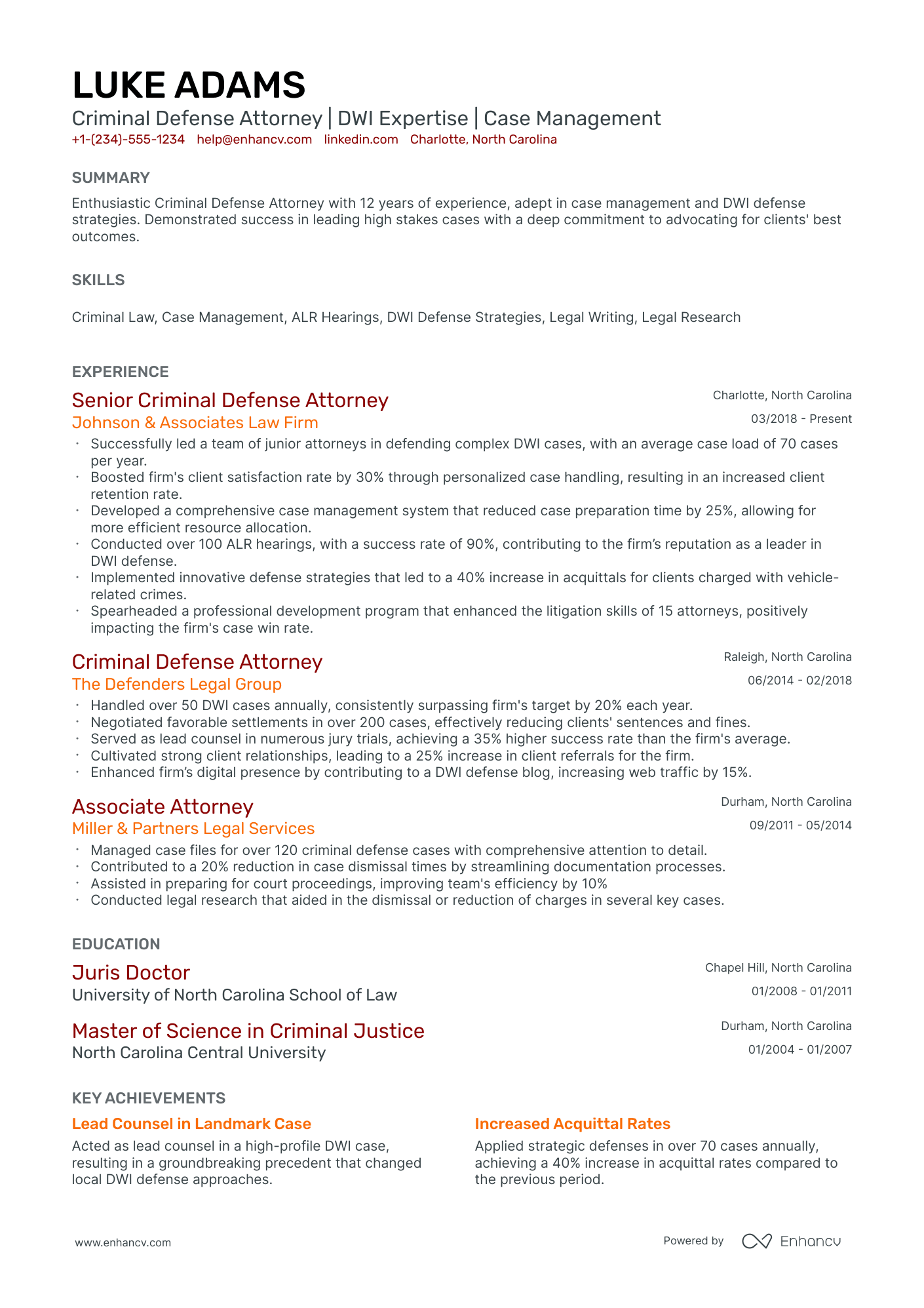
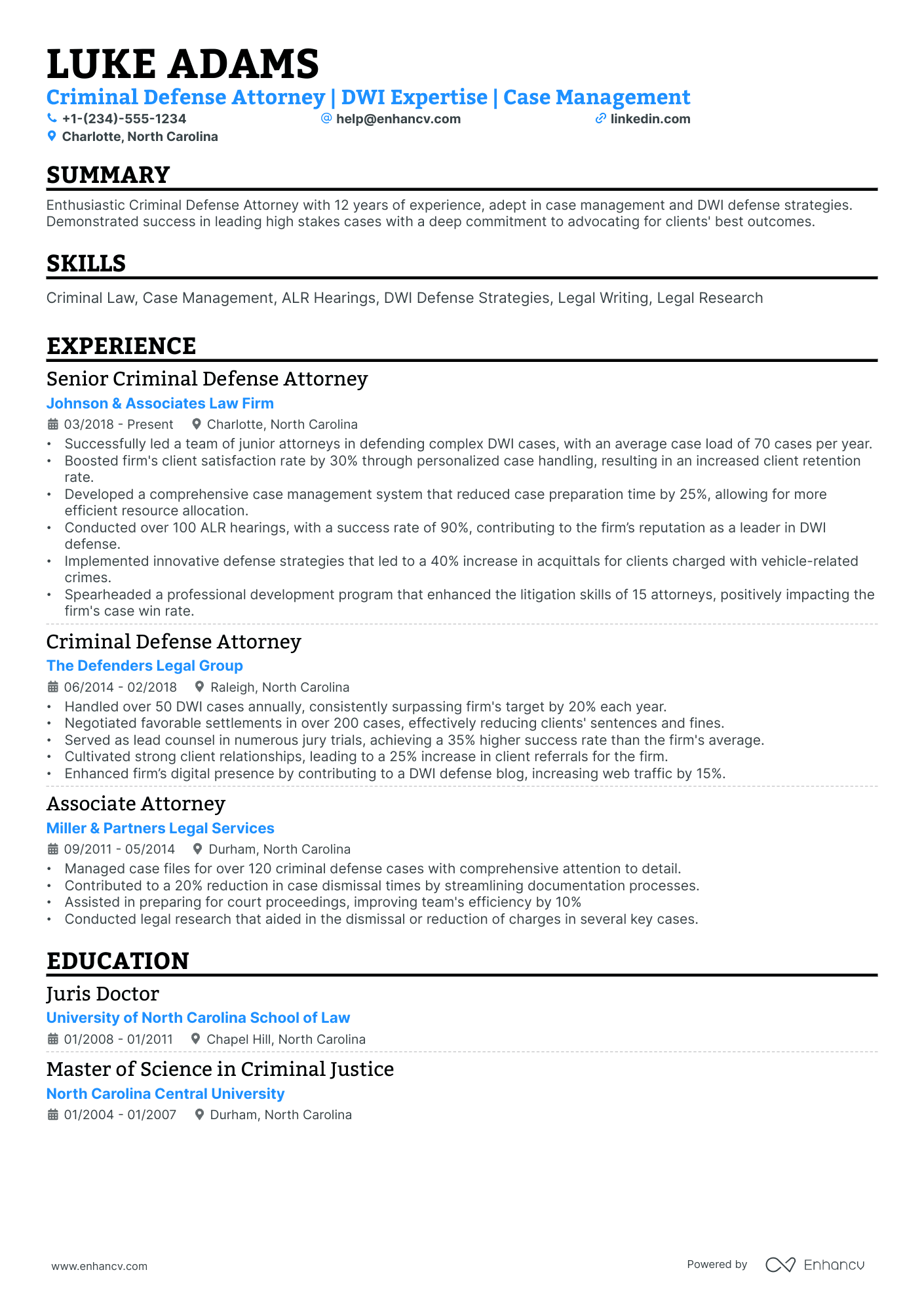
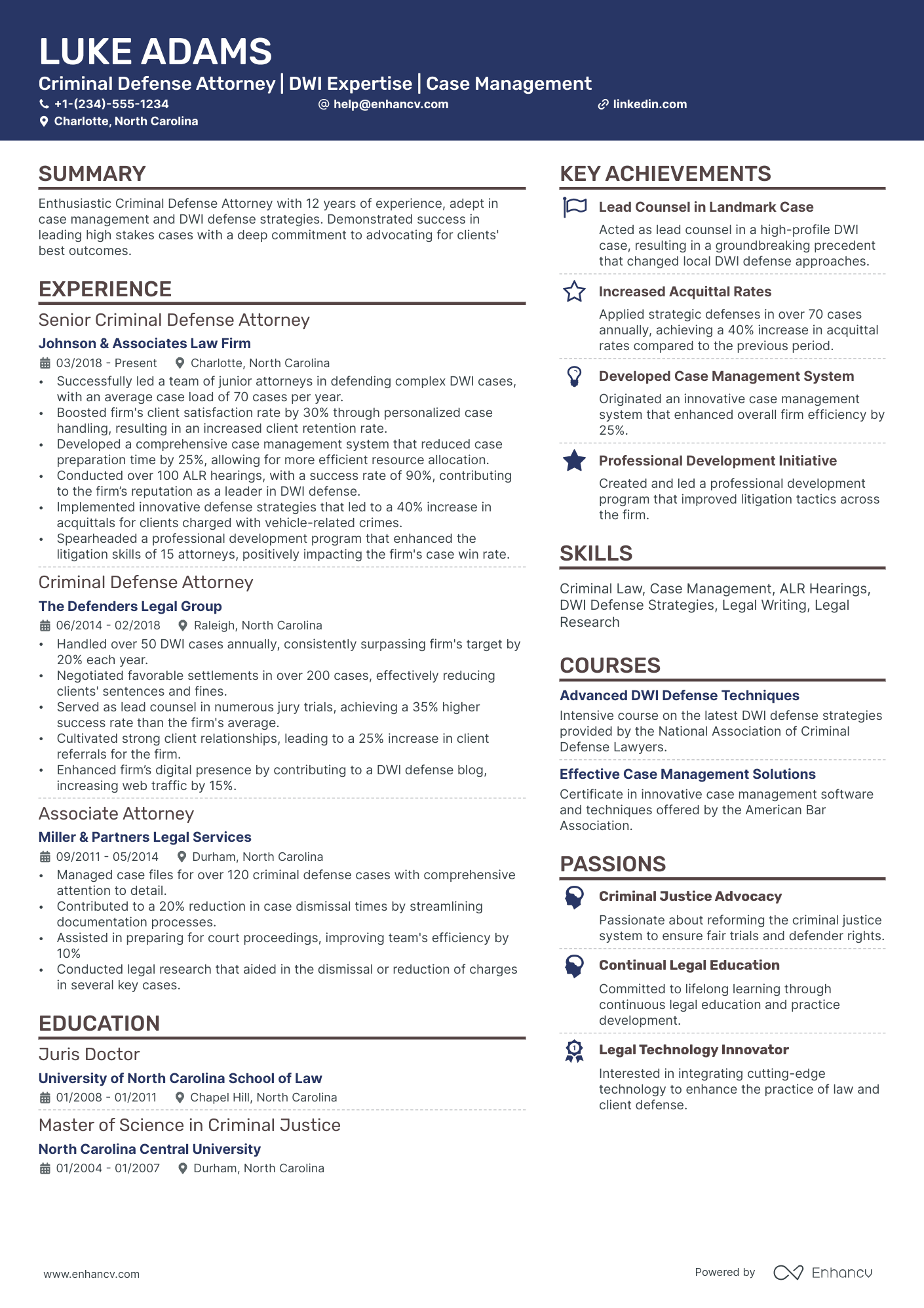
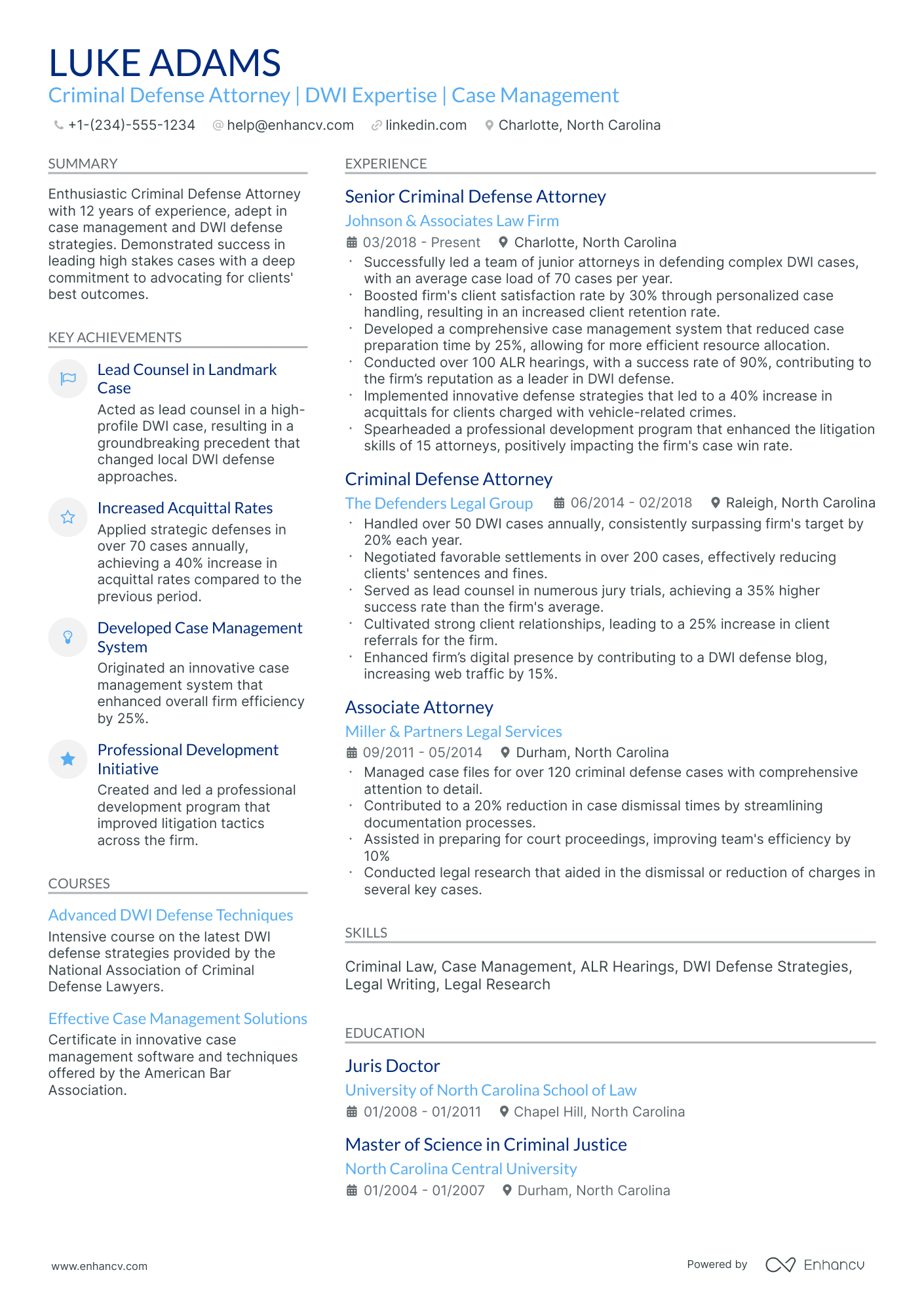
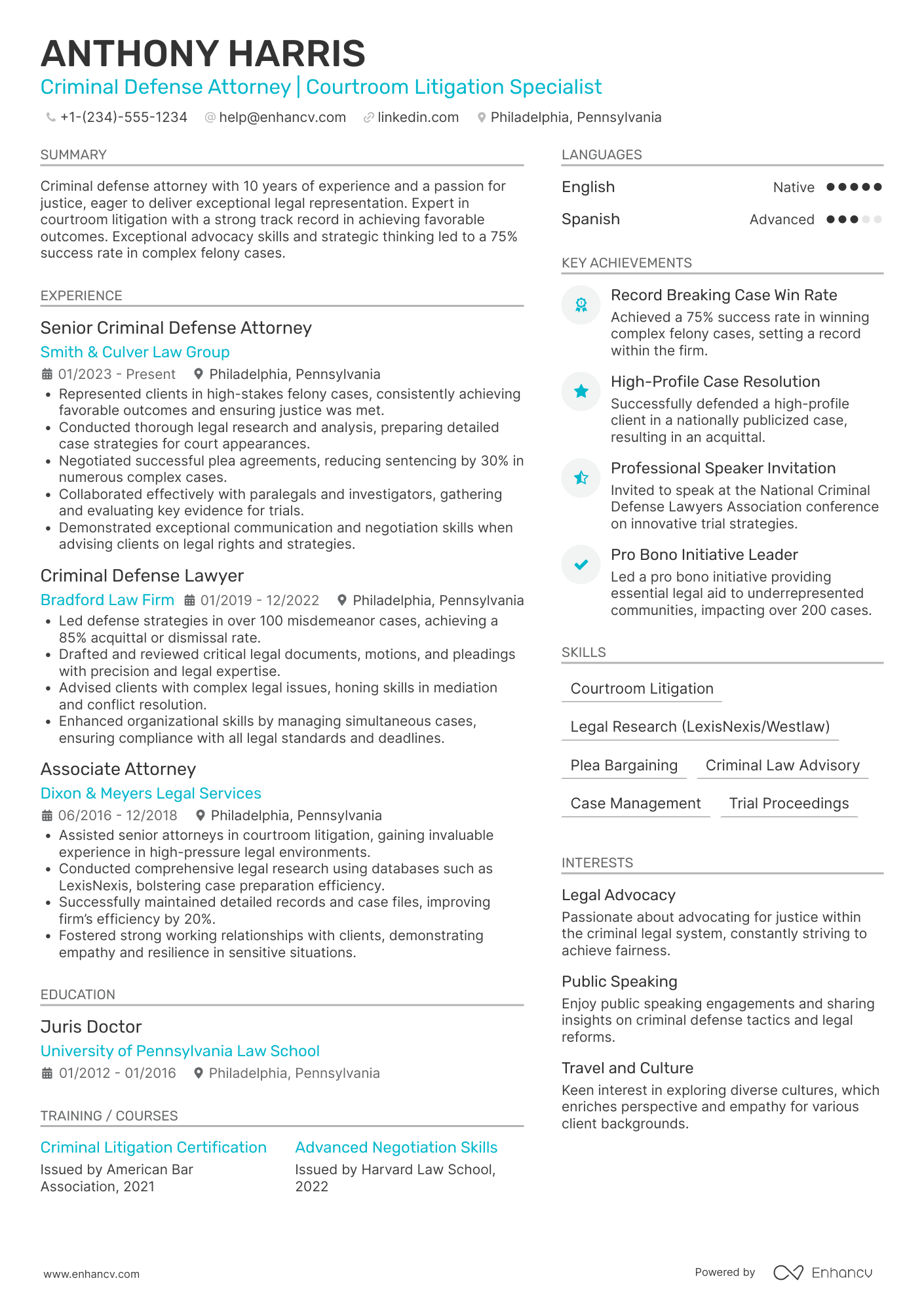
Many applications fail because a criminal lawyer resume reads like a case list, not a proof of courtroom impact. That hurts when applicant tracking system screening and fast recruiter scans favor clear outcomes in a crowded applicant pool.
A strong resume shows what you delivered: charges reduced or dismissed, favorable plea deals secured, motions granted, suppression rulings won, or trials resolved on tight timelines. Quantify results with win rates, caseload volume, dollar exposure limited, and client satisfaction. If you're unsure where to begin, learning how to write a resume that highlights impact over activity is the essential first step.

Key takeaways
- Quantify case outcomes like dismissal rates, caseload volume, and sentencing reductions in every experience bullet.
- Use reverse-chronological format for five-plus years of criminal law experience to show clear progression.
- Tailor each resume to the job posting by mirroring its practice areas, tools, and jurisdictions.
- Anchor skills in real results across your summary and experience sections, not just a standalone list.
- Entry-level candidates should lead with clinic work, moot court, and legal research tied to measurable outputs.
- Pair your resume with a cover letter that highlights one or two specific, measurable courtroom outcomes.
- Enhancv can help you turn routine job duties into sharp, quantified resume bullets in seconds.
How to format a criminal lawyer resume
Recruiters evaluating criminal lawyer resumes prioritize courtroom experience, case outcomes, and demonstrated legal judgment across progressively complex matters. A clean, well-structured format ensures these signals surface immediately—both for human reviewers scanning in seconds and for applicant tracking systems parsing your credentials. Choosing the right resume format is the foundation of that clarity.

I have significant experience in this role—which format should I use?
Use a reverse-chronological format to present your criminal law career in a clear, linear progression that highlights deepening expertise and expanding caseload responsibility. Do:
- Lead each role entry with scope indicators: jurisdiction type, caseload volume, case severity (misdemeanors through capital offenses), and supervisory responsibilities.
- Emphasize domain-specific proficiencies such as trial advocacy, plea negotiation, motion practice, sentencing strategy, forensic evidence analysis, and familiarity with federal versus state criminal procedure.
- Quantify outcomes wherever possible—acquittal rates, case dismissals, reduced sentences, and caseload size demonstrate tangible impact.
I'm junior or switching into this role—what format works best?
A hybrid format works best, allowing you to lead with a targeted skills section while still grounding your experience in a concise work history. Do:
- Place a skills section near the top highlighting criminal law competencies such as legal research, client interviewing, criminal procedure, evidence rules, and case management software like Clio or MyCase.
- Feature clinical work, internships, public defender placements, pro bono cases, moot court achievements, or paralegal experience in a dedicated projects or experience section.
- Connect every listed skill to a specific action and its result so recruiters see practical application, not just coursework.
Why hybrid and functional resumes don't work for senior roles
Hybrid and functional formats fragment your career timeline, obscuring the progression from associate counsel to lead trial attorney—exactly the trajectory hiring partners and legal recruiters need to verify. They also dilute leadership impact by stripping context from achievements, making it impossible to assess accountability, decision ownership, and the complexity of matters you managed at each stage. Avoid these formats entirely if you have five or more years of criminal law practice with a consistent employment history.
- A functional format may be acceptable only if you're transitioning into criminal law from a related practice area (civil litigation, regulatory enforcement), returning after an extended career gap, or have limited direct criminal defense experience—but even then, every listed skill must be tied to specific cases, projects, or measurable outcomes.
With the right format in place, it's time to fill each part of your resume with the sections hiring managers expect to see.
What sections should go on a criminal lawyer resume
Recruiters expect to see a clear record of criminal defense work, courtroom experience, and measurable case outcomes. Understanding which resume sections to include ensures you present that record in the order hiring managers expect.
Use this structure for maximum clarity:
- Header
- Summary
- Experience
- Skills
- Projects
- Education
- Certifications
- Optional sections: Awards, Publications, Languages
Strong experience bullets should emphasize case results, motion and trial outcomes, jurisdictional scope, caseload volume, and measurable client impact.
Is your resume good enough?
Drop your resume here or choose a file. PDF & DOCX only. Max 2MB file size.
Once you’ve organized your resume with the right core components, the next step is to write your criminal lawyer experience section so it supports that structure with clear, relevant details.
How to write your criminal lawyer resume experience
The experience section of your criminal lawyer resume should prove that you've delivered real results—whether through case outcomes, client representation, or courtroom strategy—using the legal tools and methods that define effective criminal defense or prosecution work. Hiring managers prioritize demonstrated impact over descriptive task lists, so every line should connect what you did to what changed because of it. Building a targeted resume for each application ensures those connections align with what each employer values most.
Each entry should include:
- Job title
- Company and location (or remote)
- Dates of employment (month and year)
Three to five concise bullet points showing what you owned, how you executed, and what outcomes you delivered:
- Ownership scope: the caseload types, client populations, practice areas, or legal teams you were directly accountable for as a criminal lawyer.
- Execution approach: the legal research platforms, case management systems, trial preparation methods, negotiation frameworks, or investigative techniques you used to build strategy and deliver representation.
- Value improved: changes to case resolution quality, client outcomes, sentencing results, procedural efficiency, compliance standards, or risk mitigation that resulted from your work in criminal law.
- Collaboration context: how you worked with prosecutors, judges, law enforcement, forensic experts, paralegals, public defenders, or other attorneys to advance case strategy or resolve matters.
- Impact delivered: outcomes expressed through verdict results, case disposition rates, reduced charges, successful appeals, or broader improvements to your firm's criminal practice—framed as results rather than activity.
Experience bullet formula
A criminal lawyer experience example
✅ Right example - modern, quantified, specific.
Senior Criminal Defense Attorney
Rivera & Cole Criminal Defense | Phoenix, AZ
2019–Present
Boutique defense firm handling felony and misdemeanor cases across Maricopa County, including high-volume arraignment and complex trial dockets.
- Led thirty-two felony cases to resolution annually, securing dismissals or charge reductions in sixty-one percent of matters by leveraging early case assessment, motion practice, and negotiated plea strategy.
- Drafted and argued ninety-plus motions per year using Westlaw and LexisNexis research, reducing average pretrial detention time by eighteen percent through successful bond and release litigation.
- Built trial-ready case files in Clio Manage and ShareFile, standardizing discovery indexing and exhibit logs to cut trial prep time by twenty-five percent across a five-attorney team.
- Conducted witness interviews and digital evidence review with Cellebrite exports, body-worn camera footage, and chain-of-custody audits, suppressing key evidence in eleven cases and lowering conviction risk on targeted counts.
- Collaborated with investigators, forensic experts, and prosecutors to negotiate restitution and diversion terms, achieving program placement for twenty-three clients and reducing projected incarceration exposure by an average of eight months.
Now that you've seen how to structure your experience entries, let's focus on aligning them with the specific demands of each job posting.
How to tailor your criminal lawyer resume experience
Recruiters evaluate your criminal lawyer resume through both human review and applicant tracking systems, so tailoring your resume to the job description is essential. Tailoring ensures the specific skills and qualifications they're seeking stand out immediately.
Ways to tailor your criminal lawyer experience:
- Mirror the exact criminal law practice areas listed in the posting.
- Match courtroom technologies or case management systems the firm uses.
- Reference the same legal standards or compliance frameworks they mention.
- Highlight trial experience if the role emphasizes litigation over negotiation.
- Include jurisdiction-specific knowledge when the posting names particular courts.
- Emphasize client communication methods or collaboration models they describe.
- Align your sentencing outcomes with the success criteria they prioritize.
- Reflect any specialization in felony or misdemeanor defense they request.
Tailoring means aligning your real accomplishments with what the role demands, not forcing disconnected keywords into your experience section.
Resume tailoring examples for criminal lawyer
| Job description excerpt | Untailored | Tailored |
|---|---|---|
| Represent clients in felony and misdemeanor cases in state court, including arraignments, pretrial hearings, bench trials, and jury trials. | Handled various legal cases and attended court hearings on behalf of clients. | Represented 120+ clients annually in felony and misdemeanor proceedings in state court, including arraignments, pretrial motions, and jury trials, achieving case dismissals or reduced charges in 40% of cases. |
| Conduct legal research using Westlaw and draft motions to suppress evidence, dismiss charges, and negotiate plea agreements with prosecuting attorneys. | Performed legal research and prepared documents for court proceedings. | Drafted motions to suppress evidence and dismiss charges using Westlaw case law analysis, and negotiated plea agreements with prosecutors that reduced average sentencing outcomes by 30% for clients facing drug-related offenses. |
| Manage a high-volume caseload of indigent defense clients, collaborate with investigators and expert witnesses, and ensure compliance with Sixth Amendment right-to-counsel standards. | Worked with a team to support clients and manage ongoing legal matters. | Managed a caseload of 80+ indigent defense clients simultaneously, coordinating with private investigators and forensic expert witnesses to build trial strategies while maintaining full compliance with Sixth Amendment right-to-counsel requirements. |
Once you’ve aligned your experience with the role’s priorities, the next step is to quantify your criminal lawyer achievements so hiring managers can quickly see your impact.
How to quantify your criminal lawyer achievements
Quantifying your achievements proves outcomes, not effort. Use numbers tied to case volume, cycle time, risk reduction, negotiated results, and courtroom performance, including charges reduced, sentencing exposure avoided, motion win rates, and faster resolutions.
Quantifying examples for criminal lawyer
| Metric | Example |
|---|---|
| Case volume | "Managed a caseload of forty-five felony and misdemeanor matters per quarter, keeping zero missed court deadlines using Clio and Outlook calendaring." |
| Cycle time | "Cut average time from arraignment to disposition from 120 days to 85 days by standardizing discovery requests and plea negotiation timelines." |
| Risk reduction | "Reduced clients' sentencing exposure by an average of eighteen months across twelve felony cases by securing charge reductions and alternative sentencing." |
| Quality accuracy | "Achieved a ninety-two percent suppression motion success rate (eleven of twelve) by tightening Fourth Amendment arguments and using Axon bodycam review." |
| Revenue impact | "Generated $310,000 in annual billings by converting twenty-eight consultations into retained cases and improving collections to ninety-six percent." |
Turn vague job duties into measurable, recruiter-ready resume bullets in seconds with Enhancv's Bullet Point Generator.
Once you've crafted strong bullet points to showcase your experience, the next step is ensuring your resume also highlights the specific hard and soft skills that criminal law employers prioritize.
How to list your hard and soft skills on a criminal lawyer resume
A well-built skills section matters because criminal lawyers must prove courtroom-ready competence; recruiters and an ATS (applicant tracking system) scan this section for job-match keywords, and the strongest resumes balance role-specific hard skills with job-critical soft skills. criminal lawyer roles require a blend of:
- Product strategy and discovery skills
- Data, analytics, and experimentation skills
- Delivery, execution, and go-to-market discipline
- Soft skills
Your skills section should be:
- Scannable (bullet-style grouping).
- Relevant to the job post.
- Backed by proof in experience bullets.
- Updated with current tools.
Place your skills section:
- Above experience if you're junior or switching careers.
- Below experience if you're mid/senior with strong achievements.

Hard skills
- Criminal procedure, evidence rules
- Motion practice, legal writing
- Arraignments, bail hearings
- Plea negotiations, sentencing advocacy
- Trial advocacy, voir dire
- Cross-examination, impeachment
- Witness prep, direct examination
- Discovery review, Brady/Giglio
- Legal research: Westlaw, LexisNexis
- Case management systems, e-filing
- Chain of custody analysis
- Forensic evidence review (DNA, toxicology)
Soft skills
- Client interviewing and counseling
- Clear courtroom communication
- Rapid issue spotting under pressure
- Decisive risk-based recommendations
- Negotiation with prosecutors
- Collaborative work with investigators
- Strategic case prioritization
- Confidentiality and discretion
- Fact-checking and consistency control
- Managing difficult client expectations
- Owning deadlines and follow-through
- Composure in adversarial settings
How to show your criminal lawyer skills in context
Skills shouldn't live only in a dedicated skills list. You can explore common resume skills across legal roles to see how other attorneys frame their competencies.
They should be demonstrated in:
- Your summary (high-level professional identity)
- Your experience (proof through outcomes)
Here's how that looks in practice.
Summary example
Criminal defense attorney with 14 years of trial experience across federal and state courts. Skilled in cross-examination, plea negotiation, and Westlaw research. Secured dismissals or acquittals in 73% of felony cases while mentoring junior associates.
- Reflects senior-level trial experience
- Names role-relevant tools and methods
- Quantifies case outcome success rate
- Highlights mentorship as a soft skill
Experience example
Senior Criminal Defense Attorney
Hargrove & Castillo LLP | Chicago, IL
March 2017–Present
- Defended 200+ felony and misdemeanor cases using Westlaw and PACER, achieving a 71% favorable verdict rate across state and federal courts.
- Collaborated with investigators and forensic experts to build trial strategies, resulting in 35 case dismissals over three years.
- Led plea negotiations alongside prosecutors, reducing average client sentencing exposure by 40% compared to initial charges filed.
- Every bullet includes measurable proof
- Skills surface naturally through real outcomes
Once you’ve anchored your criminal lawyer strengths in real examples, the next step is learning how to write a criminal lawyer resume with no experience, so you can present those same capabilities without relying on a work history.
How do I write a criminal lawyer resume with no experience
Even without full-time experience, you can demonstrate readiness through clinical work, internships, and academic projects. Our guide on writing a resume without work experience covers the full strategy, but here are criminal-law-specific examples to get you started:
- Criminal defense clinic casework
- Public defender office internship
- Pro bono expungement intake support
- Legal research memos on motions
- Mock trial or moot court advocacy
- Court observation and hearing summaries
- Evidence review and discovery indexing
- Client interview role-plays with notes
Focus on:
- Motion drafting samples and outcomes
- Criminal procedure research and citations
- Case management and deadline tracking
- Ethics, confidentiality, and compliance
Resume format tip for entry-level criminal lawyer
Use a skills-based resume format because it highlights legal writing, research, and courtroom exposure before limited work history. Do:
- Lead with a summary of relevant legal work.
- Add a skills section tied to examples.
- Quantify outputs: motions, memos, clients.
- List clinic matters like real cases.
- Include tools: Westlaw, LexisNexis, Clio.
- Drafted three suppression motion memos in a criminal defense clinic using Westlaw and Bluebook citations, supporting two favorable plea offers and cutting exposure by 40%.
Even without professional experience, your education section can carry significant weight on your resume—here's how to make it count.
How to list your education on a criminal lawyer resume
Your education section lets hiring teams confirm you hold the required legal degrees. It also signals specialized criminal law training that sets you apart from other candidates.
Include:
- Degree name
- Institution
- Location
- Graduation year
- Relevant coursework (for juniors or entry-level candidates)
- Honors & GPA (if 3.5 or higher)
Avoid listing specific months or days for graduation. Use the year only for a cleaner look.
Here's a strong education entry tailored to a criminal lawyer resume:
Example education entry
Juris Doctor (JD)
Georgetown University Law Center, Washington, D.C.
Graduated 2021
GPA: 3.7/4.0
- Relevant Coursework: Criminal Procedure, Constitutional Law, Evidence, Federal Sentencing Guidelines, White-Collar Crime
- Honors: Dean's List (all semesters), Moot Court Best Oralist Award
How to list your certifications on a criminal lawyer resume
Certifications on a resume show a criminal lawyer's commitment to ongoing learning, proficiency with legal tools, and relevance to current practice standards in criminal law.
Include:
- Certificate name
- Issuing organization
- Year
- Optional: credential ID or URL
- Place certifications below education when they're older, less relevant to criminal law, or used as supporting credentials.
- Place certifications above education when they're recent, highly relevant to criminal law, or required for your target role.
Best certifications for your criminal lawyer resume
National Board of Trial Advocacy (NBTA) Criminal Trial Law Certification National Board of Trial Advocacy (NBTA) Criminal Appellate Law Certification Association of Certified E-Discovery Specialists (ACEDS) Certified E-Discovery Specialist (CEDS) National Association of Legal Investigators (NALI) Certified Legal Investigator (CLI) Strafford Continuing Legal Education (CLE) Certificate in Criminal Trial Practice National Institute for Trial Advocacy (NITA) Trial Advocacy Certificate American Bar Association (ABA) Continuing Legal Education (CLE) Certificate in Criminal Law
Once you’ve presented your credentials in a clear, verifiable way, you can write your criminal lawyer resume summary to highlight those qualifications up front and set context for the rest of your experience.
How to write your criminal lawyer resume summary
Your resume summary is the first thing a recruiter reads. A sharp, specific opening sets the tone and decides whether the rest of your resume gets attention.
Keep it to three to four lines, with:
- Your title and total years of criminal law experience.
- Practice area focus, such as felony defense, federal cases, or juvenile law.
- Core skills like trial advocacy, plea negotiation, or legal research platforms.
- One or two measurable results, such as case dismissal rates or caseload volume.
- Soft skills tied to outcomes, like client communication that improved retention.

PRO TIP
At a junior level, lead with your practice area, relevant skills, and early wins. Highlight specific tools or certifications that prove readiness. Avoid vague phrases like "passionate advocate" or "motivated self-starter." Recruiters want evidence, not enthusiasm.
Example summary for a criminal lawyer
Criminal defense attorney with three years of experience handling misdemeanor and felony cases. Negotiated reduced charges in 40% of assigned cases. Skilled in trial preparation, client counseling, and Westlaw research.
Optimize your resume summary and objective for ATS
Drop your resume here or choose a file.
PDF & DOCX only. Max 2MB file size.
Now that your summary conveys your strongest qualifications at a glance, make sure your header presents your contact details just as clearly so recruiters can reach you without any friction.
What to include in a criminal lawyer resume header
Your resume header lists your key identifying and contact details, boosting visibility, credibility, and fast recruiter screening for a criminal lawyer role.
Essential resume header elements
- Full name
- Tailored job title and headline
- Location
- Phone number
- Professional email
- GitHub link
- Portfolio link
A LinkedIn link helps recruiters verify experience quickly and supports screening.
Don't include a photo on a criminal lawyer resume unless the role is explicitly front-facing or appearance-dependent.
Keep the header to two lines, match your job title to the posting, and use consistent formatting across every application.
Criminal lawyer resume header
Jordan M. Carter
Criminal lawyer | Trial advocacy, motions practice, and case strategy
Chicago, IL
(312) 555-01XX
your.name@enhancv.com
github.com/yourname
yourwebsite.com
linkedin.com/in/yourname
Once your identifying details and key credentials are clearly presented at the top, you can strengthen the rest of your application with additional sections that highlight relevant experience and qualifications.
Additional sections for criminal lawyer resumes
Beyond core qualifications, additional sections help you stand out when competing against equally credentialed criminal lawyer candidates.
They showcase unique strengths and specialized credibility that hiring partners actively seek.
Consider adding these sections to your criminal lawyer resume:
- Languages
- Publications and legal scholarship
- Bar admissions and jurisdictions
- Pro bono criminal defense work
- Professional affiliations and legal associations
- Speaking engagements and CLE presentations
- Notable case outcomes
Once you've strengthened your resume with relevant additional sections, pairing it with a well-crafted cover letter can further set your application apart.
Do criminal lawyer resumes need a cover letter
A cover letter isn't required for every criminal lawyer role, but it often helps. If you're unsure what a cover letter is or when to use one, it can matter most for competitive openings or firms that expect one. Skip it only when the posting says not to include one.
Use these guidelines to decide and write quickly:
- Explain role and team fit: Tie your courtroom style and case mix to the firm's practice, clients, and pace.
- Highlight one or two outcomes: Pick a motion win, dismissal, or sentencing result, and state your role and measurable impact.
- Show context awareness: Reference the firm's client base, local courts, and case volume, and connect your approach to those realities.
- Address transitions or gaps: Clarify a move from prosecution to defense, a relocation, or limited trial work, and show how you'll ramp fast.
Drop your resume here or choose a file.
PDF & DOCX only. Max 2MB file size.
Once you’ve decided whether to include a cover letter based on the role and employer expectations, you can use AI to strengthen your criminal lawyer resume more efficiently.
Using AI to improve your criminal lawyer resume
AI can sharpen your resume's clarity, structure, and impact. It helps tighten language and highlight relevant achievements. But overuse strips authenticity. Once your content reads clearly and fits the role, step away from AI. For specific prompt ideas, our guide on ChatGPT resume writing covers techniques you can apply directly to criminal law resumes.
Here are 10 practical prompts you can copy and paste to strengthen specific sections of your criminal lawyer resume:
- Strengthen summary focus: "Rewrite my criminal lawyer resume summary to emphasize trial experience, case outcomes, and core defense competencies in under four sentences."
- Quantify case results: "Add measurable outcomes to my criminal lawyer experience bullets, including acquittal rates, cases handled, and charges reduced or dismissed."
- Tighten bullet structure: "Rewrite these criminal lawyer experience bullets using strong action verbs and parallel structure, each under 15 words."
- Align skills precisely: "Review this criminal lawyer job posting and reorder my skills section to match the most relevant qualifications listed."
- Refine legal certifications: "Rewrite my criminal lawyer certifications section to highlight bar admissions, specializations, and continuing legal education clearly."
- Clarify education details: "Edit my criminal lawyer education section to feature honors, relevant coursework, and moot court or clinic participation concisely."
- Improve project descriptions: "Rewrite my criminal lawyer pro bono and project entries to show scope, legal strategy used, and client impact."
- Remove redundant phrasing: "Identify and remove filler words or redundant phrases across my entire criminal lawyer resume without changing meaning."
- Tailor for prosecution roles: "Adjust my criminal lawyer resume experience section to emphasize prosecution-relevant skills like case preparation and witness coordination."
- Sharpen courtroom language: "Replace vague descriptions in my criminal lawyer resume with specific courtroom terminology and procedural references."
Stop using AI once your resume sounds accurate, specific, and aligned with real experience. AI should never invent experience or inflate claims—if it didn't happen, it doesn't belong here.
Conclusion
A strong criminal lawyer resume shows measurable outcomes, role-specific skills, and clean structure. Highlight case results, motion success rates, favorable plea terms, and trial experience. Pair those results with concise sections for experience, education, bar admission, and key skills.
Today’s hiring market rewards criminal lawyers who show impact fast and communicate clearly. Keep your format consistent, your bullets specific, and your skills aligned to the role. That focus signals readiness now and for near-future hiring needs.