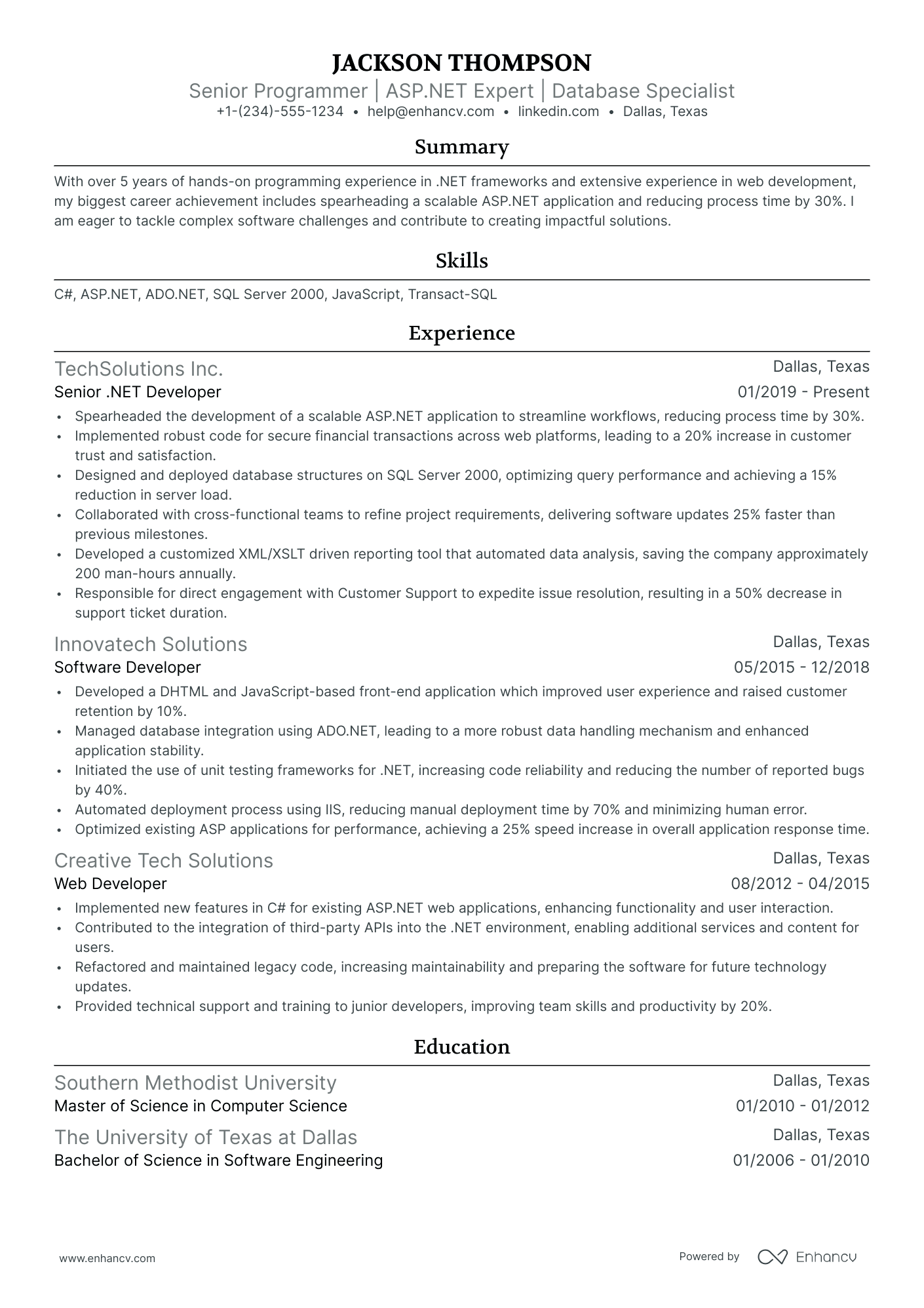
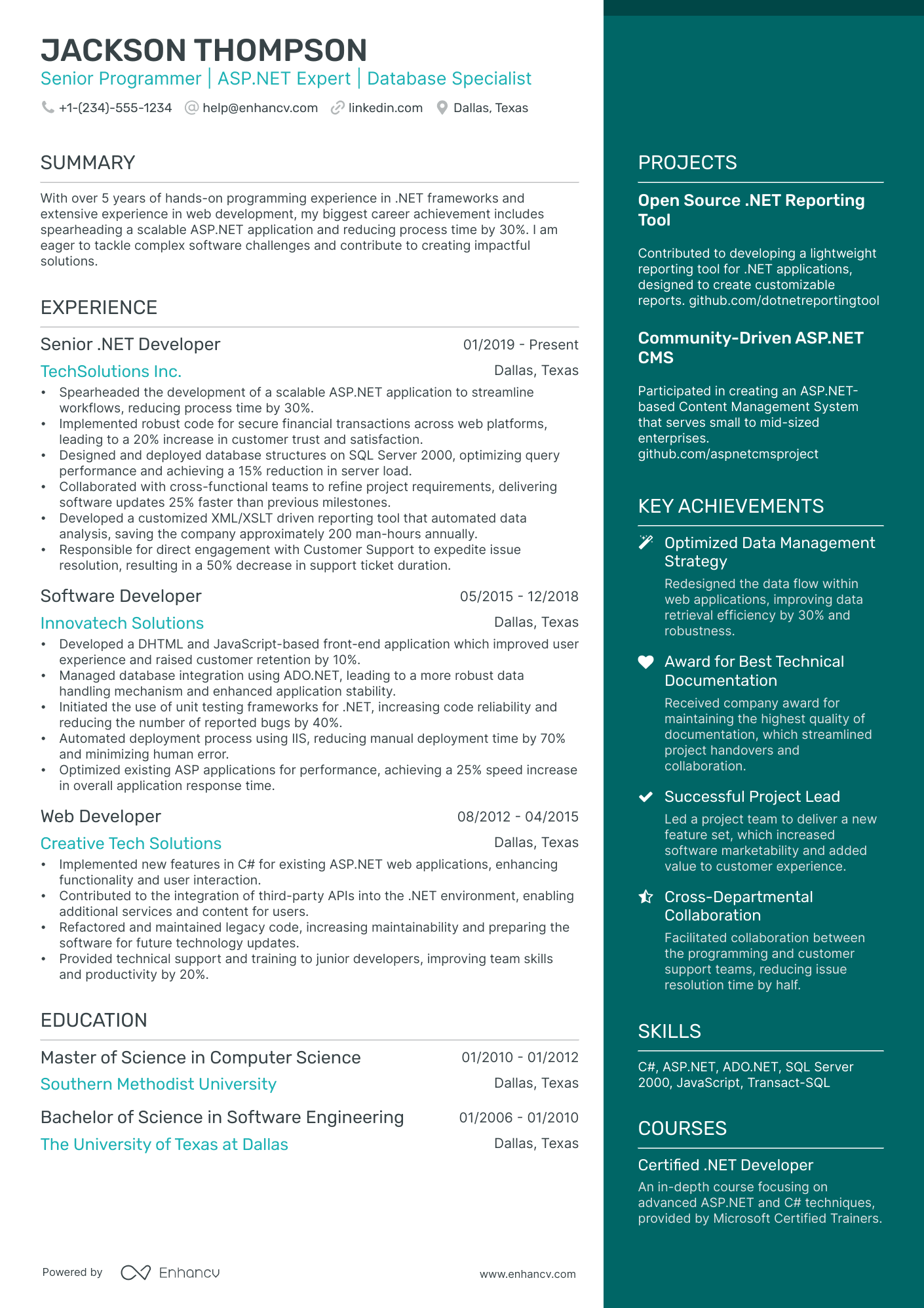
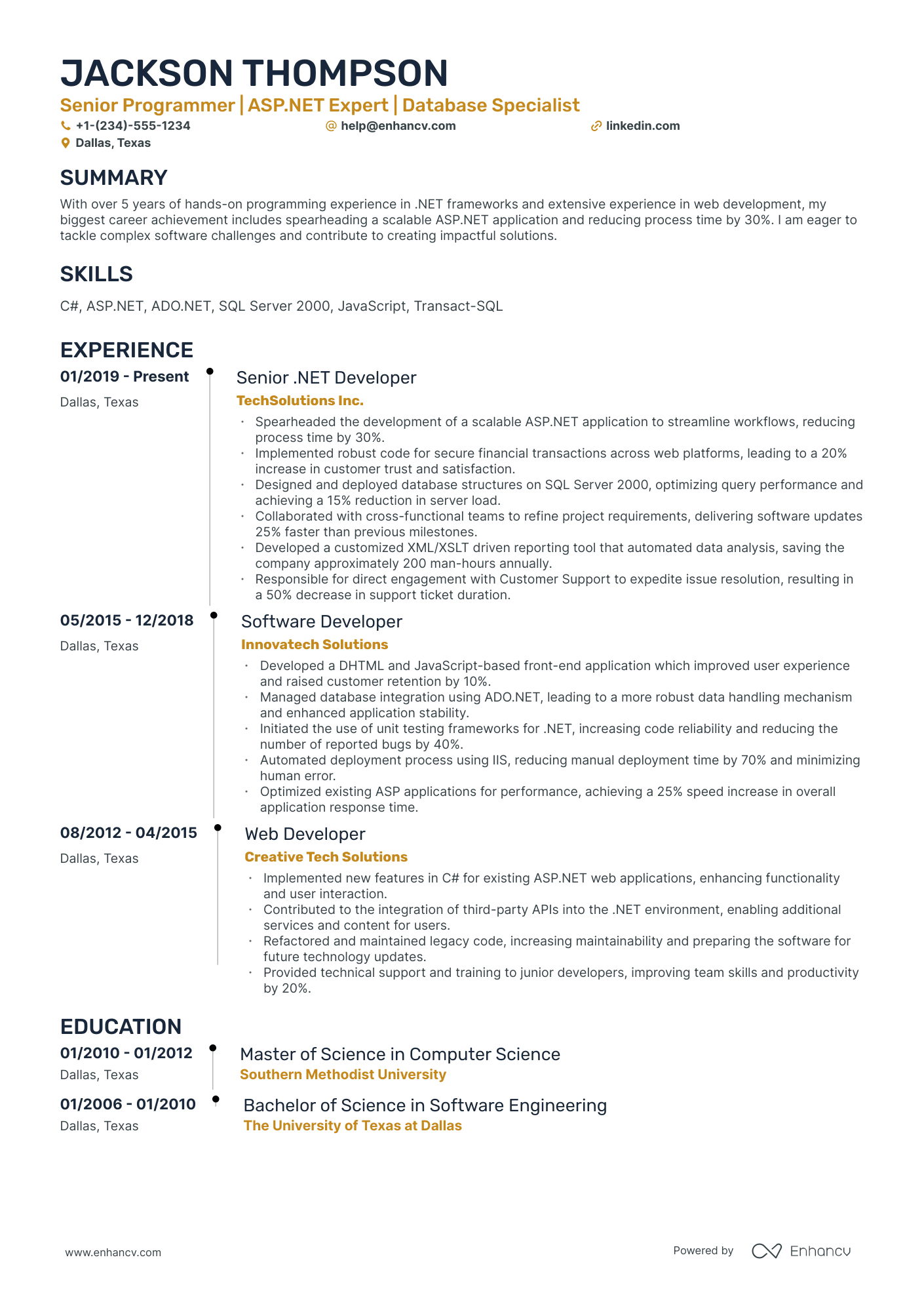
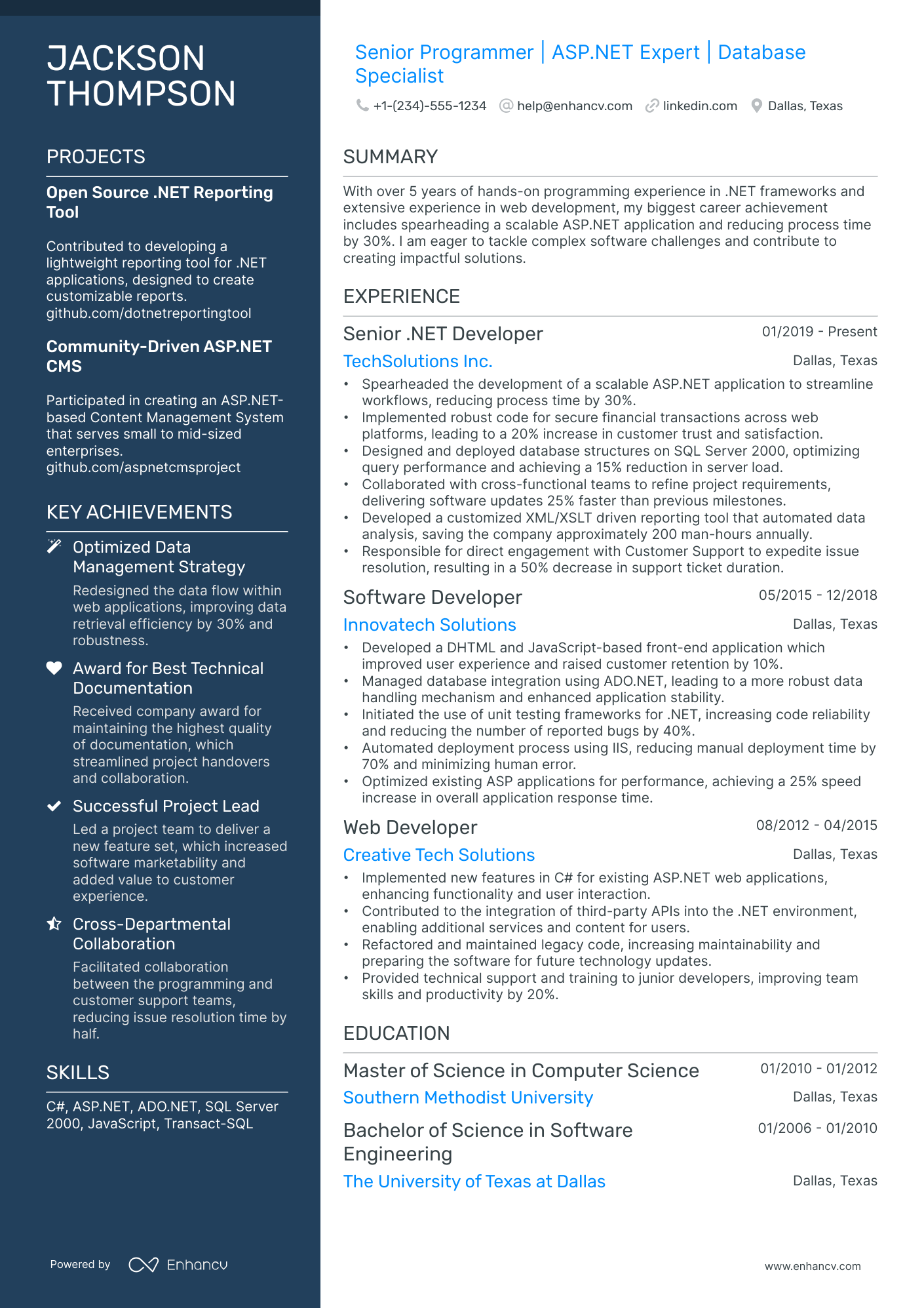
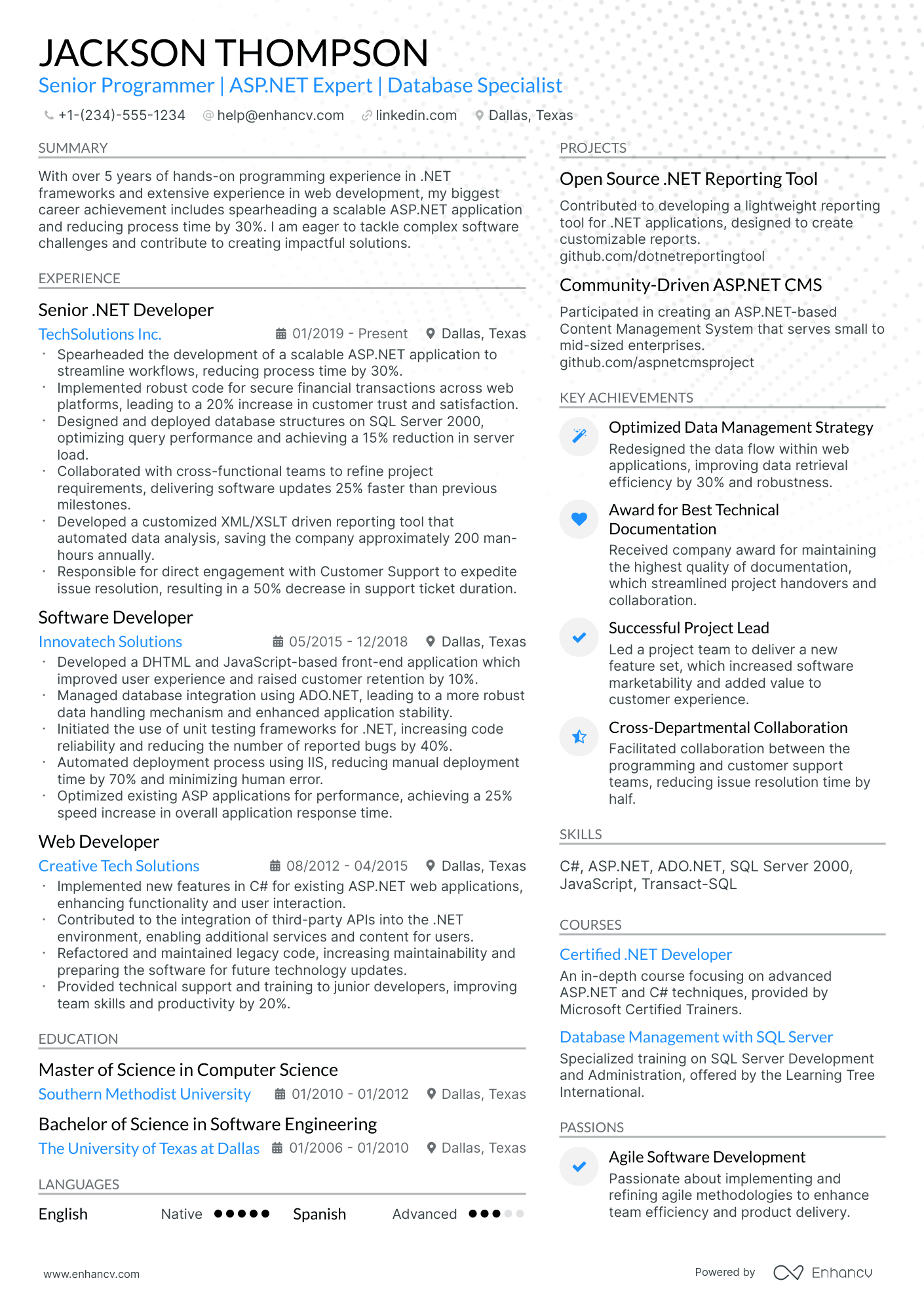
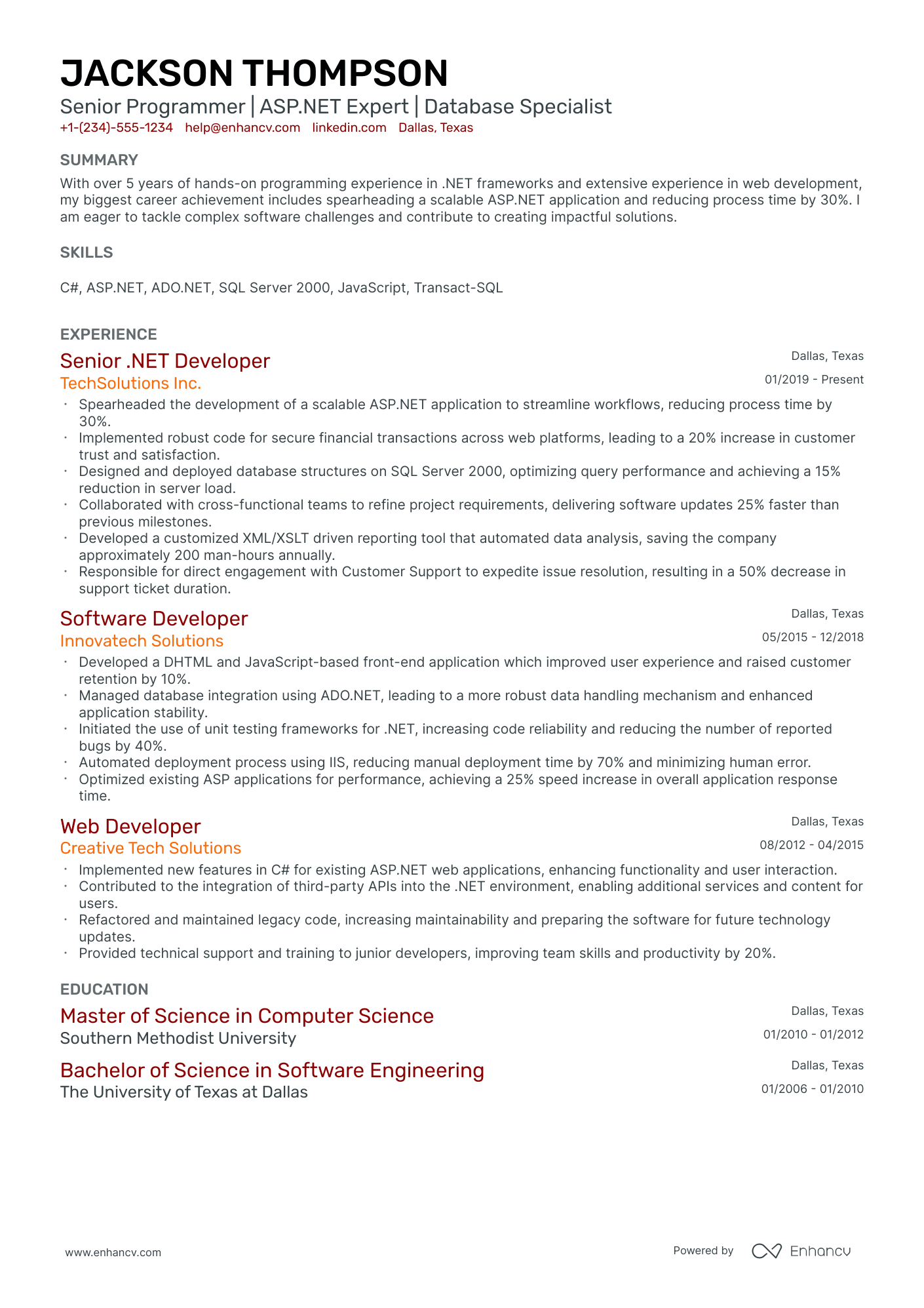
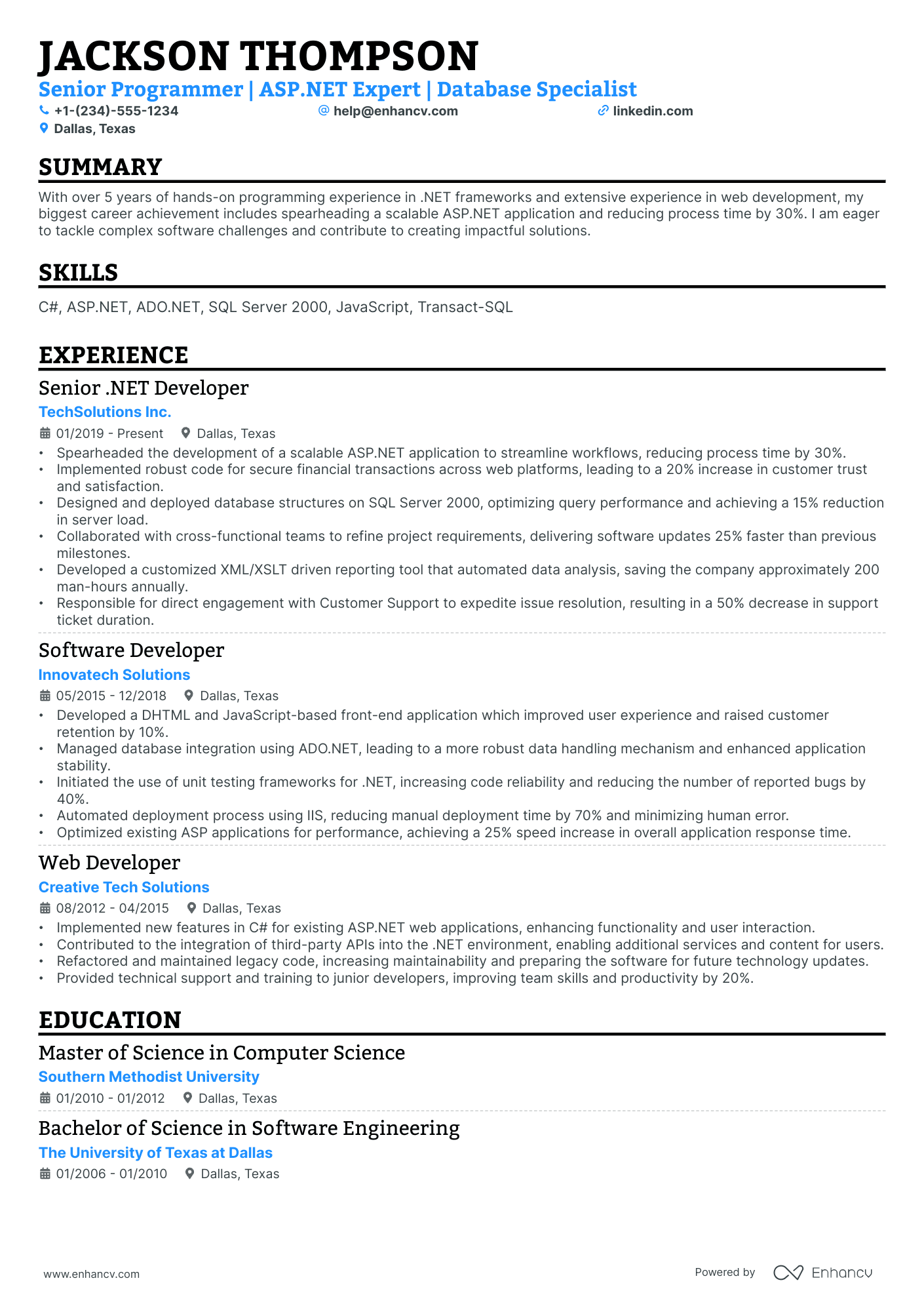
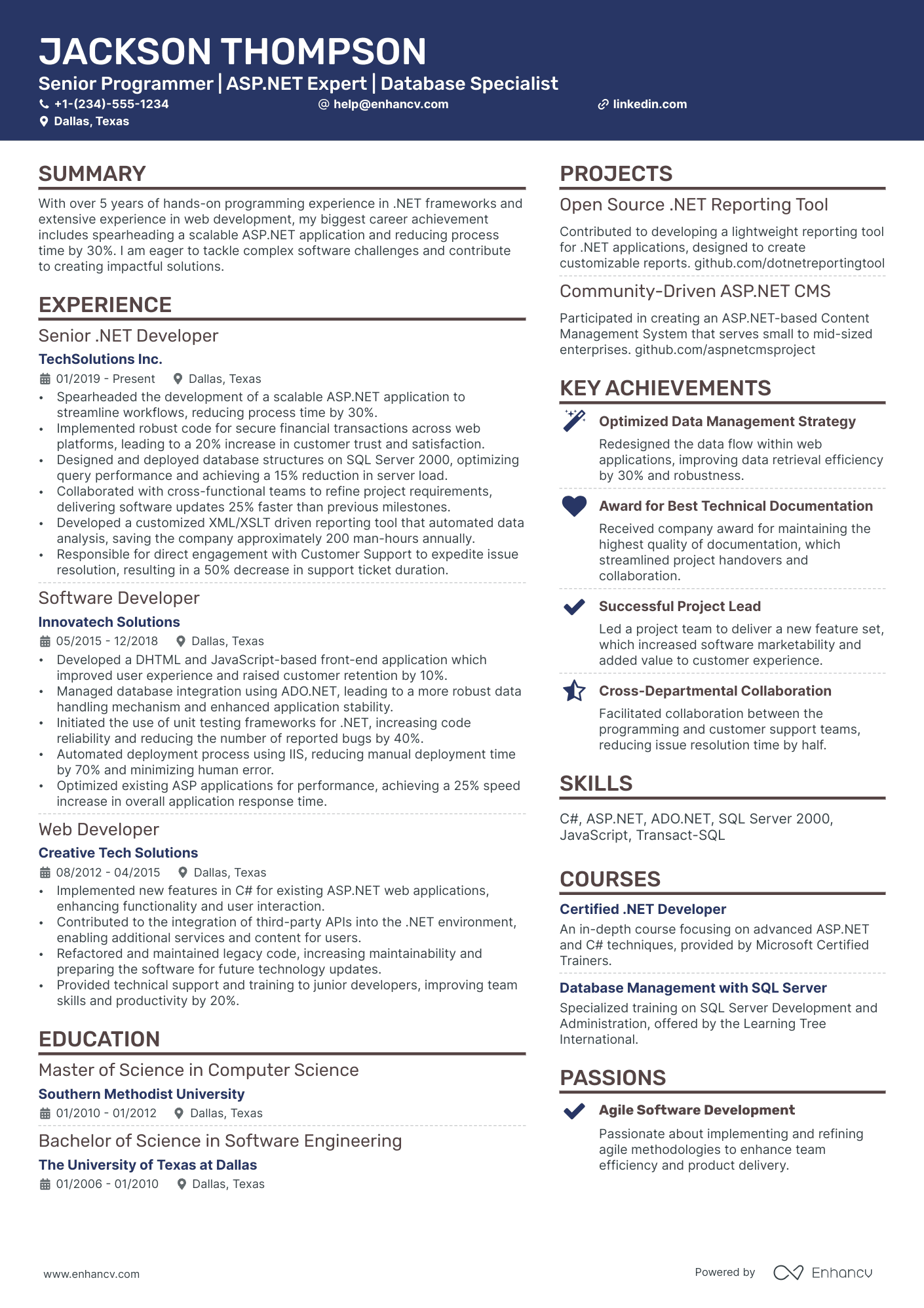
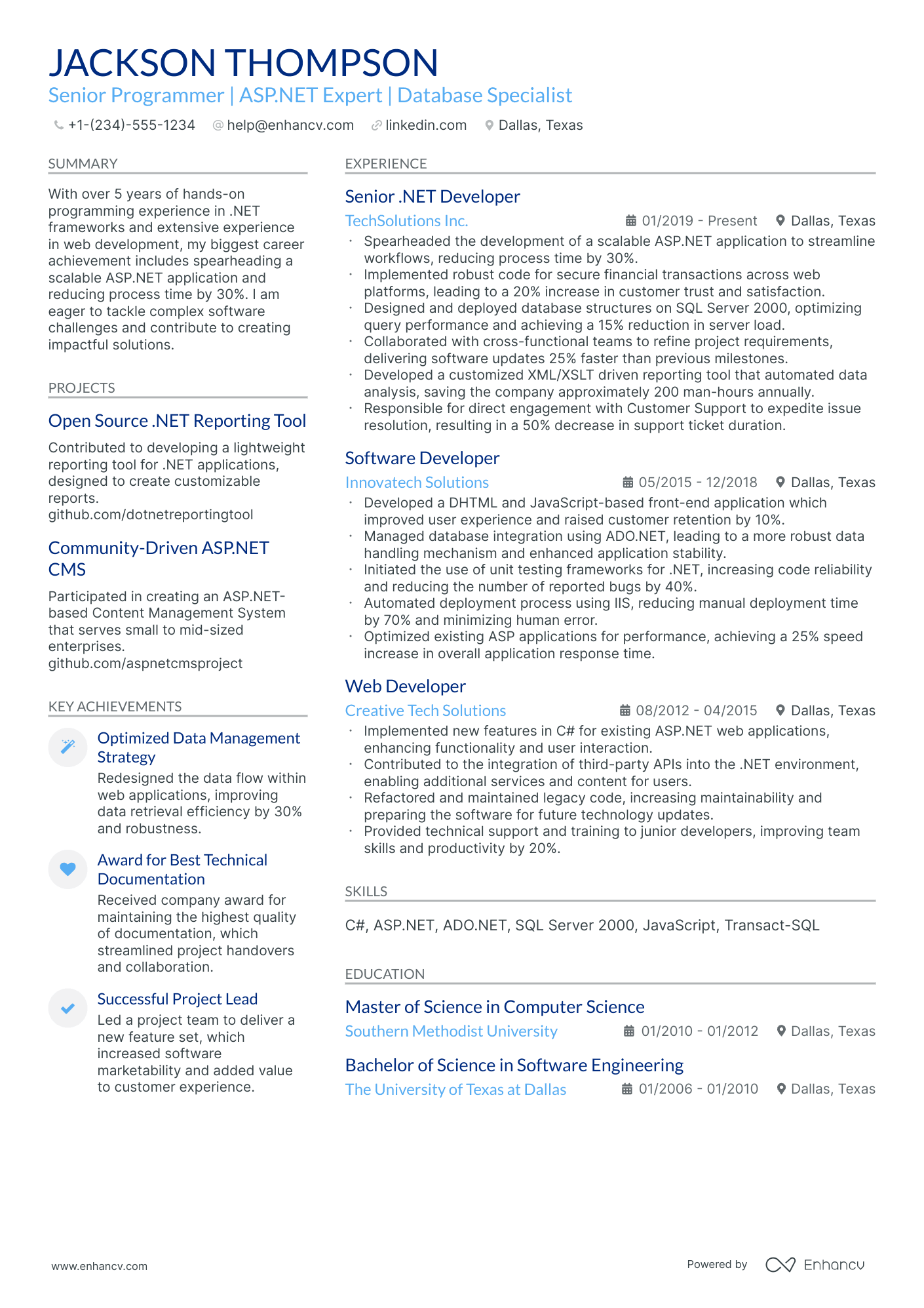
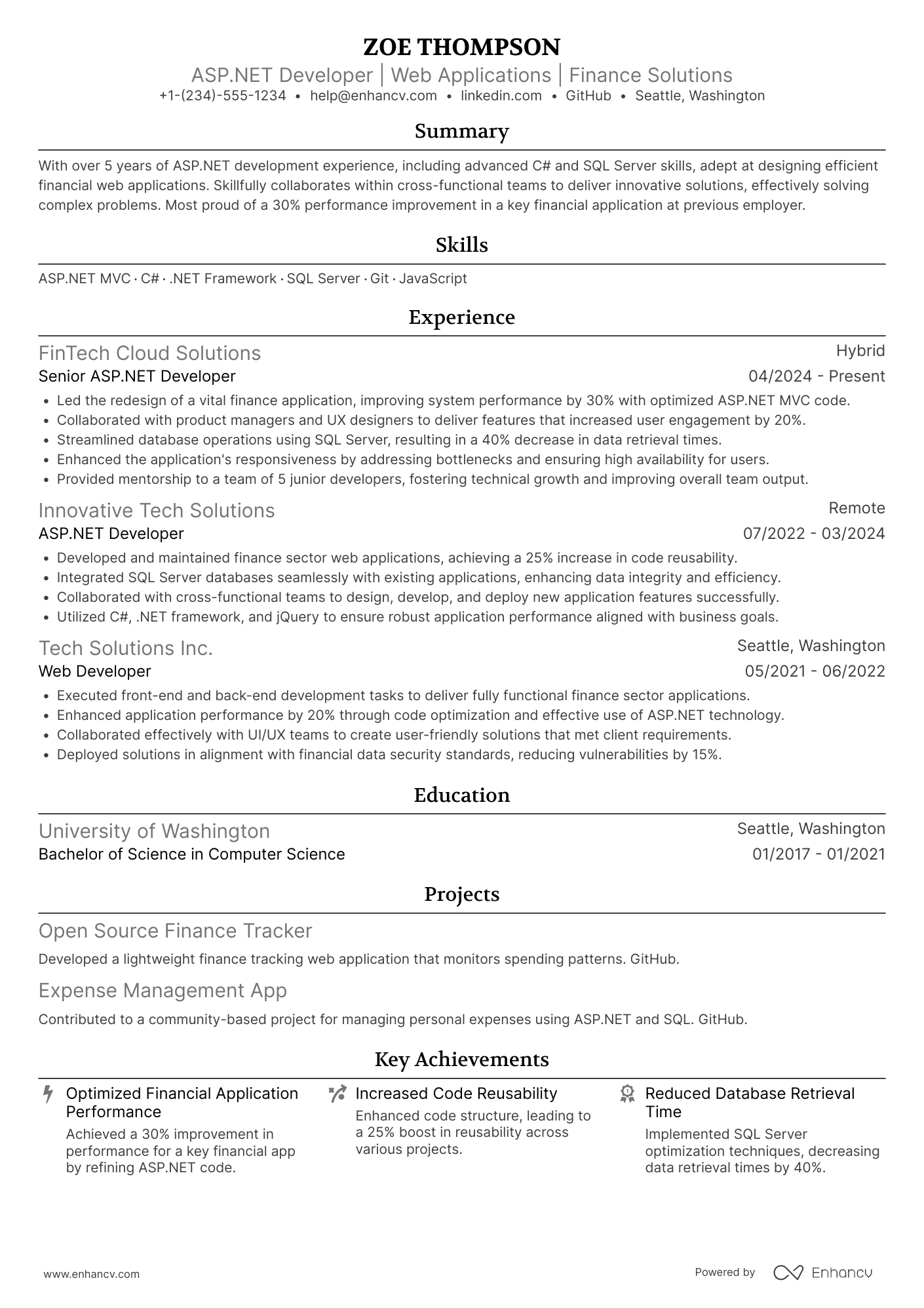
Many ASP.NET developer resume submissions fail because they read like tool inventories and generic duties, so the signal gets lost in ATS screening and fast recruiter scans. In a crowded market, that weak targeting keeps your best work from reaching interviews. If you're unsure where to begin, learning how to write a resume that highlights real impact is the first step.
A strong resume shows what you delivered and why it mattered. You should highlight measurable impact like faster response times, fewer production defects, successful migrations, on-time releases, improved test coverage, reduced cloud spend, and features that lifted conversion or retention.

Key takeaways
- Anchor every experience bullet to a measurable outcome, not a task description.
- Use reverse-chronological format for experienced developers and hybrid format for career switchers.
- Mirror the job posting's exact framework versions, tools, and terminology in your bullets.
- Place skills above experience when junior, below experience when your achievements speak louder.
- Quantify performance, reliability, delivery speed, cost, and security improvements with specific numbers.
- Showcase projects with GitHub links and metrics if you lack full-time ASP.NET experience.
- Use Enhancv's Bullet Point Generator to turn vague duties into results-driven resume bullets.
How to format a ASP.NET developer resume
Recruiters evaluating ASP.NET developer resumes prioritize hands-on experience with the .NET ecosystem, familiarity with frameworks like ASP.NET Core and MVC, and evidence of building or maintaining production-grade web applications. A clean, reverse-chronological or hybrid format ensures these signals surface quickly during both human review and applicant tracking system (ATS) parsing. Choosing the right resume format is essential for making your qualifications easy to find.

I have significant experience in this role—which format should I use?
Use a reverse-chronological format to present your ASP.NET development career in a clear, linear timeline that highlights growth and deepening technical ownership. Do:
- Lead each role entry with your scope of ownership—number of applications maintained, team size, or system architecture decisions you drove.
- List role-specific tools and frameworks (ASP.NET Core, Entity Framework, Azure DevOps, SQL Server, RESTful API design) in context within your experience bullets, not just in a skills sidebar.
- Quantify outcomes tied to performance, reliability, or delivery speed rather than listing duties.
I'm junior or switching into this role—what format works best?
Use a hybrid format that leads with a focused technical skills section, then follows with experience or project entries in reverse-chronological order. Do:
- Place core ASP.NET skills (C#, ASP.NET MVC/Core, Entity Framework, SQL Server, HTML/CSS/JavaScript) in a dedicated section near the top of the resume so ATS filters and recruiters find them immediately.
- Include personal projects, bootcamp capstones, or open-source contributions that demonstrate hands-on ASP.NET development, even if they weren't paid roles.
- Connect every bullet to a concrete action and a measurable or observable result, not just a technology name.
Why not use a functional resume?
A functional format strips away the timeline and context recruiters need to evaluate how you applied ASP.NET skills in real working environments, making it harder to assess your readiness for production-level responsibilities.
- Edge-case exception: A functional resume may be acceptable if you're transitioning from a related role (such as desktop .NET development or QA automation) and have no direct ASP.NET job titles to show—but only if every listed skill is tied to a specific project, contribution, or outcome rather than presented as a standalone keyword list.
With your resume's format established, the next step is filling it with the right sections to showcase your qualifications effectively.
What sections should go on a ASP.NET developer resume
Recruiters expect a clean, role-specific resume that shows your ASP.NET impact across production systems, teams, and business outcomes. Knowing which resume sections to include and how to order them is key to maximum clarity. Use this structure for maximum clarity:
- Header
- Summary
- Experience
- Skills
- Projects
- Education
- Certifications
- Optional sections: Open-source work, leadership, languages
Strong experience bullets should emphasize measurable results, system scope, performance and reliability gains, and your ownership of ASP.NET features from design through deployment.
Is your resume good enough?
Drop your resume here or choose a file. PDF & DOCX only. Max 2MB file size.
With your resume’s key components in place, focus next on writing your ASP.NET developer experience section so each role clearly supports and strengthens the overall structure.
How to write your ASP.NET developer resume experience
Your experience section should highlight the applications, APIs, and systems you've shipped or delivered using ASP.NET and related Microsoft technologies—anchored by measurable outcomes like improved performance, reduced downtime, or faster release cycles. Hiring managers prioritize demonstrated impact over descriptive task lists, so every bullet should prove you drove results rather than simply occupied a role. Building a targeted resume for each application ensures your experience aligns with what the hiring team actually needs.
Each entry should include:
- Job title
- Company and location (or remote)
- Dates of employment (month and year)
Three to five concise bullet points showing what you owned, how you executed, and what outcomes you delivered:
- Ownership scope: the web applications, microservices, internal platforms, or data layers you were directly accountable for building, maintaining, or scaling within your ASP.NET environment.
- Execution approach: the frameworks, libraries, and tooling you relied on—such as ASP.NET Core, Entity Framework, Azure DevOps, SQL Server, or CI/CD pipelines—to architect solutions and ship production-ready code.
- Value improved: the specific dimension of quality you elevated, whether that was application performance, page load speed, test coverage, deployment frequency, security posture, or system reliability across your .NET stack.
- Collaboration context: how you partnered with product managers, QA engineers, DevOps teams, UX designers, or external vendors to align technical decisions with business requirements and deliver integrated features.
- Impact delivered: the tangible outcomes your work produced, expressed through results such as reduced error rates, increased throughput, shortened development cycles, or expanded user capacity—not the activities themselves.
Experience bullet formula
A ASP.NET developer experience example
✅ Right example - modern, quantified, specific.
ASP.NET Developer
ClearLedger | Austin, TX
2022–Present
Built and scaled a multi-tenant billing and reporting platform for mid-market SaaS companies processing millions of invoices per month.
- Modernized a legacy ASP.NET MVC app to ASP.NET Core eight and Razor Pages, cutting average page load time from one point eight seconds to one point one seconds and reducing server costs by eighteen percent.
- Implemented RESTful APIs in ASP.NET Core with Entity Framework Core, SQL Server, and Redis caching, improving p95 endpoint latency by thirty-six percent and supporting two times higher peak traffic.
- Designed event-driven workflows with Azure Service Bus and Hangfire background jobs, reducing failed invoice runs by forty-two percent and eliminating manual reprocessing for finance operations.
- Hardened authentication and authorization using Microsoft Identity, OAuth two point zero, and role-based access control, lowering security audit findings by sixty percent and meeting SOC two change-control requirements.
- Partnered with product managers, designers, and QA to ship eight production releases per quarter via GitHub Actions, Docker, and automated xUnit integration tests, cutting escaped defects by twenty-eight percent.
Now that you've seen how a strong experience section comes together, let's look at how to adjust those details to match a specific job posting.
How to tailor your ASP.NET developer resume experience
Recruiters evaluate your resume through both human review and applicant tracking systems (ATS), scanning for alignment with the specific role. Tailoring your resume to the job description increases your chances of passing both filters.
Ways to tailor your ASP.NET developer experience:
- Match the exact .NET framework versions and tools listed in the posting.
- Mirror the job description's terminology for architectural patterns like MVC or Web API.
- Reflect specific database technologies such as SQL Server or Entity Framework mentioned.
- Quantify performance improvements using the same KPIs the employer highlights.
- Include relevant industry experience when the role targets a specific domain.
- Emphasize security practices like authentication or authorization if the posting requires them.
- Reference Agile or Scrum workflows when the team structure calls for them.
- Highlight CI/CD pipeline experience using the deployment tools the employer names.
Tailoring means aligning your real accomplishments with what the role demands, not forcing keywords into your experience where they don't belong.
Resume tailoring examples for ASP.NET developer
| Job description excerpt | Untailored | Tailored |
|---|---|---|
| "Build and maintain scalable web applications using ASP.NET Core, Entity Framework, and Azure DevOps CI/CD pipelines" | Developed web applications using various technologies and frameworks. | Built and maintained five ASP.NET Core web applications serving 50,000+ daily users, leveraging Entity Framework for data access and automating deployments through Azure DevOps CI/CD pipelines to reduce release cycles by 40%. |
| "Design and implement RESTful APIs integrated with SQL Server databases, ensuring high availability and performance optimization" | Worked on backend systems and helped improve application performance. | Designed and implemented 12 RESTful APIs in ASP.NET Web API integrated with SQL Server, optimizing stored procedures and query execution plans to cut average response times from 800ms to 200ms while maintaining 99.9% uptime. |
| "Collaborate with cross-functional teams to migrate legacy .NET Framework applications to .NET 6+, following clean architecture and SOLID principles" | Participated in application upgrades and followed coding best practices. | Led the migration of three legacy .NET Framework 4.8 applications to .NET 6, restructuring codebases around clean architecture and SOLID principles in collaboration with a cross-functional team of eight developers, QA engineers, and product managers—reducing technical debt by 35%. |
Once you’ve aligned your experience with the role’s requirements, quantify your ASP.NET developer achievements to show the impact of that work in measurable terms.
How to quantify your ASP.NET developer achievements
Quantifying your achievements proves business impact, not just effort. For ASP.NET developers, focus on performance, reliability, quality, delivery speed, and security outcomes using measurable changes in latency, error rates, deployment frequency, and incident reduction.
Quantifying examples for ASP.NET developer
| Metric | Example |
|---|---|
| Performance | "Reduced API p95 latency from 480 ms to 190 ms by optimizing Entity Framework queries, adding Redis caching, and tuning SQL Server indexes." |
| Reliability | "Cut production 500 errors by 62% by adding Polly retries, improving exception handling, and expanding health checks in ASP.NET Core." |
| Delivery speed | "Shortened release cycle from biweekly to twice weekly by building Azure DevOps pipelines, adding automated tests, and standardizing deployments." |
| Cost efficiency | "Lowered Azure App Service compute cost by 28% by right-sizing plans, enabling autoscale, and reducing background job runtime in Hangfire." |
| Security risk | "Reduced high-severity findings from nine to one by fixing OWASP Top Ten issues, rotating secrets in Azure Key Vault, and enforcing HTTPS and HSTS." |
Turn vague job duties into measurable, recruiter-ready resume bullets in seconds with Enhancv's Bullet Point Generator.
Once you've crafted strong, results-driven bullet points for your experience section, it's equally important to strategically present your hard and soft skills to give recruiters a complete picture of your qualifications.
How to list your hard and soft skills on a ASP.NET developer resume
Your skills section shows recruiters and applicant tracking systems (ATS) that you can build, secure, and ship .NET applications, and it often drives keyword matching and interview selection; aim for a hard skills-heavy mix with targeted soft skills that support delivery. ASP.NET developer roles require a blend of:
- Product strategy and discovery skills.
- Data, analytics, and experimentation skills.
- Delivery, execution, and go-to-market discipline.
- Soft skills.
Your skills section should be:
- Scannable (bullet-style grouping).
- Relevant to the job post.
- Backed by proof in experience bullets.
- Updated with current tools.
Place your skills section:
- Above experience if you're junior or switching careers.
- Below experience if you're mid/senior with strong achievements.

Hard skills
- C#, .NET, ASP.NET Core
- Web APIs, REST, JSON
- Entity Framework Core, LINQ
- SQL Server, T-SQL
- Azure App Service, Azure SQL
- Docker, containerization
- CI/CD, Azure DevOps, GitHub Actions
- Git, pull request workflows
- Authentication, authorization (OAuth 2.0, OpenID Connect)
- OWASP Top 10, secure coding
- Logging, monitoring, Application Insights
- Unit testing, xUnit, Moq
Soft skills
- Translate requirements into technical tasks
- Clarify scope and acceptance criteria
- Communicate tradeoffs and timelines
- Write actionable code review feedback
- Collaborate with QA on test coverage
- Pair program to unblock teammates
- Own production issues through resolution
- Prioritize fixes by user impact
- Document APIs and integration contracts
- Coordinate releases across teams
- Make data-informed implementation decisions
- Manage stakeholder expectations proactively
How to show your ASP.NET developer skills in context
Skills shouldn't appear only in isolated lists on your resume. Explore resume skills examples to see how top candidates weave technical abilities into real accomplishments.
They should be demonstrated in:
- Your summary (high-level professional identity)
- Your experience (proof through outcomes)
Here's what both look like in practice.
Summary example
Senior ASP.NET developer with eight years of experience building scalable enterprise healthcare platforms. Proficient in C#, Azure, and RESTful API design. Led a microservices migration that reduced system downtime by 40% while mentoring a six-person development team.
- States seniority and experience level
- Names role-relevant tools and frameworks
- Includes a measurable performance outcome
- Highlights leadership as a soft skill
Experience example
Senior ASP.NET Developer
Bridgewell Health Systems | Remote
March 2019–August 2024
- Redesigned a monolithic .NET Framework application into ASP.NET Core microservices, cutting deployment time by 55% across three production environments.
- Collaborated with product managers and QA engineers to implement Entity Framework Core data pipelines, improving query performance by 30%.
- Built CI/CD workflows using Azure DevOps and Docker, reducing release cycle length from two weeks to three days.
- Every bullet includes measurable proof.
- Skills appear naturally within accomplishments.
Once you’ve demonstrated your ASP.NET abilities through relevant examples and outcomes, the next step is to apply that approach to building an ASP.NET developer resume with no experience by highlighting what you’ve done in place of formal roles.
How do I write a ASP.NET developer resume with no experience
Even without full-time experience, you can demonstrate readiness through projects and contributions. Our guide on writing a resume without work experience walks you through how to position these effectively:
- Personal ASP.NET developer portfolio projects
- Open-source ASP.NET developer contributions
- Capstone ASP.NET developer web app
- Freelance ASP.NET developer bug fixes
- Internship ASP.NET developer deliverables
- Hackathon ASP.NET developer prototypes
- Coding bootcamp ASP.NET developer projects
- Technical blog ASP.NET developer tutorials
Focus on:
- ASP.NET developer project impact metrics
- GitHub commits, pull requests, issues
- SQL, Entity Framework, LINQ
- Tests, CI, and deployment
Resume format tip for entry-level ASP.NET developer
Use a hybrid resume format. It highlights projects and skills first, while still showing education and any related work history. Do:
- Lead with a Projects section.
- Include GitHub links per project.
- List tools: .NET, C#, SQL.
- Add metrics: latency, users, defects.
- Match keywords to job posts.
- Built a personal ASP.NET developer portfolio app with ASP.NET Core, Entity Framework, and SQL Server, cutting average page load time from 1.8s to 1.1s.
Even without professional experience, your education section can demonstrate the technical foundation and relevant coursework that hiring managers look for in an ASP.NET developer candidate.
How to list your education on a ASP.NET developer resume
Your education section helps hiring teams confirm you have the technical foundation for the ASP.NET developer role. It signals relevant training in software development, programming, and web technologies.
Include:
- Degree name
- Institution
- Location
- Graduation year
- Relevant coursework (for juniors or entry-level candidates)
- Honors & GPA (if 3.5 or higher)
Skip month and day details—list the graduation year only.
Here's a strong education entry tailored to an ASP.NET developer resume:
Example education entry
Bachelor of Science in Computer Science
University of Illinois at Chicago, Chicago, IL
Graduated 2021
GPA: 3.7/4.0
- Relevant coursework: Object-Oriented Programming, Web Application Development, Database Systems, Software Engineering, Cloud Computing
- Honors: Dean's List (six semesters), Magna Cum Laude
How to list your certifications on a ASP.NET developer resume
Certifications on your resume show an ASP.NET developer's commitment to learning, proficiency with Microsoft tools, and alignment with current industry needs, especially across cloud, security, and modern development workflows. Include:
- Certificate name
- Issuing organization
- Year
- Optional: credential ID or URL
- Place certifications below education when they're older, less relevant to ASP.NET developer roles, or you already have strong, recent academic credentials.
- Place certifications above education when they're recent, highly relevant to ASP.NET developer work, or they target the exact stack in the job posting.
Best certifications for your ASP.NET developer resume
- Microsoft Certified: Azure Developer Associate
- Microsoft Certified: Azure Solutions Architect Expert
- Microsoft Certified: DevOps Engineer Expert
- Microsoft Certified: Azure Security Engineer Associate
- Microsoft Certified: Azure Fundamentals
- AWS Certified Developer – Associate
- Google Cloud Professional Cloud Developer
Once you’ve positioned your certifications where they’re easy to verify, use your ASP.NET developer resume summary to tie those credentials to your most relevant strengths right away.
How to write your ASP.NET developer resume summary
Your resume summary is the first thing a recruiter reads. A strong one instantly signals you have the right skills and experience for the ASP.NET developer role.
Keep it to three to four lines, with:
- Your title and years of hands-on ASP.NET development experience.
- The domain or product type you've worked in, such as SaaS platforms or enterprise web applications.
- Core tools and technologies like ASP.NET Core, C#, SQL Server, Entity Framework, and REST APIs.
- One or two quantified achievements, such as improving page load times or reducing bug counts.
- A soft skill tied to a real outcome, like collaborating with cross-functional teams to ship features on schedule.

PRO TIP
At a junior level, focus on the specific tools you know and any measurable contributions from internships, projects, or early roles. Avoid vague phrases like "passionate self-starter" or "quick learner." Instead, show relevance through concrete skills and real results, even small ones.
Example summary for a ASP.NET developer
ASP.NET developer with two years of experience building web applications using C#, Entity Framework, and SQL Server. Reduced API response times by 30% through query optimization. Collaborated with a five-member team to deliver features ahead of sprint deadlines.
Optimize your resume summary and objective for ATS
Drop your resume here or choose a file.
PDF & DOCX only. Max 2MB file size.
With your summary crafted to showcase your strongest qualifications, make sure the header above it presents your contact details accurately so recruiters can actually reach you.
What to include in a ASP.NET developer resume header
A resume header is the top section with your key identifiers, and it boosts visibility, credibility, and recruiter screening for a ASP.NET developer role.
Essential resume header elements
- Full name
- Tailored job title and headline
- Location
- Phone number
- Professional email
- GitHub link
- Portfolio link
A LinkedIn link helps recruiters verify experience quickly and supports screening.
Do not include photos on a ASP.NET developer resume unless the role is explicitly front-facing or appearance-dependent.
Match your headline and links to the ASP.NET developer job description so recruiters can confirm fit in seconds.
Example
ASP.NET developer resume header
Jordan Kim
ASP.NET developer | C# and SQL Server | Web APIs and Azure
Austin, TX
(512) 555-01XX
jordan.kim@enhancv.com
github.com/jordankim
jordankim.dev
linkedin.com/in/jordankim
Once your contact details and professional identifiers are set up at the top, add targeted additional sections to strengthen the rest of your ASP.NET developer resume.
Additional sections for ASP.NET developer resumes
When your core sections don't fully capture your expertise, additional sections help you stand out among other ASP.NET developer candidates. For example, listing language skills can be a differentiator for teams serving international markets.
- Certifications (Microsoft, Azure, .NET-specific)
- Technical publications and blog posts
- Open source contributions
- Languages
- Professional memberships (ACM, .NET Foundation)
- Conference talks and presentations
- Hobbies and interests
Once you've rounded out your resume with the right supplementary sections, it's worth turning your attention to another key element of your application package—the cover letter.
Do ASP.NET developer resumes need a cover letter
A cover letter isn't required for an ASP.NET developer, but it helps in competitive roles or teams that expect one. If you're wondering what a cover letter is and when it adds value, the answer depends on how much context your resume alone can convey.
Use these tips to decide when to include one and what to say:
- Explain role and team fit by tying your experience to the stack, delivery model, and collaboration style in the job description.
- Highlight one or two outcomes from relevant projects, such as performance gains, reduced incidents, or faster releases using ASP.NET and related tools.
- Show you understand the product, users, or business context by referencing a key workflow, constraint, or metric the team likely cares about.
- Address career transitions or non-obvious experience by connecting past work to ASP.NET developer responsibilities and explaining the change in one clear sentence.
Drop your resume here or choose a file.
PDF & DOCX only. Max 2MB file size.
Once you’ve decided whether to include a cover letter to add context beyond your resume, the next step is using AI to refine your ASP.NET developer resume faster and more consistently.
Using AI to improve your ASP.NET developer resume
AI can sharpen your resume's clarity, structure, and impact. It helps tighten language and highlight relevant achievements. But overuse kills authenticity. If you're exploring this approach, check out these ChatGPT resume writing prompts for practical starting points. Once your content is clear and role-aligned, step away from AI.
Here are 10 practical prompts to strengthen specific sections of your ASP.NET developer resume:
Strengthen your summary
Quantify achievements
Tighten bullet structure
Align skills strategically
Improve project descriptions
Remove filler language
Refine education details
Highlight certifications clearly
Tailor for job postings
Fix weak phrasing
Conclusion
A strong ASP.NET developer resume proves impact with measurable outcomes, shows role-specific skills, and stays easy to scan. Use clear sections, consistent formatting, and concise bullet points that connect your work to results.
Hiring teams want ASP.NET developer candidates who can deliver now and adapt fast. When your resume highlights outcomes, core skills, and a clean structure, it shows you’re ready for today’s market.