Most product manager cover letters read like a backlog.
“Owned roadmap. Worked with stakeholders. Delivered features.”
Every PM says this. It doesn’t help a hiring manager decide who to interview. The difference comes down to one thing: product impact.
The same impact rule governs the document beside the letter — our product manager resume guide shows how to translate roadmap wins, adoption metrics, and retention deltas into bullets a hiring manager can actually scan in thirty seconds.
Strong candidates don’t describe what they owned—they show what changed. User growth, revenue impact, retention improvements, or adoption metrics. Your cover letter is where you explain how you think about product decisions, tradeoffs, and outcomes.
This guide shows you how to structure your cover letter so hiring managers can quickly see how you build products that work.

Key takeaways
- Open with a product outcome (growth, retention, revenue, or adoption).
- Focus on one product story—not a list of features.
- Show how you made decisions, not just what you shipped.
- Demonstrate cross-functional collaboration.
- Connect your experience to the company’s product.
- Keep it to one page—PM hiring managers move fast.
What is a product manager cover letter?
A product manager cover letter is a one-page document that explains how you make product decisions, prioritize work, and deliver measurable outcomes.
It complements your resume by showing:
- How you think about product problems.
- How you balance user needs and business goals.
- How you work across teams to deliver results.
Why most product manager cover letters fail:
- Listing responsibilities instead of outcomes.
- Focusing on features, not impact.
- Ignoring product thinking and decision-making.
- Not connecting experience to the company’s product.
Product manager cover letter example
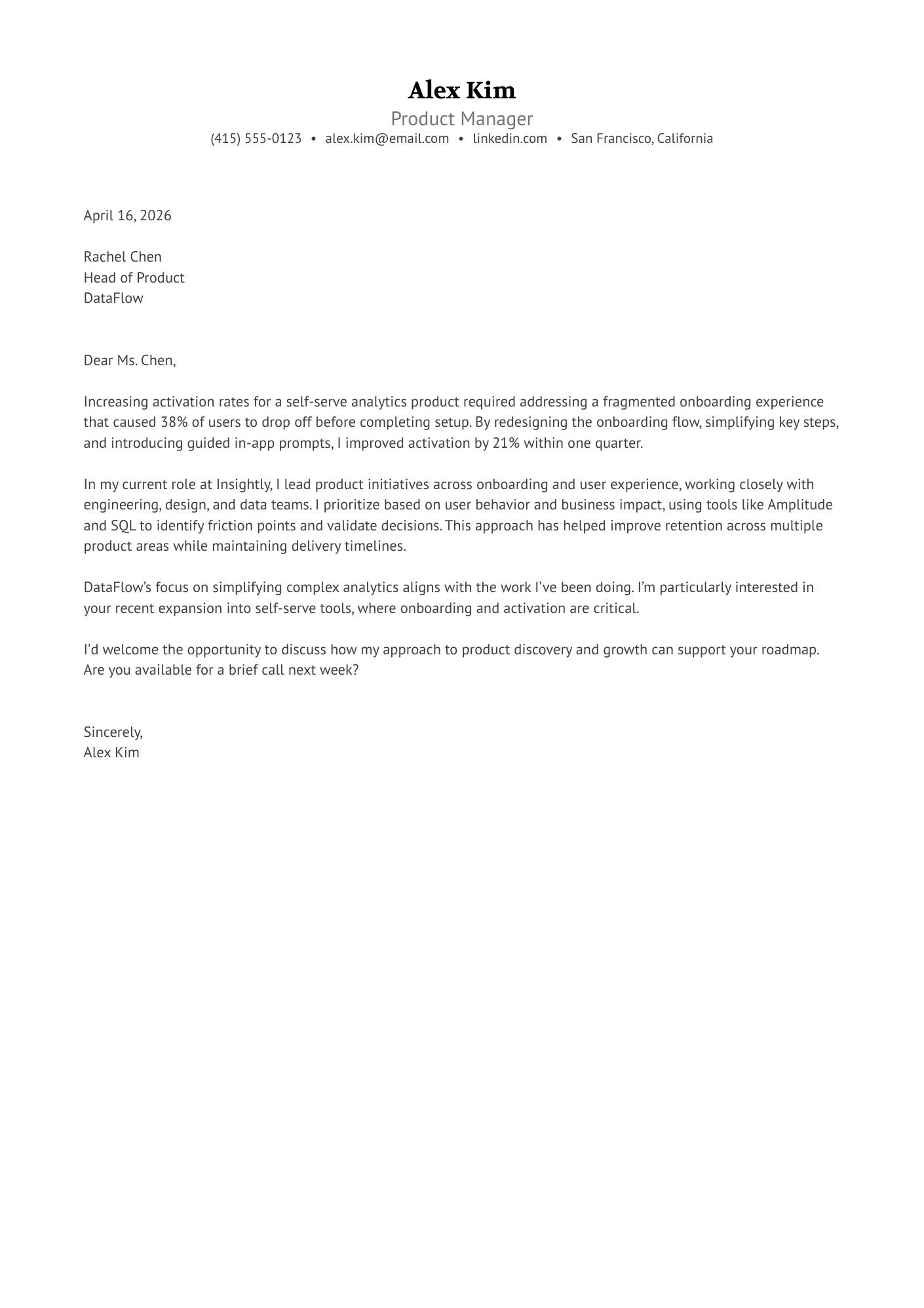
Before breaking down structure, it helps to see what a strong product manager cover letter looks like in practice. Let’s take a look at an example.
Alex Kim
San Francisco, California
(415) 555-0123
alex.kim@email.com
Rachel Chen
Head of Product
DataFlow
Alex Kim


Why this works
- Opens with a clear product problem and measurable outcome.
- Shows decision-making and product thinking.
- Demonstrates cross-functional collaboration.
- Includes tools in context (not as a list).
- Aligns directly with the company’s product.
- Ends with a clear next step.
What your product manager cover letter needs to show
Product hiring managers review applications with a simple set of questions in mind. Most candidates answer only one—and miss the opportunity to show how they actually think.
1. Can you drive product impact?
- Show measurable outcomes such as growth, retention, revenue, or engagement improvements.
- Connect your work directly to business results, not just feature delivery.
- Demonstrate that your decisions moved key metrics.
2. What’s your strongest product story?
- Focus on one product initiative and walk through it clearly.
- Explain the problem, your approach, and the outcome.
- Show how you prioritized and made tradeoffs.
3. Why this product and company?
- Show that you understand the company’s product and market.
- Reference specific features, users, or challenges.
- Connect your experience to their product strategy.
4. Can you work across teams?
- Demonstrate collaboration with engineering, design, and stakeholders.
- Show how you align teams and drive execution.
- Prove that you can move work forward without direct authority.
Once you understand what hiring managers are looking for, the next step is structuring your cover letter so those signals are easy to spot.
Drop your resume here or choose a file.
PDF & DOCX only. Max 2MB file size.
Sections to include and how to format your cover letter
A product manager cover letter follows a standard structure—but each section must show product thinking.
Required sections
- Full header: name, contact info, LinkedIn
- Date and company address
- Named salutation
- Opening paragraph: product outcome
- Body: product story + company alignment
- Closing: next step
- Professional sign-off
Formatting rules
- Length: one page (300–400 words)
- Font: clean and readable
- Layout: simple and left-aligned
- Structure: easy to scan
Clear structure reflects clear thinking—critical for PM roles.
What recruiters look for in product manager candidates
Hiring managers evaluate both execution and thinking.
What they scan for first:
- Measurable product impact
- Product thinking and prioritization
- Cross-functional collaboration
- Analytical skills and data usage
- Domain or product familiarity
- Ownership and delivery
Understanding what matters is essential—but it only works if your letter reaches the right person.
How to address a product manager cover letter
Most applications are reviewed by product leads or hiring managers. Don’t overlook addressing your letter to the right person.

Salutations
Find:
- hiring manager
- product lead
- head of product
Use:
- “Dear [Name]”
- or “Dear Product Team”
Avoid generic greetings—they signal low effort.
Once your letter reaches the right person, the next step is making sure they keep reading.
How to open a product manager cover letter
Your opening should read like a product win—not an introduction.
Strong opening
Improving onboarding for a SaaS analytics platform increased activation rates by 21% by addressing user drop-off during setup.
Weak opening
I am writing to apply for the Product Manager role.
A strong opening gets attention—now the body needs to show how you think and what you’ve delivered.
How to write the body of your product manager cover letter
The body should read like a product case study.
Paragraph 1: Product impact
Structure:
- problem
- approach
- measurable result
Product impact example
A significant drop-off during onboarding was limiting activation for our self-serve analytics product, with 35% of users failing to complete setup. I analyzed user behavior using Amplitude, identified friction points in the account configuration flow, and prioritized a simplified onboarding sequence with guided prompts. As a result, activation rates increased by 19% within one quarter, with a corresponding lift in early-stage retention.
Paragraph 2: Company alignment
Show:
- why this product
- how your experience fits
Company alignment example
Your focus on simplifying complex data workflows for non-technical users closely aligns with the onboarding and usability improvements I’ve led in SaaS environments. I’ve worked on similar challenges—reducing friction in user journeys and improving activation—and would bring that same product-led growth mindset to your team.
How to tailor your product manager cover letter to the job description
Most job descriptions tell you exactly what to highlight.
Match job posting language to your product manager cover letter
| Job posting says | Your cover letter should include |
|---|---|
| Experience with growth or activation | A metric-driven example showing user growth or conversion |
| Strong analytical skills | Tools and how you used data to make decisions |
| Ability to differentiate instruction. | How you worked with engineering and design |
| Cross-functional collaboration | How you identified and validated problems |
| SaaS or domain knowledge | Relevant product or industry experience |

PRO TIP
Enhancv’s Tailoring Tool scans a product job description and highlights which parts of your experience to emphasize—saving time when you’re applying to multiple product teams with different priorities.
The body explains your impact—the closing turns that into a next step.
How to close a product manager cover letter
Your closing should reinforce value and suggest a next step.
Strong closing
I’d welcome the opportunity to discuss how my experience improving activation and retention can support your product’s growth. Are you available for a brief call next week?
Weak closing
Thank you for considering my application.
PRO TIP
Use a professional sign-off and include your teaching credential after your name—this immediately signals your qualification to teach at the grade level.
That approach works when you have product experience—but the strategy shifts if you’re moving into product for the first time.
Product manager cover letter with no experience
You can still write a strong cover letter by focusing on product thinking, regardless of your lack of experience.
What counts:
- side projects
- case studies
- internships
- product critiques
Strong opening
I analyzed onboarding flows for three SaaS tools and identified common drop-off points, proposing improvements that increased simulated activation rates in user testing.
Describe one situation where you:
- identified a problem
- proposed a solution
- evaluated the result
That shows readiness better than saying you’re “interested in product.”
Frequently asked questions
Even strong product candidates get this part wrong. These are the questions hiring managers are effectively answering as they read your cover letter—and where clarity makes the difference.
What makes a product manager cover letter stand out?
Clarity of thinking and measurable impact.
Strong cover letters:
- Show one clear product story.
- Include real metrics (activation, retention, conversion).
- Explain decisions and tradeoffs.
Most candidates write about owning roadmaps. Few explain why they made specific product decisions—and what changed as a result.
Should I include metrics in my cover letter?
Yes—this is one of the strongest signals you can include.
Instead of:
🔴 “Improved user experience”
Write:
🟢 “Increased onboarding completion rates by 21% by simplifying the signup flow”
You don’t need perfect data—but you do need to show that your work moved something measurable.
How do I show product thinking in a cover letter?
Focus on decisions, not tasks.
Include:
- How you identified the problem.
- How you prioritized solutions.
- What tradeoffs you made.
- How you validated the outcome.
Product thinking example
User data showed a drop-off at onboarding step two, so I prioritized simplifying that step over adding new features.
That shows product thinking. Listing tools does not.
What’s the biggest mistake candidates make?
Writing a delivery-focused letter instead of a decision-focused one.
Weak cover letters:
- List features shipped.
- Describe collaboration at a high level.
- Avoid specifics.
Strong cover letters:
- Explain one product decision clearly.
- Show measurable impact.
- Connect to business outcomes.
Hiring managers aren’t evaluating execution alone—they’re evaluating judgment.
Do product managers actually need a cover letter?
Yes—especially for competitive roles. Many candidates have similar resumes.
The cover letter is what shows:
- how you think
- how you prioritize
- how you approach ambiguity
At that level, thinking is the job.
What should I check before sending my cover letter?
- One product story is clearly explained.
- A measurable result is included.
- The company’s product is referenced.
- Your decision-making is visible.
- The structure is clean and easy to scan.
If all five are true, you’re ahead of most applicants.
If you're ready to put together the full application, Enhancv’s cover letter templates keep your structure clean and focused on product impact. Pair it with a strong product manager resume to give hiring teams a clear view of how you think and what you’ve delivered.
Final thoughts
A strong product manager cover letter isn’t about ownership—it’s about judgment. Most candidates can point to features they’ve shipped.
Fewer can explain why those features mattered, what tradeoffs they made, and how those decisions changed the product. That’s what hiring managers are looking for.
If your letter makes it easy to understand how you think about problems, prioritize solutions, and measure outcomes, you give yourself a real chance of standing out.
Because at the end of the day, product management isn’t about delivering work—it’s about making decisions that move the product forward.
PRO TIP
Structure your cover letter like a product case study: problem, approach, result. Enhancv’s AI Cover Letter Generator helps you organize your thinking so your impact is easy to understand.