A paralegal cover letter has 30–45 seconds to prove you can carry a real caseload without supervision creep. It needs four things up front: practice area, the type of firm you fit (Big Law, mid-size, in-house, government), one outcome with a number, and a credential like NALA CP or NFPA RP. The U.S. counted about 376,200 paralegals in 2024.

Key takeaways
- Hiring readers sort your letter into a practice-area pile before sentence two, so the opening must name the specific position and group, not just "paralegal."
- The reader changes by firm tier and the letter has to match who's actually reading it first.
- Structure paragraph by paragraph: open with position and one quantified result, use the body for tenure and firm-specific research, and close with a brief request to discuss.
- Specificity is the credibility test. One quantified outcome, software named by product, and practice-area vocabulary that proves you've done the work, not just watched it.
- A clean three-paragraph letter doubles as a writing sample. Senior paralegals read it the way they'd read a draft motion, so structure, citation form, and a brief close matter as much as the content.
Paralegal hiring runs on cues the role itself trains you to read—specifics, names, numbers, and the right vocabulary in the right order. The sections below walk through what hiring attorneys and senior paralegals look for, how the letter shifts across firm types and practice areas, and what a strong one looks like end to end—followed by the mistakes that get letters cut on first pass.
And before you draft a single sentence, line the letter up against the document it sits beside — our paralegal resume guide covers the practice-area cues, software (Westlaw, Relativity, iManage), and credentials (NALA CP, NFPA RP) a hiring attorney scans first.
What does a paralegal cover letter need to do?
A paralegal cover letter has one job: convince the reader you can be billed out at $95–$180 an hour without an associate redoing your work. Big Law firms, regional boutiques, in-house legal departments, government offices, and solo practices all hire paralegals—but they buy different things.
A litigation paralegal at a 400-lawyer firm survives on e-discovery throughput and Bates numbering. A real estate paralegal at a 6-person boutique survives on closing checklists and title work.
The letter has to telegraph which one you are inside the first paragraph, because the reader is sorting your resume into a practice-area pile before they read sentence two.
That sorting step is the entire game. Most applicants miss it because they write a letter for "paralegal" instead of "litigation paralegal at a regional firm with a complex-commercial book." Generic gets you cut.
Thecover letter format you choose matters less than whether the opening tells the reader which type of paralegal you are.
Who reads your paralegal cover letter before the attorney sees it?
| Firm type | Who reads first | What they’re reading for |
|---|---|---|
| Big Law/firms 25+ attorneys | Recruiter or HR coordinator | Keywords from the job ad: practice area, certifications (NALA CP, NFPA RP/CRP, California MCLE registration), software (Relativity, iManage, Clio, NetDocuments, Westlaw, Lexis). |
| Big Law/firms 25+ attorneys | Paralegal manager or senior paralegal | Whether you can really do the work. They've seen 200 letters that say "strong attention to detail" and want to see what you billed last month. |
| Small firm (under ~10 attorneys) | The supervising attorney directly | Caseload fit, software they already use (Clio, MyCase, PracticePanther), how you handle a client calling at 4:50 Friday with a 5 p.m. filing deadline. Skip the HR-speak. |
| In-house legal department | Corporate counsel or contracts manager | Whether you can work without billable-hour structure. Contract volume, CLM software experience, vendor and compliance work. |
| Government, public defender, prosecutor | Hiring committee or chief paralegal | Caseload tolerance (can you sit on 80 active matters without dropping one), the specific case management system they use, public-service motivation that doesn't sound rehearsed. |
Which specifics turn a generic letter into a hireable one?
Five things separate a hireable paralegal letter from one that gets cut in the first pass.
A real outcome with a number in the opening hook
Skip "extensive experience in litigation support."
Try "ran the document review on a 180,000-page commercial contract dispute, flagged 312 hot docs, settled three weeks before trial."
Numbers are credibility currency in a profession that bills in tenths of an hour. Theright cover letter length leaves room for one specific story, not three vague ones.
Software fluency named by product
Westlaw and Lexis are table stakes. The differentiators are Relativity (e-discovery), iManage and NetDocuments (document management), Clio and MyCase (small-firm practice management), Aderant and Elite 3E (Big Law billing), CompuLaw and Aderant CompuLaw (court rules calendaring), and EDGAR (SEC filings).
Name the ones the posting mentions, then one or two more that suggest depth.
Certification status
Add your current NALA CP, NFPA RP or CRP, AAPI's accredited program, and state-specific designations like California's voluntary registration. If you're sitting for the CP exam in three months, say so. If you let a certification lapse, address it briefly rather than hoping the reader doesn't check.
Practice-area vocabulary that proves you've done the work
A litigation paralegal who's actually filed motions knows the difference between a motion in limine and a motion to compel—and uses the right one in the letter.
A corporate paralegal knows what a 12(g) filing is, what a 10-K's Item 1A covers, and why an unfiled cap table is a problem.
An immigration paralegal can tell an I-140 from an I-485 without thinking. Vague or wrong vocabulary tells the reader you've watched the work but not done it.
A line that addresses the firm specifically
Read three pages of the firm's website before you write the letter. Reference a recent case they handled, a practice area they've grown into recently, a partner whose work you've followed, or the firm's pro bono focus. Two sentences is enough. Thestructure of a strong cover letter puts this in the second paragraph, where it has space to land (closings are weak real estate for firm-specific detail).
What does a strong paralegal cover letter look like?
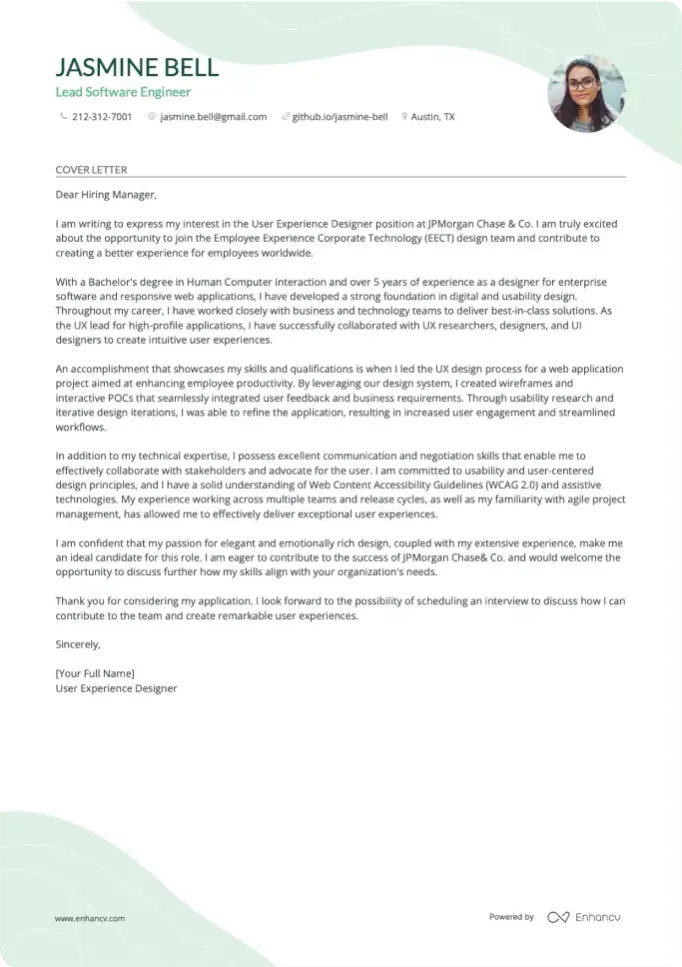
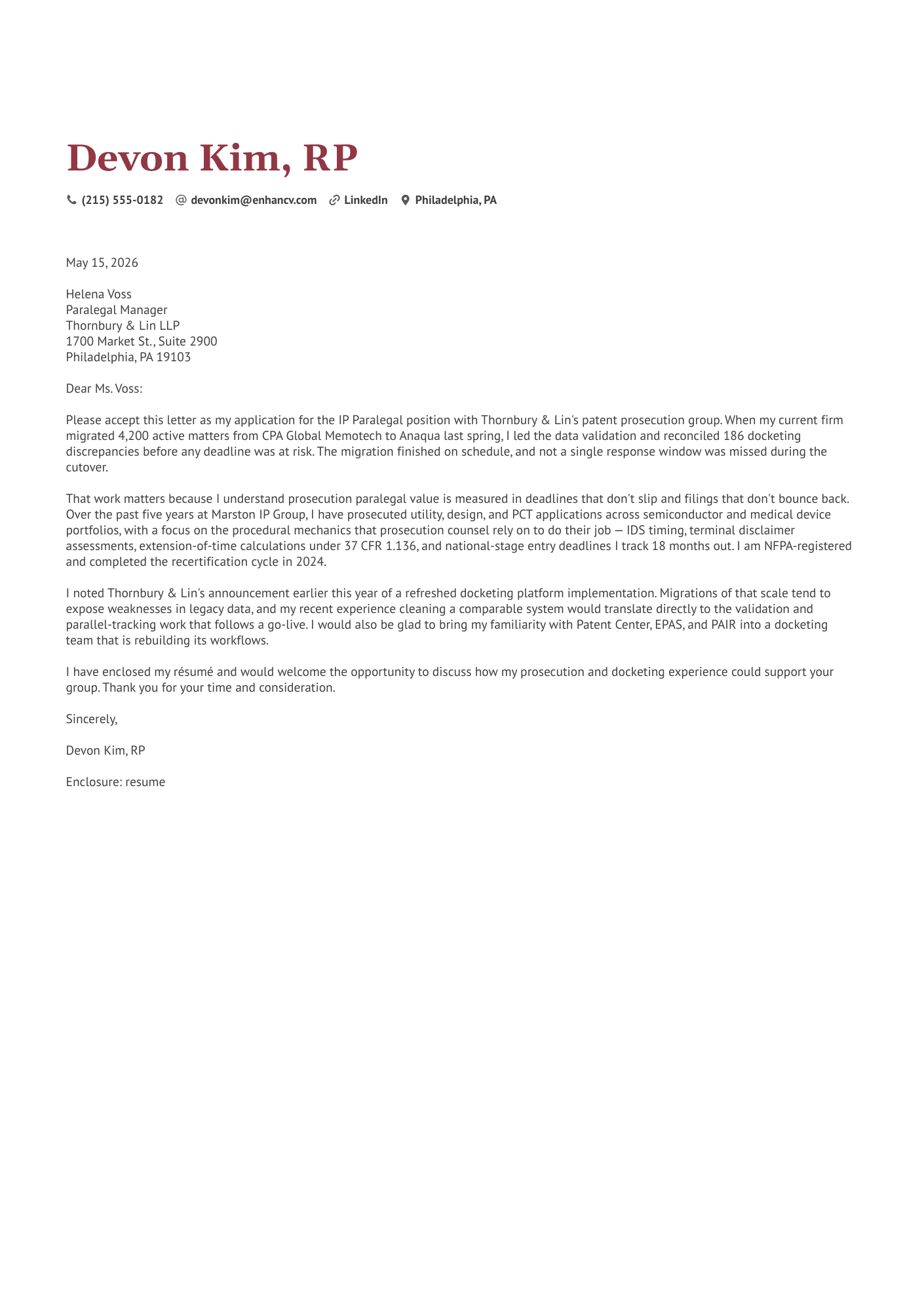
A strong paralegal cover letter looks like the one below—a litigation paralegal with about six years of experience applying to the complex commercial litigation group at a mid-size regional firm. The fullcover letter header, full address block, and a concrete opening hook are deliberate—they tell the reader you've drafted a few filings and know they have form requirements.
Marisol Aguirre, CP
Chicago, IL
(312) 555-0149
aguirre@enhancv.com
Marisol Aguirre, CP


The opening states the position applied for and leads with a quantified result—"reduced first-pass review time by 40%"—rather than a self-description.
The second paragraph establishes tenure, jurisdictions, scope of work, and credential status. The third paragraph demonstrates research into the firm and the practice group. The fourth lists specific platforms and filing experience. For more on the closing, see Enhancv'sshort cover letter examples—most paralegal letters run too long, and the strongest ones close briefly.

PRO TIP
If you're applying to a different practice area, swap the hook and the software list.
A real estate paralegal at a small firm might open with "Closed 47 commercial real estate transactions in 2025 totaling $61M, including a complex 1031 exchange that required coordinating with three title companies on a 12-day clock."
An immigration paralegal at a non-profit might open with "Filed 134 affirmative asylum applications and 89 family-based petitions in 2025 with a 96% RFE-free rate." Same shape, different evidence.
What mistakes get paralegal letters cut on first pass?
Hiring attorneys and senior paralegals say the same things over and over about why letters land in the no pile.
Generic opening that could apply to any role
I am writing to express my interest in the paralegal position advertised on Indeed" tells the reader nothing. The first paragraph should name the practice area, the experience level, and ideally a number—and probably the firm tier you've worked in too.
Claims that don't match the resume
If the letter says "expert in Relativity" but the resume doesn't list a single case where Relativity was used, the reader assumes you took a tutorial. Expert claims need a matching anchor on the résumé.
Treating a paralegal letter like an attorney letter
Paralegals don't argue cases or develop strategy. The letter shouldn't claim authorship of work that belongs to the supervising attorney. UPL (unauthorized practice of law) is a real concern, and a letter that overclaims signals trouble.
See thelawyer cover letter examples page if you're applying to be the attorney. Otherwise stay in the paralegal lane.
No certification or status mentioned
If you're certified, say so. If you're not, don't pretend to be. Mention what you do have: an ABA-approved certificate, a paralegal degree program, state-specific registration, or coursework in progress. Skipping the credential question entirely makes the reader assume you have nothing to mention.
Using "legal assistant" and "paralegal" interchangeably.
In some states (California, Florida) the terms have specific meanings under statute. Use the term the posting uses. If you're moving from one role to the other, thelegal assistant cover letter page covers the cross-over framing.
Forgetting to match the letter to the firm tier
A Big Law letter that reads like a small-firm letter (chatty, informal) gets cut for tone. A small-firm letter that reads like a Big Law letter (heavy on titles and credentials, light on practical detail) gets cut for missing the point. Read the firm's About page before you draft.
Practice-area drift
If you're a corporate paralegal applying to a litigation role, address the pivot directly. Don't pretend the corporate work was litigation. Acknowledge the move and name the transferable skills—entity diligence translates to corporate-document review in commercial litigation, for example.
Frequently asked questions on paralegal cover letters
Here are some more common questions and answers you may find useful when applying for a paralegal job in the U.S.
Do paralegal cover letters still matter in 2026 if firms use ATS?
Yes, more than for many other roles. Some law firms, even the ones that route applications through Workday or iCIMS, have a human reading the cover letter before the resume. Senior paralegals especially read cover letters carefully because the writing sample is part of the evaluation. A paralegal who can't write a clean three-paragraph letter probably can't draft a clean motion either.
How long should a paralegal cover letter be?
One page, 250–400 words, three to four paragraphs. Big Law tolerates the longer end of that range. Small firms and in-house departments prefer the shorter end. Never go to a second page—it's a credibility tax for a role that's partly judged on document discipline.
Should I list every paralegal certification I have?
No. List the ones the posting mentions and the ones that mean something specific to a hiring paralegal, like NALA CP, NFPA RP/CRP, ABA-approved program completion, and state registration. Don't list a generic "paralegal certificate of completion" from a non-accredited online program if you also have a CP. List the strongest credential and move on.
What if I'm a paralegal student or recent graduate with no firm experience?
Lead with the program (ABA-approved is the credential to name), the practice areas your coursework covered, and any internship or clinic work. If you've done volunteer legal work like Legal Aid, a clinic, immigration non-profit, name the supervising attorney and the type of cases. New-grad paralegal letters compete on specificity of training, not on years.
How do I handle a gap in paralegal experience?
Address it briefly in the second paragraph. One sentence. "I stepped out of legal work from 2022 to 2024 to handle a family medical situation, and have spent the past four months recertifying my CP and refreshing on Relativity 12 changes."
Don't apologize, don't over-explain, and don't leave the reader to guess. Hiring paralegals would rather see the gap acknowledged than hidden.
Should I follow up after sending a paralegal cover letter?
Yes, but timing depends on firm size.
- Big Law: don't follow up—the recruiter will reach out if interested.
- Mid-size: a polite email at the two-week mark to the named contact.
- Small firm or solo: a phone call at the one-week mark is appropriate and often welcome.
- Government and public defender: don't follow up. Their hiring timelines are out of the recruiter's hands.
Final thoughts
The strongest paralegal cover letters in 2026 sound like a paralegal already inside the firm describing what they do. Practice area named, firm tier matched, software listed by product, one outcome with a number, and a closing that respects the reader's time.
The Bureau of Labor Statistics expects roughly flat employment growth through 2034, but projects 39,300 openings a year—most of them from turnover, and turnover happens fast. The letter that names the work specifically tends to get the callback.