How to List Communication Skills on a Resume: Examples & How to Improve
How to prove your value beyond generic buzzwords






Is your resume ATS-friendly?
Drop your resume here or upload a file to find out if the skills in your resume are readable by an ATS.
Soft skills aren’t going anywhere—and employers are still asking for them loudly.
In an HR Dive analysis of nearly two million job postings, communication topped the list of most-requested skills.
Yet, few candidates know how to prove this strength on paper. Most simply list "good communicator" as a bullet point and hope for the best. But that won’t hold up in a quick recruiter skim.
So how do you capture such a massive, nuanced human skill into a resume?
You need a strategy that goes beyond generic buzzwords. That’s where Enhancv shines. Our AI Resume Builder helps you translate your unique voice into a powerful narrative that resonates.
Let's turn those “intangible” traits into your strongest hiring advantage.

Key takeaways
- Communication is consistently the top soft skill, but recruiters demand proof of impact rather than generic buzzwords.
- Modern communication skills fall into five categories: verbal, written, non-verbal, interpersonal, and digital/AI fluency.
- Use the STAR method to demonstrate how your specific communication style solved business problems or improved workflows.
- Whenever it feels natural, quantify your people skills with hard numbers, such as money saved, time reduced, or stakeholder adoption rates.
- Tailor your resume by matching your vocabulary to the specific verbs found in the job description and your seniority level.
- Strategically place communication assets in your summary, experience bullets, or a core competencies section for maximum visibility.
What are communication skills?
Communication skills are the abilities you use to convey information effectively to others. This includes speaking, listening, observing, and empathizing.
Communication is consistently ranked as the number one soft skill because it determines how well you collaborate. On a well-written resume, though, it means more than “good with people.” It’s your ability to create understanding—and move work forward—through clarity.
Employers want proof you can interpret complex ideas and explain them in a way that clicks with any audience.
To organize your communication skills on a resume, it helps to think of them as five core pillars.
Five main types of communication skills
| Communication skill | What it means |
|---|---|
| Verbal communication | This is how you speak. It includes clarity in meetings, public speaking, and professional phone etiquette. It also involves adapting your vocabulary to your audience, whether they’re clients or engineers. Employers value those who can explain difficult concepts simply and confidently. |
| Written communication | In remote and hybrid settings, writing is your voice. This spans emails, reports, copywriting, and technical documentation. It requires the ability to summarize complex data into clear, actionable updates. Good written communication saves the team time and prevents costly misunderstandings. |
| Non-verbal communication | This is often the loudest part of the message. It covers body language, tone, and the crucial skill of active listening. It helps you read the room and understand what isn't explicitly said during a conversation. Even on video calls, your eye contact and posture signal your level of engagement. |
| Interpersonal skills | This is the "human" element. It involves empathy, conflict resolution, and the ability to build genuine rapport. It also determines how well you integrate into a company culture. Essential for maintaining morale and collaboration during high-pressure projects. |
| Digital and AI communication skills | The modern frontier. It means mastering asynchronous tools (like Slack), prompting AI, and visualizing complex data. Companies prioritize candidates who can not only interpret data but present it visually (charts, dashboards) to make it instantly understood. It’s about using technology to streamline human connection and turn numbers into a clear narrative. |
Holding an MA in Communication and a CPRW certification, I look at resumes through a specific lens. Your resume is not just a document containing a list of skills. It’s a piece of communication material in itself.
From the design layout to how you visualize data, everything signals something to the hiring manager. A cluttered page communicates disorganization, while a clean structure signals clarity of thought.
Therefore, writing your resume must start with the golden rule of communication: know your audience. You must understand what the recruiter values before you can persuade them.
Author’s take
With that mindset, let’s look at the specific skills that speak recruiters’ language.
Most in-demand communication skills for a resume
Communication is too broad to list as a single skill—you can’t cover every aspect or just write “excellent communicator."
To get hired, you need clarity and precision. You must prove you have the specific type of communication style that fits the role.
Before you pick from the list below, use these three quick tips to find your target:
- Dissect the job description (JD): Highlight every verb related to talking, writing, or presenting. Do they say "present to stakeholders" or "collaborate on Slack"?
- Research the company: A law firm values formal reporting. A tech startup likely values quick, asynchronous updates. Match their vibe.
- Check the recruiter:A quick look at their LinkedIn posts can reveal if they prefer professional rigidity or conversational wit.
Don't worry, we’ll dive even deeper into the art of tailoring these skills later in the article.
But once you know the context, you can choose the content.
Below is the master list of communication skills, categorized by type and paired with the roles that need them most.
Top verbal and presentation skills
| Communication skill | What it is | Who it’s best for |
|---|---|---|
| Public speaking | The ability to deliver a message confidently to a large group without losing their attention. | CEO, public relations manager, teacher, sales representative, politician |
| Negotiation | Finding a middle ground where two parties feel satisfied, often involving budgets or contracts. | sales manager, real estate agent, procurement officer, lawyer, project manager |
| Persuasion | Convincing others to adopt your viewpoint or take a specific action through logic and emotion. | marketing manager, copywriter, fundraiser, lawyer, account executive |
| Presenting to stakeholders | Translating technical progress or complex data into business value for decision-makers. | product manager, business analyst, UX designer, consultant, project manager |
| Facilitating meetings | Guiding a group conversation to ensure it stays on track and reaches a clear conclusion. | Scrum master, Agile coach, team lead, HR manager, operations manager |
In many modern companies, if it isn't written down, it didn't happen.
Most wanted written and documentation skills
| Communication skill | What it is | Who it’s best for |
|---|---|---|
| Technical writing | Explaining complex systems or processes in simple manuals or guides for end-users. | software engineer, technical writer, product manager, data scientist, UX writer |
| Copywriting | Writing strategic text designed to drive sales, engagement, or brand awareness. | marketing specialist, social media manager, brand manager, SEO specialist, creative director |
| Editing and proofreading | Ensuring all written materials are error-free, tonally consistent, and easy to read. | editor, content manager, legal assistant, administrative assistant, journalist |
| Report generation | Compiling raw data into structured summaries that highlight trends and actionable insights | data analyst, financial analyst, accountant, business intelligence specialist, operations manager |
| Grant writing | Crafting persuasive proposals to secure funding from organizations or government. | non-profit manager, academic researcher, fundraising coordinator, program director, NGO specialist |
The skills below influence how people experience working with you—and how smoothly you collaborate as a team.
Best interpersonal skills
| Communication skill | What it is | Who it’s best for |
|---|---|---|
| Active listening | Hearing not just the words, but understanding the underlying intent and emotion of the speaker. | customer support, therapist, HR manager, user researcher, sales representative |
| Conflict resolution | De-escalating tense situations and finding solutions that restore professional harmony. | HR manager, team lead, customer service manager, mediator, project manager |
| Constructive feedback | Delivering criticism in a way that encourages growth rather than defensiveness. | manager, team lead, editor, teacher, Agile coach |
| Emotional intelligence (EQ) | Recognizing your own emotions and those of others to manage interactions effectively. | HR specialist, nurse, social worker, customer success manager, leadership roles |
| Client relations | Building long-term trust and satisfaction with external partners or customers. | account manager, sales representative, consultant, PR specialist, event planner |
Last but not least, the skills below are shaping up to be 2026’s must-haves—yet many people don’t think of them as part of strong communication.
Digital and AI communication skills
| Communication skill | What it is | Who it’s best for |
|---|---|---|
| Prompt engineering | Effectively communicating context and goals to AI tools to generate high-quality outputs. | AI specialist, content creator, developer, digital marketer, data analyst |
| Asynchronous collaboration | Writing clear updates in tools like Slack or Notion to reduce the need for live meetings. | remote IT roles, project manager, virtual assistant, product manager, distributed teams |
| Virtual presentation | Managing engagement, tech setup, and energy levels effectively on Zoom or Google Meet. | remote sales reps, webinar host, online tutor, team lead, mid- and executive-level roles |
| Cross-cultural digital etiquette | Navigating time zones and cultural nuances when communicating with global remote teams. | international business manager, localization specialist, global HR, translator, export manager |
| AI editing | Refining AI-generated content to ensure it sounds human and matches the brand voice. | content editor, copywriter, SEO specialist, marketing manager, communications lead |
Identifying the right skills is only half the battle. The rest is presentation.
How to highlight communication skills on a resume
“Excellent communication skills” might be the most overused line on any resume. It’s vague, subjective, and doesn’t show how you communicate at work. Recruiters see it so often it barely registers.
What they really want is evidence—what you communicated, who it was for, and what changed because of it.

PRO TIP
In an Enhancv study, 52% of the interviewed hiring managers said they expect resumes to back up achievements with clear proof.
Below is a three-step approach to putting communication skills on your resume:
Step 1: Show, don’t tell
Treat communication like any other skill on a resume. You don’t claim you’re great at it—you show it through outcomes. Pick one moment where your communication solved a real problem. Then write it as a story in one line.
A simple way to do that is the STAR method (Situation, Task, Action, Result). You don’t need all four labels in the bullet. Just include enough context to make the result believable.
If you’re unsure what to write, ask yourself these questions:
- What was unclear, tense, or stuck?
- Who needed alignment: a client, a manager, a team, a stakeholder?
- What did you do to create clarity: meeting, doc, pitch, negotiation, message?
- What improved after: speed, quality, retention, cost, buy-in, fewer errors?
Step 2: Use verbs that signal impact
Your verb choice sets the tone fast. Weak verbs make strong work sound routine, while stronger verbs show leadership, ownership, and influence.
- Avoid: talked to, wrote, handled, spoke with, replied to
- Use: facilitated, negotiated, authored, advocated, clarified, orchestrated, presented
PRO TIP
Match the verb to the type of communication.
“Negotiated” fits stakeholders. “Clarified” is suitable for messy processes. “Authored” works for documentation.
Step 3: Add numbers where possible
Soft skills often feel abstract, but numbers make them undeniable. Data gives the recruiter immediate context regarding the scale of your abilities.
If you can’t quantify the result, quantify the volume or frequency of your communication.
Instead of “Presented project updates to the team,” write “Presented weekly updates to a cross-functional team of 20+ stakeholders, ensuring full alignment on deliverables.”
Replace “Wrote articles for the company blog” with “Authored 12 SEO-optimized articles that increased organic traffic by 30% over six months.”
PRO TIP
Struggling to find the right phrasing? Enhancv’s Bullet Point Generator suggests strong, industry-specific examples for you. It even highlights vague lines and reminds you to add specific metrics to ensure your impact is front and center.
Applying these steps to technical skills is easy because they are measurable. But with communication, the results can quickly feel forced or robotic.
This is where artificial intelligence becomes a valuable writing partner. If you’re stuck, AI can help you translate a vague memory into a strong, convincing sentence.
Here’s an AI prompt to get you started. Just remember to edit the output so it sounds like you, not a machine.
Write 3 resume bullet points that prove my communication skills for a [JOB TITLE] role in [INDUSTRY].
Follow these rules:
- 18–24 words each
- Start with a strong verb
- Include [AUDIENCE] + [WHAT I DID] + [RESULT]
- Use the STAR logic but don’t label it
- Avoid phrases like “excellent communication,” “good communicator,” and generic buzzwords
- If I don’t have exact metrics, use a credible, non-numeric outcome (e.g., reduced rework, faster decisions, smoother handoffs)
Use this information:
- Situation (what was unclear/stuck): [SITUATION]
- Audience (who needed clarity): [AUDIENCE]
- Action (what I did + format): [ACTION: meeting/doc/presentation/negotiation/async update]
- Tools or channels (optional): [TOOLS/CHANNELS]
- Result (what improved): [RESULT]
Now, let’s look at a few more good and bad examples.
Before and after examples of describing communication skills on a resume
A small rewrite can turn a generic claim into proof.
Here are a few upgrades using the same formula outlined above:
Showcasing client relations skills
Bad: “Responsible for communication with clients.”
Good: “Facilitated weekly status meetings with 5 key clients, reducing project delays by 15% through clear expectation setting.”
Quantifying written communication
Bad: “Good at writing.”
Good: “Authored the internal ‘Remote Work Playbook,’ adopted by 200+ employees to standardize async communication.”
Emphasizing conflict resolution
Bad: “Handled disputes between team members.”
Good: “Mediated a conflict between design and engineering, aligning on a shared workflow that saved 10 hours per sprint.”
How to choose the right communication skills for your role
You now know how to describe your communication style, and you have the master list ready. However, this doesn’t mean you should put every single one on your resume.
Cramming them all in is a mistake, as it will make your application look cluttered and desperate.
To get hired, you must filter this list down to the top three or five that matter most.

The shift: from "standout" to "standard"
According to Enhancv's data, the value of listing generic "communication" has shifted. In 2023, it topped the list of most sought-after soft skills. However, by 2024, it dropped significantly, becoming a baseline expectation rather than a differentiator.
In its place, specific, high-level applications of communication have surged. Strategic planning leaped to the #2 spot, and team leadership emerged as a key focus, proving that employers now prioritize defined, actionable capabilities over broad traits.
Here’s how to tailor your resume communication skills to the job you’re applying for.
Let the job description lead
Your roadmap is the job ad itself. Read it carefully and highlight every communication-related verb. If they ask for "stakeholder management," do not write "talking to bosses." Use their exact language. This shows the recruiter you understand the specific demands of their role.
Consider applicant tracking systems (ATS)
Using the keywords from the job description isn't just for humans. It’s also for the ATS. These systems scan your resume for specific words found in the ad, normally hard skills or certifications.
For example, if the requirement is “strategic negotiation,” writing that you’re “good at making deals” will likely be ignored by the software.
Match your seniority level
Context changes everything. A junior developer needs active listening and teamwork to learn quickly. A CTO needs strategic leadership and strong public speaking skills to lead.
Ensure the skills you choose match the level of responsibility you’re targeting. Don’t waste space on basic skills if you’re applying for a leadership role.
PRO TIP
Manual tailoring is tedious. Enhancv’s One-Click Job Tailoring tool automates this in one click. Simply paste the job description, and our AI instantly aligns it with your resume. It highlights missing keywords and gives you a real-time match score to ensure you pass the ATS.
Where to put communication skills on your resume
There is no single "perfect" spot for communication skills. However, if the role centers around them, they belong in the top third of your document.
The rule is simple: place your most relevant assets where they can’t be missed. Usually, this means the summary or header, where the recruiter's attention is freshest.
But remember, you rarely just list the word "communication" by itself. You need to provide context to make it stick.
Let’s look at the three prime real estate spots to do just that.
The summary section
Think of the summary as the "hook" of your story. It sits at the top and frames exactly how the recruiter interprets the rest of your experience.
If your ability to lead, persuade, or translate complex ideas is your primary asset, don’t make them wait for the bullet points to find it. State it upfront.
Who is this placement best for?
- Senior professionals and leaders: Because at this level, your ability to align teams is often more valuable than your technical output.
- Career changers: Because communication is a universal transferable skill that bridges the gap between your past experience and your new target role.
How to use it:
This is not the place for a dry list of keywords. Instead, use this space to define your specific communication style using strong adjectives.
Communication skills in a resume summary
Strategic Project Manager with 5+ years of experience orchestrating cross-functional remote teams. Proven track record of negotiating complex stakeholder requirements to facilitate on-time product delivery.
The experience section
If the summary is the "hook," the experience section is the evidence. This is where you validate the claims you made in your introduction.
Listing "strong communication" here is not enough. You must demonstrate it in action, showing how your ability to convey information directly influenced a business outcome.
Who is this best for?
- Everyone: This is a universal requirement. Whether you’re an intern or a director, recruiters need to see how you interact with others.
- Results-driven roles: For positions like sales, product management, or customer success, your communication style is the primary tool you use to achieve your metrics (revenue, retention, efficiency).
How to use it:
Don’t isolate communication as a separate duty (e.g., "Responsible for talking to clients"). Embed it into your bullet points using the STAR approach mentioned earlier in this guide. Show the skill as the method you used to solve a problem.
Here’s an example:
Communication in your work experience entries
Senior Product ManagerCloudScale Solutions | San Francisco, CA Jan 2022–Present
- Facilitated bi-weekly alignment workshops between Engineering and Sales teams, reducing feature-request conflicts by 40%.
- Authored a comprehensive internal API guide that clarified technical requirements for non-technical stakeholders, cutting support tickets by 25%.
- Presented quarterly product roadmaps to C-Suite executives, successfully advocating for a budget increase of $50k for user research initiatives.
The skills section
The skills section is excellent for hitting keywords and satisfying the ATS. However, avoid a lonely list of soft skills like "creative" or "friendly." Instead, mix them with hard tools to show digital fluency.
Who is this best for?
- Technical and hybrid roles: If you’re in tech, marketing, or operations, you must show you can communicate using specific tools like Slack, Jira, or Tableau.
- ATS optimization: This is the safest place to ensure you hit the exact keywords found in the job ad without disrupting the flow of your experience section.
How to use it:
Don’t separate your skills into "Soft" and "Hard" columns. Instead, use a combined approach.
Pair your communication skills with the digital tools that power them. This signals digital fluency, proving you don’t just know how to talk, but how to collaborate in a modern, often remote, environment.
Here’s what a project manager could include in their resume:
Highlighting communication in the skills section
SKILLS
- Collaboration Tools: Slack (Async communication), Microsoft Teams, Zoom (Virtual Facilitation), Notion (Documentation)
- Project Management: Jira (Ticket Management), Asana, Trello, Agile Methodologies
- Communication & Presentation: Public Speaking, Stakeholder Management, Technical Writing, Cross-Cultural Communication, Data Visualization (Tableau)
- Languages: English (Native), Spanish (Professional Working Proficiency)
Alternative: The core competencies section
A great alternative is a core competencies section. Similar to Skills, it underlines your primary areas of expertise, but it offers more strategic weight.
Unlike a standard list of single keywords, this placement allows you to use multi-word phrases that combine your communication style with business impact. It also signals to the recruiter that you possess high-level capabilities rather than just basic tools.
It’s best for executives, managers, and senior specialists who need to highlight broad areas of leadership (e.g., "Cross-Functional Team Leadership") rather than individual tasks.
Check out how this looks on a resume:
Communication style in your core competencies
CORE COMPETENCIES
- Strategic Stakeholder Management
- Crisis Communication & PR
- Global Vendor Negotiation
- Agile Team Facilitation
- Change Management Leadership
Communication skills resume example
Ready to put theory into practice? You can customize this exact template in Enhancv’s AI Resume Builder to ensure your communication skills stand out.
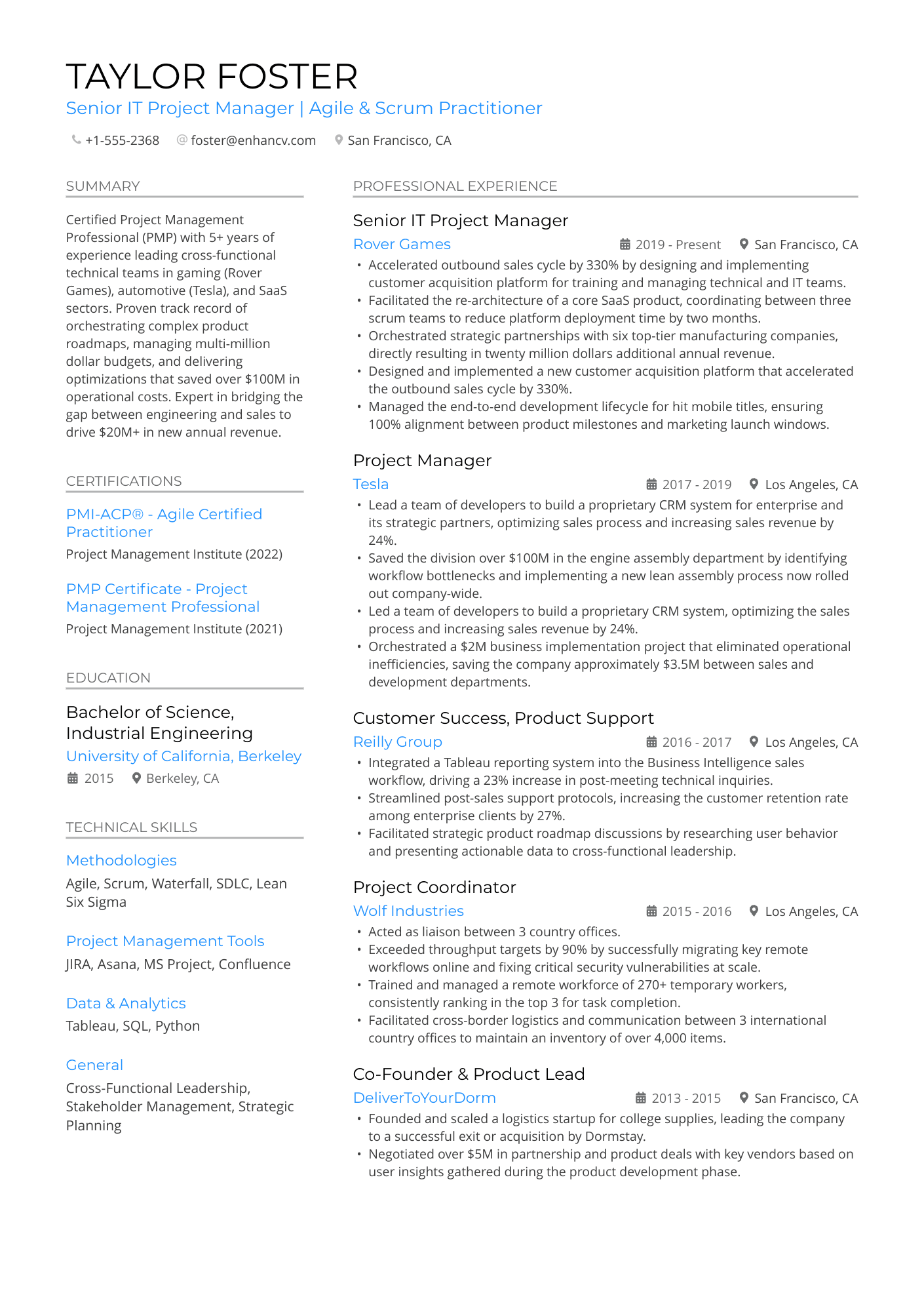
While the example above focuses on project management, every role requires a unique communication toolkit. If you’re targeting a different path, use the skills bank below to find the exact keywords for your industry.
Top communication skills for the 10 most in-demand jobs in the U.S.
Communication is not one-size-fits-all. A nurse needs bedside manner, while a data analyst needs data visualization.
To help you tailor your resume instantly, we’ve curated the essential communication stack for the most sought-after jobs in 2026.
Find your role below and copy the keywords that match your experience.
Business analyst (BA) communication skills
- The core: Requirements gathering, gap analysis, process modeling, stakeholder interviewing
- Digital/AI: User stories (Jira), visual process mapping (Lucidchart/Visio), SQL for data verification
- Resume phrasing: "Translated ambiguous stakeholder requests into precise technical specifications for development teams."
Sales representative/account executive communication skills
- The core: Active listening, objection handling, negotiation, persuasion
- Digital/AI: CRM hygiene (Salesforce/HubSpot), cold email personalization (AI tools), social selling (LinkedIn)
- Resume phrasing: "Negotiated multi-year contracts by identifying key client pain points."
Software engineer/developer communication skills
- The core: Technical translation (explaining code to non-techies), active listening, peer review feedback
- Digital/AI: GitHub documentation, API documentation, Jira ticket clarity
- Resume phrasing: "Translated complex technical requirements into actionable user stories."
Registered nurse (RN) communication skills
- The core: Patient advocacy, empathetic listening, crisis de-escalation, bedside manner
- Digital/AI: Telehealth etiquette, electronic health record (EHR) accuracy
- Resume phrasing: "Communicated critical patient status updates to multidisciplinary care teams."
Customer success manager (CSM) communication skills
- The core: Client onboarding, relationship building, retention strategy
- Digital/AI: Video Loom recordings (async support), AI chatbot oversight, ticket management (Zendesk)
- Resume phrasing: "Advocated for client needs internally to influence the product roadmap."
Marketing specialist communication skills
- The core: Brand storytelling, copywriting, cross-cultural communication
- Digital/AI: SEO content strategy, AI prompt engineering (Midjourney/ChatGPT), social media engagement
- Resume phrasing: "Defined the brand voice across 5+ social channels to increase engagement."
Data analyst communication skills
- The core: Data storytelling, presenting to non-technical audiences, critical thinking
- Digital/AI: Tableau/PowerBI dashboards, Python (Pandas), automated reporting
- Resume phrasing: "Presented complex data insights to C-Suite to drive strategic decisions."
Human resources (HR) communication skills
- The core: Conflict mediation, confidentiality, employee relations, inclusive language
- Digital/AI: HRIS management, remote culture building, policy documentation
- Resume phrasing: "Mediated sensitive employee disputes to reach amicable resolutions."
Executive assistant (EA) communication skills
- The core: Gatekeeping, anticipating needs, "managing up," confidentiality
- Digital/AI: Inbox Zero Management, Calendar Tetris (AI Scheduling Tools), Travel Logistics.
- Resume phrasing: "Orchestrated executive communications for the CEO, ensuring priority alignment."
Teacher/educator communication skills
- The core: Differentiated instruction, parent-teacher negotiation, social-emotional learning (SEL)
- Digital/AI: LMS architecture (Canvas), AI lesson planning, virtual classroom management
- Resume phrasing: "Adapted complex curriculum concepts for diverse learning styles."
Finding the right keywords for a specific role is crucial, but what if you’re just starting your career? If that sounds like you, your focus shouldn't be on niche specialization, but on demonstrating potential and growth.
Communication skills progression for students, interns, and juniors
Communication skills don’t show up all at once—they grow as you move from classroom projects to real-world work and, eventually, owning communication with stakeholders. Use your current stage to guide the kinds of examples you show on your resume.
Here is how communication skills evolve as you enter the workforce.
Students
- Presented research findings to a class of 30+ peers and faculty, turning complex ideas into clear, five-minute talks with slides.
- Coordinated weekly updates in a four-person project team, documenting decisions in shared notes and email recaps.
Interns
- Shared concise progress updates in stand-up meetings, flagging blockers early so your manager could adjust priorities.
- Drafted client-ready emails and reports based on your manager’s outline, then revised them using feedback to match the team’s tone.
Junior professionals
- Led status updates for a small project team, summarizing risks, next steps, and ownership in short meeting notes.
- Handled first-line communication with internal or external stakeholders (clients, vendors, or other teams), escalating sensitive issues clearly to your manager when needed.
How to improve your communication skills (and prove it)
Merely claiming to be a "good communicator" is easy. Proving it is hard.
The best way to hone your skills is to treat your daily work habits as resume-building exercises.
Here’s how to turn three common communication practices into tangible assets for your application.
Practice active listening
Most people listen to respond, not to understand.
Relax, it’s never too late to start using the "2-second pause" rule. Wait two seconds after someone finishes speaking before you reply. This forces you to absorb information rather than preparing your rebuttal.
The resume win:
Active listening gives you concrete examples for bullets like:
"Reduced project rework by 15% by conducting in-depth requirement gathering sessions with stakeholders."
Master the "elevator pitch"
We’ve all heard it—if you can’t explain your job to a 5-year-old, you don’t understand it well enough.
In this case, it’s best to practice summarizing your current role in one sentence, focusing on value rather than tasks.
The resume win:
This is the direct training ground for your resume summary. If you can verbally articulate your value in 30 seconds, you can write a punchy, 3-line summary that hooks the recruiter immediately.
Start writing your summary now
Drop your resume here or choose a file.
PDF & DOCX only. Max 2MB file size.
Work on your digital hygiene
In a remote world, your writing style is your voice. But that voice gets lost if there is too much noise.
For example, before sending any email or Slack message, cut the word count by 30%. Remove "fluff" words like "just," "actually," and "I think."
The resume win:
This trains you to write lean resume bullet points. A recruiter scans your resume for less than 20 seconds. The ability to convey a complex achievement in one line is the ultimate proof of strong communication.
Frequently asked questions about resume communication skills
Still have questions about how to define or demonstrate your communication style?
Here are the answers to the most common queries candidates have when refining their resumes.
What are the four main types of communication?
Traditionally, there were only four—but in the modern workplace, we must count a fifth:
- Verbal: Speaking face-to-face, on the phone, or via video calls.
- Non-verbal: Body language, eye contact, tone of voice, and gestures.
- Written: Emails, reports, Teams messages, and documentation.
- Visual: Charts, graphs, maps, and logos used to convey data instantly.
- AI & human-computer interaction: The newest form. This is the ability to communicate clearly with artificial intelligence (prompt engineering) to generate accurate results, code, or content.
Is communication a hard or soft skill?
It is primarily a soft skill because it relates to how you interact with others rather than technical knowledge. However, it crosses into hard skills when you specialize in tools or methodologies. For example, technical writing, bilingual proficiency, or public relations strategy are hard skills.
Does my resume design reflect my communication skills?
Absolutely. Think of your layout as "visual body language."
Before a recruiter reads a single word, the design tells them how you organize information.
- A cluttered, dense resume suggests you struggle to prioritize key data or distill complex thoughts.
- A clean, scannable layout demonstrates user empathy—proving you understand the reader's need for speed and clarity. It shows you respect their time enough to make the document easy to digest.
What is the most important communication skill?
Active listening. Communication is never a solo act. It’s a dynamic loop between two parties. Therefore, the most critical skill is the ability to read your audience and adjust your style to fit their needs, rather than just pushing your own agenda.
PRO TIP
Communication expert Nancy Duarte calls this Adaptive Listening™. She argues that you must identify exactly what the speaker needs in that moment using the S.A.I.D. framework (Support, Advance, Immerse, Discern).
For example, does your counterpart need emotional support, or do they need you to advance a project strategically? Adjusting your approach to match their specific state is what separates good communicators from great ones.
What is another word for communication skills on a resume?
To avoid the cliché "good communicator," use action-oriented synonyms that describe the result of your communication:
- For leadership: facilitated, orchestrated, negotiated
- For teamwork: collaborated, liaised, mediated
- For sales/impact: persuaded, advocated, presented
What are the 5 C’s of communication?
The 5 C's are a checklist to ensure your messages (be it emails or reports) are effective:
- Clear: The purpose is immediately obvious.
- Concise: No filler words or fluff.
- Complete: Includes all necessary details (who, what, when).
- Cohesive: Logical flow from start to finish.
- Concrete: Uses specific facts and data, not vague guesses.
What are the best books on communication skills for work?
Three classics that cover the different pillars of workplace interaction include:
- For influence: How to Win Friends and Influence People by Dale Carnegie
- For conflict: Crucial Conversations by Kerry Patterson et al.
- For storytelling & presentations: Resonate by Nancy Duarte
- For global teams: The Culture Map by Erin Meyer
- For empathy: Nonviolent Communication by Marshall B. Rosenberg
Should I mention communication skills in my cover letter?
Yes, but prove it, don't just say it. Instead of writing "I have excellent communication skills," describe a specific time you used those skills to solve a problem. For example: "I orchestrated a new asynchronous reporting workflow that reduced weekly meeting times by 20%."
Drop your resume here or choose a file.
PDF & DOCX only. Max 2MB file size.
How do you describe your communication style in an interview?
Be honest, but frame it around adaptability.
A great answer sounds like this:
I’m an adaptive communicator. I prefer direct and concise emails for daily updates to respect everyone's time, but for complex feedback or brainstorming, I always prioritize face-to-face or video calls to ensure tone and nuance aren't lost.
Conclusion
Communication is no longer just about speaking clearly. It’s about demonstrating impact through negotiation, digital fluency, and strategic storytelling. By moving away from generic buzzwords and grounding your skills in data, you transform your resume from a passive list into a persuasive argument.
Don't let your "soft" skills fade into the background—make them the loudest part of your application. With the right context and specific examples, you can prove to recruiters that you are the bridge-builder they need. Your resume is your first act of communication—make it count.
Make one that's truly you.