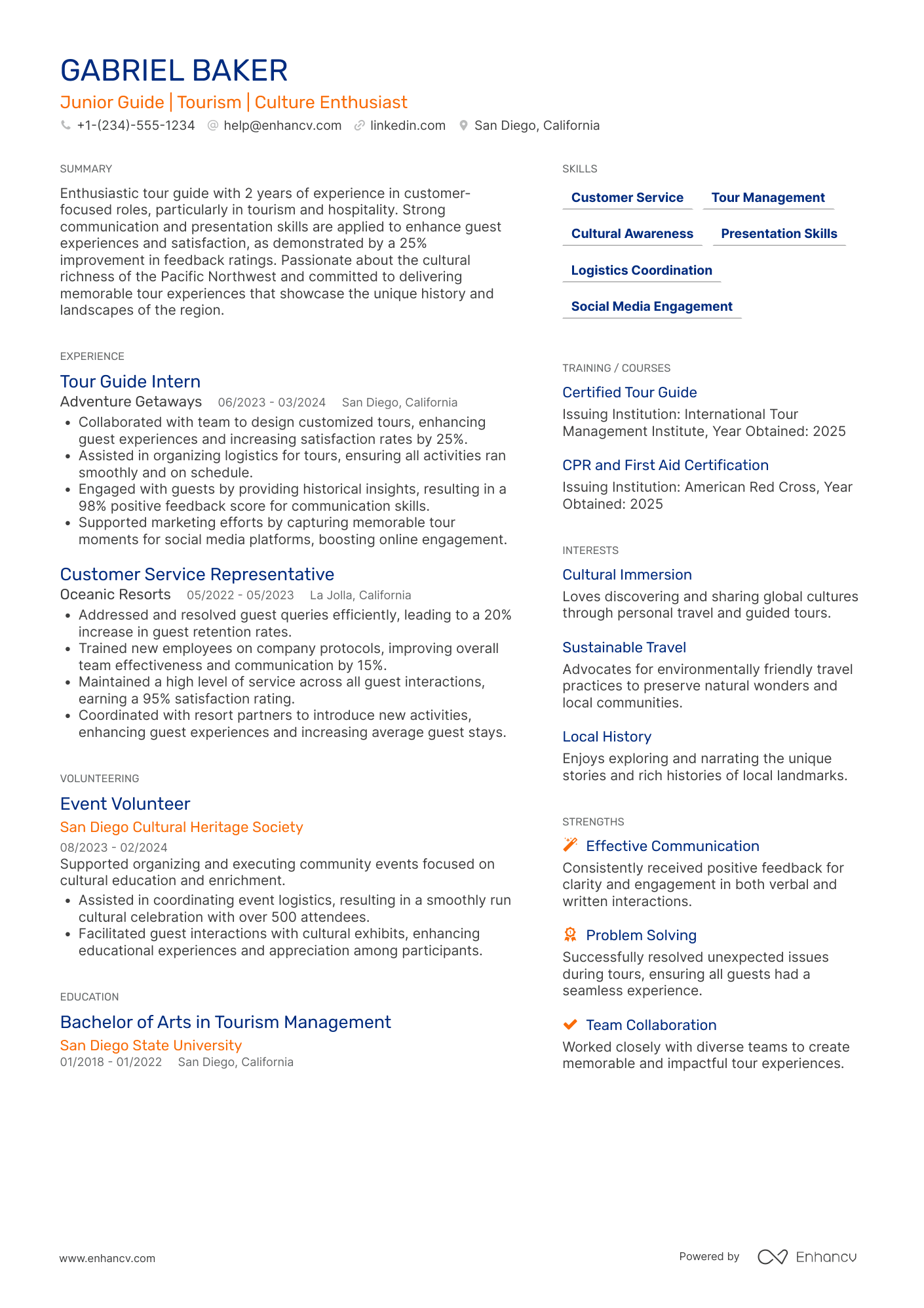
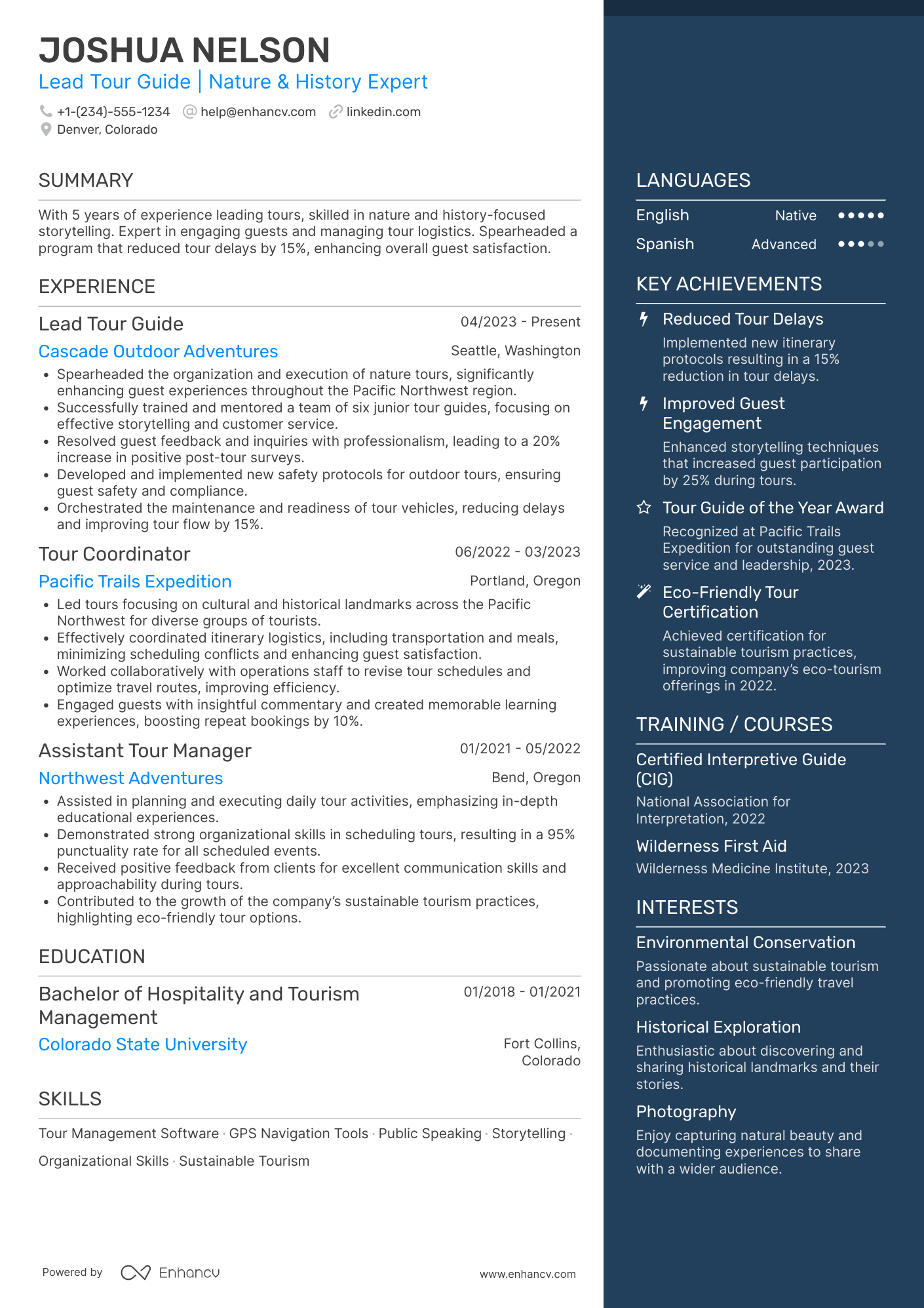
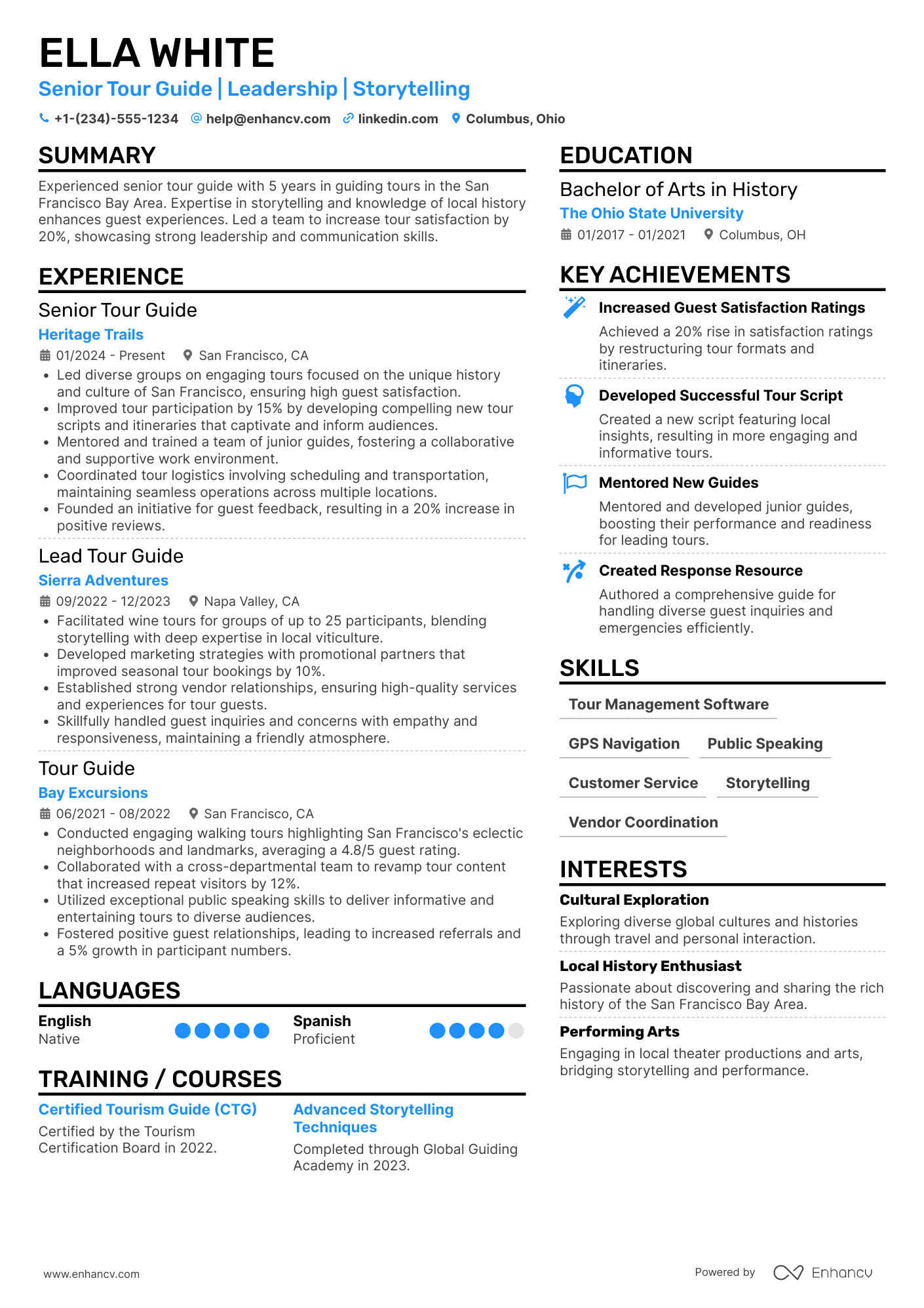
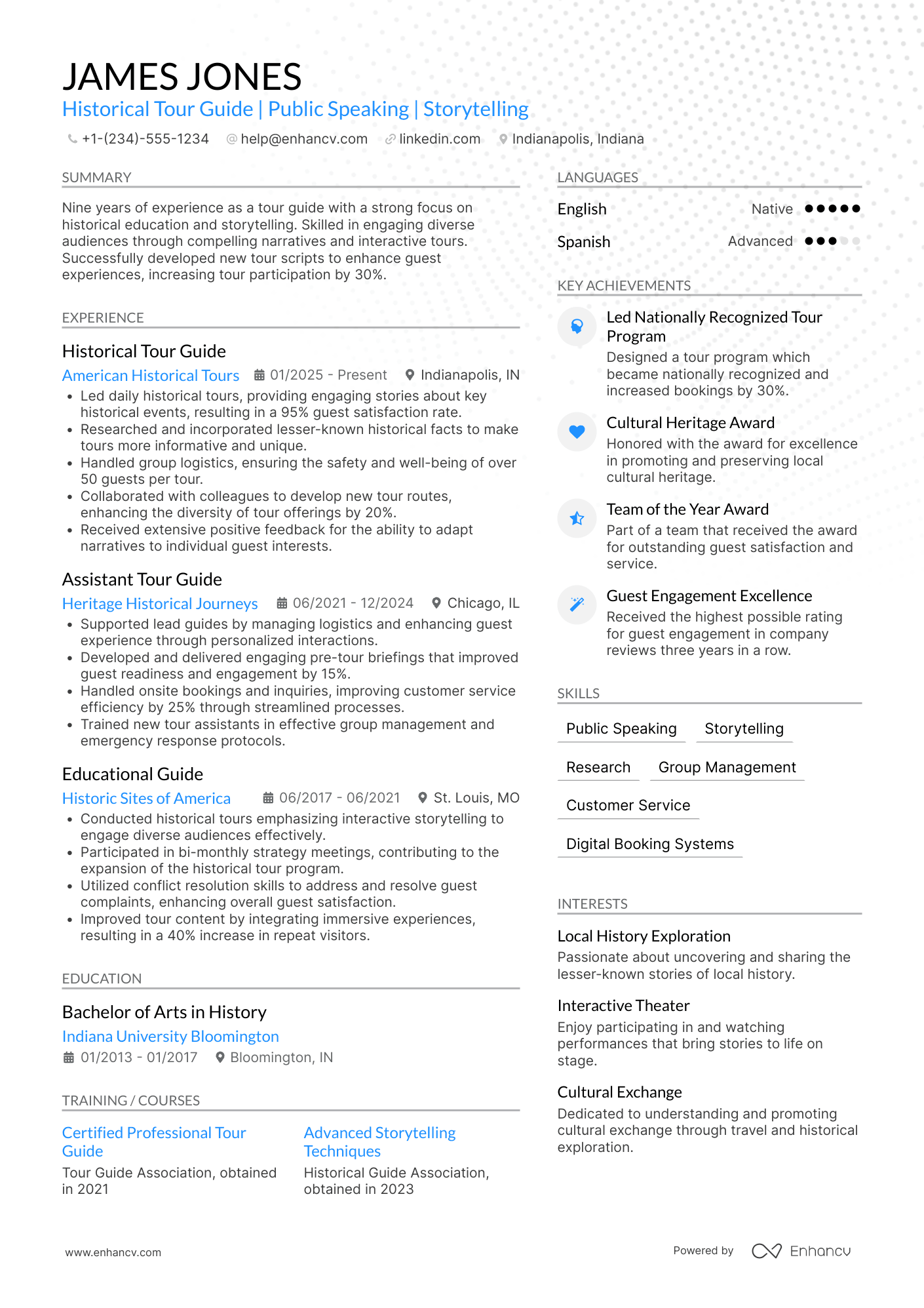
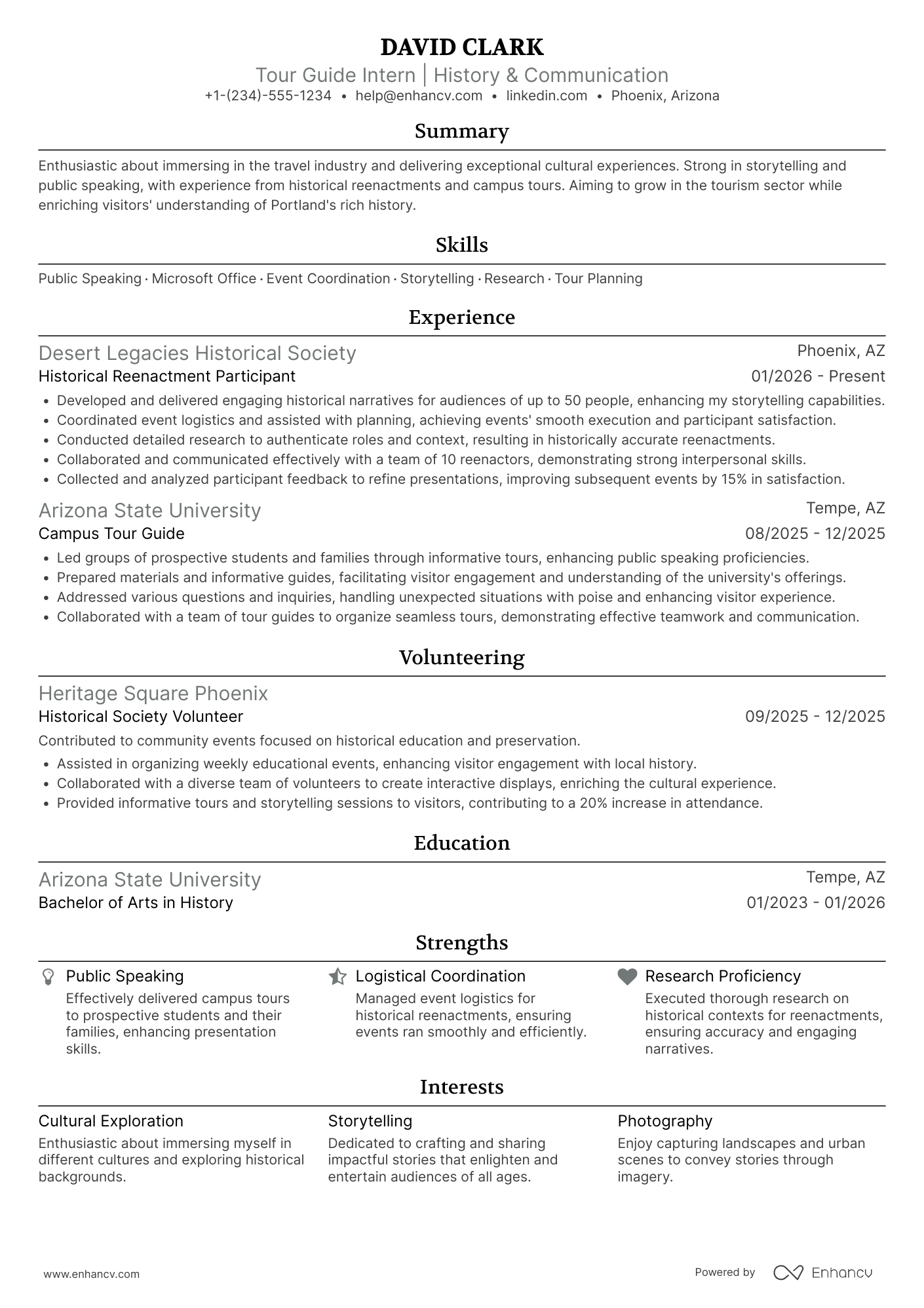
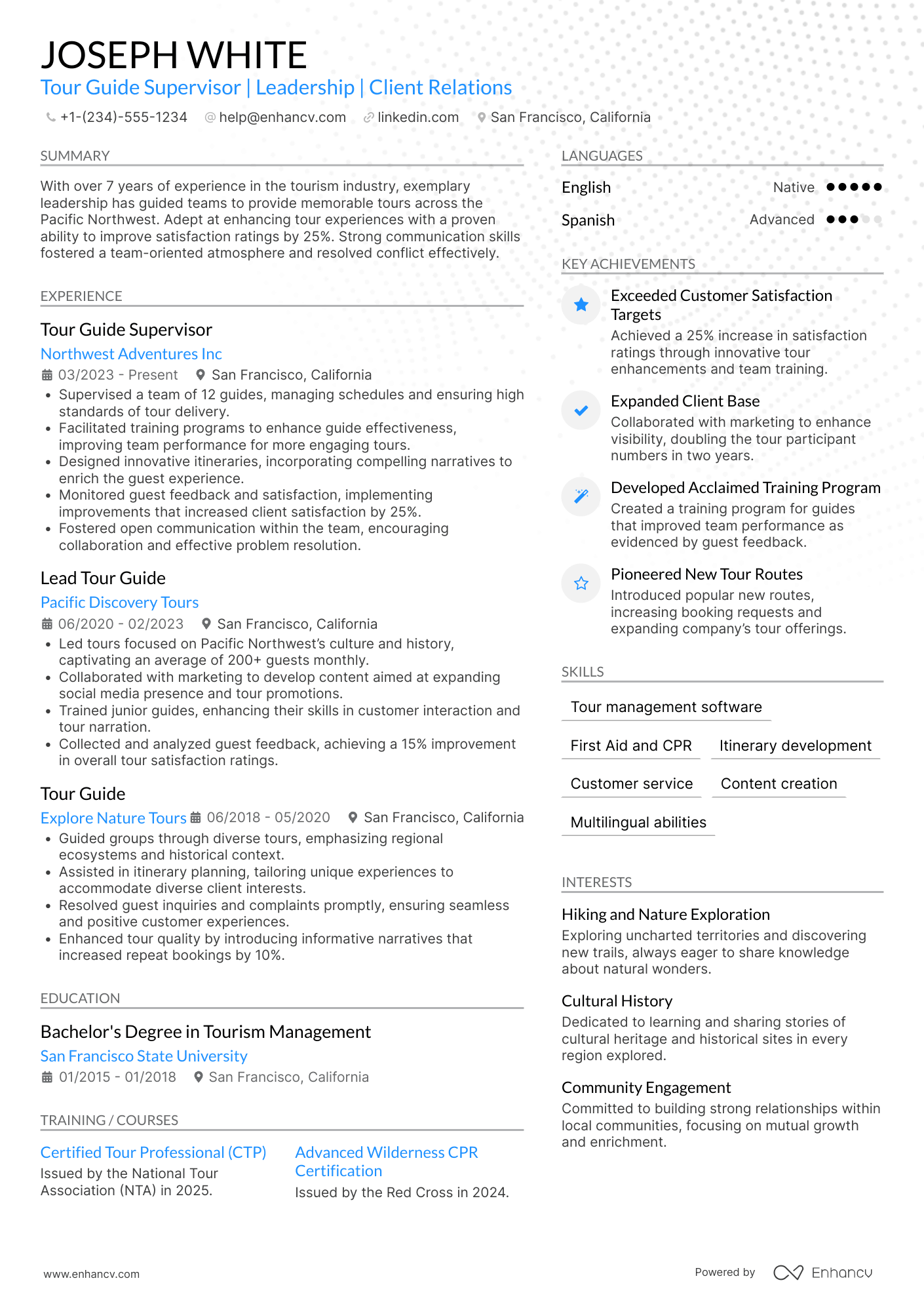
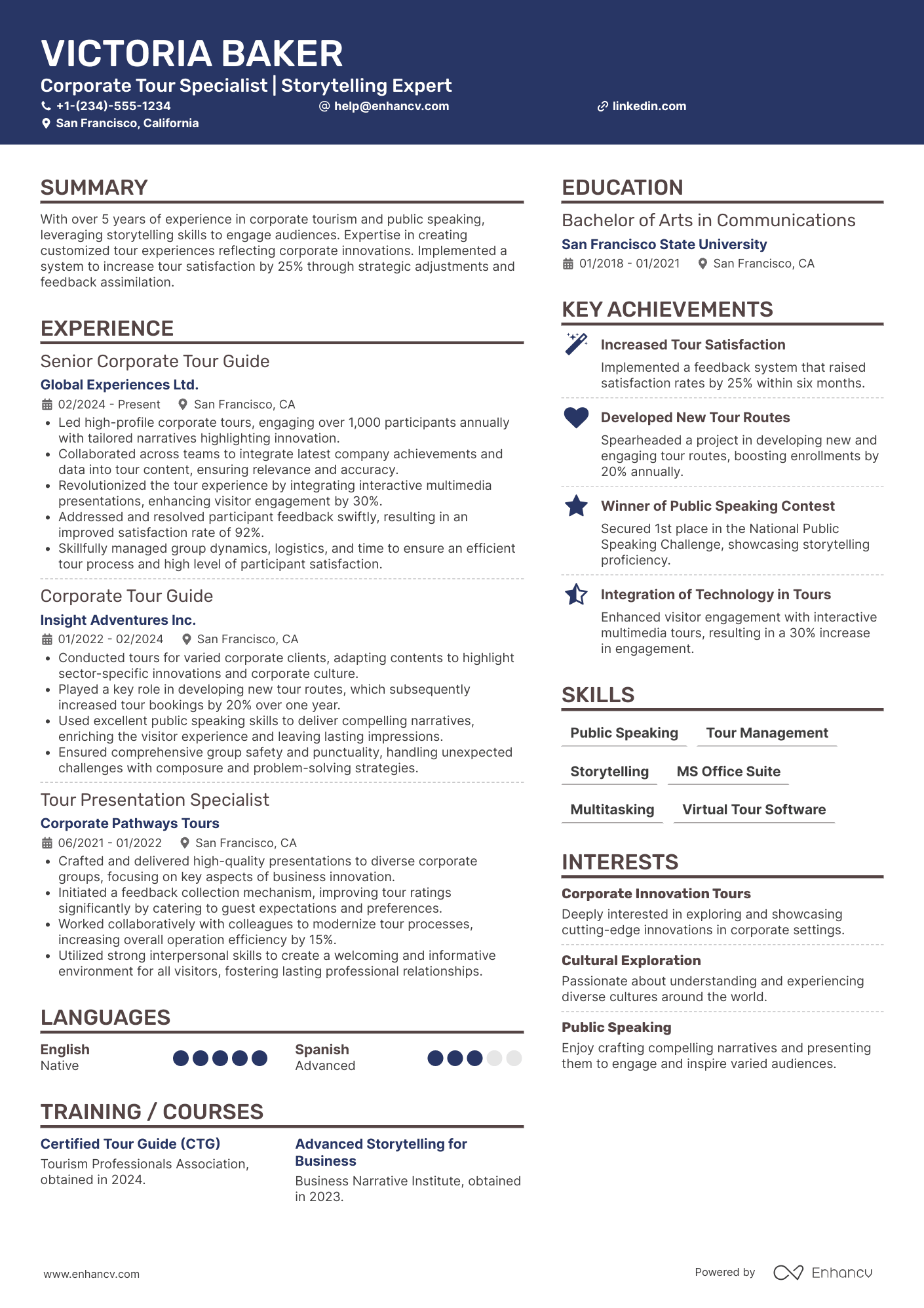
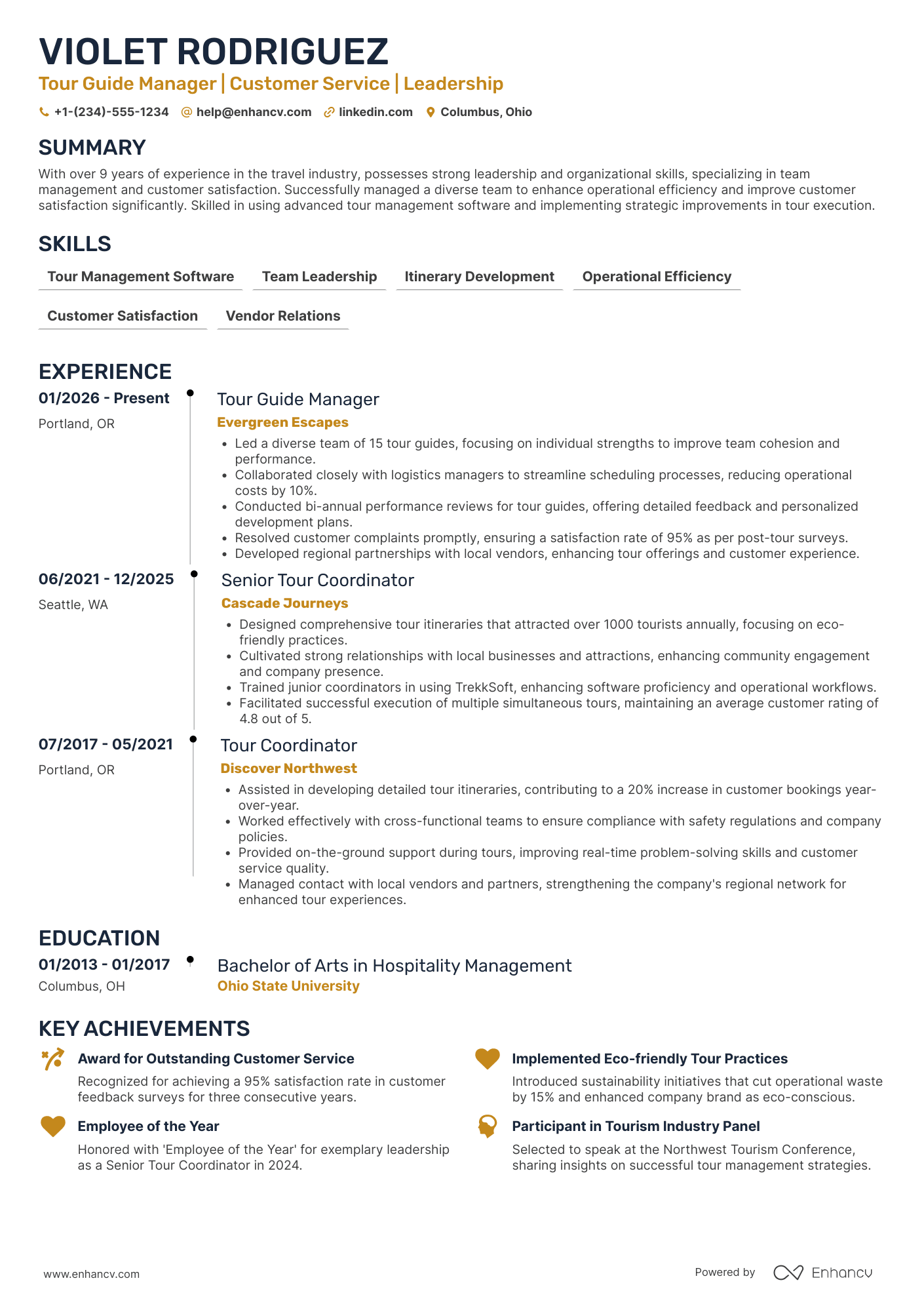
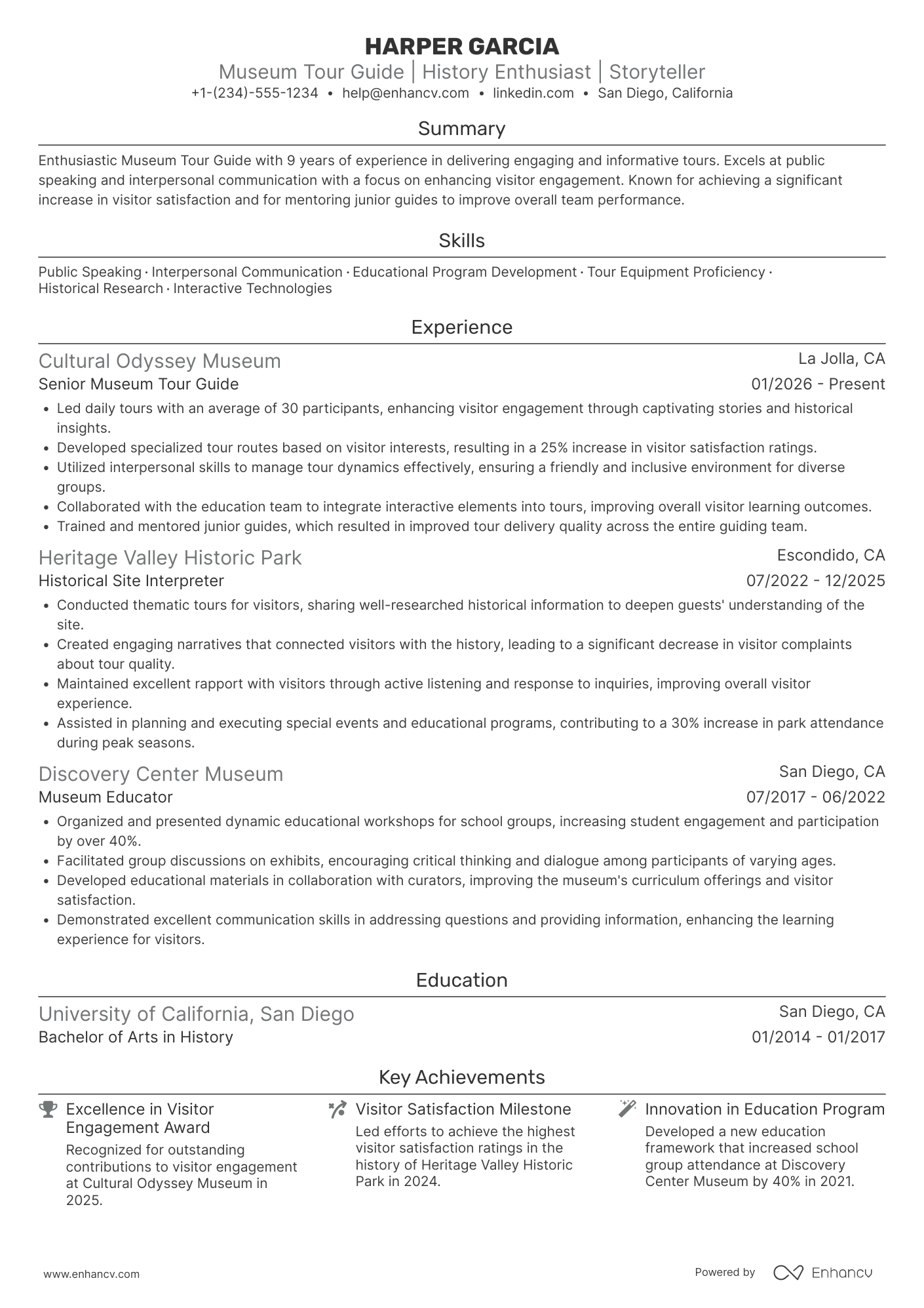
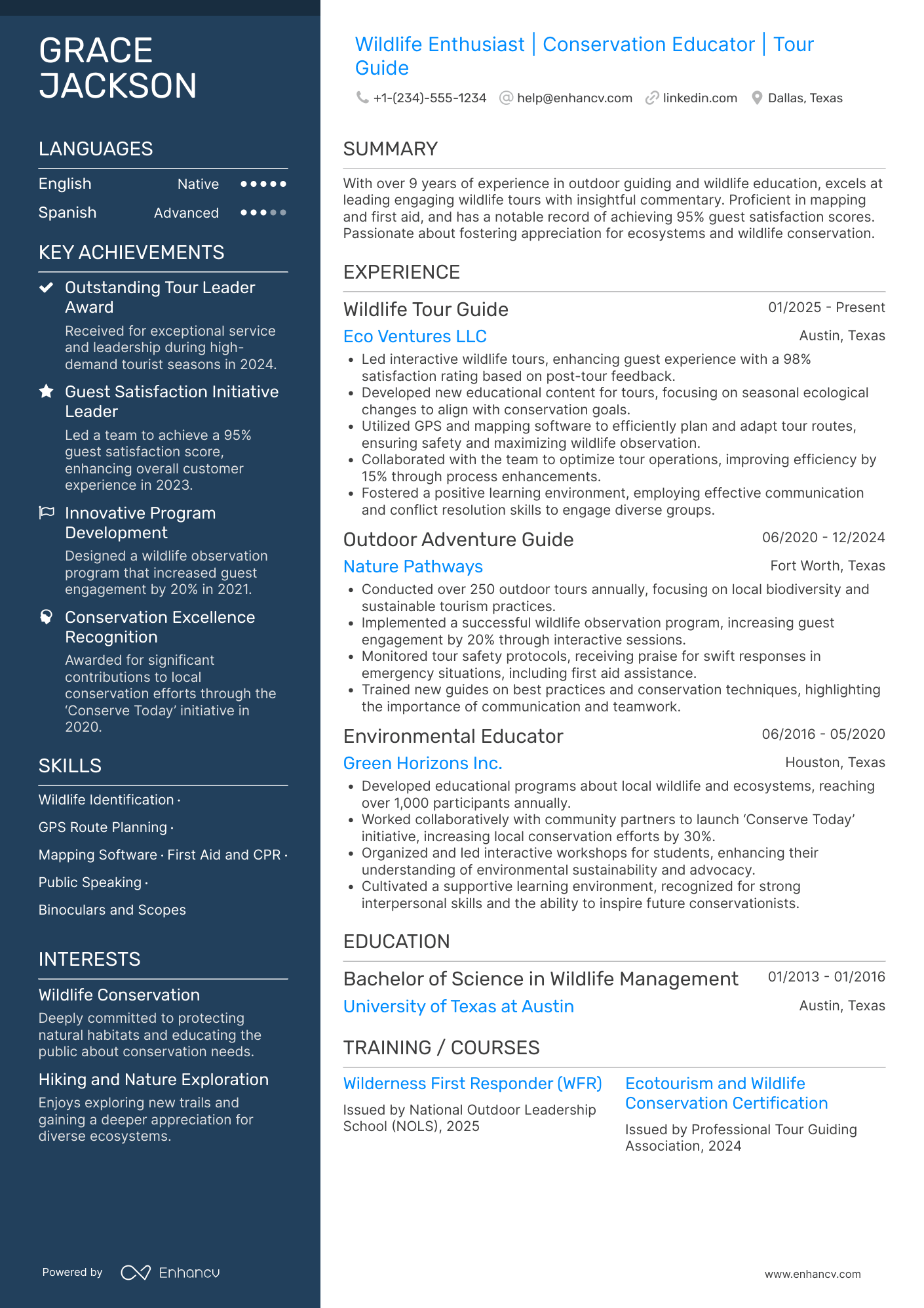
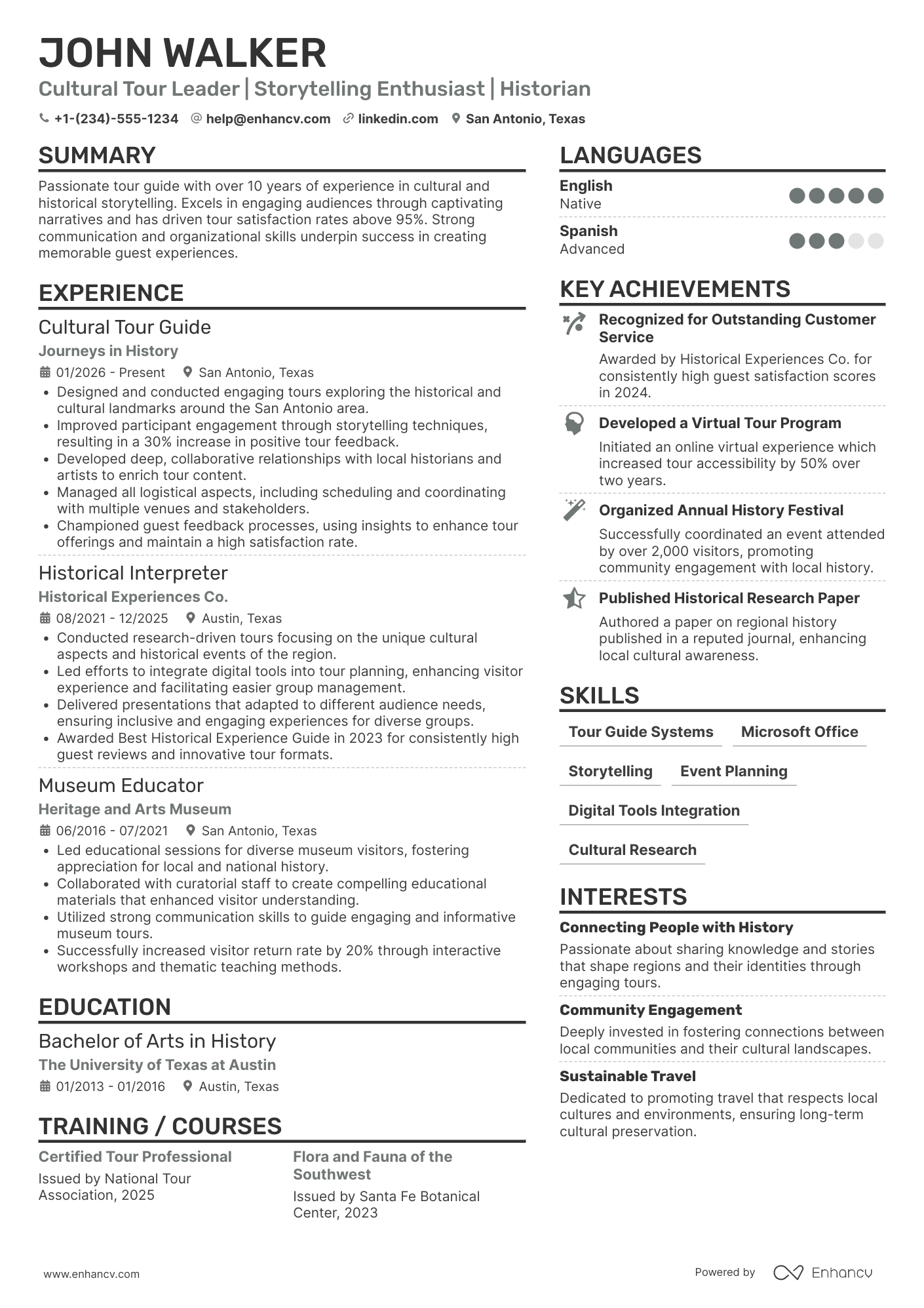
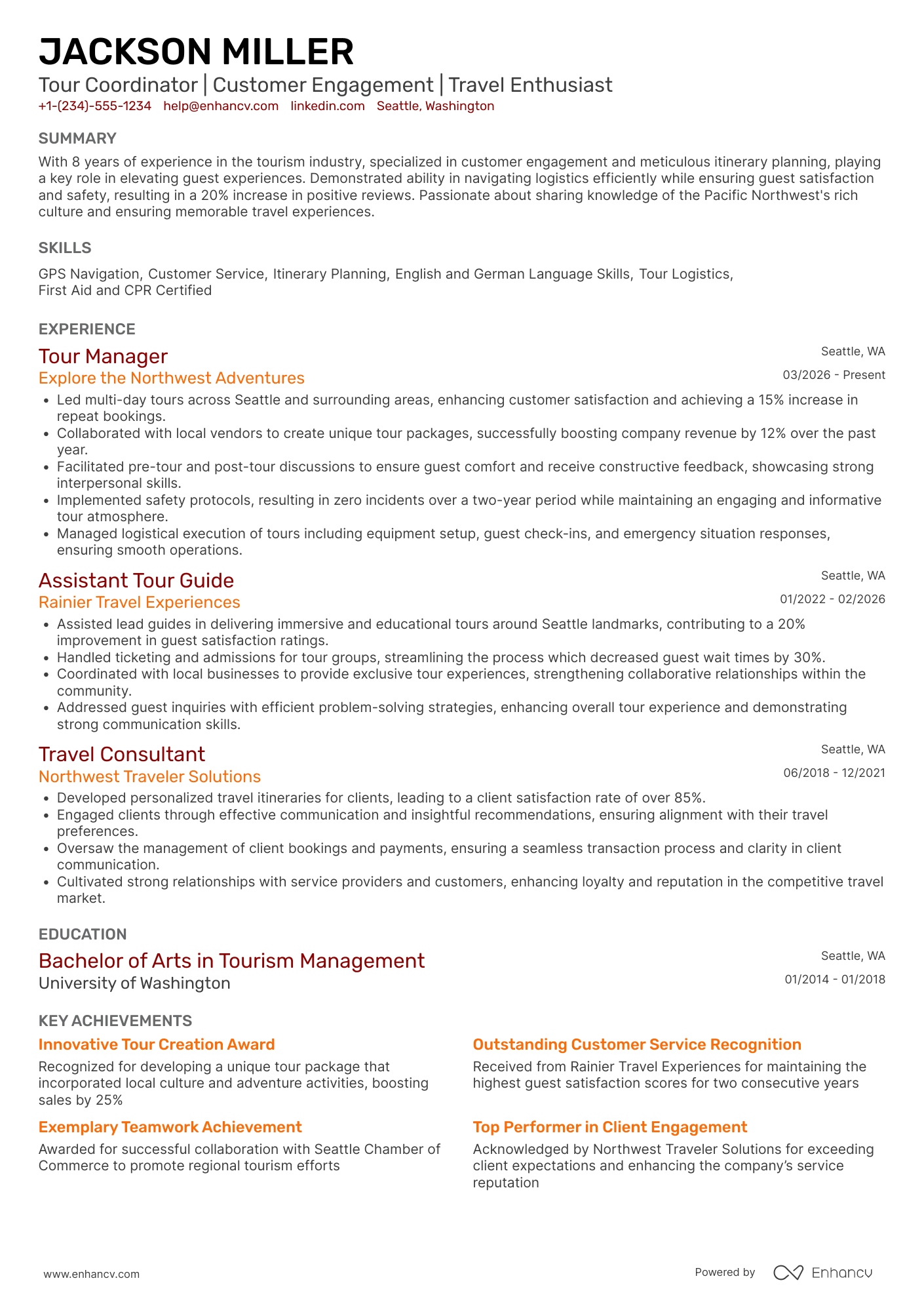
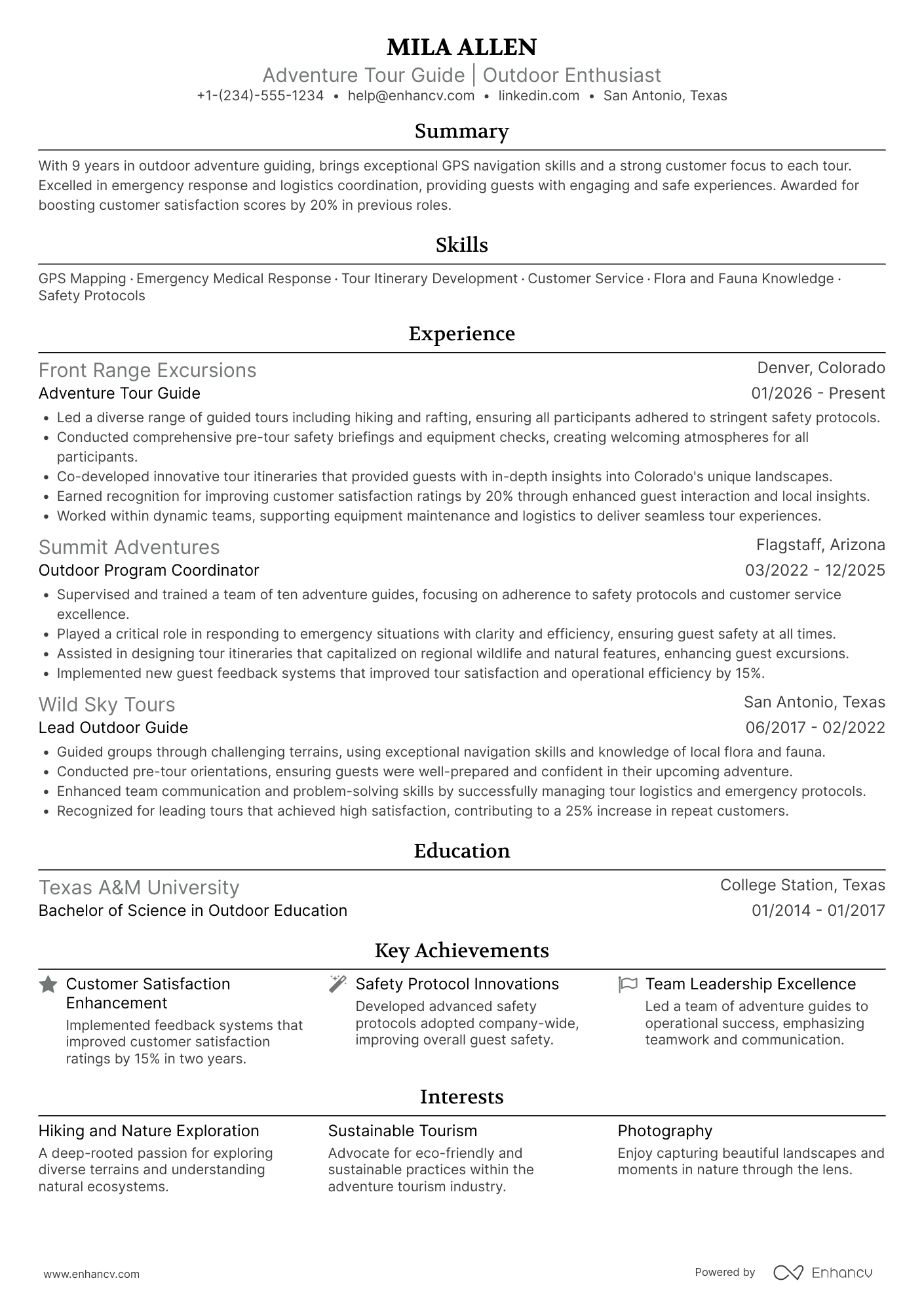
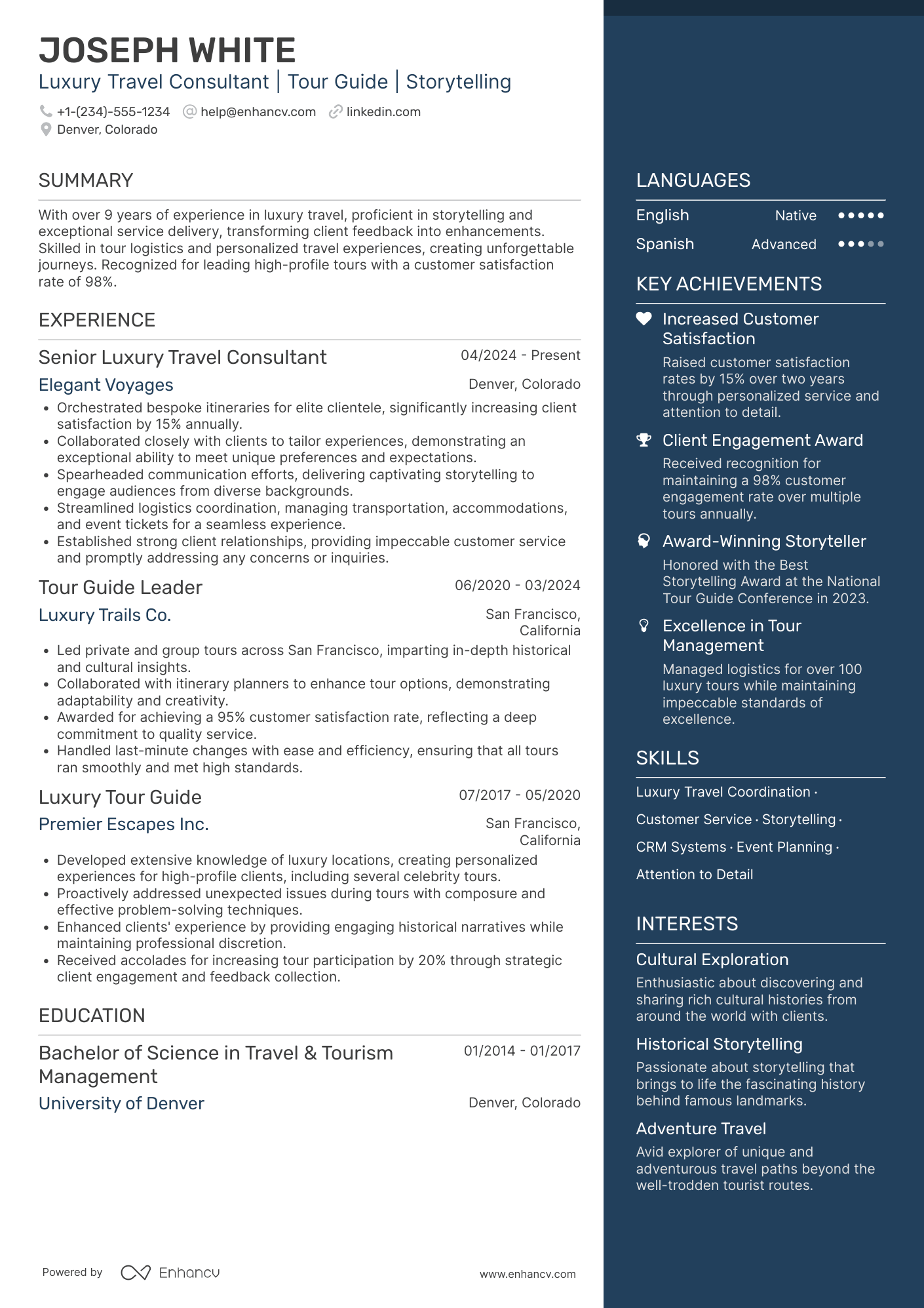
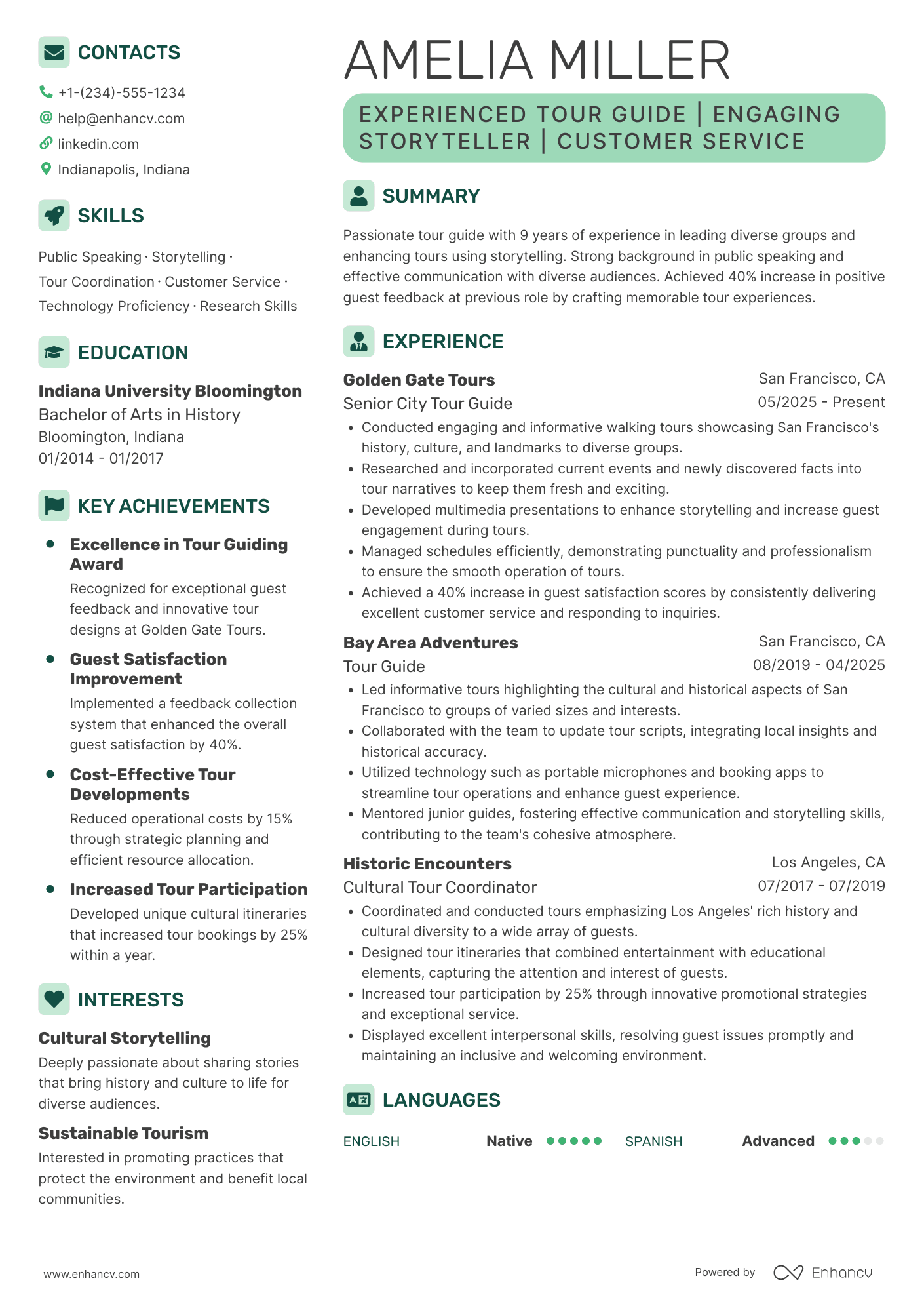
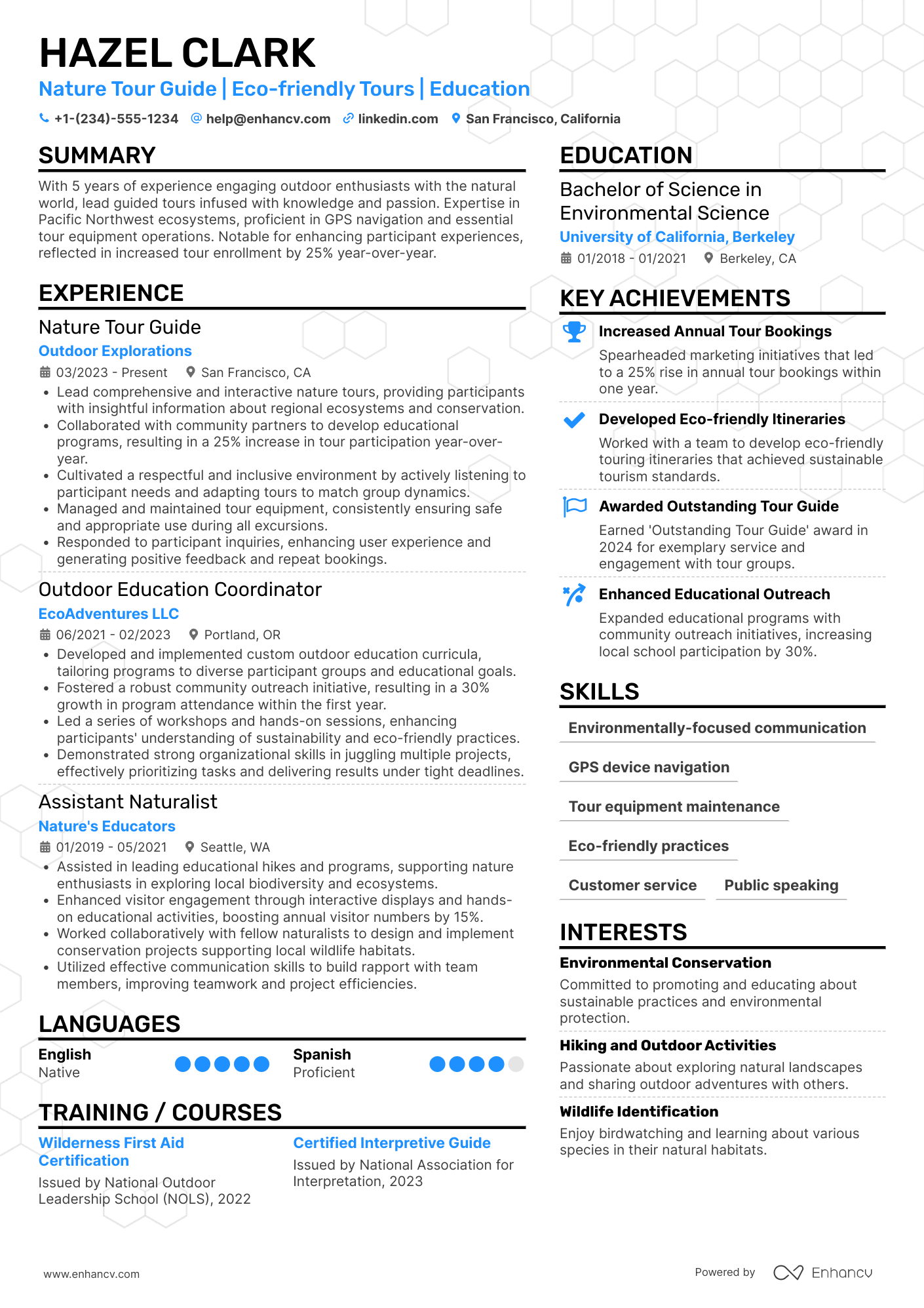
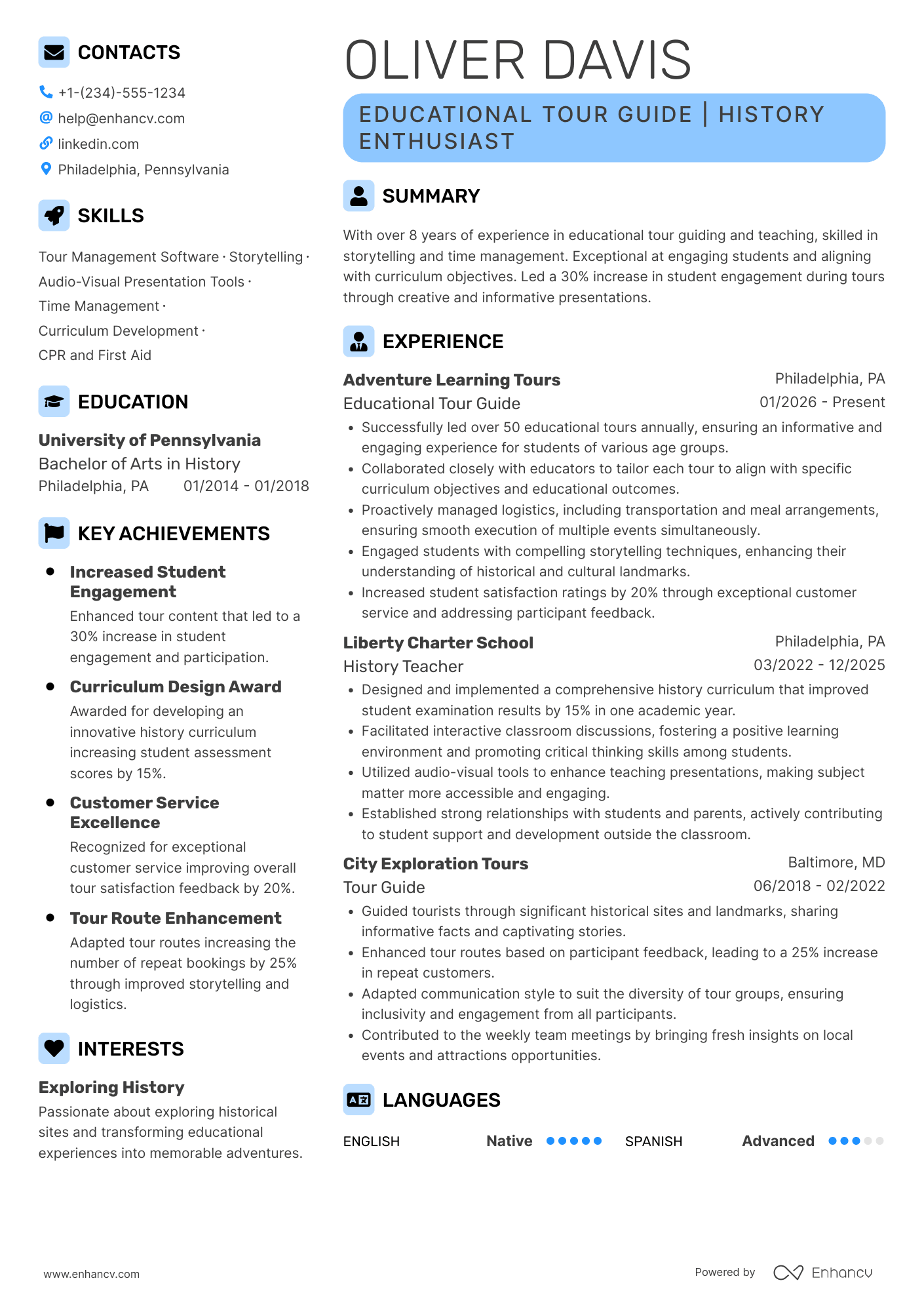
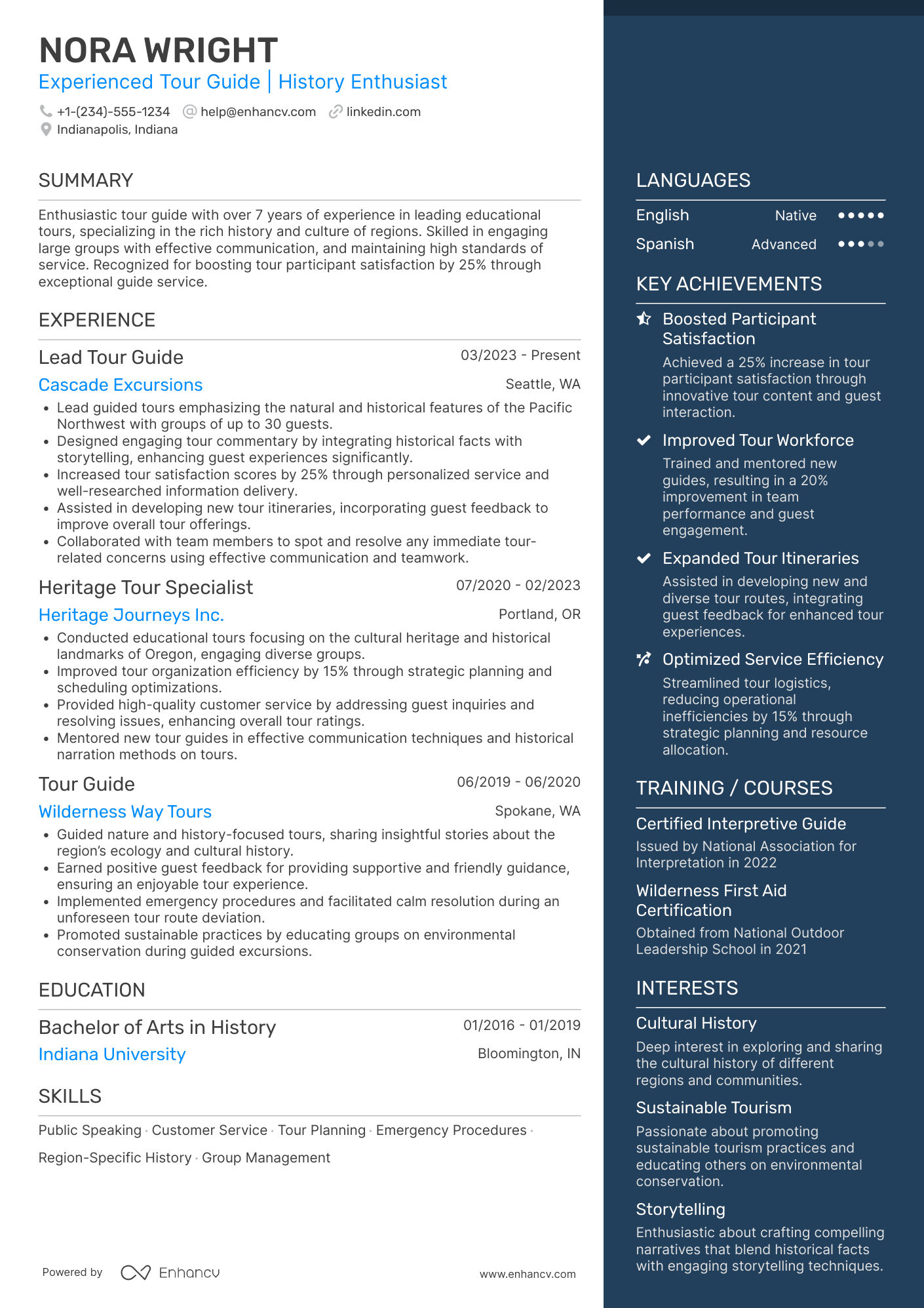
Many tour guide resume drafts fail because they read like tour scripts, not evidence of results. That hurts when applicant tracking system screening and fast recruiter scans filter out vague, responsibility-only descriptions.
Once the resume clears the scan, the operator reads the letter for the voice — our tour guide cover letter examples show how to put one guest-experience save or signature route into the narrative a manager hires for.
A strong resume shows what changed because you led the experience. Knowing how to make your resume stand out means you highlight guest satisfaction scores, group sizes managed, on-time departure rates, upsell revenue, five-star review volume, and safety incident-free days. You connect your delivery to repeat bookings and partner referrals.

Key takeaways
- Quantify guest volume, satisfaction scores, and revenue impact in every experience bullet.
- Use reverse-chronological format with direct guiding experience; switch to hybrid only when entering the field.
- Tailor each resume to the job posting's exact tour formats, tools, and language requirements.
- Demonstrate skills through measurable outcomes in your summary and experience, not just a skills list.
- Place certifications like CPR, CIG, or CTP prominently—they signal safety awareness and professionalism.
- Use AI to tighten phrasing and fill keyword gaps, but stop before it inflates your claims.
- Build your tour guide resume faster with Enhancv, keeping structure clean and content recruiter-ready.
How to format a tour guide resume
Recruiters hiring tour guides prioritize strong communication skills, relevant certifications, destination knowledge, and evidence of positive guest experiences. A clean, well-organized resume format ensures these signals surface quickly during both manual review and applicant tracking system (ATS) scans.

I have significant experience in this role—which format should I use?
Use a reverse-chronological format to showcase your progression through guiding roles and the breadth of your tour expertise. Do:
- Lead with your most recent position and highlight the scope of tours you've managed—group sizes, tour types, regions, and languages spoken.
- Feature role-specific qualifications such as CPR/first aid certification, foreign language fluency, local licensing, and proficiency with booking platforms like FareHarbor or Rezdy.
- Quantify guest satisfaction, repeat booking rates, revenue contributions, or review scores to demonstrate measurable impact.
I'm junior or switching into this role—what format works best?
A hybrid format works best, letting you lead with relevant skills and certifications while still showing a concise work history. Do:
- Place a skills section near the top highlighting guest-facing abilities, language proficiency, regional knowledge, and any guiding certifications or tourism coursework.
- Include volunteer guiding, travel blogging, hospitality roles, or relevant academic projects to demonstrate transferable experience.
- Connect every listed skill or project to a specific action and a tangible result so recruiters see practical application.
Why not use a functional resume?
A functional resume strips away the timeline of your work history, making it difficult for hiring managers to verify where and when you developed your guiding skills—context that matters even for entry-level tour guide roles.
- Career changers with no guiding history: If your only relevant experience comes from transferable skills like public speaking, hospitality, or education, a functional format can group those competencies together while you build direct tour guide experience.
- Significant employment gaps: If time away from the workforce makes a chronological layout look sparse, a functional format lets you foreground certifications, volunteer guiding, and relevant training.
Once you've established a clean, readable format, the next step is filling it with the right sections to showcase your qualifications effectively.
What sections should go on a tour guide resume
Recruiters expect a tour guide resume to quickly show your guiding experience, customer service strengths, and ability to run safe, engaging tours. Understanding which resume sections to include ensures nothing important gets overlooked.
Use this structure for maximum clarity:
- Header
- Summary
- Experience
- Skills
- Projects
- Education
- Certifications
- Optional sections (Languages, Volunteering, Awards)
Your experience bullets should emphasize measurable outcomes, group sizes, tour frequency, safety record, customer satisfaction, and upsell or revenue impact.
Is your resume good enough?
Drop your resume here or choose a file. PDF & DOCX only. Max 2MB file size.
Now that you’ve organized the key resume components, the next step is to write your tour guide resume experience so it fits those sections and highlights your impact.
How to write your tour guide resume experience
The experience section is where you prove you've delivered memorable, well-organized tours—not just led them. Hiring managers want to see demonstrated impact through guest engagement strategies, storytelling techniques, route planning tools, and measurable outcomes like group sizes managed, satisfaction ratings earned, or repeat booking rates achieved rather than a generic list of daily duties. Building a targeted resume for each application ensures your experience aligns with what the specific employer values most.
Each entry should include:
- Job title
- Company and location (or remote)
- Dates of employment (month and year)
Three to five concise bullet points showing what you owned, how you executed, and what outcomes you delivered:
- Ownership scope: the specific tours, routes, destinations, guest segments, or regional programs you were directly accountable for as a tour guide.
- Execution approach: the storytelling frameworks, itinerary planning tools, guest management techniques, safety protocols, or interpretation methods you relied on to deliver engaging and well-structured tour experiences.
- Value improved: the changes you drove in guest satisfaction, tour accessibility, safety compliance, booking retention, operational efficiency, or the overall quality and reliability of the tour experience.
- Collaboration context: how you coordinated with local vendors, transportation providers, venue staff, marketing teams, booking platforms, or tourism boards to create seamless experiences for your guests.
- Impact delivered: the tangible results your work produced—expressed through guest outcomes, business growth, scale of operations, or organizational improvements rather than a description of tasks you performed.
Experience bullet formula
A tour guide experience example
✅ Right example - modern, quantified, specific.
Senior City Tour Guide
Riverfront Heritage Tours | Charleston, SC
2021–Present
Boutique tour operator running daily walking and small-van experiences for domestic and international travelers across Charleston’s historic district.
- Led 520+ walking and small-van tours for 9,400+ guests; maintained a 4.9/5 average rating across Google and TripAdvisor by using structured storytelling frameworks and real-time audience checks.
- Implemented FareHarbor for online bookings, waivers, and automated confirmations; reduced no-shows by 18% and cut daily check-in time by 25 minutes through QR code scanning and standardized scripts.
- Built and maintained route plans in Google Maps and AllTrails with timed stops, accessibility notes, and weather contingencies; improved on-time tour completion from 86% to 96% while preserving a two-hour target duration.
- Partnered with local museums, restaurants, and site managers to coordinate group access and cross-promotions; increased add-on partner ticket sales by 14% and generated $22,000 in incremental quarterly revenue.
- Trained and coached seven new guides using ride-alongs, rubric-based evaluations, and safety checklists; lowered guest complaints by 30% and achieved zero reportable safety incidents for twelve consecutive months.
Now that you've seen how a strong experience section comes together, let's look at how to adjust those details to match the specific tour guide role you're targeting.
How to tailor your tour guide resume experience
Recruiters evaluate your tour guide resume through both human review and applicant tracking systems (ATS), so tailoring your resume to the job description is essential. Tailoring ensures the skills and accomplishments you highlight directly reflect what the employer is looking for.
Ways to tailor your tour guide experience:
- Match specific booking platforms or reservation systems named in the posting.
- Mirror the exact terminology used for tour formats or itinerary styles.
- Highlight group size management that reflects the role's stated capacity.
- Include relevant destination or regional expertise the employer specifies.
- Emphasize safety compliance and risk protocols if the posting mentions them.
- Reference accessibility practices or inclusive guiding standards when listed.
- Align guest satisfaction or feedback metrics with their stated success criteria.
- Showcase multilingual abilities using the same languages the job requires.
Tailoring means aligning your real accomplishments with the role's specific requirements rather than forcing unrelated keywords into your experience.
Resume tailoring examples for tour guide
| Job description excerpt | Untailored | Tailored |
|---|
Once you’ve aligned your experience with the role’s priorities, quantify your tour guide achievements to show the impact of that work.
How to quantify your tour guide achievements
Quantifying your achievements shows how your tours improved guest experience and business results. Track guests per tour, satisfaction scores, on-time starts, upsell revenue, and safety or compliance outcomes to prove impact.
Quantifying examples for tour guide
| Metric | Example |
|---|---|
| Guest volume | "Led 180 walking tours for 3,200 guests in peak season, averaging 18 guests per tour while maintaining smooth pacing and clear audibility." |
| Satisfaction score | "Raised post-tour rating from 4.6 to 4.8 out of 5 by adding a five-minute Q&A stop and updating stories using weekly guest feedback." |
| On-time delivery | "Improved on-time departures from 82% to 96% by using a 10-minute pre-brief checklist and timed meet-up reminders via WhatsApp." |
| Revenue upsell | "Generated $14,500 in add-on sales in three months by converting 22% of guests to museum tickets and evening tours at the final stop." |
| Safety compliance | "Completed 100% of safety checks across 60 boat tours, logging incidents at zero and passing two audit spot-checks with no findings." |
Turn your everyday tasks into measurable, recruiter-ready resume bullets in seconds with Enhancv's Bullet Point Generator.
Once you've crafted strong bullet points for your experience section, you'll want to apply that same precision to highlighting the hard and soft skills that make you an effective tour guide.
How to list your hard and soft skills on a tour guide resume
Your skills section shows you can lead safe, engaging tours, and recruiters and an ATS (applicant tracking system) scan this section to confirm role fit fast; aim for a balanced mix of hard skills like operations and tools and soft skills like guest communication. tour guide roles require a blend of:
- Product strategy and discovery skills.
- Data, analytics, and experimentation skills.
- Delivery, execution, and go-to-market discipline.
- Soft skills.
Your skills section should be:
- Scannable (bullet-style grouping).
- Relevant to the job post.
- Backed by proof in experience bullets.
- Updated with current tools.
Place your skills section:
- Above experience if you're junior or switching careers.
- Below experience if you're mid/senior with strong achievements.

Hard skills
- Tour scripting and storytelling
- Guest safety and risk assessment
- Emergency response procedures
- Group management and pacing
- Route planning and logistics
- Ticketing and check-in systems
- Point-of-sale systems, Square
- Booking platforms, FareHarbor, Peek Pro
- Customer relationship management (CRM) systems
- Public address systems and microphones
- GPS navigation, Google Maps
- Cash handling and reconciliation
Soft skills
- Lead groups with authority
- Communicate clearly to mixed audiences
- Read the room and adjust delivery
- De-escalate guest conflicts fast
- Make safety-first decisions
- Keep tours on schedule
- Coordinate with drivers and vendors
- Handle complaints with professionalism
- Manage last-minute changes calmly
- Upsell add-ons without pressure
- Support teammates during peak hours
- Follow standard operating procedures consistently
How to show your tour guide skills in context
Skills shouldn't live only in a bulleted list on your resume. Explore curated examples of resume skills to see how top candidates present their abilities effectively.
They should be demonstrated in:
- Your summary (high-level professional identity)
- Your experience (proof through outcomes)
Here's how that looks in practice for a tour guide.
Summary example
Senior tour guide with 10+ years leading cultural and historical tours across the American Southwest. Skilled in group management, multilingual interpretation, and storytelling techniques. Boosted guest satisfaction ratings by 34% through redesigned itineraries and real-time audience engagement.
- Reflects senior-level expertise immediately
- Names role-specific methods and tools
- Includes a concrete, measurable outcome
- Highlights communication and soft skills
Experience example
Senior Tour Guide
Canyon Heritage Tours | Sedona, AZ
March 2018–Present
- Led 1,200+ guided excursions annually, maintaining a 4.9/5 average guest rating across all booking platforms.
- Collaborated with local historians and park rangers to develop eight new interpretive trail routes, increasing repeat bookings by 22%.
- Trained 15 junior guides on storytelling frameworks and safety protocols, reducing incident reports by 40% within one year.
- Every bullet includes measurable proof
- Skills surface naturally through real outcomes
Once you’ve demonstrated your guiding strengths through specific examples and outcomes, the next step is applying that approach to a tour guide resume when you don’t have direct experience.
How do I write a tour guide resume with no experience
Even without full-time experience, you can demonstrate readiness through transferable activities. If you're building a resume without work experience, focus on these relevant alternatives:
- Campus ambassador or orientation guide
- Volunteer museum or gallery docent
- Community walking tour volunteer
- Study abroad trip itinerary leader
- Hospitality, retail, or front desk
- Event staff for festivals, conferences
- Language exchange or tutoring sessions
- Local history research presentation
Focus on:
- Clear route planning and timing
- Audience management and safety procedures
- Research-backed storytelling and facts
- Tools used: maps, audio, ticketing
Resume format tip for entry-level tour guide
Use a combination resume format. It highlights relevant projects and skills first, then supports them with any work history. Do:
- Add a "Guiding projects" section.
- Quantify groups, duration, and ratings.
- List languages and proficiency levels.
- Include tools: Google Maps, QR codes.
- Tailor highlights to each tour guide job.
- Led a campus ambassador tour for 30 visitors using Google Maps routing and timed stops, cutting late arrivals by 25% across three sessions.
Even without professional experience, your education section can demonstrate relevant knowledge and qualifications that make you a strong candidate—here's how to present it effectively.
How to list your education on a tour guide resume
Your education section helps hiring teams confirm you have foundational knowledge in history, culture, communication, or hospitality—all relevant to succeeding as a tour guide.
Include:
- Degree name
- Institution
- Location
- Graduation year
- Relevant coursework (for juniors or entry-level candidates)
- Honors & GPA (if 3.5 or higher)
Skip month and day details—list the graduation year only.
Here's a strong education entry tailored to a tour guide resume.
Example education entry
Bachelor of Arts in History
University of Arizona, Tucson, AZ
Graduated 2021
GPA: 3.7
- Relevant Coursework: Public Speaking, Cultural Anthropology, American Southwest History, Tourism and Hospitality Management
- Honors: Magna Cum Laude, Dean's List (six semesters)
How to list your certifications on a tour guide resume
Certifications on your resume show your commitment to learning, prove tool proficiency, and confirm industry relevance as a tour guide. They also signal safety awareness and customer-focused service.
Include:
- Certificate name
- Issuing organization
- Year
- Optional: credential ID or URL
- Place certifications below education when your degree is recent and your certifications add supporting value.
- Place certifications above education when they are recent, role-relevant, or required for the tour guide jobs you target.
Best certifications for your tour guide resume
- Certified Tour Professional (CTP)
- Certified Interpretive Guide (CIG)
- First Aid/CPR/AED Certification (American Red Cross)
- Wilderness First Aid (WFA)
- International Tour Management Institute (ITMI) Tour Director Certification
- ServSafe Food Handler Certification
- FEMA Incident Command System (ICS) 100
Once you’ve added your credentials in a clear, easy-to-scan format, use your tour guide resume summary to spotlight them and show how they support your fit for the role.
How to write your tour guide resume summary
Your resume summary is the first thing a recruiter reads. A strong one instantly signals you're the right fit for a tour guide role.
Keep it to three to four lines, with:
- Your title and total years of experience in guiding or hospitality.
- The type of tours, destinations, or audiences you specialize in.
- Core skills like group management, route planning, or multilingual communication.
- One or two measurable achievements, such as guest satisfaction scores or group sizes.
- Soft skills tied to real outcomes, like storytelling that boosted positive reviews.

PRO TIP
At the tour guide level, emphasize relevant skills, specific tour formats, and early wins that show guest impact. Avoid vague phrases like "passionate people person" or "hardworking team player." Instead, connect every detail to a concrete result or responsibility.
Example summary for a tour guide
Bilingual tour guide with two years of experience leading city walking tours for groups of up to 30. Earned a 4.9/5 average guest rating across 200+ tours.
Optimize your resume summary and objective for ATS
Drop your resume here or choose a file.
PDF & DOCX only. Max 2MB file size.
Now that your summary captures your strongest qualifications, make sure your header presents the essential contact and professional details hiring managers need to reach you.
What to include in a tour guide resume header
A resume header lists your key contact details and role focus, boosting visibility, credibility, and fast recruiter screening for tour guide roles.
Essential resume header elements
- Full name
- Tailored job title and headline
- Location
- Phone number
- Professional email
- GitHub link
- Portfolio link
A LinkedIn link helps recruiters verify your experience quickly and supports screening.
Do not include a photo on a tour guide resume unless the role is explicitly front-facing or appearance-dependent.
Match your headline to the tour type and region you guide so recruiters can confirm fit in seconds.
Tour guide resume header
Jordan Taylor
Tour Guide | City History & Food Tours | Bilingual English-Spanish
Chicago, IL
(312) 555-01XX
your.name@enhancv.com github.com/yourname yourwebsite.com linkedin.com/in/yourname
Once your contact details and role information are set at the top, add relevant additional sections to highlight qualifications that don’t fit in the main resume format.
Additional sections for tour guide resumes
When your core qualifications match other applicants, well-chosen additional sections can set you apart and reinforce your credibility.
Consider adding these sections if they're relevant to your experience:
- Languages
- Certifications and licenses
- Hobbies and interests
- Volunteer experience
- Awards and recognitions
- Professional affiliations
- Publications
Once you've strengthened your resume with relevant additional sections, the next step is pairing it with a cover letter to give hiring managers a fuller picture of your qualifications.
Do tour guide resumes need a cover letter
A cover letter isn't required for most tour guide roles, but it helps in competitive postings or when employers expect strong guest communication. If you're unsure what a cover letter is and when to use one, it can make the difference when your resume doesn't fully show fit, local knowledge, or customer service style.
Use a cover letter to add context and proof:
- Explain why you fit the tour guide team, including your tone, pacing, and approach to handling mixed groups.
- Highlight one or two relevant projects or outcomes, such as improving review scores, increasing add-on sales, or reducing late starts.
- Show you understand the product, users, or business context, including the route, guest profiles, seasonality, and what drives repeat bookings.
- Address career transitions or non-obvious experience by connecting transferable skills, like teaching, hospitality, or performance, to tour guide work.
Drop your resume here or choose a file.
PDF & DOCX only. Max 2MB file size.
Once you’ve decided whether to include a cover letter to add context and strengthen your application, the next step is using AI to improve your tour guide resume so it communicates your value clearly and consistently.
Using AI to improve your tour guide resume
AI can sharpen your resume's clarity, structure, and impact. It helps you find stronger phrasing and tighten wordy bullets. But overuse strips authenticity fast. Once your content feels clear and role-aligned, step away from it. For specific prompts and strategies, explore how ChatGPT can help with resume writing.
Here are 10 practical prompts you can copy and paste to strengthen specific sections of your tour guide resume:
- Strengthen your summary: "Rewrite my tour guide resume summary to highlight relevant experience, key strengths, and the type of touring environment I work in."
- Quantify experience bullets: "Add measurable results to these tour guide experience bullets, such as group sizes, tour frequency, or satisfaction ratings."
- Tighten wordy descriptions: "Shorten each of my tour guide experience bullets to one concise line without losing specific details or achievements."
- Align skills strategically: "Compare my tour guide skills section against this job posting and suggest missing keywords that match my real abilities."
- Improve action verbs: "Replace weak or repetitive verbs in my tour guide experience section with strong, specific action verbs."
- Refine certifications formatting: "Reorganize my tour guide certifications section so the most relevant credentials appear first with clear dates."
- Clarify education relevance: "Rewrite my education section to emphasize coursework and training directly applicable to a tour guide role."
- Highlight project impact: "Rewrite this tour guide project description to focus on outcomes, visitor engagement, and logistical scope."
- Remove filler language: "Identify and remove vague or filler phrases from my tour guide resume that don't add specific value."
- Tailor for a posting: "Adjust my tour guide resume bullets to better match this job description while keeping all claims truthful and accurate."
Stop using AI once your resume sounds accurate, specific, and aligned with real experience. AI should never invent experience or inflate claims—if it didn't happen, it doesn't belong here.
Conclusion
A strong tour guide resume highlights measurable outcomes, role-specific skills, and a clear structure. Show guest satisfaction scores, tour volume, revenue impact, and safety records. Pair those results with expertise in storytelling, group management, logistics, and customer service.
Keep formatting consistent and easy to scan, with focused sections and action-driven bullets. This approach shows you’re ready for today’s hiring market and adaptable as expectations shift. It helps employers see your value quickly and confidently.