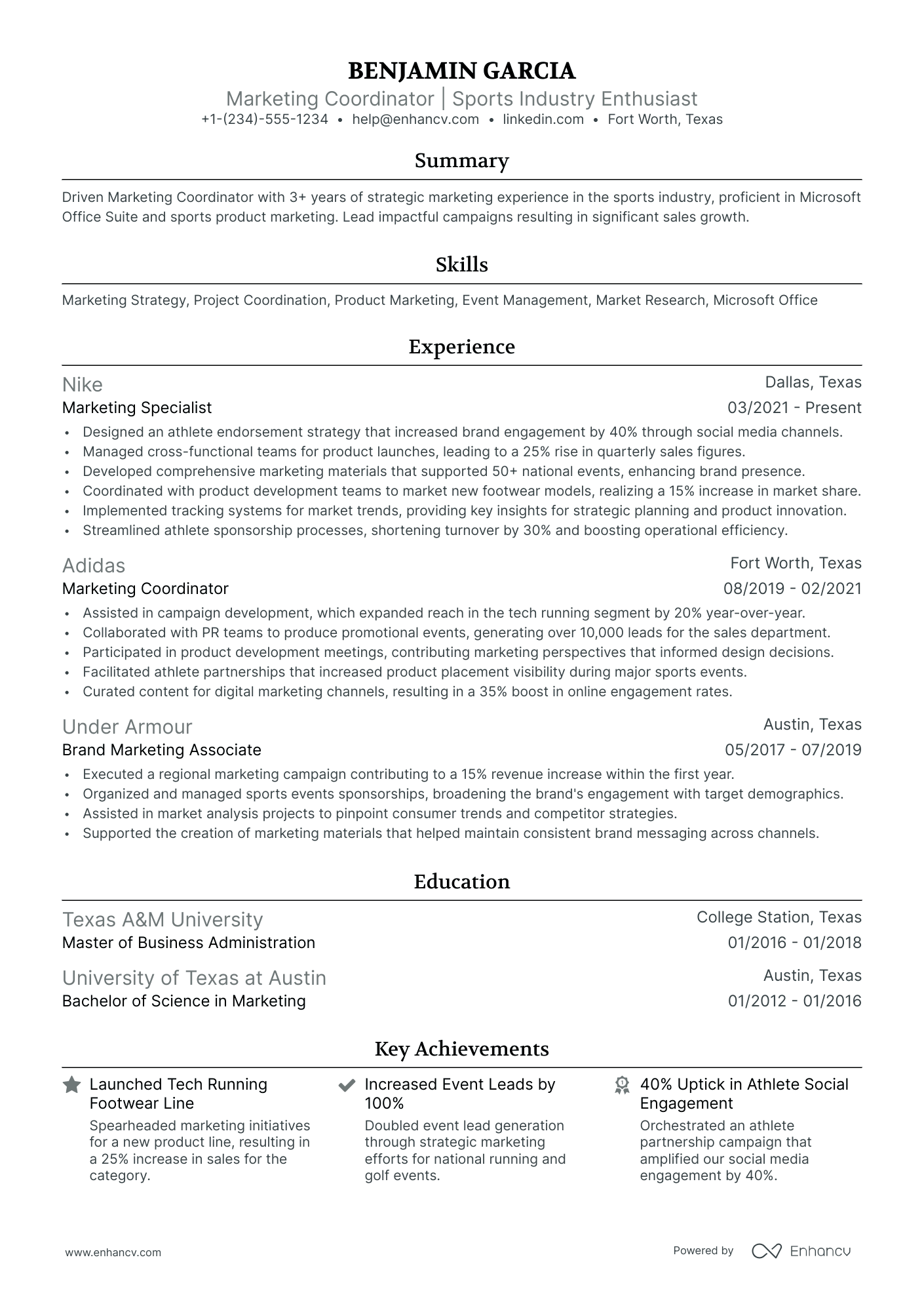
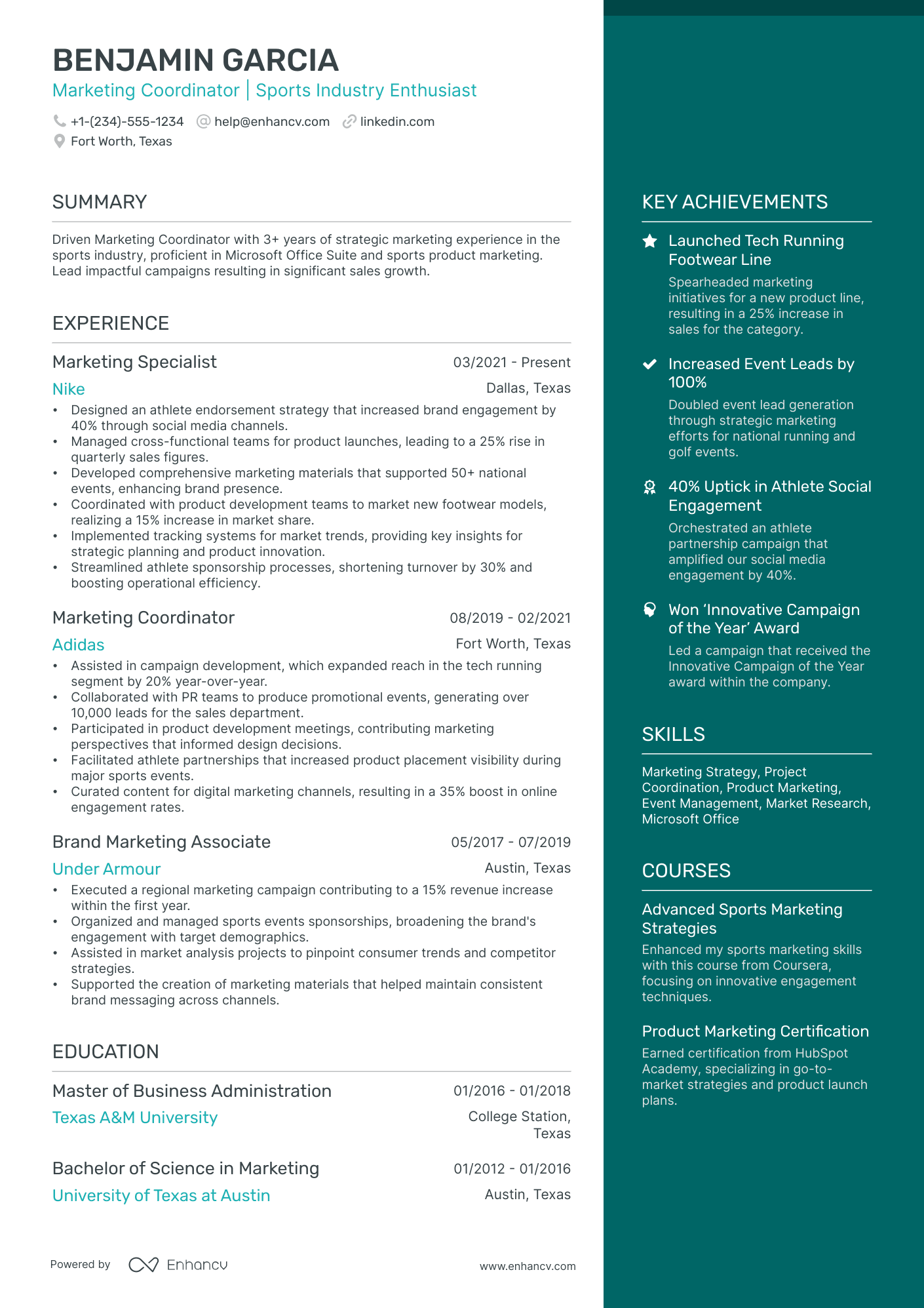
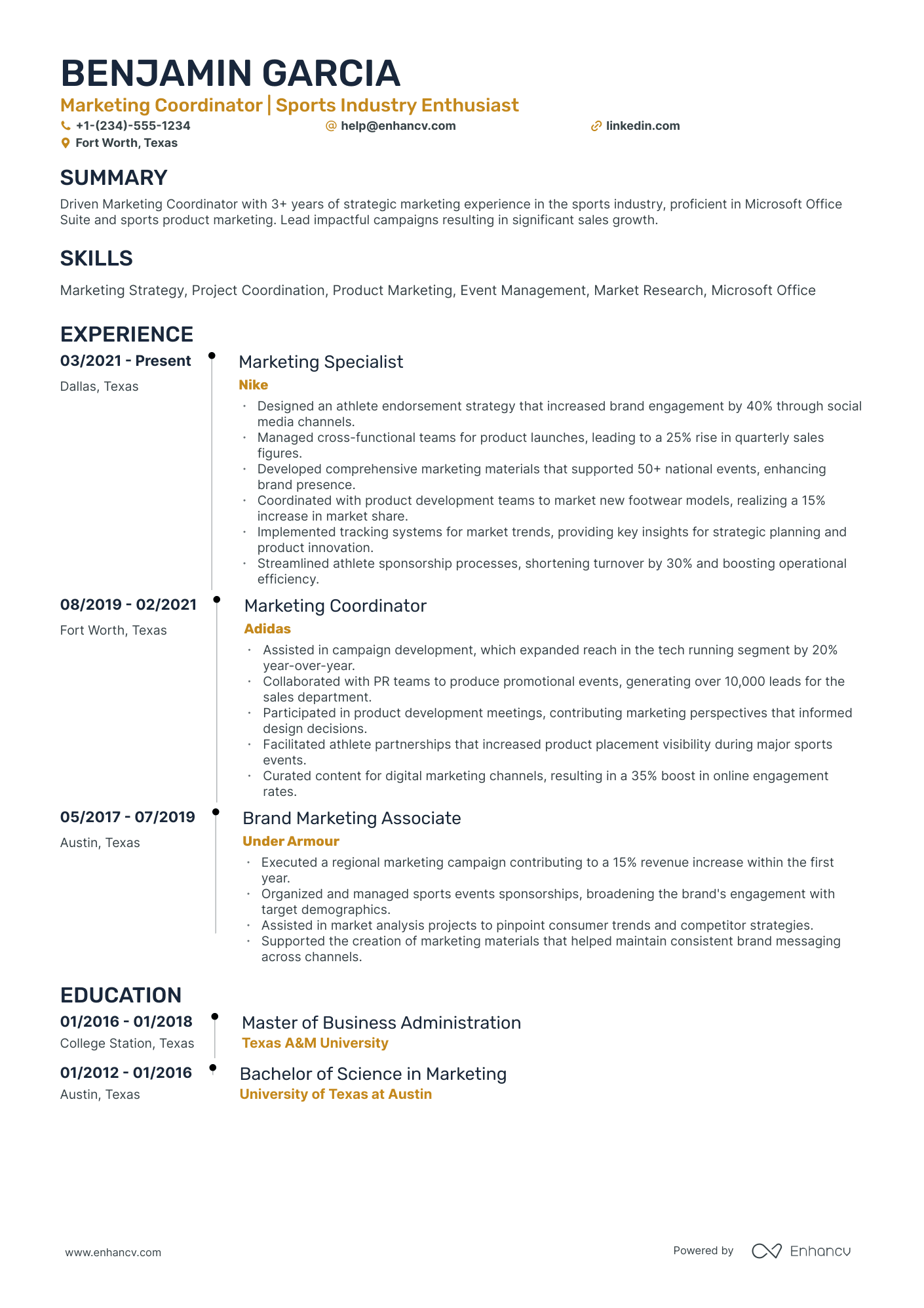
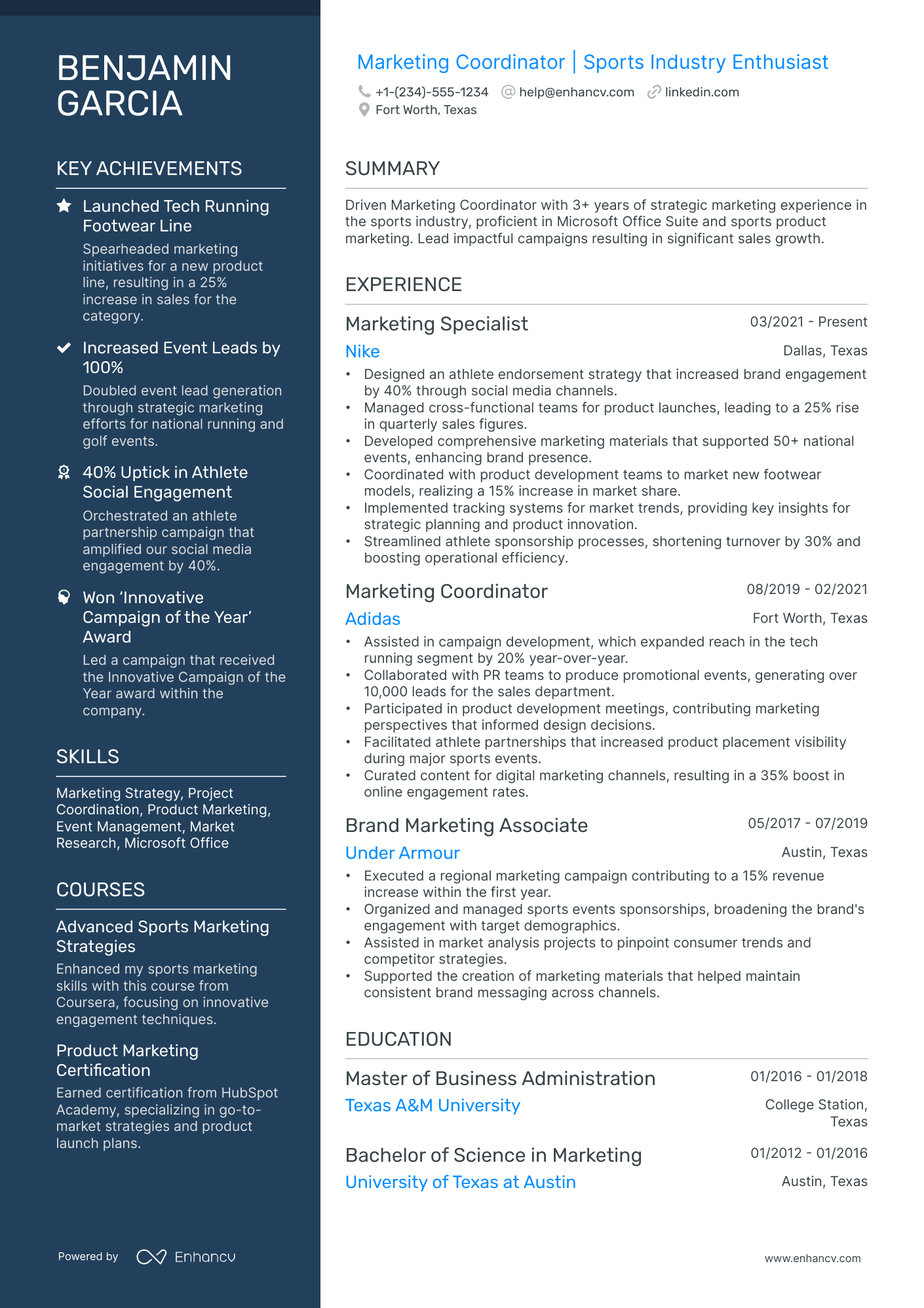
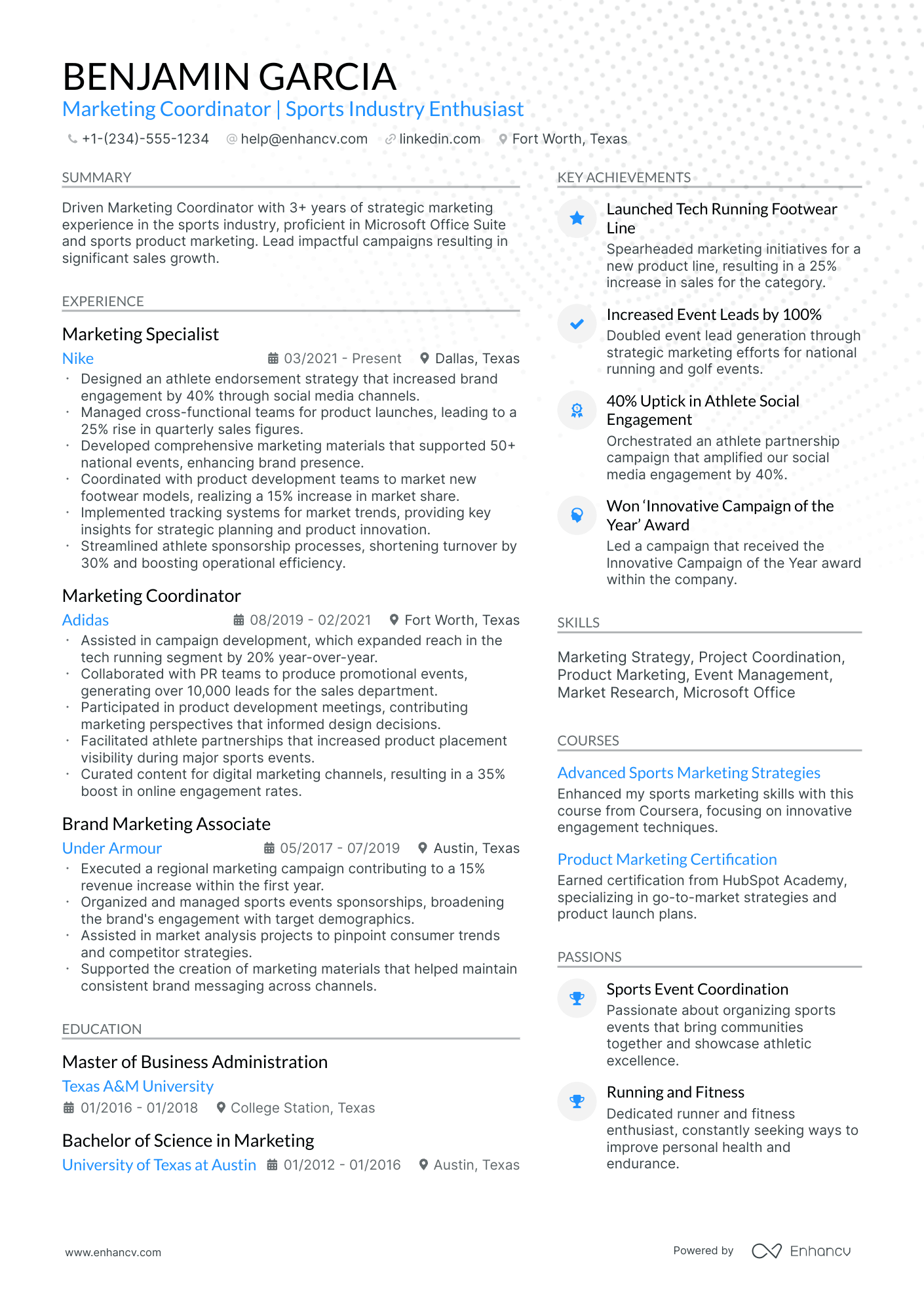
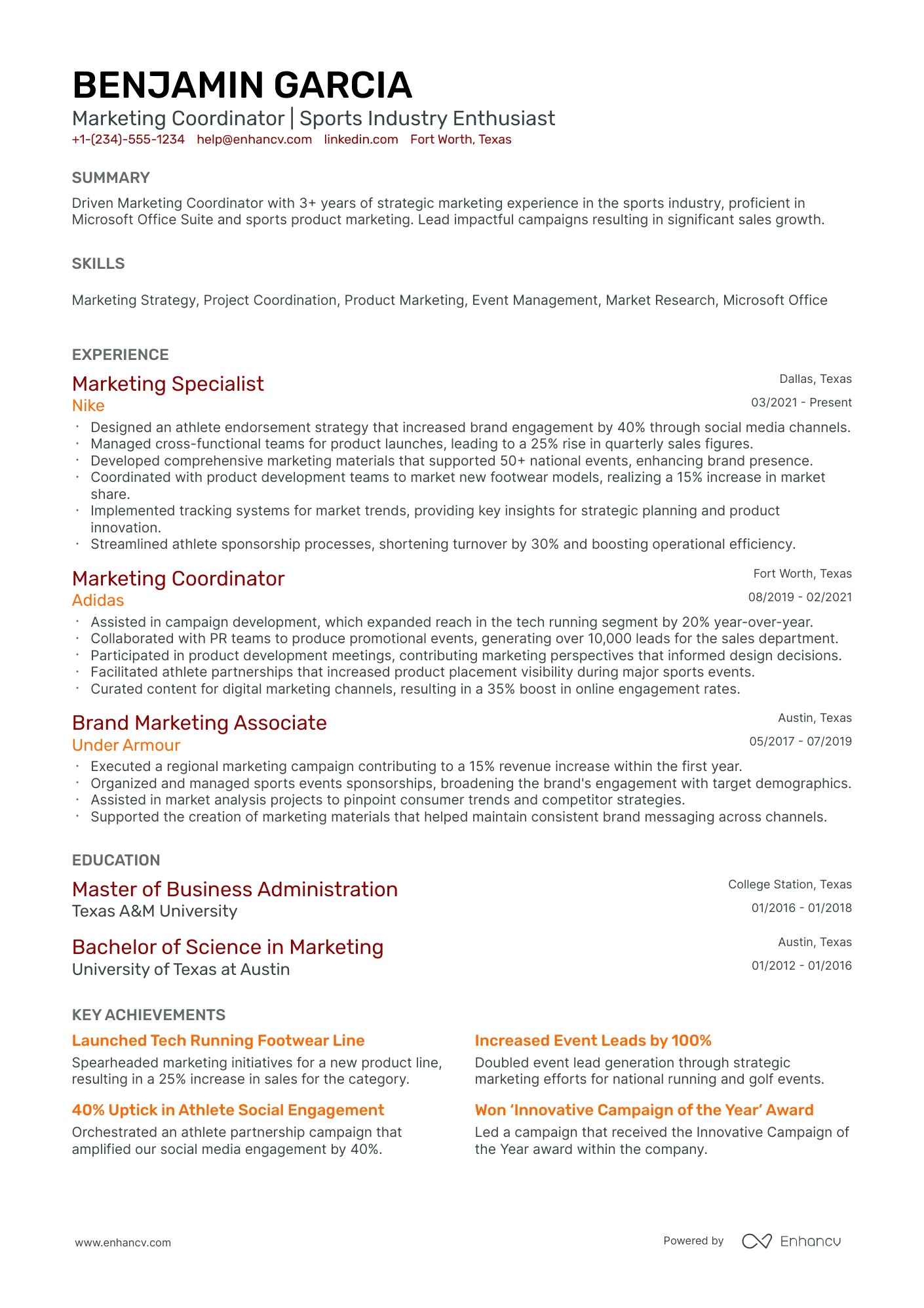
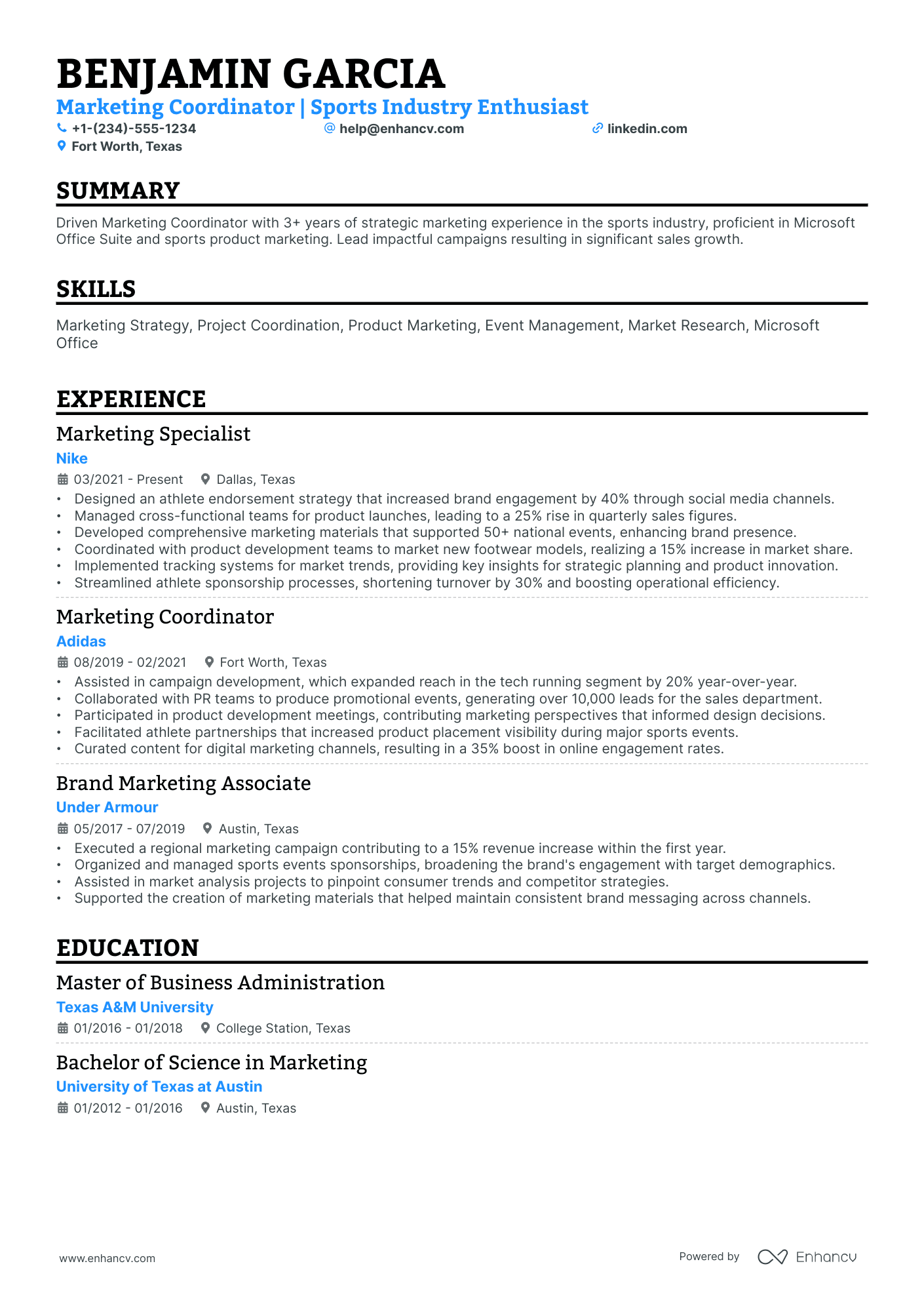
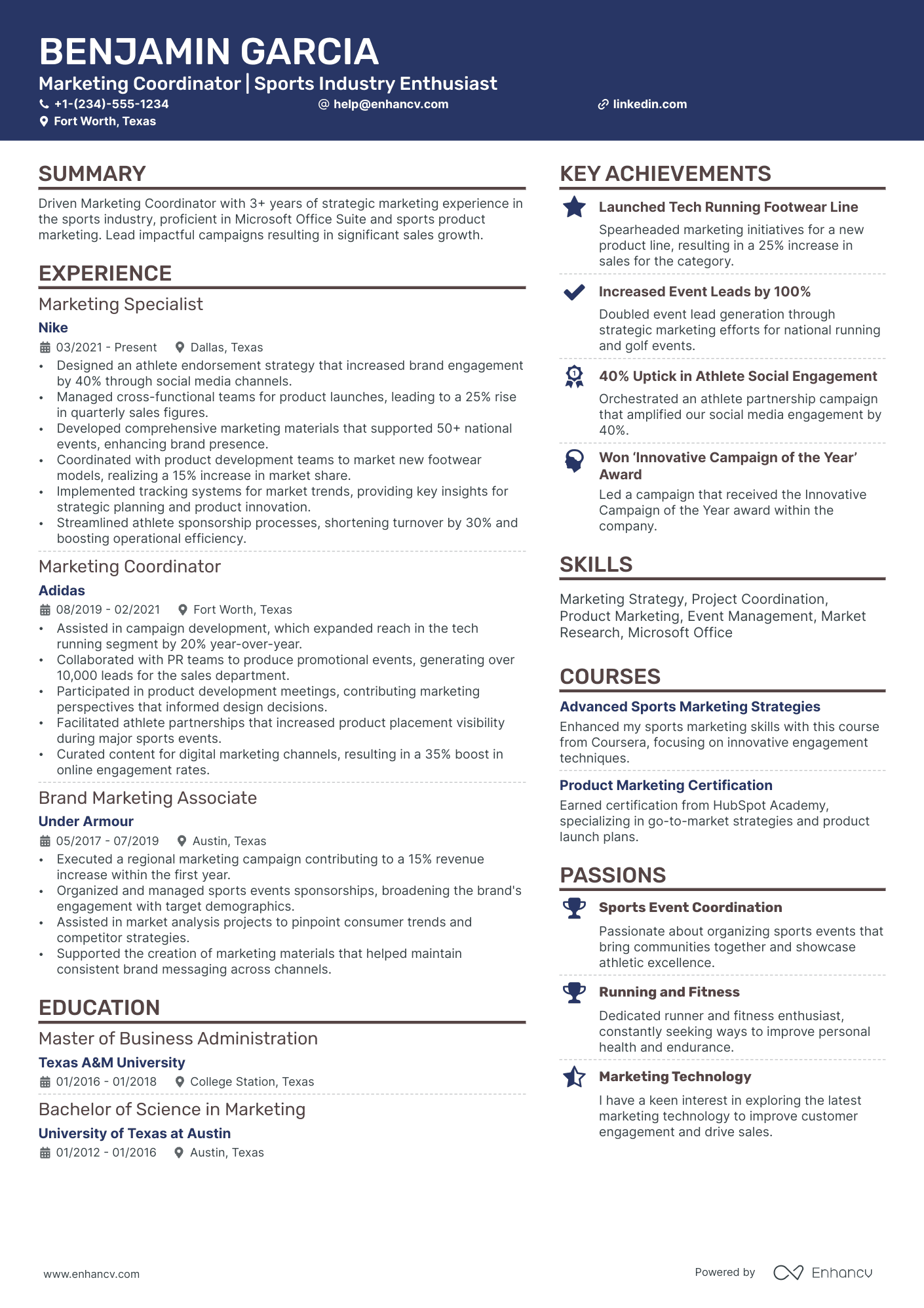
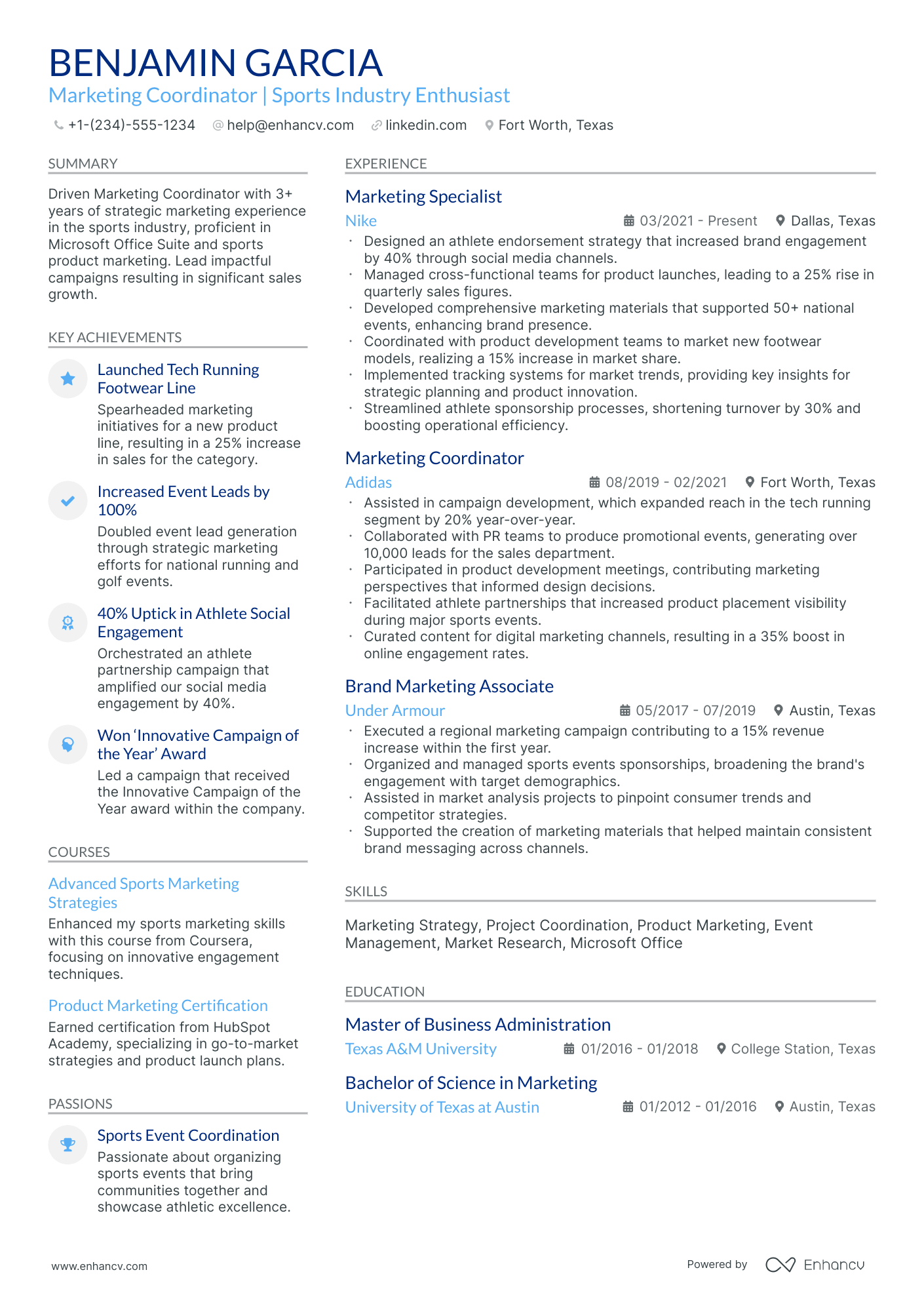
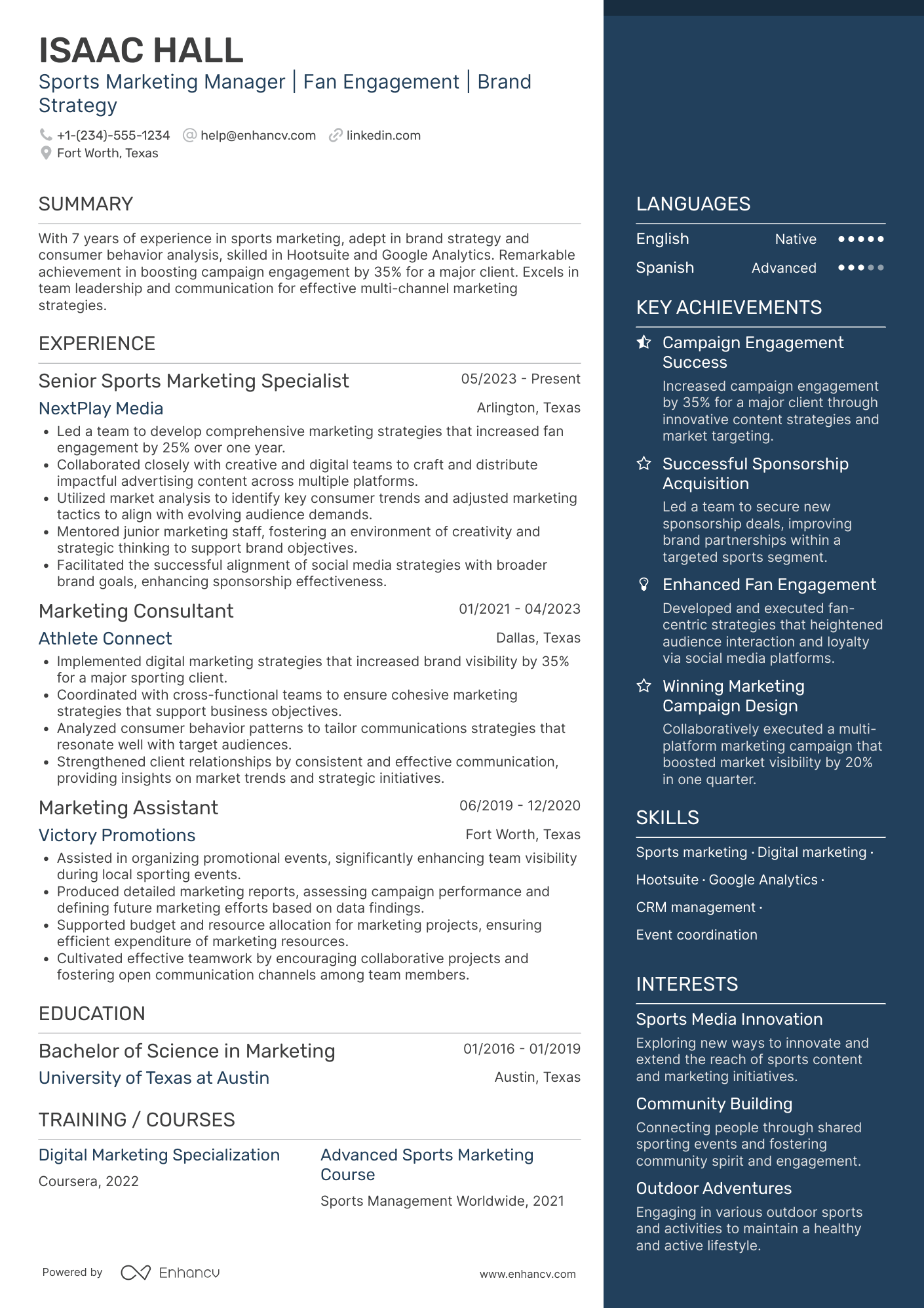
Most sports marketing resumes fail because they read like task lists and bury results under campaign jargon. A sports marketing manager resume must pass ATS filters and win a fast recruiter scan in a crowded field.
A strong resume shows what changed because of your work. Understanding how to make your resume stand out starts with quantifying sponsorship revenue, ticket sales lift, audience growth, engagement rate gains, partner retention, budget size, and on-time launch delivery across channels and events.

Key takeaways
- Quantify sponsorship revenue, ticket sales, and engagement gains in every experience bullet.
- Use reverse-chronological format if you have direct sports marketing experience.
- Tailor resume language to match each job posting's tools, metrics, and terminology.
- Lead with a projects section when you lack full-time sports marketing roles.
- Place skills above experience for career changers and below it for senior candidates.
- Pair each listed skill with a measurable outcome somewhere on your resume.
- Use Enhancv to build clear, ATS-ready bullets that highlight real campaign results.
How to format a sports marketing resume
Recruiters evaluating sports marketing resumes prioritize campaign performance metrics, brand partnership experience, audience engagement data, and familiarity with sports-specific platforms and sponsorship ecosystems. A clean, well-structured resume format ensures these signals surface quickly during both automated screening and the initial human scan.

I have significant experience in this role—which format should I use?
Use a reverse-chronological format to lead with your most recent and relevant sports marketing accomplishments. Do:
- Lead each role entry with scope and ownership details—budget size, team headcount, number of brand or sponsorship partners managed, and market reach.
- Highlight proficiency in role-specific tools and domains such as sponsorship valuation platforms, sports analytics software (e.g., Nielsen Sports, Hookit), CRM systems, media buying tools, and rights management.
- Quantify outcomes tied to business impact—revenue generated from partnerships, fan engagement lift, ticket or merchandise sales influenced, or media impression value delivered.
I'm junior or switching into this role—what format works best?
A hybrid format works best, letting you feature transferable skills prominently while still showing your work or project history in chronological order. Do:
- Place a dedicated skills section near the top of your resume, spotlighting sports marketing competencies such as sponsorship activation, event marketing, fan engagement strategy, and social media analytics.
- Include internships, volunteer roles, freelance projects, or university athletics marketing work that demonstrates hands-on experience within sports or entertainment contexts.
- Connect every listed action to a clear outcome, even at a small scale, to show you understand the relationship between marketing effort and measurable results.
Why not use a functional resume?
A functional format strips away the timeline and context recruiters need to evaluate how your sports marketing skills were applied, making it harder to verify the depth or relevance of your experience.
- A functional format may be reasonable if you're transitioning from a related field (e.g., general marketing, event management, or athletics administration) and have no direct sports marketing job titles—but only if you anchor every listed skill to a specific project, campaign, or measurable outcome.
With your format establishing a clean, scannable structure, the next step is filling it with the right sections to showcase your qualifications effectively.
What sections should go on a sports marketing resume
Recruiters expect a sports marketing resume to quickly show measurable campaign impact, brand partnership results, and fan growth outcomes. Knowing what to put on a resume helps you prioritize the most impactful details.
Use this structure for maximum clarity:
- Header
- Summary
- Experience
- Skills
- Projects
- Education
- Certifications
- Optional sections: Awards, Leadership, Languages
Your experience bullets should emphasize quantified results, audience reach, revenue impact, partnership outcomes, and the scope of campaigns you owned.
Is your resume good enough?
Drop your resume here or choose a file. PDF & DOCX only. Max 2MB file size.
Once you’ve organized your resume with the right components, the next step is to write your sports marketing experience in a way that fits that structure and shows impact.
How to write your sports marketing resume experience
Your work experience section should spotlight the campaigns, partnerships, and activations you've shipped within the sports industry—along with the platforms, analytics tools, and marketing methods you used to deliver them. Hiring managers in sports marketing prioritize demonstrated impact on fan engagement, sponsorship revenue, and brand visibility over descriptive task lists.
Each entry should include:
- Job title
- Company and location (or remote)
- Dates of employment (month and year)
Three to five concise bullet points showing what you owned, how you executed, and what outcomes you delivered:
- Ownership scope: the campaigns, sponsorship accounts, athlete or team brand partnerships, fan engagement platforms, or market segments you were directly accountable for.
- Execution approach: the marketing automation platforms, social media management tools, audience analytics frameworks, CRM systems, or media buying methods you used to plan and deliver sports marketing initiatives.
- Value improved: changes to fan acquisition rates, sponsorship renewal performance, game-day attendance, brand sentiment, digital engagement quality, or campaign efficiency tied to your sports marketing work.
- Collaboration context: how you coordinated with athletic departments, league offices, creative agencies, broadcast partners, sales teams, or corporate sponsors to align messaging and execute integrated campaigns.
- Impact delivered: outcomes expressed through growth in brand reach, sponsorship portfolio value, audience retention, merchandise revenue, or ticket sales attribution rather than a summary of daily responsibilities.
Experience bullet formula
A sports marketing experience example
✅ Right example - modern, quantified, specific.
Sports Marketing Manager, Partnerships & Growth
Redwood FC | Los Angeles, CA
2022–2025
Top-tier professional soccer club with a one million-plus fan community across digital channels and matchday experiences.
- Led integrated matchday and digital campaigns using Adobe Creative Cloud, Sprout Social, and Google Analytics, lifting ticket revenue 18% year over year and reducing cost per acquisition 22% across paid social.
- Negotiated and activated eight brand partnerships using HubSpot CRM (customer relationship management) and Airtable, delivering $1.6M in sponsorship revenue and exceeding contracted impression goals by 27%.
- Built segmented fan journeys in Salesforce Marketing Cloud and Klaviyo, improving email click-through rate 31% and increasing merchandise conversion 14% through personalized offers and automated post-match flows.
- Launched a creator and athlete content program with legal, design, and video teams, scaling short-form output to 20 assets per week and growing TikTok and Instagram followers 24% in one season.
- Standardized campaign reporting in Looker Studio with UTM governance and A B testing, cutting weekly performance reporting time 40% and improving budget reallocation speed from five days to two.
Now that you've seen how a strong experience section comes together, let's look at how to adjust yours to match the specific role you're targeting.
How to tailor your sports marketing resume experience
Recruiters evaluate your sports marketing resume through applicant tracking systems and manual review, scoring candidates against specific job posting criteria. Tailoring your resume to the job description by mirroring the language and priorities in each listing increases your chances of advancing past both filters.
Ways to tailor your sports marketing experience:
- Match sponsorship platforms and CRM tools named in the job description.
- Mirror the exact fan engagement metrics the posting prioritizes.
- Use the same terminology for campaign strategies or activation methods listed.
- Include sport-specific or league-specific experience when the role requires it.
- Highlight revenue generation or ticket sales KPIs the employer references.
- Reflect social media channels and digital analytics tools the posting specifies.
- Emphasize cross-functional collaboration with sales or communications teams if mentioned.
- Reference brand partnership frameworks or naming rights workflows the role involves.
Tailoring means aligning your real accomplishments with what each employer values—not forcing disconnected keywords into your experience bullets.
Resume tailoring examples for sports marketing
| Job description excerpt | Untailored | Tailored |
|---|---|---|
| "Develop and execute integrated marketing campaigns for live sporting events, leveraging social media, email, and in-venue activations to drive ticket sales." | Helped create marketing campaigns and worked on promotional materials for events. | Developed integrated campaigns for 12 live NBA G League events per season, coordinating social media, email sequences, and in-venue activations that drove a 23% increase in single-game ticket sales year over year. |
| "Manage relationships with corporate sponsors, prepare post-event recaps with measurable ROI data, and identify upsell opportunities using Salesforce CRM." | Worked with sponsors and helped maintain business relationships for the organization. | Managed a portfolio of eight corporate sponsors in Salesforce CRM, delivering post-event recaps with verified ROI metrics—including impressions, on-site engagement, and media value—that secured $340K in upsell commitments across two sponsorship cycles. |
| "Analyze fan engagement data through Google Analytics and social listening tools like Sprout Social to optimize content strategy across Instagram, TikTok, and X." | Tracked social media performance and provided reports to the marketing team. | Used Google Analytics and Sprout Social to analyze fan engagement across Instagram, TikTok, and X, identifying content patterns that informed a revised posting strategy and lifted average engagement rate from 2.1% to 4.7% over one MLS season. |
Once you’ve aligned your experience with the role’s priorities, the next step is to quantify your sports marketing achievements so hiring managers can see the impact behind those choices.
How to quantify your sports marketing achievements
Quantifying your achievements proves business impact beyond hype. Focus on revenue influenced, ticket and merchandise conversions, sponsorship value, campaign efficiency, fan retention, and delivery speed across channels like email, paid social, and the team's customer relationship management platform.
Quantifying examples for sports marketing
| Metric | Example |
|---|---|
| Revenue influenced | "Drove $312K in ticket revenue by retargeting lapsed buyers in Meta Ads Manager, improving purchase conversion from 1.9% to 2.6% over six weeks." |
| Sponsorship value | "Secured $180K incremental sponsor value by packaging three in-arena and social placements, increasing partner deliverables completion from 88% to 98%." |
| Cycle time | "Cut campaign launch cycle time from nine days to five by standardizing briefs and approvals in Asana, enabling eight additional game-week pushes." |
| Retention rate | "Improved season-ticket member renewal from 84% to 88% using segmented email journeys in Salesforce Marketing Cloud and a churn-risk call list." |
| Accuracy rate | "Reduced promo-code and pricing errors from 3.2% to 0.8% by adding a pre-send checklist and point-of-sale validation with Ticketmaster exports." |
Turn vague job duties into measurable, recruiter-ready resume bullets in seconds with Enhancv's Bullet Point Generator.
Once you've crafted strong bullet points that showcase your achievements, the next step is ensuring your resume highlights the right mix of hard and soft skills that sports marketing employers prioritize.
How to list your hard and soft skills on a sports marketing resume
Your skills section shows you can drive fan growth and sponsorship value, and recruiters and ATS scan it to match keywords to the job post, so aim for a balanced mix of hard skills and role-specific soft skills.
sports marketing roles require a blend of:
- Product strategy and discovery skills
- Data, analytics, and experimentation skills
- Delivery, execution, and go-to-market discipline
- Soft skills
Your skills section should be:
- Scannable (bullet-style grouping).
- Relevant to the job post.
- Backed by proof in experience bullets.
- Updated with current tools.
Place your skills section:
- Above experience if you're junior or switching careers.
- Below experience if you're mid/senior with strong achievements.

Hard skills
- Sponsorship activation planning
- Partnership proposal decks
- Media planning, buying
- Paid social ads manager
- Google Analytics 4 (GA4)
- Google Tag Manager
- Search engine optimization
- Email marketing automation
- Customer relationship management systems
- Marketing attribution modeling
- A/B test design
- Ticketing and fan data platforms
Soft skills
- Aligning stakeholders on goals
- Translating insights into actions
- Writing sponsor-ready narratives
- Negotiating partner deliverables
- Managing cross-functional timelines
- Prioritizing high-impact work
- Communicating with executives
- Coordinating with creative teams
- Owning campaign performance
- Handling live-event pivots
- Giving clear, actionable feedback
- Collaborating with sales teams
How to show your sports marketing skills in context
Skills shouldn't live only in a bulleted list on your resume.
They should be demonstrated in:
- Your summary (high-level professional identity)
- Your experience (proof through outcomes)
Here's how that looks in practice. You can also explore common resume skills across industries to benchmark your own list.
Summary example
Senior sports marketing strategist with 10+ years driving fan engagement and sponsorship revenue for professional sports brands. Skilled in CRM platforms, digital campaign strategy, and cross-functional partnership development. Grew seasonal ticket holder retention by 27% through targeted lifecycle marketing.
- Reflects senior-level expertise immediately
- Names specific tools and methods
- Leads with a measurable outcome
- Signals collaboration and leadership ability
Experience example
Senior Marketing Manager
Velocity Sports Group | Chicago, IL
June 2019–Present
- Launched data-driven email campaigns using Salesforce Marketing Cloud, boosting single-game ticket sales by 34% year over year.
- Partnered with sponsorship and creative teams to execute integrated activations, generating $1.2M in new partner revenue.
- Developed social media playbooks leveraging Sprout Social analytics, increasing gameday engagement rates by 52% across platforms.
- Every bullet includes measurable proof
- Skills surface naturally through real outcomes
Once you’ve tied your marketing strengths to real sports-related outcomes, the next step is building a sports marketing resume with no experience by presenting those same strengths through transferable projects and responsibilities.
How do I write a sports marketing resume with no experience
Even without full-time experience, you can demonstrate readiness through:
- Campus athletics social media campaigns
- NIL athlete content partnerships
- Fan survey and data analysis
- Student club sponsorship outreach
- Event promotions and street teams
- Ticketing email and SMS campaigns
- Sports brand case competitions
- Local team volunteer marketing support
If you're starting out, our guide on writing a resume without work experience covers strategies for highlighting projects, coursework, and transferable skills.
Focus on:
- Campaign results with clear metrics
- Audience growth and engagement data
- Sponsorship outreach and pitch materials
- Sports marketing tools and workflows
Resume format tip for entry-level sports marketing
Use a combination resume format because it highlights projects and skills first, while still showing your work history and leadership roles. Do:
- Lead with a Projects section.
- Add metrics to every sports marketing bullet.
- List tools like Google Analytics.
- Include links to portfolios or posts.
- Tailor keywords to each job.
- Built a campus athletics Instagram content calendar in Canva and Later, boosting average engagement rate from 3.1% to 5.0% in eight weeks.
Even without formal work experience, your academic background can serve as a strong foundation for your resume—so presenting your education strategically is essential.
How to list your education on a sports marketing resume
Your education section helps hiring teams confirm you have the foundational knowledge needed for sports marketing. It validates your academic background in marketing, business, or communications quickly.
Include:
- Degree name
- Institution
- Location
- Graduation year
- Relevant coursework (for juniors or entry-level candidates)
- Honors & GPA (if 3.5 or higher)
Skip month and day details—list the graduation year only.
Here's a strong education entry tailored to sports marketing:
Example education entry
Bachelor of Science in Marketing, Concentration in Sports Management
University of Oregon, Eugene, OR
2022 | GPA: 3.7/4.0
- Relevant Coursework: Sports Consumer Behavior, Brand Strategy in Athletics, Digital Marketing for Sports Organizations, Event Promotion & Sponsorship
- Honors: Dean's List (six consecutive semesters), Marketing Department Outstanding Graduate Award
How to list your certifications on a sports marketing resume
Certifications on your resume show your commitment to learning, prove tool proficiency, and signal industry relevance in sports marketing. They help recruiters trust your skills in analytics, media, and campaign execution.
Include:
- Certificate name
- Issuing organization
- Year
- Optional: credential ID or URL
- List certifications below education when your degree is recent and the certifications support it without adding stronger sports marketing relevance.
- List certifications above education when they are recent, highly relevant to sports marketing, or required for the role you're targeting.
Best certifications for your sports marketing resume
Google Analytics Certification Google Ads Certification Meta Certified Digital Marketing Associate HubSpot Content Marketing Certification HubSpot Social Media Marketing Certification Hootsuite Social Marketing Certification Tableau Desktop Specialist
Once you’ve positioned your credentials to support your expertise, you’re ready to write your sports marketing resume summary to highlight that value upfront.
How to write your sports marketing resume summary
Your resume summary is the first thing a recruiter reads. A strong one instantly connects your experience to the sports marketing role you're targeting.
Keep it to three to four lines, with:
- Your title and total years of experience in marketing or sports-related fields.
- The domain you specialize in, such as collegiate athletics, professional leagues, or sports brands.
- Core skills like campaign management, sponsorship activation, social media strategy, or event marketing.
- One or two measurable wins, such as engagement growth, revenue from partnerships, or ticket sales increases.
- Soft skills tied to outcomes, like cross-functional collaboration that improved campaign turnaround time.

PRO TIP
At the entry level, lead with relevant skills, tools, and any early results from internships or projects. Avoid vague phrases like "passionate team player" or "motivated self-starter." Recruiters want specifics—name the platforms you used and the outcomes you helped drive.
Example summary for a sports marketing
Sports marketing coordinator with two years of experience managing social media campaigns for collegiate athletics. Grew Instagram engagement 35% using Sprout Social and led game-day promotions that boosted student attendance.
Optimize your resume summary and objective for ATS
Drop your resume here or choose a file.
PDF & DOCX only. Max 2MB file size.
Now that your summary is ready to hook recruiters with your strongest qualifications, make sure the header above it presents your contact details correctly so they can actually reach you.
What to include in a sports marketing resume header
A resume header is the top section that identifies you and your contact details, boosting visibility, credibility, and recruiter screening for sports marketing roles.
Essential resume header elements
- Full name
- Tailored job title and headline
- Location
- Phone number
- Professional email
- GitHub link
- Portfolio link
A LinkedIn link helps recruiters confirm your roles, dates, and recommendations fast, which supports early screening decisions.
Don't include a photo on a sports marketing resume unless the role is explicitly front-facing or appearance-dependent.
Match your header headline to the sports marketing job posting by using the same specialty and level, such as partnerships, digital campaigns, or brand activation.
Example
Sports marketing resume header
Jordan Taylor
Sports Marketing Specialist | Partnerships, Fan Engagement, and Campaign Strategy
Chicago, IL
(312) 555-01XX
your.name@enhancv.com
github.com/yourname
yourwebsite.com
linkedin.com/in/yourname
Once your contact details and professional identifiers are set at the top, add targeted additional sections to reinforce your fit and provide supporting context.
Additional sections for sports marketing resumes
Standing out in sports marketing means showcasing credentials that go beyond standard work experience and education.
The right additional sections highlight niche expertise and industry involvement that hiring managers value:
- Languages
- Certifications (e.g., Google Analytics, HubSpot, sports management credentials)
- Industry conferences and events
- Publications and media features
- Professional affiliations (e.g., Sports Marketing Association)
- Volunteer experience in athletics or sporting events
- Hobbies and interests tied to sports and fan culture
Once you've strengthened your resume with relevant additional sections, the next step is pairing it with a cover letter that reinforces your qualifications and gives hiring managers a fuller picture of your candidacy.
Do sports marketing resumes need a cover letter
A cover letter isn't required for most sports marketing roles, but it helps when jobs draw many applicants or when the hiring manager expects one. If you're unsure where to start, understanding what a cover letter is and how it complements your resume can clarify when one is worth writing. It can make a difference when your resume needs context or when fit matters as much as skills.
Use a cover letter to add value, not to repeat your resume:
- Explain why you fit the specific team: Connect your strengths to the organization's audience, brand voice, and current priorities.
- Highlight one or two outcomes: Pick a campaign, partnership, or content launch and share the goal, your role, and the measurable result.
- Show you understand the business context: Reference the product, fans, sponsors, ticketing, or media goals, and how marketing supports revenue or retention.
- Address non-obvious experience: Clarify a career change, a gap, or transferable work, and link it to sports marketing responsibilities.
Drop your resume here or choose a file.
PDF & DOCX only. Max 2MB file size.
Even if you decide to include a cover letter, using AI to improve your sports marketing resume helps you tailor your content faster and more consistently.
Using AI to improve your sports marketing resume
AI can sharpen your resume's clarity, structure, and overall impact. It helps tighten language and align content with specific roles. But overuse strips authenticity. Once your resume reads clearly and fits the role, step away from AI. If you're exploring tools, our comparison of which AI is best for writing resumes can help you choose the right one.
Here are 10 prompts you can copy and paste to strengthen specific sections of your sports marketing resume:
- Strengthen your summary: "Rewrite my resume summary to highlight my sports marketing experience, core strengths, and the specific value I bring to prospective employers."
- Quantify achievements: "Review my sports marketing experience bullets and suggest ways to add measurable results like revenue growth, attendance increases, or engagement rates."
- Tighten bullet points: "Edit these sports marketing experience bullets to start with strong action verbs and remove any filler words or redundant phrasing."
- Align with job descriptions: "Compare my resume to this sports marketing job description and identify gaps in keywords, skills, or qualifications I should address."
- Refine your skills: "Reorganize my skills section to prioritize the most relevant hard and soft skills for a sports marketing role."
- Improve project descriptions: "Rewrite my sports marketing project descriptions to clearly state my role, the strategy used, and the outcome achieved."
- Clarify education relevance: "Revise my education section to emphasize coursework, honors, or activities directly related to sports marketing."
- Showcase certifications: "Reformat my certifications section so each entry clearly connects to sports marketing tools, platforms, or industry standards."
- Remove weak language: "Flag any vague or passive phrases across my sports marketing resume and suggest direct, confident replacements."
- Check for consistency: "Review my entire sports marketing resume for inconsistent formatting, tense shifts, or misaligned dates and job titles."
Stop using AI once your resume sounds accurate, specific, and aligned with real experience. AI should never invent experience or inflate claims—if it didn't happen, it doesn't belong here.
Conclusion
A strong sports marketing resume proves impact with measurable outcomes, highlights role-specific skills, and uses a clear structure that’s easy to scan. Lead with results, support them with the right tools and channels, and keep every line relevant.
Hiring teams want clear evidence you can drive revenue, engagement, and partnerships in today’s sports marketing market. A focused format and strong metrics show you’re ready now and prepared for what hiring will demand next.