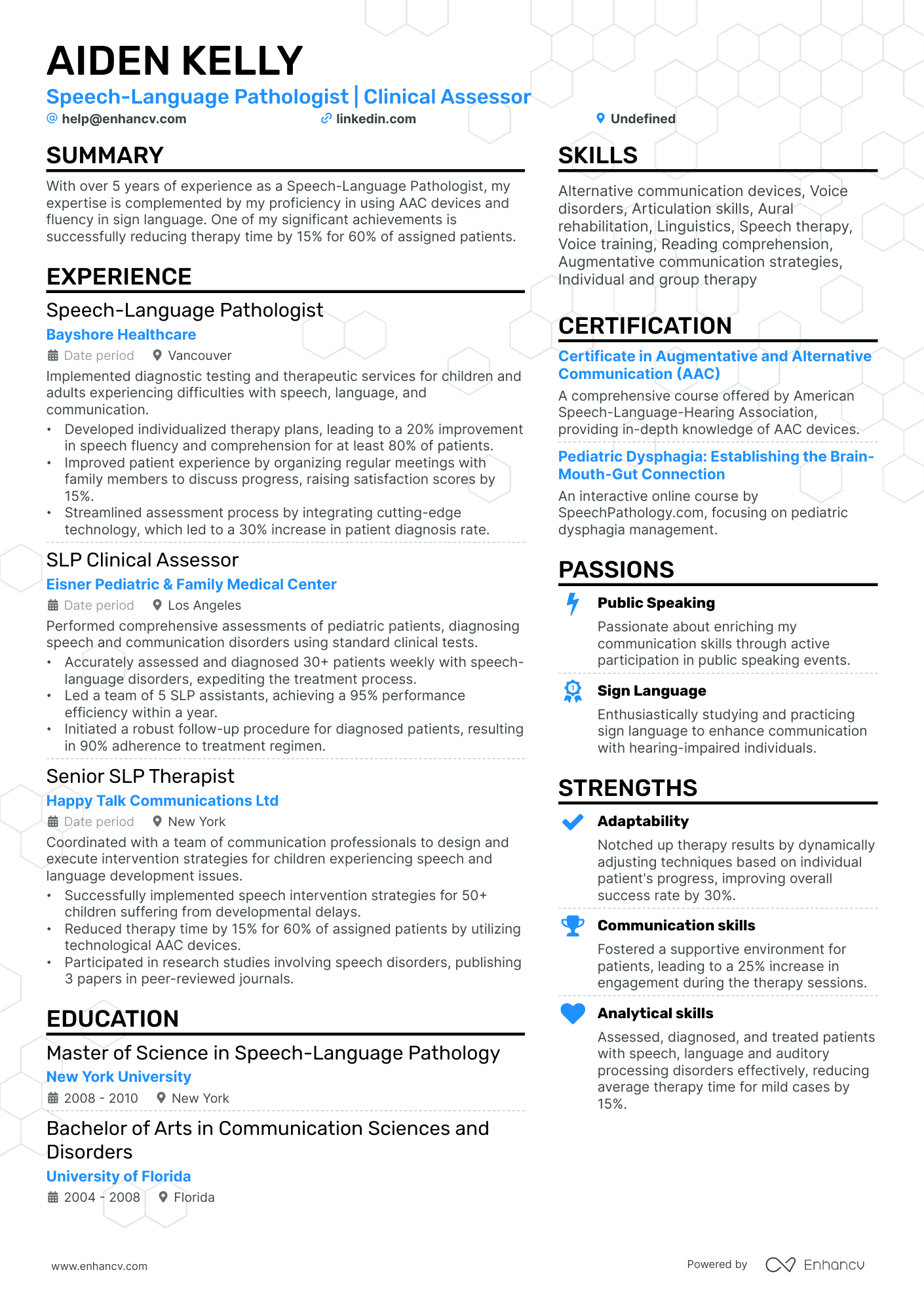
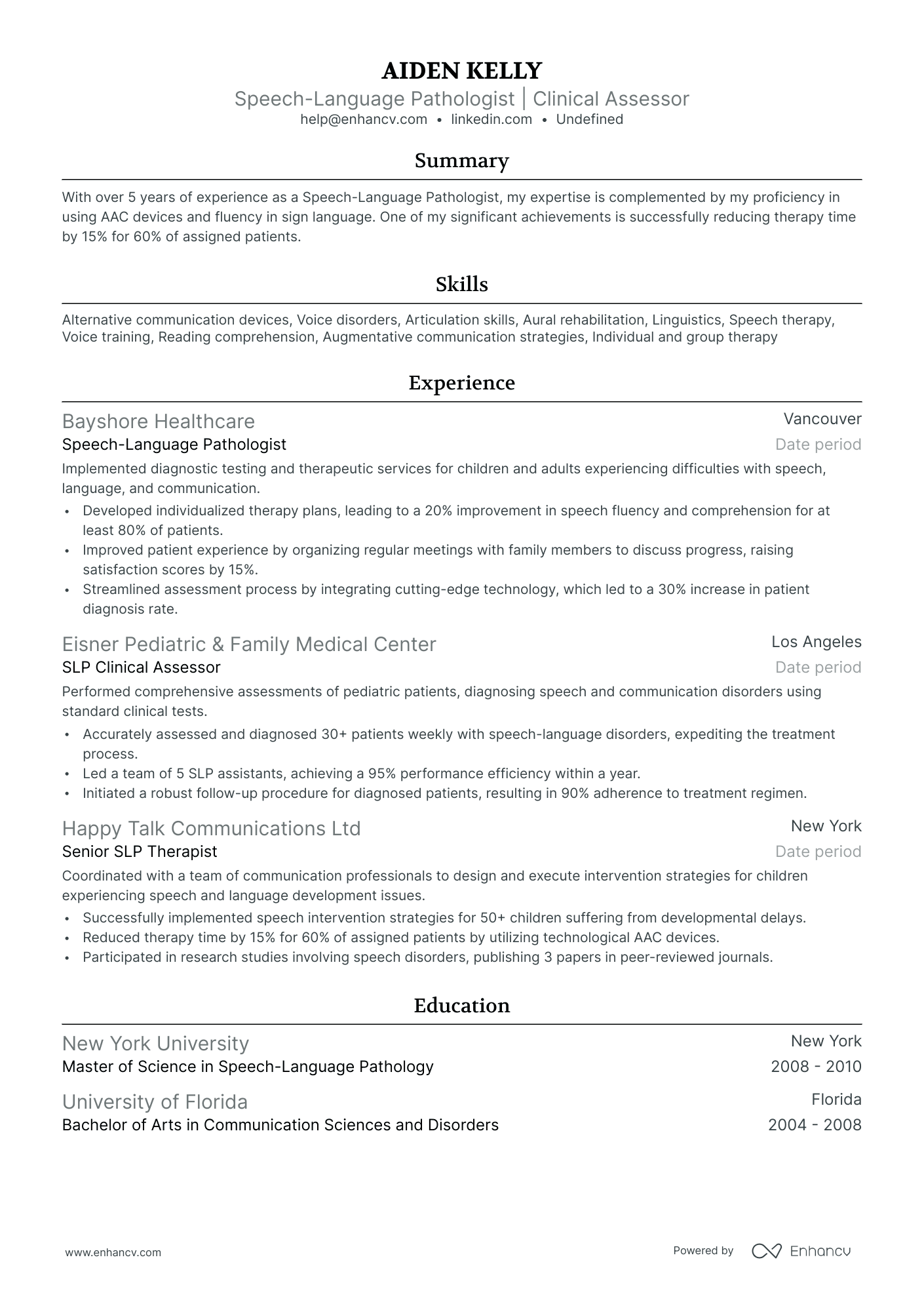
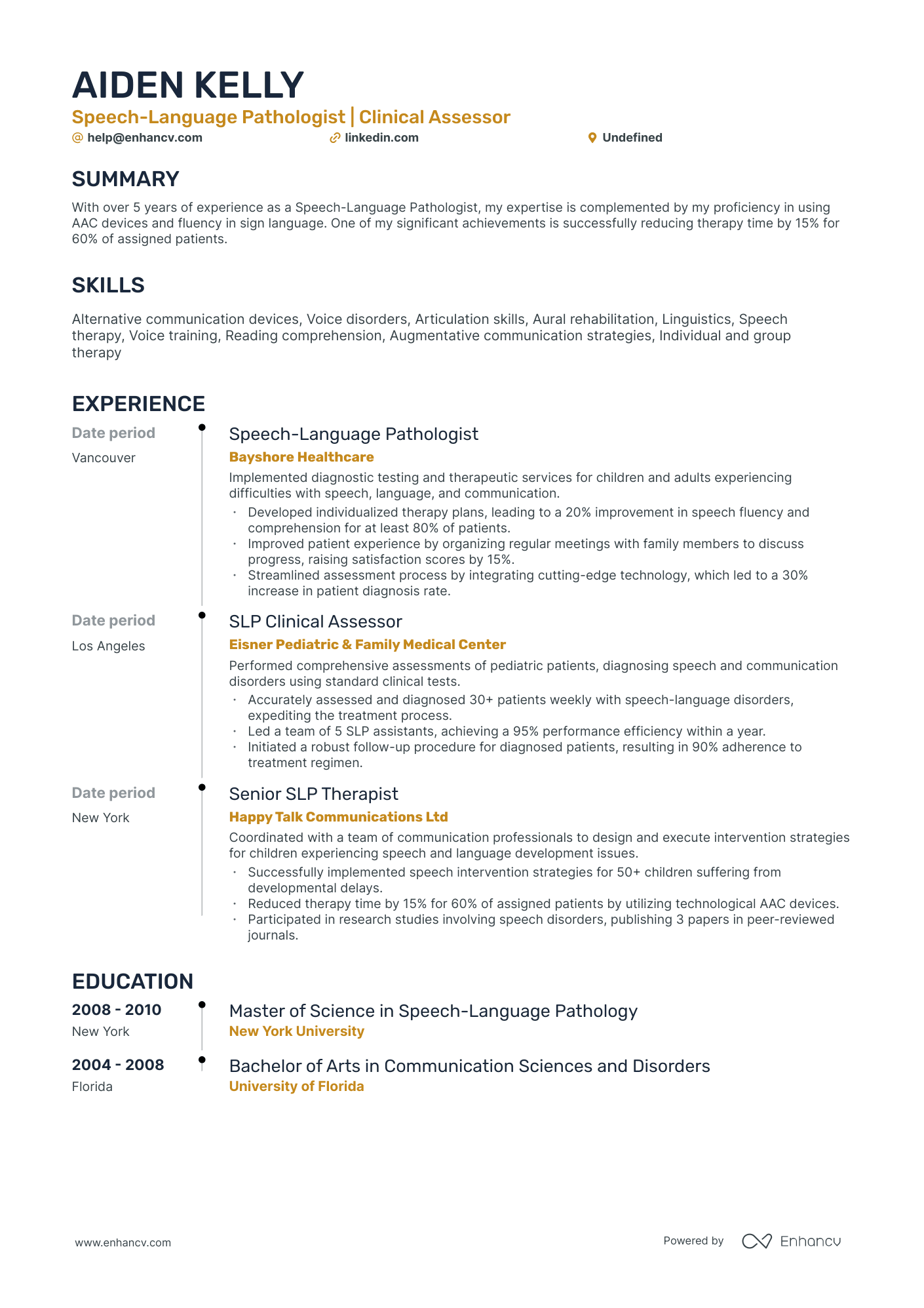
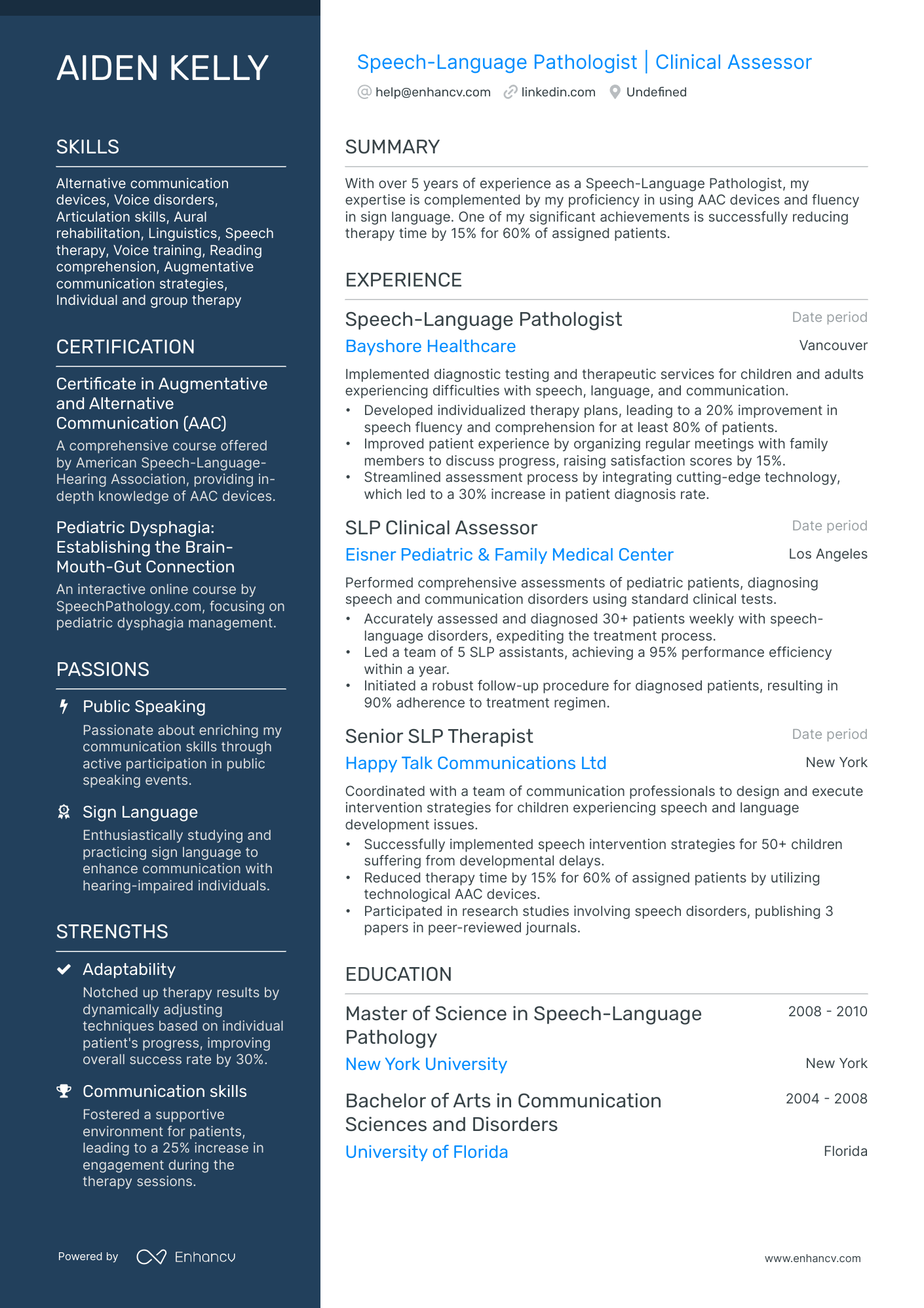
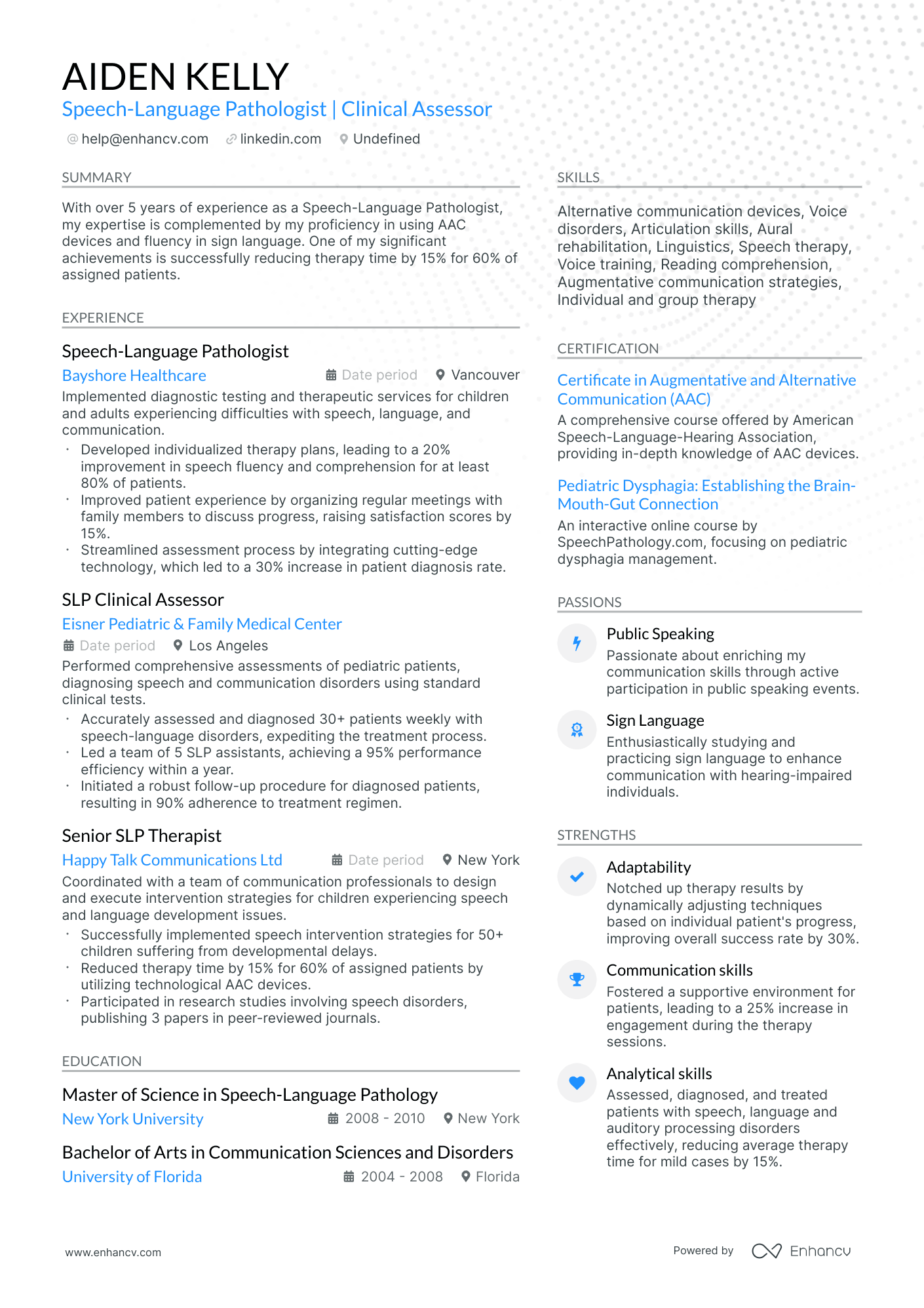
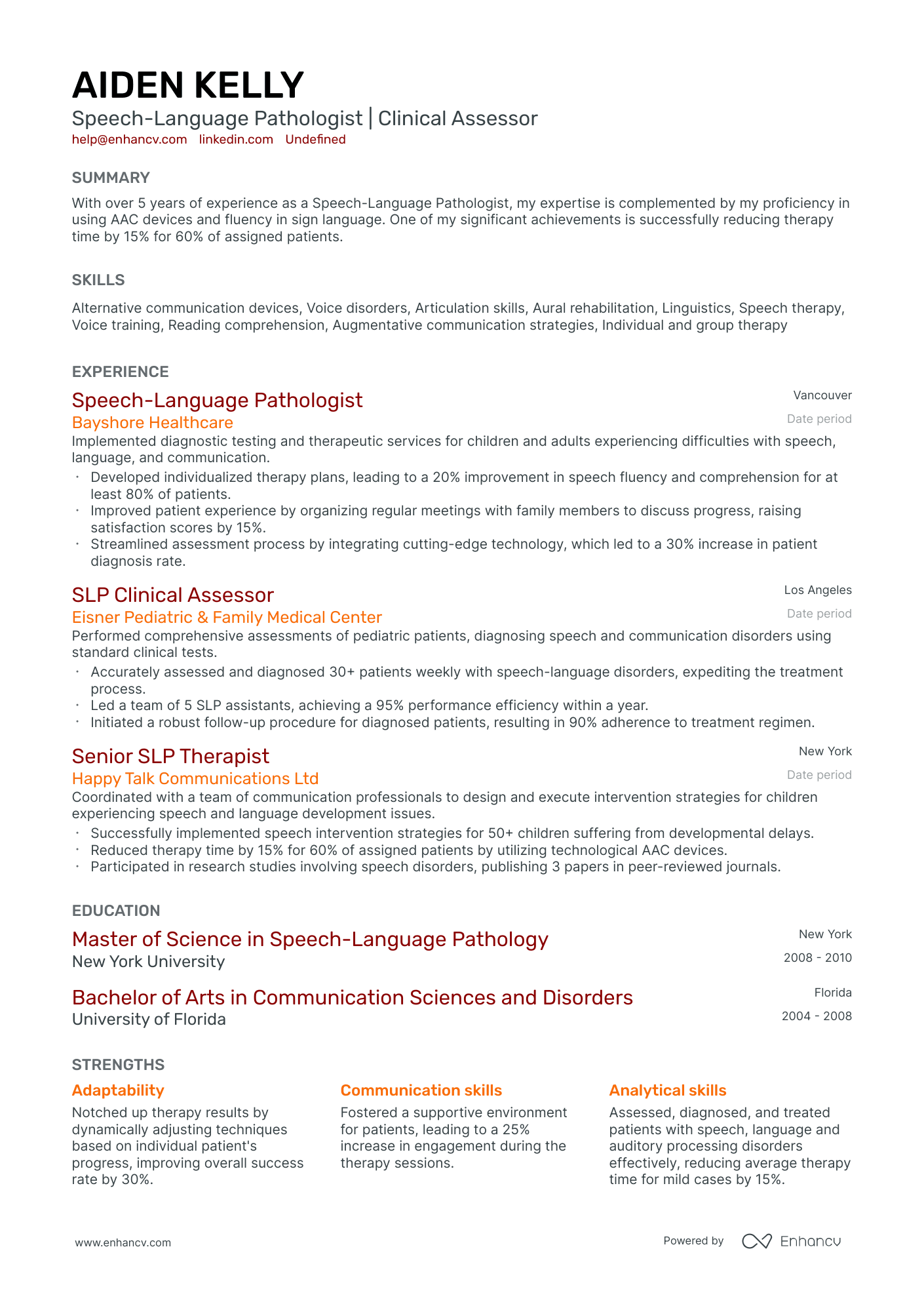
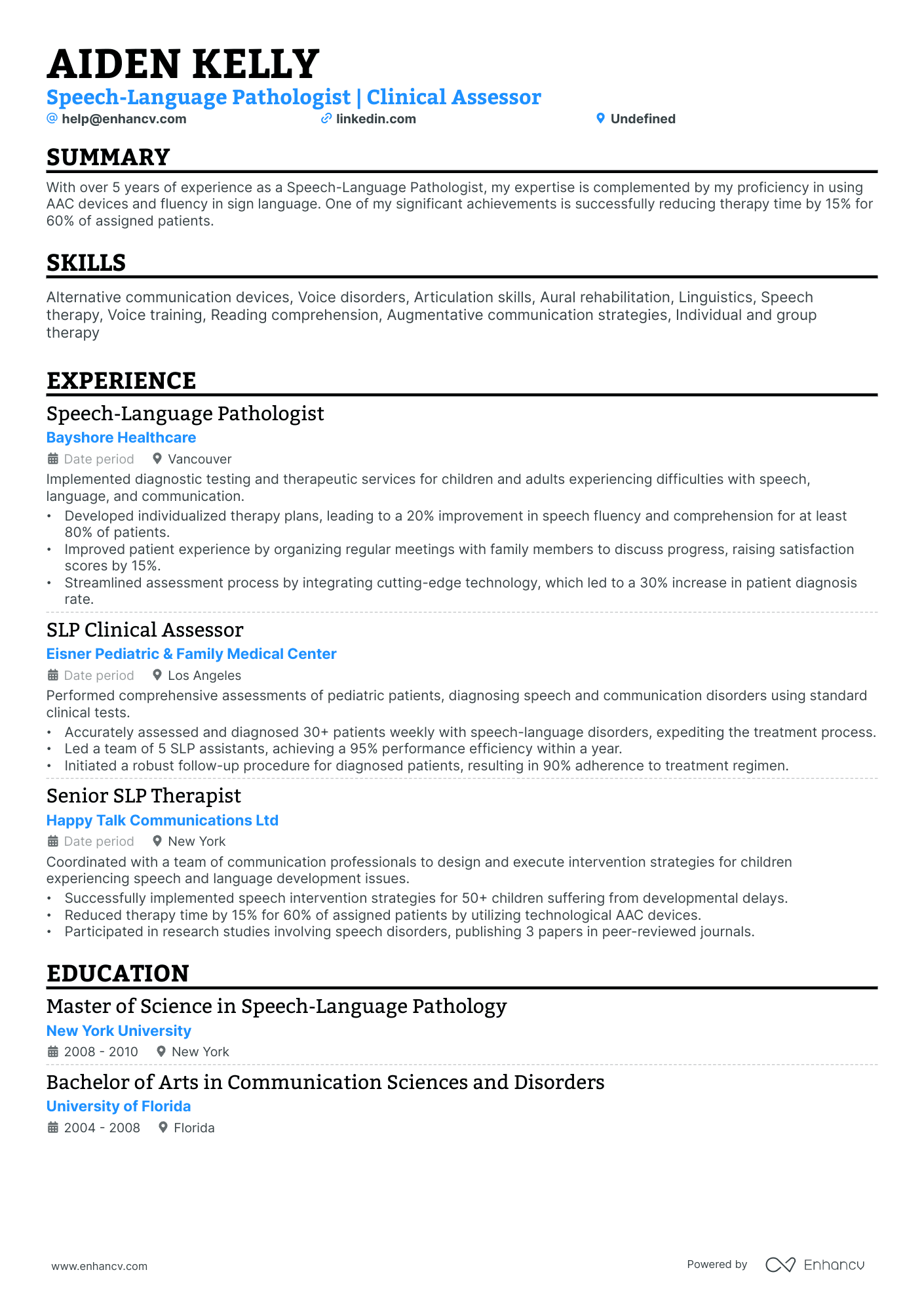
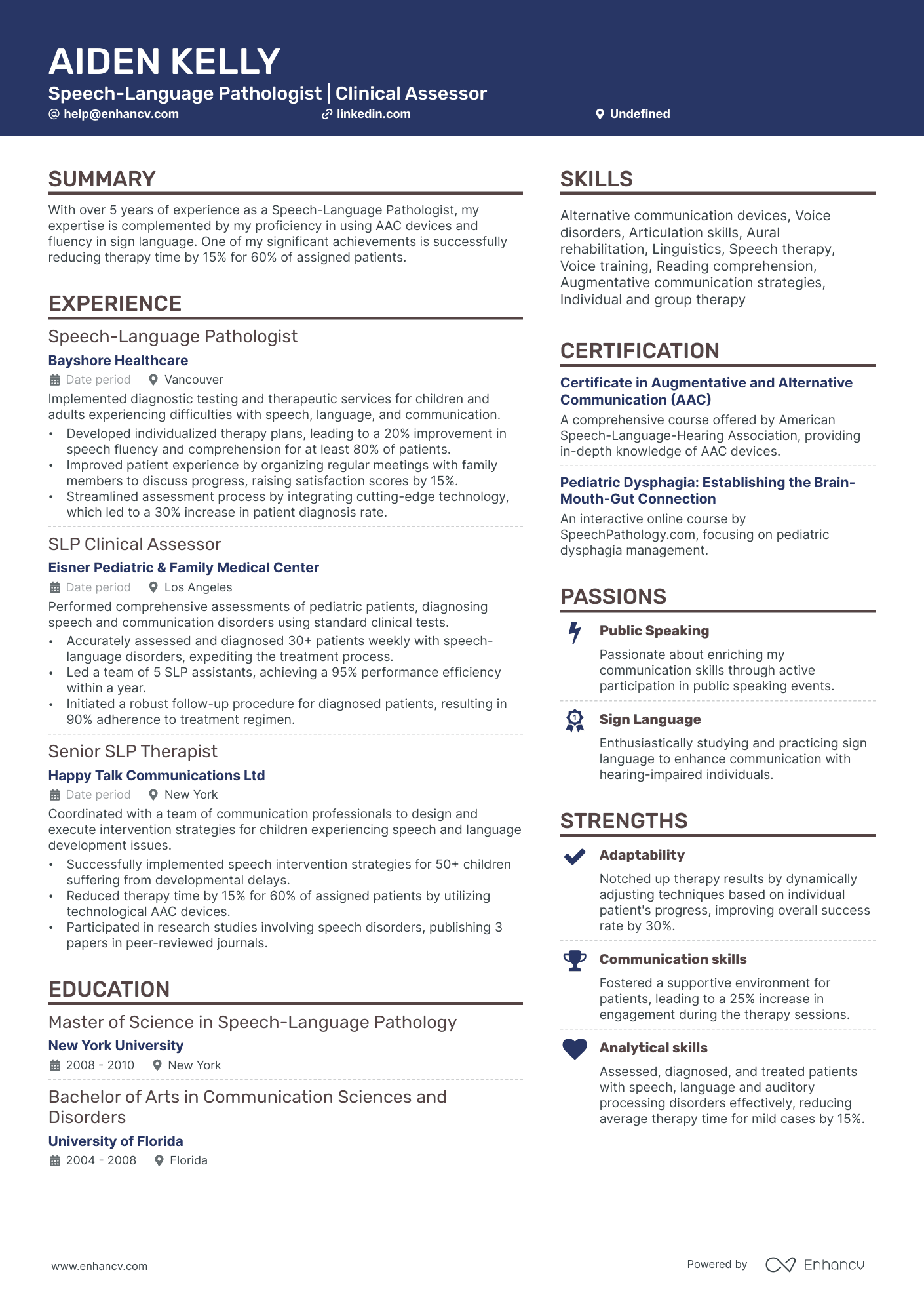
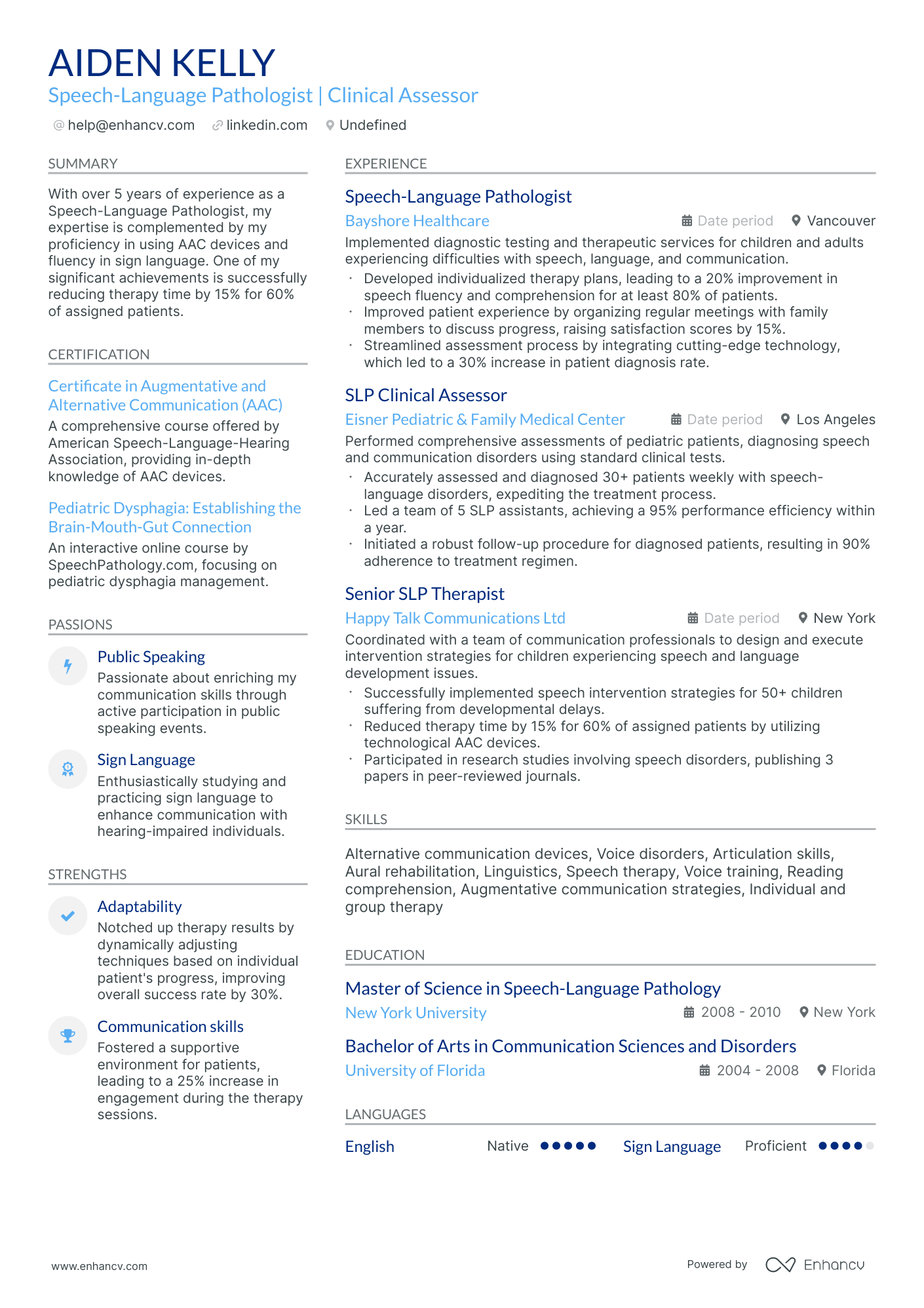
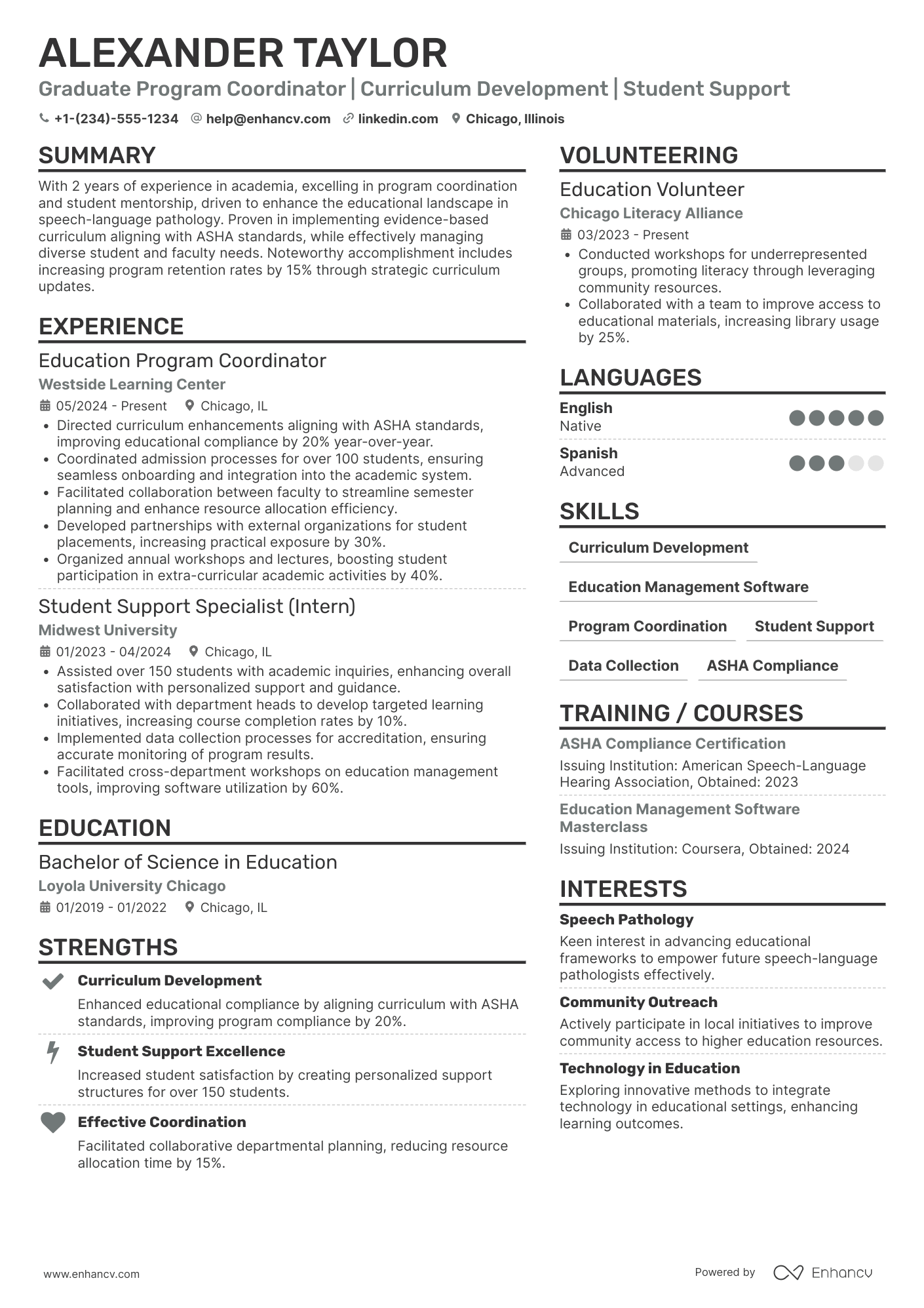
Many SLP Grad School resume drafts fail because they read like coursework logs, not proof you can deliver clinical results under supervision. That hurts when applicant tracking systems filter keywords, reviewers scan fast, and programs compare dozens of similar candidates. Knowing how to make your resume stand out is critical in this competitive landscape.
A strong resume shows what changed because of your work. You should highlight caseload size, measurable progress, timely documentation, fewer missed sessions, improved caregiver carryover, and successful goal attainment across articulation, language, fluency, or AAC plans.

Key takeaways
- Quantify clinical outcomes like caseload size, goal mastery rates, and documentation turnaround times.
- Tailor each resume to mirror the specific program's populations, tools, and priorities.
- Use a reverse-chronological format unless limited clinical experience justifies a hybrid layout.
- Replace vague duty descriptions with ownership, execution method, and measurable impact.
- Place skills above experience if you're entry-level, and back each one with proof.
- Write a three- to four-line summary featuring your setting, population focus, and strongest result.
- Use Enhancv to turn clinical duties into measurable, program-aligned resume bullets faster.
How to format a SLP Grad School resume
Admissions committees and clinical placement coordinators reviewing SLP grad school resumes prioritize relevant clinical observation hours, academic preparation in communication sciences, and any hands-on experience with diverse populations. Choosing the right resume format ensures these signals surface quickly, especially when reviewers are scanning dozens of applications in a single sitting.

I have significant experience in this role—which format should I use?
Use a reverse-chronological format to present your clinical and academic experiences in order, showing clear growth in responsibility and skill complexity. Do:
- Lead with your most recent and most relevant clinical or research positions, highlighting the scope of populations served and settings worked in.
- Feature role-specific tools, assessments, and domains—such as AAC devices, standardized articulation screenings, fluency intervention protocols, or dysphagia observation hours.
- Quantify outcomes and contributions wherever possible, including caseload numbers, hours logged, or measurable client progress.
I'm junior or switching into this role—what format works best?
A hybrid format works well when your direct SLP experience is limited but you have transferable skills from related fields like education, psychology, or healthcare. Do:
- Place a skills section near the top of your resume, highlighting coursework, certifications (such as CPR/First Aid), and relevant competencies like bilingual proficiency or experience with IEP documentation.
- Include academic projects, volunteer work, or paraprofessional roles that demonstrate exposure to speech-language pathology populations or clinical environments.
- Connect every listed skill or experience to a specific action and a clear outcome, even if the outcome is developmental rather than clinical.
Why not use a functional resume?
A functional format strips away the timeline and context that admissions committees need to verify your clinical observation hours, academic progression, and hands-on experience—making it harder to evaluate your readiness for a graduate program.
- Career changers with no clinical hours yet: If you're transitioning from teaching, psychology, or a related field and lack direct SLP experience, a functional format can foreground transferable skills—but only if each skill is tied to a specific project, volunteer role, or outcome.
- Applicants with resume gaps: If you've taken time away from academics or clinical work, a functional layout can redirect attention to relevant coursework and certifications, though you should still briefly account for gaps in a cover letter.
With your formatting foundation in place, the next step is identifying exactly which sections to include so each one serves a clear purpose on your resume.
What sections should go on a SLP Grad School resume
Admissions reviewers expect a clear, complete resume that highlights your academic readiness, clinical exposure, and communication strengths for speech-language pathology graduate school. Understanding which resume sections to include is essential for maximum clarity:
- Header
- Summary
- Experience
- Skills
- Projects
- Education
- Certifications
- Optional sections: Research, Volunteering, Languages
Strong experience bullets should emphasize measurable outcomes, your scope of responsibility, and the impact of your work with clients, teams, or research labs.
Is your resume good enough?
Drop your resume here or choose a file. PDF & DOCX only. Max 2MB file size.
Once you’ve organized your resume with the key categories admissions expects, you can focus on writing your experience section so it supports those categories with clear, relevant details.
How to write your SLP Grad School resume experience
Your experience section should prove you've delivered meaningful work in speech-language pathology settings—not just observed or assisted. Graduate admissions committees prioritize demonstrated clinical impact, evidence-based methods, and measurable client outcomes over generic task descriptions. Building a targeted resume for each program ensures your most relevant qualifications take center stage.
Each entry should include:
- Job title
- Company and location (or remote)
- Dates of employment (month and year)
Three to five concise bullet points showing what you owned, how you executed, and what outcomes you delivered:
- Ownership scope: the caseloads, therapy programs, diagnostic screenings, client populations, or clinical settings you were directly accountable for in your speech-language pathology work.
- Execution approach: the assessment tools, therapeutic techniques, evidence-based interventions, documentation systems, or treatment planning frameworks you used to guide clinical decisions and deliver services.
- Value improved: changes to client communication outcomes, treatment plan effectiveness, service delivery efficiency, diagnostic accuracy, or accessibility of speech-language services that resulted from your contributions.
- Collaboration context: how you coordinated with supervising SLPs, audiologists, special education teams, families, physicians, or interdisciplinary rehabilitation professionals to support comprehensive client care.
- Impact delivered: outcomes expressed through client progress, program reach, caseload scale, or service improvements rather than a simple list of daily responsibilities.
Experience bullet formula
A SLP Grad School experience example
✅ Right example - modern, quantified, specific.
Graduate Clinician, Speech-Language Pathology
University Speech and Hearing Clinic | Boston, MA
2024–Present
ASHA-aligned training clinic delivering evidence-based evaluation and therapy across pediatric and adult caseloads.
- Administered and scored CELF-5, GFTA-3, and PLS-5 evaluations; generated eight diagnostic reports per semester in EPIC within forty-eight hours, reducing documentation turnaround time by thirty percent.
- Designed and delivered individualized treatment plans using evidence-based practice and motor learning principles; increased goal mastery from baseline by an average of twenty-five percent across ten clients using weekly data probes in Google Sheets.
- Implemented AAC (augmentative and alternative communication) supports using Proloquo2Go and TD Snap; improved functional requesting accuracy from forty percent to seventy-five percent over six weeks, collaborating with caregivers and special education teachers.
- Coordinated interdisciplinary care with audiology, occupational therapy, and school teams; standardized handoffs using SBAR (Situation, Background, Assessment, Recommendation), cutting missed follow-ups by twenty percent across the clinic cohort.
- Led telepractice sessions via Zoom for Healthcare; maintained ninety-five percent attendance and increased home-program adherence by thirty-five percent through caregiver coaching and automated reminders in the clinic’s scheduling system.
Now that you've seen how a strong experience section comes together, let's break down how to tailor each element to match the specific program you're applying to.
How to tailor your SLP Grad School resume experience
Admissions committees and applicant tracking systems both screen SLP grad school resumes for relevant clinical and academic experience. Tailoring your resume to the job description—or in this case, the program description—ensures your qualifications stand out immediately.
Ways to tailor your SLP Grad School experience:
- Mirror specific disorder populations or caseload types listed in program requirements.
- Reference assessment tools and standardized tests named in the program description.
- Use the exact clinical terminology each program applies to practicum settings.
- Highlight supervised clinical hours in settings the program values most.
- Emphasize evidence-based intervention approaches the program explicitly prioritizes.
- Include relevant experience with AAC devices or dysphagia management when specified.
- Align your documentation language with ASHA standards referenced in admissions criteria.
- Showcase interdisciplinary collaboration experience matching the program's team-based model.
Tailoring means aligning your genuine clinical achievements and academic preparation with each program's specific requirements—not artificially inserting terminology you can't back up.
Resume tailoring examples for SLP Grad School
| Job description excerpt | Untailored | Tailored |
|---|---|---|
| "Candidates should demonstrate clinical experience with pediatric speech-sound disorders using evidence-based assessment tools such as the GFTA-3 and KLPA-3." | Worked with children on speech skills in a clinical setting. | Conducted phonological assessments for 15+ pediatric clients using the GFTA-3 and KLPA-3, identifying speech-sound disorder patterns to guide individualized treatment planning. |
| "Applicants must show experience in adult neurogenic communication disorders, including aphasia intervention using LPAA frameworks." | Helped adults with communication difficulties during a clinical rotation. | Delivered aphasia intervention for six adult clients across two semesters using the Life Participation Approach to Aphasia (LPAA), targeting functional communication goals in group and individual sessions. |
| "Strong candidates will have documented experience in AAC device programming and implementation for individuals with complex communication needs." | Assisted clients who needed alternative communication support. | Programmed and customized AAC devices using TouchChat and LAMP Words for Life for four clients with complex communication needs, training caregivers on device integration across home and school environments. |
Once you’ve aligned your experience with each program’s priorities, the next step is to quantify your SLP grad school achievements so reviewers can quickly see your impact.
How to quantify your SLP Grad School achievements
Quantifying your achievements proves clinical impact and readiness for graduate-level training. Focus on caseload volume, treatment outcomes, documentation accuracy, turnaround time, caregiver satisfaction, and safety or compliance measures.
Quantifying examples for SLP Grad School
| Metric | Example |
|---|---|
| Caseload volume | "Supported a caseload of 12 pediatric clients per week, coordinating schedules and materials across three therapy groups." |
| Treatment outcomes | "Tracked progress for eight clients using goal-accuracy probes, increasing mean sound production accuracy from 55% to 75% over eight weeks." |
| Documentation accuracy | "Audited 60 SOAP notes in Google Sheets and reduced missing elements from 18% to 3% by standardizing a documentation checklist." |
| Turnaround time | "Cut session note turnaround from 48 hours to 12 hours by using EHR templates and a same-day documentation workflow." |
| Caregiver satisfaction | "Collected post-session surveys from 25 caregivers and improved average satisfaction from 4.2 to 4.7 out of 5 by adding home-practice handouts." |
Turn vague job duties into measurable, recruiter-ready resume bullets in seconds with Enhancv's Bullet Point Generator.
Once you've crafted strong bullet points for your experience section, it's equally important to strategically present your hard and soft skills to give admissions committees a complete picture of your qualifications.
How to list your hard and soft skills on a SLP Grad School resume
A well-organized skills section shows you can succeed in graduate-level speech-language pathology training, and recruiters and an ATS (applicant tracking system) scan this section to match keywords fast—aim for more hard skills than soft skills, then reinforce both in your experience. SLP Grad School roles require a blend of:
- Product strategy and discovery skills.
- Data, analytics, and experimentation skills.
- Delivery, execution, and go-to-market discipline.
- Soft skills.
Your skills section should be:
- Scannable (bullet-style grouping).
- Relevant to the job post.
- Backed by proof in experience bullets.
- Updated with current tools.
Place your skills section:
- Above experience if you're junior or switching careers.
- Below experience if you're mid/senior with strong achievements.

Hard skills
- Oral mechanism exam
- Speech sound assessment
- Language sampling, analysis
- AAC evaluation, feature matching
- Phonetic transcription, IPA
- Dysphagia screening, clinical swallow eval
- Voice evaluation, CAPE-V
- Fluency assessment, SSI-4
- Standardized scoring, norm-referenced interpretation
- SOAP notes, clinical documentation
- HIPAA compliance, confidentiality
- Telepractice platforms, video conferencing
Soft skills
- Translate findings into plain language
- Ask targeted case history questions
- Collaborate with supervisors and peers
- Incorporate feedback quickly
- Prioritize caseload tasks and deadlines
- Present case summaries clearly
- Coordinate with families and caregivers
- Communicate professionally with educators
- Maintain boundaries and confidentiality
- Document decisions and rationale
- Stay calm during challenging sessions
- Advocate for client-centered goals
How to show your SLP Grad School skills in context
Skills shouldn't live only in a bulleted list on your resume. Browse resume skills examples to see how top candidates integrate competencies throughout their applications.
They should be demonstrated in:
- Your summary (high-level professional identity)
- Your experience (proof through outcomes)
Here's how that looks in practice.
Summary example
Senior speech-language pathologist with 12 years of pediatric experience specializing in augmentative and alternative communication. Skilled in LAMP and PROMPT therapy, reducing average treatment duration by 30% across caseloads of 45+ clients through evidence-based intervention planning and interdisciplinary collaboration.
- Reflects senior-level clinical expertise
- Names specific therapeutic tools and methods
- Quantifies a meaningful client outcome
- Highlights collaboration as a core strength
Experience example
Senior Speech-Language Pathologist
Children's Therapy Partners | Portland, OR
June 2018–March 2024
- Implemented LAMP-based AAC interventions for 50+ pediatric clients, improving functional communication scores by 35% within six months.
- Collaborated with occupational therapists and educators to design individualized education programs, increasing IEP goal achievement rates by 28%.
- Trained four junior clinicians on PROMPT technique and clinical documentation using PracticeForce EHR, cutting onboarding time by three weeks.
- Every bullet includes measurable proof.
- Skills appear naturally within achievements.
Once you’ve demonstrated your communication, research, and clinical readiness through coursework, projects, and relevant activities, the next step is to structure those details into an SLP grad school resume even if you don’t have formal experience.
How do I write a SLP Grad School resume with no experience
Even without full-time experience, you can demonstrate readiness through clinical exposure and academic projects. Learn how to build a compelling resume without work experience by leveraging these substitutes:
- University speech lab observations
- Clinical shadowing with SLPs
- Research assistantship in communication sciences
- Capstone on language development
- Volunteer tutoring for literacy support
- Campus clinic intake documentation practice
- AAC (augmentative and alternative communication) projects
- Relevant coursework with case analyses
Focus on:
- Quantified outcomes from projects
- Relevant clinical and research methods
- Documentation, ethics, and compliance
- Tools: AAC, IPA, screening
Resume format tip for entry-level SLP Grad School
Use a skills-forward hybrid resume format. It highlights relevant coursework and projects first, then adds experience substitutes that prove readiness. Do:
- Lead with SLP Grad School relevant skills.
- Add coursework with applied deliverables.
- Quantify results using clear metrics.
- Name tools, assessments, and frameworks.
- Use action verbs and outcomes.
- Built AAC (augmentative and alternative communication) boards for three mock clients, improving message selection accuracy from 60% to 85% across two trial sessions.
Even without traditional work experience, your education serves as the strongest foundation of your resume—and presenting it effectively is essential.
How to list your education on a SLP Grad School resume
Your education section lets hiring teams confirm you have the foundational academic training needed for SLP Grad School. It validates your readiness for advanced study.
Include:
- Degree name
- Institution
- Location
- Graduation year
- Relevant coursework (for juniors or entry-level candidates)
- Honors & GPA (if 3.5 or higher)
Skip month and day details—list the graduation year only.
Here's a strong education entry tailored for a SLP Grad School resume:
Example education entry
Bachelor of Science in Communication Sciences and Disorders
University of Wisconsin–Madison, Madison, WI
Graduated 2024
GPA: 3.8/4.0
- Relevant Coursework: Anatomy of Speech and Hearing, Phonetics, Language Development, Audiology, Neuroscience of Communication
- Honors: Dean's List (six semesters), Magna Cum Laude
How to list your certifications on a SLP Grad School resume
Certifications on your resume show your commitment to learning, prove tool proficiency, and highlight industry relevance for a SLP Grad School resume, especially when you lack extensive clinical experience.
Include:
- Certificate name
- Issuing organization
- Year
- Optional: credential ID or URL
- List certifications below education when your degrees and clinical coursework are more recent and directly aligned with SLP Grad School requirements.
- List certifications above education when they are recent and highly relevant to SLP Grad School focus areas, such as feeding, autism, or AAC.
Best certifications for your SLP Grad School resume
- ASHA Certificate of Clinical Competence in Speech-Language Pathology (CCC-SLP)
- Hanen 'It Takes Two to Talk' Program Certificate
- PECS Level One Training Certificate
- PROMPT Introduction to PROMPT Technique Certificate
- VitalStim Therapy Certification
- MBSImP Registered Clinician
- DIRFloortime Basic Certificate
Once you’ve positioned your credentials where admissions committees can spot them quickly, shift to your SLP grad school resume summary to connect those qualifications to your overall fit for the program.
How to write your SLP Grad School resume summary
Your resume summary is the first thing an admissions committee reads. A strong opening instantly signals your clinical readiness and commitment to speech-language pathology.
Keep it to three to four lines, with:
- Your current title or role and years of relevant experience.
- Clinical setting or population focus, such as pediatric or acute care.
- Core skills like AAC implementation, fluency assessment, or dysphagia screening.
- One or two quantified achievements that show real impact.
- Interpersonal strengths tied to measurable client or team outcomes.

PRO TIP
At the pre-graduate level, emphasize clinical observation hours, relevant coursework, and early hands-on contributions. Highlight specific tools and populations you've worked with. Avoid vague phrases like "passionate communicator" or "eager learner." Replace them with concrete skills and results.
Example summary for a SLP Grad School
Speech-language pathology assistant with two years of pediatric experience. Supported caseloads of 30+ clients using AAC devices. Completed 150 clinical observation hours across school and outpatient settings.
Optimize your resume summary and objective for ATS
Drop your resume here or choose a file.
PDF & DOCX only. Max 2MB file size.
With your summary crafted to spotlight your clinical strengths and academic focus, the next step is ensuring your header presents the essential contact details recruiters need to reach you.
What to include in a SLP Grad School resume header
Your resume header is the top section with your key details, and it boosts visibility, credibility, and fast recruiter screening for SLP Grad School.
Essential resume header elements
- Full name
- Tailored job title and headline
- Location
- Phone number
- Professional email
- GitHub link
- Portfolio link
A LinkedIn link lets recruiters verify your experience quickly and supports screening.
Don't include a photo on a SLP Grad School resume unless the role is explicitly front-facing or appearance-dependent.
Keep your header consistent with your application name, use one line per detail, and check every link on desktop and mobile.
Example
SLP Grad School resume header
Jordan M. Rivera
SLP Grad School Applicant | Speech-Language Pathology M.S. Candidate
Austin, TX
(512) 555-01XX
your.name@enhancv.com
github.com/yourname
yourwebsite.com
linkedin.com/in/yourname
Once your contact details and key identifiers are clearly presented at the top, you can strengthen the rest of your application by adding the additional sections that highlight your qualifications for SLP grad school.
Additional sections for SLP Grad School resumes
Extra resume sections help you stand out when they highlight unique qualifications relevant to SLP Grad School admissions committees. For example, listing language skills on your resume can demonstrate your ability to serve multilingual populations.
- Languages
- Publications and presentations
- Professional affiliations
- Honors and awards
- Certifications (e.g., CPR, HIPAA)
- Volunteer experience
- Continuing education and workshops
Once your resume sections are finalized, pairing them with a strong cover letter can further strengthen your application.
Do SLP Grad School resumes need a cover letter
SLP Grad School applications don't always require a cover letter, but it often helps. If you're unsure what a cover letter is or when to include one, it matters most for competitive programs or when reviewers expect clear fit. It can make a difference when your resume needs context.
Use a cover letter strategically:
- Explain fit: Connect your interests to the program's clinical focus, faculty labs, or placement sites, and show how you'll contribute.
- Highlight one or two outcomes: Describe a research, clinical, or leadership project and the result, using clear impact or learning outcomes.
- Show context understanding: Reference the program's clients, community partners, or training model, and link it to your goals and strengths.
- Address transitions: Clarify a major change, gap, or non-obvious experience, and explain how it prepares you for SLP Grad School.
Drop your resume here or choose a file.
PDF & DOCX only. Max 2MB file size.
Even if you decide to include a cover letter to strengthen your application, the next step is to use AI to refine your SLP grad school resume so it aligns with each program’s expectations.
Using AI to improve your SLP Grad School resume
AI can sharpen your resume's clarity, structure, and impact. It helps refine language and highlight relevant experience for SLP Grad School applications. But overuse creates generic, hollow content. Once your resume sounds clear and role-aligned, step away from AI. If you're exploring this approach, check out these ChatGPT resume writing prompts to get started.
Here are practical prompts you can copy and paste to strengthen specific resume sections:
- Strengthen your summary: "Rewrite my resume summary to highlight my strongest qualifications for SLP Grad School admission in two to three concise sentences."
- Quantify clinical experience: "Add measurable outcomes to these clinical experience bullets so they demonstrate impact relevant to SLP Grad School expectations."
- Refine skills language: "Edit my skills section to prioritize competencies SLP Grad School admissions committees value most, removing vague or generic entries."
- Clarify research projects: "Rewrite this research project description to emphasize methods, findings, and direct relevance to SLP Grad School preparation."
- Tighten education details: "Restructure my education section to feature coursework, honors, and GPA details that matter most for SLP Grad School applications."
- Improve observation hours: "Rewrite my observation hours descriptions to clearly show settings, populations, and skills gained for SLP Grad School readiness."
- Align volunteer experience: "Revise these volunteer experience bullets to connect my contributions directly to competencies valued in SLP Grad School programs."
- Highlight certifications: "Reorganize and clarify my certifications section so each credential's relevance to SLP Grad School is immediately obvious."
- Eliminate weak phrasing: "Identify and replace vague or passive language across my resume with strong, specific wording suited for SLP Grad School applications."
- Check overall consistency: "Review my full resume for tone, tense, and formatting consistency, ensuring everything aligns with SLP Grad School application standards."
Stop using AI once your resume sounds accurate, specific, and aligned with real experience. AI should never invent experience or inflate claims—if it didn't happen, it doesn't belong here.
Conclusion
A strong SLP Grad School resume proves impact with measurable outcomes, highlights role-specific skills, and stays easy to scan with a clear structure. It shows what you did, how well you did it, and why it matters.
This approach signals readiness for today’s and near-future hiring market. When your achievements, skills, and format align, reviewers can quickly trust your fit and move you forward.