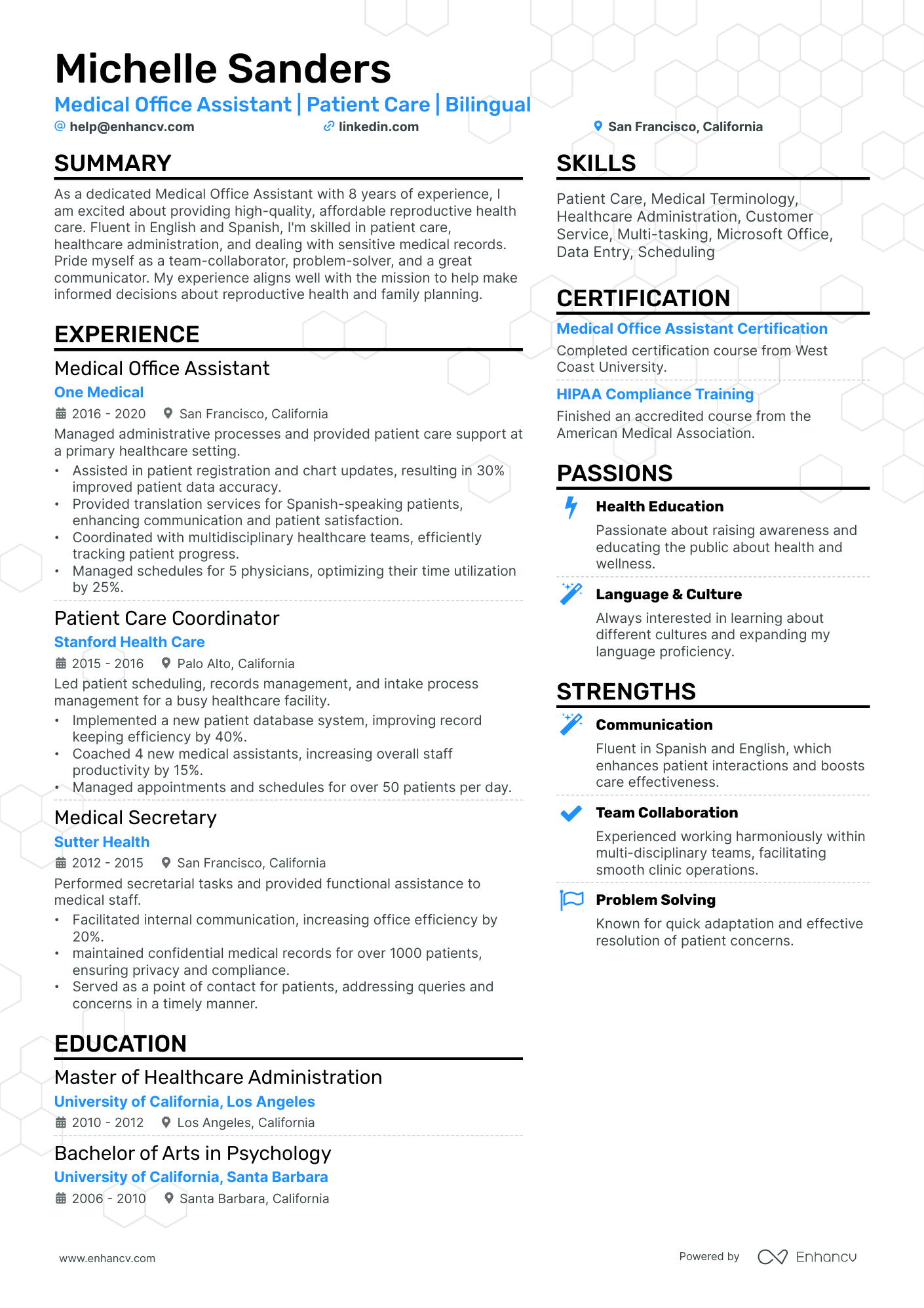
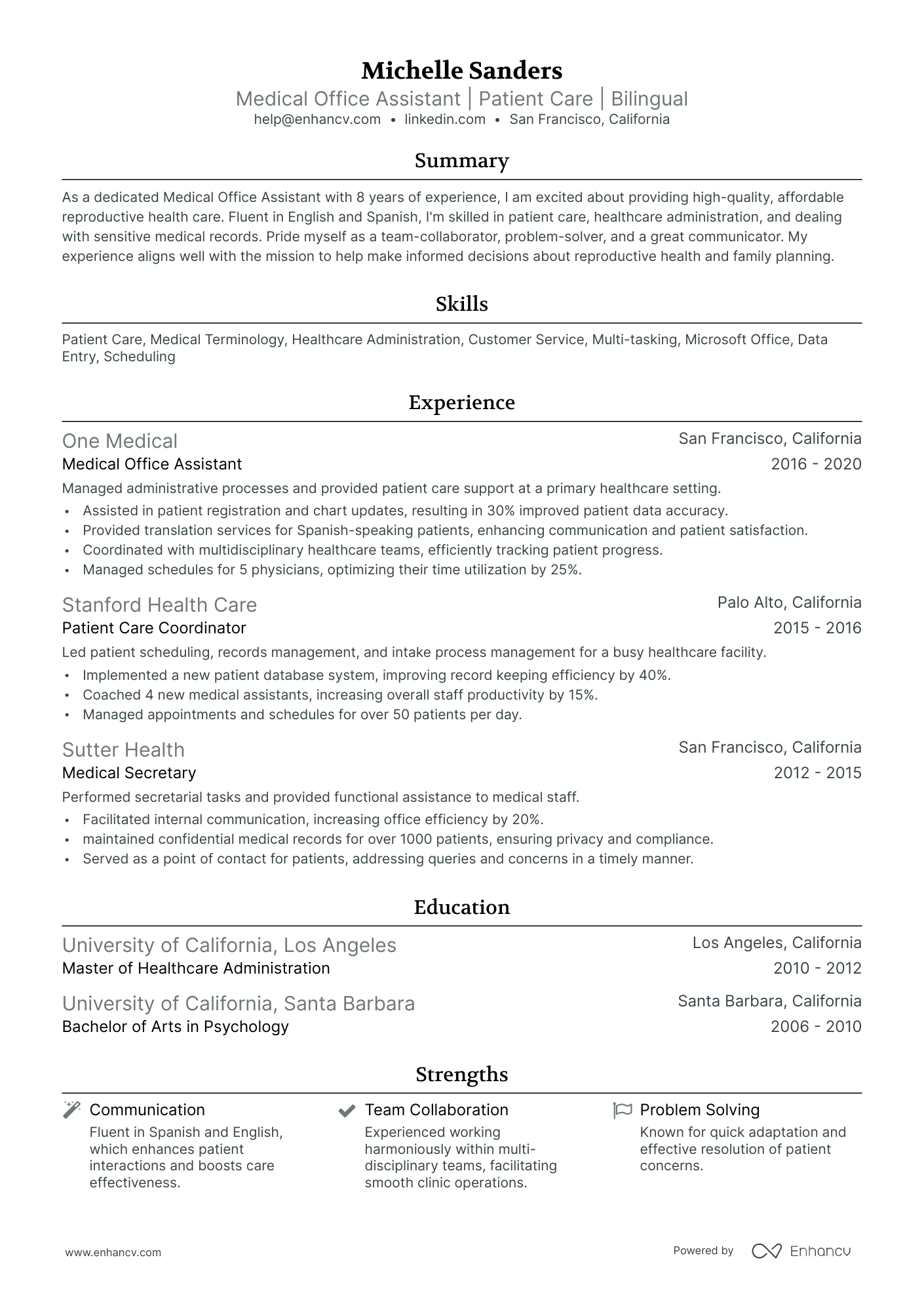
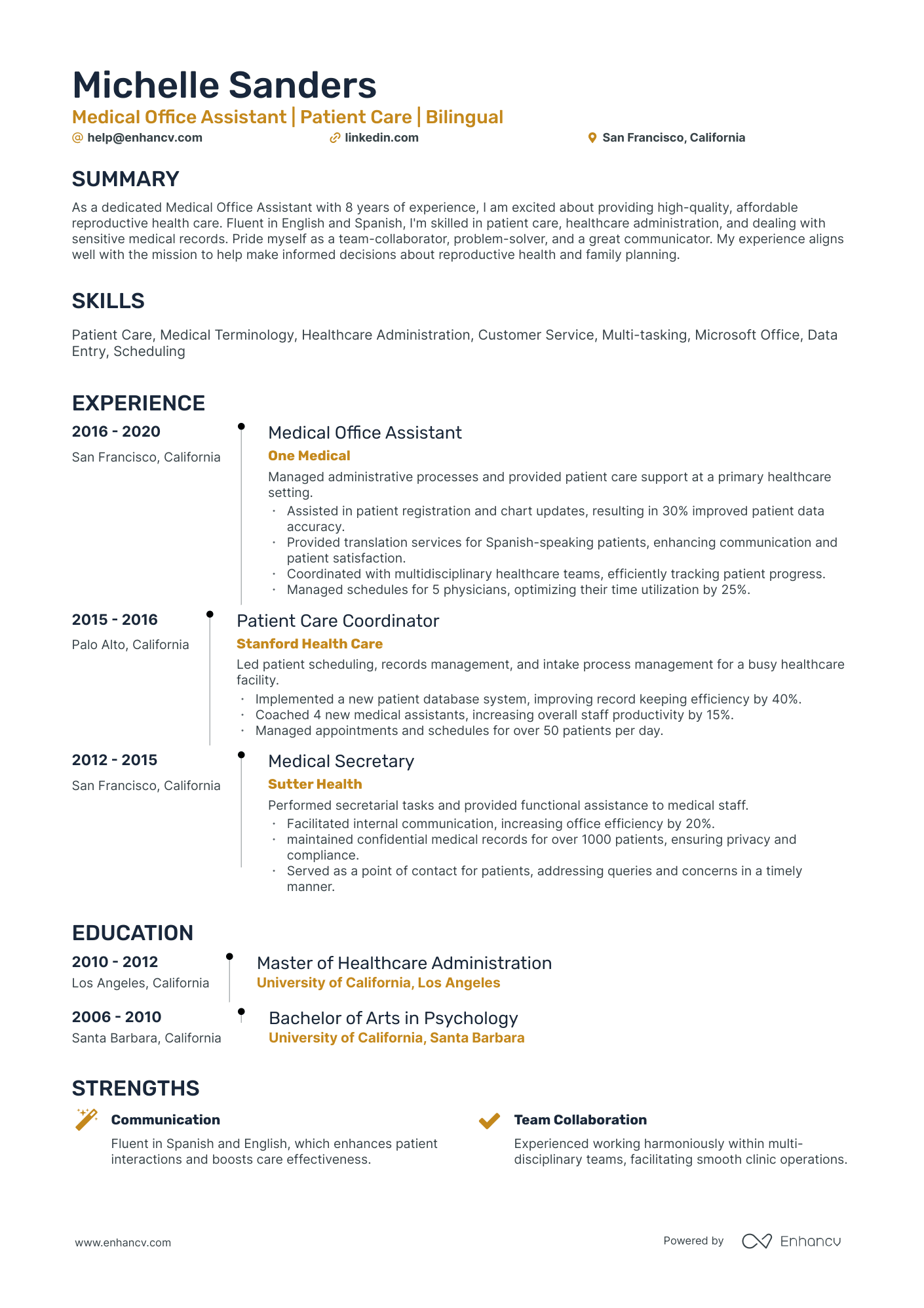
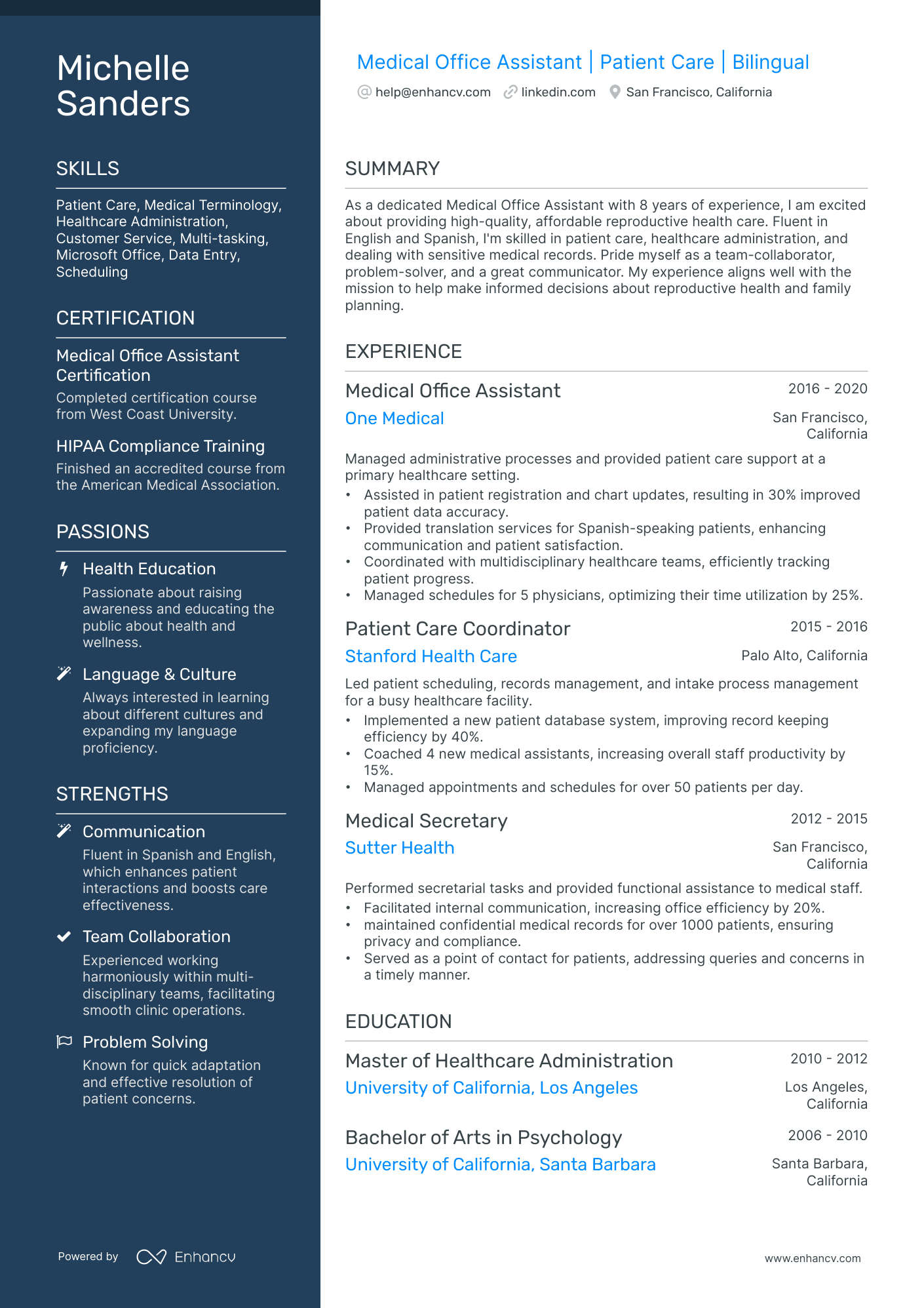
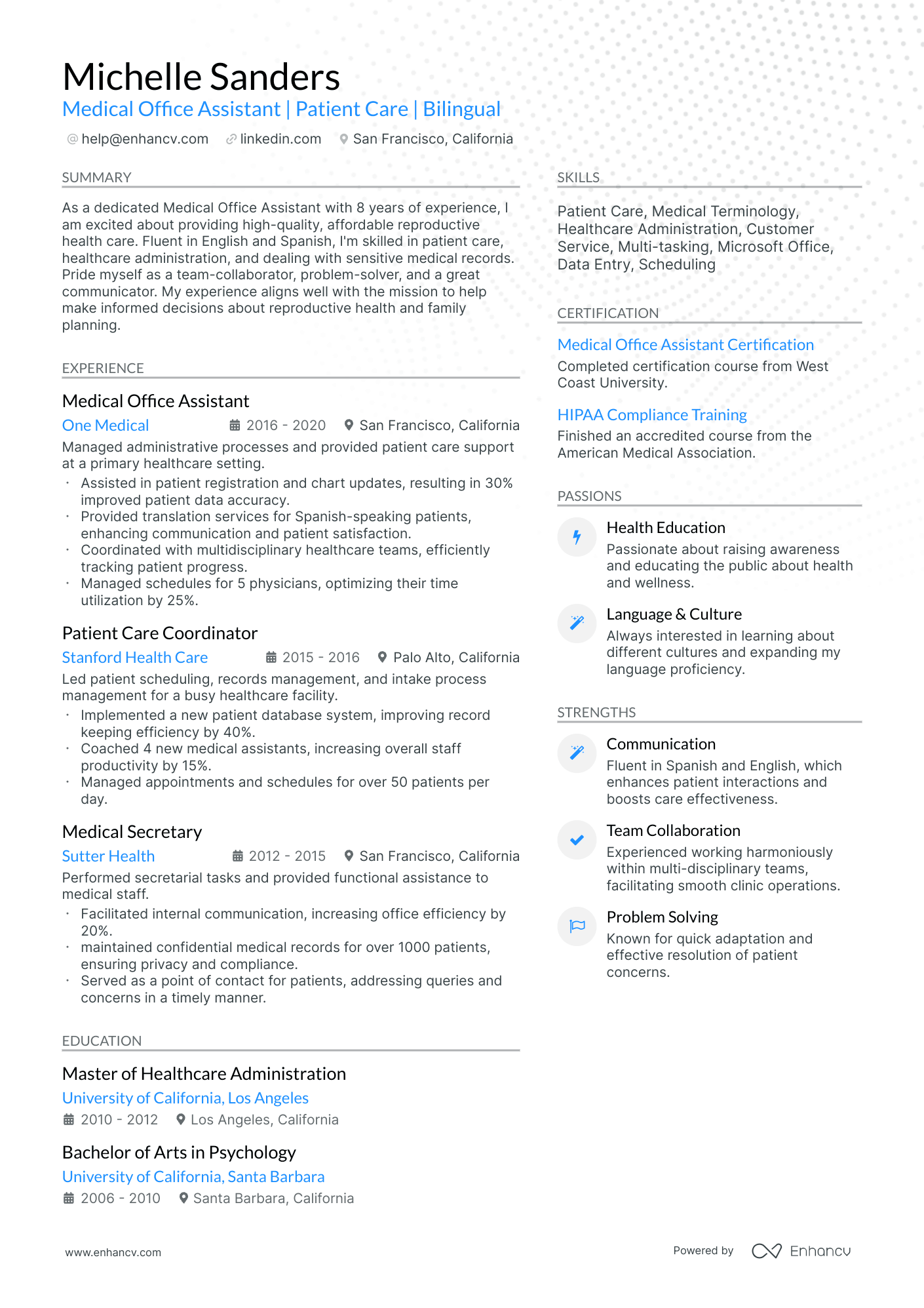
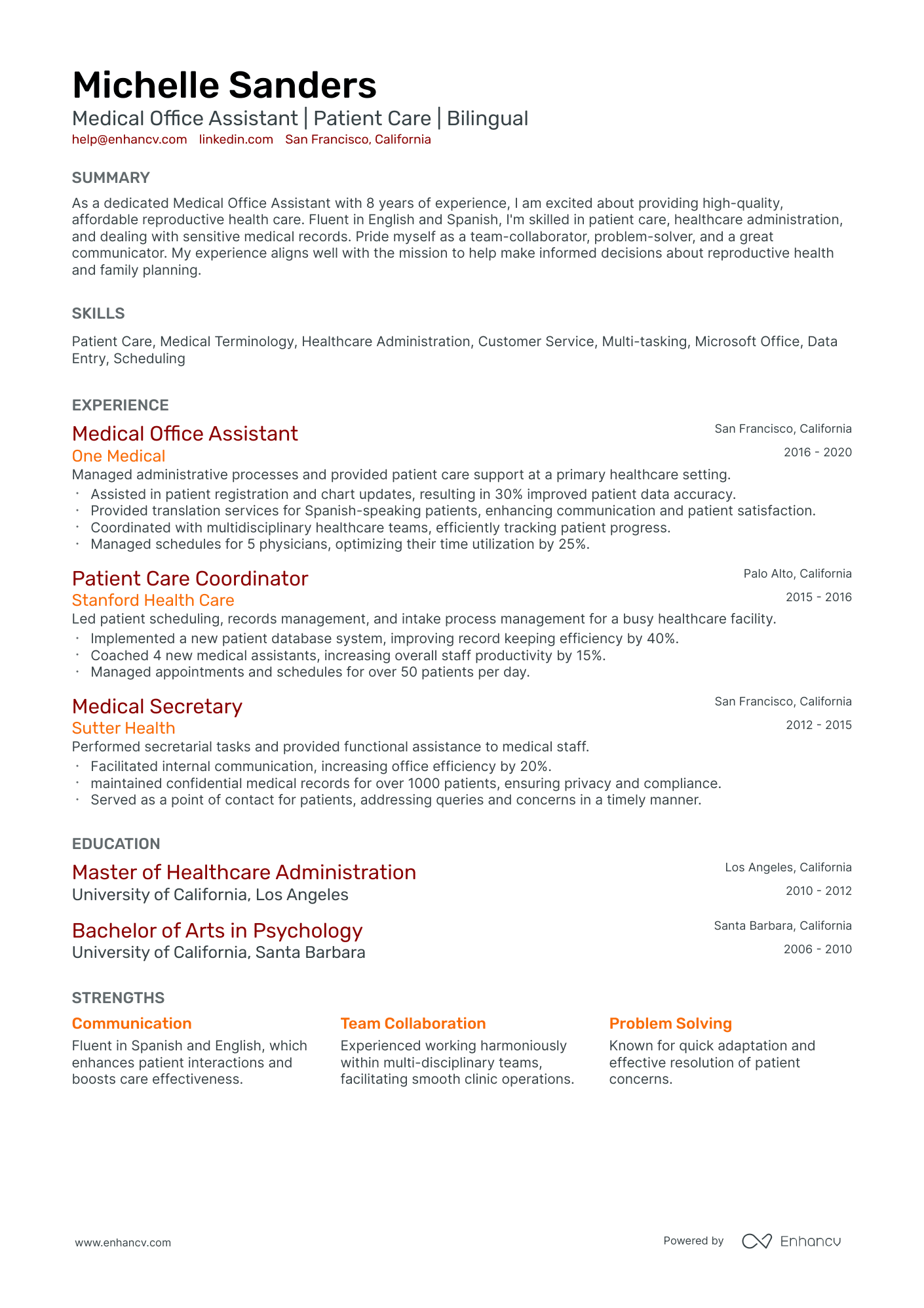
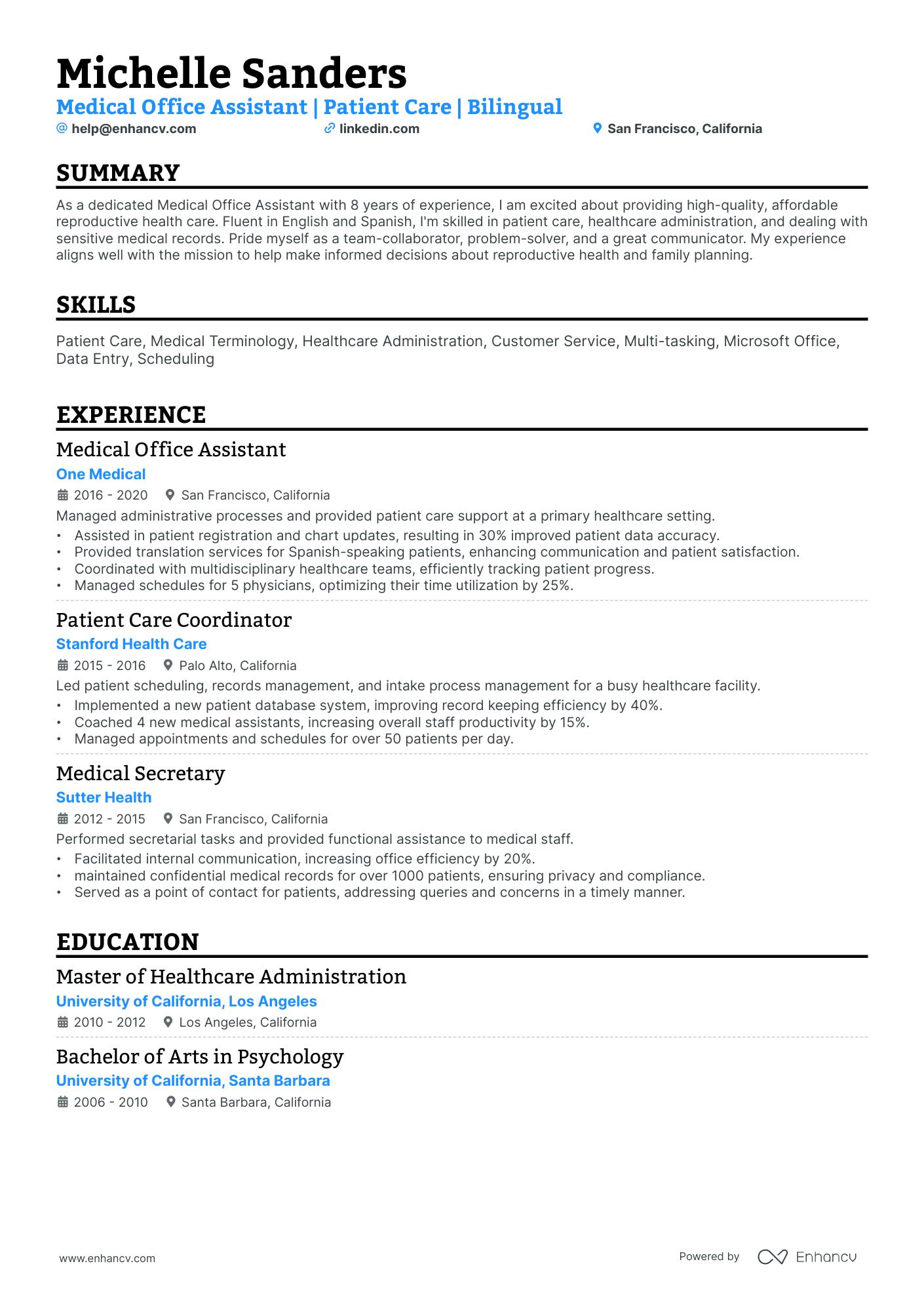
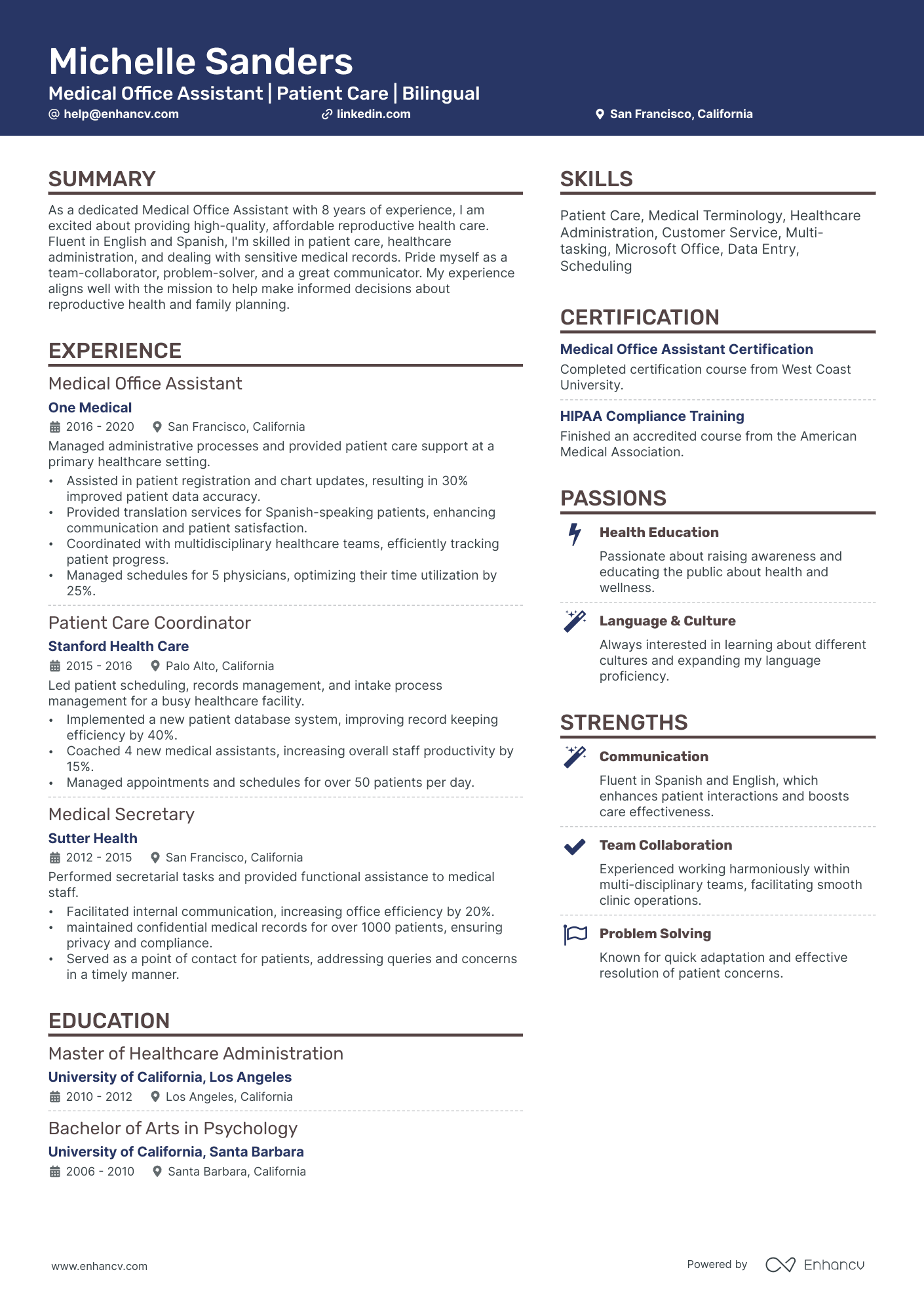
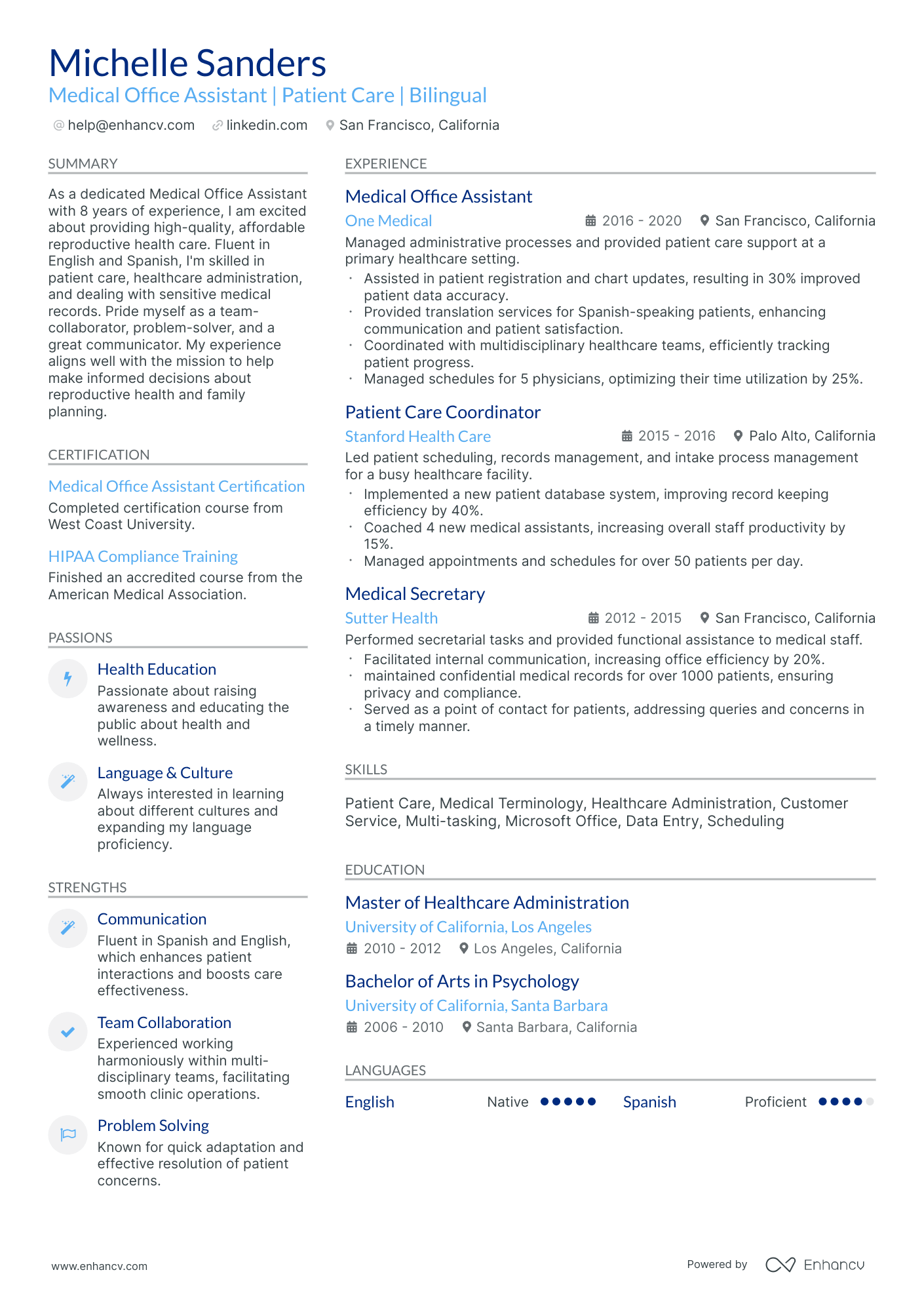
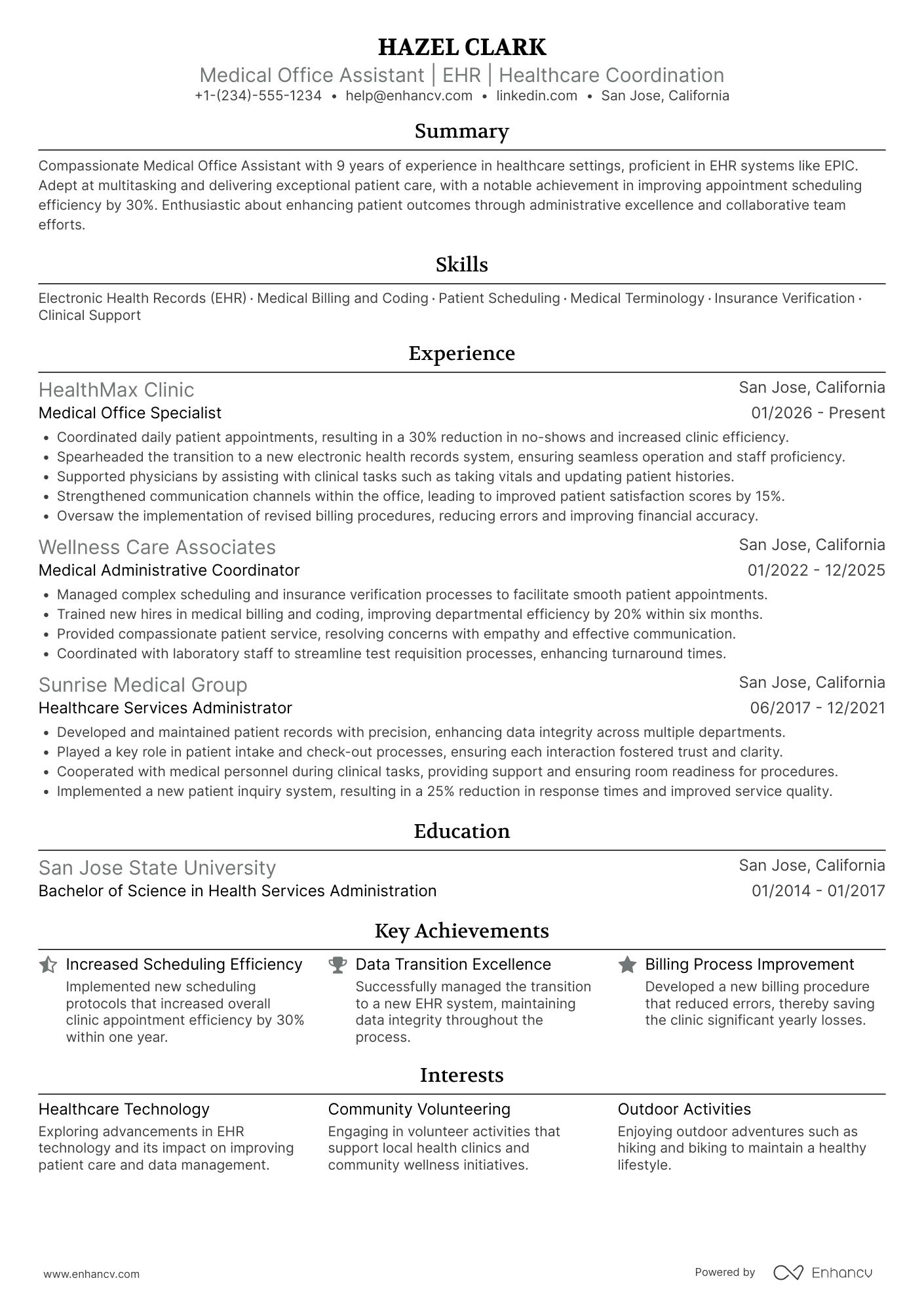
Many medical office assistant resume drafts fail because they read like task lists and bury results in dense text. That format gets filtered by applicant tracking systems and overlooked in rapid recruiter scans. Competition makes every second count. Knowing how to make your resume stand out is essential in a crowded applicant pool.
A strong resume shows how you improve access, accuracy, and patient experience. You should highlight outcomes like reduced check-in times, higher appointment fill rates, cleaner insurance claims with fewer denials, faster chart completion, improved copay collection, and fewer scheduling errors.

Key takeaways
- Quantify scheduling, billing, and patient flow outcomes instead of listing daily duties.
- Match EHR platforms and medical terminology directly to each job posting.
- Use reverse-chronological format with experience; use hybrid format without it.
- Tie every listed skill to a specific result in your experience bullets.
- Place certifications like CMAA or CEHRS near education for quick recruiter scanning.
- Keep your summary to three or four lines with tools, settings, and measurable wins.
- Build and refine your medical office assistant resume with Enhancv to stay ATS-ready.
Job market snapshot for medical office assistants
We analyzed 253 recent medical office assistant job ads across major US job boards. These numbers help you understand employer expectations, industry demand, employment type trends at a glance.
What level of experience employers are looking for medical office assistants
| Years of Experience | Percentage found in job ads |
|---|---|
| 1–2 years | 11.5% (29) |
| 3–4 years | 2.8% (7) |
| 5–6 years | 0.8% (2) |
| Not specified | 85.0% (215) |
Medical office assistant ads by area of specialization (industry)
| Industry (Area) | Percentage found in job ads |
|---|---|
| Healthcare | 72.7% (184) |
| Finance & Banking | 24.5% (62) |
Top companies hiring medical office assistants
| Company | Percentage found in job ads |
|---|---|
| OSF Healthcare | 10.7% (27) |
| UNC Health Care Systems | 9.9% (25) |
| Deaconess Health System | 8.7% (22) |
| MUSC (Med. Univ of South Carolina) | 6.7% (17) |
| University of Mississippi Medical Center | 5.5% (14) |
| Johns Hopkins Medicine | 4.7% (12) |
| St. Catherine of Siena | 4.7% (12) |
| Tenet Healthcare Corporation | 4.7% (12) |
| Northwell Health | 4.3% (11) |
| Northeast Georgia Health System | 4.0% (10) |
Role overview stats
These tables show the most common responsibilities and employment types for medical office assistant roles. Use them to align your resume with what employers expect and to understand how the role is structured across the market.
Day-to-day activities and top responsibilities for a medical office assistant
| Responsibility | Percentage found in job ads |
|---|---|
| Computer skills | 17.8% (45) |
| Phlebotomy | 14.2% (36) |
| Medical terminology | 13.8% (35) |
| Osha | 13.4% (34) |
| Emr | 13.0% (33) |
| Epic | 13.0% (33) |
| Microsoft office | 13.0% (33) |
| Hipaa | 12.3% (31) |
| Ekg | 10.7% (27) |
| Billing | 9.9% (25) |
| Electronic health record | 9.9% (25) |
| Customer service | 9.5% (24) |
How to format a medical office assistant resume
Recruiters hiring for medical office assistant roles prioritize organized candidates who can demonstrate patient-facing communication skills, familiarity with electronic health records (EHR) systems, and reliable administrative accuracy. Your resume format directly affects how quickly a hiring manager can spot these signals—and whether an applicant tracking system (ATS) can parse them correctly.

I have significant experience in this role—which format should I use?
Use a reverse-chronological format to lead with your strongest and most recent medical office experience. Do:
- Highlight the scope of your responsibilities, including patient volume, office size, and the range of administrative duties you owned.
- Feature role-specific tools and skills—such as Epic, Athenahealth, medical billing codes (CPT/ICD-10), insurance verification, and HIPAA compliance—within each position.
- Quantify outcomes that show your direct impact on office efficiency, patient satisfaction, or error reduction.
I'm junior or switching into this role—what format works best?
A hybrid format works best, letting you lead with a targeted skills section before supporting it with any relevant work or clinical experience. Do:
- Place a skills section near the top of your resume that highlights EHR proficiency, medical terminology, patient intake procedures, and insurance processing.
- Include projects, internships, externships, or volunteer work in healthcare settings to demonstrate hands-on exposure to medical office workflows.
- Connect every listed skill or experience to a concrete action and a clear result so hiring managers see practical capability, not just knowledge.
Why not use a functional resume?
A functional format strips away the timeline and context that hiring managers need to verify where and how you developed your medical office skills, making it harder to trust your qualifications.
- Career changers moving into healthcare administration who have transferable skills in scheduling, customer service, or data entry but no direct medical office experience.
- Recent graduates of medical office assistant certificate programs with limited formal work history but relevant externship or clinical hours.
- Candidates with resume gaps due to personal circumstances who still completed healthcare-related training or volunteer work during that time.
- A functional format is acceptable when you're re-entering the workforce after an extended gap and your only healthcare exposure comes from recent certification coursework or volunteer patient intake work—but always anchor each skill to a specific project or outcome rather than listing competencies in isolation.
Once you've established a clean, readable format, the next step is deciding which sections to include so each one serves a clear purpose on your resume.
What sections should go on a medical office assistant resume
Recruiters expect a medical office assistant resume to quickly show how you support front-desk operations, patient flow, and accurate documentation. Understanding what to put on a resume helps you prioritize the right content for this role.
Use this structure for maximum clarity:
- Header
- Summary
- Experience
- Skills
- Projects
- Education
- Certifications
- Optional sections: Volunteering, Languages, Awards
Strong experience bullets should emphasize measurable impact on scheduling efficiency, patient satisfaction, billing accuracy, record management, and clinic throughput, including clear scope and results.
Is your resume good enough?
Drop your resume here or choose a file. PDF & DOCX only. Max 2MB file size.
Once you’ve organized your resume with the right building blocks, the next step is to write a strong experience section that shows how you’ve applied those elements in real medical office settings.
How to write your medical office assistant resume experience
The experience section of your medical office assistant resume should highlight the work you've delivered—scheduling systems you managed, patient intake processes you improved, and electronic health record (EHR) platforms you operated daily. Hiring managers prioritize demonstrated impact over descriptive task lists, so focus on outcomes that prove you kept the office running smoothly and patients moving efficiently through care. Building a targeted resume ensures each bullet speaks directly to what the employer needs.
Each entry should include:
- Job title
- Company and location (or remote)
- Dates of employment (month and year)
Three to five concise bullet points showing what you owned, how you executed, and what outcomes you delivered:
- Ownership scope: the front-desk operations, patient scheduling queues, medical records systems, insurance verification workflows, or office supply inventories you were directly accountable for maintaining and organizing.
- Execution approach: the tools and methods you relied on to complete your work, such as EHR platforms, practice management software, medical coding references, HIPAA compliance protocols, or multi-line phone systems.
- Value improved: the changes you drove in appointment accuracy, patient wait times, billing error rates, records retrieval speed, office efficiency, or regulatory compliance that made the practice run better.
- Collaboration context: how you coordinated with physicians, nurses, billing specialists, insurance representatives, lab technicians, or patients to ensure seamless communication and uninterrupted care delivery.
- Impact delivered: the tangible results your work produced—expressed through patient satisfaction improvements, claim processing turnaround, scheduling capacity gains, or reductions in administrative bottlenecks—rather than a simple list of daily duties.
Experience bullet formula
A medical office assistant experience example
✅ Right example - modern, quantified, specific.
Medical Office Assistant
Riverside Family Medicine | Austin, TX
2022–Present
High-volume primary care clinic supporting six providers and serving 120+ patients per day.
- Streamlined patient check-in and insurance verification in Epic by standardizing intake workflows and eligibility checks, cutting average wait time by 18% (six to five minutes) across 2,500 monthly visits.
- Reconciled claims and corrected coding issues using Kareo and clearinghouse reports in partnership with the billing specialist, reducing denial rate from 9.2% to 6.8% and accelerating collections by eight days.
- Coordinated referrals and prior authorizations through CoverMyMeds and payer portals, improving approval turnaround time by 27% and preventing an estimated 35 delayed procedures per quarter.
- Implemented HIPAA-compliant document management in SharePoint and Adobe Acrobat with role-based access, decreasing misfiled records by 41% and passing two internal audits with zero high-risk findings.
- Optimized appointment scheduling in Epic by applying template rules and reminder automation, lowering no-show rate by 12% and adding 10 weekly appointment slots without extending clinic hours.
Now that you've seen how a strong experience section comes together, let's look at how to adjust those details to match the specific job you're applying for.
How to tailor your medical office assistant resume experience
Recruiters evaluate your medical office assistant resume through both human review and applicant tracking systems. Tailoring your resume to the job description ensures you pass both screenings.
Ways to tailor your medical office assistant experience:
- Match the EHR or practice management software named in the posting.
- Mirror the exact medical terminology used in the job description.
- Highlight patient scheduling workflows that reflect their stated process.
- Emphasize HIPAA compliance experience when the posting references it.
- Include insurance verification or billing tasks the employer prioritizes.
- Reference front desk coordination or multi-provider office experience directly.
- Align your metrics with the KPIs they mention like patient volume.
- Showcase familiarity with their referenced medical coding standards.
Tailoring means aligning your real accomplishments with what the employer asks for, not forcing keywords where they don't belong.
Resume tailoring examples for medical office assistant
| Job description excerpt | Untailored | Tailored |
|---|---|---|
| Schedule and confirm patient appointments using eClinicalWorks, verify insurance eligibility, and manage referrals for a multi-provider family practice. | Handled scheduling and other front desk duties in a busy office. | Scheduled and confirmed 80+ daily patient appointments in eClinicalWorks for a five-provider family practice, verified insurance eligibility in real time, and coordinated specialist referrals to reduce patient wait times by 15%. |
| Collect copays and outstanding balances at check-in, post payments in Kareo, and reconcile daily cash reports for the billing department. | Processed payments and helped with billing tasks as needed. | Collected copays and outstanding balances at check-in, posted payments accurately in Kareo, and reconciled daily cash reports averaging $4,200 with zero discrepancies over 12 consecutive months. |
| Maintain and update electronic health records in Epic, ensure HIPAA-compliant handling of protected health information, and assist clinical staff with patient intake documentation. | Updated patient files and assisted with general administrative tasks. | Maintained and updated electronic health records for 1,500+ active patients in Epic, enforced HIPAA-compliant handling of all protected health information, and completed patient intake documentation for clinical staff across three departments. |
Once you’ve aligned your experience with the role’s priorities, the next step is to quantify your medical office assistant achievements so hiring managers can see the impact of your work.
How to quantify your medical office assistant achievements
Numbers prove your impact on patient flow, billing accuracy, and compliance. Track appointment volume, check-in time, claim acceptance rates, copay collections, and record accuracy to show efficiency, revenue support, and reduced risk. Learn more about quantifying achievements to make every bullet count.
Quantifying examples for medical office assistant
| Metric | Example |
|---|---|
| Cycle time | "Cut average check-in from eight minutes to five by pre-registering patients in Epic and standardizing insurance verification steps." |
| Volume handled | "Scheduled and confirmed 70–90 appointments weekly across three providers, keeping no-show rates under six percent with automated reminders." |
| Billing accuracy | "Improved clean-claim rate from 92% to 97% by validating ICD-10 codes and demographics before submission in Athenahealth." |
| Revenue collected | "Increased point-of-service copay collection from $1,800 to $2,600 per week by using scripted prompts and daily reconciliation in QuickBooks." |
| Compliance risk | "Reduced HIPAA incidents to zero for twelve months by enforcing chart sign-out logs and secure faxing through RightFax." |
Turn vague job duties into measurable, recruiter-ready resume bullets in seconds with Enhancv's Bullet Point Generator.
Once you've crafted strong bullet points for your experience section, the next step is ensuring your skills section effectively highlights the hard and soft skills that medical offices value most.
How to list your hard and soft skills on a medical office assistant resume
Your skills section shows you can keep patient flow moving, protect health information, and support clinicians, and recruiters and an ATS (applicant tracking system) scan this section for job-matched keywords—aim for a hard-skill-heavy mix supported by role-specific soft skills. Medical office assistant roles require a blend of:
- Product strategy and discovery skills.
- Data, analytics, and experimentation skills.
- Delivery, execution, and go-to-market discipline.
- Soft skills.
Your skills section should be:
- Scannable (bullet-style grouping).
- Relevant to the job post.
- Backed by proof in experience bullets.
- Updated with current tools.
Place your skills section:
- Above experience if you're junior or switching careers.
- Below experience if you're mid/senior with strong achievements.

Hard skills
- Electronic health records, Epic, Cerner
- Medical scheduling, appointment triage
- Insurance verification, eligibility checks
- Prior authorizations
- Medical billing, claims submission
- International Classification of Diseases, Current Procedural Terminology coding
- Patient registration, demographic updates
- Copay collection, payment posting
- Health Insurance Portability and Accountability Act compliance
- Referral management
- Clinical documentation support
- Microsoft Excel, Google Sheets
Including strong hard skills like EHR platforms and billing codes gives your resume the technical credibility hiring managers look for.
Soft skills
- Patient-centered communication
- De-escalate upset patients
- Coordinate across clinical teams
- Prioritize high-volume workloads
- Verify details before submission
- Protect confidential information
- Clarify instructions with providers
- Manage competing deadlines
- Follow up until resolution
- Adapt to schedule changes
- Document clearly and consistently
- Maintain professionalism under pressure
Pairing these with well-chosen soft skills demonstrates your ability to handle the human side of medical office work.
How to show your medical office assistant skills in context
Skills shouldn't live only in a bulleted list on your resume. Explore resume skills examples to see how other medical office professionals present their abilities effectively.
They should be demonstrated in:
- Your summary (high-level professional identity)
- Your experience (proof through outcomes)
Here's what strong, skill-rich entries look like in practice.
Summary example
Medical office assistant with eight years in multi-physician pediatric practices. Skilled in Epic EHR, insurance verification, and patient scheduling. Streamlined front-desk intake workflows, reducing average patient wait times by 22% while maintaining compassionate, family-centered communication.
- Reflects senior-level experience clearly
- Names role-specific tools like Epic
- Quantifies a meaningful operational outcome
- Highlights patient-centered soft skills
Experience example
Senior Medical Office Assistant
Lakeview Pediatric Partners | Milwaukee, WI
June 2019–March 2025
- Managed scheduling for five physicians using Epic EHR, cutting appointment conflicts by 34% within one quarter.
- Collaborated with billing staff to verify insurance eligibility, reducing claim rejections by 19% year over year.
- Trained four new front-desk hires on HIPAA-compliant intake procedures, improving onboarding speed by two weeks.
- Every bullet includes measurable proof
- Skills appear naturally through real outcomes
Once you’ve demonstrated your strengths through specific, role-relevant examples, the next step is applying that approach to build a medical office assistant resume with no experience.
How do I write a medical office assistant resume with no experience
Even without full-time experience, you can demonstrate readiness through:
- Medical office assistant certificate coursework
- Clinic or hospital volunteer shifts
- Externship in a medical office
- Front desk or reception work
- Customer service with scheduling systems
- Data entry with protected data
- School project using electronic health records
Our guide on writing a resume without work experience offers additional strategies for building a compelling application from scratch.
Focus on:
- Appointment scheduling and phone triage
- Electronic health record documentation basics
- Insurance, referrals, and intake forms
- Accuracy, privacy, and compliance knowledge
Resume format tip for entry-level medical office assistant
Use a hybrid resume format because it highlights relevant skills and projects first, while still showing work history, even if it's unrelated. Do:
- Add a skills section with tools and tasks.
- List coursework with healthcare admin topics.
- Quantify results from projects and volunteering.
- Include software, like electronic health records.
- Use job posting keywords in bullets.
- Built a mock patient intake workflow in an electronic health record training system, entered fifty records with zero errors, and cut check-in time by twenty percent.
Once you've structured your resume around transferable skills and relevant coursework, the next step is presenting your education effectively—often the strongest section for candidates entering the field.
How to list your education on a medical office assistant resume
Your education section helps hiring teams confirm you have the foundational knowledge needed. It validates your training in areas like medical terminology, office administration, and healthcare procedures.
Include:
- Degree name
- Institution
- Location
- Graduation year
- Relevant coursework (for juniors or entry-level candidates)
- Honors & GPA (if 3.5 or higher)
Skip month and day details—list the graduation year only.
Here's a strong education entry tailored to a medical office assistant resume:
Example education entry
Associate of Applied Science in Medical Office Administration
Brookline Community College, Boston, MA
Graduated 2023
GPA: 3.7/4.0
- Relevant Coursework: Medical Terminology, Health Records Management, Medical Billing and Coding, Healthcare Office Procedures
- Honors: Dean's List, Fall 2022 and Spring 2023
How to list your certifications on a medical office assistant resume
Certifications on a resume show a medical office assistant's commitment to learning, proficiency with office and billing tools, and alignment with healthcare standards and regulations.
Include:
- Certificate name
- Issuing organization
- Year
- Optional: credential ID or URL
- Place certifications below education when your education is recent and directly related, and your certifications are older or less relevant.
- Place certifications above education when they are recent, required by employers, or closely match the medical office assistant role you're targeting.
Best certifications for your medical office assistant resume
- Certified Medical Administrative Assistant (CMAA)
- Certified Electronic Health Records Specialist (CEHRS)
- Certified Billing and Coding Specialist (CBCS)
- Certified Professional Coder (CPC)
- Basic Life Support (BLS)
- HIPAA Compliance Certification
- Medical Terminology Certification
Once you’ve positioned your credentials where hiring managers can spot them quickly, shift to your medical office assistant resume summary to tie those qualifications to the value you bring in a few lines.
How to write your medical office assistant resume summary
Your resume summary is the first thing a recruiter reads. A strong one immediately signals you're qualified for the medical office assistant role.
Keep it to three to four lines, with:
- Your title and total years of relevant experience.
- The healthcare setting or domain you've worked in, such as outpatient clinics or specialty practices.
- Core tools and skills like electronic health records, medical billing, CPT coding, or patient scheduling software.
- One or two measurable achievements, such as reducing wait times or improving billing accuracy.
- Soft skills tied to real outcomes, like patient communication that boosted satisfaction scores.

PRO TIP
At this level, emphasize specific clinical administrative skills, relevant software proficiency, and early wins that show initiative. Avoid vague phrases like "hard worker" or "passionate about healthcare." Recruiters want proof of what you can do, not personality descriptors.
Example summary for a medical office assistant
Medical office assistant with two years of experience in outpatient clinics. Skilled in Epic EHR, insurance verification, and CPT coding. Reduced patient check-in time by 20% through streamlined scheduling workflows.
Optimize your resume summary and objective for ATS
Drop your resume here or choose a file.
PDF & DOCX only. Max 2MB file size.
Now that your summary effectively showcases your qualifications, make sure the header above it presents your contact details correctly so hiring managers can easily reach you.
What to include in a medical office assistant resume header
A resume header lists your key contact details and role fit, helping recruiters spot you fast, trust your information, and screen you efficiently.
Essential resume header elements
- Full name
- Tailored job title and headline
- Location
- Phone number
- Professional email
- GitHub link
- Portfolio link
A LinkedIn link helps recruiters verify your experience quickly and supports screening.
Do not include photos on a medical office assistant resume unless the role is explicitly front-facing or appearance-dependent.
Keep the header at the top, match your job title to the posting, and use consistent formatting so recruiters can contact you fast.
Medical office assistant resume header
Jordan Lee
Medical office assistant | Patient scheduling, insurance verification, and EHR support
Phoenix, AZ
(602) 555-01XX
your.name@enhancv.com
github.com/yourname
yourwebsite.com
linkedin.com/in/yourname
Once your contact details and role-specific identifiers are set at the top, add the following optional sections to strengthen the rest of your medical office assistant resume.
Additional sections for medical office assistant resumes
Adding extra sections helps you stand out when your core qualifications match other candidates—especially for showcasing role-specific credibility. For example, listing language skills can be a strong differentiator in clinics serving diverse patient populations.
- Languages
- Certifications and licenses
- Professional affiliations
- Volunteer experience in healthcare settings
- Continuing education and training
- Hobbies and interests
Once you've rounded out your resume with these supplementary sections, pair it with a tailored cover letter to give hiring managers even more reason to schedule an interview.
Do medical office assistant resumes need a cover letter
A cover letter isn't required for a medical office assistant, but it often helps in competitive clinics or hospitals. If you're unsure where to start, our guide on what a cover letter is breaks down the basics. It can make a difference when hiring managers expect context beyond a resume. It also helps when your experience needs a quick explanation.
Use these pointers to decide when and how to add one:
- Explain role and team fit: Match your strengths to the clinic's pace, patient volume, and coordination needs across front desk and back office.
- Highlight one or two outcomes: Share a specific project, such as reducing no-shows, improving scheduling accuracy, or speeding up insurance verification.
- Show you understand the context: Reference the patient population, appointment types, and tools used, such as an electronic health record system and phone triage.
- Address transitions or non-obvious experience: Connect transferable work, gaps, or a specialty change to medical office assistant tasks and compliance expectations.
Drop your resume here or choose a file.
PDF & DOCX only. Max 2MB file size.
Once you’ve decided whether an additional letter adds value to your application, you can use AI to improve your medical office assistant resume by strengthening the content you submit.
Using AI to improve your medical office assistant resume
AI can sharpen your resume's clarity, structure, and impact. It helps you find stronger phrasing and tighten loose sections. But overuse kills authenticity. Once your content sounds clear and fits the role, step away from the tool. If you're curious about where to start, explore ChatGPT resume writing prompts tailored for resume improvement.
Here are 10 practical prompts you can copy and paste to strengthen specific sections of your medical office assistant resume:
- Strengthen your summary: "Rewrite my medical office assistant resume summary to highlight patient-facing skills and administrative strengths in three concise sentences."
- Quantify experience: "Add measurable results to these medical office assistant experience bullets using patient volume, accuracy rates, or time savings."
- Tighten bullet points: "Shorten each of my medical office assistant job description bullets to one line without losing key responsibilities or outcomes."
- Align with postings: "Compare my medical office assistant resume skills section against this job posting and suggest missing keywords."
- Improve action verbs: "Replace weak or repeated verbs in my medical office assistant experience section with stronger, more specific alternatives."
- Refine certifications: "Reorganize my medical office assistant certifications section by relevance, and suggest clearer formatting for dates and issuing bodies."
- Clarify education details: "Rewrite my medical office assistant education section to emphasize coursework and training relevant to clinical office workflows."
- Highlight software skills: "Identify which EHR and scheduling tools to feature prominently in my medical office assistant skills section."
- Focus project descriptions: "Edit my medical office assistant project descriptions to emphasize process improvements, cost reductions, or patient satisfaction gains."
- Remove filler language: "Flag and remove vague phrases like 'assisted with' or 'responsible for' throughout my medical office assistant resume."
Stop using AI once your resume sounds accurate, specific, and aligned with real experience. AI should never invent experience or inflate claims—if it didn't happen, it doesn't belong here.
Conclusion
A strong medical office assistant resume highlights measurable outcomes, role-specific skills, and a clear structure. Use numbers to show scheduling accuracy, reduced wait times, clean claims, and steady patient satisfaction. Keep each section easy to scan and consistent.
Show readiness for today’s and near-future hiring market by matching your experience to current clinic needs. Emphasize patient intake, electronic health record documentation, insurance verification, and calm communication. Present your work history and skills in a direct, organized format.