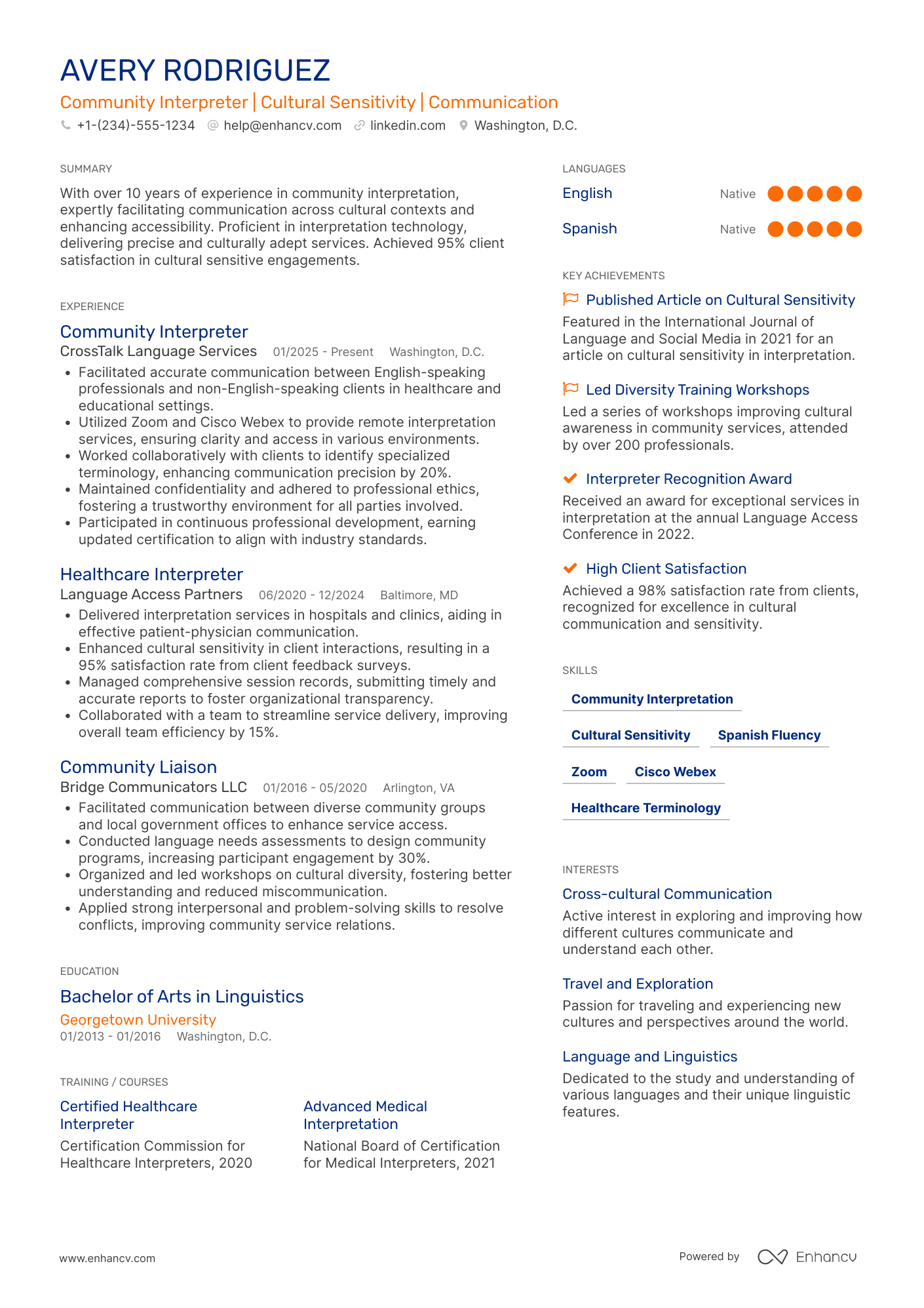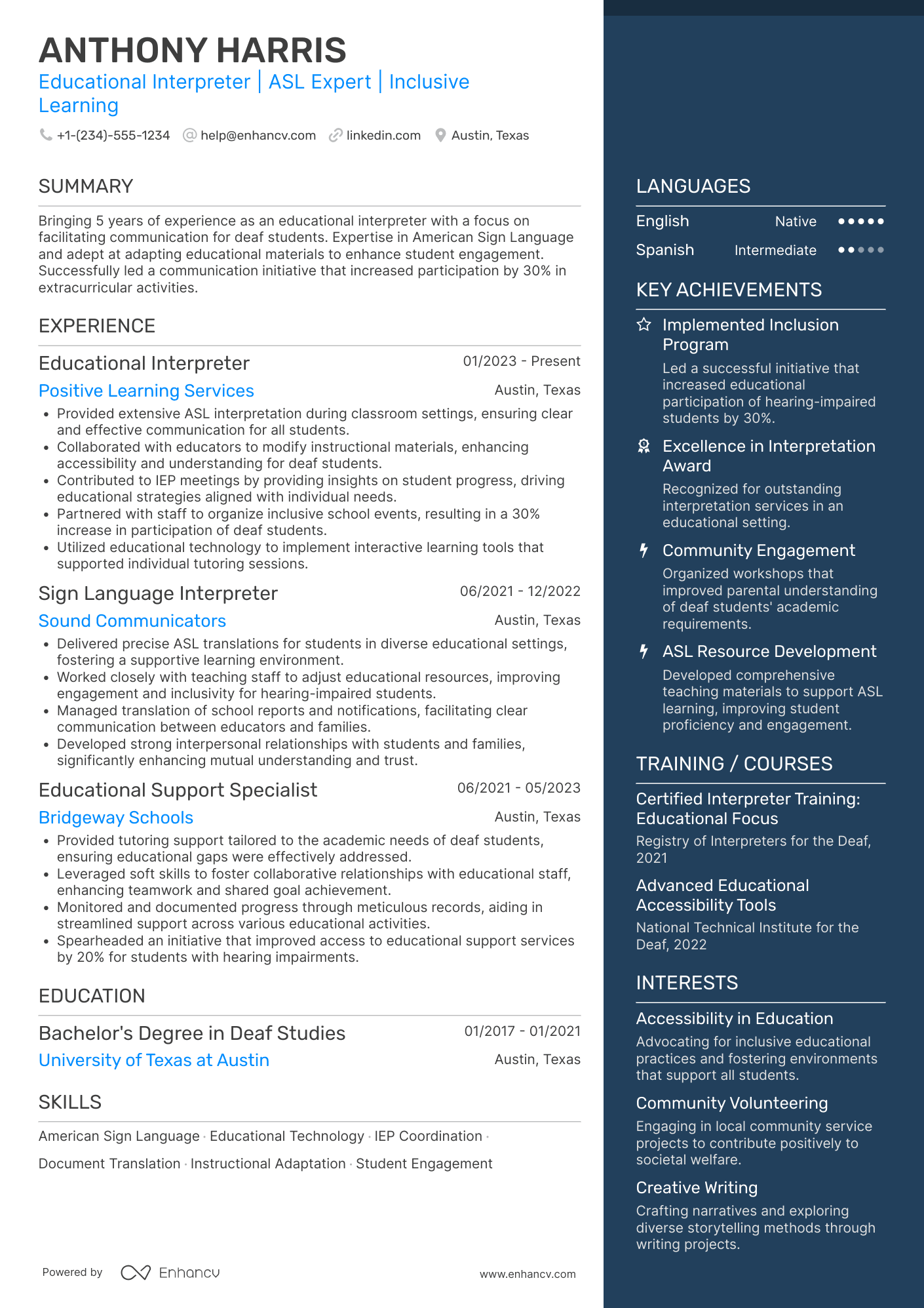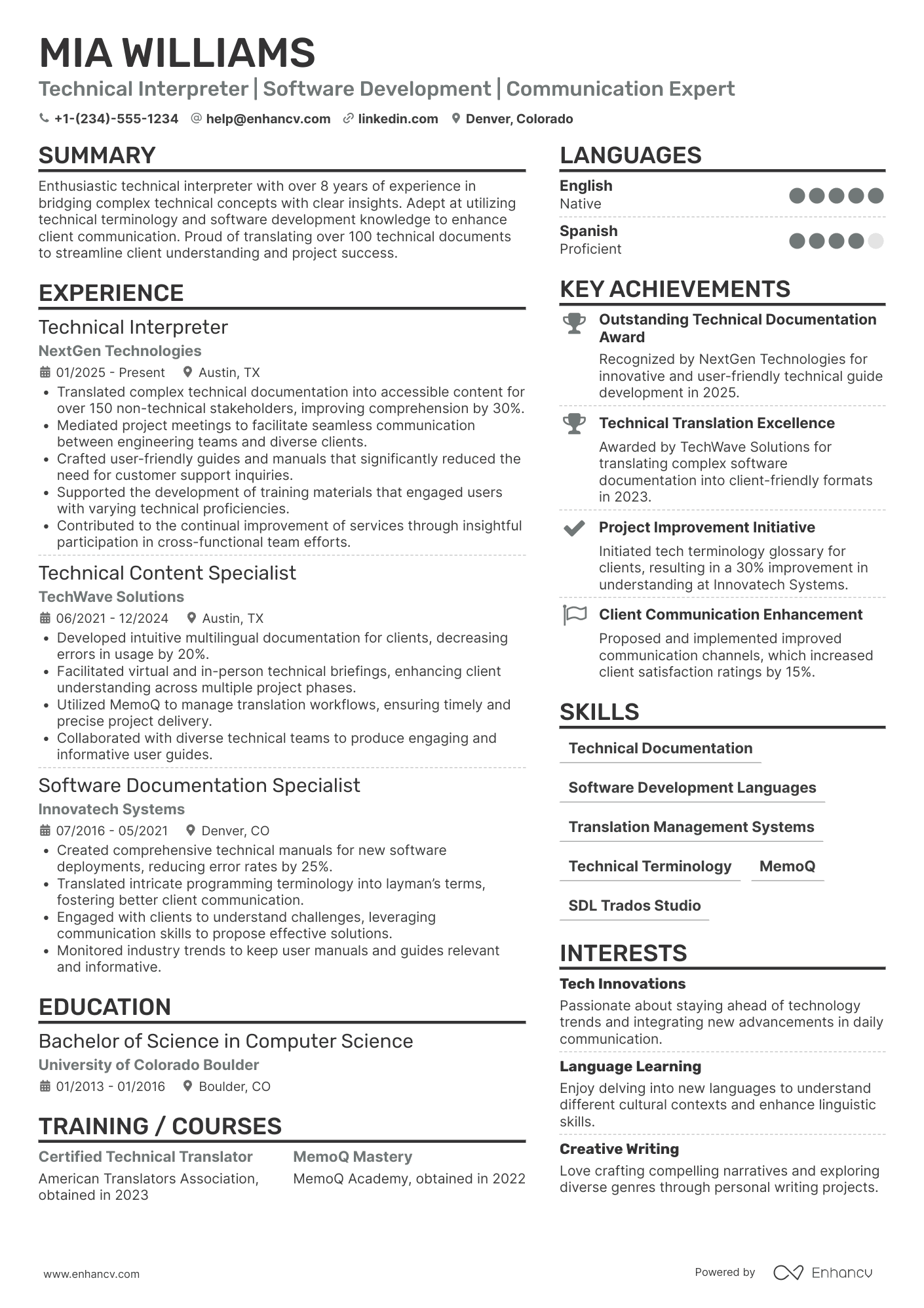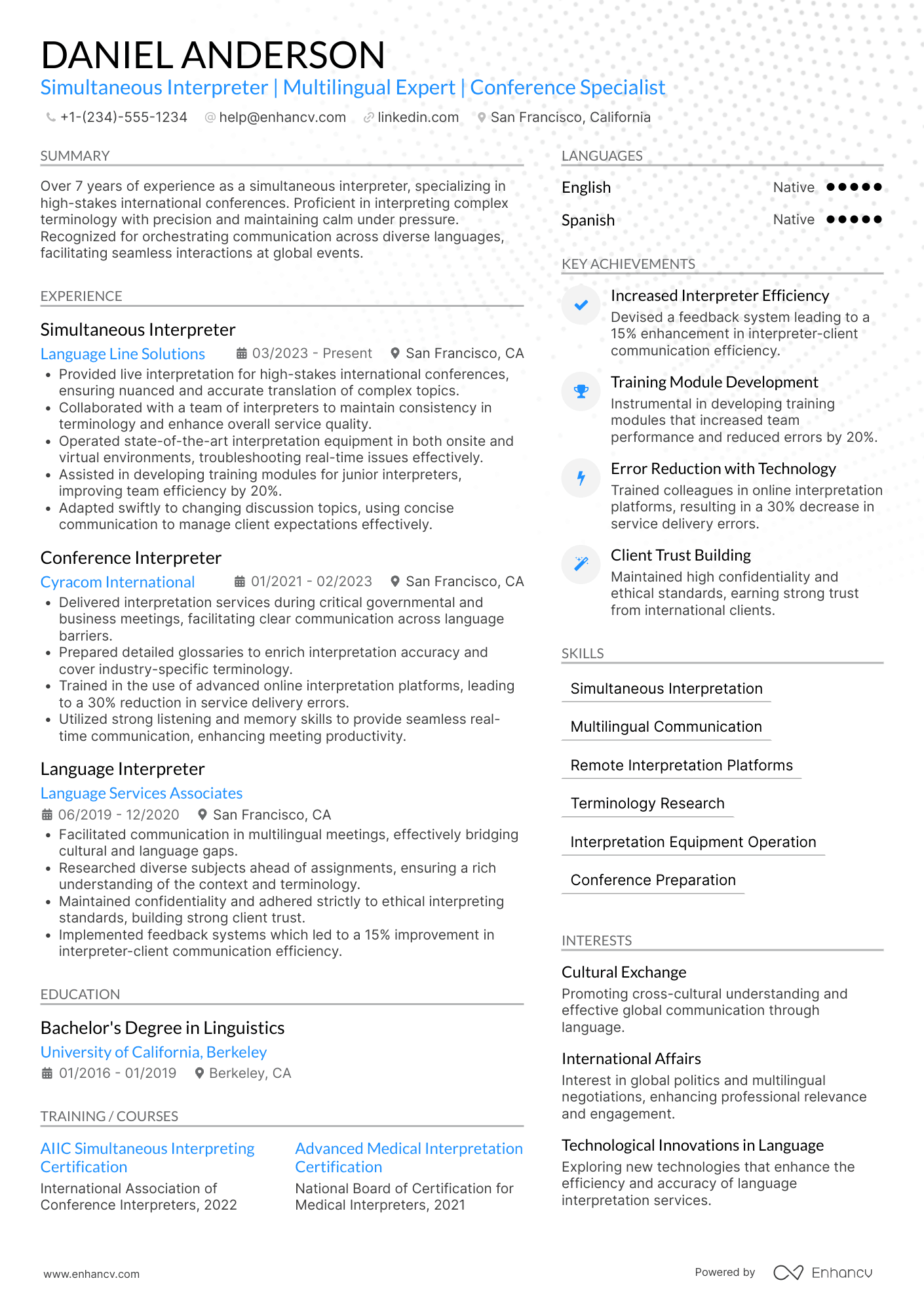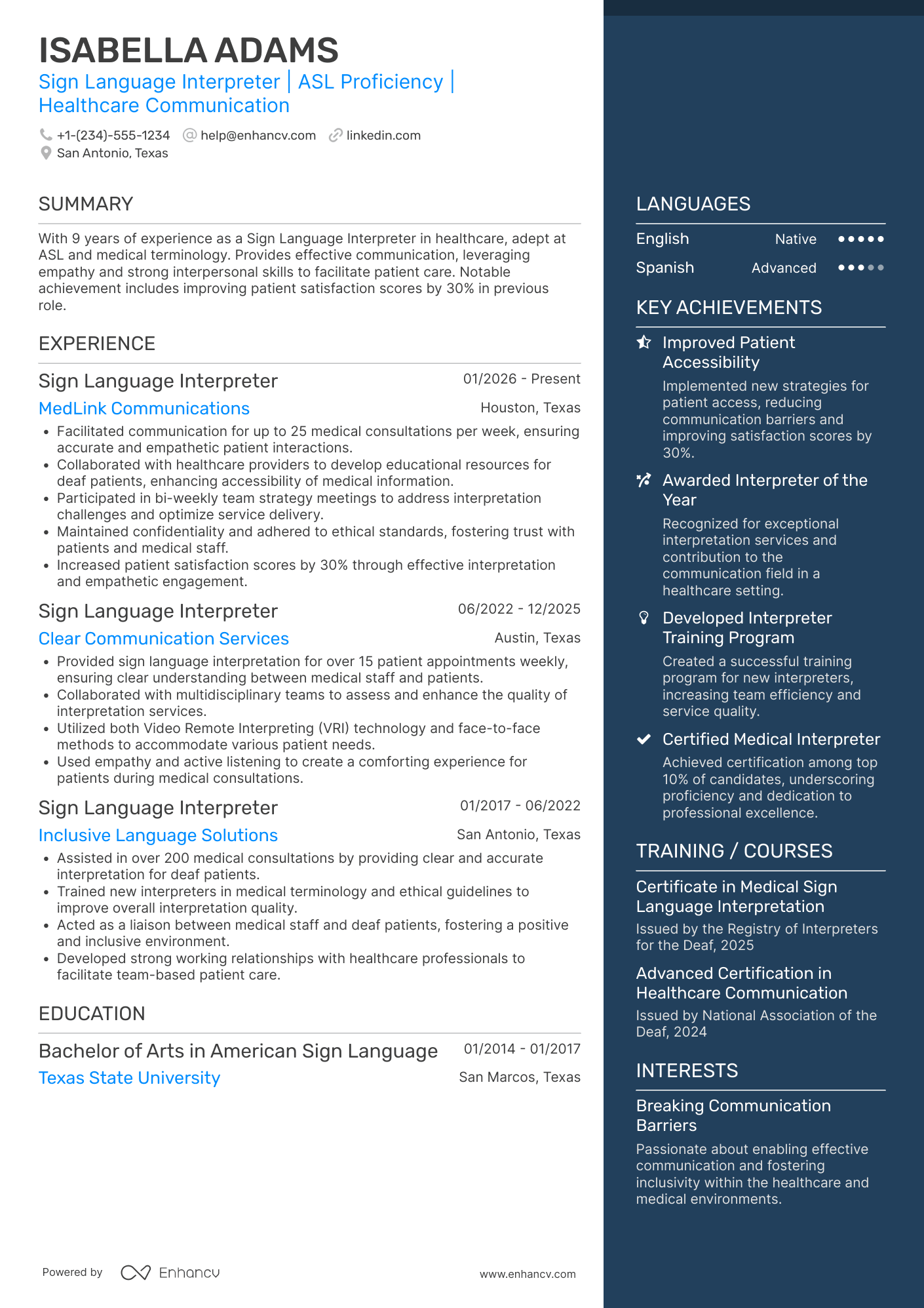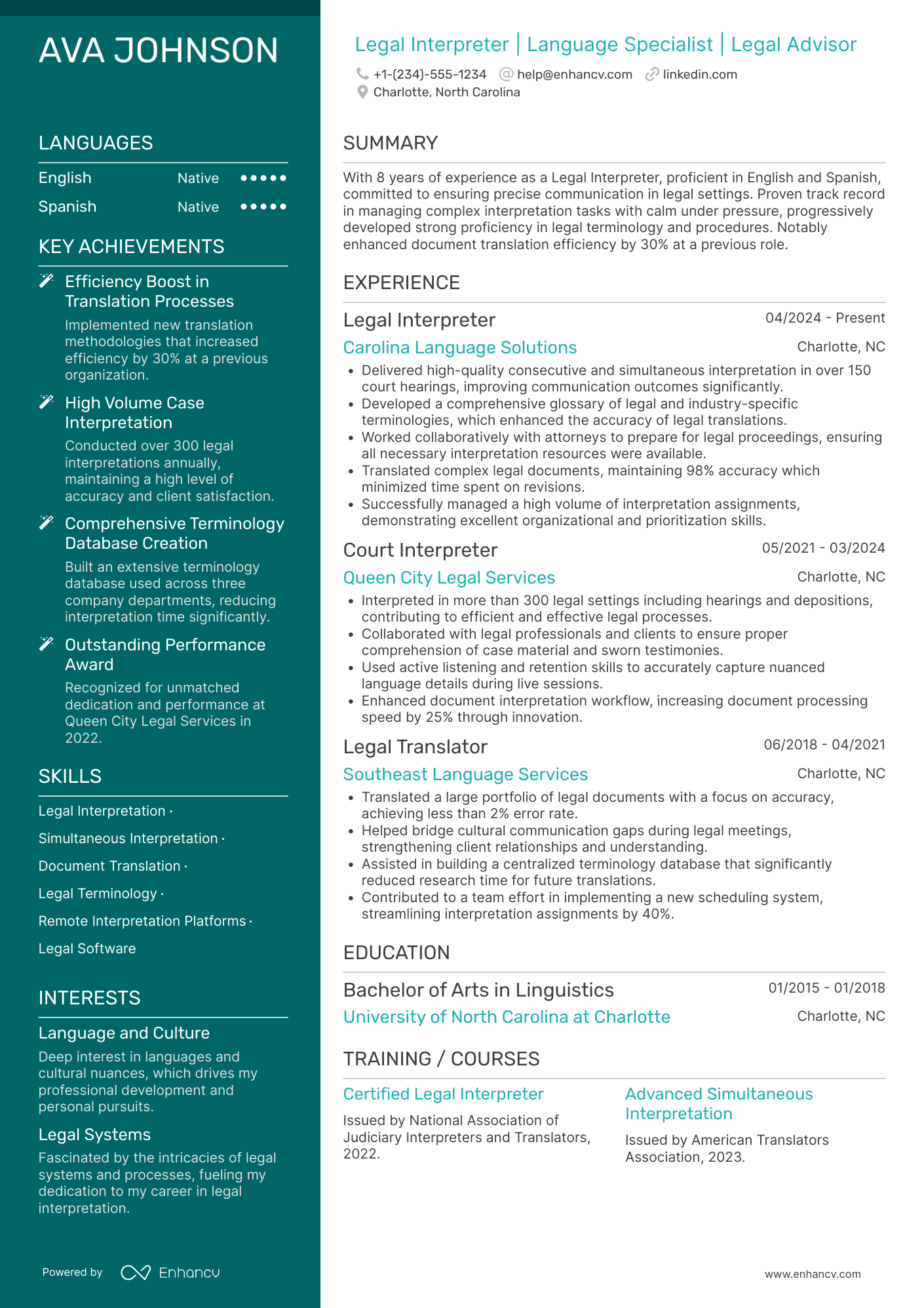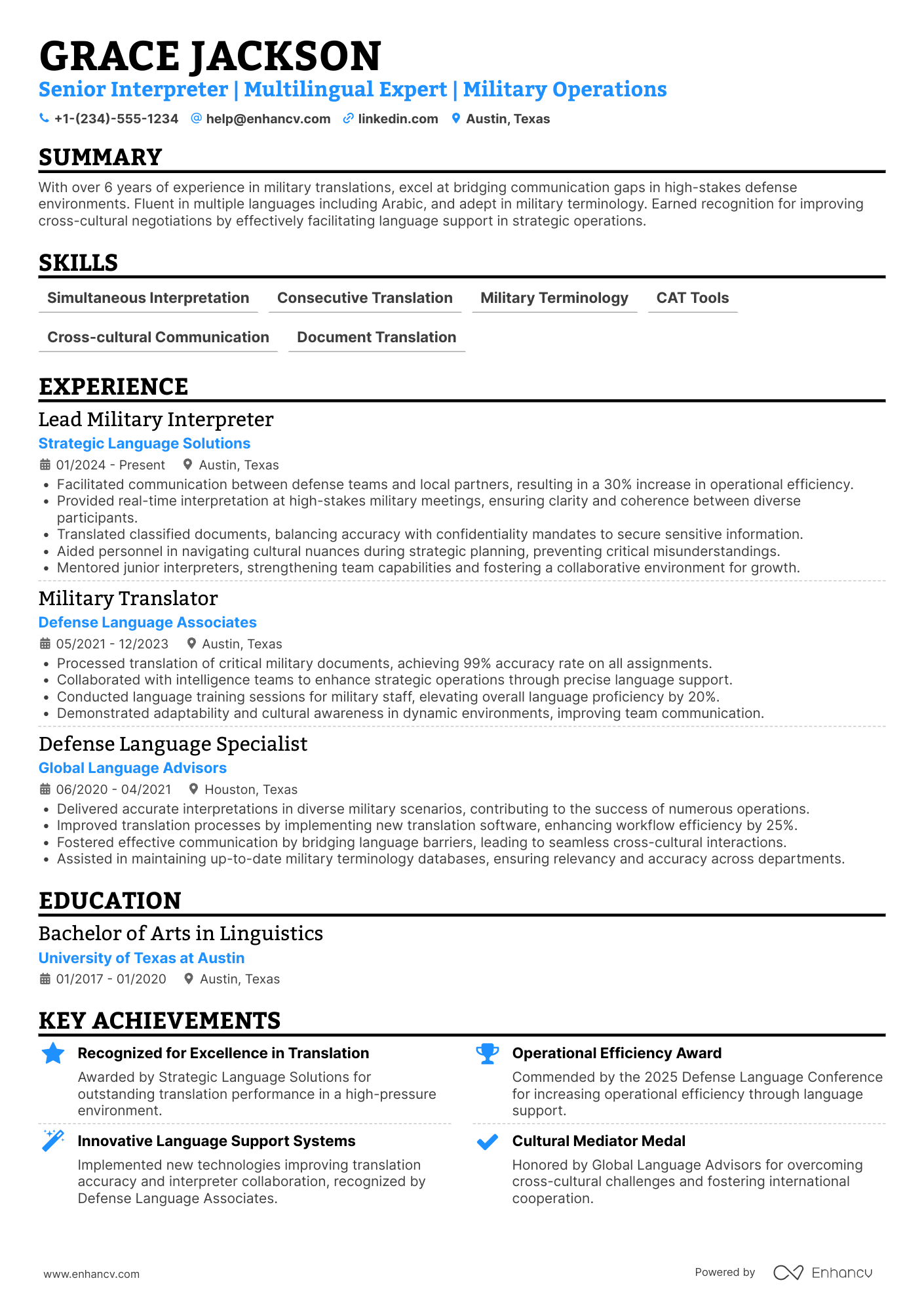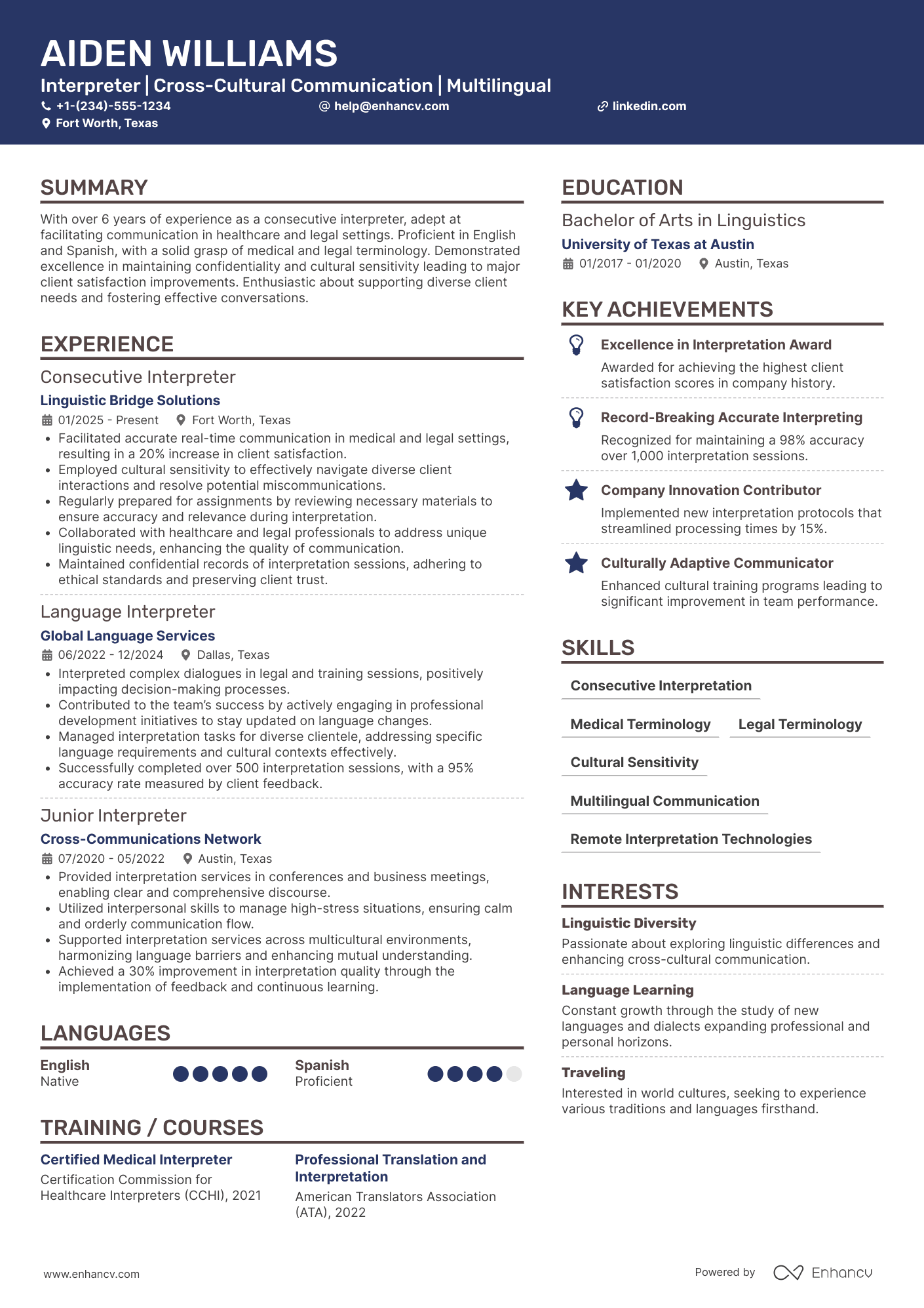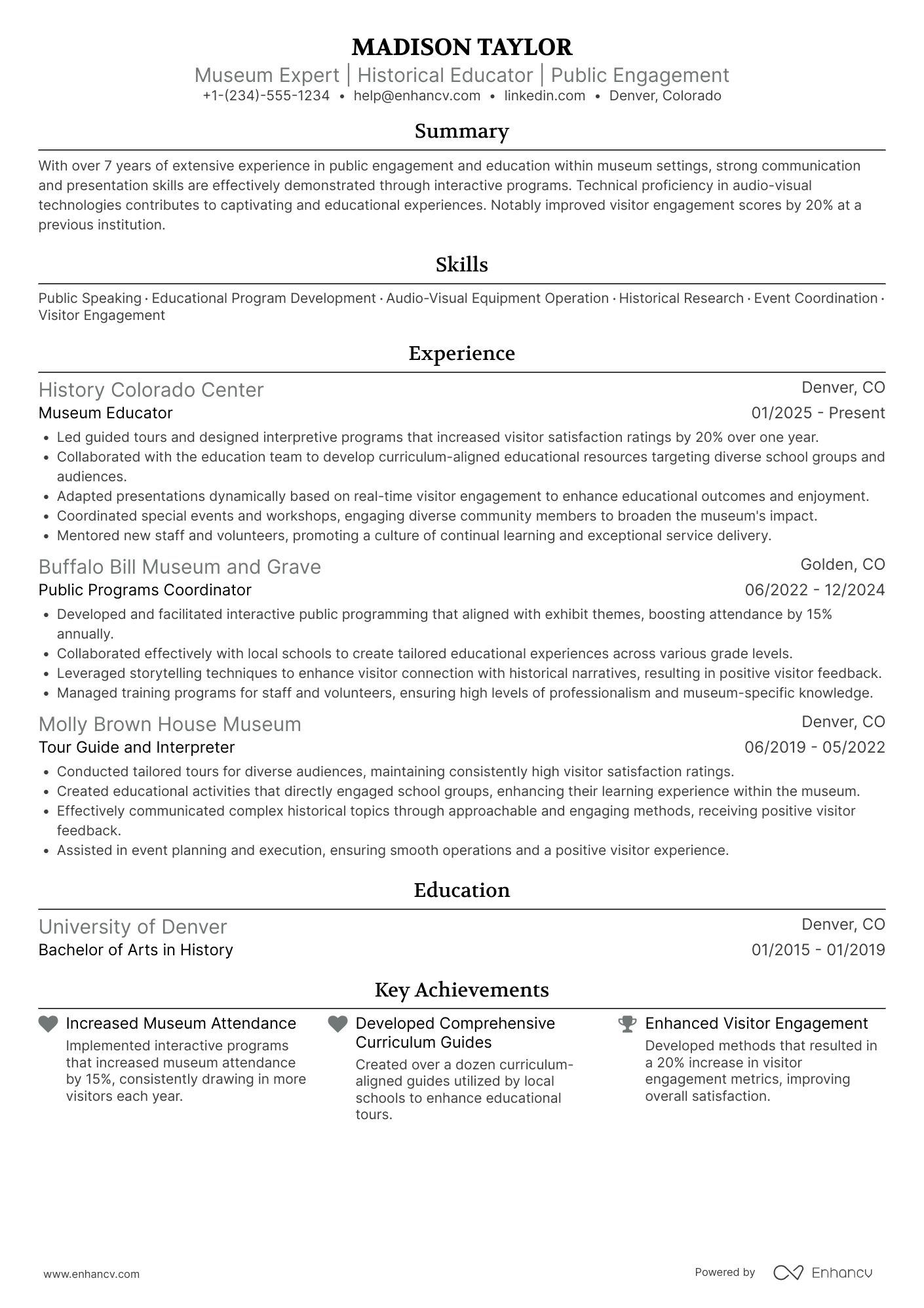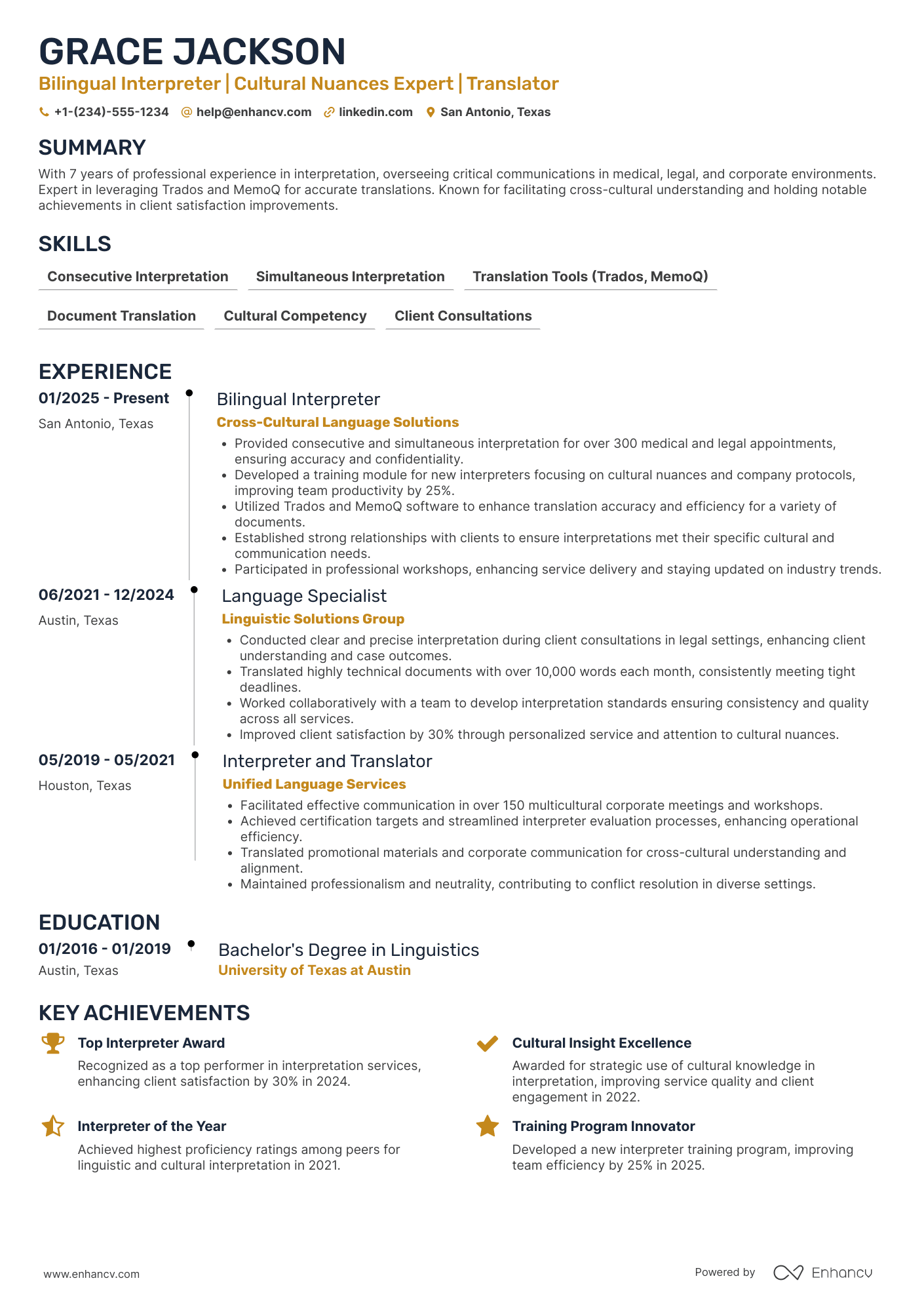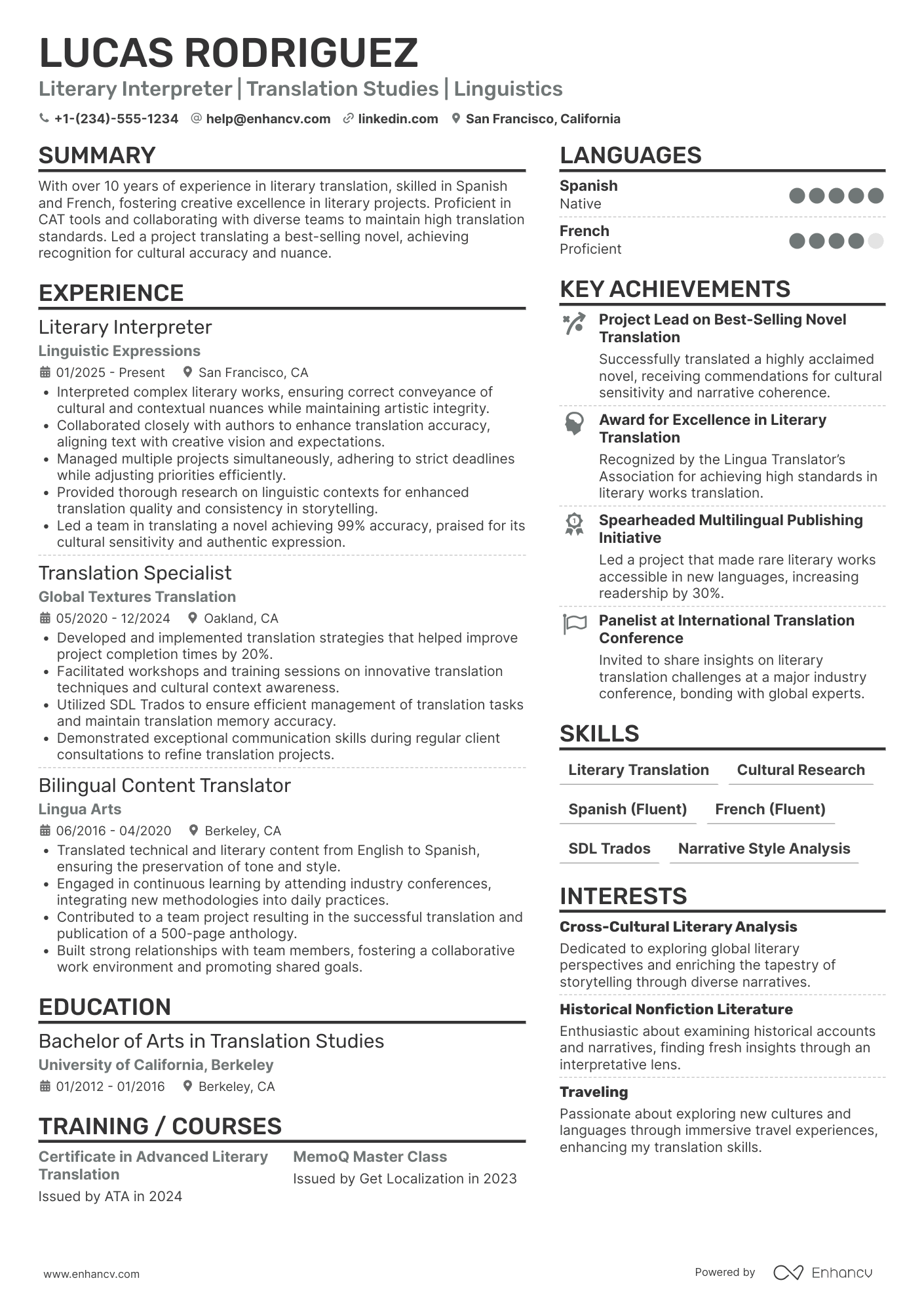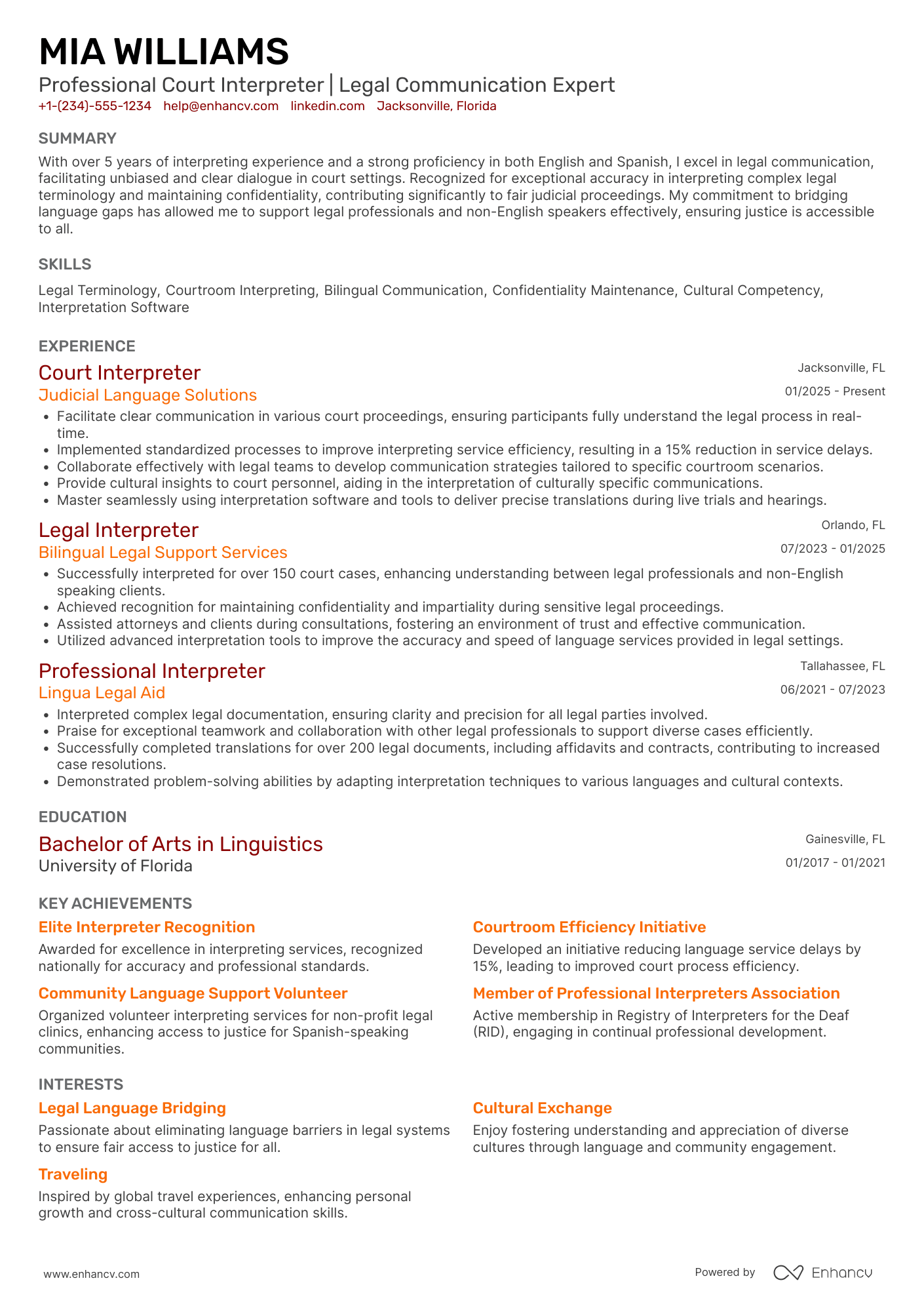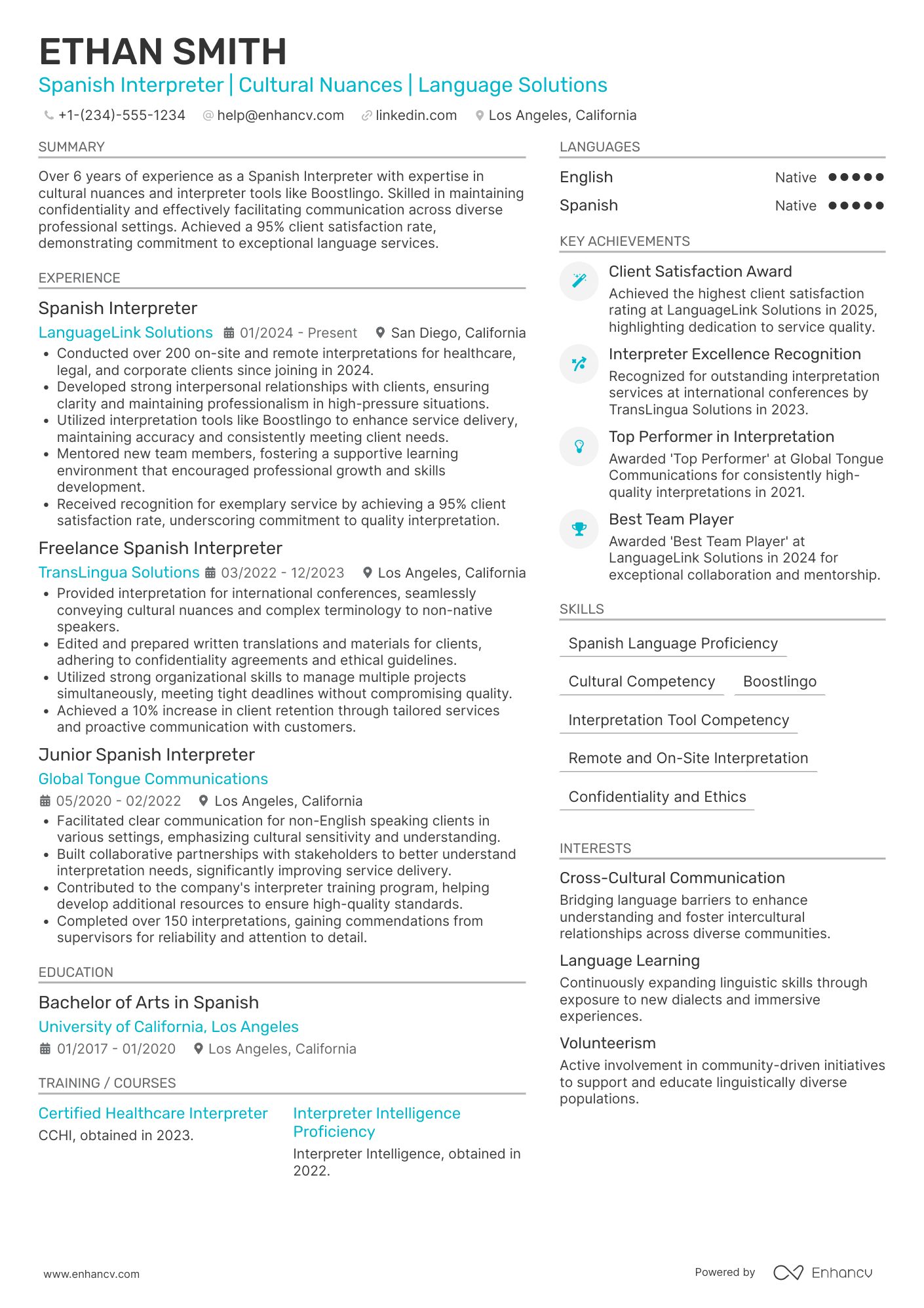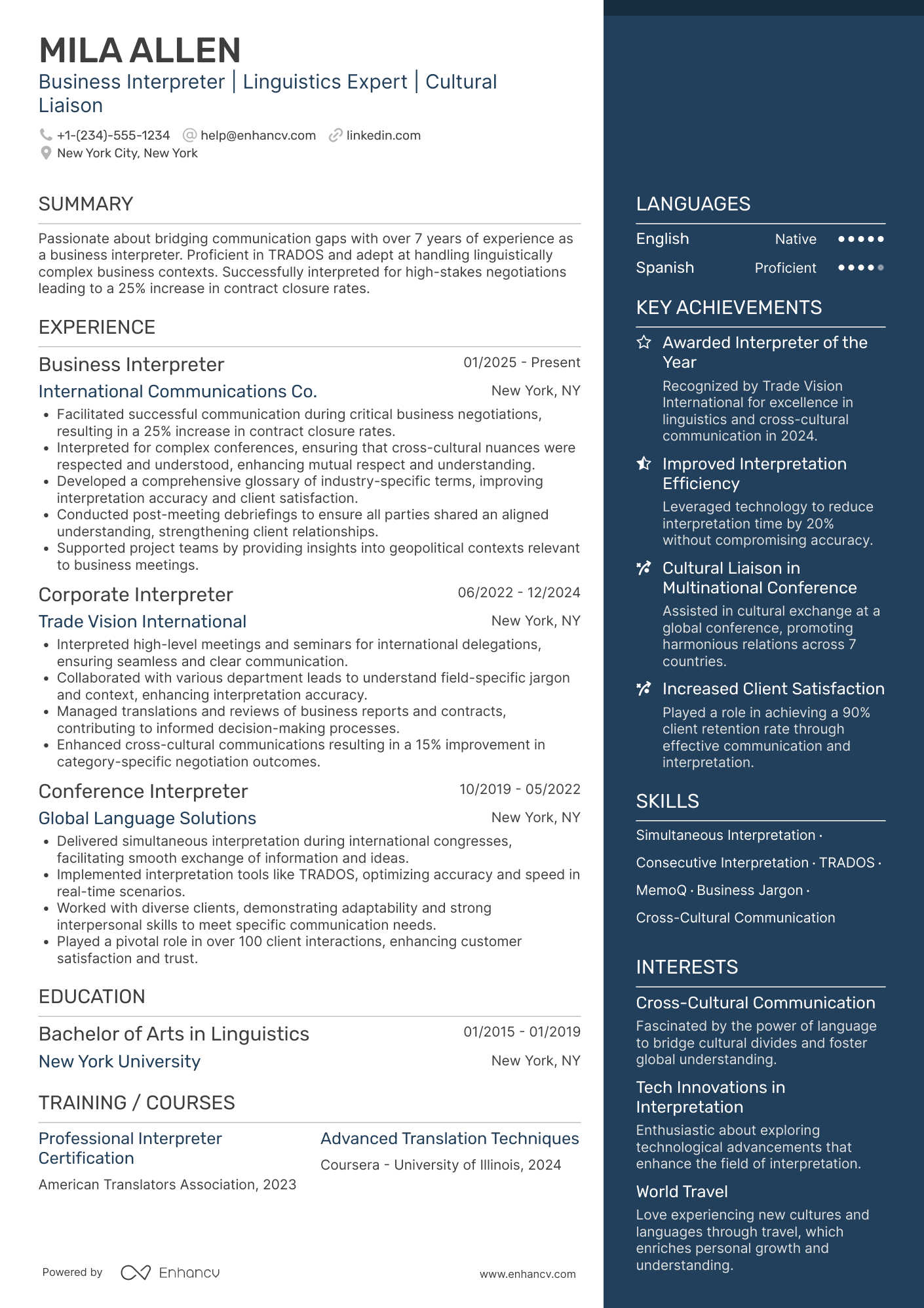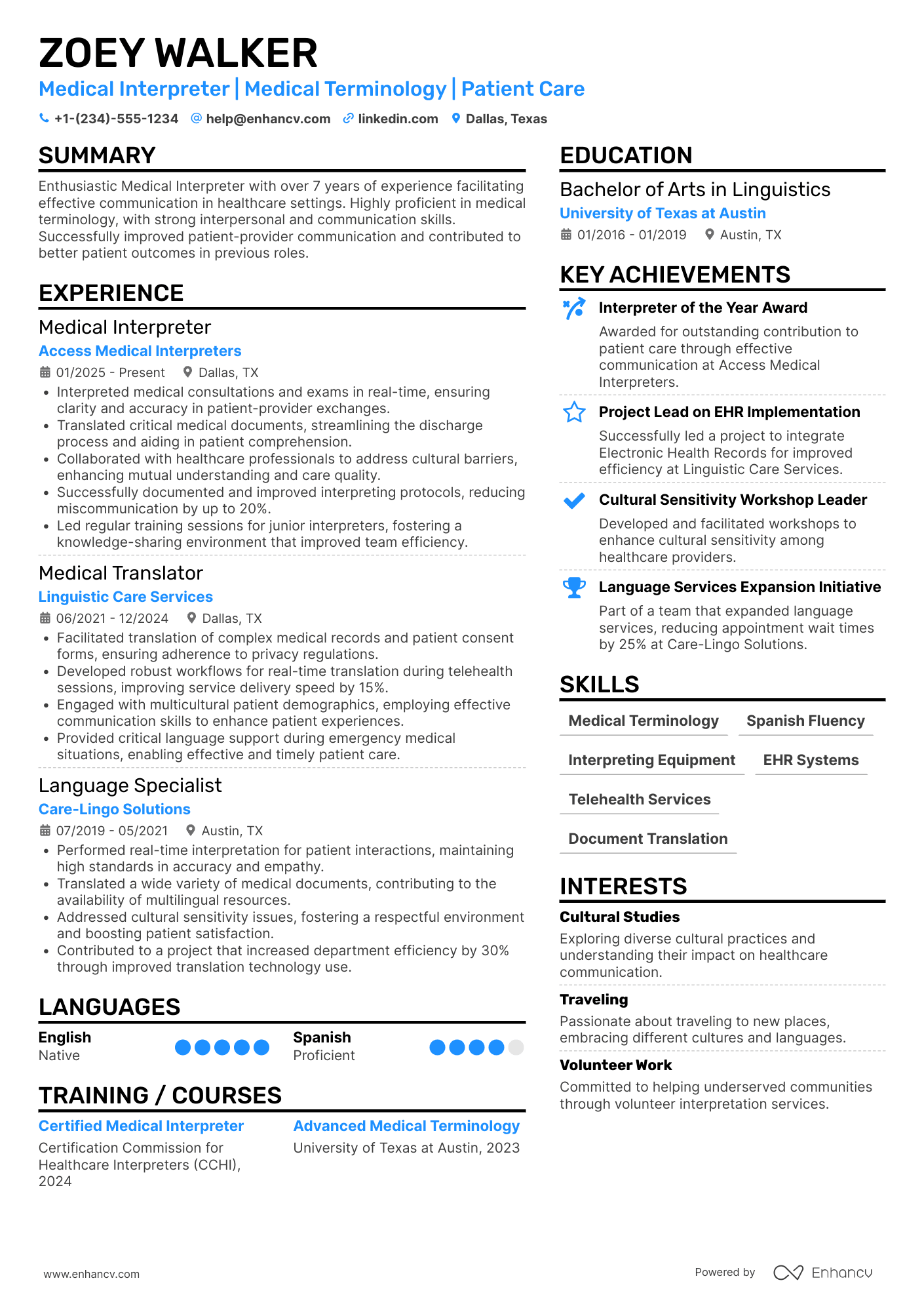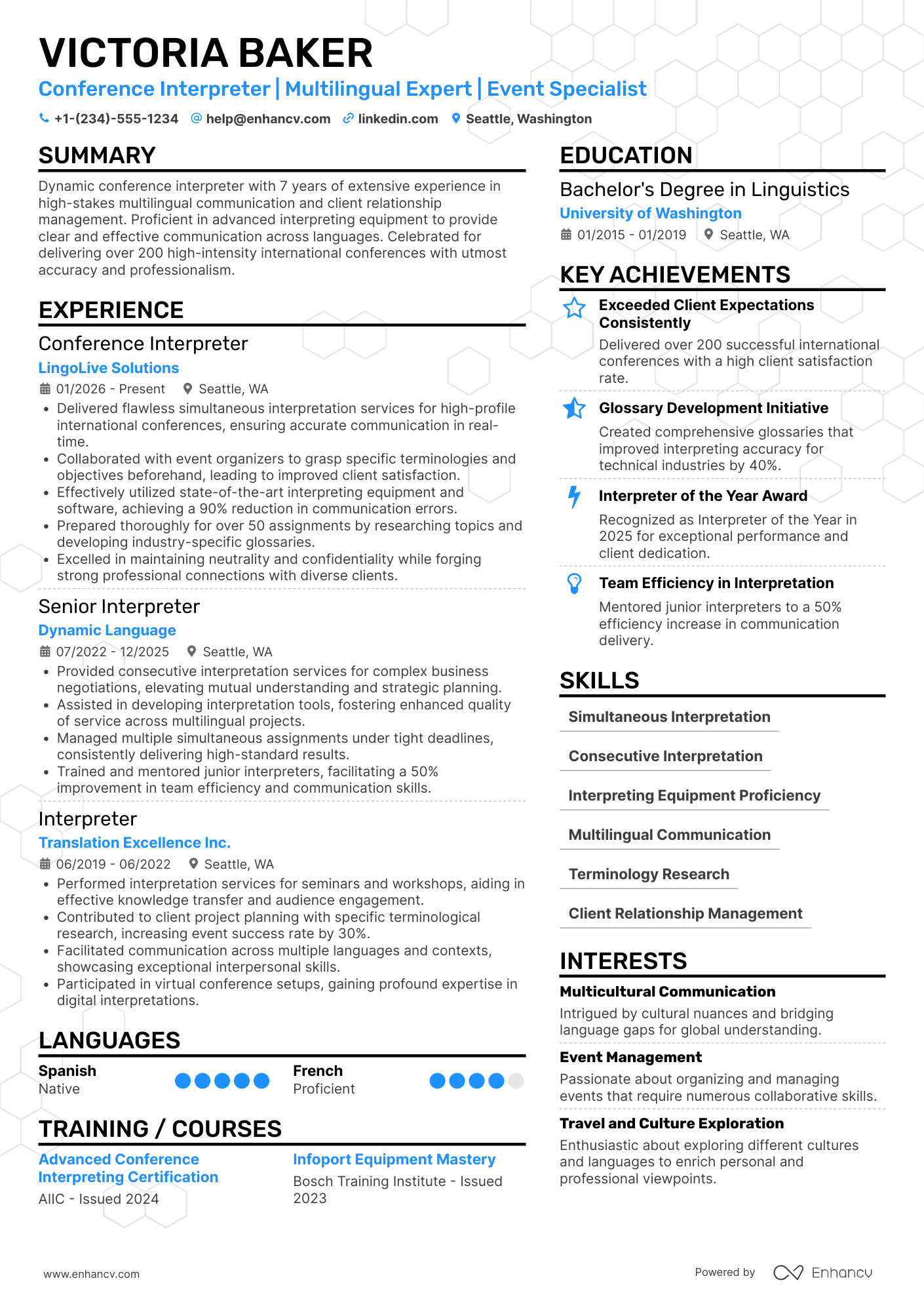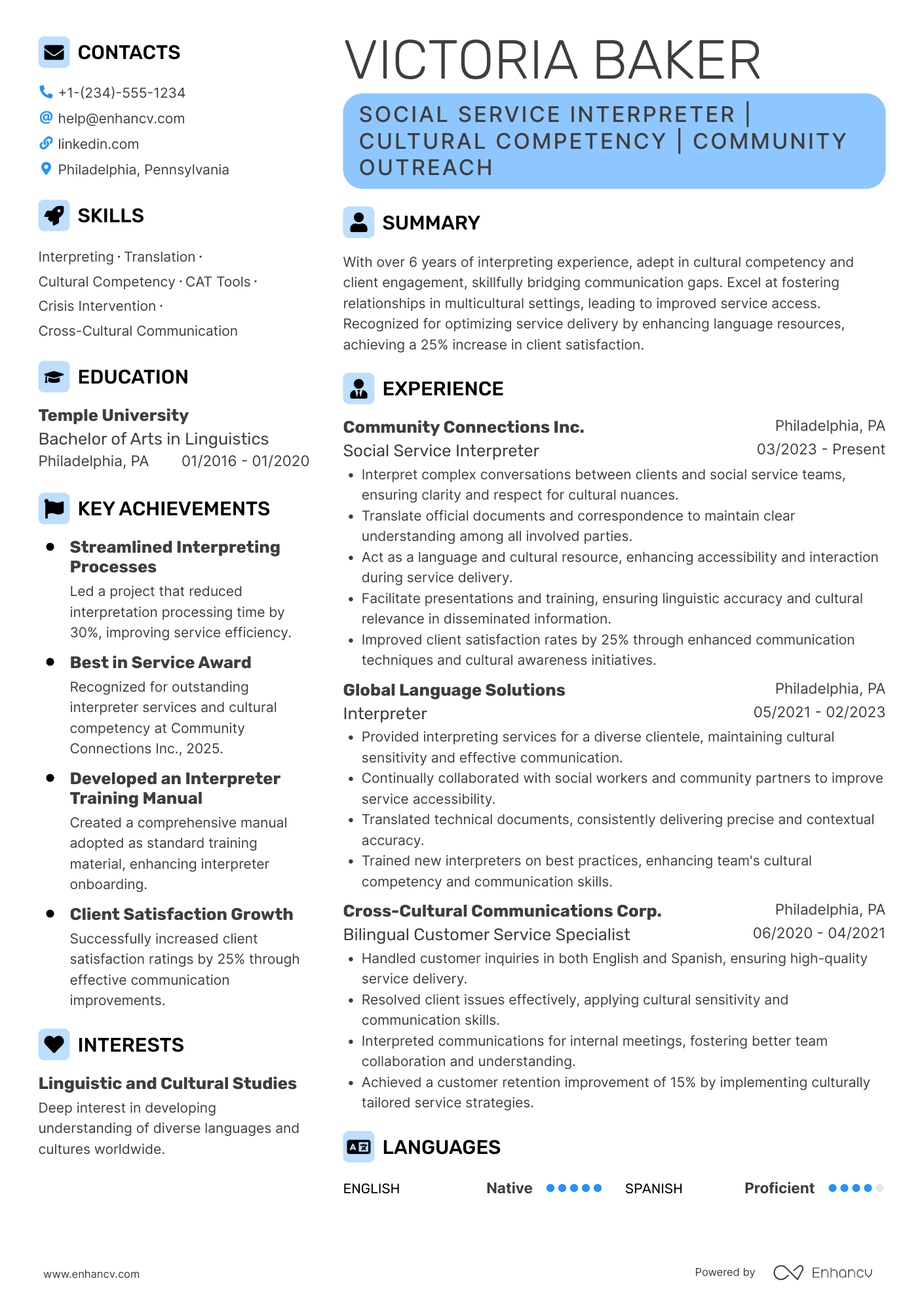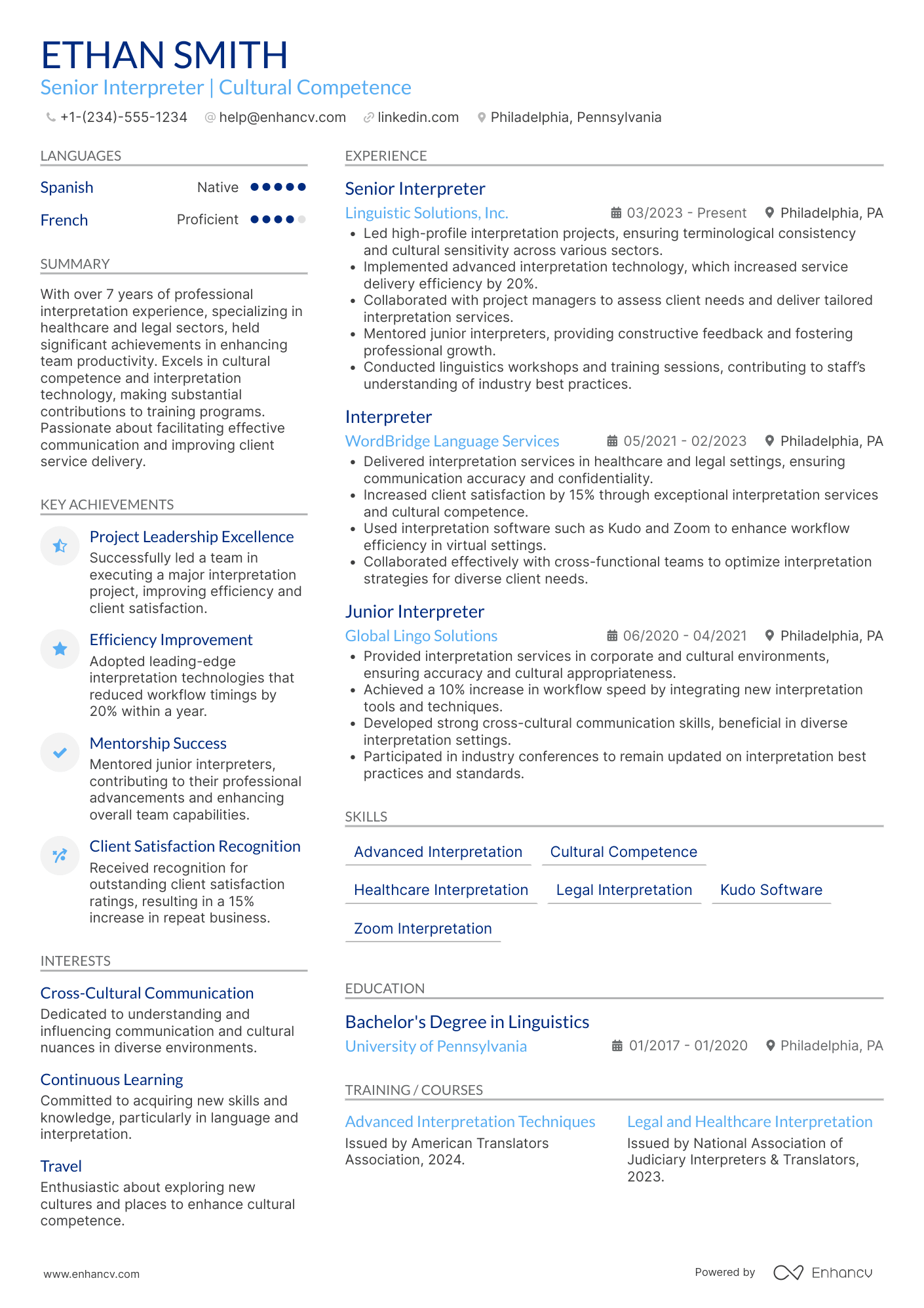
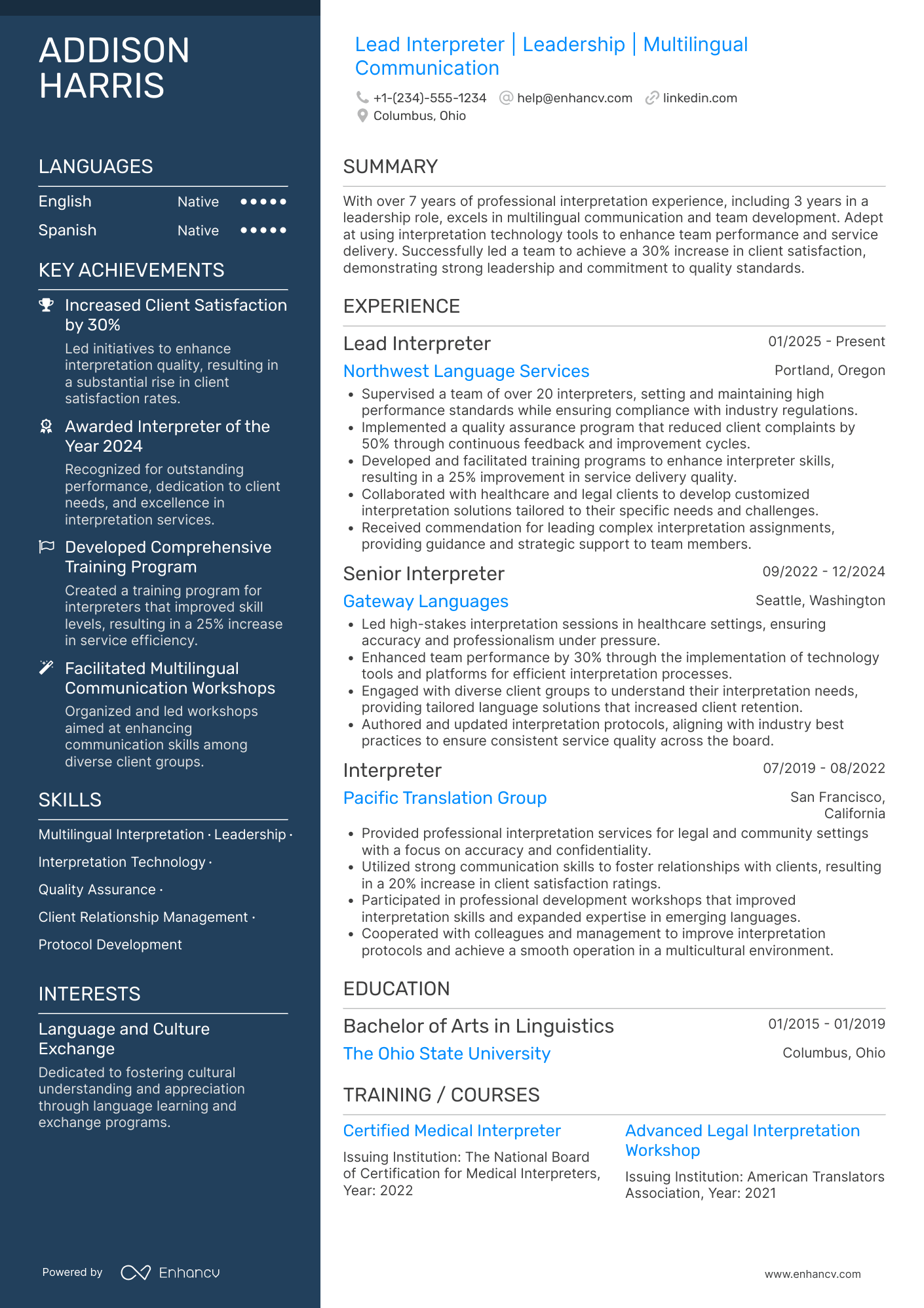
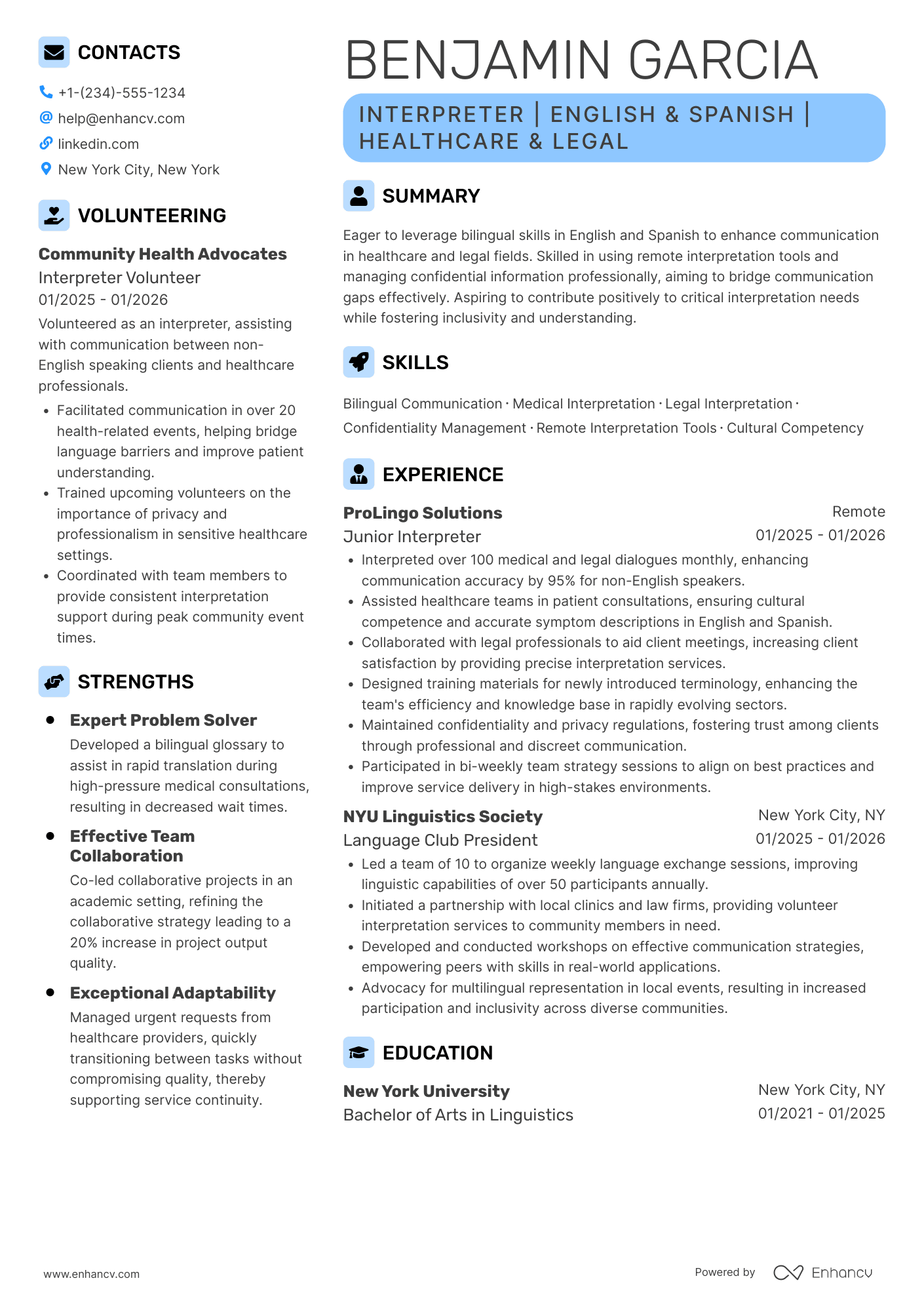
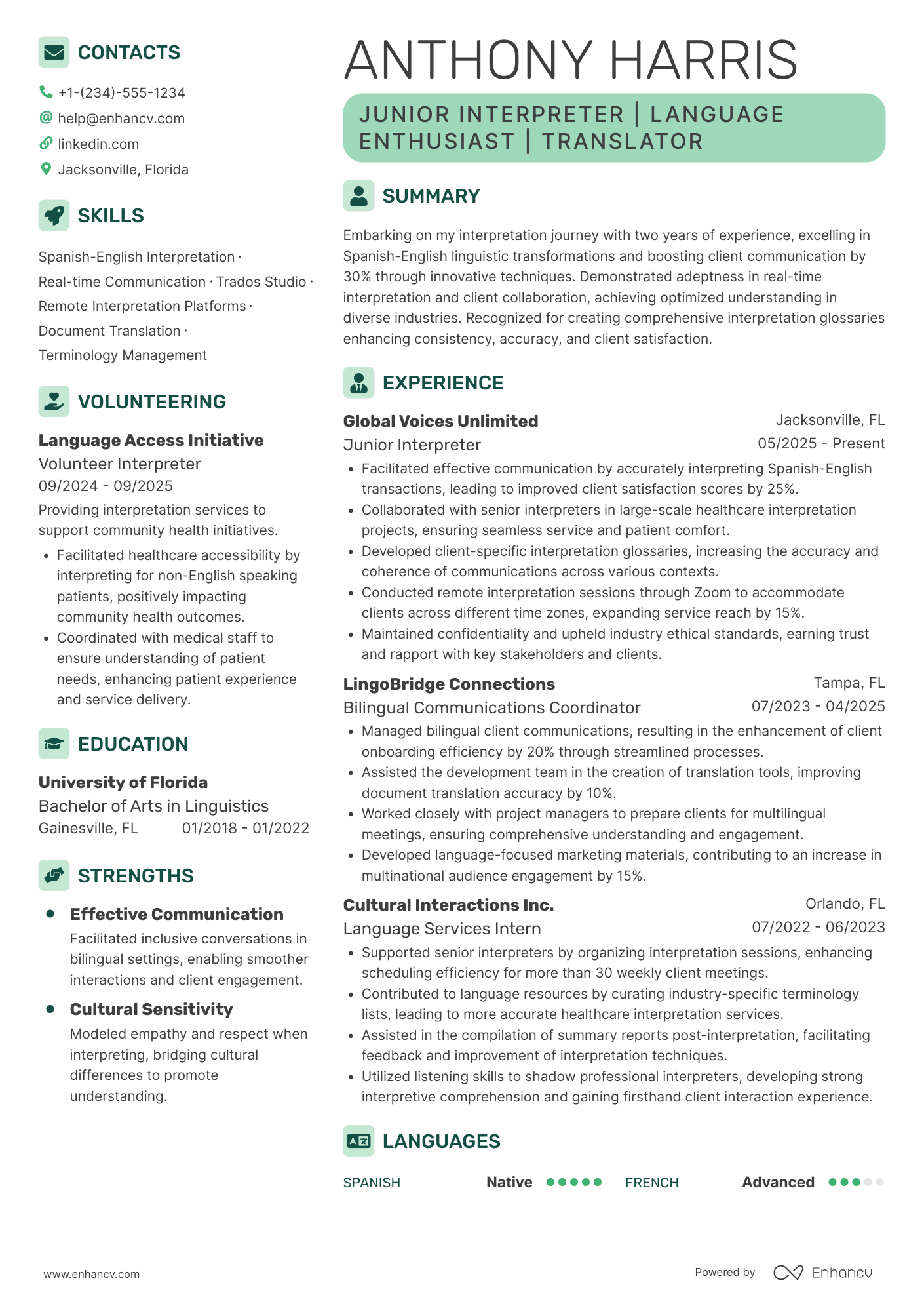
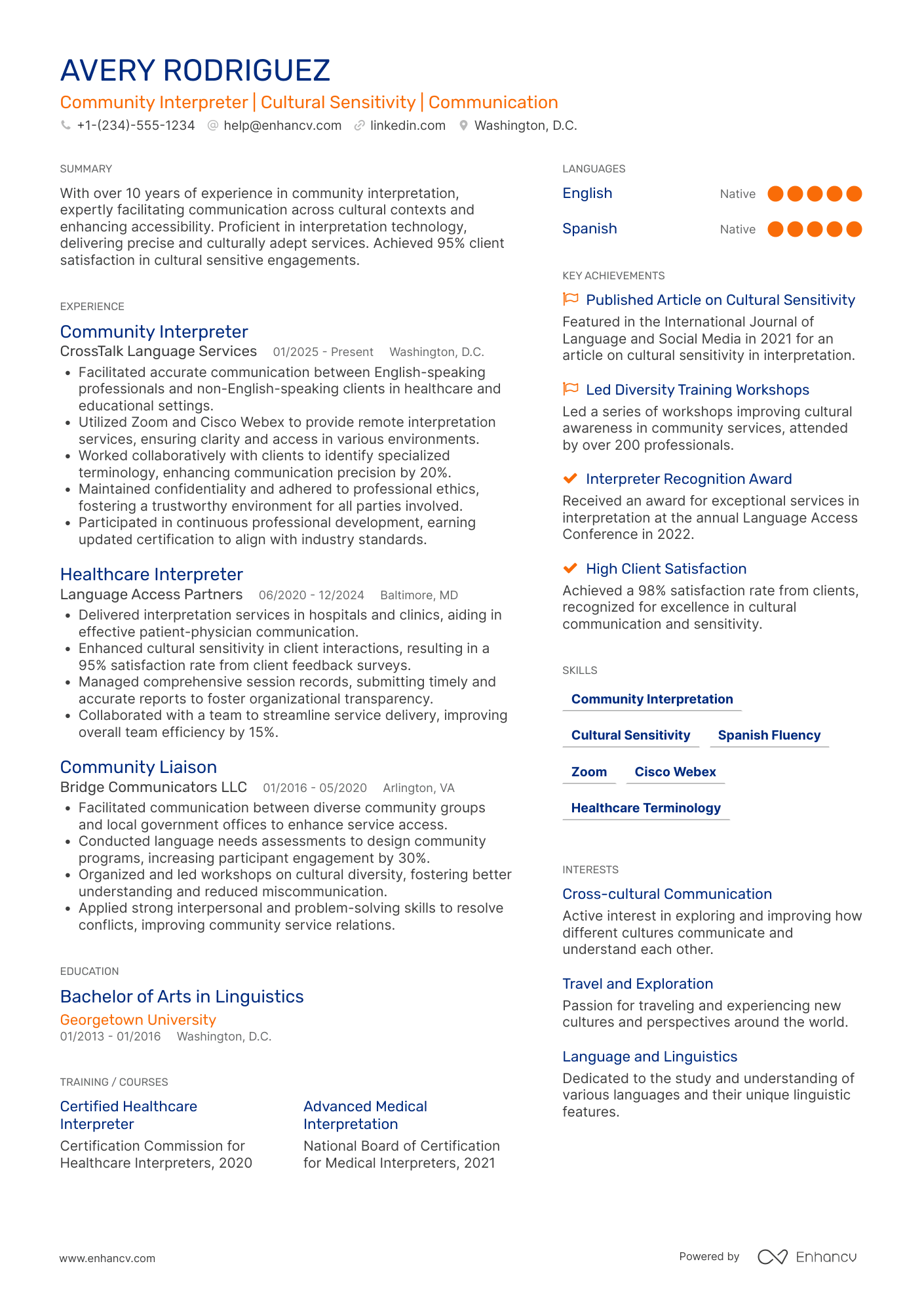
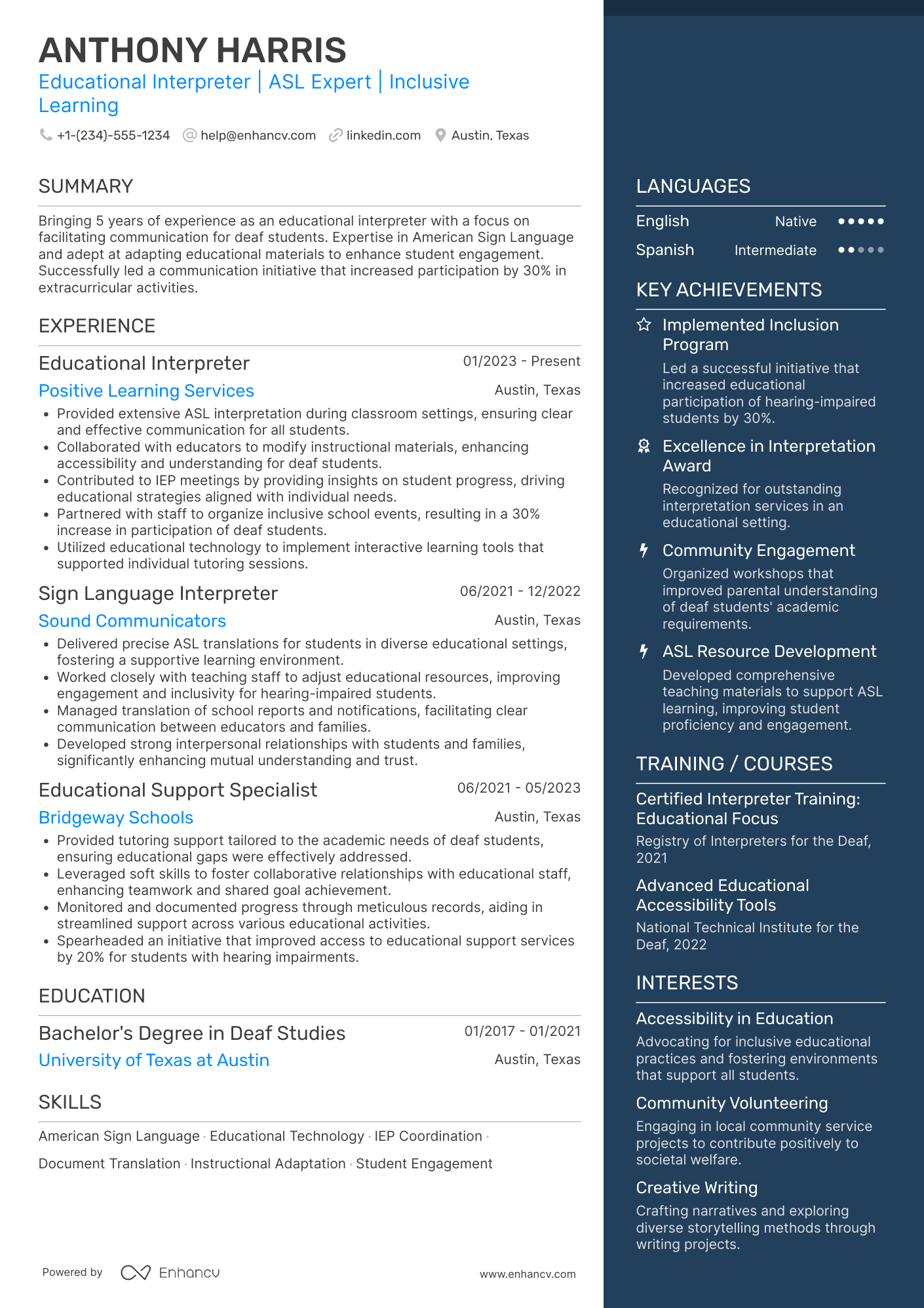
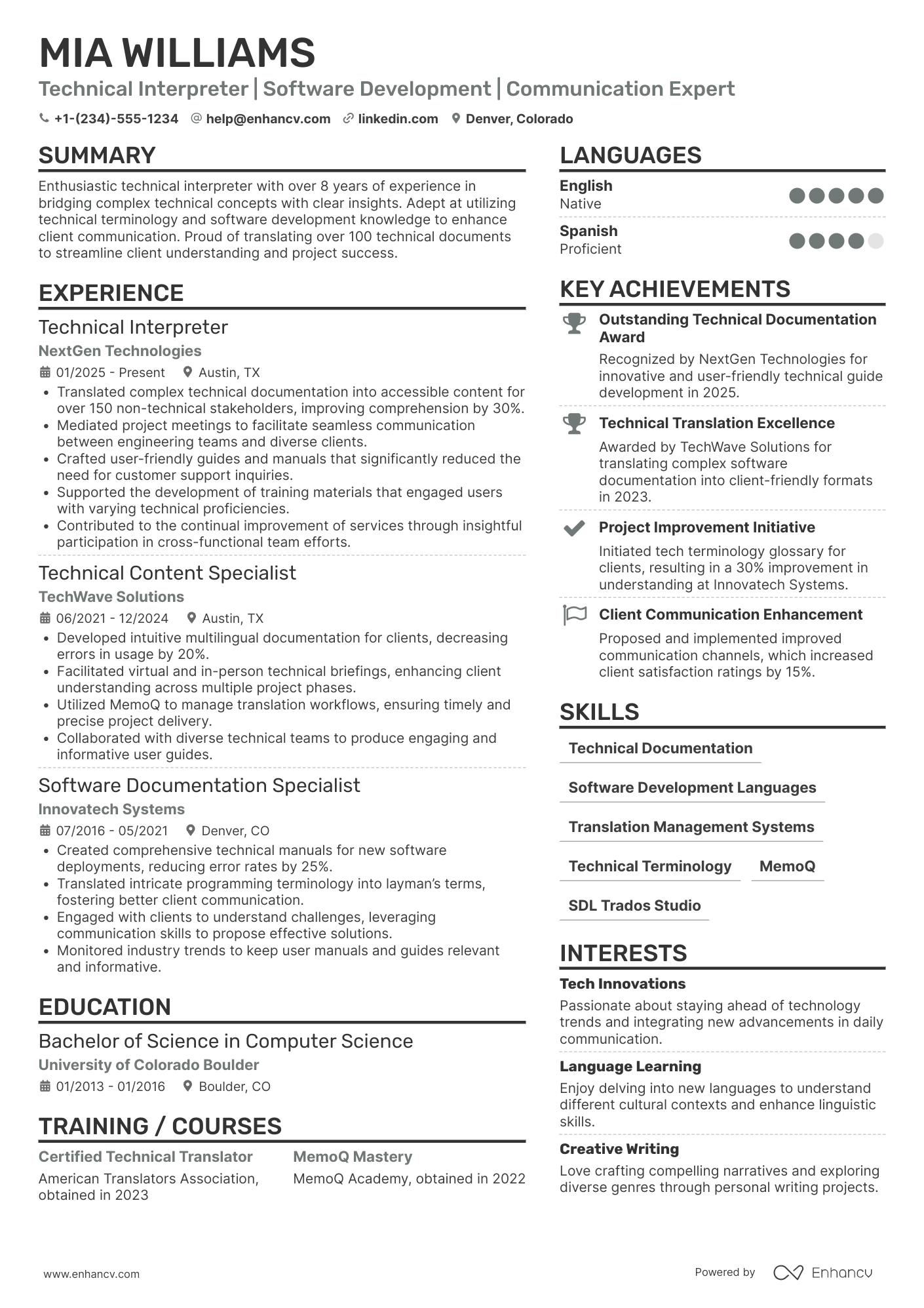
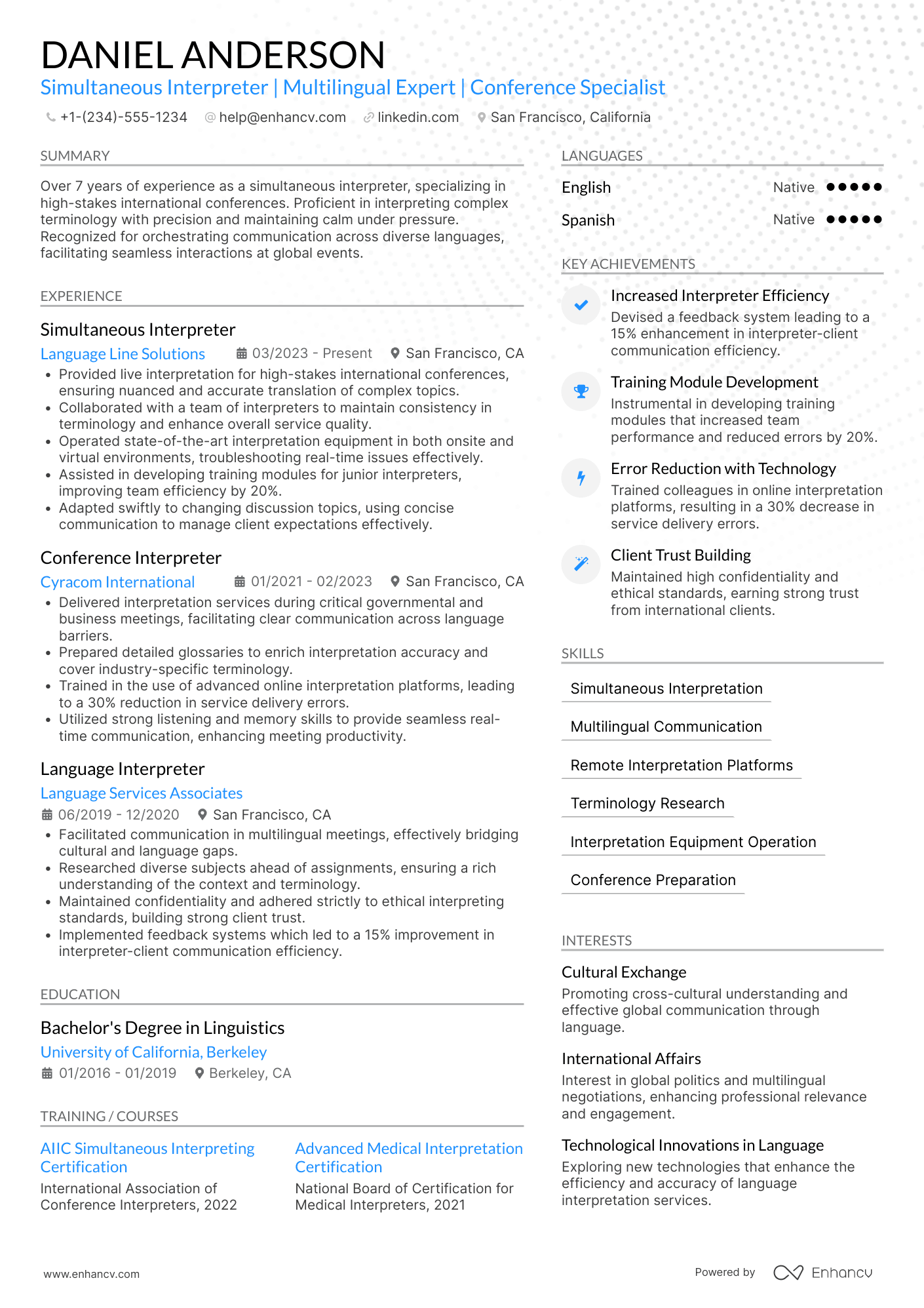
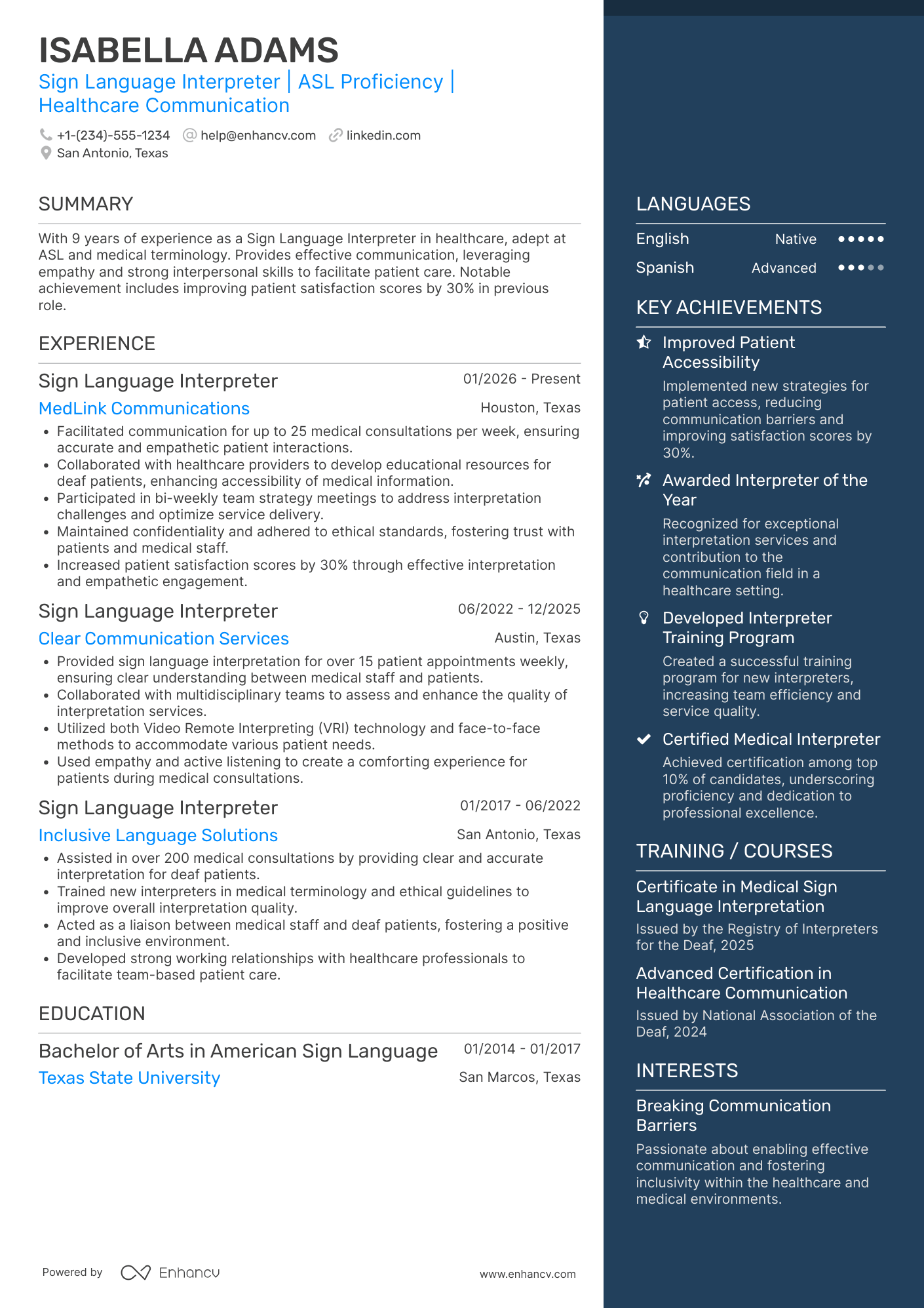
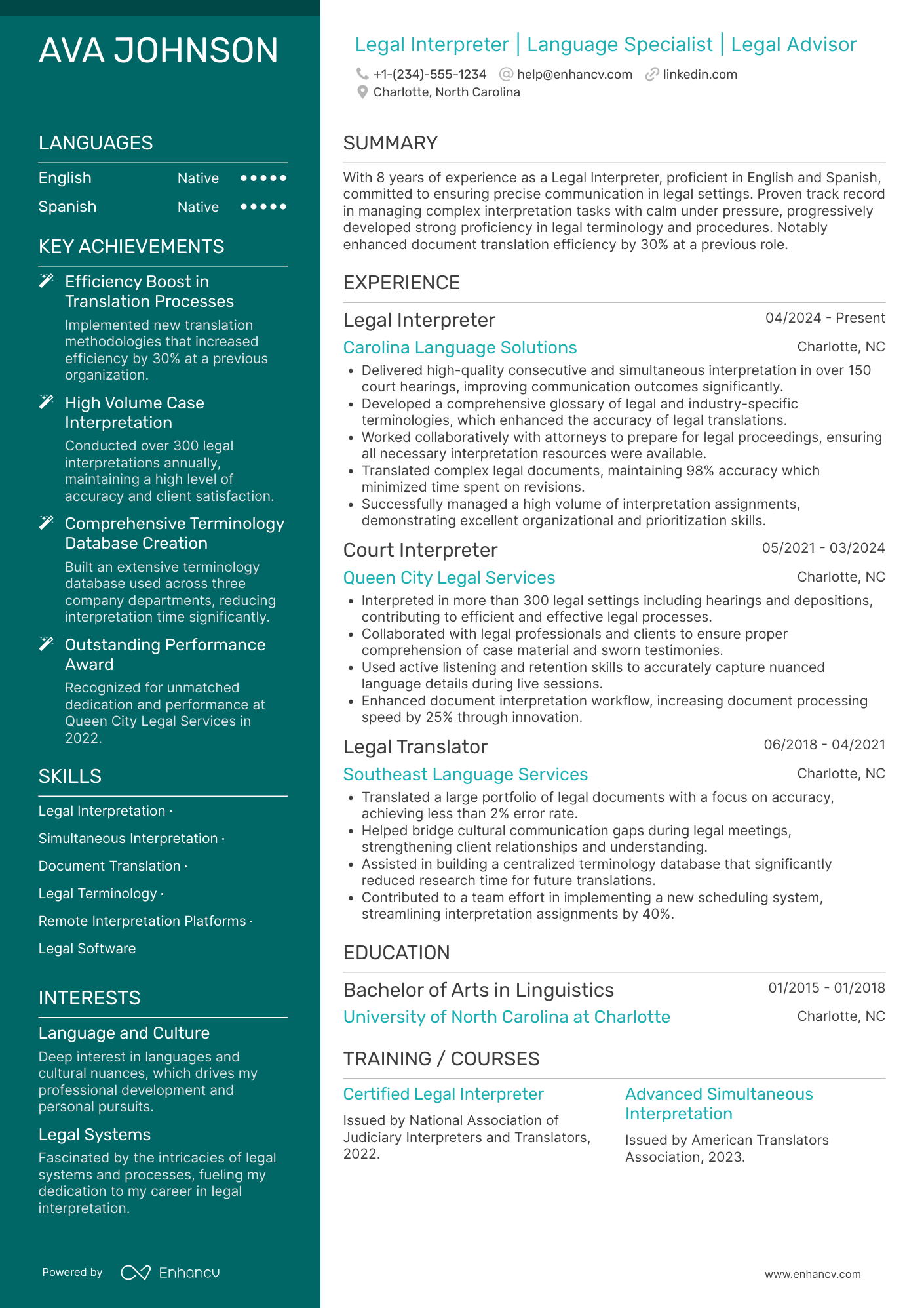
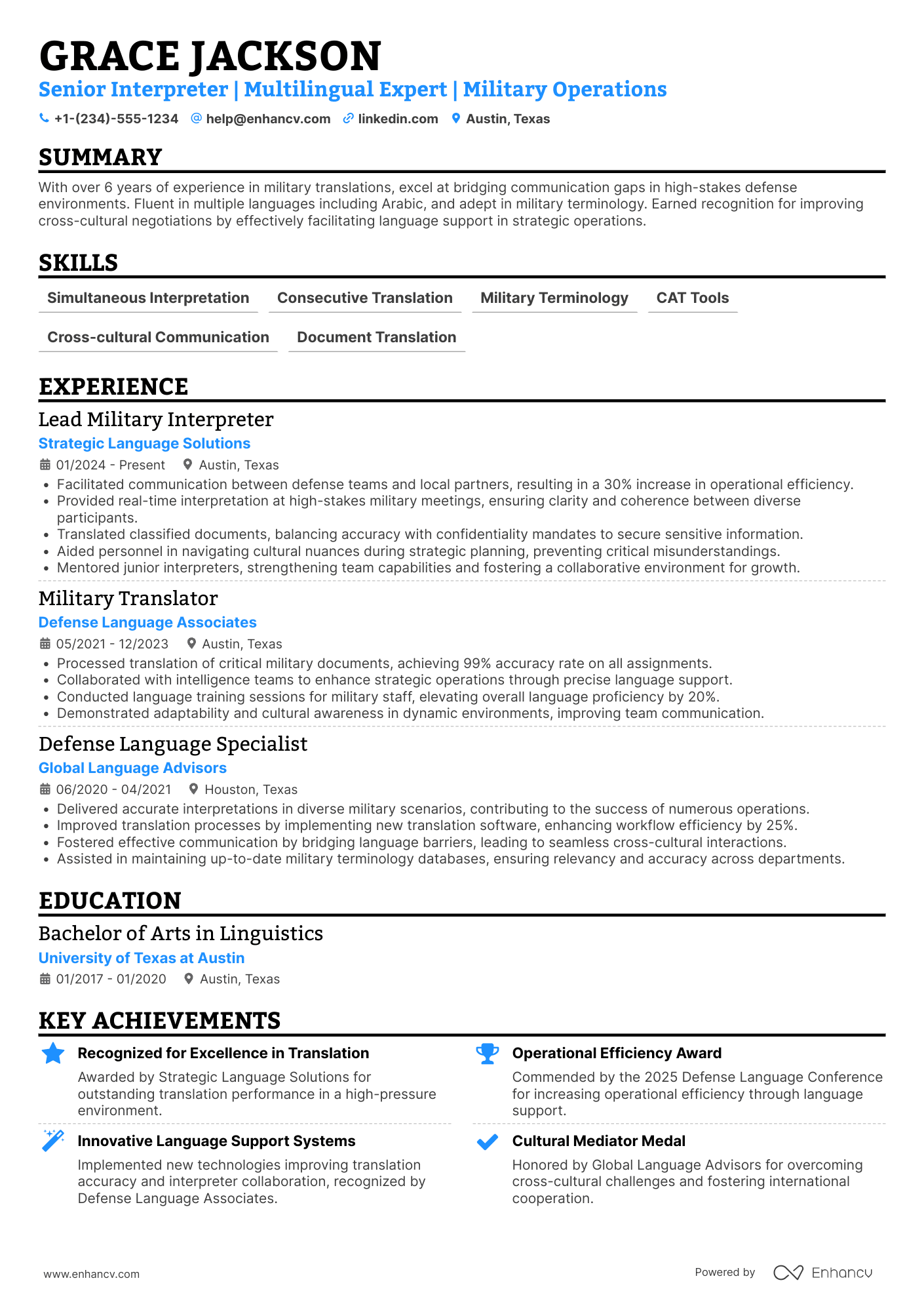
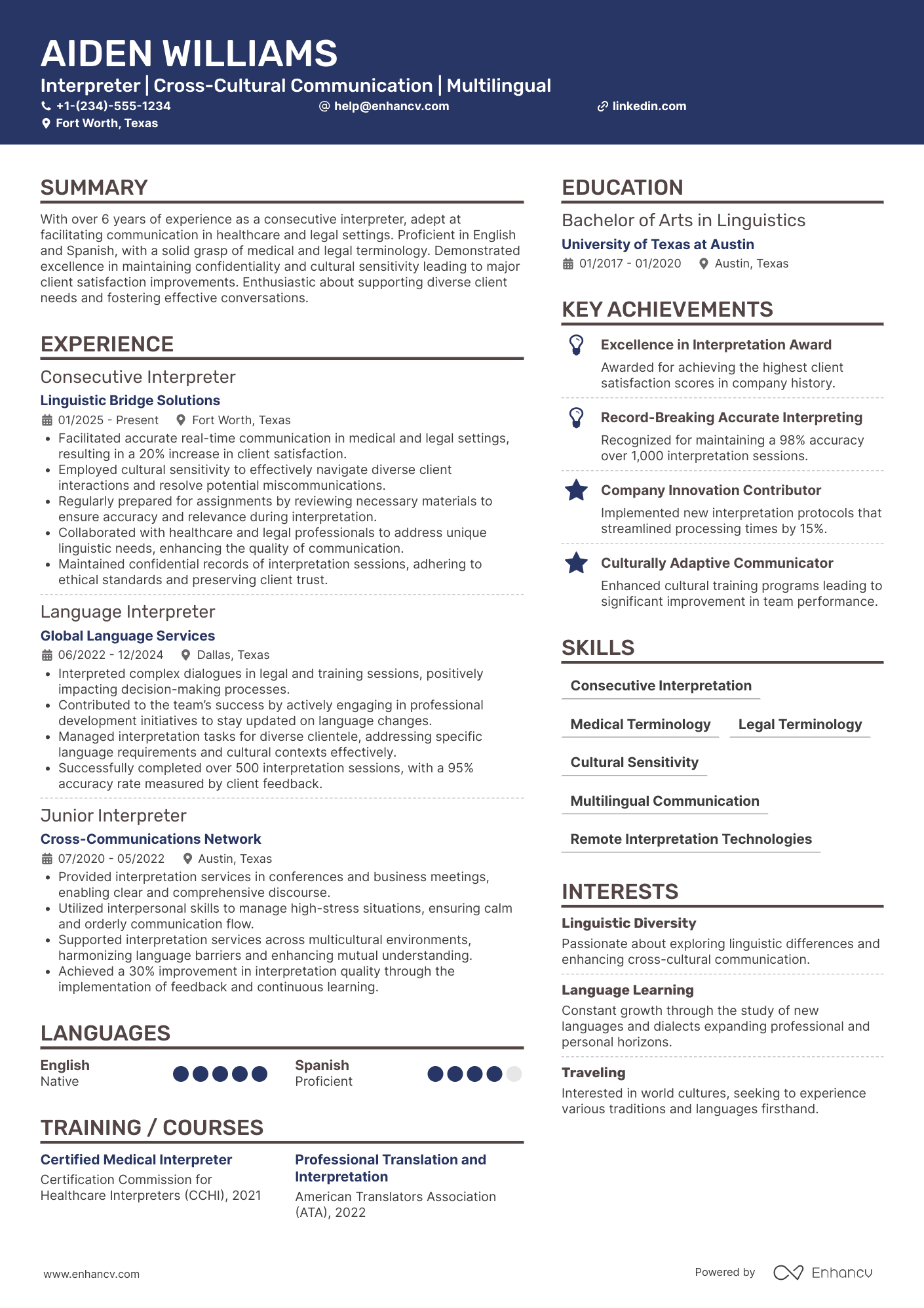
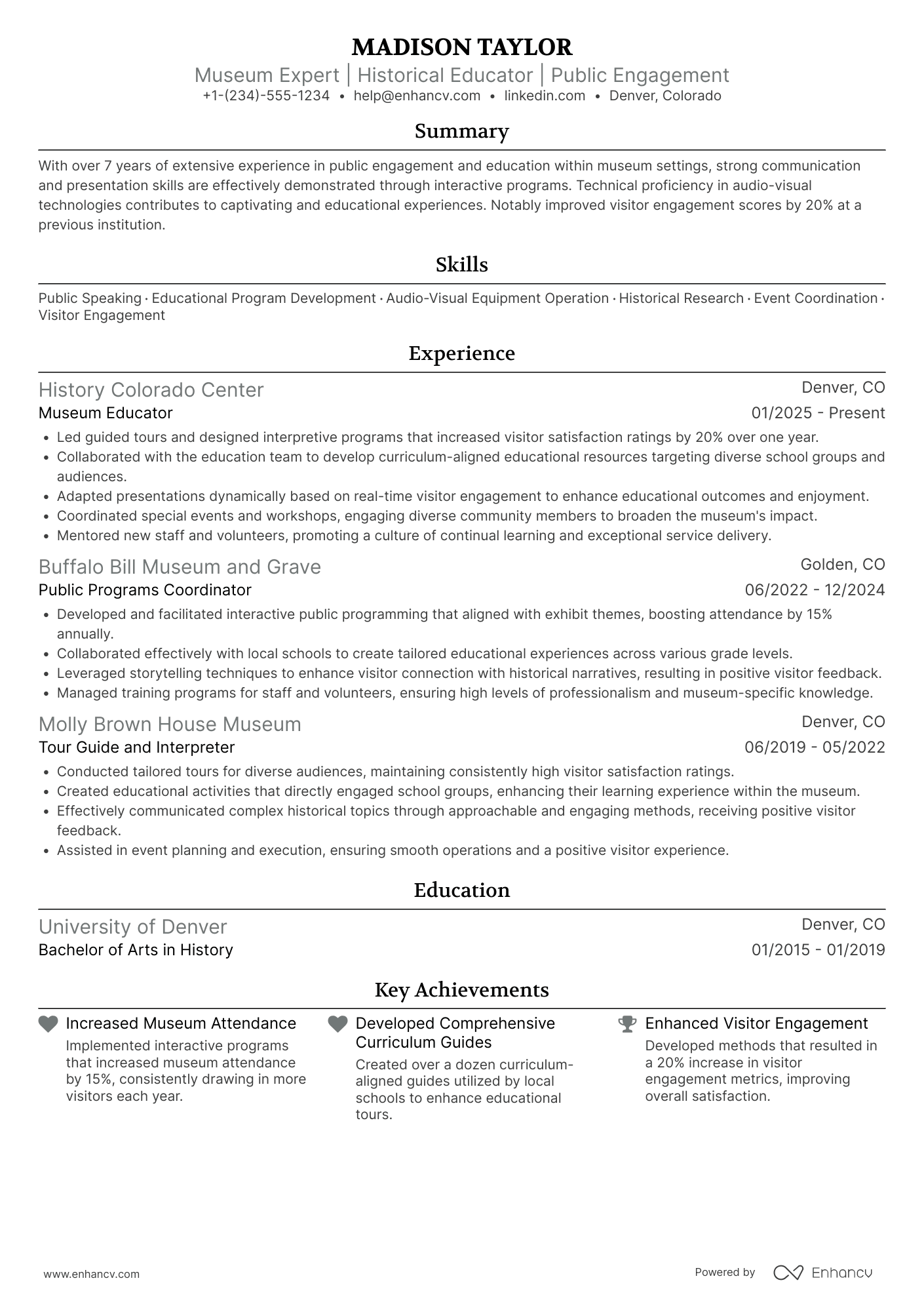
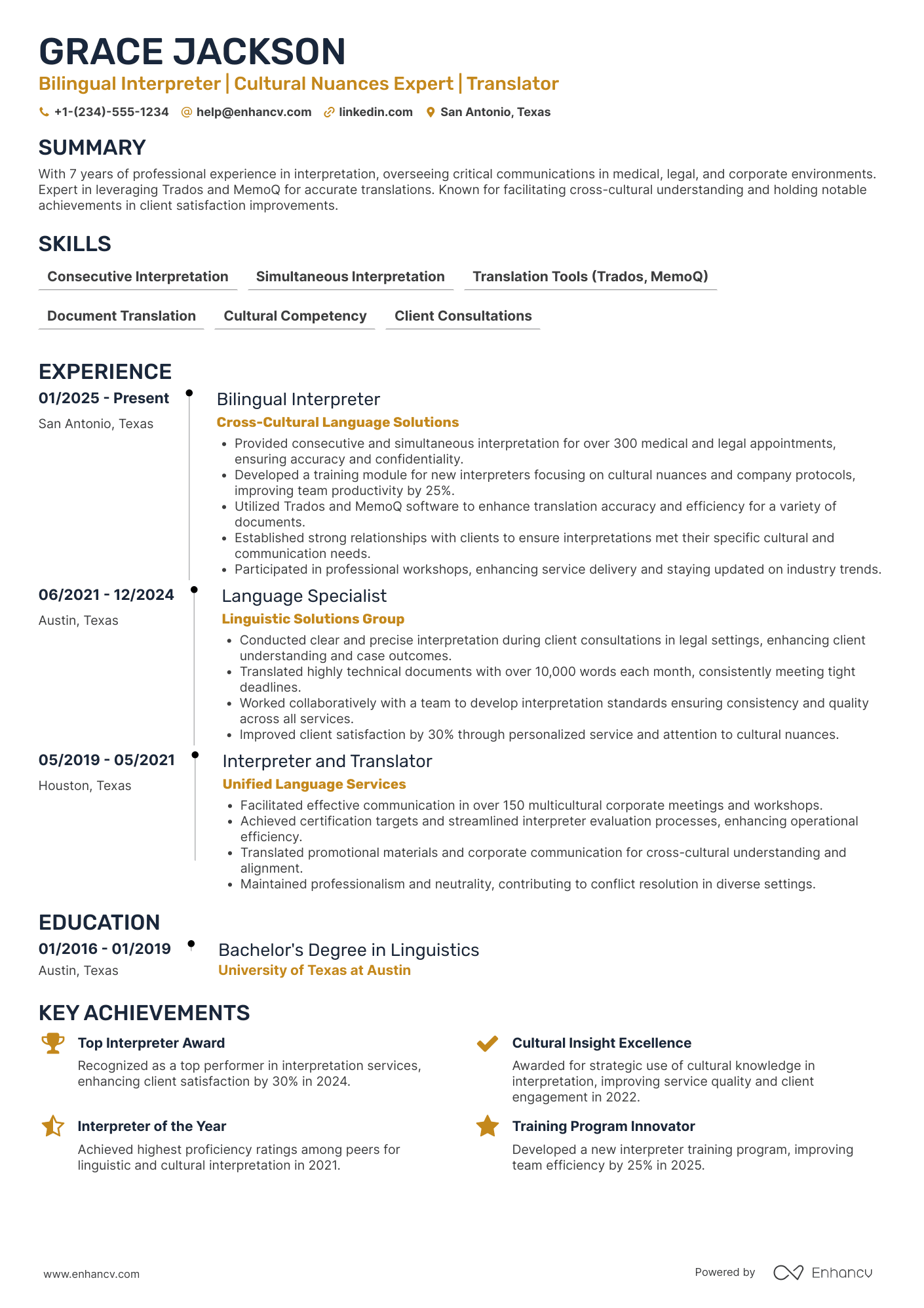
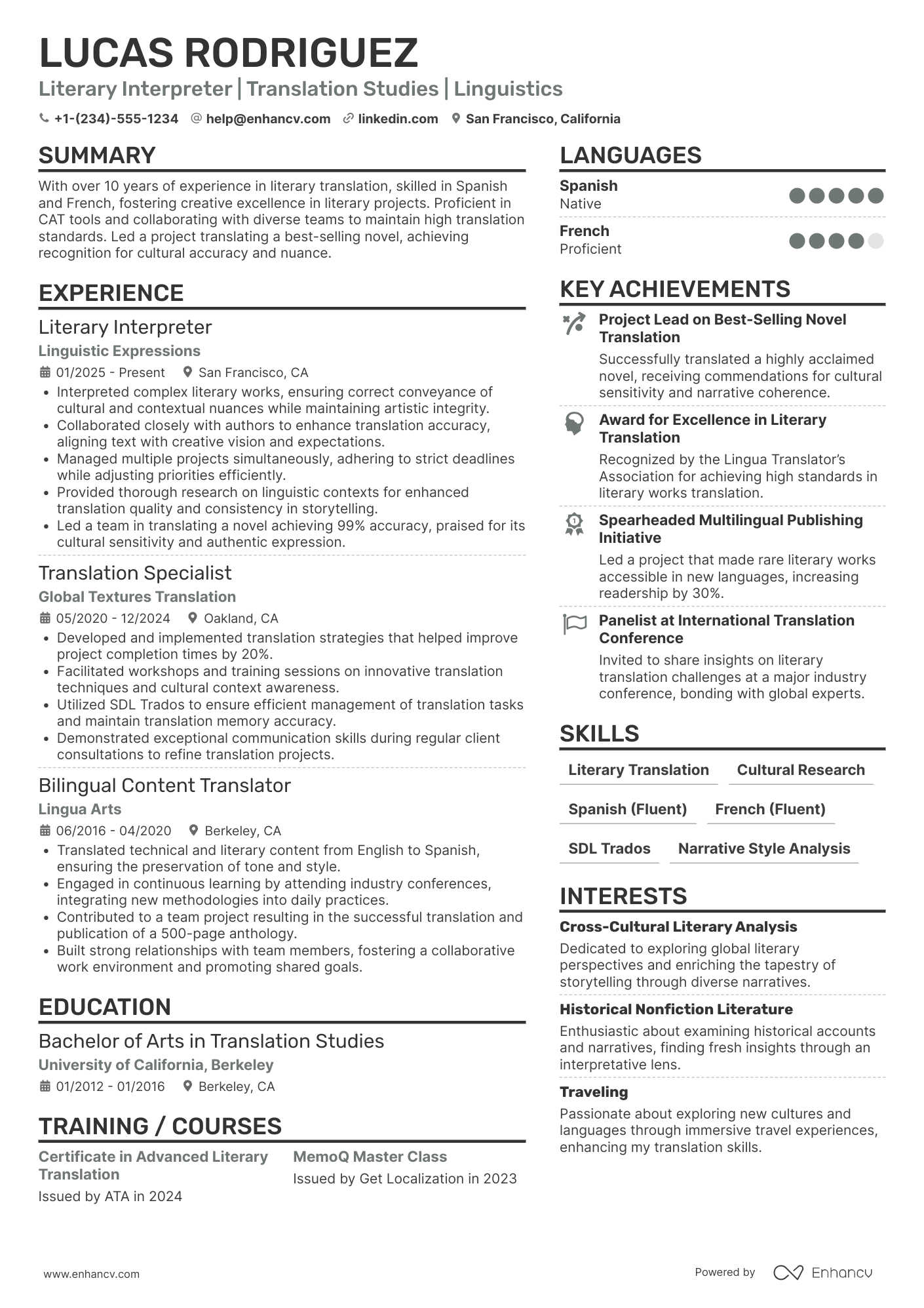
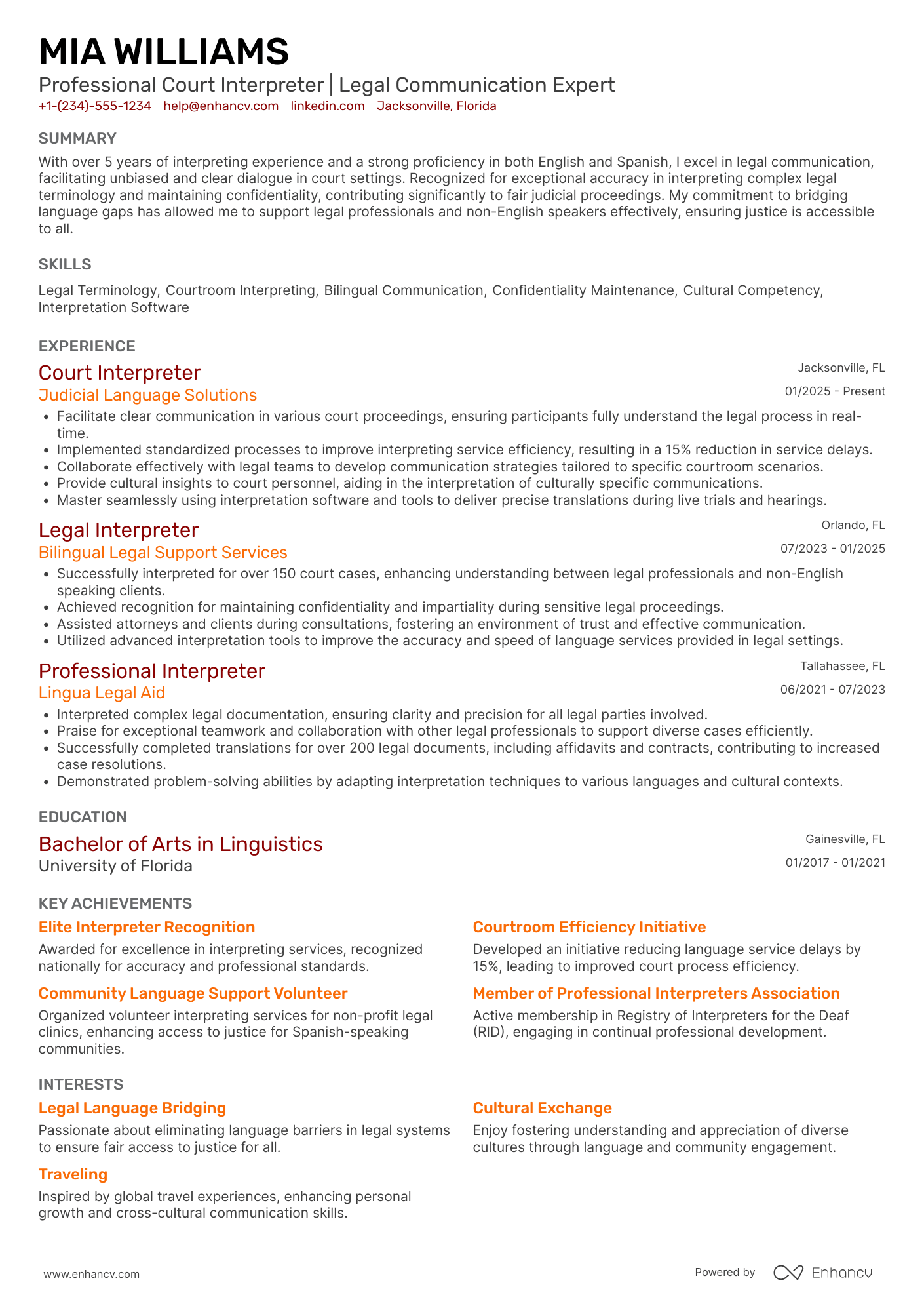
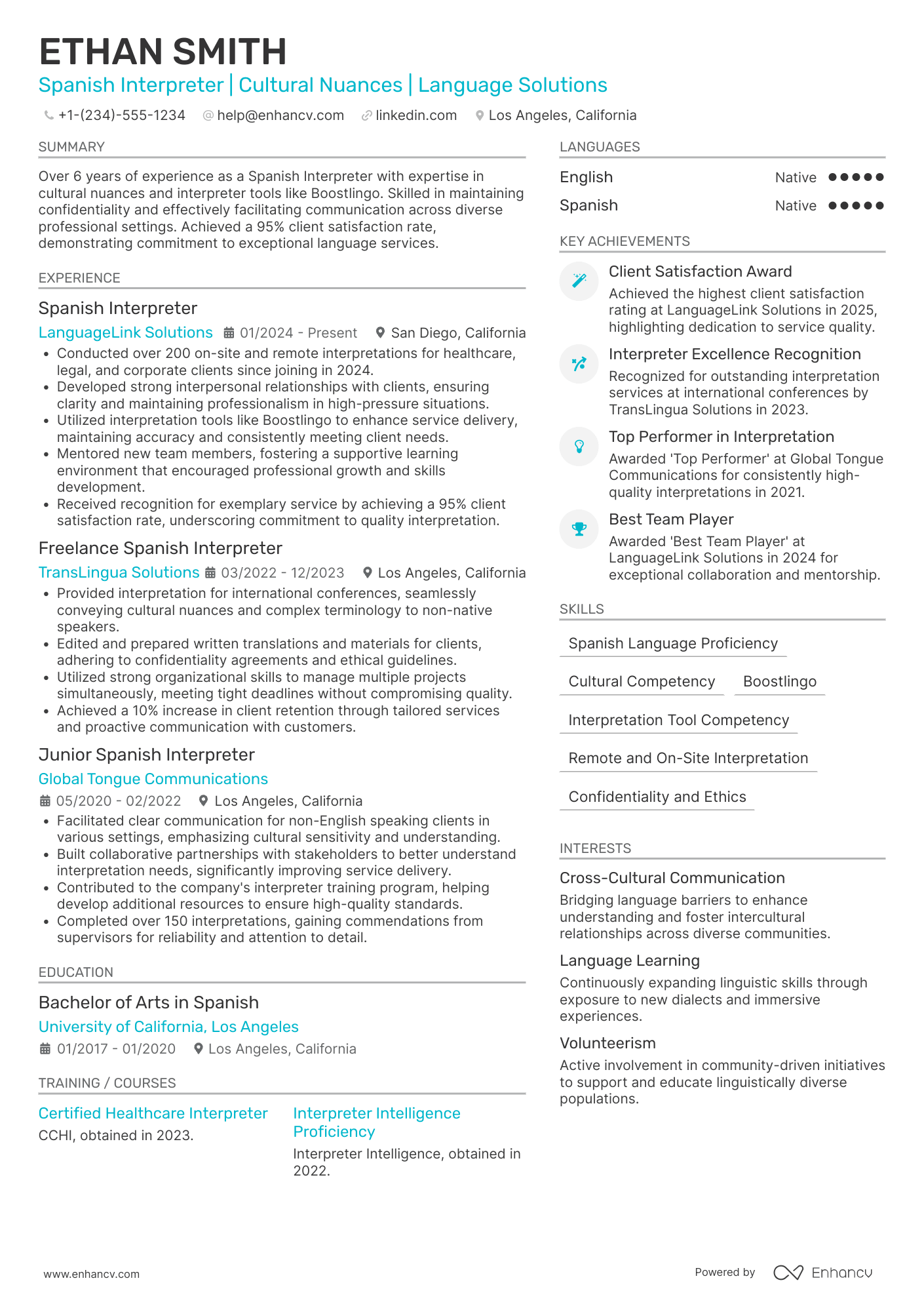
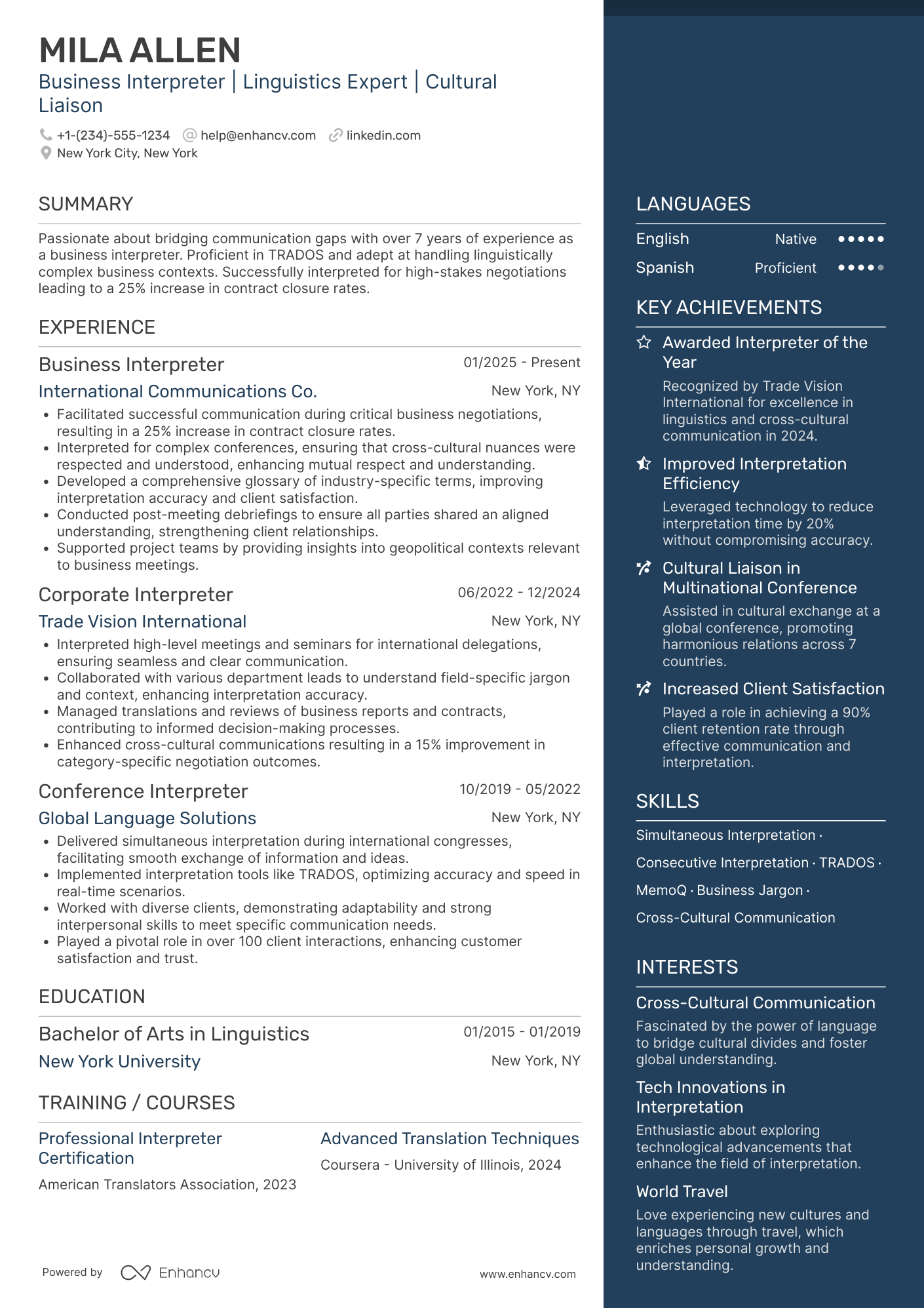
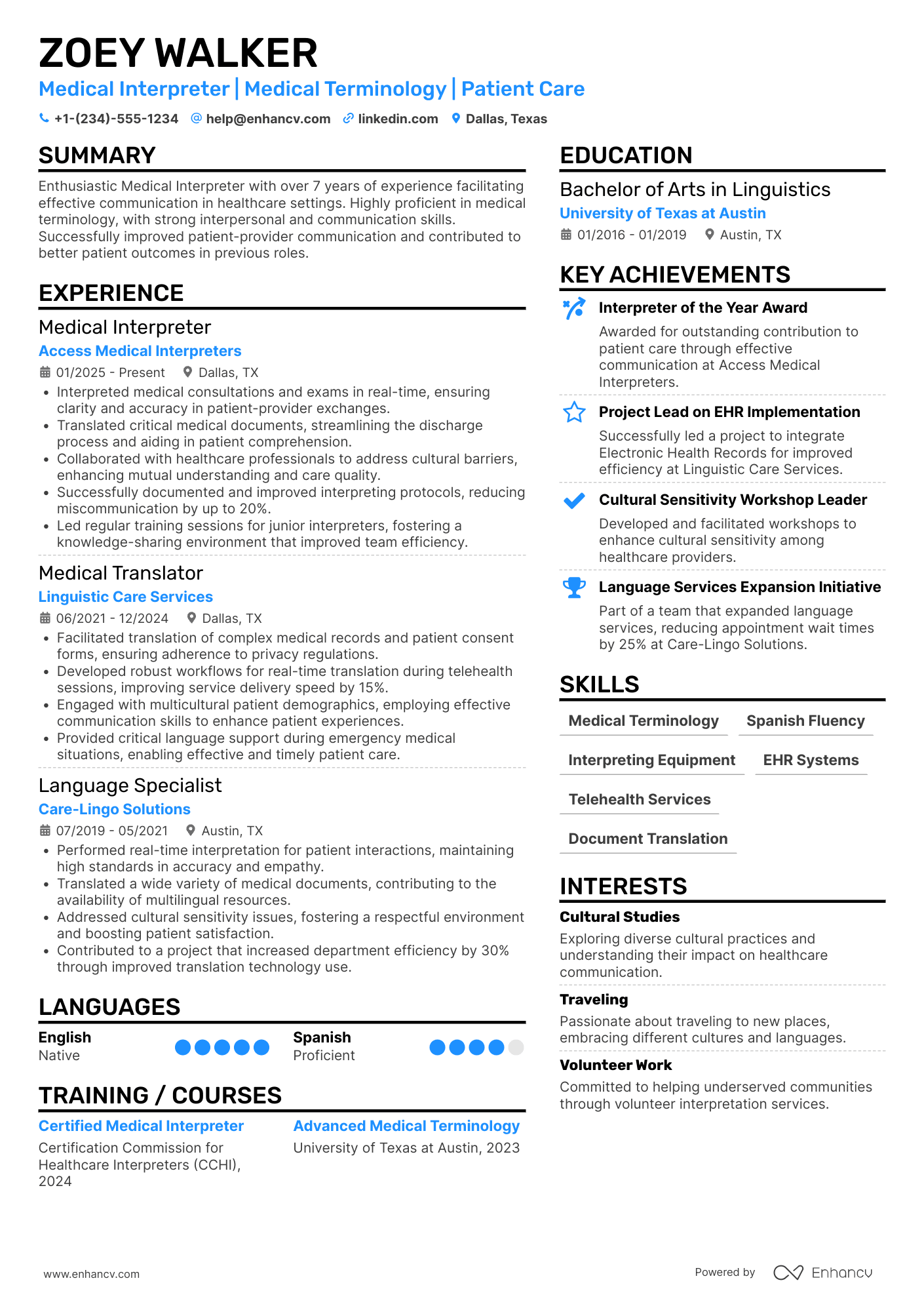
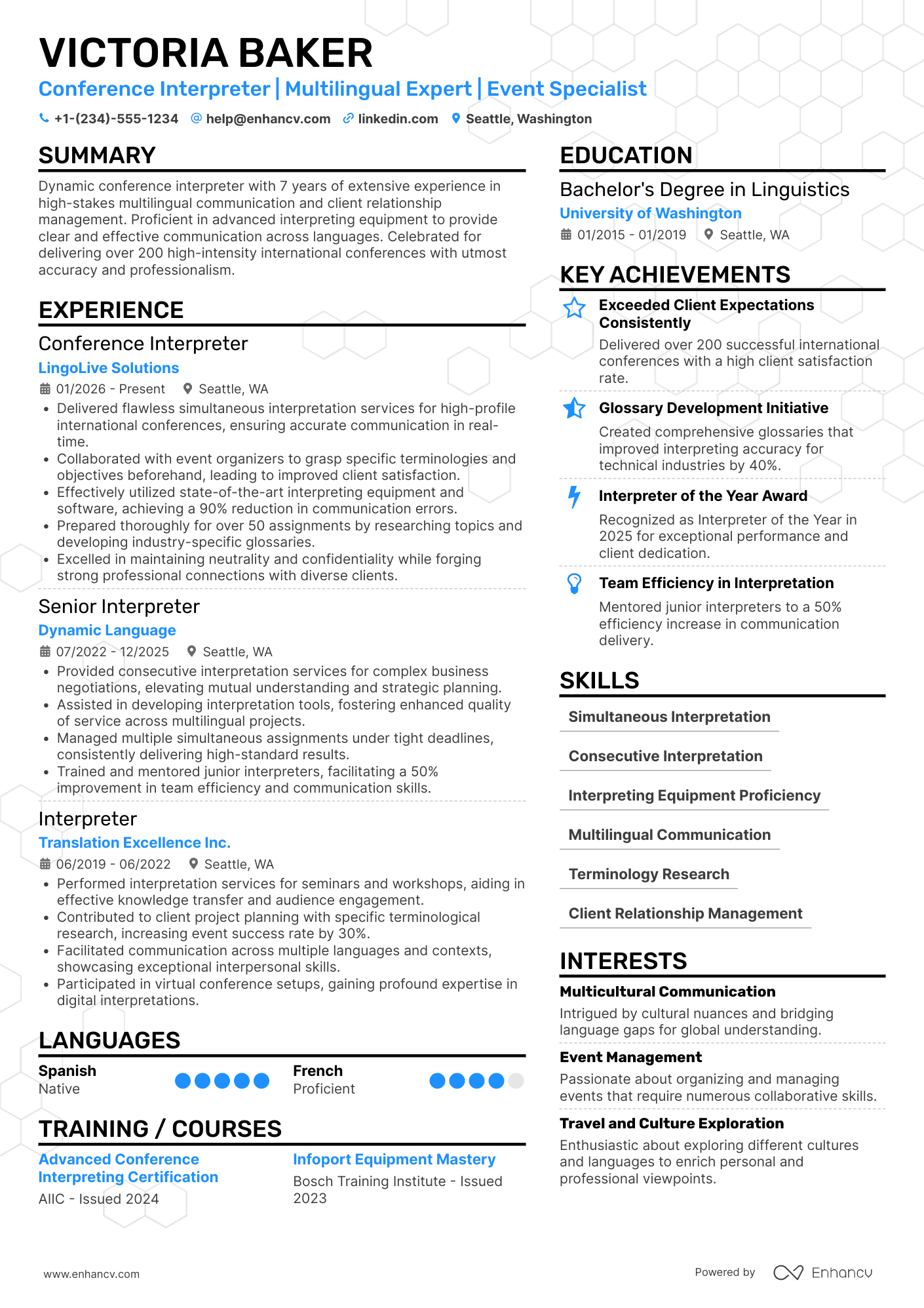
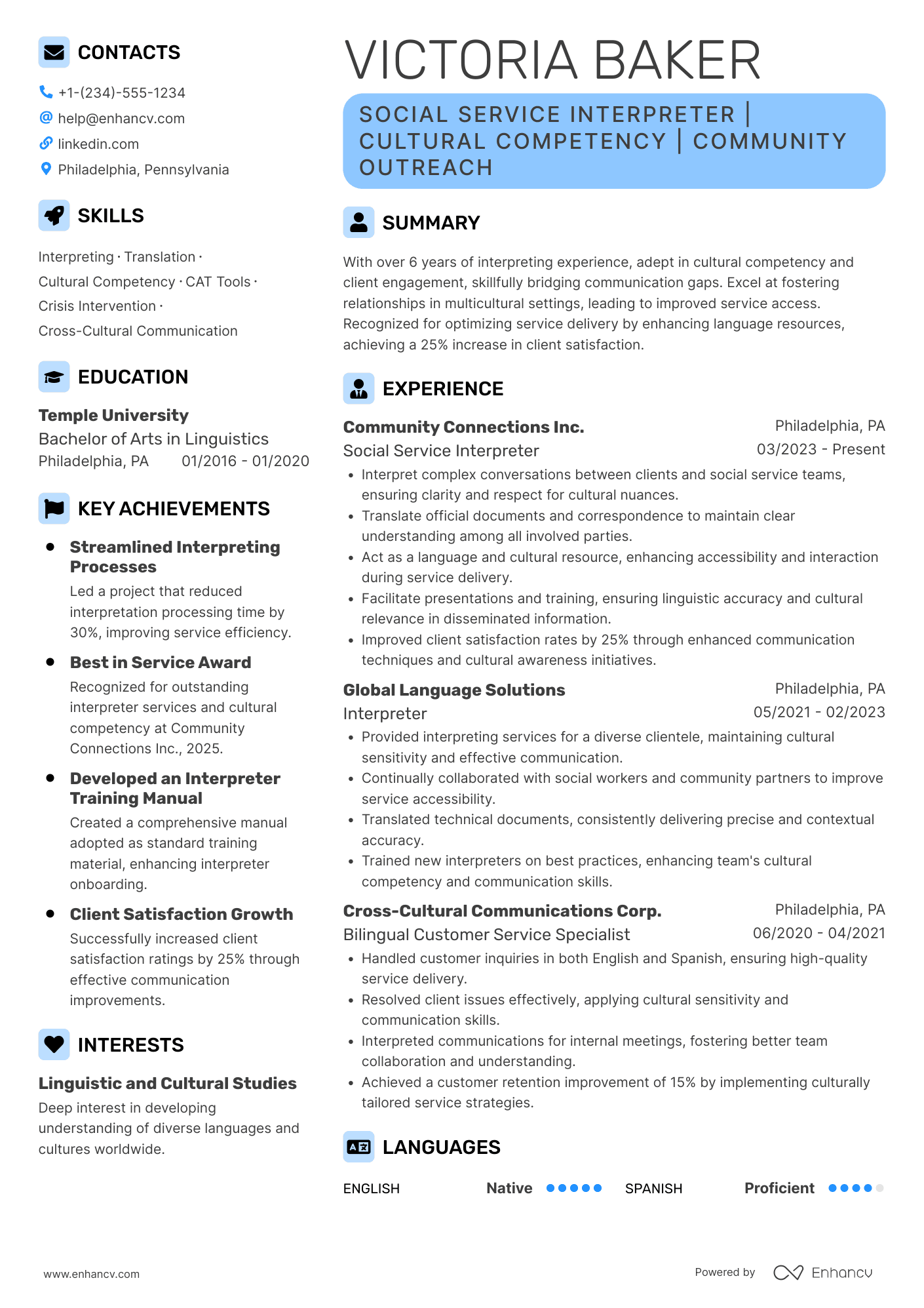
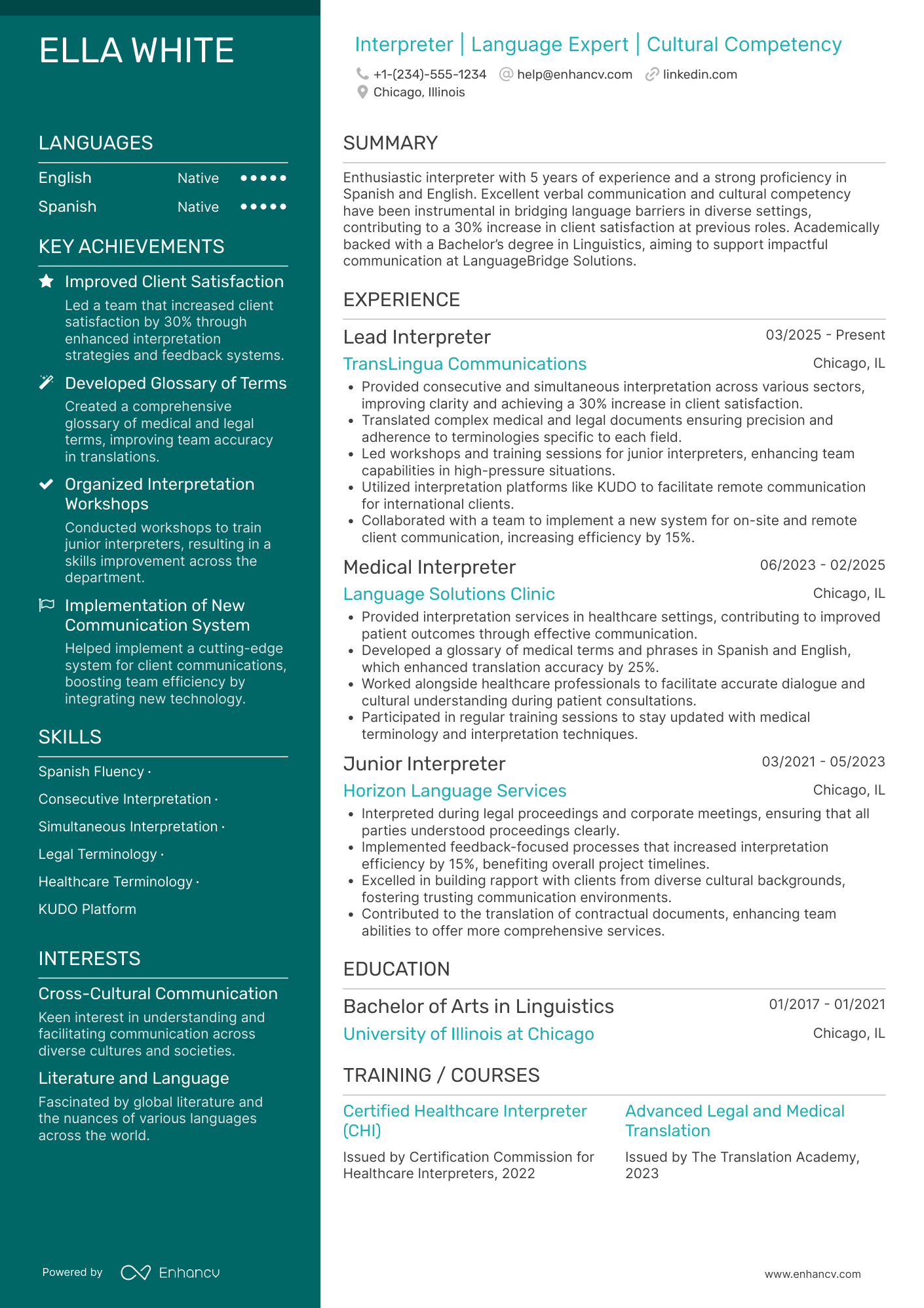
Many interpreter resume submissions fail because they describe language pairs and duties but don't prove accuracy, confidentiality, and domain readiness. That makes them easy to reject during ATS screening and rapid recruiter scans in a competitive market.
A strong resume shows what you delivered and who benefited. Knowing how to make your resume stand out means highlighting on-time session coverage across clinics or court calendars, low error or correction rates, high satisfaction scores, and reduced appointment delays. Show volumes handled, sensitive cases supported, and consistent terminology quality.

Key takeaways
- Quantify interpreting outcomes like session volume, accuracy rates, and satisfaction scores on every resume.
- Tailor language pairs, interpreting modes, and domain terms to match each job posting exactly.
- Use reverse-chronological format for experienced interpreters and hybrid format for career changers.
- Place certifications above education when they're recent and required for your target role.
- Prove skills inside experience bullets rather than listing them only in a standalone section.
- Enhancv can help you turn vague interpreter duties into measurable, recruiter-ready bullet points.
- Stop using AI once your resume accurately reflects real experience—never invent or inflate claims.
Job market snapshot for interpreters
We analyzed 772 recent interpreter job ads across major US job boards. These numbers help you understand salary landscape, regional hotspots, skills in demand at a glance.
What level of experience employers are looking for interpreters
| Years of Experience | Percentage found in job ads |
|---|---|
| 1–2 years | 4.9% (38) |
| 3–4 years | 1.6% (12) |
| 5–6 years | 0.6% (5) |
| 9–10 years | 0.1% (1) |
| 10+ years | 10.0% (77) |
| Not specified | 82.9% (640) |
Interpreter ads by area of specialization (industry)
| Industry (Area) | Percentage found in job ads |
|---|---|
| Healthcare | 56.3% (435) |
| Finance & Banking | 19.9% (154) |
| Education | 13.9% (107) |
| Government | 7.6% (59) |
| Retail & E-commerce | 1.3% (10) |
Top companies hiring interpreters
| Company | Percentage found in job ads |
|---|---|
| Language Services Associates | 30.3% (234) |
| Propio | 7.9% (61) |
| TransPerfect | 7.6% (59) |
| Language Line | 3.1% (24) |
| State of Florida | 1.3% (10) |
| The Stepping Stones Group | 1.3% (10) |
Role overview stats
These tables show the most common responsibilities and employment types for interpreter roles. Use them to align your resume with what employers expect and to understand how the role is structured across the market.
Day-to-day activities and top responsibilities for a interpreter
| Responsibility | Percentage found in job ads |
|---|---|
| English | 18.7% (144) |
| American sign language | 15.2% (117) |
| Spanish | 14.0% (108) |
| Interpreting | 10.5% (81) |
| Medical terminology | 10.2% (79) |
| Microsoft word | 10.2% (79) |
| Ms office | 8.9% (69) |
| 8.8% (68) | |
| Web-based platforms | 8.5% (66) |
| Interpretation | 7.5% (58) |
| Windows | 7.5% (58) |
| Medical interpreting | 7.0% (54) |
Type of employment (remote vs on-site vs hybrid)
| Employment type | Percentage found in job ads |
|---|---|
| On-site | 71.1% (549) |
| Remote | 25.3% (195) |
| Hybrid | 3.6% (28) |
How to format a interpreter resume
Recruiters evaluating interpreter resumes prioritize language proficiency, subject-matter specialization, and documented experience across interpreting modes such as simultaneous, consecutive, and sight translation. A clean, well-structured resume format ensures these qualifications surface quickly during both human review and applicant tracking system (ATS) parsing.

I have significant experience in this role—which format should I use?
Use a reverse-chronological format to spotlight your depth of interpreting experience and progression across increasingly complex assignments. Do:
- Lead with your most recent roles, emphasizing scope—languages served, settings (legal, medical, conference), and volume of assignments or clients managed.
- Highlight interpreting certifications, specialized terminology domains, and tools such as CAT software, remote simultaneous interpreting platforms, or booth equipment.
- Quantify outcomes wherever possible, including accuracy benchmarks, caseloads, client satisfaction scores, or time-sensitive deliverables.
I'm junior or switching into this role—what format works best?
A hybrid format works best because it lets you lead with relevant language skills and interpreting competencies while still showing a concise work history. Do:
- Place a skills section near the top, listing language pairs, interpreting modes, and any certifications such as a court interpreter credential or medical interpreter training.
- Include volunteer interpreting, practicum hours, academic projects, or community-based assignments to demonstrate hands-on experience.
- Connect each entry to a clear outcome so recruiters see the link between your abilities and real-world results.
Why not use a functional resume?
A functional resume strips away the context recruiters need to evaluate where, when, and how you applied your interpreting skills, making it harder to verify specialization or progression. A functional format might be acceptable if you're transitioning from translation-only work, re-entering the workforce after an extended gap, or have limited formal interpreting employment—but only if every listed skill is tied directly to a specific project, assignment, or measurable outcome.
Once you've established a clean, readable format, the next step is deciding which sections to include so each one serves a clear purpose on your resume.
What sections should go on a interpreter resume
Recruiters expect your interpreter resume to show clear language coverage, interpreting settings, and measurable results. Understanding which resume sections to include helps you organize this information effectively.
Use this structure for maximum clarity:
- Header
- Summary
- Experience
- Skills
- Projects
- Education
- Certifications
- Optional sections: Languages, Volunteering, Awards
Strong experience bullets should emphasize accuracy, speed, compliance, and outcomes across high-stakes encounters, including volume, complexity, and client or patient satisfaction.
Is your resume good enough?
Drop your resume here or choose a file. PDF & DOCX only. Max 2MB file size.
Now that you’ve organized the key resume components employers expect, use the next steps to write your interpreter resume experience so each role supports those sections with clear, relevant details.
How to write your interpreter resume experience
Your experience section proves you can deliver accurate, effective interpretation in real-world settings—not just that you've held interpreter positions. Hiring managers prioritize demonstrated impact, such as successful assignments completed, specialized terminology mastered, and communication outcomes achieved, over generic task descriptions. Building a targeted resume ensures each entry speaks directly to the role you're pursuing.
Each entry should include:
- Job title
- Company and location (or remote)
- Dates of employment (month and year)
Three to five concise bullet points showing what you owned, how you executed, and what outcomes you delivered:
- Ownership scope: the languages, subject domains, client accounts, or interpretation settings you were directly responsible for, whether in legal, medical, conference, community, or corporate environments.
- Execution approach: the interpretation modes, technologies, and preparation methods you relied on—such as simultaneous or consecutive techniques, remote interpretation platforms, glossary development, or terminology research workflows.
- Value improved: the changes you drove in communication accuracy, session efficiency, cultural accessibility, client comprehension, or compliance with institutional language-access standards.
- Collaboration context: how you coordinated with attorneys, healthcare providers, educators, government officials, event organizers, or other stakeholders to ensure seamless multilingual communication.
- Impact delivered: the outcomes your interpretation work produced, expressed through scope of assignments handled, client retention, expanded language coverage, or measurable improvements in service delivery rather than a list of duties performed.
Experience bullet formula
A interpreter experience example
✅ Right example - modern, quantified, specific.
Medical Interpreter (Spanish–English)
North Valley Health Network | Phoenix, AZ
2022–Present
Nonprofit health system supporting four outpatient clinics and a 220-bed hospital serving a high-volume, multilingual patient population.
- Interpreted Spanish–English for an average of thirty patient encounters per shift across emergency, obstetrics, oncology, and primary care using consecutive and sight translation, improving patient comprehension scores by 18% on post-visit surveys.
- Documented language needs, encounter notes, and informed-consent interpretation in Epic, reducing repeat clarification calls by 22% and cutting average discharge delays by twelve minutes per patient.
- Coordinated with physicians, nurses, and social workers to support rapid-response and end-of-life discussions, maintaining 98% on internal quality audits aligned to National Council on Interpreting in Health Care standards.
- Managed video remote interpreting and telehealth sessions via Zoom for Healthcare and LanguageLine, expanding same-day language coverage by 35% while keeping connection failure rates under 2%.
- Built a bilingual terminology glossary in SharePoint and delivered quarterly micro-trainings with the patient experience team, lowering terminology-related incident reports by 27% and improving new-interpreter ramp time by two weeks.
Now that you've seen what a strong experience section looks like in practice, let's break down how to tailor those details to match the specific interpreter role you're targeting.
How to tailor your interpreter resume experience
Recruiters evaluate your interpreter resume through applicant tracking systems and manual review, scoring candidates on how closely their experience matches the job posting. Tailoring your resume to the job description ensures the right skills, tools, and qualifications surface immediately.
Ways to tailor your interpreter experience:
- Match the specific language pairs and dialects listed in the posting.
- Mirror the interpretation mode referenced such as simultaneous or consecutive.
- Use the exact terminology for industry standards or certification requirements.
- Include domain experience in legal medical or conference settings when relevant.
- Highlight compliance with confidentiality protocols or ethical guidelines if mentioned.
- Reflect the collaboration workflows described such as team or remote interpreting.
- Align your technology skills with platforms or equipment named in the posting.
- Emphasize quality assurance or accuracy benchmarks the employer prioritizes.
Tailoring means aligning your real achievements with what the role demands, not forcing keywords where they don't belong.
Resume tailoring examples for interpreter
| Job description excerpt | Untailored | Tailored |
|---|---|---|
| Provide simultaneous interpretation for international trade conferences using Bosch digital infrared equipment, supporting English–Mandarin language pairs with specialized terminology in finance and export compliance. | Interpreted at various events and meetings for diverse audiences. | Delivered simultaneous English–Mandarin interpretation at 15+ international trade conferences annually, operating Bosch digital infrared systems and preparing specialized glossaries covering finance and export compliance terminology. |
| Perform consecutive and sight interpretation for immigration court proceedings, ensuring accuracy and compliance with NAJIT standards while supporting respondents with limited English proficiency. | Helped non-English speakers communicate during legal proceedings. | Performed consecutive and sight interpretation in federal immigration court hearings, maintaining strict compliance with NAJIT standards and achieving a 98% accuracy rate across 200+ proceedings for respondents with limited English proficiency. |
| Deliver over-the-phone interpretation (OPI) in medical settings using LanguageLine platform, interpreting between Spanish and English for patient intake, discharge instructions, and informed consent conversations in HIPAA-compliant environments. | Provided phone interpretation services for healthcare clients in Spanish and English. | Interpreted 40+ daily Spanish–English OPI calls via the LanguageLine platform for hospital patient intake, discharge, and informed consent workflows, adhering to HIPAA regulations and reducing average call handle time by 12%. |
Once you’ve aligned your experience with the role’s needs, the next step is to quantify your interpreter achievements so employers can see the impact of your work.
How to quantify your interpreter achievements
Quantifying your achievements shows how your interpreting improved accuracy, speed, and outcomes. Track sessions handled, accuracy and error rates, turnaround time, compliance incidents avoided, and satisfaction scores from patients, clients, or internal stakeholders.
Quantifying examples for interpreter
| Metric | Example |
|---|---|
| Volume handled | "Interpreted 18–25 medical visits per day across pediatrics and cardiology using Cyracom, maintaining complete documentation for 100% of encounters." |
| Accuracy rate | "Achieved 98% QA accuracy across 60 monitored calls by following NAATI-aligned terminology standards and using a personal glossary in Excel." |
| Turnaround time | "Reduced average on-demand connection time from 90 seconds to 35 seconds by standardizing intake prompts and hotkeys in LanguageLine." |
| Compliance risk | "Prevented zero confidentiality breaches across 1,200 sessions by enforcing HIPAA protocols and escalating sensitive cases through the approved chain." |
| Satisfaction score | "Raised clinician satisfaction from 4.3 to 4.7 out of five in three months by clarifying speaker turns and confirming understanding at key decision points." |
Turn vague job duties into measurable, recruiter-ready resume bullets in seconds with Enhancv's Bullet Point Generator.
Once you've crafted strong bullet points that highlight your accomplishments, the next step is ensuring your resume also presents the right balance of hard and soft skills that interpreting roles demand.
How to list your hard and soft skills on a interpreter resume
Your skills section shows language coverage, interpreting methods, and compliance—recruiters and ATS scan them to confirm role fit fast, so aim for a mix of role-specific hard skills and job-critical soft skills. interpreter roles require a blend of:
- Product strategy and discovery skills.
- Data, analytics, and experimentation skills.
- Delivery, execution, and go-to-market discipline.
- Soft skills.
Your skills section should be:
- Scannable (bullet-style grouping).
- Relevant to the job post.
- Backed by proof in experience bullets.
- Updated with current tools.
Place your skills section:
- Above experience if you're junior or switching careers.
- Below experience if you're mid/senior with strong achievements.

Hard skills
- Consecutive interpreting
- Simultaneous interpreting
- Sight translation
- Medical terminology
- Legal terminology
- HIPAA compliance
- Court interpreting protocols
- Remote interpreting platforms
- Zoom, Microsoft Teams, Webex
- Interpreter note-taking techniques
- Glossary and terminology management
- Audio equipment setup
Soft skills
- Clarify meaning in real time
- Maintain neutrality and boundaries
- Manage turn-taking and flow
- Ask targeted clarification questions
- Adapt register and tone
- Handle sensitive conversations
- Coordinate with clinicians and staff
- De-escalate misunderstandings
- Follow strict confidentiality
- Stay composed under pressure
- Give concise, accurate summaries
- Communicate scheduling constraints early
How to show your interpreter skills in context
Skills shouldn't live only in a bulleted list on your resume. Explore examples of resume skills to see how interpreters present their abilities effectively.
They should be demonstrated in:
- Your summary (high-level professional identity)
- Your experience (proof through outcomes)
Here's how that looks in practice.
Summary example
Senior conference interpreter with 12 years of experience delivering simultaneous and consecutive interpretation across legal and diplomatic settings. Proficient in RSI platforms and CAT tools. Reduced client miscommunication incidents by 35% through rigorous terminology management.
- Specifies senior-level experience clearly.
- Names role-relevant tools and platforms.
- Includes a concrete, measurable outcome.
- Highlights communication as a soft skill.
Experience example
Senior Conference Interpreter
Globo Language Solutions | Remote
March 2019–Present
- Delivered simultaneous interpretation for 200+ multilingual legal proceedings using Zoom and KUDO, achieving a 98% client satisfaction rate.
- Collaborated with legal teams to build specialized glossaries, reducing terminology errors by 40% across depositions.
- Mentored three junior interpreters on consecutive note-taking methods, improving their accuracy scores by 25% within six months.
- Every bullet includes measurable proof.
- Skills appear naturally within achievements.
Once you’ve demonstrated your interpreting strengths through concrete examples and outcomes, the next step is to translate that approach into a resume format that works even if you don’t have formal experience.
How do I write a interpreter resume with no experience
Even without full-time experience, you can demonstrate readiness through volunteering, practicum hours, and training projects. If you're building a resume without work experience, focus on structured substitutes that showcase your interpreting abilities:
- Community clinic interpreting volunteer shifts
- University language lab interpreting practicum
- Remote interpreting platform mock sessions
- Court observation and terminology notes
- Interpreting certificate program capstone
- Bilingual hotline call simulations
- Translation and interpretation portfolio samples
- Shadowing interpreters with debrief logs
Focus on:
- Language pairs and proficiency proof
- Interpreting hours and settings
- Glossaries, terminology, and accuracy checks
- Tools used and documented results
Resume format tip for entry-level interpreter
Use a combination resume format because it highlights interpreting skills and training before work history, while still showing structured experience substitutes. Do:
- Add a "Relevant Interpreting Experience" section.
- List each substitute like a job entry.
- Include hours, setting, and language pair.
- Name tools used, such as glossaries.
- Quantify outcomes, like accuracy rates.
- Completed twenty remote interpreting mock sessions using a custom medical glossary, improving terminology accuracy from 85% to 95% across five simulated patient intakes.
Even without professional interpreting experience, your education section can demonstrate the linguistic foundation and relevant training that qualify you for the role.
How to list your education on a interpreter resume
Your education section helps hiring teams confirm you have the linguistic training and foundational knowledge needed for interpreter roles. It validates your language proficiency and academic background quickly.
Include:
- Degree name
- Institution
- Location
- Graduation year
- Relevant coursework (for juniors or entry-level candidates)
- Honors & GPA (if 3.5 or higher)
Avoid listing specific months or days for your graduation date—use the year only.
Here's a strong education entry tailored for an interpreter resume.
Example education entry
Bachelor of Arts in Translation and Interpreting Studies
University of Maryland, College Park, MD
Graduated 2021
GPA: 3.8/4.0
- Relevant Coursework: Simultaneous Interpreting, Legal Translation, Cross-Cultural Communication, Advanced Spanish Linguistics
- Honors: Magna Cum Laude, Dean's List (all semesters)
How to list your certifications on a interpreter resume
Certifications on your resume show your commitment to learning, confirm tool proficiency, and signal industry relevance as an interpreter, especially for specialized settings and compliance-driven work. Include:
- Certificate name
- Issuing organization
- Year
- Optional: credential ID or URL
- Place certifications below education when your degree is recent and aligns closely with interpreter work, and your certifications are older or secondary.
- Place certifications above education when they are recent, highly relevant to your interpreter specialty, or required for the roles you target.
Best certifications for your interpreter resume
Certified Healthcare Interpreter (CCHI) Core Certification Healthcare Interpreter (CCHI) National Board Certified Medical Interpreter (NBCMI) Certified Deaf Interpreter (Registry of Interpreters for the Deaf) NIC Certification (Registry of Interpreters for the Deaf) Court Interpreter Certification (National Center for State Courts) Certificate in Legal Interpreting (American Translators Association)
Once you’ve presented your credentials in a clear, easy-to-scan format, you’re ready to write your interpreter resume summary so employers see their relevance right away.
How to write your interpreter resume summary
Your resume summary is the first thing a recruiter reads, so it sets the tone for your entire application. A strong summary instantly signals you have the language skills and interpreting experience the role demands.
Keep it to three to four lines, with:
- Your title and total years of interpreting experience.
- Domain or industry focus, such as medical, legal, or conference interpreting.
- Core skills like simultaneous interpretation, consecutive interpretation, or sight translation.
- One or two quantified achievements that show your real-world impact.
- Soft skills tied to outcomes, such as cultural sensitivity that improved client satisfaction.

PRO TIP
At this level, emphasize language pairs, relevant certifications, and early professional contributions. Highlight specific domains where you've built experience. Avoid vague phrases like "passionate communicator" or "hardworking team player." Replace them with concrete skills and measurable results.
Example summary for a interpreter
Bilingual Spanish-English interpreter with three years of experience in medical and legal settings. Provided consecutive interpretation for 500+ patient appointments annually. Certified in healthcare interpreting with strong cultural mediation skills.
Optimize your resume summary and objective for ATS
Drop your resume here or choose a file.
PDF & DOCX only. Max 2MB file size.
Now that your summary captures your interpreting strengths, make sure your resume header presents the contact details and professional information recruiters need to reach you.
What to include in a interpreter resume header
A well-crafted resume header lists your key identifiers and contact details, helping your interpreter application stand out in searches, build credibility, and pass recruiter screening fast.
Essential resume header elements
- Full name
- Tailored job title and headline
- Location
- Phone number
- Professional email
- GitHub link
- Portfolio link
Including a LinkedIn link helps recruiters confirm roles, dates, and recommendations quickly, which supports faster screening.
Don't include a photo on an interpreter resume unless the role is explicitly front-facing or appearance-dependent.
Match your header job title to the posting and add your language pair and modality so recruiters spot fit at a glance.
Interpreter resume header
Jordan Lee
Interpreter | Spanish-English Medical Interpreter (On-site, Phone, Video)
Austin, TX
(512) 555-01XX
jordan.lee@enhancv.com
github.com/jordanlee
yourwebsite.com
linkedin.com/in/jordanlee
Once you’ve set your contact details and role information up front, add the following optional sections to round out your interpreter resume with relevant supporting details.
Additional sections for interpreter resumes
When your core qualifications match other candidates, well-chosen additional sections can set your interpreter resume apart with deeper credibility. For example, listing language skills with specific proficiency levels helps recruiters quickly verify your linguistic range.
- Languages and proficiency levels
- Certifications and accreditations
- Professional affiliations
- Volunteer interpreting experience
- Publications and conference presentations
- Continuing education and specialized training
- Hobbies and interests
Once you've strengthened your resume with relevant additional sections, pairing it with a well-crafted cover letter can further set your application apart.
Do interpreter resumes need a cover letter
Most interpreter roles don't require a cover letter, but it helps in competitive openings or when the employer expects one. If you're unsure what a cover letter is and when it adds value, it can make a difference when your fit, context, or experience needs quick explanation.
Use a cover letter to add details your resume can't show:
- Explain role and team fit: match your interpreting modes, subject areas, and collaboration style to the setting and stakeholders.
- Highlight one or two relevant projects or outcomes: cite measurable impact like reduced errors, improved satisfaction scores, or faster turnaround.
- Show understanding of the product, users, or business context: reference the audience, compliance needs, terminology, and communication risks.
- Address career transitions or non-obvious experience: connect adjacent work to interpreter skills, and explain gaps, relocations, or language pair changes.
Drop your resume here or choose a file.
PDF & DOCX only. Max 2MB file size.
Even when you decide a cover letter won’t add value for an interpreter role, using AI to improve your interpreter resume helps you strengthen the document employers will rely on most.
Using AI to improve your interpreter resume
AI can sharpen your resume's clarity, structure, and impact. It helps refine language and highlight relevant skills. But overuse strips authenticity. Once your content reads clearly and aligns with your target role, step away from AI. If you're wondering which AI is best for writing resumes, start with tools that help you edit rather than generate from scratch.
Here are 10 practical prompts to strengthen specific sections of your interpreter resume:
- Strengthen your summary. "Rewrite my interpreter resume summary to highlight my language pairs, specialization, and years of experience in two concise sentences."
- Quantify your impact. "Add measurable results to these interpreter experience bullets, such as session volumes, accuracy rates, or client satisfaction scores."
- Tailor to a job posting. "Compare my interpreter resume skills section against this job description and suggest missing keywords I should include."
- Sharpen experience bullets. "Rewrite these interpreter experience bullet points using strong action verbs and remove any vague or redundant phrasing."
- Improve skills relevance. "Review my interpreter skills list and remove generic entries. Suggest industry-specific skills that match this job posting."
- Refine certification details. "Reformat my interpreter certifications section so each entry clearly lists the credential name, issuing body, and date earned."
- Clarify education entries. "Rewrite my interpreter resume education section to emphasize coursework, language training, and relevant academic achievements."
- Highlight project experience. "Turn this interpreter project description into three concise bullet points that emphasize scope, language pairs, and outcomes."
- Eliminate filler language. "Scan my interpreter resume for filler words, passive voice, and unnecessary adjectives. Suggest cleaner alternatives for each."
- Align tone and focus. "Adjust the tone of my interpreter resume so it sounds professional, confident, and specific to the healthcare interpreting field."
Stop using AI once your resume sounds accurate, specific, and aligned with real experience. AI should never invent experience or inflate claims—if it didn't happen, it doesn't belong here.
Conclusion
A strong interpreter resume shows measurable outcomes, role-specific skills, and a clear structure. It highlights accuracy, speed, and subject knowledge, backed by metrics like volume handled, on-time delivery, and client satisfaction.
Keep each section easy to scan and focused on the interpreter work you do best. With results, relevant skills, and clean formatting, your resume signals readiness for today’s hiring needs and near-future demands.
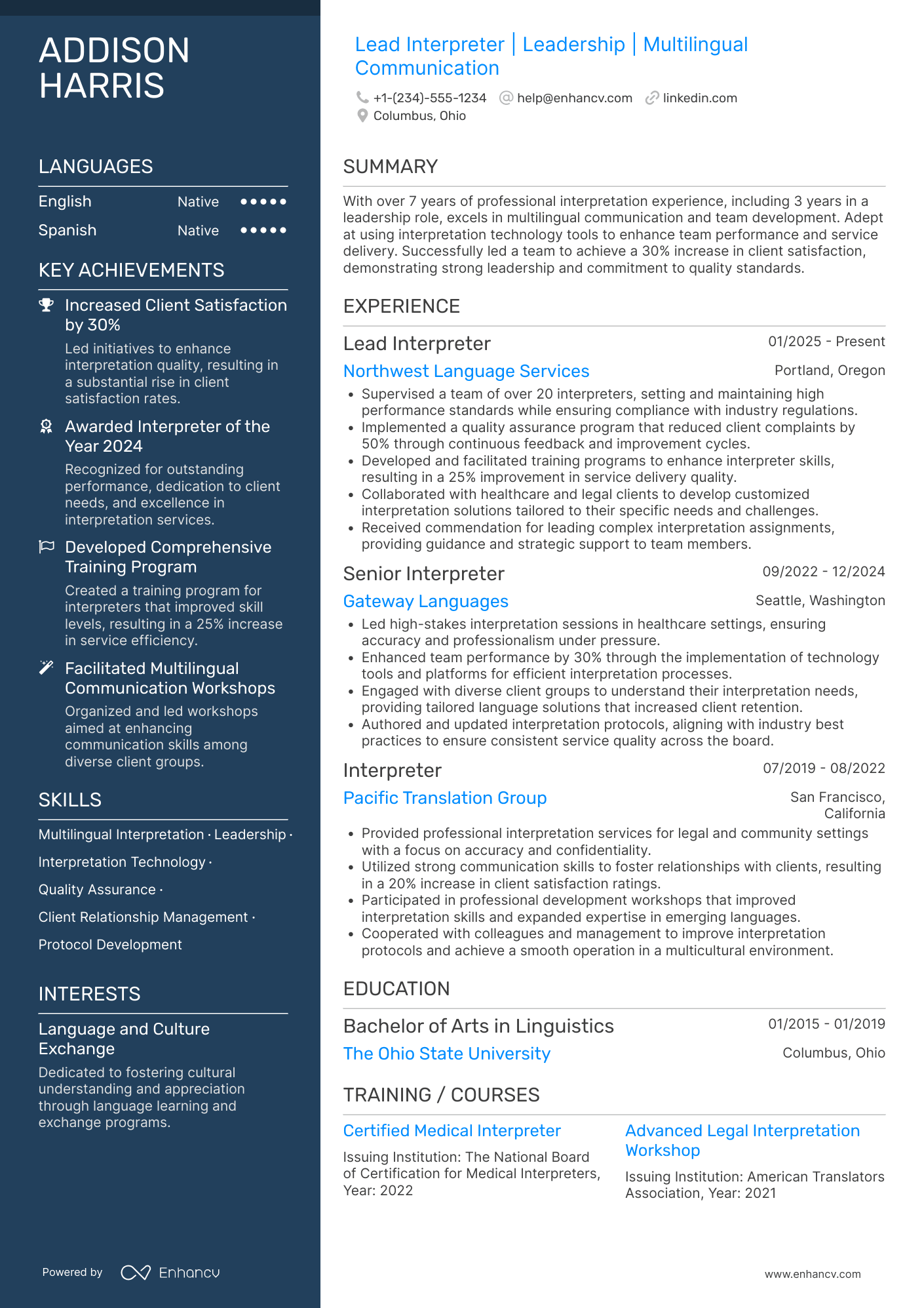
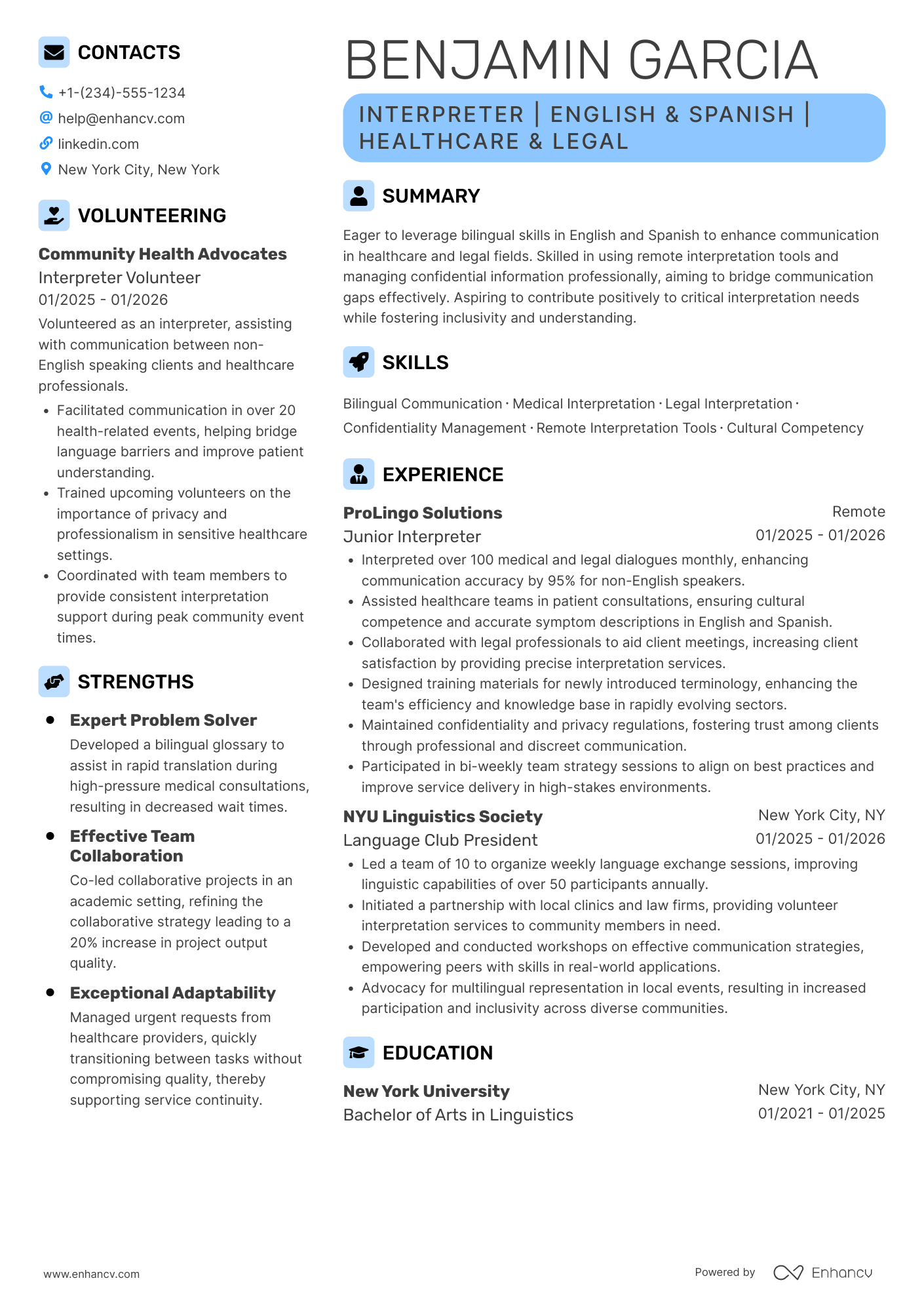
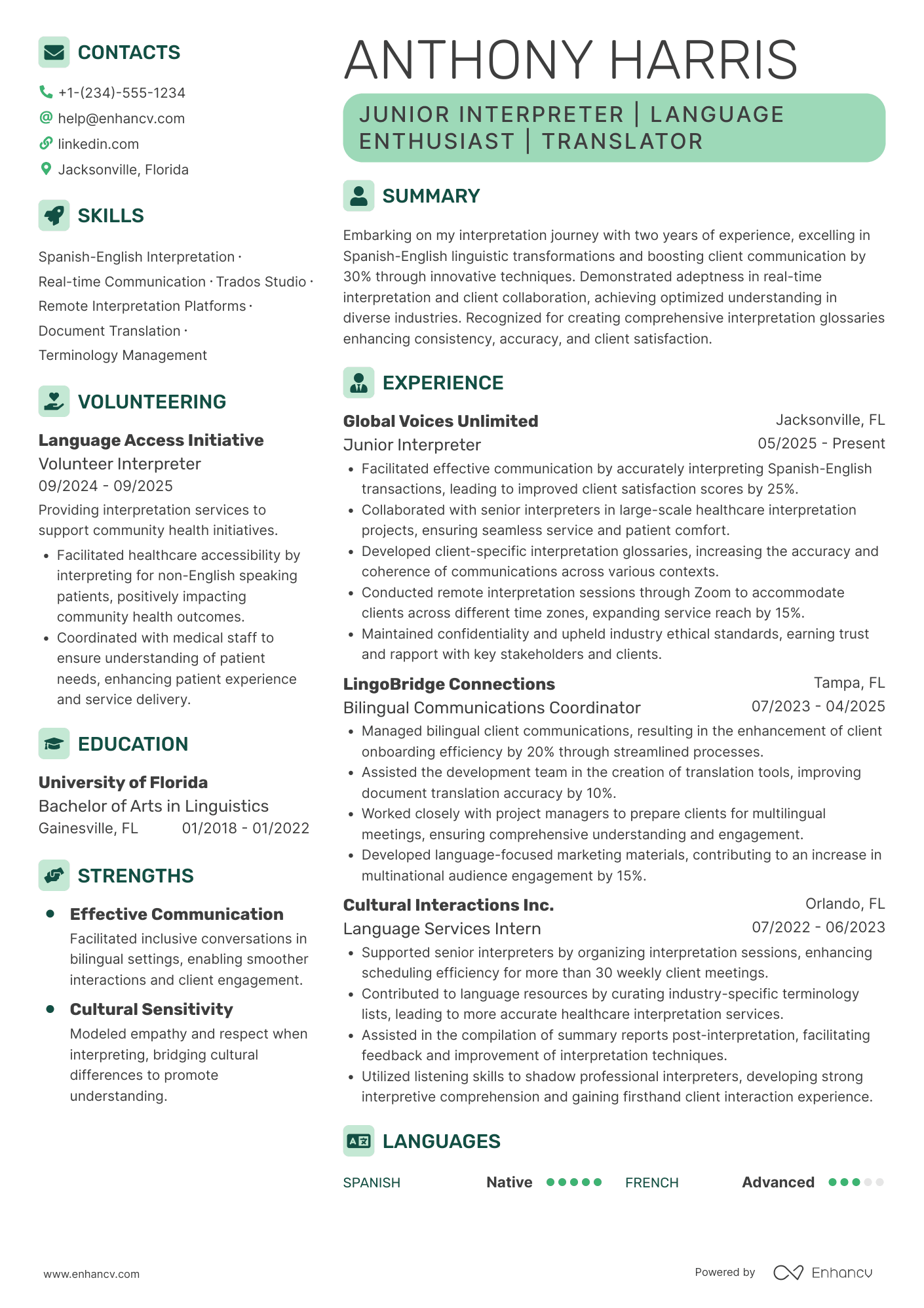
Interpreter resume examples
By Experience
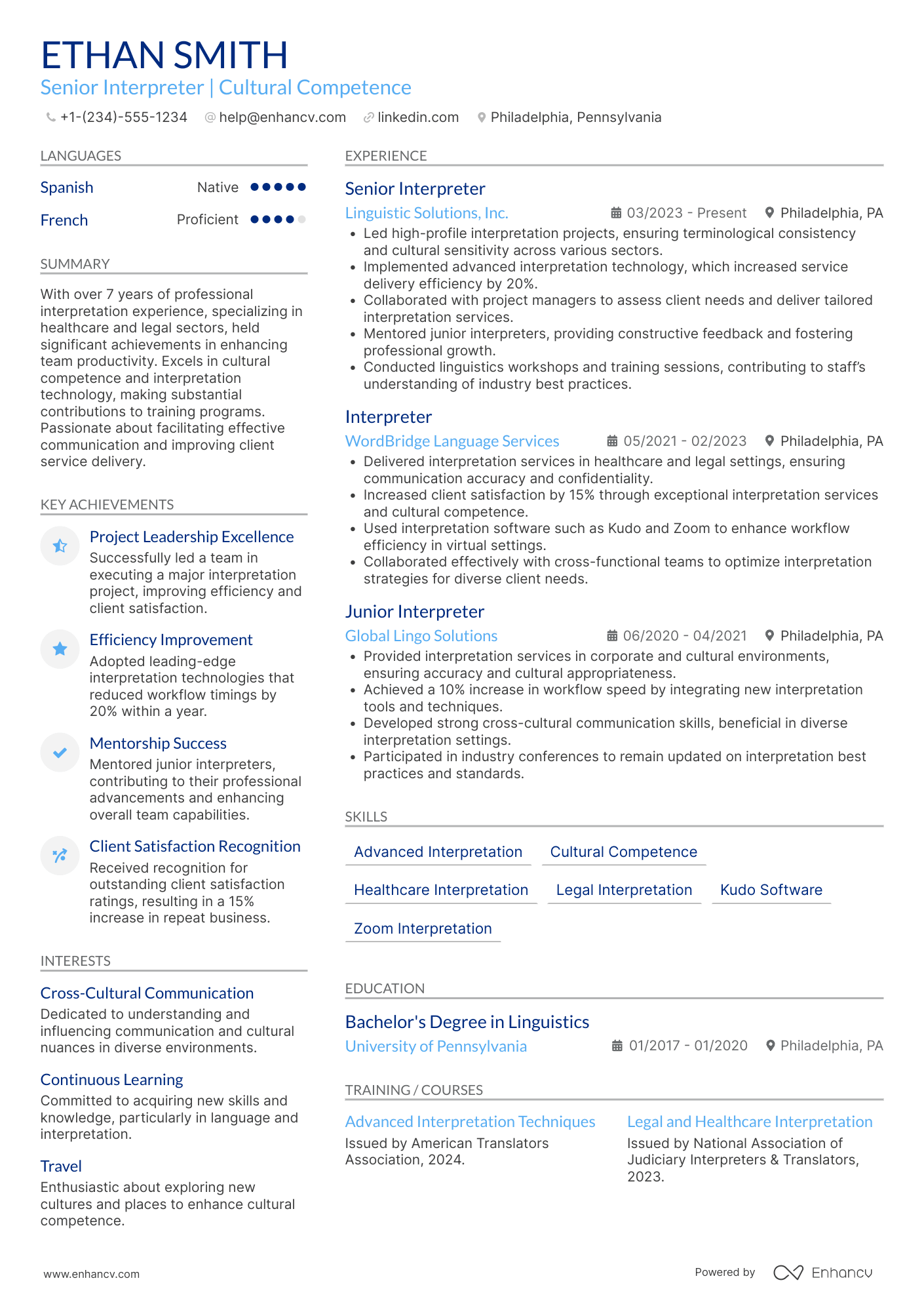
By Role