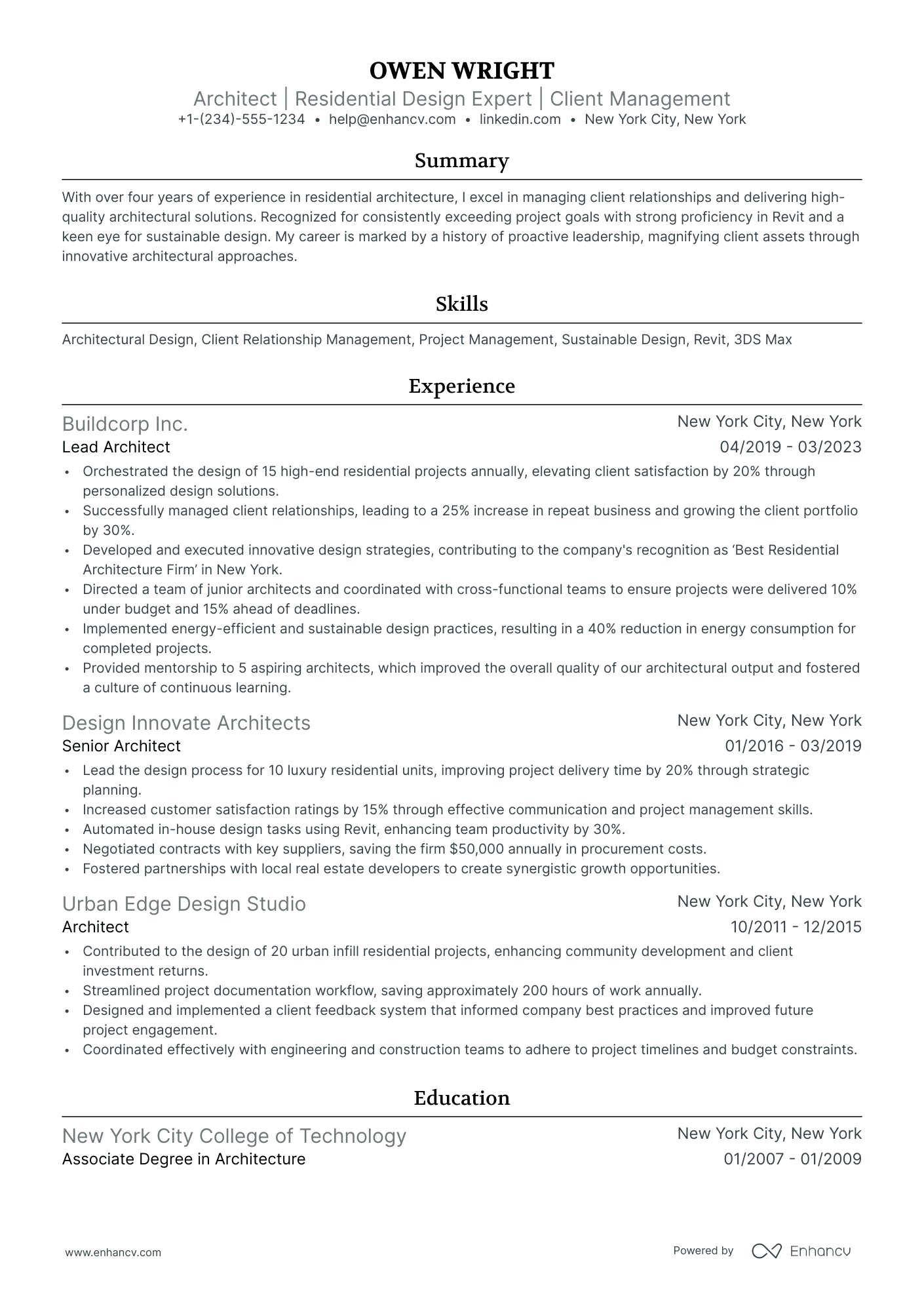
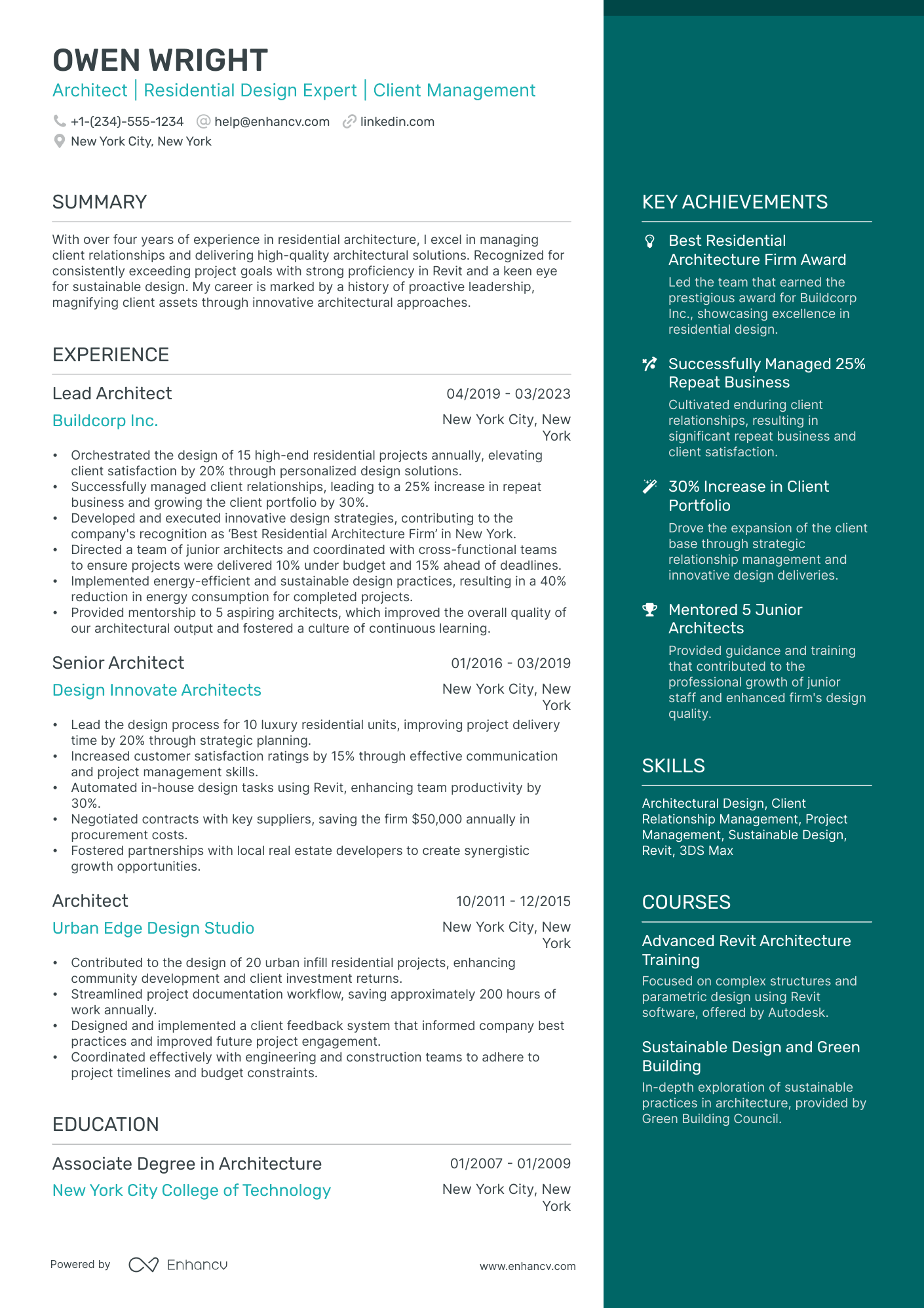
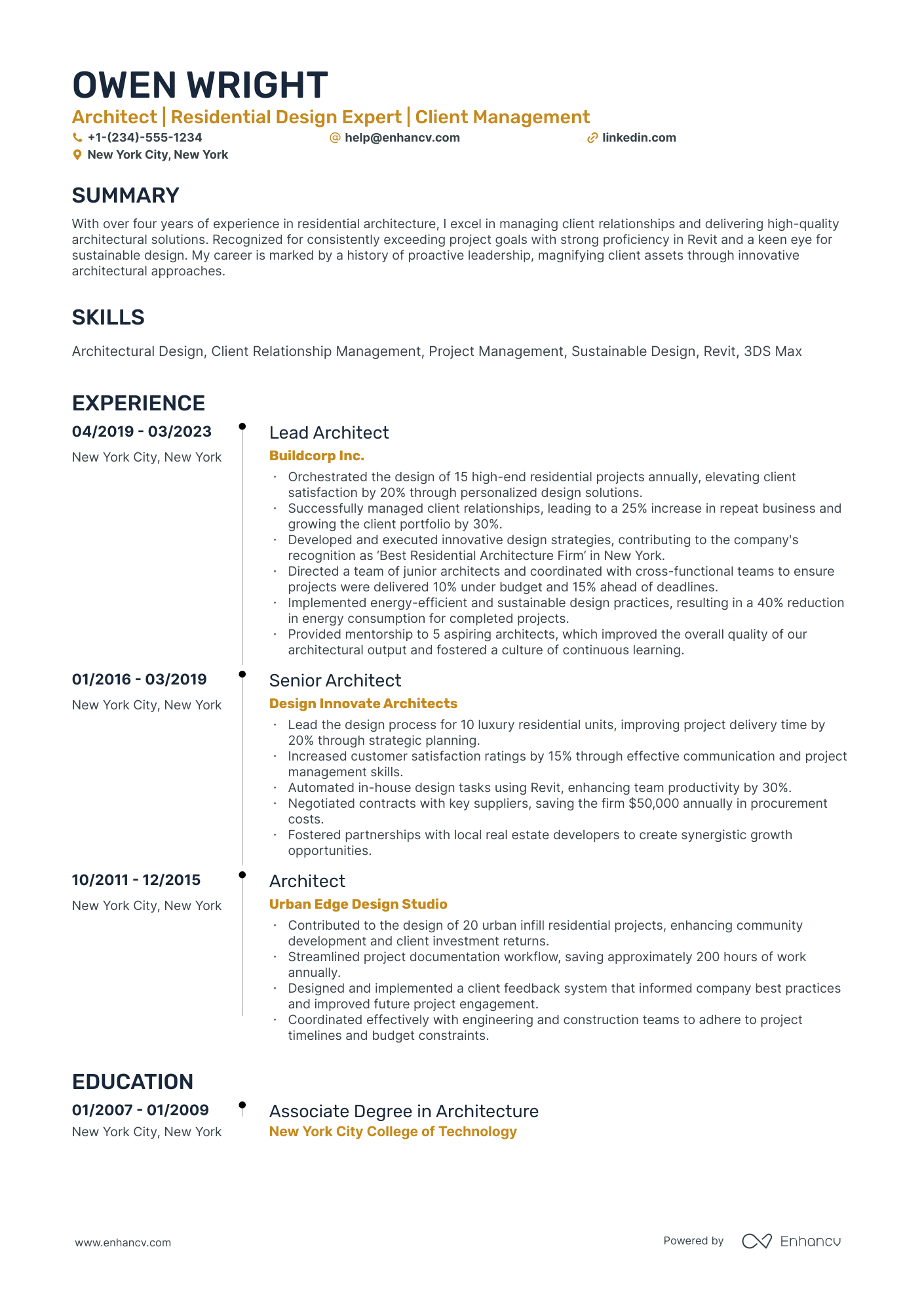
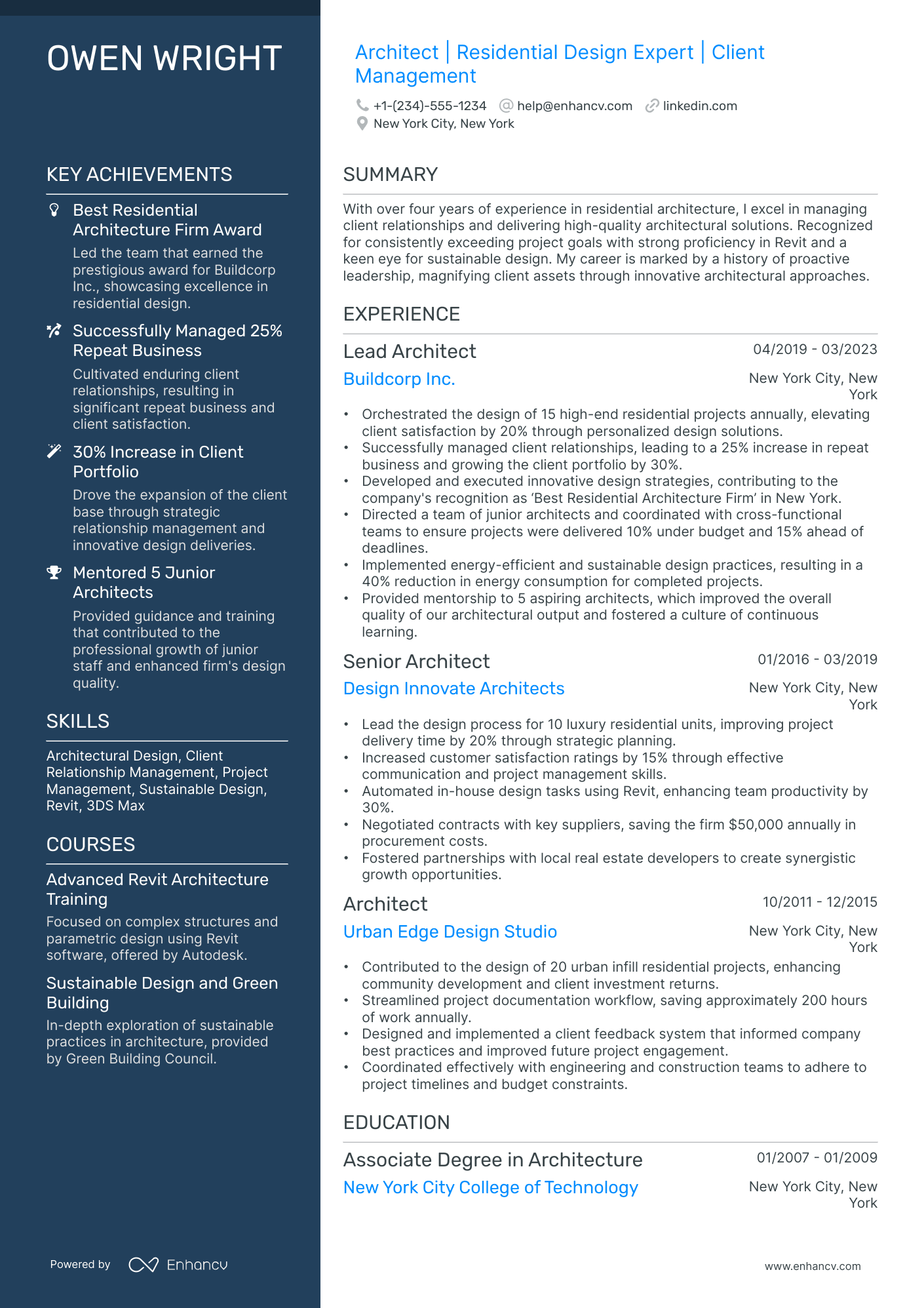
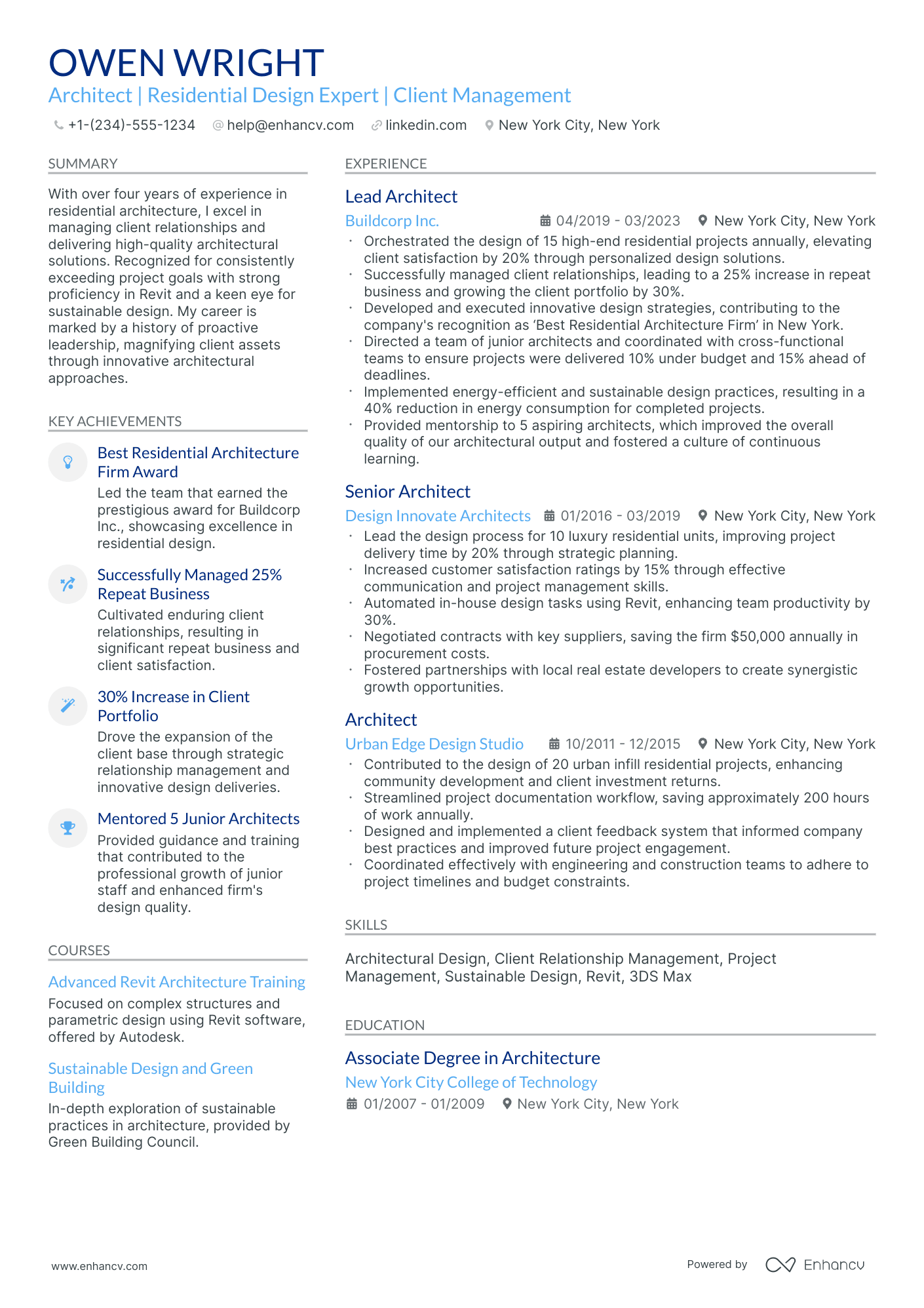
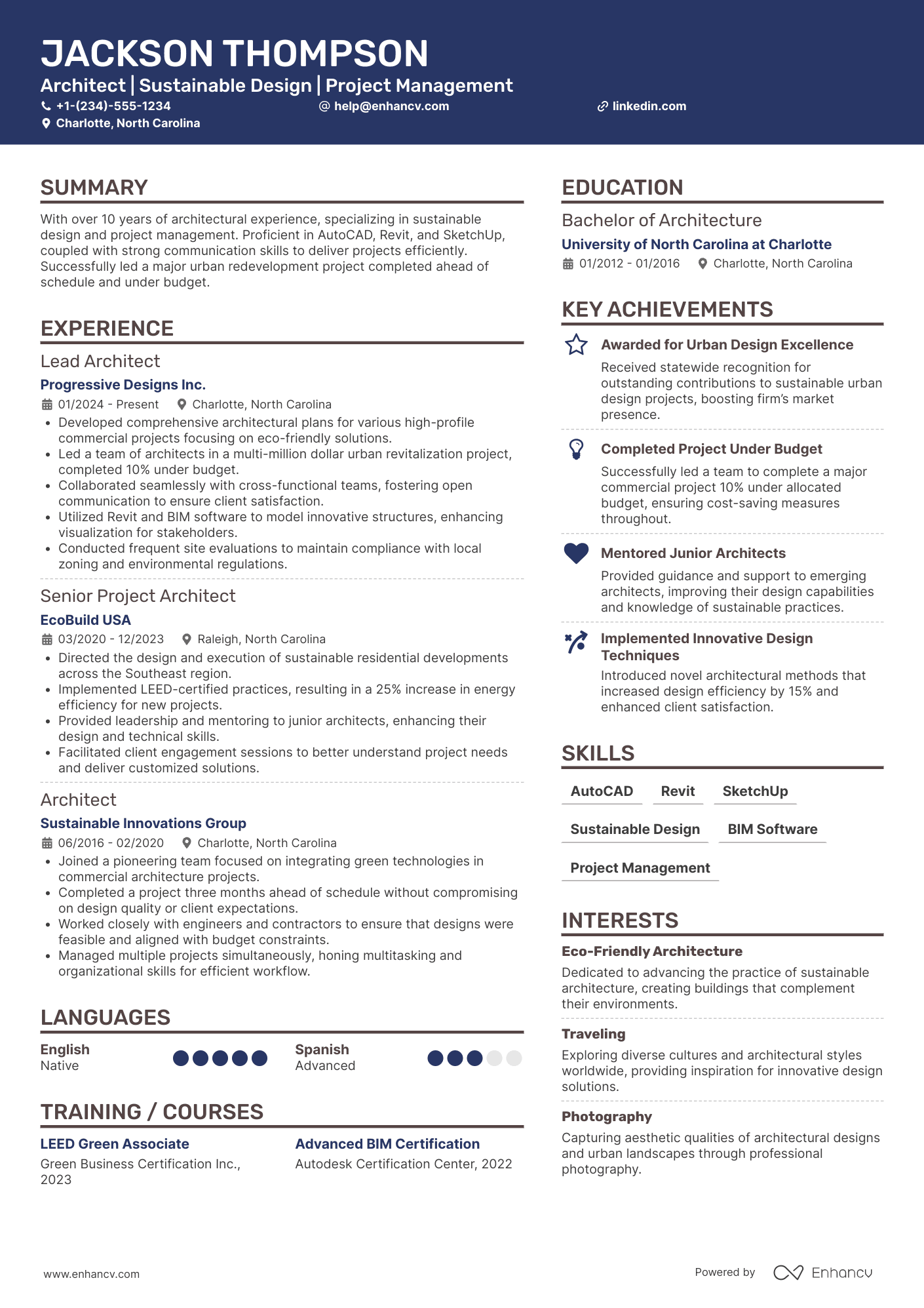
Most freelance architect resume submissions fail because they read like project diaries, not evidence of results. In today's hiring process, your freelance architect resume must survive ATS screening and fast recruiter scans in a crowded market. Understanding how to make your resume stand out is critical when competing against other freelance professionals.
A strong resume shows what you delivered and why it mattered. You should highlight budgets managed, square footage designed, permit approvals secured, schedule compression, change orders reduced, and punch list items closed faster. Tie work to client satisfaction, safety compliance, and measurable cost savings.

Key takeaways
- Quantify project outcomes like budgets, timelines, and change orders instead of listing daily tasks.
- Use reverse-chronological format for experienced architects and hybrid format for career switchers.
- Tailor every experience bullet to mirror the job posting's tools, codes, and project types.
- Place skills above experience if you're junior, below experience if you're senior.
- Tie each listed skill to a measurable result in your summary or experience section.
- Build your resume faster and more consistently using Enhancv's structured templates and tools.
- Include certifications like LEED AP or Revit Professional directly after your education section.
How to format a freelance architect resume
Recruiters evaluating freelance architects prioritize a diverse project portfolio, proficiency with industry-standard design tools, and the ability to manage client relationships independently. A clear, well-organized resume format ensures these signals—project scope, technical range, and self-directed delivery—are immediately visible rather than buried under inconsistent formatting. Paying attention to your resume layout is equally important for making a strong first impression.

I have significant experience in this role—which format should I use?
Use the reverse-chronological format to present your freelance engagements in order, giving recruiters a clear timeline of your project history and professional growth. Do:
- Lead each entry with project scope and client type (residential, commercial, institutional) to show the range of your independent practice.
- Highlight proficiency in role-specific tools and domains such as AutoCAD, Revit, SketchUp, BIM coordination, and local building code compliance.
- Quantify outcomes tied to budget management, project timelines, or client acquisition to demonstrate business impact.
I'm junior or switching into this role—what format works best?
A hybrid format works best, letting you lead with a strong skills section while still providing a timeline of relevant projects or employment. Do:
- Place your core competencies—such as drafting, 3D modeling, sustainable design principles, and zoning research—near the top of the resume so they're visible immediately.
- Include academic projects, internships, design competitions, or contract work that demonstrates architectural problem-solving, even if the experience wasn't a formal freelance engagement.
- Connect each action to a clear result: for example, "Applied parametric modeling in Grasshopper → developed a modular facade concept → reduced material waste estimates by 15% in the studio's feasibility study."
Why not use a functional resume?
A functional resume strips away the project-by-project context that hiring managers rely on to assess an architect's design range, client management ability, and delivery track record, making it the weakest choice for this role.
- Edge-case exception: A functional format may be acceptable if you're transitioning into freelance architecture from a related field (such as interior design or civil engineering), have a limited formal work history, or need to address significant resume gaps—but only if every listed skill is tied directly to a completed project or measurable outcome.
Once you've established a clean, readable format, the next step is deciding which sections to include and how to arrange them for maximum impact.
What sections should go on a freelance architect resume
Recruiters expect a freelance architect resume to show clear project delivery, client-facing work, and measurable results. Knowing what to put on a resume helps you prioritize the right information for your audience.
Use this structure for maximum clarity:
- Header
- Summary
- Experience
- Skills
- Projects
- Education
- Certifications
- Optional sections: Awards, Publications, Languages
Write experience bullets that highlight project scope, your role across phases, budget and schedule outcomes, client satisfaction, and measurable impact on approvals, costs, and buildability.
Is your resume good enough?
Drop your resume here or choose a file. PDF & DOCX only. Max 2MB file size.
Once you’ve organized your resume with the right building blocks, the next step is learning how to write your freelance architect resume experience so each role supports the structure and shows your impact.
How to write your freelance architect resume experience
Your work experience section proves you can independently deliver architectural work that meets client objectives and regulatory standards. Hiring managers prioritize demonstrated impact—shipped designs, resolved structural challenges, and measurable project outcomes—over descriptive task lists that simply catalog daily responsibilities.
Each entry should include:
- Job title
- Company and location (or remote)
- Dates of employment (month and year)
Three to five concise bullet points showing what you owned, how you executed, and what outcomes you delivered:
- Ownership scope: the building types, design phases, client accounts, or project portfolios you were directly accountable for as a freelance architect.
- Execution approach: the design software, building codes, construction documentation methods, or sustainable design frameworks you applied to move projects from concept through permitting and completion.
- Value improved: changes to energy performance, code compliance, construction timelines, cost efficiency, or spatial functionality that resulted from your architectural decisions.
- Collaboration context: how you coordinated with structural engineers, general contractors, municipal reviewers, interior designers, or clients to align design intent with technical and budgetary constraints.
- Impact delivered: outcomes expressed through project scale, client retention, approval rates, or built results rather than a summary of tasks performed.
Experience bullet formula
A freelance architect experience example
✅ Right example - modern, quantified, specific.
Freelance Architect
Independent Practice | Remote
2021–Present
Deliver end-to-end design and construction support for residential and light-commercial clients across three states.
- Led schematic design through construction administration for twelve projects (85,000 total square feet) using Revit, AutoCAD, and Bluebeam Revu, cutting average permit turnaround time by 22% through tighter code documentation.
- Produced coordinated BIM sets (architecture, structure, mechanical, electrical, and plumbing) and ran clash detection in Navisworks, reducing construction change orders by 18% across four ground-up builds.
- Managed consultant and client workflows with Procore and Microsoft Project—aligning civil, structural, and mechanical, electrical, and plumbing deliverables—saving an average of six weeks per project by resolving scope gaps before design development sign-off.
- Delivered photorealistic visualizations and material studies in Enscape and Adobe Creative Cloud, improving client approval rates from first design presentation to 90% and reducing revision cycles by 30%.
- Negotiated bids and administered contracts (AIA B101, A201) with owners, general contractors, and inspectors, holding construction costs within 3% of budget on eight projects while reducing request for information volume by 25% through clearer details.
Now that you've seen how a strong freelance architect experience section comes together, let's look at how to adjust yours to match the specific role you're targeting.
How to tailor your freelance architect resume experience
Recruiters evaluate your freelance architect resume through applicant tracking systems and manual review, filtering for specific qualifications. Tailoring your resume to the job description by mirroring the posting's language and priorities increases your chances of passing both screenings.
Ways to tailor your freelance architect experience:
- Match design software and BIM tools listed in the job description.
- Mirror the exact building codes and zoning standards referenced.
- Reflect project types like residential commercial or mixed-use explicitly.
- Align your sustainability certifications with LEED or WELL requirements mentioned.
- Incorporate the construction delivery methods the posting specifies.
- Highlight client collaboration and stakeholder coordination workflows described.
- Reference accessibility and ADA compliance if the role requires it.
- Echo the scale and scope metrics the employer uses for projects.
Tailoring means aligning your genuine project accomplishments with the employer's stated requirements, not forcing disconnected keywords into your experience bullets.
Resume tailoring examples for freelance architect
| Job description excerpt | Untailored | Tailored |
|---|---|---|
| Seeking a freelance architect to develop schematic designs and construction documents for mixed-use residential projects using Revit and AutoCAD, coordinating with structural and MEP consultants. | Worked on building designs and created various architectural documents for clients. | Developed schematic designs and full construction document sets in Revit and AutoCAD for three mixed-use residential projects (50–120 units), coordinating deliverables with structural and MEP consultants to meet permitting deadlines. |
| Freelance architect needed to lead code compliance reviews and zoning analysis for adaptive reuse projects in historic urban districts, ensuring adherence to local preservation guidelines. | Reviewed building codes and helped make sure projects followed regulations. | Led code compliance reviews and zoning analyses for four adaptive reuse projects in designated historic districts, resolving preservation guideline conflicts that reduced municipal revision requests by 40%. |
| Looking for a freelance architect to produce 3D renderings and client presentation packages in SketchUp and Enscape for boutique hospitality renovations, translating brand identity into spatial design concepts. | Created 3D models and presentations for different types of projects. | Produced photorealistic 3D renderings and client presentation packages in SketchUp and Enscape for six boutique hotel renovations, translating each brand's identity into spatial design concepts that secured owner approval in a single review cycle. |
Once you’ve aligned your experience with the role’s priorities, quantify your achievements to show the measurable impact of that work.
How to quantify your freelance architect achievements
Quantifying your achievements shows clients the results you delivered, not just the designs you produced. Track schedule, budget, change orders, permitting outcomes, construction issues, and sustainability performance across each project phase.
Quantifying examples for freelance architect
| Metric | Example |
|---|---|
| Budget control | "Delivered a 6,200-square-foot custom home design at $1.95M construction budget, reducing alternates by 18% through value engineering in Revit." |
| Delivery speed | "Cut schematic design turnaround from six weeks to four by standardizing details in Revit and Bluebeam, meeting a fast-track bid date." |
| Permitting success | "Secured first-pass approval for three tenant improvement permits in Los Angeles, avoiding resubmittals by coordinating code sheets and Title 24 forms." |
| Change orders | "Reduced construction change orders from 4.5% to 2.1% of contract value by tightening drawing coordination and resolving clashes before issue-for-bid." |
| Energy performance | "Improved modeled energy use intensity by 22% for a 28,000-square-foot office retrofit using energy modeling and high-performance envelope specs." |
Turn your everyday tasks into measurable, recruiter-ready resume bullets in seconds with Enhancv's Bullet Point Generator.
With strong, results-driven bullet points in place, the next step is ensuring your skills section equally highlights the hard and soft skills that set you apart as a freelance architect.
How to list your hard and soft skills on a freelance architect resume
Your skills section shows clients you can design, document, and deliver projects end-to-end, and recruiters and an ATS (applicant tracking system) scan this section for keyword match, so aim for a balanced mix of hard skills and role-specific soft skills.
freelance architect roles require a blend of:
- Product strategy and discovery skills
- Data, analytics, and experimentation skills
- Delivery, execution, and go-to-market discipline
- Soft skills
Your skills section should be:
- Scannable (bullet-style grouping).
- Relevant to the job post.
- Backed by proof in experience bullets.
- Updated with current tools.
Place your skills section:
- Above experience if you're junior or switching careers.
- Below experience if you're mid/senior with strong achievements.

Hard skills
- Schematic design, design development
- Construction documents, detailing
- Revit, BIM coordination
- AutoCAD drafting standards
- SketchUp, Rhino 3D modeling
- Enscape, Lumion rendering
- Adobe Creative Cloud
- Building codes, zoning analysis
- ADA compliance, life safety
- Specifications, CSI MasterFormat
- Consultant coordination, submittals
- Cost estimating, value engineering
Soft skills
- Run client discovery workshops
- Translate goals into scope
- Write clear fee proposals
- Negotiate scope and change orders
- Lead consultant coordination calls
- Present design options and tradeoffs
- Manage stakeholder expectations
- Make code-driven design decisions
- Prioritize tasks across projects
- Document decisions and approvals
- Resolve conflicts with contractors
- Own schedules and deliverables
How to show your freelance architect skills in context
Skills shouldn't live only in a list. Browse examples of resume skills shown in context to see how other professionals integrate them effectively.
They should be demonstrated in:
- Your summary (high-level professional identity)
- Your experience (proof through outcomes)
Here's what this looks like in practice.
Summary example
Freelance architect with 12 years of experience in sustainable commercial design. Skilled in Revit, BIM coordination, and parametric modeling. Delivered LEED-certified projects across 15 states, reducing average client energy costs by 22% through integrated passive design strategies.
- Signals senior-level expertise immediately
- Names industry-standard tools and methods
- Includes a concrete, measurable outcome
- Highlights client-focused communication skills
Experience example
Senior Freelance Architect
Pinehall Design Collaborative | Remote
March 2019–Present
- Led schematic design for a 40,000-square-foot mixed-use development using Revit and BIM 360, completing documentation 18% ahead of schedule.
- Collaborated with structural engineers and MEP consultants to resolve clashes early, cutting RFIs by 35% during construction administration.
- Developed sustainable design packages using parametric modeling in Grasshopper, helping three clients achieve LEED Gold certification.
- Every bullet includes measurable proof
- Skills appear naturally within real outcomes
Once you’ve demonstrated your architectural strengths through real project outcomes and client-ready deliverables, the next step is applying that same approach to building a freelance architect resume with no experience.
How do I write a freelance architect resume with no experience
Even without full-time experience, you can demonstrate readiness through relevant projects and transferable skills. Our guide on writing a resume without work experience covers this approach in detail. Consider showcasing:
- Studio design projects and critiques
- Permit set drafting for coursework
- Construction document sets for classes
- Competition entries with juried feedback
- Pro bono small space redesign
- Internship-adjacent contract drafting work
- Site surveys and as-built drawings
- BIM models and renderings portfolio
Focus on:
- Code-aware drawings and documentation
- Revit and AutoCAD deliverables
- Measurable outcomes and constraints
- Clear scope, budget, and timeline
Resume format tip for entry-level freelance architect
Use a combination resume format because it highlights project work and technical skills while still showing a clear timeline for credibility. Do:
- Put project experience above work history.
- Add a tools line: Revit, AutoCAD, Rhino.
- Write bullets with scope, tools, outcome.
- Include links to a curated portfolio.
- Name your role as freelance architect.
- Created Revit as-built model from site survey for a 900-square-foot retail suite, reducing field conflicts by 20% during contractor walkthrough.
Even without professional experience, your educational background can serve as the foundation of your resume—here's how to present it effectively.
How to list your education on a freelance architect resume
Your education section helps hiring teams confirm you hold the foundational design, engineering, and technical knowledge required for freelance architect roles. It validates your qualifications quickly.
Include:
- Degree name
- Institution
- Location
- Graduation year
- Relevant coursework (for juniors or entry-level candidates)
- Honors & GPA (if 3.5 or higher)
Skip month and day details—list the graduation year only.
Here's a strong education entry tailored for a freelance architect resume:
Example education entry
Bachelor of Architecture (B.Arch)
Cornell University, Ithaca, NY
Graduated 2019
GPA: 3.7/4.0
- Relevant Coursework: Sustainable Design Systems, Advanced Structural Analysis, Urban Planning Studio, Digital Fabrication Methods
- Honors: Dean's List, four consecutive semesters
How to list your certifications on a freelance architect resume
Certifications on a resume show a freelance architect's commitment to learning, mastery of specialized tools, and alignment with current industry standards and codes.
Include:
- Certificate name
- Issuing organization
- Year
- Optional: credential ID or URL
- Place certifications below education when your degrees are recent and your certifications add supporting context.
- Place certifications above education when they're recent, highly relevant to your services, or required for the roles you target.
Best certifications for your freelance architect resume
- LEED Green Associate
- LEED AP BD+C
- WELL AP
- Certified Passive House Designer (CPHD)
- Autodesk Certified Professional: Revit for Architectural Design
- CSI Construction Documents Technologist (CDT)
- Certified Construction Manager (CCM)
Once you’ve placed your credentials where recruiters can verify them quickly, shift to your freelance architect resume summary to show how those qualifications translate into value for clients.
How to write your freelance architect resume summary
Your resume summary is the first thing a recruiter reads, so it needs to earn attention fast. A strong opening tied to freelance architecture signals you're focused, qualified, and ready to deliver.
Keep it to three to four lines, with:
- Your title and total years of freelance or architectural experience.
- The domain you specialize in, such as residential, commercial, or mixed-use design.
- Core tools and skills like AutoCAD, Revit, SketchUp, or sustainable design principles.
- One or two measurable achievements, such as projects completed or budgets managed.
- Soft skills connected to real outcomes, like client communication that reduced revision cycles.

PRO TIP
At the freelance level, emphasize versatility, reliable project delivery, and technical skill with industry-standard tools. Highlight early wins that show client trust and tangible results. Avoid vague descriptors like "passionate" or "hardworking"—recruiters want proof, not promises.
Example summary for a freelance architect
Freelance architect with four years of experience designing residential and commercial projects in Revit and AutoCAD. Delivered 15+ client projects on time, reducing average revision rounds by 30% through proactive communication.
Optimize your resume summary and objective for ATS
Drop your resume here or choose a file.
PDF & DOCX only. Max 2MB file size.
Now that your summary captures your professional value, make sure your header presents the essential contact and branding details recruiters need to reach you.
What to include in a freelance architect resume header
A resume header lists your key identifying and contact details, helping freelance architect candidates boost visibility, credibility, and pass recruiter screening fast.
Essential resume header elements
- Full name
- Tailored job title and headline
- Location
- Phone number
- Professional email
- GitHub link
- Portfolio link
A LinkedIn link helps recruiters verify experience quickly, which supports faster screening decisions.
Do not include photos on a freelance architect resume unless the role is explicitly front-facing or appearance-dependent.
Keep your header on one to two lines, match your freelance architect headline to the role, and use consistent formatting across every platform.
Example
Freelance architect resume header
Jordan Taylor
Freelance architect | Residential remodels and permitting support
Austin, TX
(512) 555-01XX
your.name@enhancv.com
github.com/yourname
yourwebsite.com
linkedin.com/in/yourname
Once your contact details and professional branding are set at the top, add targeted additional sections to strengthen your freelance architect resume with relevant supporting information.
Additional sections for freelance architect resumes
Extra resume sections help a freelance architect stand out when core qualifications align closely with competing candidates.
They signal specialized expertise, cultural fit, and professional credibility beyond standard work history.
Consider adding these sections when they're directly relevant to the role:
- Languages
- Publications and design journals
- Professional affiliations and architecture organizations
- Awards and design competitions
- Conferences and speaking engagements
- Hobbies and interests tied to design or sustainability
- Volunteer work in community planning or habitat projects
Once you've strengthened your resume with relevant additional sections, the next step is pairing it with a cover letter to give your application even more context and impact.
Do freelance architect resumes need a cover letter
A cover letter isn't required for a freelance architect, but it helps in competitive roles or when clients expect one. If you're unsure where to start, learn what a cover letter is and how it complements your resume. It can make a difference when your fit, scope, or impact isn't obvious from the resume.
Use a cover letter to add context your freelance architect resume can't:
- Explain role or team fit by matching your workflow to their setup, including stakeholders, approvals, and handoffs.
- Highlight one or two relevant projects or outcomes with clear metrics, constraints, and your specific responsibilities as a freelance architect.
- Show understanding of the product, users, or business context by referencing their priorities, risks, and how you'd validate decisions.
- Address career transitions or non-obvious experience by connecting past work to the role's requirements and explaining the change in one sentence.
Drop your resume here or choose a file.
PDF & DOCX only. Max 2MB file size.
Once you’ve decided whether to include a cover letter based on the client and project, the next step is using AI to improve your freelance architect resume so you can tailor it faster and more consistently.
Using AI to improve your freelance architect resume
AI can sharpen your resume's clarity, structure, and overall impact. It helps tighten language and highlight measurable results. But overuse strips authenticity fast. Once your content feels clear and role-aligned, step away from AI entirely. For practical prompts and workflows, explore our guide on ChatGPT resume writing.
Here are 10 practical prompts you can copy and paste to strengthen specific sections of your freelance architect resume:
- Sharpen the summary: "Rewrite this freelance architect resume summary to highlight core specializations, project scope, and years of independent practice in under four sentences."
- Quantify project results: "Add measurable outcomes to these freelance architect experience bullets, such as budget savings, square footage delivered, or timelines met."
- Tighten experience bullets: "Edit these freelance architect experience entries to start with strong action verbs and remove any redundant or vague language."
- Align skills strategically: "Reorganize this freelance architect skills section to prioritize technical proficiencies most relevant to commercial design and residential renovation projects."
- Strengthen project descriptions: "Rewrite these freelance architect project entries to clearly state the client type, project scope, design approach, and final deliverable."
- Improve certification clarity: "Rephrase this freelance architect certifications section so each entry includes the credential name, issuing body, and year obtained."
- Refine education details: "Edit this freelance architect education section to emphasize relevant coursework, studio projects, or honors tied to architectural practice."
- Remove filler language: "Identify and remove all vague or filler phrases from this freelance architect resume without changing the core meaning of each bullet."
- Tailor for specialization: "Adjust this freelance architect resume to emphasize sustainable design experience, including LEED-related projects, materials knowledge, and energy modeling."
- Clarify client diversity: "Rewrite the freelance architect experience section to clearly distinguish between residential, commercial, institutional, and mixed-use project types."
Stop using AI once your resume sounds accurate, specific, and aligned with real experience. AI should never invent experience or inflate claims—if it didn't happen, it doesn't belong here.
Conclusion
A strong freelance architect resume highlights measurable outcomes, role-specific skills, and a clear structure. It shows project scope, budgets, timelines, and results, backed by tools, codes, and coordination skills.
Keep it easy to scan, consistent, and focused on how you deliver value across projects. This approach signals readiness for today’s hiring market and the near-future demand for flexible, accountable freelance architect talent.