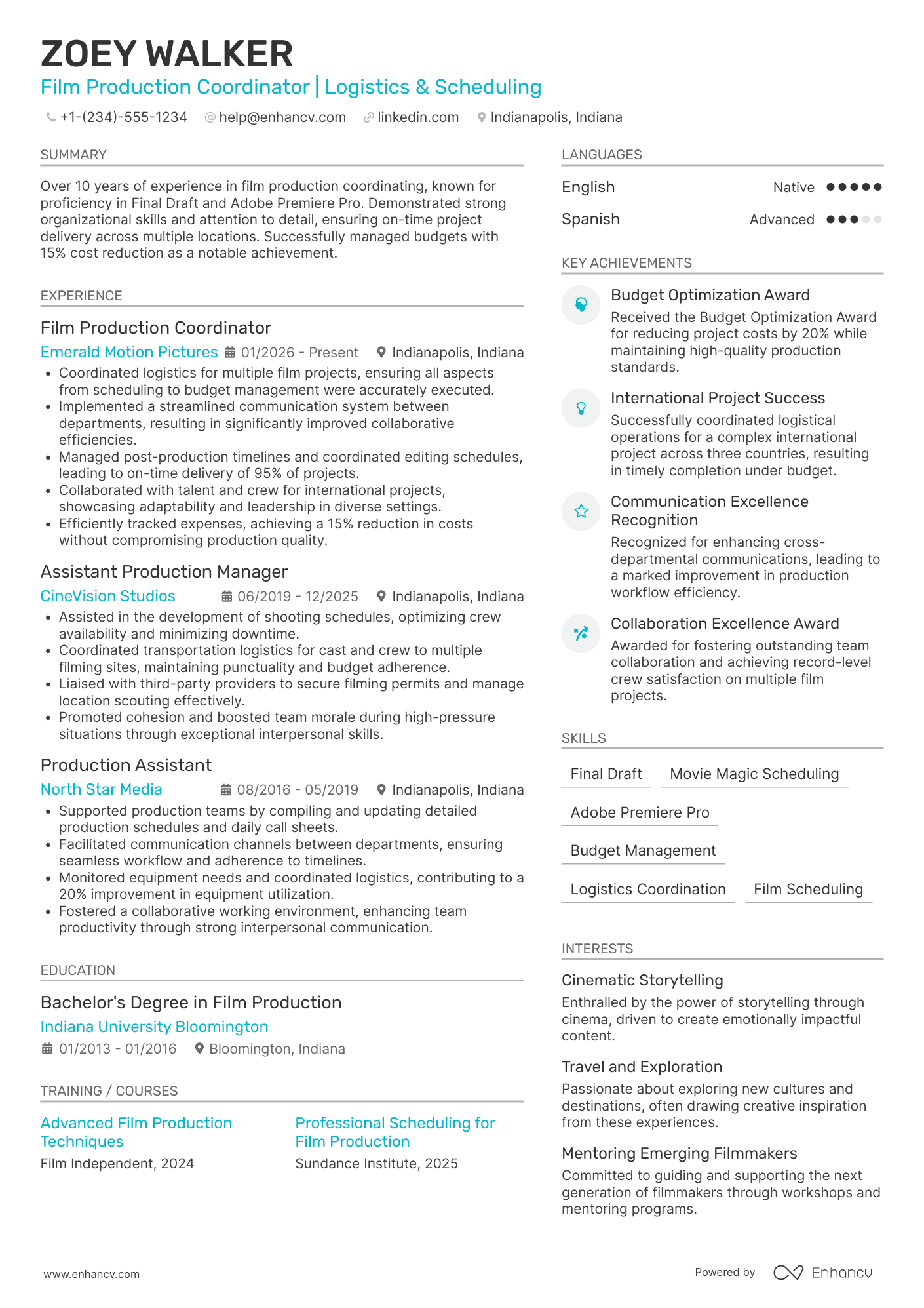


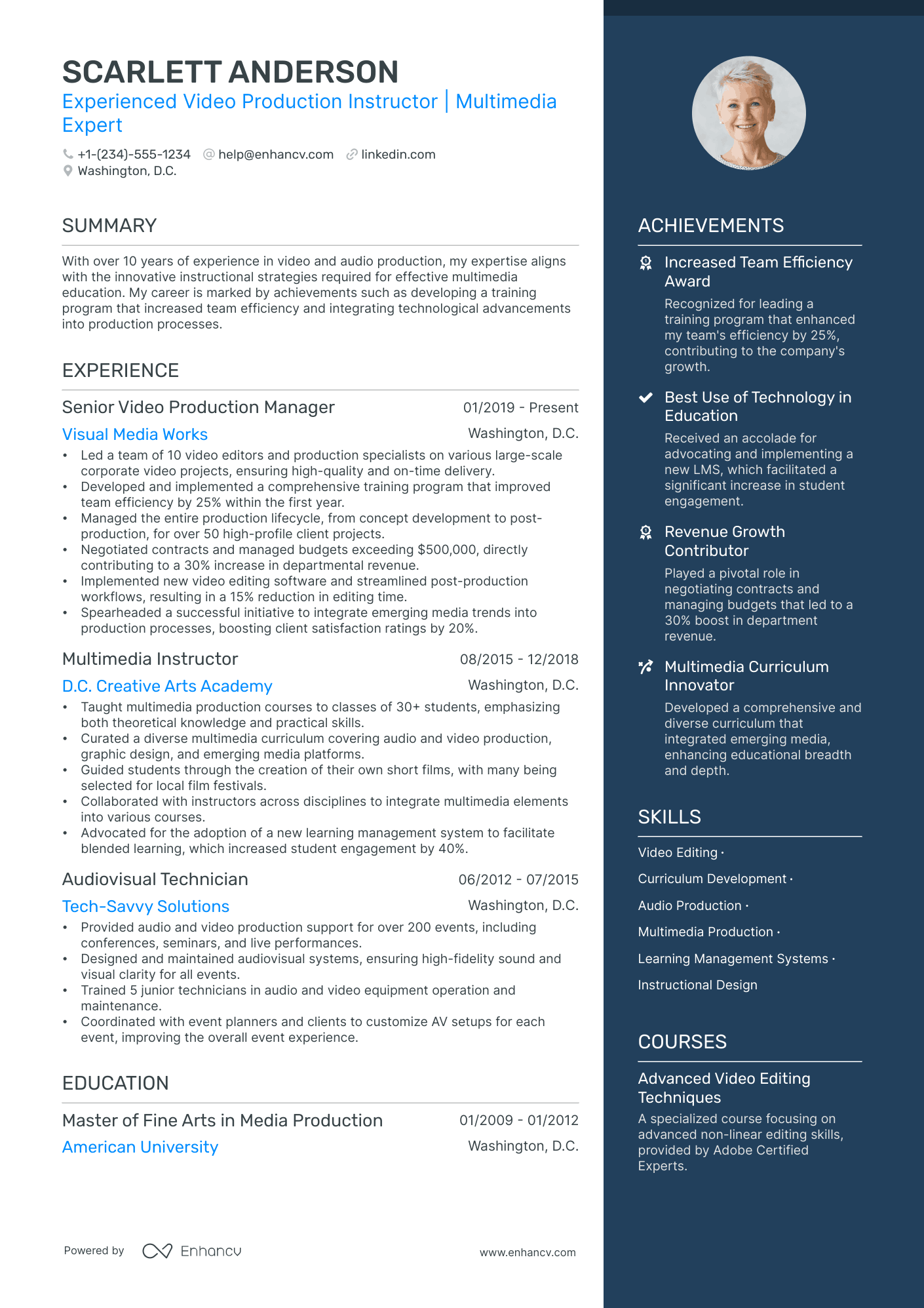
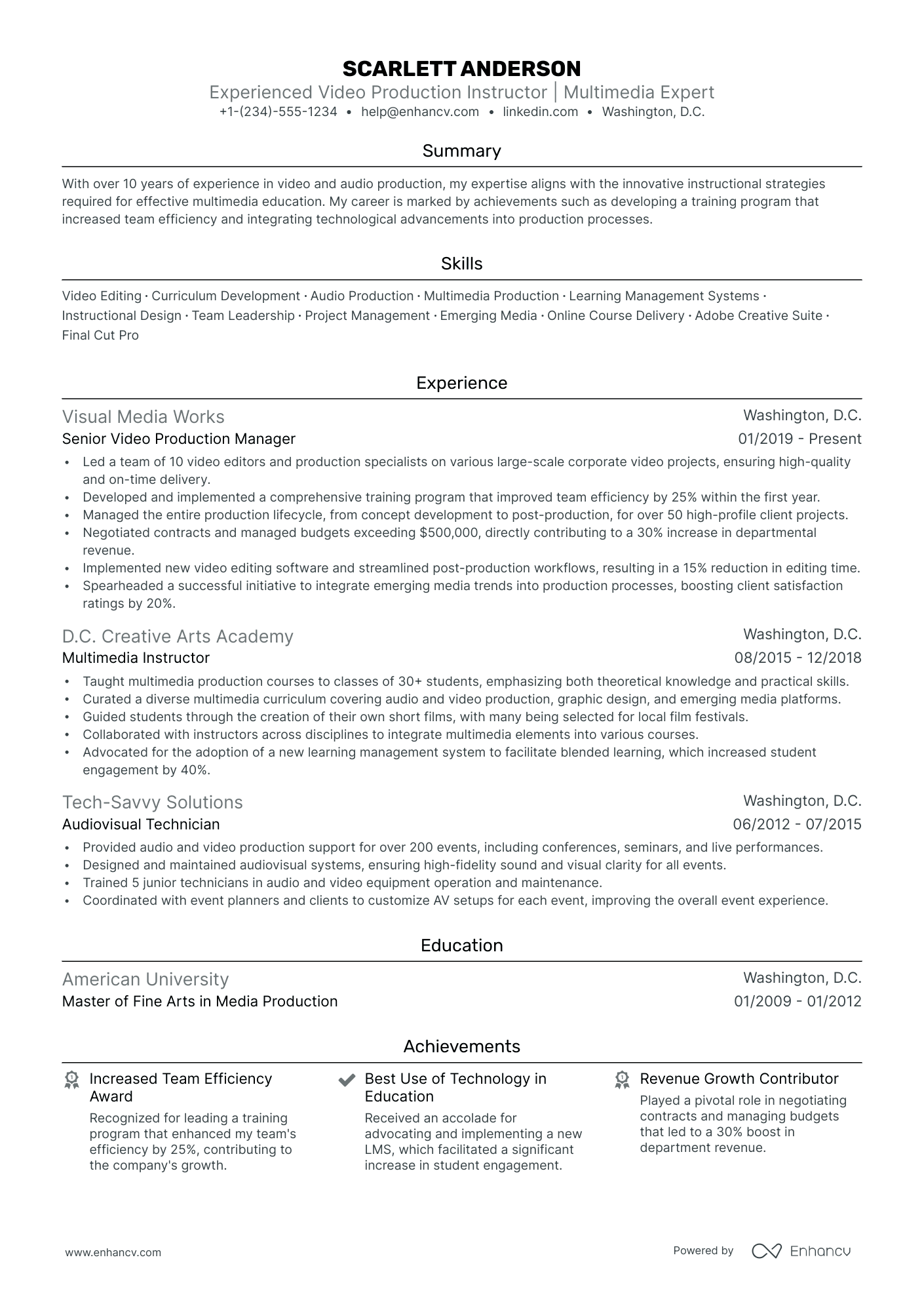
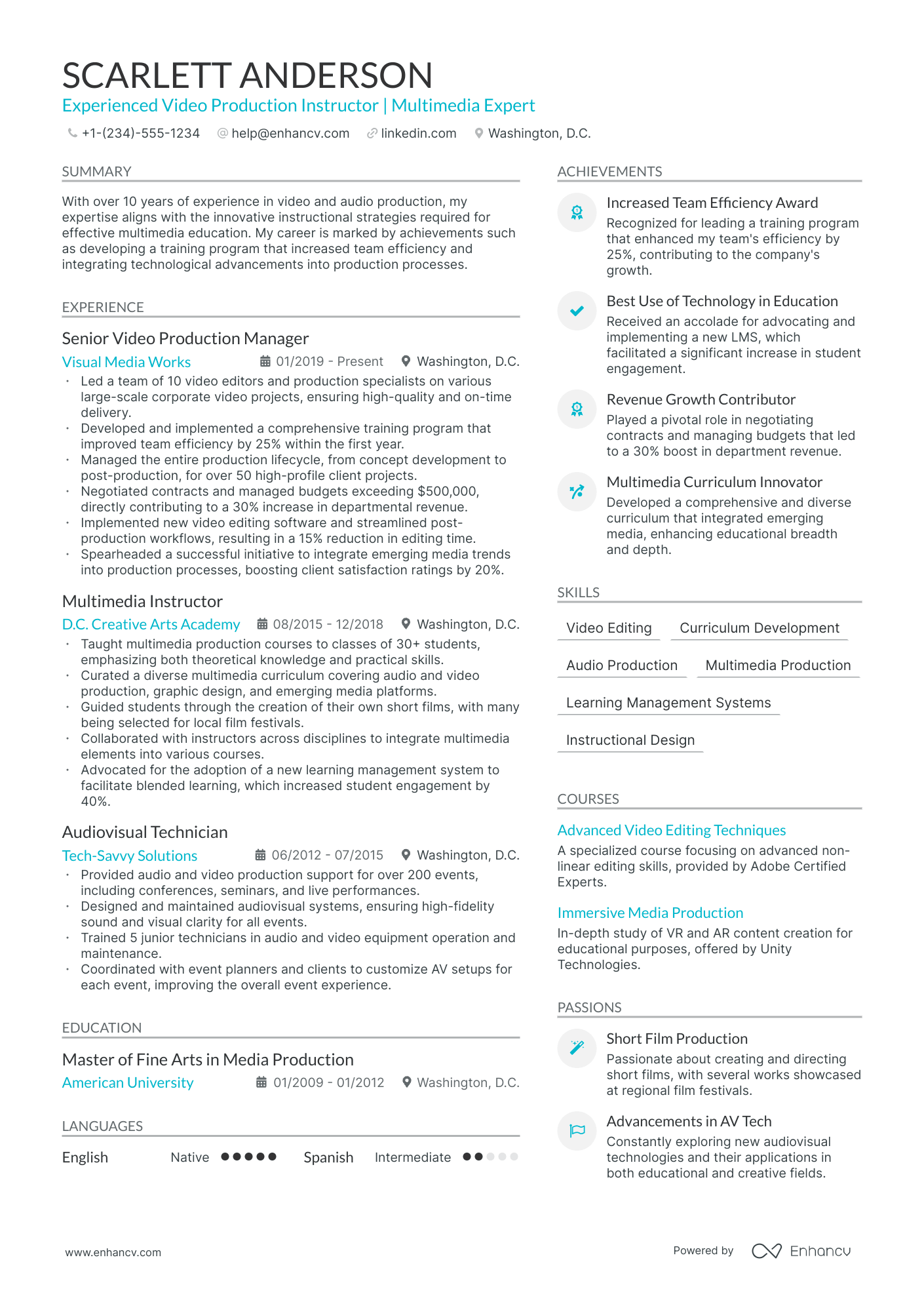
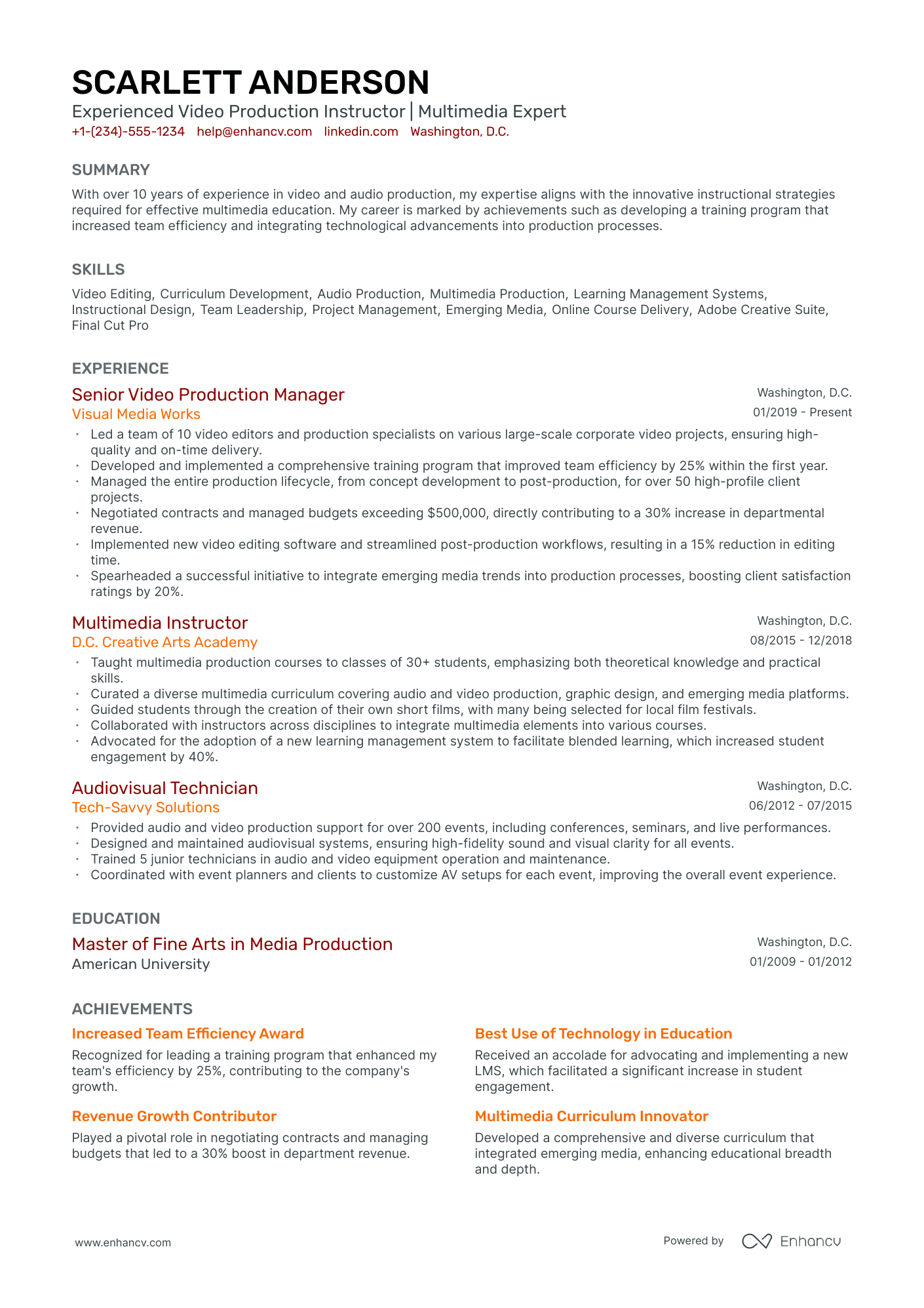
Film production resume submissions often fail because they read like call sheets, listing gear and duties without showing delivery impact. That gets buried in rapid recruiter scans, high competition, and applicant tracking system filters that reward clear, relevant outcomes.
A strong resume shows how you helped productions ship on time and on budget. Knowing how to make your resume stand out starts with highlighting schedule adherence, cost savings, shoot days managed, permits cleared, vendor negotiations, reduced overtime, fewer reshoots, smoother post handoffs, and consistent quality under tight timelines.

Key takeaways
- Anchor every experience bullet to a measurable outcome like budget savings, schedule gains, or reduced reshoots.
- Use reverse-chronological format if you have steady production credits; use hybrid if you're switching careers.
- Tailor your resume to each posting by mirroring the job description's tools, workflows, and terminology.
- Place skills above experience when you're junior, and below experience when you have strong credits.
- Demonstrate skills inside your summary and experience bullets, not only in a standalone list.
- Use AI prompts to tighten language and quantify results, but stop before it invents or inflates claims.
- Pair your resume with a cover letter when your fit or career path needs context beyond credits.
How to format a film production resume
Recruiters reviewing film production resumes prioritize hands-on production experience, familiarity with industry-standard tools and workflows, and evidence that you can deliver projects on time and within budget. A clean, well-structured resume format ensures these signals surface quickly during a fast scan, whether the reader is a hiring manager, a line producer, or an applicant tracking system (ATS).

I have significant experience in this role—which format should I use?
Use a reverse-chronological format to lead with your strongest and most recent production credits first. Do:
- Open each role entry with your title, the production name, and your scope of responsibility (e.g., department size, budget tier, or production type such as feature, episodic, or commercial).
- List role-specific tools and domains—scheduling software like Movie Magic or StudioBinder, union protocols, location management, post-production pipelines—within the context of each credit.
- Anchor every bullet to a measurable outcome or business impact, such as cost savings, schedule adherence, or crew efficiency gains.
I'm junior or switching into this role—what format works best?
A hybrid format works best because it lets you lead with transferable production skills while still showing a timeline of relevant experience. Do:
- Place a focused skills section near the top highlighting production-relevant competencies such as call sheet coordination, equipment logistics, or clearance workflows.
- Include project-based entries—student films, freelance gigs, internships, or adjacent event production work—formatted with titles, dates, and brief descriptions of your role.
- Connect every skill or project entry to a clear action and result so reviewers see what you contributed, not just what you were exposed to.
Why not use a functional resume?
A functional resume strips away the production-by-production context that hiring managers rely on to gauge your readiness for set workflows, crew dynamics, and deadline-driven environments.
- Career changers with transferable logistics, event, or media experience who can group relevant skills under production-oriented categories.
- Recent graduates with multiple short-form credits (student films, spec projects) that are stronger presented as a skills portfolio than as a thin chronological list.
- Candidates with resume gaps who need to foreground recent training, certifications, or freelance project work over an inconsistent timeline.
Now that you've established a clean, readable layout, it's time to fill it with the right sections that showcase your experience and skills to hiring managers.
What sections should go on a film production resume
Recruiters expect a clean, production-focused resume that makes your credits, responsibilities, and on-set results easy to scan. Understanding what to put on a resume for film production is essential for maximum clarity.
Use this structure:
- Header
- Summary
- Experience
- Skills
- Projects
- Education
- Certifications
- Optional sections: Awards, Volunteering, Languages
Your experience bullets should emphasize measurable production outcomes, the scope of shoots you supported, and the impact you drove on schedule, budget, safety, and deliverables.
Is your resume good enough?
Drop your resume here or choose a file. PDF & DOCX only. Max 2MB file size.
With your resume structure in place, the next step is to write the experience section in a way that fits those elements and supports your film production credits.
How to write your film production resume experience
The experience section of your film production resume should spotlight projects you shipped—whether feature films, commercials, series, or shorts—along with the role-specific tools and methods you used to bring them from pre-production through delivery. Hiring managers in film production prioritize demonstrated impact over descriptive task lists, so every line should prove you moved a project forward, solved a real production problem, or improved a measurable outcome. Building a targeted resume for each opportunity ensures your experience section speaks directly to the role's requirements.
Each entry should include:
- Job title
- Company and location (or remote)
- Dates of employment (month and year)
Three to five concise bullet points showing what you owned, how you executed, and what outcomes you delivered:
- Ownership scope: the productions, departments, stages of the pipeline, budgets, or crews you were directly accountable for throughout the filmmaking process.
- Execution approach: the production management software, scheduling tools, camera and lighting systems, editing platforms, or on-set workflows you applied to plan, shoot, or finish deliverables.
- Value improved: changes to production efficiency, turnaround time, footage quality, post-production accuracy, safety compliance, or budget adherence that resulted from your work on set or in the edit suite.
- Collaboration context: how you coordinated with directors, cinematographers, art departments, sound teams, post-production houses, distributors, or other cross-functional stakeholders to keep a production on schedule and on vision.
- Impact delivered: outcomes framed as tangible results—such as completed deliverables, festival selections, distribution milestones, audience reach, or cost savings—rather than a list of daily activities.
Experience bullet formula
A film production experience example
✅ Right example - modern, quantified, specific.
Production Coordinator
Northlight Pictures | Atlanta, GA
2022–2025
Mid-budget narrative film studio producing six to eight union shoots per year across Georgia and Louisiana.
- Coordinated day-to-day production operations for a twenty-eight-day feature, managing Movie Magic Scheduling, Google Workspace, and Slack workflows to keep shoot days within one percent of plan and avoid two potential company moves.
- Built and maintained a $3.2M budget in Movie Magic Budgeting, reconciling P-card and PO activity weekly to cut cost variance from eight percent to three percent by wrap.
- Implemented a cloud-based call sheet and distribution process using StudioBinder and DocuSign, reducing call sheet errors by 40 percent and saving the assistant director team six hours per week.
- Partnered with the line producer, assistant director team, and department heads to track vendor bids, COIs, and deal memos, shortening turnaround time from three days to one day and preventing $25K in rush fees.
- Led wrap deliverables across production, post, and finance—camera reports, sound logs, releases, and chain-of-title—using Airtable and Dropbox to achieve 100 percent delivery acceptance on first submission.
Now that you've seen how a strong experience section comes together, let's look at how to adjust those details to match the specific role you're targeting.
How to tailor your film production resume experience
Recruiters evaluate film production resumes through both human review and applicant tracking systems (ATS), so tailoring your resume to the job description is essential. Aligning your listed skills and accomplishments with the specific role increases your chances of advancing past both screening stages.
Ways to tailor your film production experience:
- Match editing software and camera systems named in the job posting.
- Mirror the production workflow terminology the listing uses.
- Reflect deliverable formats and distribution standards the role specifies.
- Include union or guild experience when the posting requires it.
- Highlight on-set safety and compliance responsibilities if mentioned.
- Use the same pre-production and post-production phase language listed.
- Emphasize cross-departmental collaboration models the job description references.
- Reference budget scale or crew size relevant to the posted role.
Tailoring means aligning your real production achievements with what the job requires, not forcing disconnected keywords into your experience section.
Resume tailoring examples for film production
| Job description excerpt | Untailored | Tailored |
|---|---|---|
| "Manage daily call sheets, shooting schedules, and crew coordination across multi-location shoots using Movie Magic Scheduling." | Helped organize production schedules and worked with crew members on set. | Coordinated daily call sheets and shooting schedules for a 45-day, multi-location shoot using Movie Magic Scheduling, managing logistics for a 120-person crew across three simultaneous units. |
| "Oversee post-production workflow including dailies processing, color pipeline management in DaVinci Resolve, and final deliverables for theatrical and streaming distribution." | Assisted with post-production tasks and helped deliver final video files to clients. | Managed end-to-end post-production workflow for a $12M independent feature, supervising dailies processing, building the color pipeline in DaVinci Resolve, and delivering final DCPs and HDR masters for theatrical release and Netflix distribution. |
| "Collaborate with the line producer to track and reconcile a $25M+ production budget, process purchase orders, and generate weekly cost reports using Entertainment Partners' PSL budgeting software." | Tracked expenses and helped keep the production on budget throughout filming. | Partnered with the line producer to reconcile a $28M production budget week over week, processing 300+ purchase orders and generating cost reports in EP's PSL software that identified $400K in savings during principal photography. |
Once you’ve aligned your experience with the role’s priorities, the next step is to quantify your film production achievements so hiring teams can quickly see your impact.
How to quantify your film production achievements
Quantifying your achievements proves your creative and operational impact across schedules, budgets, quality, and risk. Focus on turnaround time, cost savings, reshoot reduction, delivery reliability, and audience or stakeholder outcomes tied to the production's goals.
Quantifying examples for film production
| Metric | Example |
|---|---|
| Delivery speed | "Delivered a 12-minute branded short in 18 days, cutting the timeline by 25% using Frame.io reviews and a locked shot list." |
| Budget efficiency | "Reduced production spend by $18,400 (12%) by renegotiating vendor rates and consolidating rentals across three shoot days." |
| Quality control | "Cut reshoots from eight setups to two by tightening continuity checks and using Resolve scopes for on-set color consistency." |
| Risk reduction | "Ran safety briefings and call sheet compliance for a 35-person crew, completing six location days with zero reportable incidents." |
| Throughput volume | "Managed ingest and organization for 1.6 terabytes of footage across four cameras, delivering labeled proxies within four hours of wrap." |
Turn vague job duties into measurable, recruiter-ready resume bullets in seconds with Enhancv's Bullet Point Generator.
Once you've crafted strong bullet points for your experience section, you'll want to apply that same precision to presenting your hard and soft skills throughout your film production resume.
How to list your hard and soft skills on a film production resume
A well-organized skills section shows you can deliver on set and in post, and recruiters and an ATS (applicant tracking system) scan them to confirm fit fast, so aim for a mostly hard-skill mix supported by role-specific soft skills.
film production roles require a blend of:
- Product strategy and discovery skills.
- Data, analytics, and experimentation skills.
- Delivery, execution, and go-to-market discipline.
- Soft skills.
Your skills section should be:
- Scannable (bullet-style grouping).
- Relevant to the job post.
- Backed by proof in experience bullets.
- Updated with current tools.
Place your skills section:
- Above experience if you're junior or switching careers.
- Below experience if you're mid/senior with strong achievements.

Hard skills
Your hard skills demonstrate the technical proficiencies that production teams need on set and in post:
- Script breakdowns, one-liners
- Scheduling: Movie Magic Scheduling
- Budgeting: Movie Magic Budgeting
- Call sheets, daily production reports
- Production coordination, travel logistics
- Location scouting, permitting, releases
- Camera workflow: RED, ARRI
- Lighting and grip packages
- Sound: boom, lav, timecode
- DIT workflow, media management
- Post: Adobe Premiere Pro, Avid Media Composer, DaVinci Resolve
- File delivery: EDL, XML, ProRes
Soft skills
Your soft skills reflect how you collaborate and lead under the pressure of production timelines:
- Align crew on daily priorities
- Run efficient production meetings
- Communicate changes fast and clearly
- Coordinate across departments under pressure
- Make tradeoffs to protect schedule
- Escalate risks early with options
- Give and receive actionable notes
- Keep vendors and talent aligned
- Resolve on-set conflicts quickly
- Maintain continuity across units
- Own deliverables through final turnover
- Document decisions and next steps
How to show your film production skills in context
Skills shouldn't live only in a bulleted list on your resume.
They should be demonstrated in:
- Your summary (high-level professional identity)
- Your experience (proof through outcomes)
Here's how that looks in practice. You can also explore common resume skills to see how other professionals in the industry present their competencies.
Summary example
Senior film production professional with 12 years of experience managing multi-million-dollar budgets across narrative and documentary features. Skilled in Avid Media Composer, scheduling with Movie Magic, and cross-departmental coordination. Delivered 15 projects on time, averaging 18% under budget.
- Reflects senior-level experience clearly
- Names industry-standard tools and software
- Quantifies budget and delivery outcomes
- Highlights leadership and collaboration skills
Experience example
Senior Line Producer
Ridgeline Pictures | Los Angeles, CA
March 2019–August 2024
- Managed production budgets totaling $22M across six features, completing each an average of 12% under budget using Movie Magic Budgeting.
- Coordinated schedules for crews of 80+ across four departments, reducing daily overtime costs by 25% through streamlined call sheet workflows.
- Partnered with post-production supervisors and editors in DaVinci Resolve pipelines, cutting final delivery timelines by three weeks on back-to-back projects.
- Every bullet includes measurable proof
- Skills appear naturally within achievements
Once you’ve demonstrated your film production abilities through relevant projects and outcomes, the next step is applying the same approach to a film production resume when you have no experience.
How do I write a film production resume with no experience
Even without full-time experience, you can demonstrate readiness through relevant projects and training. Our guide on writing a resume without work experience covers this in detail. Here are strong starting points:
- Student film crew credits.
- Community theater tech run crew.
- Volunteer on indie film shoots.
- Film production coursework capstone projects.
- Equipment checkout and inventory logs.
- Editing practice reels with timecodes.
- Set runner shifts for events.
- Location scouting photo reports.
Focus on:
- Clear film production role and scope.
- Credits, tools, and deliverables.
- Measurable outcomes and efficiency gains.
- Reliability shown through schedules and logs.
Resume format tip for entry-level film production
Use a combination resume format because it highlights film production skills and projects first, while still showing any work history and on-set reliability. Do:
- Put a "Projects" section above work history.
- List film production tools used per project.
- Add credits with role, dates, scope.
- Quantify outputs: pages, hours, shots.
- Include links to reels or cuts.
- Edited a five-minute short in DaVinci Resolve, synced dual-system audio, and delivered a timecoded cut list that cut revision time by 20%.
Once you've positioned your transferable skills and relevant projects to compensate for limited professional experience, the next step is structuring your education section to further reinforce your qualifications.
How to list your education on a film production resume
Your education section helps hiring teams confirm you have foundational training in film production. It validates core technical skills and theoretical knowledge relevant to the craft.
Include:
- Degree name
- Institution
- Location
- Graduation year
- Relevant coursework (for juniors or entry-level candidates)
- Honors & GPA (if 3.5 or higher)
Skip month and day details—list the graduation year only.
Here's a strong education entry tailored to film production:
Example education entry
Bachelor of Fine Arts in Film Production
University of Southern California, Los Angeles, CA
Graduated 2022
GPA: 3.7/4.0
- Relevant coursework: Cinematography, Post-Production Editing, Sound Design, Directing for Screen, and Production Management
- Honors: Dean's List, Magna Cum Laude
How to list your certifications on a film production resume
Certifications on your resume show your commitment to learning, prove tool proficiency, and signal industry relevance in film production, especially when your credits are still growing.
Include:
- Certificate name
- Issuing organization
- Year
- Optional: credential ID or URL
- Place certifications below education when your degree is recent and more relevant than the credentials.
- Place certifications above education when they are recent, role-specific, and directly match the film production job requirements.
Best certifications for your film production resume
- Avid Certified User: Media Composer
- Adobe Certified Professional: Premiere Pro
- Adobe Certified Professional: After Effects
- Blackmagic Design Certified Training: DaVinci Resolve
- Apple Certified Pro: Final Cut Pro
- OSHA 10-Hour General Industry
- Part 107 Remote Pilot Certificate
Once you’ve positioned your credentials where hiring managers can spot them fast, focus on how to write your film production resume summary to tie that expertise to the role.
How to write your film production resume summary
Your resume summary is the first thing a recruiter reads, so it needs to earn their attention fast. A strong opening signals you understand the craft and can deliver results on set.
Keep it to three to four lines, with:
- Your current title and total years of experience in film production.
- The type of productions you've worked on, such as features, commercials, or episodics.
- Core skills like budgeting, scheduling, crew coordination, or post-production workflows.
- One or two measurable accomplishments, such as productions delivered under budget or ahead of schedule.
- Soft skills tied to real outcomes, like communication that reduced crew turnover or problem-solving that kept shoots on track.

PRO TIP
At an entry or junior level, lead with your strongest technical skills and relevant production tools. Highlight early contributions that show you can handle real responsibilities. Avoid vague phrases like "passionate storyteller" or "eager to learn." Instead, ground every claim in something specific you did or delivered on a production.
Example summary for a film production
Detail-oriented production assistant with two years of experience on independent features and branded content. Coordinated logistics for 15+ shoot days and helped reduce equipment costs by 12% through vendor negotiations.
Optimize your resume summary and objective for ATS
Drop your resume here or choose a file.
PDF & DOCX only. Max 2MB file size.
Now that your summary captures your professional strengths, make sure the header framing it presents your contact details correctly so recruiters can actually reach you.
What to include in a film production resume header
Your resume header is the top section with your identity and contact details, and it drives visibility, credibility, and fast recruiter screening in film production.
Essential resume header elements
- Full name
- Tailored job title and headline
- Location
- Phone number
- Professional email
- GitHub link
- Portfolio link
A LinkedIn link helps recruiters verify experience quickly and supports screening.
Don't include a photo on a film production resume unless the role is explicitly front-facing or appearance-dependent.
Keep your header consistent with your film production role, and make every link and contact detail easy to scan and copy.
Example
Film production resume header
Jordan Rivera
Production Coordinator | Film production scheduling, call sheets, and set logistics
Los Angeles, CA
(323) 555-01XX
your.name@enhancv.com github.com/yourname yourwebsite.com linkedin.com/in/yourname
Once your contact details, role, and key identifiers are in place at the top, you can strengthen the rest of your application with additional sections that add relevant context and proof of your fit.
Additional sections for film production resumes
Extra resume sections help you stand out when your core experience doesn't fully capture your on-set versatility or technical depth.
Choose sections that reinforce your credibility for the specific film production role you're targeting:
- Languages
- Certifications and safety training
- Equipment and technical proficiencies
- Film festivals and screenings
- Professional affiliations and union memberships
- Hobbies and interests
- Publications and industry credits
Once your resume's additional sections highlight the full scope of your expertise, pairing it with a tailored cover letter can further strengthen your application.
Do film production resumes need a cover letter
A cover letter isn't required for a film production resume, but it helps for competitive roles or when hiring teams expect context beyond credits. If you're unsure about the format, learning what a cover letter is and how it complements your resume can help you decide. It can make a difference when your fit, project impact, or path isn't obvious.
Use it to add clarity and relevance:
- Explain role and team fit by matching your set experience to the production's workflow, pace, and department needs.
- Highlight one or two relevant projects with outcomes, such as schedule gains, cost control, smoother company moves, or fewer resets.
- Show you understand the film production's audience, distribution plan, and business constraints, and how that affects creative and logistics choices.
- Address career transitions or non-obvious experience by connecting transferable skills to film production tasks, tools, and on-set decision-making.
Drop your resume here or choose a file.
PDF & DOCX only. Max 2MB file size.
Even if you decide a cover letter adds value for your film production application, the next step is using AI to improve your film production resume so it aligns with the role and stands out faster.
Using AI to improve your film production resume
AI can sharpen your resume's clarity, structure, and overall impact. It helps tighten language and highlight measurable results. However, overusing it risks stripping away authenticity. Once your content feels clear and aligned with your target role, step back. If you're wondering which AI is best for writing resumes, the answer depends on how much control you want over tone and formatting.
Here are 10 practical prompts you can copy and paste to strengthen specific sections of your film production resume:
- Strengthen your summary. "Rewrite my film production resume summary to highlight my strongest skills and most relevant experience in under four sentences."
- Quantify your impact. "Add measurable results to these film production experience bullets, focusing on budgets managed, crew sizes, or project timelines."
- Tighten bullet points. "Shorten each of my film production experience bullets to one concise line that leads with a strong action verb."
- Align with roles. "Compare my film production resume experience section to this job description and suggest wording changes to improve alignment."
- Refine technical skills. "Reorganize my film production skills section by grouping tools, software, and techniques into clear, relevant categories."
- Improve project descriptions. "Rewrite my film production project entries to emphasize my specific role, deliverables, and the outcome of each project."
- Clarify education details. "Revise my education section to better highlight coursework and training directly relevant to film production careers."
- Highlight certifications. "Rewrite my film production certifications section so each entry clearly states the credential's relevance to on-set roles."
- Remove filler language. "Identify and remove vague or redundant phrases across my entire film production resume without changing the core meaning."
- Boost action verbs. "Replace weak or repeated verbs in my film production experience bullets with specific, industry-appropriate alternatives."
Stop using AI once your resume sounds accurate, specific, and aligned with real experience. AI should never invent experience or inflate claims—if it didn't happen, it doesn't belong here.
Conclusion
A strong film production resume shows measurable outcomes, role-specific skills, and a clear structure that’s easy to scan. It highlights what you delivered, how you worked on set, and the tools and workflows you used.
Keep your film production resume focused, consistent, and results-driven so hiring teams can match you to the role fast. This approach shows you’re ready for today’s hiring market and the near-future pace of production.