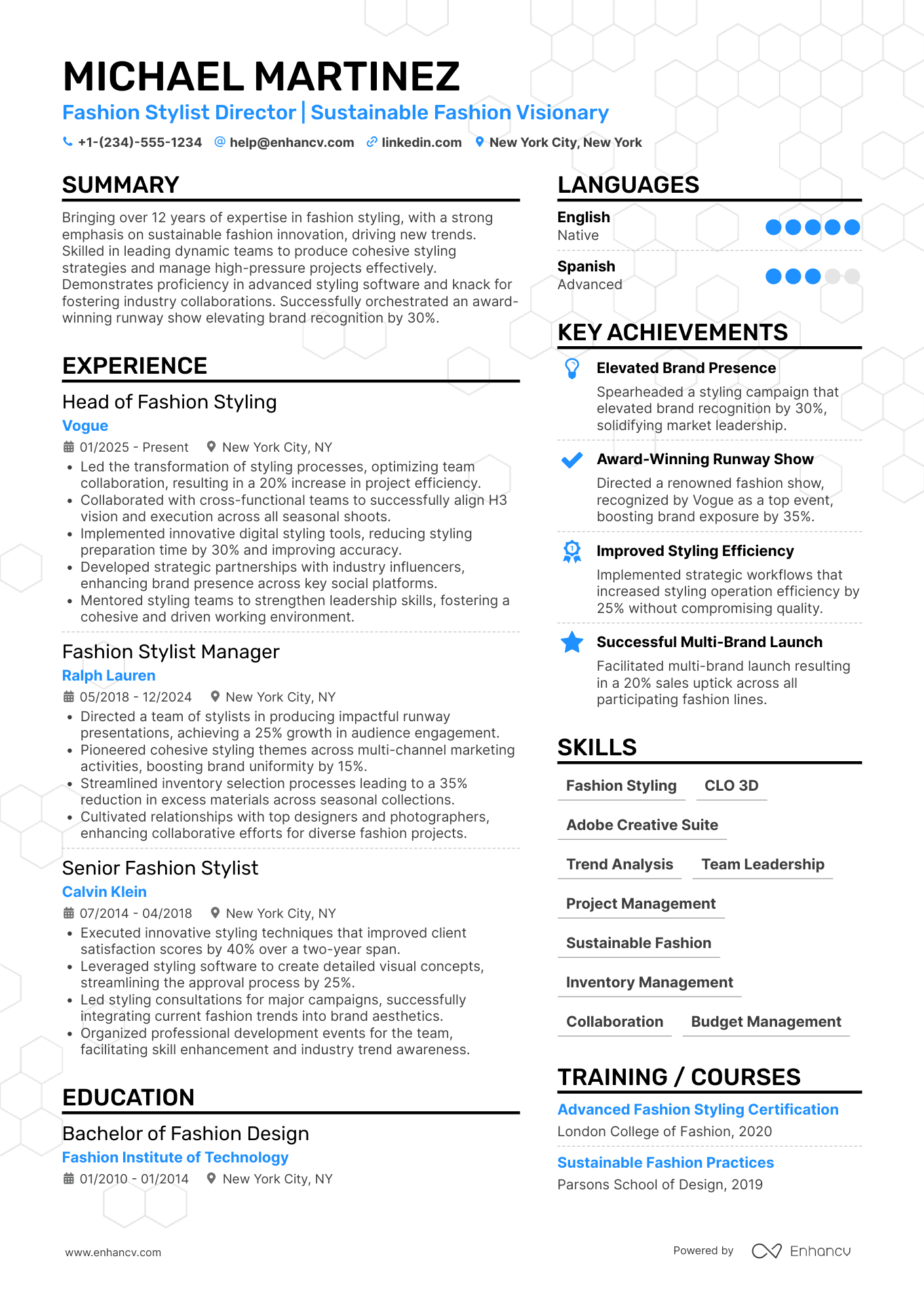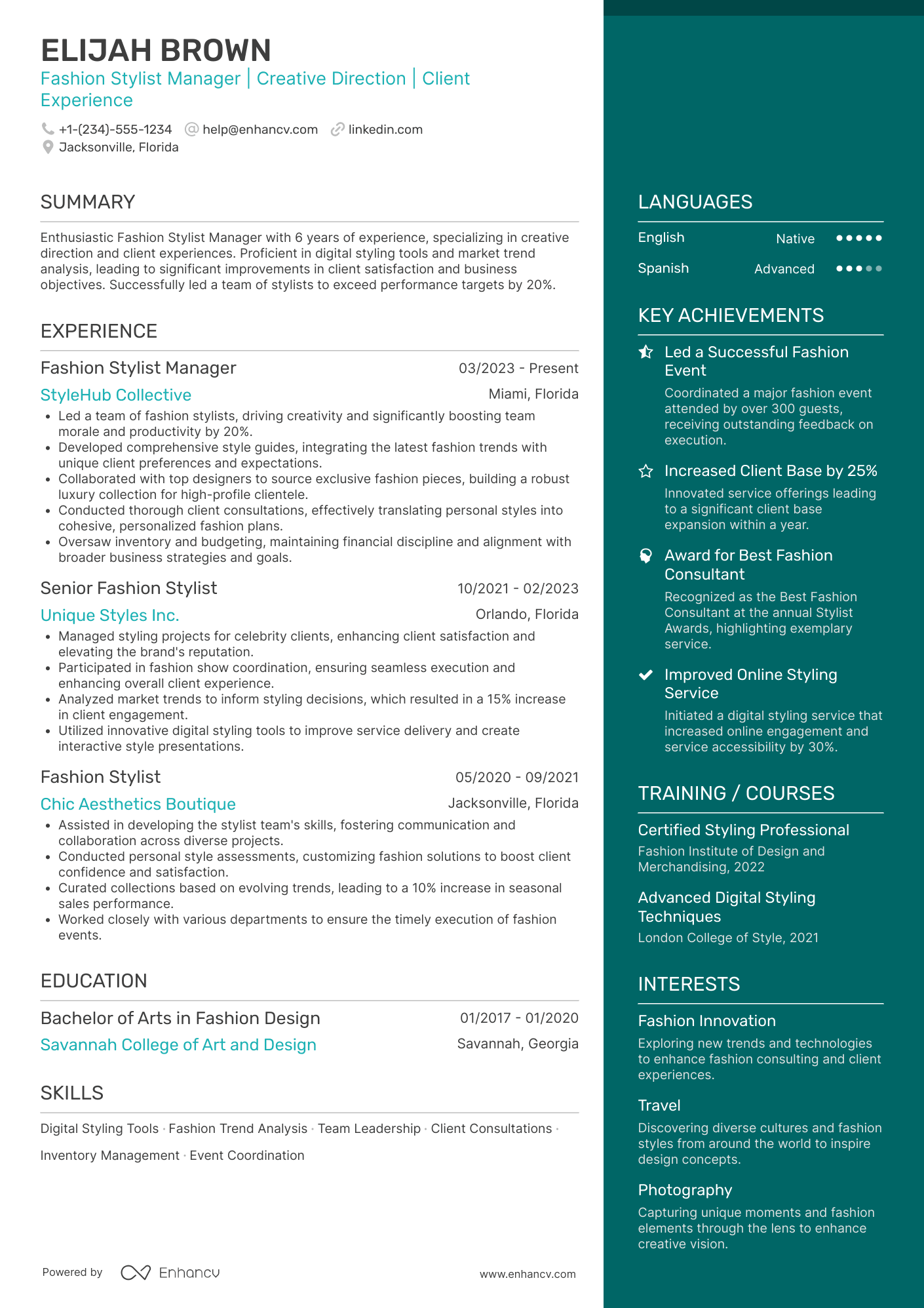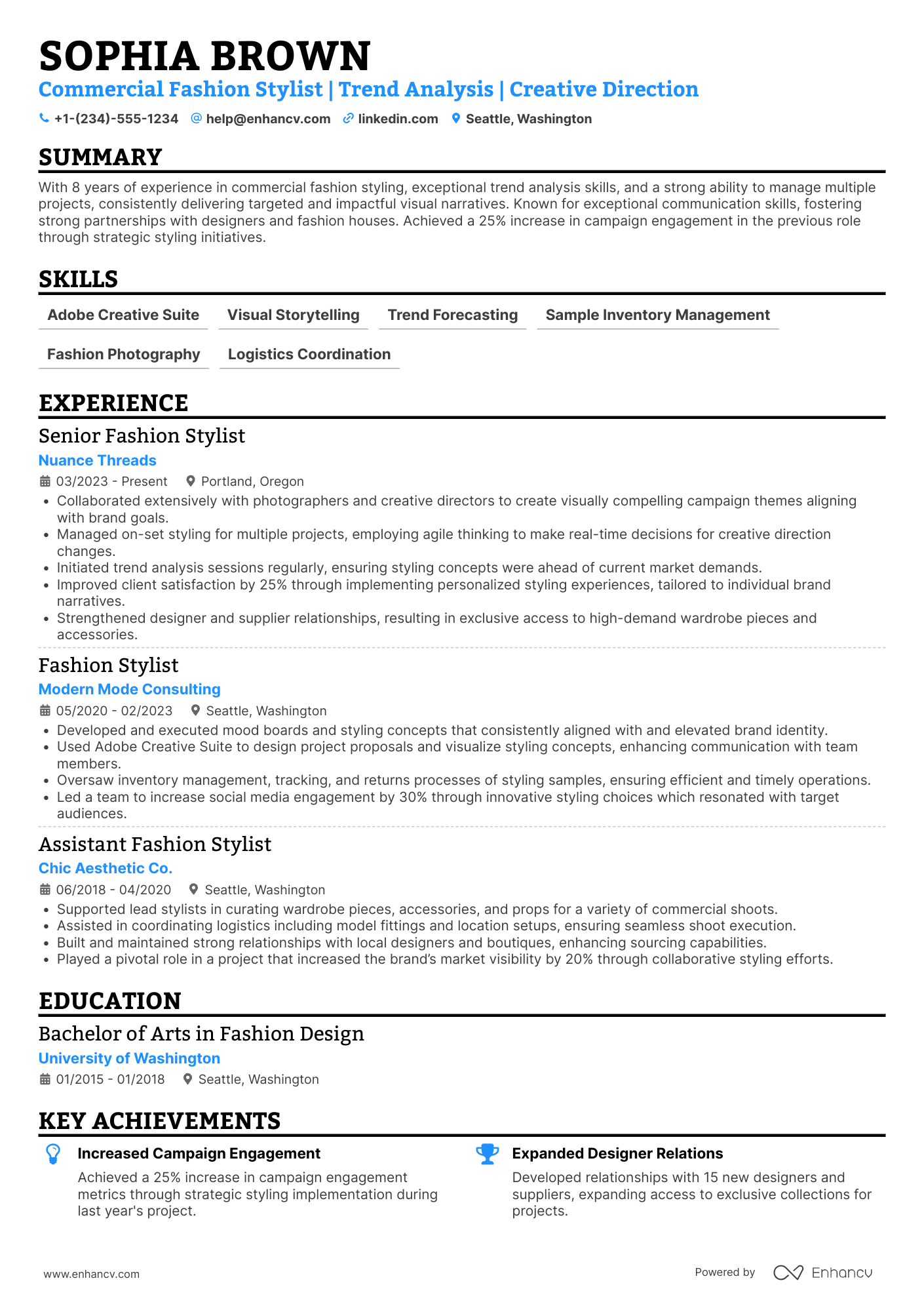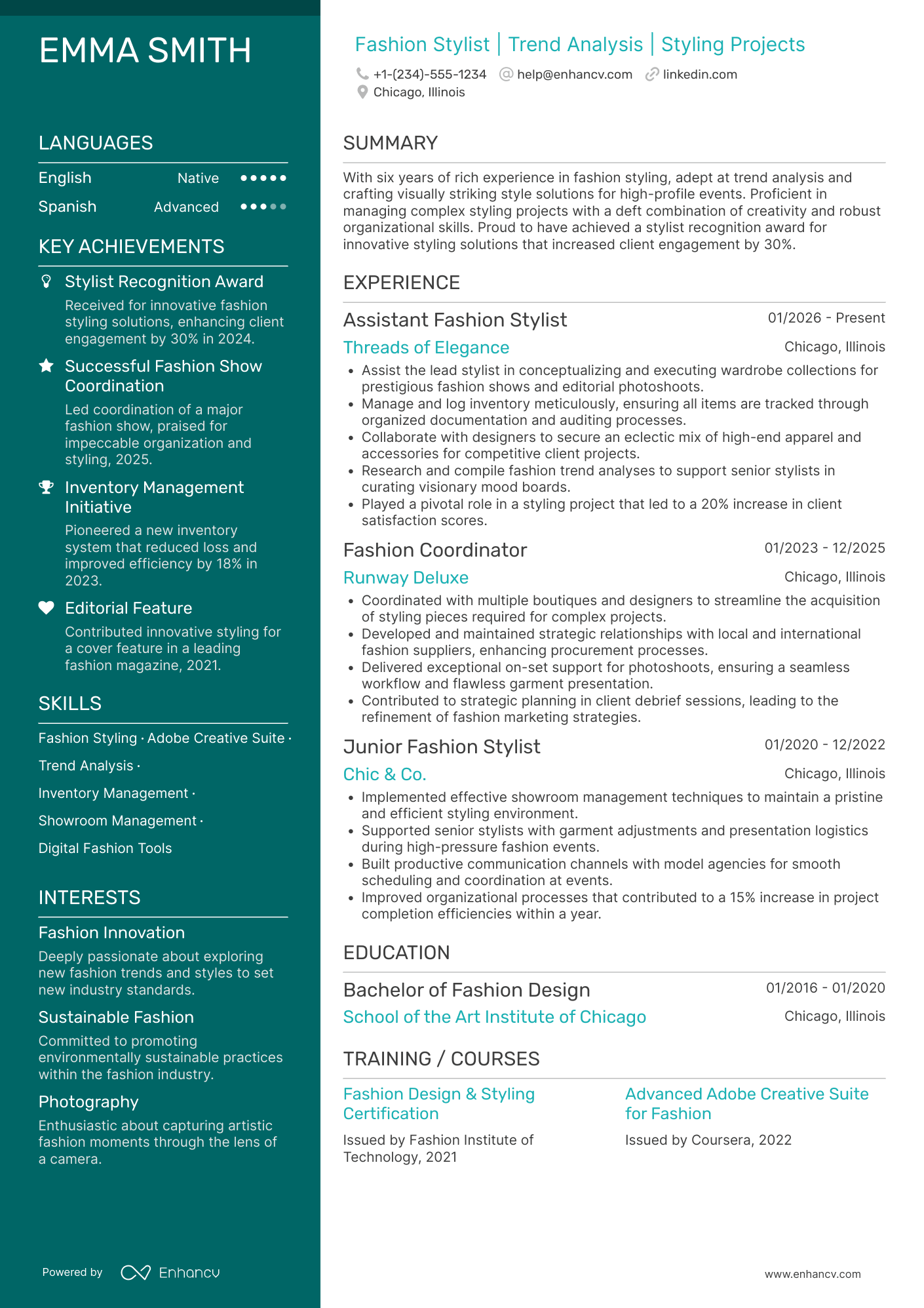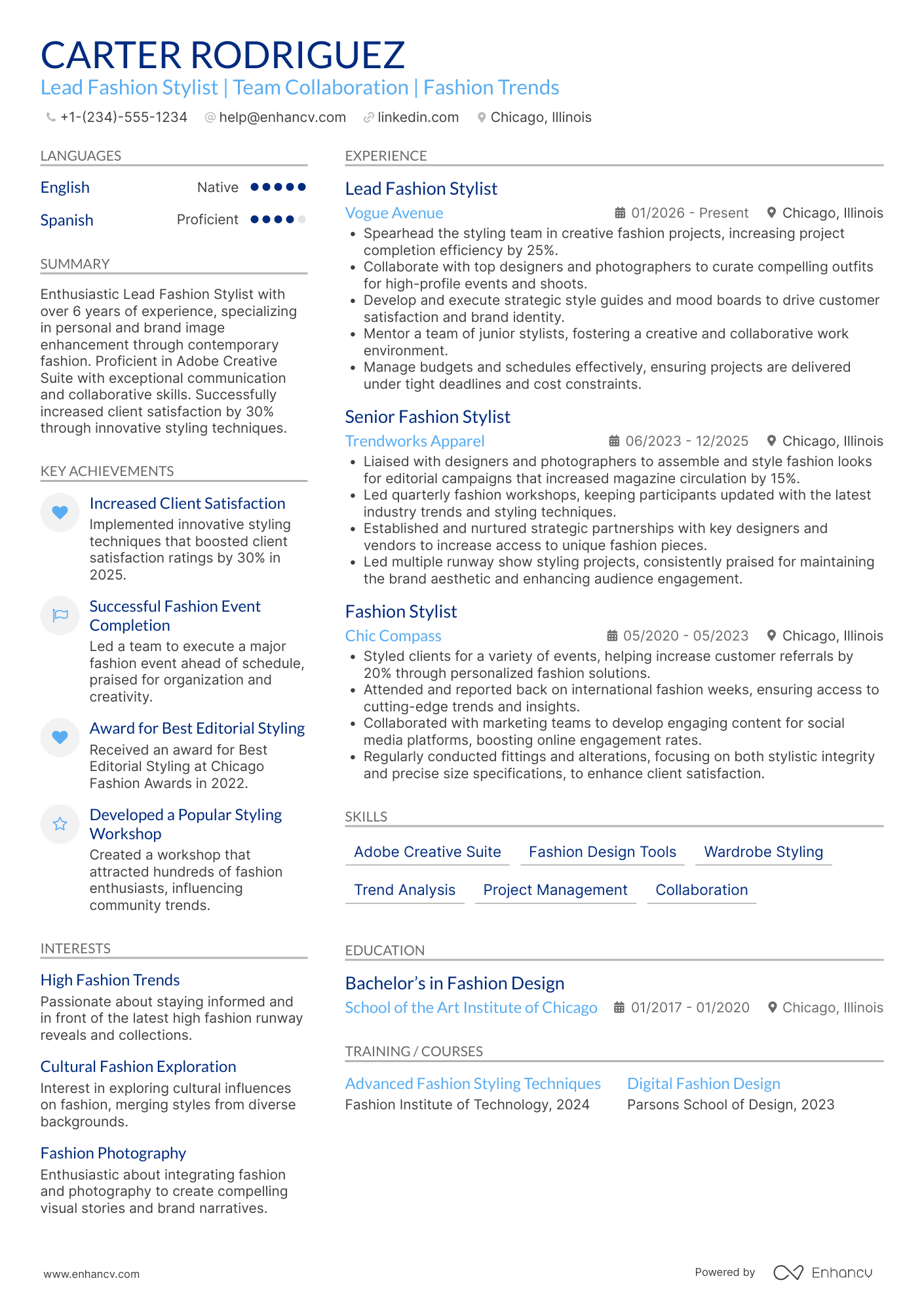
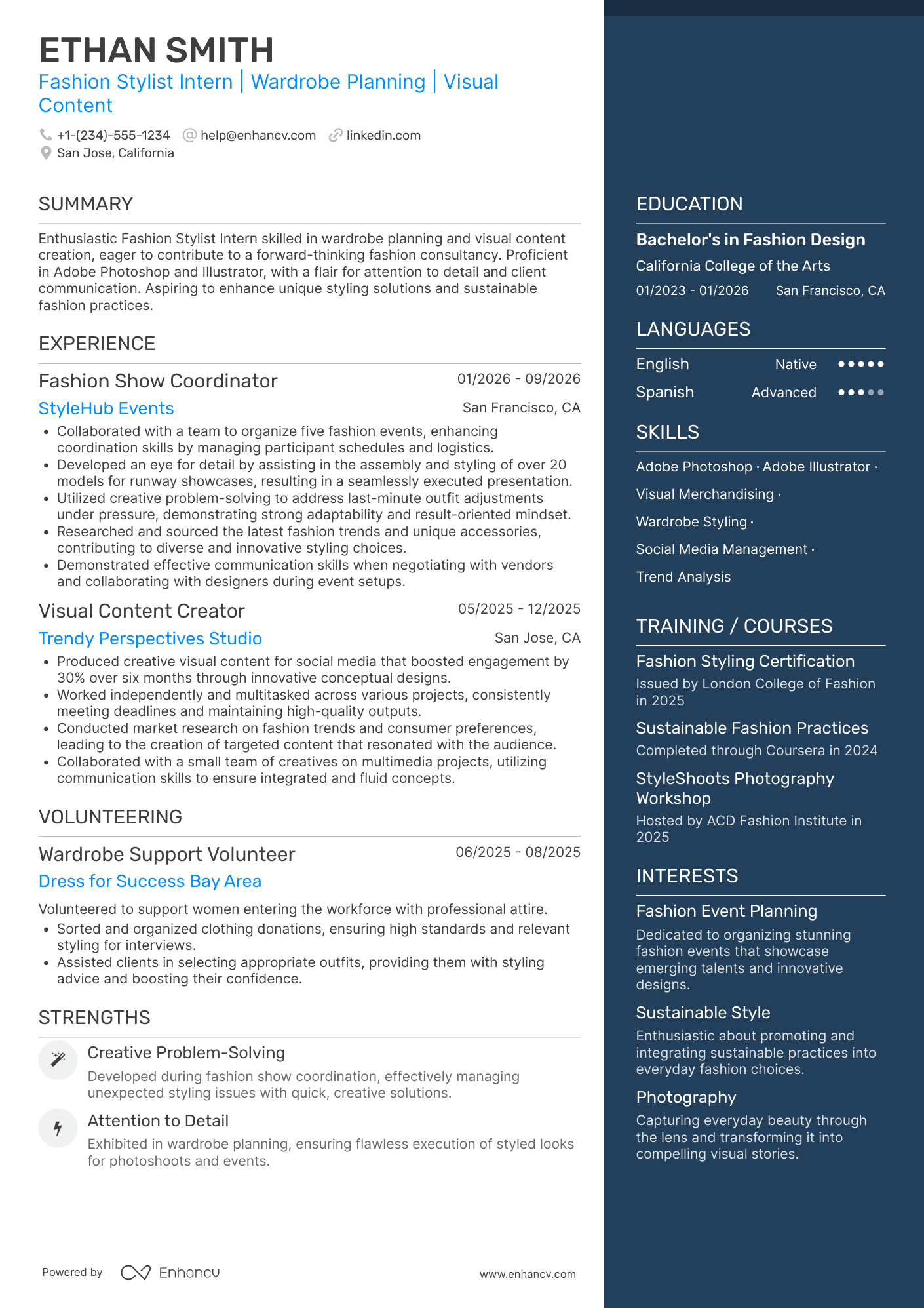
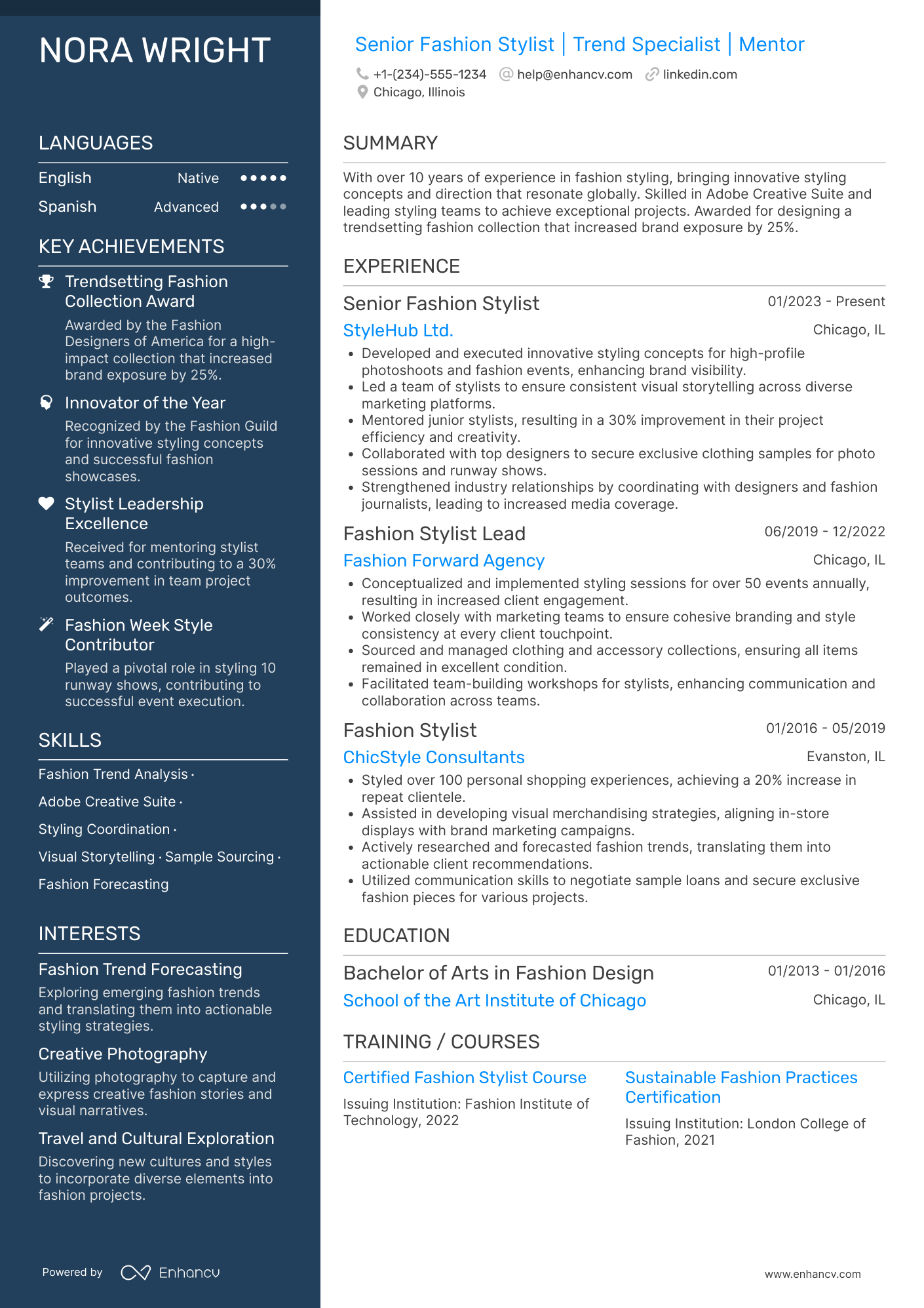
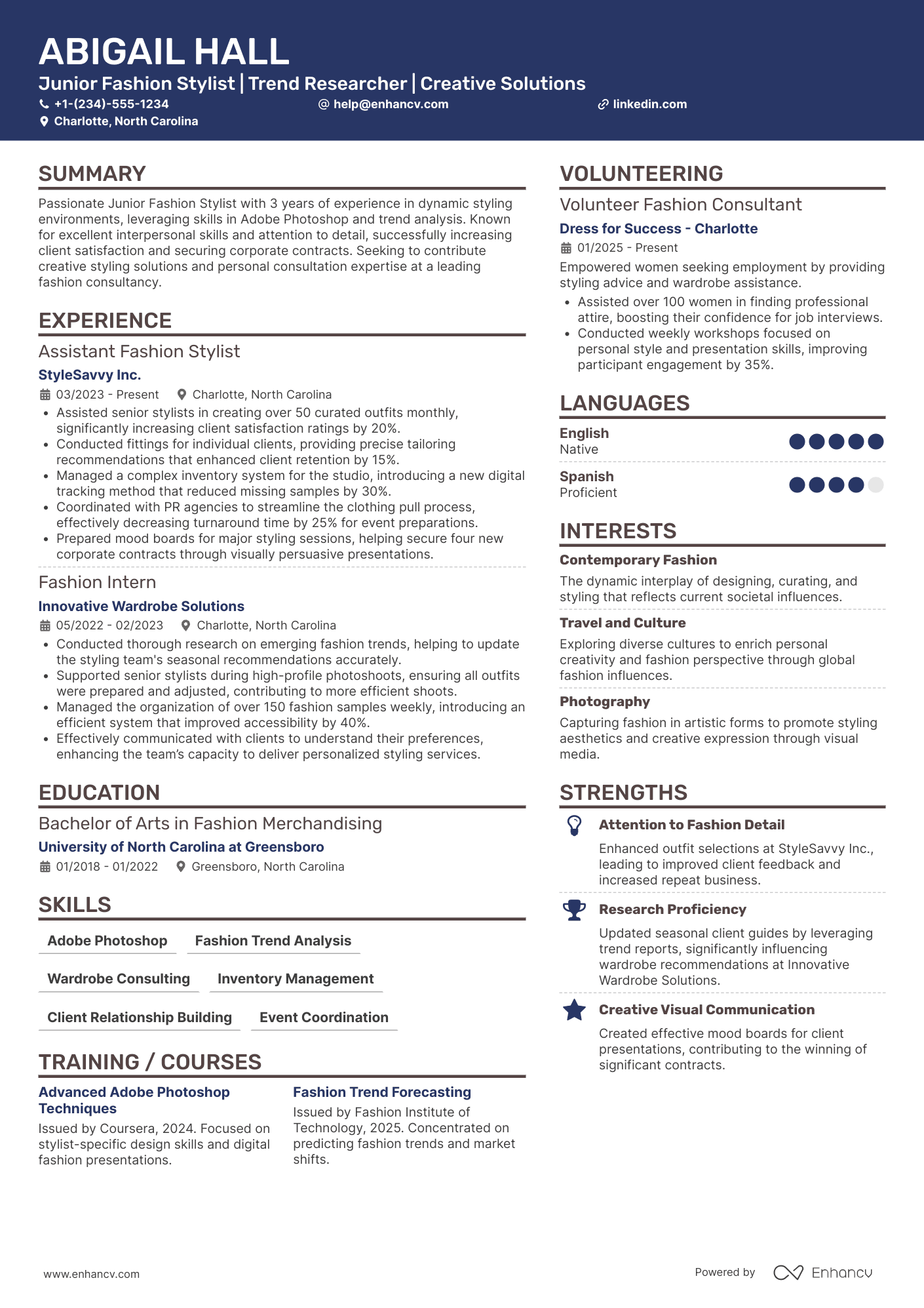
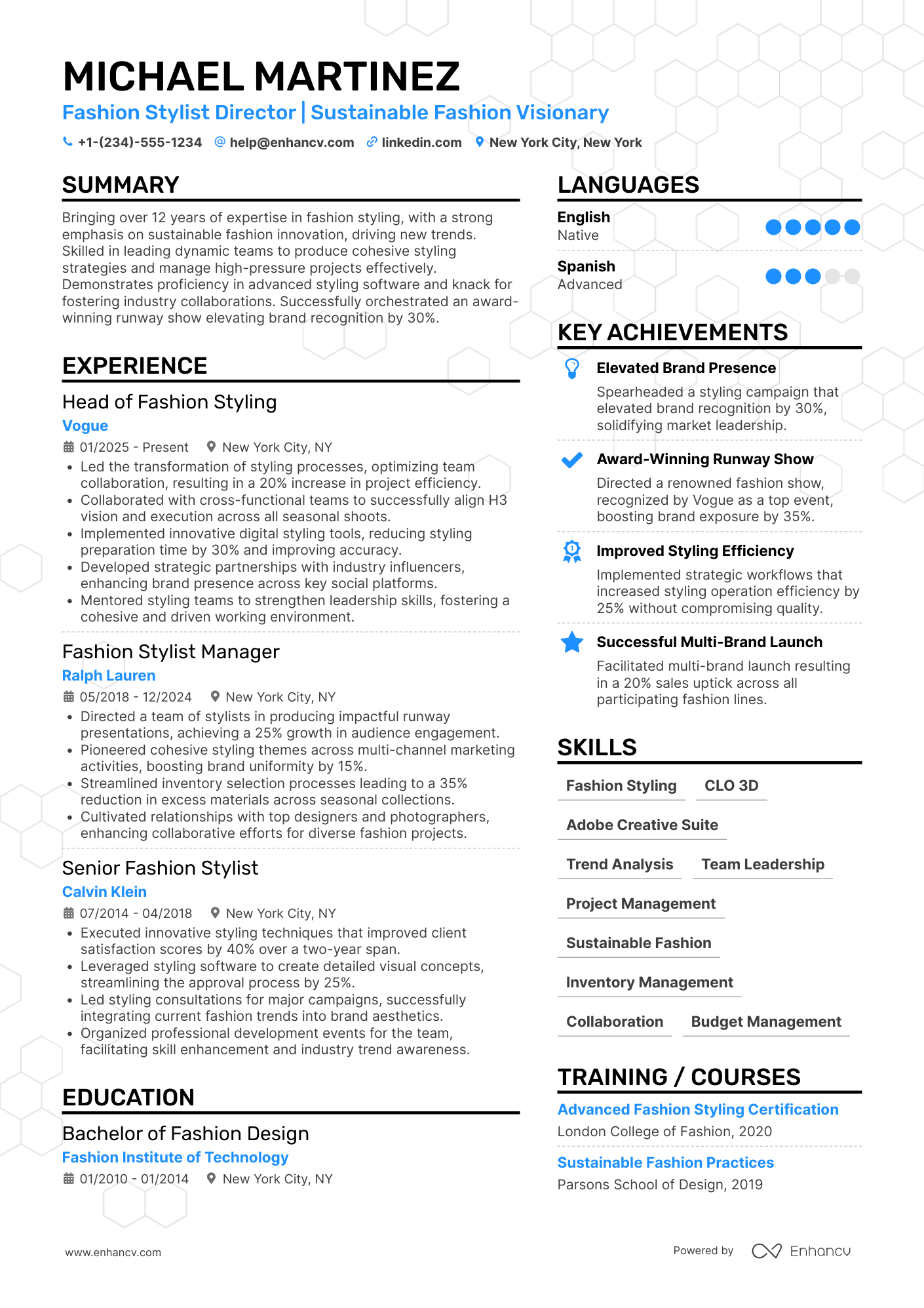
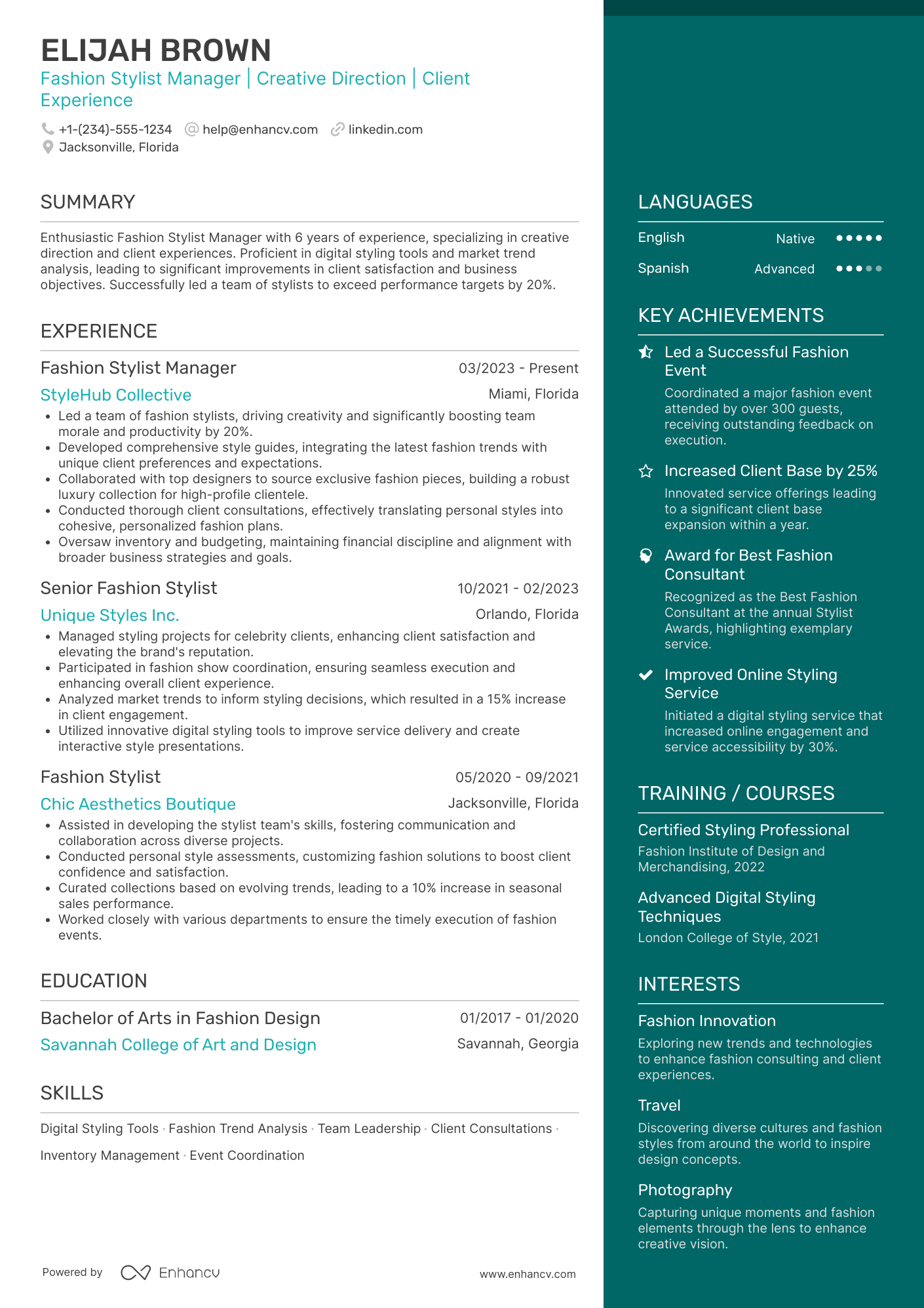
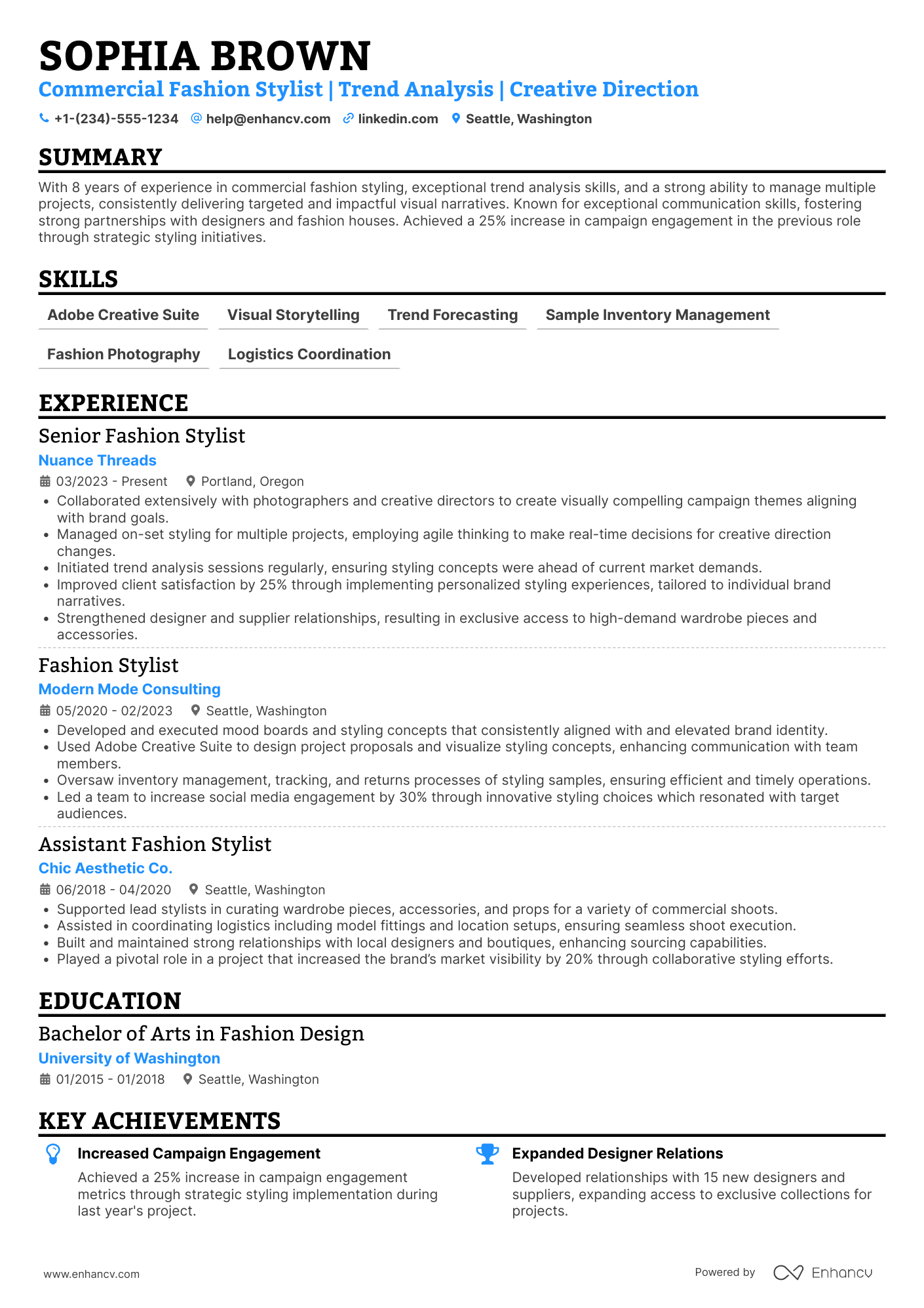
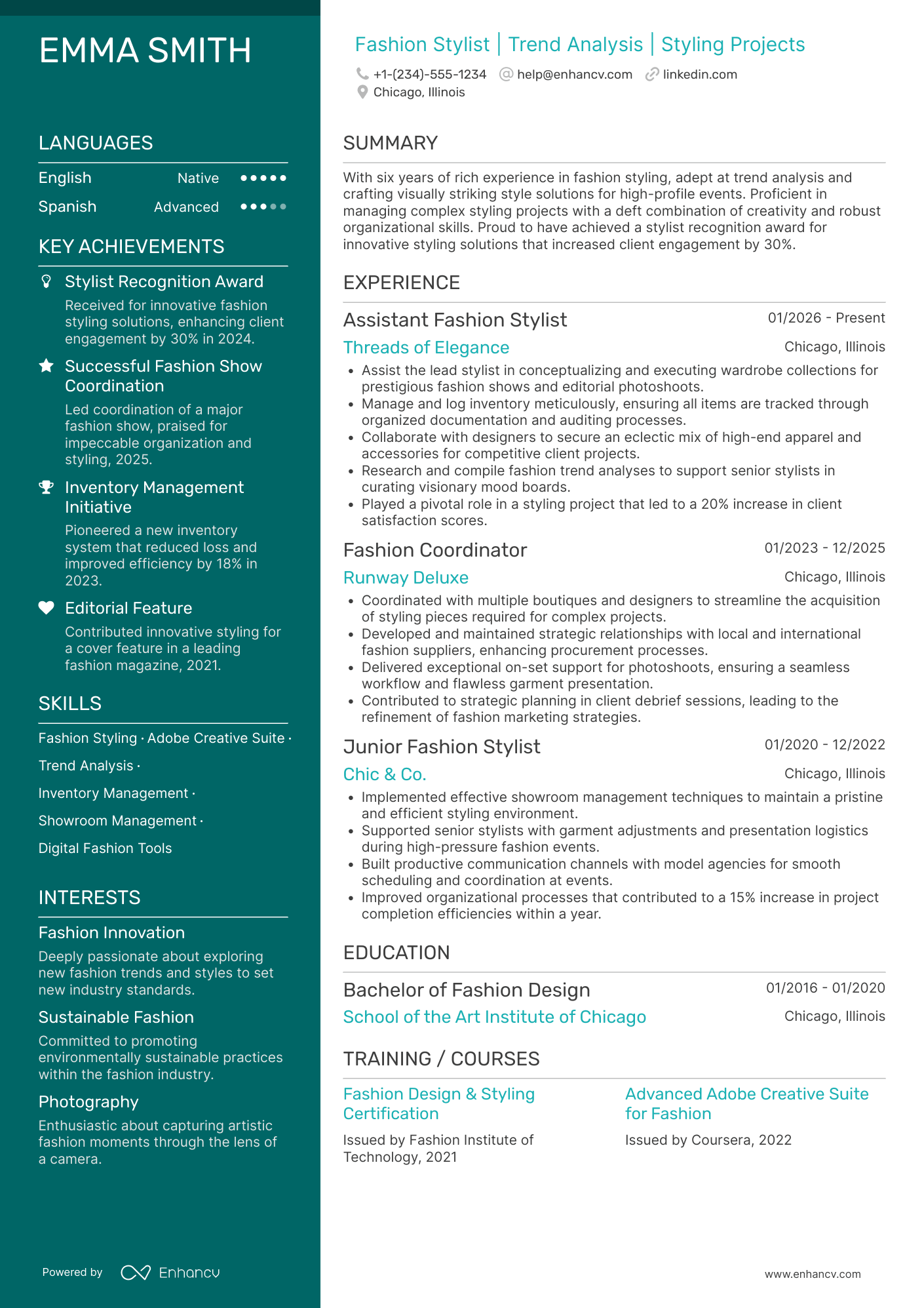
Many fashion stylist resumes fail because they read like task lists and bury measurable impact. A fashion stylist resume that lacks clear results gets filtered by ATS keywords and skipped in rapid recruiter scans.
A strong resume shows what you delivered and why it worked. Knowing how to make your resume stand out starts with highlighting revenue lifts from styled campaigns, conversion gains, client retention, on-time shoot delivery, budget control, and brand consistency across multiple markets.

Key takeaways
- Quantify styling outcomes like conversion lift, client retention, and turnaround time in every bullet.
- Use reverse-chronological format for experienced stylists and hybrid format for career changers.
- Tailor each experience bullet to mirror the job posting's exact tools, methods, and terminology.
- Place your skills section above experience if you're junior or switching into styling.
- Anchor every listed skill to a real project, collaboration, or measurable result.
- Pair your resume with a cover letter when the role demands brand-fit context or creative point of view.
- Use Enhancv to turn vague styling duties into focused, metric-driven resume bullets faster.
How to format a fashion stylist resume
Recruiters evaluating fashion stylist resumes prioritize a strong visual narrative of creative projects, client relationships, and brand collaborations—supported by measurable outcomes like revenue influence, client retention, or editorial placements. Choosing the right resume format determines how quickly a hiring manager can trace your creative range and professional growth, so the structure you pick is critical for both human readers and applicant tracking systems.

I have significant experience in this role—which format should I use?
Use a reverse-chronological format to showcase your styling career in a clear, linear progression that highlights deepening client rosters, brand partnerships, and creative leadership. Do:
- Lead each role entry with your scope of work—number of clients managed, size of editorial or commercial projects, and any team oversight or creative direction responsibilities.
- Feature role-specific tools and domains such as trend forecasting platforms, wardrobe management software, mood board tools (e.g., Style Archive, Launchmetrics), and expertise across editorial, commercial, celebrity, or personal styling verticals.
- Quantify outcomes tied to business impact, including client acquisition rates, revenue generated through styling services, campaign reach, or repeat booking percentages.
I'm junior or switching into this role—what format works best?
A hybrid format works best, placing a focused skills section at the top while still grounding your experience in a chronological work history—even if that history is brief or drawn from adjacent fields. Do:
- Position your strongest styling-relevant skills—color theory, trend analysis, garment fitting, client consultation—at the top of the resume where recruiters and applicant tracking systems scan first.
- Highlight transferable projects such as freelance lookbooks, student fashion shows, personal styling for events, retail visual merchandising, or volunteer wardrobe coordination for theater or film.
- Connect every action to a clear result so hiring managers can see your potential impact, not just task completion.
Why not use a functional resume?
A functional format strips away the timeline of your growth, making it difficult for recruiters to verify where and when you developed your styling skills—which raises red flags even for early-career candidates. Functional resumes can make sense in a narrow set of circumstances specific to this field:
- You're transitioning from a related creative role (e.g., visual merchandiser, costume designer, makeup artist) and need to reframe existing skills for a styling context.
- You have a gap in employment but continued building your portfolio through freelance styling, personal projects, or industry-adjacent work.
- You have minimal formal work history but hold relevant certifications or completed styling apprenticeships and internships.
- A functional format is acceptable only when you have no relevant employment history to list chronologically, such as a complete career pivot into fashion styling, and even then, every skill listed should be anchored to a real project, collaboration, or measurable result.
Once your format establishes a clean, readable structure, the next step is filling it with the right sections to showcase your qualifications effectively.
What sections should go on a fashion stylist resume
Recruiters expect a clean, portfolio-minded resume that proves your styling range, client results, and on-set professionalism. Understanding which resume sections to include helps you organize your qualifications for maximum clarity.
Use this structure for maximum clarity:
- Header
- Summary
- Experience
- Skills
- Projects
- Education
- Certifications
- Optional sections: Awards, Publications, Languages
Your experience bullets should emphasize measurable outcomes, the scope of shoots or clients you supported, and the impact of your styling on brand consistency, engagement, sales, or editorial placements.
Is your resume good enough?
Drop your resume here or choose a file. PDF & DOCX only. Max 2MB file size.
Once you’ve organized your resume with the right core components, the next step is to write your fashion stylist resume experience in a way that fits those sections and shows your impact.
How to write your fashion stylist resume experience
The experience section is where you prove you've delivered styling work that moved the needle—whether through client transformations, editorial shoots, campaign direction, or retail performance. Hiring managers prioritize demonstrated impact over descriptive task lists, so every bullet should connect your styling expertise, tools, and methods to a measurable outcome.
Each entry should include:
- Job title
- Company and location (or remote)
- Dates of employment (month and year)
Three to five concise bullet points showing what you owned, how you executed, and what outcomes you delivered:
- Ownership scope: the styling projects, client portfolios, editorial accounts, wardrobe departments, lookbooks, or brand partnerships you were directly accountable for as a fashion stylist.
- Execution approach: the trend forecasting methods, mood boarding techniques, fitting processes, sourcing strategies, style software, or visual merchandising frameworks you used to make creative decisions and deliver polished styling work.
- Value improved: changes to client satisfaction, brand consistency, visual quality, wardrobe efficiency, return rates, or editorial turnaround that resulted from your styling direction.
- Collaboration context: how you partnered with photographers, creative directors, makeup artists, designers, buyers, talent, or marketing teams to align styling choices with broader creative or commercial goals.
- Impact delivered: outcomes expressed through client retention, revenue influence, audience engagement, campaign reach, or brand perception rather than a list of tasks you performed on set or in-store.
Experience bullet formula
A fashion stylist experience example
✅ Right example - modern, quantified, specific.
Fashion Stylist (E-commerce & Campaigns)
Luna & Thread | Los Angeles, CA
2022–Present
Direct-to-consumer womenswear brand producing weekly e-commerce drops and seasonal campaigns across web, email, and paid social.
- Led end-to-end styling for 140+ product launches per year, increasing add-to-cart rate by 12% through optimized outfit building, fit notes, and on-model consistency standards.
- Built seasonal style guides and shot lists in Notion and Google Sheets, cutting pre-production time by 25% and aligning creative direction across photographers, hair and makeup, and producers.
- Managed sample trafficking and inventory in Airtable, reducing missing or delayed samples by 35% and improving on-time shoot completion from 82% to 94%.
- Partnered with designers and merchandisers to refine styling for key categories, lifting full-price sell-through by nine percent and reducing returns due to “not as pictured” feedback by 18%.
- Directed on-set styling for two-day campaign shoots, coordinating with retouchers in Adobe Photoshop and Capture One workflows to reduce post-production revisions by 30% and deliver final selects two days faster.
Now that you've seen how a strong experience section comes together, let's break down how to adapt yours to match the specific job you're targeting.
How to tailor your fashion stylist resume experience
Recruiters evaluate your fashion stylist resume through applicant tracking systems and manual review. Tailoring your resume to the job description ensures your qualifications stand out in both screenings.
Ways to tailor your fashion stylist experience:
- Match styling tools and software platforms listed in the posting.
- Use the exact terminology for styling methods or techniques referenced.
- Mirror client satisfaction or retention metrics the employer prioritizes.
- Include specific fashion industry segments you have worked in.
- Highlight collaboration with photographers or creative directors when requested.
- Emphasize brand guideline adherence if the role requires visual consistency.
- Reference trend forecasting processes that align with stated expectations.
- Showcase editorial or commercial styling workflows the posting describes.
Tailoring means aligning your real accomplishments with what the employer needs—not forcing disconnected keywords into your experience section.
Resume tailoring examples for fashion stylist
| Job description excerpt | Untailored | Tailored |
|---|---|---|
| "Style clients for editorial shoots and red-carpet events using current trend forecasting and mood board development in collaboration with photographers and creative directors." | Helped style clients for various events and projects. | Styled 30+ clients annually for editorial shoots and red-carpet appearances, developing mood boards informed by trend forecasting tools like WGSN and collaborating directly with photographers and creative directors to execute cohesive visual narratives. |
| "Manage wardrobe inventory and coordinate with luxury brand showrooms to pull pieces for high-profile talent, ensuring looks align with brand partnerships and contractual obligations." | Handled clothing and worked with brands for styling projects. | Managed a rotating wardrobe inventory of 200+ luxury pieces, coordinating pulls from showrooms including Chanel, Valentino, and Balenciaga while ensuring every look satisfied brand partnership guidelines and talent contractual requirements. |
| "Conduct personal styling consultations for private clients, building seasonal capsule wardrobes tailored to lifestyle, body type, and budget using tools like Style Archive and Google Shopping." | Provided styling advice to clients and helped them shop. | Led one-on-one styling consultations for a roster of 15 private clients, building seasonal capsule wardrobes of 25–40 pieces per client using Style Archive for wardrobe tracking and Google Shopping for budget-conscious sourcing aligned with each client's lifestyle and body type. |
Once you’ve aligned your experience with the role’s priorities, the next step is to quantify your fashion stylist achievements so hiring managers can see the results of your work.
How to quantify your fashion stylist achievements
Quantifying your achievements shows how your styling choices drove results, not just aesthetics. Track measurable outcomes like conversion lift, client satisfaction, turnaround time, budget accuracy, and returns reduction across shoots, fittings, and campaigns.
Quantifying examples for fashion stylist
| Metric | Example |
|---|---|
| Conversion rate | "Styled 18-product e-commerce capsule in Shopify; increased add-to-cart rate from 6.8% to 8.1% and lifted conversion by 0.6 points over four weeks." |
| Turnaround time | "Cut lookbook styling cycle from five days to three by standardizing fittings and using Airtable shot lists for a 42-look seasonal drop." |
| Budget adherence | "Managed $25,000 sample and pull budget; kept overages under 2% by tracking loans, shipping, and rush alterations in Google Sheets." |
| Returns reduction | "Reduced size-and-fit returns by 11% by adding fit notes, fabric callouts, and styling guidance to product pages for 60 top-selling items." |
| Client satisfaction | "Raised client satisfaction from 4.3 to 4.7 out of 5 across 12 VIP appointments by tightening pre-visit questionnaires and post-visit follow-ups in CRM." |
Turn vague job duties into measurable, recruiter-ready resume bullets in seconds with Enhancv's Bullet Point Generator.
Once you've crafted strong bullet points for your experience section, you'll want to apply that same precision to presenting your hard and soft skills effectively.
How to list your hard and soft skills on a fashion stylist resume
Your skills section shows you can build client-ready looks, manage fittings and shoots, and deliver on-brand results; recruiters and an ATS (applicant tracking system) scan this section for role keywords, and strong resumes balance hard skills with execution-focused soft skills. fashion stylist roles require a blend of:
- Product strategy and discovery skills.
- Data, analytics, and experimentation skills.
- Delivery, execution, and go-to-market discipline.
- Soft skills.
Your skills section should be:
- Scannable (bullet-style grouping).
- Relevant to the job post.
- Backed by proof in experience bullets.
- Updated with current tools.
Place your skills section:
- Above experience if you're junior or switching careers.
- Below experience if you're mid/senior with strong achievements.

Hard skills
- Trend forecasting, mood boards
- Wardrobe audits, closet organization
- Client intake, style profiling
- Outfit building, capsule wardrobes
- Color theory, body proportions
- Fit analysis, alterations coordination
- Pull lists, sample trafficking
- Styling for e-commerce, lookbooks
- On-set styling, photo shoot prep
- Vendor sourcing, brand relationships
- Inventory tracking, asset management
- Budgeting, cost-per-look tracking
Soft skills
- Translate briefs into looks
- Align stakeholders on vision
- Present options with rationale
- Give clear fitting direction
- Negotiate pulls and timelines
- Resolve fit and styling issues
- Manage last-minute changes
- Prioritize under tight deadlines
- Maintain client confidentiality
- Collaborate with photographers and glam
- Lead assistants and interns
- Document decisions and next steps
How to show your fashion stylist skills in context
Skills shouldn't live only in a dedicated skills list. Browse examples of resume skills to see how stylists weave their abilities into every section.
They should be demonstrated in:
- Your summary (high-level professional identity)
- Your experience (proof through outcomes)
Here's what that looks like in practice.
Summary example
Senior fashion stylist with 10+ years in editorial and celebrity styling. Skilled in trend forecasting, mood boarding, and cross-functional collaboration. Increased client retention by 35% through personalized styling frameworks and strong vendor relationships.
- Reflects senior-level expertise clearly
- Names role-relevant tools and methods
- Includes a measurable retention metric
- Highlights collaboration as a soft skill
Experience example
Senior Fashion Stylist
Arc & Line Studio | New York, NY
March 2019–Present
- Styled 80+ editorial shoots annually using trend forecasting and mood boarding, boosting publication placements by 40%.
- Collaborated with photographers, designers, and art directors to execute cohesive visual narratives across 12 seasonal campaigns.
- Implemented a digital wardrobe tracking system that reduced pull-to-return turnaround time by 25%.
- Every bullet includes measurable proof
- Skills appear naturally within accomplishments
Once you’ve demonstrated your styling strengths through real examples, the next step is to apply the same approach to a fashion stylist resume with no experience so you can present your capabilities clearly without relying on formal roles.
How do I write a fashion stylist resume with no experience
Even without full-time experience, you can demonstrate readiness through styling projects and transferable work. If you're building a resume without work experience, focus on portfolio pieces and measurable contributions:
- Portfolio of styled outfit looks
- Editorial photoshoot collaborations with photographers
- Volunteer styling for community events
- Personal shopping for friends and family
- Thrift flips and wardrobe revamps
- Social media styling content series
- Styling assistant work on set
- Fashion retail visual merchandising projects
Focus on:
- Clear styling portfolio with results
- Brand fit and trend research
- On-set workflow and kit readiness
- Measurable impact on engagement or sales
Resume format tip for entry-level fashion stylist
Use a combination resume format to highlight styling projects and tools above work history. It helps recruiters scan your portfolio, methods, and results fast. Do:
- Lead with a Styling Projects section.
- Link a portfolio with labeled looks.
- List tools: Pinterest, Canva, Lightroom.
- Quantify results: clicks, saves, bookings.
- Match keywords to the job post.
- Produced a six-look capsule styling series using Pinterest mood boards and Canva line sheets, increasing Instagram saves by 38% over four weeks.
Even without traditional work experience, your education section can demonstrate relevant knowledge and training that strengthens your candidacy.
How to list your education on a fashion stylist resume
Your education section helps hiring teams confirm you have foundational knowledge in design, textiles, or visual aesthetics. It quickly validates your training for the fashion stylist role.
Include:
- Degree name
- Institution
- Location
- Graduation year
- Relevant coursework (for juniors or entry-level candidates)
- Honors & GPA (if 3.5 or higher)
Avoid listing specific months or days—use the graduation year only for a cleaner look.
Here's a strong education entry tailored for a fashion stylist resume.
Example education entry
Bachelor of Fine Arts in Fashion Design
Parsons School of Design, New York, NY
2021 | GPA: 3.7
- Relevant Coursework: Textile Science, Color Theory, Trend Forecasting, Visual Merchandising, History of Fashion
- Honors: Dean's List, 2019–2021
How to list your certifications on a fashion stylist resume
Certifications on your resume show a fashion stylist's commitment to learning, proficiency with styling tools, and up-to-date industry knowledge that clients and employers trust. Include:
- Certificate name
- Issuing organization
- Year
- Optional: credential ID or URL
- Place certifications below education when your degree is recent and your certifications add secondary support.
- Place certifications above education when they're recent, highly relevant to a fashion stylist role, or required by the job posting.
Best certifications for your fashion stylist resume
Adobe Certified Professional (Photoshop) Adobe Certified Professional (Illustrator) Fashion Styling Certificate (London College of Fashion, University of the Arts London) Personal Styling Certificate (New York Institute of Art and Design) Certified Image Consultant (Association of Image Consultants International) Wardrobe Stylist Certificate (Fashion Institute of Technology)
Once you’ve positioned your credentials where hiring managers can spot them quickly, use your fashion stylist resume summary to connect those qualifications to the value you bring.
How to write your fashion stylist resume summary
Your resume summary is the first thing a recruiter reads. A strong one instantly signals you have the styling skills and creative eye the role demands.
Keep it to three to four lines, with:
- Your title and total years of fashion styling experience.
- The domain you work in, such as editorial, commercial, or personal styling.
- Core skills like trend forecasting, wardrobe curation, or mood board development.
- One or two measurable achievements, like client retention rates or campaign results.
- Soft skills tied to real outcomes, such as client communication that increased repeat bookings.

PRO TIP
At the junior level, emphasize your hands-on styling skills, relevant tools, and any early wins. Highlight specific contributions like assisting on shoots or building client wardrobes. Avoid vague phrases like "passionate creative" or "fashion-forward thinker." Recruiters want proof of what you've done, not promises about what you hope to do.
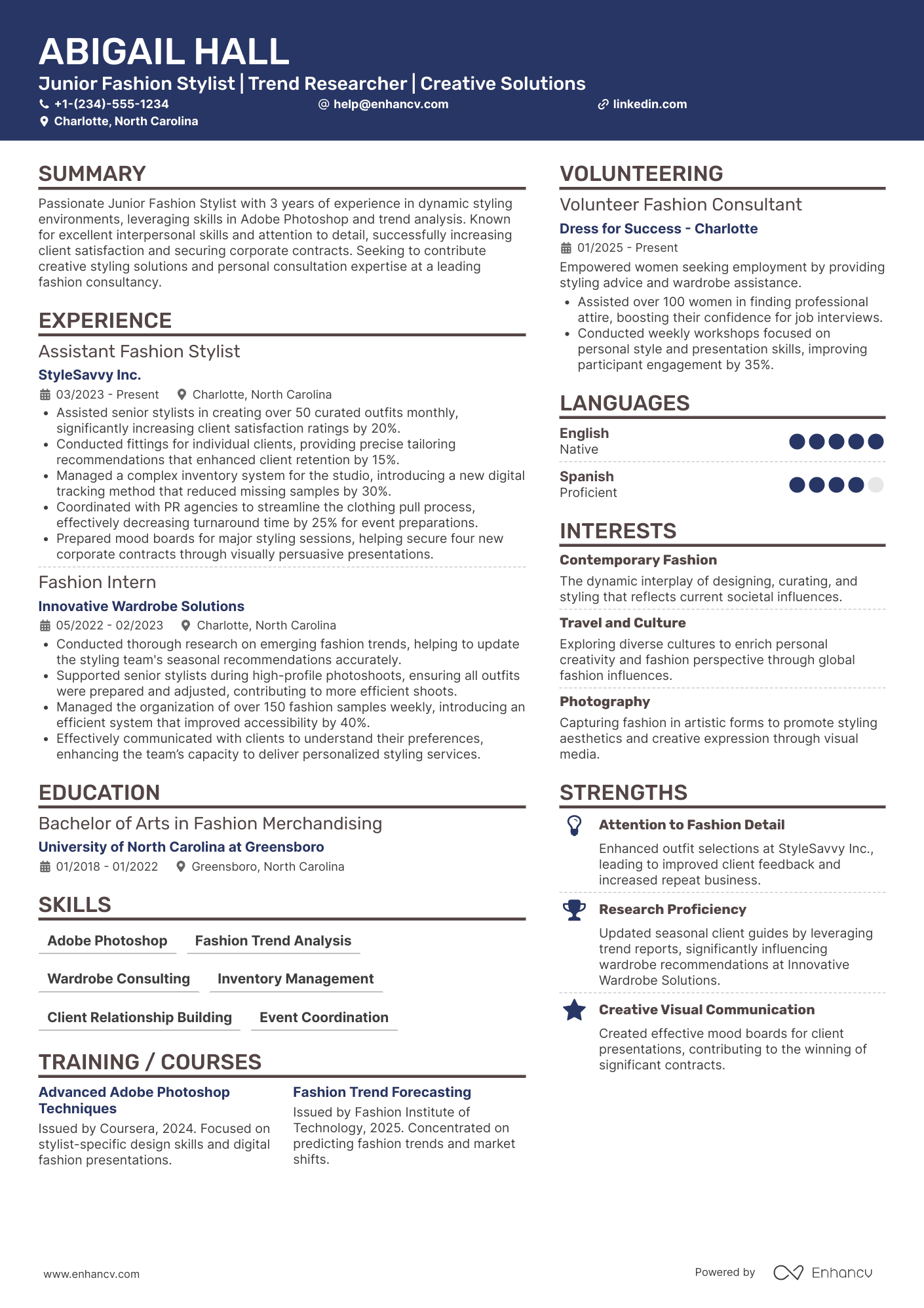
Example summary for a fashion stylist
Fashion stylist with two years of experience in commercial and personal styling. Curated wardrobes for 40+ clients using trend forecasting tools, boosting repeat booking rates by 25%.
Optimize your resume summary and objective for ATS
Drop your resume here or choose a file.
PDF & DOCX only. Max 2MB file size.
Now that your summary captures your styling expertise at a glance, make sure your resume header presents the essential contact and professional details recruiters need to reach you.
What to include in a fashion stylist resume header
A resume header is the top section with your key contact and professional details, helping fashion stylist visibility, credibility, and fast recruiter screening.
Essential resume header elements
- Full name
- Tailored job title and headline
- Location
- Phone number
- Professional email
- GitHub link
- Portfolio link
A LinkedIn link lets recruiters verify your experience quickly and supports screening.
Don't include photos on a fashion stylist resume unless the role is explicitly front-facing or appearance-dependent.
Use a clear headline that matches the job posting and keep your links short, consistent, and easy to copy.
Fashion stylist resume header
Avery Johnson
Fashion stylist | Editorial and e-commerce styling
Los Angeles, CA
(310) 555-01XX
your.name@enhancv.com
github.com/yourname
yourwebsite.com
linkedin.com/in/yourname
Once your contact details and role focus are clear at the top, you can strengthen the rest of your application with additional sections for fashion stylist resumes that add relevant context.
Additional sections for fashion stylist resumes
When your core qualifications match other candidates, well-chosen additional sections can set your fashion stylist resume apart with unique credibility. For example, listing language skills can be especially valuable if you work with international clients or brands across multiple markets.
- Languages
- Hobbies and interests
- Publications and media features
- Fashion shows and events
- Professional affiliations and memberships
- Volunteer styling work
Once you've rounded out your resume with the right supplementary sections, it's worth pairing it with a strong cover letter to make an even bigger impression.
Do fashion stylist resumes need a cover letter
A cover letter isn't required for every fashion stylist role, but it helps in competitive searches or when hiring managers expect one. If you're unsure where to start, understanding what a cover letter is and how it complements your resume can make a real difference when the role demands a specific point of view.
Use a cover letter to add context your resume can't show:
- Explain role and team fit by matching your styling approach to the brand voice, shoot workflow, and cross-functional partners.
- Highlight one or two relevant projects with outcomes, such as improved conversion on product pages or faster sample-to-shoot turnaround.
- Show you understand the product, users, and business context, including target customer, price point, and channel needs across ecommerce and social.
- Address career transitions or non-obvious experience by connecting transferable skills to fashion stylist responsibilities and tools.
Drop your resume here or choose a file.
PDF & DOCX only. Max 2MB file size.
Even if you include a cover letter to add context beyond your resume, the next step is using AI to improve your fashion stylist resume so it reads clearly, highlights your strongest work, and stays consistent throughout.
Using AI to improve your fashion stylist resume
AI can sharpen your resume's clarity, structure, and impact. It helps refine bullet points, tighten language, and highlight measurable results. But overuse strips authenticity. Once your content feels clear and role-aligned, step away from AI. If you're wondering which AI is best for writing resumes, focus on tools that let you stay in control of the final output.
Here are 10 practical prompts to strengthen specific sections of your fashion stylist resume:
- Strengthen your summary. "Rewrite my fashion stylist resume summary to highlight my styling specialties, client base, and years of experience in under four sentences."
- Quantify styling results. "Add measurable outcomes to these fashion stylist experience bullets, focusing on client retention rates, revenue impact, or wardrobe budgets managed."
- Sharpen action verbs. "Replace weak verbs in my fashion stylist experience section with strong, industry-specific action verbs that convey creative leadership."
- Tailor skills section. "Review this fashion stylist job description and reorder my skills section to prioritize the most relevant technical and creative abilities."
- Refine project descriptions. "Rewrite my fashion stylist project entries to clearly state the goal, my specific role, and the final outcome for each project."
- Tighten bullet points. "Shorten each fashion stylist experience bullet to one concise line without losing key details about responsibilities or achievements."
- Align education section. "Rewrite my education entries to emphasize coursework, training, or honors directly relevant to a fashion stylist career path."
- Highlight certifications clearly. "Format my fashion stylist certifications section so each entry includes the credential name, issuing organization, and completion date."
- Remove filler language. "Identify and remove vague or redundant phrases across my entire fashion stylist resume while keeping the original meaning intact."
- Match job posting language. "Compare my fashion stylist resume against this job posting and suggest specific wording changes to improve keyword alignment."
Stop using AI once your resume sounds accurate, specific, and aligned with real experience. AI should never invent experience or inflate claims—if it didn't happen, it doesn't belong here.
Conclusion
A strong fashion stylist resume proves impact with measurable outcomes, highlights role-specific skills, and stays easy to scan. Use clear headings, focused bullet points, and consistent formatting. Show results like sales lift, booking growth, higher engagement, or faster styling turnaround.
Keep your fashion stylist resume targeted and current for today’s hiring market. Lead with your strongest work, quantify wins, and match your skills to the role. With a clean structure and clear results, you’ll look ready for what teams need now.
Fashion Stylist resume examples
By Experience
By Role