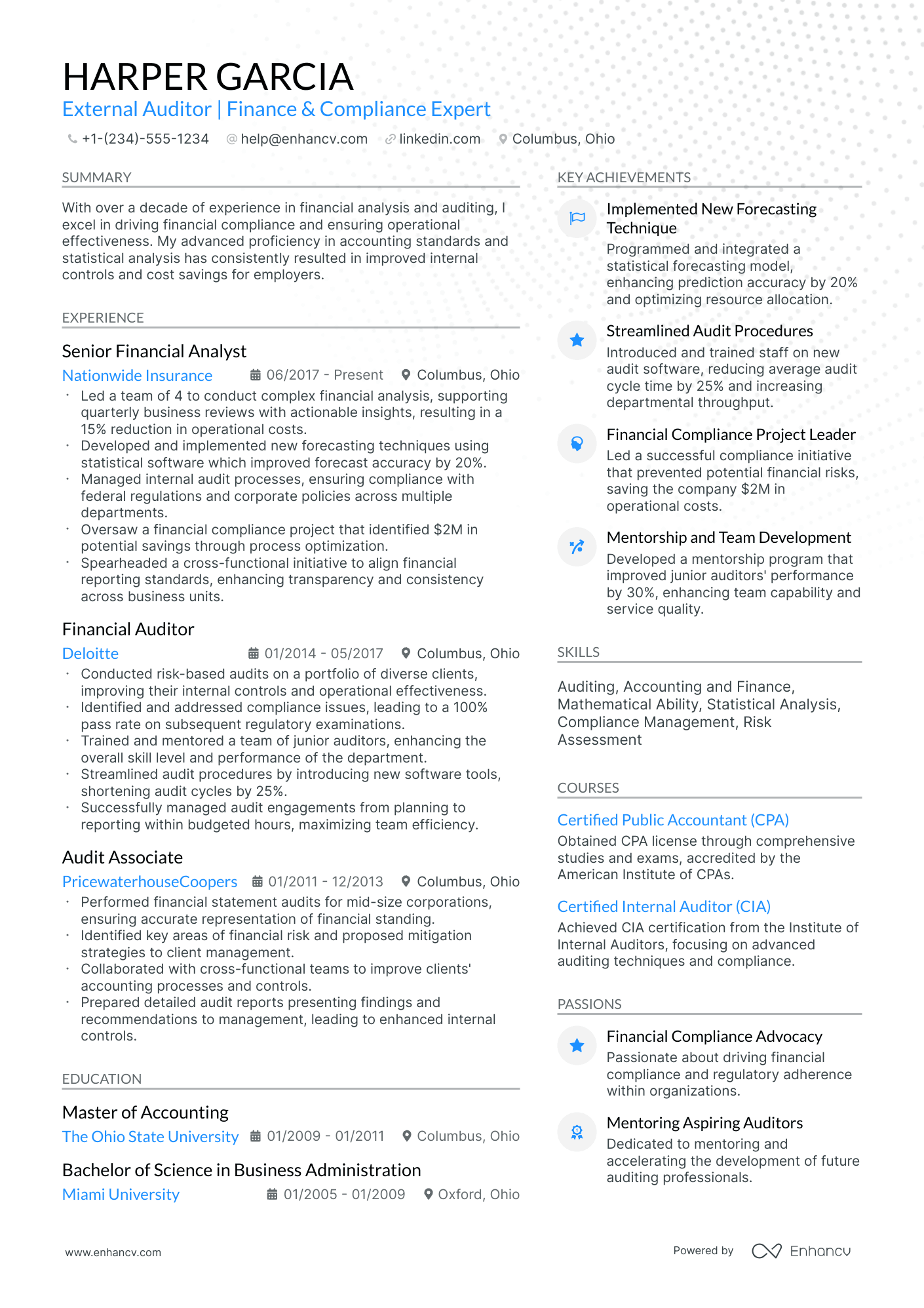
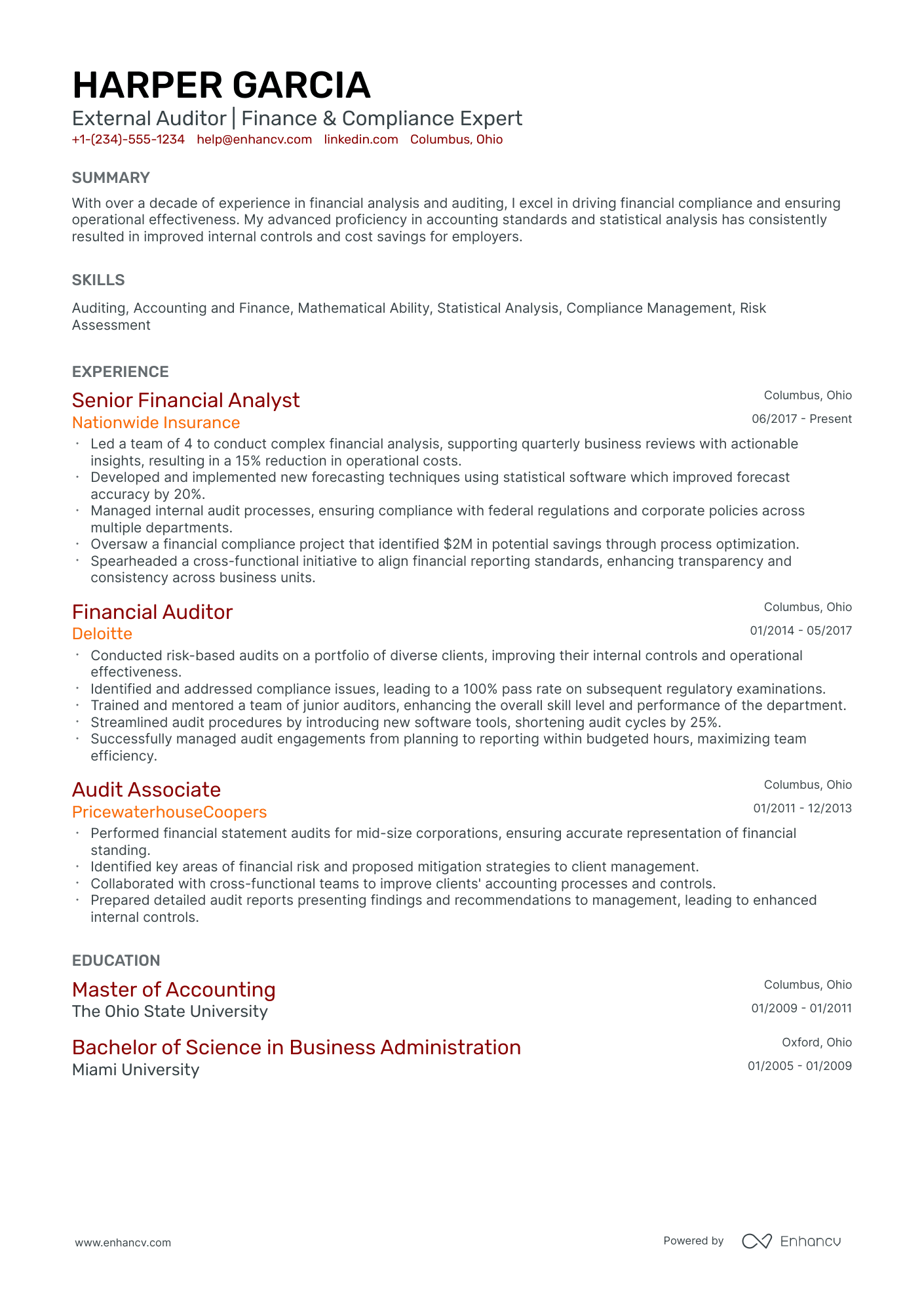
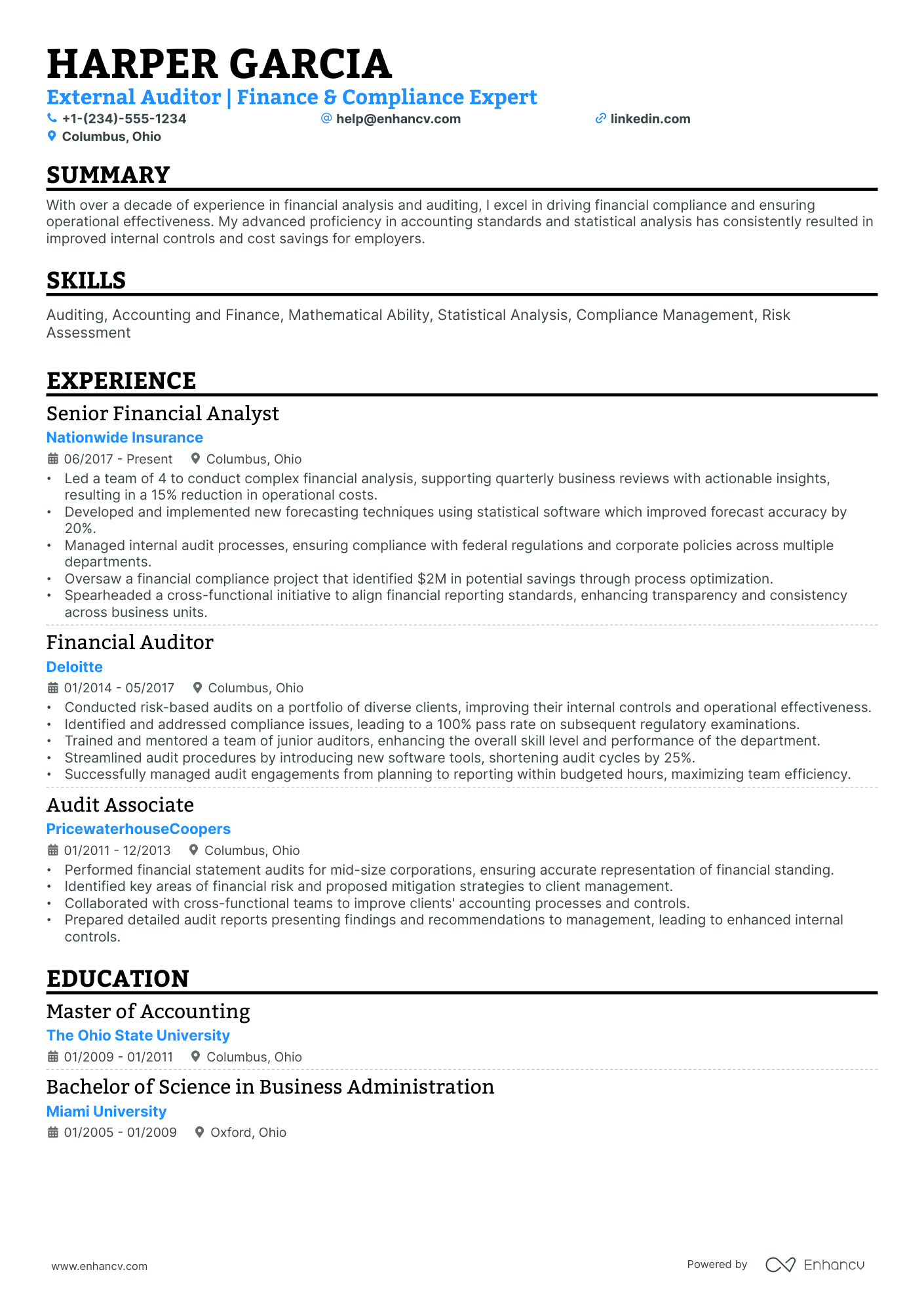
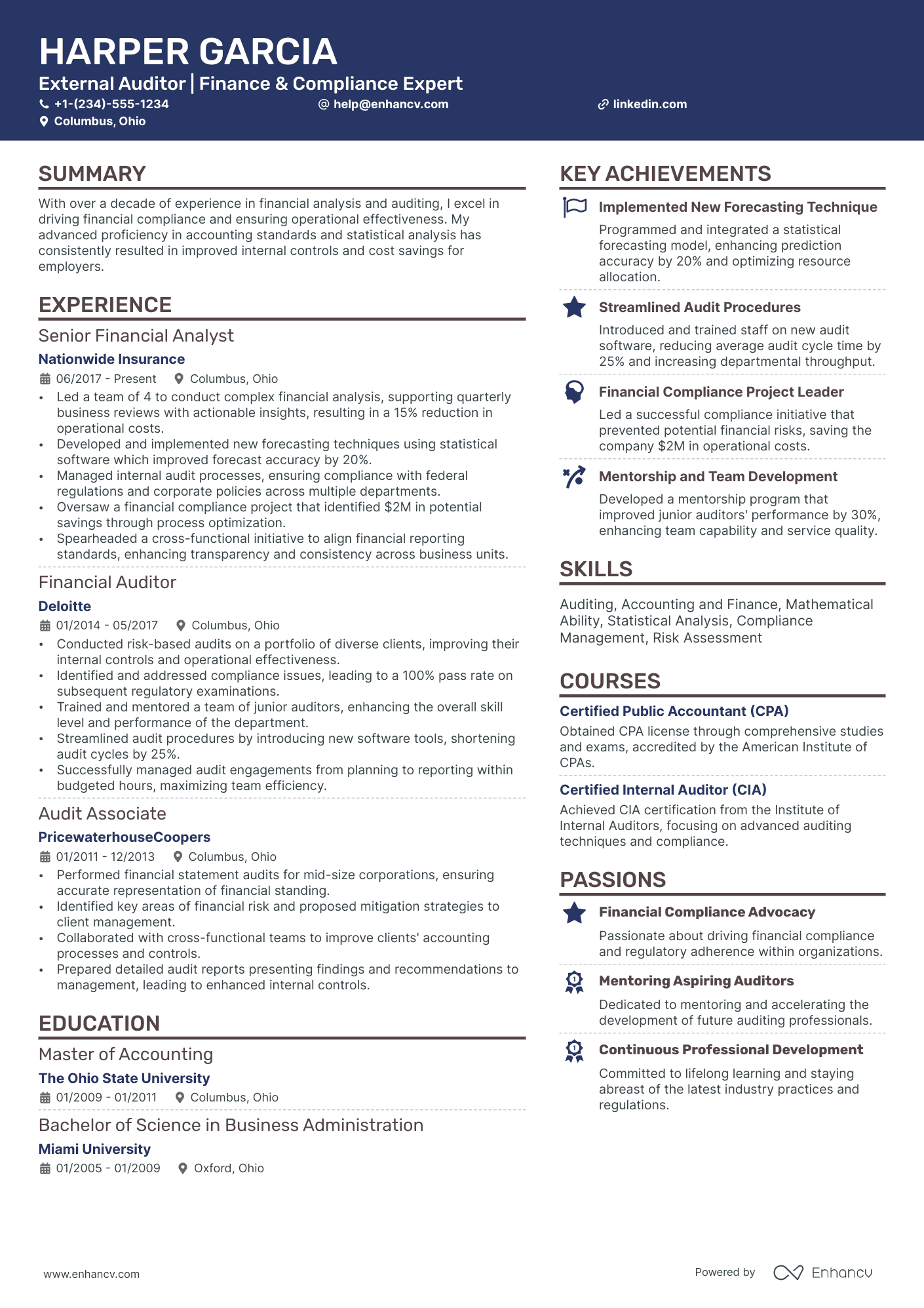
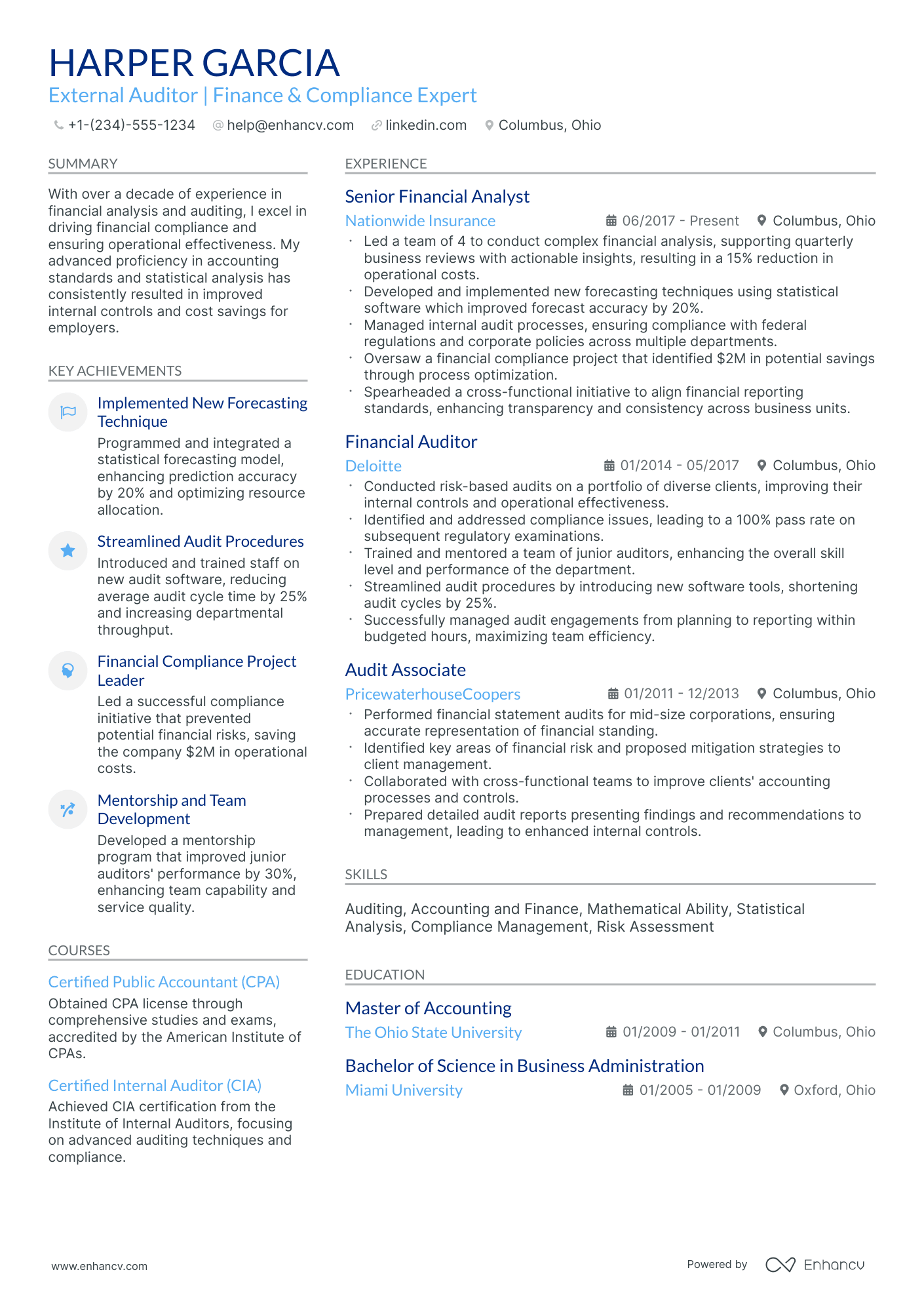
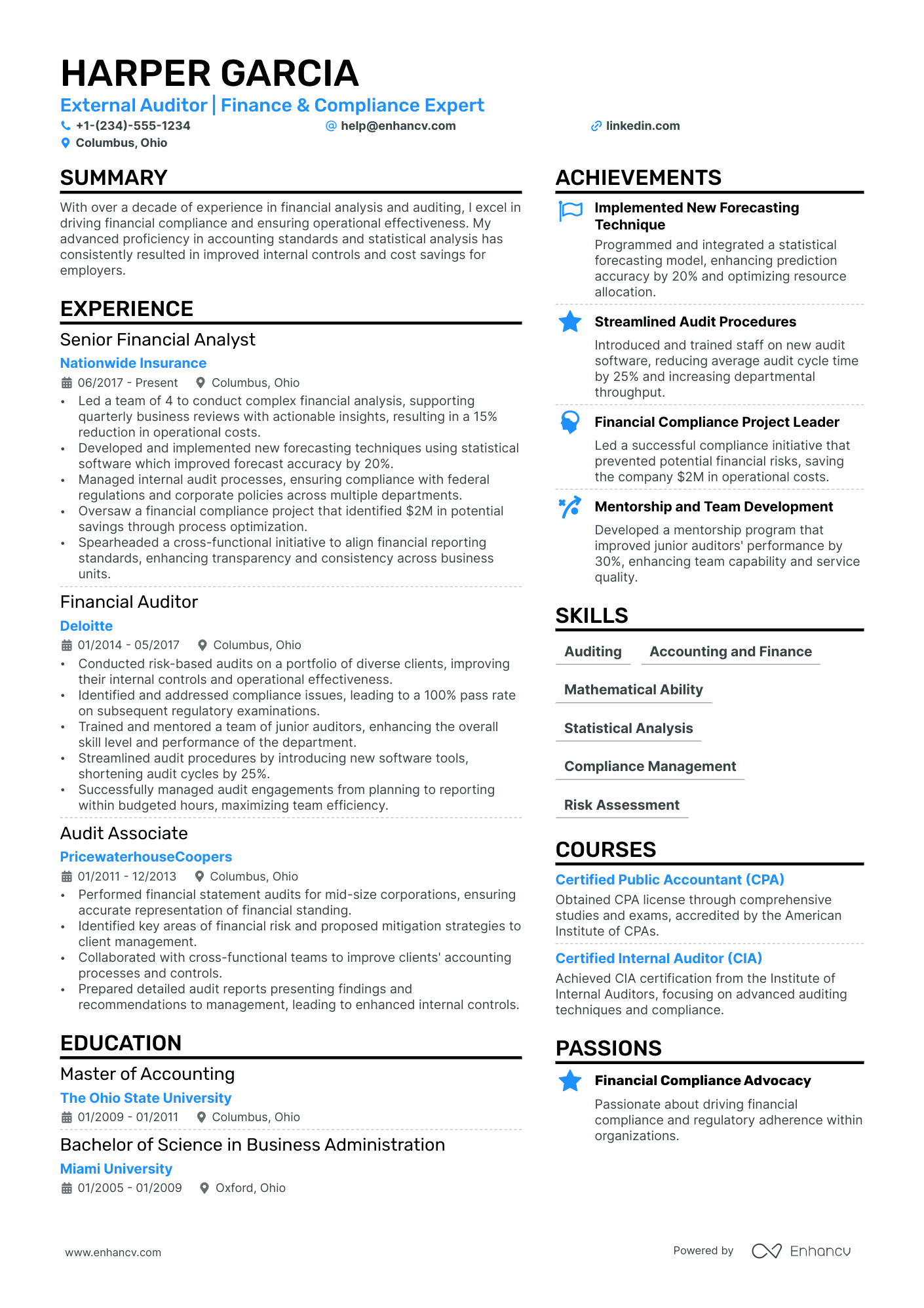
Many external auditor resumes fail because they read like checklists of standards and tasks, not evidence of risk reduction and assurance value. In today's ATS screening and rapid recruiter scans, an external auditor resume that lacks outcomes gets filtered fast.
A strong resume shows what changed because of your work. Knowing how to make your resume stand out means you should highlight audit scope, materiality, and results—issues found, control weaknesses remediated, and deadlines met. Include metrics like hours saved, error rates reduced, and clean opinions delivered across multi-entity engagements.

Key takeaways
- Quantify audit outcomes like cycle time, findings, and cost recovery instead of listing duties.
- Use reverse-chronological format to show clear career progression through audit roles.
- Tailor every experience bullet to mirror the job posting's standards, tools, and terminology.
- Anchor each skill to a specific engagement, measurable result, or client outcome.
- Place certifications like CPA or CIA where recruiters expect them—near your education section.
- Write a three- to four-line summary featuring your audit scope, tools, and top achievement.
- Use Enhancv to turn vague responsibilities into metric-driven, recruiter-ready resume bullets.
How to format a external auditor resume
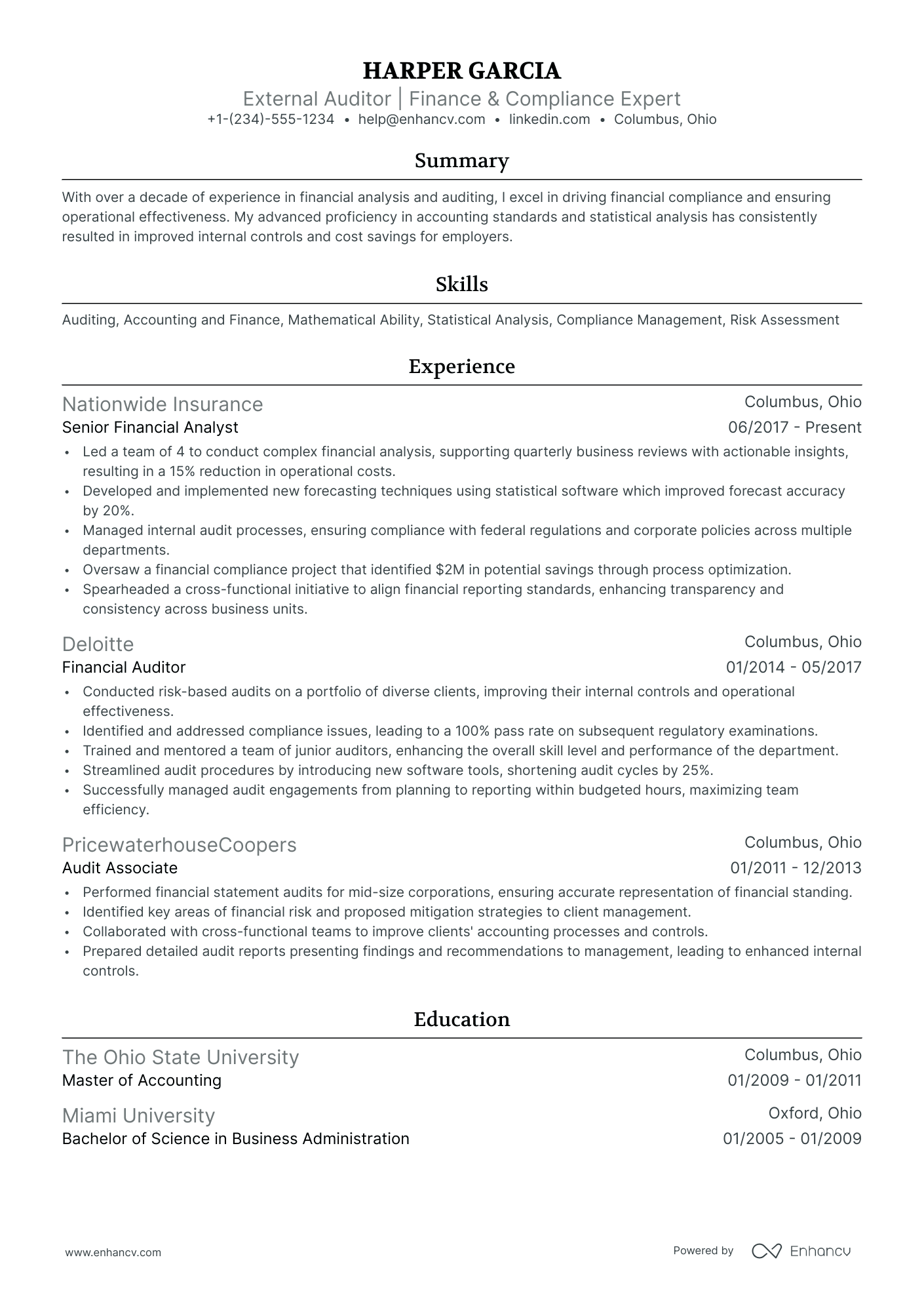
Recruiters evaluating external auditor resumes prioritize evidence of audit methodology expertise, client portfolio management, regulatory knowledge, and progressive leadership over engagement teams. A reverse-chronological format ensures these signals—especially career progression from staff auditor through senior or managerial roles—are immediately visible to both hiring managers and applicant tracking systems.

I have significant experience in this role—which format should I use?
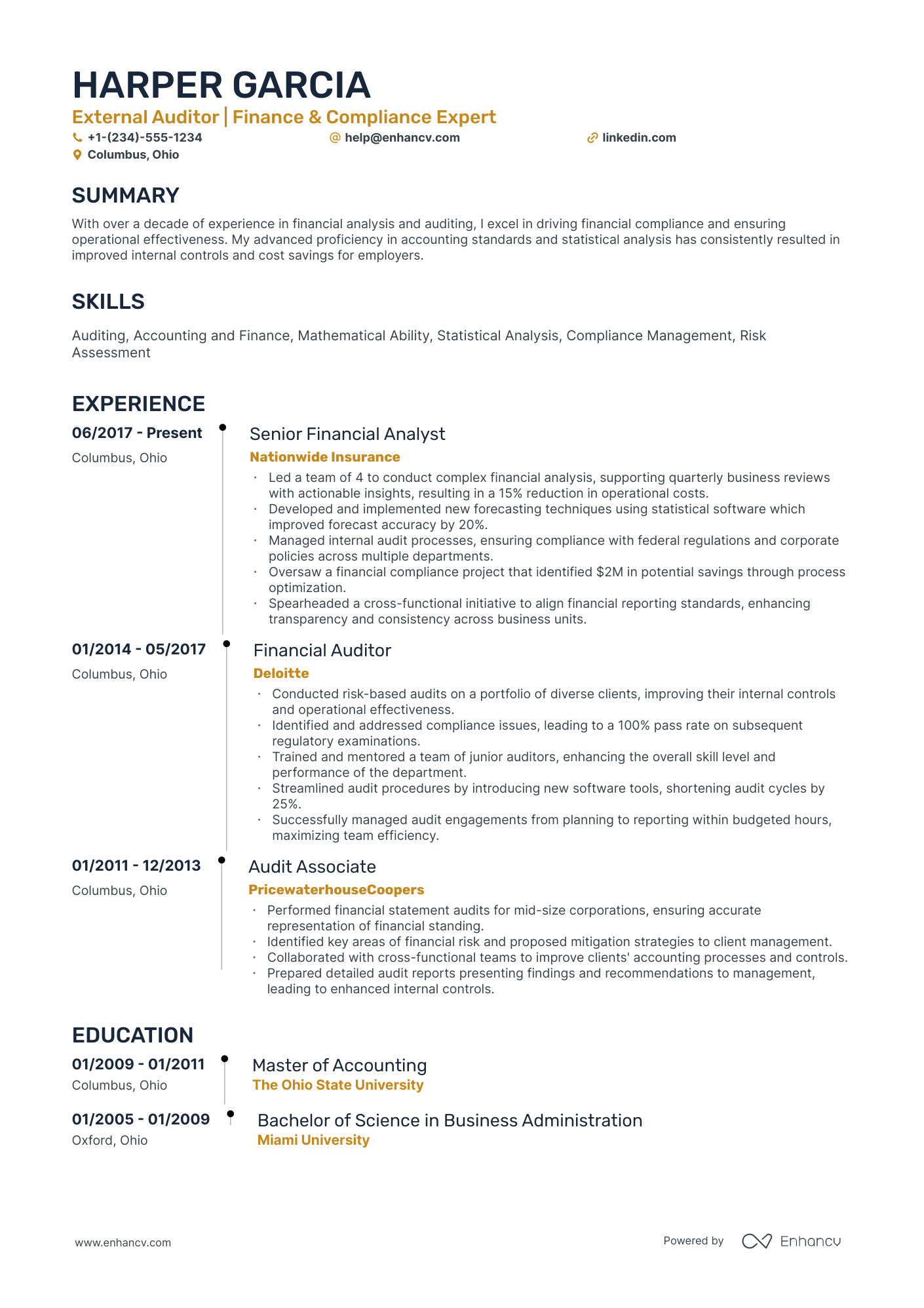
Use a reverse-chronological format to showcase your deepening audit responsibilities, client relationships, and leadership scope across engagements. Do:
- Lead with your most recent role and emphasize scope: number of engagements managed, team size, and client revenue tiers.
- Highlight domain-specific proficiencies such as GAAS, PCAOB standards, IFRS, SOX compliance, risk assessment frameworks, and audit management tools like CaseWare or TeamMate.
- Quantify outcomes tied to business impact—audit efficiency gains, material misstatement detection, cost savings from process improvements, or client retention rates.
I'm junior or switching into this role—what format works best?
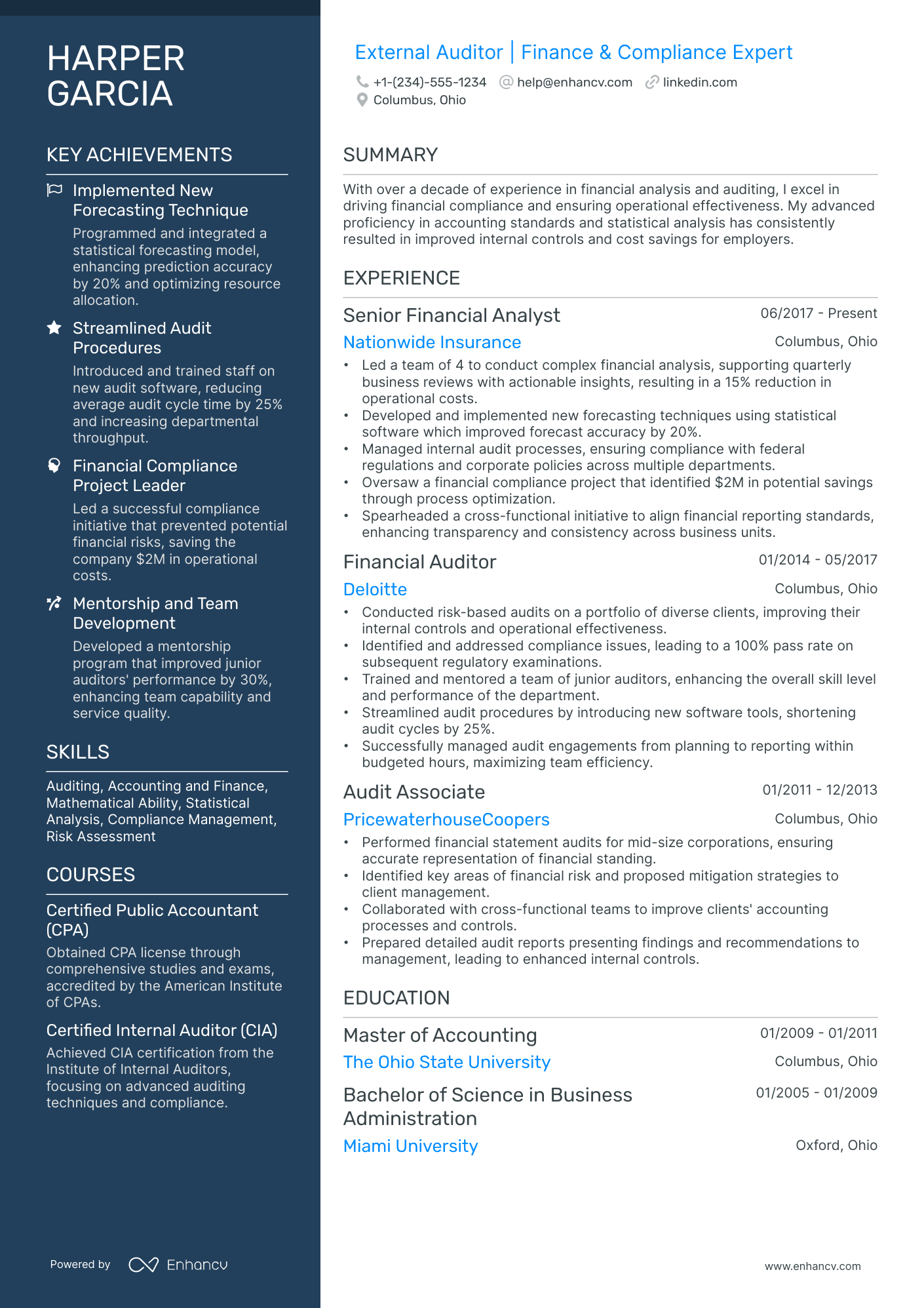
A hybrid format works best, allowing you to lead with relevant audit skills and certifications while still presenting your work history in chronological order. Do:
- Place a skills section near the top featuring audit-relevant competencies such as GAAP knowledge, analytical procedures, sampling techniques, and tools like Excel, IDEA, or ACL.
- Include academic projects, internships, or transitional experience—such as internal audit rotations or accounting roles—that demonstrate exposure to audit workflows.
- Connect every listed skill or experience to a concrete action and an observable result.
Why not use a functional resume?
A functional resume strips away the timeline of your audit experience, making it difficult for recruiters to assess your growth trajectory, the complexity of engagements you've handled, and your readiness for increasing responsibility.
- Career changers with transferable audit-adjacent experience: If you're transitioning from internal audit, tax, or compliance and lack direct external audit titles, a functional format can group relevant skills—but each skill must be anchored to a specific project, engagement, or measurable outcome to maintain credibility.
With your format established, the next step is filling it with the right sections to give recruiters a complete picture of your qualifications.
What sections should go on a external auditor resume
Recruiters expect to quickly find your audit scope, industry exposure, and evidence you improved compliance, controls, and reporting accuracy. Understanding which resume sections to include ensures hiring managers find what they need fast.
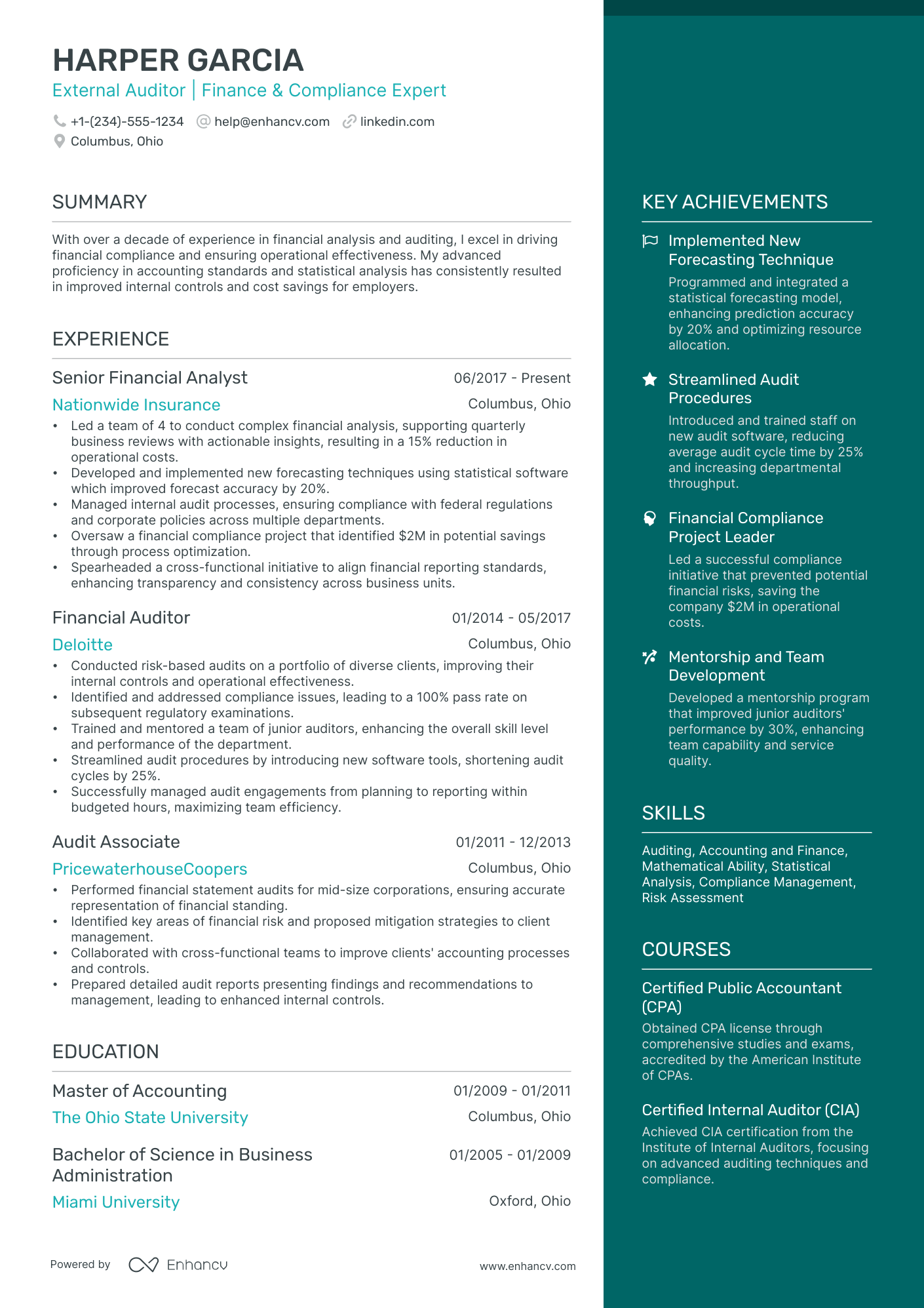
Use this structure for maximum clarity:
- Header
- Summary
- Experience
- Skills
- Projects
- Education
- Certifications
- Optional sections: Awards, Publications, Languages
Strong experience bullets should emphasize audit scope, risk level, measurable findings, remediation outcomes, and the business impact of your recommendations.
Is your resume good enough?
Drop your resume here or choose a file. PDF & DOCX only. Max 2MB file size.
Once you’ve organized your resume with the right core components, the next step is to write your external auditor resume experience section so it fits that structure and supports it.
How to write your external auditor resume experience
The experience section of your external auditor resume should highlight the audits you've completed, the standards and methodologies you've applied, and the measurable outcomes your work produced for clients or firms. Hiring managers prioritize demonstrated impact—such as risk mitigation, compliance improvements, and process efficiencies—over descriptive task lists that simply restate job duties. Building a targeted resume for each application ensures your experience aligns with what the specific role demands.
Each entry should include:
- Job title
- Company and location (or remote)
- Dates of employment (month and year)
Three to five concise bullet points showing what you owned, how you executed, and what outcomes you delivered:
- Ownership scope: the audit engagements, client portfolios, industry sectors, financial statement areas, or teams you were directly accountable for as an external auditor.
- Execution approach: the auditing standards, risk assessment frameworks, sampling techniques, analytics tools, or regulatory guidelines you applied to plan and execute engagements.
- Value improved: the changes you drove in audit quality, compliance accuracy, reporting reliability, control effectiveness, or risk exposure reduction for the entities you audited.
- Collaboration context: how you coordinated with client management, internal audit teams, regulatory bodies, legal counsel, or cross-functional engagement teams to gather evidence, resolve findings, and deliver opinions.
- Impact delivered: the outcomes your work produced, expressed through engagement scope, deficiency resolution, client retention, restatement prevention, or firm-level contributions rather than routine activity descriptions.
Experience bullet formula
A external auditor experience example
✅ Right example - modern, quantified, specific.
External Auditor
KPMG | Chicago, IL
2022–2025
Led integrated and financial statement audits for mid-market manufacturing and software clients ($50M–$500M revenue) under tight reporting timelines.
- Directed end-to-end audit planning and risk assessment in CaseWare and Microsoft Excel, scoping five concurrent engagements and cutting fieldwork cycle time by 18% through tighter PBC (provided by client) scheduling and milestone tracking.
- Tested internal controls over financial reporting under Sarbanes-Oxley (SOX) using AuditBoard, increasing control testing coverage by 25% while reducing rework by 30% via standardized walkthrough templates and evidence checklists.
- Built data analytics procedures in Alteryx and SQL to analyze 1.2M+ journal entries, flagging 140 high-risk transactions and supporting four material adjustment recommendations totaling $2.8M.
- Coordinated weekly status reviews with client controllers, FP&A (financial planning and analysis) leads, and IT owners, resolving 95% of open audit requests within forty-eight hours and avoiding a two-week reporting delay.
- Authored clear, defensible workpapers and memos aligned to PCAOB and AICPA standards, reducing first-review notes by 35% and improving on-time issuance from 82% to 96% across the portfolio.
Now that you've seen how a strong experience section comes together, let's break down how to tailor each element to match the specific external auditor role you're targeting.
How to tailor your external auditor resume experience
Recruiters evaluate your external auditor resume through applicant tracking systems and manual review, scanning for alignment with specific job requirements. Tailoring your resume to the job description increases your chances of passing both filters.
Ways to tailor your external auditor experience:
- Match audit software and tools listed in the job description.
- Mirror the exact accounting standards or frameworks they reference.
- Use their terminology for risk assessment and audit procedures.
- Highlight industry experience that aligns with the client portfolio.
- Emphasize regulatory compliance areas specified in the posting.
- Reflect the engagement types and methodologies they prioritize.
- Include relevant reporting structures or stakeholder collaboration models.
- Align your results with the performance indicators they mention.
Tailoring means aligning your real accomplishments with what the role demands, not forcing disconnected keywords into your experience bullets.
Resume tailoring examples for external auditor
| Job description excerpt | Untailored | Tailored |
|---|---|---|
| Perform risk-based audits of financial statements in accordance with PCAOB standards for publicly traded clients in the manufacturing sector | Conducted audits and reviewed financial documents for various clients. | Executed risk-based financial statement audits for 12 publicly traded manufacturing clients in full compliance with PCAOB standards, identifying material misstatements totaling $4.2M. |
| Evaluate internal controls over financial reporting (ICFR) using the COSO framework and document findings in CaseWare | Assessed company controls and prepared audit documentation. | Evaluated ICFR for mid-market clients using the COSO 2013 framework, documenting all control deficiencies and testing results in CaseWare across 8 concurrent engagements. |
| Lead walkthroughs with client finance teams to identify process gaps in revenue recognition under ASC 606 | Communicated with clients and helped identify issues in their processes. | Led 15+ walkthroughs with client controllers and finance teams to map revenue recognition workflows, identifying three recurring process gaps in ASC 606 compliance that resulted in restated disclosures. |
Once you’ve aligned your experience with the role’s audit scope and priorities, the next step is to quantify your achievements so hiring teams can quickly see your impact.
How to quantify your external auditor achievements
Quantifying your achievements proves audit impact beyond tasks. Focus on cycle time, findings severity, coverage, and risk reduction, plus dollars recovered or prevented and compliance outcomes across clients, entities, and standards.
Quantifying examples for external auditor
| Metric | Example |
|---|---|
| Audit cycle time | "Cut year-end audit fieldwork from six weeks to four by standardizing PBC requests in Excel and SharePoint and running weekly status dashboards." |
| Risk reduction | "Identified three high-risk revenue recognition gaps and drove remediation that reduced control exceptions from nine to two in the next quarterly testing cycle." |
| Quality accuracy | "Reduced review notes per workpaper from 1.8 to 0.6 by adding tie-out checklists and cross-referencing in CaseWare Working Papers." |
| Coverage volume | "Led audits for eight entities across manufacturing and services, testing 120 key controls and 35 substantive procedures under United States Generally Accepted Auditing Standards." |
| Cost recovery | "Recovered $240,000 in overbillings by analyzing vendor contracts and invoices, then issuing audit adjustments and supporting negotiations with procurement." |
Turn vague job duties into measurable, recruiter-ready resume bullets in seconds with Enhancv's Bullet Point Generator.
With strong bullet points in place, it's equally important to highlight the right hard and soft skills that reinforce your qualifications as an external auditor.
How to list your hard and soft skills on a external auditor resume
Your skills section shows you can plan and execute risk-based audits, and recruiters and applicant tracking systems (ATS) scan this section for role keywords and fit—aim for a balance of audit technical skills and job-specific communication and execution skills. external auditor roles require a blend of:
- Product strategy and discovery skills.
- Data, analytics, and experimentation skills.
- Delivery, execution, and go-to-market discipline.
- Soft skills.
Your skills section should be:
- Scannable (bullet-style grouping).
- Relevant to the job post.
- Backed by proof in experience bullets.
- Updated with current tools.
Place your skills section:
- Above experience if you're junior or switching careers.
- Below experience if you're mid/senior with strong achievements.

Hard skills
- Risk-based audit planning
- Audit programs and workpapers
- Internal controls testing
- SOX compliance and ICFR
- Financial statement auditing
- IFRS, US GAAP
- PCAOB, AICPA standards
- Sampling and substantive testing
- Data analytics: Excel, Power BI, SQL
- Audit management tools: TeamMate, AuditBoard
- ERP controls: SAP, Oracle
- Fraud risk assessment
Listing strong hard skills on your resume signals technical audit competence to both ATS and hiring managers.
Soft skills
- Interviewing process owners
- Writing clear audit reports
- Presenting findings to leadership
- Challenging evidence with tact
- Prioritizing high-risk issues
- Driving remediation follow-through
- Managing deadlines across audits
- Coordinating across stakeholders
- Escalating issues early
- Maintaining independence and ethics
- Documenting defensible judgments
- Asking precise, testable questions
Don't underestimate the importance of soft skills on your resume—they demonstrate the communication, judgment, and professionalism that audit firms value highly.
How to show your external auditor skills in context
Skills shouldn't live only in a bulleted list on your resume. Explore resume skills examples to see how top candidates weave competencies throughout their resumes.
They should be demonstrated in:
- Your summary (high-level professional identity)
- Your experience (proof through outcomes)
Here's what that looks like in practice.
Summary example
Senior external auditor with 12 years in financial services, specializing in PCAOB-standard engagements using IDEA and TeamMate. Led cross-functional audit teams across 30+ public company clients, reducing report turnaround time by 25% through streamlined risk assessment workflows.
- Reflects senior-level experience clearly
- Names industry-specific tools and standards
- Quantifies efficiency improvements with metrics
- Highlights leadership and collaboration skills
Experience example
Senior External Auditor
Calloway & Hess CPAs | Denver, CO
June 2018–March 2025
- Executed risk-based audit procedures for 15 financial services clients annually using IDEA analytics, identifying $2.1M in misstatements over three years.
- Collaborated with internal audit teams and C-suite stakeholders to streamline SOX compliance testing, cutting fieldwork duration by 20%.
- Mentored four staff auditors on TeamMate documentation standards, improving first-review pass rates by 35% across the practice group.
- Every bullet includes measurable outcomes
- Skills surface naturally through real achievements
Once you’ve tied your audit strengths to real outcomes and responsibilities, the next step is applying that same approach to building an external auditor resume with no experience.
How do I write a external auditor resume with no experience
Even without full-time experience, you can demonstrate readiness through:
- Audit-focused coursework and case studies
- University audit club leadership roles
- Internship in accounting or finance
- Volunteer bookkeeping for nonprofits
- Mock audits using sample datasets
- Capstone on internal controls testing
- Tax prep experience with workpapers
- Excel-based reconciliations and variance analysis
If you're starting out, our guide on writing a resume without work experience shows how to position academic and project-based accomplishments effectively.
Focus on:
- Audit planning and risk assessment
- Workpaper quality and documentation
- Controls testing and sampling methods
- Accounting standards and compliance basics
Resume format tip for entry-level external auditor
Use a skills-first hybrid resume format because it highlights audit methods, tools, and projects before limited work history. Do:
- Put an "Audit Projects" section near top.
- List tools: Excel, IDEA, ACL.
- Quantify scope: samples, accounts, hours.
- Describe procedures: vouching, tracing, recalculation.
- Mirror job posting keywords in bullets.
- Completed a mock external auditor walkthrough and controls test in Excel and IDEA, sampled 30 transactions, and cut exceptions from seven to two after reperforming calculations.
Since your education and certifications carry the most weight when you lack professional experience, presenting them strategically on your resume is essential.
How to list your education on a external auditor resume
Your education section helps hiring teams confirm you have the foundational accounting and auditing knowledge required. It validates your qualifications quickly and builds credibility for the external auditor role.
Include:
- Degree name
- Institution
- Location
- Graduation year
- Relevant coursework (for juniors or entry-level candidates)
- Honors & GPA (if 3.5 or higher)
Skip month and day details—list the graduation year only.
Here's a strong education entry tailored to the external auditor role:
Example education entry
Bachelor of Science in Accounting
University of Illinois Urbana-Champaign, Champaign, IL
Graduated 2021
GPA: 3.7/4.0
- Relevant Coursework: Auditing Theory & Practice, Financial Statement Analysis, Internal Controls, Federal Taxation, Forensic Accounting
- Honors: Magna Cum Laude, Beta Alpha Psi Honor Society
How to list your certifications on a external auditor resume
Certifications on your resume show an external auditor's commitment to learning, proficiency with audit tools and standards, and alignment with industry expectations. They also help hiring teams quickly validate specialized knowledge and credibility.
Include:
- Certificate name
- Issuing organization
- Year
- Optional: credential ID or URL
- Place certifications below education when they're older, less relevant to external auditor work, or secondary to a recent degree.
- Place certifications above education when they're recent, highly relevant to external auditor roles, or required by the job posting.
Best certifications for your external auditor resume
- Certified Public Accountant (CPA)
- Certified Internal Auditor (CIA)
- Certified Information Systems Auditor (CISA)
- Chartered Financial Analyst (CFA)
- Certified Fraud Examiner (CFE)
- Certification in Risk Management Assurance (CRMA)
- ACCA Qualification (Association of Chartered Certified Accountants)
Once you’ve positioned your credentials where hiring managers can spot them quickly, shift to writing your external auditor resume summary to connect those qualifications to the value you bring.
How to write your external auditor resume summary
Your resume summary is the first thing a recruiter reads. A strong one instantly signals you're qualified for the external auditor role.
Keep it to three to four lines, with:
- Your title and total years of auditing experience.
- Industry focus, such as public accounting, financial services, or manufacturing.
- Core tools and skills like GAAP, IFRS, ACL, or CaseWare.
- One or two measurable achievements that prove your impact.
- Soft skills tied to real outcomes, such as communication that improved client retention.

PRO TIP
At this level, prioritize technical skills, relevant certifications, and early wins over vague claims. Highlight specific audit methodologies you've applied and measurable contributions. Avoid phrases like "passionate team player" or "eager to learn." Replace them with concrete evidence of what you've done.
Example summary for a external auditor
Detail-oriented external auditor with three years of experience performing GAAP-compliant audits across financial services. Skilled in ACL and CaseWare, reducing fieldwork time by 15% through improved sampling procedures.
Optimize your resume summary and objective for ATS
Drop your resume here or choose a file.
PDF & DOCX only. Max 2MB file size.
With your summary crafted to highlight your audit expertise and value, make sure the header framing it presents your contact details correctly so hiring managers can easily reach you.
What to include in a external auditor resume header
A resume header lists your key contact details and role focus, helping a external auditor stand out in searches, build credibility, and pass recruiter screening.
Essential resume header elements
- Full name
- Tailored job title and headline
- Location
- Phone number
- Professional email
- GitHub link
- Portfolio link
A LinkedIn link lets recruiters verify your experience quickly and supports faster screening decisions.
Don't include a photo on a external auditor resume unless the role is explicitly front-facing or appearance-dependent.
Keep the header to one or two lines, match your external auditor title to the job post, and use links that open to polished, updated profiles.
External auditor resume header
Jordan Blake
External Auditor | SOX, GAAP, and Risk-Based Audit Planning
Chicago, IL | (312) 555-01XX | jordan.blake@enhancv.com
github.com/jordanblake yourwebsite.com linkedin.com/in/jordanblake
Once your contact details and key credentials are clearly presented at the top, you can strengthen the rest of your resume by adding relevant additional sections that support your external auditor qualifications.
Additional sections for external auditor resumes
When your core qualifications match other candidates, additional resume sections can highlight unique strengths that set you apart as an external auditor.
- Languages
- Professional certifications and licenses
- Industry conferences and speaking engagements
- Publications and thought leadership
- Professional affiliations and memberships
- Volunteer and pro bono audit work
- Continuing professional education
Once you've strengthened your resume with targeted additional sections, the next step is pairing it with a cover letter that adds even more context to your qualifications.
Do external auditor resumes need a cover letter
An external auditor cover letter isn't always required, but it helps in competitive roles or firms that expect one. If you're unsure where to start, understanding what a cover letter is and how it complements your resume can clarify when to include one. It can make a difference when your resume needs context, or when you want to signal strong client, industry, or team fit.
Use a cover letter to add details your resume can't:
- Explain role and team fit: Match your experience to the audit portfolio, industry focus, client size, and engagement model.
- Highlight one or two outcomes: Name a project and results, such as reduced testing time, improved workpaper quality, or fewer review notes.
- Show business context: Reference the firm's clients, regulatory environment, and key risks, and how you scope and test them.
- Address transitions or non-obvious experience: Connect internal audit, accounting, or advisory work to external auditor responsibilities and standards.
Drop your resume here or choose a file.
PDF & DOCX only. Max 2MB file size.
Once you’ve decided whether to include a cover letter alongside your external auditor resume, you can use AI to improve your external auditor resume so it aligns more closely with the role and highlights your qualifications.
Using AI to improve your external auditor resume
AI can sharpen your resume's clarity, structure, and overall impact. It helps tighten language and highlight measurable results. But overuse strips authenticity fast. Once your content is clear and role-aligned, step away from AI. For practical prompt ideas, check out our guide on ChatGPT resume writing tailored for job seekers.
Here are 10 practical prompts you can copy and paste to strengthen specific sections of your external auditor resume:
Strengthen summary focus
Quantify experience bullets
Tighten skills relevance
Improve action verbs
Align with job posting
Clarify certification details
Refine project descriptions
Trim redundant phrasing
Enhance education section
Fix inconsistent formatting
Conclusion
A strong external auditor resume shows measurable outcomes, role-specific skills, and a clear structure. Use results like reduced findings, faster close timelines, and improved compliance rates. Highlight risk assessment, audit planning, sampling, controls testing, and clear client communication.
Keep your external auditor resume easy to scan and consistent from top to bottom. Align each bullet with the job requirements and back it with numbers. This approach signals readiness for today’s hiring market and near-future expectations.