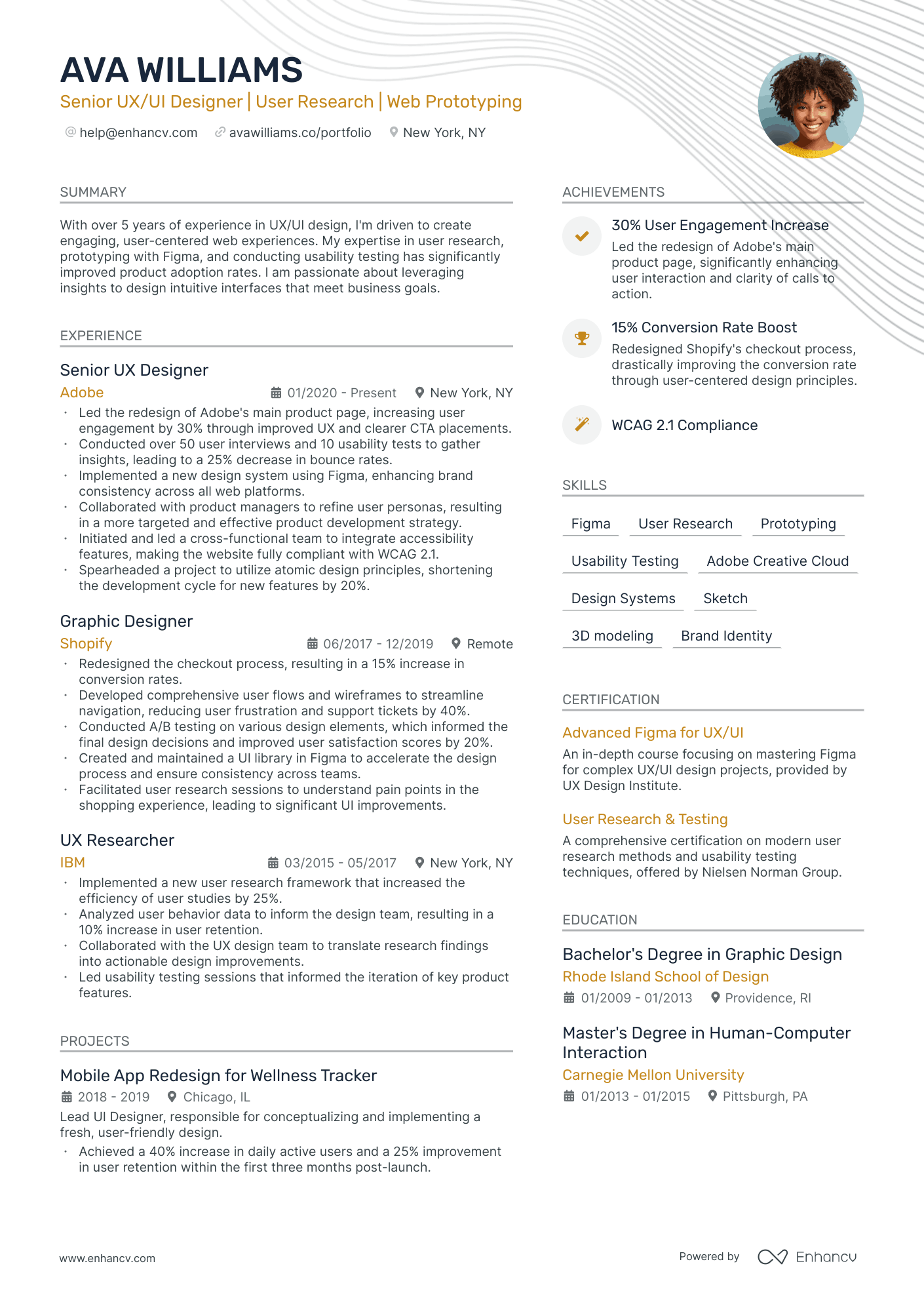
With the constant influx of AI tools like Midjourney, DALL-E, and the rise of "vibe coding," it’s easy to feel like the ground is shifting under the design industry. Is the specialist becoming redundant?
Not even close. We are entering an era ofAI fatigue, where audiences are craving authenticity and the human touch that algorithms can't replicate. However, to land the best roles in 2026, your graphic designer resume needs to prove you are more than just a tool user—you need to show you are a strategic visual problem solver.
At Enhancv, we provide the tools to help you make that pivot. From AI-powered suggestions to tailored templates, our builder helps you create a resume that proves innate human creativity still counts. In this guide, you’ll find 13 examples and a step-by-step breakdown to help you build an application that stands out in an automated world.

Key takeaways
- Use a hybrid resume format to show your technical skills and software stack immediately, while keeping your work history organized for recruiters.
- Move beyond aesthetics by using metrics—like conversion rates, production volume, or time saved—to prove your designs drive business goals.
- Always include a clickable link to your portfolio in the header—it is the ultimate evidence backing up the claims in your resume.
- Customize your skills section for every application (e.g., emphasizing Figma for UI roles vs. InDesign for print) to pass applicant tracking software (ATS) filters.
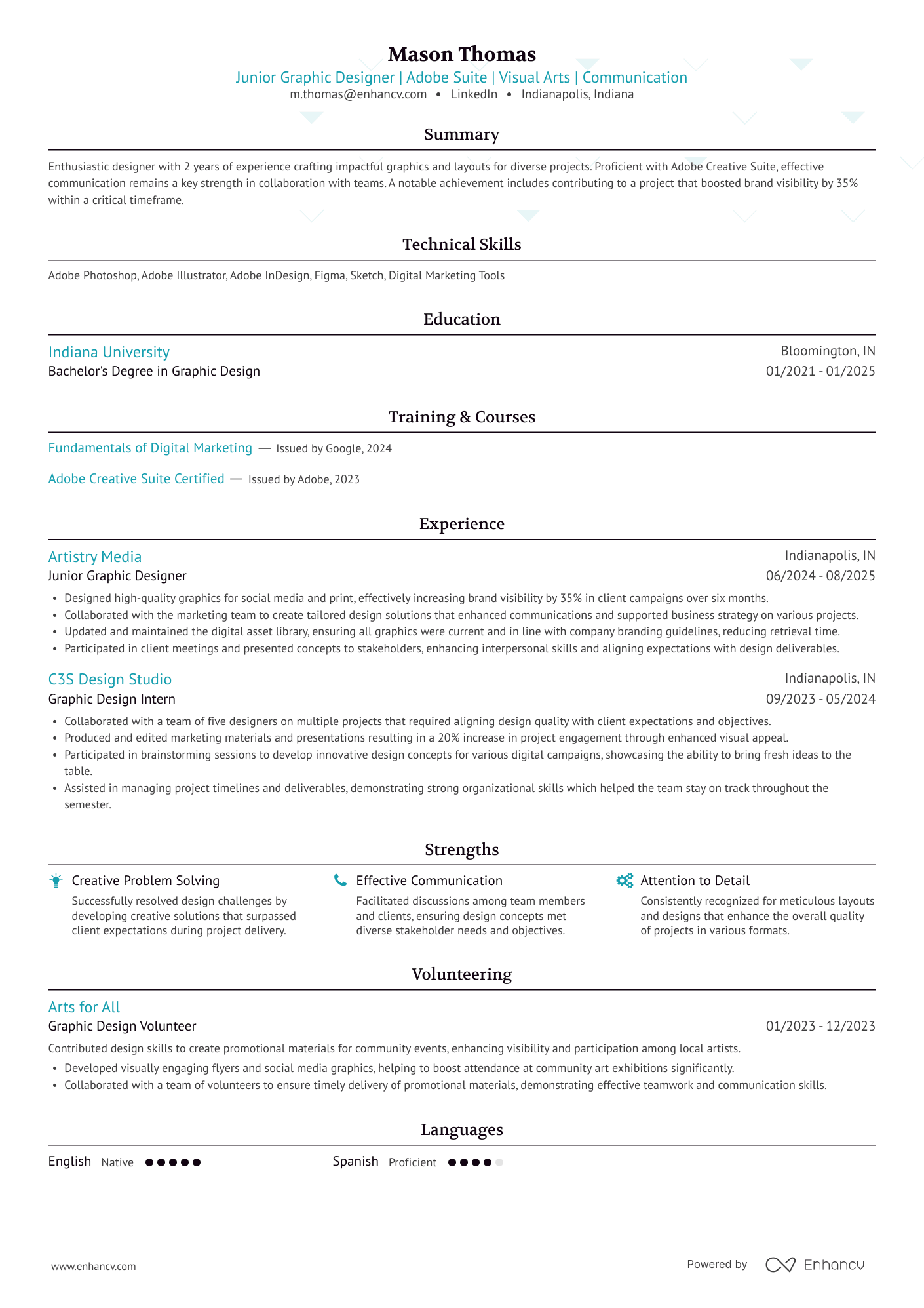
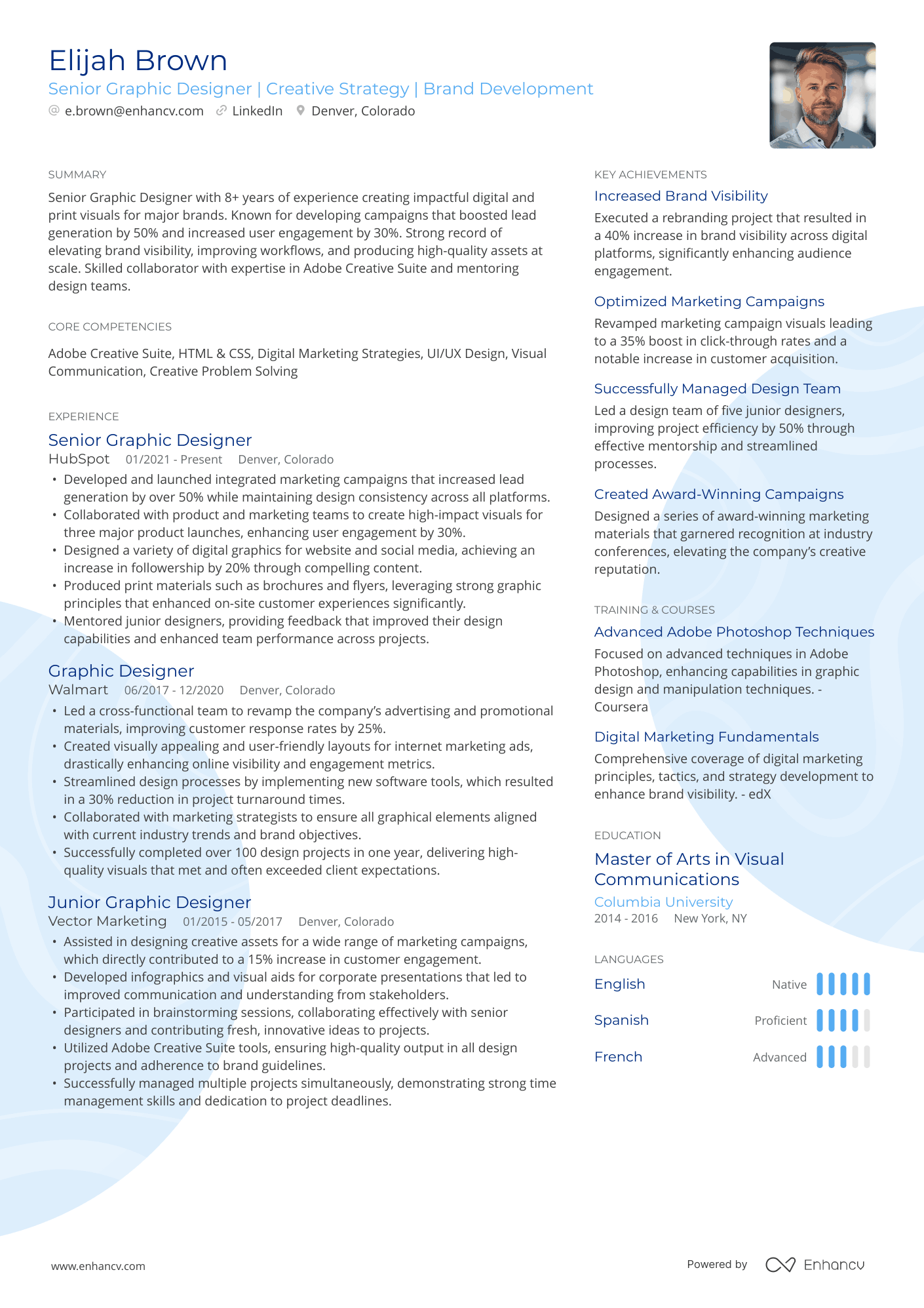
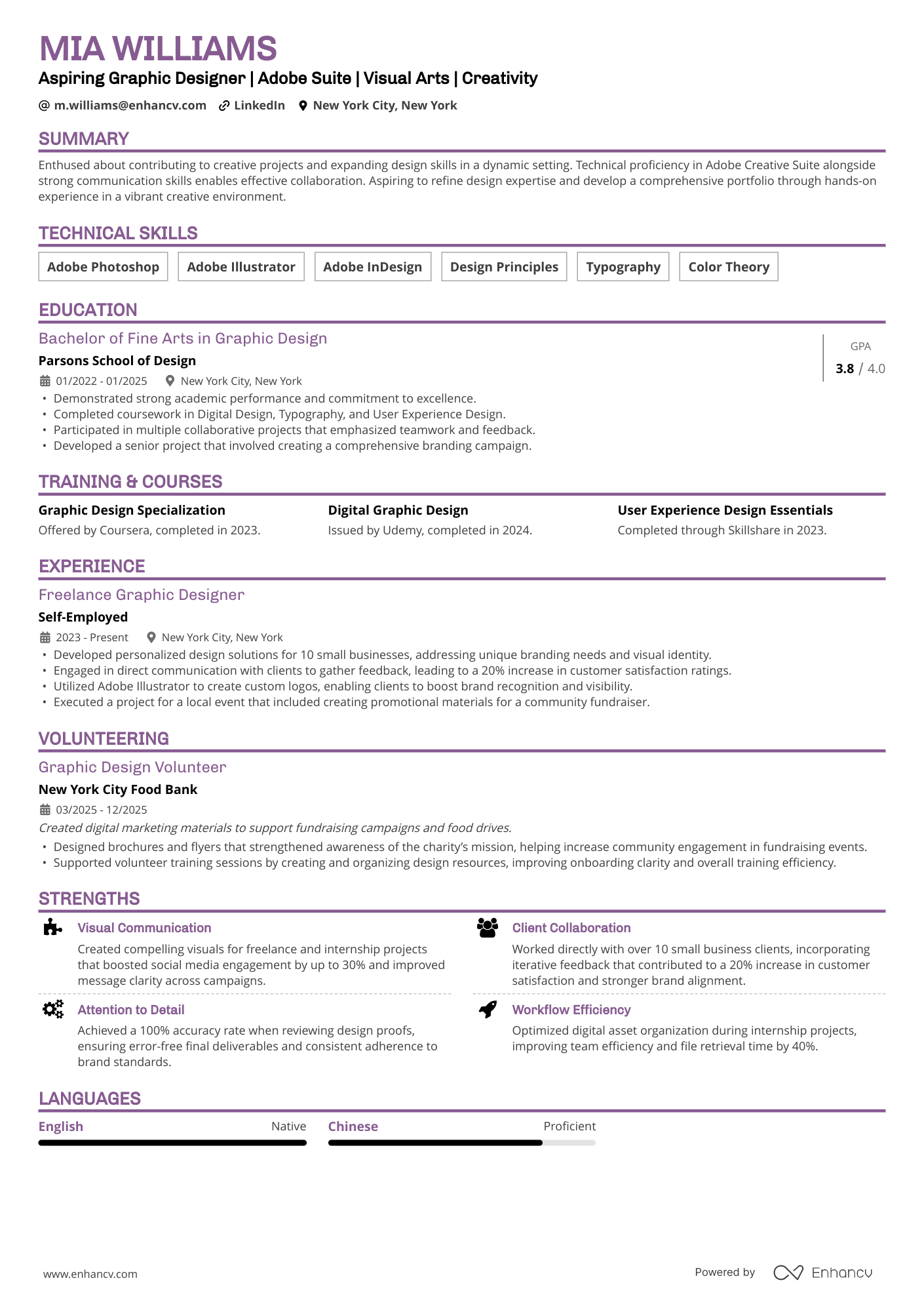
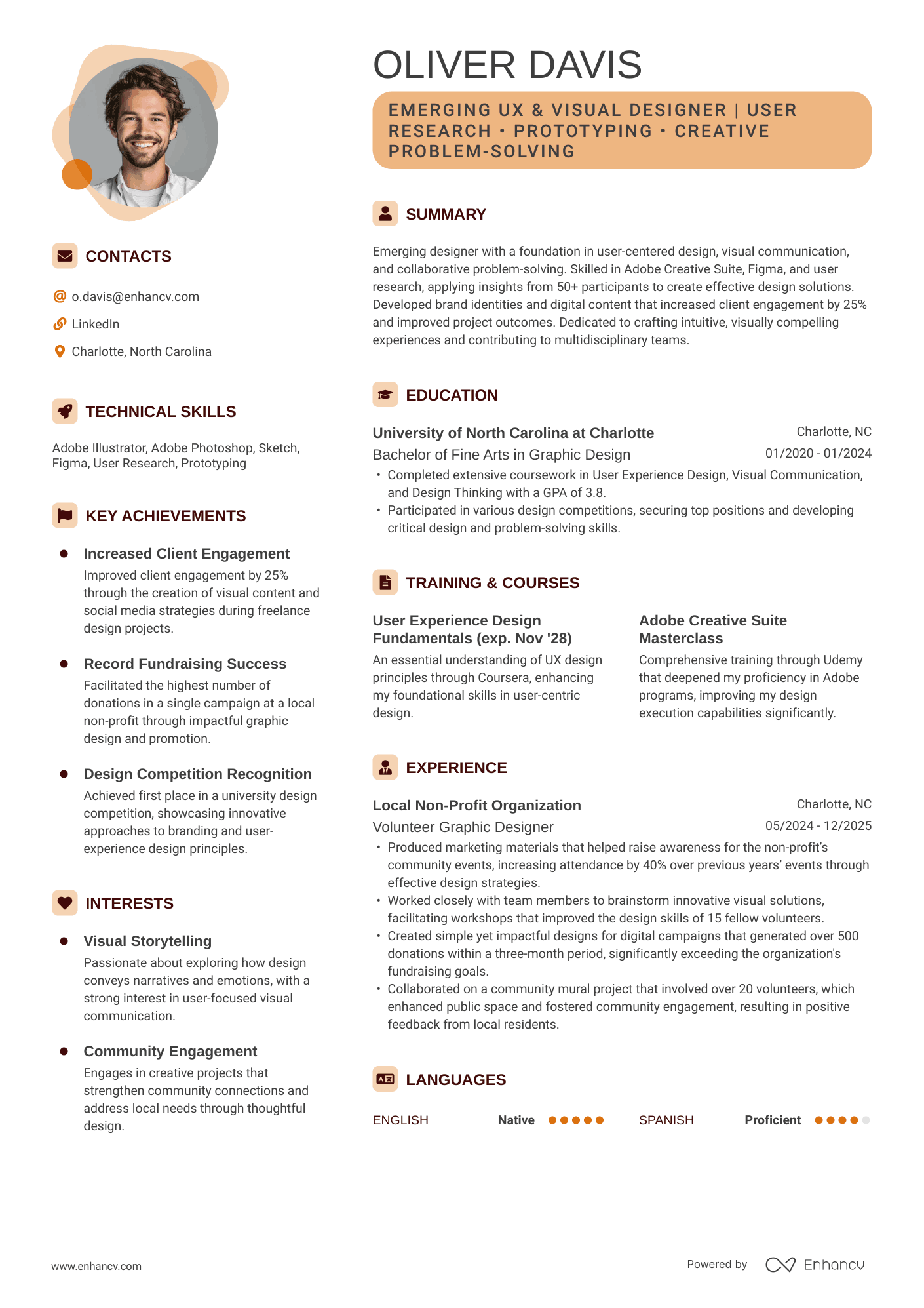
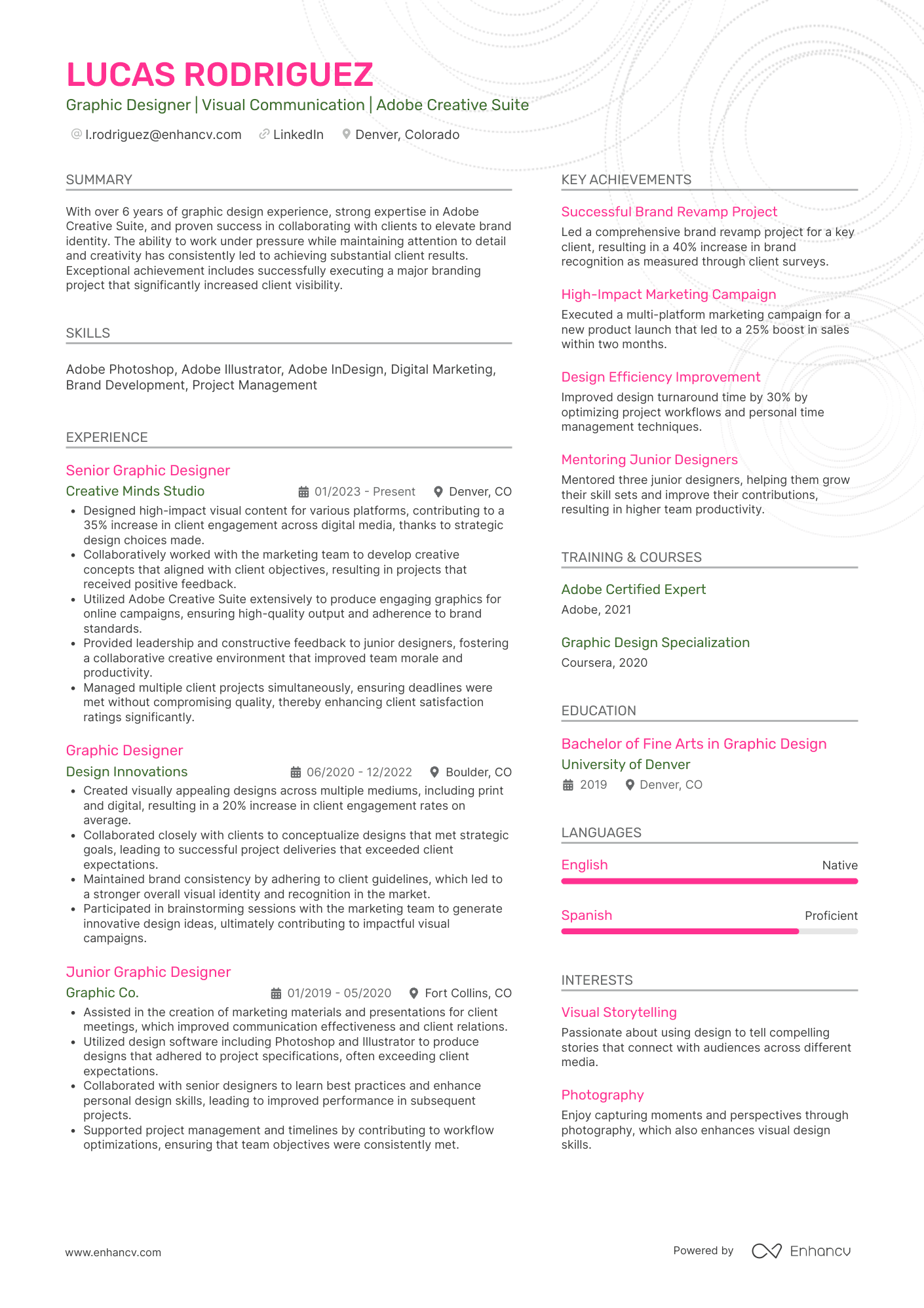
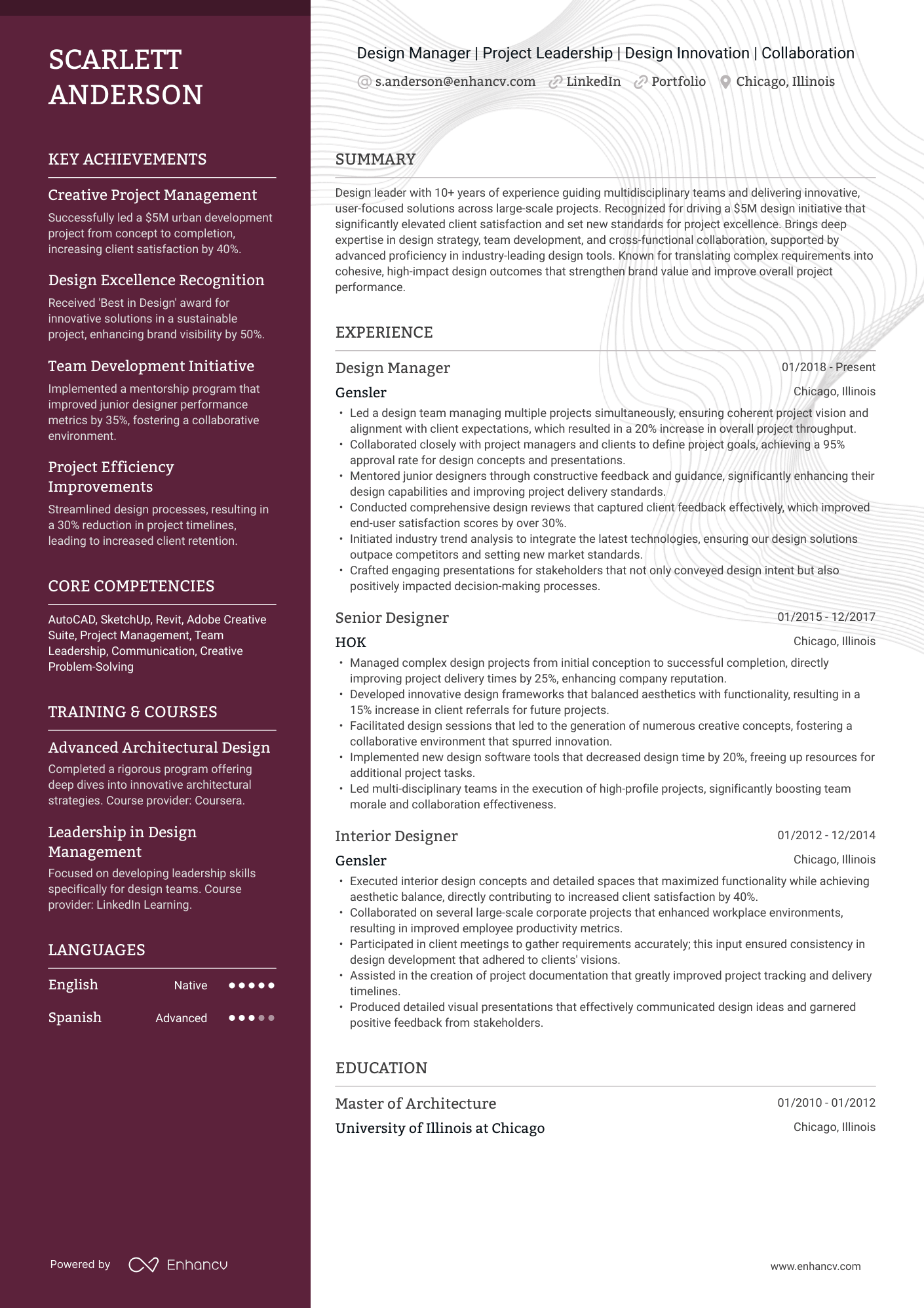
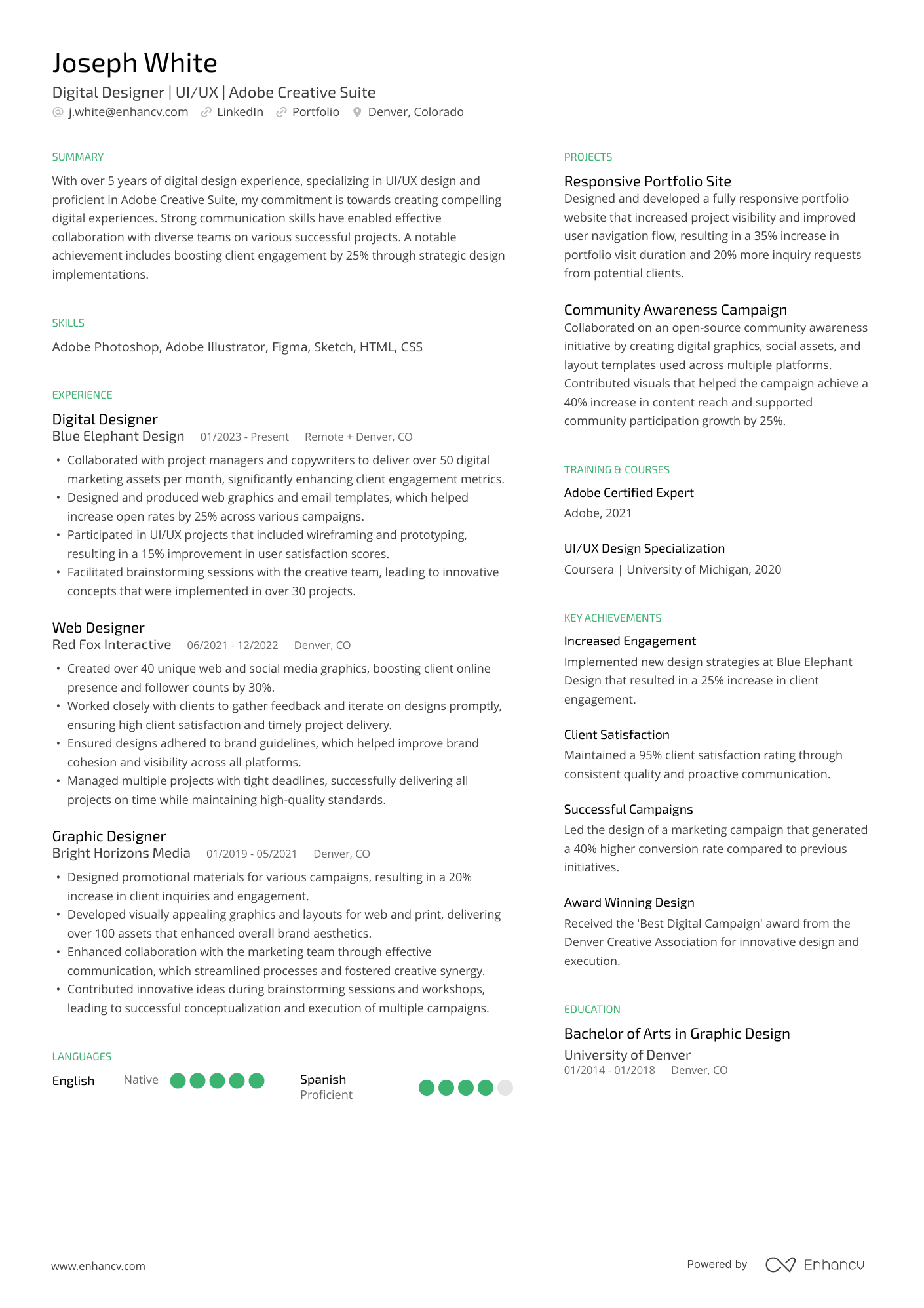
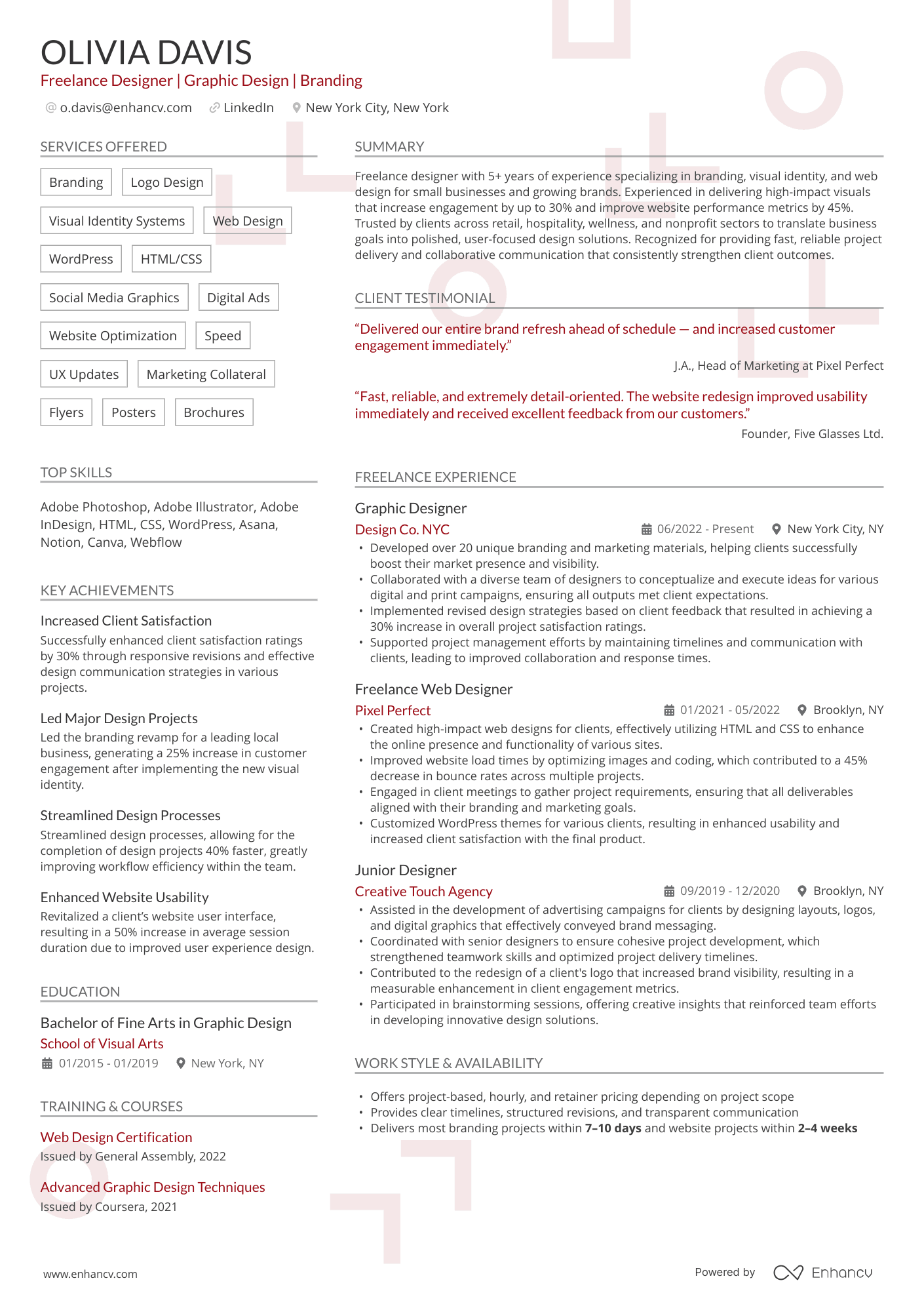
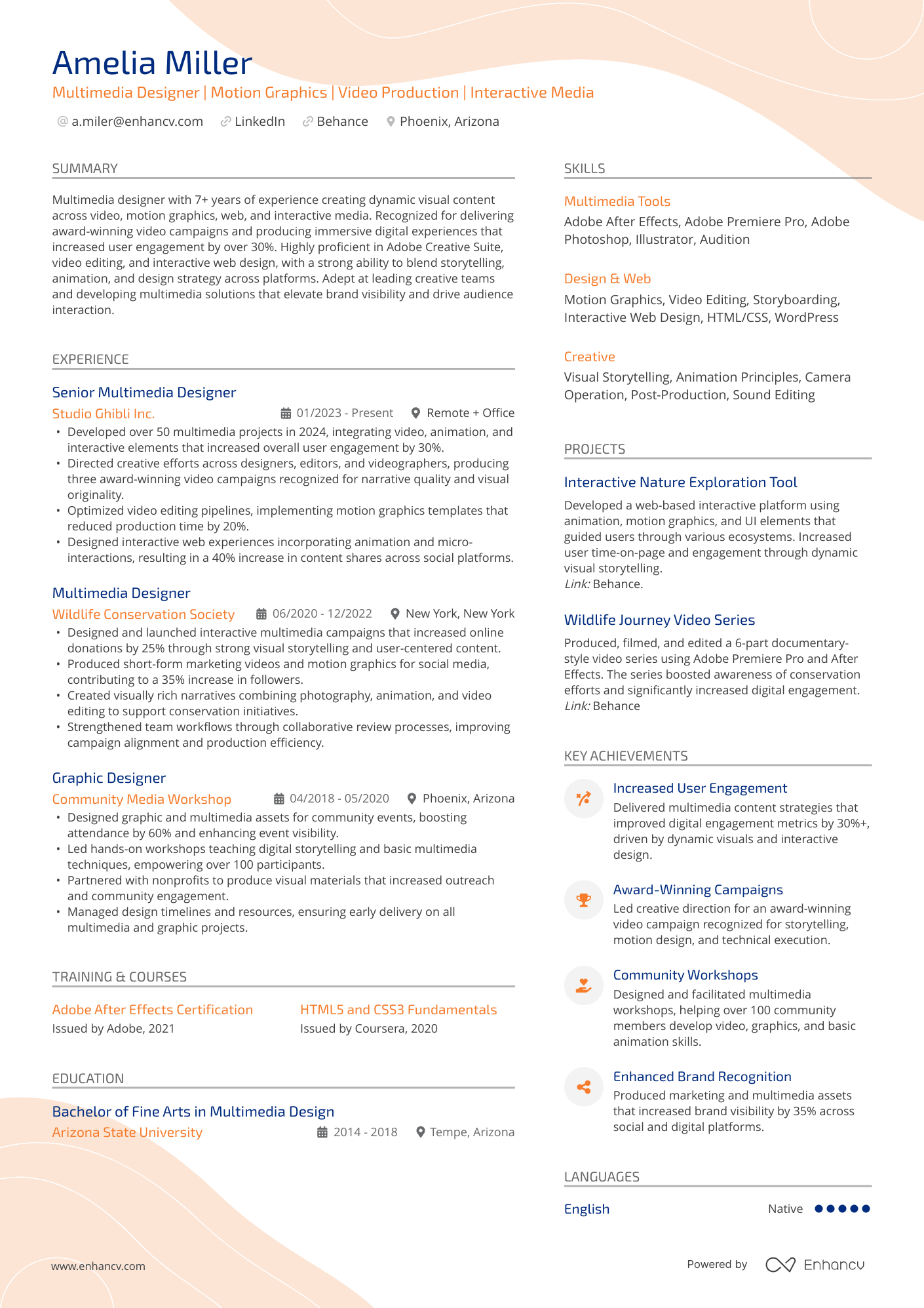
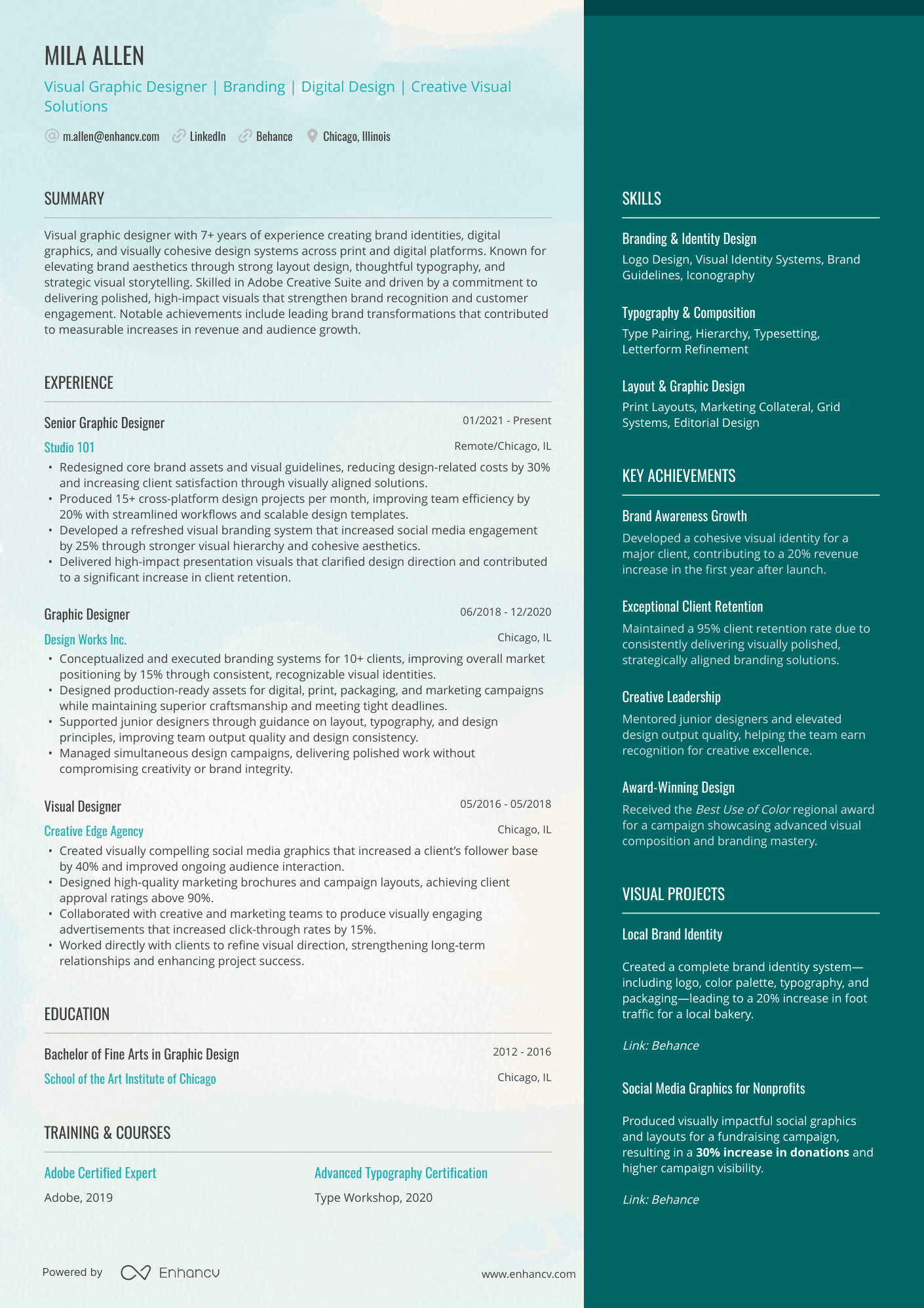
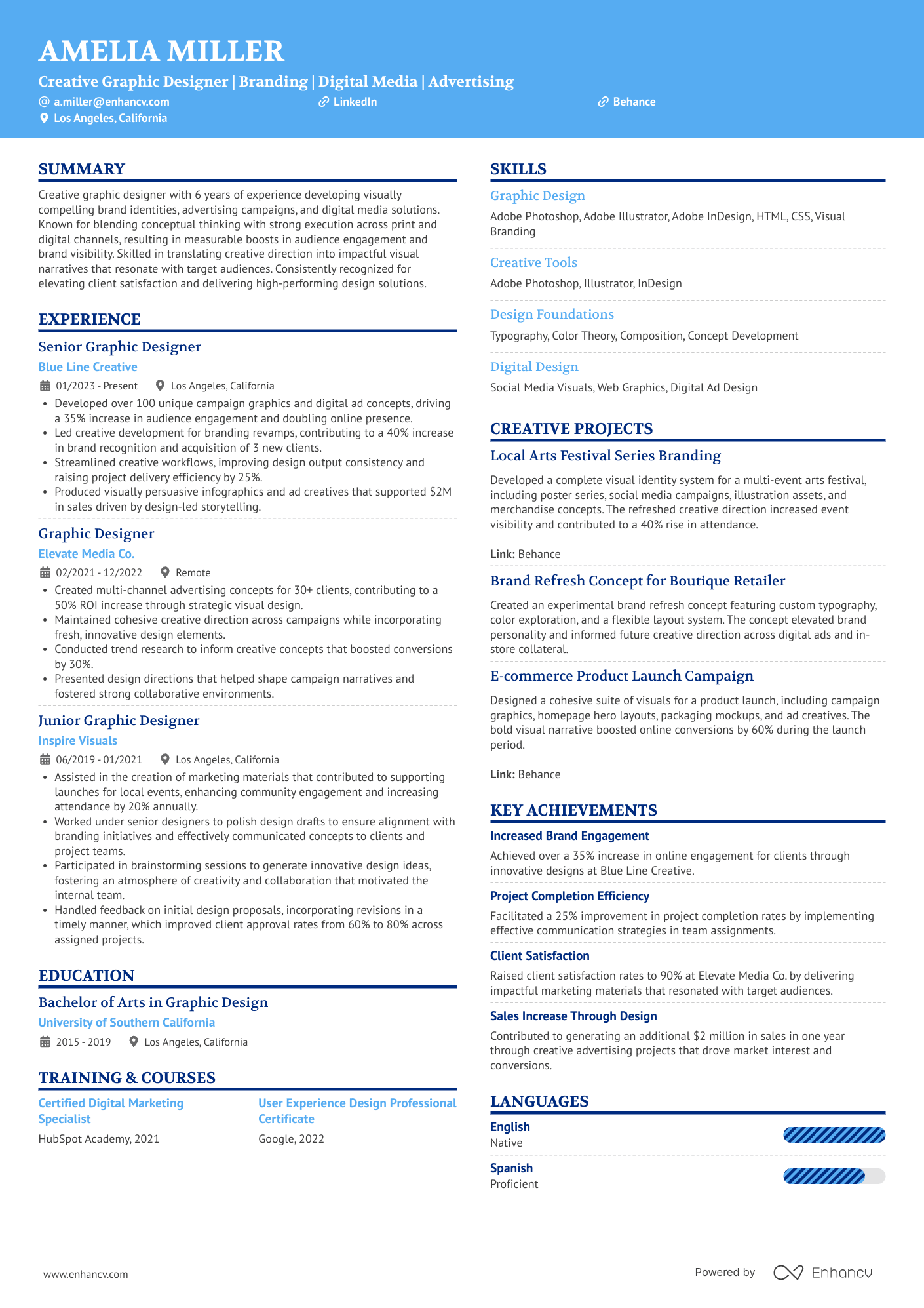
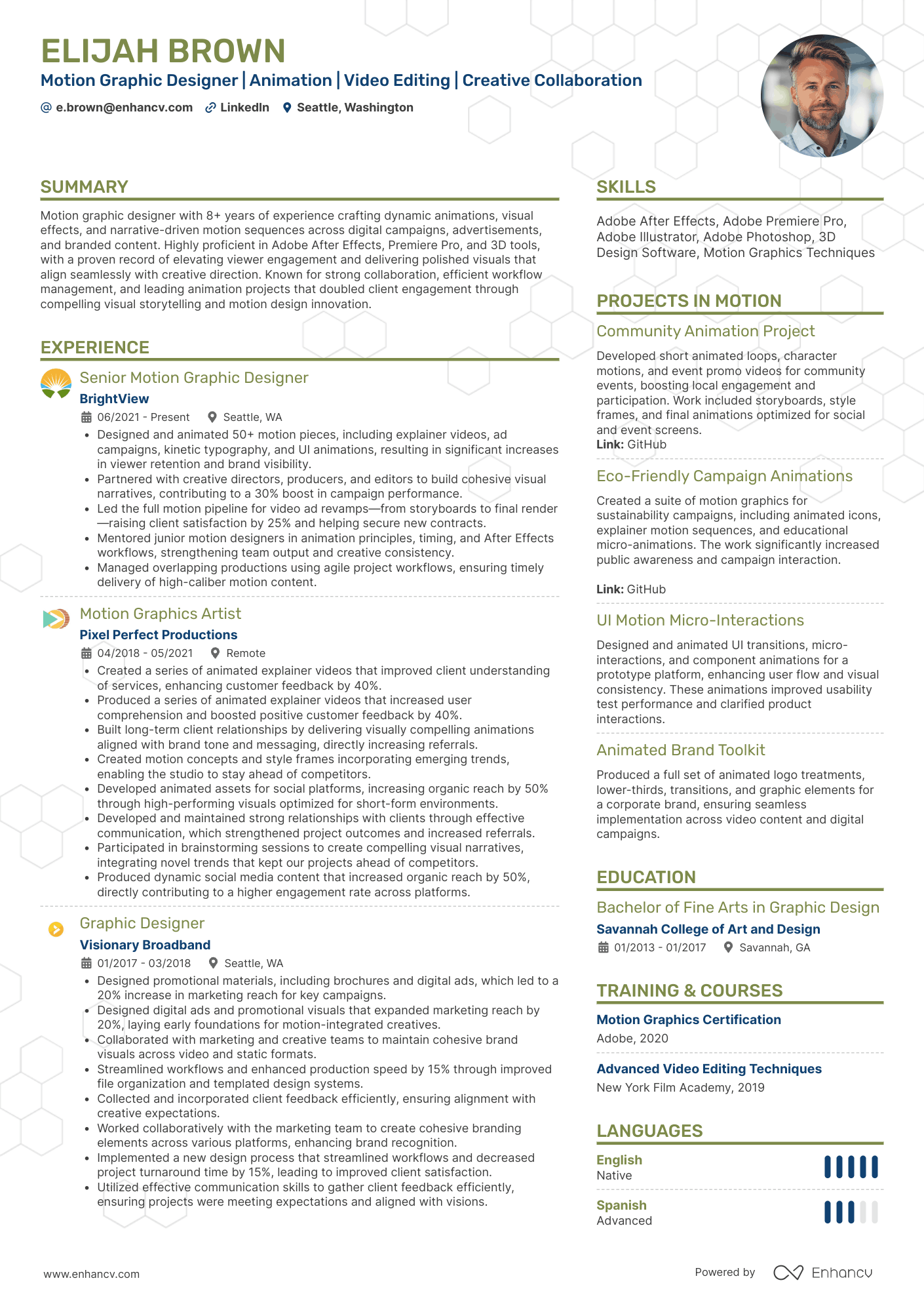
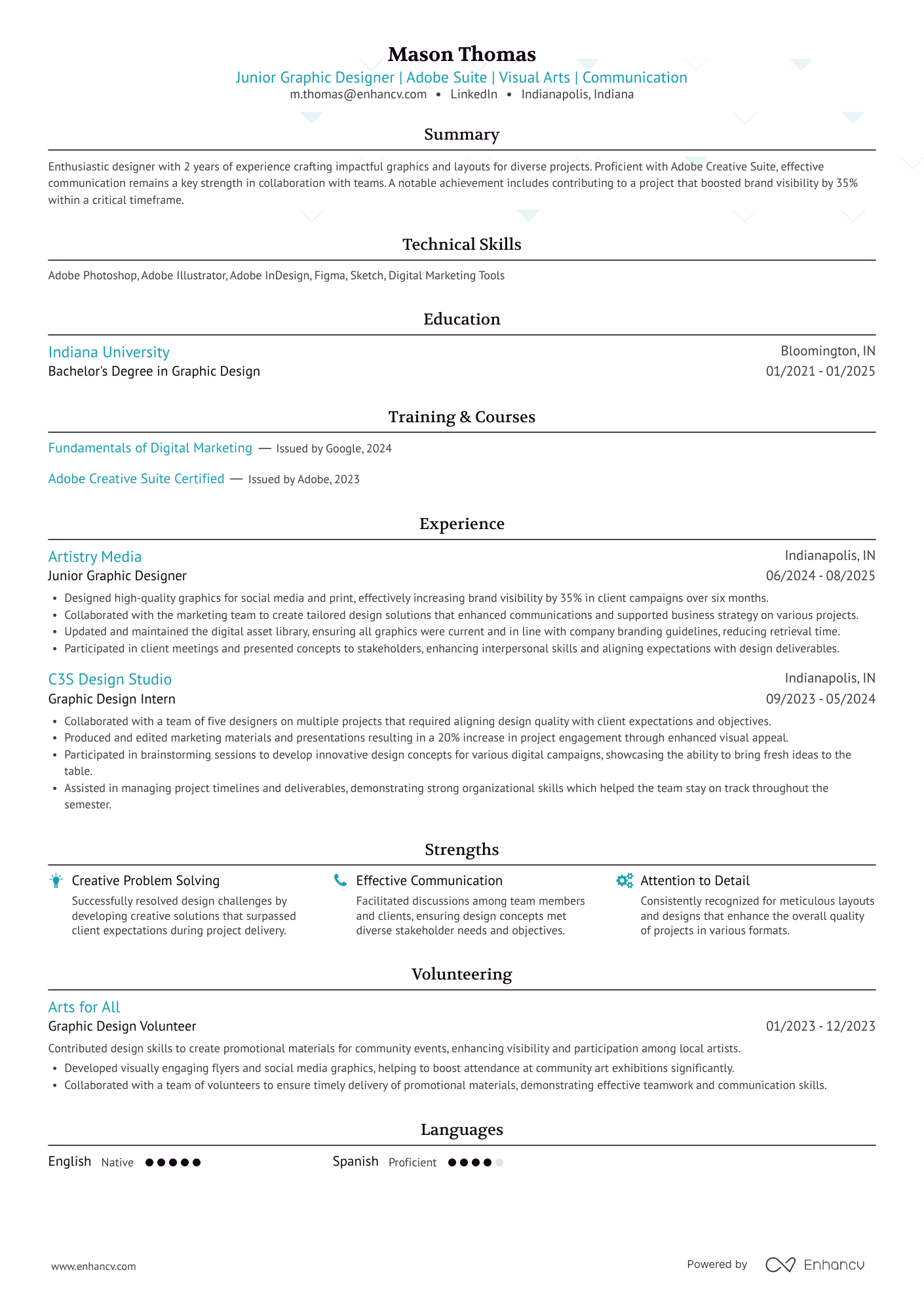
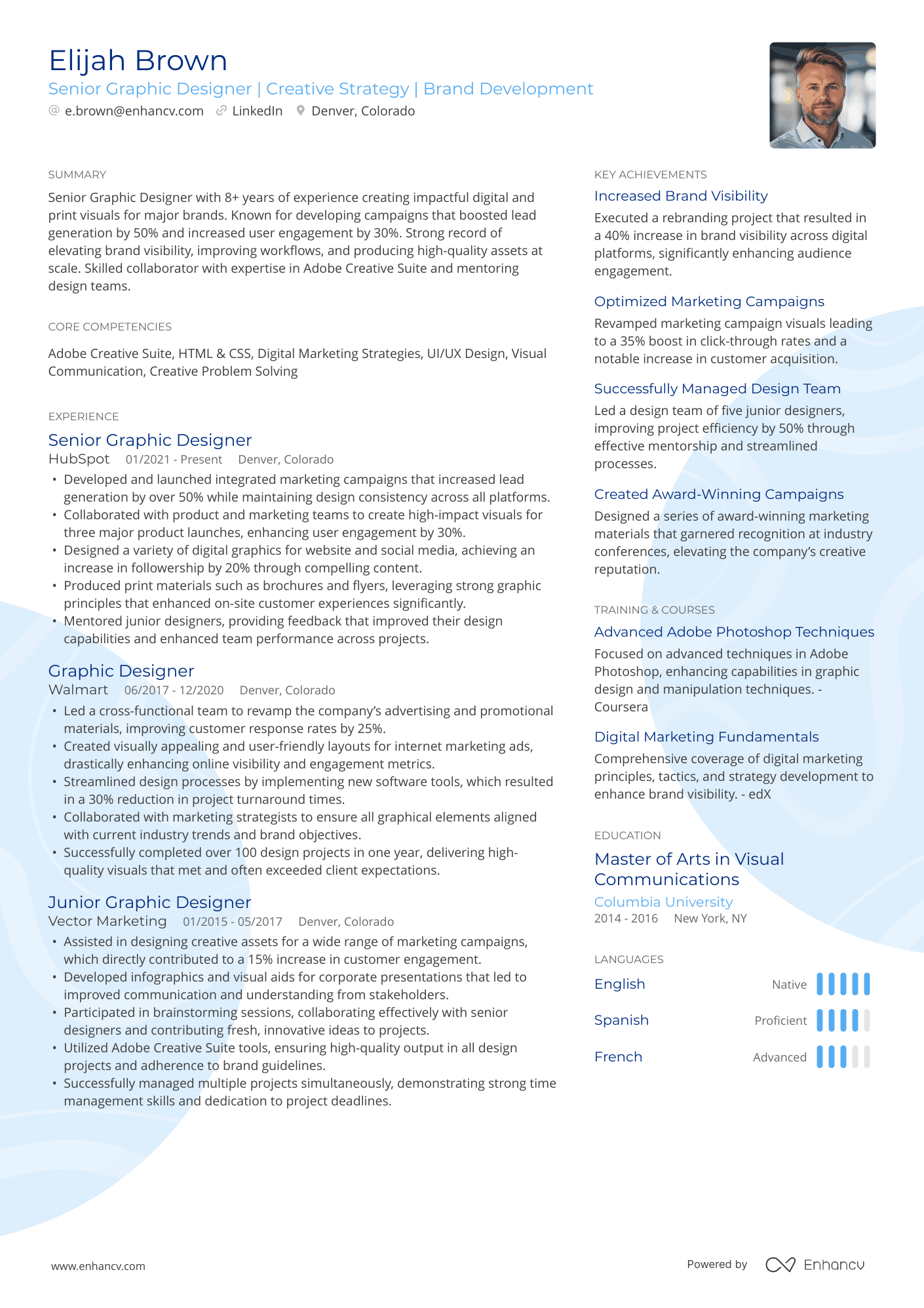
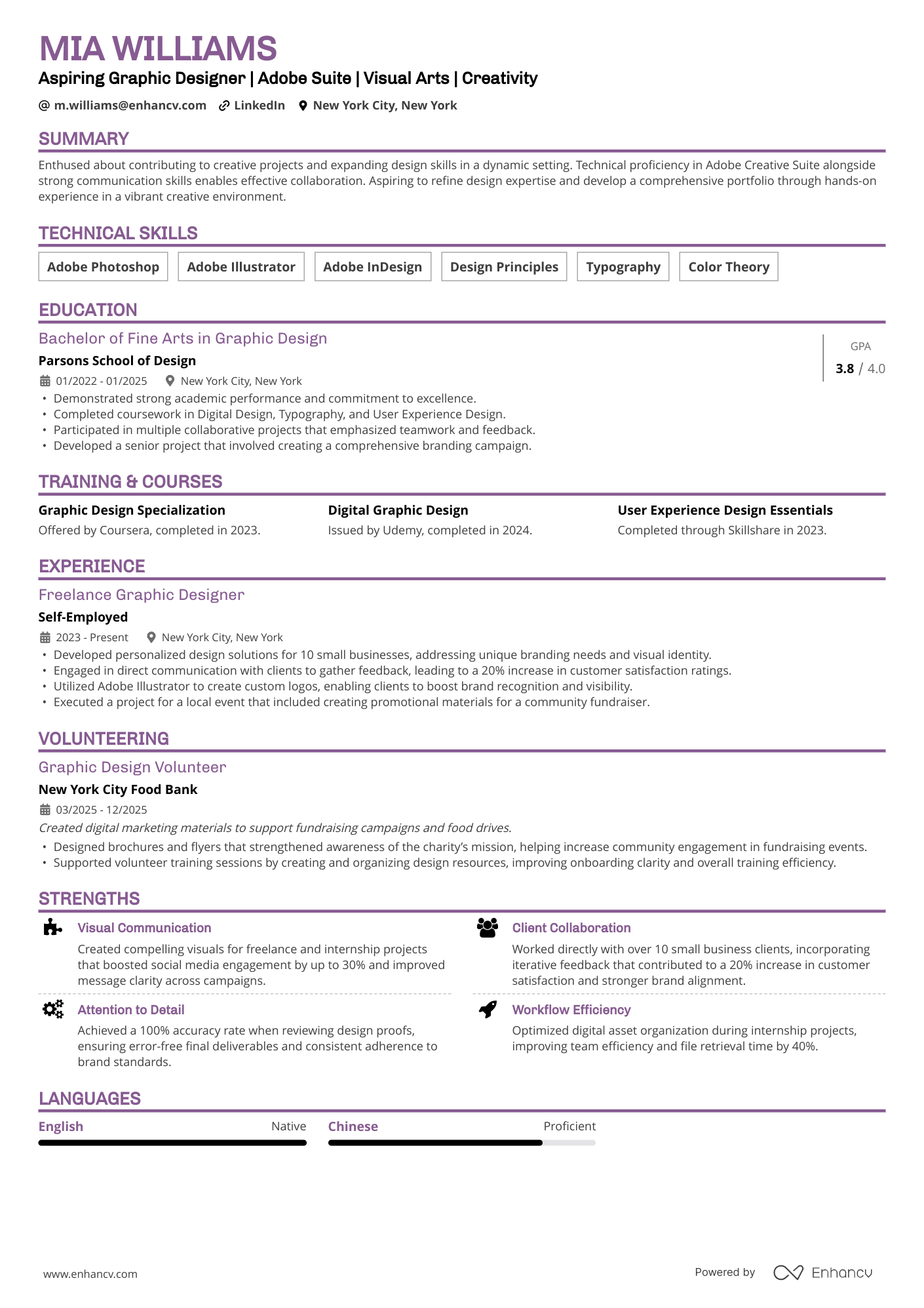
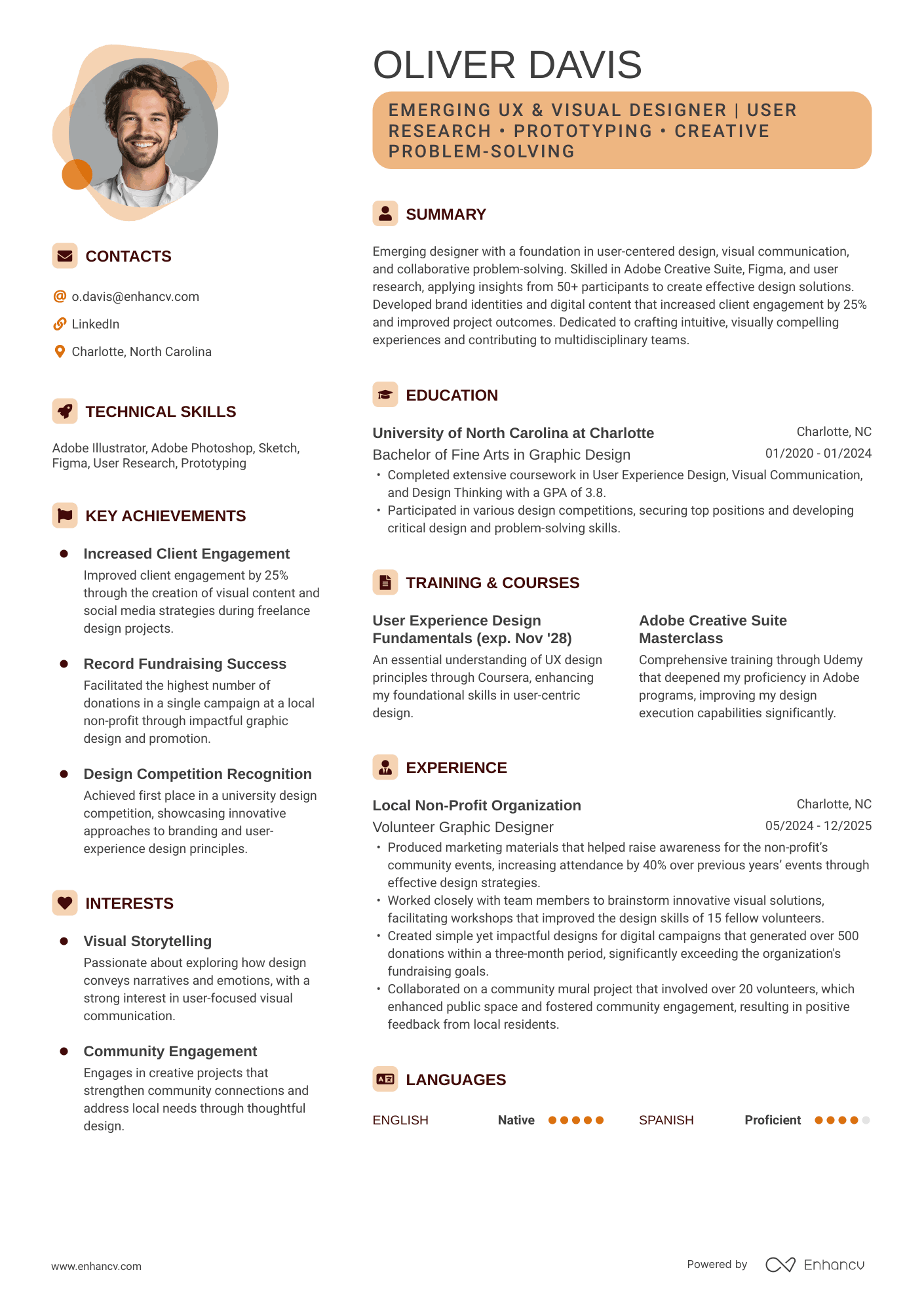
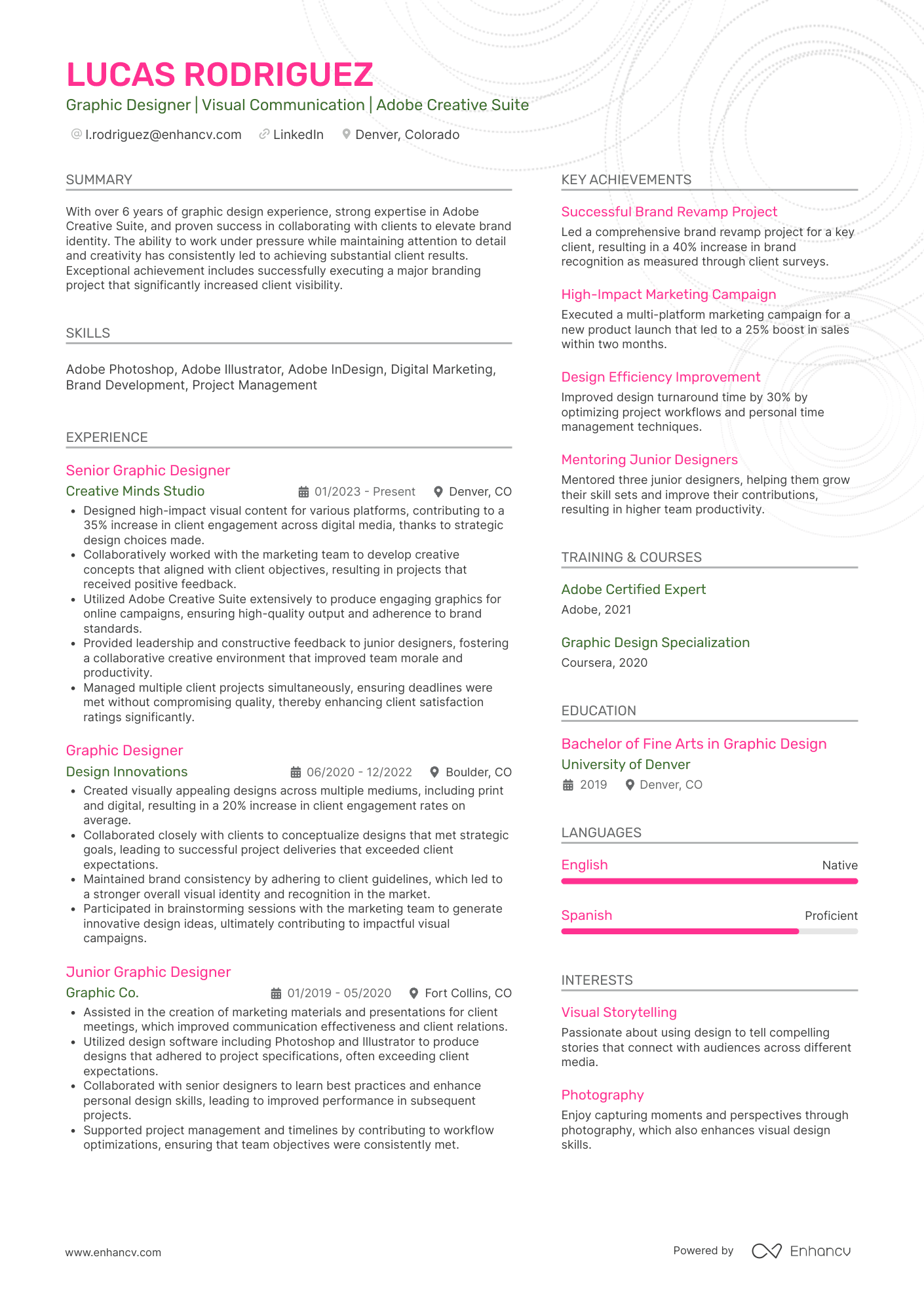
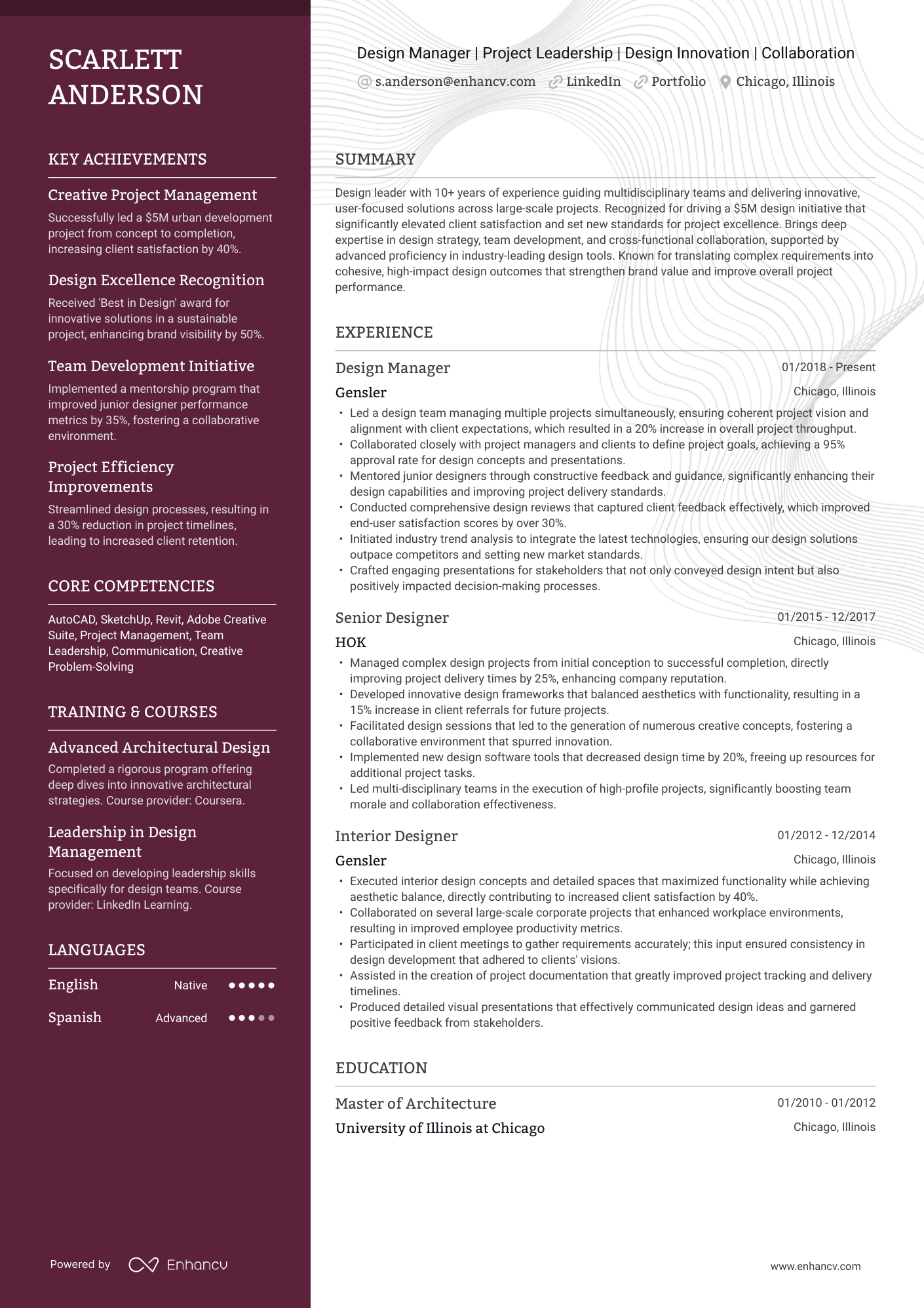
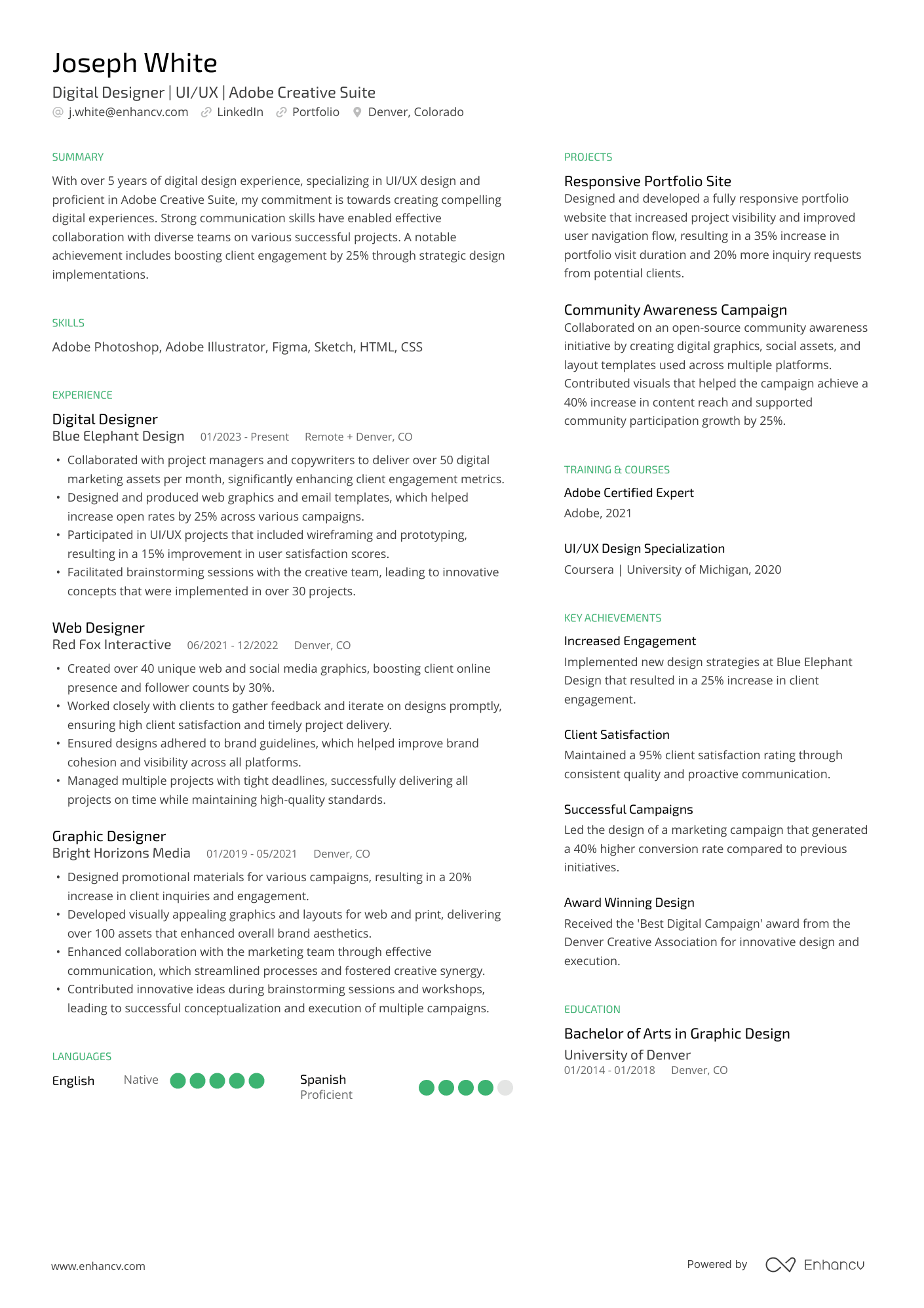
The following examples were created with Enhancv Resume Builder. They helped real-world graphic designers prove their value. Use them as an inspiration.
Explore our collection of graphic designer resumes
By Experience
By Role
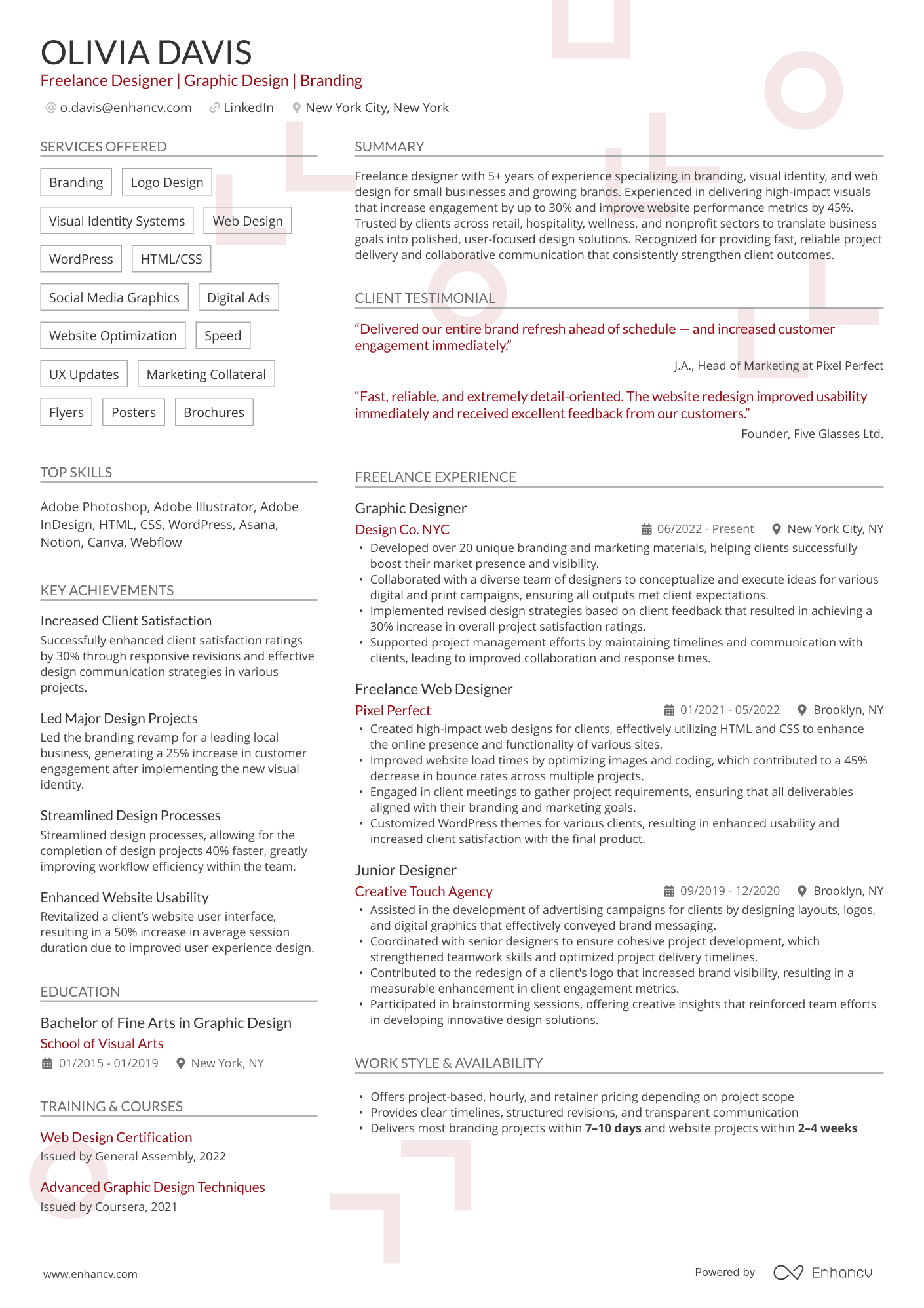
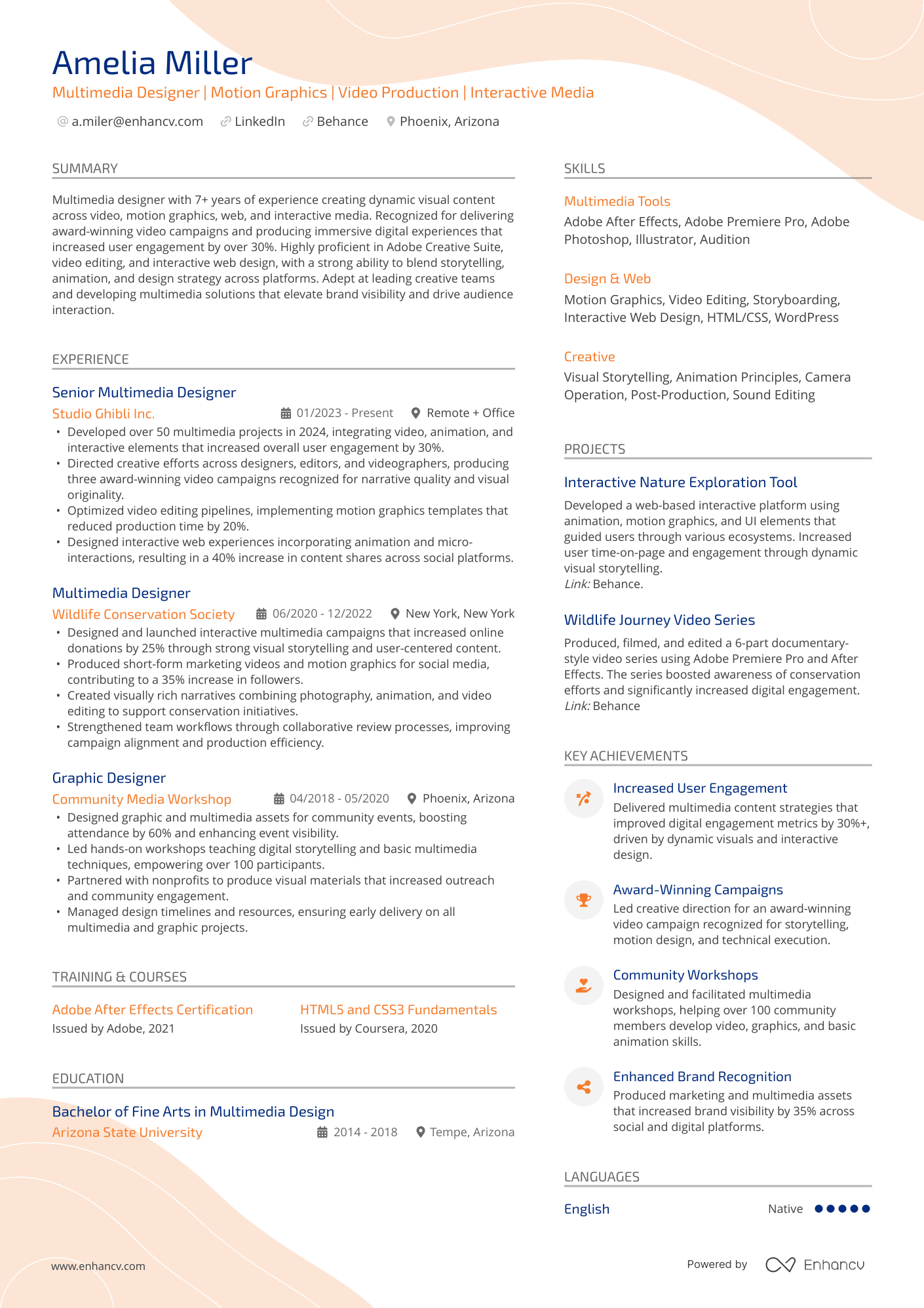
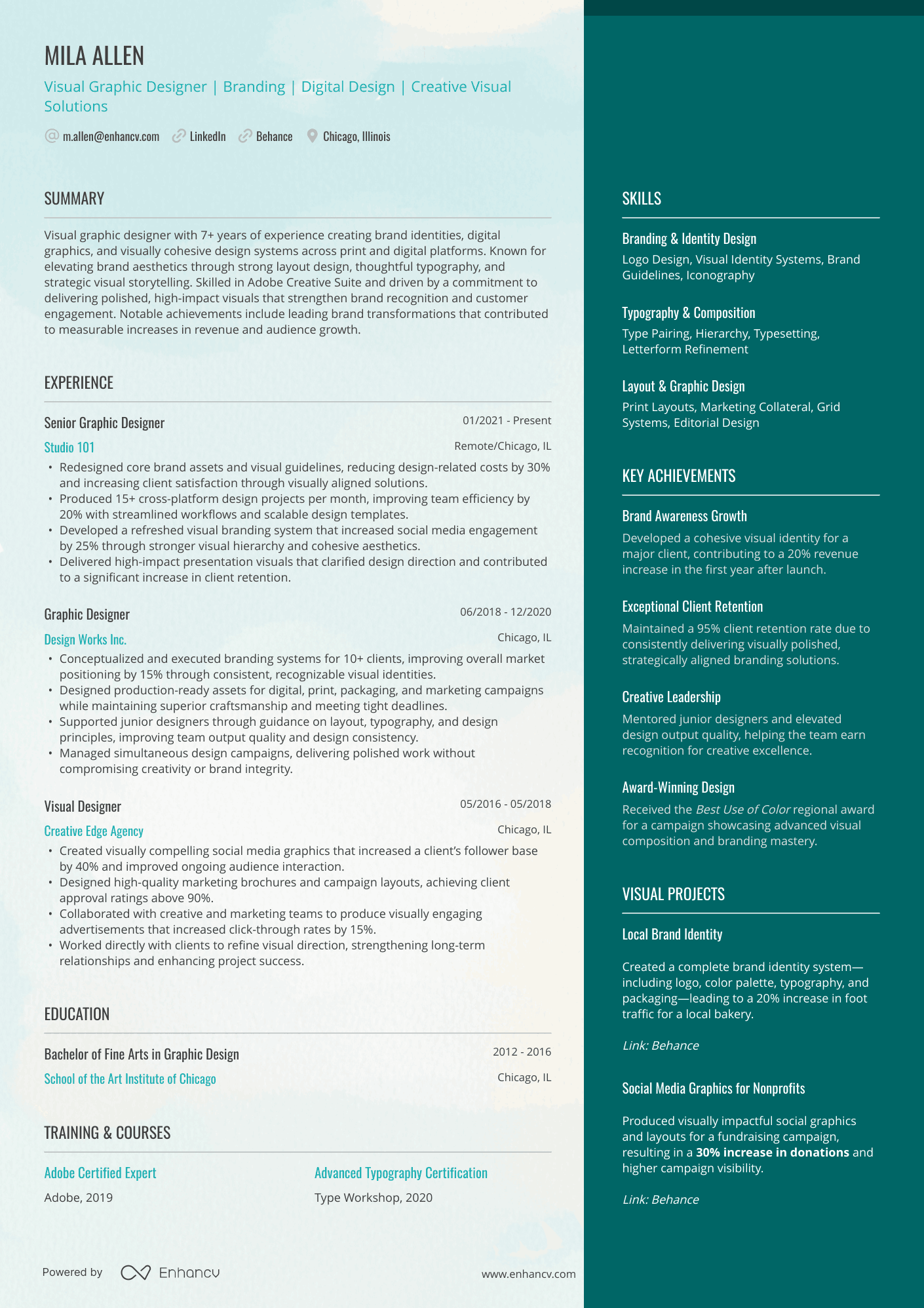
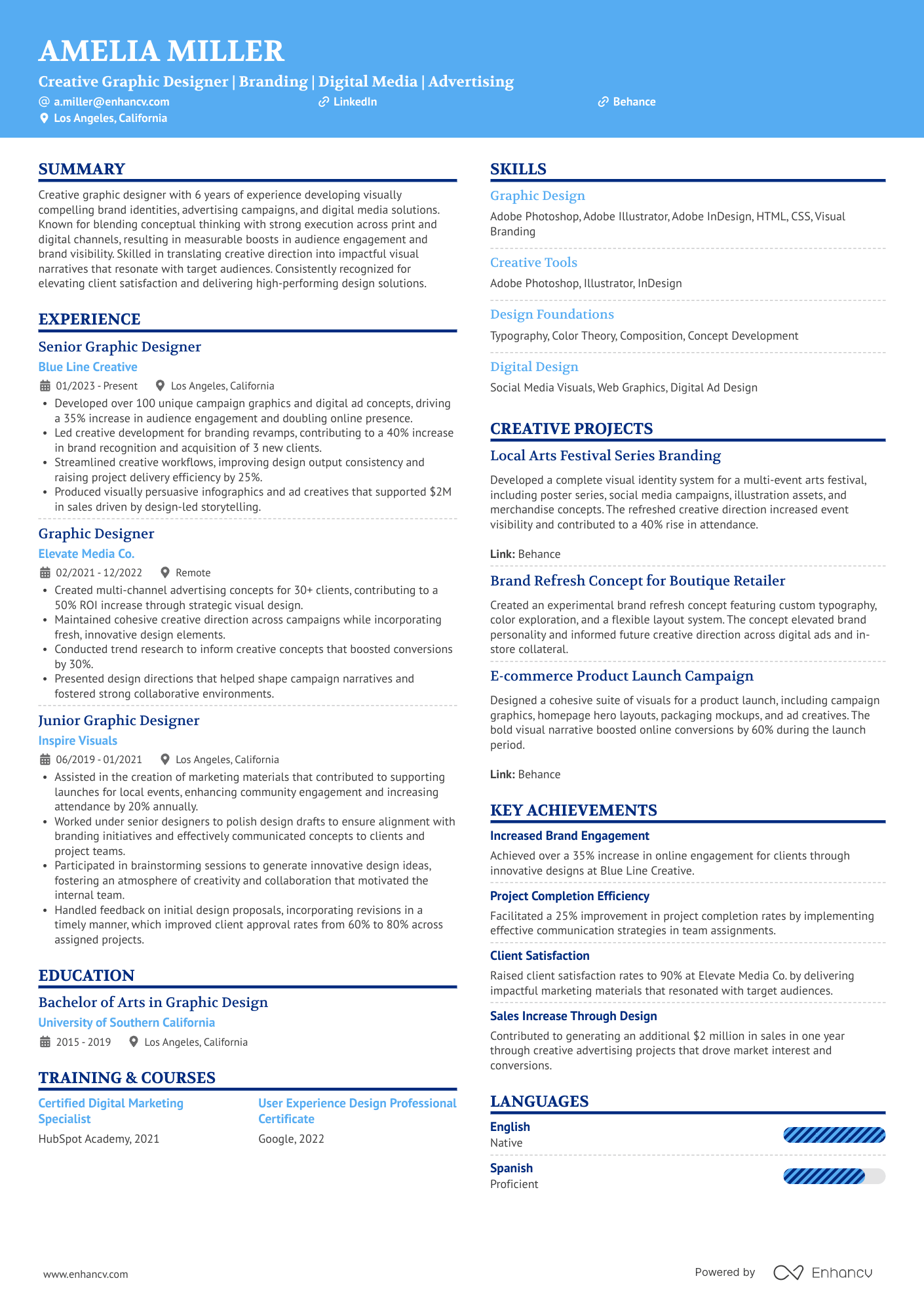
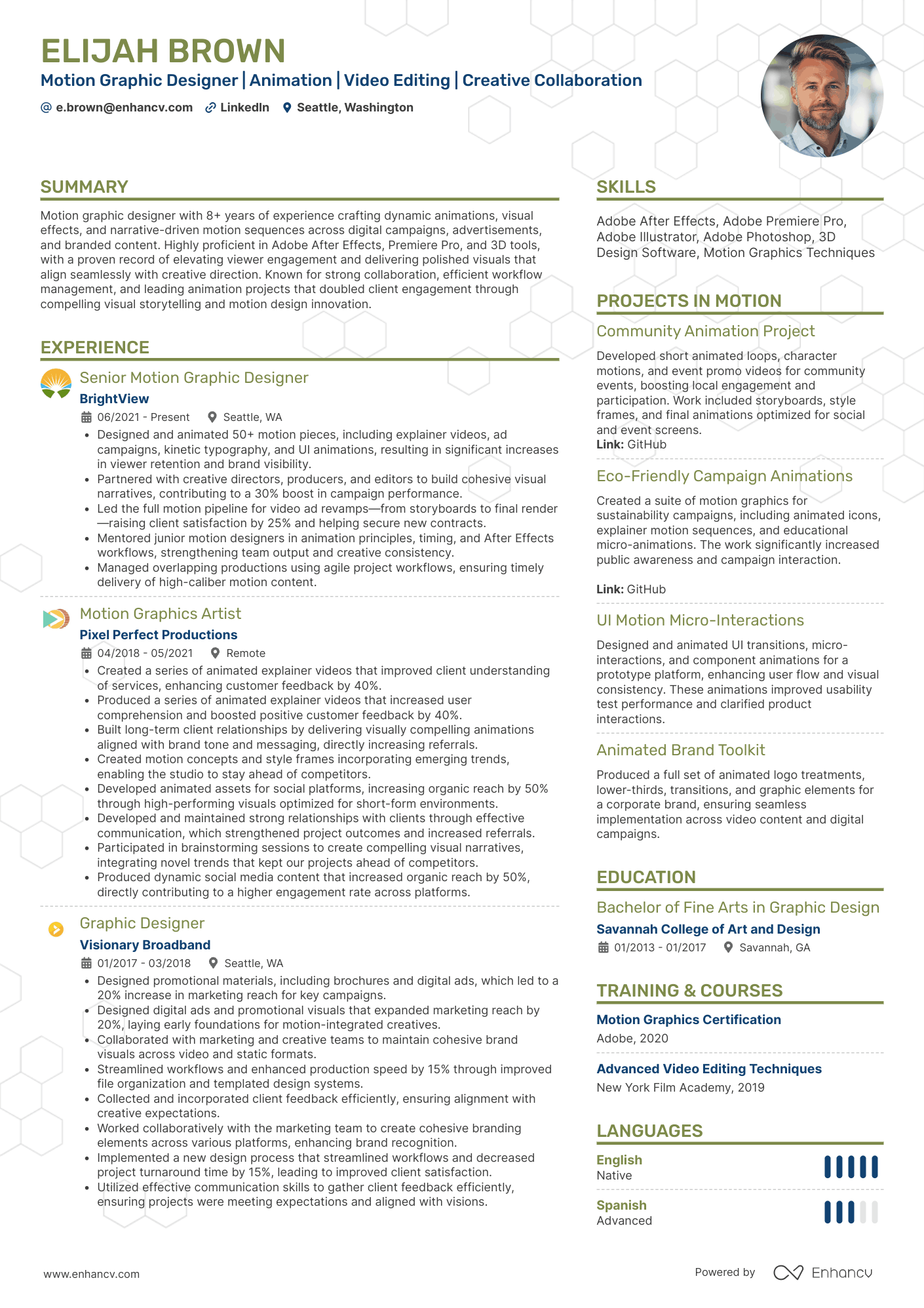
How to choose the best graphic designer resume format
Your portfolio shows you can design, but your resume format proves you can organize information hierarchically—a core design skill. Recruiters don't want to hunt for your software proficiency or your employment dates. They need a layout that balances your technical "toolkit" with your professional history.
Which resume format should a graphic designer use?
For most graphic designers in 2026—especially freelancers or those with diverse project histories—the hybrid (combination) resume format is the strongest choice.
Unlike the standard reverse-chronological format, the hybrid structure places a robust Skills or Areas of Expertise section alongside your work history.
- Why it works for designers: It allows you to group your projects according to the skills you applied (e.g., "UI/UX," "Branding," "Motion Graphics"). This puts emphasis on your abilities and immediately informs the recruiter how you’ve used them.
- Why it works for freelancers: If you have overlapping contracts or gaps between gigs, the combination format provides a cohesive narrative that ties your scattered timeline together.
What sections should go on a graphic designer resume?
To follow the hybrid structure effectively, organize your sections in this order:
- Header: Name, contact info, and a clickable link to your portfolio.
- Resume Summary: A concise pitch of your design philosophy and experience level.
- Key Skills / Technology Stack: (Placed above or alongside experience) A categorized list of your software and design capabilities.
- Experience: Your work history (still in reverse-chronological order).
- Education: Degree and relevant design coursework.
- Certifications & Awards: (Optional) Adobe certifications or design competition wins
If you’ve got a resume already, run it through Enhancv’s free ATS Checker. It’ll give your document a score and actionable steps for improvement.
Is your resume good enough?
Drop your resume here or choose a file. PDF & DOCX only. Max 2MB file size.
Now let’s move on to writing your resume, step by step.
How to write your graphic designer resume experience
Your portfolio shows the final product, but your resume experience section needs to reflect the process, the constraints, and the business impact you encountered to get there.
Every graphic designer's resume experience entry should show:
- Job title and company name: Be specific (e.g., Senior Graphic Designer, Production Artist, or Freelance Art Director), as this signals your level of autonomy.
- Dates of employment: Even if you’re using a hybrid format, list these in reverse-chronological order so recruiters can trace your career growth.
- Contextual portfolio links: If a specific role involved a major campaign or rebranding, link directly to that case study within the bullet point.
Create three to six focused points that highlight:
- Project Scope & Volume: The scale of your work (e.g., budget size, timeline pressures, or quantity of assets produced weekly).
- Tools & Methodologies: Mentioning specific software (Figma, After Effects, InDesign) in the context of how you used them to solve a problem.
- Collaboration: How you worked with non-designers—copywriters, developers, marketing managers, and external print vendors.
- Measurable Results: The tangible outcome of your design (e.g., increased ad click-through rate, reduced production time, or successful brand launch).
Not all design impact is measurable by data, and that’s okay. If you don't have hard numbers, focus on qualitative wins or scale. Did a client explicitly praise the new look? Did the design launch on time despite a shortened timeline? Did your work appear on a major billboard or in a national campaign? "Client satisfaction" and "Project Completion" are valid results, too.
Author’s take
Let’s see how this works out in an example:
Good example of a graphic designer experience section
Freelance Graphic Designer & Art Director | Self-Employed
2019 – Present
- Project Highlights:
- Brand Identity: Developed a complete visual identity for GreenLeaf Logistics (Logo, Style Guide, Vehicle Wraps), helping them secure $1.5M in seed funding.
- Web Design: Redesigned the UX/UI for ShopLocal App using Figma, resulting in a 30% decrease in user churn within 3 months of launch.
- Print Collateral: Managed the end-to-end production of marketing materials for CityFest 2024, coordinating with print vendors to deliver 10,000+ units 15% under budget.
As impressive as your experience is, the main thing is that it targets the job posting. Let’s see how to do that.
How to tailor your graphic designer resume experience
Both recruiters and ATS compare your resume against the job description to see how good of a match you are.
If your resume lists "print design" but they need "UI prototyping," you will be rejected—even if you know both. Tailoring ensures your bullets reflect the specific tools, outputs, and workflows they are asking for.
Here are several ways to tailor your graphic designer experience section:
- Mirror the software stack: If the job description asks for Figma and you list Sketch, update it. If they want InDesign for print work, highlight your layout projects.
- Match the output type: Emphasize digital ads, landing pages, or print brochures based on what the company actually produces.
- Adopt their language: Do they call it "Visual Design," "Brand Identity," or "Creative Comms"? Use the exact terminology found in the posting.
- Highlight the right environment: For agency roles, emphasize speed and client pitching. For in-house roles, emphasize brand consistency and cross-functional collaboration.
Tailoring your resume is the bridge between your portfolio and the interview. Below are examples of how graphic designers can turn generic bullets into tailored, high-impact achievements that match the job description.
Resume tailoring examples for project managers
| Job description excerpt | Untailored bullet | Tailored bullet |
|---|---|---|
| Looking for a designer proficient in Adobe After Effects to create engaging social media motion graphics. | Created graphics for social media posts. | Designed and animated 15+ motion graphics per month using Adobe After Effects, driving a 15% increase in engagement. |
| Must have experience preparing files for print production and communicating with external vendors. | Designed brochures and flyers for the company. | Managed end-to-end print production for marketing brochures, coordinating with external vendors to ensure color accuracy. |
| Collaborate with marketing teams to design high-converting landing pages. | Worked on the company website design. | Collaborated with marketing teams to design responsive landing pages that improved click-through rates by 12%. |
We know rewriting your resume for every single job application is taxing. It’s a tedious process, but it’s necessary to get hired. To save yourself the headache, use Enhancv’s One-Click Tailoring Tool. Simply paste the job description, and the integrated AI will instantly update your bullet points, skills, and summary to fit the role—saving you hours of manual editing.

One final note on tailoring
While matching the keywords from the job posting is crucial to the ATS, keep in mind that it's rarely the "robot" that rejects you. According toEnhancv’s interviews with 25 recruiters, 92% confirmed their systems do not automatically reject resumes based on formatting or keywords alone. Your resume isn't being rejected by a machine because you used two columns—it’s likely being passed over by a human because the experience didn't look relevant.
Tailor for the machine to get ranked, but write for the human to land an interview.
How to quantify your experience on a graphic designer resume
Designers often hesitate to use numbers, feeling that "art" can't be measured. But in a business context, design is a metric. And the more people you reach with your art, the bigger your impact. Quantifying your experience shows hiring managers the scale of your output and the actual return on investment (ROI) you delivered for the client or company.
Here are five ways to quantify your experience as a graphic designer, even if you don't have access to deep marketing analytics:
Examples of how to quantify project manager achievements on your resume
| How to quantify | Example bullet point |
|---|---|
| Volume of output: Demonstrate your speed and ability to handle high-volume workloads without sacrificing quality. | “Produced over 50 unique digital assets per week for social media channels while maintaining strict brand consistency.” |
| Efficiency & Time savings: Highlight how you optimized workflows or created tools that saved the company man-hours. | “Created master templates in InDesign and Figma that reduced the production time for monthly newsletters by 30%.” |
| Marketing impact: Link your designs to performance metrics like click-through rates (CTR), conversion, or sales. | “Redesigned the checkout flow UI, resulting in a 12% uplift in conversion rates and a measurable decrease in cart abandonment.” |
| Budget management: Show financial responsibility, especially regarding print production or software licensing. | “Managed a $20,000 annual print budget, negotiating with vendors to reduce printing costs by 15% through paper stock optimization.” |
| Audience engagement: Use social metrics to prove your designs resonate with the target demographic. | “Designed an infographic series that generated 3,000+ shares and became the highest-traffic content on the company blog in Q3.” |
Struggling to translate your creative process into data? You don't have to do the math alone. UseEnhancv’s Bullet Point Generator to instantly create achievement-based bullets that highlight your impact and impress recruiters.
How to list your hard and soft skills on your graphic designer resume
In a graphic designer resume, your skills take on a pivotal role. By placing your technical capabilities near the top—before your work history—you immediately answer the recruiter's most pressing question: "Can this person use the tools we use?"
Your Skills section should include your hard skills—software you work with, tools you use–that can be easily tested and measured.
Keep in mind soft skills are less convincing as a standalone list, which is why it’s best to interweave them into your experience or your resume profile.

Best hard skills for your graphic designer resume
- Adobe Photoshop
- Adobe Illustrator
- Adobe InDesign
- Figma
- Sketch
- Adobe After Effects
- Typography
- Print Production
- Branding & Identity
- Midjourney / AI Generative Tools
Best soft skills for your graphic designer resume
- Visual Communication
- Creative Problem Solving
- Time Management
- Client Relations
- Attention to Detail
- Cross-functional Collaboration
- Receptiveness to Feedback
- Adaptability
- User Empathy
- Visual Storytelling
Now let’s see how soft skills work embedded in a resume section.
Summary
Senior Graphic Designer with 7+ years of experience blending technical precision with creative problem-solving. Expert in translating complex client requirements into clean visual solutions while maintaining open lines of communication with stakeholders. Proven ability to mentor junior staff and foster a collaborative creative environment under tight deadlines.
Experience
Senior Graphic Designer | Creative Spark Agency
2023 – Present
- Partnered closely with the marketing and engineering teams to launch a new SaaS product, translating complex technical requirements into user-friendly visual assets that increased demo sign-ups by 18%.
- Mentored 3 junior designers, conducting weekly feedback sessions and implementing a new file organization system that improved team efficiency and reduced onboarding time for new hires.
- Presented design concepts and brand strategies to C-level stakeholders, effectively managing client expectations and negotiating scope changes to keep projects profitable.
- Successfully pivoted the creative direction of a major campaign mid-stream due to market shifts, delivering all assets on time despite a 30% reduction in the original timeline.
How to list your certifications and education on your graphic designer resume
While your education isn’t the most important thing when it comes to your graphic design resume. The employer will always want to see your hands-on experience first. And if your portfolio is subpar, your perfect transcript won’t compensate.
However, in a competitive sphere, your diploma could give you the edge you need.
Your education section validates your foundational knowledge, and many large agencies and corporate HR departments still use a bachelor’s degree as a screening requirement. This section must be accurate, cohesive, and easy to scan.
Education entry sample
Bachelor of Fine Arts (BFA) in Graphic Design Rhode Island School of Design (RISD) 2023
- Senior Capstone: "Sustainable Packaging Solutions for Urban Markets"
- Graduated cum laude
Certifications, on the other hand, can be much more actionable and useful on a graphic designer resume, as they show you are committed to mastering specific tools and staying current with industry standards. While a degree proves you know the theory of design, a certification proves you have the technical proficiency to execute it.
Best certifications for your graphic designer resume
- Adobe Certified Professional (Photoshop, Illustrator, InDesign)
- Google UX Design Professional Certificate
- CalArts UI / UX Design Specialization (Coursera)
- HubSpot Content Marketing Certification (Great for marketing/social media designers)
- Certified Professional in Accessibility Core Competencies (CPACC) (Crucial for web/UI designers)
How to write your graphic designer resume summary
Write your summary last, once you have a complete overview of your career. Aim for three to five concise sentences that pack your value and experience in a punch which will set a lasting impression on the recruiter.
Here’s what to include:
- The technical skills and design tools you are proficient in;
- The impact of your design work on previous clients or employers;
- Specific design projects and deliverables you have managed;
- Your aspirations and what you look forward to achieving in the new role.
Let’s look at a resume summary that will get you an interview.
Example summary:
Senior Graphic Designer with 8+ years of experience creating visual identities for tech startups. Expert in Adobe Photoshop, Illustrator, and InDesign. Recently led a website redesign that increased user engagement by 25%. Excited to bring clear, strategic design solutions to The Digital Hyve team.
This summary draws attention because it proves impact with a specific metric ("25% increase") and clarifies the software stack immediately. It reads like a natural introduction while still checking every box for the recruiter: experience, skills, results, and company alignment.
Get a resume summary that shows you can lead and deliver
Drop your resume here or choose a file.
PDF & DOCX only. Max 2MB file size.
How do I write a graphic designer resume with no experience?
At the beginning of your career, opt for a functional resume to put your skills and portfolio front and center. This way, your lack of experience wouldn’t get in the way of getting your dream job.
Here's what to include to effectively show your potential:
- Portfolio Link: This is your most important asset. Populate it with your best student work, personal passion projects, or redesigns of existing brands.
- Freelance & "Spec" Work: Even small logos for friends or unpaid concepts count. List these as "Freelance Graphic Designer" to show professional initiative.
- Relevant Coursework: Highlight specific classes where you produced full campaigns, complex layouts, or user interfaces.
- Volunteer Work: Designing flyers for a charity, social media assets for a student club, or event posters shows real-world application of your skills.
- Competitions & Hackathons: Participation in design challenges (like Adobe Creative Jams) demonstrates speed and ability to work under pressure.

PRO TIP
Entry-level graphic designers have two strong advantages over their more experienced peers: their availability and their lower rates. It's not a bad thing: everybody must start somewhere.
Frequently asked questions about project manager resumes and job applications
Building a graphic designer resume comes with unique challenges—mainly, how to balance your visual creativity with the rigid technical requirements of hiring platforms. Below, we answer the most common questions regarding file formats, industry standards, and specific design application rules to help you finalize your document.
What should your graphic designer resume header include?
Your header is the first design element a recruiter sees. It must include your full name, professional email address, and—most importantly—a clickable link to your portfolio. This could be a separate document, your own website, or you could use a platform like Behance or Dribble.
A full home address is outdated; we recommend including only your state and zip code.
Should I design my resume in Photoshop or Illustrator?
While it is tempting to use your design tools to create a visually stunning resume, it can be risky. Resumes exported as images or complex PDFs from Photoshop often cannot be read by applicant tracking systems.
It’s safer to use a dedicated resume builder or a clean text-based PDF exported from InDesign (make sure it’s flattened, so that text can be selected). If the requirements say so, you could also use a Google Doc or a Word document.
How should you save and name your graphic designer resume?
Always save your resume as a PDF unless the job posting explicitly asks for a Word document. This ensures your layout, typography, and fonts stay intact across different devices. Name the file professionally: FirstnameLastnameGraphicDesignerResume.pdf.
Naming your files randomly (ResumeFinal_v3.pdf) is a common joke among designers but it won’t be appreciated in a job hunt.
How should I visualize my skill levels?
As a designer, your resume is a visual document. Using visual elements like skill bars or graphs can help break up dense text and guide the recruiter's eye to your strongest areas.
Just ensure that any visual element is paired with a text label (e.g., "Expert" or "Advanced") so that ATS can read your proficiency level accurately—Enhancv’s templates are designed to handle this balance.
Do I need a cover letter as a graphic designer?
Yes. While your portfolio shows what you can create, your cover letter explains why you create it. It is your chance to explain your design process, the context behind a specific project in your portfolio, or why you are passionate about that specific company’s brand identity.
Just make sure your cover letter doesn’t repeat your resume.
Drop your resume here or choose a file.
PDF & DOCX only. Max 2MB file size.
How do I show career progression if I’ve mostly freelanced?
For many designers, freelancing is a preferred career path. Group your freelance work under a single entry like "Freelance Graphic Designer" or "Independent Creative Consultant."
In the bullet points, list your high-profile clients, the variety of industries you served, and the scope of projects to show stability and business growth, rather than listing every small gig separately.
How much do graphic designers earn?
Salaries vary significantly based on location, industry, and specialization. As of 2025, the average base pay for a Graphic Designer in the US fallsbetween $55,000 and $75,000 per year. Specialized roles, such as UI Designers, Motion Graphics Artists, or Senior Art Directors, often command higher salaries, ranging from $85,000 to over $110,000.
Is a photo required on a graphic designer resume?
In the US, UK, and Canada, you should not include a photo on your resume to avoid potential bias and discrimination.
However, in many European, Asian, and South American countries, a professional headshot is standard practice. Always research the specific norms of the region where you are applying.
How can I make my resume stand out without over-designing it?
Focus on typography and hierarchy. Use a clean, legible font pairing, subtle use of color (perhaps matching your personal brand), and plenty of white space. A well-structured, readable resume demonstrates your mastery of design principles better than a cluttered, overly decorative one.
Final thoughts
Your resume is your most important design project, but it doesn't have to be your most stressful one. Remember that great design is about communication, not just decoration. By combining your unique visual style with the strategic elements we’ve covered—clear hierarchy, tailored content, and quantifiable impact—you’re proving that your creativity drives actual business results.
Now, go turn that potential into your next great role—you’ve got this!