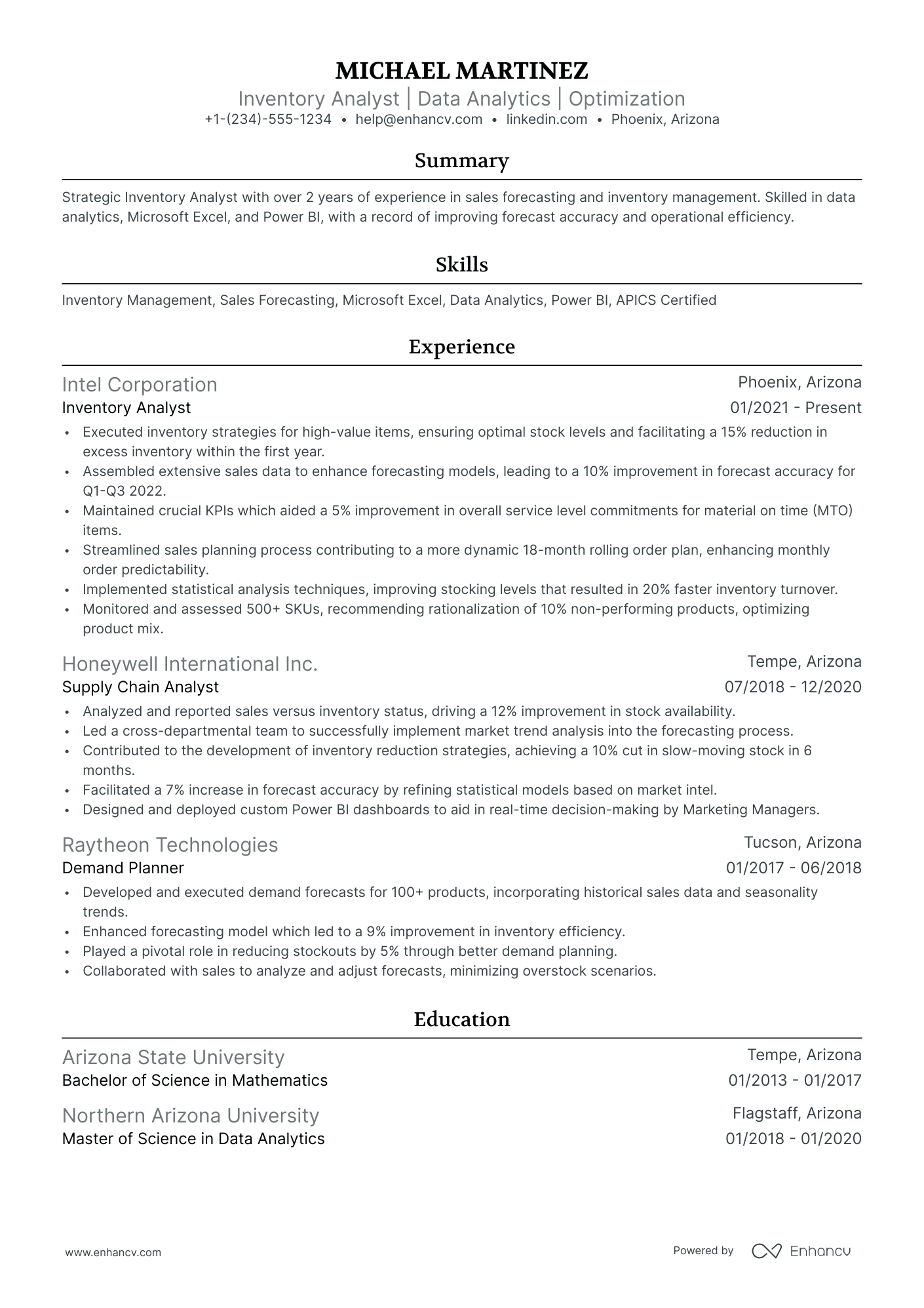
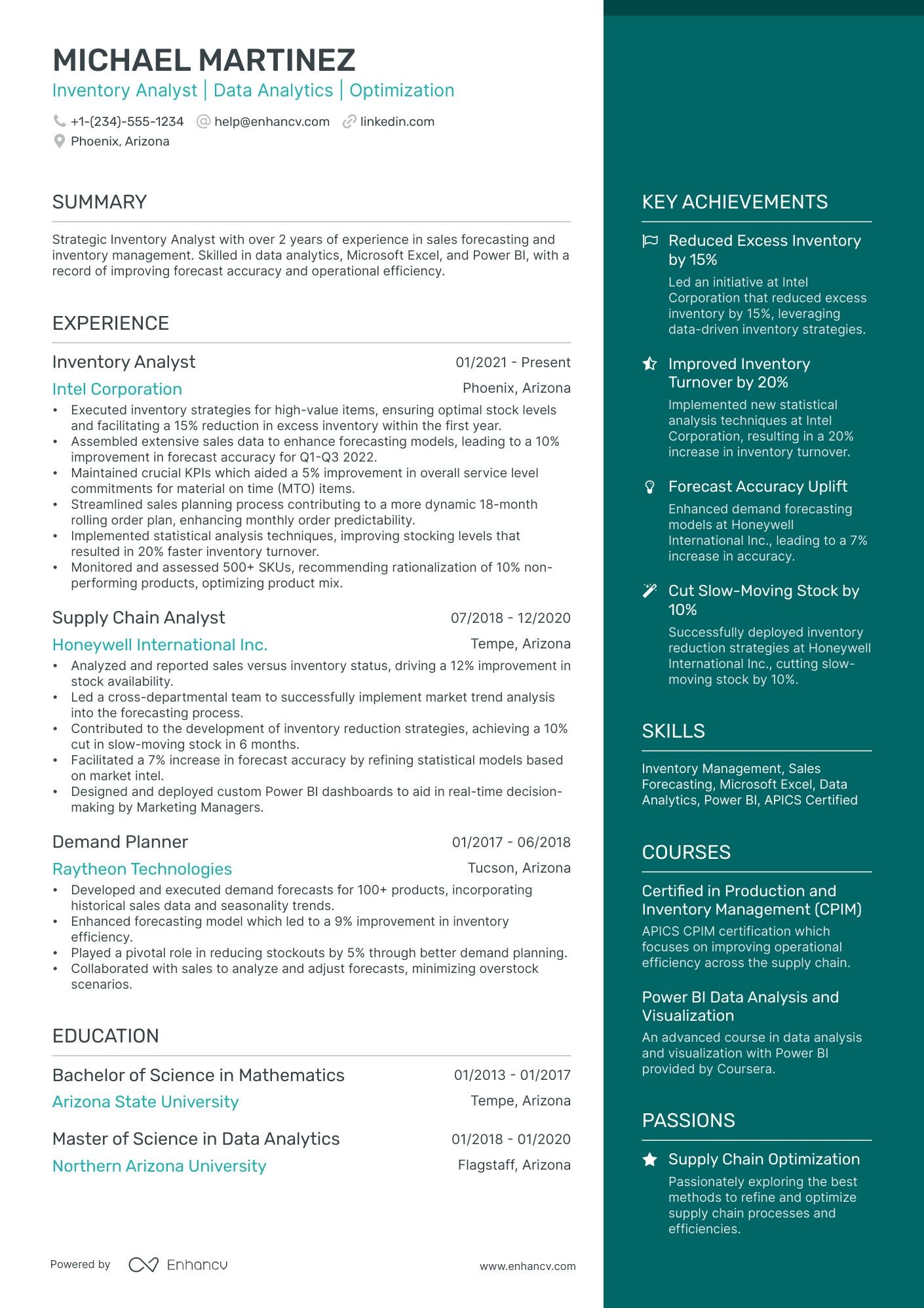
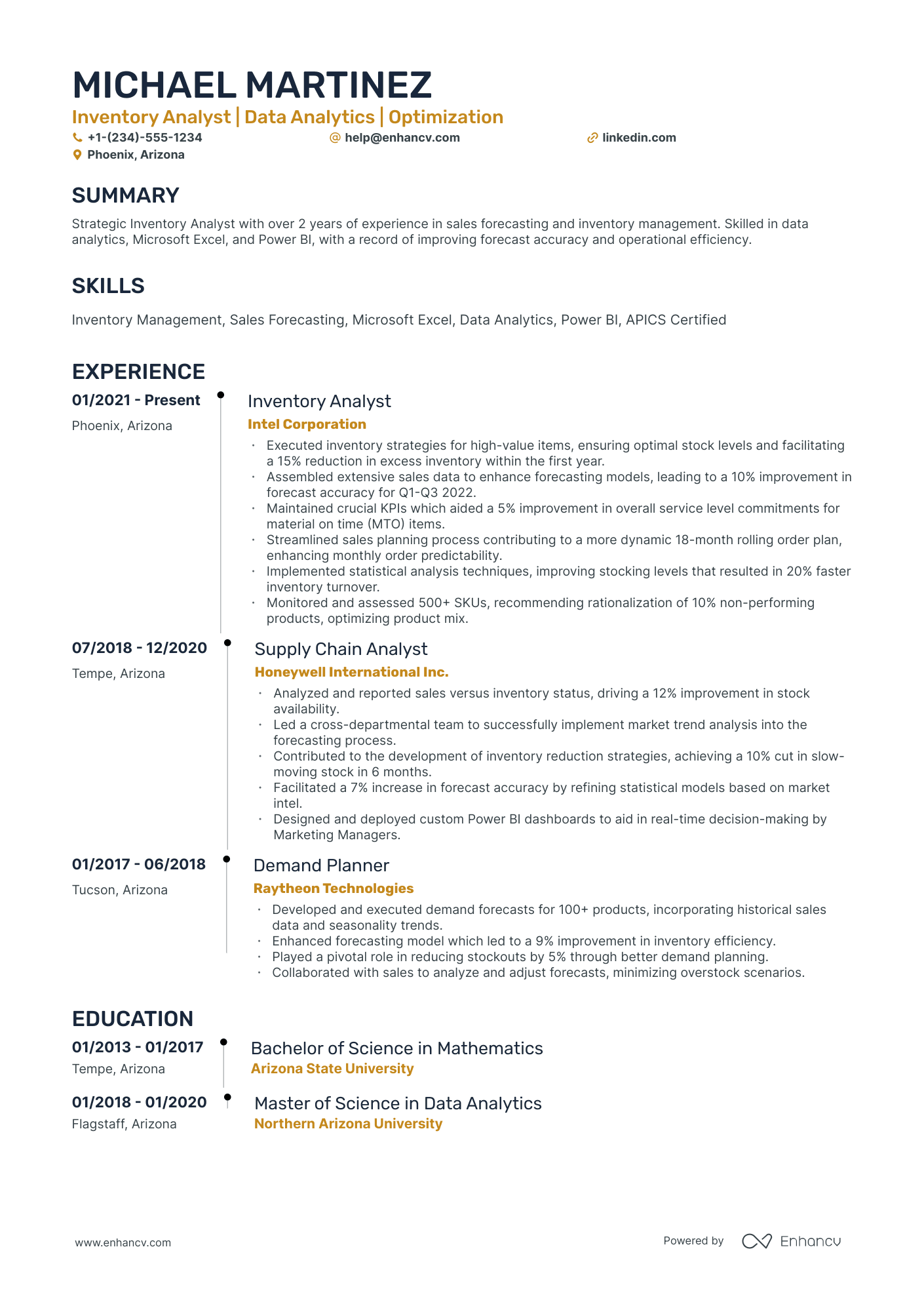
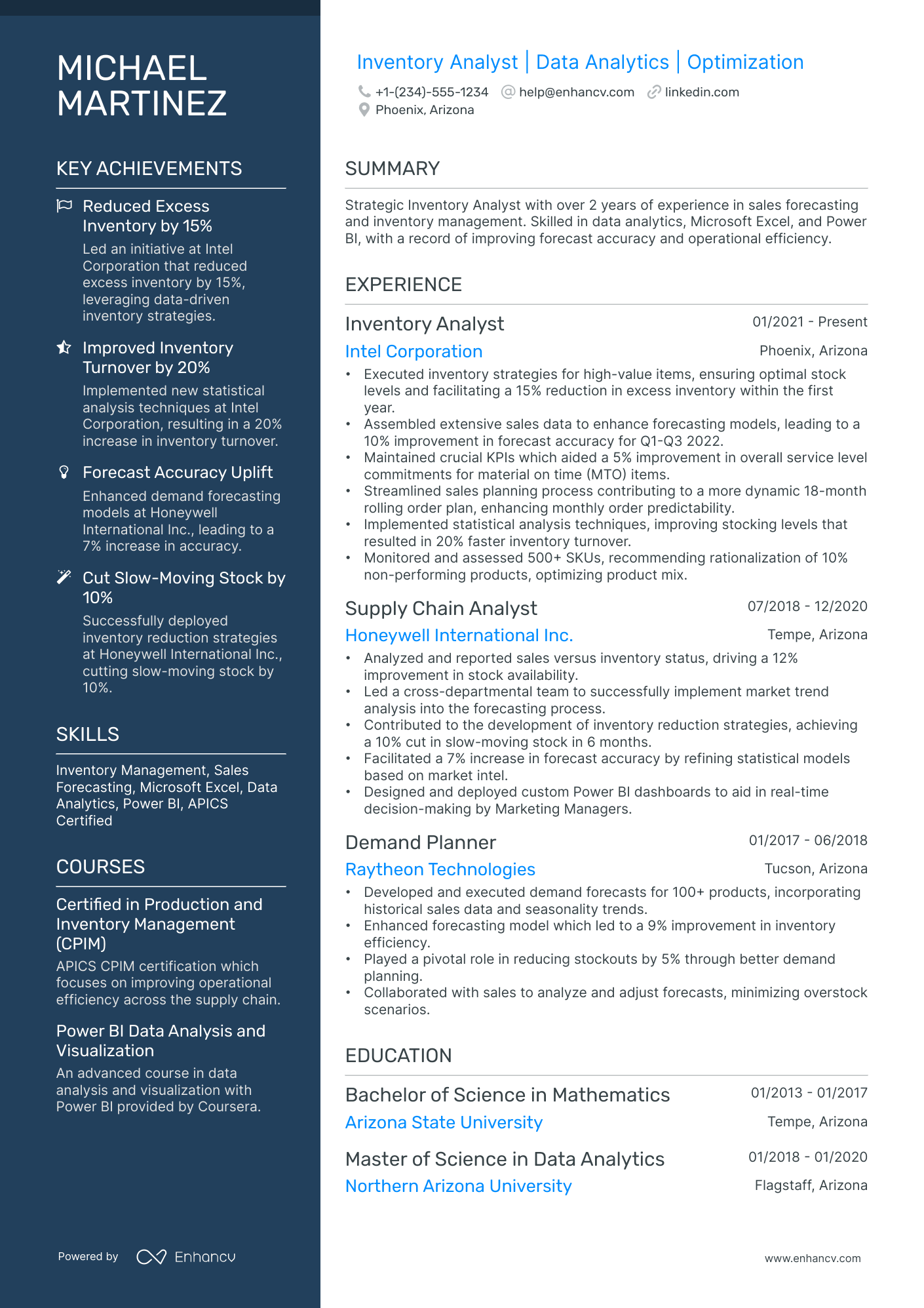
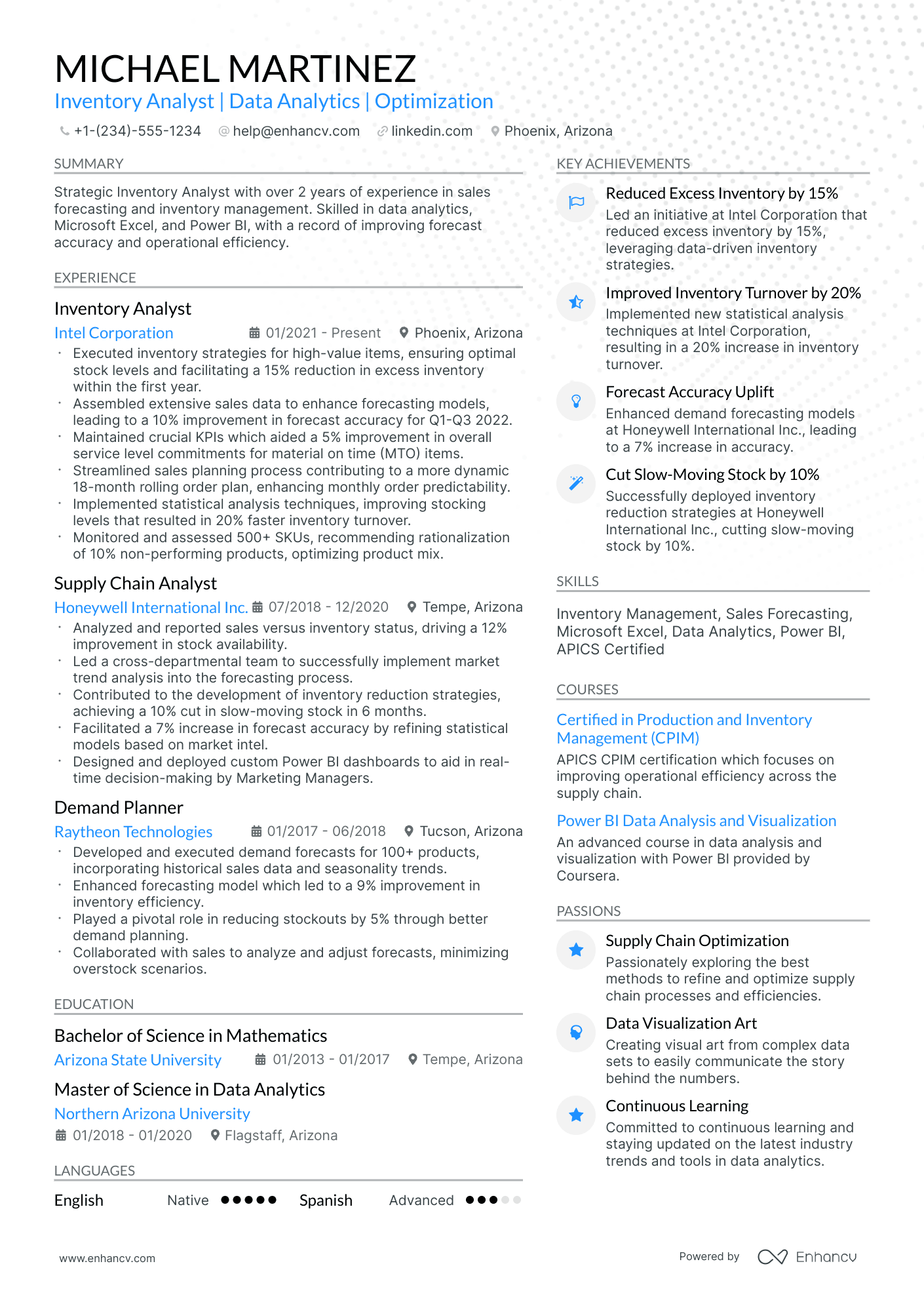
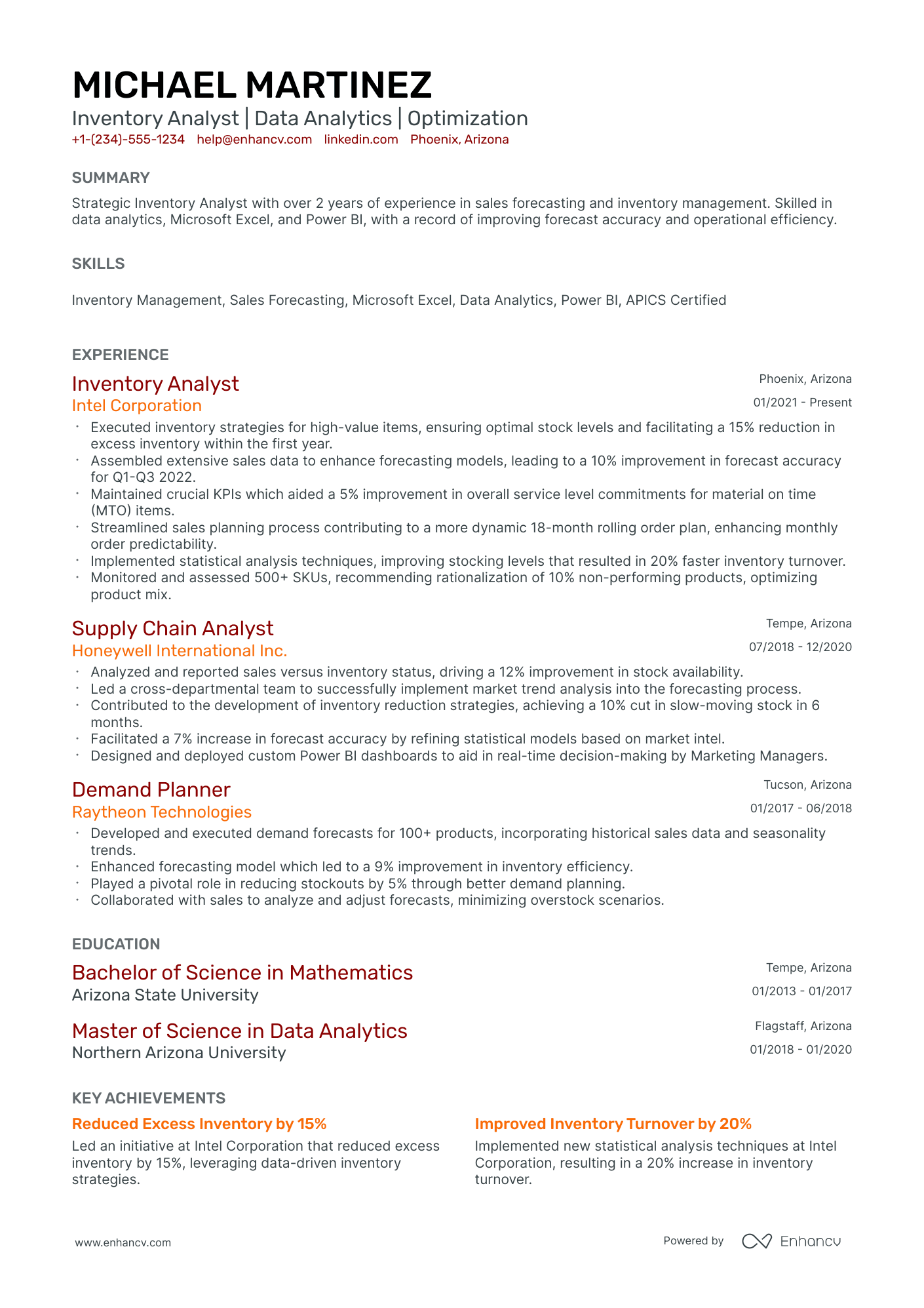
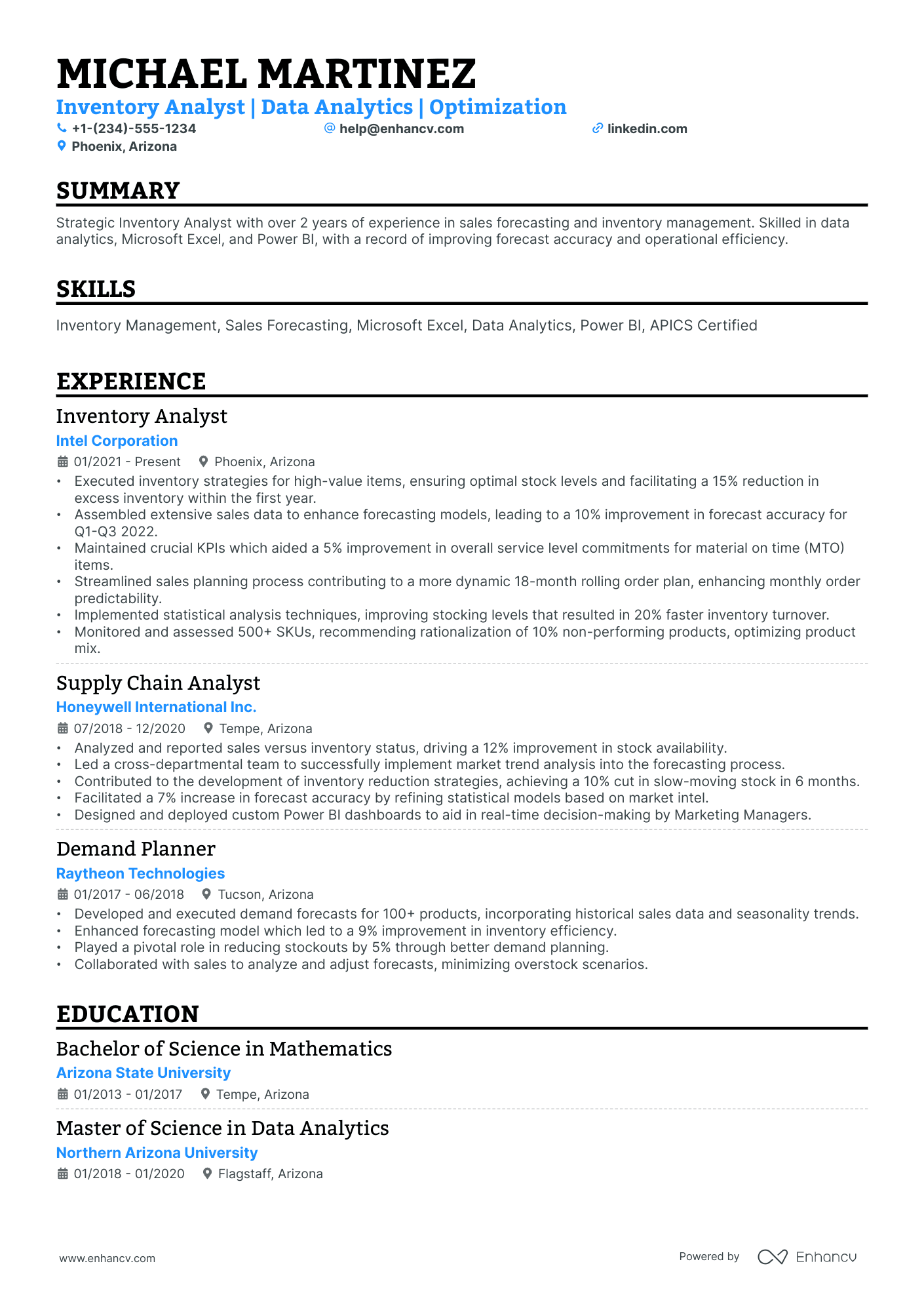
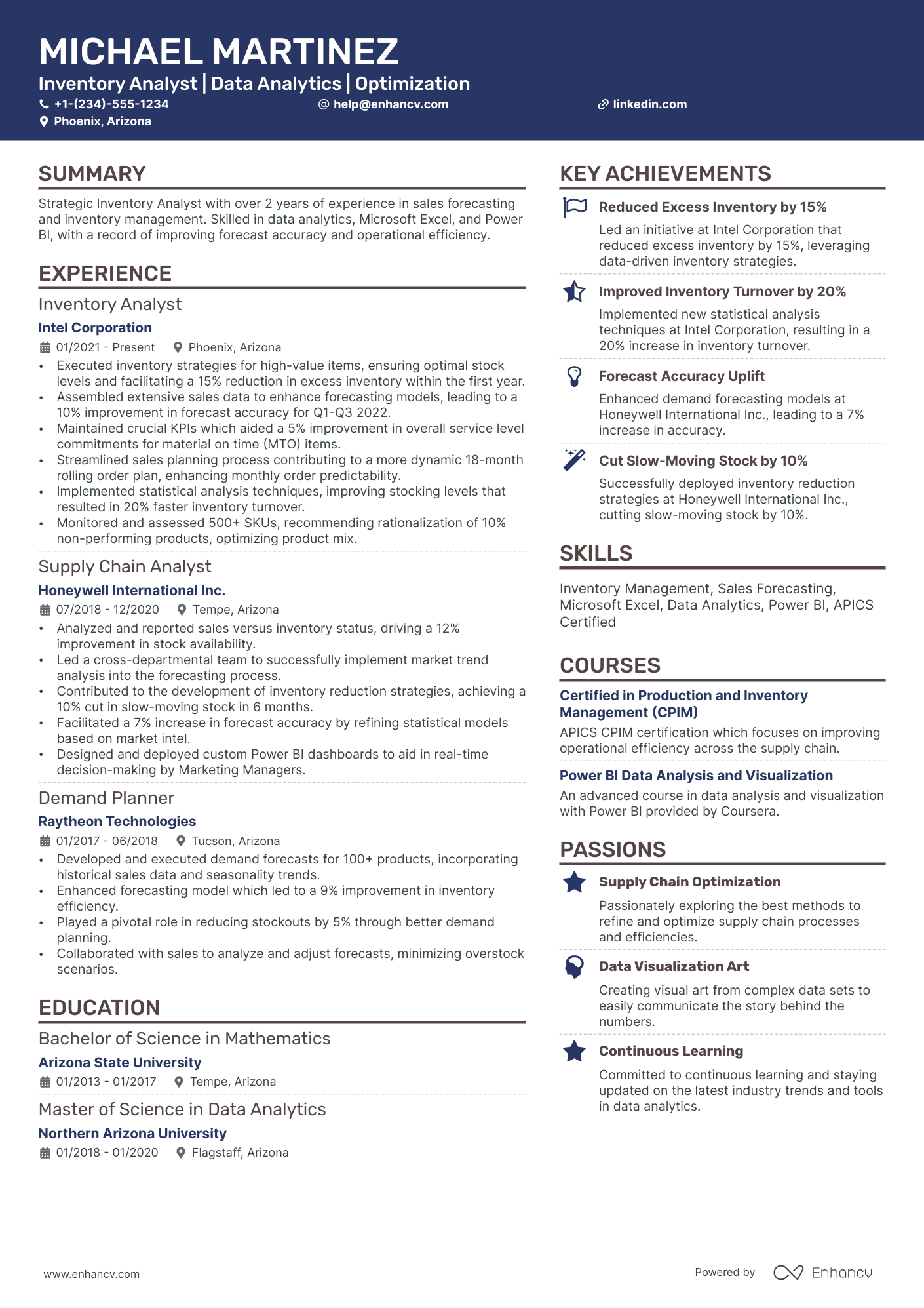
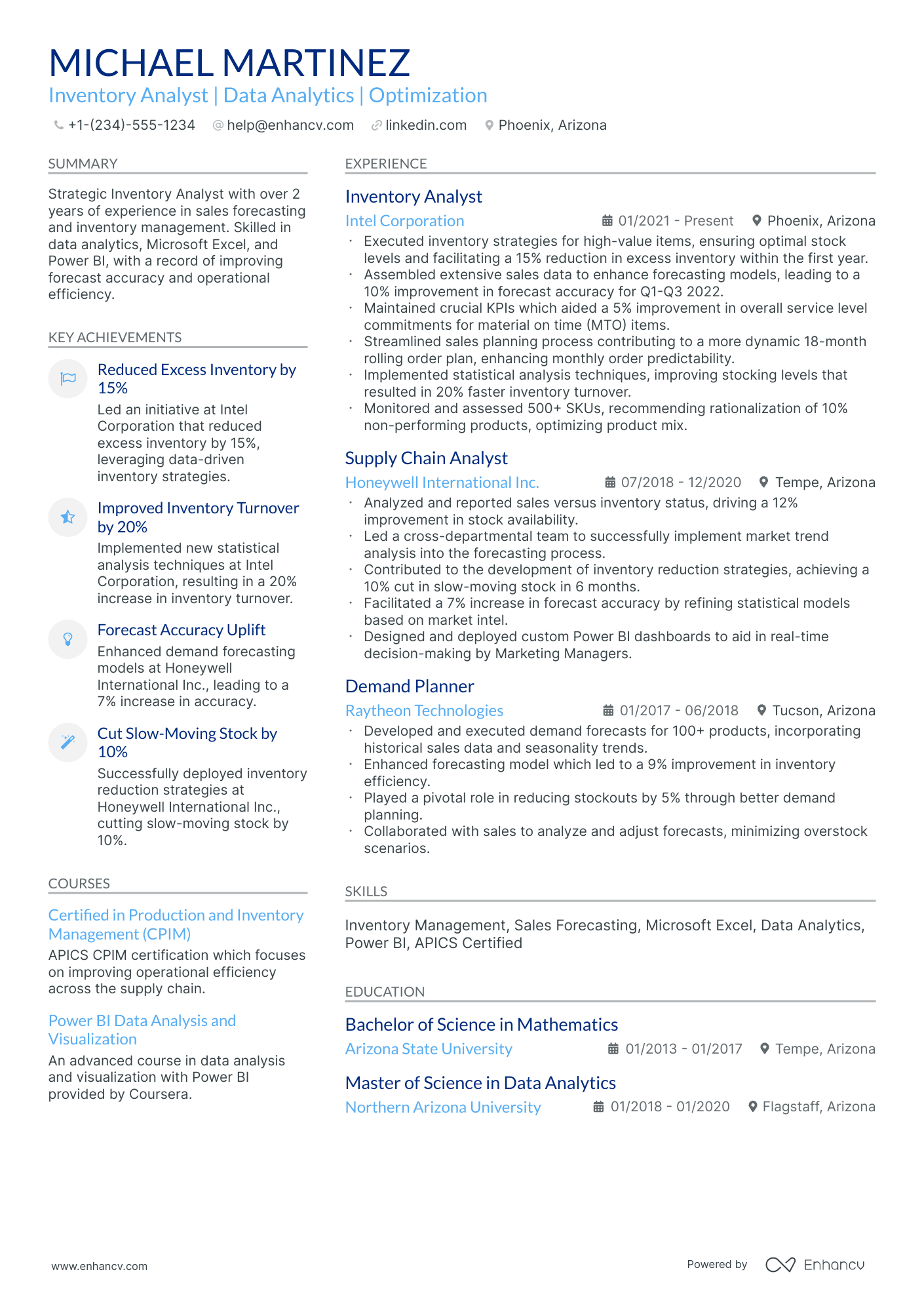
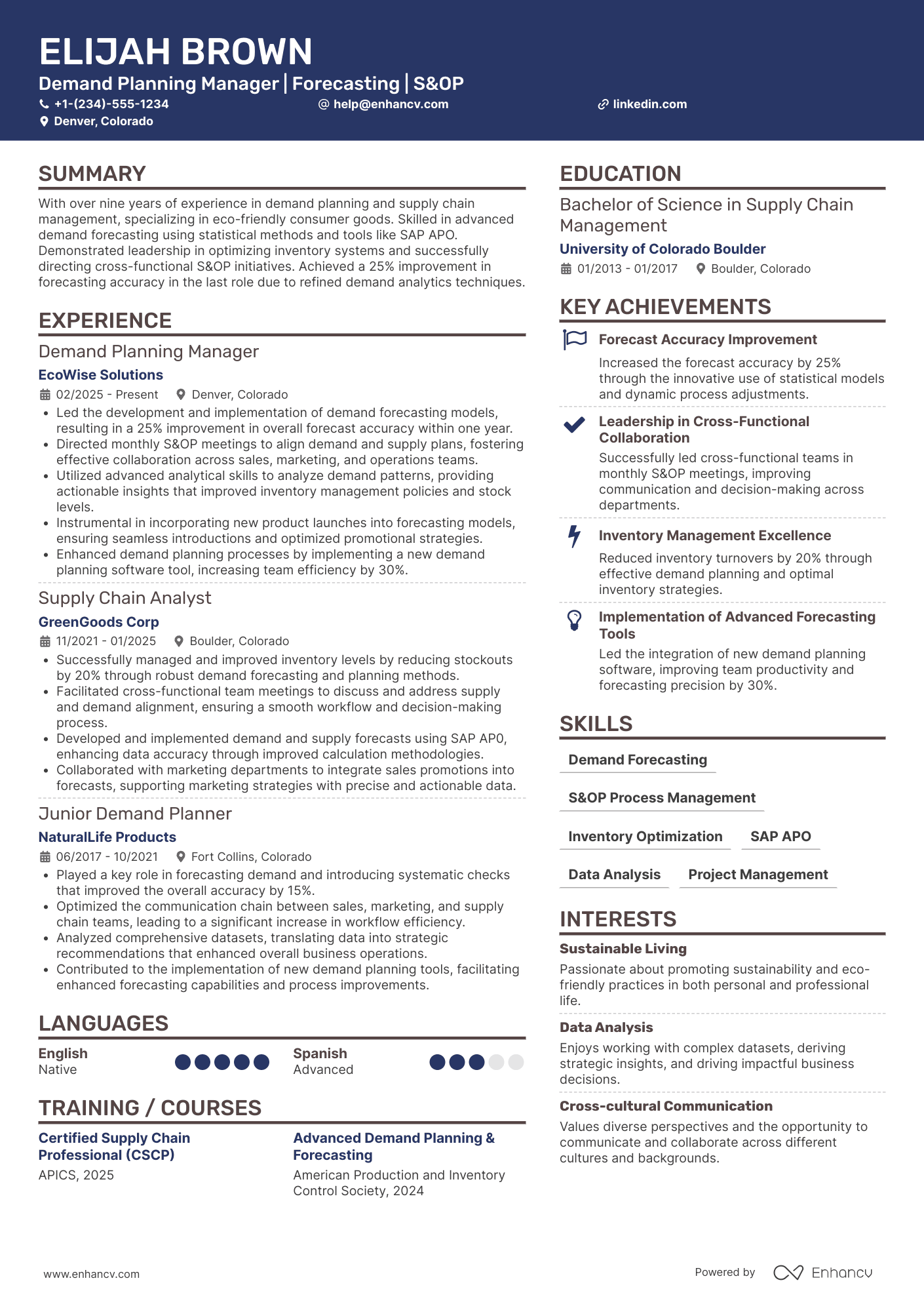
Many demand planning manager resume drafts fail because they bury forecast accuracy, bias, and service-level impact under tools and generic duties. That weak framing costs you in ATS screening and fast recruiter scans, especially when competition is tight.
A strong resume shows how you improved outcomes, not just what you used. Knowing how to make your resume stand out means highlighting forecast accuracy gains, lower mean absolute percentage error, reduced stockouts, fewer expedites, improved on-time delivery, and inventory turns across a defined portfolio value.

Key takeaways
- Quantify forecast accuracy, inventory savings, and service-level gains in every experience bullet.
- Use a reverse-chronological format to showcase career growth and expanding planning ownership.
- Tailor resume language to mirror the exact tools, methods, and KPIs in each job posting.
- Demonstrate skills through measurable outcomes in your experience section, not just a skills list.
- Pair each accomplishment with ownership scope, execution approach, and business impact delivered.
- Enhancv can help you turn vague duties into metric-driven bullets that pass ATS and recruiter scans.
- Stop using AI once your resume accurately reflects real experience—never inflate or fabricate claims.
How to format a demand planning manager resume
Recruiters evaluating demand planning manager candidates prioritize evidence of cross-functional coordination, forecast accuracy improvements, and supply chain optimization delivered across progressively responsible roles. A reverse-chronological format ensures these signals—career growth, leadership scope, and measurable business impact—are immediately visible to both hiring managers and applicant tracking systems. Choosing the right resume layout further supports readability and quick information retrieval.

I have significant experience in this role—which format should I use?
Use a reverse-chronological format to showcase your progression through demand planning leadership and the expanding scope of your operational ownership. Do:
- Lead with your most senior role first, emphasizing team size, budget authority, and cross-functional stakeholder management across supply chain, sales, and finance.
- Highlight proficiency in role-specific tools and methodologies such as SAP IBP, Oracle Demantra, Kinaxis, S&OP processes, and statistical forecasting models.
- Quantify business impact through metrics like forecast accuracy improvement, inventory reduction, revenue protection, or service-level gains.
I'm junior or switching into this role—what format works best?
A hybrid format works best, allowing you to feature relevant demand planning skills and analytical competencies at the top while still presenting your work history in chronological order. Do:
- Place a skills section above your experience, spotlighting demand forecasting, inventory optimization, ERP systems, and data analysis tools like Excel, Power BI, or Python.
- Include project-based experience—such as S&OP participation, demand model development, or cross-functional planning initiatives—even if it came from adjacent supply chain or analyst roles.
- Connect every action to a result so hiring managers see the throughline between your capabilities and tangible planning outcomes.
Why not use a functional resume?
A functional format strips away the timeline and context that hiring managers need to evaluate how your demand planning capabilities developed and where you applied them, making it harder to assess readiness for a management-level role. A functional resume may be acceptable if you're transitioning from a closely related field (such as supply chain analysis or procurement) and have limited direct demand planning job titles—but only if each listed skill is tied to a specific project, tool, or outcome rather than presented as a standalone claim.
Now that you've established a clean, readable layout, it's time to fill it with the right sections that highlight your demand planning expertise.
What sections should go on a demand planning manager resume
Recruiters expect a demand planning manager resume to show forecasting expertise, cross-functional leadership, and measurable business results. Understanding which resume sections to include ensures you present your qualifications in the order hiring teams expect.
Use this structure for maximum clarity:
- Header
- Summary
- Experience
- Skills
- Projects
- Education
- Certifications
- Optional sections: Awards, Leadership, Languages
Strong experience bullets should emphasize forecast accuracy improvements, inventory and service-level outcomes, scope of ownership, and quantifiable impact on revenue, cost, and planning cycle time.
Is your resume good enough?
Drop your resume here or choose a file. PDF & DOCX only. Max 2MB file size.
With your resume structure in place, the next step is to write the experience section so it fits those sections and shows your impact clearly.
How to write your demand planning manager resume experience
The experience section is where you prove you've shipped forecasts, optimized inventory strategies, and driven measurable improvements across supply chain operations. Building a targeted resume ensures hiring managers see demonstrated impact—accurate demand models deployed, stockout reductions achieved, or planning processes transformed—rather than descriptive task lists.
Each entry should include:
- Job title
- Company and location (or remote)
- Dates of employment (month and year)
Three to five concise bullet points showing what you owned, how you executed, and what outcomes you delivered:
- Ownership scope: the product lines, SKU portfolios, regional markets, demand planning systems, or cross-functional planning teams you were directly accountable for as a demand planning manager.
- Execution approach: the forecasting tools, statistical models, ERP and demand planning platforms, scenario analyses, or consensus planning frameworks you used to generate forecasts and inform inventory decisions.
- Value improved: changes to forecast accuracy, inventory turnover, service levels, planning cycle times, waste reduction, or risk mitigation that resulted from your demand planning work.
- Collaboration context: how you partnered with sales, marketing, finance, procurement, and supply chain stakeholders—or external vendors and retail partners—to align demand signals with operational capacity and business strategy.
- Impact delivered: outcomes expressed through improvements in fill rates, reductions in excess inventory, revenue protected during demand volatility, or planning processes scaled across new channels and geographies rather than activities performed.
Experience bullet formula
A demand planning manager experience example
✅ Right example - modern, quantified, specific.
Demand Planning Manager
Crestline Consumer Goods | Chicago, IL
2021–Present
Multi-category consumer packaged goods manufacturer supporting big-box retail, e-commerce, and wholesale channels across North America.
- Led monthly sales and operations planning (S&OP) cycle across Sales, Finance, Marketing, and Supply Chain using SAP Integrated Business Planning (SAP IBP), improving forecast accuracy from 72% to 84% and cutting stockouts 18%.
- Built a statistical forecasting framework in Python and SQL (ARIMA, gradient boosting) and operationalized it in Power BI, reducing forecast bias 22% and saving eight analyst hours per week through automated exception reporting.
- Implemented demand segmentation and new product introduction (NPI) forecasting playbooks in SAP Advanced Planning and Optimization (SAP APO), increasing new item forecast accuracy 15% and reducing obsolete inventory $1.3M annually.
- Partnered with category managers and key accounts to integrate point-of-sale and promotion data (NielsenIQ, retailer feeds) into baseline and uplift models, improving promotional forecast accuracy 19% and lifting on-shelf availability six points.
- Established governance for master data, demand overrides, and scenario planning, reducing last-minute schedule changes 25% and improving supplier on-time, in-full performance from 91% to 96%.
Now that you've seen how a strong experience section looks in practice, let's break down how to tailor each element to match the specific demand planning manager role you're targeting.
How to tailor your demand planning manager resume experience
Recruiters evaluate your demand planning manager resume through both applicant tracking systems and human review. Tailoring your resume to the job description ensures your qualifications connect directly with what the hiring team needs.
Ways to tailor your demand planning manager experience:
- Match forecasting tools and planning software listed in the job description.
- Mirror the exact demand planning methodologies the posting references.
- Use the same terminology for S&OP processes the employer describes.
- Highlight supply chain KPIs and accuracy metrics the role prioritizes.
- Include industry-specific experience when the posting names a sector.
- Emphasize cross-functional collaboration models referenced in the listing.
- Align your inventory optimization approach with stated performance goals.
- Reflect ERP or statistical forecasting systems the employer requires.
Tailoring means aligning your real accomplishments with the role's stated requirements—not forcing keywords where they don't belong.
Resume tailoring examples for demand planning manager
| Job description excerpt | Untailored | Tailored |
|---|---|---|
| "Develop and maintain statistical forecast models using SAP IBP to drive consensus demand plans across multiple product lines." | Assisted with forecasting and helped improve planning processes. | Built and maintained statistical forecast models in SAP IBP, generating consensus demand plans across 12 product lines and reducing forecast error by 18% year over year. |
| "Collaborate with sales, marketing, and supply chain teams to align demand signals with S&OP process inputs on a monthly cadence." | Worked cross-functionally with different departments on planning activities. | Partnered with sales, marketing, and supply chain stakeholders to integrate demand signals into monthly S&OP cycles, improving plan alignment and cutting excess inventory by $2.4M annually. |
| "Analyze POS data, market trends, and promotional calendars to adjust short-term and mid-term demand forecasts for the CPG portfolio." | Reviewed data and updated forecasts as needed. | Analyzed point-of-sale data, promotional calendars, and category trends to refine short-term and mid-term demand forecasts for a 300-SKU CPG portfolio, achieving 94% forecast accuracy at the monthly level. |
Once your experience aligns with the role’s priorities, the next step is to quantify your demand planning manager achievements so hiring teams can see the impact.
How to quantify your demand planning manager achievements
Quantifying your achievements proves you improved forecast accuracy, inventory health, and service levels—not just ran meetings. Focus on forecast error, bias, inventory turns, stockouts, planning cycle time, and cost-to-serve impacts.
Quantifying examples for demand planning manager
| Metric | Example |
|---|---|
| Forecast accuracy | "Cut MAPE from 24% to 15% in six months by tuning SAP Integrated Business Planning models and aligning monthly consensus demand reviews across five product families." |
| Inventory efficiency | "Reduced days of inventory on hand from 62 to 49 while maintaining 98% fill rate by resetting safety stocks and lead times for 1,200 stock keeping units." |
| Service level | "Lowered stockout rate from 6.5% to 3.1% by improving allocation rules and expediting exceptions through weekly shortage reviews with supply planning and logistics." |
| Planning cycle time | "Shortened the monthly demand planning cycle from ten to six business days by automating data pulls in Power BI and standardizing assumptions templates." |
| Cost impact | "Avoided $1.4M in obsolescence by flagging slow movers with a 90-day alert and coordinating promotions and end-of-life plans with sales and product." |
Turn vague job duties into measurable, recruiter-ready resume bullets in seconds with Enhancv's Bullet Point Generator.
With strong bullet points in place, it's equally important to highlight the right hard and soft skills that align with what hiring managers expect from a demand planning manager.
How to list your hard and soft skills on a demand planning manager resume
Your skills section shows you can forecast demand, align supply, and drive service levels—recruiters and an ATS (applicant tracking system) scan this section to match keywords fast, so aim for a balanced mix of hard skills like planning tools and execution-focused soft skills.
demand planning manager roles require a blend of:
- Product strategy and discovery skills
- Data, analytics, and experimentation skills
- Delivery, execution, and go-to-market discipline
- Soft skills
Your skills section should be:
- Scannable (bullet-style grouping).
- Relevant to the job post.
- Backed by proof in experience bullets.
- Updated with current tools.
Place your skills section:
- Above experience if you're junior or switching careers.
- Below experience if you're mid/senior with strong achievements.

Hard skills
- Demand forecasting models
- Statistical forecasting
- Forecast accuracy, bias tracking
- Sales and operations planning
- Integrated business planning
- Inventory optimization
- Replenishment planning
- Promotion and event forecasting
- New product launch forecasting
- SAP Integrated Business Planning
- Oracle Demantra
- Excel, Power Query, SQL
Soft skills
- Lead cross-functional alignment
- Challenge assumptions with data
- Translate insights into actions
- Drive decisions under ambiguity
- Manage trade-offs transparently
- Influence without authority
- Communicate forecast risk early
- Facilitate sales and operations planning meetings
- Build consensus across sales and supply chain
- Hold owners to deadlines
- Escalate issues with options
- Mentor and develop analysts
How to show your demand planning manager skills in context
Skills shouldn't live only in a bulleted list on your resume. Explore examples of resume skills shown in context to see how top candidates weave competencies into their narratives.
They should be demonstrated in:
- Your summary (high-level professional identity)
- Your experience (proof through outcomes)
Here's what strong, skill-rich resume content looks like in practice.
Summary example
Demand planning manager with 10+ years in consumer packaged goods, skilled in SAP IBP, statistical forecasting, and cross-functional S&OP leadership. Reduced forecast error by 18% while aligning supply strategy across six product categories.
- Reflects senior-level experience clearly
- Names industry-relevant tools and methods
- Quantifies forecast accuracy improvement
- Signals cross-functional leadership ability
Experience example
Demand Planning Manager
Ridgeline Consumer Brands | Charlotte, NC
March 2019–Present
- Improved demand forecast accuracy from 74% to 91% using SAP IBP and ensemble modeling across four product lines.
- Partnered with procurement, sales, and finance teams to redesign the monthly S&OP cycle, cutting planning time by 30%.
- Built a real-time KPI dashboard in Power BI that reduced excess inventory costs by $2.1M annually.
- Every bullet includes measurable proof
- Skills surface naturally through real outcomes
Once you’ve demonstrated these abilities through measurable examples, the next step is adapting that approach for a demand planning manager resume when you don’t have direct experience.
How do I write a demand planning manager resume with no experience
Even without full-time experience, you can demonstrate readiness through transferable work. If you're building a resume without work experience, focus on projects and coursework that showcase planning fundamentals:
- Supply chain or operations internships
- Retail inventory planning experience
- Forecasting coursework capstone project
- ERP system training labs
- Demand planning case competitions
- Sales and operations planning simulations
- Data analysis portfolio projects
- Volunteer purchasing and replenishment
Focus on:
- Forecast accuracy and bias tracking
- Inventory turns and service levels
- Cross-functional planning deliverables
- Tool proficiency: Excel, SQL, Power BI
Resume format tip for entry-level demand planning manager
Use a hybrid resume format because it highlights skills and projects first while still showing a clear timeline of education and roles. Do:
- Put a "Projects" section above experience.
- Quantify results with clear metrics.
- Name tools used in each bullet.
- Add relevant coursework with outcomes.
- Tailor keywords to each job post.
- Built a weekly demand forecast in Excel using moving averages and seasonality for a mock retail SKU set, improving mean absolute percentage error by 12% versus baseline.
Even without direct experience, a well-structured education section can demonstrate the analytical and supply chain knowledge that hiring managers look for in a demand planning manager.
How to list your education on a demand planning manager resume
Your education section helps hiring teams confirm you have the foundational knowledge needed for a demand planning manager role. It validates analytical, supply chain, and business skills quickly.
Include:
- Degree name
- Institution
- Location
- Graduation year
- Relevant coursework (for juniors or entry-level candidates)
- Honors & GPA (if 3.5 or higher)
Skip month and day details—list the graduation year only.
Here's a strong education entry tailored to a demand planning manager resume.
Example education entry
Bachelor of Science in Supply Chain Management
Penn State University, University Park, PA
Graduated 2016
GPA: 3.7/4.0
- Relevant Coursework: Demand Forecasting, Inventory Optimization, Statistical Analysis, Operations Management
- Honors: Dean's List, Magna Cum Laude
How to list your certifications on a demand planning manager resume
Certifications on your resume show your commitment to learning, prove tool proficiency, and signal industry relevance as a demand planning manager. They also help hiring teams validate your skills faster.
Include:
- Certificate name
- Issuing organization
- Year
- Optional: credential ID or URL
- Place certifications below education when they are older, broad, or less relevant to demand planning manager responsibilities.
- Place certifications above education when they are recent, highly relevant, or required for the demand planning manager role.
Best certifications for your demand planning manager resume
- APICS Certified Supply Chain Professional (CSCP)
- APICS Certified in Planning and Inventory Management (CPIM)
- IBF Certified Professional Forecaster (CPF)
- SAP Certified Application Associate: SAP Integrated Business Planning
- Oracle Supply Chain Planning Certification
- Microsoft Certified: Power BI Data Analyst Associate
- Lean Six Sigma Green Belt
Once you’ve positioned your credentials to reinforce your qualifications, shift to writing your demand planning manager resume summary so you can highlight that value upfront.
How to write your demand planning manager resume summary
Your resume summary is the first thing a recruiter reads. A strong one instantly signals you're qualified for the demand planning manager role.
Keep it to three to four lines, with:
- Your title and total years of experience in demand planning or supply chain management.
- Domain expertise, such as CPG, retail, manufacturing, or distribution.
- Core tools like SAP APO, Oracle Demantra, Kinaxis, or advanced Excel modeling.
- One or two quantified achievements, such as forecast accuracy gains or inventory reductions.
- Soft skills tied to real outcomes, like cross-functional collaboration that improved S&OP alignment.

PRO TIP
At the manager level, emphasize ownership of forecasting processes and measurable business outcomes. Highlight team leadership, stakeholder management, and decisions that improved accuracy or reduced cost. Avoid vague phrases like "results-driven professional" or "passionate about supply chain excellence."
Example summary for a demand planning manager
Demand planning manager with eight years in CPG forecasting. Led a team of four analysts, improving forecast accuracy by 18% using SAP IBP and driving $2.3M in inventory savings.
Optimize your resume summary and objective for ATS
Drop your resume here or choose a file.
PDF & DOCX only. Max 2MB file size.
Now that your summary is ready to showcase your forecasting expertise and strategic value, make sure the header above it presents your contact details clearly so recruiters can actually reach you.
What to include in a demand planning manager resume header
A resume header is the top section with your key identifiers, and it boosts visibility, credibility, and recruiter screening for a demand planning manager role.
Essential resume header elements
- Full name
- Tailored job title and headline
- Location
- Phone number
- Professional email
- GitHub link
- Portfolio link
A LinkedIn link helps recruiters verify experience quickly and supports screening.
Don't include photos on a demand planning manager resume unless the role is explicitly front-facing or appearance-dependent.
Match your header title to the posting and align your headline with demand forecasting, inventory planning, and cross-functional planning strengths.
Example
Demand planning manager resume header
Jordan Lee
Demand planning manager | Demand forecasting, inventory planning, and sales and operations planning
Chicago, IL
(312) 555-01XX
jordan.lee@enhancv.com
github.com/jordanlee
jordanlee.com
linkedin.com/in/jordanlee
Once your contact details and role information are clearly presented at the top, you can strengthen your resume with additional sections that add relevant context and credibility.
Additional sections for demand planning manager resumes
Adding extra sections strengthens your resume when they showcase expertise directly relevant to forecasting, supply chain strategy, or cross-functional leadership. For example, listing language skills can highlight your ability to coordinate with global teams and regional stakeholders.
- Languages
- Certifications (APICS CPIM, CSCP, IBF CPF)
- Professional affiliations
- Publications
- Awards and recognitions
- Technical proficiencies
- Volunteer leadership
Once you've strengthened your resume with well-chosen additional sections, the next step is pairing it with a cover letter that adds even more context to your candidacy.
Do demand planning manager resumes need a cover letter
A cover letter isn't required for a demand planning manager, but it helps in competitive searches or when hiring teams expect one. If you're unsure what a cover letter is or when to use one, it can make a difference when your resume needs context, or when you're targeting a specific product line.
Use a cover letter to add value in these situations:
- Explain role and team fit: Tie your planning approach to the company's forecasting cadence, sales and operations planning process, and cross-functional partners.
- Highlight one or two outcomes: Name a project, your role, and the measurable result, such as forecast accuracy, bias reduction, or inventory turns.
- Show business context: Reference the product, users, channels, and demand drivers, and how you'd incorporate them into the forecast.
- Address non-obvious experience: Clarify a career transition, industry change, or unusual scope, and connect it to demand planning manager requirements.
Drop your resume here or choose a file.
PDF & DOCX only. Max 2MB file size.
Even if you decide a cover letter adds little value for your application, AI tools can help you strengthen your demand planning manager resume faster and more precisely.
Using AI to improve your demand planning manager resume
AI can sharpen your resume's clarity, structure, and impact. It helps refine language and highlight measurable results. But overuse kills authenticity. Once your content is clear and role-aligned, step away from AI. For practical starting points, explore these ChatGPT resume writing prompts tailored for resume improvement.
Here are 10 practical prompts to strengthen specific sections of your demand planning manager resume:
Strengthen your summary
Quantify experience bullets
Tighten action verbs
Align skills section
Refine project descriptions
Improve education relevance
Highlight certifications strategically
Remove filler language
Tailor for ATS
Clarify leadership impact
Conclusion
A strong demand planning manager resume proves impact with measurable outcomes, like forecast accuracy gains, lower inventory costs, and fewer stockouts. It highlights role-specific skills, including demand forecasting, sales and operations planning, and cross-functional leadership. It stays easy to scan with clear sections and consistent formatting.
Today’s hiring market rewards demand planning managers who show results, sound judgment, and strong execution. A structured resume with targeted metrics, relevant tools, and clear scope signals you can deliver now and adapt to near-future needs.