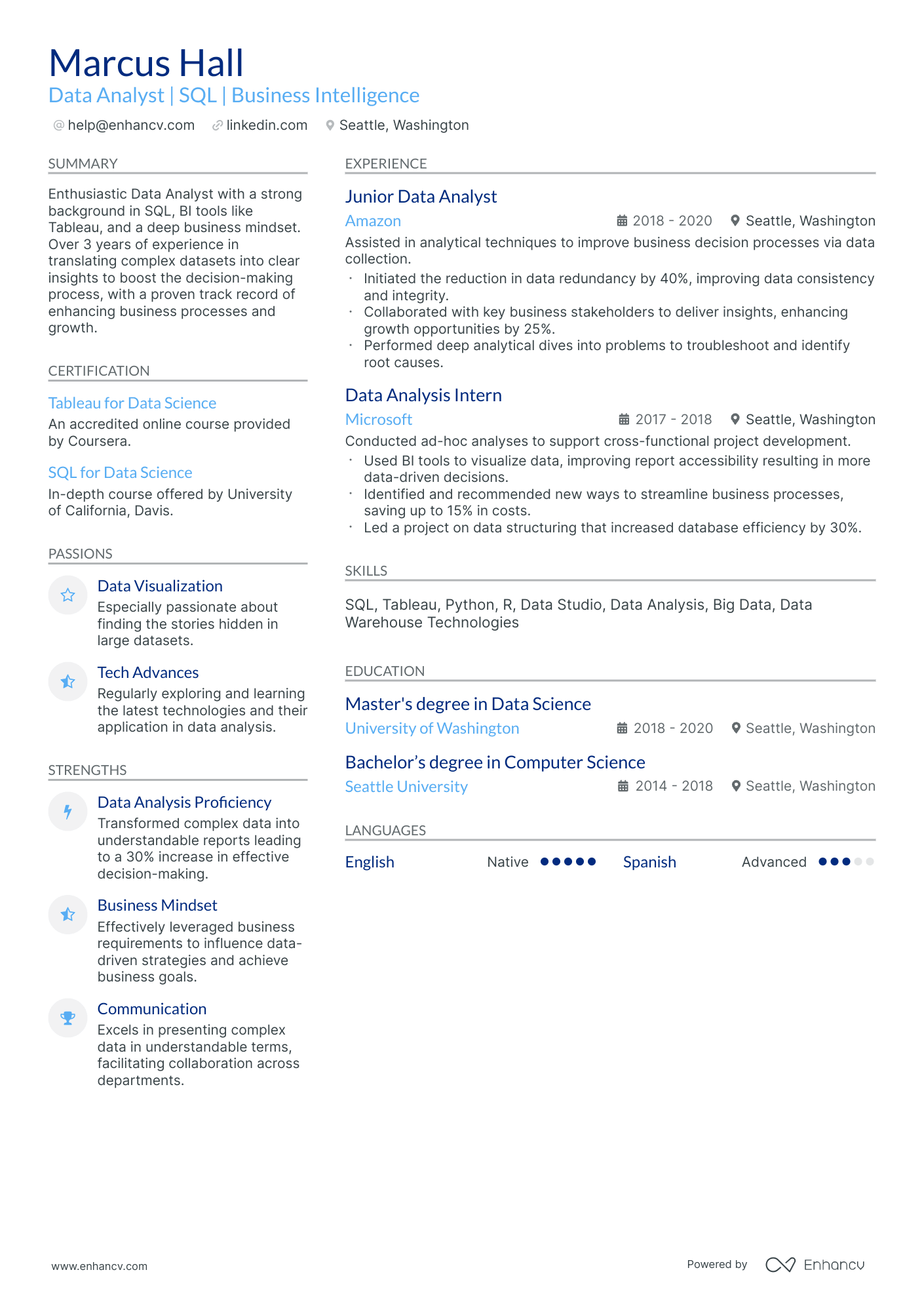
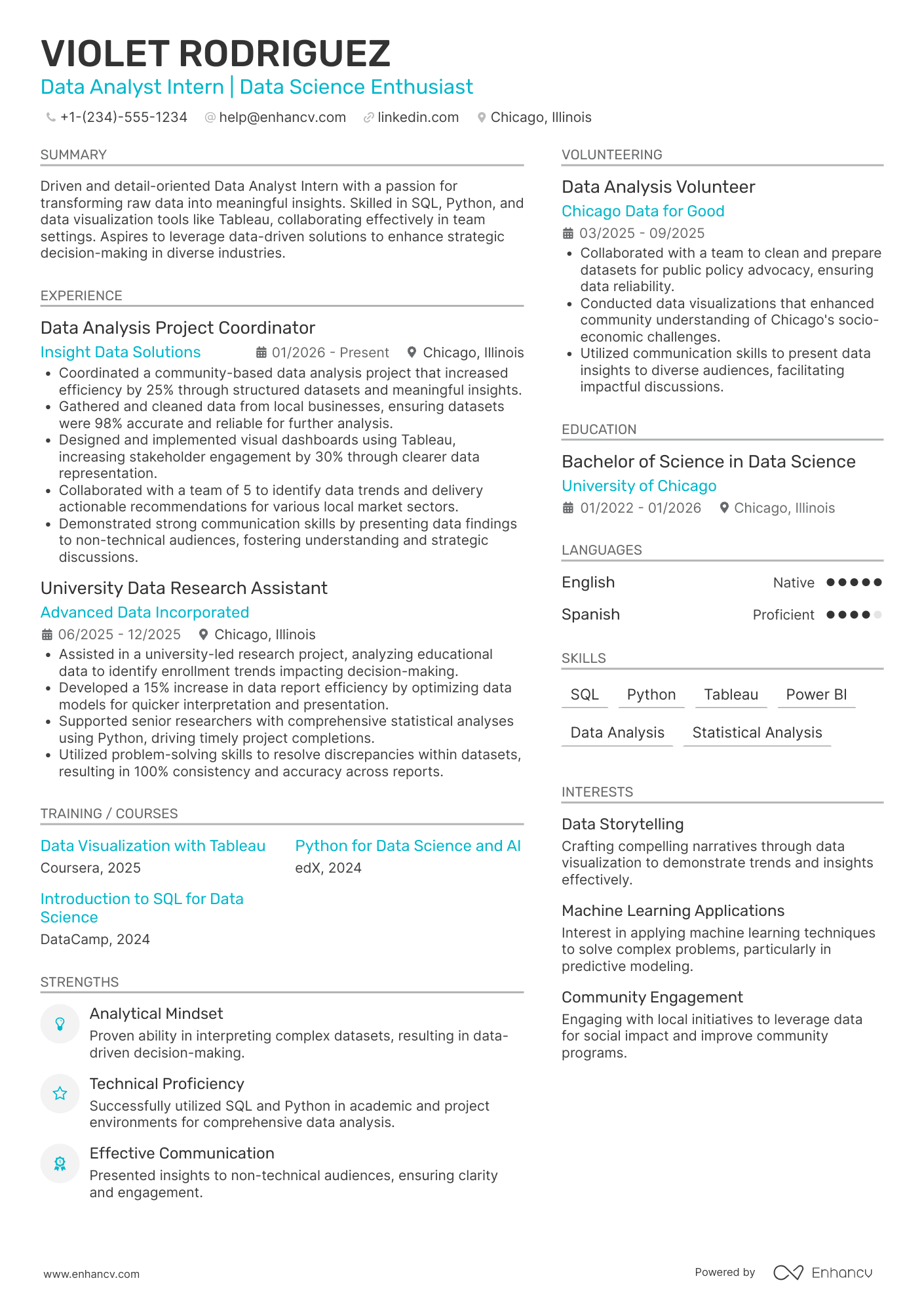
Many data analyst intern resume applications fail because they list tools and class projects without showing what changed, improved, or shipped. In ATS screening and fast recruiter scans, that reads as generic, and strong candidates blend together.
A strong resume shows outcomes you drove and how you measured them. Knowing how to make your resume stand out means highlighting accuracy gains, faster reporting cycles, cleaner datasets, dashboards adopted by stakeholders, and insights that influenced decisions. Include scope, timelines, and measurable impact.

Key takeaways
- Quantify every experience bullet with metrics like reporting speed, accuracy gains, or cost savings.
- Use a reverse-chronological format if you have relevant internship or analyst-adjacent experience.
- Lead with a skills section when you're junior, then back each skill with a project outcome.
- Mirror the exact tools, platforms, and terminology from the job posting in your resume.
- Replace task descriptions with ownership, execution method, and measurable result in each bullet.
- Showcase coursework, capstone projects, or Kaggle notebooks when you lack formal work history.
- Build your resume faster with Enhancv, then tailor each version to the specific role you're targeting.
Job market snapshot for data analyst interns
We analyzed 61 recent data analyst intern job ads across major US job boards. These numbers help you understand employer expectations, skills in demand, industry demand at a glance.
What level of experience employers are looking for data analyst interns
| Years of Experience | Percentage found in job ads |
|---|---|
| 1–2 years | 8.2% (5) |
| 5–6 years | 1.6% (1) |
| 10+ years | 3.3% (2) |
| Not specified | 83.6% (51) |
Data analyst intern ads by area of specialization (industry)
| Industry (Area) | Percentage found in job ads |
|---|---|
| Finance & Banking | 52.5% (32) |
| Education | 18.0% (11) |
Role overview stats
These tables show the most common responsibilities and employment types for data analyst intern roles. Use them to align your resume with what employers expect and to understand how the role is structured across the market.
Day-to-day activities and top responsibilities for a data analyst intern
| Responsibility | Percentage found in job ads |
|---|---|
| Power bi | 52.5% (32) |
| Python | 52.5% (32) |
| Sql | 50.8% (31) |
| Data analysis | 41.0% (25) |
| Excel | 39.3% (24) |
| Data visualization | 36.1% (22) |
| Tableau | 26.2% (16) |
| R | 16.4% (10) |
| Data analytics | 9.8% (6) |
| Agile | 8.2% (5) |
| Aws | 8.2% (5) |
| Machine learning | 8.2% (5) |
Type of employment (remote vs on-site vs hybrid)
| Employment type | Percentage found in job ads |
|---|---|
| On-site | 62.3% (38) |
| Hybrid | 34.4% (21) |
How to format a data analyst intern resume
Recruiters reviewing data analyst intern resumes prioritize technical skills, academic projects, and any hands-on experience with data tools—even from coursework or personal projects. Choosing the right resume format needs to surface these signals immediately, because hiring managers often spend under 10 seconds on an initial scan, and applicant tracking systems (ATS) parse structured, chronological layouts most reliably.

I have significant experience in this role—which format should I use?
Use a reverse-chronological format to put your most recent and relevant data experience front and center. Do:
- Lead with your most recent internship, co-op, or analyst-adjacent role to show clear scope and ownership of data tasks.
- Highlight role-specific tools and skills—SQL, Python, Excel, Tableau, or any statistical software—within each experience entry.
- Quantify outcomes wherever possible, tying your analysis work to a measurable result or business insight.
I'm junior or switching into this role—what format works best?
Use a hybrid format that leads with a focused skills section, followed by any experience listed in reverse-chronological order. Do:
- Place a dedicated skills section near the top of your resume, listing technical proficiencies (SQL, Python, R, Excel, Tableau) so recruiters and ATS systems catch them immediately.
- Include academic projects, capstone work, personal data projects, or freelance analysis in a dedicated section to demonstrate transitional experience.
- Connect every listed skill to a specific action and outcome, even if the context is a classroom or self-directed project.
Why not use a functional resume?
A functional resume strips away the timeline and context recruiters need to evaluate how you've applied your skills, making it harder to assess growth, initiative, or the scope of your projects—which is especially damaging for intern candidates who already have limited professional history. Avoid a functional format unless you have no other way to organize your experience coherently.
- A functional resume may be acceptable if you're making a significant career change from an unrelated field, have a gap in your academic or work timeline, or have no formal work history at all—but even then, tie every listed skill to a specific project, coursework deliverable, or measurable outcome rather than presenting skills in isolation.
Once your format establishes a clean, scannable structure, the next step is deciding which sections to include so every part of your resume serves a clear purpose.
What sections should go on a data analyst intern resume
Recruiters expect a clean, easy-to-scan resume that proves you can analyze data, communicate insights, and support business decisions. Understanding which resume sections to include ensures maximum clarity.
Use this structure for maximum clarity:
- Header
- Summary
- Experience
- Skills
- Projects
- Education
- Certifications
- Optional sections: Research, leadership, volunteering
Strong experience bullets should emphasize measurable impact, clear outcomes, and the scope of your analysis, including the tools you used and the decisions your work supported.
Is your resume good enough?
Drop your resume here or choose a file. PDF & DOCX only. Max 2MB file size.
Once you’ve organized the key resume components, the next step is to write your data analyst intern resume experience so your work history supports each section with clear, relevant impact.
How to write your data analyst intern resume experience
The experience section is where you prove you've shipped real analytical work—not just completed coursework. Hiring managers reviewing data analyst intern resumes prioritize demonstrated impact through role-relevant tools, methods, and measurable outcomes over descriptive task lists.
Each entry should include:
- Job title
- Company and location (or remote)
- Dates of employment (month and year)
Three to five concise bullet points showing what you owned, how you executed, and what outcomes you delivered:
- Ownership scope: the datasets, dashboards, reporting pipelines, or analytical projects you were directly accountable for as a data analyst intern.
- Execution approach: the tools, languages, frameworks, or statistical methods you applied—such as SQL, Python, Excel, Tableau, or regression analysis—to clean data, build models, or generate insights.
- Value improved: the specific improvements you drove in data accuracy, reporting speed, query performance, forecast reliability, or decision-making efficiency within your team or organization.
- Collaboration context: how you partnered with analysts, engineers, product managers, or business stakeholders to translate data findings into actionable recommendations.
- Impact delivered: the tangible results your work produced, expressed through business outcomes, operational gains, or strategic contributions rather than a list of tasks you performed.
Experience bullet formula
A data analyst intern experience example
✅ Right example - modern, quantified, specific.
Data analyst intern
BrightCart | Austin, TX
2024–2025
E-commerce marketplace serving 2M monthly active users with a focus on fast delivery and personalized recommendations.
- Built and automated weekly KPI dashboards in Tableau using Snowflake and SQL, cutting recurring reporting time by 70% and improving on-time stakeholder updates from 60% to 95%.
- Analyzed conversion funnel drop-offs with SQL and Python (pandas), isolating three checkout friction points and partnering with product managers and designers to ship changes that lifted checkout conversion by 2.4%.
- Implemented data quality checks with dbt (data build tool) tests and Great Expectations, reducing null-rate incidents in order and payment tables by 38% and preventing two high-severity reporting errors.
- Ran an A/B test readout for a new recommendations module using statistical significance testing in Python, validating a 1.8% revenue-per-session lift and aligning findings with engineering and finance for rollout.
- Standardized event tracking documentation in Confluence and validated instrumentation with engineers in Amplitude, increasing schema compliance from 72% to 93% across five core user journeys.
Now that you've seen how a strong experience entry looks in practice, let's break down how to tailor each element to match the specific data analyst internship you're applying for.
How to tailor your data analyst intern resume experience
Recruiters evaluate your data analyst intern resume through both human review and applicant tracking systems, so alignment with the job posting matters. Tailoring your resume to the job description ensures the tools, methods, and responsibilities you list directly reflect what the employer prioritizes.
Ways to tailor your data analyst intern experience:
- Match SQL Python R or Excel versions named in the job description.
- Mirror the exact terminology used for reporting or visualization platforms.
- Align your listed KPIs with the success metrics the posting specifies.
- Reference the specific database or cloud systems the employer uses.
- Highlight data cleaning or wrangling methods mentioned in the role.
- Include relevant industry experience such as healthcare finance or retail.
- Emphasize statistical techniques or modeling approaches the posting requests.
- Showcase collaboration with cross-functional teams if the role requires it.
Tailoring means aligning your real accomplishments with the language and priorities of each job posting, not forcing in keywords where they don't belong.
Resume tailoring examples for data analyst intern
| Job description excerpt | Untailored | Tailored |
|---|---|---|
| "Assist in building dashboards and reports using Tableau to support marketing analytics." | Created reports and visualizations for various teams. | Built three Tableau dashboards tracking email campaign performance, reducing the marketing team's weekly reporting time by 40%. |
| "Use SQL to extract and clean data from large databases to support business decision-making." | Worked with data and helped with analysis projects. | Wrote SQL queries to extract and clean datasets of 500K+ records from PostgreSQL, delivering weekly sales trend analyses that informed regional pricing decisions. |
| "Support A/B testing initiatives and summarize findings using Excel and Python." | Assisted with testing and data tasks using different tools. | Analyzed A/B test results for a checkout flow redesign using Python (pandas) and Excel, summarizing a 12% conversion lift in a stakeholder-ready report. |
Once you’ve aligned your experience with the role’s priorities, quantify your data analyst intern achievements to show the measurable impact behind those contributions.
How to quantify your data analyst intern achievements
Quantifying your achievements proves business impact, not just activity. For a data analyst intern, focus on accuracy gains, faster reporting, query performance, data quality, stakeholder adoption, cost savings, and risk reduction.
Quantifying examples for data analyst intern
| Metric | Example |
|---|---|
| Reporting speed | "Automated a weekly KPI report in Python and SQL, cutting turnaround from two days to two hours for eight stakeholders." |
| Data quality | "Built validation checks in dbt that reduced missing values from 6.2% to 1.1% across three core tables." |
| Query performance | "Optimized Snowflake queries with clustering and join rewrites, reducing average runtime from 90 seconds to 18 seconds on 120 million rows." |
| Delivery throughput | "Shipped twelve Tableau dashboards in six weeks, meeting 100% of sprint commitments and standardizing metrics for four teams." |
| Risk reduction | "Implemented role-based access in BigQuery for five datasets, eliminating unauthorized access findings in the quarterly audit." |
Turn vague job duties into measurable, recruiter-ready resume bullets in seconds with Enhancv's Bullet Point Generator.
Once your bullet points clearly convey your impact, pairing them with a well-organized skills section strengthens your data analyst intern resume even further.
How to list your hard and soft skills on a data analyst intern resume
Your skills section shows you can clean, analyze, and communicate data, and recruiters and applicant tracking systems scan this section for exact keyword matches; aim for a balance of hard skills like tools and methods and soft skills like stakeholder-ready communication. data analyst intern roles require a blend of:
- Product strategy and discovery skills.
- Data, analytics, and experimentation skills.
- Delivery, execution, and go-to-market discipline.
- Soft skills.
Your skills section should be:
- Scannable (bullet-style grouping).
- Relevant to the job post.
- Backed by proof in experience bullets.
- Updated with current tools.
Place your skills section:
- Above experience if you're junior or switching careers.
- Below experience if you're mid/senior with strong achievements.

Hard skills
- SQL, joins, CTEs
- Excel, PivotTables, XLOOKUP
- Python, pandas, NumPy
- Data cleaning, deduplication
- Exploratory data analysis
- Data visualization, Tableau, Power BI
- Dashboarding, KPI tracking
- A/B testing basics
- Statistical inference, hypothesis testing
- ETL basics, dbt (basics)
- Git, version control
- Data documentation, data dictionaries
Soft skills
- Translate questions into metrics
- Clarify requirements with stakeholders
- Write concise analysis summaries
- Present insights to nontechnical teams
- Document assumptions and definitions
- Prioritize tasks by impact
- Ask targeted, data-driven questions
- Validate results before sharing
- Collaborate in code reviews
- Incorporate feedback quickly
- Manage deadlines and scope
- Escalate risks with options
How to show your data analyst intern skills in context
Skills shouldn't live only in a neat list on your resume. Browse examples of resume skills to see how other candidates present their technical proficiencies effectively.
They should be demonstrated in:
- Your summary (high-level professional identity)
- Your experience (proof through outcomes)
Here's what strong, skills-driven writing looks like in practice.
Summary example
Analytics-focused business student with two years of coursework in SQL, Python, and Tableau. Completed a capstone project analyzing retail supply chain data, identifying inefficiencies that reduced projected fulfillment costs by 14%. Eager to bring curiosity and analytical rigor to a fast-paced team.
- Reflects a senior-level intern profile
- Names industry-relevant tools immediately
- Leads with a measurable cost outcome
- Highlights curiosity as a soft skill
Experience example
Data Analyst Intern
Bridgewell Logistics | Remote
June 2024–August 2024
- Built automated Tableau dashboards tracking weekly shipment KPIs, reducing manual reporting time by 35% for the operations team.
- Partnered with two senior analysts to clean and model 120,000+ rows of warehouse data using SQL and Python.
- Presented trend analysis findings to the logistics director, informing a routing change that cut average delivery time by 8%.
- Every bullet includes a measurable outcome.
- Tools and collaboration appear naturally in context.
Once you’ve tied your analytical abilities to real coursework, projects, and outcomes, the next step is structuring a data analyst intern resume with no experience so those examples still read as credible, job-ready proof.
How do I write a data analyst intern resume with no experience
Even without full-time experience, you can demonstrate readiness through projects and coursework. If you're building a resume without work experience, focus on these proof points:
- SQL portfolio queries on GitHub
- Excel dashboard for real dataset
- Tableau or Power BI project
- Kaggle analysis notebook and write-up
- Class capstone using Python pandas
- Volunteer reporting for student club
- Data cleaning case study with documentation
- Internship-style take-home analytics challenge
Focus on:
- Clean, reproducible analysis workflow
- SQL and spreadsheet proficiency
- Portfolio links with clear outcomes
- Business metrics and data storytelling
Resume format tip for entry-level data analyst intern
Use a hybrid resume format that leads with skills and projects, then adds education and any work history. It highlights evidence of analysis when your job history is limited. Do:
- Put projects above work history.
- List tools in each project.
- Link to GitHub or dashboards.
- Quantify results with clear metrics.
- Match keywords to the posting.
- Built a Tableau dashboard from a public retail dataset, using SQL for aggregation and Excel for validation, cutting weekly reporting time by 30%.
Once you've structured your resume around transferable skills and relevant projects, the next step is presenting your education—often the strongest section for candidates entering the field.
How to list your education on a data analyst intern resume
Your education section helps hiring teams confirm you have the foundational knowledge needed for a data analyst intern role. It highlights relevant academic training quickly.
Include:
- Degree name
- Institution
- Location
- Graduation year
- Relevant coursework (for juniors or entry-level candidates)
- Honors & GPA (if 3.5 or higher)
Skip month and day details—list the graduation year only.
Here's a strong education entry tailored to the data analyst intern role.
Example education entry
Bachelor of Science in Statistics
University of Michigan, Ann Arbor, MI
Graduation: 2025
GPA: 3.7/4.0
- Relevant coursework: Data Visualization, Applied Regression Analysis, SQL for Data Management, Probability and Statistical Inference
- Honors: Dean's List (six consecutive semesters)
How to list your certifications on a data analyst intern resume
Certifications show your commitment to learning, your proficiency with common analytics tools, and your awareness of industry standards for a data analyst intern role.
Include:
- Certificate name
- Issuing organization
- Year
- Optional: credential ID or URL
- List certifications below education when your degree is recent and your coursework best matches the data analyst intern role.
- List certifications above education when they are more recent than your degree and directly match the tools in the data analyst intern job posting.
Best certifications for your data analyst intern resume
Google Data Analytics Professional Certificate Microsoft Certified: Power BI Data Analyst Associate Tableau Certified Data Analyst AWS Certified Data Analytics – Specialty IBM Data Analyst Professional Certificate SAS Certified Specialist: Base Programming Using SAS 9.4 Microsoft Office Specialist: Excel Associate
Once you’ve positioned your certifications where recruiters will notice them, move on to your data analyst intern resume summary to connect those credentials to the value you’ll bring.
How to write your data analyst intern resume summary
Your resume summary is the first thing a recruiter reads. A strong one immediately signals you have relevant skills and potential for the data analyst intern role.
Keep it to three to four lines, with:
- Your title and relevant academic or internship experience.
- The domain or industry you've worked in, such as e-commerce, finance, or healthcare.
- Core tools and skills like SQL, Excel, Python, Tableau, or statistical analysis.
- One or two quantified contributions from coursework, projects, or internships.
- Soft skills tied to real outcomes, such as collaboration that improved reporting workflows.

PRO TIP
At the intern level, emphasize technical skills, relevant coursework, and any hands-on project results. Recruiters want to see you can apply tools to real data problems. Avoid vague phrases like "passionate learner" or "hardworking team player." Replace them with specific skills and measurable contributions.
Example summary for a data analyst intern
Data analytics student with hands-on SQL and Tableau experience. Built a sales dashboard during a capstone project that reduced weekly reporting time by 30% for a five-person marketing team.
Optimize your resume summary and objective for ATS
Drop your resume here or choose a file.
PDF & DOCX only. Max 2MB file size.
Now that your summary is ready to highlight your strongest qualifications, make sure the header above it presents your contact details clearly and professionally.
What to include in a data analyst intern resume header
A resume header lists your key contact and profile details, helping recruiters spot you fast, trust your information, and screen you for a data analyst intern role.
Essential resume header elements
- Full name
- Tailored job title and headline
- Location
- Phone number
- Professional email
- GitHub link
- Portfolio link
A LinkedIn link helps recruiters verify experience quickly and supports screening.
Do not include a photo on a data analyst intern resume unless the role is explicitly front-facing or appearance-dependent.
Keep your header to one or two lines, match your job title to the posting, and use links that open to your strongest, most relevant work.
Data analyst intern resume header
Jordan Lee
Data analyst intern — SQL, Excel, and Tableau projects
Austin, TX | (512) 555-01XX | your.name@enhancv.com
github.com/yourname yourwebsite.com linkedin.com/in/yourname
Once your contact details and key identifiers are in place at the top, add relevant additional sections to provide supporting context that strengthens your data analyst intern application.
Additional sections for data analyst intern resumes
When your experience is limited, additional sections help you stand out by showcasing relevant skills and interests specific to a data analyst intern. For example, listing language skills can demonstrate your ability to work with international teams or multilingual datasets.
- Languages
- Certifications (Google Data Analytics, IBM Data Science, etc.)
- Hobbies and interests
- Projects (Kaggle competitions, personal dashboards, etc.)
- Publications
- Volunteer experience
- Professional affiliations
Once you've rounded out your resume with the right supplementary sections, the next step is pairing it with a strong cover letter to make your application even more competitive.
Do data analyst intern resumes need a cover letter
A cover letter isn't required for every data analyst intern role. If you're unsure about what a cover letter is and when it matters, it helps when the role is competitive, the posting asks for one, or the team expects context beyond your resume. It can make a difference when your experience needs explanation.
Use a cover letter to add details your resume can't show:
- Explain role and team fit by matching your skills to the tools, data types, and workflows in the job description.
- Highlight one or two relevant projects with outcomes, including your analysis approach, key metrics, and what changed after your work.
- Show you understand the product, users, or business context by naming one problem you'd measure and the data you'd use.
- Address career transitions or non-obvious experience by connecting past work to analysis tasks, such as reporting, experimentation, or data quality.
Drop your resume here or choose a file.
PDF & DOCX only. Max 2MB file size.
Even when you decide to skip a cover letter and let your resume carry the application, AI can help you sharpen your data analyst intern resume so it communicates your value faster and more clearly.
Using AI to improve your data analyst intern resume
AI can sharpen your resume's clarity, structure, and impact. It helps refine language and highlight relevant skills for a data analyst intern role. If you're wondering which AI is best for writing resumes, start with tools that let you control the output. But overuse risks making your resume sound robotic. Stop editing once your content feels authentic and role-aligned.
Here are 10 practical prompts you can copy and paste to strengthen specific sections:
- Strengthen your summary: "Rewrite my resume summary to highlight my most relevant qualifications for a data analyst intern position in three concise sentences."
- Quantify experience bullets: "Add measurable outcomes to these experience bullet points for a data analyst intern resume, using percentages or numbers where possible."
- Tailor skills section: "Review this skills list and remove anything irrelevant to a data analyst intern role. Suggest missing technical skills I should add."
- Sharpen project descriptions: "Rewrite these project descriptions to clearly show the tools, methods, and results relevant to a data analyst intern position."
- Improve action verbs: "Replace weak or repetitive verbs in my data analyst intern resume bullets with stronger, more specific action verbs."
- Align with job posting: "Compare my resume to this job description and suggest edits that better align my experience with this data analyst intern role."
- Refine education section: "Highlight the most relevant coursework, honors, and academic achievements for a data analyst intern resume in my education section."
- Clarify certifications: "Rewrite my certifications section to emphasize which credentials are most valuable for a data analyst intern application."
- Remove filler language: "Identify and remove vague or unnecessary words from my data analyst intern resume without changing the core meaning."
- Check overall consistency: "Review my full data analyst intern resume for inconsistent formatting, tense shifts, and unclear phrasing. Suggest specific fixes."
Stop using AI once your resume sounds accurate, specific, and aligned with real experience. AI should never invent experience or inflate claims—if it didn't happen, it doesn't belong here.
Conclusion
A strong data analyst intern resume shows measurable outcomes, role-specific skills, and a clear structure. Use numbers to prove impact, highlight tools and methods you used, and keep sections easy to scan.
This approach signals you can contribute quickly in today’s hiring market and adapt as expectations shift. With focused bullets, consistent formatting, and results-first language, your data analyst intern resume reads as job-ready.