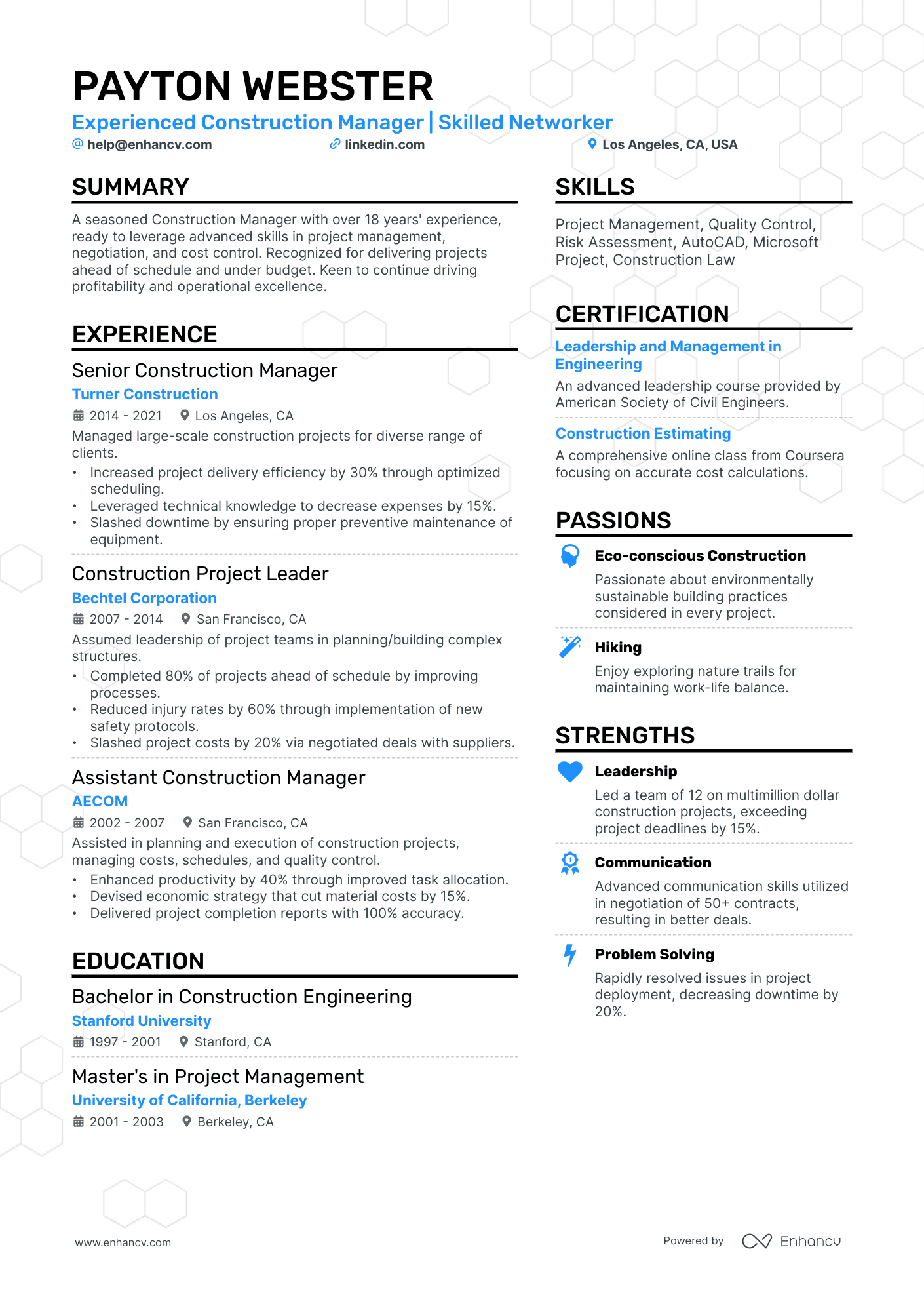
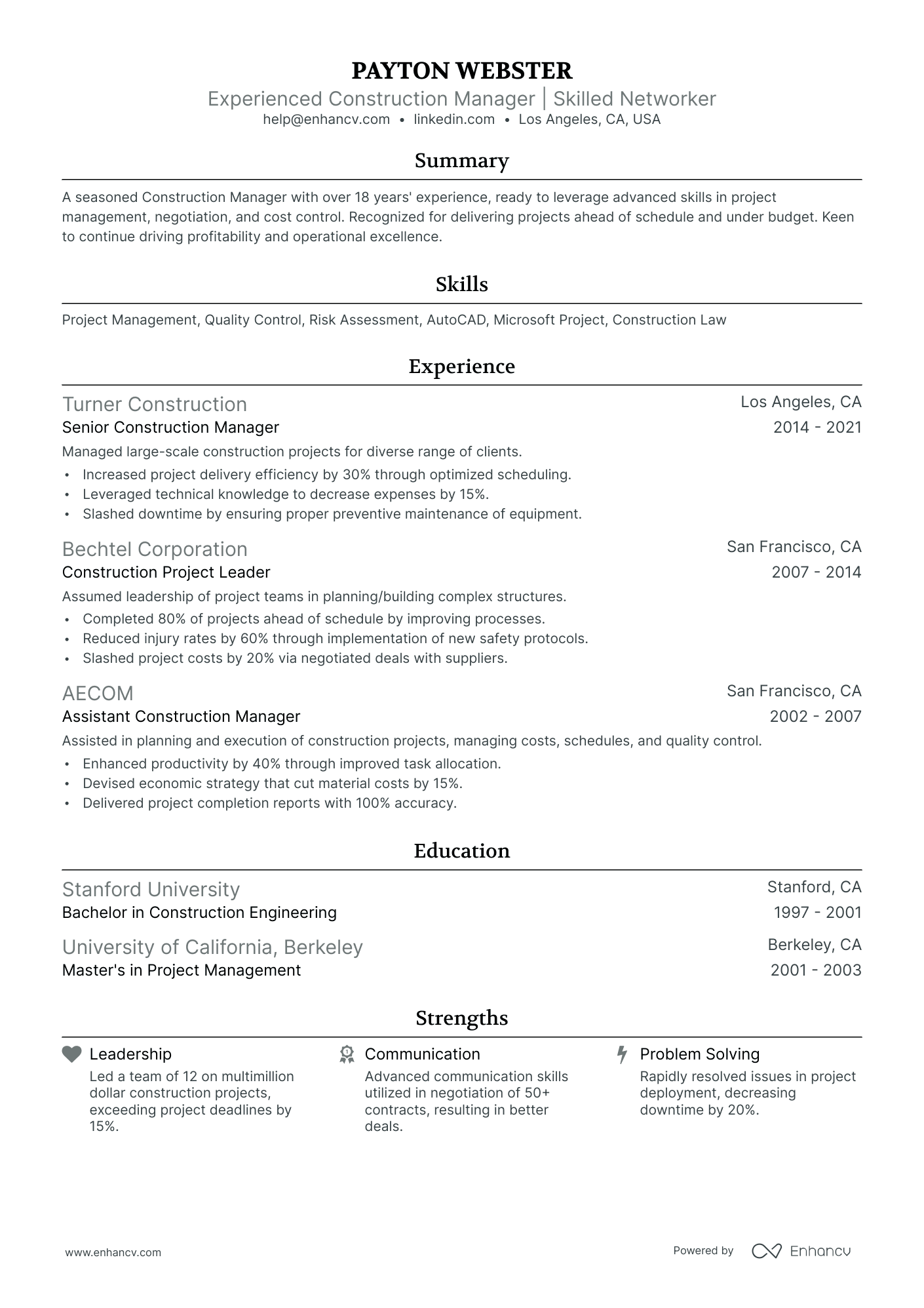
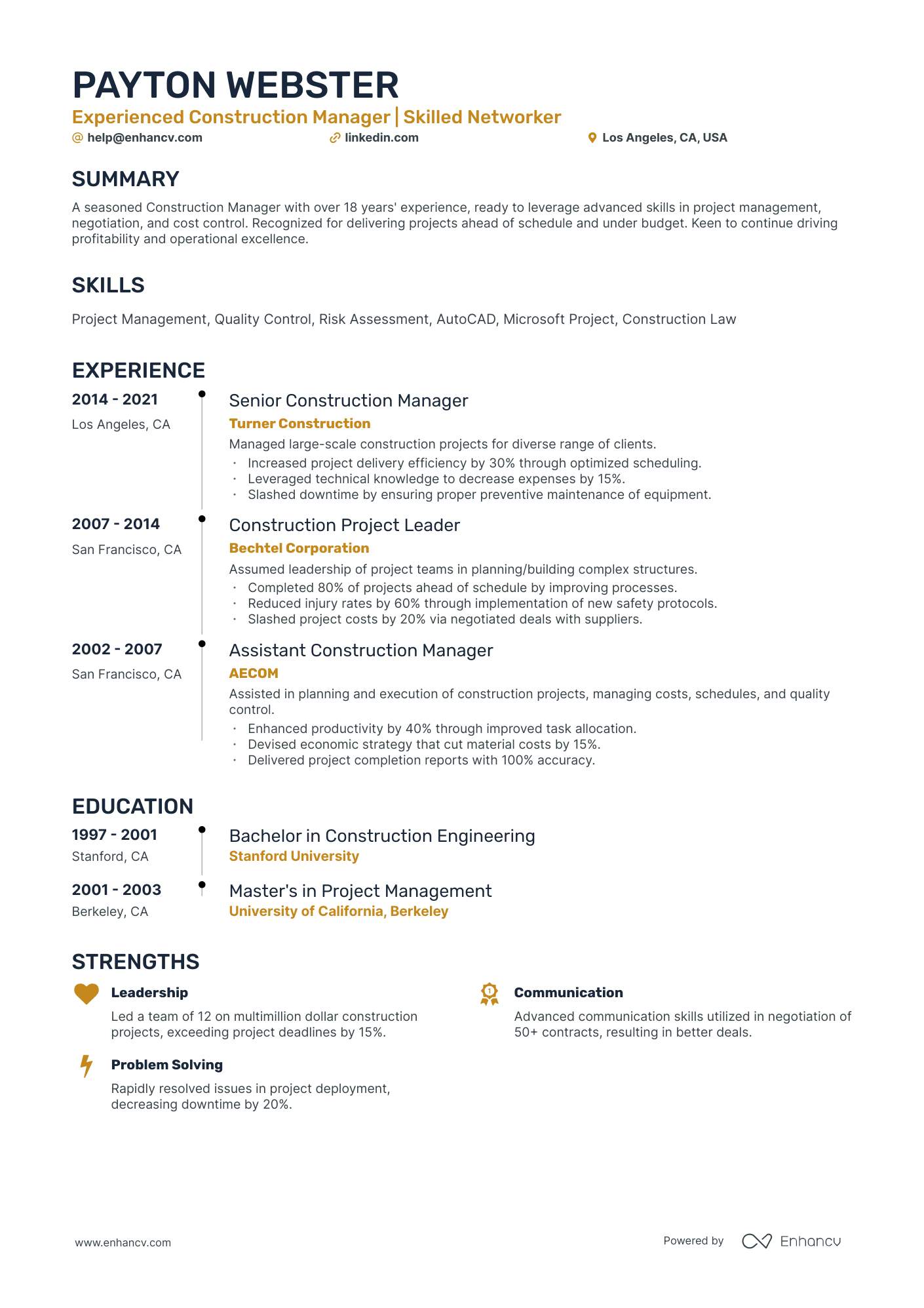
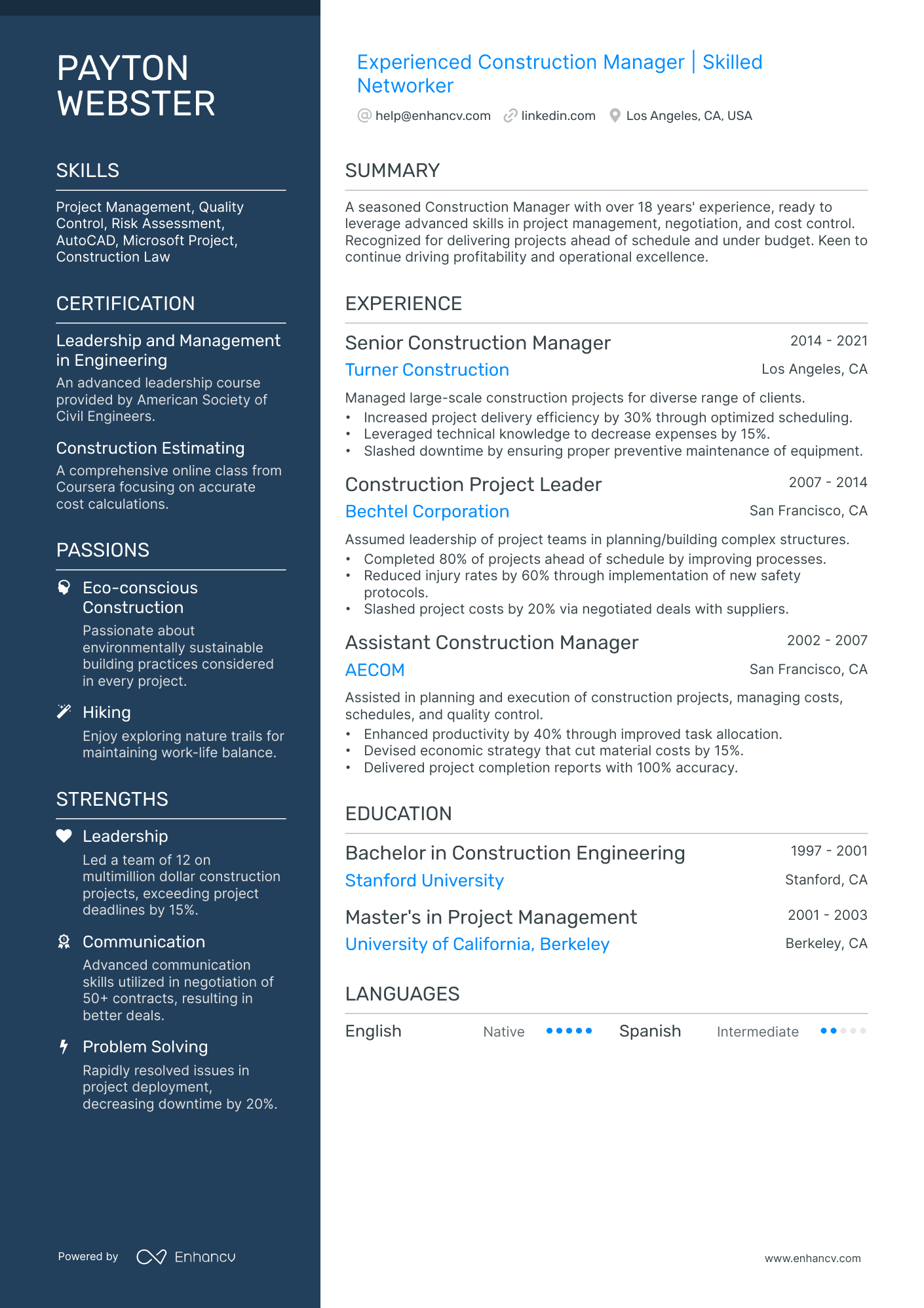
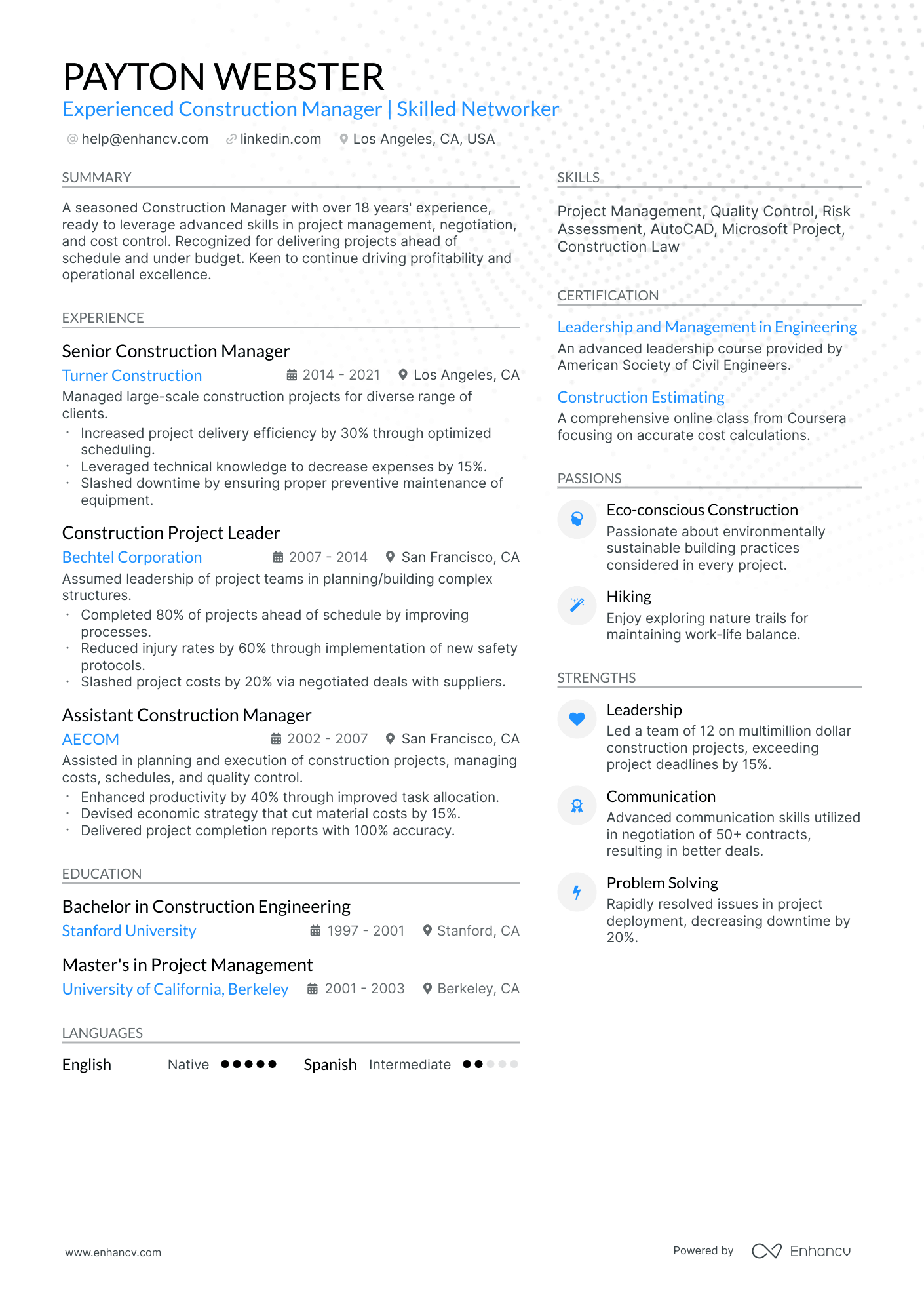
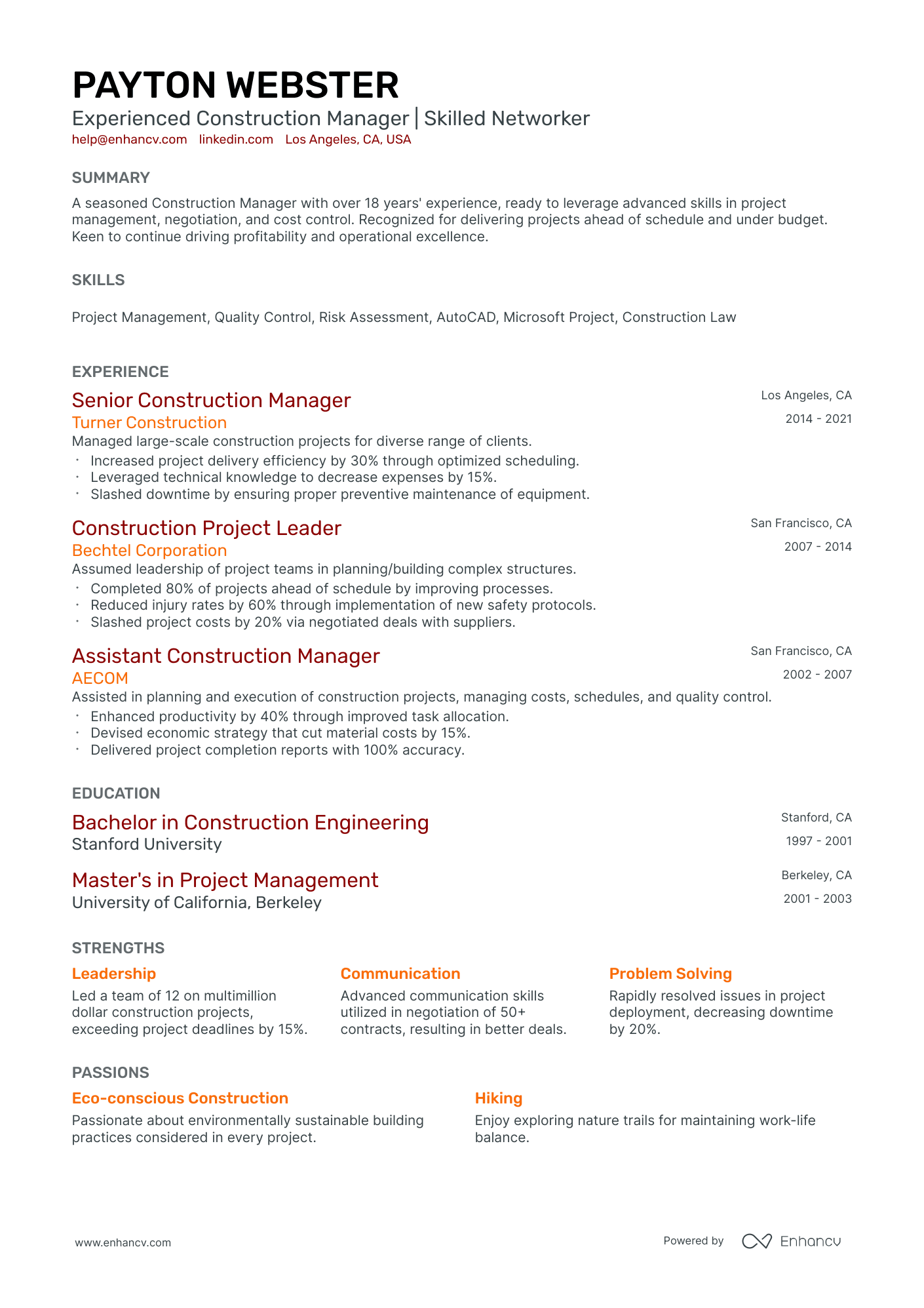
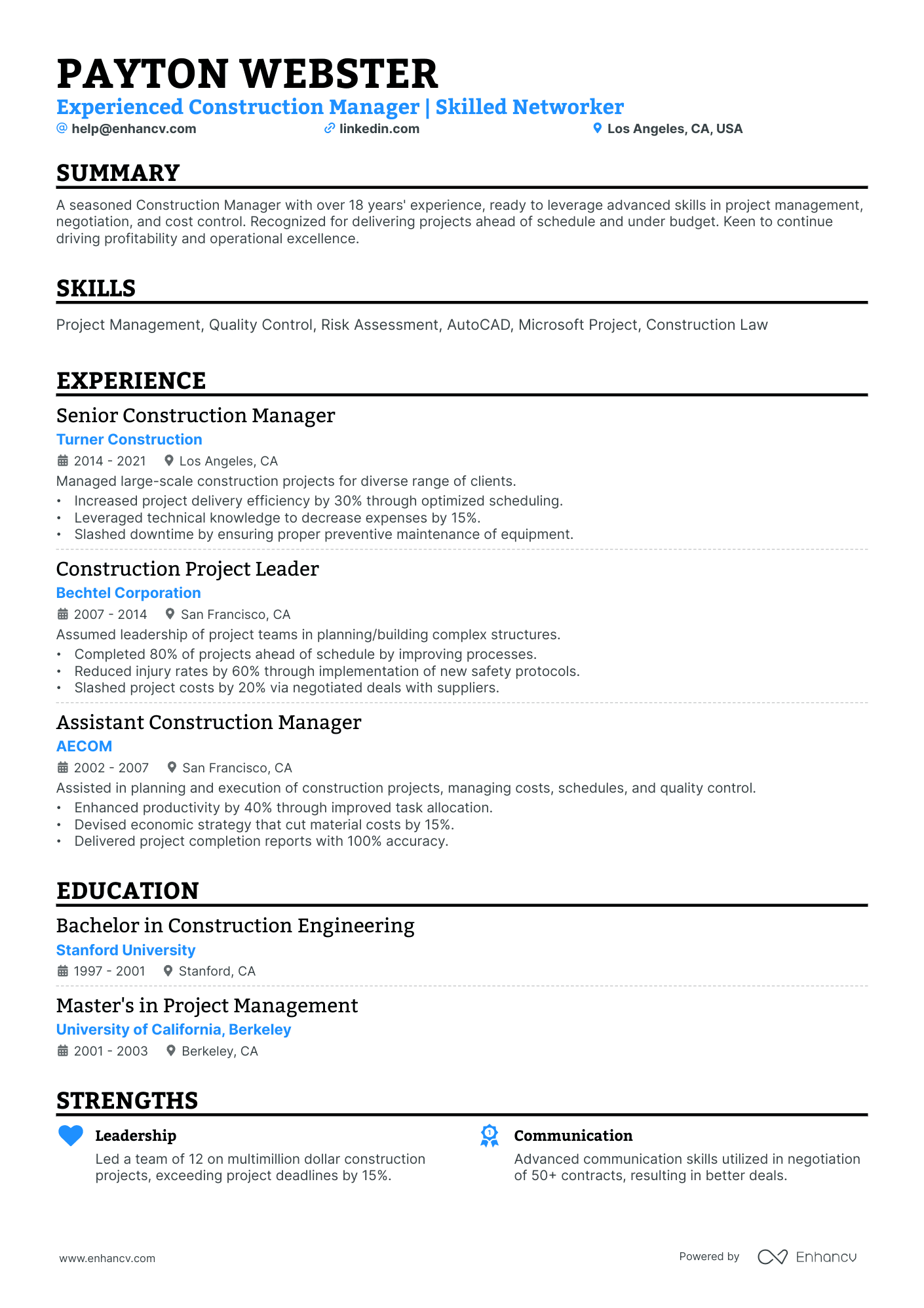


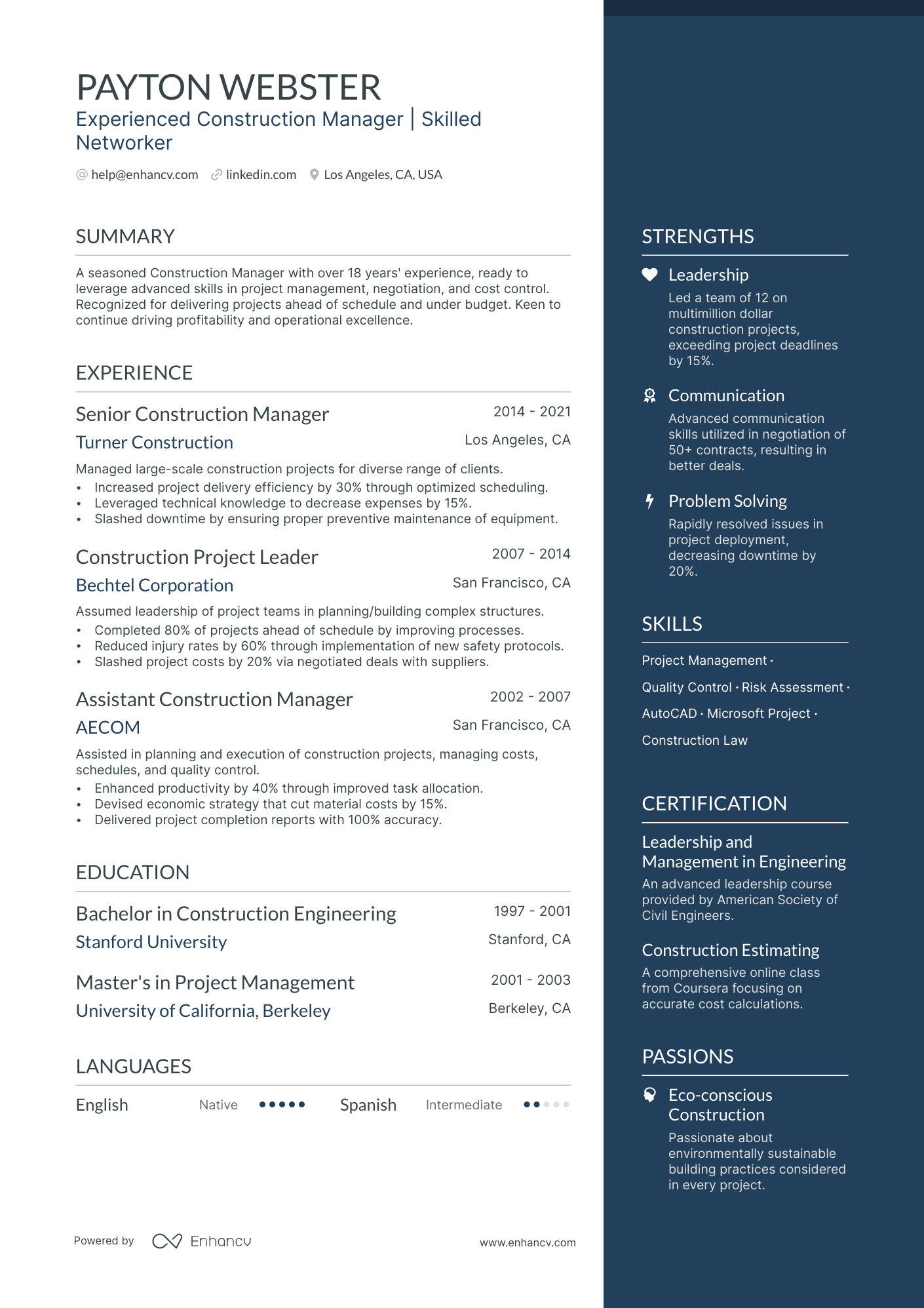
Construction business owner resume submissions often fail because they read like a company profile, not a hiring document. That buries measurable impact, so an ATS (applicant tracking system) and rushed recruiters can't confirm fit fast.
A strong resume shows what you delivered and what improved because of your leadership. Knowing how to write a resume that highlights revenue growth, margin gains, change order reductions, on-time completion rates, safety incident reductions, bid win rates, and project scopes managed is essential. Quantify crews led, budgets owned, and client retention.

Key takeaways
- Quantify revenue growth, profit margins, and safety records instead of listing job duties.
- Use reverse-chronological format to prove sustained business operations and leadership trajectory.
- Mirror the job posting's exact tools, terminology, and project types in your experience bullets.
- Anchor every listed skill to a specific project outcome or measurable result.
- Place certifications like OSHA 30 or PMP near education to validate specialized expertise fast.
- Write a three- to four-line summary that names your scope, revenue scale, and years led.
- Use Enhancv's bullet point generator to turn vague responsibilities into recruiter-ready, quantified achievements.
How to format a construction business owner resume
Recruiters and potential partners evaluating a construction business owner resume prioritize evidence of business growth, project portfolio scope, financial management, and operational leadership. The right resume format ensures these high-impact signals surface immediately rather than getting buried beneath skills lists or non-chronological sections.

I have significant experience in this role—which format should I use?
Use a reverse-chronological format—it's the strongest choice for showcasing your trajectory as a construction business owner. Do:
- Lead with the scope and ownership of your business operations, including revenue oversight, team size, number of concurrent projects, and client acquisition responsibility.
- Highlight domain-specific expertise such as estimating and bidding, subcontractor management, building codes compliance, OSHA regulations, and construction management software (e.g., Procore, Buildertrend, PlanGrid).
- Quantify business impact through measurable outcomes tied to profitability, project delivery, and growth.
- "Grew residential construction firm from $1.2M to $4.8M in annual revenue over five years by expanding into commercial renovations, securing 40+ municipal contracts, and reducing project completion timelines by 18%."
I'm junior or switching into this role—what format works best?
A hybrid format works best because it lets you lead with transferable skills while still showing a clear work history. Do:
- Place a dedicated skills section near the top featuring construction-relevant competencies such as project estimation, permit coordination, vendor negotiation, and safety compliance.
- Include projects, freelance builds, or transitional experience—such as managing a renovation, overseeing subcontractors for a family business, or completing a construction management certification—to demonstrate hands-on exposure.
- Connect every action to a clear result so hiring managers or potential clients see your ability to deliver, not just participate.
- Budget management (skill) → negotiated material contracts with three regional suppliers (action) → reduced project costs by 12% on a $350K residential build (result).
Why not use a functional resume?
A functional resume strips away the timeline that proves you can manage sustained business operations, making it harder for reviewers to verify your capacity for financial accountability, project delivery, and client relationship management over time. When a functional format might be acceptable: If you're transitioning into construction business ownership from a related trade role (e.g., general contractor, site supervisor) or re-entering the industry after a significant gap, a functional format can work—but only if every listed skill is anchored to a specific project, outcome, or measurable result rather than presented as a standalone claim.
Once you've locked in the right format, the next step is deciding which sections to include so each one works within that structure.
What sections should go on a construction business owner resume
Recruiters expect to see how you've grown revenue, delivered projects safely and on schedule, and led crews and subcontractors profitably. Understanding what to put on a resume for this role is critical to making the right impression.
Use this structure for maximum clarity:
- Header
- Summary
- Experience
- Skills
- Projects
- Education
- Certifications
- Optional sections: Awards, Leadership, Volunteering
Your experience bullets should emphasize measurable results, project scope, profitability, schedule and budget performance, safety outcomes, and team leadership.
Is your resume good enough?
Drop your resume here or choose a file. PDF & DOCX only. Max 2MB file size.
Now that you’ve organized the key parts of your resume, the next step is to write your construction business owner experience section so it supports those details with clear, results-driven examples.
How to write your construction business owner resume experience
Your work experience section proves you can deliver completed projects, manage construction operations end to end, and produce measurable business results. Hiring managers and potential partners prioritize demonstrated impact—profitable builds, satisfied clients, efficient crews—over descriptive task lists that simply catalog daily responsibilities.
Each entry should include:
- Job title
- Company and location (or remote)
- Dates of employment (month and year)
Three to five concise bullet points showing what you owned, how you executed, and what outcomes you delivered:
- Ownership scope: the projects, job sites, subcontractor networks, client portfolios, or operational divisions you were directly accountable for as a construction business owner.
- Execution approach: the estimating software, project management platforms, building codes and compliance frameworks, procurement strategies, or scheduling methods you relied on to plan and deliver construction work.
- Value improved: changes to project timelines, build quality, jobsite safety records, cost control, material waste reduction, or regulatory compliance that resulted from your decisions.
- Collaboration context: how you coordinated with architects, engineers, municipal inspectors, subcontractors, suppliers, lenders, or clients to keep projects aligned and moving forward.
- Impact delivered: outcomes expressed through revenue growth, portfolio expansion, client retention, on-time delivery rates, or margin improvements rather than a list of activities performed.
Experience bullet formula
A construction business owner experience example
✅ Right example - modern, quantified, specific.
Owner and General Contractor
Stonebridge Construction Group | Austin, TX
2018–Present
Residential and light commercial general contractor delivering design-build renovations and ground-up projects across Central Texas.
- Launched and scaled a design-build pipeline using JobTread, QuickBooks Online, and HubSpot, increasing annual revenue from $650K to $2.4M while maintaining a 32% gross margin.
- Implemented Procore-based project controls—RFIs, submittals, daily logs, and photo documentation—cutting schedule overruns from 18% to 6% across twenty-eight projects.
- Negotiated subcontractor MSAs and standardized scopes of work using RSMeans benchmarks and Microsoft Excel cost models, reducing change order value by 22% and improving bid hit rate by 15%.
- Directed estimating, procurement, and cash flow forecasting with Buildertrend, Bluebeam Revu, and QuickBooks Online, improving on-time vendor payments to 98% and reducing material stockouts by 30%.
- Led OSHA compliance, quality inspections, and client communication cadences with site superintendents, architects, and homeowners, lowering rework hours by 25% and improving average post-project satisfaction to 4.8 out of 5.
Now that you've seen how a strong experience section comes together, let's look at how to adjust yours to match the specific job you're applying for.
How to tailor your construction business owner resume experience
Recruiters evaluate your resume through applicant tracking systems and manual review, scanning for alignment with the specific role. Tailoring your resume to the job description by mirroring the posting's language and priorities increases your chances of passing both filters.
Ways to tailor your construction business owner experience:
- Match project management software and estimating tools named in the posting.
- Use the exact terminology for building codes and safety standards listed.
- Mirror revenue or project volume metrics the job description prioritizes.
- Highlight experience in the specific construction sectors the role requires.
- Emphasize OSHA compliance and quality control processes when referenced.
- Align your subcontractor coordination methods with stated collaboration models.
- Include relevant licensing and certifications the posting specifically mentions.
- Reflect the bidding or procurement workflows described in the job requirements.
Tailoring means aligning your real accomplishments with the role's stated needs, not forcing unrelated keywords into your experience.
Resume tailoring examples for construction business owner
| Job description excerpt | Untailored | Tailored |
|---|---|---|
| Oversee residential and commercial projects from pre-construction through closeout, managing budgets exceeding $5M using Procore and ensuring OSHA compliance across all job sites. | Managed construction projects and handled budgets for various builds. | Directed 12+ residential and commercial projects from pre-construction through closeout, managing budgets totaling $8.2M in Procore while maintaining zero OSHA violations across all active job sites. |
| Lead subcontractor procurement, negotiate contracts, and build long-term vendor relationships to reduce material costs and maintain project timelines on multi-family housing developments. | Worked with subcontractors and vendors to complete construction projects on time. | Negotiated contracts with 30+ subcontractors for multi-family housing developments, securing vendor partnerships that reduced material costs by 14% and kept 95% of projects on or ahead of schedule. |
| Develop and execute business growth strategies, including bidding on municipal infrastructure contracts, expanding service territories, and increasing annual revenue through diversified project pipelines. | Grew the business and brought in new clients over several years. | Expanded service territory into three adjacent counties by winning $3.4M in municipal infrastructure bids, diversifying the project pipeline to increase annual revenue by 22% over two fiscal years. |
Once you’ve aligned your experience with the role’s priorities, the next step is to quantify your construction business owner achievements so employers can see the measurable impact of your work.
How to quantify your construction business owner achievements
Quantifying your achievements proves business impact beyond craftsmanship. Track revenue, profit margin, schedule performance, safety, and quality. Use numbers tied to bids won, cost control, change orders, rework, incidents, and on-time delivery.
Quantifying examples for construction business owner
| Metric | Example |
|---|---|
| Revenue growth | "Grew annual revenue from $1.2M to $2.0M in two years by expanding into commercial tenant improvements and improving bid win rate from 18% to 27%." |
| Profit margin | "Increased gross margin from 22% to 29% by renegotiating supplier pricing, standardizing takeoffs in Excel, and tightening change-order tracking in QuickBooks." |
| Schedule delivery | "Improved on-time project completion from 70% to 92% across twenty-four jobs by using two-week lookaheads and daily huddles with subcontractors." |
| Safety risk | "Reduced recordable incidents from four to one year-over-year by implementing weekly toolbox talks, job hazard analyses, and a near-miss log." |
| Quality rework | "Cut rework costs from 6% to 2% of contract value by adding pre-drywall inspections, photo documentation, and subcontractor punch lists." |
Turn vague job duties into measurable, recruiter-ready resume bullets in seconds with Enhancv's Bullet Point Generator.
Once you've crafted strong bullet points to showcase your experience, the next step is ensuring your resume also highlights the right combination of hard and soft skills that construction business owners need.
How to list your hard and soft skills on a construction business owner resume
Your skills section shows how you win and deliver projects profitably, and recruiters and an ATS (applicant tracking system) scan this section for role-fit keywords, so aim for a balanced mix of technical construction, business operations, and leadership skills. Construction business owner roles require a blend of:
- Product strategy and discovery skills.
- Data, analytics, and experimentation skills.
- Delivery, execution, and go-to-market discipline.
- Soft skills.
Your skills section should be:
- Scannable (bullet-style grouping).
- Relevant to the job post.
- Backed by proof in experience bullets.
- Updated with current tools.
Place your skills section:
- Above experience if you're junior or switching careers.
- Below experience if you're mid/senior with strong achievements.

Hard skills
Your hard skills demonstrate technical proficiency in the tools, systems, and processes that drive construction projects forward:
- Estimating and takeoffs
- Job costing and WIP reporting
- Budgeting and cash flow forecasting
- Project scheduling, CPM
- Procore, Buildertrend
- Bluebeam Revu, PlanGrid
- Change order management
- Subcontractor procurement
- Contract negotiation, AIA forms
- OSHA compliance and safety programs
- Permit, code, and inspection coordination
- RFIs, submittals, closeout
Soft skills
Your soft skills reflect how you lead teams, manage stakeholders, and navigate the daily pressures of running a construction business:
- Scope alignment with clients
- Clear crew and subcontractor direction
- Vendor and client negotiation
- Fast field-to-office decision-making
- Risk triage and escalation
- Conflict resolution on site
- Accountability for schedule and budget
- Stakeholder updates and expectation setting
- Cross-trade coordination
- Quality standards enforcement
- Coaching and performance feedback
- Calm response under pressure
How to show your construction business owner skills in context
Skills shouldn't live only in a bulleted list on your resume. Explore resume skills examples to see how top candidates integrate competencies throughout their documents.
They should be demonstrated in:
- Your summary (high-level professional identity)
- Your experience (proof through outcomes)
Here's how that looks in practice for a construction business owner.
Summary example
Construction business owner with 18 years leading residential and commercial builds. Skilled in project scheduling, cost estimation, and crew management using Procore and Buildertrend. Grew annual revenue 35% while maintaining OSHA-compliant jobsites across three states.
- Reflects senior-level expertise clearly
- Names industry-standard tools
- Leads with a measurable revenue outcome
- Highlights safety and leadership skills
Experience example
Owner and General Contractor
Ridgeline Builders LLC | Denver, CO
March 2012–Present
- Managed $4.2M in annual projects using Procore, coordinating with architects, engineers, and municipal inspectors to close permits 20% faster.
- Reduced material waste by 15% after implementing Buildertrend inventory tracking across all active residential jobsites.
- Mentored a 26-person crew and maintained a zero-lost-time safety record for three consecutive years through weekly OSHA toolbox talks.
- Every bullet includes measurable proof
- Skills appear naturally within achievements
Once you’ve tied your abilities to real project outcomes and responsibilities, the next step is to apply that same approach to building a construction business owner resume when you don’t have direct experience.
How do I write a construction business owner resume with no experience
Even without full-time experience, you can demonstrate readiness through transferable work. If you're building a resume without work experience, focus on projects, training, and hands-on involvement that prove construction knowledge:
- Family renovation leadership projects
- Volunteer build site coordination
- Paid handyman or contractor gigs
- Construction estimating coursework projects
- Permit research and application support
- Supplier quotes and material takeoffs
- Jobsite safety training certifications
- Small business budgeting and invoicing
Focus on:
- Documented project scope and results
- Safety training and compliance knowledge
- Estimating, scheduling, and budgeting
- Tools, software, and methods used
Resume format tip for entry-level construction business owner
Use a skills-based resume format because it puts projects, certifications, and tools above a thin work history and shows readiness fast. Do:
- Lead with a "Projects" section.
- Quantify outcomes: cost, time, rework.
- List tools: Excel, QuickBooks, Procore.
- Add certifications with dates and IDs.
- Include permits, bids, and takeoffs.
- Produced three supplier quotes and a materials takeoff in Excel for a family kitchen refresh, cutting material costs by 12% while staying within a $6,500 budget.
Even without formal experience, your educational background can strengthen your resume by demonstrating relevant knowledge and foundational skills—so let's look at how to present it effectively.
How to list your education on a construction business owner resume
Your education section helps hiring teams confirm you have foundational knowledge in construction management, business operations, or engineering principles relevant to the construction business owner role.
Include:
- Degree name
- Institution
- Location
- Graduation year
- Relevant coursework (for juniors or entry-level candidates)
- Honors & GPA (if 3.5 or higher)
Avoid listing month or day details—use the graduation year only.
Here's a strong education entry tailored for a construction business owner resume.
Example education entry
Bachelor of Science in Construction Management
University of Florida, Gainesville, FL
Graduated: 2012
GPA: 3.7/4.0
- Relevant Coursework: Construction Estimating, Project Scheduling, Business Finance, Contract Law, and Structural Engineering Fundamentals
- Honors: Magna Cum Laude, Dean's List (all semesters)
How to list your certifications on a construction business owner resume
Certifications on a resume show a construction business owner's commitment to learning, proficiency with tools and standards, and relevance in today's jobsite and business environment. Include:
- Certificate name
- Issuing organization
- Year
- Optional: credential ID or URL
- Put certifications below education when they are older, less relevant, or secondary to your degree or core training.
- Put certifications above education when they are recent, required for your work, or closely match the construction business owner role.
Best certifications for your construction business owner resume
- OSHA 30-Hour Construction
- LEED Green Associate
- Certified Construction Manager (CCM)
- Project Management Professional (PMP)
- Certified Professional Constructor (CPC)
- EPA Lead-Safe Certified Renovator (RRP)
- ICC Residential Building Inspector (B1)
Once you’ve positioned your credentials so they’re easy to verify, shift to your construction business owner resume summary to connect those qualifications to the value you deliver.
How to write your construction business owner resume summary
Your resume summary is the first thing a recruiter reads. A strong one instantly signals you have the leadership, industry depth, and business acumen this role demands.
Keep it to three to four lines, with:
- Your title and total years of experience in construction or related industries.
- Domain expertise such as residential, commercial, or industrial construction.
- Core competencies like project estimation, contract negotiation, P&L management, and building codes.
- One or two quantified achievements such as revenue growth, project volume, or cost savings.
- Soft skills tied to real outcomes, like team leadership that reduced turnover or client relations that drove repeat business.

PRO TIP
As a business owner, emphasize scope of operations, financial outcomes, and strategic decision-making. Highlight revenue figures, team sizes, and project portfolios you managed directly. Avoid vague phrases like "passionate leader" or "results-driven professional." Recruiters want proof, not personality declarations.
Example summary for a construction business owner
Construction business owner with 12 years leading residential and commercial projects. Grew annual revenue from $1.2M to $4.8M while managing teams of 35+. Skilled in contract negotiation, budgeting, and regulatory compliance.
Optimize your resume summary and objective for ATS
Drop your resume here or choose a file.
PDF & DOCX only. Max 2MB file size.
Now that your summary captures your value as a construction business owner, make sure the header framing it presents your contact details correctly so recruiters can reach you.
What to include in a construction business owner resume header
A resume header is the top section with your key identifiers, helping a construction business owner improve visibility, build credibility, and pass recruiter screening fast.
Essential resume header elements
- Full name
- Tailored job title and headline
- Location
- Phone number
- Professional email
- GitHub link
- Portfolio link
A LinkedIn link helps recruiters verify experience quickly and supports screening with consistent dates, roles, and company details.
Do not include a photo on a construction business owner resume unless the role is explicitly front-facing or appearance-dependent.
Match your header details to the job posting and keep formatting consistent across your resume and online profiles.
Example
Construction business owner resume header
Jordan Ramirez
Construction business owner | Residential and light commercial general contracting
Austin, TX
(512) 555-01XX
jordan.ramirez@enhancv.com
github.com/jordanramirez
jordanramirezbuilds.com
linkedin.com/in/jordanramirez
Once your contact details and professional identifiers are set, add targeted additional sections to reinforce your qualifications and support the rest of your resume.
Additional sections for construction business owner resumes
Adding extra sections helps a construction business owner stand out when core qualifications alone don't capture the full scope of expertise.
- Licenses and certifications
- Professional affiliations
- Languages — listing language skills on your resume can be especially valuable when managing diverse crews or working with multilingual clients and subcontractors.
- Awards and industry recognition
- Community involvement and volunteer work
- Publications and speaking engagements
- Safety training and compliance credentials
Once you've rounded out your resume with the right supplementary sections, it's equally important to pair it with a strong cover letter.
Do construction business owner resumes need a cover letter
A cover letter isn't required for a construction business owner, but it helps in competitive searches or when the hiring manager expects one. If you're unsure what a cover letter is or when to use one, it can make the difference when your resume doesn't clearly show fit, scope, or results.
Use a cover letter to add context your resume can't:
- Explain role or team fit: Clarify how you partner with estimators, superintendents, and clients, and how you lead crews and subcontractors.
- Highlight one or two relevant projects or outcomes: Name a project type and quantify results like margin, schedule recovery, safety metrics, or change order control.
- Show understanding of the business context: Reference the company's markets, delivery model, and constraints like permitting, labor availability, and supply chain lead times.
- Address career transitions or non-obvious experience: Connect ownership work to the role, and explain gaps, relocations, or shifts in project types.
Drop your resume here or choose a file.
PDF & DOCX only. Max 2MB file size.
Even when you choose to rely on your resume instead of adding a cover letter, AI can help you strengthen your construction business owner resume faster and more consistently.
Using AI to improve your construction business owner resume
AI can sharpen your resume's clarity, structure, and overall impact. It helps tighten language and highlight measurable results. But overuse strips authenticity fast. Once your content reads clearly and aligns with your actual role, step away from AI. For guidance on using ChatGPT for resume writing, start with targeted prompts that refine rather than replace your own words.
Here are 10 practical prompts you can copy and paste to strengthen specific sections of your resume:
- Strengthen your summary: "Rewrite my construction business owner resume summary to highlight leadership scope, revenue scale, and years of industry experience in three sentences."
- Quantify project results: "Add measurable outcomes to these construction business owner experience bullets, focusing on project timelines, budgets, and crew sizes managed."
- Clarify skills relevance: "Review my skills section and remove any entries that don't directly apply to a construction business owner role."
- Improve action verbs: "Replace weak or repetitive verbs in my construction business owner experience bullets with strong, specific action words."
- Tighten project descriptions: "Condense these construction business owner project descriptions to one line each, keeping scope, value, and completion status."
- Align certifications: "Reorder my certifications section so the most relevant credentials for a construction business owner appear first."
- Refine education details: "Simplify my education section to emphasize coursework or degrees most applicable to a construction business owner career."
- Target industry keywords: "Identify missing construction business owner keywords in my resume by comparing it against this job description."
- Eliminate redundancy: "Find and remove duplicate information across my construction business owner resume's summary, experience, and skills sections."
- Sharpen client results: "Rewrite these construction business owner experience bullets to emphasize client satisfaction metrics, repeat business rates, and referral outcomes."
Stop using AI once your resume sounds accurate, specific, and aligned with real experience. AI should never invent experience or inflate claims—if it didn't happen, it doesn't belong here.
Conclusion
A strong construction business owner resume shows measurable outcomes, role-specific skills, and a clear structure. Lead with results like revenue growth, margin gains, schedule performance, safety metrics, and repeat clients. Support them with estimating, project management, subcontractor oversight, and compliance.
Keep each section easy to scan, and align it to the roles you want now. When your resume proves impact and leadership, you show readiness for today’s hiring market and what comes next.